Indicatif présent de
S’appeler, Comprendre, Parler
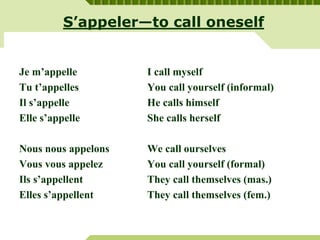
S’appeler—to call oneself
Je m’appelle I call myself
Tu t’appelles You call yourself (informal)
Il s’appelle He calls himself
Elle s’appelle She calls herself
Nous nous appelons We call ourselves
Vous vous appelez You call yourself (formal)
Ils s’appellent They call themselves (mas.)
Elles s’appellent They call themselves (fem.)
Comprendre—to understand
Je comprends I understand, am understanding
Tu comprends You understand (informal)
Il comprend He understands
Elle comprend She understands
Nous comprenons We understand
Vous comprenez you understand (formal)
Ils comprennent They understand (mas.)
Elles comprennent They understand (fem.)
Parler—to speak
Je parle I speak, I am speaking, I do speak
Tu parles You speak
Il parle He speaks
Elle parle She speaks
Nous parlons We speak
Vous parlez You speak
Ils parlent They speak (mas.)
Elles parlent They speak (fem.)
La Négation—the negation
Basic Negation
Ne ... pas is placed around the conjugated
verb to negate an affirmative sentence in
French.
Note that the ne changes to n' before a
verb beginning with a vowel.
a, e, i, o, u, h, & y
(h & Y are semi vowels)
La Négation—the negation
For example
Je comprends français.
Je ne comprends pas français.
Je parle français.
Je ne parle pas français.
Il est français.
Il n’est pas français.
Les Articles—the articles
Les articles définis
1. The is Le before a masculine singular noun
beginning with a consonant.
2. The is La before a feminine singular noun
beginning with a consonant.
3. The is Les before a masculine and feminine
plural noun beginning with a consonant or a vowel
or a semi vowel.
4. Both Le and La are shortened to L’ before a
singular noun beginning with a vowel or semi
vowel.
Les Articles—the articles
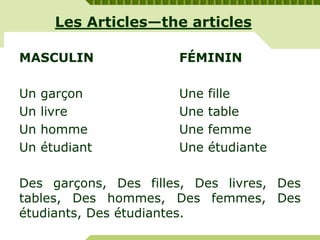
MASCULIN FÉMININ
Le garçon La fille
Le livre La table
L’homme La femme
L’étudiant L’ étudiante
Les garçons, Les filles, Les livres, Les tables,
Les hommes, Les femmes, Les étudiants,
Les étudiantes.
Les Articles—the articles
Les articles indéfinis
1. Un, a, an is used before a singular
masculine noun.
2. Une, a, an is used before a singular
fiminine noun.
3. Des, some is used before a plural
masculine and feminine noun.
Les Articles—the articles
MASCULIN FÉMININ
Un garçon Une fille
Un livre Une table
Un homme Une femme
Un étudiant Une étudiante
Des garçons, Des filles, Des livres, Des
tables, Des hommes, Des femmes, Des
étudiants, Des étudiantes.
Indicatif présent de Avoir—to have
J’ai I have, am having, do have
Tu as You have
Il a He has, It has (mas.)
Elle a She has, It has (fem.)
Nous avons We have
Vous avez You have
Ils ont They have (mas.)
Elles ont They have (fem.)
Indicatif présent de
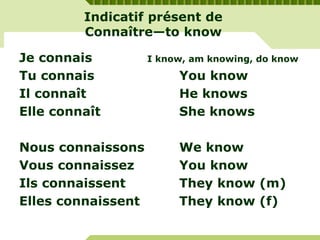
Connaître—to know
Je connais I know, am knowing, do know
Tu connais You know
Il connaît He knows
Elle connaît She knows
Nous connaissons We know
Vous connaissez You know
Ils connaissent They know (m)
Elles connaissent They know (f)
Être—to be
Je suis I am
Tu es You are
Il est He / It is
Elle est She/It is
Nous sommes We are
Vous êtes You are
Ils sont They are (m)
Elles sont They are (f)
NOUN GENDER
All nouns in French have a gender,
either masculine or feminine. It is very
important to learn a noun's gender
along with the noun itself because
articles (a, the) and adjectives change
depending on the gender of the noun
they precede or follow.
Notice that the masculine words are
preceded by le and feminine words are
preceded by la both of which mean the.
NOUN GENDER
Ending is usually
-age masculine Exceptions: une cage, une image, une
nage, une page, une plage,
une rage
-eau masculine Exceptions: l'eau, la peau
-ée feminine Exceptions: un lycée, un musée
-ion feminine Exceptions: un avion, un bastion,
billion, un million, un lion,
un scion
-té feminine Exceptions: un comité, un invité
NOUN GENDER
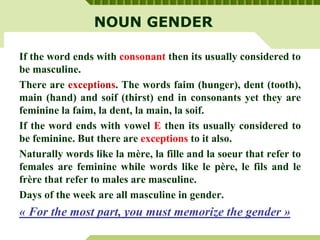
If the word ends with consonant then its usually considered to
be masculine.
There are exceptions. The words faim (hunger), dent (tooth),
main (hand) and soif (thirst) end in consonants yet they are
feminine la faim, la dent, la main, la soif.
If the word ends with vowel E then its usually considered to
be feminine. But there are exceptions to it also.
Naturally words like la mère, la fille and la soeur that refer to
females are feminine while words like le père, le fils and le
frère that refer to males are masculine.
Days of the week are all masculine in gender.
« For the most part, you must memorize the gender »
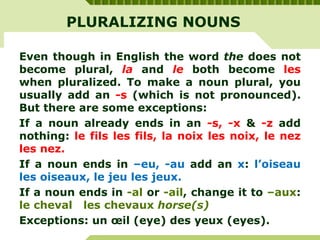
PLURALIZING NOUNS
Even though in English the word the does not
become plural, la and le both become les
when pluralized. To make a noun plural, you
usually add an -s (which is not pronounced).
But there are some exceptions:
If a noun already ends in an -s, -x & -z add
nothing: le fils les fils, la noix les noix, le nez
les nez.
If a noun ends in –eu, -au add an x: l’oiseau
les oiseaux, le jeu les jeux.
If a noun ends in -al or -ail, change it to –aux:
le cheval les chevaux horse(s)
Exceptions: un œil (eye) des yeux (eyes).
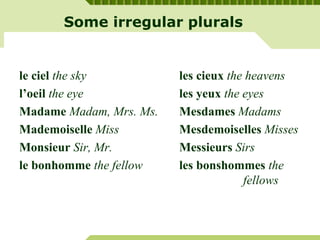
Some irregular plurals
le ciel the sky les cieux the heavens
l’oeil the eye les yeux the eyes
Madame Madam, Mrs. Ms. Mesdames Madams
Mademoiselle Miss Mesdemoiselles Misses
Monsieur Sir, Mr. Messieurs Sirs
le bonhomme the fellow les bonshommes the
fellows
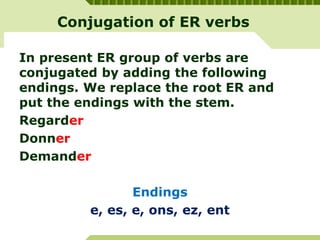
Conjugation of ER verbs
In present ER group of verbs are
conjugated by adding the following
endings. We replace the root ER and
put the endings with the stem.
Regarder
Donner
Demander
Endings
e, es, e, ons, ez, ent
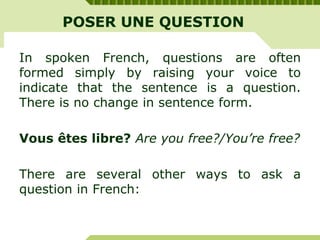
POSER UNE QUESTION
In spoken French, questions are often
formed simply by raising your voice to
indicate that the sentence is a question.
There is no change in sentence form.
Vous êtes libre? Are you free?/You’re free?
There are several other ways to ask a
question in French:
Questions with pronoun subjects:
There are two ways of asking a question
with a pronoun subject:
a. Place the pronoun after the verb:
Parlez-vous français? Do you speak
French?
b. Place est-ce que (is it that) before the
sentence:
Est-ce que je parle trop vite? Am I
talking too fast?
Est-ce que vous parlez français? Do you
speak French?
Questions with noun subjects:
When a question begins with a noun, the
pronoun is repeated after the verb. The
letter t is inserted between the subject
pronoun and the verb in the 3rd person
singular form when the verb ends with an–e
and after the verb a (has).
Votre frère parle-t-il français? Does your
brother speak French?
Votre sœur a-t-elle quitté la maison?
Has your sister left the house?
Questions introduced by interrogative
words:
The common interrogative words are:
Combien how many/how much
Quand when
Comment how
Où where
Pourquoi why
Que what
Qui who/whom
Quel / Quelle what / which
Questions introduced by interrogative
words:
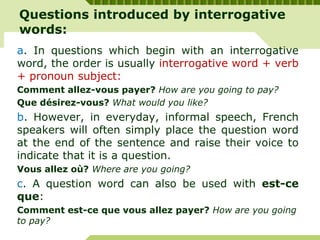
a. In questions which begin with an interrogative
word, the order is usually interrogative word + verb
+ pronoun subject:
Comment allez-vous payer? How are you going to pay?
Que désirez-vous? What would you like?
b. However, in everyday, informal speech, French
speakers will often simply place the question word
at the end of the sentence and raise their voice to
indicate that it is a question.
Vous allez où? Where are you going?
c. A question word can also be used with est-ce
que:
Comment est-ce que vous allez payer? How are you going
to pay?
ADJECTIFS POSSESSIFS, AU SINGULIER
MASCULIN FEMININ
(a) mon père my father ma mère my mother
ton père your father ta mère your mother
son père his, her father sa mère his, her mother
(b) notre père et notre mère
our father and our mother
votre père et votre mère
your father and your mother
leur père et leur mère
their father and their mother
ADJECTIFS POSSESSIFS, AU SINGULIER
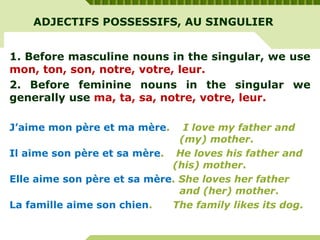
1. Before masculine nouns in the singular, we use
mon, ton, son, notre, votre, leur.
2. Before feminine nouns in the singular we
generally use ma, ta, sa, notre, votre, leur.
J’aime mon père et ma mère. I love my father and
(my) mother.
Il aime son père et sa mère. He loves his father and
(his) mother.
Elle aime son père et sa mère. She loves her father
and (her) mother.
La famille aime son chien. The family likes its dog.
ADJECTIFS POSSESSIFS, AU SINGULIER
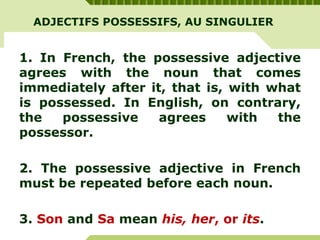
1. In French, the possessive adjective
agrees with the noun that comes
immediately after it, that is, with what
is possessed. In English, on contrary,
the possessive agrees with the
possessor.
2. The possessive adjective in French
must be repeated before each noun.
3. Son and Sa mean his, her, or its.
ADJECTIFS POSSESSIFS, AU PLURIEL
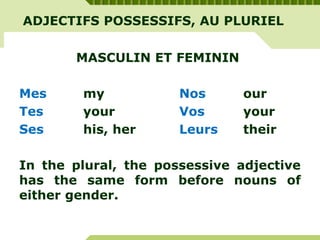
MASCULIN ET FEMININ
Mes my Nos our
Tes your Vos your
Ses his, her Leurs their
In the plural, the possessive adjective
has the same form before nouns of
either gender.
ADJECTIFS POSSESSIFS, AU PLURIEL
REMARQUEZ
Mon, Ton, Son
Hélène est mon amie. Helene is my friend.
Hélène est son amie. Helen is his (or her) friend.
J’aime son histoire. I like his (or her) story.
Mon, ton, son, are used instead of ma, ta, sa
before feminine nouns beginning with a vowel.
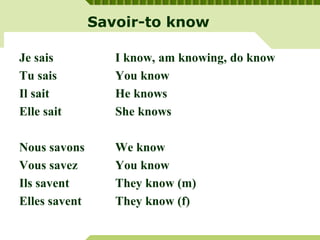
Savoir-to know
Je sais I know, am knowing, do know
Tu sais You know
Il sait He knows
Elle sait She knows
Nous savons We know
Vous savez You know
Ils savent They know (m)
Elles savent They know (f)
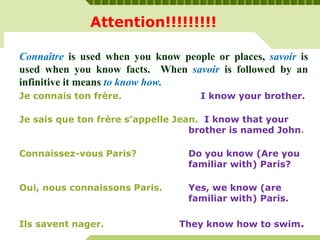
Attention!!!!!!!!!
Connaître is used when you know people or places, savoir is
used when you know facts. When savoir is followed by an
infinitive it means to know how.
Je connais ton frère. I know your brother.
Je sais que ton frère s'appelle Jean. I know that your
brother is named John.
Connaissez-vous Paris? Do you know (Are you
familiar with) Paris?
Oui, nous connaissons Paris. Yes, we know (are
familiar with) Paris.
Ils savent nager. They know how to swim.
Faire—to do, to make
Je fais I do, am doing
Tu fais You do
Il fait He does
Elle fait She does
Nous faisons We do
Vous faites You do
Ils font They do (m)
Elles font They do (f)
Faire is used in expressions of weather (il fait beau) and many other
idiomatic expressions.
ADJECTIFS—ADJECTIVES
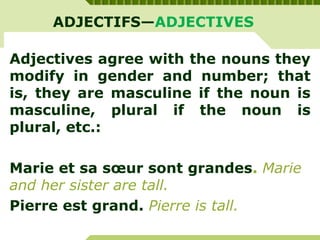
Adjectives agree with the nouns they
modify in gender and number; that
is, they are masculine if the noun is
masculine, plural if the noun is
plural, etc.:
Marie et sa sœur sont grandes. Marie
and her sister are tall.
Pierre est grand. Pierre is tall.
ADJECTIFS—ADJECTIVES
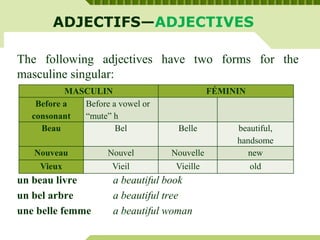
The following adjectives have two forms for the
masculine singular:
un beau livre a beautiful book
un bel arbre a beautiful tree
une belle femme a beautiful woman
MASCULIN FÉMININ
Before a
consonant
Before a vowel or
“mute” h
Beau Bel Belle beautiful,
handsome
Nouveau Nouvel Nouvelle new
Vieux Vieil Vieille old
ADJECTIFS—ADJECTIVES
The feminine of adjectives is normally formed by adding –e to the
masculine singular:
un petit garçon a little boy
une petite fille a little girl
a. If the masculine singular already ends in –e, the adjective has the
same form in the feminine:
un jeune homme a young man
une jeune femme a young woman
b. Adjectives ending in –er in the masculine singular change the e to
è and then add –e:
Masculine Feminine
étranger étrangère foreign
ADJECTIFS—ADJECTIVES
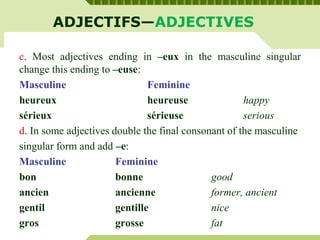
c. Most adjectives ending in –eux in the masculine singular
change this ending to –euse:
Masculine Feminine
heureux heureuse happy
sérieux sérieuse serious
d. In some adjectives double the final consonant of the masculine
singular form and add –e:
Masculine Feminine
bon bonne good
ancien ancienne former, ancient
gentil gentille nice
gros grosse fat
ADJECTIFS—ADJECTIVES
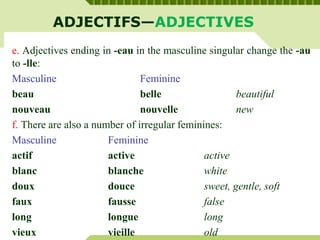
e. Adjectives ending in -eau in the masculine singular change the -au
to -lle:
Masculine Feminine
beau belle beautiful
nouveau nouvelle new
f. There are also a number of irregular feminines:
Masculine Feminine
actif active active
blanc blanche white
doux douce sweet, gentle, soft
faux fausse false
long longue long
vieux vieille old
ADJECTIFS—ADJECTIVES PLURAL
The plural of adjectives is regularly formed by adding –s to the
singular:
A. But if the adjective ends in –s or –x in the masculine singular, the
masculine plural stays the same:
un mauvais garçon a bad boy
deux mauvais garçons two bad boys
Singular Plural
Masculine un petit garçon a little
boy
deux petits garçons two little
boys
Feminine une petite fille a little
girl
deux petites filles two little
girls
ADJECTIFS—ADJECTIVES PLURAL
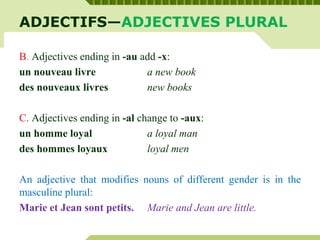
B. Adjectives ending in -au add -x:
un nouveau livre a new book
des nouveaux livres new books
C. Adjectives ending in -al change to -aux:
un homme loyal a loyal man
des hommes loyaux loyal men
An adjective that modifies nouns of different gender is in the
masculine plural:
Marie et Jean sont petits. Marie and Jean are little.
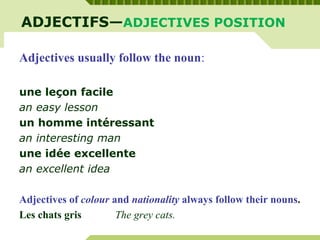
ADJECTIFS—ADJECTIVES POSITION
Adjectives usually follow the noun:
une leçon facile
an easy lesson
un homme intéressant
an interesting man
une idée excellente
an excellent idea
Adjectives of colour and nationality always follow their nouns.
Les chats gris The grey cats.
ADJECTIFS—ADJECTIVES POSITION
There are some common adjectives, however, that usually
precede the nouns they modify. These are often known as the
“BAGS” adjectives because they are the adjectives that deal
with Beauty, Age, Good (and Bad), and Size.
Beau Beautiful Joli Pretty
Bon Good Long Long
Court Short Mauvais Bad
Gentil Nice, pleasant Nouveau New
Gros Big, fat Petit Small, little
Jeune Young Vieux Old
ADJECTIFS DÉMONSTRATIFS
The various forms of the Demonstrative Adjective
Masculin
SINGULIER PLURIEL
Ce livre this (that)
book
Ces livres these (those)
books
Cet enfant this (that)
child
Ces enfants these (those)
children
Cet homme this (that)
man
Ces hommes these (those)
men
Féminin Cette femme this (that)
woman
Ces femmes these (those)
women
ADJECTIFS DÉMONSTRATIFS
1. This, that before a noun is expressed in French as follows:
Ce before a masculine noun beginning with a consonant.
Cet before a masculine noun beginning with a vowel or silent h.
Cette before any feminine noun.
The plural of ce, cet, cette before any noun is Ces, these, those.
2. Ce garçon et cette fille. This boy and girl.
Ces chiens et ces chats. Those dogs and cats.
The demonstrative adjective is repeated before each noun.
PRONOMS PERSONNELS DISJOINTS
SINGULIER PLURIEL
Moi, I, me Nous, we, us
Toi, you Vous, you
Lui, he, him Eux, they, them (masculine)
Elle, she, her Elles, they, them (feminine)
The above forms are called disjunctive or emphatic because they
may be used apart from the verb.
After prepositions:
Ils vont avec nous. They go with us.
Nous n’allons pas sans eux. We do not go without them.
Je vais chez moi. I am going home.
Indicatif présent de ALLER- to go
Je vais I go, am going
Tu vas
Il va
Elle va
Nous allons We go, are going
Vous allez
Ils vont
Elles vont
PARTICIPE PASSÉ--Participe passé des verbes réguliers
INFINITIF PARTICIPE PASSÉ
1. Donner, to give Donné, given
Demander, to ask Demandé, asked
2. Finir, to finish Fini, finished
Applaudir, to applaud Applaudi, applauded
3. Entendre, to hear Entendu, heard
Répondre, to answer Répondu, answered
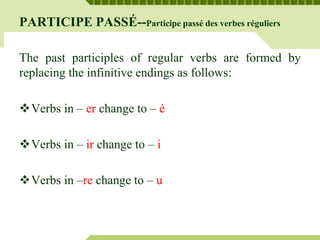
PARTICIPE PASSÉ--Participe passé des verbes réguliers
The past participles of regular verbs are formed by
replacing the infinitive endings as follows:
Verbs in – er change to – é
Verbs in – ir change to – i
Verbs in –re change to – u
PARTICIPE PASSÉ des verbes irréguliers
INFINITIF PARTICIPE PASSÉ
Avoir, to have eu, had
Etre, to be été, been
Dire, to say dit, said
Faire, to do fait, did
PASSÉ COMPOSÉ
The passé composé of most verbs is formed by
combining the present indicative of the auxiliary avoir
with the past participle of the verb.
J’ai fini mon travail.
I finished (have finished) my work.
J’ai travaillé aujourd’hui.
I worked (have worked) today.
Nous avons rencontré Paul hier.
We met (we did meet) Paul yesterday.
Il a été malade.
He was (he has been) ill.
PASSÉ COMPOSÉ
The passé composé expresses not only what has happened or has been
happening in the past, but also what happened or did happen. It
corresponds therefore both to the English perfect and to the English
simple past.
Ordre des mots
Avez-vous parlé à Jean? Oui, je lui ai parlé. Yes I spoke to him.
Est-ce que vous avez parlé à Jean ? Non, je ne lui ai pas parlé. No, I did not speak to him
Ne m’avez-vous pas entendu ? Oui, je vous ai entendu. Yes, I heard you.
Est-ce que vous ne m’avez pas entendu ?Non, je ne vous ai pas entendu. No, I did not hear you.
In a compound tense, like the passé composé, the conjunctive pronoun
objects come immediately before the auxiliary.
In the negative form, the auxiliary (including pronouns before or after
it) comes between ne and pas.
PASSÉ COMPOSÉ
Temps composé avec être
1. A few intransitive verbs use être, instead of avoir, with the past
participle to form their compound tenses. Such verbs are:
Aller to go Partir to leave
Entrer to enter, go in Descendre to come down
Arriver to arrive Tomber to fall
Monter to go up Rester to stay
Venir to come Devenir to become
Sortir to go out Retourner to go back
Rentrer to get back home, go in again.
PASSÉ COMPOSÉ
2. Nous sommes allés au théâtre.
We went to the theatre.
Marie, êtes-vous sortie ?
Mary, did you go out?
Paul et Jean, êtes-vous rentrés ?
Paul and John, have you come in?
The past participle of a verb conjugated with être is
treated like an adjective and agrees with the subject.
PASSÉ COMPOSÉ
Temps composés des verbes réfléchis
All reflexive verbs form their compound tenses with être and the past
participle.
Passé composé de se laver, to wash oneself
I washed myself, I have washed myself I did not wash myself, I have not washed myself
Je me suis lavé (e) Je ne me suis pas lavé (e)
Tu t’es lavé (e) Tu ne t’es pas lavé (e)
Il s’est lavé Il ne s’est pas lavé
Elle s’est lavée Elle ne s’est pas lavée
Nous nous sommes lavé (e) s Nous ne nous sommes pas lavé (e) s
Vous vous êtes lavé (e) s Vous ne vous êtes pas lavé (e) s
Ils se sont lavés Ils ne se sont pas lavés
Elles se sont lavées Elles ne se sont pas lavées
FUTUR DES VERBES
Futur des verbes réguliers
To form the future of the regular verbs, the endings – ai –as –a –
ons –ez –ont are added to the infinitive. Observe that the final –e
of verbs ending in –re is dropped before the future endings.
DONNER FINIR ENTENDRE
I shall give I shall finish I shall hear
Je donnerai Je finirai J’entendrai
Tu donneras Tu finiras Tu entendras
Il donnera Il finira Il entendra
Elle donnera Elle finira Elle entendra
Nous donnerons Nous finirons Nous entendrons
Vous donnerez Vous finirez Vous entendrez
Ils donneront Ils finiront Ils entendront
Elles donneront Elles finiront Elles entendront
FUTUR DES VERBES
Emploi du futur
1. Je finirai mon travail ce soir.I shall finish my work this evening.
Quand il rencontrera je lui parlerai.When he gets home I shall speak to
him.
The future is used as in English. But it must also be used when future
time is implied after quand, lorsque, when; aussitôt que, dès que, as
soon as.
2. Vous lui donnerez ceci. You will give him this.
Ils ne passeront pas. They shall not (will not) pass.
Tu ne tueras pas. Thou (you) shall not kill.
The differences expressed in English by ‘shall’ and ‘will’ do not exist
in French.
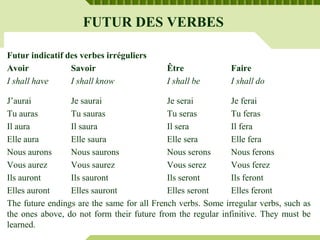
FUTUR DES VERBES
Futur indicatif des verbes irréguliers
Avoir Savoir Être Faire
I shall have I shall know I shall be I shall do
J’aurai Je saurai Je serai Je ferai
Tu auras Tu sauras Tu seras Tu feras
Il aura Il saura Il sera Il fera
Elle aura Elle saura Elle sera Elle fera
Nous aurons Nous saurons Nous serons Nous ferons
Vous aurez Vous saurez Vous serez Vous ferez
Ils auront Ils sauront Ils seront Ils feront
Elles auront Elles sauront Elles seront Elles feront
The future endings are the same for all French verbs. Some irregular verbs, such as
the ones above, do not form their future from the regular infinitive. They must be
learned.
FUTUR DES VERBES
Verbes à changements orthographiques
1. Verbs having mute e in the stem vowel, such as amener, to bring
along; lever, to raise, change e to è before silent e throughout the
conjugation.
Conjugated like amener: mener, to lead, take (to a place); emmener, to
take along; se promener, to take a walk.
Amener, to bring along
PRÉSENT FUTUR
I bring I shall bring
J’amène Nous amenons J’amènerai Nous amènerons
Tu amènes Vous amenez Tu amèneras Vous amènerez
Il amène Ils amènent Il amènera Ils amèneront
Elle amène Elles amènent Elle amènera Elles amèneront
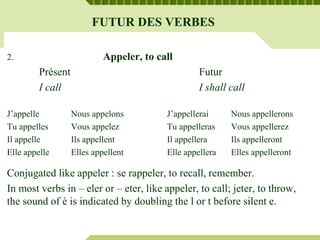
FUTUR DES VERBES
2. Appeler, to call
Présent Futur
I call I shall call
J’appelle Nous appelons J’appellerai Nous appellerons
Tu appelles Vous appelez Tu appelleras Vous appellerez
Il appelle Ils appellent Il appellera Ils appelleront
Elle appelle Elles appellent Elle appellera Elles appelleront
Conjugated like appeler : se rappeler, to recall, remember.
In most verbs in – eler or – eter, like appeler, to call; jeter, to throw,
the sound of è is indicated by doubling the l or t before silent e.
FUTUR DES VERBES
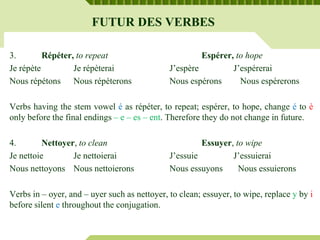
3. Répéter, to repeat Espérer, to hope
Je répète Je répèterai J’espère J’espérerai
Nous répétons Nous répèterons Nous espérons Nous espérerons
Verbs having the stem vowel é as répéter, to repeat; espérer, to hope, change é to è
only before the final endings – e – es – ent. Therefore they do not change in future.
4. Nettoyer, to clean Essuyer, to wipe
Je nettoie Je nettoierai J’essuie J’essuierai
Nous nettoyons Nous nettoierons Nous essuyons Nous essuierons
Verbs in – oyer, and – uyer such as nettoyer, to clean; essuyer, to wipe, replace y by i
before silent e throughout the conjugation.
FUTUR DES VERBES
Futur de aller, to go; venir, to come; tenir, to hold
I shall go I shall come I shall hold
J’irai Je viendrai Je tiendrai
Tu iras Tu viendras Tu tiendras
Il ira Il viendra Il tiendra
Elle ira Elle viendra Elle tiendra
Nous irons Nous viendrons Nous tiendrons
Vous irez Vous viendrez Vous tiendrez
Ils iront Ils viendront Ils tiendront
Elles iront Elles viendront Elles tiendront
Best
Dr. Amit Purushottam
Carcs.in
6299893489

French Grammar(For Beginners)

  • 1.
  • 2.
    S’appeler—to call oneself Jem’appelle I call myself Tu t’appelles You call yourself (informal) Il s’appelle He calls himself Elle s’appelle She calls herself Nous nous appelons We call ourselves Vous vous appelez You call yourself (formal) Ils s’appellent They call themselves (mas.) Elles s’appellent They call themselves (fem.)
  • 3.
    Comprendre—to understand Je comprendsI understand, am understanding Tu comprends You understand (informal) Il comprend He understands Elle comprend She understands Nous comprenons We understand Vous comprenez you understand (formal) Ils comprennent They understand (mas.) Elles comprennent They understand (fem.)
  • 4.
    Parler—to speak Je parleI speak, I am speaking, I do speak Tu parles You speak Il parle He speaks Elle parle She speaks Nous parlons We speak Vous parlez You speak Ils parlent They speak (mas.) Elles parlent They speak (fem.)
  • 5.
    La Négation—the negation BasicNegation Ne ... pas is placed around the conjugated verb to negate an affirmative sentence in French. Note that the ne changes to n' before a verb beginning with a vowel. a, e, i, o, u, h, & y (h & Y are semi vowels)
  • 6.
    La Négation—the negation Forexample Je comprends français. Je ne comprends pas français. Je parle français. Je ne parle pas français. Il est français. Il n’est pas français.
  • 7.
    Les Articles—the articles Lesarticles définis 1. The is Le before a masculine singular noun beginning with a consonant. 2. The is La before a feminine singular noun beginning with a consonant. 3. The is Les before a masculine and feminine plural noun beginning with a consonant or a vowel or a semi vowel. 4. Both Le and La are shortened to L’ before a singular noun beginning with a vowel or semi vowel.
  • 8.
    Les Articles—the articles MASCULINFÉMININ Le garçon La fille Le livre La table L’homme La femme L’étudiant L’ étudiante Les garçons, Les filles, Les livres, Les tables, Les hommes, Les femmes, Les étudiants, Les étudiantes.
  • 9.
    Les Articles—the articles Lesarticles indéfinis 1. Un, a, an is used before a singular masculine noun. 2. Une, a, an is used before a singular fiminine noun. 3. Des, some is used before a plural masculine and feminine noun.
  • 10.
    Les Articles—the articles MASCULINFÉMININ Un garçon Une fille Un livre Une table Un homme Une femme Un étudiant Une étudiante Des garçons, Des filles, Des livres, Des tables, Des hommes, Des femmes, Des étudiants, Des étudiantes.
  • 11.
    Indicatif présent deAvoir—to have J’ai I have, am having, do have Tu as You have Il a He has, It has (mas.) Elle a She has, It has (fem.) Nous avons We have Vous avez You have Ils ont They have (mas.) Elles ont They have (fem.)
  • 12.
    Indicatif présent de Connaître—toknow Je connais I know, am knowing, do know Tu connais You know Il connaît He knows Elle connaît She knows Nous connaissons We know Vous connaissez You know Ils connaissent They know (m) Elles connaissent They know (f)
  • 13.
    Être—to be Je suisI am Tu es You are Il est He / It is Elle est She/It is Nous sommes We are Vous êtes You are Ils sont They are (m) Elles sont They are (f)
  • 14.
    NOUN GENDER All nounsin French have a gender, either masculine or feminine. It is very important to learn a noun's gender along with the noun itself because articles (a, the) and adjectives change depending on the gender of the noun they precede or follow. Notice that the masculine words are preceded by le and feminine words are preceded by la both of which mean the.
  • 15.
    NOUN GENDER Ending isusually -age masculine Exceptions: une cage, une image, une nage, une page, une plage, une rage -eau masculine Exceptions: l'eau, la peau -ée feminine Exceptions: un lycée, un musée -ion feminine Exceptions: un avion, un bastion, billion, un million, un lion, un scion -té feminine Exceptions: un comité, un invité
  • 16.
    NOUN GENDER If theword ends with consonant then its usually considered to be masculine. There are exceptions. The words faim (hunger), dent (tooth), main (hand) and soif (thirst) end in consonants yet they are feminine la faim, la dent, la main, la soif. If the word ends with vowel E then its usually considered to be feminine. But there are exceptions to it also. Naturally words like la mère, la fille and la soeur that refer to females are feminine while words like le père, le fils and le frère that refer to males are masculine. Days of the week are all masculine in gender. « For the most part, you must memorize the gender »
  • 17.
    PLURALIZING NOUNS Even thoughin English the word the does not become plural, la and le both become les when pluralized. To make a noun plural, you usually add an -s (which is not pronounced). But there are some exceptions: If a noun already ends in an -s, -x & -z add nothing: le fils les fils, la noix les noix, le nez les nez. If a noun ends in –eu, -au add an x: l’oiseau les oiseaux, le jeu les jeux. If a noun ends in -al or -ail, change it to –aux: le cheval les chevaux horse(s) Exceptions: un œil (eye) des yeux (eyes).
  • 18.
    Some irregular plurals leciel the sky les cieux the heavens l’oeil the eye les yeux the eyes Madame Madam, Mrs. Ms. Mesdames Madams Mademoiselle Miss Mesdemoiselles Misses Monsieur Sir, Mr. Messieurs Sirs le bonhomme the fellow les bonshommes the fellows
  • 19.
    Conjugation of ERverbs In present ER group of verbs are conjugated by adding the following endings. We replace the root ER and put the endings with the stem. Regarder Donner Demander Endings e, es, e, ons, ez, ent
  • 20.
    POSER UNE QUESTION Inspoken French, questions are often formed simply by raising your voice to indicate that the sentence is a question. There is no change in sentence form. Vous êtes libre? Are you free?/You’re free? There are several other ways to ask a question in French:
  • 21.
    Questions with pronounsubjects: There are two ways of asking a question with a pronoun subject: a. Place the pronoun after the verb: Parlez-vous français? Do you speak French? b. Place est-ce que (is it that) before the sentence: Est-ce que je parle trop vite? Am I talking too fast? Est-ce que vous parlez français? Do you speak French?
  • 22.
    Questions with nounsubjects: When a question begins with a noun, the pronoun is repeated after the verb. The letter t is inserted between the subject pronoun and the verb in the 3rd person singular form when the verb ends with an–e and after the verb a (has). Votre frère parle-t-il français? Does your brother speak French? Votre sœur a-t-elle quitté la maison? Has your sister left the house?
  • 23.
    Questions introduced byinterrogative words: The common interrogative words are: Combien how many/how much Quand when Comment how Où where Pourquoi why Que what Qui who/whom Quel / Quelle what / which
  • 24.
    Questions introduced byinterrogative words: a. In questions which begin with an interrogative word, the order is usually interrogative word + verb + pronoun subject: Comment allez-vous payer? How are you going to pay? Que désirez-vous? What would you like? b. However, in everyday, informal speech, French speakers will often simply place the question word at the end of the sentence and raise their voice to indicate that it is a question. Vous allez où? Where are you going? c. A question word can also be used with est-ce que: Comment est-ce que vous allez payer? How are you going to pay?
  • 25.
    ADJECTIFS POSSESSIFS, AUSINGULIER MASCULIN FEMININ (a) mon père my father ma mère my mother ton père your father ta mère your mother son père his, her father sa mère his, her mother (b) notre père et notre mère our father and our mother votre père et votre mère your father and your mother leur père et leur mère their father and their mother
  • 26.
    ADJECTIFS POSSESSIFS, AUSINGULIER 1. Before masculine nouns in the singular, we use mon, ton, son, notre, votre, leur. 2. Before feminine nouns in the singular we generally use ma, ta, sa, notre, votre, leur. J’aime mon père et ma mère. I love my father and (my) mother. Il aime son père et sa mère. He loves his father and (his) mother. Elle aime son père et sa mère. She loves her father and (her) mother. La famille aime son chien. The family likes its dog.
  • 27.
    ADJECTIFS POSSESSIFS, AUSINGULIER 1. In French, the possessive adjective agrees with the noun that comes immediately after it, that is, with what is possessed. In English, on contrary, the possessive agrees with the possessor. 2. The possessive adjective in French must be repeated before each noun. 3. Son and Sa mean his, her, or its.
  • 28.
    ADJECTIFS POSSESSIFS, AUPLURIEL MASCULIN ET FEMININ Mes my Nos our Tes your Vos your Ses his, her Leurs their In the plural, the possessive adjective has the same form before nouns of either gender.
  • 29.
    ADJECTIFS POSSESSIFS, AUPLURIEL REMARQUEZ Mon, Ton, Son Hélène est mon amie. Helene is my friend. Hélène est son amie. Helen is his (or her) friend. J’aime son histoire. I like his (or her) story. Mon, ton, son, are used instead of ma, ta, sa before feminine nouns beginning with a vowel.
  • 30.
    Savoir-to know Je saisI know, am knowing, do know Tu sais You know Il sait He knows Elle sait She knows Nous savons We know Vous savez You know Ils savent They know (m) Elles savent They know (f)
  • 31.
    Attention!!!!!!!!! Connaître is usedwhen you know people or places, savoir is used when you know facts. When savoir is followed by an infinitive it means to know how. Je connais ton frère. I know your brother. Je sais que ton frère s'appelle Jean. I know that your brother is named John. Connaissez-vous Paris? Do you know (Are you familiar with) Paris? Oui, nous connaissons Paris. Yes, we know (are familiar with) Paris. Ils savent nager. They know how to swim.
  • 32.
    Faire—to do, tomake Je fais I do, am doing Tu fais You do Il fait He does Elle fait She does Nous faisons We do Vous faites You do Ils font They do (m) Elles font They do (f) Faire is used in expressions of weather (il fait beau) and many other idiomatic expressions.
  • 33.
    ADJECTIFS—ADJECTIVES Adjectives agree withthe nouns they modify in gender and number; that is, they are masculine if the noun is masculine, plural if the noun is plural, etc.: Marie et sa sœur sont grandes. Marie and her sister are tall. Pierre est grand. Pierre is tall.
  • 34.
    ADJECTIFS—ADJECTIVES The following adjectiveshave two forms for the masculine singular: un beau livre a beautiful book un bel arbre a beautiful tree une belle femme a beautiful woman MASCULIN FÉMININ Before a consonant Before a vowel or “mute” h Beau Bel Belle beautiful, handsome Nouveau Nouvel Nouvelle new Vieux Vieil Vieille old
  • 35.
    ADJECTIFS—ADJECTIVES The feminine ofadjectives is normally formed by adding –e to the masculine singular: un petit garçon a little boy une petite fille a little girl a. If the masculine singular already ends in –e, the adjective has the same form in the feminine: un jeune homme a young man une jeune femme a young woman b. Adjectives ending in –er in the masculine singular change the e to è and then add –e: Masculine Feminine étranger étrangère foreign
  • 36.
    ADJECTIFS—ADJECTIVES c. Most adjectivesending in –eux in the masculine singular change this ending to –euse: Masculine Feminine heureux heureuse happy sérieux sérieuse serious d. In some adjectives double the final consonant of the masculine singular form and add –e: Masculine Feminine bon bonne good ancien ancienne former, ancient gentil gentille nice gros grosse fat
  • 37.
    ADJECTIFS—ADJECTIVES e. Adjectives endingin -eau in the masculine singular change the -au to -lle: Masculine Feminine beau belle beautiful nouveau nouvelle new f. There are also a number of irregular feminines: Masculine Feminine actif active active blanc blanche white doux douce sweet, gentle, soft faux fausse false long longue long vieux vieille old
  • 38.
    ADJECTIFS—ADJECTIVES PLURAL The pluralof adjectives is regularly formed by adding –s to the singular: A. But if the adjective ends in –s or –x in the masculine singular, the masculine plural stays the same: un mauvais garçon a bad boy deux mauvais garçons two bad boys Singular Plural Masculine un petit garçon a little boy deux petits garçons two little boys Feminine une petite fille a little girl deux petites filles two little girls
  • 39.
    ADJECTIFS—ADJECTIVES PLURAL B. Adjectivesending in -au add -x: un nouveau livre a new book des nouveaux livres new books C. Adjectives ending in -al change to -aux: un homme loyal a loyal man des hommes loyaux loyal men An adjective that modifies nouns of different gender is in the masculine plural: Marie et Jean sont petits. Marie and Jean are little.
  • 40.
    ADJECTIFS—ADJECTIVES POSITION Adjectives usuallyfollow the noun: une leçon facile an easy lesson un homme intéressant an interesting man une idée excellente an excellent idea Adjectives of colour and nationality always follow their nouns. Les chats gris The grey cats.
  • 41.
    ADJECTIFS—ADJECTIVES POSITION There aresome common adjectives, however, that usually precede the nouns they modify. These are often known as the “BAGS” adjectives because they are the adjectives that deal with Beauty, Age, Good (and Bad), and Size. Beau Beautiful Joli Pretty Bon Good Long Long Court Short Mauvais Bad Gentil Nice, pleasant Nouveau New Gros Big, fat Petit Small, little Jeune Young Vieux Old
  • 42.
    ADJECTIFS DÉMONSTRATIFS The variousforms of the Demonstrative Adjective Masculin SINGULIER PLURIEL Ce livre this (that) book Ces livres these (those) books Cet enfant this (that) child Ces enfants these (those) children Cet homme this (that) man Ces hommes these (those) men Féminin Cette femme this (that) woman Ces femmes these (those) women
  • 43.
    ADJECTIFS DÉMONSTRATIFS 1. This,that before a noun is expressed in French as follows: Ce before a masculine noun beginning with a consonant. Cet before a masculine noun beginning with a vowel or silent h. Cette before any feminine noun. The plural of ce, cet, cette before any noun is Ces, these, those. 2. Ce garçon et cette fille. This boy and girl. Ces chiens et ces chats. Those dogs and cats. The demonstrative adjective is repeated before each noun.
  • 44.
    PRONOMS PERSONNELS DISJOINTS SINGULIERPLURIEL Moi, I, me Nous, we, us Toi, you Vous, you Lui, he, him Eux, they, them (masculine) Elle, she, her Elles, they, them (feminine) The above forms are called disjunctive or emphatic because they may be used apart from the verb. After prepositions: Ils vont avec nous. They go with us. Nous n’allons pas sans eux. We do not go without them. Je vais chez moi. I am going home.
  • 45.
    Indicatif présent deALLER- to go Je vais I go, am going Tu vas Il va Elle va Nous allons We go, are going Vous allez Ils vont Elles vont
  • 46.
    PARTICIPE PASSÉ--Participe passédes verbes réguliers INFINITIF PARTICIPE PASSÉ 1. Donner, to give Donné, given Demander, to ask Demandé, asked 2. Finir, to finish Fini, finished Applaudir, to applaud Applaudi, applauded 3. Entendre, to hear Entendu, heard Répondre, to answer Répondu, answered
  • 47.
    PARTICIPE PASSÉ--Participe passédes verbes réguliers The past participles of regular verbs are formed by replacing the infinitive endings as follows: Verbs in – er change to – é Verbs in – ir change to – i Verbs in –re change to – u
  • 48.
    PARTICIPE PASSÉ desverbes irréguliers INFINITIF PARTICIPE PASSÉ Avoir, to have eu, had Etre, to be été, been Dire, to say dit, said Faire, to do fait, did
  • 49.
    PASSÉ COMPOSÉ The passécomposé of most verbs is formed by combining the present indicative of the auxiliary avoir with the past participle of the verb. J’ai fini mon travail. I finished (have finished) my work. J’ai travaillé aujourd’hui. I worked (have worked) today. Nous avons rencontré Paul hier. We met (we did meet) Paul yesterday. Il a été malade. He was (he has been) ill.
  • 50.
    PASSÉ COMPOSÉ The passécomposé expresses not only what has happened or has been happening in the past, but also what happened or did happen. It corresponds therefore both to the English perfect and to the English simple past. Ordre des mots Avez-vous parlé à Jean? Oui, je lui ai parlé. Yes I spoke to him. Est-ce que vous avez parlé à Jean ? Non, je ne lui ai pas parlé. No, I did not speak to him Ne m’avez-vous pas entendu ? Oui, je vous ai entendu. Yes, I heard you. Est-ce que vous ne m’avez pas entendu ?Non, je ne vous ai pas entendu. No, I did not hear you. In a compound tense, like the passé composé, the conjunctive pronoun objects come immediately before the auxiliary. In the negative form, the auxiliary (including pronouns before or after it) comes between ne and pas.
  • 51.
    PASSÉ COMPOSÉ Temps composéavec être 1. A few intransitive verbs use être, instead of avoir, with the past participle to form their compound tenses. Such verbs are: Aller to go Partir to leave Entrer to enter, go in Descendre to come down Arriver to arrive Tomber to fall Monter to go up Rester to stay Venir to come Devenir to become Sortir to go out Retourner to go back Rentrer to get back home, go in again.
  • 52.
    PASSÉ COMPOSÉ 2. Noussommes allés au théâtre. We went to the theatre. Marie, êtes-vous sortie ? Mary, did you go out? Paul et Jean, êtes-vous rentrés ? Paul and John, have you come in? The past participle of a verb conjugated with être is treated like an adjective and agrees with the subject.
  • 53.
    PASSÉ COMPOSÉ Temps composésdes verbes réfléchis All reflexive verbs form their compound tenses with être and the past participle. Passé composé de se laver, to wash oneself I washed myself, I have washed myself I did not wash myself, I have not washed myself Je me suis lavé (e) Je ne me suis pas lavé (e) Tu t’es lavé (e) Tu ne t’es pas lavé (e) Il s’est lavé Il ne s’est pas lavé Elle s’est lavée Elle ne s’est pas lavée Nous nous sommes lavé (e) s Nous ne nous sommes pas lavé (e) s Vous vous êtes lavé (e) s Vous ne vous êtes pas lavé (e) s Ils se sont lavés Ils ne se sont pas lavés Elles se sont lavées Elles ne se sont pas lavées
  • 54.
    FUTUR DES VERBES Futurdes verbes réguliers To form the future of the regular verbs, the endings – ai –as –a – ons –ez –ont are added to the infinitive. Observe that the final –e of verbs ending in –re is dropped before the future endings. DONNER FINIR ENTENDRE I shall give I shall finish I shall hear Je donnerai Je finirai J’entendrai Tu donneras Tu finiras Tu entendras Il donnera Il finira Il entendra Elle donnera Elle finira Elle entendra Nous donnerons Nous finirons Nous entendrons Vous donnerez Vous finirez Vous entendrez Ils donneront Ils finiront Ils entendront Elles donneront Elles finiront Elles entendront
  • 55.
    FUTUR DES VERBES Emploidu futur 1. Je finirai mon travail ce soir.I shall finish my work this evening. Quand il rencontrera je lui parlerai.When he gets home I shall speak to him. The future is used as in English. But it must also be used when future time is implied after quand, lorsque, when; aussitôt que, dès que, as soon as. 2. Vous lui donnerez ceci. You will give him this. Ils ne passeront pas. They shall not (will not) pass. Tu ne tueras pas. Thou (you) shall not kill. The differences expressed in English by ‘shall’ and ‘will’ do not exist in French.
  • 56.
    FUTUR DES VERBES Futurindicatif des verbes irréguliers Avoir Savoir Être Faire I shall have I shall know I shall be I shall do J’aurai Je saurai Je serai Je ferai Tu auras Tu sauras Tu seras Tu feras Il aura Il saura Il sera Il fera Elle aura Elle saura Elle sera Elle fera Nous aurons Nous saurons Nous serons Nous ferons Vous aurez Vous saurez Vous serez Vous ferez Ils auront Ils sauront Ils seront Ils feront Elles auront Elles sauront Elles seront Elles feront The future endings are the same for all French verbs. Some irregular verbs, such as the ones above, do not form their future from the regular infinitive. They must be learned.
  • 57.
    FUTUR DES VERBES Verbesà changements orthographiques 1. Verbs having mute e in the stem vowel, such as amener, to bring along; lever, to raise, change e to è before silent e throughout the conjugation. Conjugated like amener: mener, to lead, take (to a place); emmener, to take along; se promener, to take a walk. Amener, to bring along PRÉSENT FUTUR I bring I shall bring J’amène Nous amenons J’amènerai Nous amènerons Tu amènes Vous amenez Tu amèneras Vous amènerez Il amène Ils amènent Il amènera Ils amèneront Elle amène Elles amènent Elle amènera Elles amèneront
  • 58.
    FUTUR DES VERBES 2.Appeler, to call Présent Futur I call I shall call J’appelle Nous appelons J’appellerai Nous appellerons Tu appelles Vous appelez Tu appelleras Vous appellerez Il appelle Ils appellent Il appellera Ils appelleront Elle appelle Elles appellent Elle appellera Elles appelleront Conjugated like appeler : se rappeler, to recall, remember. In most verbs in – eler or – eter, like appeler, to call; jeter, to throw, the sound of è is indicated by doubling the l or t before silent e.
  • 59.
    FUTUR DES VERBES 3.Répéter, to repeat Espérer, to hope Je répète Je répèterai J’espère J’espérerai Nous répétons Nous répèterons Nous espérons Nous espérerons Verbs having the stem vowel é as répéter, to repeat; espérer, to hope, change é to è only before the final endings – e – es – ent. Therefore they do not change in future. 4. Nettoyer, to clean Essuyer, to wipe Je nettoie Je nettoierai J’essuie J’essuierai Nous nettoyons Nous nettoierons Nous essuyons Nous essuierons Verbs in – oyer, and – uyer such as nettoyer, to clean; essuyer, to wipe, replace y by i before silent e throughout the conjugation.
  • 60.
    FUTUR DES VERBES Futurde aller, to go; venir, to come; tenir, to hold I shall go I shall come I shall hold J’irai Je viendrai Je tiendrai Tu iras Tu viendras Tu tiendras Il ira Il viendra Il tiendra Elle ira Elle viendra Elle tiendra Nous irons Nous viendrons Nous tiendrons Vous irez Vous viendrez Vous tiendrez Ils iront Ils viendront Ils tiendront Elles iront Elles viendront Elles tiendront
  • 61.