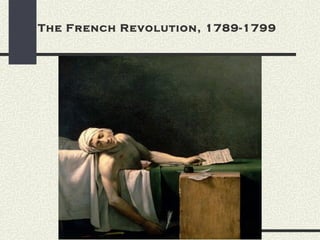
The French Revolution, 1789-1799
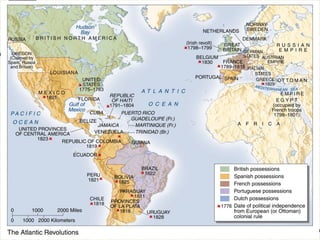
Map of Atlantic Revolutions: Where is Europe? France?
One approach to studying history


Causes
Process
Consequences
What were the causes of the
French Revolution?


                    QuickTimeª and a
         TIFF (Uncompressed) decompressor
            are needed to see this picture.
Causes of the French Revolution


The Enlightenment
  Ideas:
        Liberty
        Equality
        Reason
        Progress
   Philosophes:
        Locke defended private property, limited sovereignty and fair
         government
        Voltaire attacked noble privileges and the Church’s authority
Causes (continued)
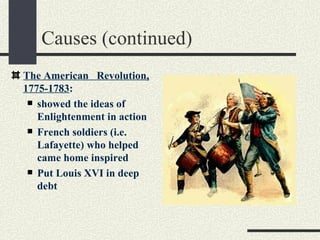
The American Revolution,
1775-1783:
  showed the ideas of
   Enlightenment in action
  French soldiers (i.e.
   Lafayette) who helped
   came home inspired
  Put Louis XVI in deep
   debt
Causes (continued)
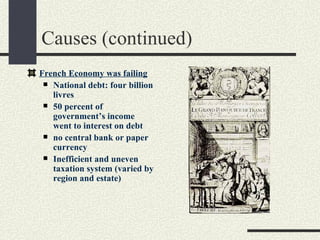
French Economy was failing
  National debt: four billion
   livres
  50 percent of
   government’s income
   went to interest on debt
  no central bank or paper
   currency
  Inefficient and uneven
   taxation system (varied by
   region and estate)
Causes (continued)
Feudal system
   Estate System outdated
   posed many difficulties to
    rising middle class of Third
    Estate
   difficult to move upward in                 QuickTimeª and a
    society, unless very rich        TIFF (Uncompressed) decompressor
                                        are needed to see this picture.
   Less well-off commoners
    resented the inequality of the
    three estates
Causes (continued)
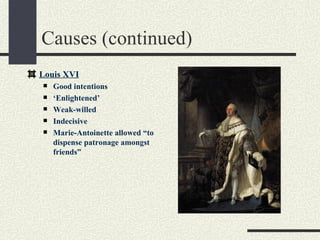
Louis XVI
   Good intentions
   ‘Enlightened’
   Weak-willed
   Indecisive
   Marie-Antoinette allowed “to
    dispense patronage amongst
    friends”
Causes (continued)
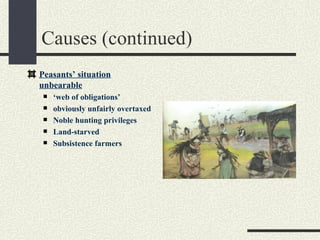
Peasants’ situation
unbearable
    ‘web of obligations’
    obviously unfairly overtaxed
    Noble hunting privileges
    Land-starved
    Subsistence farmers
Causes (continued)
Harvest failures in
1787-1788:
  less food

  higher prices

  businesses failed

  unemployment in cities              QuickTimeª and a
                            TIFF (Uncompressed) decompressor
                               are needed to see this picture.
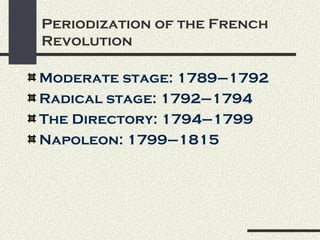
Periodization of the French
Revolution

Moderate stage: 1789–1792
Radical stage: 1792–1794
The Directory: 1794–1799
Napoleon: 1799–1815
Outbreak of the Revolution


THE SPARK: Fiscal crisis forced Louis XVI to
call the Estates-General, summer, 1788 (first
time since 1614)
   The three estates elected delegates:
        First Estate represented about 100,000 clergymen
        Second Estate represented about 400,000 noble men and
         women
        Third Estate represented about 24.5 million people
Outbreak (contd.)
   Main disagreement: representation
       Should the estates vote by estate or by
        individual?
       Third Estate argued that all delegates
        should sit together and vote as individuals
       Third Estate demanded as many delegates
        as the First and Second Estates combined:
        “Doubling the Third”
       Louis opposed, then changed his
        position
Who were the Third Estate
delegates?
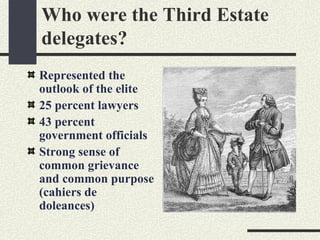
Represented the
outlook of the elite
25 percent lawyers
43 percent
government officials
Strong sense of
common grievance
and common purpose
(cahiers de
doleances)
Outbreak (contd.)
 May 5, 1789: Estates General
  convened at Versailles
 June 17, 1789: the delegates of
  the Third Estate declared
  themselves to be the National
  Assembly
the Oath of the Tennis Court
(June 20, 1789)


                      QuickTimeª and a
           TIFF (Uncompressed) decompressor
              are needed to see this picture.
                      QuickTimeª and a
           TIFF (Uncompressed) decompressor
              are needed to see this picture.
Outbreak (Contd.)
  Public attention to the events in
   Paris was high
  Price of bread soared

  Rumors circulated that Louis was
   about to stage a coup d’état
  Parisian workers (sans-culottes)
   organized a militia of volunteers
Outbreak (Contd.)
 July
     14, 1789: the
 Storming of the Bastille
  Bastille was symbol of royal
   authority
  Its fall symbolized of the people’s
   role in revolutionary change
The Storming the Bastille


                     QuickTimeª and a
          TIFF (Uncompressed) decompressor
             are needed to see this picture.
Outbreak (Contd.)
 The   Great Fear
   Rumors that the king’s armies were
    on their way
   Peasants attacked and burned
    manor houses
   Destroyed manor records
The Great Fear


              QuickTimeª and a
   TIFF (Uncompressed) decompressor
      are needed to see this picture.
Response
August 4, 1789: National Assembly voted to
abolish all noble and other privileges
    Church tithe

    the corvée

    hunting privileges

    tax exemptions and monopolies

    Obliterated the remnants of feudalism
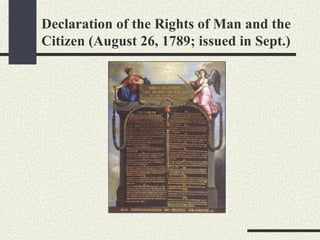
Declaration of the Rights of Man and the
Citizen (August 26, 1789; issued in Sept.)
The National Assembly and the
liberal revolution

   The Declaration of the Rights of Man
    and Citizen
       Declared natural rights
         Private property

         Liberty, security, and resistance to
           oppression
       Declared freedom of speech, religious
        toleration, and liberty of the press to be
        inviolable
       Equality before the law
The masses take the
initiative: October Days
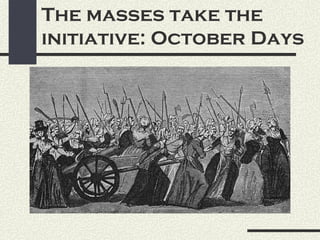
 Brought on by economic crisis
 Parisian women marched to
  Versailles (October 5) and
  demanded to be heard
The masses take the
initiative: October Days
The masses take the
initiative: October Days

 Women demanded Louis and his
  family return to Paris
 Women with the help of the
  National Guard forced Louis
  (and the National Assembly) to
  move to Paris
Women and the revolution

o   General participation in the
    Revolution
       o   Took leading roles in mass actions
       o   Joined clubs, demonstrations, and debates
       o   Women as citizens
o   Olympe de Gouges, Declaration of
    the Rights of Women and the
    Citizen (1791)
       o   Women should have the same rights as men
Religion and the revolution

The most divisive issue
     National Assembly confiscated church
      property (November 1789)
     The Civil Constitution of the Clergy (July 1790)
        Bishops and clergy subject to the laws of
         the state
        Salaries to be paid from public treasury

     Church reforms polarized France
        Many resented the privileged position of
         the church
        Parish church an institution of great local
         importance

French Revolution

  • 1.
  • 2.
    Map of AtlanticRevolutions: Where is Europe? France?
  • 3.
    One approach tostudying history Causes Process Consequences
  • 4.
    What were thecauses of the French Revolution? QuickTimeª and a TIFF (Uncompressed) decompressor are needed to see this picture.
  • 5.
    Causes of theFrench Revolution The Enlightenment  Ideas:  Liberty  Equality  Reason  Progress  Philosophes:  Locke defended private property, limited sovereignty and fair government  Voltaire attacked noble privileges and the Church’s authority
  • 6.
    Causes (continued) The AmericanRevolution, 1775-1783:  showed the ideas of Enlightenment in action  French soldiers (i.e. Lafayette) who helped came home inspired  Put Louis XVI in deep debt
  • 7.
    Causes (continued) French Economywas failing  National debt: four billion livres  50 percent of government’s income went to interest on debt  no central bank or paper currency  Inefficient and uneven taxation system (varied by region and estate)
  • 8.
    Causes (continued) Feudal system  Estate System outdated  posed many difficulties to rising middle class of Third Estate  difficult to move upward in QuickTimeª and a society, unless very rich TIFF (Uncompressed) decompressor are needed to see this picture.  Less well-off commoners resented the inequality of the three estates
  • 9.
    Causes (continued) Louis XVI  Good intentions  ‘Enlightened’  Weak-willed  Indecisive  Marie-Antoinette allowed “to dispense patronage amongst friends”
  • 10.
    Causes (continued) Peasants’ situation unbearable  ‘web of obligations’  obviously unfairly overtaxed  Noble hunting privileges  Land-starved  Subsistence farmers
  • 11.
    Causes (continued) Harvest failuresin 1787-1788:  less food  higher prices  businesses failed  unemployment in cities QuickTimeª and a TIFF (Uncompressed) decompressor are needed to see this picture.
  • 12.
    Periodization of theFrench Revolution Moderate stage: 1789–1792 Radical stage: 1792–1794 The Directory: 1794–1799 Napoleon: 1799–1815
  • 13.
    Outbreak of theRevolution THE SPARK: Fiscal crisis forced Louis XVI to call the Estates-General, summer, 1788 (first time since 1614)  The three estates elected delegates:  First Estate represented about 100,000 clergymen  Second Estate represented about 400,000 noble men and women  Third Estate represented about 24.5 million people
  • 14.
    Outbreak (contd.)  Main disagreement: representation  Should the estates vote by estate or by individual?  Third Estate argued that all delegates should sit together and vote as individuals  Third Estate demanded as many delegates as the First and Second Estates combined: “Doubling the Third”  Louis opposed, then changed his position
  • 15.
    Who were theThird Estate delegates? Represented the outlook of the elite 25 percent lawyers 43 percent government officials Strong sense of common grievance and common purpose (cahiers de doleances)
  • 16.
    Outbreak (contd.)  May5, 1789: Estates General convened at Versailles  June 17, 1789: the delegates of the Third Estate declared themselves to be the National Assembly
  • 17.
    the Oath ofthe Tennis Court (June 20, 1789) QuickTimeª and a TIFF (Uncompressed) decompressor are needed to see this picture. QuickTimeª and a TIFF (Uncompressed) decompressor are needed to see this picture.
  • 18.
    Outbreak (Contd.) Public attention to the events in Paris was high  Price of bread soared  Rumors circulated that Louis was about to stage a coup d’état  Parisian workers (sans-culottes) organized a militia of volunteers
  • 19.
    Outbreak (Contd.)  July 14, 1789: the Storming of the Bastille  Bastille was symbol of royal authority  Its fall symbolized of the people’s role in revolutionary change
  • 20.
    The Storming theBastille QuickTimeª and a TIFF (Uncompressed) decompressor are needed to see this picture.
  • 21.
    Outbreak (Contd.)  The Great Fear  Rumors that the king’s armies were on their way  Peasants attacked and burned manor houses  Destroyed manor records
  • 22.
    The Great Fear QuickTimeª and a TIFF (Uncompressed) decompressor are needed to see this picture.
  • 23.
    Response August 4, 1789:National Assembly voted to abolish all noble and other privileges  Church tithe  the corvée  hunting privileges  tax exemptions and monopolies  Obliterated the remnants of feudalism
  • 24.
    Declaration of theRights of Man and the Citizen (August 26, 1789; issued in Sept.)
  • 25.
    The National Assemblyand the liberal revolution  The Declaration of the Rights of Man and Citizen  Declared natural rights  Private property  Liberty, security, and resistance to oppression  Declared freedom of speech, religious toleration, and liberty of the press to be inviolable  Equality before the law
  • 26.
    The masses takethe initiative: October Days  Brought on by economic crisis  Parisian women marched to Versailles (October 5) and demanded to be heard
  • 27.
    The masses takethe initiative: October Days
  • 28.
    The masses takethe initiative: October Days  Women demanded Louis and his family return to Paris  Women with the help of the National Guard forced Louis (and the National Assembly) to move to Paris
  • 29.
    Women and therevolution o General participation in the Revolution o Took leading roles in mass actions o Joined clubs, demonstrations, and debates o Women as citizens o Olympe de Gouges, Declaration of the Rights of Women and the Citizen (1791) o Women should have the same rights as men
  • 30.
    Religion and therevolution The most divisive issue  National Assembly confiscated church property (November 1789)  The Civil Constitution of the Clergy (July 1790)  Bishops and clergy subject to the laws of the state  Salaries to be paid from public treasury  Church reforms polarized France  Many resented the privileged position of the church  Parish church an institution of great local importance

Editor's Notes

  • #2 Death of Marat by Jacques-Louis David © Alexander Burkatovski/CORBIS
  • #3 Where is Europe? Where is France?
  • #5 Students should try to think up their own list of causes.