Asperger's Syndrome Franklinville Central School
People with Autism "People with autism spend more time doing things they are not good at than anyone else."  Toni Atwood
Definition Asperger’s Syndrome (AS) is a developmental  disability that is defined by impairments in social relationships, verbal and nonverbal communication, and by restrictive, repetitive patterns of behaviors, interests, and activities.
Background Identified in 1944 by Hans Asperger. (Austria)‏ Brought to the attention of the English-speaking world in 1980 by Dr. Lorna Wing. Was not added to the Diagnostic and Statistics Manual of the American Psychiatric Association until 1994. “ Autism’s Shadow”
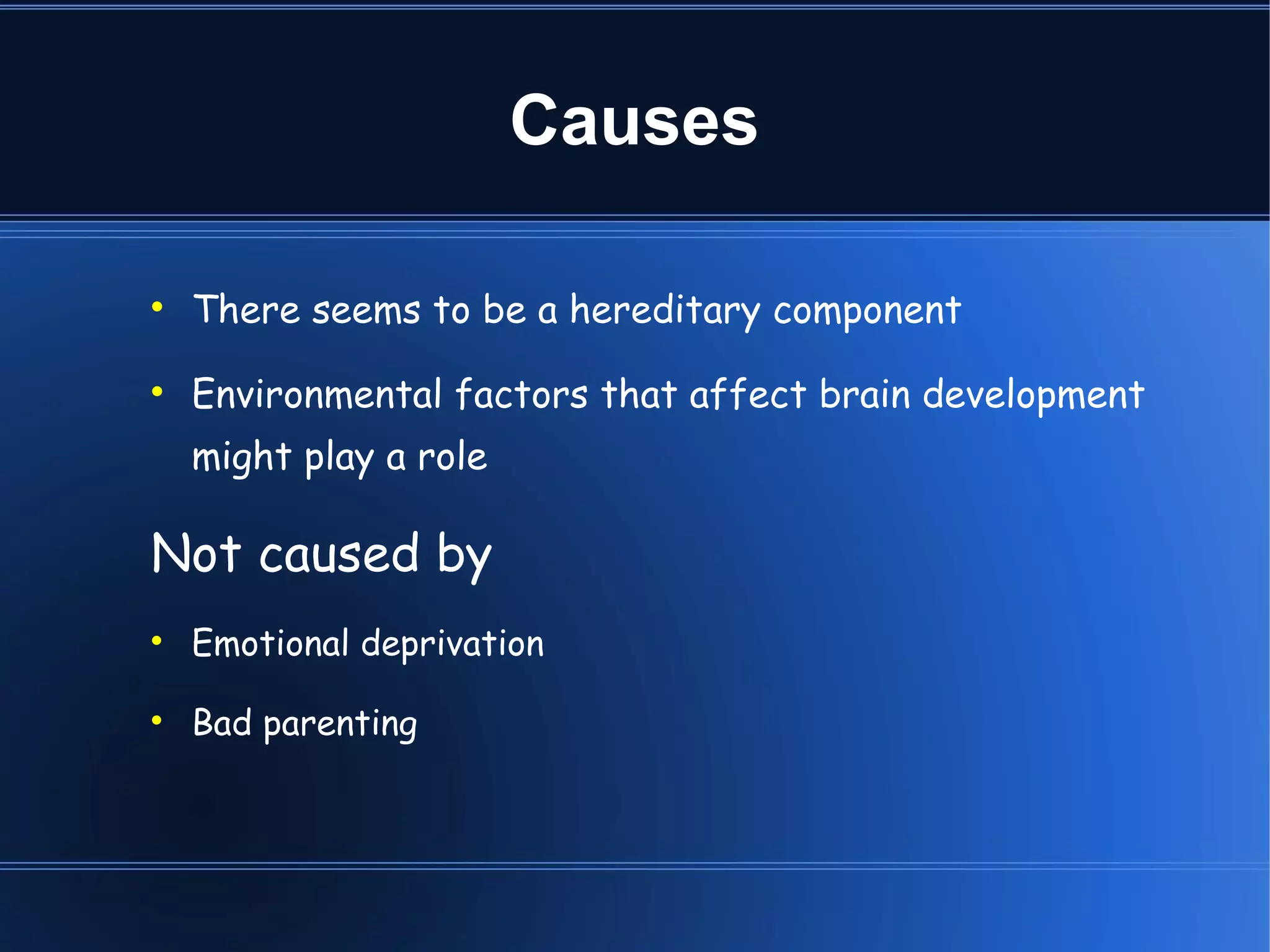
Causes There seems to be a hereditary component  Environmental factors that affect brain development might play a role Not caused by Emotional deprivation  Bad parenting
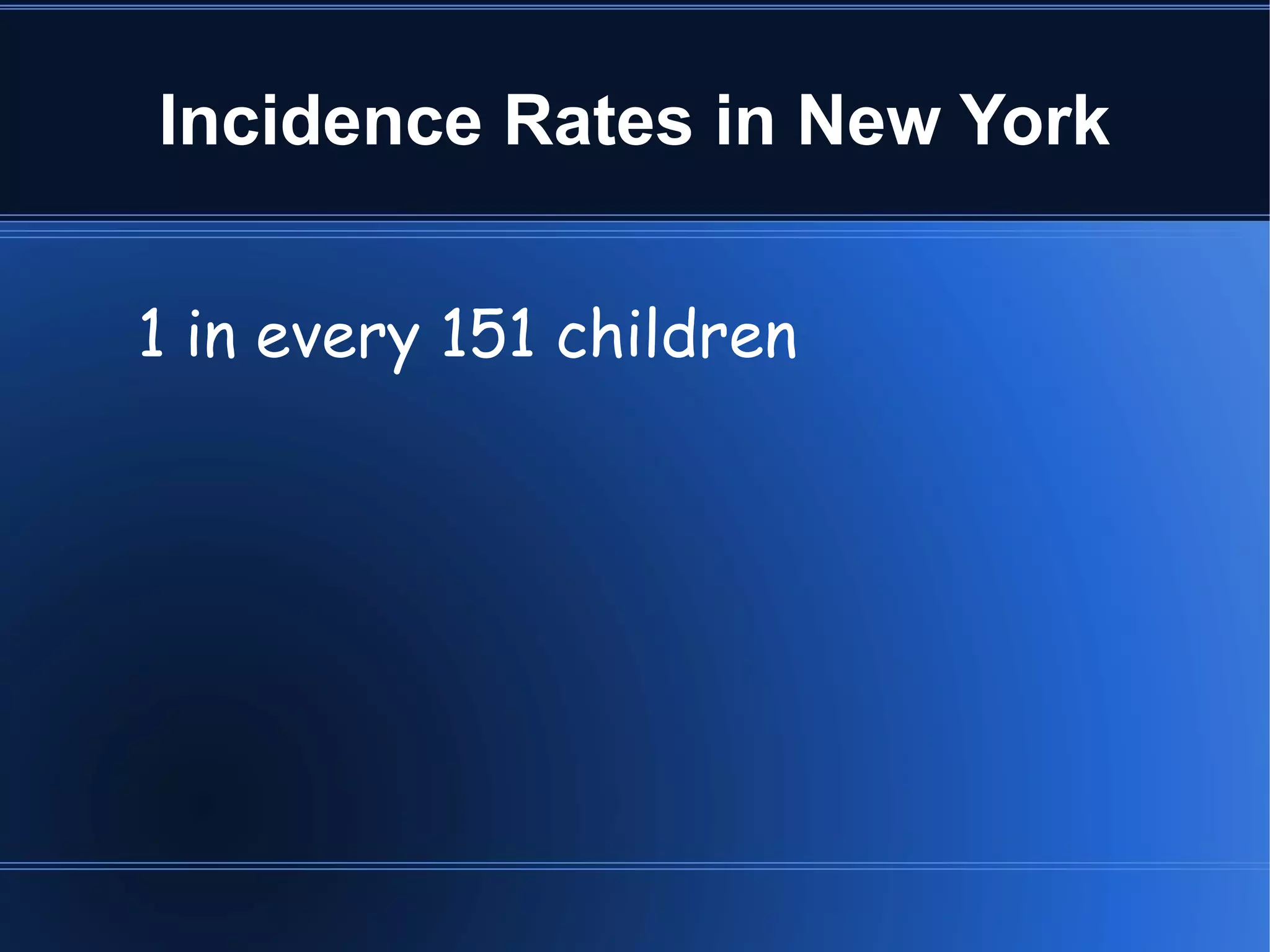
Incidence Rates in New York 1 in every 91 children
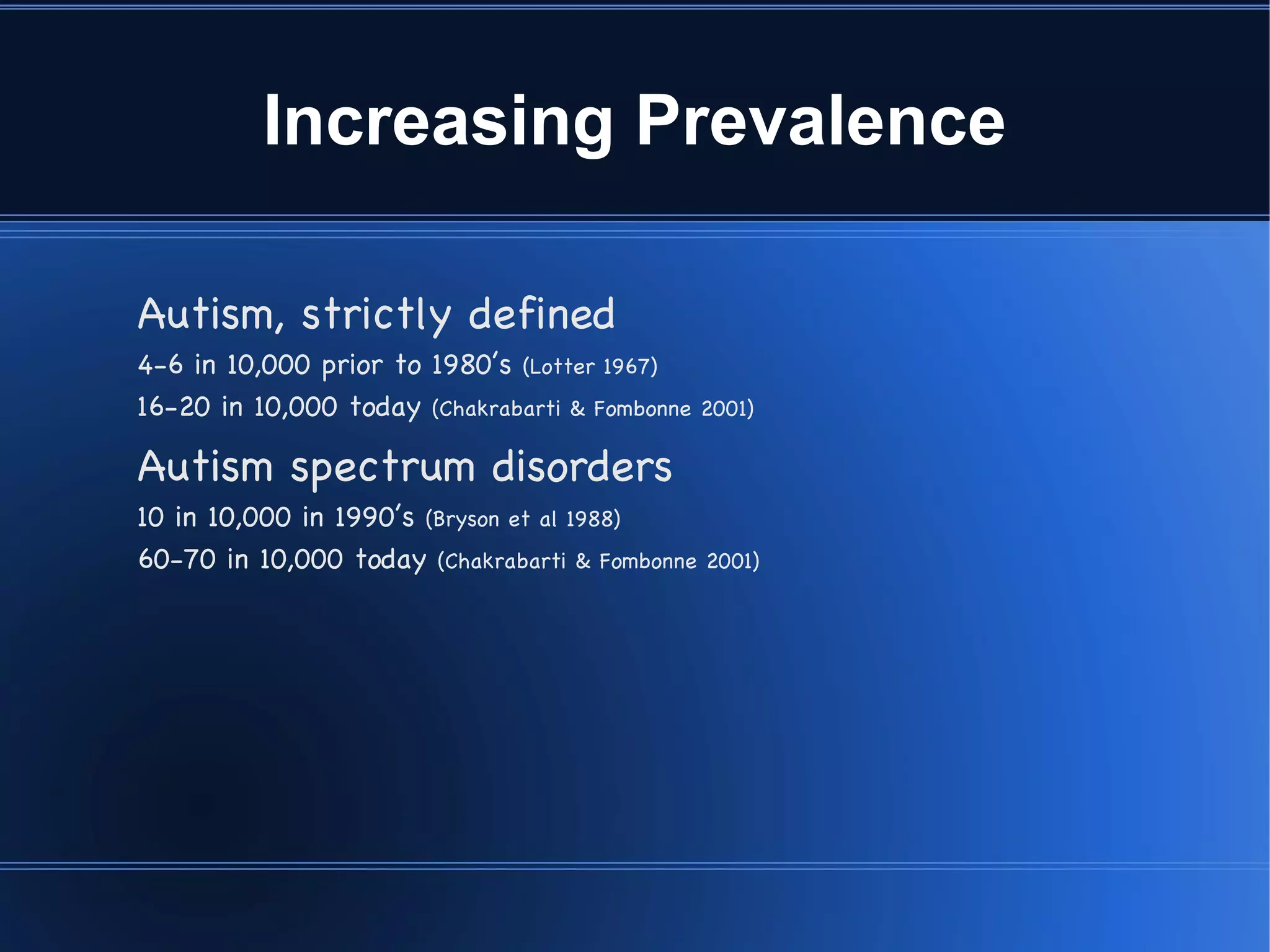
Increasing Prevalence Autism, strictly defined 4-6 in 10,000 prior to 1980’s  (Lotter 1967)‏ 16-20 in 10,000 today  (Chakrabarti & Fombonne 2001)‏ Autism spectrum disorders 10 in 10,000 in 1990’s  (Bryson et al 1988)‏ 60-70 in 10,000 today  (Chakrabarti & Fombonne 2001)‏
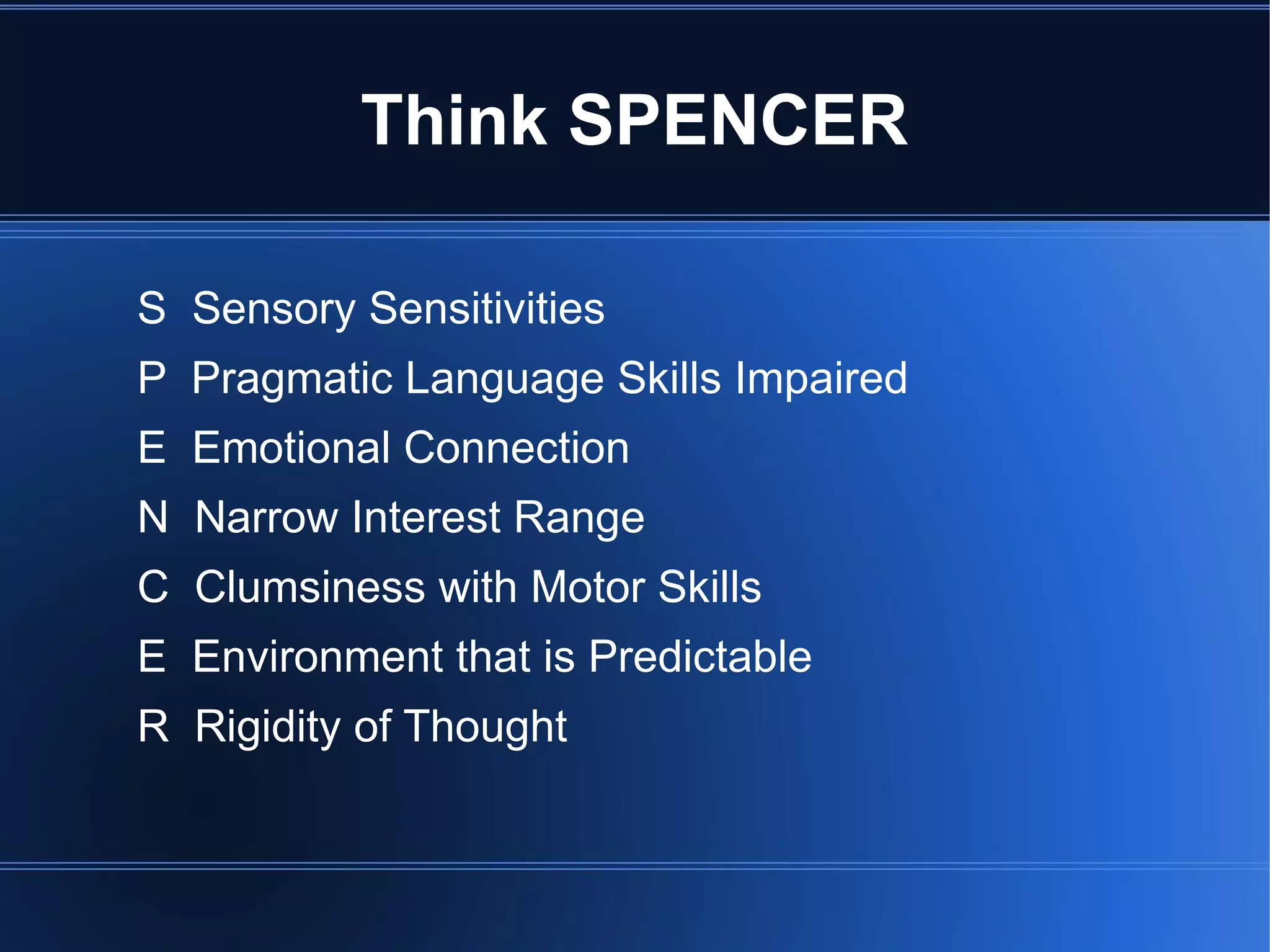
Think SPENCER S  Sensory Sensitivities P  Pragmatic Language Skills Impaired E  Emotional Connection N  Narrow Interest Range C  Clumsiness with Motor Skills E  Environment that is Predictable R  Rigidity of Thought
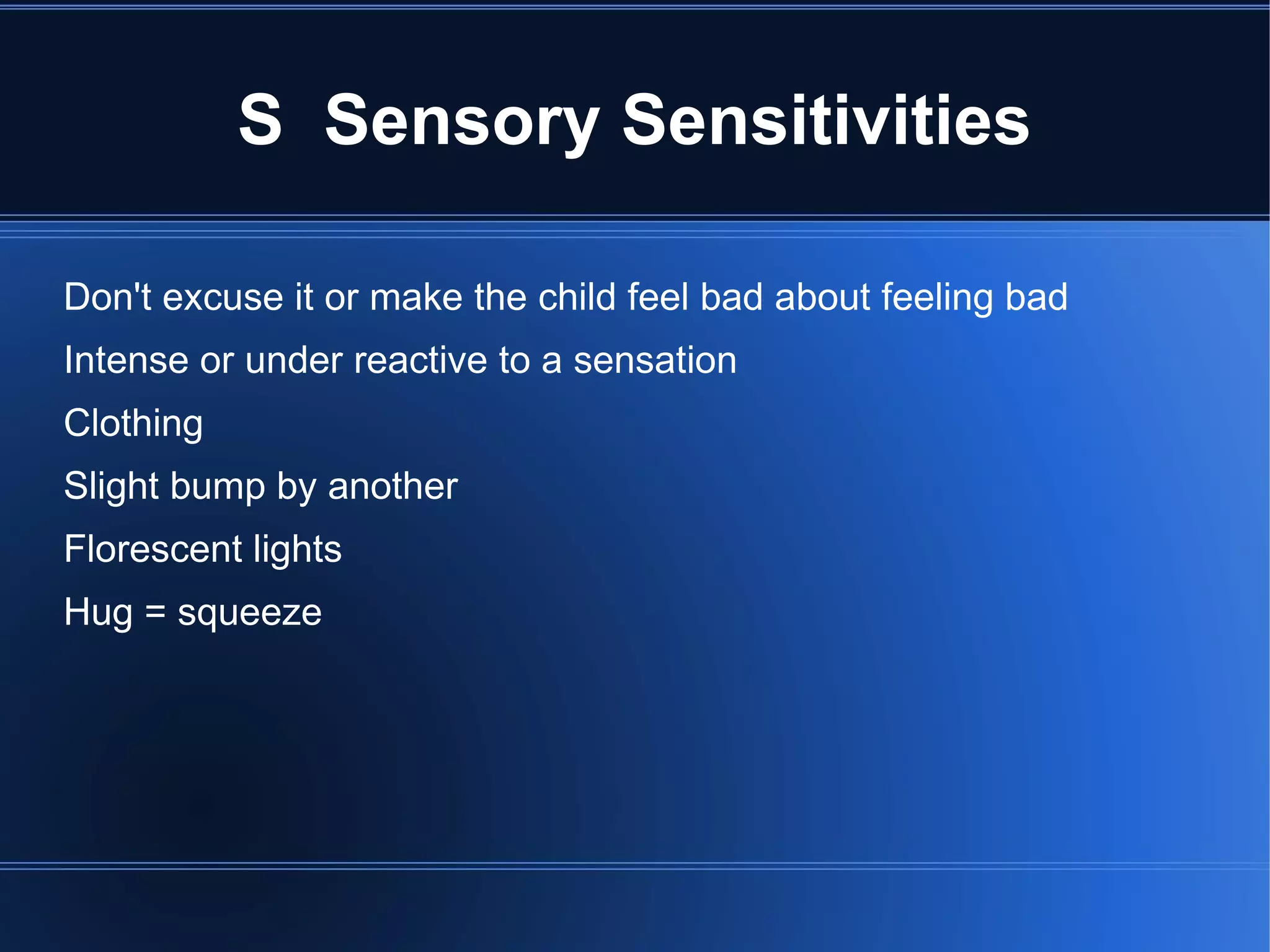
S  Sensory Sensitivities Don't excuse it or make the child feel bad about feeling bad Intense or under reactive to a sensation Clothing Slight bump by another Florescent lights Hug = squeeze
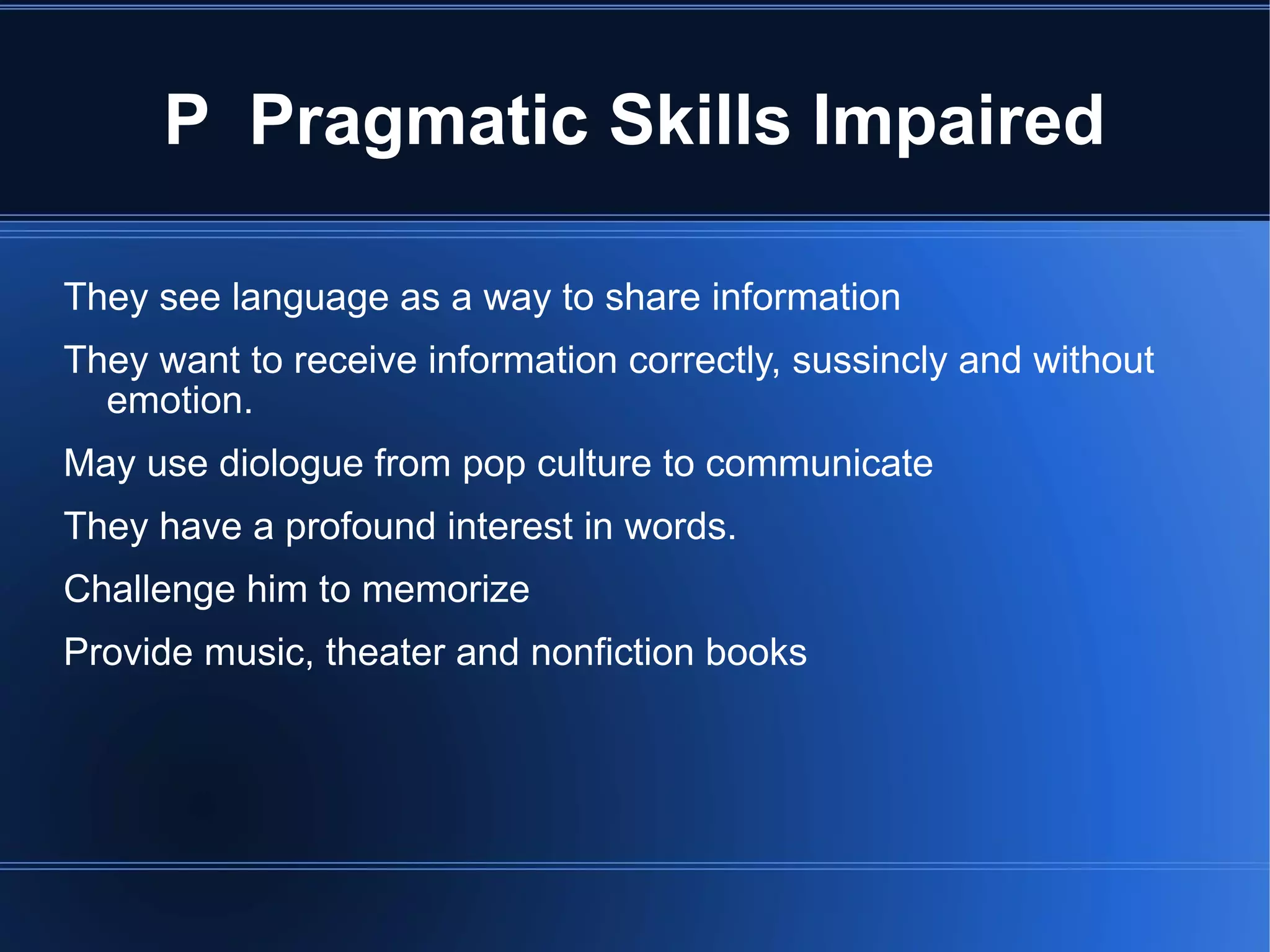
P  Pragmatic Skills Impaired They see language as a way to share information They want to receive information correctly, sussincly and without emotion. May use diologue from pop culture to communicate They have a profound interest in words. Challenge him to memorize Provide music, theater and nonfiction books
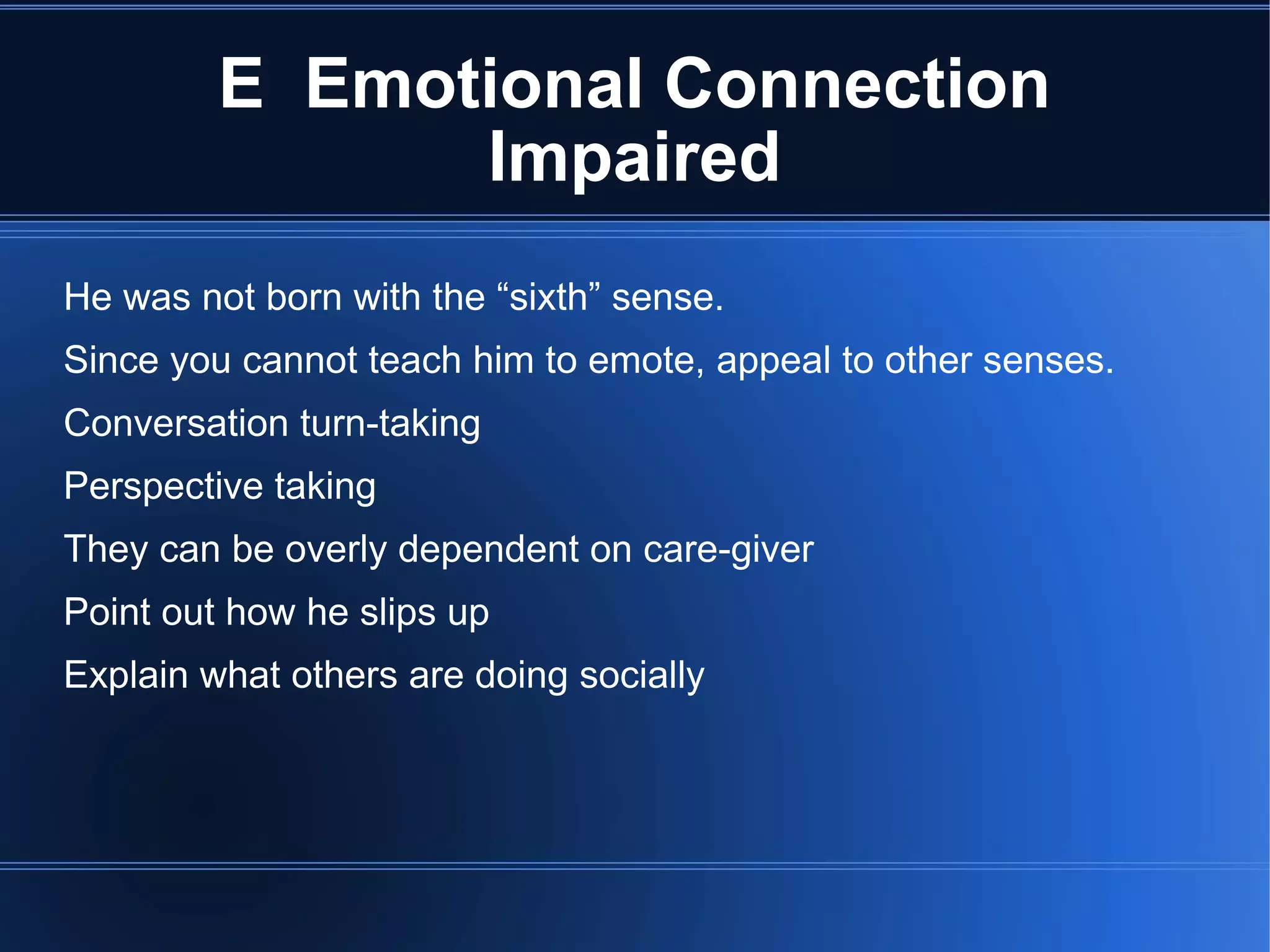
E  Emotional Connection Impaired He was not born with the “sixth” sense.  Since you cannot teach him to emote, appeal to other senses. Conversation turn-taking Perspective taking They can be overly dependent on care-giver Point out how he slips up Explain what others are doing socially
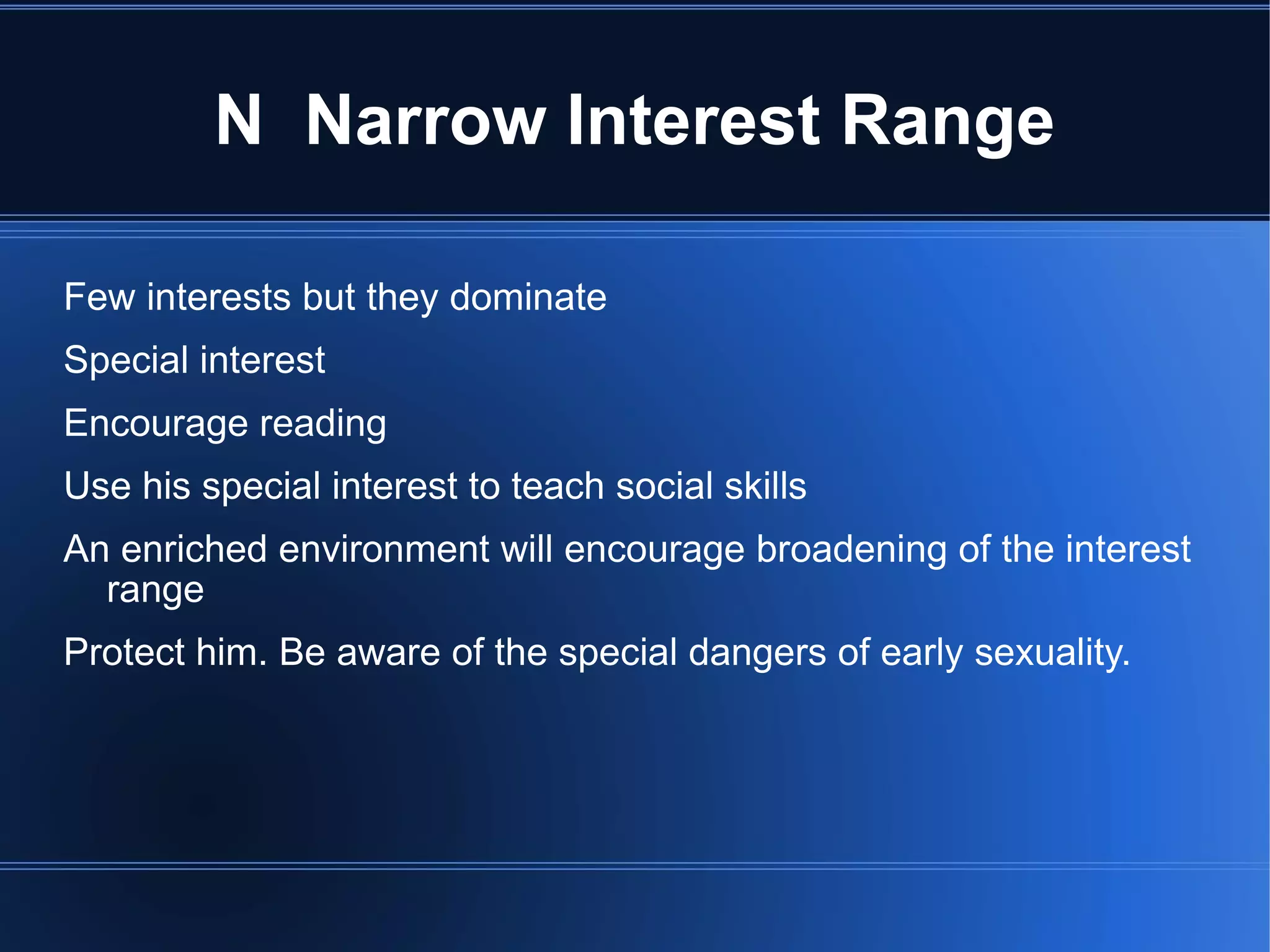
N  Narrow Interest Range Few interests but they dominate Special interest Encourage reading Use his special interest to teach social skills An enriched environment will encourage broadening of the interest range Protect him. Be aware of the special dangers of early sexuality.
C  Clumsy Motor Skills Let the schedule work for you Encourage trying new things
E  Environment Predictability Importance of structure and routine Talk about changes way before they happen so he can plan. If you have to be spontaneous, communicate to him  the reasons so he can have some control.
R  Rigidity of Thought Mindblindedness – inability to determine what others are thinking. They tend to take things literally. Need for time alone to reconstruct social interactions.
Instructional Ideas Be careful in classroom seating assignments Use the “peer buddy” system Avoid self-selection in group work Carefully consider the maturity of the group members involved Provide “safe haven” or quiet area Explain metaphor and sarcasm use concretely Use “social stories” for providing directions Vigorously but respectfully maintain class rules and other boundaries
Other treatments Parent education and training  Social skills training  Language therapy  Sensory integration training for younger children, usually performed by an occupational therapist, in which a child is desensitized to stimuli to which he is overly sensitive  Psychotherapy or behavioral/cognitive therapy for older children
Technology Visuals Graphics Models, manipulatives Computers The Internet

Aspergers Presentation for Special Education

  • 1.
  • 2.
    People with Autism"People with autism spend more time doing things they are not good at than anyone else." Toni Atwood
  • 3.
    Definition Asperger’s Syndrome(AS) is a developmental disability that is defined by impairments in social relationships, verbal and nonverbal communication, and by restrictive, repetitive patterns of behaviors, interests, and activities.
  • 4.
    Background Identified in1944 by Hans Asperger. (Austria)‏ Brought to the attention of the English-speaking world in 1980 by Dr. Lorna Wing. Was not added to the Diagnostic and Statistics Manual of the American Psychiatric Association until 1994. “ Autism’s Shadow”
  • 5.
    Causes There seemsto be a hereditary component Environmental factors that affect brain development might play a role Not caused by Emotional deprivation Bad parenting
  • 6.
    Incidence Rates inNew York 1 in every 91 children
  • 7.
    Increasing Prevalence Autism,strictly defined 4-6 in 10,000 prior to 1980’s (Lotter 1967)‏ 16-20 in 10,000 today (Chakrabarti & Fombonne 2001)‏ Autism spectrum disorders 10 in 10,000 in 1990’s (Bryson et al 1988)‏ 60-70 in 10,000 today (Chakrabarti & Fombonne 2001)‏
  • 8.
    Think SPENCER S Sensory Sensitivities P Pragmatic Language Skills Impaired E Emotional Connection N Narrow Interest Range C Clumsiness with Motor Skills E Environment that is Predictable R Rigidity of Thought
  • 9.
    S SensorySensitivities Don't excuse it or make the child feel bad about feeling bad Intense or under reactive to a sensation Clothing Slight bump by another Florescent lights Hug = squeeze
  • 10.
    P PragmaticSkills Impaired They see language as a way to share information They want to receive information correctly, sussincly and without emotion. May use diologue from pop culture to communicate They have a profound interest in words. Challenge him to memorize Provide music, theater and nonfiction books
  • 11.
    E EmotionalConnection Impaired He was not born with the “sixth” sense. Since you cannot teach him to emote, appeal to other senses. Conversation turn-taking Perspective taking They can be overly dependent on care-giver Point out how he slips up Explain what others are doing socially
  • 12.
    N NarrowInterest Range Few interests but they dominate Special interest Encourage reading Use his special interest to teach social skills An enriched environment will encourage broadening of the interest range Protect him. Be aware of the special dangers of early sexuality.
  • 13.
    C ClumsyMotor Skills Let the schedule work for you Encourage trying new things
  • 14.
    E EnvironmentPredictability Importance of structure and routine Talk about changes way before they happen so he can plan. If you have to be spontaneous, communicate to him the reasons so he can have some control.
  • 15.
    R Rigidityof Thought Mindblindedness – inability to determine what others are thinking. They tend to take things literally. Need for time alone to reconstruct social interactions.
  • 16.
    Instructional Ideas Becareful in classroom seating assignments Use the “peer buddy” system Avoid self-selection in group work Carefully consider the maturity of the group members involved Provide “safe haven” or quiet area Explain metaphor and sarcasm use concretely Use “social stories” for providing directions Vigorously but respectfully maintain class rules and other boundaries
  • 17.
    Other treatments Parenteducation and training Social skills training Language therapy Sensory integration training for younger children, usually performed by an occupational therapist, in which a child is desensitized to stimuli to which he is overly sensitive Psychotherapy or behavioral/cognitive therapy for older children
  • 18.
    Technology Visuals GraphicsModels, manipulatives Computers The Internet