Design of Precast Reinforced Concrete Structures
Chote Soranakom
Masoud Yekani Fard
Prof. Barzin Mobasher
FULTON
s c h o o l o f e n g i n e e r i n g
Outline
 Precast panels
– Ultimate and serviceability design
– SRP Design chart
 Cast in place water tanks
– Finite element analysis
– ASU design methodology
 Fiber reinforced concrete slab
– Round panel tests
– Full scale testing of flat slab
– Finite element simulation of flat slab
FULTON
s c h o o l o f e n g i n e e r i n g
Pre-cast panels
 Panels are made of plain concrete and steel rebar to be
installed on site
FULTON
s c h o o l o f e n g i n e e r i n g
Installation of pre-cast water tank
 Panels are
assembled on
site
 The wall joints
are connected
using bolts and
epoxy
 The base slab is
connected to the
periphery walls by
friction through
slots
FULTON
s c h o o l o f e n g i n e e r i n g
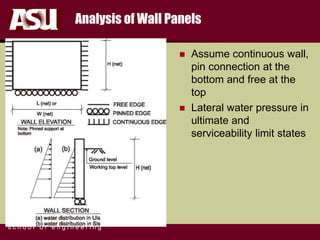
Analysis of Wall Panels
 Assume continuous wall,
pin connection at the
bottom and free at the
top
 Lateral water pressure in
ultimate and
serviceability limit states
FULTON
s c h o o l o f e n g i n e e r i n g
Critical Internal Forces
 Critical moment,
shear, and axial
forces
– Horizontal
– Vertical
 Design thickness
and reinforcement
for both
– Ultimate
– Serviceability
FULTON
s c h o o l o f e n g i n e e r i n g
SRP Design Chart
 The thickness
and reinforcing
mesh for
panels of tanks
with different
dimensions
 Design using
ACI ultimate
limit state
0 10 20 30
Maximum Clear Span (ft)
0
5
10
15
20
EffectiveDepth(ft)(finighgradetofloor)
Over strength
Needs more
reinforcement
Reinforcement and
thickness is okay
3
2
1 4
5
1
4
3
2
5
6" wall with # 4@ 12"
6" wall with # 4@ 6"
8" wall with # 5@ 12"
8" wall with # 5@ 6"
Analysis required
FULTON
s c h o o l o f e n g i n e e r i n g
Cast in Place Water Tank
 For small dimension, the
cast in place water tank
is usually used.
FULTON
s c h o o l o f e n g i n e e r i n g
Finite Element Analysis
 Lateral loading
– Water
– Earth pressure
– Surcharge
 Finite element model
– Shell elements
FULTON
s c h o o l o f e n g i n e e r i n g
Analysis Results
 Load Case1:
– 1.4 Self weight +
1.4 Water pressure
– Moment in short span
direction SM1
 Load Case2:
– 1.4 Self weight +
1.7 Earth pressure +
1.7 Uniform pressure due to surcharge
– Moment in short span direction SM1
FULTON
s c h o o l o f e n g i n e e r i n g
Material Models
 (a) rectangular cross
section
 (b) tension model
 (c) compression model
 (d) steel model
FULTON
s c h o o l o f e n g i n e e r i n g
Simplified Design Equation
0 1 2 3
Normalized Ultimate Moment, M'u
0
1
2
3
NormalizedMomentatInfinity,M'
0
1
2
3
M
'
=
3/(+)
3
'M

  

21
6
cr crM bd
0.90 'u crM M M 
where
For plain strain softening FRC only
FULTON
s c h o o l o f e n g i n e e r i n g
Concrete Flat Slab
 Flat slab was constructed by only fiber reinforced
concrete in France
FULTON
s c h o o l o f e n g i n e e r i n g
Round Panel Test
 Fiber reinforced concrete round panel tests were conducted to
evaluate post crack tensile strength capacity
(a) (b)
FULTON
s c h o o l o f e n g i n e e r i n g
Construction and Field Testing
 Cast in place SFRC
 Use minimum reinforcement along the column lines to
prevent progressive collapse
FULTON
s c h o o l o f e n g i n e e r i n g
Inverse Analysis of Round Panel Tests
 Tensile stress crack width were obtained by inverse
analysis, using finite element method
– Mix Vf=80 kg/m3
– Mix Vf=100 kg/m3
0 10 20 30
Deflection (mm)
0
50
100
150
200
Load(kN)
Experiment Vf 100 kg/m3
Simulation Vf 100 kg/m3
Experiment Vf 80 kg/m3
Simulation Vf80kg/m3
0 0.5 1 1.5 2
Crack Width (mm)
0
0.5
1
1.5
2
2.5
TensileStress(MPa)
Vf 100 kg/m3
Vf 80 kg/m3
E=20,000 MPa, =0.15
(Vf=80kg/m3)
E=24,000 MPa, =0.15
(Vf=100kg/m3)
(a) (b)
FULTON
s c h o o l o f e n g i n e e r i n g
Full Scale Testing of Concrete Flat Slab
 Point load was applied at the center panel
 Deflections were measured and crack patterns were
monitored
FULTON
s c h o o l o f e n g i n e e r i n g
Finite Element Model
 For efficiency reason, model the slab for only the upper
quarter
FULTON
s c h o o l o f e n g i n e e r i n g
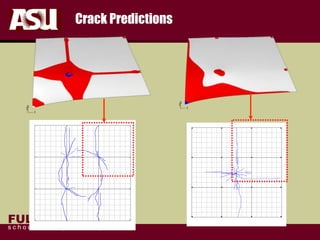
Crack Predictions
Oberseite - ULS Mittellast
S
N
West Ost
Unterseite
S
N
WestOst
Durchgezogen: bis 200 kN
gestrichelt: bis Brucklast
FULTON
s c h o o l o f e n g i n e e r i n g
Septic Tanks
FULTON
s c h o o l o f e n g i n e e r i n g
FULTON
s c h o o l o f e n g i n e e r i n g
Full Capacity Testing
FULTON
s c h o o l o f e n g i n e e r i n g
Conclusions
 Fiber reinforced concrete can be used in
precast and cast in place structural
element
 ASU has developed the model and
design methodology for structural
members
FULTON
s c h o o l o f e n g i n e e r i n g
References
 Soranakom, C., and Mobasher, B., “Closed-Form
Solutions for Flexural Response of Fiber-Reinforced
Concrete Beams,” Journal of Engineering Mechanics,
Vol. 133, No. 8, August, 2007, pp. 933-941.
 Soranakom, C., and Mobasher, B., “Analytical Modeling
of Fiber Reinforced Concrete with and without
Conventional Steel Rebar” Journal of Structural
Engineering, (in press)
 Soranakom, C., and Mobasher, B., Destrée, X..,
“Numerical Simulation of FRC Round Panel Tests and
Full-Scale Elevated Slabs,” ACI SP-248-3, Deflection
and Stiffness Issues in FRC and Thin Structural
Elements, October 2007, pp. 31-40.
 Bernard E.S., “Behaviour of Round Steel Fibre
Reinforced Concrete Panels under Point Loads,”
Materials and Structures, Vol.33 Apr 2000, pp.181-188.
 ACI Committee 318, Building Code Requirements for
Structural Concrete (ACI 318-02) and Commentary
(ACI 318R-02), American Concrete Institute,
Formington Hills MI,various editions

Frc pre cast_system_condensed

  • 1.
    Design of PrecastReinforced Concrete Structures Chote Soranakom Masoud Yekani Fard Prof. Barzin Mobasher
  • 2.
    FULTON s c ho o l o f e n g i n e e r i n g Outline  Precast panels – Ultimate and serviceability design – SRP Design chart  Cast in place water tanks – Finite element analysis – ASU design methodology  Fiber reinforced concrete slab – Round panel tests – Full scale testing of flat slab – Finite element simulation of flat slab
  • 3.
    FULTON s c ho o l o f e n g i n e e r i n g Pre-cast panels  Panels are made of plain concrete and steel rebar to be installed on site
  • 4.
    FULTON s c ho o l o f e n g i n e e r i n g Installation of pre-cast water tank  Panels are assembled on site  The wall joints are connected using bolts and epoxy  The base slab is connected to the periphery walls by friction through slots
  • 5.
    FULTON s c ho o l o f e n g i n e e r i n g Analysis of Wall Panels  Assume continuous wall, pin connection at the bottom and free at the top  Lateral water pressure in ultimate and serviceability limit states
  • 6.
    FULTON s c ho o l o f e n g i n e e r i n g Critical Internal Forces  Critical moment, shear, and axial forces – Horizontal – Vertical  Design thickness and reinforcement for both – Ultimate – Serviceability
  • 7.
    FULTON s c ho o l o f e n g i n e e r i n g SRP Design Chart  The thickness and reinforcing mesh for panels of tanks with different dimensions  Design using ACI ultimate limit state 0 10 20 30 Maximum Clear Span (ft) 0 5 10 15 20 EffectiveDepth(ft)(finighgradetofloor) Over strength Needs more reinforcement Reinforcement and thickness is okay 3 2 1 4 5 1 4 3 2 5 6" wall with # 4@ 12" 6" wall with # 4@ 6" 8" wall with # 5@ 12" 8" wall with # 5@ 6" Analysis required
  • 8.
    FULTON s c ho o l o f e n g i n e e r i n g Cast in Place Water Tank  For small dimension, the cast in place water tank is usually used.
  • 9.
    FULTON s c ho o l o f e n g i n e e r i n g Finite Element Analysis  Lateral loading – Water – Earth pressure – Surcharge  Finite element model – Shell elements
  • 10.
    FULTON s c ho o l o f e n g i n e e r i n g Analysis Results  Load Case1: – 1.4 Self weight + 1.4 Water pressure – Moment in short span direction SM1  Load Case2: – 1.4 Self weight + 1.7 Earth pressure + 1.7 Uniform pressure due to surcharge – Moment in short span direction SM1
  • 11.
    FULTON s c ho o l o f e n g i n e e r i n g Material Models  (a) rectangular cross section  (b) tension model  (c) compression model  (d) steel model
  • 12.
    FULTON s c ho o l o f e n g i n e e r i n g Simplified Design Equation 0 1 2 3 Normalized Ultimate Moment, M'u 0 1 2 3 NormalizedMomentatInfinity,M' 0 1 2 3 M ' = 3/(+) 3 'M      21 6 cr crM bd 0.90 'u crM M M  where For plain strain softening FRC only
  • 13.
    FULTON s c ho o l o f e n g i n e e r i n g Concrete Flat Slab  Flat slab was constructed by only fiber reinforced concrete in France
  • 14.
    FULTON s c ho o l o f e n g i n e e r i n g Round Panel Test  Fiber reinforced concrete round panel tests were conducted to evaluate post crack tensile strength capacity (a) (b)
  • 15.
    FULTON s c ho o l o f e n g i n e e r i n g Construction and Field Testing  Cast in place SFRC  Use minimum reinforcement along the column lines to prevent progressive collapse
  • 16.
    FULTON s c ho o l o f e n g i n e e r i n g Inverse Analysis of Round Panel Tests  Tensile stress crack width were obtained by inverse analysis, using finite element method – Mix Vf=80 kg/m3 – Mix Vf=100 kg/m3 0 10 20 30 Deflection (mm) 0 50 100 150 200 Load(kN) Experiment Vf 100 kg/m3 Simulation Vf 100 kg/m3 Experiment Vf 80 kg/m3 Simulation Vf80kg/m3 0 0.5 1 1.5 2 Crack Width (mm) 0 0.5 1 1.5 2 2.5 TensileStress(MPa) Vf 100 kg/m3 Vf 80 kg/m3 E=20,000 MPa, =0.15 (Vf=80kg/m3) E=24,000 MPa, =0.15 (Vf=100kg/m3) (a) (b)
  • 17.
    FULTON s c ho o l o f e n g i n e e r i n g Full Scale Testing of Concrete Flat Slab  Point load was applied at the center panel  Deflections were measured and crack patterns were monitored
  • 18.
    FULTON s c ho o l o f e n g i n e e r i n g Finite Element Model  For efficiency reason, model the slab for only the upper quarter
  • 19.
    FULTON s c ho o l o f e n g i n e e r i n g Crack Predictions Oberseite - ULS Mittellast S N West Ost Unterseite S N WestOst Durchgezogen: bis 200 kN gestrichelt: bis Brucklast
  • 20.
    FULTON s c ho o l o f e n g i n e e r i n g Septic Tanks
  • 21.
    FULTON s c ho o l o f e n g i n e e r i n g
  • 22.
    FULTON s c ho o l o f e n g i n e e r i n g Full Capacity Testing
  • 23.
    FULTON s c ho o l o f e n g i n e e r i n g Conclusions  Fiber reinforced concrete can be used in precast and cast in place structural element  ASU has developed the model and design methodology for structural members
  • 24.
    FULTON s c ho o l o f e n g i n e e r i n g References  Soranakom, C., and Mobasher, B., “Closed-Form Solutions for Flexural Response of Fiber-Reinforced Concrete Beams,” Journal of Engineering Mechanics, Vol. 133, No. 8, August, 2007, pp. 933-941.  Soranakom, C., and Mobasher, B., “Analytical Modeling of Fiber Reinforced Concrete with and without Conventional Steel Rebar” Journal of Structural Engineering, (in press)  Soranakom, C., and Mobasher, B., Destrée, X.., “Numerical Simulation of FRC Round Panel Tests and Full-Scale Elevated Slabs,” ACI SP-248-3, Deflection and Stiffness Issues in FRC and Thin Structural Elements, October 2007, pp. 31-40.  Bernard E.S., “Behaviour of Round Steel Fibre Reinforced Concrete Panels under Point Loads,” Materials and Structures, Vol.33 Apr 2000, pp.181-188.  ACI Committee 318, Building Code Requirements for Structural Concrete (ACI 318-02) and Commentary (ACI 318R-02), American Concrete Institute, Formington Hills MI,various editions