Auditing for Fraud – Cases and Applications Presentation for Miami-Dade Chapter - FICPA June 23, 2009 Dr. Raymond S. Kulzick, CPA, CFE, CFF, CDFA, FCPA St. Thomas University Kulzick Consulting, PA Information in this presentation is believed to be reliable at the time of the presentation; but the authors do not assume any responsibility for its use and it should not be relied upon as authoritative. Illustrations are for educational purposes only and do not include all facts & circumstances.
Ray Kulzick  Kulzick Consulting, PA Forensic Accounting Divorce Fraud Business Damages Data Analysis for Litigation
Outline Fraud Audit & Accounting Standards SAS 99 Required Approach Understanding the Risks Financial Statement Fraud Cases & Examples 5 major types of financial statement fraud Conclusions
Financial Statement Fraud “Intentional misstatements or omissions of amounts or disclosures in financial statements designed to deceive FS users where the effect causes the FS not to be presented … in conformity with … GAAP.” – SAS 99 “We lie about what we owe and we lie about what we earn.” – Barry Minkow 1/05
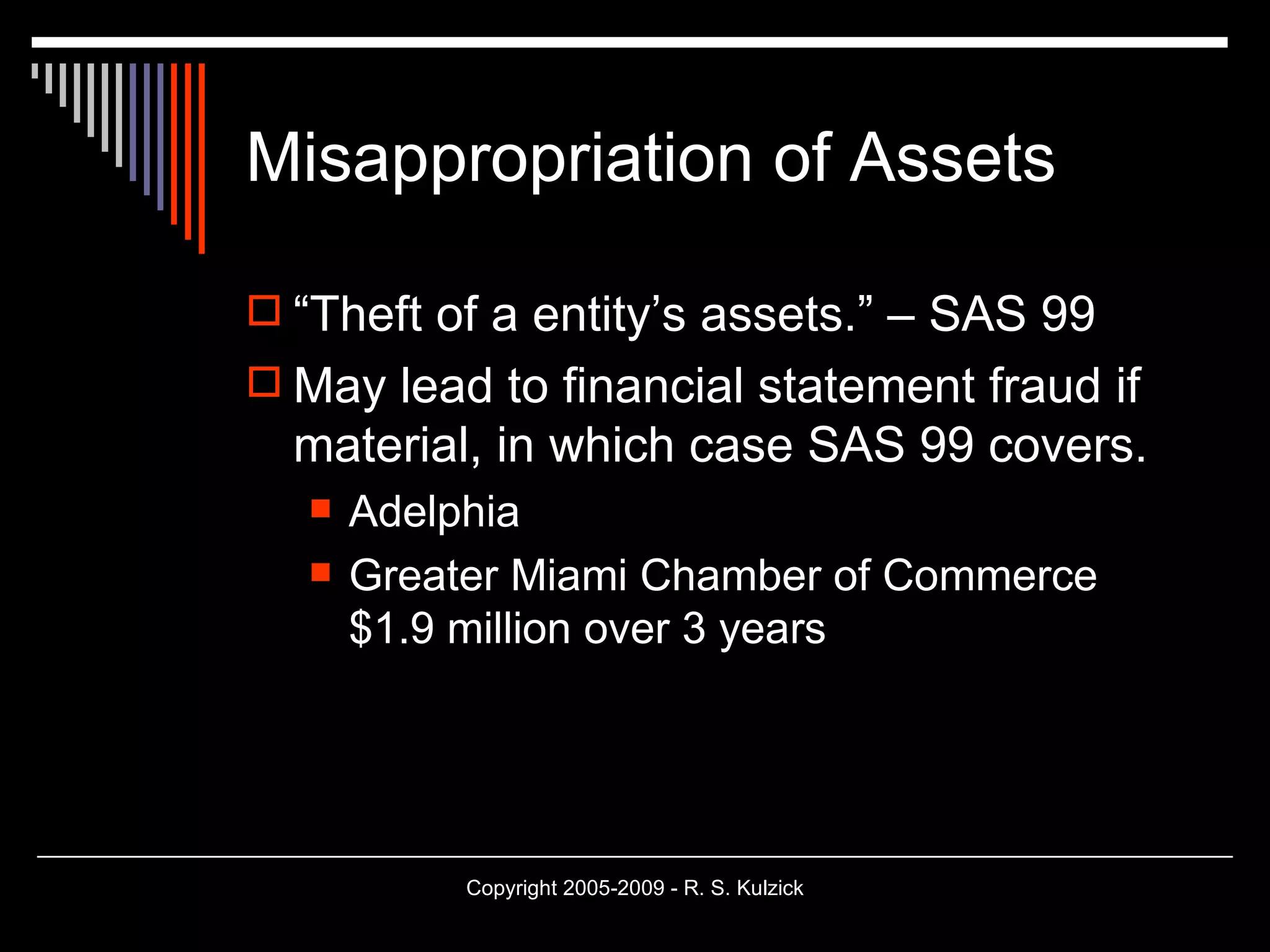
Misappropriation of Assets “Theft of a entity’s assets.” – SAS 99 May lead to financial statement fraud if material, in which case SAS 99 covers. Adelphia  Greater Miami Chamber of Commerce $1.9 million over 3 years
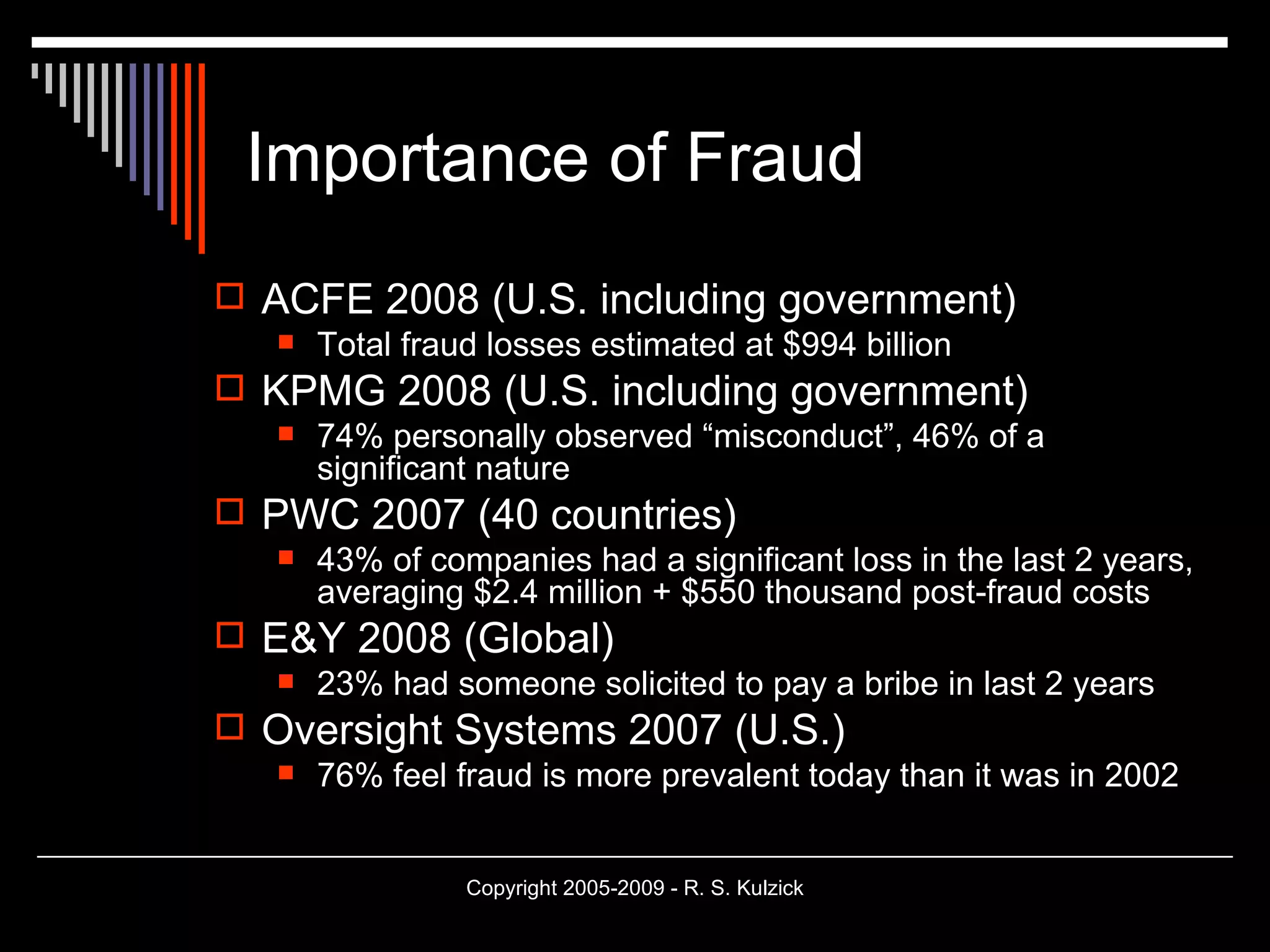
Importance of Fraud ACFE 2008 (U.S. including government) Total fraud losses estimated at $994 billion KPMG 2008 (U.S. including government) 74% personally observed “misconduct”, 46% of a significant nature PWC 2007 (40 countries) 43% of companies had a significant loss in the last 2 years, averaging $2.4 million + $550 thousand post-fraud costs E&Y 2008 (Global) 23% had someone solicited to pay a bribe in last 2 years Oversight Systems 2007 (U.S.) 76% feel fraud is more prevalent today than it was in 2002
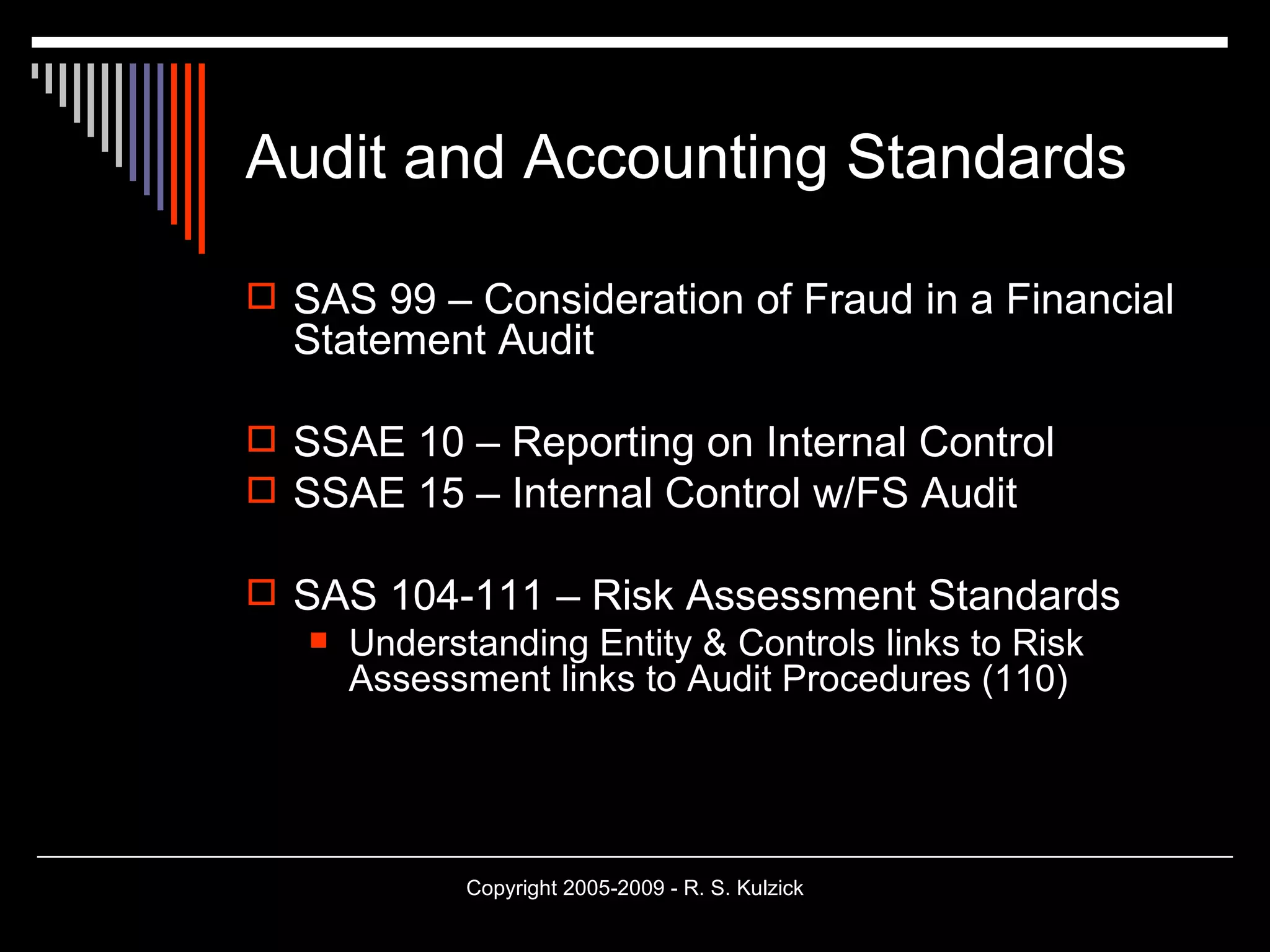
Audit and Accounting Standards SAS 99 – Consideration of Fraud in a Financial Statement Audit SSAE 10 – Reporting on Internal Control SSAE 15 – Internal Control w/FS Audit SAS 104-111 – Risk Assessment Standards Understanding Entity & Controls links to Risk Assessment links to Audit Procedures (110)
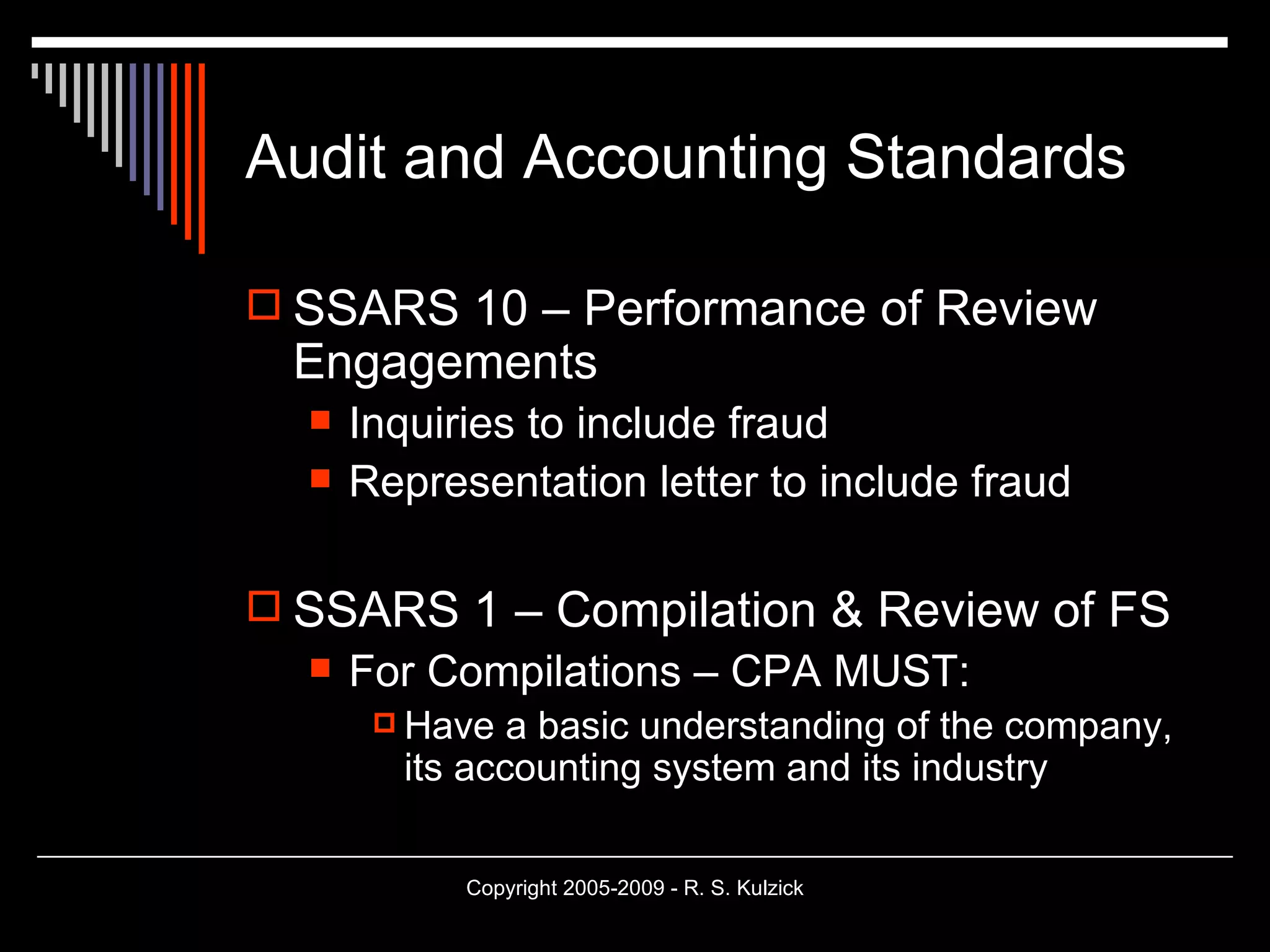
Audit and Accounting Standards SSARS 10 – Performance of Review Engagements Inquiries to include fraud Representation letter to include fraud SSARS 1 – Compilation & Review of FS For Compilations – CPA MUST: Have a basic understanding of the company, its accounting system and its industry
Current Economic Issues January, 2009 – AICPA issued a audit risk alert on Going Concern Issues in the current environment. March, 2009 – AICPA Audit Practice Bulletin:  “ The audit profession should continue to exercise vigilance and rigor under the current economic climate.” Specific suggestions in Appendix, including fraud considerations
8 Steps for SAS 99 Discussion among engagement personnel Obtaining the information needed to identify the risks of material misstatement due to fraud Identifying risks that may result in a material misstatement due to fraud
8 Steps for SAS 99 Assessing identified risks after assessing and taking into account controls Responding to the results of the assessment Evaluating audit evidence Communicating about possible fraud Documenting the auditor’s consideration of fraud
Understand the Risks - Business and Industry What does the business do? How does it do it? How do competitors do it? What is the competitive situation? Who are the customers? Why do they buy from this company? Who are the vendors? What are the vendor customs in this industry?
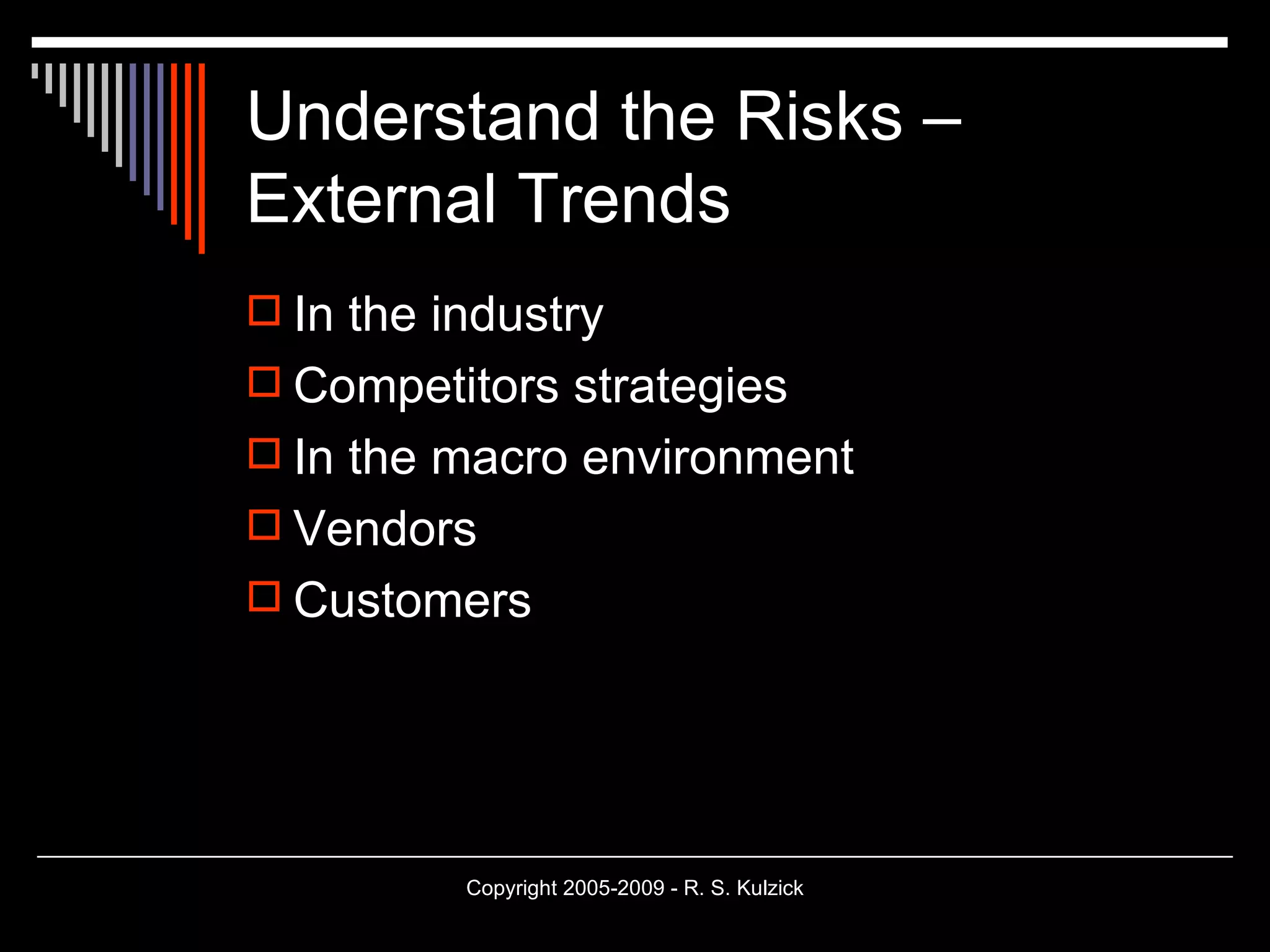
Understand the Risks –  External Trends In the industry Competitors strategies In the macro environment Vendors Customers
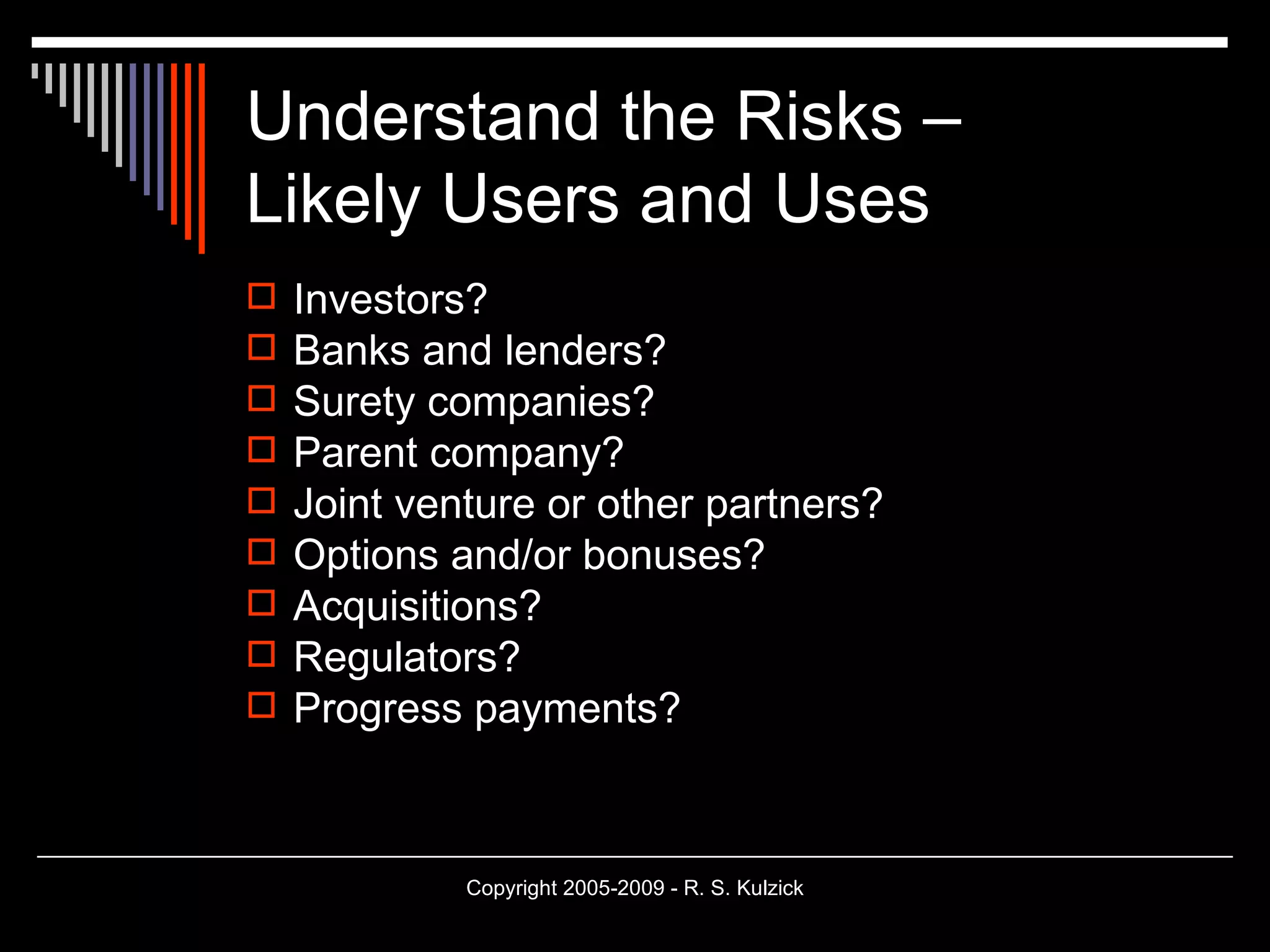
Understand the Risks –  Likely Users and Uses Investors? Banks and lenders? Surety companies? Parent company? Joint venture or other partners? Options and/or bonuses? Acquisitions? Regulators? Progress payments?
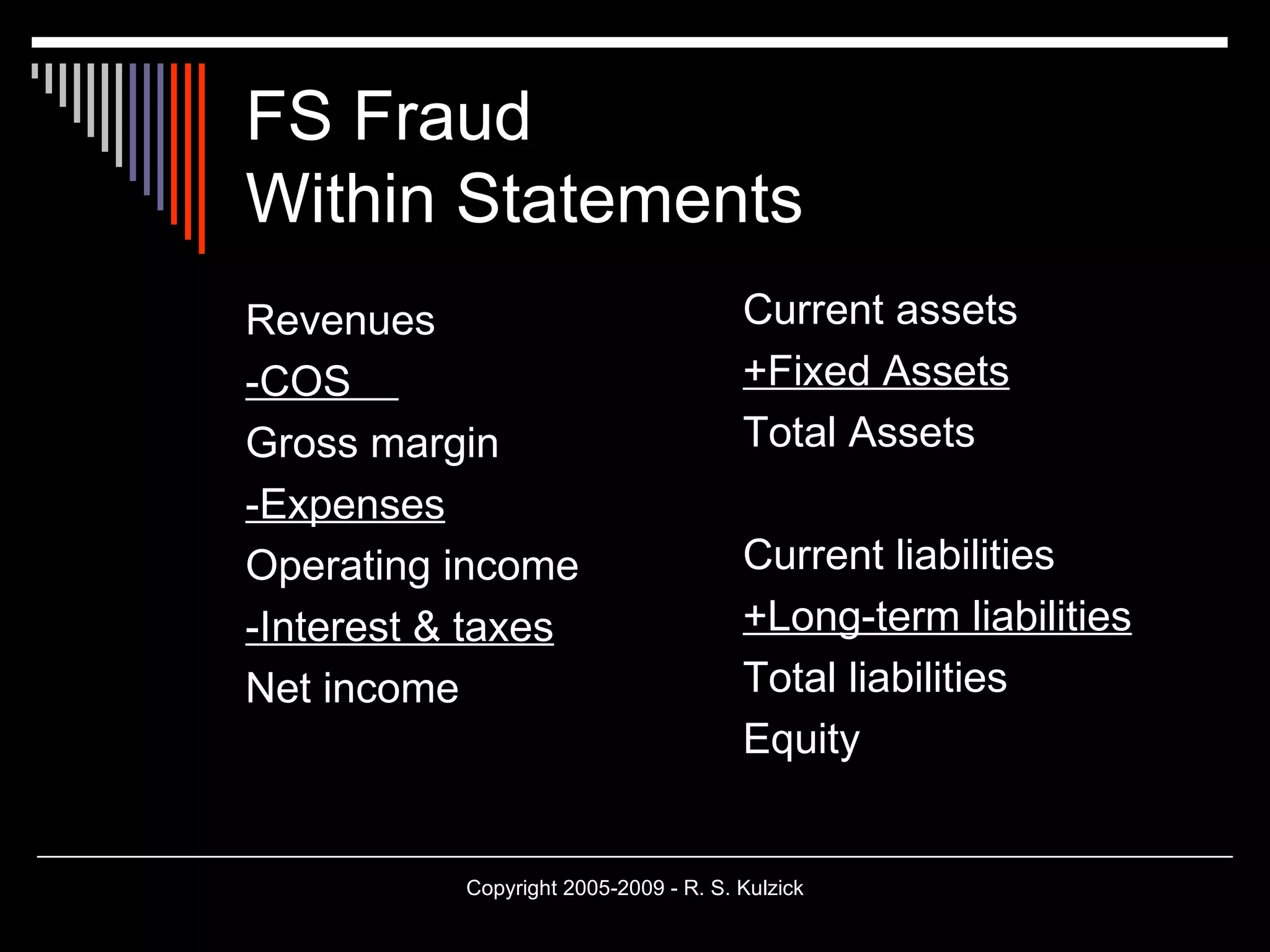
FS Fraud Within Statements Revenues -COS  Gross margin -Expenses Operating income -Interest & taxes Net income Current assets +Fixed Assets Total Assets Current liabilities +Long-term liabilities Total liabilities Equity
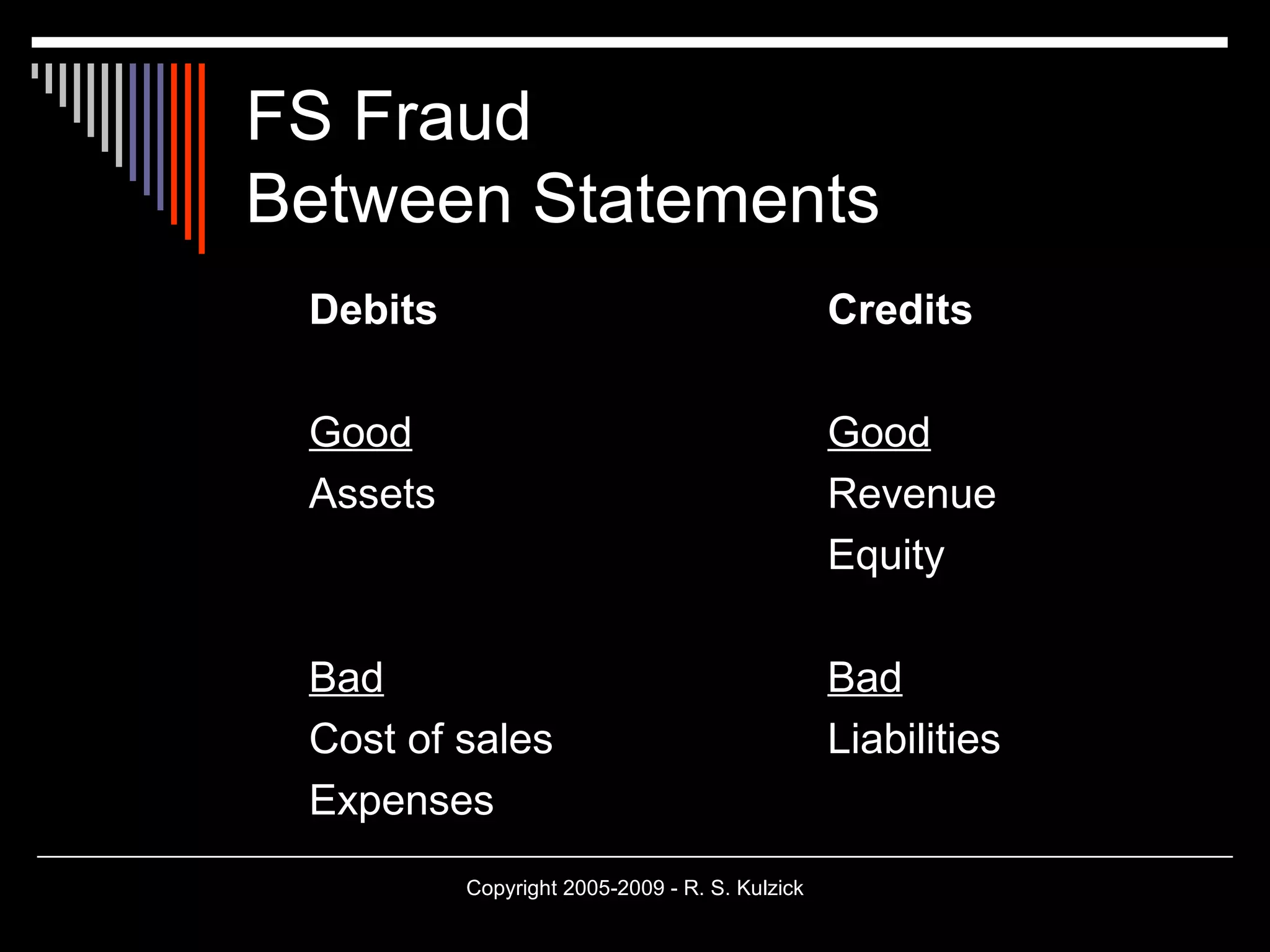
FS Fraud Between Statements Debits Good Assets Bad Cost of sales Expenses Credits Good Revenue Equity Bad Liabilities
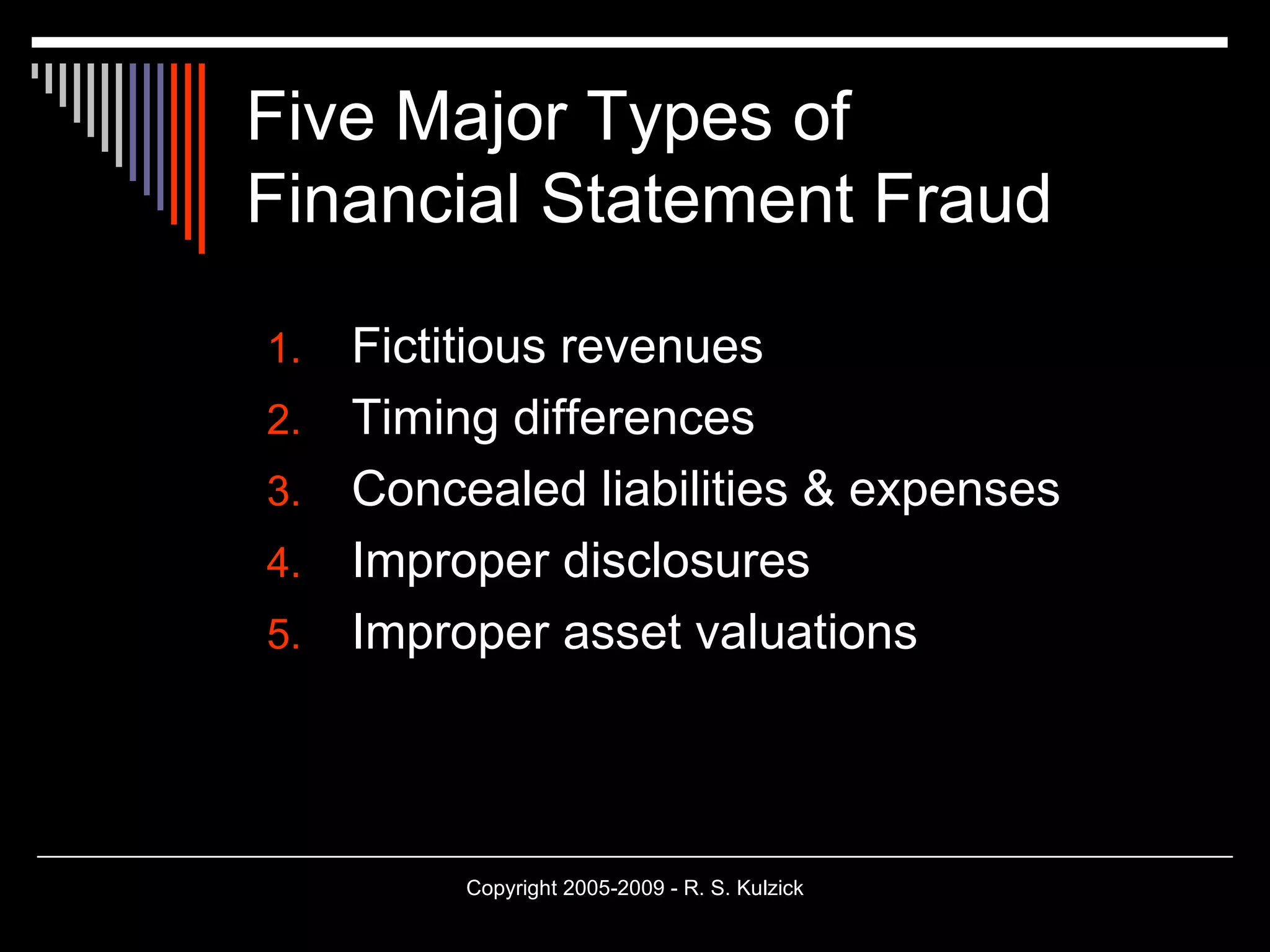
Five Major Types of Financial Statement Fraud Fictitious revenues Timing differences Concealed liabilities & expenses Improper disclosures Improper asset valuations
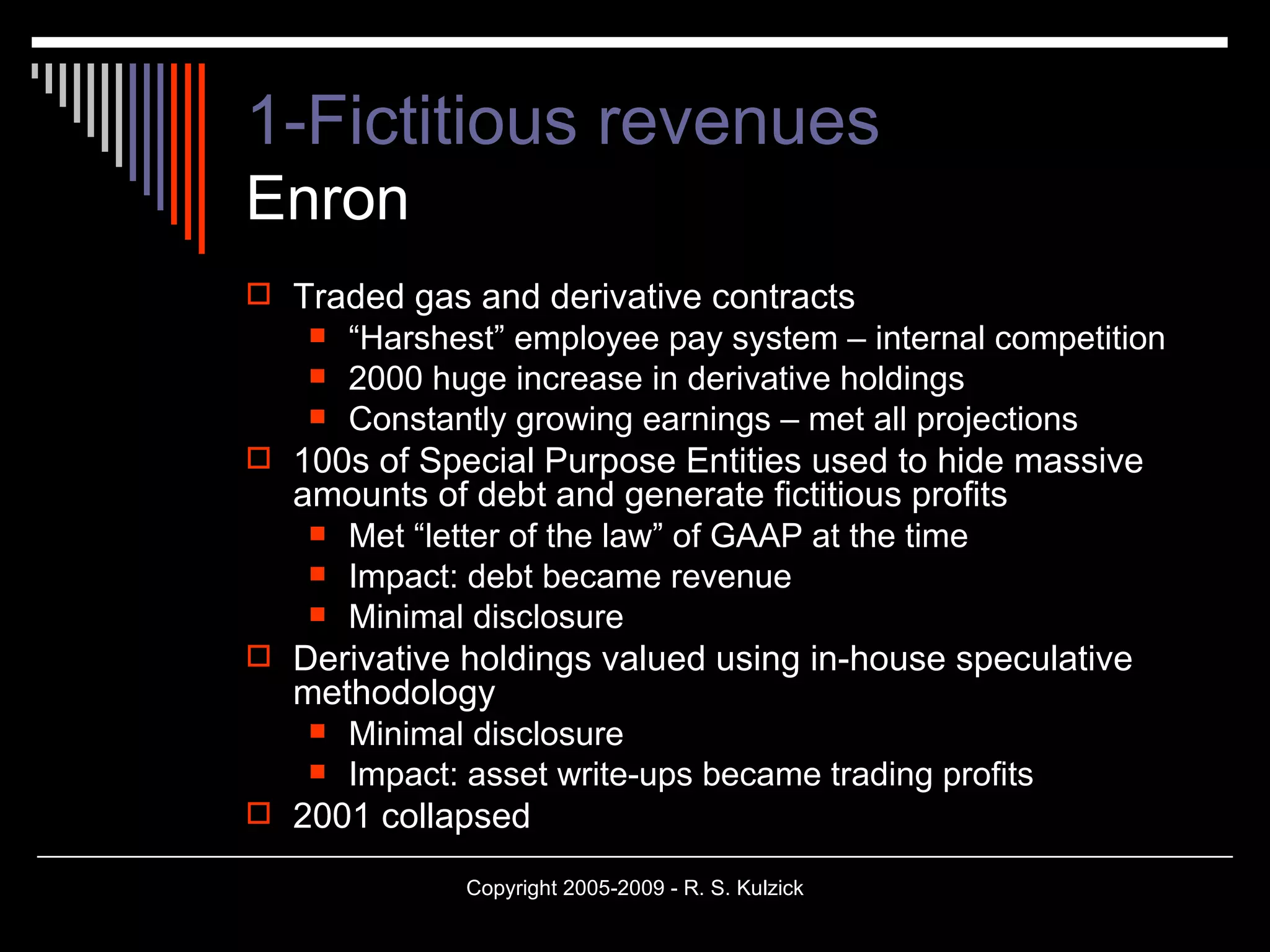
1-Fictitious revenues   Enron Traded gas and derivative contracts “ Harshest” employee pay system – internal competition 2000 huge increase in derivative holdings Constantly growing earnings – met all projections 100s of Special Purpose Entities used to hide massive amounts of debt and generate fictitious profits Met “letter of the law” of GAAP at the time Impact: debt became revenue Minimal disclosure Derivative holdings valued using in-house speculative methodology Minimal disclosure Impact: asset write-ups became trading profits 2001 collapsed
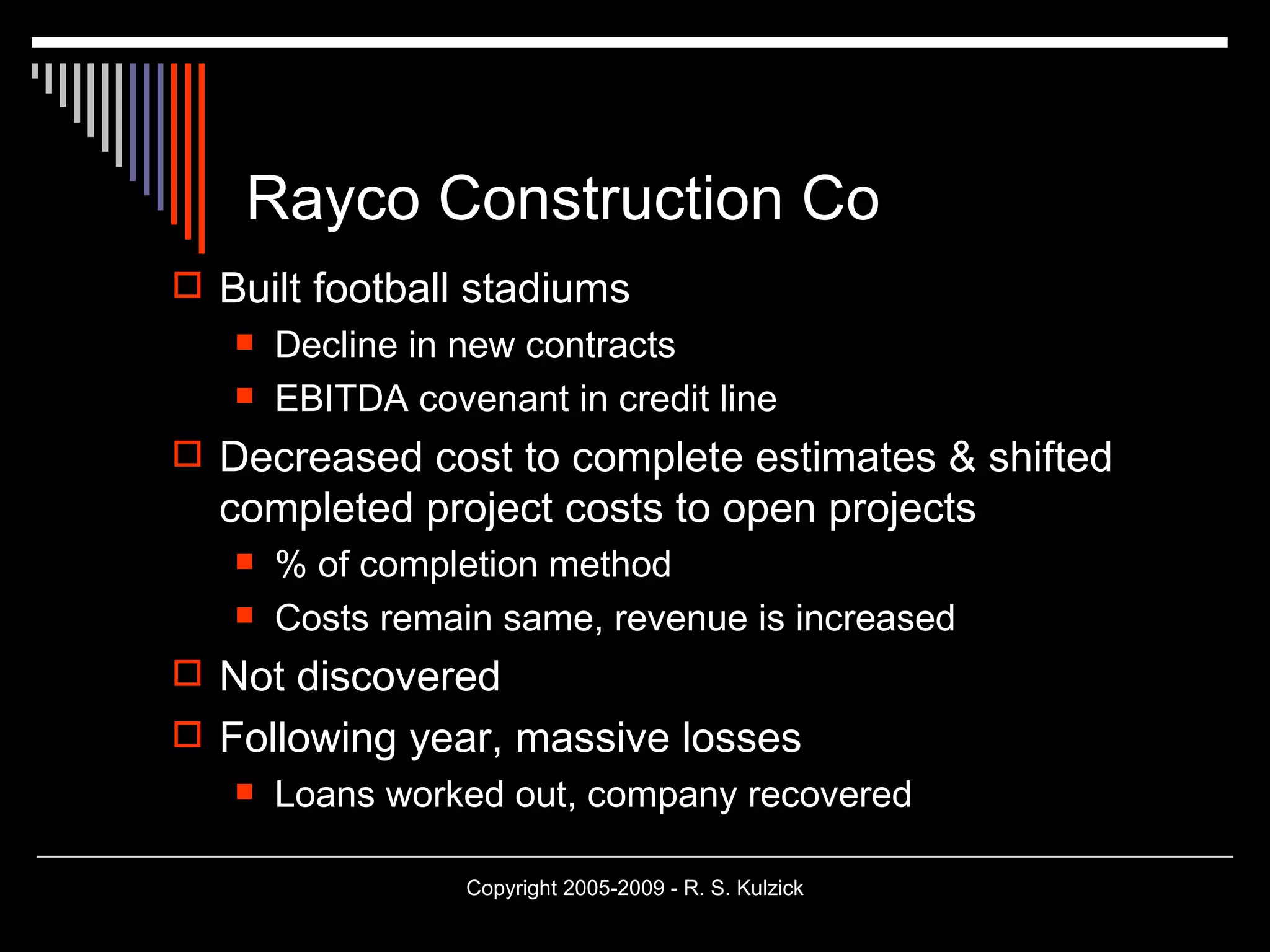
Rayco Construction Co Built football stadiums Decline in new contracts EBITDA covenant in credit line Decreased cost to complete estimates & shifted completed project costs to open projects % of completion method Costs remain same, revenue is increased Not discovered Following year, massive losses Loans worked out, company recovered
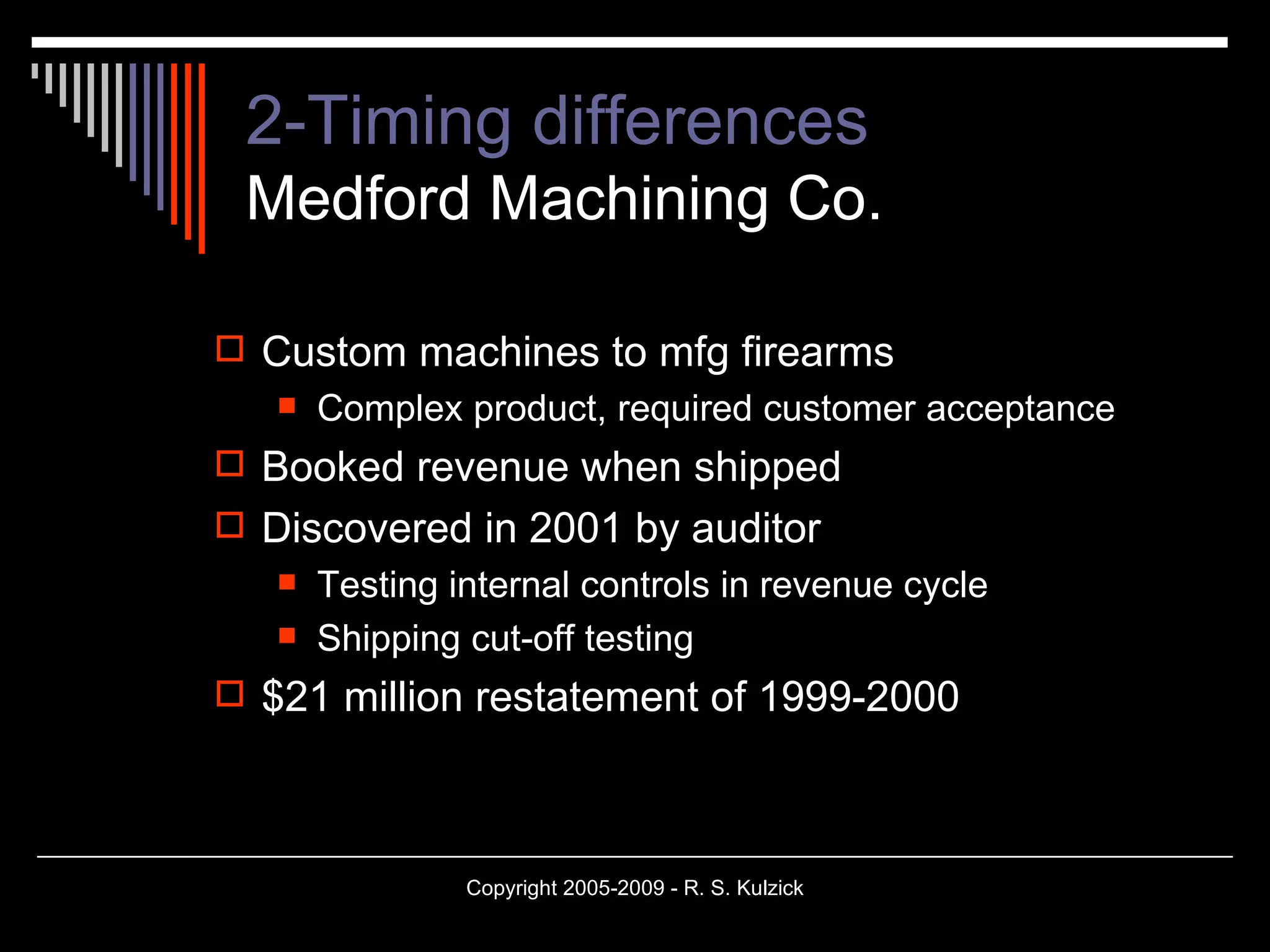
2-Timing differences Medford Machining Co. Custom machines to mfg firearms Complex product, required customer acceptance Booked revenue when shipped Discovered in 2001 by auditor Testing internal controls in revenue cycle Shipping cut-off testing $21 million restatement of 1999-2000
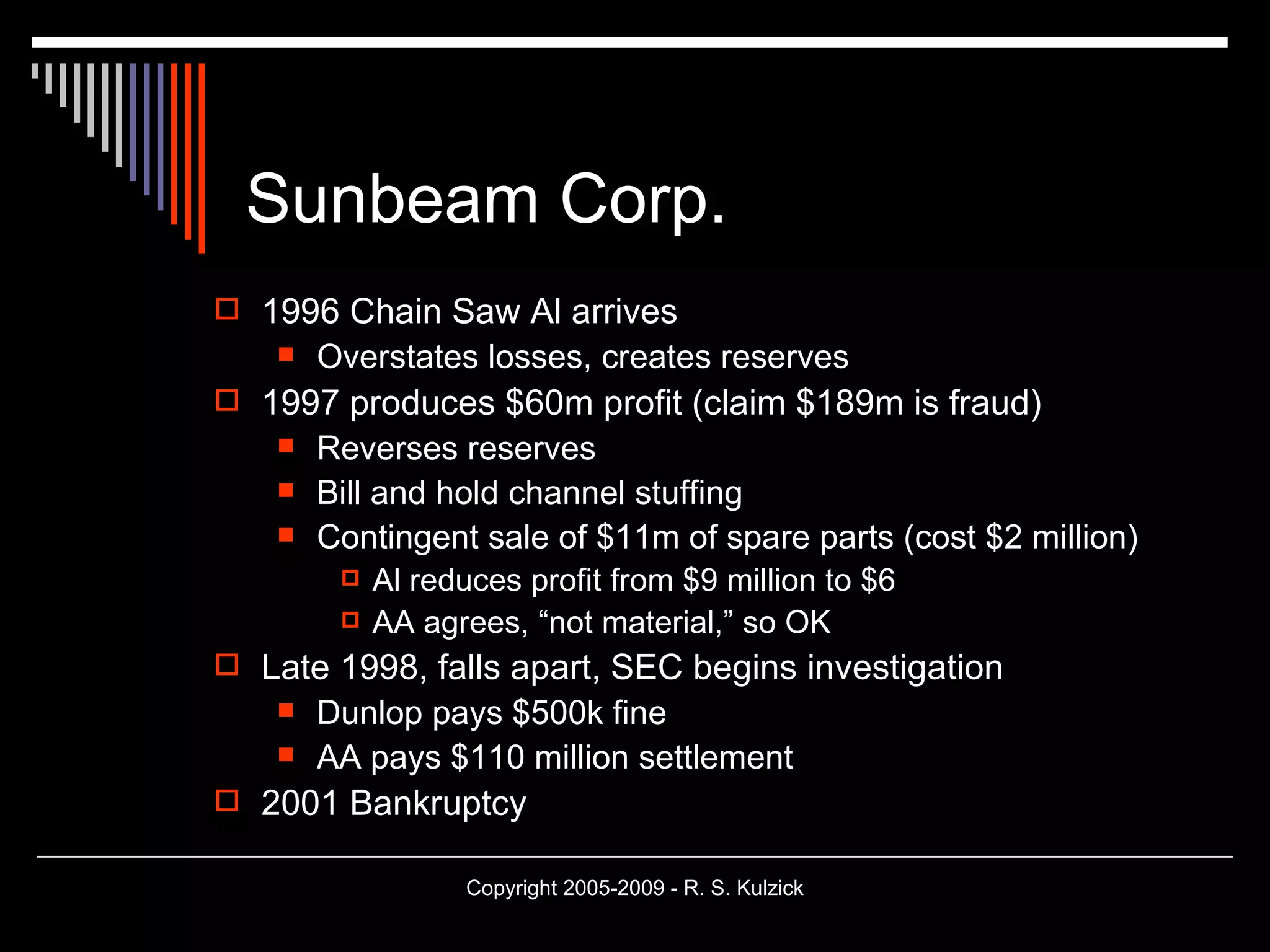
Sunbeam Corp. 1996 Chain Saw Al arrives Overstates losses, creates reserves 1997 produces $60m profit (claim $189m is fraud) Reverses reserves Bill and hold channel stuffing Contingent sale of $11m of spare parts (cost $2 million) Al reduces profit from $9 million to $6 AA agrees, “not material,” so OK Late 1998, falls apart, SEC begins investigation  Dunlop pays $500k fine AA pays $110 million settlement 2001 Bankruptcy
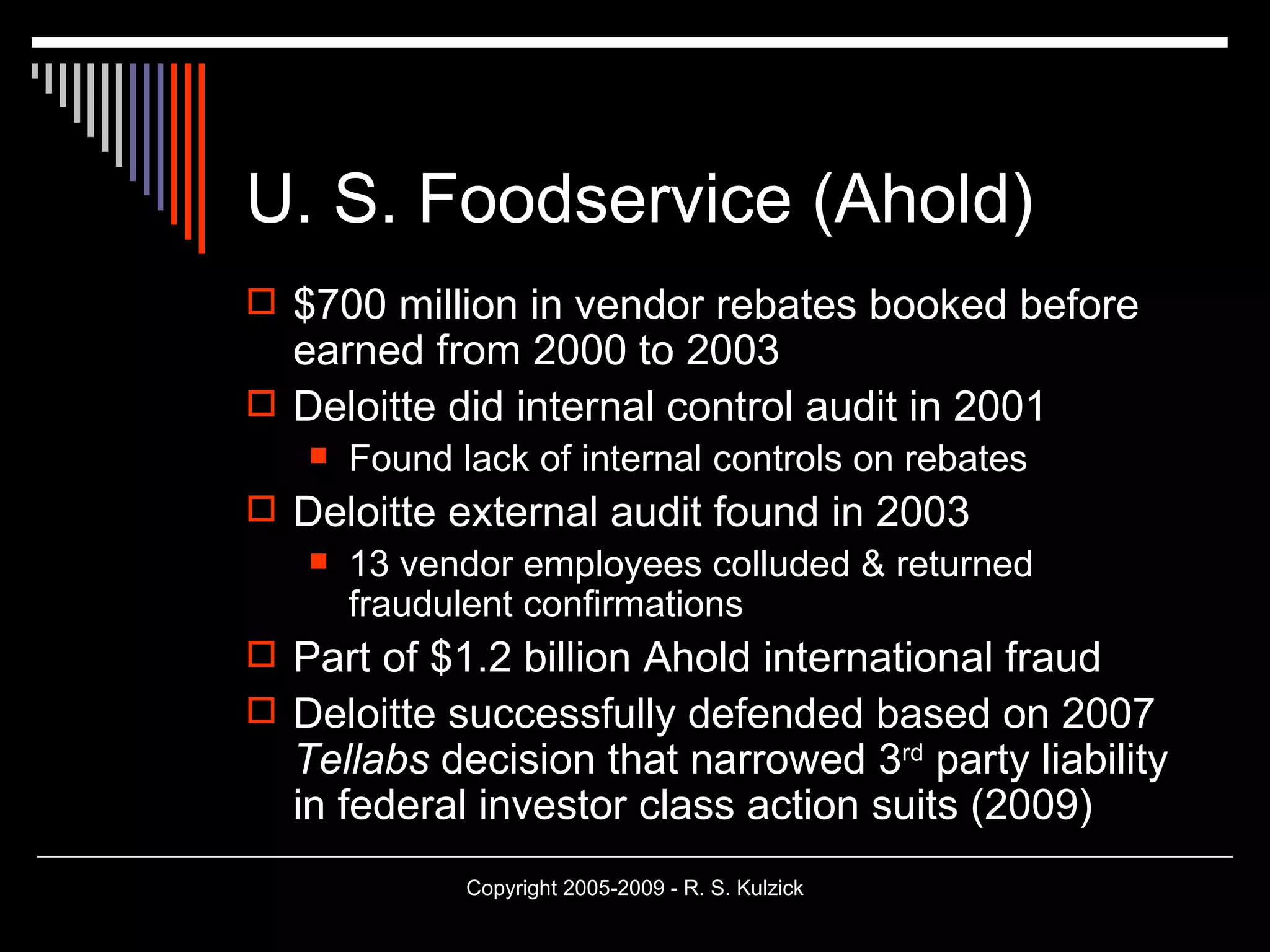
U. S. Foodservice (Ahold) $700 million in vendor rebates booked before earned from 2000 to 2003 Deloitte did internal control audit in 2001 Found lack of internal controls on rebates Deloitte external audit found in 2003 13 vendor employees colluded & returned fraudulent confirmations Part of $1.2 billion Ahold international fraud Deloitte successfully defended based on 2007  Tellabs  decision that narrowed 3 rd  party liability in federal investor class action suits (2009)
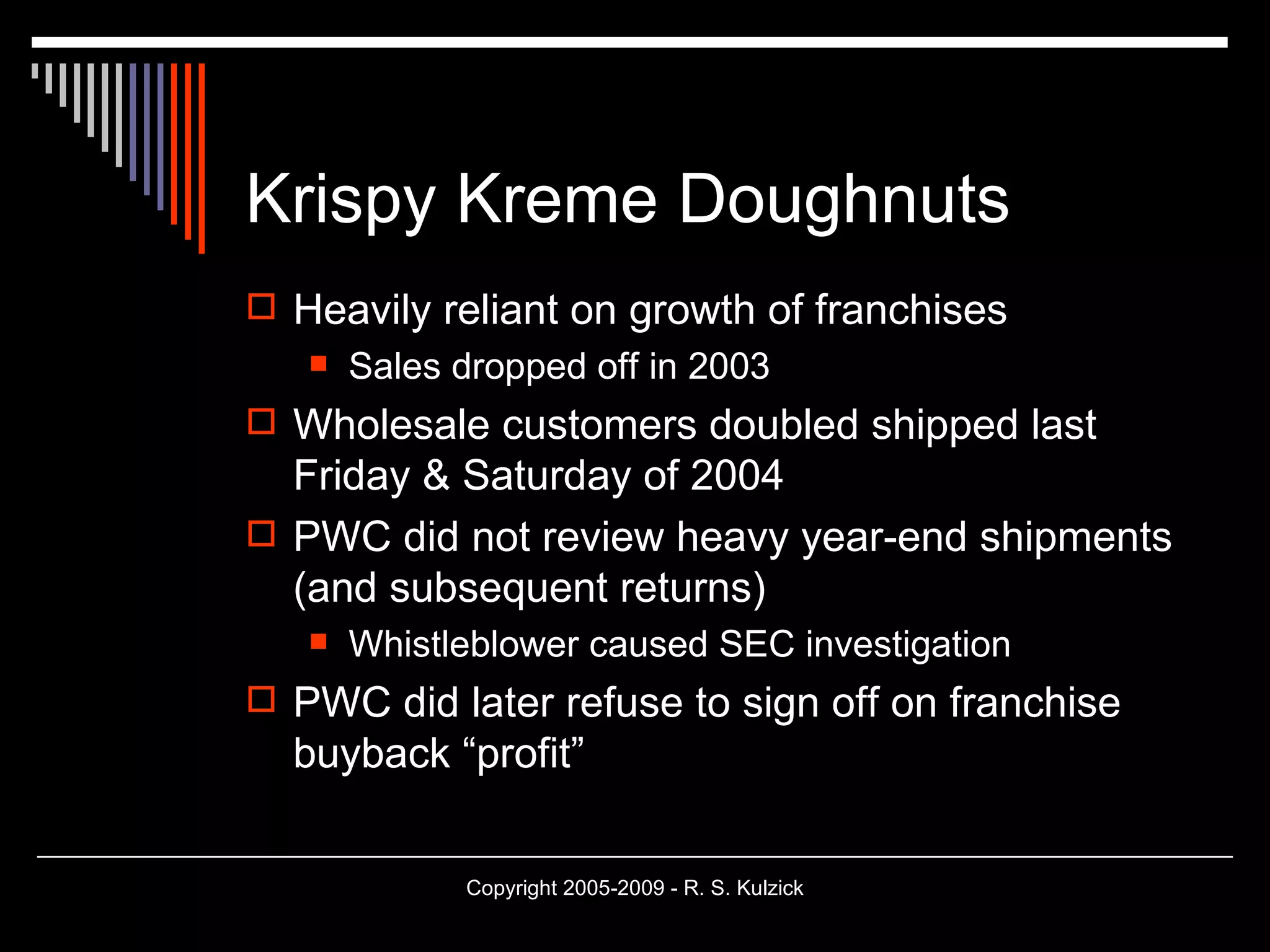
Krispy Kreme Doughnuts Heavily reliant on growth of franchises Sales dropped off in 2003 Wholesale customers doubled shipped last Friday & Saturday of 2004 PWC did not review heavy year-end shipments (and subsequent returns) Whistleblower caused SEC investigation PWC did later refuse to sign off on franchise buyback “profit”
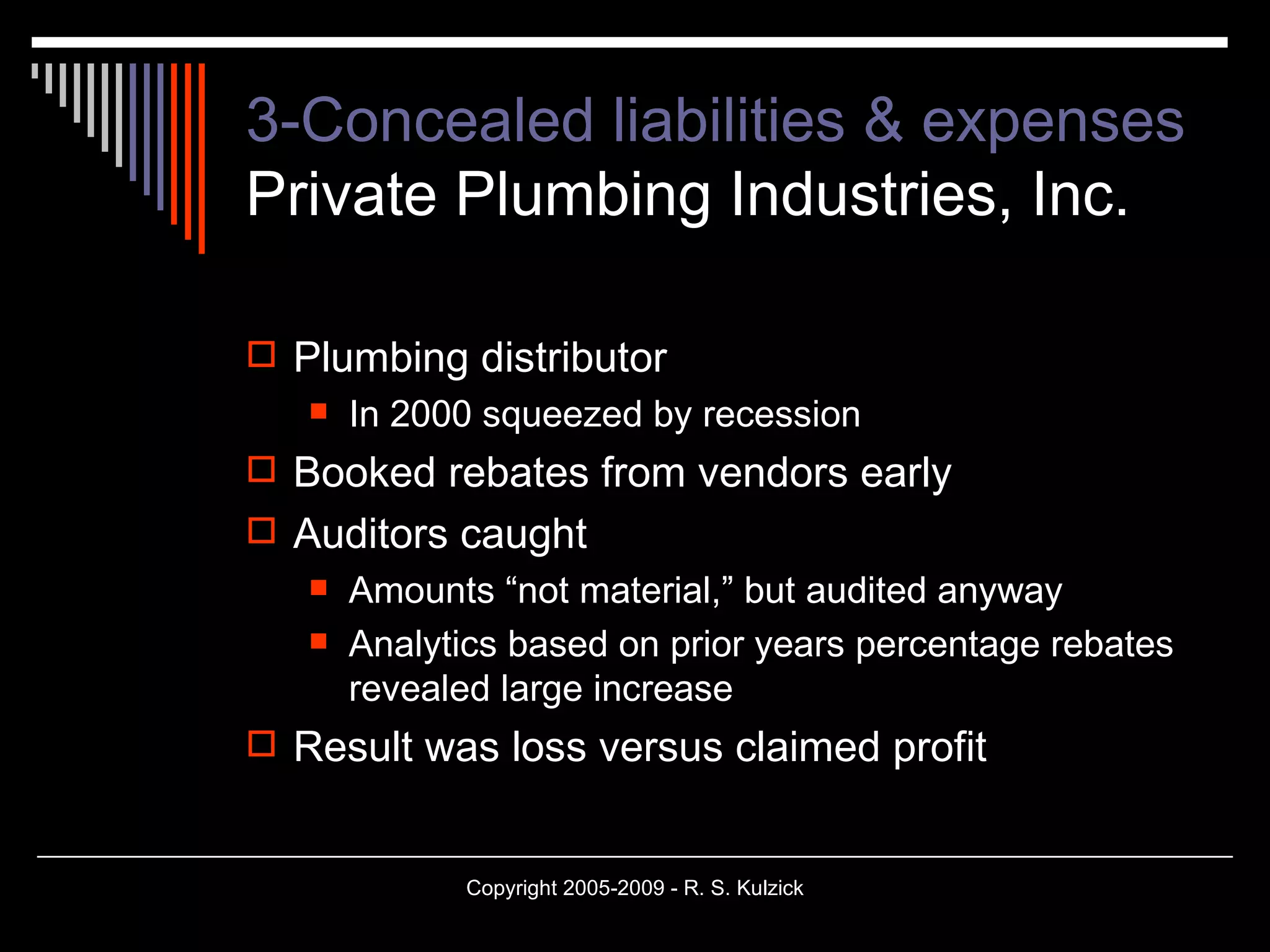
3-Concealed liabilities & expenses Private Plumbing Industries, Inc. Plumbing distributor In 2000 squeezed by recession Booked rebates from vendors early Auditors caught Amounts “not material,” but audited anyway Analytics based on prior years percentage rebates revealed large increase Result was loss versus claimed profit
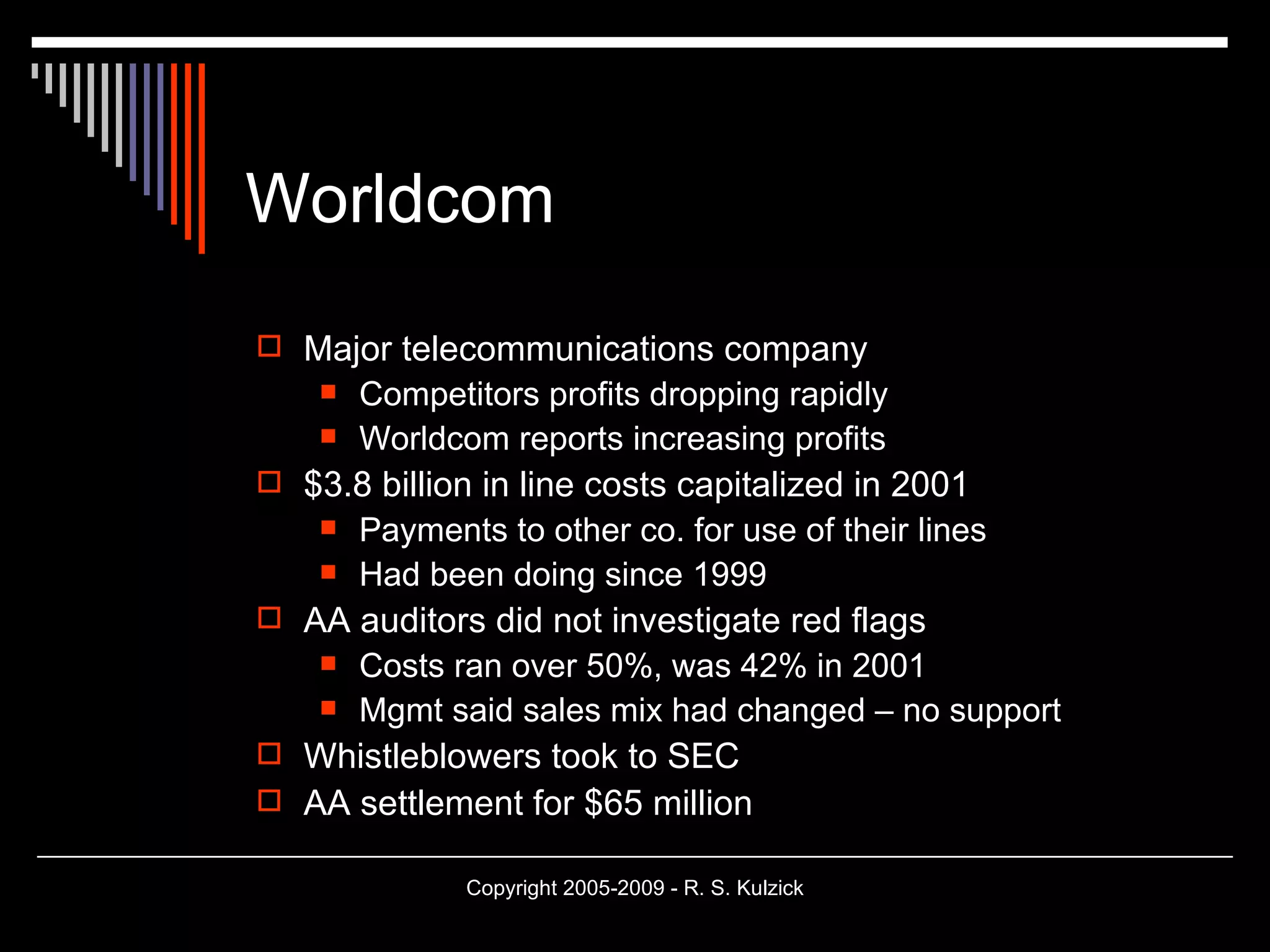
Worldcom Major telecommunications company Competitors profits dropping rapidly Worldcom reports increasing profits $3.8 billion in line costs capitalized in 2001 Payments to other co. for use of their lines Had been doing since 1999 AA auditors did not investigate red flags Costs ran over 50%, was 42% in 2001 Mgmt said sales mix had changed – no support Whistleblowers took to SEC AA settlement for $65 million
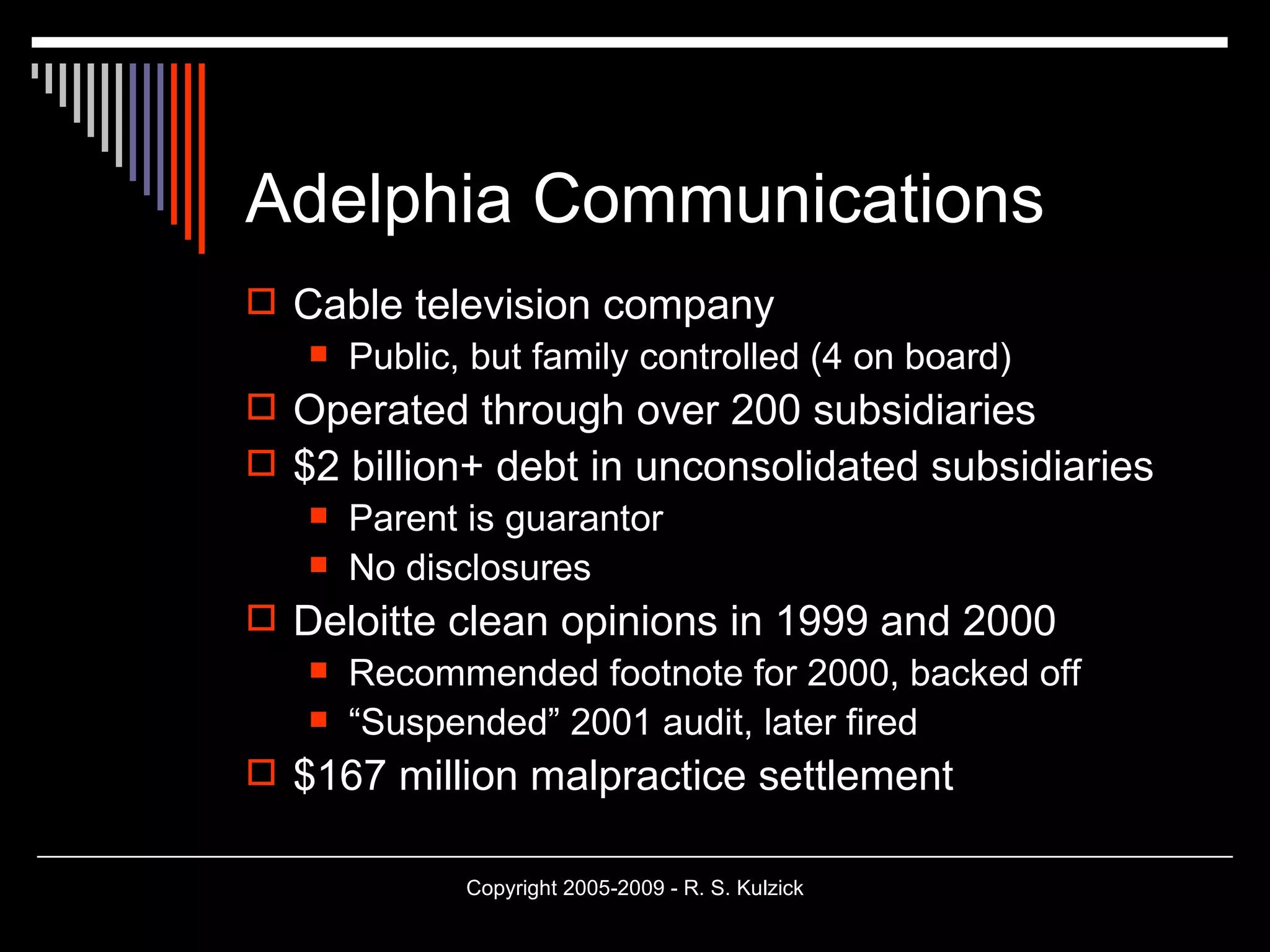
Adelphia Communications Cable television company Public, but family controlled (4 on board) Operated through over 200 subsidiaries $2 billion+ debt in unconsolidated subsidiaries Parent is guarantor No disclosures Deloitte clean opinions in 1999 and 2000 Recommended footnote for 2000, backed off “ Suspended” 2001 audit, later fired $167 million malpractice settlement
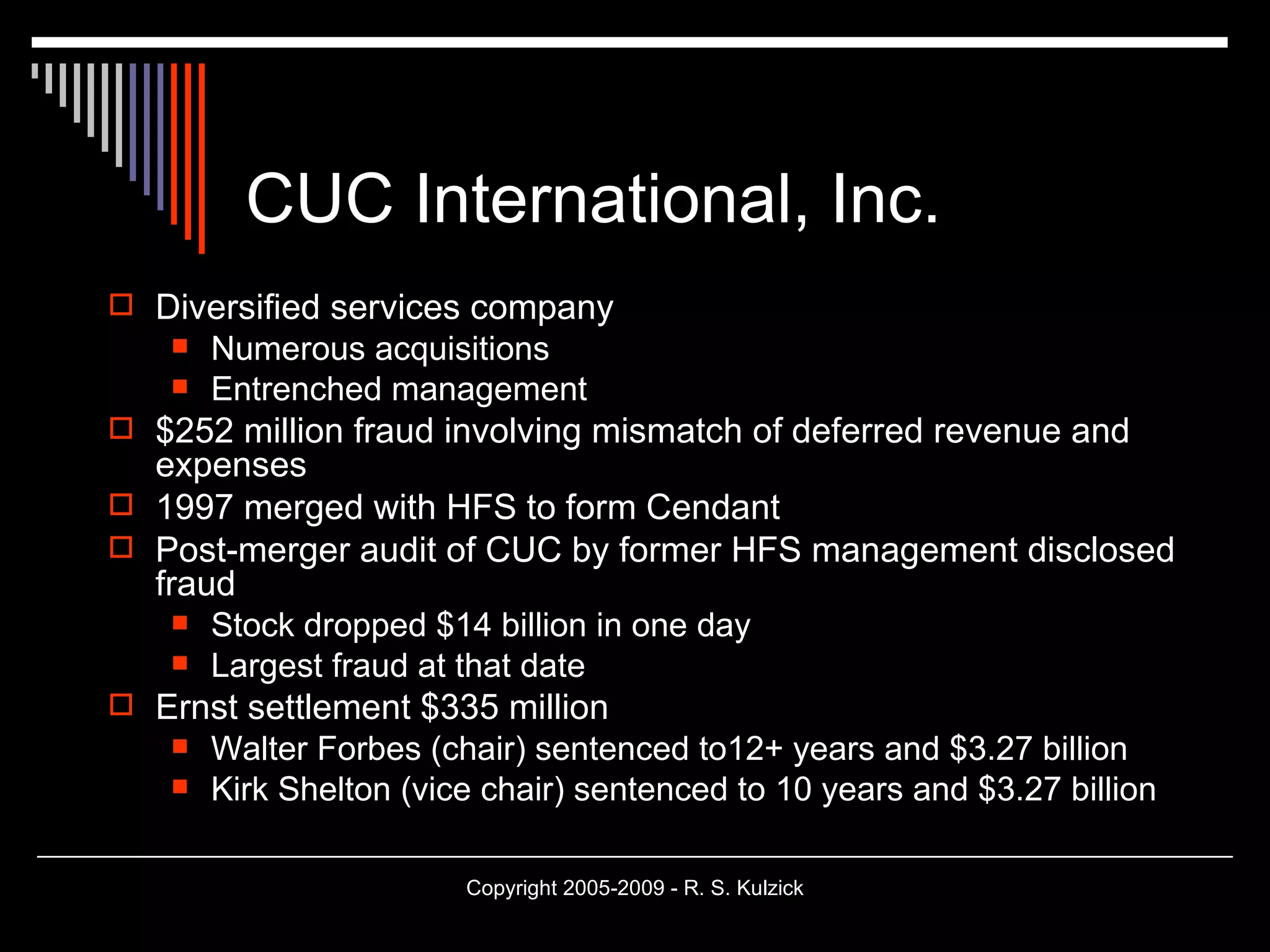
CUC International, Inc. Diversified services company Numerous acquisitions Entrenched management $252 million fraud involving mismatch of deferred revenue and expenses 1997 merged with HFS to form Cendant Post-merger audit of CUC by former HFS management disclosed fraud Stock dropped $14 billion in one day Largest fraud at that date Ernst settlement $335 million Walter Forbes (chair) sentenced to12+ years and $3.27 billion  Kirk Shelton (vice chair) sentenced to 10 years and $3.27 billion
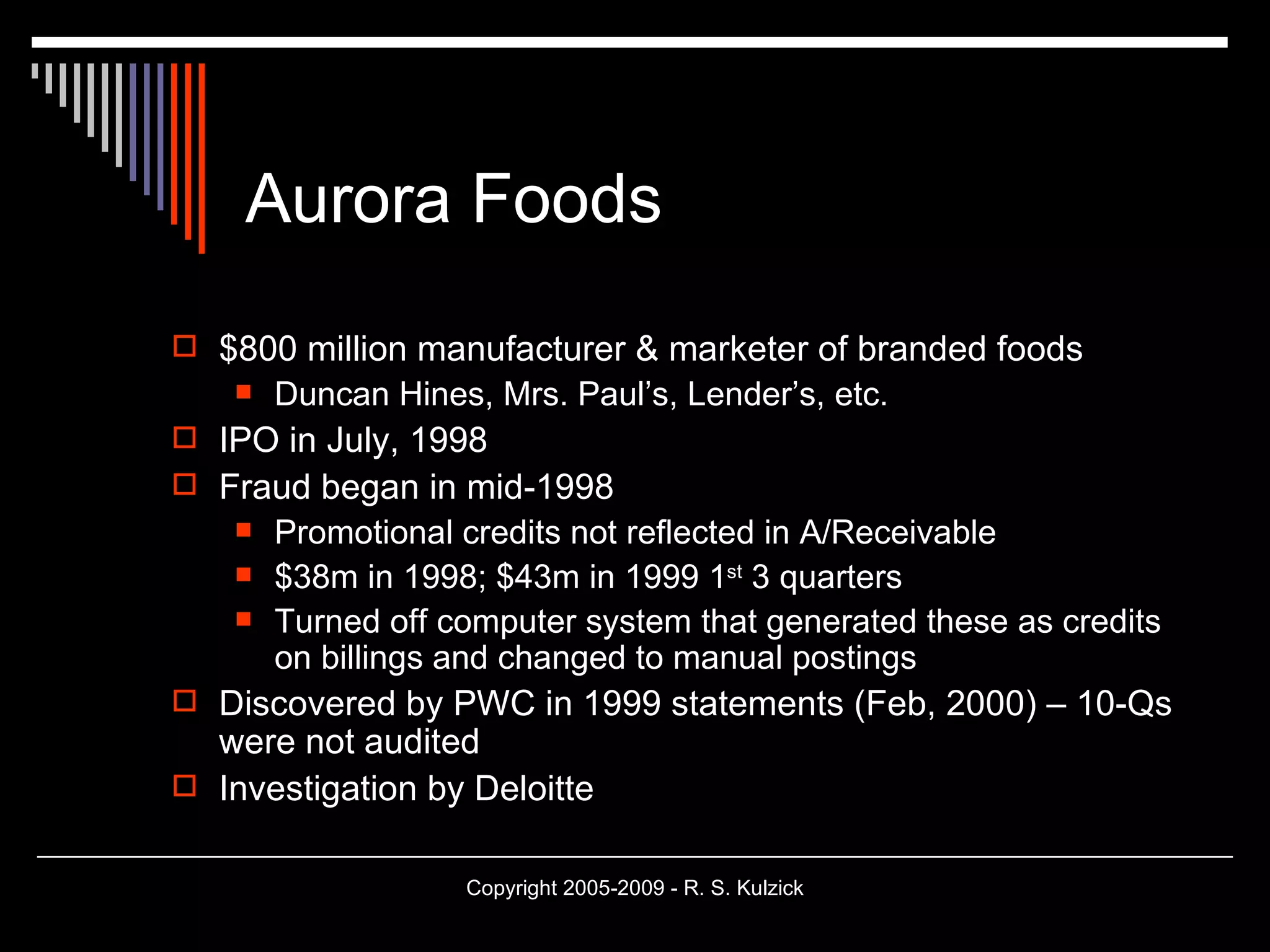
Aurora Foods $800 million manufacturer & marketer of branded foods Duncan Hines, Mrs. Paul’s, Lender’s, etc. IPO in July, 1998 Fraud began in mid-1998 Promotional credits not reflected in A/Receivable  $38m in 1998; $43m in 1999 1 st  3 quarters Turned off computer system that generated these as credits on billings and changed to manual postings Discovered by PWC in 1999 statements (Feb, 2000) – 10-Qs were not audited Investigation by Deloitte
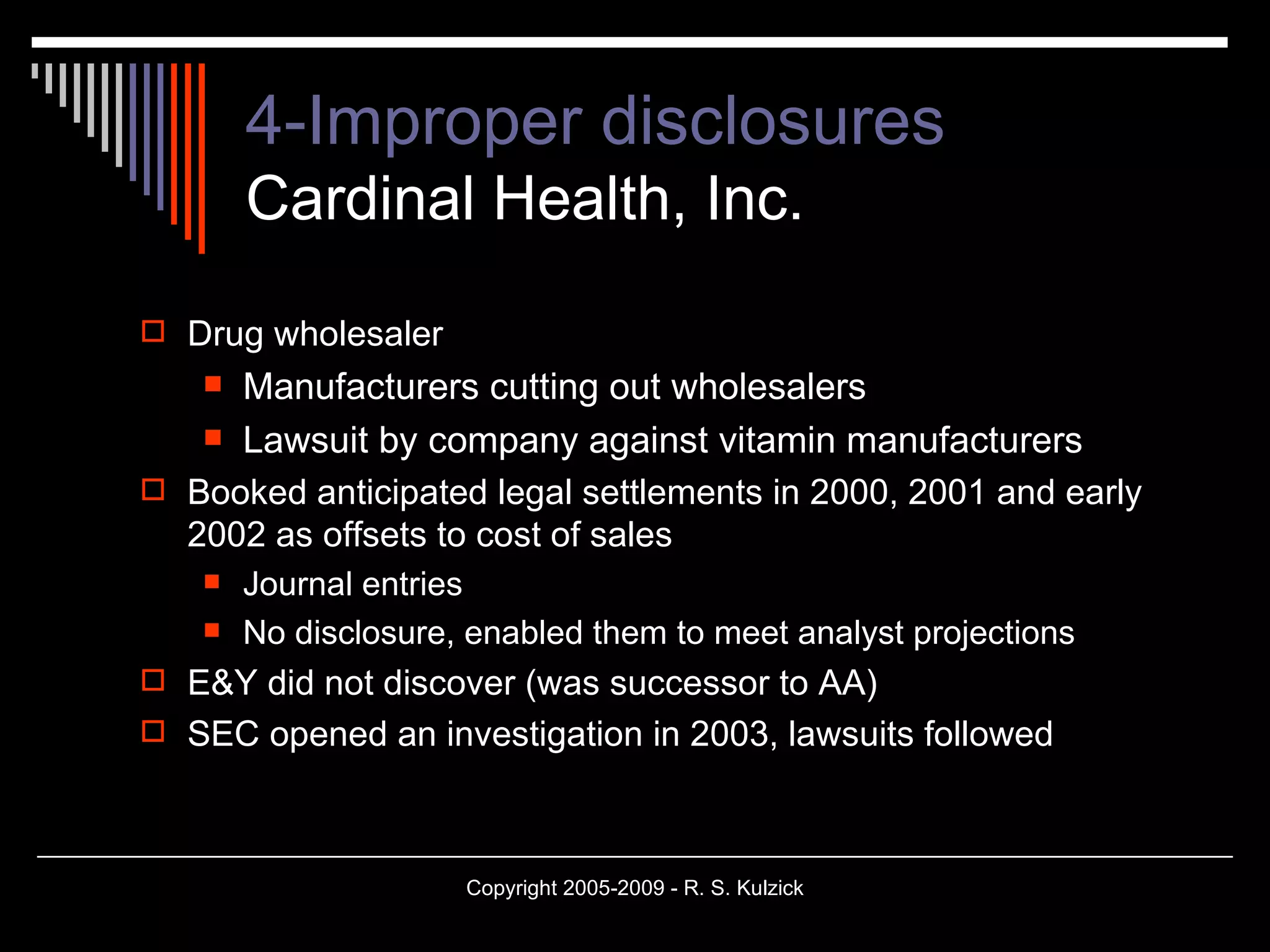
4-Improper disclosures Cardinal Health, Inc. Drug wholesaler Manufacturers cutting out wholesalers Lawsuit by company against vitamin manufacturers Booked anticipated legal settlements in 2000, 2001 and early 2002 as offsets to cost of sales Journal entries No disclosure, enabled them to meet analyst projections E&Y did not discover (was successor to AA) SEC opened an investigation in 2003, lawsuits followed
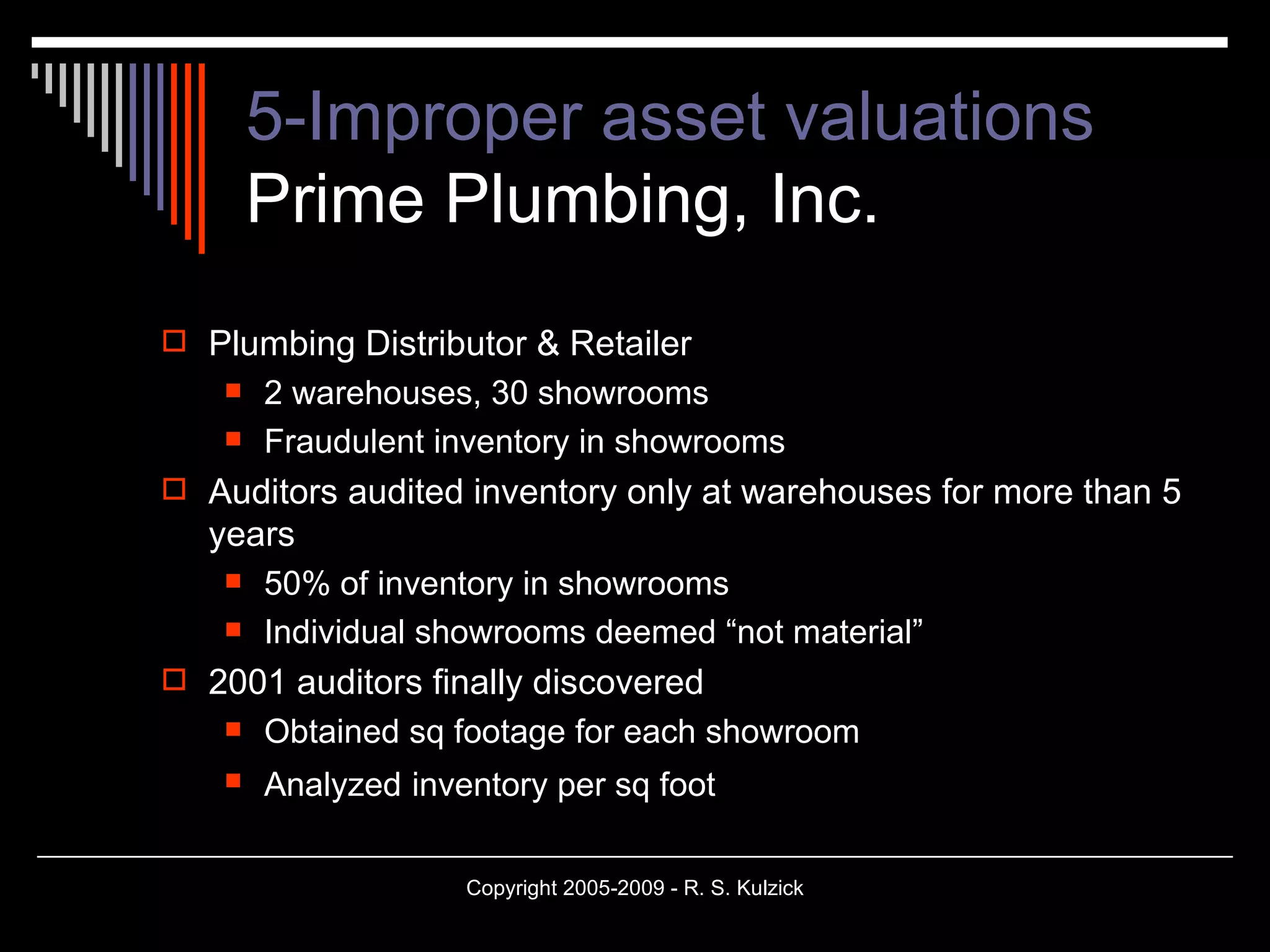
5-Improper asset valuations Prime Plumbing, Inc. Plumbing Distributor & Retailer 2 warehouses, 30 showrooms Fraudulent inventory in showrooms Auditors audited inventory only at warehouses for more than 5 years 50% of inventory in showrooms Individual showrooms deemed “not material” 2001 auditors finally discovered Obtained sq footage for each showroom Analyzed   inventory per sq foot
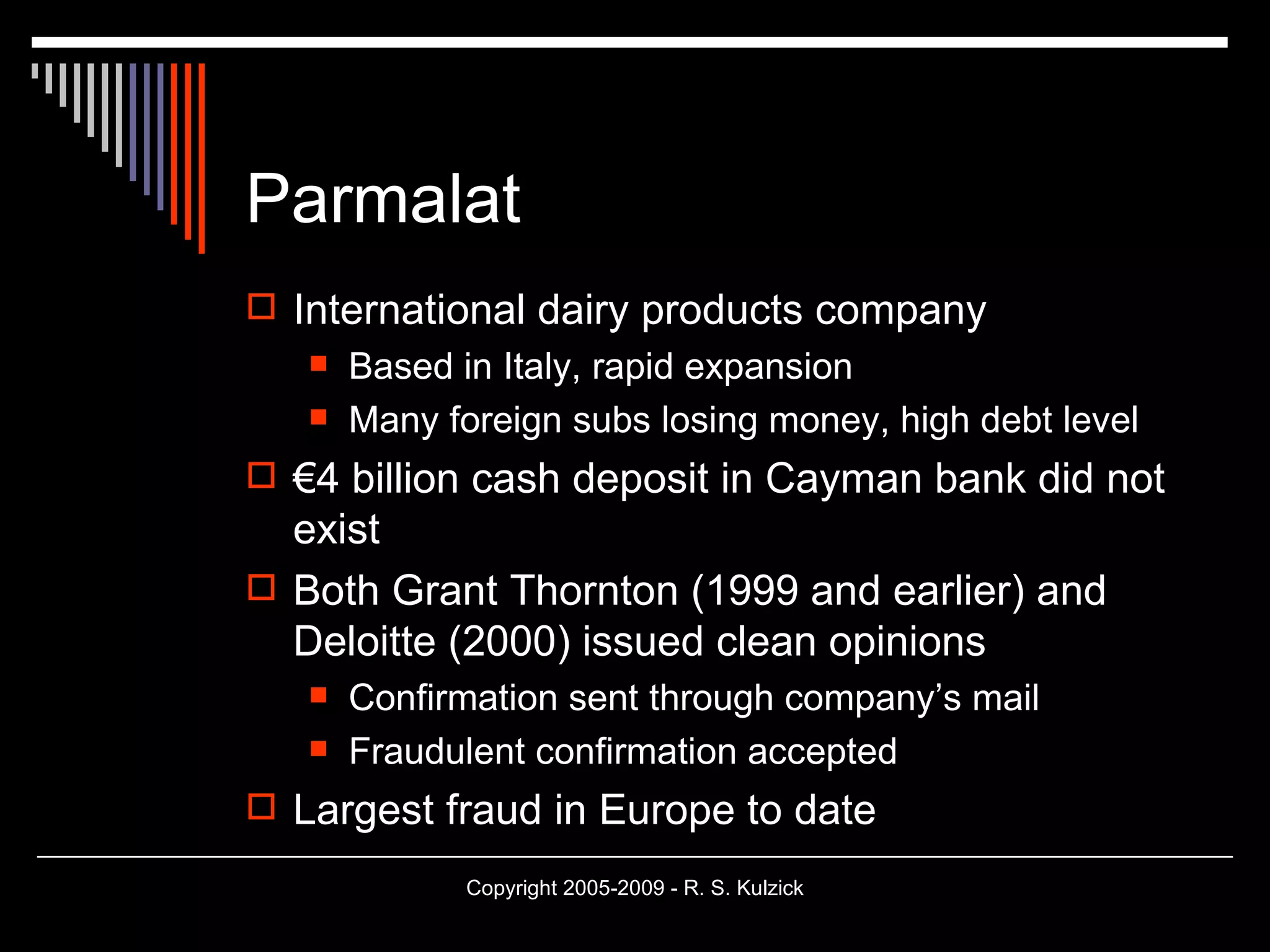
Parmalat International dairy products company Based in Italy, rapid expansion Many foreign subs losing money, high debt level € 4 billion cash deposit in Cayman bank did not exist Both Grant Thornton (1999 and earlier) and  Deloitte (2000) issued clean opinions Confirmation sent through company’s mail Fraudulent confirmation accepted Largest fraud in Europe to date
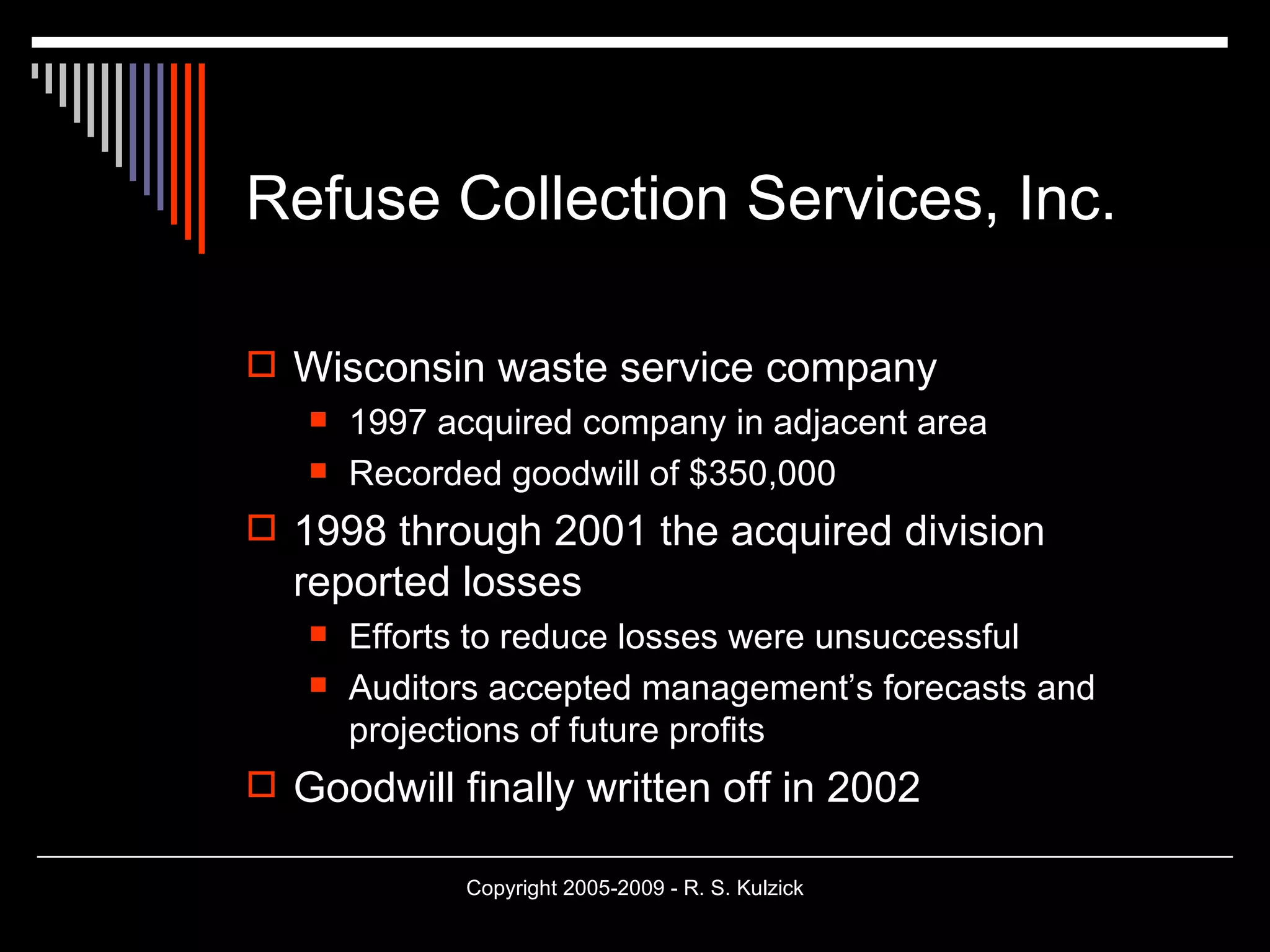
Refuse Collection Services, Inc. Wisconsin waste service company 1997 acquired company in adjacent area Recorded goodwill of $350,000 1998 through 2001 the acquired division reported losses Efforts to reduce losses were unsuccessful Auditors accepted management’s forecasts and projections of future profits Goodwill finally written off in 2002
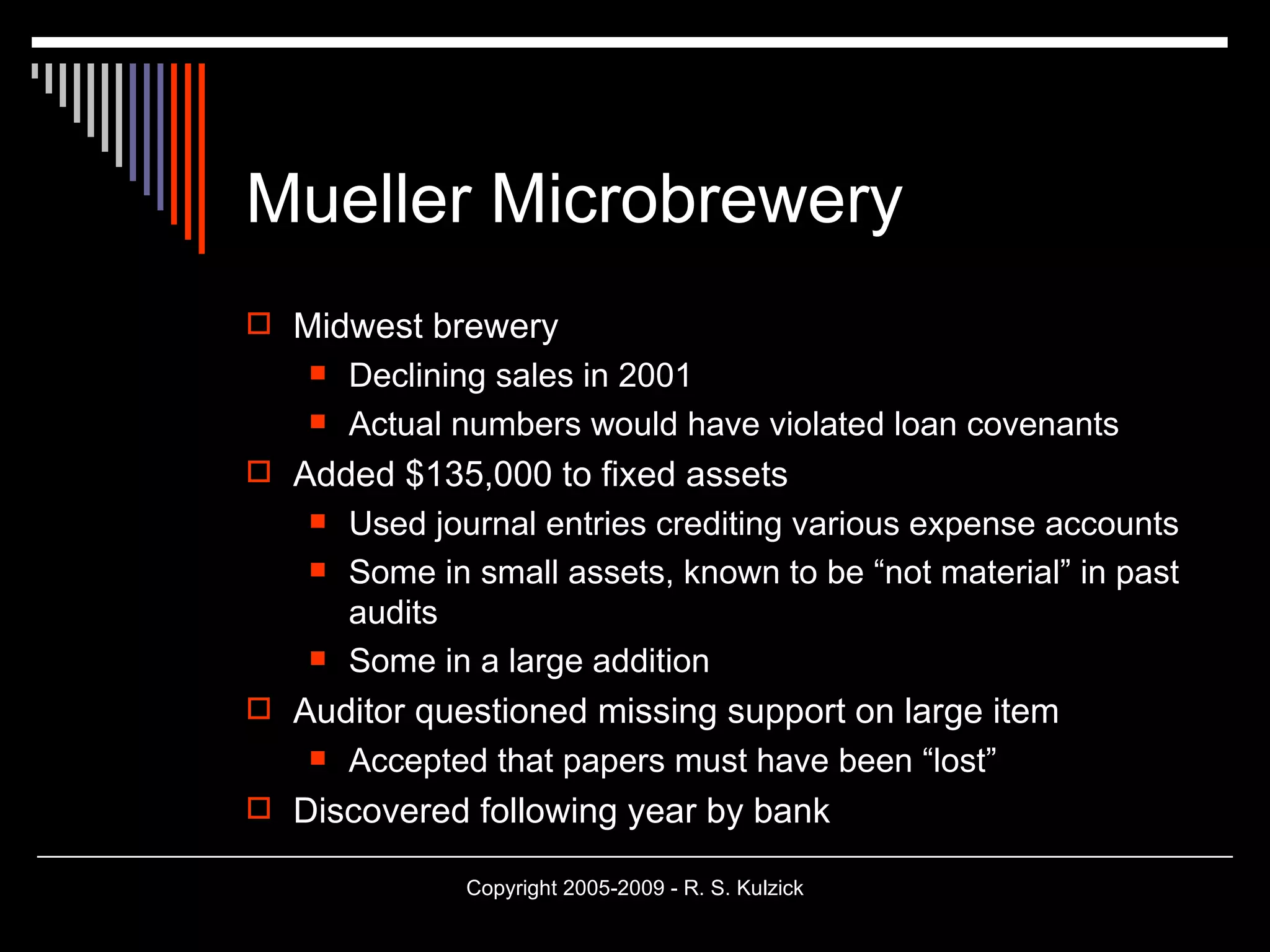
Mueller Microbrewery Midwest brewery Declining sales in 2001 Actual numbers would have violated loan covenants Added $135,000 to fixed assets Used journal entries crediting various expense accounts Some in small assets, known to be “not material” in past audits Some in a large addition Auditor questioned missing support on large item Accepted that papers must have been “lost” Discovered following year by bank
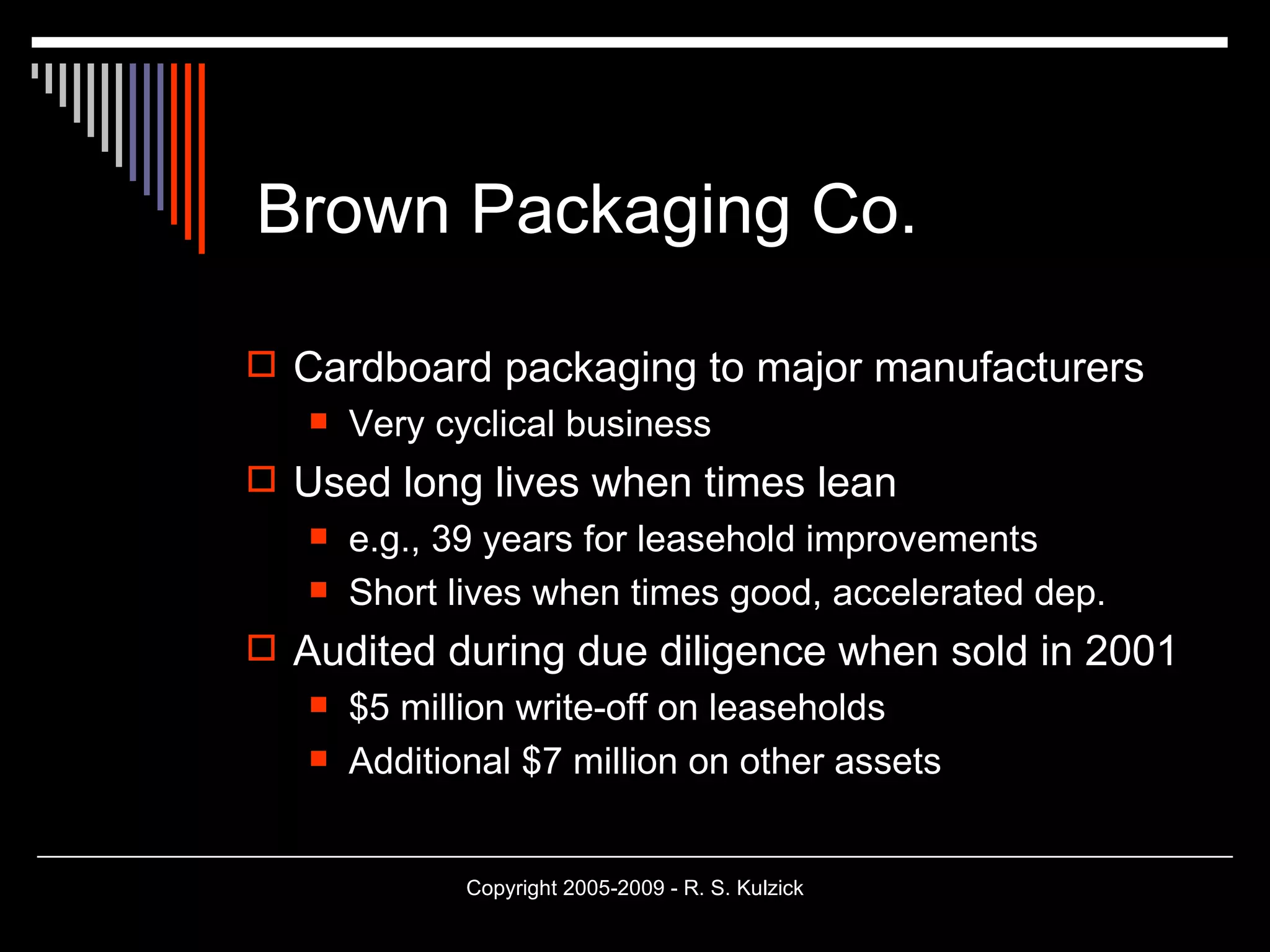
Brown Packaging Co. Cardboard packaging to major manufacturers Very cyclical business Used long lives when times lean e.g., 39 years for leasehold improvements Short lives when times good, accelerated dep. Audited during due diligence when sold in 2001 $5 million write-off on leaseholds Additional $7 million on other assets
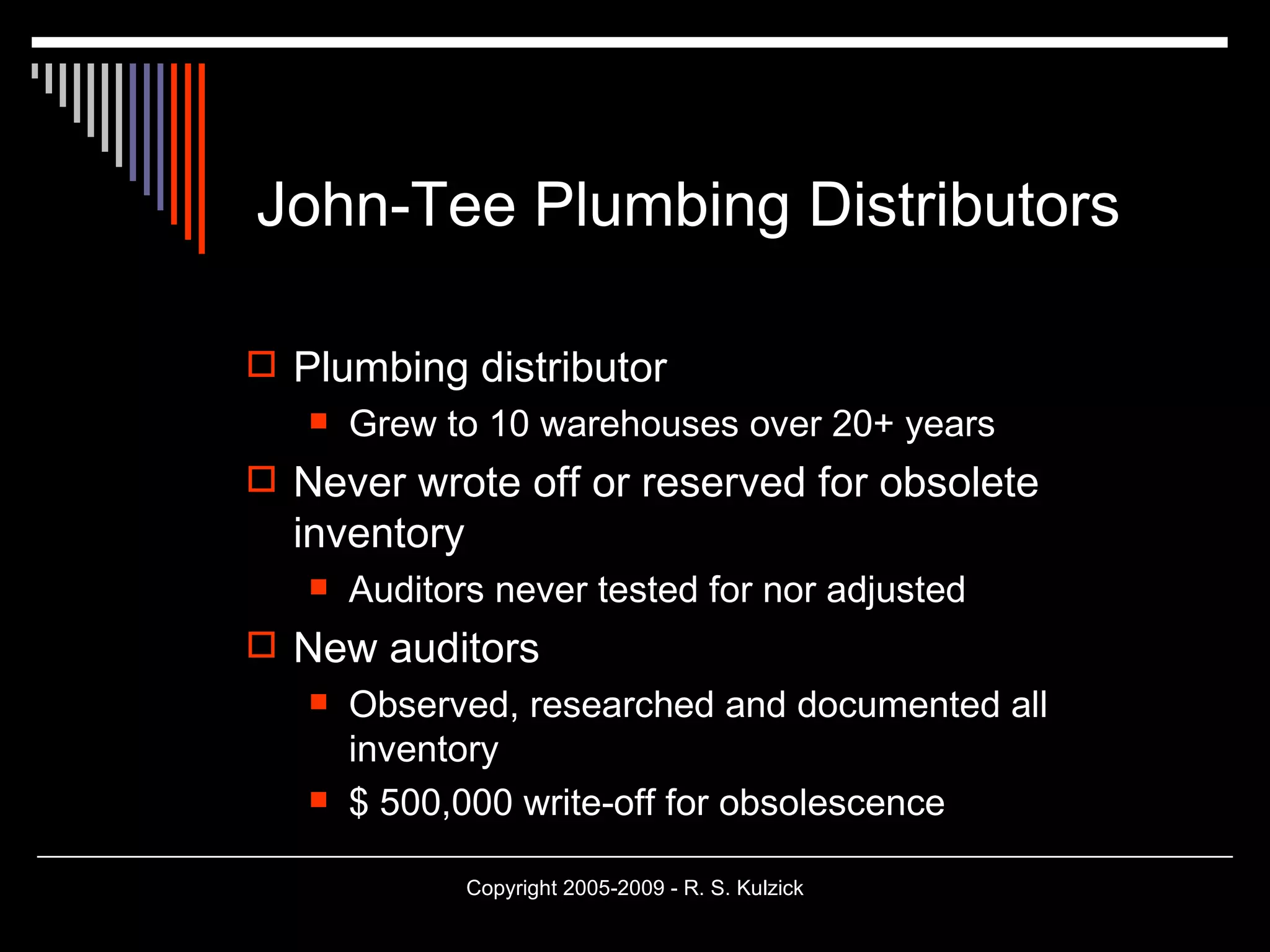
John-Tee Plumbing Distributors Plumbing distributor Grew to 10 warehouses over 20+ years Never wrote off or reserved for obsolete inventory Auditors never tested for nor adjusted New auditors Observed, researched and documented all inventory $ 500,000 write-off for obsolescence
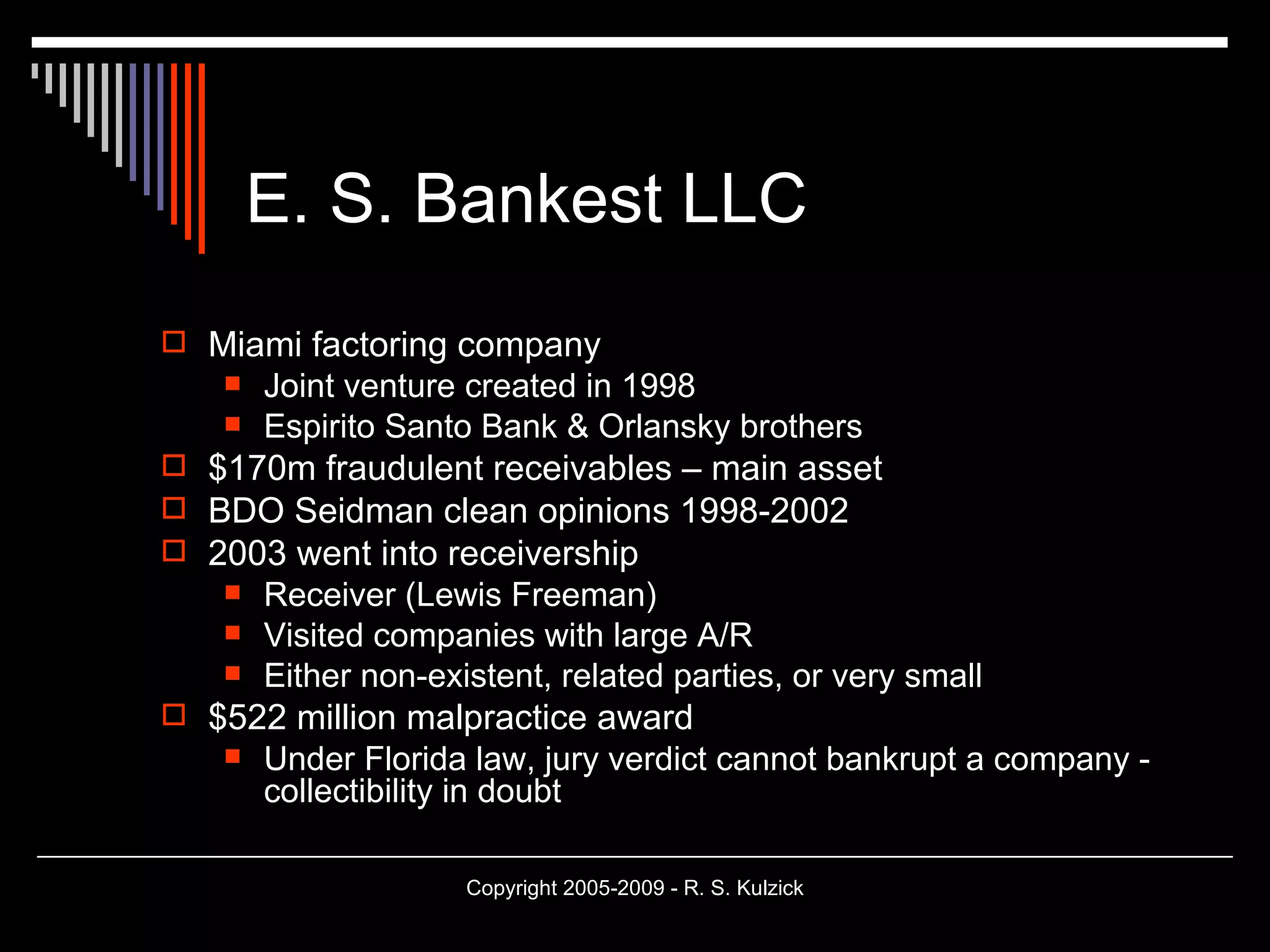
E. S. Bankest LLC Miami factoring company Joint venture created in 1998 Espirito Santo Bank & Orlansky brothers $170m fraudulent receivables – main asset BDO Seidman clean opinions 1998-2002 2003 went into receivership Receiver (Lewis Freeman)  Visited companies with large A/R Either non-existent, related parties, or very small $522 million malpractice award Under Florida law, jury verdict cannot bankrupt a company - collectibility in doubt
Conclusions Materiality is not based on transactions Management sometimes lies Don’t audit something you don’t understand Just because it isn’t consolidated doesn’t mean its not important Look at the big picture – where’s the risk? Do the financials “present fairly” to third party users?
Thank you! Questions? Ray Kulzick – 305.812.4998 Kulzick Consulting, PA [email_address]
Ray Kulzick  Kulzick Consulting, PA Forensic Accounting Divorce Fraud Business Damages Data Analysis for Litigation
Master of Accounting – 30 credits Specialization in Forensic Accounting Specialization in Tax MBA – 42 credits Specialization in Accounting Joint JD degree program MS in Management – 36 credits Specialization in Management Accounting Graduate Certificates – 12 credits Forensic Accounting Taxation Management Accounting

Fraud Cases in Auditing

  • 1.
    Auditing for Fraud– Cases and Applications Presentation for Miami-Dade Chapter - FICPA June 23, 2009 Dr. Raymond S. Kulzick, CPA, CFE, CFF, CDFA, FCPA St. Thomas University Kulzick Consulting, PA Information in this presentation is believed to be reliable at the time of the presentation; but the authors do not assume any responsibility for its use and it should not be relied upon as authoritative. Illustrations are for educational purposes only and do not include all facts & circumstances.
  • 2.
    Ray Kulzick Kulzick Consulting, PA Forensic Accounting Divorce Fraud Business Damages Data Analysis for Litigation
  • 3.
    Outline Fraud Audit& Accounting Standards SAS 99 Required Approach Understanding the Risks Financial Statement Fraud Cases & Examples 5 major types of financial statement fraud Conclusions
  • 4.
    Financial Statement Fraud“Intentional misstatements or omissions of amounts or disclosures in financial statements designed to deceive FS users where the effect causes the FS not to be presented … in conformity with … GAAP.” – SAS 99 “We lie about what we owe and we lie about what we earn.” – Barry Minkow 1/05
  • 5.
    Misappropriation of Assets“Theft of a entity’s assets.” – SAS 99 May lead to financial statement fraud if material, in which case SAS 99 covers. Adelphia Greater Miami Chamber of Commerce $1.9 million over 3 years
  • 6.
    Importance of FraudACFE 2008 (U.S. including government) Total fraud losses estimated at $994 billion KPMG 2008 (U.S. including government) 74% personally observed “misconduct”, 46% of a significant nature PWC 2007 (40 countries) 43% of companies had a significant loss in the last 2 years, averaging $2.4 million + $550 thousand post-fraud costs E&Y 2008 (Global) 23% had someone solicited to pay a bribe in last 2 years Oversight Systems 2007 (U.S.) 76% feel fraud is more prevalent today than it was in 2002
  • 7.
    Audit and AccountingStandards SAS 99 – Consideration of Fraud in a Financial Statement Audit SSAE 10 – Reporting on Internal Control SSAE 15 – Internal Control w/FS Audit SAS 104-111 – Risk Assessment Standards Understanding Entity & Controls links to Risk Assessment links to Audit Procedures (110)
  • 8.
    Audit and AccountingStandards SSARS 10 – Performance of Review Engagements Inquiries to include fraud Representation letter to include fraud SSARS 1 – Compilation & Review of FS For Compilations – CPA MUST: Have a basic understanding of the company, its accounting system and its industry
  • 9.
    Current Economic IssuesJanuary, 2009 – AICPA issued a audit risk alert on Going Concern Issues in the current environment. March, 2009 – AICPA Audit Practice Bulletin: “ The audit profession should continue to exercise vigilance and rigor under the current economic climate.” Specific suggestions in Appendix, including fraud considerations
  • 10.
    8 Steps forSAS 99 Discussion among engagement personnel Obtaining the information needed to identify the risks of material misstatement due to fraud Identifying risks that may result in a material misstatement due to fraud
  • 11.
    8 Steps forSAS 99 Assessing identified risks after assessing and taking into account controls Responding to the results of the assessment Evaluating audit evidence Communicating about possible fraud Documenting the auditor’s consideration of fraud
  • 12.
    Understand the Risks- Business and Industry What does the business do? How does it do it? How do competitors do it? What is the competitive situation? Who are the customers? Why do they buy from this company? Who are the vendors? What are the vendor customs in this industry?
  • 13.
    Understand the Risks– External Trends In the industry Competitors strategies In the macro environment Vendors Customers
  • 14.
    Understand the Risks– Likely Users and Uses Investors? Banks and lenders? Surety companies? Parent company? Joint venture or other partners? Options and/or bonuses? Acquisitions? Regulators? Progress payments?
  • 15.
    FS Fraud WithinStatements Revenues -COS Gross margin -Expenses Operating income -Interest & taxes Net income Current assets +Fixed Assets Total Assets Current liabilities +Long-term liabilities Total liabilities Equity
  • 16.
    FS Fraud BetweenStatements Debits Good Assets Bad Cost of sales Expenses Credits Good Revenue Equity Bad Liabilities
  • 17.
    Five Major Typesof Financial Statement Fraud Fictitious revenues Timing differences Concealed liabilities & expenses Improper disclosures Improper asset valuations
  • 18.
    1-Fictitious revenues Enron Traded gas and derivative contracts “ Harshest” employee pay system – internal competition 2000 huge increase in derivative holdings Constantly growing earnings – met all projections 100s of Special Purpose Entities used to hide massive amounts of debt and generate fictitious profits Met “letter of the law” of GAAP at the time Impact: debt became revenue Minimal disclosure Derivative holdings valued using in-house speculative methodology Minimal disclosure Impact: asset write-ups became trading profits 2001 collapsed
  • 19.
    Rayco Construction CoBuilt football stadiums Decline in new contracts EBITDA covenant in credit line Decreased cost to complete estimates & shifted completed project costs to open projects % of completion method Costs remain same, revenue is increased Not discovered Following year, massive losses Loans worked out, company recovered
  • 20.
    2-Timing differences MedfordMachining Co. Custom machines to mfg firearms Complex product, required customer acceptance Booked revenue when shipped Discovered in 2001 by auditor Testing internal controls in revenue cycle Shipping cut-off testing $21 million restatement of 1999-2000
  • 21.
    Sunbeam Corp. 1996Chain Saw Al arrives Overstates losses, creates reserves 1997 produces $60m profit (claim $189m is fraud) Reverses reserves Bill and hold channel stuffing Contingent sale of $11m of spare parts (cost $2 million) Al reduces profit from $9 million to $6 AA agrees, “not material,” so OK Late 1998, falls apart, SEC begins investigation Dunlop pays $500k fine AA pays $110 million settlement 2001 Bankruptcy
  • 22.
    U. S. Foodservice(Ahold) $700 million in vendor rebates booked before earned from 2000 to 2003 Deloitte did internal control audit in 2001 Found lack of internal controls on rebates Deloitte external audit found in 2003 13 vendor employees colluded & returned fraudulent confirmations Part of $1.2 billion Ahold international fraud Deloitte successfully defended based on 2007 Tellabs decision that narrowed 3 rd party liability in federal investor class action suits (2009)
  • 23.
    Krispy Kreme DoughnutsHeavily reliant on growth of franchises Sales dropped off in 2003 Wholesale customers doubled shipped last Friday & Saturday of 2004 PWC did not review heavy year-end shipments (and subsequent returns) Whistleblower caused SEC investigation PWC did later refuse to sign off on franchise buyback “profit”
  • 24.
    3-Concealed liabilities &expenses Private Plumbing Industries, Inc. Plumbing distributor In 2000 squeezed by recession Booked rebates from vendors early Auditors caught Amounts “not material,” but audited anyway Analytics based on prior years percentage rebates revealed large increase Result was loss versus claimed profit
  • 25.
    Worldcom Major telecommunicationscompany Competitors profits dropping rapidly Worldcom reports increasing profits $3.8 billion in line costs capitalized in 2001 Payments to other co. for use of their lines Had been doing since 1999 AA auditors did not investigate red flags Costs ran over 50%, was 42% in 2001 Mgmt said sales mix had changed – no support Whistleblowers took to SEC AA settlement for $65 million
  • 26.
    Adelphia Communications Cabletelevision company Public, but family controlled (4 on board) Operated through over 200 subsidiaries $2 billion+ debt in unconsolidated subsidiaries Parent is guarantor No disclosures Deloitte clean opinions in 1999 and 2000 Recommended footnote for 2000, backed off “ Suspended” 2001 audit, later fired $167 million malpractice settlement
  • 27.
    CUC International, Inc.Diversified services company Numerous acquisitions Entrenched management $252 million fraud involving mismatch of deferred revenue and expenses 1997 merged with HFS to form Cendant Post-merger audit of CUC by former HFS management disclosed fraud Stock dropped $14 billion in one day Largest fraud at that date Ernst settlement $335 million Walter Forbes (chair) sentenced to12+ years and $3.27 billion Kirk Shelton (vice chair) sentenced to 10 years and $3.27 billion
  • 28.
    Aurora Foods $800million manufacturer & marketer of branded foods Duncan Hines, Mrs. Paul’s, Lender’s, etc. IPO in July, 1998 Fraud began in mid-1998 Promotional credits not reflected in A/Receivable $38m in 1998; $43m in 1999 1 st 3 quarters Turned off computer system that generated these as credits on billings and changed to manual postings Discovered by PWC in 1999 statements (Feb, 2000) – 10-Qs were not audited Investigation by Deloitte
  • 29.
    4-Improper disclosures CardinalHealth, Inc. Drug wholesaler Manufacturers cutting out wholesalers Lawsuit by company against vitamin manufacturers Booked anticipated legal settlements in 2000, 2001 and early 2002 as offsets to cost of sales Journal entries No disclosure, enabled them to meet analyst projections E&Y did not discover (was successor to AA) SEC opened an investigation in 2003, lawsuits followed
  • 30.
    5-Improper asset valuationsPrime Plumbing, Inc. Plumbing Distributor & Retailer 2 warehouses, 30 showrooms Fraudulent inventory in showrooms Auditors audited inventory only at warehouses for more than 5 years 50% of inventory in showrooms Individual showrooms deemed “not material” 2001 auditors finally discovered Obtained sq footage for each showroom Analyzed inventory per sq foot
  • 31.
    Parmalat International dairyproducts company Based in Italy, rapid expansion Many foreign subs losing money, high debt level € 4 billion cash deposit in Cayman bank did not exist Both Grant Thornton (1999 and earlier) and Deloitte (2000) issued clean opinions Confirmation sent through company’s mail Fraudulent confirmation accepted Largest fraud in Europe to date
  • 32.
    Refuse Collection Services,Inc. Wisconsin waste service company 1997 acquired company in adjacent area Recorded goodwill of $350,000 1998 through 2001 the acquired division reported losses Efforts to reduce losses were unsuccessful Auditors accepted management’s forecasts and projections of future profits Goodwill finally written off in 2002
  • 33.
    Mueller Microbrewery Midwestbrewery Declining sales in 2001 Actual numbers would have violated loan covenants Added $135,000 to fixed assets Used journal entries crediting various expense accounts Some in small assets, known to be “not material” in past audits Some in a large addition Auditor questioned missing support on large item Accepted that papers must have been “lost” Discovered following year by bank
  • 34.
    Brown Packaging Co.Cardboard packaging to major manufacturers Very cyclical business Used long lives when times lean e.g., 39 years for leasehold improvements Short lives when times good, accelerated dep. Audited during due diligence when sold in 2001 $5 million write-off on leaseholds Additional $7 million on other assets
  • 35.
    John-Tee Plumbing DistributorsPlumbing distributor Grew to 10 warehouses over 20+ years Never wrote off or reserved for obsolete inventory Auditors never tested for nor adjusted New auditors Observed, researched and documented all inventory $ 500,000 write-off for obsolescence
  • 36.
    E. S. BankestLLC Miami factoring company Joint venture created in 1998 Espirito Santo Bank & Orlansky brothers $170m fraudulent receivables – main asset BDO Seidman clean opinions 1998-2002 2003 went into receivership Receiver (Lewis Freeman) Visited companies with large A/R Either non-existent, related parties, or very small $522 million malpractice award Under Florida law, jury verdict cannot bankrupt a company - collectibility in doubt
  • 37.
    Conclusions Materiality isnot based on transactions Management sometimes lies Don’t audit something you don’t understand Just because it isn’t consolidated doesn’t mean its not important Look at the big picture – where’s the risk? Do the financials “present fairly” to third party users?
  • 38.
    Thank you! Questions?Ray Kulzick – 305.812.4998 Kulzick Consulting, PA [email_address]
  • 39.
    Ray Kulzick Kulzick Consulting, PA Forensic Accounting Divorce Fraud Business Damages Data Analysis for Litigation
  • 40.
    Master of Accounting– 30 credits Specialization in Forensic Accounting Specialization in Tax MBA – 42 credits Specialization in Accounting Joint JD degree program MS in Management – 36 credits Specialization in Management Accounting Graduate Certificates – 12 credits Forensic Accounting Taxation Management Accounting

Editor's Notes

  • #3 Auditing for Financial Statement Fraud January 25, 2005 Dr. Raymond S. Kulzick, CPA, CFE [email_address]
  • #40 Auditing for Financial Statement Fraud January 25, 2005 Dr. Raymond S. Kulzick, CPA, CFE [email_address]
  • #41 Auditing for Financial Statement Fraud January 25, 2005 Dr. Raymond S. Kulzick, CPA, CFE [email_address]