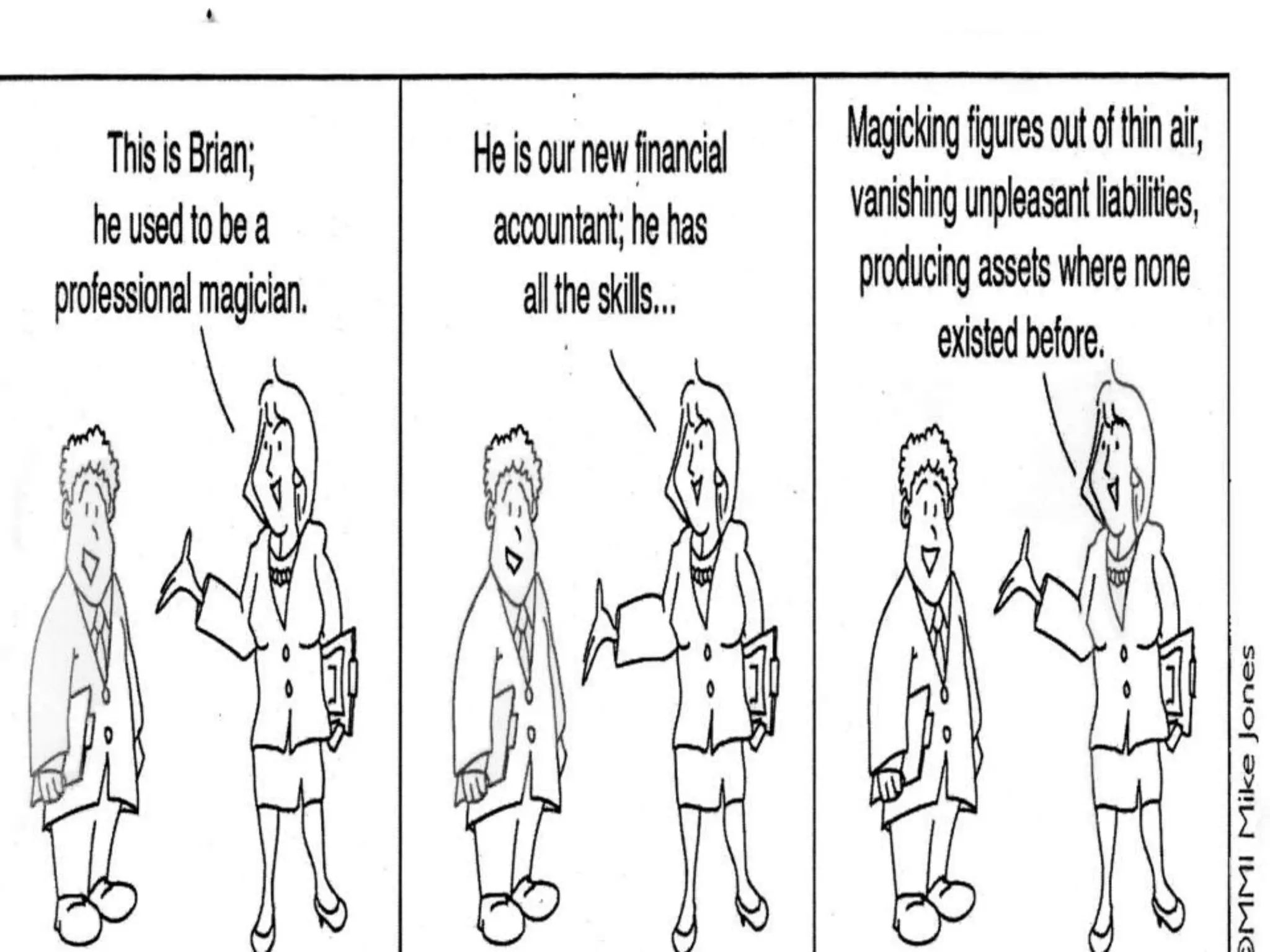
THE LEMONADE STORY
Financial
Shenanigans(FS)
PRESENTED BY
Ranjit Pisharody 75
Pravin Dhas 76
V. Rao Pentakota 80
N.Sharda 93
Sheryl Susan John 94
Subasri 104
OVERVIEW
 What are shenanigans ?
 Strategies used for FS
 Likely candidates for FS
 Why do Shenanigans exist?
 Finding Shenanigans
 Case study: Worldcom, Xerox
 Road to Reform
WHAT DOES FS MEAN?
 Actions or omissions intended to
hide or distort the real
financial performance or
financial condition of an entity.
 They range from minor
deceptions to more serious
misapplications of accounting
principles.
Strategies used for FS
 Overstated Revenue
 Under Reported Expenses
 Shifting to earlier or later period
OVERSTATED REVENUE
 Recording revenue too early
 Recording False or Bogus revenues
 Inflating income with one time gains
UNDER REPORTED EXPENSES
 Moving current expenses to a later period
 Failure to disclose liabilities
SHIFTING TO EARLIER OR LATER PERIOD
 Moving current income to a later period
 Moving future expenses to the current period
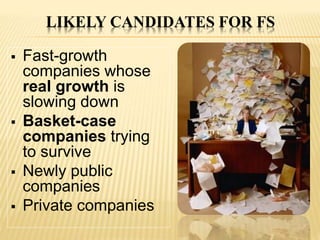
LIKELY CANDIDATES FOR FS
 Fast-growth
companies whose
real growth is
slowing down
 Basket-case
companies trying
to survive
 Newly public
companies
 Private companies
10
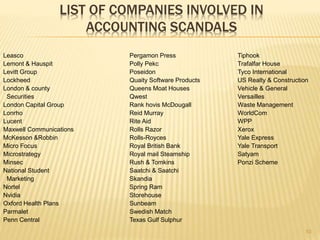
LIST OF COMPANIES INVOLVED IN
ACCOUNTING SCANDALS
Leasco Pergamon Press Tiphook
Lemont & Hauspit Polly Pekc Trafalfar House
Levitt Group Poseidon Tyco International
Lockheed Quaity Software Products US Realty & Construction
London & county Queens Moat Houses Vehicle & General
Securities Qwest Versailles
London Capital Group Rank hovis McDougall Waste Management
Lonrho Reid Murray WorldCom
Lucent Rite Aid WPP
Maxwell Communications Rolls Razor Xerox
McKesson &Robbin Rolls-Royces Yale Express
Micro Focus Royal British Bank Yale Transport
Microstrategy Royal mail Steamship Satyam
Minsec Rush & Tomkins Ponzi Scheme
National Student Saatchi & Saatchi
Marketing Skandia
Nortel Spring Ram
Nvidia Storehouse
Oxford Health Plans Sunbeam
Parmalet Swedish Match
Penn Central Texas Gulf Sulphur
11
Why do shenanigans exist?
 After all it pays!
 It’s easy
 Discovery is difficult
and unlikely
 Improving Liquidity
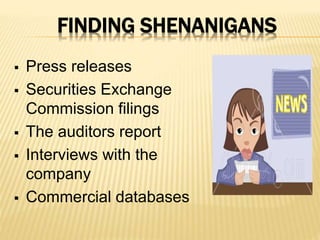
FINDING SHENANIGANS
 Press releases
 Securities Exchange
Commission filings
 The auditors report
 Interviews with the
company
 Commercial databases
AN INTERESTING QUOTE
“How do you explain to an
intelligent public that it is
possible for two companies
in the same industry to
follow entirely different
accounting principles and
both get a true and fair
audit report?”
THE WORLDCOM SAGA – CASE STUDY
 It was 1983 in a coffee shop, that Mr. Bernie
Ebbers came up with a concept that became
WorldCom
 From Humble Beginnings to a Giant
 Telecom industry faced low margins and Mr.
Ebbers decided ‘growth=survival’
 Purchased over 60 firms in 2nd half of the
90’s
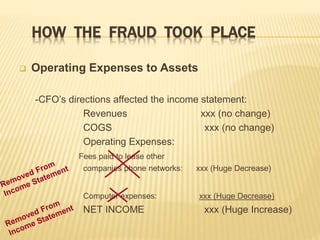
HOW THE FRAUD TOOK PLACE
 Operating Expenses to Assets
-CFO’s directions affected the income statement:
Revenues xxx (no change)
COGS xxx (no change)
Operating Expenses:
Fees paid to lease other
companies phone networks: xxx (Huge Decrease)
Computer expenses: xxx (Huge Decrease)
NET INCOME xxx (Huge Increase)
POST-FRAUD HAPPENINGS
 17,000 jobs cut to save $1 billion.
 WorldCom was renamed MCI in 2004 when it
emerged from bankruptcy
 Sullivan pleaded guilty to 3 federal criminal
charges for fraud and conspiracy
 10 former directors agreed to pay $54 million
to settle a shareholder class-action lawsuit
XEROX SCAM – CASE STUDY
 Xerox, a global document management
company, was founded in 1906 in Rochester
 How it started?
 Xerox revealed in 2002 that it overstated it’s
revenue by $2 billion
 SEC, however, began investigation prior to
Xerox’s announcement and planned to conduct
an audit which revealed a $6 billion
overstatement
Manipulations Used
 Cookie-Jar Method
 Acceleration of revenue from short-term
equipment rentals, which were improperly
classified as long-term leases
 Escalating reported earnings to match expected
earnings
Effects
 Xerox could count as earnings what was
essentially future revenue
 Allowed the company to meet profit
expectations
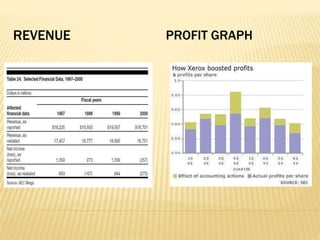
REVENUE PROFIT GRAPH
Why?
 Declining revenue in the early 1990’s
 Pressure from investors to keep up short
term earnings
 Top executives, whose incomes are bound up
with stock options.
Role of KPMG
 It was the auditing firm of Xerox
 The auditing firm knew what was going on and
decided to allow it to continue
Consequence
 Xerox Corp. agreed to pay $670 million while
KPMG had to pay $80 million, to settle an eight-
year-old securities lawsuit filed on behalf of Xerox
investors
THE ROAD TO REFORM : PROTECTING THE
PUBLIC INTEREST
 Government regulation &
oversight
 Strengthening the Auditors
Profession
 Public trust & confidence in the
integrity of auditors
 Public understanding of the
auditor’s role
 Corporate governance &
responsibility
 Importance of ethical behavior
and doing the “right” thing
CONCLUSION
From these scandals, it is important to
learn the know how and know why so that
we can understand how to avoid these
situations in the future.
WHAT WE CAN DO?
“Everyone should habitually be aware of the
moral implications of what he or she is asked
to do and, each by each , should stand up for
the right to be moral.”
- Jane Jacobs – Systems of Survival
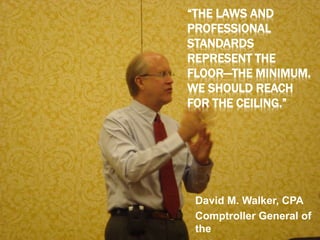
“THE LAWS AND
PROFESSIONAL
STANDARDS
REPRESENT THE
FLOOR—THE MINIMUM.
WE SHOULD REACH
FOR THE CEILING.”
David M. Walker, CPA
Comptroller General of
the

dokumen.tips_financial-shenanigans-ppt.pptx

  • 2.
  • 3.
    Financial Shenanigans(FS) PRESENTED BY Ranjit Pisharody75 Pravin Dhas 76 V. Rao Pentakota 80 N.Sharda 93 Sheryl Susan John 94 Subasri 104
  • 4.
    OVERVIEW  What areshenanigans ?  Strategies used for FS  Likely candidates for FS  Why do Shenanigans exist?  Finding Shenanigans  Case study: Worldcom, Xerox  Road to Reform
  • 5.
    WHAT DOES FSMEAN?  Actions or omissions intended to hide or distort the real financial performance or financial condition of an entity.  They range from minor deceptions to more serious misapplications of accounting principles.
  • 6.
    Strategies used forFS  Overstated Revenue  Under Reported Expenses  Shifting to earlier or later period
  • 7.
    OVERSTATED REVENUE  Recordingrevenue too early  Recording False or Bogus revenues  Inflating income with one time gains
  • 8.
    UNDER REPORTED EXPENSES Moving current expenses to a later period  Failure to disclose liabilities SHIFTING TO EARLIER OR LATER PERIOD  Moving current income to a later period  Moving future expenses to the current period
  • 9.
    LIKELY CANDIDATES FORFS  Fast-growth companies whose real growth is slowing down  Basket-case companies trying to survive  Newly public companies  Private companies
  • 10.
    10 LIST OF COMPANIESINVOLVED IN ACCOUNTING SCANDALS Leasco Pergamon Press Tiphook Lemont & Hauspit Polly Pekc Trafalfar House Levitt Group Poseidon Tyco International Lockheed Quaity Software Products US Realty & Construction London & county Queens Moat Houses Vehicle & General Securities Qwest Versailles London Capital Group Rank hovis McDougall Waste Management Lonrho Reid Murray WorldCom Lucent Rite Aid WPP Maxwell Communications Rolls Razor Xerox McKesson &Robbin Rolls-Royces Yale Express Micro Focus Royal British Bank Yale Transport Microstrategy Royal mail Steamship Satyam Minsec Rush & Tomkins Ponzi Scheme National Student Saatchi & Saatchi Marketing Skandia Nortel Spring Ram Nvidia Storehouse Oxford Health Plans Sunbeam Parmalet Swedish Match Penn Central Texas Gulf Sulphur
  • 11.
  • 12.
    Why do shenanigansexist?  After all it pays!  It’s easy  Discovery is difficult and unlikely  Improving Liquidity
  • 13.
    FINDING SHENANIGANS  Pressreleases  Securities Exchange Commission filings  The auditors report  Interviews with the company  Commercial databases
  • 14.
    AN INTERESTING QUOTE “Howdo you explain to an intelligent public that it is possible for two companies in the same industry to follow entirely different accounting principles and both get a true and fair audit report?”
  • 15.
    THE WORLDCOM SAGA– CASE STUDY  It was 1983 in a coffee shop, that Mr. Bernie Ebbers came up with a concept that became WorldCom  From Humble Beginnings to a Giant  Telecom industry faced low margins and Mr. Ebbers decided ‘growth=survival’  Purchased over 60 firms in 2nd half of the 90’s
  • 16.
    HOW THE FRAUDTOOK PLACE  Operating Expenses to Assets -CFO’s directions affected the income statement: Revenues xxx (no change) COGS xxx (no change) Operating Expenses: Fees paid to lease other companies phone networks: xxx (Huge Decrease) Computer expenses: xxx (Huge Decrease) NET INCOME xxx (Huge Increase)
  • 17.
    POST-FRAUD HAPPENINGS  17,000jobs cut to save $1 billion.  WorldCom was renamed MCI in 2004 when it emerged from bankruptcy  Sullivan pleaded guilty to 3 federal criminal charges for fraud and conspiracy  10 former directors agreed to pay $54 million to settle a shareholder class-action lawsuit
  • 18.
    XEROX SCAM –CASE STUDY  Xerox, a global document management company, was founded in 1906 in Rochester  How it started?  Xerox revealed in 2002 that it overstated it’s revenue by $2 billion  SEC, however, began investigation prior to Xerox’s announcement and planned to conduct an audit which revealed a $6 billion overstatement
  • 19.
    Manipulations Used  Cookie-JarMethod  Acceleration of revenue from short-term equipment rentals, which were improperly classified as long-term leases  Escalating reported earnings to match expected earnings Effects  Xerox could count as earnings what was essentially future revenue  Allowed the company to meet profit expectations
  • 20.
  • 21.
    Why?  Declining revenuein the early 1990’s  Pressure from investors to keep up short term earnings  Top executives, whose incomes are bound up with stock options. Role of KPMG  It was the auditing firm of Xerox  The auditing firm knew what was going on and decided to allow it to continue
  • 22.
    Consequence  Xerox Corp.agreed to pay $670 million while KPMG had to pay $80 million, to settle an eight- year-old securities lawsuit filed on behalf of Xerox investors
  • 23.
    THE ROAD TOREFORM : PROTECTING THE PUBLIC INTEREST  Government regulation & oversight  Strengthening the Auditors Profession  Public trust & confidence in the integrity of auditors  Public understanding of the auditor’s role  Corporate governance & responsibility  Importance of ethical behavior and doing the “right” thing
  • 24.
    CONCLUSION From these scandals,it is important to learn the know how and know why so that we can understand how to avoid these situations in the future. WHAT WE CAN DO? “Everyone should habitually be aware of the moral implications of what he or she is asked to do and, each by each , should stand up for the right to be moral.” - Jane Jacobs – Systems of Survival
  • 25.
    “THE LAWS AND PROFESSIONAL STANDARDS REPRESENTTHE FLOOR—THE MINIMUM. WE SHOULD REACH FOR THE CEILING.” David M. Walker, CPA Comptroller General of the

Editor's Notes

  • #3 The lemonade Story Good Morning! Well to start with I’m going to tell u a story- A lemonade Story Imagine you're a kid with a lemonade stand and you want to build a roof over it so that you and your customers aren't in the hot sun. You don't have the money because business hasn't been that good. Your brother has the money, but he won't lend it to you unless he knows that he'll make something in the deal. You're sure that having a covered lemonade stand will make all the difference for your business because your customers will enjoy sipping their drinks in the cool shade. So you decide to creatively boost your current sales figures and offer your brother a chance to invest in your business. He gives you the money to build your roof in exchange for 25 percent of your profits. For reasons unknown to you, the covered stand doesn't really sell any more lemonade than the uncovered stand did. Now your brother is mad, because the profit he thought he was going to make was based on phony sales figures. So any guesses on what would be the topic of this presentation.
  • #5 Here is an overview of the topics we will be dealing abt..(max of 15 sec) Finding Shenanigans
  • #6 Companies report future earnings that are deceptive, unwarranted, and down-right dangerous to the financial system--and no one complains. During the boom, chief executives pumped up earnings by casting aside any constraints on how and when they booked sales and calculated costs. And people turned a blind eye to accounting shenanigans as long as stocks moved ever higher. Then came the bust, and corporations played the same numbers game to soften the blow to earnings, hoping again for investors' complicity. Although companies are required to follow Generally Accepted Accounting Principals (GAAP), many companies find loopholes and ways to fudge their numbers. These items are crucial for analysts to recognize in order to avoid recommending poor investments to their clients. This “anything-goes accounting” must end. So,What are financial shenanigans?? Financial shenanigans are actions or omissions (tricks) intended to hide or distort the real financial performance or financial condition of an entity. They range from minor deceptions to more serious misapplications of accounting principles Shenanigans means tricks
  • #7 1)Accounting shenanigans when the economy turns bad: When the economy turns bad, it’s time to expect more accounting shenanigans from public companies. Sometimes, a company has been using aggressive accounting for years, and a dismal economic picture makes it difficult to hide the old chicanery any further. Other times, a firm decides to use accounting tricks to mitigate the impact of poor operating results. And then there are the opportunists, who use financial reporting to make bad times seem even worse, knowing that when the economy turns around, they can undo some of their overly negative accounting assumptions — and look all the better moving forward. 2) Inflating current reported income - A company can inflate its current income by inflating current revenues and gains, or deflating current expenses.   3)Deflating current reported income – A company can deflate current revenues by deflating current revenues or gains, or inflating current expenses. Shenanigans aimed at inflating current reported income are considered more serious, because they make the company look much better than it is. Furthermore, over time, the inflation of current income will most likely be discovered in the future and will make the company stock plummet. On the other hand, deflating current reported income will only serve as an income-smoothing mechanism and will not have as serious of an impact on common shareholders.
  • #8 (Explain in one line from original word document) By Recording revenues prematurely and/or of questionable quality, Recording fictional revenues, Creating special transactions or one-time transactions to generate a gain, Not recording or reducing liabilities improperly, Shifting current expenses to past or future periods, Deferring current revenues to a future period, Recognizing future expenses in current expenses as a special one-time charge. Shipping goods before sale is finalized Recording revenue when important uncertainties exist Recording revenue when future services are still due Recording sales for no reason - Misclassifying income from investments as revenue - Recording the cash received from a lending transaction as revenues - Recording supplier refunds as revenues Selling undervalued assets and show it as a profit -Selling investments for a gain and recording it as revenue, or using it to reduce current operating expenses -Reclassifying certain balance sheet accounts to create income
  • #9 Excluding expenses and the related liability - Modifying accounting assumptions in an effort to decrease the reported liabilities - Failure to record unearned revenues (customer prepayments) and recording these amounts as revenues
  • #10 Likely Candidates for Shenanigans There are certain types of companies that have a higher probability for performing shenanigans. 1.Fast-growth companies whose real growth is beginning to slow Growth companies command a premium over slower-growth companies. If a company is no longer classified as a growth company, its valuation can be severely affected. 2. Basket-case companies trying to survive These are companies that have a weak management. Management may resort to financial shenanigans in an effort to make investors believe that the company’s problems are not significant. 3.Newly public companies (IPO) These have been known to have weak internal controls, making them susceptible to earnings manipulation. 4.Private companies. Private companies that are closely held do not need to produce audited financial statements, and are likely to use financial shenanigans 
  • #12 November 9, 2007
  • #13 Shenanigans exist because under GAAP a company’s management has many options from which to choose to record certain economic events. These options are called "accounting rules" and, when used, are referred to as "accounting events". Because the various choices will have differing effects on reported earnings, management has the opportunity to manipulate its financial results, although it may not exercise that option. So why would management want to use financial shenanigans to cook the books? Because it pays to do so; it’s easy, and the discovery of shenanigans is difficult and unlikely. 1. It pays Displaying a good financial performance can be very beneficial monetarily for the current management, especially if its short-term compensation is based on the company’s current performance. Managers who have a significant position in a public company stock (stock-option program) will most likely want to defer reporting losses or cook the book until they sell their current holdings. There are also non-monetary incentives for management, such as keeping their job. 2. It’s easy Financial accounting standards are broad. It is easy for management to use the accounting rules that best fit its needs rather than those of the stockholders or lenders. 3. Discovery is difficult and unlikely Though there have been several advancements in the area of discovering accounting frauds - due in part to the Enron scandal - they remain difficult to identify, and it’s unlikely that the managers will get caught. In the past, the potential penalties for companies that engage in financial shenanigans were small. Fortunately, this has changed, and the penalties can be severe for both managers and board members. 4.Another aim of financial shenanigans is to improve liquidity. By inflating revenues or hiding debt, companies can obtain funding with lower borrowing costs and fewer restrictive financial covenants.
  • #14 Finding Shenanigans There are four sources of information an analyst should use to detect financial shenanigans: 1.Press releases Press releases can provide an analyst with useful information. That said, they must be used and analyzed diligently. 2.Securities Exchange Commission filings Securities filings are forms such as the Form 10-K (annual), 10-Q (quarterly), 8-K (special events) and 144 (corporate insider activity) and annual reports, proxy statements and registration statements.  Armed with these documents analysts should look in: ####MENTION THE HEADINGS IN BRIEF:::###  The auditors report – Red flags include: - Inclusion of a qualified opinion - No audit committee, or audit committee comprises mostly of related parties - Proxy statement – Red flags include: - Pending lawsuits or other contingent liabilities - Special compensation plans or perks for officers and directors - Footnotes to financial statements – Red flags include: - Abnormalities found in the accounting-policy descriptions - Pending lawsuits or other contingent liabilities - Unbilled receivables - Off-balance-sheet transactions - Changes in accounting principles and estimations Management discussion and analysis (MD&A) – Red flags include: - Large planned expenses - Decreased liquidity - Abnormal need for working capital  Form 8-K – This will provide information on: - The company’s acquisition and divestitures - Change in auditor – If a company changes auditors, it could be because the previous auditor did not want to sign off on the financial statements. - Form 144 – Red flags include: - Insiders selling a large portion of their holdings 3.Interviews with the company Company interviews are also a good way to get close and personal with a company’s management and ask some more targeted questions. 4.Commercial databases Analysts can also make use of commercial databases such as LexisNexis and Compustat to screen for companies displaying potential warning sings of operating and accounting problems
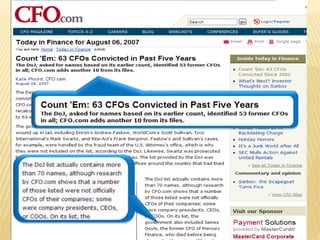
  • #16 The Worldcom Saga It was 1983 in a coffee shop in Mississippi that Mr. Bernard Ebberss first helped create the business concept that became WorldCom. From its humble beginnings as an obscure long distance telephone company WorldCom, through the execution of an aggressive acquisition strategy, evolved into the second-largest long distance telephone company in the United States and one of the largest companies handling worldwide Internet data traffic. WorldCom achieved its position as a significant player in the telecommunications industry through the successful completion of 65 acquisitions.11 Between 1991 and 1997, WorldCom spent almost $60 billion in the acquisition of many of these companies and accumulated $41 billion in debt. Facts About Founders Mr. Ebbers, CEO. increased his stocks by by placing his stocks as security. The price of the estocks were as high as 60$. Using this situation,he Netted $140 million from stock sales. Also ebbsers took loan from Worldcom at rates as low as 2%.This loans, also called as sweet heart loans were used to to fund his personal investments. Mr. Scott Sullivan Served as CFO, treasurer and secretary for worldcom. He directed staff to make false accounting entries. Also, he personally made false and misleading public statements regarding finances. He too Netted $45 million from stock sales of worldcom during worldcom’s boom period.
  • #17 Reduced Reserve Accounts to cover liabilities of acquired companies Further Misclassification of expenses CFO told key staff members to mark operating costs as long-term investments Huge losses turned into enormous profits. $1.38 billion in net income in 2001 Inflated the company’s value in its assets In 1999, revenue growth slowed and the stock price began falling. WorldCom's expenses as a percentage of its total revenue increased because the growth rate of its earnings dropped. This also meant WorldCom's earnings might not meet Wall Street analysts' expectations. In an effort to increase revenue, WorldCom reduced the amount of money it held in reserve (to cover liabilities for the companies it had acquired). From 1998-2000, WorldCom reduced reserve accounts held to cover liabilities of acquired companies. Thus WorldCom added $2.8 billion to the revenue line from these reserves Reserves didn’t cut it; An e-mail was sent in December 2000 to a division in Texas directing misclassification of expenses.   They recorded Operating Expenses as assets on the balance sheet instead of as expenses on the income statement. Operating expenses must be subtracted from revenue immediately, while the cost of capital expenses can be spread over time. Improperly representing operating costs inflated WorldCom's profits. CFO told key staff members to mark operating costs as long-term investments to the tune of $3.85 billion. These newly classified assets were expenses that WorldCom paid to lease phone network lines from other companies to access their networks. They also added a fictional journal entry for $500 million in computer expenses, for which supporting documents for the expenses were never found. WorldCom managers also tweaked their assumptions about amount customers owe the company(Account Receivables). In this area, managerial assumptions play two important roles in receivables accounting. In the first place, they contribute to the amount of funds reserved to cover bad debts. The lower the assumption of noncollectable bills, the smaller the reserve fund required. These changes turned WorldCom's losses into profits to the tune of $1.38 billion in 2001. It also made WorldCom's assets appear more valuable.
  • #18 After tips were sent to the internal audit team and accounting irregularities were spotted in MCI's books, the SEC requested that WorldCom provide more information. The SEC was suspicious because while WorldCom was making so much profit, AT&T (another telecom giant) was losing money. An internal audit turned up the billions WorldCom had announced as capital expenditures as well as the $500 million in undocumented computer expenses. There was also another $2 billion in questionable entries. WorldCom's audit committee was asked for documents supporting capital expenditures, but it could not produce them. The controller admitted to the internal auditors that they weren't following accounting standards. WorldCom then admitted to inflating its profits by $3.8 billion over the previous five quarters. A little over a month after the internal audit began, WorldCom filed for bankruptcy. When it emerged from bankruptcy in 2004, WorldCom was renamed MCI. Former CEO Bernie Ebbers and former CFO Scott Sullivan were charged with fraud and violating securities laws. Ebbers was found guilty on all counts in March 2005 and sentenced to 25 years in prison, but is free on appeal. Sullivan pleaded guilty and took the stand against Ebbers in exchange for a more lenient sentence of five years.
  • #19 In one of the latest scandals involving a prominent American corporation, Xerox revealed in 2002 that over the five years prior to 2002 it had improperly classified over $6 billion in revenue, leading to an overstatement of earnings by nearly $2 billion. The announcement of accounting manipulations. It was estimated at the time, however, that the amount involved was about half that which is now stated, or abXerox is not entirely new. The Securities and Exchange Commission (SEC) began an investigation that ended in April of that year. The SEC had charged the producer of copiers and related services with out $3 billion. A settlement was eventually reached that included a $10 million fine, as well as an agreement to conduct a further audit. It was this audit that produced the $6 billion figure.   There were two basic manipulations that formed the basis for the SEC investigation. The first was the so-called “cookie jar” method. This involved improperly storing revenue off the balance sheet and then releasing the stored funds at strategic times in order to boost lagging earnings for a particular quarter. This is a widely used manipulation.. The second method—and what accounted for the larger part of the fraudulent earnings—was the acceleration of revenue from short-term equipment rentals, which were improperly classified as long-term leases. The difference was significant because according to the Generally Accepted Accounting Principles (GAAP)—the standards by which a company’s books are supposed to be measured—the entire value of a long-term lease can be included as revenue in the first year of the agreement. The value of a rental, on the other hand, is spread out over the duration of the contract. The effect of the manipulation was that Xerox could count as earnings what was essentially future revenue. This boosted short-term profits and allowed the company to meet profit expectations in 1997, 1998 and 1999, though it had the effect of reducing earnings during the past two years. In 1998 Xerox reported a pretax income of $579 million, while it should have reported a loss of $13 million. On the other hand, the $137 million loss for 2001 will become a $365 million gain after the manipulation is reversed. The $1.9 billion total that will now be subtracted from revenue reported from 1997-2001 will be added to future reports. Thus, unlike some of the other scandals that have emerged over the past several months, Xerox has not been accused of falsely creating unearned income. Rather it spread its income out in a fraudulent manner. To the same end, WorldCom improperly capitalized about $4 billion in ordinary expenses in order to allow the company to deduct the expense over a period of decades rather than writing it off all at once. Both these methods serve to boost short-term profits.       Why carry out these manipulations when the extra money earned in one year would have to be subtracted from future years?       This was necessary because corporations are under enormous pressure from Wall Street investors to keep up short-term earnings. Otherwise, their share values will drop, which not only threatens companies heavily reliant on share values to finance debt, but also has financial consequences for top executives, whose astronomical incomes are bound up with stock options. The SEC investigation noted that “compensation of Xerox senior management depended significantly on their ability to meet [earnings] targets.” Because of the accounting manipulations, top Xerox executives were able to cash in on stock options valued at an estimated $35 million. Xerox stock rose to a peak of $60 a share in mid-1999, when the company was carrying out the accounting fraud. It has since declined sharply and is now trading at about $7. Confronted with declining revenue during the late 1990s that should have led to lower than expected earnings reports—thereby reflecting the true nature of the company’s deepening problems—Xerox decided to cook the books. This was done quite methodically. Internal documents have recorded discussions among top officials at Xerox concerning ways to manipulate accounting to allow the company to meet Wall Street expectations. Executives apparently calculated the exact amount that would have to be altered in order to allow the company to just meet or slightly exceed “first call consensus” expectations on Wall Street, which are determined prior to a company’s release of earnings data. In 1997, for example, expected earnings were at $1.99 a share, while reported earnings were $2.02. Actual earnings, correcting for the accounting manipulations, were at $1.65. Using its earlier underestimate of $3 billion in improperly classified revenue, the SEC calculated these actual earnings. In 1998, expected and reported earnings were both at $2.33 while actual earnings were only $1.72 a share. In 1999, reported earnings beat expected earnings by one cent, while actual earnings fell short by almost 50 cents. This is a striking example of a company fitting earnings to expectations in order to prevent a run on stock. It is, however, a fairly common practice. Many companies, like General Electric for example, always seem to come out just barely ahead of expectations. Indeed, recent studies have found the distribution of reported earnings of major companies around expectations was skewed to the positive side. That is, it is more likely for a company to beat than to fall short of expectations, suggesting that there are many companies that have been following the same accounting practices as Xerox. Like the WorldCom fraud, Xerox’s manipulation should have been easy to detect if there was anyone interested in looking. As former SEC chief accountant Lynn Turner noted, “These numbers have gotten so large that it’s akin to auditors driving past Mt. Everest and saying they never saw it.... Corporate America has somehow gotten into the mindset that this is OK.” Xerox’s auditor during the period in question was KPMG, one of the “big four” accounting firms that dominate the profession. KPMG was fired in October and replaced by PricewaterhouseCoopers. KPMG was also part of the SEC investigation that began last year. The evidence suggests that the auditing firm knew what was going on and decided to allow it to continue. An internal document obtained by the SEC contained a statement by a KPMG official acknowledging that Xerox’s schemes constituted “half-baked revenue recognition.” When the KPMG auditor in charge of the Xerox account began to raise some concerns about the company’s improper techniques, he was replaced with someone else.   Burning a hole……The Consequences that followed   Xerox Corp. agreed to pay $670 million while KPMG LLP had to pay $80 million, to settle an eight-year-old securities lawsuit filed on behalf of Xerox investors who claimed Xerox committed accounting fraud to meet Wall Street earnings expectations.
  • #24 "Disasters teach us how to prevent the last disaster,“ uditor Independence: A Bit More Rope Topics: Audits Tags: Audit, Auditor Independence, Finance, Financial Accounting, SEC Source: Financial Executives International E-mail this page Related Content FREE Registration is required Overview: The SEC's final version of its new rule on auditor independence wasn't as harsh as the proposal would have suggested. That gives audit firms, especially the Big Five, a little more breathing room. The Securities and Exchange Commission's (SEC) commitment to auditor independence is not new, proposal made independence the hottest and perhaps the most controversial topic. Chairman asserts that independence is "the core of the accounting profession... the space to think, to speak, and to act on the truth and truth is the lifeblood of investor confidence." The auditors' role is to act in the interests of shareholders and the public, not in the interest of management. With present scenario of financial markets bringing enormous pressure on management to meet or exceed analysts' expectations, reports of earnings management (sometimes even fraud) appear to be at an all-time high. The SEC asserts that the audit role must be strong and reliable to assure the integrity of management, the fairness of financial statements and ultimately the integrity of the financial markets, and it believes auditor independence in both fact and appearance to be essential. (Is this item miscategorized? Does it need more tags? Let us know.) Financial crisis shifts balance toward regulation Wed Jun 17, 2009 5:20 PM EDT politics, business, us, barack-obama, regulation, great-depression, pendulum Tom Raum, Associated Press Writer Federal Reserve Chairman Ben Bernanke, right, holds a copy of the outlined reforms as he sits next to Director of National Economic Council, Lawrence Summers, right, as they wait for President Barack Obama to deliver remarks on the new comprehensive regulatory reform plan, Wednesday, June 17, 2009, in the East Room of the White House in Washington. (AP Photo/Pablo Martinez Monsivais) WASHINGTON — The pendulum of government regulation is swinging in a new direction. The government spent most of the past three decades dismantling rules put in place to fix the bad practices that led to the Great Depression of the 1930s. President Barack Obama's financial overhaul plan marks a clear step back toward greater regulation. The country often responds to crises with a raft of new laws and rules designed to keep whatever caused the crisis from happening again. Washington is home to many large federal buildings that stand as monuments to past bursts of crisis-driven government intervention: the Commerce Department, Federal Reserve, the Securities and Exchange Commission and the departments of Housing and Urban Development, Energy, and Homeland Security. There's always a risk of going too far on the regulation or deregulation side. And later corrections in the opposite direction have been common. Either way, the buildings full of federal workers remain. "In theory, regulation and markets should evolve together. In fact, almost always, regulation comes after disasters" and it isn't always for the better, said John Steele Gordon, an economic historian and author of the book "The Great Game: The Emergence of Wall Street as a World Power." "Disasters teach us how to prevent the last disaster," he said. The Obama revamp plan unveiled Wednesday asks Congress to give the Federal Reserve new powers to oversee the biggest financial players whose failure could imperil the economy and place stiff capital requirements on them. In addition, the plan would empower a council of regulators that would police the entire financial system for risky products. New powers would be provided to safely wind down giant financial institutions on the verge of collapse. And, it would create a new consumer protection agency to guard against credit and other abuses that played a big role in the current crisis. Obama said it was designed to end the greedy practices and risk-taking that led to the severest downturn since the Great Depression while seeking "a careful balance" against too much regulation. President Ronald Reagan — with his mantra that government was not the solution but the problem to the nation's woes — is usually credited with beginning the unwinding of federal regulations in the early 1980s. He argued for setting free the mighty engine of capitalism and persuaded Congress to deregulate many businesses. Distinctions between commercial and savings banks were eliminated during his presidency. But the move toward deregulation was well under way under predecessor Jimmy Carter, who pushed for the lifting of federal controls on airlines, trucking, railroads and natural gas. There was a brief bout with reregulation in the late 1980s and early 1990s, as the government seized control of more than 1,000 failed savings and loans. But then President Bill Clinton took financial deregulation a step further, signing a bipartisan bill in 1999 that ended the 1930s-era barrier between banks and investment and insurance companies — but without subjecting those institutions to the same rules that applied to regular banks. That gave rise to huge one-stop shopping financial supermarkets. In a light regulatory climate and with easy monetary policies by the Fed, all sorts of complicated financial instruments were packaged and sold to investors, many based on shaky mortgages that later turned out to be extremely vulnerable to a housing downturn. Obama's plan builds on a proposal by former Treasury Secretary Henry Paulson and accelerates a move toward re-regulation that had its beginning in a 2002 law to crack down on corporate fraud and accounting practices following the Enron and Worldcom accounting scandals. The White House and its backers said the plan would prevent another near-collapse of the nation's financial system. Some critics said it gave the Fed too much power, others said it didn't go far enough. The plan may be just "adding another layer of bureaucracy to an overcrowded regulatory framework," said Joseph Lynyak, an attorney who represents banks and other financial institutions before federal and state regulatory agencies. Richard Spillenkothen, the Fed's former top banking regulator who left in 2006 and is now a director at Deloitte & Touche LLP's regulatory and capital markets consulting practice, called the plan "a major turning point. ... You are going to see a much more heightened role by the government in the regulatory process." "I think these tools will be helpful in improving the odds that regulators will identify or head off problems. But there are no guarantees in life. There are things that can happen that can't be anticipated," he added. Federal financial regulation has been back and forth throughout history, with cycles of relatively light regulation followed by crackdowns. When President Andrew Jackson did away with the Bank of the United States, it led to the 1837 panic on Wall Street but also ushered in a decades-long period in which the federal government essentially kept its hands off financial markets. In the late 19th century, huge business monopolies and trusts took advantage of weak government oversight to control markets and put a stranglehold on the U.S. economy. That fed a rise in public sentiment for government regulation. The result was the Sherman Antitrust Act in 1890 and the trust-busting in the early 1900s by President Theodore Roosevelt. Roosevelt persuaded Congress to establish a new-Cabinet level Department of Commerce and Labor to expand regulation and monitoring. In 1907, the economy was again weakening, leading a number of businesses and Wall Street brokerages to go bankrupt. By the fall, the Knickerbocker Trust Co. in New York City and the Westinghouse Electric Co. both failed, touching off the Panic of 1907. Stock market prices plunged and customers made a run on banks. The crisis led to legislation setting up the Fed, which President Woodrow Wilson signed into law on Dec. 23, 1913. The Fed's mission: provide the country with economic and price stability and oversee the safety and soundness of U.S. banks. Over the years, the Fed's role in banking and the economy has expanded. It is considered to be an independent central bank because its decisions don't have to be approved by the president or anyone else in the executive branch. In the "Roaring 20s" following the end of World War I, wild stock market speculation, easy credit and shaky banking practices led to the 1929 stock market crash that ushered in the Great Depression. The Securities and Exchange Commission was then created to restore investor confidence and faith in the financial system. Through the 1930s, other regulatory and oversight commissions and public-works programs also were put in place under President Franklin D. Roosevelt as the government took an increasingly active role in managing the economy. But the popularity of strong government financial regulation began to fade in the bull markets of the 1980s and 1990s. Each of the nation's major financial crises has something in common: each prompted the government to "look into what caused it and then there's a big swing of the pendulum to re-regulation," said Ken Thomas, a lecturer in finance at the University of Pennsylvania's Wharton School. "When things get better, the government will start deregulating and sow the seeds for the next crisis." © 2009 The Associated Press. All rights reserved. This material may not be published, broa