EXTERNAL AUDITING WITH
A FOCUS ON NON PROFIT
ORGANIZATIONS
Emily Weary
MBA 592
April 25, 2016
OVERVIEW
 Introduction
 Value of an Audit
 Accounting Scandals
 Accounting Principles and Standards
 Audit Procedures
 Trends in Financial Reporting of Nonprofits
 Conclusion
ECONOMIC CRIME
 More organizations have been exposed to
deficiencies in accounting practices
 Fraud cases lead to:
 Collapse of entire organizations
 Significant investment losses
 Litigation
 Imprisonment of top executives
 Companies look to third parties to maintain effective
system of internal controls
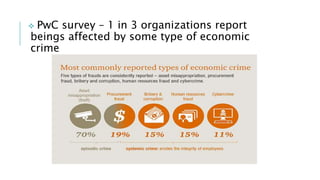
 PwC survey – 1 in 3 organizations report
beings affected by some type of economic
crime
THE PURPOSE OF AN AUDIT
 Provide financial statement users with an opinion
on whether the financial statements are presented
fairly
 Financial information is complex and is
demanded in a timely manner
 Causes increased risk that information will be
misleading or fail to meet the company’s business
objectives
 Important that policies are routinely reviewed
and improved in order to increase proficiency
NON PROFIT ORGANIZATIONS
 Many are required to have independent audit due to
nature of funding sources
 CPA will review financial records, accounts, internal
controls, and ordinary business operations
 Grantors will request audited financial statements to
reassure that the organization is in a sound financial
position
 Conducting an audit is a good business practice for
companies to adopt
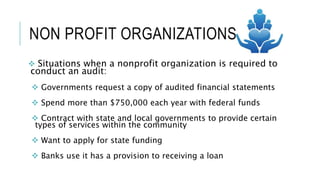
NON PROFIT ORGANIZATIONS
 Situations when a nonprofit organization is required to
conduct an audit:
 Governments request a copy of audited financial statements
 Spend more than $750,000 each year with federal funds
 Contract with state and local governments to provide certain
types of services within the community
 Want to apply for state funding
 Banks use it has a provision to receiving a loan
VALUE OF AN AUDIT
 Gives some insight into how well the organization is
being managed
 Makes companies aware of potential risks
 Helps solve complex accounting issues
 Must be planned and economically efficient
FRAUD
 Intentionally falsifying amounts of disclosures to mislead
financial statement users
 Feel some type of pressure or incentive from sources
both in and out of the company
 Fraudsters have no ethical values when it comes to
knowingly committing an act that is dishonest
 Usually employees but can be management – have the
most access to information and better able to conceal it
EVIDENCE
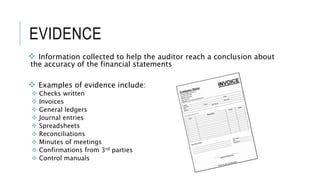
 Information collected to help the auditor reach a conclusion about
the accuracy of the financial statements
 Examples of evidence include:
 Checks written
 Invoices
 General ledgers
 Journal entries
 Spreadsheets
 Reconciliations
 Minutes of meetings
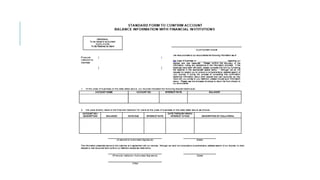
 Confirmations from 3rd parties
 Control manuals
EVIDENCE
 All unusual trends need to be investigated
 All documentation needs to be checked for authenticity
 Unapproved transactions raise suspicion in management’s
operations
 Must come from a dependable source
 Inquiry, observation, and inspection
 Help them gain a basic understanding day-to-day operations of the
company
NONPROFIT RISK ASSESSMENT
 Typical nonprofit organization is subject to rapid change
 Should make note of any changes in personnel, procedures,
funding sources, controls, and any pending litigations
 Increase in errors due to money being spent on mission
instead of administrative costs
 Level of risk associated with misstatements is higher
 Terms of grants can change
 Could reduce the monetary amount of funding
NONPROFIT RISK ASSESSMENT
 Many rely heavily on contributions from one donor
 May have a few employees recording entries, some of which
have no type of accounting background
 High employee turnover
 No training for replacements
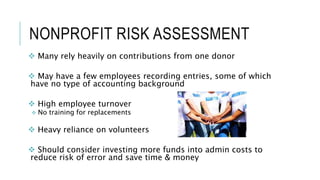
 Heavy reliance on volunteers
 Should consider investing more funds into admin costs to
reduce risk of error and save time & money
SARBANES-OXLEY ACT OF 2002
(SOX)
 U.S. Senate and the House of Representations passed SOX to improve
quality and reliability of financial reporting after result of fraud scandals
 Improved guidelines for reporting
 Indicated penalties and longer prison sentences
 Requires at least one member of the audit committee to have a financial
background to help make sound financial decisions
 Many argue on its effectiveness, but it has helped internal controls become
more valuable
 Passed after WorldCom scandal
ACCOUNTING SCANDALS
 CEO, Bernie Ebbers, overstated their assets by nearly $11 billion
 Capitalized line costs rather than expensing them
 Inflated Revenue through fake accounting entries
 Focused on achieving rapid growth through acquisitions
 Capitalizing these costs would have allowed the company to spread their current
year expenses into future years
 Appeared to be improving – encouraged stock purchases
 Ebbers was sentenced to 25 years for conspiracy and filing false documents with
regulators
ACCOUNTING SCANDALS IN
NONPROFITS
 Focused on doing good for those in need, many people want to
think they are made up of hard-working and honest individuals
 2013 Washington Post found that from 2008 – 2012 over 1,000
nonprofits had seen a “significant diversion” of their assets
 Attributed to theft, investment fraud, embezzlement, and other
unauthorized uses of funds
 Tend to have more faith in employees – more lenient with controls
 Easier for fraud and embezzlement to occur due to lack of strict
guidelines
ACCOUNTING SCANDALS
 Tried to look as if they were more successful with the money they
were receiving from donors
 Made up of many different offices – each has different principles
and practices
 Counting some of their contributions twice
 Would portray their revenue to be greater and their expenses lower
 Occurred when 2 or more would count the same contribution as
their own
EFFECTS OF FRAUD ON
EMPLOYEES
 Many management teams involved in covering up fraud tend to bully their
employees
 Try to get rid of anyone who asks too many questions
 Stakeholders should be more informed on a monthly basis through
documentation showing:
 All balances in cash accounts
 Bills that are owed to vendors
 Lists of outstanding receivables
 Salaries and benefits paid for key employees
 All transactions should require proper approval
PRINCIPLES AND STANDARDS
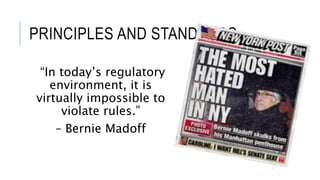
“In today’s regulatory
environment, it is
virtually impossible to
violate rules.”
– Bernie Madoff
PRINCIPLES AND STANDARDS
 Provide a way for auditors to measure quality and the objectives
intended to be achieved
 Standard framework of guidelines used for financial accounting
purposes are generally accepted accounting principles (GAAP)
 Would be very difficult to fully evaluate the financial condition of the
organization without GAAP
 Issued by the Financial Accounting Standards Board (FASB)
 FASB requires auditors to issue a report asserting an opinion about the
financial practices of the organization
 Whether the financial statements are presented fairly
PRINCIPLES AND STANDARDS
 Generally Accepted Auditing Standards (GAAS) are a set of criteria used
to direct the process of the audit
 Made up of General Standards, Standards of Field Work, and Reporting
Standards
 Address the general responsibilities of the auditor
 Responsible for being competent and obtaining the necessary
capabilities to perform an audit through experience and education
 Must be planned and supervised
 Must have sufficient understanding of the entity and its environment
PROCEDURES
 Most engagements typically consist of four stages:
 Planning
 Preliminary Review
 Fieldwork
 Reporting
 Main objective: develop a strategy and plan that will aid in search for
evidence to form an opinion on whether the financial statements are fairly
presented
 Must review the company’s process of recording and summarizing
transactions
 If the auditors are able to determine that the company’s controls are
effective, then they can accept the fact that the balances in each account are
ENGAGEMENT PLANNING AND RISK
ASSESSMENT
 Must arrange a meeting with clients to go over intentions and
responsibilities regarding the scope of the audit
 Arrangements should be agreed upon before any fieldwork begins
 Auditors issue arrangement letter – terms and requirements
 Topics to be included:
 Objectives of engagement
 Management’s responsibilities
 Auditor’s responsibilities
 Limitations
ENGAGEMENT PLANNING AND RISK
ASSESSMENT
 Most important step - establish and document a plan that lists all
procedures that need to be performed to assess risk of material
misstatement
 Misstatements can occur as a result of errors or fraud – Difference is
intention
 Involves gaining an understanding of the entity and its environment
 Collecting information regarding the client’s industry
 Regulations or other external factors affecting the entity
 Application of accounting policies
 Related business risks
 Can determine if any risks are present and where to look to see if those
ENGAGEMENT PLANNING AND RISK
ASSESSMENT
 Must direct their attention to areas that are subject to higher
amounts of risk
 Determine materiality limit - amount of a transaction that would
make a difference and influence the decision of financial statement
users
 Calculate a certain dollar amount based off a predetermined
benchmark of either total revenue or total assets
 Use this amount to select a sample of transactions to test or
invoices to review
 Validate that amount of undetected misstatements is immaterial
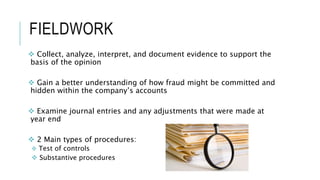
FIELDWORK
 Collect, analyze, interpret, and document evidence to support the
basis of the opinion
 Gain a better understanding of how fraud might be committed and
hidden within the company’s accounts
 Examine journal entries and any adjustments that were made at
year end
 2 Main types of procedures:
 Test of controls
 Substantive procedures
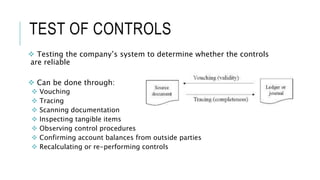
TEST OF CONTROLS
 Testing the company’s system to determine whether the controls
are reliable
 Can be done through:
 Vouching
 Tracing
 Scanning documentation
 Inspecting tangible items
 Observing control procedures
 Confirming account balances from outside parties
 Recalculating or re-performing controls
SUBSTANTIVE PROCEDURES
 Performed to obtain sufficient and appropriate evidence
 Some key indicators of the pervasiveness of fraud include:
 Inconsistencies in accounting records
 Conflicting or missing information
 Problematic relationships between auditors and management
 Unclear or varying responses to inquiries
 Examine the company’s assets and business records to ensure that the
information collected is useful and relevant
 Typically performed at the client’s location to facilitate open
communication and keep the client up-to-date with any observations or
developments
COMPLETING THE AUDIT
 Any misstatements that have been identified should be discussed
with the client
 Should be given the opportunity to adjust them if they will have a
substantial influence on the financial statements
 Issues of going concern and subsequent events should be
addressed
 Occur during the time between the date of the financial statements and
the date of the auditor’s report
 Legal letters sent - requesting information about any pending or
threatening litigations that they were engaged in
 Many nonprofits have administrative protests and lawsuits occur
REPORTING FINDINGS
 The auditors will determine the nature of their opinion
 4 types of opinions that an auditor can express:
 Unqualified – In conformity with GAAP
 Qualified – In conformity with GAAP except for limited items
 Adverse opinion – Not in compliance with GAAP
 Disclaimer – No opinion is expressed
 Issue a report – specifying overall perception of the company
from a financial perspective
REPORTING FINDINGS
 Discussion of
recommendations
 Main objective: offer
constructive feedback to modify
and improve procedures
 Examples of recommendations:
 Reconcile all bank statements on a
monthly basis to ensure that they
agree to the GL
 Reconcile all AR and AP Aging reports
to GL
 Keep track of billings on a weekly
basis to ensure accurate and timely
billings
 Use excel spreadsheet to avoid
mathematical errors
 Allocate gross wages and payroll
NONPROFIT TRENDS
 Extremely diverse internal operations - different missions,
processes, and objectives
 Faced with the same external forces - changes in the economy, user
demographics, and technology
 Trends should be analyzed by management and BOD to address
potential threats
 Top 3 trends:
 Resource limitations
 Increased demand
 Increase in awareness of devotion to mission
NONPROFIT CHALLENGES
 Biggest challenges:
 Lack of time to deliver quality services
 Insufficient budget for direct program expenses
 Inability to measure effectiveness
 Economy is most influential factor – unstable government grant
situation
 Use their resources to fulfill their mission rather than generate
income
 Must meet the terms indicated in grants and agreements in order
to receive adequate funding
SOLUTIONS
 Advocacy – aids in the process of educating policy makers
about the needs of the people within the communities that
nonprofits serve
 Helps eliminate some of the barriers that prevent nonprofits
from promoting their visions
TECHNOLOGY
 As the business environment continues to evolve, so too does the
development of technology
 Has allowed many individuals and foundations to donate more
money via the internet
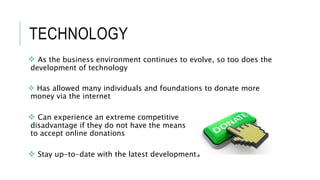
 Can experience an extreme competitive
disadvantage if they do not have the means
to accept online donations
 Stay up-to-date with the latest developments
TECHNOLOGY
 People who see benefit of their offerings are more motivated
to spread the word
 Will easily establish an immediate epidemic through the use
of social media
 Use of technology has shown positive results
 Enables nonprofits to focus on their missions rather than
insignificant matters
IMPACT OF SOCIAL MEDIA
 ALS Ice Bucket Challenge
ETHICS
 Every company should take necessary steps to make ethical
business decisions
 People perform better when they believe that their workplace is
treating them with dignity and is rewarding ethical conduct
 Should develop a code of professional ethics
 Provide guidance to employees about how to address certain
situations that may require an ethical decision.
CONCLUSION
 More than half of organizations within the United States have been
subjected to some type of fraud
 Increase may be due to the fact that more companies have been
implementing stronger internal control procedures
 Has led to an increase in the number of frauds actually being
detected
 Have been able to detect and address more fraud related issues
through the work of external auditors
CONCLUSION
 Economic crime has and will continue to be a threat to every type of
organization
 How companies confront these threats will determine how
sustainable they will be
 Whether or not their company will be in the position financially
where they will be able to operate well into the future
 By reviewing a company’s accounting policies and procedures,
auditors can confirm that the company is following the necessary
steps to prevent fraud from occurring

Emily Weary MBA 592 Presentation

  • 1.
    EXTERNAL AUDITING WITH AFOCUS ON NON PROFIT ORGANIZATIONS Emily Weary MBA 592 April 25, 2016
  • 2.
    OVERVIEW  Introduction  Valueof an Audit  Accounting Scandals  Accounting Principles and Standards  Audit Procedures  Trends in Financial Reporting of Nonprofits  Conclusion
  • 3.
    ECONOMIC CRIME  Moreorganizations have been exposed to deficiencies in accounting practices  Fraud cases lead to:  Collapse of entire organizations  Significant investment losses  Litigation  Imprisonment of top executives  Companies look to third parties to maintain effective system of internal controls
  • 4.
     PwC survey– 1 in 3 organizations report beings affected by some type of economic crime
  • 5.
    THE PURPOSE OFAN AUDIT  Provide financial statement users with an opinion on whether the financial statements are presented fairly  Financial information is complex and is demanded in a timely manner  Causes increased risk that information will be misleading or fail to meet the company’s business objectives  Important that policies are routinely reviewed and improved in order to increase proficiency
  • 6.
    NON PROFIT ORGANIZATIONS Many are required to have independent audit due to nature of funding sources  CPA will review financial records, accounts, internal controls, and ordinary business operations  Grantors will request audited financial statements to reassure that the organization is in a sound financial position  Conducting an audit is a good business practice for companies to adopt
  • 7.
    NON PROFIT ORGANIZATIONS Situations when a nonprofit organization is required to conduct an audit:  Governments request a copy of audited financial statements  Spend more than $750,000 each year with federal funds  Contract with state and local governments to provide certain types of services within the community  Want to apply for state funding  Banks use it has a provision to receiving a loan
  • 8.
    VALUE OF ANAUDIT  Gives some insight into how well the organization is being managed  Makes companies aware of potential risks  Helps solve complex accounting issues  Must be planned and economically efficient
  • 9.
    FRAUD  Intentionally falsifyingamounts of disclosures to mislead financial statement users  Feel some type of pressure or incentive from sources both in and out of the company  Fraudsters have no ethical values when it comes to knowingly committing an act that is dishonest  Usually employees but can be management – have the most access to information and better able to conceal it
  • 10.
    EVIDENCE  Information collectedto help the auditor reach a conclusion about the accuracy of the financial statements  Examples of evidence include:  Checks written  Invoices  General ledgers  Journal entries  Spreadsheets  Reconciliations  Minutes of meetings  Confirmations from 3rd parties  Control manuals
  • 12.
    EVIDENCE  All unusualtrends need to be investigated  All documentation needs to be checked for authenticity  Unapproved transactions raise suspicion in management’s operations  Must come from a dependable source  Inquiry, observation, and inspection  Help them gain a basic understanding day-to-day operations of the company
  • 13.
    NONPROFIT RISK ASSESSMENT Typical nonprofit organization is subject to rapid change  Should make note of any changes in personnel, procedures, funding sources, controls, and any pending litigations  Increase in errors due to money being spent on mission instead of administrative costs  Level of risk associated with misstatements is higher  Terms of grants can change  Could reduce the monetary amount of funding
  • 14.
    NONPROFIT RISK ASSESSMENT Many rely heavily on contributions from one donor  May have a few employees recording entries, some of which have no type of accounting background  High employee turnover  No training for replacements  Heavy reliance on volunteers  Should consider investing more funds into admin costs to reduce risk of error and save time & money
  • 15.
    SARBANES-OXLEY ACT OF2002 (SOX)  U.S. Senate and the House of Representations passed SOX to improve quality and reliability of financial reporting after result of fraud scandals  Improved guidelines for reporting  Indicated penalties and longer prison sentences  Requires at least one member of the audit committee to have a financial background to help make sound financial decisions  Many argue on its effectiveness, but it has helped internal controls become more valuable  Passed after WorldCom scandal
  • 16.
    ACCOUNTING SCANDALS  CEO,Bernie Ebbers, overstated their assets by nearly $11 billion  Capitalized line costs rather than expensing them  Inflated Revenue through fake accounting entries  Focused on achieving rapid growth through acquisitions  Capitalizing these costs would have allowed the company to spread their current year expenses into future years  Appeared to be improving – encouraged stock purchases  Ebbers was sentenced to 25 years for conspiracy and filing false documents with regulators
  • 18.
    ACCOUNTING SCANDALS IN NONPROFITS Focused on doing good for those in need, many people want to think they are made up of hard-working and honest individuals  2013 Washington Post found that from 2008 – 2012 over 1,000 nonprofits had seen a “significant diversion” of their assets  Attributed to theft, investment fraud, embezzlement, and other unauthorized uses of funds  Tend to have more faith in employees – more lenient with controls  Easier for fraud and embezzlement to occur due to lack of strict guidelines
  • 19.
    ACCOUNTING SCANDALS  Triedto look as if they were more successful with the money they were receiving from donors  Made up of many different offices – each has different principles and practices  Counting some of their contributions twice  Would portray their revenue to be greater and their expenses lower  Occurred when 2 or more would count the same contribution as their own
  • 20.
    EFFECTS OF FRAUDON EMPLOYEES  Many management teams involved in covering up fraud tend to bully their employees  Try to get rid of anyone who asks too many questions  Stakeholders should be more informed on a monthly basis through documentation showing:  All balances in cash accounts  Bills that are owed to vendors  Lists of outstanding receivables  Salaries and benefits paid for key employees  All transactions should require proper approval
  • 21.
    PRINCIPLES AND STANDARDS “Intoday’s regulatory environment, it is virtually impossible to violate rules.” – Bernie Madoff
  • 22.
    PRINCIPLES AND STANDARDS Provide a way for auditors to measure quality and the objectives intended to be achieved  Standard framework of guidelines used for financial accounting purposes are generally accepted accounting principles (GAAP)  Would be very difficult to fully evaluate the financial condition of the organization without GAAP  Issued by the Financial Accounting Standards Board (FASB)  FASB requires auditors to issue a report asserting an opinion about the financial practices of the organization  Whether the financial statements are presented fairly
  • 23.
    PRINCIPLES AND STANDARDS Generally Accepted Auditing Standards (GAAS) are a set of criteria used to direct the process of the audit  Made up of General Standards, Standards of Field Work, and Reporting Standards  Address the general responsibilities of the auditor  Responsible for being competent and obtaining the necessary capabilities to perform an audit through experience and education  Must be planned and supervised  Must have sufficient understanding of the entity and its environment
  • 24.
    PROCEDURES  Most engagementstypically consist of four stages:  Planning  Preliminary Review  Fieldwork  Reporting  Main objective: develop a strategy and plan that will aid in search for evidence to form an opinion on whether the financial statements are fairly presented  Must review the company’s process of recording and summarizing transactions  If the auditors are able to determine that the company’s controls are effective, then they can accept the fact that the balances in each account are
  • 25.
    ENGAGEMENT PLANNING ANDRISK ASSESSMENT  Must arrange a meeting with clients to go over intentions and responsibilities regarding the scope of the audit  Arrangements should be agreed upon before any fieldwork begins  Auditors issue arrangement letter – terms and requirements  Topics to be included:  Objectives of engagement  Management’s responsibilities  Auditor’s responsibilities  Limitations
  • 26.
    ENGAGEMENT PLANNING ANDRISK ASSESSMENT  Most important step - establish and document a plan that lists all procedures that need to be performed to assess risk of material misstatement  Misstatements can occur as a result of errors or fraud – Difference is intention  Involves gaining an understanding of the entity and its environment  Collecting information regarding the client’s industry  Regulations or other external factors affecting the entity  Application of accounting policies  Related business risks  Can determine if any risks are present and where to look to see if those
  • 27.
    ENGAGEMENT PLANNING ANDRISK ASSESSMENT  Must direct their attention to areas that are subject to higher amounts of risk  Determine materiality limit - amount of a transaction that would make a difference and influence the decision of financial statement users  Calculate a certain dollar amount based off a predetermined benchmark of either total revenue or total assets  Use this amount to select a sample of transactions to test or invoices to review  Validate that amount of undetected misstatements is immaterial
  • 28.
    FIELDWORK  Collect, analyze,interpret, and document evidence to support the basis of the opinion  Gain a better understanding of how fraud might be committed and hidden within the company’s accounts  Examine journal entries and any adjustments that were made at year end  2 Main types of procedures:  Test of controls  Substantive procedures
  • 29.
    TEST OF CONTROLS Testing the company’s system to determine whether the controls are reliable  Can be done through:  Vouching  Tracing  Scanning documentation  Inspecting tangible items  Observing control procedures  Confirming account balances from outside parties  Recalculating or re-performing controls
  • 30.
    SUBSTANTIVE PROCEDURES  Performedto obtain sufficient and appropriate evidence  Some key indicators of the pervasiveness of fraud include:  Inconsistencies in accounting records  Conflicting or missing information  Problematic relationships between auditors and management  Unclear or varying responses to inquiries  Examine the company’s assets and business records to ensure that the information collected is useful and relevant  Typically performed at the client’s location to facilitate open communication and keep the client up-to-date with any observations or developments
  • 31.
    COMPLETING THE AUDIT Any misstatements that have been identified should be discussed with the client  Should be given the opportunity to adjust them if they will have a substantial influence on the financial statements  Issues of going concern and subsequent events should be addressed  Occur during the time between the date of the financial statements and the date of the auditor’s report  Legal letters sent - requesting information about any pending or threatening litigations that they were engaged in  Many nonprofits have administrative protests and lawsuits occur
  • 32.
    REPORTING FINDINGS  Theauditors will determine the nature of their opinion  4 types of opinions that an auditor can express:  Unqualified – In conformity with GAAP  Qualified – In conformity with GAAP except for limited items  Adverse opinion – Not in compliance with GAAP  Disclaimer – No opinion is expressed  Issue a report – specifying overall perception of the company from a financial perspective
  • 33.
    REPORTING FINDINGS  Discussionof recommendations  Main objective: offer constructive feedback to modify and improve procedures  Examples of recommendations:  Reconcile all bank statements on a monthly basis to ensure that they agree to the GL  Reconcile all AR and AP Aging reports to GL  Keep track of billings on a weekly basis to ensure accurate and timely billings  Use excel spreadsheet to avoid mathematical errors  Allocate gross wages and payroll
  • 34.
    NONPROFIT TRENDS  Extremelydiverse internal operations - different missions, processes, and objectives  Faced with the same external forces - changes in the economy, user demographics, and technology  Trends should be analyzed by management and BOD to address potential threats  Top 3 trends:  Resource limitations  Increased demand  Increase in awareness of devotion to mission
  • 35.
    NONPROFIT CHALLENGES  Biggestchallenges:  Lack of time to deliver quality services  Insufficient budget for direct program expenses  Inability to measure effectiveness  Economy is most influential factor – unstable government grant situation  Use their resources to fulfill their mission rather than generate income  Must meet the terms indicated in grants and agreements in order to receive adequate funding
  • 36.
    SOLUTIONS  Advocacy –aids in the process of educating policy makers about the needs of the people within the communities that nonprofits serve  Helps eliminate some of the barriers that prevent nonprofits from promoting their visions
  • 37.
    TECHNOLOGY  As thebusiness environment continues to evolve, so too does the development of technology  Has allowed many individuals and foundations to donate more money via the internet  Can experience an extreme competitive disadvantage if they do not have the means to accept online donations  Stay up-to-date with the latest developments
  • 38.
    TECHNOLOGY  People whosee benefit of their offerings are more motivated to spread the word  Will easily establish an immediate epidemic through the use of social media  Use of technology has shown positive results  Enables nonprofits to focus on their missions rather than insignificant matters
  • 39.
    IMPACT OF SOCIALMEDIA  ALS Ice Bucket Challenge
  • 41.
    ETHICS  Every companyshould take necessary steps to make ethical business decisions  People perform better when they believe that their workplace is treating them with dignity and is rewarding ethical conduct  Should develop a code of professional ethics  Provide guidance to employees about how to address certain situations that may require an ethical decision.
  • 42.
    CONCLUSION  More thanhalf of organizations within the United States have been subjected to some type of fraud  Increase may be due to the fact that more companies have been implementing stronger internal control procedures  Has led to an increase in the number of frauds actually being detected  Have been able to detect and address more fraud related issues through the work of external auditors
  • 43.
    CONCLUSION  Economic crimehas and will continue to be a threat to every type of organization  How companies confront these threats will determine how sustainable they will be  Whether or not their company will be in the position financially where they will be able to operate well into the future  By reviewing a company’s accounting policies and procedures, auditors can confirm that the company is following the necessary steps to prevent fraud from occurring