

OBJECTIVE
• To present a matrix that may serve as a
planning guide for initiating college extension
program.
EXTENSION
• REFERS TO THE ACT OF COMMUNICATING,
PERSUADING AND HELPING SPECIFIC SECTORS
OR TARGET CLIENTELES TO ENABLE THEM TO
EFFECTIVELY IMPROVE PRODUCTION,
COMMUNITY AND/OR INSTITUTIONS, AND
QUALITY OF LIFE.
COMPONENTS OF EXTENSION
• TRAINING PROGRAMS
• TECHNICAL ASSISTANCE AND ADVISORY
SERVICES
• COMMUNICATION/INFORMATION SERVICES
• COMMUNITY OUTREACH ACTIVITIES
• TECHNOLOGY TRANSFER, UTILIZATION AND
COMMERCIALIZATION
GOALS OF EXTENSION
•
•
•
•
•

STRATEGIC
ACCOUNTABILITY
RELEVANCE
EMPOWERMENT
CATALYST OF CHANGE
ORGANIZATION OF EXTENSION
•
•
•
•

COLLABORATIVE
SPECIALIZATION
LOGISTICS AND SUPPORTS
ROLES AND RESPONSIBILITIES
DIMENSIONS
• Significance: importance of issue/opportunity
to be addressed, goals/objectives of
consequence
• Context: consistency with university/college
values and interest, appropriateness of
expertise, degree of collaboration,
appropriateness of methodological approach,
sufficiency and creative use of resources
DIMENSIONS
• Scholarship: knowledge resources, knowledge
application, knowledge generation, knowledge
utilization.
• Impacts: impact on issues, institutions and
individuals, sustainability and capacity
building, university-community relations,
benefit to the university.
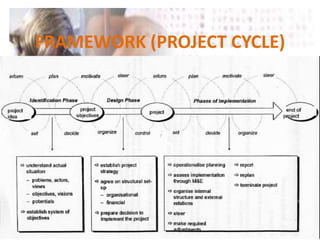
FRAMEWORK (PROJECT CYCLE)
GUIDELINES FOR PROJECT
PROPOSALS
• TITLE OF THE ACTIVITY: Formulated to give the
activity a clear profile.
• SUMMARY
• PARTNERSHIP: Brief presentation of the tasks and
areas of responsibility for the collaborative
partners and implementers.
• BACKGROUND: The feasibility, concept and
cooperation.
• COMMUNITY ANALYSIS: A clarification why the
activities are relevant and important in the
community through highlighting the situation in
the community.
GUIDELINES FOR PROJECT
PROPOSALS
• TARGET GROUP: Describe in actual numbers, age,
gender, their quality of life.
• PROBLEM ANALYSIS. Identify the focal problem,
its causes and its effects.
• OBJECTIVE ANALYSIS: Formulate different levels
of objectives.
• ACTIVITIES: Specify where, how and when and
for whom.
• CAPACITY BUILDING: Identify support for the
development of knowledge and expertise for the
target group.
GUIDELINES FOR PROJECT
PROPOSALS
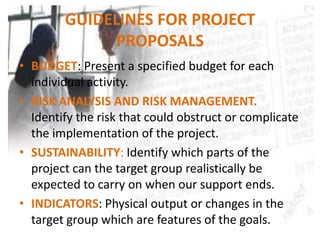
• BUDGET: Present a specified budget for each
individual activity.
• RISK ANALYSIS AND RISK MANAGEMENT.
Identify the risk that could obstruct or complicate
the implementation of the project.
• SUSTAINABILITY: Identify which parts of the
project can the target group realistically be
expected to carry on when our support ends.
• INDICATORS: Physical output or changes in the
target group which are features of the goals.
MONITORING AND EVALUATION
• DEVELOP INDICATORS
• MONITORING SYSTEM DESIGN
• TERMS OF REFERENCE FOR AN EVALUATION
PROCESS.
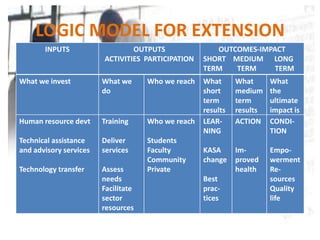
LOGIC MODEL FOR EXTENSION
INPUTS

OUTPUTS
ACTIVITIES PARTICIPATION

What we invest

What we
do

Who we reach

Human resource devt

Training

Who we reach

Technical assistance
and advisory services

Deliver
services

Technology transfer

Assess
needs
Facilitate
sector
resources

Students
Faculty
Community
Private

OUTCOMES-IMPACT
SHORT MEDIUM LONG
TERM
TERM
TERM

What
short
term
results
LEARNING

What
medium
term
results
ACTION

What
the
ultimate
impact is
CONDITION

KASA
change

Improved
health

Empowerment
Resources
Quality
life

Best
practices
WHILE THIS MAY MEAN A MUCH
LESSER VALUE, NOTHING CAN
SURPASS THE FULFILMENT AND THE
JOY OF KNOWING WE WILL DO IT
WELL IN THE EYES OF MEN AND GOD.

Framework of impact based college extension program

  • 2.
    OBJECTIVE • To presenta matrix that may serve as a planning guide for initiating college extension program.
  • 3.
    EXTENSION • REFERS TOTHE ACT OF COMMUNICATING, PERSUADING AND HELPING SPECIFIC SECTORS OR TARGET CLIENTELES TO ENABLE THEM TO EFFECTIVELY IMPROVE PRODUCTION, COMMUNITY AND/OR INSTITUTIONS, AND QUALITY OF LIFE.
  • 4.
    COMPONENTS OF EXTENSION •TRAINING PROGRAMS • TECHNICAL ASSISTANCE AND ADVISORY SERVICES • COMMUNICATION/INFORMATION SERVICES • COMMUNITY OUTREACH ACTIVITIES • TECHNOLOGY TRANSFER, UTILIZATION AND COMMERCIALIZATION
  • 5.
  • 6.
  • 7.
    DIMENSIONS • Significance: importanceof issue/opportunity to be addressed, goals/objectives of consequence • Context: consistency with university/college values and interest, appropriateness of expertise, degree of collaboration, appropriateness of methodological approach, sufficiency and creative use of resources
  • 8.
    DIMENSIONS • Scholarship: knowledgeresources, knowledge application, knowledge generation, knowledge utilization. • Impacts: impact on issues, institutions and individuals, sustainability and capacity building, university-community relations, benefit to the university.
  • 9.
  • 10.
    GUIDELINES FOR PROJECT PROPOSALS •TITLE OF THE ACTIVITY: Formulated to give the activity a clear profile. • SUMMARY • PARTNERSHIP: Brief presentation of the tasks and areas of responsibility for the collaborative partners and implementers. • BACKGROUND: The feasibility, concept and cooperation. • COMMUNITY ANALYSIS: A clarification why the activities are relevant and important in the community through highlighting the situation in the community.
  • 11.
    GUIDELINES FOR PROJECT PROPOSALS •TARGET GROUP: Describe in actual numbers, age, gender, their quality of life. • PROBLEM ANALYSIS. Identify the focal problem, its causes and its effects. • OBJECTIVE ANALYSIS: Formulate different levels of objectives. • ACTIVITIES: Specify where, how and when and for whom. • CAPACITY BUILDING: Identify support for the development of knowledge and expertise for the target group.
  • 12.
    GUIDELINES FOR PROJECT PROPOSALS •BUDGET: Present a specified budget for each individual activity. • RISK ANALYSIS AND RISK MANAGEMENT. Identify the risk that could obstruct or complicate the implementation of the project. • SUSTAINABILITY: Identify which parts of the project can the target group realistically be expected to carry on when our support ends. • INDICATORS: Physical output or changes in the target group which are features of the goals.
  • 13.
    MONITORING AND EVALUATION •DEVELOP INDICATORS • MONITORING SYSTEM DESIGN • TERMS OF REFERENCE FOR AN EVALUATION PROCESS.
  • 14.
    LOGIC MODEL FOREXTENSION INPUTS OUTPUTS ACTIVITIES PARTICIPATION What we invest What we do Who we reach Human resource devt Training Who we reach Technical assistance and advisory services Deliver services Technology transfer Assess needs Facilitate sector resources Students Faculty Community Private OUTCOMES-IMPACT SHORT MEDIUM LONG TERM TERM TERM What short term results LEARNING What medium term results ACTION What the ultimate impact is CONDITION KASA change Improved health Empowerment Resources Quality life Best practices
  • 15.
    WHILE THIS MAYMEAN A MUCH LESSER VALUE, NOTHING CAN SURPASS THE FULFILMENT AND THE JOY OF KNOWING WE WILL DO IT WELL IN THE EYES OF MEN AND GOD.

Editor's Notes

  • #5 non-degree, non-creditTo agenciesDissemination of knowledge and skillsSocial services, pilot projectsPromoting research outputs or technologies to potential users
  • #6 Encompasses many contemporary challengesProvides extension remain accountableNeeds and issues in productive mannerIncrease in spiritual, economic, political, social strengths, developing confidence, skills for self-sufficiencySignificant transformation measureable in terms of income, employment, educ, health, envi quality, entre activities, civic participation
  • #7 Active involvement, planning and decision makingFull range of structuring tasks involvedLocating and linking wd agencies, legal aspectsInterdisciplinary teams
  • #8 How serious? Target groups open to the new opportunity? What consequences could result from not addressing? / stakeholders agreed that G.O are valuables? Will value be added?Compare with VMGO? To what extent does the project fit with indv and units available expertise? Extend of participation in planning, defining impacts, implementing, mon and evaln? Developmental, participatory, accommodate variety of learning styles? Sufficient, extend of utilization, realistic?
  • #9 Extent the project is shaped by up-to-date, cross-disciplinary, utilized? Defined, design appropriate, innovation, provision for midstream modification? Lessons learned, assessment of scholarly merit? Project generated replicable, available for dissemination and utilization?Needs fulfilled, issues addressed? New skills, technology, process, networks, alternative resources? Opportunities for new collaboration, expansion of constituency, better interaction? Student experiences, curricular changes, TL or research activities, enhanced reputation, recognition?
  • #10 identification- objective system clarifiedConceptual – project plan elaboratedImplementation – project purpose achieved
  • #12 OVERALL OBJECTIVES BASED ON EFFECTSPROJECT PURPOSE FOCAL PROBLEMINTERMEDIATE OBJECTIVES – CAUSES
  • #15 KNOWLEDGE ATTITUDES SKILLS ASPIRATIONS