Fracture Of Femoral
Neck In Adults
By
Ihab El-Desouky (M.D.)
Associate Prof. Pelvis and Reconstruction unit.
Kasr Al-Ainy School of Medicine
November 2018
Femoral neck fracture in Adults
•Aim
1. Background
2. Anatomy
3. Epidemiology
4. Patho-anatomy + Classifications
5. Mechanism of injury
6. Clinical presentation/Radiological
investigation
7. Aims of treatment
8. Management
9. Complications
Femoral neck fracture in Adults
•Background:
• Predominantly in the elderly, low-energy
falls, with osteoporosis
• In young patients (below 50 years)
a high-energy mechanism, associated
injuries
• Intra-capsular and may compromise the
tenuous blood supply to the femoral head
• Basi-cervical fractures are extracapsular
Femoral neck fracture in Adults
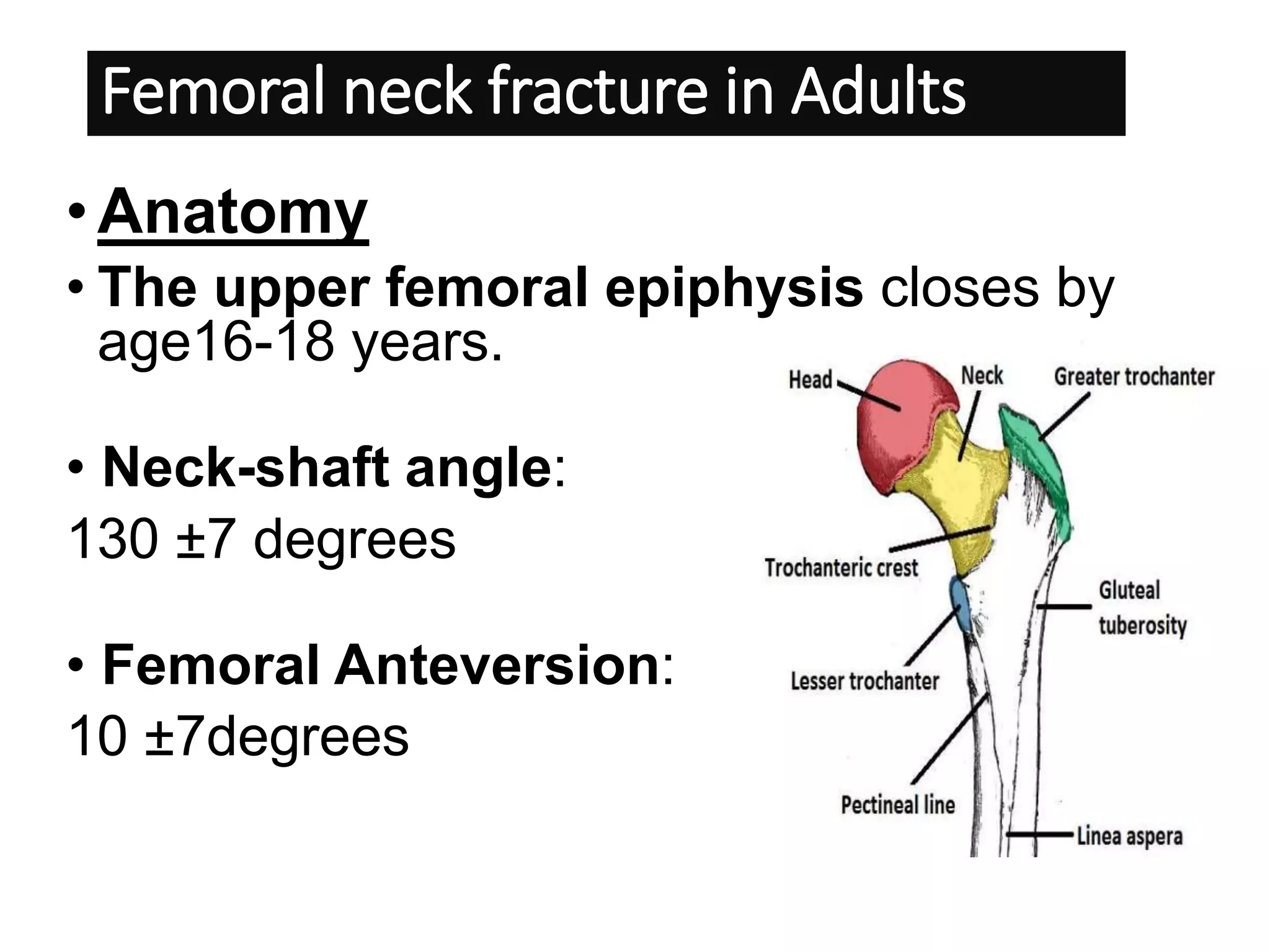
•Anatomy
• The upper femoral epiphysis closes by
age16-18 years.
• Neck-shaft angle:
130 ±7 degrees
• Femoral Anteversion:
10 ±7degrees
Femoral neck fracture in Adults
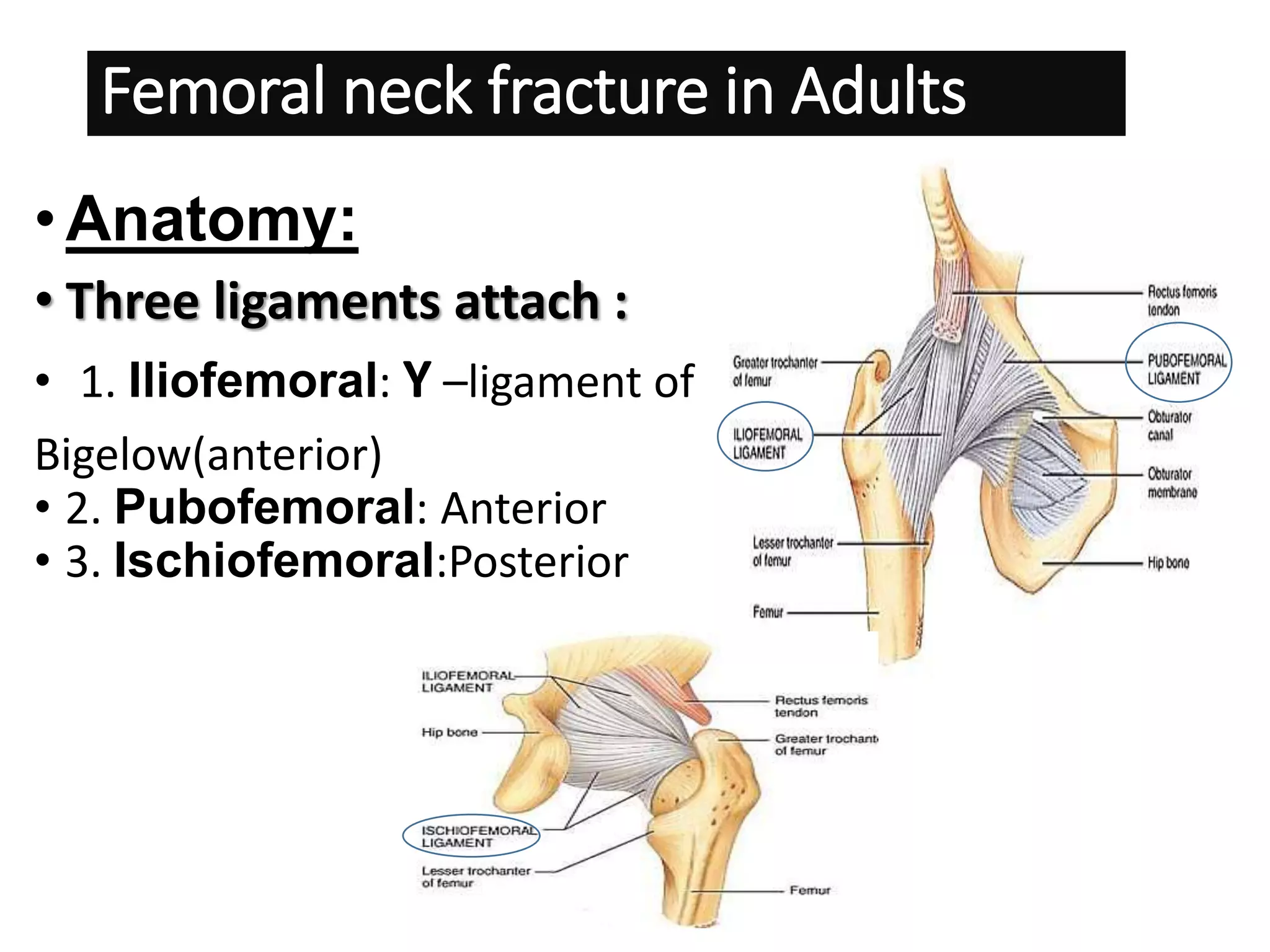
•Anatomy:
• Three ligaments attach :
• 1. Iliofemoral: Y –ligament of
Bigelow(anterior)
• 2. Pubofemoral: Anterior
• 3. Ischiofemoral:Posterior
Femoral neck fracture in Adults
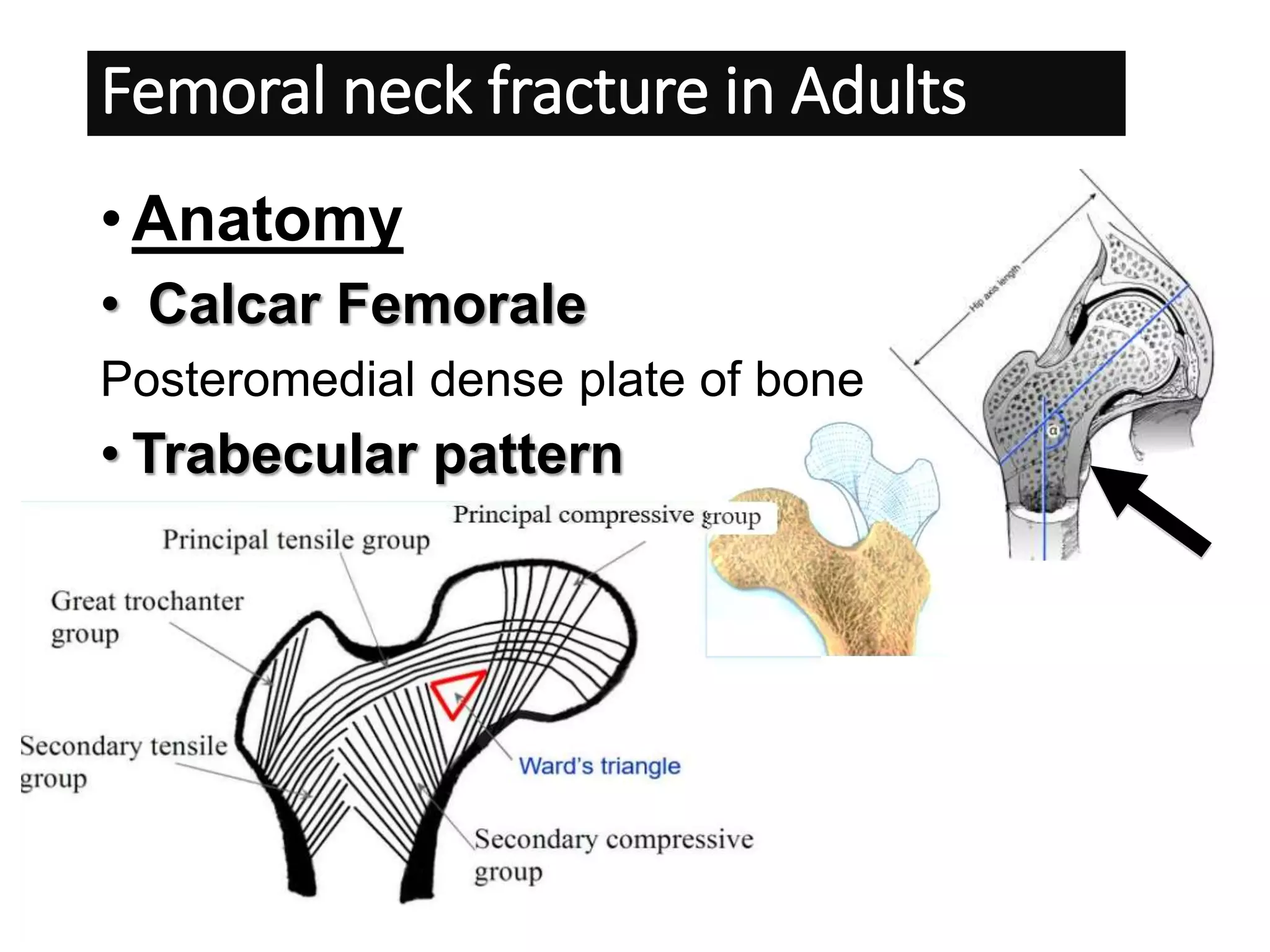
•Anatomy
• Calcar Femorale
Posteromedial dense plate of bone
• Trabecular pattern
Femoral neck fracture in Adults
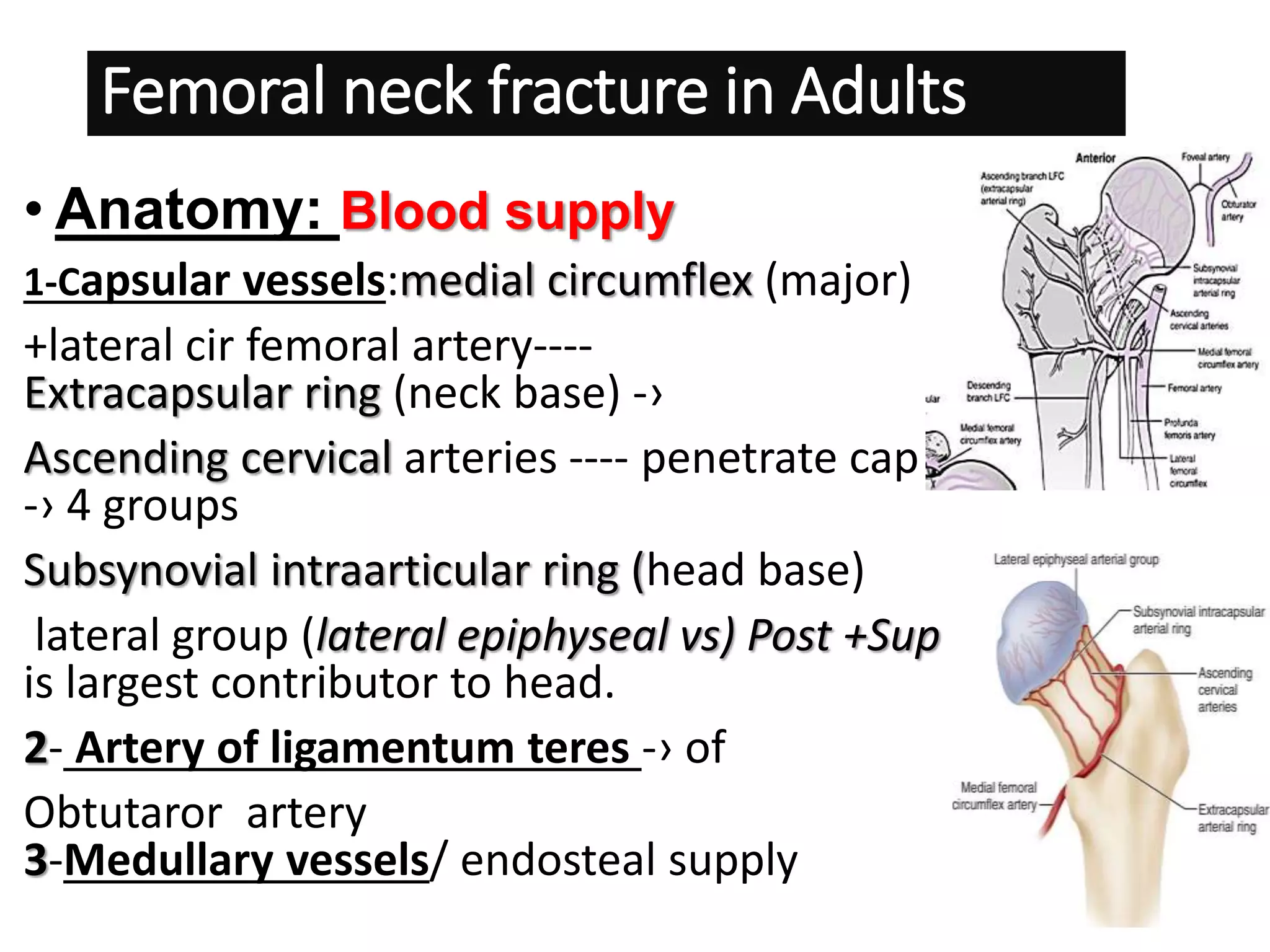
• Anatomy: Blood supply
1-Capsular vessels:medial circumflex (major)
+lateral cir femoral artery----
Extracapsular ring (neck base) -›
Ascending cervical arteries ---- penetrate cap
-› 4 groups
Subsynovial intraarticular ring (head base)
lateral group (lateral epiphyseal vs) Post +Sup
is largest contributor to head.
2- Artery of ligamentum teres -› of
Obtutaror artery
3-Medullary vessels/ endosteal supply
Femoral neck fracture in Adults
•Anatomy
• Greater fracture displacement = greater risk of
retinacular vessel disruption
• Tamponade effect of blood after # in intact
capsule
• Theoretical risk of AVN with increased pressure
Femoral neck fracture in Adults
•Epidemiology:
• 250,000 hip fractures occur in the United States each
year (50% involve the femoral neck)
• Elderly : (97%)
• Female to male ratio:3 :1
• Patients with a femoral neck fracture are at risk for a
second hip fracture and falls :by 5 -7 folds within 3 years
• Young (3%)
Femoral neck fracture in Adults
• Epidemiology: Bimodal distribution.
• Elderly
• incidence doubles each decade beyond age 50
• Earlier than intertrochanteric #
• higher in females, caucasians ,smokers, lower BMI (fat),
excessive caffeine & alcoholics.
• Predisposing factors
1-Loss of bone strength
2-Loss of local shock absorbers (fat)
3-Reduction in protective responses (muscle weakness)
4-Increased risk of falls (alcholics,visual acuity)
5-Previous fractures: 5-7 folds
• Young
• high energy trauma
Femoral neck fracture in Adults
• Patho-anatomy and classifications:
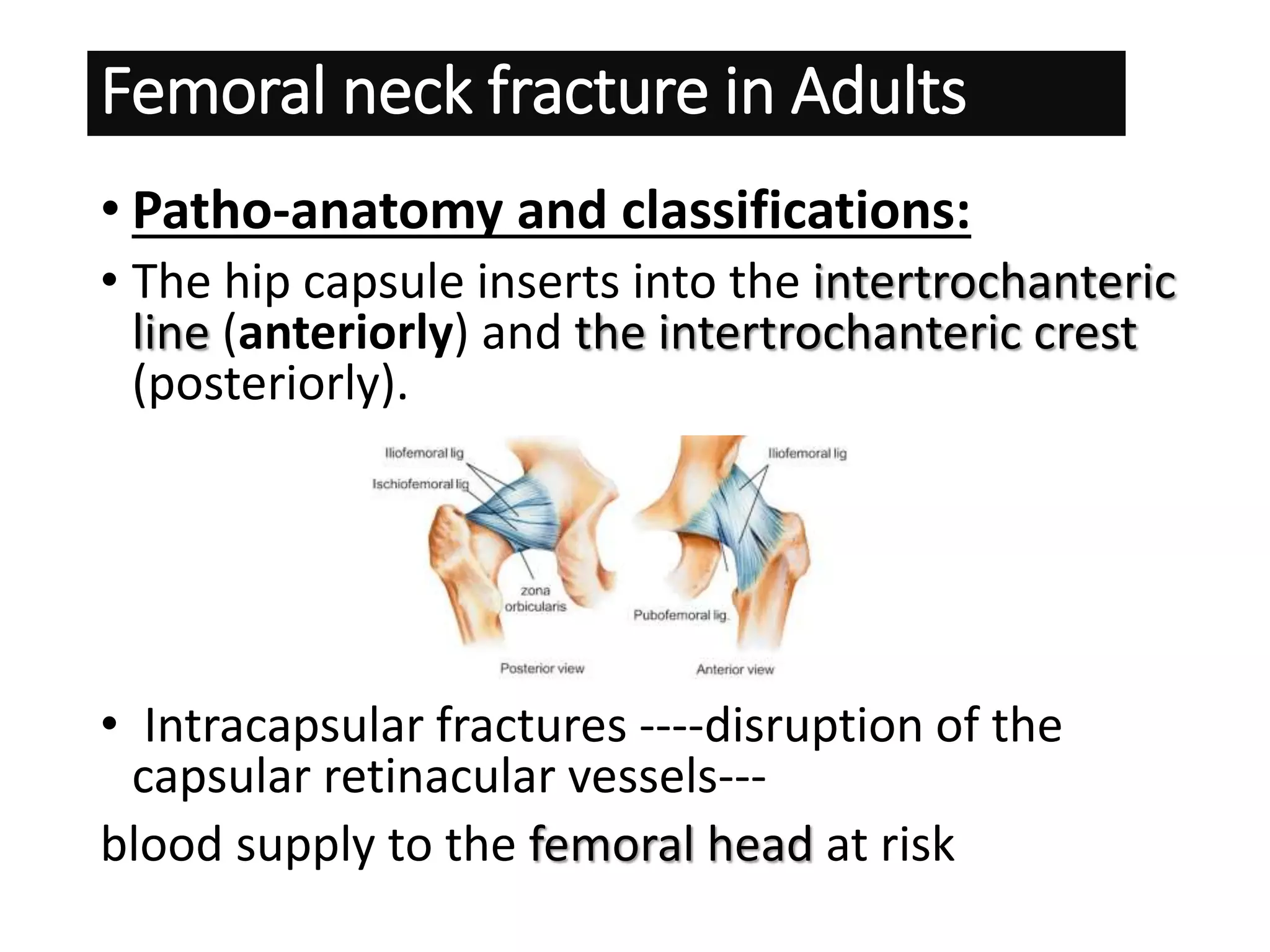
• The hip capsule inserts into the intertrochanteric
line (anteriorly) and the intertrochanteric crest
(posteriorly).
• Intracapsular fractures ----disruption of the
capsular retinacular vessels---
blood supply to the femoral head at risk
Femoral neck fracture in Adults
• Patho-anatomy and classifications:
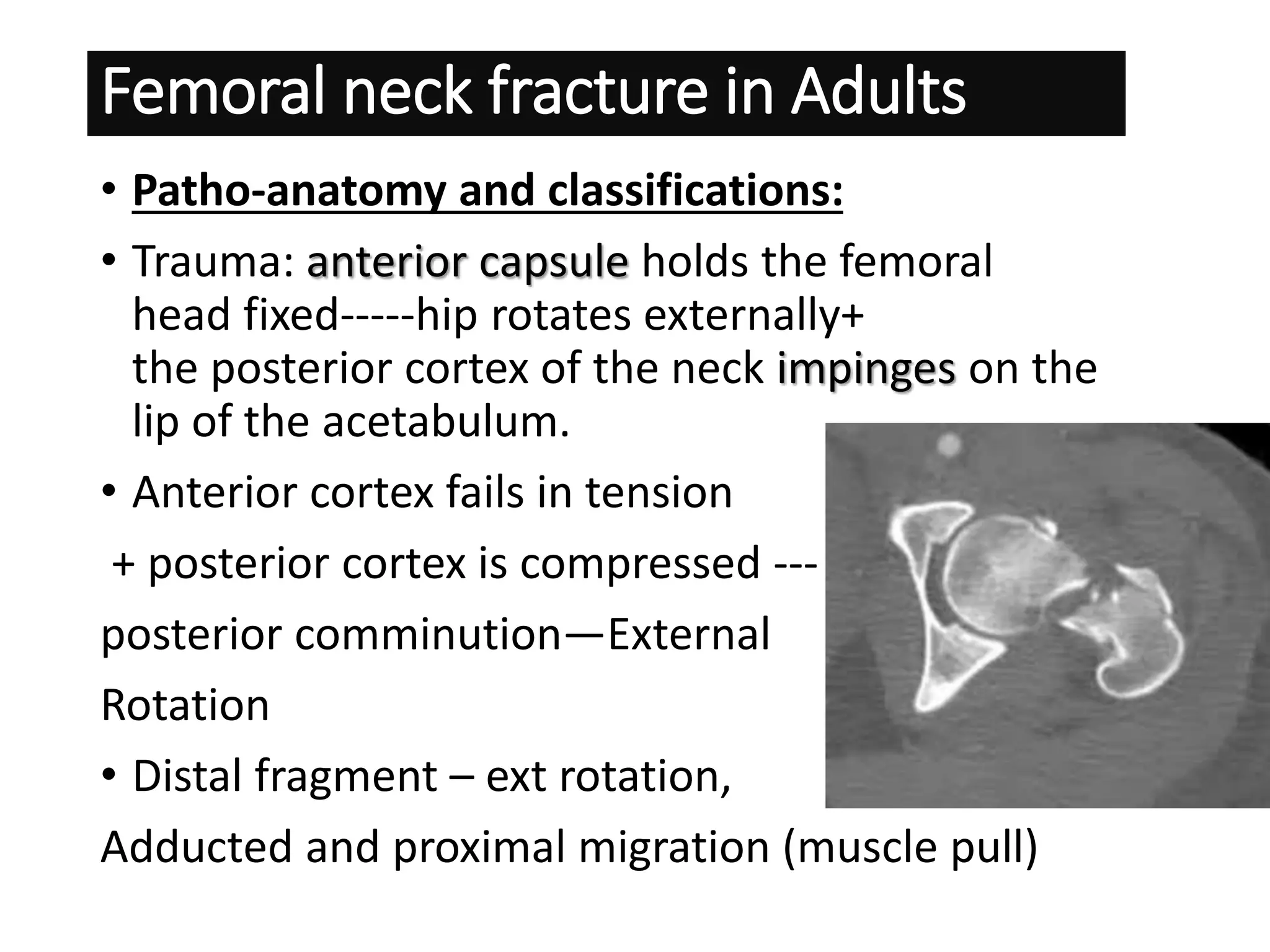
• Trauma: anterior capsule holds the femoral
head fixed-----hip rotates externally+
the posterior cortex of the neck impinges on the
lip of the acetabulum.
• Anterior cortex fails in tension
+ posterior cortex is compressed ---
posterior comminution—External
Rotation
• Distal fragment – ext rotation,
Adducted and proximal migration (muscle pull)
Femoral neck fracture in Adults
• Patho-anatomy and classifications:
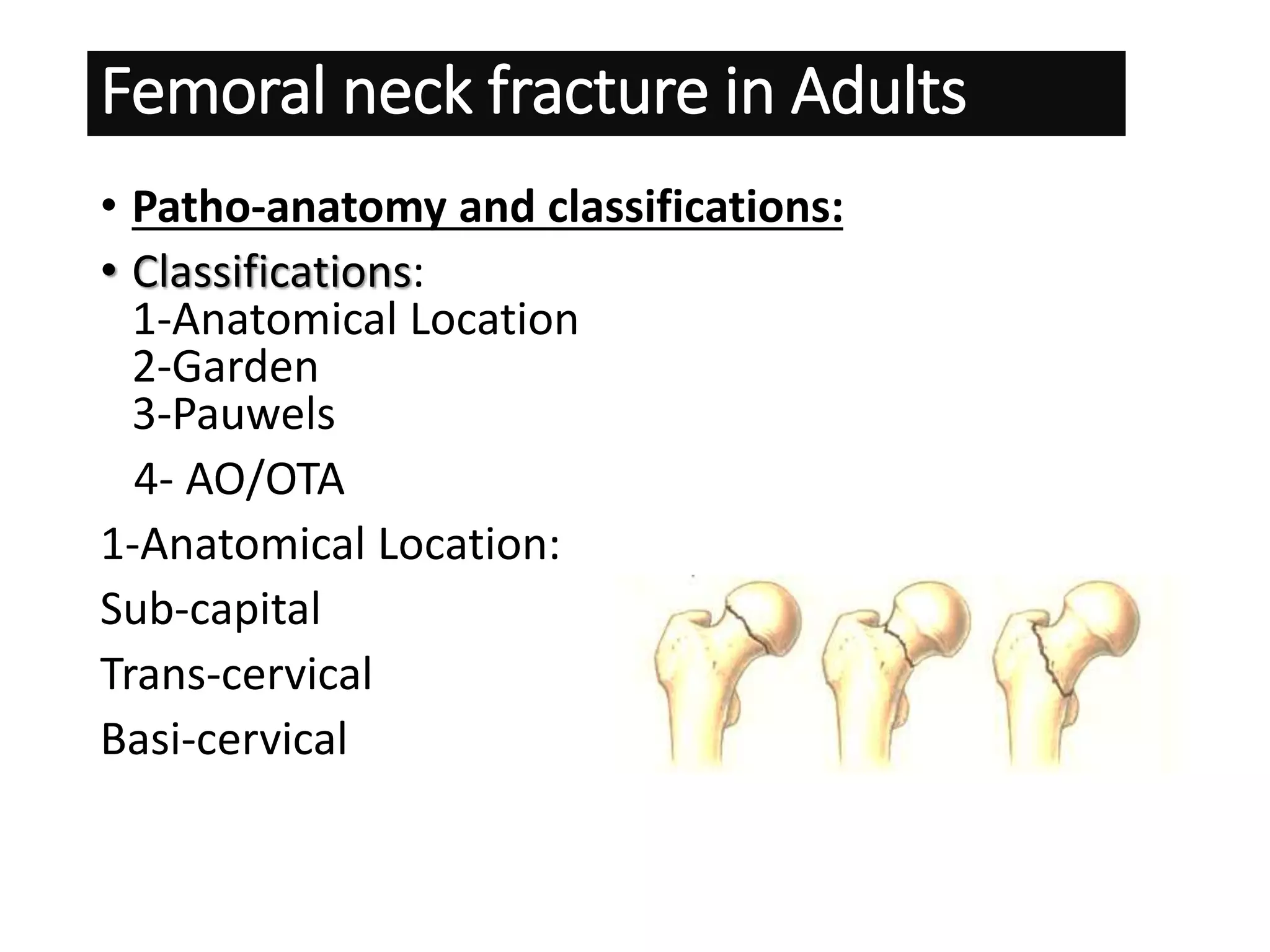
• Classifications:
1-Anatomical Location
2-Garden
3-Pauwels
4- AO/OTA
1-Anatomical Location:
Sub-capital
Trans-cervical
Basi-cervical
Femoral neck fracture in Adults
• Patho-anatomy and classifications:
2-Garden ‘s Classification (1961)
Degree of displacement
Relates to risk of vascular disruption
Most commonly applied to geriatric/ insuffiency fractures
Stage I: Stage II:
incomplete fracture line complete fracture line;
(valgus impacted) nondisplaced
Femoral neck fracture in Adults
• Patho-anatomy and classifications:
Stage III: Stage IV:
complete fracture line complete fracture line;
Partially displaced totally displaced (continuous)
• But:Poor inter-observer reliability
• Modified to:
• Non-displaced: stages I &II
• Displaced: stages III &IV (retinacular vs disruption)
Femoral neck fracture in Adults
• Patho-anatomy and classifications:
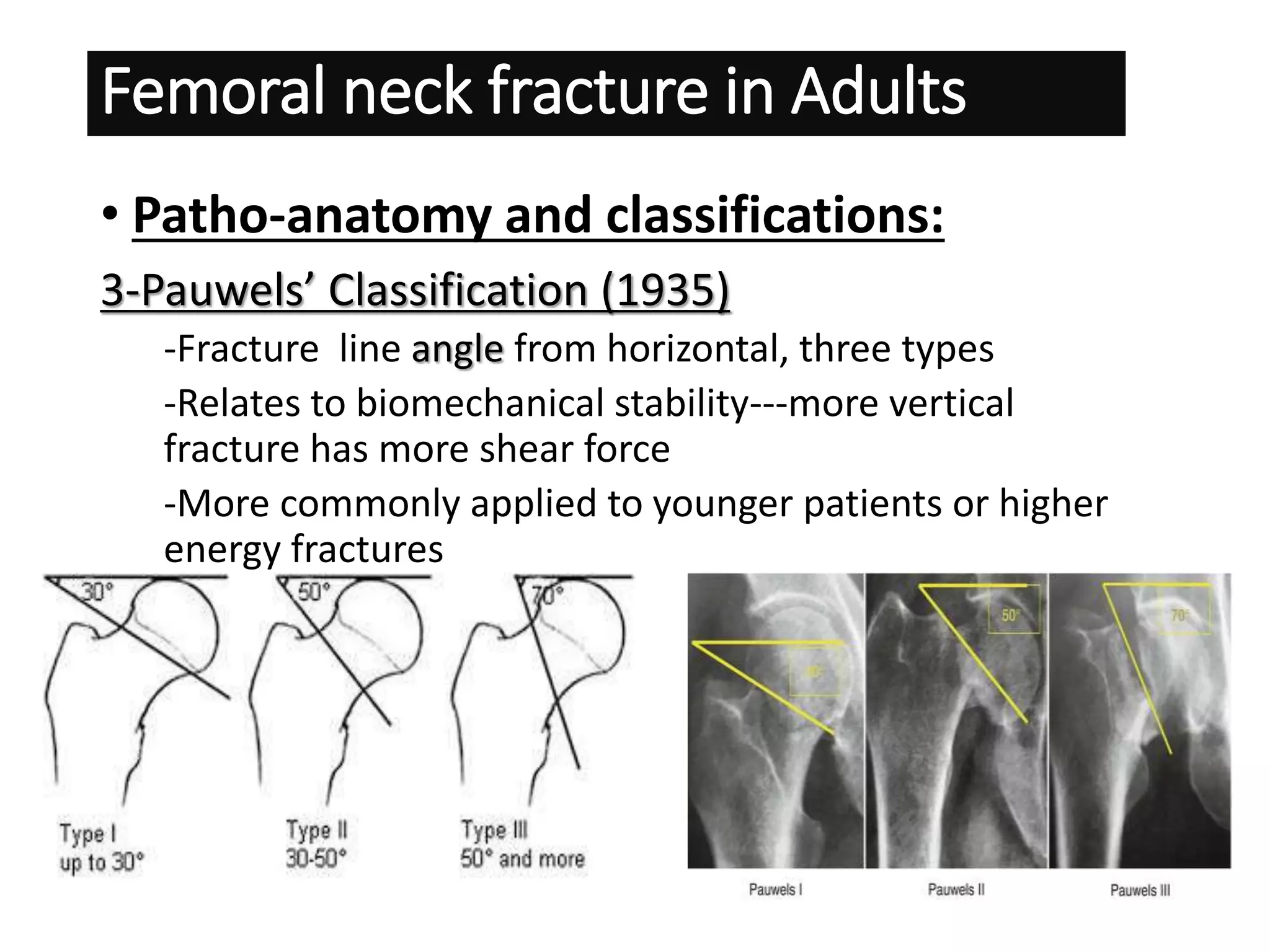
3-Pauwels’ Classification (1935)
-Fracture line angle from horizontal, three types
-Relates to biomechanical stability---more vertical
fracture has more shear force
-More commonly applied to younger patients or higher
energy fractures
Femoral neck fracture in Adults
4-AO/OTA
FEMUR NECK IS 31-B
• B1 nondisplaced (minimally displaced)
subcapital fracture
• B2 transcervical
• B3 all displaced
Subcapital fractures
Femoral neck fracture in Adults
• Mechanism of injury
• Low Energy: elderly
-Direct: Falling directly onto the hip
-Indirect: Twisting mechanism (tripping over a
loose carpet)
• High Energy: young.
Motor car accident, fall from a height
• Cyclical Loading :Stress fracture
Clinical presentation/Radiological investigation
1-Clinical Presentation:
History of a traumatic event (except in
stress fractures)
• Young patients with high-energy ---associated injuries
including head.
• Missed fracture can be disastrous.
Clinical examination
• Shortening
• External rotation
• Inability to SLR
• Groin tenderness
Femoral neck fracture in Adults
• Radiological investigation:
1-Plain radiograph (Antero-posterior and Lateral)
2-MRI
3-CT
4-Bone Scan
1-Plain radiography:
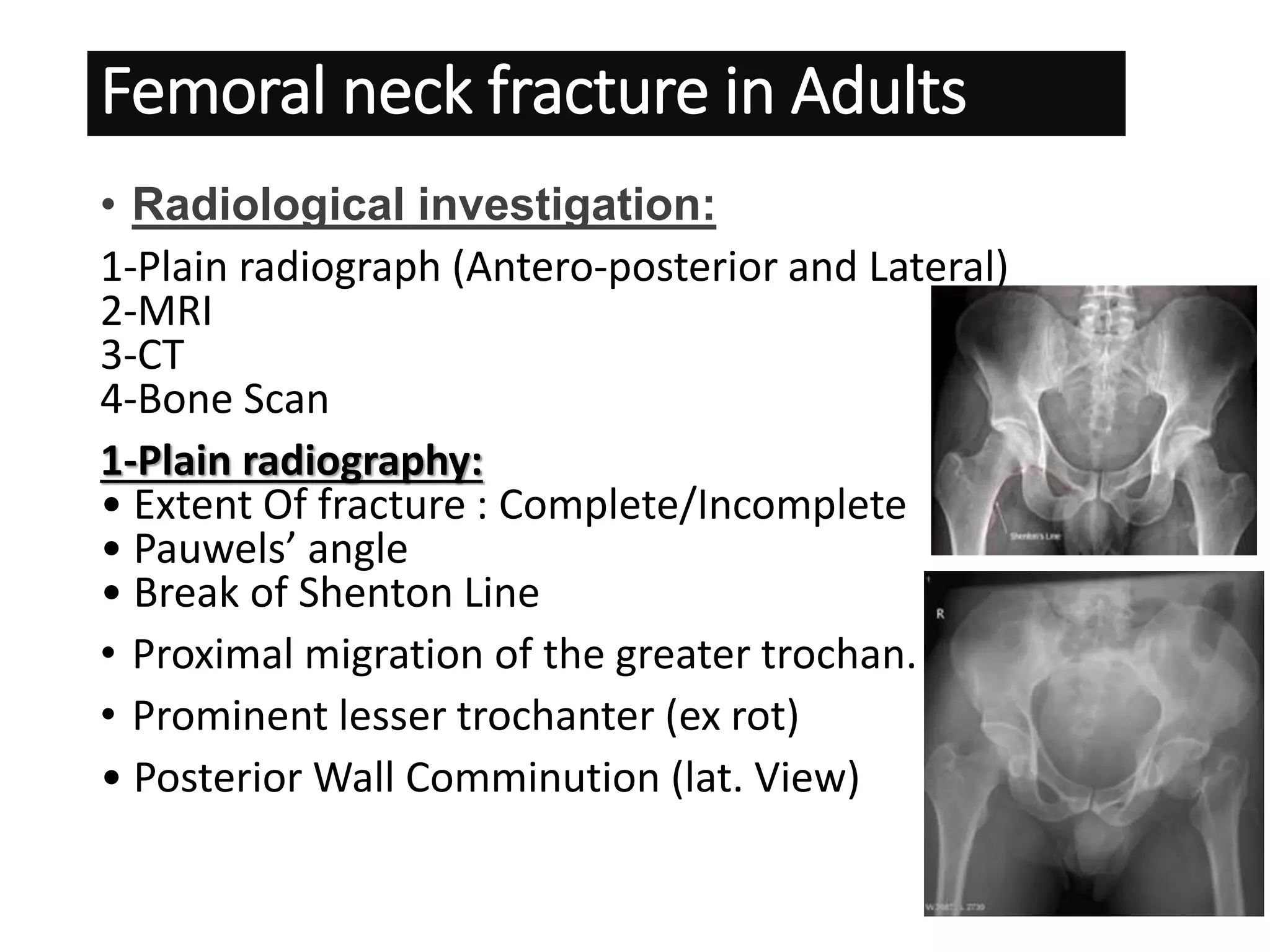
• Extent Of fracture : Complete/Incomplete
• Pauwels’ angle
• Break of Shenton Line
• Proximal migration of the greater trochan.
• Prominent lesser trochanter (ex rot)
• Posterior Wall Comminution (lat. View)
Femoral neck fracture in Adults
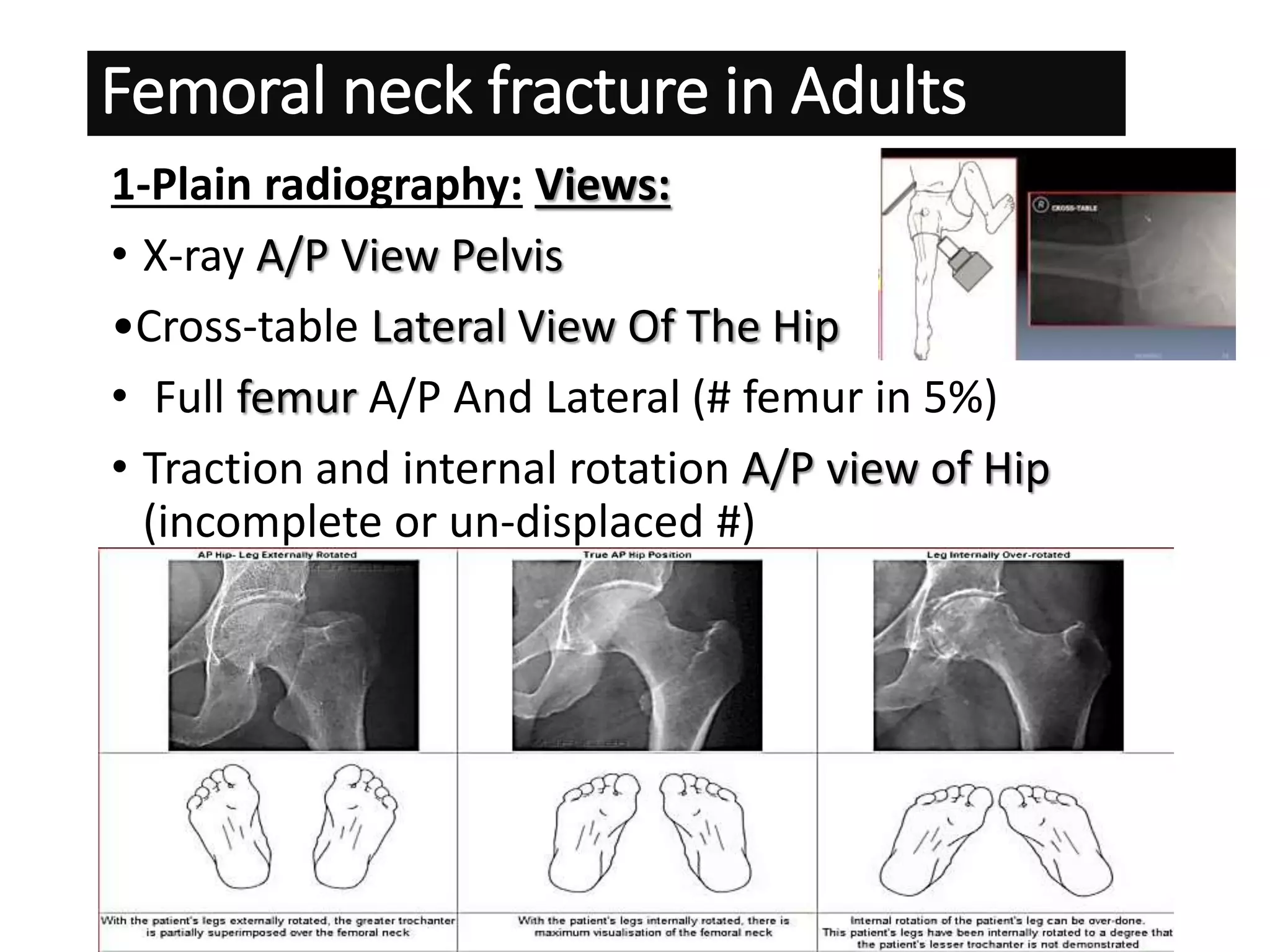
1-Plain radiography: Views:
• X-ray A/P View Pelvis
•Cross-table Lateral View Of The Hip
• Full femur A/P And Lateral (# femur in 5%)
• Traction and internal rotation A/P view of Hip
(incomplete or un-displaced #)
Femoral neck fracture in Adults
2-MRI
• Occult femoral neck fracture.
• elderly patient who is persistently unable to
weight bear.
• 100% sensitive and specific
• May reduce cost by
shortening time to diagnosis
• Femoral head viability in FU
Femoral neck fracture in Adults
3-CT
- Comminution preoperatively
-Abnormalities of bone in pathological #
-Check for union postoperatively
4-Bone Scan
Increased uptake :
80% of cases after 24 hr
; 95% at 7 days
Femoral neck fracture in Adults
7. Aims of treatment:
For elderly patients : >65 ys.
• Mobilize
• Weight bearing as tolerated
• Minimize period of bedrest
• Minimize surgical morbidity
• Safest operation
• Decrease chance of reoperation
Femoral neck fracture in Adults
7. Aims of treatment:
For young patients : <55- 65 ys
• Spare femoral HEAD
• Avoid varus deformity
• Improves union rate
• Optimal functional outcome (offset)
• Minimize vascular injury
• Avoid AVN
Femoral neck fracture in Adults
• Treatment Options
• Non-operative
• Limited role
• Usually high operative risk patient
• Valgus impacted fracture
• Elderly need to be WB as tolerated
• Mobilize early
• Operative:
• Reduction and fixation
• Open or percutaneous
• Arthroplasty
• Hemi or total
Femoral neck fracture in Adults
• Operative treatment: Decision Making Variables:
1-Patient Factors
• Young (active)
– High energy
injuries
• Often multi-
trauma
– Often High
Pauwels Angle
(shear)
• Elderly
– Lower energy
injury (falls)
– Comorbidities
– Pre-existing hip
disease
Femoral neck fracture in Adults
2-Fracture Characteristics
• Displacement: (I &II) Vs (III & IV)
• Stability
– Pauwels’ angle
– Comminution, especially posteromedial
Femoral neck fracture in Adults
•Pre-operative Considerations
• Traction not beneficial
– No effect on fracture reduction
– No difference in analgesic use
– Pressure sore/ skin problems (limited Pt rolling)
– Increased cost
– Traction position decreases capsular volume
• Capsule volume greatest in flexion/external rotation
• Potential hazardous effect on blood flow by increasing
intra-capsular pressure (tamponade)
Femoral neck fracture in Adults
•Pre-operative Considerations:
Timing of surgery in Young
• Surgical Urgency
Femoral neck fracture in Adults
•Pre-operative Considerations:
Timing of surgery in Young
-Jain et al. (2002) : fixation within 12 h Vs delayed fixation
(>12 h) ----AVN 16% in the delayed group & 0% in the early
group .
-Barnes et al.(1976) timing of surgery did not affect the
rates of nonunion and AVN within the first week post-
injury
-Experimental studies (Keating ;2009) ---- osteocytes
viability continue up to 3 weeks post-fractures
-Fixation is done on day of trauma, delayed cases up to 2
weeks --- fixation with accepted imperfect reduction
Femoral neck fracture in Adults
•Pre-operative Considerations:
Timing of surgery in Elderly >65ys
• Surgical urgency in relatively healthy patients
(decreased mortality, complications, length of
stay)
• Surgical delay up to 72 hours for medical
stabilization warranted in unhealthy patients
• 2.25 increase in MORTALITY if > 4 day delay
• related to increased severity of medical
problems (chest, cardiac, Renal)
Femoral neck fracture in Adults
Treatment Options:
Young patient
• Open reduction
– Improved accuracy
– Decompresses capsule
(capsulotomy)
• May have greater risk
of infection
• Closed reduction
– Less surgical morbidity
• Higher rate of deep infection in open reduction group
• 0.5% versus 4%
• No difference in AVN
• 17% in both groups
• No difference in nonunion
• 12% in closed group versus 15% in open group (p = 0.25)
MUST achieve an appropriate reduction regardless of
either method
Closed versus Open Reduction INJURY 2015
Closed Reduction Techniques
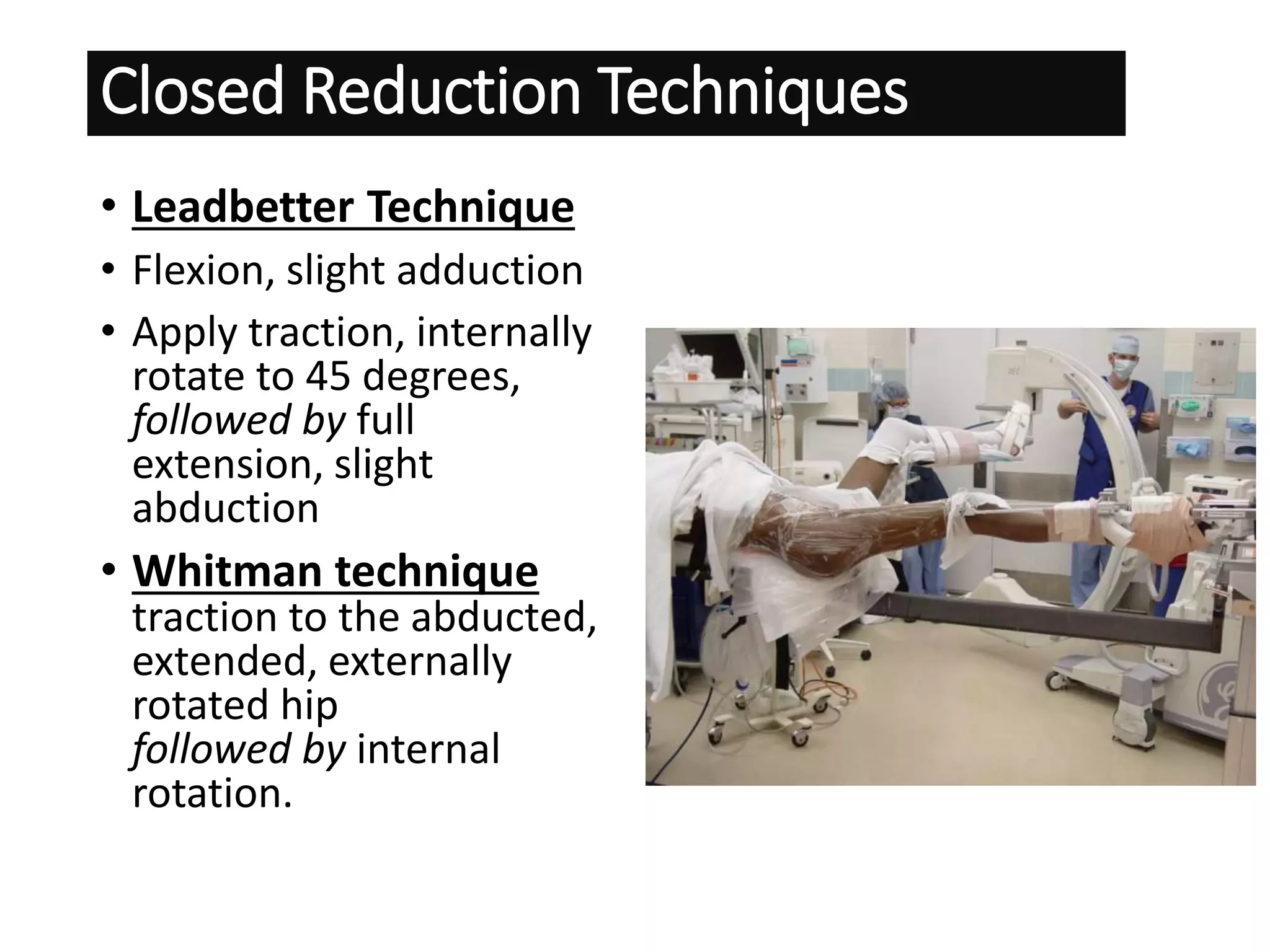
• Leadbetter Technique
• Flexion, slight adduction
• Apply traction, internally
rotate to 45 degrees,
followed by full
extension, slight
abduction
• Whitman technique
traction to the abducted,
extended, externally
rotated hip
followed by internal
rotation.
Open Reduction: Approach
• Watson-Jones
• anterolateral
• Between TFL and
gluteus medius
• Best for basicervical
• Fracture table Radiolucent under pelvis
• Use Schanz pins, weber clamps for reduction
Open Reduction Technique
Femoral neck fracture in Adults
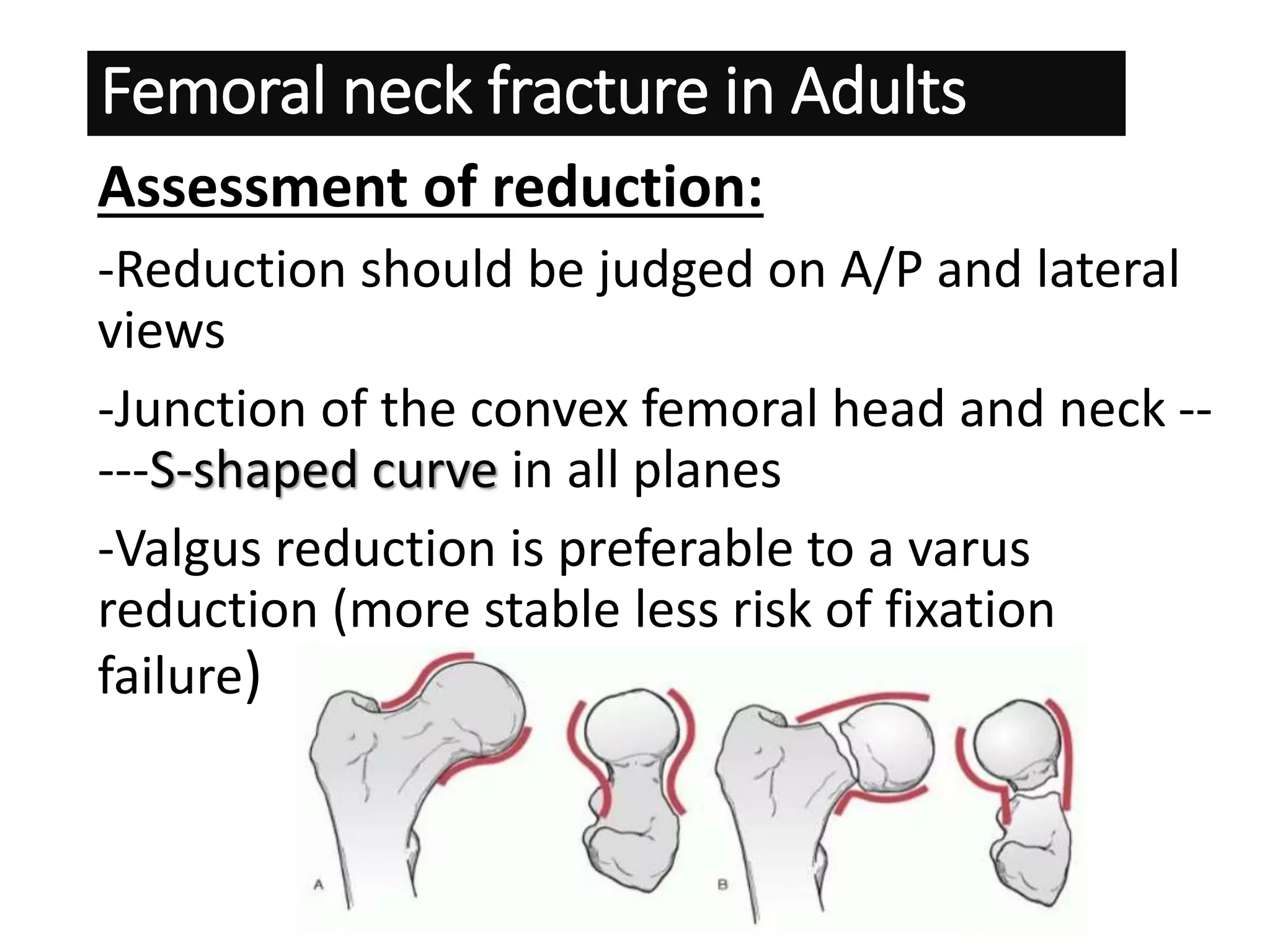
Assessment of reduction:
-Reduction should be judged on A/P and lateral
views
-Junction of the convex femoral head and neck --
---S-shaped curve in all planes
-Valgus reduction is preferable to a varus
reduction (more stable less risk of fixation
failure)
Femoral neck fracture in Adults
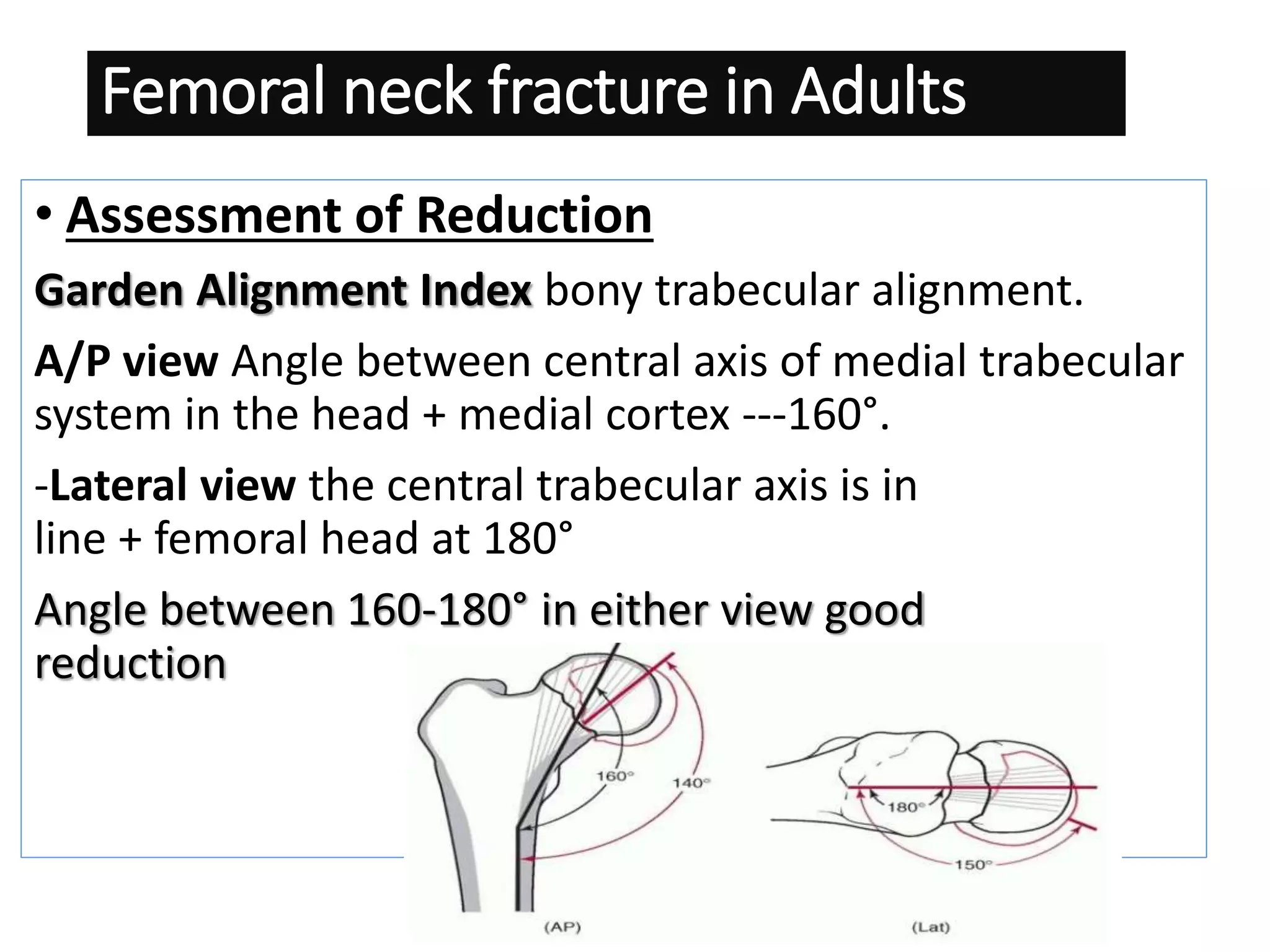
• Assessment of Reduction
Garden Alignment Index bony trabecular alignment.
A/P view Angle between central axis of medial trabecular
system in the head + medial cortex ---160°.
-Lateral view the central trabecular axis is in
line + femoral head at 180°
Angle between 160-180° in either view good
reduction
Fixation Methods
• 3 cannulated Screws
• 4 cannulated Screws
• Dynamic hip screw
(with anti-rotation S)
• Blade plate
Femoral neck fracture in Adults
• 3 cannulated screws fixation:
• 3 partially threaded screws in inverted triangle
configuration (apex-distal)
Fixation Concepts
• Reduction makes it
stable
• Avoid ANY varus
• Avoid inferior offset
• Malreduction likely
to fail
Fixation Concepts
• Screw position Spread
• Inferior within 3 mm of cortex
• Posterior within 3 mm of cortex
• Need one screw resting on calcar
• Threads should end at least 5mm
from subchondral bone
• Multiple views to check
appropriate depth
• Avoid posterior/superior
• to avoid iatrogenic vascular damage (lat
epiphyseal V.)
• Should not start below level of
lesser trochanter
• Avoid many perforations
• Avoid stress riser---subtrochanteric #
Fixation Concepts
Good Bad
Posterior Anterior
Lateral
Epiphyseal
Artery
- Good spread
- Hugging Calcar and
posterior cortex
- Posterior and inferior
screws are most important
- Clustered together
- Nothing on calcar
Fixation Concepts
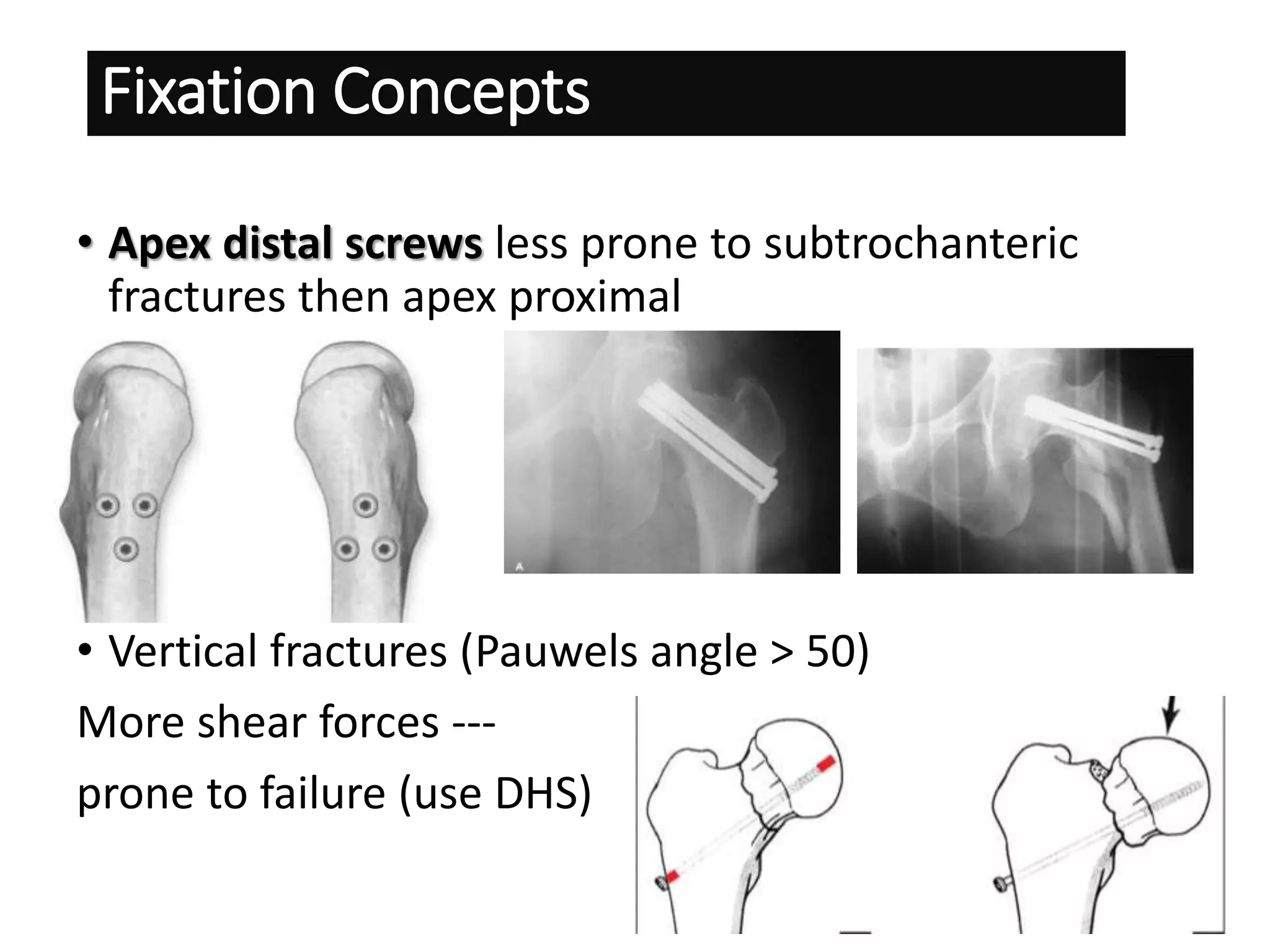
• Apex distal screws less prone to subtrochanteric
fractures then apex proximal
• Vertical fractures (Pauwels angle > 50)
More shear forces ---
prone to failure (use DHS)
Fixation Concepts
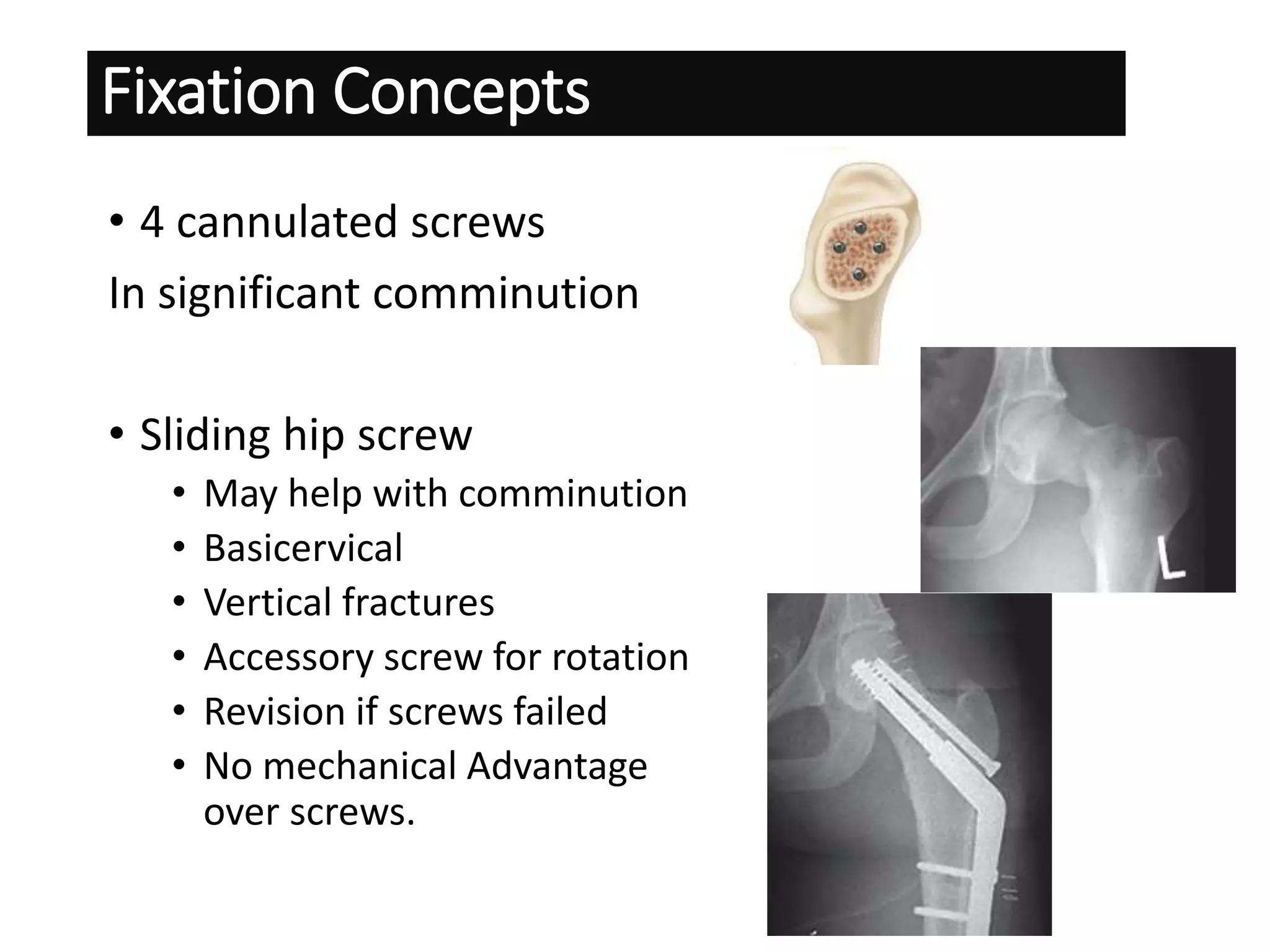
• 4 cannulated screws
In significant comminution
• Sliding hip screw
• May help with comminution
• Basicervical
• Vertical fractures
• Accessory screw for rotation
• Revision if screws failed
• No mechanical Advantage
over screws.
Treatment Options:
Geriatric Patients
• Fixation
• Lower surgical risk
• Higher risk for
reoperation
• Replacement
• Higher surgical risk
• Fewer reoperations
• Better function
• Use
– Stable (valgus
impacted) fractures
– Minimally displaced
fractures
• Use
– Displaced fractures
– Unstable fractures
– Poor bone quality
Treatment Options:
Geriatric Patients
Treatment Options:
Geriatric Patients
Arthroplasty Issues:
Hemiarthroplasty versus THA
• Hemi
• More revisions
• 6-18%
• Smaller operation
• Less blood loss
• More stable (large head
• Total Hip
• Fewer revisions
• 4%
• Better functional outcome
• More dislocations
( use Dual Mobility)
Hemiarthroplasty Issues:
Unipolar vs. Bipolar Hemiarthroplasty
• Unipolar
• Lower cost
• Simpler
• Bipolar
• Theoretical less wear
• More modular
• More expensive
• Can dissociate
• NO PROVEN
ADVANTAGE
Arthroplasty Issues:
Cement Or Cementless
• Cement (PMMA)
• Improved mobility,
function, walking aids
• Most studies show no
difference in morbidity /
mortality
• Sudden Intra-op cardiac
arrest
• Non-cemented (Press-fit)
• Pain / Loosening higher
• Intra-op or periop fracture
risk higher (in men > 80
years)
Arthroplasty Issues:
Surgical Approach
• Posterior
• 60% higher short-term
mortality
• Higher dislocation rate
• Anterior/Anterolateral
• Fewer dislocations
GERIATRIC Summary
• MRI to rule out occult fracture in older patients
unable to weight bear
• CRPP for valgus impacted or nondisplaced fractures
• Arthroplasty if displaced
• Hemi in debilitated
• Consider THA for active older patients and
associated arthritis.
• Cemented stems
• Anterior and antero-laterl approach
Special Issue:
Stress Fractures
• Females 4–10 times more common
• Amenorrhea / eating disorders (Coeliac disease common)
• Hormone deficiency
• Recent increase in athletic activity
• Clinical Presentation
• Activity / weight bearing related pain
• Anterior groin pain
• Limited ROM at extremes
• ± Antalgic gait
• Must evaluate back, knee, contralateral hip
Stress Fractures
• Imaging
• Plain Radiographs
• Negative in up to 66%
• Bone Scan
• Sensitivity 93-100%
• Specificity 76-95%
• MRI
• 100% sensitivity / specificity
• Also Differentiates: synovitis, tendon/
muscle injuries, neoplasm, AVN,
transient osteoporosis of hip
Stress Fractures
• Classification
• Compression sided
• Callus / fracture at inferior
aspect femoral neck
• Tension sided
• Callus / fracture at superior
aspect femoral neck
• Displaced or non
Stress Fractures:
Treatment
• Compression sided
• Fracture < 50% across neck
• “stable”
• TTT: Activity / weight bearing modification
• Fracture >50% across neck
• Potentially unstable with risk for displacement
• TTT: fixation
• Tension sided
• - Nondisplaced------Unstable
• TTT: fixation (Protect weight bearing till fixation ASAP)
• - Displaced
• TTT: fixation
• Fix within 24 hours
COMPLICATIONS
1-Non-union
2-Osteonecrosis (AVN)
3-Failure of fixation
4-Fracture distal for fixation (sub trochanteric)
5-Post-traumatic arthrosis.
6-Blood transfusion
7-DVT and PE
8-Mortality.
COMPLICATIONS
1-Non-union
• 0-5% in Non-displaced fractures
• 9-35% in Displaced fractures
• Increased incidence with
– Posterior comminution
– Initial displacement -Imperfect reduction
– Non-compressive fixation
• Clinical presentation
– Groin or buttock pain
– Activity / weight bearing related
– Symptoms : more severe / occur earlier than AVN
Non-union
• Imaging
• Radiographs: lucent zones
• CT: lack of healing
• Bone Scan: high uptake
• MRI:
assess femoral head viability
Non-union
Treatment:
• Young patients
– Valgus intertrochanteric
osteotomy (Pauwels)
– Creates compressive forces
Non-union
•Elderly patients
•Arthroplasty
• Results typically not as good as
primary elective arthroplasty
•Girdlestone Resection Arthroplasty
• Limited indications (if infection)
Special Problems:
Osteonecrosis (AVN)
• Up to 10% of nondisplaced and up to 30% of
displaced fractures
• Increased incidence with
• Inadequate Reduction
• Delayed reduction ??
• Initial displacement
• associated hip dislocation
Osteonecrosis (AVN)
• Clinical presentation
• Groin / buttock / proximal thigh pain
• May not limit function
• Onset usually later than nonunion
• Imaging
• Plain radiographs:
segmental collapse / arthritis
• Bone Scan: “cold” spots
• MRI: diagnostic
Osteonecrosis (AVN)
• Treatment
• Elderly patients
• Only 30-37% patients require reoperation
• Arthroplasty
• Results not as good as primary elective arthroplasty
• Girdlestone Resection Arthroplasty
• Limited indications
Young Patients
-Proximal Femoral Osteotomy
If Less than 50% head collapse
-Arthroplasty
-Arthrodesis
Significant functional limitations
** Prevention is the Key **
COMPLICATIONS
• Failure of Fixation
• Inadequate / unstable reduction
• Poor bone quality
• Poor choice of implant (Vertical #)
• Treatment
• Elderly: Arthroplasty
• Young: -Repeat ORIF by DHS
augmented by tri-calcium phosphate
or bone cement
-Valgus-producing osteotomy
-Arthroplasty
COMPLICATIONS
• Fracture Distal to Fixation (Subtrochat)
– 20% if screws at or below Lesser Trochanter
– Poor bone quality esp. with anterior start site
– Poor angle of screw fixation
– Multiple passes of drill or guide pin
Treatment
– Elderly & Young:
– Fixation of subtrochanteric with IMN
Complications
• Post-traumatic arthrosis
• Joint penetration with hardware
• AVN related
• Blood Transfusions
• THR > Hemi > ORIF
• DVT / PE
• Multiple prophylactic regimens exist
Complications
Mortality
• One-year mortality 14-50%
• Increased risk:
• Medical comorbidities: more falls
• Surgical delay > 3 days
• Dementia patient
Thank you

Fracture Of Femoral Neck In Adults.pptx

  • 1.
    Fracture Of Femoral NeckIn Adults By Ihab El-Desouky (M.D.) Associate Prof. Pelvis and Reconstruction unit. Kasr Al-Ainy School of Medicine November 2018
  • 2.
    Femoral neck fracturein Adults •Aim 1. Background 2. Anatomy 3. Epidemiology 4. Patho-anatomy + Classifications 5. Mechanism of injury 6. Clinical presentation/Radiological investigation 7. Aims of treatment 8. Management 9. Complications
  • 3.
    Femoral neck fracturein Adults •Background: • Predominantly in the elderly, low-energy falls, with osteoporosis • In young patients (below 50 years) a high-energy mechanism, associated injuries • Intra-capsular and may compromise the tenuous blood supply to the femoral head • Basi-cervical fractures are extracapsular
  • 4.
    Femoral neck fracturein Adults •Anatomy • The upper femoral epiphysis closes by age16-18 years. • Neck-shaft angle: 130 ±7 degrees • Femoral Anteversion: 10 ±7degrees
  • 5.
    Femoral neck fracturein Adults •Anatomy: • Three ligaments attach : • 1. Iliofemoral: Y –ligament of Bigelow(anterior) • 2. Pubofemoral: Anterior • 3. Ischiofemoral:Posterior
  • 6.
    Femoral neck fracturein Adults •Anatomy • Calcar Femorale Posteromedial dense plate of bone • Trabecular pattern
  • 7.
    Femoral neck fracturein Adults • Anatomy: Blood supply 1-Capsular vessels:medial circumflex (major) +lateral cir femoral artery---- Extracapsular ring (neck base) -› Ascending cervical arteries ---- penetrate cap -› 4 groups Subsynovial intraarticular ring (head base) lateral group (lateral epiphyseal vs) Post +Sup is largest contributor to head. 2- Artery of ligamentum teres -› of Obtutaror artery 3-Medullary vessels/ endosteal supply
  • 8.
    Femoral neck fracturein Adults •Anatomy • Greater fracture displacement = greater risk of retinacular vessel disruption • Tamponade effect of blood after # in intact capsule • Theoretical risk of AVN with increased pressure
  • 9.
    Femoral neck fracturein Adults •Epidemiology: • 250,000 hip fractures occur in the United States each year (50% involve the femoral neck) • Elderly : (97%) • Female to male ratio:3 :1 • Patients with a femoral neck fracture are at risk for a second hip fracture and falls :by 5 -7 folds within 3 years • Young (3%)
  • 10.
    Femoral neck fracturein Adults • Epidemiology: Bimodal distribution. • Elderly • incidence doubles each decade beyond age 50 • Earlier than intertrochanteric # • higher in females, caucasians ,smokers, lower BMI (fat), excessive caffeine & alcoholics. • Predisposing factors 1-Loss of bone strength 2-Loss of local shock absorbers (fat) 3-Reduction in protective responses (muscle weakness) 4-Increased risk of falls (alcholics,visual acuity) 5-Previous fractures: 5-7 folds • Young • high energy trauma
  • 11.
    Femoral neck fracturein Adults • Patho-anatomy and classifications: • The hip capsule inserts into the intertrochanteric line (anteriorly) and the intertrochanteric crest (posteriorly). • Intracapsular fractures ----disruption of the capsular retinacular vessels--- blood supply to the femoral head at risk
  • 12.
    Femoral neck fracturein Adults • Patho-anatomy and classifications: • Trauma: anterior capsule holds the femoral head fixed-----hip rotates externally+ the posterior cortex of the neck impinges on the lip of the acetabulum. • Anterior cortex fails in tension + posterior cortex is compressed --- posterior comminution—External Rotation • Distal fragment – ext rotation, Adducted and proximal migration (muscle pull)
  • 13.
    Femoral neck fracturein Adults • Patho-anatomy and classifications: • Classifications: 1-Anatomical Location 2-Garden 3-Pauwels 4- AO/OTA 1-Anatomical Location: Sub-capital Trans-cervical Basi-cervical
  • 14.
    Femoral neck fracturein Adults • Patho-anatomy and classifications: 2-Garden ‘s Classification (1961) Degree of displacement Relates to risk of vascular disruption Most commonly applied to geriatric/ insuffiency fractures Stage I: Stage II: incomplete fracture line complete fracture line; (valgus impacted) nondisplaced
  • 15.
    Femoral neck fracturein Adults • Patho-anatomy and classifications: Stage III: Stage IV: complete fracture line complete fracture line; Partially displaced totally displaced (continuous) • But:Poor inter-observer reliability • Modified to: • Non-displaced: stages I &II • Displaced: stages III &IV (retinacular vs disruption)
  • 16.
    Femoral neck fracturein Adults • Patho-anatomy and classifications: 3-Pauwels’ Classification (1935) -Fracture line angle from horizontal, three types -Relates to biomechanical stability---more vertical fracture has more shear force -More commonly applied to younger patients or higher energy fractures
  • 17.
    Femoral neck fracturein Adults 4-AO/OTA FEMUR NECK IS 31-B • B1 nondisplaced (minimally displaced) subcapital fracture • B2 transcervical • B3 all displaced Subcapital fractures
  • 18.
    Femoral neck fracturein Adults • Mechanism of injury • Low Energy: elderly -Direct: Falling directly onto the hip -Indirect: Twisting mechanism (tripping over a loose carpet) • High Energy: young. Motor car accident, fall from a height • Cyclical Loading :Stress fracture
  • 19.
    Clinical presentation/Radiological investigation 1-ClinicalPresentation: History of a traumatic event (except in stress fractures) • Young patients with high-energy ---associated injuries including head. • Missed fracture can be disastrous. Clinical examination • Shortening • External rotation • Inability to SLR • Groin tenderness Femoral neck fracture in Adults
  • 20.
    Femoral neck fracturein Adults • Radiological investigation: 1-Plain radiograph (Antero-posterior and Lateral) 2-MRI 3-CT 4-Bone Scan 1-Plain radiography: • Extent Of fracture : Complete/Incomplete • Pauwels’ angle • Break of Shenton Line • Proximal migration of the greater trochan. • Prominent lesser trochanter (ex rot) • Posterior Wall Comminution (lat. View)
  • 21.
    Femoral neck fracturein Adults 1-Plain radiography: Views: • X-ray A/P View Pelvis •Cross-table Lateral View Of The Hip • Full femur A/P And Lateral (# femur in 5%) • Traction and internal rotation A/P view of Hip (incomplete or un-displaced #)
  • 22.
    Femoral neck fracturein Adults 2-MRI • Occult femoral neck fracture. • elderly patient who is persistently unable to weight bear. • 100% sensitive and specific • May reduce cost by shortening time to diagnosis • Femoral head viability in FU
  • 23.
    Femoral neck fracturein Adults 3-CT - Comminution preoperatively -Abnormalities of bone in pathological # -Check for union postoperatively 4-Bone Scan Increased uptake : 80% of cases after 24 hr ; 95% at 7 days
  • 24.
    Femoral neck fracturein Adults 7. Aims of treatment: For elderly patients : >65 ys. • Mobilize • Weight bearing as tolerated • Minimize period of bedrest • Minimize surgical morbidity • Safest operation • Decrease chance of reoperation
  • 25.
    Femoral neck fracturein Adults 7. Aims of treatment: For young patients : <55- 65 ys • Spare femoral HEAD • Avoid varus deformity • Improves union rate • Optimal functional outcome (offset) • Minimize vascular injury • Avoid AVN
  • 26.
    Femoral neck fracturein Adults • Treatment Options • Non-operative • Limited role • Usually high operative risk patient • Valgus impacted fracture • Elderly need to be WB as tolerated • Mobilize early • Operative: • Reduction and fixation • Open or percutaneous • Arthroplasty • Hemi or total
  • 27.
    Femoral neck fracturein Adults • Operative treatment: Decision Making Variables: 1-Patient Factors • Young (active) – High energy injuries • Often multi- trauma – Often High Pauwels Angle (shear) • Elderly – Lower energy injury (falls) – Comorbidities – Pre-existing hip disease
  • 28.
    Femoral neck fracturein Adults 2-Fracture Characteristics • Displacement: (I &II) Vs (III & IV) • Stability – Pauwels’ angle – Comminution, especially posteromedial
  • 29.
    Femoral neck fracturein Adults •Pre-operative Considerations • Traction not beneficial – No effect on fracture reduction – No difference in analgesic use – Pressure sore/ skin problems (limited Pt rolling) – Increased cost – Traction position decreases capsular volume • Capsule volume greatest in flexion/external rotation • Potential hazardous effect on blood flow by increasing intra-capsular pressure (tamponade)
  • 30.
    Femoral neck fracturein Adults •Pre-operative Considerations: Timing of surgery in Young • Surgical Urgency
  • 31.
    Femoral neck fracturein Adults •Pre-operative Considerations: Timing of surgery in Young -Jain et al. (2002) : fixation within 12 h Vs delayed fixation (>12 h) ----AVN 16% in the delayed group & 0% in the early group . -Barnes et al.(1976) timing of surgery did not affect the rates of nonunion and AVN within the first week post- injury -Experimental studies (Keating ;2009) ---- osteocytes viability continue up to 3 weeks post-fractures -Fixation is done on day of trauma, delayed cases up to 2 weeks --- fixation with accepted imperfect reduction
  • 32.
    Femoral neck fracturein Adults •Pre-operative Considerations: Timing of surgery in Elderly >65ys • Surgical urgency in relatively healthy patients (decreased mortality, complications, length of stay) • Surgical delay up to 72 hours for medical stabilization warranted in unhealthy patients • 2.25 increase in MORTALITY if > 4 day delay • related to increased severity of medical problems (chest, cardiac, Renal)
  • 33.
    Femoral neck fracturein Adults Treatment Options: Young patient • Open reduction – Improved accuracy – Decompresses capsule (capsulotomy) • May have greater risk of infection • Closed reduction – Less surgical morbidity
  • 34.
    • Higher rateof deep infection in open reduction group • 0.5% versus 4% • No difference in AVN • 17% in both groups • No difference in nonunion • 12% in closed group versus 15% in open group (p = 0.25) MUST achieve an appropriate reduction regardless of either method Closed versus Open Reduction INJURY 2015
  • 35.
    Closed Reduction Techniques •Leadbetter Technique • Flexion, slight adduction • Apply traction, internally rotate to 45 degrees, followed by full extension, slight abduction • Whitman technique traction to the abducted, extended, externally rotated hip followed by internal rotation.
  • 36.
    Open Reduction: Approach •Watson-Jones • anterolateral • Between TFL and gluteus medius • Best for basicervical
  • 37.
    • Fracture tableRadiolucent under pelvis • Use Schanz pins, weber clamps for reduction Open Reduction Technique
  • 38.
    Femoral neck fracturein Adults Assessment of reduction: -Reduction should be judged on A/P and lateral views -Junction of the convex femoral head and neck -- ---S-shaped curve in all planes -Valgus reduction is preferable to a varus reduction (more stable less risk of fixation failure)
  • 39.
    Femoral neck fracturein Adults • Assessment of Reduction Garden Alignment Index bony trabecular alignment. A/P view Angle between central axis of medial trabecular system in the head + medial cortex ---160°. -Lateral view the central trabecular axis is in line + femoral head at 180° Angle between 160-180° in either view good reduction
  • 40.
    Fixation Methods • 3cannulated Screws • 4 cannulated Screws • Dynamic hip screw (with anti-rotation S) • Blade plate
  • 41.
    Femoral neck fracturein Adults • 3 cannulated screws fixation: • 3 partially threaded screws in inverted triangle configuration (apex-distal)
  • 42.
    Fixation Concepts • Reductionmakes it stable • Avoid ANY varus • Avoid inferior offset • Malreduction likely to fail
  • 43.
    Fixation Concepts • Screwposition Spread • Inferior within 3 mm of cortex • Posterior within 3 mm of cortex • Need one screw resting on calcar • Threads should end at least 5mm from subchondral bone • Multiple views to check appropriate depth • Avoid posterior/superior • to avoid iatrogenic vascular damage (lat epiphyseal V.) • Should not start below level of lesser trochanter • Avoid many perforations • Avoid stress riser---subtrochanteric #
  • 44.
    Fixation Concepts Good Bad PosteriorAnterior Lateral Epiphyseal Artery - Good spread - Hugging Calcar and posterior cortex - Posterior and inferior screws are most important - Clustered together - Nothing on calcar
  • 45.
    Fixation Concepts • Apexdistal screws less prone to subtrochanteric fractures then apex proximal • Vertical fractures (Pauwels angle > 50) More shear forces --- prone to failure (use DHS)
  • 46.
    Fixation Concepts • 4cannulated screws In significant comminution • Sliding hip screw • May help with comminution • Basicervical • Vertical fractures • Accessory screw for rotation • Revision if screws failed • No mechanical Advantage over screws.
  • 47.
    Treatment Options: Geriatric Patients •Fixation • Lower surgical risk • Higher risk for reoperation • Replacement • Higher surgical risk • Fewer reoperations • Better function • Use – Stable (valgus impacted) fractures – Minimally displaced fractures • Use – Displaced fractures – Unstable fractures – Poor bone quality
  • 48.
  • 49.
  • 50.
    Arthroplasty Issues: Hemiarthroplasty versusTHA • Hemi • More revisions • 6-18% • Smaller operation • Less blood loss • More stable (large head • Total Hip • Fewer revisions • 4% • Better functional outcome • More dislocations ( use Dual Mobility)
  • 51.
    Hemiarthroplasty Issues: Unipolar vs.Bipolar Hemiarthroplasty • Unipolar • Lower cost • Simpler • Bipolar • Theoretical less wear • More modular • More expensive • Can dissociate • NO PROVEN ADVANTAGE
  • 52.
    Arthroplasty Issues: Cement OrCementless • Cement (PMMA) • Improved mobility, function, walking aids • Most studies show no difference in morbidity / mortality • Sudden Intra-op cardiac arrest • Non-cemented (Press-fit) • Pain / Loosening higher • Intra-op or periop fracture risk higher (in men > 80 years)
  • 53.
    Arthroplasty Issues: Surgical Approach •Posterior • 60% higher short-term mortality • Higher dislocation rate • Anterior/Anterolateral • Fewer dislocations
  • 54.
    GERIATRIC Summary • MRIto rule out occult fracture in older patients unable to weight bear • CRPP for valgus impacted or nondisplaced fractures • Arthroplasty if displaced • Hemi in debilitated • Consider THA for active older patients and associated arthritis. • Cemented stems • Anterior and antero-laterl approach
  • 55.
    Special Issue: Stress Fractures •Females 4–10 times more common • Amenorrhea / eating disorders (Coeliac disease common) • Hormone deficiency • Recent increase in athletic activity • Clinical Presentation • Activity / weight bearing related pain • Anterior groin pain • Limited ROM at extremes • ± Antalgic gait • Must evaluate back, knee, contralateral hip
  • 56.
    Stress Fractures • Imaging •Plain Radiographs • Negative in up to 66% • Bone Scan • Sensitivity 93-100% • Specificity 76-95% • MRI • 100% sensitivity / specificity • Also Differentiates: synovitis, tendon/ muscle injuries, neoplasm, AVN, transient osteoporosis of hip
  • 57.
    Stress Fractures • Classification •Compression sided • Callus / fracture at inferior aspect femoral neck • Tension sided • Callus / fracture at superior aspect femoral neck • Displaced or non
  • 58.
    Stress Fractures: Treatment • Compressionsided • Fracture < 50% across neck • “stable” • TTT: Activity / weight bearing modification • Fracture >50% across neck • Potentially unstable with risk for displacement • TTT: fixation • Tension sided • - Nondisplaced------Unstable • TTT: fixation (Protect weight bearing till fixation ASAP) • - Displaced • TTT: fixation • Fix within 24 hours
  • 59.
    COMPLICATIONS 1-Non-union 2-Osteonecrosis (AVN) 3-Failure offixation 4-Fracture distal for fixation (sub trochanteric) 5-Post-traumatic arthrosis. 6-Blood transfusion 7-DVT and PE 8-Mortality.
  • 60.
    COMPLICATIONS 1-Non-union • 0-5% inNon-displaced fractures • 9-35% in Displaced fractures • Increased incidence with – Posterior comminution – Initial displacement -Imperfect reduction – Non-compressive fixation • Clinical presentation – Groin or buttock pain – Activity / weight bearing related – Symptoms : more severe / occur earlier than AVN
  • 61.
    Non-union • Imaging • Radiographs:lucent zones • CT: lack of healing • Bone Scan: high uptake • MRI: assess femoral head viability
  • 62.
    Non-union Treatment: • Young patients –Valgus intertrochanteric osteotomy (Pauwels) – Creates compressive forces
  • 63.
    Non-union •Elderly patients •Arthroplasty • Resultstypically not as good as primary elective arthroplasty •Girdlestone Resection Arthroplasty • Limited indications (if infection)
  • 64.
    Special Problems: Osteonecrosis (AVN) •Up to 10% of nondisplaced and up to 30% of displaced fractures • Increased incidence with • Inadequate Reduction • Delayed reduction ?? • Initial displacement • associated hip dislocation
  • 65.
    Osteonecrosis (AVN) • Clinicalpresentation • Groin / buttock / proximal thigh pain • May not limit function • Onset usually later than nonunion • Imaging • Plain radiographs: segmental collapse / arthritis • Bone Scan: “cold” spots • MRI: diagnostic
  • 66.
    Osteonecrosis (AVN) • Treatment •Elderly patients • Only 30-37% patients require reoperation • Arthroplasty • Results not as good as primary elective arthroplasty • Girdlestone Resection Arthroplasty • Limited indications Young Patients -Proximal Femoral Osteotomy If Less than 50% head collapse -Arthroplasty -Arthrodesis Significant functional limitations ** Prevention is the Key **
  • 67.
    COMPLICATIONS • Failure ofFixation • Inadequate / unstable reduction • Poor bone quality • Poor choice of implant (Vertical #) • Treatment • Elderly: Arthroplasty • Young: -Repeat ORIF by DHS augmented by tri-calcium phosphate or bone cement -Valgus-producing osteotomy -Arthroplasty
  • 68.
    COMPLICATIONS • Fracture Distalto Fixation (Subtrochat) – 20% if screws at or below Lesser Trochanter – Poor bone quality esp. with anterior start site – Poor angle of screw fixation – Multiple passes of drill or guide pin Treatment – Elderly & Young: – Fixation of subtrochanteric with IMN
  • 69.
    Complications • Post-traumatic arthrosis •Joint penetration with hardware • AVN related • Blood Transfusions • THR > Hemi > ORIF • DVT / PE • Multiple prophylactic regimens exist
  • 70.
    Complications Mortality • One-year mortality14-50% • Increased risk: • Medical comorbidities: more falls • Surgical delay > 3 days • Dementia patient
  • 72.

Editor's Notes

  • #6 Iliofemoral attached at intertrochanteric line Ischiofemoral attach at half of the back of neck
  • #8 Called retinacula vessels at time of capsular penetration
  • #17 Line between the fracture ends and line with horizontal
  • #20 . GM,gluteus maximus; PI, piriformis; OI, obturator internus; GE, gemelli; QF, quadratus femoris; RF, rectus femoris; AM, adductor muscles; HS, hamstring muscles
  • #21 SHENTON'S LINE IS A LINE FORMED BY THE INFERIOR ASPECT OF THE SUPERIOR PUBIC RAMUS AND THE MEDIAL ASPECT OF THE UPPER FEMUR. SHENTON'S LINE SHOULD DESCRIBE A SMOOTH CURVE. BROKEN IN NECK #
  • #22 Not over internal rotation
  • #30 So you limit this flexion and external rotation ---lower capsular volume– increased pressure– lower Blood flow
  • #32 Osteocytes viability with ability of healing
  • #34 Capsulotomy Reduces intracapsular pressure from fracture hematoma Increased capsular pressure not clinically associated with AVN
  • #35 2015
  • #68 Use DHS in Vertical #
  • #69 Remove posterior screw and pass the nail
  • #72 Algorithm if elderly ptn Tilt < 20 = less comminution no = marked comminution in week bone use DHS Conservative ttt if bad general condition