Reaping R&D Tax Credits from 
Sustainability Efforts 
Origin Green Ireland Presentation 
Derek Henry 
28 November 2014
Agenda 
1. Brief overview of the R&D Tax Credit 
2. R&D potential within Sustainability related activities 
3. Some Myths about the R&D Tax Credit Regime 
4. Questions and answers
R&D Tax Credit Regime 
Benefits 
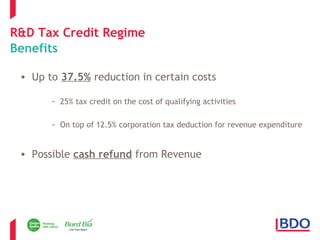
• Up to 37.5% reduction in certain costs 
- 25% tax credit on the cost of qualifying activities 
- On top of 12.5% corporation tax deduction for revenue expenditure 
• Possible cash refund from Revenue
R&D Tax Credit Regime 
Finance Bill 2015 Update 
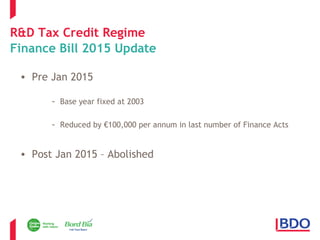
• Pre Jan 2015 
- Base year fixed at 2003 
- Reduced by €100,000 per annum in last number of Finance Acts 
• Post Jan 2015 – Abolished
R&D Tax Credit Regime 
Qualifying Activities 
“R&D activities” 
(i) basic research, 
(ii) applied research, 
(iii) experimental development, 
Activity must: 
(I) seek to achieve scientific or technological advancement, and 
(II) involve the resolution of scientific or technological uncertainty. 
Page 5
R&D Tax Credit Regime 
Making the Claim 
• Self-assessment 
• Technical Report 
• Claims need to be made within 12 months of the financial year end 
Page 6
R&D Tax Credit Regime 
Issues faced by Clients 
• Legal definitions versus practical application 
• Finance function 
• Engaging with technical staff 
• Integrity of classification of activities 
• Revenue scrutiny 
Page 7
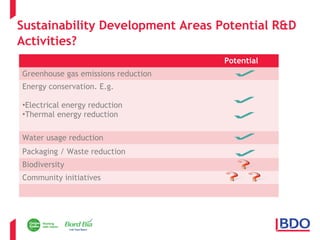
Sustainability Development Areas Potential R&D 
Activities? 
Page 8 
Potential 
Greenhouse gas emissions reduction 
Energy conservation. E.g. 
•Electrical energy reduction 
•Thermal energy reduction 
Water usage reduction 
Packaging / Waste reduction 
Biodiversity 
Community initiatives
Potential R&D Activities within Sustainability 
Development 
• Material substitution or Experimentation with new materials 
• Investigation and optimisation of existing process parameters and 
improvements to existing processes 
• Investigations into various new manufacturing methods / sub-processes and 
integration of same into existing processes 
• Packaging materials change or improvement 
• Investigation into alternative uses for waste products (e.g. new product 
development)
Non R&D Activities 
• Achievement of sustainability goals through standard methods (e.g. 
introduction of known techniques or existing ‘off the shelf’ solutions) 
• Standard implementation of new Plant and Machinery into a new or existing 
process (i.e. use of a standard piece of machinery as it was intended to be 
used, with no modification to such machinery required) 
• Routine biodiversity activities 
• Community initiatives
Some Examples We Have Encountered 
1. Greenhouse gas emissions- improvement of N efficiency while maintaining crop 
yields 
2. Energy conservation- design and implementation of a complex ambient control 
system 
3. Water usage reduction- waste water treatment, cleaning, mixing 
4. Packaging and waste reduction- PVdc substitution due to regulatory changes
Potential Additional R&D Areas 
• Development of new, or improvement to existing, products or processes in 
order to achieve an advance in a number of areas, including: 
• Yield 
• Cost 
• Quality 
• Stability 
• Consistency 
• Shelf life, etc.
Some myths about R&D 
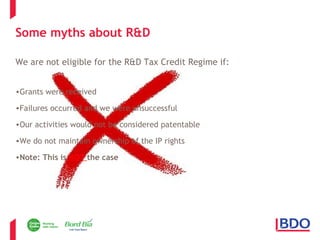
We are not eligible for the R&D Tax Credit Regime if: 
•Grants were received 
•Failures occurred and we were unsuccessful 
•Our activities would not be considered patentable 
•We do not maintain ownership of the IP rights 
•Note: This is NOT the case 
Page 13
QUESTIONS AND ANSWERS 
Derek Henry 
Head of R&D Tax Services 
dhenry@bdo.ie 
01-4700211

Full presentation

  • 1.
    Reaping R&D TaxCredits from Sustainability Efforts Origin Green Ireland Presentation Derek Henry 28 November 2014
  • 2.
    Agenda 1. Briefoverview of the R&D Tax Credit 2. R&D potential within Sustainability related activities 3. Some Myths about the R&D Tax Credit Regime 4. Questions and answers
  • 3.
    R&D Tax CreditRegime Benefits • Up to 37.5% reduction in certain costs - 25% tax credit on the cost of qualifying activities - On top of 12.5% corporation tax deduction for revenue expenditure • Possible cash refund from Revenue
  • 4.
    R&D Tax CreditRegime Finance Bill 2015 Update • Pre Jan 2015 - Base year fixed at 2003 - Reduced by €100,000 per annum in last number of Finance Acts • Post Jan 2015 – Abolished
  • 5.
    R&D Tax CreditRegime Qualifying Activities “R&D activities” (i) basic research, (ii) applied research, (iii) experimental development, Activity must: (I) seek to achieve scientific or technological advancement, and (II) involve the resolution of scientific or technological uncertainty. Page 5
  • 6.
    R&D Tax CreditRegime Making the Claim • Self-assessment • Technical Report • Claims need to be made within 12 months of the financial year end Page 6
  • 7.
    R&D Tax CreditRegime Issues faced by Clients • Legal definitions versus practical application • Finance function • Engaging with technical staff • Integrity of classification of activities • Revenue scrutiny Page 7
  • 8.
    Sustainability Development AreasPotential R&D Activities? Page 8 Potential Greenhouse gas emissions reduction Energy conservation. E.g. •Electrical energy reduction •Thermal energy reduction Water usage reduction Packaging / Waste reduction Biodiversity Community initiatives
  • 9.
    Potential R&D Activitieswithin Sustainability Development • Material substitution or Experimentation with new materials • Investigation and optimisation of existing process parameters and improvements to existing processes • Investigations into various new manufacturing methods / sub-processes and integration of same into existing processes • Packaging materials change or improvement • Investigation into alternative uses for waste products (e.g. new product development)
  • 10.
    Non R&D Activities • Achievement of sustainability goals through standard methods (e.g. introduction of known techniques or existing ‘off the shelf’ solutions) • Standard implementation of new Plant and Machinery into a new or existing process (i.e. use of a standard piece of machinery as it was intended to be used, with no modification to such machinery required) • Routine biodiversity activities • Community initiatives
  • 11.
    Some Examples WeHave Encountered 1. Greenhouse gas emissions- improvement of N efficiency while maintaining crop yields 2. Energy conservation- design and implementation of a complex ambient control system 3. Water usage reduction- waste water treatment, cleaning, mixing 4. Packaging and waste reduction- PVdc substitution due to regulatory changes
  • 12.
    Potential Additional R&DAreas • Development of new, or improvement to existing, products or processes in order to achieve an advance in a number of areas, including: • Yield • Cost • Quality • Stability • Consistency • Shelf life, etc.
  • 13.
    Some myths aboutR&D We are not eligible for the R&D Tax Credit Regime if: •Grants were received •Failures occurred and we were unsuccessful •Our activities would not be considered patentable •We do not maintain ownership of the IP rights •Note: This is NOT the case Page 13
  • 14.
    QUESTIONS AND ANSWERS Derek Henry Head of R&D Tax Services dhenry@bdo.ie 01-4700211