International Journal of Electronics and Communication Engineering & Technology (IJECET), ISSN 0976
          INTERNATIONAL JOURNAL OF ELECTRONICS AND
– 6464(Print), ISSN 0976 – 6472(Online) Volume 3, Issue 1, January- June (2012), © IAEME
 COMMUNICATION ENGINEERING & TECHNOLOGY (IJECET)

ISSN 0976 – 6464(Print)
ISSN 0976 – 6472(Online)
Volume 3, Issue 1, January- June (2012), pp. 130-138
                                                                         IJECET
© IAEME: www.iaeme.com/ijecet.html
Journal Impact Factor (2011): 0.8500 (Calculated by GISI)              ©IAEME
www.jifactor.com


          FPGA IMPLEMENTATION OF LOW COMPLEXITY
          LINEAR PERIODICALLY TIME VARYING FILTER

             Sriadibhatla Sridevi, Dr. Ravindra Dhuli and Prof. P. L. H. Varaprasad


ABSTRACT

       This paper presents a low complexity architecture for a linear periodically time
varying (LPTV) filter. This architecture is based on multi-input multi-output(MIMO)
representation of LPTV filters. The input signal is divided into blocks and parallel
processing is incorporated, there by considerably reducing the effective input sampling
rate. A single multiplier can be shared for each linear time invariant (LTI) filter in the
representation. Each LTI filter is realized in the transposed direct form filter using
multiplier less multiplication structures based on Binary common bit patterns (BCS). The
proposed structure is simulated, synthesized and implemented on Virtex v50efg256-7
Field Programmable Gate Array (FPGA).

Index Terms: LPTV, MIMO representation, BCS, FPGA

    I. INTRODUCTION
LINEAR periodically time varying (LPTV) systems/filters have number of applications
in many fields such as Control systems, Communications, Signal processing and Circuit
modeling [3], [7], [21], [6]. Spread spectrum applications [6], Trans multiplexing [16],
blind channel estimation [18], spectral scrambling [9], temporal scrambling [4], digital
water marking of natural images [12], sample data systems [21] and multi rate filter
banks [19] are the potential applications.
        LPTV systems can be expressed as generalization of Linear time invariant (LTI)
systems. If the input for a M-period LPTV system is delayed by M samples, output is also
delayed by the same number of samples. An LPTV system with a period of ’1’ is nothing
but an LTI system [15]. Various equivalent structures for an LPTV filters and their inter
relationships were derived in [14].


                                               130
International Journal of Electronics and Communication Engineering & Technology (IJECET), ISSN 0976
– 6464(Print), ISSN 0976 – 6472(Online) Volume 3, Issue 1, January- June (2012), © IAEME

         The relations between multi-input multi-output (MIMO) representation and
various other representations are presented in [15]. Here the authors present a technique
to transform from the LTI MIMO structure to the original single-input/single-output
LPTV difference equation and discusses its implications. The hardware implementation
of the LPTV filters is the area of greater interest now a day. Much of the previous work
concentrated on VLSI implementation of LTI filters. The complexity of LTI filters is
dominated by the complexity of coefficient multipliers. R. I. Hartley proposed that the
common sub expression elimination (CSE) methods based on canonical signed digit
(CSD) coefficients will produce low complexity FIR filter coefficient multipliers [8]. In
[13], the technique in [8] was modified to minimize the number of adder-steps in a
maximal path of decomposed multiplications and thus to improve the speed of operation.
In [10], R. Mahesh and A. P. Vinod proposed the Binary Common Sub expression (BCS)
elimination algorithm. It resulted in improved adder reductions and thus low complexity
FIR filters compared to [8] and [13]. In [20], a method based on the pseudo floating point
method was used to encode the filter coefficients and thus to reduce the complexity of the
filter. Implementation approach for reconfigurable FIR filters has been proposed in [17]
and [11]. Ref [2], [1] have touched on the VLSI implementation of multi rate FIR filter
design.
        In the present work we introduce a novel implementation strategy for an LPTV filter
using the MIMO representation. Any given LPTV filter can be viewed as MIMO LTI system.
Thus the analysis of MIMO LTI systems can be directly applied to LPTV systems. If we are
considering an LPTV system of period M, we will divide the input signal into blocks of size M.
We employ parallel processing on this blocks using LTI systems. Hence the effective input
sampling rate reduces by a factor M. After processing the resulting output signals are interlaced
equivalently to perform unblocked. Since there is a considerable reduction in the input sampling
rate, we can employ single multiplier on shared basis for each LTI filter. In the proposed
architecture, multiplication is performed without multipliers using Binary Common Bit patterns
(BCS) based shift and add units, multipliers and adders.
       The organization of the paper is as follows. Section II deals with the basics of
LPTV system. Section III explains the proposed LPTV FIR filter design. Simulation and
synthesis results are presented in section IV. Section V concludes the paper.


                (a) Blocking operator                             (b) MIMO Representation
                     Fig. 1 Blocking operator and MIMO representation


                                               131
International Journal of Electronics and Communication Engineering & Technology (IJECET), ISSN 0976
– 6464(Print), ISSN 0976 – 6472(Online) Volume 3, Issue 1, January- June (2012), © IAEME

    II. BASICS OF LPTV

A Linear system is called an LPTV system of period M, if a shift of M samples in the
input sequence result in similar shift of M samples in the output sequence. The input
output relationship of any linear system is given by the generalization of convolution sum
as

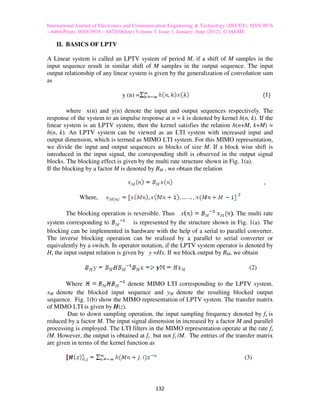
                                 y (n) =                                                      (1)

        where x(n) and y(n) denote the input and output sequences respectively. The
response of the system to an impulse response at n = k is denoted by kernel h(n, k). If the
linear system is an LPTV system, then the kernel satisfies the relation h(n+M, k+M) =
h(n, k). An LPTV system can be viewed as an LTI system with increased input and
output dimension, which is termed as MIMO LTI system. For this MIMO representation,
we divide the input and output sequences as blocks of size M. If a block wise shift is
introduced in the input signal, the corresponding shift is observed in the output signal
blocks. The blocking effect is given by the multi rate structure shown in Fig. 1(a).
If the blocking by a factor M is denoted by BM , we obtain the relation

                                                                                               ,
                                                                                   T
              Where,

        The blocking operation is reversible. Thus x                       . The multi rate
system corresponding to             is represented by the structure shown in Fig. 1(a). The
blocking can be implemented in hardware with the help of a serial to parallel converter.
The inverse blocking operation can be realized by a parallel to serial converter or
equivalently by a switch. In operator notation, if the LPTV system operator is denoted by
H, the input output relation is given by y =Hx. If we block output by BM, we obtain

                                                                                        (2)

        Where                    denote MIMO LTI corresponding to the LPTV system.
xM denote the blocked input sequence and yM denote the resulting blocked output
sequence. Fig. 1(b) show the MIMO representation of LPTV system. The transfer matrix
of MIMO LTI is given by H(z).
        Due to down sampling operation, the input sampling frequency denoted by fs is
reduced by a factor M. The input signal dimension in increased by a factor M and parallel
processing is employed. The LTI filters in the MIMO representation operate at the rate fs
/M. However, the output is obtained at fs , but not fs /M. The entries of the transfer matrix
are given in terms of the kernel function as

                                                                                       (3)


                                               132
International Journal of Electronics and Communication Engineering & Technology (IJECET), ISSN 0976
– 6464(Print), ISSN 0976 – 6472(Online) Volume 3, Issue 1, January- June (2012), © IAEME


        This relation an be proved by Fig. 1(a) and Fig. 1(b). Interested reader may refer
[5].To realize an N-tap, M period LPTV system in MIMO representation M2 LTI filters
consisting of N/M taps each are required. There are two advantages in this realization.
First advantage is that, instead of M number of N-tap filters, we can use M2 number of
N/M-tap filters. This facilitates to run all N/M tap filters in parallel which increases the
speed of operation. All the LTI filters can run at a sampling frequency of fs /M, instead of
fs. This is the second advantage. Each N/M tap filters requires N/M coefficient multipliers
normally. But as the rate at which multiplier has to operate is reduced by a factor M, we
can use a single multiplier in time sharing basis for all N/M coefficient multiplications.
Hence the total number of multipliers required for the entire LPTV system is reduced
from M × N to only M and this can considerably reduce the area occupied.


      (a) Shift and Adder architecture                        (b) Multiplication block

    III. LOW COMPLEXITY LPTV FIR FILTER DESIGN

    An N- tap, M- period LPTV filter can be realized by using M2 LTI filters of N/M taps
each. Each LTI filter in the proposed design is in transposed direct form. In the proposed
design ,the coefficient multiplier of each LTI filter is replaced by a multiplier less
multiplication block based on Binary Common bit patterns (BCS).The novel
multiplication block can be divided into two units. BCS based shift and add unit and
multiplication unit.
A. BCS based Shift and Add Unit
    An n-bit binary number in general can form 2n Binary Common Bit patterns. For
example, a 3-bit binary representation can form 8 common bit patterns. They are (000),
(001), (010), (011), (100), (101), (110), (111). The common bit patterns like (001), (010)
and (100) do not require any adder for their implementation as they have a single non
zero bit. The bit pattern (000) does not need an adder or a shifter. Considering x as input
signal, the remaining bit patterns can be expressed as follows


                                               133
International Journal of Electronics and Communication Engineering & Technology (IJECET), ISSN 0976
– 6464(Print), ISSN 0976 – 6472(Online) Volume 3, Issue 1, January- June (2012), © IAEME


        (011) = 2−1x + 2−2x
        (101) = x + 2−2x                                          (4)
        (110) = x + 2−1x
        (111) = x + 2−1x + 2−2x

        To realize the above Binary Common Bit patterns, five adders are required.
However, if we perform some simplifications such as 2-1x + 2−2x = 2−1(x + 2−1x) and x+
[2-1x+2-2x ] = x+ 2-1 x+2-2x, then all the BCSs can be realized with a minimum of three
adders . The number of adders required to realize all the possible n-bit common binary bit
patterns is 2n-1-1. The architecture of shift and add unit is shown in Fig. 2(a). All the eight
BCS are fed to the multiplication block.

B . Multiplication Block
        The architecture of multiplication block is shown in Fig. 2(b). The coefficient
word length is 16 bits .The filter coefficients are stored in the coefficient memory in sign
magnitude form with most significant bit representing the sign bit. Each 16 bit coefficient
is stored as 17 bit value in coefficient memory. Each row in the memory corresponds to
one coefficient. The coefficient values corresponding to 20 to 2−14 are partitioned into
groups of three bits and they are used as select signals to multiplexers MUX1 to MUX5.
It is easy to note that MUX1 to MUX5 are 8:1 multiplexers as they have three select
lines. The value corresponding to 2−15 forms the select line to a 2:1 multiplexer. Let r1 to
r6 denote the outputs of MUX1 to MUX6 respectively. Then the output is given by

                              TABLE I MACRO-STATISTICS


                              TABLE II SYNTHESIS RESULTS


                                               134
International Journal of Electronics and Communication Engineering & Technology (IJECET), ISSN 0976
– 6464(Print), ISSN 0976 – 6472(Online) Volume 3, Issue 1, January- June (2012), © IAEME

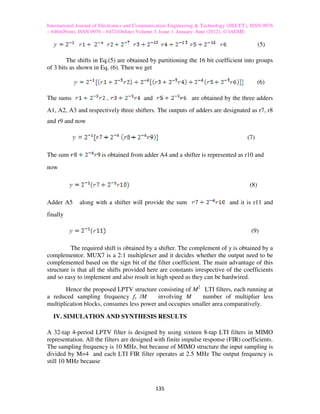
                                                                                              (5)

        The shifts in Eq.(5) are obtained by partitioning the 16 bit coefficient into groups
of 3 bits as shown in Eq. (6). Then we get

                                                                                              (6)

The sums                  ,               and                  are obtained by the three adders
A1, A2, A3 and respectively three shifters. The outputs of adders are designated as r7, r8
and r9 and now

                                                                                       (7)

The sum                is obtained from adder A4 and a shifter is represented as r10 and
now

                                                                                        (8)

Adder A5      along with a shifter will provide the sum                        and it is r11 and
finally

                                                                                         (9)

          The required shift is obtained by a shifter. The complement of y is obtained by a
complementor. MUX7 is a 2:1 multiplexer and it decides whether the output need to be
complemented based on the sign bit of the filter coefficient. The main advantage of this
structure is that all the shifts provided here are constants irrespective of the coefficients
and so easy to implement and also result in high speed as they can be hardwired.
       Hence the proposed LPTV structure consisting of M2 LTI filters, each running at
a reduced sampling frequency fs /M         involving M     number of multiplier less
multiplication blocks, consumes less power and occupies smaller area comparatively.

  IV. SIMULATION AND SYNTHESIS RESULTS

A 32-tap 4-period LPTV filter is designed by using sixteen 8-tap LTI filters in MIMO
representation. All the filters are designed with finite impulse response (FIR) coefficients.
The sampling frequency is 10 MHz, but because of MIMO structure the input sampling is
divided by M=4 and each LTI FIR filter operates at 2.5 MHz The output frequency is
still 10 MHz because


                                                135
International Journal of Electronics and Communication Engineering & Technology (IJECET), ISSN 0976
– 6464(Print), ISSN 0976 – 6472(Online) Volume 3, Issue 1, January- June (2012), © IAEME

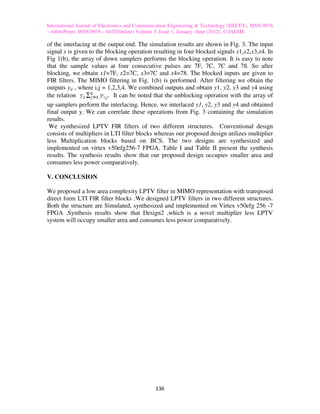
of the interlacing at the output end. The simulation results are shown in Fig. 3. The input
signal x is given to the blocking operation resulting in four blocked signals x1,x2,x3,x4. In
Fig 1(b), the array of down samplers performs the blocking operation. It is easy to note
that the sample values at four consecutive pulses are 7F, 7C, 7C and 78. So after
blocking, we obtain x1=7F, x2=7C, x3=7C and x4=78. The blocked inputs are given to
FIR filters. The MIMO filtering in Fig. 1(b) is performed. After filtering we obtain the
outputs yij , where i,j = 1,2,3,4. We combined outputs and obtain y1, y2, y3 and y4 using
the relation              . It can be noted that the unblocking operation with the array of
up samplers perform the interlacing. Hence, we interlaced y1, y2, y3 and y4 and obtained
final output y. We can correlate these operations from Fig. 3 containing the simulation
results.
 We synthesized LPTV FIR filters of two different structures. Conventional design
consists of multipliers in LTI filter blocks whereas our proposed design utilizes multiplier
less Multiplication blocks based on BCS. The two designs are synthesized and
implemented on virtex v50efg256-7 FPGA. Table I and Table II present the synthesis
results. The synthesis results show that our proposed design occupies smaller area and
consumes less power comparatively.

V. CONCLUSION

We proposed a low area complexity LPTV filter in MIMO representation with transposed
direct form LTI FIR filter blocks .We designed LPTV filters in two different structures.
Both the structure are Simulated, synthesized and implemented on Virtex v50efg 256 -7
FPGA .Synthesis results show that Design2 ,which is a novel multiplier less LPTV
system will occupy smaller area and consumes less power comparatively.


                                               136
International Journal of Electronics and Communication Engineering & Technology (IJECET), ISSN 0976
– 6464(Print), ISSN 0976 – 6472(Online) Volume 3, Issue 1, January- June (2012), © IAEME


                                   Fig. 3 Simulation results

REFERENCES

[1] K.H. Abed and S.B. Nerurkar. Implementation of a low power decimation filter using
1/3-band iir filter. In Wireless Communications and Networking, 2003. WCNC 2003.
2003 IEEE, volume 1, pages 460–465. IEEE, 2003.
[2] D.C. Andreas. Vlsi implementation of a one-stage 64: 1 fir decimator. In 89th
Convention of the Audio Engineering Society, J. Audio Eng. Soc.(Abstracts), volume 38,
page 872, 1990.
[3] W. Chauvet, B. Cristea, B. Lacaze, D. Roviras, and A. Duverdier. Design of
orthogonal lptv filters: Application to spread spectrum multiple access. In Acoustics,
Speech, and Signal Processing, 2004. Proceedings.(ICASSP’04). IEEE International
Conference on, volume 2, pages ii–645. IEEE, 2004.
[4] W. Chauvet, B. Lacaze, D. Roviras, and A. Duverdier. Spreading properties of
periodic clock changes application to interleavers. Signal Processing, 88(2):221–235,
2008.
[5] Ravindra Dhuli and Brajesh Lall, Generalized poly phase identity. In the proceedings
of INDICON 09,DAIICT,Gandhinagar,India,December 2009.
[6] A. Duverdier and B. Lacaze. Transmission of two users by means of periodic clock
changes. In Acoustics, Speech and Signal Processing, 1998. Proceedings of the 1998
IEEE International Conference on, volume 3, pages 1825–1828. IEEE, 1998.

                                               137
International Journal of Electronics and Communication Engineering & Technology (IJECET), ISSN 0976
– 6464(Print), ISSN 0976 – 6472(Online) Volume 3, Issue 1, January- June (2012), © IAEME

[7] G. Gelli and F. Verde. Blind fsr-lptv equalization and interference rejection.
Communications, IEEE Transactions on, 51(2):145–150, 2003.
[8] R.I. Hartley. Subexpression sharing in filters using canonic signed digit multipliers.
Circuits and Systems II: Analog and Digital Signal Processing, IEEE Transactions on,
43(10):677–688, 1996.
[9] R. Ishii and M. Kakishita. A design method for a periodically time-varying digital
filter for spectrum scrambling. Acoustics, Speech and Signal Processing, IEEE
Transactions on, 38(7):1219–1222, 1990.
[10] R. Mahesh and AP Vinod. A new common subexpression elimination algorithm for
realizing low-complexity higher order digital filters. Computer-Aided Design of
Integrated Circuits and Systems, IEEE Transactions on, 27(2):217–229, 2008.
[11] R. Mahesh and AP Vinod. New reconfigurable architectures for implementing fir
filters with low complexity. Computer-Aided Design of Integrated Circuits and Systems,
IEEE Transactions on, 29(2):275–288, 2010.
[12] V. Martin, M. Chabert, and B. Lacaze. Digital watermarking of natural images based
on lptv filters. In Acoustics, Speech and Signal Processing, 2007. ICASSP 2007. IEEE
International Conference on, volume 2, pages II–197. IEEE, 2007.
[13] M. Mart´ınez-Peir´o, E.I. Boemo, and L. Wanhammar. Design of high-speed
multiplierless filters using a nonrecursive signed common subexpression algorithm.
Circuits and Systems II: Analog and Digital Signal Processing, IEEE Transactions on,
49(3):196–203, 2002.
[14] D. McLernon. One-dimensional linear periodically time-varying structures:
derivations, interrelationships and properties. In Vision, Image and Signal Processing,
IEE Proceedings-, volume 146, pages 245–252. IET, 1999.
[15] DC McLernon. Relationship between an lptv system and the equivalent lti mimo
structure. In Vision, Image and Signal Processing, IEE Proceedings-, volume 150, pages
133–141. IET, 2003.
[16] J.S. Prater and C.M. Loeffler. Analysis and design of periodically time-varying iir
filters, with applications to transmultiplexing. Signal Processing, IEEE Transactions on,
40(11):2715–2725, 1992.
[17] T. Solla and O. Vainio. Comparison of programmable fir filter architectures for low
power. In Solid-State Circuits Conference, 2002. ESSCIRC 2002. Proceedings of the
28th European, pages 759–762. IEEE, 2002.
[18] M.K. Tsatsanis and G.B. Giannakis. Transmitter induced cyclostationarity for blind
channel equalization. Signal Processing, IEEE Transactions on, 45(7):1785–1794, 1997.
[19] P.P. Vaidyanathan. Multirate systems and filter banks. Pearson Education India,
1993.
[20] AP Vinod and E.M.K. Lai. Low power and high-speed implementation of fir filters
for software defined radio receivers. Wireless Communications, IEEE Transactions on,
5(7):1669–1675, 2006.
[21] J. Wang, T. Chen, and B. Huang. Multirate sampled-data systems: computing fast-
rate models. Journal of process control, 14(1):79–88, 2004.


                                               138

Fpga implementation of low complexity linear periodically time varying filter

  • 1.
    International Journal ofElectronics and Communication Engineering & Technology (IJECET), ISSN 0976 INTERNATIONAL JOURNAL OF ELECTRONICS AND – 6464(Print), ISSN 0976 – 6472(Online) Volume 3, Issue 1, January- June (2012), © IAEME COMMUNICATION ENGINEERING & TECHNOLOGY (IJECET) ISSN 0976 – 6464(Print) ISSN 0976 – 6472(Online) Volume 3, Issue 1, January- June (2012), pp. 130-138 IJECET © IAEME: www.iaeme.com/ijecet.html Journal Impact Factor (2011): 0.8500 (Calculated by GISI) ©IAEME www.jifactor.com FPGA IMPLEMENTATION OF LOW COMPLEXITY LINEAR PERIODICALLY TIME VARYING FILTER Sriadibhatla Sridevi, Dr. Ravindra Dhuli and Prof. P. L. H. Varaprasad ABSTRACT This paper presents a low complexity architecture for a linear periodically time varying (LPTV) filter. This architecture is based on multi-input multi-output(MIMO) representation of LPTV filters. The input signal is divided into blocks and parallel processing is incorporated, there by considerably reducing the effective input sampling rate. A single multiplier can be shared for each linear time invariant (LTI) filter in the representation. Each LTI filter is realized in the transposed direct form filter using multiplier less multiplication structures based on Binary common bit patterns (BCS). The proposed structure is simulated, synthesized and implemented on Virtex v50efg256-7 Field Programmable Gate Array (FPGA). Index Terms: LPTV, MIMO representation, BCS, FPGA I. INTRODUCTION LINEAR periodically time varying (LPTV) systems/filters have number of applications in many fields such as Control systems, Communications, Signal processing and Circuit modeling [3], [7], [21], [6]. Spread spectrum applications [6], Trans multiplexing [16], blind channel estimation [18], spectral scrambling [9], temporal scrambling [4], digital water marking of natural images [12], sample data systems [21] and multi rate filter banks [19] are the potential applications. LPTV systems can be expressed as generalization of Linear time invariant (LTI) systems. If the input for a M-period LPTV system is delayed by M samples, output is also delayed by the same number of samples. An LPTV system with a period of ’1’ is nothing but an LTI system [15]. Various equivalent structures for an LPTV filters and their inter relationships were derived in [14]. 130
  • 2.
    International Journal ofElectronics and Communication Engineering & Technology (IJECET), ISSN 0976 – 6464(Print), ISSN 0976 – 6472(Online) Volume 3, Issue 1, January- June (2012), © IAEME The relations between multi-input multi-output (MIMO) representation and various other representations are presented in [15]. Here the authors present a technique to transform from the LTI MIMO structure to the original single-input/single-output LPTV difference equation and discusses its implications. The hardware implementation of the LPTV filters is the area of greater interest now a day. Much of the previous work concentrated on VLSI implementation of LTI filters. The complexity of LTI filters is dominated by the complexity of coefficient multipliers. R. I. Hartley proposed that the common sub expression elimination (CSE) methods based on canonical signed digit (CSD) coefficients will produce low complexity FIR filter coefficient multipliers [8]. In [13], the technique in [8] was modified to minimize the number of adder-steps in a maximal path of decomposed multiplications and thus to improve the speed of operation. In [10], R. Mahesh and A. P. Vinod proposed the Binary Common Sub expression (BCS) elimination algorithm. It resulted in improved adder reductions and thus low complexity FIR filters compared to [8] and [13]. In [20], a method based on the pseudo floating point method was used to encode the filter coefficients and thus to reduce the complexity of the filter. Implementation approach for reconfigurable FIR filters has been proposed in [17] and [11]. Ref [2], [1] have touched on the VLSI implementation of multi rate FIR filter design. In the present work we introduce a novel implementation strategy for an LPTV filter using the MIMO representation. Any given LPTV filter can be viewed as MIMO LTI system. Thus the analysis of MIMO LTI systems can be directly applied to LPTV systems. If we are considering an LPTV system of period M, we will divide the input signal into blocks of size M. We employ parallel processing on this blocks using LTI systems. Hence the effective input sampling rate reduces by a factor M. After processing the resulting output signals are interlaced equivalently to perform unblocked. Since there is a considerable reduction in the input sampling rate, we can employ single multiplier on shared basis for each LTI filter. In the proposed architecture, multiplication is performed without multipliers using Binary Common Bit patterns (BCS) based shift and add units, multipliers and adders. The organization of the paper is as follows. Section II deals with the basics of LPTV system. Section III explains the proposed LPTV FIR filter design. Simulation and synthesis results are presented in section IV. Section V concludes the paper. (a) Blocking operator (b) MIMO Representation Fig. 1 Blocking operator and MIMO representation 131
  • 3.
    International Journal ofElectronics and Communication Engineering & Technology (IJECET), ISSN 0976 – 6464(Print), ISSN 0976 – 6472(Online) Volume 3, Issue 1, January- June (2012), © IAEME II. BASICS OF LPTV A Linear system is called an LPTV system of period M, if a shift of M samples in the input sequence result in similar shift of M samples in the output sequence. The input output relationship of any linear system is given by the generalization of convolution sum as y (n) = (1) where x(n) and y(n) denote the input and output sequences respectively. The response of the system to an impulse response at n = k is denoted by kernel h(n, k). If the linear system is an LPTV system, then the kernel satisfies the relation h(n+M, k+M) = h(n, k). An LPTV system can be viewed as an LTI system with increased input and output dimension, which is termed as MIMO LTI system. For this MIMO representation, we divide the input and output sequences as blocks of size M. If a block wise shift is introduced in the input signal, the corresponding shift is observed in the output signal blocks. The blocking effect is given by the multi rate structure shown in Fig. 1(a). If the blocking by a factor M is denoted by BM , we obtain the relation , T Where, The blocking operation is reversible. Thus x . The multi rate system corresponding to is represented by the structure shown in Fig. 1(a). The blocking can be implemented in hardware with the help of a serial to parallel converter. The inverse blocking operation can be realized by a parallel to serial converter or equivalently by a switch. In operator notation, if the LPTV system operator is denoted by H, the input output relation is given by y =Hx. If we block output by BM, we obtain (2) Where denote MIMO LTI corresponding to the LPTV system. xM denote the blocked input sequence and yM denote the resulting blocked output sequence. Fig. 1(b) show the MIMO representation of LPTV system. The transfer matrix of MIMO LTI is given by H(z). Due to down sampling operation, the input sampling frequency denoted by fs is reduced by a factor M. The input signal dimension in increased by a factor M and parallel processing is employed. The LTI filters in the MIMO representation operate at the rate fs /M. However, the output is obtained at fs , but not fs /M. The entries of the transfer matrix are given in terms of the kernel function as (3) 132
  • 4.
    International Journal ofElectronics and Communication Engineering & Technology (IJECET), ISSN 0976 – 6464(Print), ISSN 0976 – 6472(Online) Volume 3, Issue 1, January- June (2012), © IAEME This relation an be proved by Fig. 1(a) and Fig. 1(b). Interested reader may refer [5].To realize an N-tap, M period LPTV system in MIMO representation M2 LTI filters consisting of N/M taps each are required. There are two advantages in this realization. First advantage is that, instead of M number of N-tap filters, we can use M2 number of N/M-tap filters. This facilitates to run all N/M tap filters in parallel which increases the speed of operation. All the LTI filters can run at a sampling frequency of fs /M, instead of fs. This is the second advantage. Each N/M tap filters requires N/M coefficient multipliers normally. But as the rate at which multiplier has to operate is reduced by a factor M, we can use a single multiplier in time sharing basis for all N/M coefficient multiplications. Hence the total number of multipliers required for the entire LPTV system is reduced from M × N to only M and this can considerably reduce the area occupied. (a) Shift and Adder architecture (b) Multiplication block III. LOW COMPLEXITY LPTV FIR FILTER DESIGN An N- tap, M- period LPTV filter can be realized by using M2 LTI filters of N/M taps each. Each LTI filter in the proposed design is in transposed direct form. In the proposed design ,the coefficient multiplier of each LTI filter is replaced by a multiplier less multiplication block based on Binary Common bit patterns (BCS).The novel multiplication block can be divided into two units. BCS based shift and add unit and multiplication unit. A. BCS based Shift and Add Unit An n-bit binary number in general can form 2n Binary Common Bit patterns. For example, a 3-bit binary representation can form 8 common bit patterns. They are (000), (001), (010), (011), (100), (101), (110), (111). The common bit patterns like (001), (010) and (100) do not require any adder for their implementation as they have a single non zero bit. The bit pattern (000) does not need an adder or a shifter. Considering x as input signal, the remaining bit patterns can be expressed as follows 133
  • 5.
    International Journal ofElectronics and Communication Engineering & Technology (IJECET), ISSN 0976 – 6464(Print), ISSN 0976 – 6472(Online) Volume 3, Issue 1, January- June (2012), © IAEME (011) = 2−1x + 2−2x (101) = x + 2−2x (4) (110) = x + 2−1x (111) = x + 2−1x + 2−2x To realize the above Binary Common Bit patterns, five adders are required. However, if we perform some simplifications such as 2-1x + 2−2x = 2−1(x + 2−1x) and x+ [2-1x+2-2x ] = x+ 2-1 x+2-2x, then all the BCSs can be realized with a minimum of three adders . The number of adders required to realize all the possible n-bit common binary bit patterns is 2n-1-1. The architecture of shift and add unit is shown in Fig. 2(a). All the eight BCS are fed to the multiplication block. B . Multiplication Block The architecture of multiplication block is shown in Fig. 2(b). The coefficient word length is 16 bits .The filter coefficients are stored in the coefficient memory in sign magnitude form with most significant bit representing the sign bit. Each 16 bit coefficient is stored as 17 bit value in coefficient memory. Each row in the memory corresponds to one coefficient. The coefficient values corresponding to 20 to 2−14 are partitioned into groups of three bits and they are used as select signals to multiplexers MUX1 to MUX5. It is easy to note that MUX1 to MUX5 are 8:1 multiplexers as they have three select lines. The value corresponding to 2−15 forms the select line to a 2:1 multiplexer. Let r1 to r6 denote the outputs of MUX1 to MUX6 respectively. Then the output is given by TABLE I MACRO-STATISTICS TABLE II SYNTHESIS RESULTS 134
  • 6.
    International Journal ofElectronics and Communication Engineering & Technology (IJECET), ISSN 0976 – 6464(Print), ISSN 0976 – 6472(Online) Volume 3, Issue 1, January- June (2012), © IAEME (5) The shifts in Eq.(5) are obtained by partitioning the 16 bit coefficient into groups of 3 bits as shown in Eq. (6). Then we get (6) The sums , and are obtained by the three adders A1, A2, A3 and respectively three shifters. The outputs of adders are designated as r7, r8 and r9 and now (7) The sum is obtained from adder A4 and a shifter is represented as r10 and now (8) Adder A5 along with a shifter will provide the sum and it is r11 and finally (9) The required shift is obtained by a shifter. The complement of y is obtained by a complementor. MUX7 is a 2:1 multiplexer and it decides whether the output need to be complemented based on the sign bit of the filter coefficient. The main advantage of this structure is that all the shifts provided here are constants irrespective of the coefficients and so easy to implement and also result in high speed as they can be hardwired. Hence the proposed LPTV structure consisting of M2 LTI filters, each running at a reduced sampling frequency fs /M involving M number of multiplier less multiplication blocks, consumes less power and occupies smaller area comparatively. IV. SIMULATION AND SYNTHESIS RESULTS A 32-tap 4-period LPTV filter is designed by using sixteen 8-tap LTI filters in MIMO representation. All the filters are designed with finite impulse response (FIR) coefficients. The sampling frequency is 10 MHz, but because of MIMO structure the input sampling is divided by M=4 and each LTI FIR filter operates at 2.5 MHz The output frequency is still 10 MHz because 135
  • 7.
    International Journal ofElectronics and Communication Engineering & Technology (IJECET), ISSN 0976 – 6464(Print), ISSN 0976 – 6472(Online) Volume 3, Issue 1, January- June (2012), © IAEME of the interlacing at the output end. The simulation results are shown in Fig. 3. The input signal x is given to the blocking operation resulting in four blocked signals x1,x2,x3,x4. In Fig 1(b), the array of down samplers performs the blocking operation. It is easy to note that the sample values at four consecutive pulses are 7F, 7C, 7C and 78. So after blocking, we obtain x1=7F, x2=7C, x3=7C and x4=78. The blocked inputs are given to FIR filters. The MIMO filtering in Fig. 1(b) is performed. After filtering we obtain the outputs yij , where i,j = 1,2,3,4. We combined outputs and obtain y1, y2, y3 and y4 using the relation . It can be noted that the unblocking operation with the array of up samplers perform the interlacing. Hence, we interlaced y1, y2, y3 and y4 and obtained final output y. We can correlate these operations from Fig. 3 containing the simulation results. We synthesized LPTV FIR filters of two different structures. Conventional design consists of multipliers in LTI filter blocks whereas our proposed design utilizes multiplier less Multiplication blocks based on BCS. The two designs are synthesized and implemented on virtex v50efg256-7 FPGA. Table I and Table II present the synthesis results. The synthesis results show that our proposed design occupies smaller area and consumes less power comparatively. V. CONCLUSION We proposed a low area complexity LPTV filter in MIMO representation with transposed direct form LTI FIR filter blocks .We designed LPTV filters in two different structures. Both the structure are Simulated, synthesized and implemented on Virtex v50efg 256 -7 FPGA .Synthesis results show that Design2 ,which is a novel multiplier less LPTV system will occupy smaller area and consumes less power comparatively. 136
  • 8.
    International Journal ofElectronics and Communication Engineering & Technology (IJECET), ISSN 0976 – 6464(Print), ISSN 0976 – 6472(Online) Volume 3, Issue 1, January- June (2012), © IAEME Fig. 3 Simulation results REFERENCES [1] K.H. Abed and S.B. Nerurkar. Implementation of a low power decimation filter using 1/3-band iir filter. In Wireless Communications and Networking, 2003. WCNC 2003. 2003 IEEE, volume 1, pages 460–465. IEEE, 2003. [2] D.C. Andreas. Vlsi implementation of a one-stage 64: 1 fir decimator. In 89th Convention of the Audio Engineering Society, J. Audio Eng. Soc.(Abstracts), volume 38, page 872, 1990. [3] W. Chauvet, B. Cristea, B. Lacaze, D. Roviras, and A. Duverdier. Design of orthogonal lptv filters: Application to spread spectrum multiple access. In Acoustics, Speech, and Signal Processing, 2004. Proceedings.(ICASSP’04). IEEE International Conference on, volume 2, pages ii–645. IEEE, 2004. [4] W. Chauvet, B. Lacaze, D. Roviras, and A. Duverdier. Spreading properties of periodic clock changes application to interleavers. Signal Processing, 88(2):221–235, 2008. [5] Ravindra Dhuli and Brajesh Lall, Generalized poly phase identity. In the proceedings of INDICON 09,DAIICT,Gandhinagar,India,December 2009. [6] A. Duverdier and B. Lacaze. Transmission of two users by means of periodic clock changes. In Acoustics, Speech and Signal Processing, 1998. Proceedings of the 1998 IEEE International Conference on, volume 3, pages 1825–1828. IEEE, 1998. 137
  • 9.
    International Journal ofElectronics and Communication Engineering & Technology (IJECET), ISSN 0976 – 6464(Print), ISSN 0976 – 6472(Online) Volume 3, Issue 1, January- June (2012), © IAEME [7] G. Gelli and F. Verde. Blind fsr-lptv equalization and interference rejection. Communications, IEEE Transactions on, 51(2):145–150, 2003. [8] R.I. Hartley. Subexpression sharing in filters using canonic signed digit multipliers. Circuits and Systems II: Analog and Digital Signal Processing, IEEE Transactions on, 43(10):677–688, 1996. [9] R. Ishii and M. Kakishita. A design method for a periodically time-varying digital filter for spectrum scrambling. Acoustics, Speech and Signal Processing, IEEE Transactions on, 38(7):1219–1222, 1990. [10] R. Mahesh and AP Vinod. A new common subexpression elimination algorithm for realizing low-complexity higher order digital filters. Computer-Aided Design of Integrated Circuits and Systems, IEEE Transactions on, 27(2):217–229, 2008. [11] R. Mahesh and AP Vinod. New reconfigurable architectures for implementing fir filters with low complexity. Computer-Aided Design of Integrated Circuits and Systems, IEEE Transactions on, 29(2):275–288, 2010. [12] V. Martin, M. Chabert, and B. Lacaze. Digital watermarking of natural images based on lptv filters. In Acoustics, Speech and Signal Processing, 2007. ICASSP 2007. IEEE International Conference on, volume 2, pages II–197. IEEE, 2007. [13] M. Mart´ınez-Peir´o, E.I. Boemo, and L. Wanhammar. Design of high-speed multiplierless filters using a nonrecursive signed common subexpression algorithm. Circuits and Systems II: Analog and Digital Signal Processing, IEEE Transactions on, 49(3):196–203, 2002. [14] D. McLernon. One-dimensional linear periodically time-varying structures: derivations, interrelationships and properties. In Vision, Image and Signal Processing, IEE Proceedings-, volume 146, pages 245–252. IET, 1999. [15] DC McLernon. Relationship between an lptv system and the equivalent lti mimo structure. In Vision, Image and Signal Processing, IEE Proceedings-, volume 150, pages 133–141. IET, 2003. [16] J.S. Prater and C.M. Loeffler. Analysis and design of periodically time-varying iir filters, with applications to transmultiplexing. Signal Processing, IEEE Transactions on, 40(11):2715–2725, 1992. [17] T. Solla and O. Vainio. Comparison of programmable fir filter architectures for low power. In Solid-State Circuits Conference, 2002. ESSCIRC 2002. Proceedings of the 28th European, pages 759–762. IEEE, 2002. [18] M.K. Tsatsanis and G.B. Giannakis. Transmitter induced cyclostationarity for blind channel equalization. Signal Processing, IEEE Transactions on, 45(7):1785–1794, 1997. [19] P.P. Vaidyanathan. Multirate systems and filter banks. Pearson Education India, 1993. [20] AP Vinod and E.M.K. Lai. Low power and high-speed implementation of fir filters for software defined radio receivers. Wireless Communications, IEEE Transactions on, 5(7):1669–1675, 2006. [21] J. Wang, T. Chen, and B. Huang. Multirate sampled-data systems: computing fast- rate models. Journal of process control, 14(1):79–88, 2004. 138