International Journal of Computer Science, Engineering and Information Technology (IJCSEIT), Vol. 4, No.5, October 2014 
FPGA BASED HEARTBEATS MONITOR WITH 
FINGERTIP OPTICAL SENSOR 
Wahyu Kusuma R.1, Ridha I.2, Yasman Rianto3, Swelandiah E.P4 
1,3 Departement of Electrcal Engineering, Gunadarma University, Jakarta, Indonesia 
2,4 Departement of Computer Science, Gunadarma University, , Jakarta, Indonesia 
ABSTRACT 
The heart is an organ of human body which has a vital function, small abnormalities can have a big impact 
on the performance of the body. Heart disease is the number one cause of death in the world. Examination 
of the heart can be detected from blood flow in the fingertips, in order to obtain information about the 
number and rhythm of the heartbeat. This research aims to design and implement the FPGA board to 
monitor the heart rate with optical sensors.The results of this study are expected to facilitate the patient's 
medical team or independently in detecting heart health. The series is composed of blocks of sensors, 
signal conditioning block, the block pulse counter, block timer 10 seconds and blocks the viewer. Based on 
the test results of the 10 respondents with a variety of age and gender, has built a tool that the percentage 
error of 3.94%. 
KEYWORDS 
Heartbeat monitor, Xilinx ISE Webpack, FPGA, optical sensor 
1. INTRODUCTION 
The heart is an organ of human body which has a vital function, small abnormalities can have a 
big impact on the performance of the heart kita.Penyakit body is the number one cause of death 
in the world. Based on data from the World Health Organization (WHO), cardiovascular disease 
has reached 29% in the percentage of deaths in the world and 17 million people die every year 
due to heart and blood vessel disease throughout the world [3]. 
The development of medical instrumentation systems is growing rapidly along with the need for 
medical personnel to diagnose a patient and a medical examination. One medical instrumentation 
used for the examination of the heart is Electrocardiograph (ECG). ECG is a medical instrument 
that is commonly used by the medical team to detect heart rate and rhythm [6]. EKG can not be 
used independently by patients to detect a patient's pulse. In addition to the expensive costs for 
the procurement of ECG, ECG devices also require special skills to operate. 
Along with the requirement in the design and manufacture of medical devices, digital electronics 
design technology is developing very rapidly, both in terms of hardware and software. Xilinx is 
one manufacturer that produces equipment or tools for modeling the design of digital systems. 
One product is in the form of a kit module board FPGA (Field Programmable Gate Array). 
FPGA is a programmable device that is composed of large modules independent logic that can be 
configured by the user who is connecting through the canals of programmable routing [4]. 
DOI : 10.5121/ijcseit.2014.4501 1
International Journal of Computer Science, Engineering and Information Technology (IJCSEIT), Vol. 4, No.5, October 2014 
Field Programmable Gate Array (FPGA) has advantages of which can be configured by the End 
User, does not require the fabrication process, and the available solutions that support 
customized VLSI chip, so the logic circuit capable of implementing, instant manufacturring, 
very-low cost prototype. While FPGA product is also supported by the availability of the Xilinx 
ISE WebPack permograman language that is used as a GUI for the digital system design 
problems is desired. 
Based on the above issues, this study will design a device that can detect heart rate by detecting 
the frequency of blood flow to the fingers automatically processed electronically using the 
module FPGA (Field Programable Gate Array). This research is expected to generate a heartbeat 
detector chip implementation can provide facilities for the medical and can be used 
independently by the user (patient) without the help of a doctor or paramedic. 
2 
2. ARCHITECTURE AND ITS IMPLEMENTATION 
This research conducted several phases of hardware design, software design pelangkat, testing 
tools, and analysis to draw conclusions. 
2.1 Hardware Design 
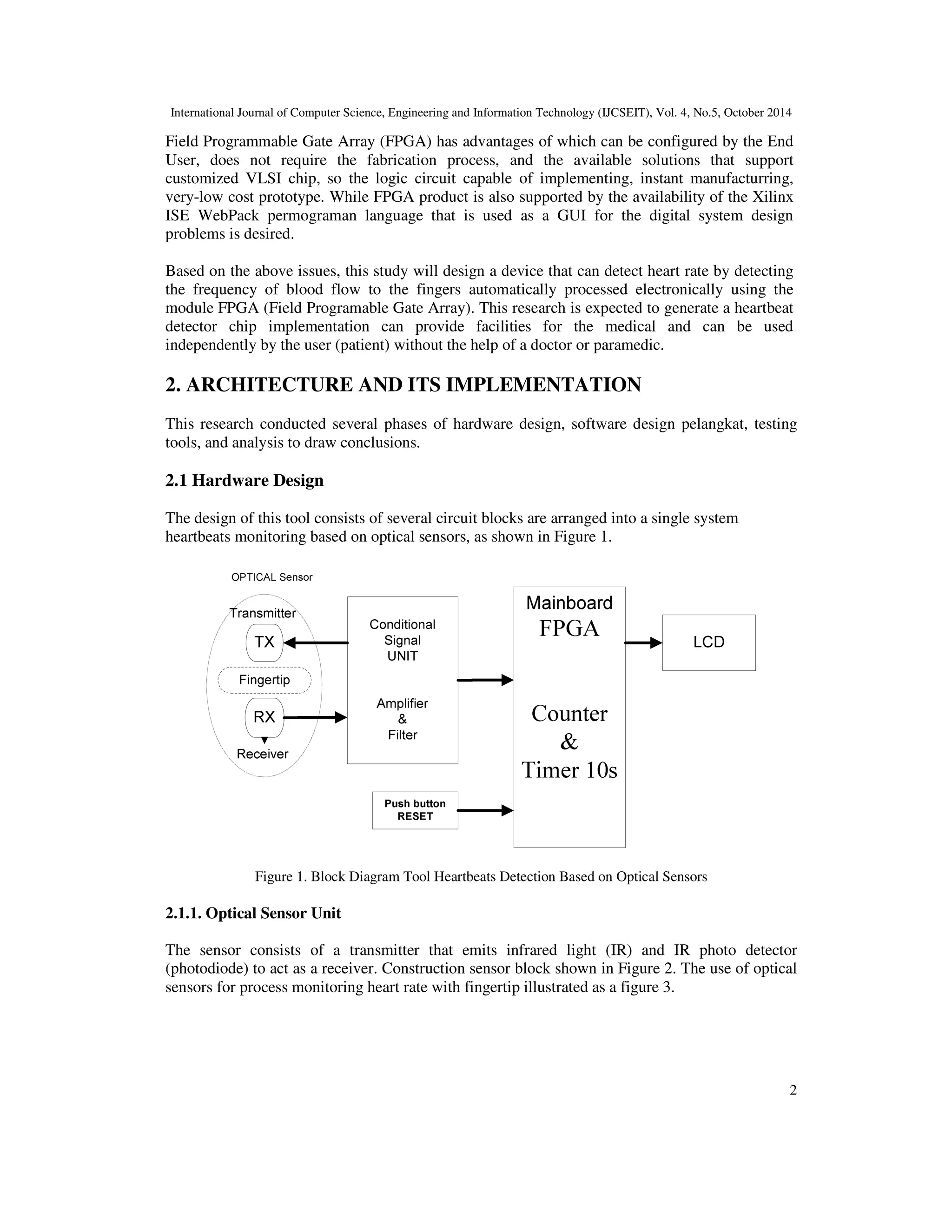
The design of this tool consists of several circuit blocks are arranged into a single system 
heartbeats monitoring based on optical sensors, as shown in Figure 1. 
Figure 1. Block Diagram Tool Heartbeats Detection Based on Optical Sensors 
2.1.1. Optical Sensor Unit 
The sensor consists of a transmitter that emits infrared light (IR) and IR photo detector 
(photodiode) to act as a receiver. Construction sensor block shown in Figure 2. The use of optical 
sensors for process monitoring heart rate with fingertip illustrated as a figure 3.
International Journal of Computer Science, Engineering and Information Technology (IJCSEIT), Vol. 4, No.5, October 2014 
3 
Figure 2. Optical sensor circuit 
Figure 3. Ilustration fingertip to optical sensor 
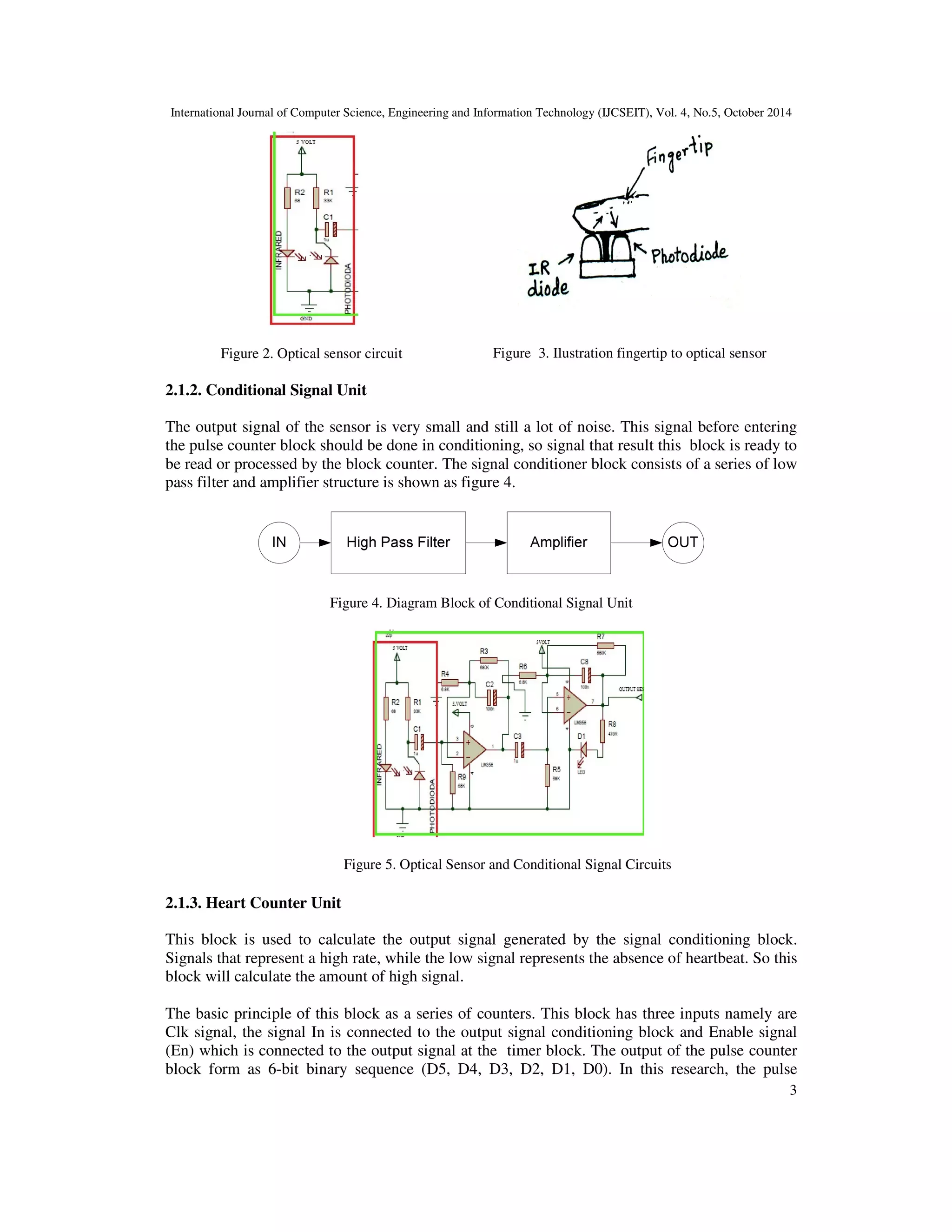
2.1.2. Conditional Signal Unit 
The output signal of the sensor is very small and still a lot of noise. This signal before entering 
the pulse counter block should be done in conditioning, so signal that result this block is ready to 
be read or processed by the block counter. The signal conditioner block consists of a series of low 
pass filter and amplifier structure is shown as figure 4. 
Figure 4. Diagram Block of Conditional Signal Unit 
Figure 5. Optical Sensor and Conditional Signal Circuits 
2.1.3. Heart Counter Unit 
This block is used to calculate the output signal generated by the signal conditioning block. 
Signals that represent a high rate, while the low signal represents the absence of heartbeat. So this 
block will calculate the amount of high signal. 
The basic principle of this block as a series of counters. This block has three inputs namely are 
Clk signal, the signal In is connected to the output signal conditioning block and Enable signal 
(En) which is connected to the output signal at the timer block. The output of the pulse counter 
block form as 6-bit binary sequence (D5, D4, D3, D2, D1, D0). In this research, the pulse
International Journal of Computer Science, Engineering and Information Technology (IJCSEIT), Vol. 4, No.5, October 2014 
counter block is designed with programming languages Xlinx WebPack ISE. The design of the 
pulse counter block is shown as figure 6. 
4 
Figurer 6. Design of Heart Counter Unit 
2.1.4. Timer 10s Unit 
This block is designed for pulse counting process is done by calculating the input signal to the 
timer block rate for 10 seconds. The basic principle of the timer unit is a clock signal frequency 
divider circuit. The clock signal is taken from the internal oscillator signal frequency of 50 MHz 
on the FPGA module. In order to get a signal with a period of 20 seconds, then beat signal as a 
function of the timer must have a frequency of 50 mHz, by taking half the period of the high 
level. The output signal timer 10s unit to be input to the Enable signal (En) at the pulse counter 
block. The timer 10s unit is shown in Figure 7. 
Figure 7. Diagram Block of Timer 10s 
2.1.5. Display Unit 
The Display unit that is used is the 6 Led (D5, D4, D3, D2, D1, D0) which represents the value of 
the output of the pulse counter block. In addition, the results of the calculation rate is also 
displayed with an LCD unit. This block already exists in the module of Spartan 3E FPGA Starter 
Kit [4], as shown in the figure 8. 
Figure 8. Display of LED and LCD at FPGA Spartan 3E Starter Kit [4] 
2.2. Designing of Programming Xilinx ISE Webpack 
In this research, design of Xilinx ISE Webpack program done on the pulse counter block and 
block the timer 10s. The programming result, then applied to the module Field Programable Gate
International Journal of Computer Science, Engineering and Information Technology (IJCSEIT), Vol. 4, No.5, October 2014 
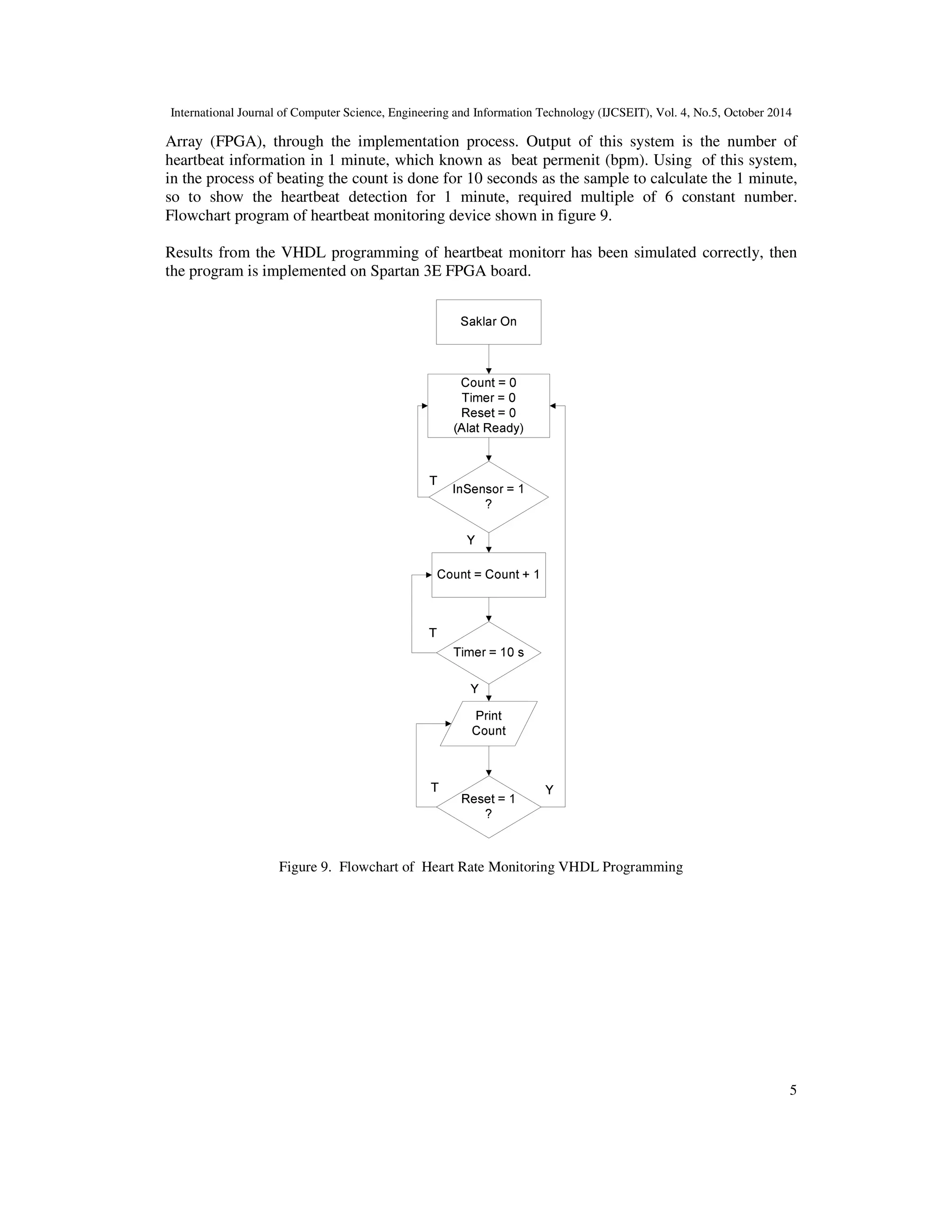
Array (FPGA), through the implementation process. Output of this system is the number of 
heartbeat information in 1 minute, which known as beat permenit (bpm). Using of this system, 
in the process of beating the count is done for 10 seconds as the sample to calculate the 1 minute, 
so to show the heartbeat detection for 1 minute, required multiple of 6 constant number. 
Flowchart program of heartbeat monitoring device shown in figure 9. 
Results from the VHDL programming of heartbeat monitorr has been simulated correctly, then 
the program is implemented on Spartan 3E FPGA board. 
5 
Figure 9. Flowchart of Heart Rate Monitoring VHDL Programming
International Journal of Computer Science, Engineering and Information Technology (IJCSEIT), Vol. 4, No.5, October 2014 
6 
2.3. RTL Viewer 
Figure 10. RTL Viewer Heartrate Monitor 
After the process of synthesis and design implementation, next the process is VIEW RTL 
Schematic, as shown in the figure 10. This figure describes the gates configuration that represent 
the pulse counter and the timer 10s devices. 
3. EXPERIMENTAL RESULT 
3.1 Conditional Signal Output Testing 
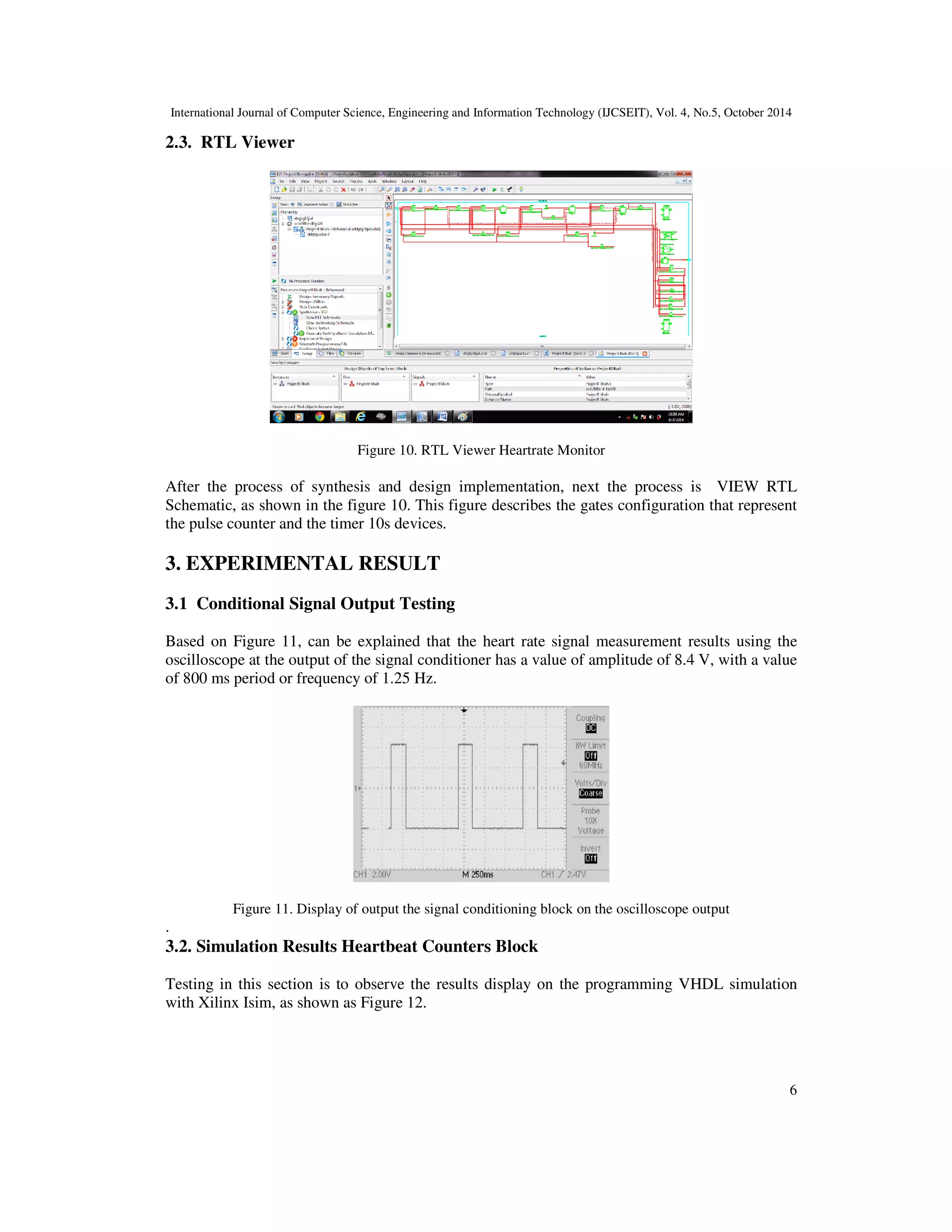
Based on Figure 11, can be explained that the heart rate signal measurement results using the 
oscilloscope at the output of the signal conditioner has a value of amplitude of 8.4 V, with a value 
of 800 ms period or frequency of 1.25 Hz. 
Figure 11. Display of output the signal conditioning block on the oscilloscope output 
. 
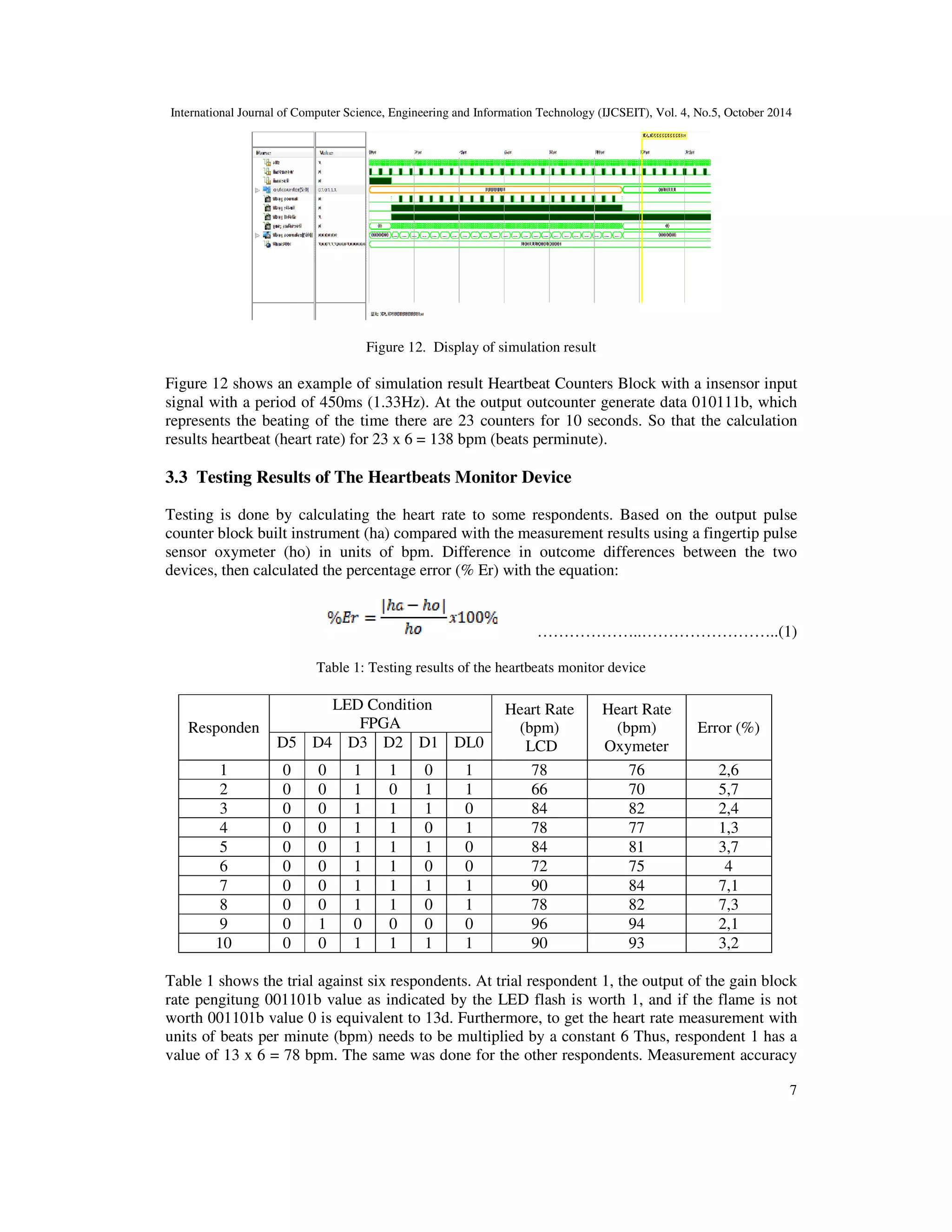
3.2. Simulation Results Heartbeat Counters Block 
Testing in this section is to observe the results display on the programming VHDL simulation 
with Xilinx Isim, as shown as Figure 12.
International Journal of Computer Science, Engineering and Information Technology (IJCSEIT), Vol. 4, No.5, October 2014 
7 
Figure 12. Display of simulation result 
Figure 12 shows an example of simulation result Heartbeat Counters Block with a insensor input 
signal with a period of 450ms (1.33Hz). At the output outcounter generate data 010111b, which 
represents the beating of the time there are 23 counters for 10 seconds. So that the calculation 
results heartbeat (heart rate) for 23 x 6 = 138 bpm (beats perminute). 
3.3 Testing Results of The Heartbeats Monitor Device 
Testing is done by calculating the heart rate to some respondents. Based on the output pulse 
counter block built instrument (ha) compared with the measurement results using a fingertip pulse 
sensor oxymeter (ho) in units of bpm. Difference in outcome differences between the two 
devices, then calculated the percentage error (% Er) with the equation: 
………………..……………………..(1) 
Table 1: Testing results of the heartbeats monitor device 
Responden 
LED Condition 
FPGA 
Heart Rate 
(bpm) 
LCD 
Heart Rate 
(bpm) 
Oxymeter 
Error (%) 
D5 D4 D3 D2 D1 DL0 
1 0 0 1 1 0 1 78 76 2,6 
2 0 0 1 0 1 1 66 70 5,7 
3 0 0 1 1 1 0 84 82 2,4 
4 0 0 1 1 0 1 78 77 1,3 
5 0 0 1 1 1 0 84 81 3,7 
6 0 0 1 1 0 0 72 75 4 
7 0 0 1 1 1 1 90 84 7,1 
8 0 0 1 1 0 1 78 82 7,3 
9 0 1 0 0 0 0 96 94 2,1 
10 0 0 1 1 1 1 90 93 3,2 
Table 1 shows the trial against six respondents. At trial respondent 1, the output of the gain block 
rate pengitung 001101b value as indicated by the LED flash is worth 1, and if the flame is not 
worth 001101b value 0 is equivalent to 13d. Furthermore, to get the heart rate measurement with 
units of beats per minute (bpm) needs to be multiplied by a constant 6 Thus, respondent 1 has a 
value of 13 x 6 = 78 bpm. The same was done for the other respondents. Measurement accuracy
International Journal of Computer Science, Engineering and Information Technology (IJCSEIT), Vol. 4, No.5, October 2014 
in terms of percentage error is calculated using equation (1). Based on the test results in Table 1, 
it has been tested tool designed to measure the number of heartbeats to 10 respondents, has an 
error (Error) an average of 3.94%. 
8 
4. CONCLUSION 
This research has successfully designed a heartbeat monitor circuit using the Xilinx ISE program 
WebPack 13.1. The series is composed of sensors block, signal conditioning block, pulse counter 
block, timer 10s unit and the display unit. Based on the test results of the 15 respondents, a tool 
designed to have a percentage error of 3.28%. 
5. SUGESTION 
a. In the testing process, the accuracy of the optical sensor is strongly influenced on laying / 
finger placement ujuag. So to overcome this required the manufacture of containers or the 
media, so the detection of blood flow in the fingertips can be precision quickly. 
b. In the signal conditioning block in this research, design and manufacturing are still using 
electronic components. In further studies need to be developed to block the signal conditioner 
made with vhdl programming, thus forming sauté specific integrated circuits or ASICs known 
(Application-Specific Integrated Circuits) 
Figure 13. FPGA based heartbeats monitor circuit 
Optical Sensor 
Conditional Signal 
Circuit 
REFERENCES 
[1] Dogan., I., Kadri., B, 2012, Hear Rate Measurement from the Finger using a low cost 
Microcontroller, http://www.emo.org.tr/ekler/ a568a2aa8c19a31_ek. pdf, 
[2] Machriz, E., Sony S., Achmad R., 2008, Perancangan Perangkat Monitoring Denyut Jantung (Heart- 
Beat Monitoring) dengan Visualisasi LCD Grafik Berbasis ATMEL AT89C51, proseding 
Konferensi Nasional Sistem dan Informatika 2008; Bali, November 15, 2008. 
[3] Hadiyani N., , 2012, Penyakit Jantung Koroner, http://www.dokterku-online. 
com/index.php/article/54-penyakit-jantung-koroner, 14 Februari 2014 
[4] Pong P. C., 2008, FPGA Prototyping by VHDL Examples: Xilinx Spartan-3 Version, Publisher: 
Wiley-Interscience 
[5] Sharief F. B., Liena E., Abdel K., Samah M. E., 2011, Microcontroller Based Heart Rate Monitor 
using Fingertip Sensors, UofKEJ Vol. 1 Issue 2 pp. 47-51,October 2011 
[6] Webster, EDS, 1981, Design of Microcomputer-Base Medical Instrumentation, Prentice Hall 
International, New Jersey 
Xilinx Spartan 3E 
FPGA
International Journal of Computer Science, Engineering and Information Technology (IJCSEIT), Vol. 4, No.5, October 2014 
9 
Authors 
Wahyu Kusuma R received the Dr. in information technology from Gunadarma University, in 
2008. Currently, he is a Electrical and Computer Laboratory staff at Gunadarma University. 
His research interests include Voice Recognition Systems, Music Information Retrieval and 
Embedded Systems with FPGA 
Ridha Iskandar received the Dr. in information technology from Gunadarma University, in 
2009. Currently, he is a computer Science laboratory staff at Gunadarma University. His 
research interests include Biomedical Signal Processing and Embedded Systems with FPGA. 
Yasman Rianto received as Student the Doctoral in information technology from 
Gunadarma University, in 2013. Currently, he is a Physic laboratory staff at Gunadarma 
University. His research interests include Sensoring and Microcontroller Application 
Swelandiah E. Pratiwi graduated form Master of Electrical Enginering Gunadarma 
University, in 2006. Currently, he is a Information Technology laboratory staff at 
Gunadarma University. His research interests include Embedded System and Microcontroller 
Application.

Fpga based heartbeats monitor with

  • 1.
    International Journal ofComputer Science, Engineering and Information Technology (IJCSEIT), Vol. 4, No.5, October 2014 FPGA BASED HEARTBEATS MONITOR WITH FINGERTIP OPTICAL SENSOR Wahyu Kusuma R.1, Ridha I.2, Yasman Rianto3, Swelandiah E.P4 1,3 Departement of Electrcal Engineering, Gunadarma University, Jakarta, Indonesia 2,4 Departement of Computer Science, Gunadarma University, , Jakarta, Indonesia ABSTRACT The heart is an organ of human body which has a vital function, small abnormalities can have a big impact on the performance of the body. Heart disease is the number one cause of death in the world. Examination of the heart can be detected from blood flow in the fingertips, in order to obtain information about the number and rhythm of the heartbeat. This research aims to design and implement the FPGA board to monitor the heart rate with optical sensors.The results of this study are expected to facilitate the patient's medical team or independently in detecting heart health. The series is composed of blocks of sensors, signal conditioning block, the block pulse counter, block timer 10 seconds and blocks the viewer. Based on the test results of the 10 respondents with a variety of age and gender, has built a tool that the percentage error of 3.94%. KEYWORDS Heartbeat monitor, Xilinx ISE Webpack, FPGA, optical sensor 1. INTRODUCTION The heart is an organ of human body which has a vital function, small abnormalities can have a big impact on the performance of the heart kita.Penyakit body is the number one cause of death in the world. Based on data from the World Health Organization (WHO), cardiovascular disease has reached 29% in the percentage of deaths in the world and 17 million people die every year due to heart and blood vessel disease throughout the world [3]. The development of medical instrumentation systems is growing rapidly along with the need for medical personnel to diagnose a patient and a medical examination. One medical instrumentation used for the examination of the heart is Electrocardiograph (ECG). ECG is a medical instrument that is commonly used by the medical team to detect heart rate and rhythm [6]. EKG can not be used independently by patients to detect a patient's pulse. In addition to the expensive costs for the procurement of ECG, ECG devices also require special skills to operate. Along with the requirement in the design and manufacture of medical devices, digital electronics design technology is developing very rapidly, both in terms of hardware and software. Xilinx is one manufacturer that produces equipment or tools for modeling the design of digital systems. One product is in the form of a kit module board FPGA (Field Programmable Gate Array). FPGA is a programmable device that is composed of large modules independent logic that can be configured by the user who is connecting through the canals of programmable routing [4]. DOI : 10.5121/ijcseit.2014.4501 1
  • 2.
    International Journal ofComputer Science, Engineering and Information Technology (IJCSEIT), Vol. 4, No.5, October 2014 Field Programmable Gate Array (FPGA) has advantages of which can be configured by the End User, does not require the fabrication process, and the available solutions that support customized VLSI chip, so the logic circuit capable of implementing, instant manufacturring, very-low cost prototype. While FPGA product is also supported by the availability of the Xilinx ISE WebPack permograman language that is used as a GUI for the digital system design problems is desired. Based on the above issues, this study will design a device that can detect heart rate by detecting the frequency of blood flow to the fingers automatically processed electronically using the module FPGA (Field Programable Gate Array). This research is expected to generate a heartbeat detector chip implementation can provide facilities for the medical and can be used independently by the user (patient) without the help of a doctor or paramedic. 2 2. ARCHITECTURE AND ITS IMPLEMENTATION This research conducted several phases of hardware design, software design pelangkat, testing tools, and analysis to draw conclusions. 2.1 Hardware Design The design of this tool consists of several circuit blocks are arranged into a single system heartbeats monitoring based on optical sensors, as shown in Figure 1. Figure 1. Block Diagram Tool Heartbeats Detection Based on Optical Sensors 2.1.1. Optical Sensor Unit The sensor consists of a transmitter that emits infrared light (IR) and IR photo detector (photodiode) to act as a receiver. Construction sensor block shown in Figure 2. The use of optical sensors for process monitoring heart rate with fingertip illustrated as a figure 3.
  • 3.
    International Journal ofComputer Science, Engineering and Information Technology (IJCSEIT), Vol. 4, No.5, October 2014 3 Figure 2. Optical sensor circuit Figure 3. Ilustration fingertip to optical sensor 2.1.2. Conditional Signal Unit The output signal of the sensor is very small and still a lot of noise. This signal before entering the pulse counter block should be done in conditioning, so signal that result this block is ready to be read or processed by the block counter. The signal conditioner block consists of a series of low pass filter and amplifier structure is shown as figure 4. Figure 4. Diagram Block of Conditional Signal Unit Figure 5. Optical Sensor and Conditional Signal Circuits 2.1.3. Heart Counter Unit This block is used to calculate the output signal generated by the signal conditioning block. Signals that represent a high rate, while the low signal represents the absence of heartbeat. So this block will calculate the amount of high signal. The basic principle of this block as a series of counters. This block has three inputs namely are Clk signal, the signal In is connected to the output signal conditioning block and Enable signal (En) which is connected to the output signal at the timer block. The output of the pulse counter block form as 6-bit binary sequence (D5, D4, D3, D2, D1, D0). In this research, the pulse
  • 4.
    International Journal ofComputer Science, Engineering and Information Technology (IJCSEIT), Vol. 4, No.5, October 2014 counter block is designed with programming languages Xlinx WebPack ISE. The design of the pulse counter block is shown as figure 6. 4 Figurer 6. Design of Heart Counter Unit 2.1.4. Timer 10s Unit This block is designed for pulse counting process is done by calculating the input signal to the timer block rate for 10 seconds. The basic principle of the timer unit is a clock signal frequency divider circuit. The clock signal is taken from the internal oscillator signal frequency of 50 MHz on the FPGA module. In order to get a signal with a period of 20 seconds, then beat signal as a function of the timer must have a frequency of 50 mHz, by taking half the period of the high level. The output signal timer 10s unit to be input to the Enable signal (En) at the pulse counter block. The timer 10s unit is shown in Figure 7. Figure 7. Diagram Block of Timer 10s 2.1.5. Display Unit The Display unit that is used is the 6 Led (D5, D4, D3, D2, D1, D0) which represents the value of the output of the pulse counter block. In addition, the results of the calculation rate is also displayed with an LCD unit. This block already exists in the module of Spartan 3E FPGA Starter Kit [4], as shown in the figure 8. Figure 8. Display of LED and LCD at FPGA Spartan 3E Starter Kit [4] 2.2. Designing of Programming Xilinx ISE Webpack In this research, design of Xilinx ISE Webpack program done on the pulse counter block and block the timer 10s. The programming result, then applied to the module Field Programable Gate
  • 5.
    International Journal ofComputer Science, Engineering and Information Technology (IJCSEIT), Vol. 4, No.5, October 2014 Array (FPGA), through the implementation process. Output of this system is the number of heartbeat information in 1 minute, which known as beat permenit (bpm). Using of this system, in the process of beating the count is done for 10 seconds as the sample to calculate the 1 minute, so to show the heartbeat detection for 1 minute, required multiple of 6 constant number. Flowchart program of heartbeat monitoring device shown in figure 9. Results from the VHDL programming of heartbeat monitorr has been simulated correctly, then the program is implemented on Spartan 3E FPGA board. 5 Figure 9. Flowchart of Heart Rate Monitoring VHDL Programming
  • 6.
    International Journal ofComputer Science, Engineering and Information Technology (IJCSEIT), Vol. 4, No.5, October 2014 6 2.3. RTL Viewer Figure 10. RTL Viewer Heartrate Monitor After the process of synthesis and design implementation, next the process is VIEW RTL Schematic, as shown in the figure 10. This figure describes the gates configuration that represent the pulse counter and the timer 10s devices. 3. EXPERIMENTAL RESULT 3.1 Conditional Signal Output Testing Based on Figure 11, can be explained that the heart rate signal measurement results using the oscilloscope at the output of the signal conditioner has a value of amplitude of 8.4 V, with a value of 800 ms period or frequency of 1.25 Hz. Figure 11. Display of output the signal conditioning block on the oscilloscope output . 3.2. Simulation Results Heartbeat Counters Block Testing in this section is to observe the results display on the programming VHDL simulation with Xilinx Isim, as shown as Figure 12.
  • 7.
    International Journal ofComputer Science, Engineering and Information Technology (IJCSEIT), Vol. 4, No.5, October 2014 7 Figure 12. Display of simulation result Figure 12 shows an example of simulation result Heartbeat Counters Block with a insensor input signal with a period of 450ms (1.33Hz). At the output outcounter generate data 010111b, which represents the beating of the time there are 23 counters for 10 seconds. So that the calculation results heartbeat (heart rate) for 23 x 6 = 138 bpm (beats perminute). 3.3 Testing Results of The Heartbeats Monitor Device Testing is done by calculating the heart rate to some respondents. Based on the output pulse counter block built instrument (ha) compared with the measurement results using a fingertip pulse sensor oxymeter (ho) in units of bpm. Difference in outcome differences between the two devices, then calculated the percentage error (% Er) with the equation: ………………..……………………..(1) Table 1: Testing results of the heartbeats monitor device Responden LED Condition FPGA Heart Rate (bpm) LCD Heart Rate (bpm) Oxymeter Error (%) D5 D4 D3 D2 D1 DL0 1 0 0 1 1 0 1 78 76 2,6 2 0 0 1 0 1 1 66 70 5,7 3 0 0 1 1 1 0 84 82 2,4 4 0 0 1 1 0 1 78 77 1,3 5 0 0 1 1 1 0 84 81 3,7 6 0 0 1 1 0 0 72 75 4 7 0 0 1 1 1 1 90 84 7,1 8 0 0 1 1 0 1 78 82 7,3 9 0 1 0 0 0 0 96 94 2,1 10 0 0 1 1 1 1 90 93 3,2 Table 1 shows the trial against six respondents. At trial respondent 1, the output of the gain block rate pengitung 001101b value as indicated by the LED flash is worth 1, and if the flame is not worth 001101b value 0 is equivalent to 13d. Furthermore, to get the heart rate measurement with units of beats per minute (bpm) needs to be multiplied by a constant 6 Thus, respondent 1 has a value of 13 x 6 = 78 bpm. The same was done for the other respondents. Measurement accuracy
  • 8.
    International Journal ofComputer Science, Engineering and Information Technology (IJCSEIT), Vol. 4, No.5, October 2014 in terms of percentage error is calculated using equation (1). Based on the test results in Table 1, it has been tested tool designed to measure the number of heartbeats to 10 respondents, has an error (Error) an average of 3.94%. 8 4. CONCLUSION This research has successfully designed a heartbeat monitor circuit using the Xilinx ISE program WebPack 13.1. The series is composed of sensors block, signal conditioning block, pulse counter block, timer 10s unit and the display unit. Based on the test results of the 15 respondents, a tool designed to have a percentage error of 3.28%. 5. SUGESTION a. In the testing process, the accuracy of the optical sensor is strongly influenced on laying / finger placement ujuag. So to overcome this required the manufacture of containers or the media, so the detection of blood flow in the fingertips can be precision quickly. b. In the signal conditioning block in this research, design and manufacturing are still using electronic components. In further studies need to be developed to block the signal conditioner made with vhdl programming, thus forming sauté specific integrated circuits or ASICs known (Application-Specific Integrated Circuits) Figure 13. FPGA based heartbeats monitor circuit Optical Sensor Conditional Signal Circuit REFERENCES [1] Dogan., I., Kadri., B, 2012, Hear Rate Measurement from the Finger using a low cost Microcontroller, http://www.emo.org.tr/ekler/ a568a2aa8c19a31_ek. pdf, [2] Machriz, E., Sony S., Achmad R., 2008, Perancangan Perangkat Monitoring Denyut Jantung (Heart- Beat Monitoring) dengan Visualisasi LCD Grafik Berbasis ATMEL AT89C51, proseding Konferensi Nasional Sistem dan Informatika 2008; Bali, November 15, 2008. [3] Hadiyani N., , 2012, Penyakit Jantung Koroner, http://www.dokterku-online. com/index.php/article/54-penyakit-jantung-koroner, 14 Februari 2014 [4] Pong P. C., 2008, FPGA Prototyping by VHDL Examples: Xilinx Spartan-3 Version, Publisher: Wiley-Interscience [5] Sharief F. B., Liena E., Abdel K., Samah M. E., 2011, Microcontroller Based Heart Rate Monitor using Fingertip Sensors, UofKEJ Vol. 1 Issue 2 pp. 47-51,October 2011 [6] Webster, EDS, 1981, Design of Microcomputer-Base Medical Instrumentation, Prentice Hall International, New Jersey Xilinx Spartan 3E FPGA
  • 9.
    International Journal ofComputer Science, Engineering and Information Technology (IJCSEIT), Vol. 4, No.5, October 2014 9 Authors Wahyu Kusuma R received the Dr. in information technology from Gunadarma University, in 2008. Currently, he is a Electrical and Computer Laboratory staff at Gunadarma University. His research interests include Voice Recognition Systems, Music Information Retrieval and Embedded Systems with FPGA Ridha Iskandar received the Dr. in information technology from Gunadarma University, in 2009. Currently, he is a computer Science laboratory staff at Gunadarma University. His research interests include Biomedical Signal Processing and Embedded Systems with FPGA. Yasman Rianto received as Student the Doctoral in information technology from Gunadarma University, in 2013. Currently, he is a Physic laboratory staff at Gunadarma University. His research interests include Sensoring and Microcontroller Application Swelandiah E. Pratiwi graduated form Master of Electrical Enginering Gunadarma University, in 2006. Currently, he is a Information Technology laboratory staff at Gunadarma University. His research interests include Embedded System and Microcontroller Application.