International Research Journal of Engineering and Technology (IRJET) e-ISSN: 2395 -0056
Volume: 04 Issue: 07 | June-2017 www.irjet.net p-ISSN: 2395-0072
© 2017, IRJET | Impact Factor value: 5.181 | ISO 9001:2008 Certified Journal | Page 737
DESIGN OF INTERFACE BOARD FOR MEDICAL KIOSK BASED ON
“OFF-THE-SHELF” PLATFORM
Sanjana S1, Mr. Rathnakara S2
1M.Tech Student, Dept. of Instrumentation Technology, Sri Jayachamarajendra College of Engineering,
Karnataka, India
2Assistant Professor, Dept. of Instrumentation Technology, Sri Jayachamarajendra College of Engineering,
Karnataka, India
---------------------------------------------------------------------***---------------------------------------------------------------------
Abstract –The main aim of this paper is to describe the
design of interface board that integrates different tested
and pre-certified Commercial-Off-the-shelf modules such as
SpO2 module, Blood Pressure module, Thermometer module,
Blood Glucose module, ultrasonic sensor which measures the
distance and the Load cell module for weight measurement.
The Interface Board will combine the results obtained from
all the modules and transfers the read data to the cloud
software via the kiosk application.
Key Words: Tele-medicine, Microcontroller, Vital Signs,
Interface device, COTS OEM modules, Embedded
System
1. INTRODUCTION
In order to describe the remote delivery of health and
social care using Information and Communication
Telemedicine, Telecare, Telehealth, Telemonitoring and
eHealth are most commonly used terms.[1][2][3][4].
IT implementation apart, innovative models of public
private partnership and capacity building through
technologies like Telemedicine are needed to address the
challenges of access to affordable and quality healthcare in
rural areas. Telemedicine employs collaborative
technologies to facilitate a virtual doctor-patient
encounter.
Quality health care is a major concern across the world;
especially in a developing country like India. Given the
massive population in India, disparity in the ratio between
doctors and patients makes it impossible for doctors in
urban areas to meet with people in remote
locations. Therefore, a medical kiosk connects the doctor
to the patient, where the patient is virtually able to consult
a real doctor and use the facilities inside the kiosk to have
the primary diagnoses carried out[5][6][7][8].
Medical Kiosk are standalone stations equipped with
biomedical devices and provide solutions to capture, store
and retrieve patient details such as demographics, patient
history, allergies, clinical findings, vitals and medications
[8][9][12]. Readings from the medical kiosk are made
available to the doctor facilitate accurate and quicker
diagnosis. Since the medical kiosks are shared between
patients the following criteria become more critical:
 Full automation of the processes
 Data security
 Ease of sterilization
 High reliability (including mechanical reliability)
When thinking of designing such a system, it is important
to have a vision of the future trends in the health care
industry. Some of the key things that need to be
considered are:
 Flexibility and scalability to address in terms of
performance, costs optimizations, availability of
interfaces.
 Fast prototyping to validate the key assumptions
and resolve the usability problems by providing
pre-integrated hardware / software solutions.
 Reduction of the development costs and
shortening the time-to-market.
 Reduction of the BOM costs of final customized
solutions.
In this paper we explain about the design that meets the
above mentioned features and also increase the reliability
and the quality of health products by using tested and pre-
certified “building blocks”[13][14].
The goal of the Interface board is to provide very basic
health services and monitoring of basic health data and
also to act as a bridge and the intermediate source
between the COTS OEM Modules and the PC end. With
invent of internet of things and more, a two way video
conferencing can also be employed in the Medical Kiosk. It
enables the Kiosk to measure the vital signs and provide
reliable data for diagnosis [10][11].
By choosing the “off-the-shelf” platform based approach,
the OEMs and medical device vendors can reduce their
efforts on the custom hardware development and fully
focus on value add areas of the business such as
applications development. Also it can be used for diverse
International Research Journal of Engineering and Technology (IRJET) e-ISSN: 2395 -0056
Volume: 04 Issue: 07 | June-2017 www.irjet.net p-ISSN: 2395-0072
© 2017, IRJET | Impact Factor value: 5.181 | ISO 9001:2008 Certified Journal | Page 738
devices like Patient Monitoring System, Mobile Health
Unit, and Diagnostic Kiosks.
2. SYSTEM ARCHITECTURE
Hardware and firmware interfacing is a very difficult task
as they have different development environments, have
different toolsets and use different terminology
[5][11][12].The current interface board is the best
example for hardware/firmware interface which is the
junction where hardware and firmware meet and
communicate with each other. On the hardware side, it is a
collection of addressable registers that are accessible to
firmware via reads and writes. On the firmware side, it is
the device drivers or low-level software that controls the
hardware by writing values to registers, interprets the
information read from the registers and responds to
interrupt requests from the hardware. Thus controlling
and communicating with COTS OEM modules. The medical
OEM device is designed with a custom proprietary
protocol from the equipment manufacturer.
The Interface Board is capable of integrating six medical
OEM devices that measures eight parameters of the
patient such as Height, Weight, Non-Invasive Blood
Pressure, Oxygen Saturation Level, Pulse rate/Heart rate,
Blood glucose, and Body temperature.
Fig-1: Block Diagram of the System Level Design
Fig-1 shows different blocks implemented in hardware as
well as firmware design.
As explained above design of the Interface Board involves
the following stages in the design workflow.
1. Hardware Design;
2. Firmware Design;
2.1 Hardware Design
This section gives the detailed overview of the hardware
modules which are used to measure above listed
parameters. First an embedded system platform where in
the data from all the modules can be collected needed to
be designed. In order to accept so many inputs the
powerful microcontroller with ARM Cortex-M4 core
120MHz 32-bit MCU is selected. The descriptions of the
OEM devices are as follows:
2.1.1 Ultrasonic Sensor HC-SR04
Ultrasonic ranging module HC - SR04 provides 2cm -
400cm non-contact measurement function, the ranging
accuracy can reach to 3mm. This module is used to
measure the height of the patient.
Fig-2Ultrasonic ranging module HC - SR04
2.1.2 Load cell
The change in resistance of the strain gauge provides an
electrical value change that is calibrated to the load placed
on load cell. Load cell used here can measure upto 500 Kgf.
2.1.3 SpO2 and Pulse Rate Module
The module is able to measure and report SpO2 and pulse
rate with identified pulse at least once per second.
2.1.4 NIBP Module
When a Blood Pressure (BP) measurement is required, the
command to start a blood pressure measurement is issued
to the module. The module will acknowledge the
Command, take a blood pressure measurement, and then
return a data packet indicating that the command has
been executed.
2.1.5 Glucose Module
Both the modules are the systems for the determination of
the total amount of glucose in whole blood respectively.
The system consists of an analyzer with specially designed
micro cuvettes containing dried reagents.
2.1.6 Temperature Module
The module is intended to use as a measuring device for
determining the patient's body temperature. It uses
infrared technology allowing the user to measure the
temperature without physical contact.
International Research Journal of Engineering and Technology (IRJET) e-ISSN: 2395 -0056
Volume: 04 Issue: 07 | June-2017 www.irjet.net p-ISSN: 2395-0072
© 2017, IRJET | Impact Factor value: 5.181 | ISO 9001:2008 Certified Journal | Page 739
2.2 Firmware Design
Firmware is a type of software that provides control,
monitoring and data manipulation in embedded systems.
The firmware consists of low-level control program for the
device. In this project we have considered a low level
programming method known as bare metal
coding/programming that is specific to the hardware used.
This is often used in small devices that require optimized
coding.
The application layer, API defines the high level interface
of the behavior and capabilities of the component and its
inputs and outputs. The HAL is a hardware abstraction
layer that defines a set of routines, protocols and tools for
interacting with the hardware driver. The driver and
board support interface with the hardware and is the
lowest layer of the firmware.Fig-3shows the Firmware
Stack-Up.
Fig-3: Firmware Stack-Up
In order to establish communication it is necessary to
implement drivers like UART Driver and USB Driver.
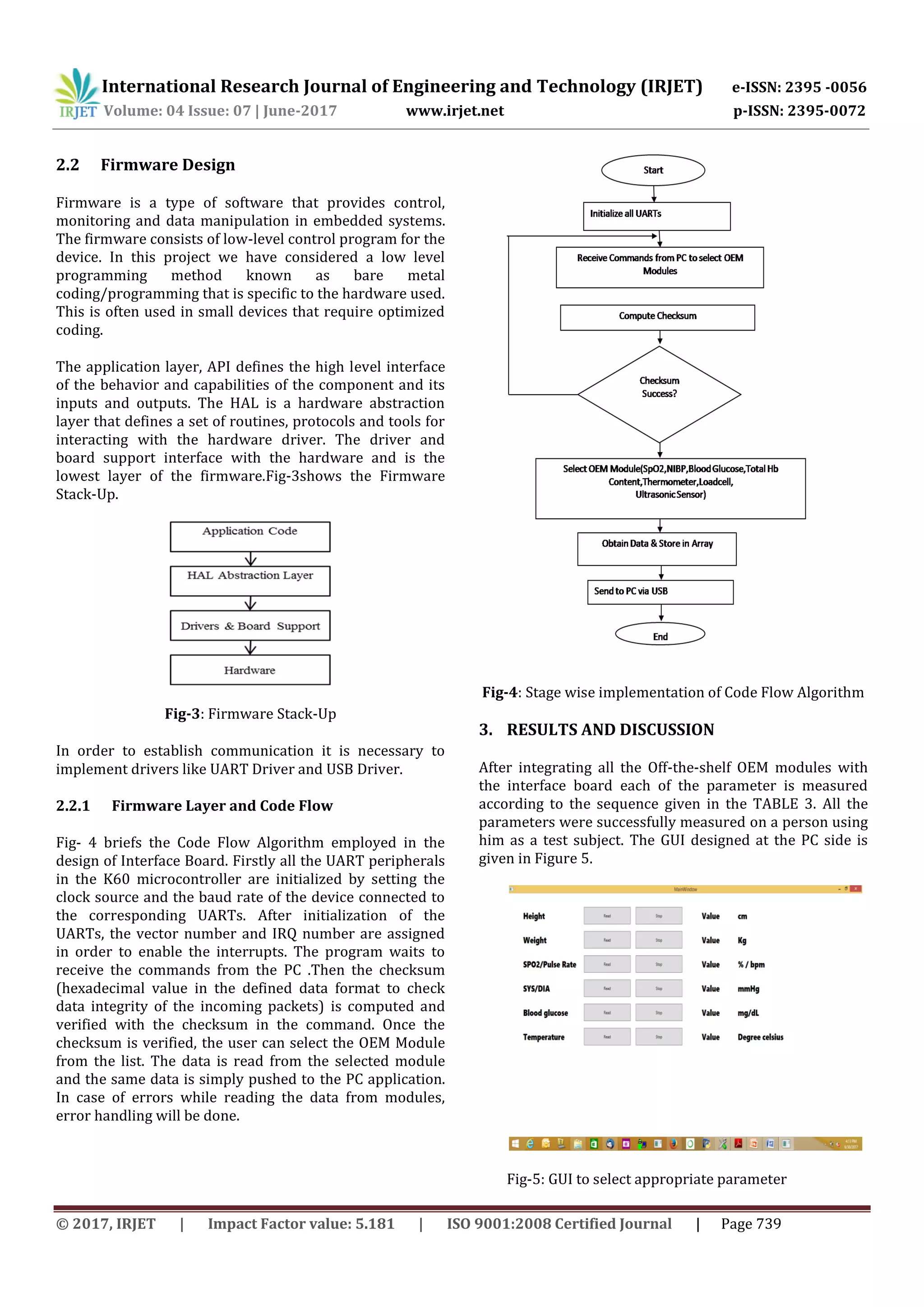
2.2.1 Firmware Layer and Code Flow
Fig- 4 briefs the Code Flow Algorithm employed in the
design of Interface Board. Firstly all the UART peripherals
in the K60 microcontroller are initialized by setting the
clock source and the baud rate of the device connected to
the corresponding UARTs. After initialization of the
UARTs, the vector number and IRQ number are assigned
in order to enable the interrupts. The program waits to
receive the commands from the PC .Then the checksum
(hexadecimal value in the defined data format to check
data integrity of the incoming packets) is computed and
verified with the checksum in the command. Once the
checksum is verified, the user can select the OEM Module
from the list. The data is read from the selected module
and the same data is simply pushed to the PC application.
In case of errors while reading the data from modules,
error handling will be done.
Fig-4: Stage wise implementation of Code Flow Algorithm
3. RESULTS AND DISCUSSION
After integrating all the Off-the-shelf OEM modules with
the interface board each of the parameter is measured
according to the sequence given in the TABLE 3. All the
parameters were successfully measured on a person using
him as a test subject. The GUI designed at the PC side is
given in Figure 5.
Fig-5: GUI to select appropriate parameter
International Research Journal of Engineering and Technology (IRJET) e-ISSN: 2395 -0056
Volume: 04 Issue: 07 | June-2017 www.irjet.net p-ISSN: 2395-0072
© 2017, IRJET | Impact Factor value: 5.181 | ISO 9001:2008 Certified Journal | Page 740
TABLE 1.Test Results
Height of the patient is the first parameter to be measured.
The program is executed in “IAR Embedded Workbench”
which is written in C Programming Language. Thus all the
parameters are measured and results are obtained as per
the sequence after integration.
4. CONCLUSION
The work presented reveals that, a system based on the
“Off-the–shelf” approach of integrating various different
modules is achievable. Off-the-shelf platform helps in
saving a lot of time as the modules will be pre-tested and
pre-certified. Also, the developer can concentrate on other
value add areas. Since the powerful K60 Arm
Microcontroller is used, it can communicate with 6
modules when compared to other microcontrollers. The
interface board can be further utilized and optimized by
adding value add features like Ethernet, Bluetooth or
Zigbee, GSM mounted on board. More number of
parameters can be integrated with the availability of more
communication channels. The unique combination of
COTS OEM Modules and microcontroller will provide
efficient design for system integration and this in
conjunction with Health kiosk and Patient Monitoring
Systems eliminate the barrier in patient health monitoring
to enhance practical health delivery.
REFERENCES
[1] Sanjana S, Rathnakara S,”Design of Intermediate
Control and Communication Unit for Health Kiosk”,
International Conference on Signal, Image Processing,
Communication and Automation, ICSIPCA-17.
[2] Jones, R.B.; McLachlan, “Healthpoint: a public access
health information system in Current Perspectives in
Health Computing”; Richards, B., Ed.; BJHC Books:
Weybridge, Surrey, UK, 1990; pp. 65-69.
[3] R.Srinivasan ,”Health Care in India- Vision 2020,Issues
and Prospects”,whitepaper,GE Healthcare Products,
December 2004.
[4] V.Ramya,B.Palaniappan,Anuradha Kumari,”Embedded
Patient Monitoring System”, International Journal of
Embedded Systems and Applications (IJESA)
Vol.1,No.2,December 2011.
[5] Rajalaxmi Das,”Health Monitoring Kiosk: An effective
system for rural health management”, Novateur
Publications,International Journal of Innovations in
Engineering Research and
Sequence
No.
Description
Measured output of the
Subject
Data Response (in Hex)
1
Height of the user is
measured. 160 cm
02,10,A0,00,00,00,00,00,00,70,
03
2
Weight of the user is
measured.
75 Kg
02,11,4B,00,00,00,00,00,00,7C,
03
3
The normal blood oxygen
saturation levels (SpO2) &
Pulse rate are measured.
SPO2 = 96%
Pulse Rate = 74 bpm
02,12,60,4A,00,00,00,
00,00,7C,03
4
The blood pressure of the
user is measured non-
invasively. Also the Heart
rate and Mean Arterial
Pressure is measured.
Systolic = 116 mmHg
Diastolic = 78 mmHg
MAP = 90 mmHg
Heart Rate = 74 bpm
02,13,74,00,4E,5A,4A,
00,00,79,03
5
Blood Sugar levels of the
user are measured. 80 mg/dL
02,15,50,00,00,00,00,
00,00,37,03
6
Body Temperature of the
user is measured. 37˚C
02,17,25,00,00,00,
00,00,00,5C,03
International Research Journal of Engineering and Technology (IRJET) e-ISSN: 2395 -0056
Volume: 04 Issue: 07 | June-2017 www.irjet.net p-ISSN: 2395-0072
© 2017, IRJET | Impact Factor value: 5.181 | ISO 9001:2008 Certified Journal | Page 741
[6] Technology[IJIERT],ISSN:2394-3696,Vol. 1, Issue 2,
December 2014.
[7] Conor Clancey,” Employing Intel Architecture
Solutions in the Home Health/Tele-Health Space”,
White Paper, Intel Corporation, January 2011.
[8] Agnus S.Swarnanisha Lakshmi , S.Palanivel Rajan,
“Scheduled H and X Medicine Dispenser PoC Design”,
Journal of Chemical and Pharmaceutical Sciences,
Special Issue 8:December 2016.
[9] Shyr-kuenchen, Tsairkao, Chia-Tai Chan, Chih-
ninghuang, Chih-Yen Chiang, Chin-Yulai, Tse-Huatung,
and Pi-Chungwang “A reliable transmission protocol
for zigbee-based wireless patient monitoring” IEEE
transactions on information technology in
biomedicine, vol. 16, no. 1, January 2012 .
[10] Ahmed N. Abdalla, Muhammad Nubli, Tan
ChienSiong, FauzanKhairi, A. Noraziah,
“Enhancement of real time multi-patient monitoring
system based on wireless sensor networks”,
International Journal of Physical Sciences, vol. 6, no.
4, February, 2011.
[11] C.D. Raut, V. G. Giripunje, “The Real-Time Monitoring
System for In-Patient Based on Biomedical Data
Acquisition System”, International Conference on
Information and Network Technology,IACSIT Press,
Singapore,2011.
[12] Piyush Goel,Sanjay Bansal,”Health ATM, Any time
Medical-Help”,International Conference on Life
Sciences and Technology,IPCBEE,Volume 3,IACSIT
Press,Singapore,2011.
[13] Taha Landolsi , A. R. Al-Ali and Yousef Al-Assaf,
“Wireless Stand-alone Portable Patient Monitoring
and Logging System”, Journal of Communications,
Vol. 2, No. 4, June 2007.
[14] R.S. Khandpur, ”Handbook of Biomedical
Instrumentation”, 3rd Edition,TMH,2014.

Design of Interface Board for Medical Kiosk Based on Off-The-Shelf Platform

  • 1.
    International Research Journalof Engineering and Technology (IRJET) e-ISSN: 2395 -0056 Volume: 04 Issue: 07 | June-2017 www.irjet.net p-ISSN: 2395-0072 © 2017, IRJET | Impact Factor value: 5.181 | ISO 9001:2008 Certified Journal | Page 737 DESIGN OF INTERFACE BOARD FOR MEDICAL KIOSK BASED ON “OFF-THE-SHELF” PLATFORM Sanjana S1, Mr. Rathnakara S2 1M.Tech Student, Dept. of Instrumentation Technology, Sri Jayachamarajendra College of Engineering, Karnataka, India 2Assistant Professor, Dept. of Instrumentation Technology, Sri Jayachamarajendra College of Engineering, Karnataka, India ---------------------------------------------------------------------***--------------------------------------------------------------------- Abstract –The main aim of this paper is to describe the design of interface board that integrates different tested and pre-certified Commercial-Off-the-shelf modules such as SpO2 module, Blood Pressure module, Thermometer module, Blood Glucose module, ultrasonic sensor which measures the distance and the Load cell module for weight measurement. The Interface Board will combine the results obtained from all the modules and transfers the read data to the cloud software via the kiosk application. Key Words: Tele-medicine, Microcontroller, Vital Signs, Interface device, COTS OEM modules, Embedded System 1. INTRODUCTION In order to describe the remote delivery of health and social care using Information and Communication Telemedicine, Telecare, Telehealth, Telemonitoring and eHealth are most commonly used terms.[1][2][3][4]. IT implementation apart, innovative models of public private partnership and capacity building through technologies like Telemedicine are needed to address the challenges of access to affordable and quality healthcare in rural areas. Telemedicine employs collaborative technologies to facilitate a virtual doctor-patient encounter. Quality health care is a major concern across the world; especially in a developing country like India. Given the massive population in India, disparity in the ratio between doctors and patients makes it impossible for doctors in urban areas to meet with people in remote locations. Therefore, a medical kiosk connects the doctor to the patient, where the patient is virtually able to consult a real doctor and use the facilities inside the kiosk to have the primary diagnoses carried out[5][6][7][8]. Medical Kiosk are standalone stations equipped with biomedical devices and provide solutions to capture, store and retrieve patient details such as demographics, patient history, allergies, clinical findings, vitals and medications [8][9][12]. Readings from the medical kiosk are made available to the doctor facilitate accurate and quicker diagnosis. Since the medical kiosks are shared between patients the following criteria become more critical:  Full automation of the processes  Data security  Ease of sterilization  High reliability (including mechanical reliability) When thinking of designing such a system, it is important to have a vision of the future trends in the health care industry. Some of the key things that need to be considered are:  Flexibility and scalability to address in terms of performance, costs optimizations, availability of interfaces.  Fast prototyping to validate the key assumptions and resolve the usability problems by providing pre-integrated hardware / software solutions.  Reduction of the development costs and shortening the time-to-market.  Reduction of the BOM costs of final customized solutions. In this paper we explain about the design that meets the above mentioned features and also increase the reliability and the quality of health products by using tested and pre- certified “building blocks”[13][14]. The goal of the Interface board is to provide very basic health services and monitoring of basic health data and also to act as a bridge and the intermediate source between the COTS OEM Modules and the PC end. With invent of internet of things and more, a two way video conferencing can also be employed in the Medical Kiosk. It enables the Kiosk to measure the vital signs and provide reliable data for diagnosis [10][11]. By choosing the “off-the-shelf” platform based approach, the OEMs and medical device vendors can reduce their efforts on the custom hardware development and fully focus on value add areas of the business such as applications development. Also it can be used for diverse
  • 2.
    International Research Journalof Engineering and Technology (IRJET) e-ISSN: 2395 -0056 Volume: 04 Issue: 07 | June-2017 www.irjet.net p-ISSN: 2395-0072 © 2017, IRJET | Impact Factor value: 5.181 | ISO 9001:2008 Certified Journal | Page 738 devices like Patient Monitoring System, Mobile Health Unit, and Diagnostic Kiosks. 2. SYSTEM ARCHITECTURE Hardware and firmware interfacing is a very difficult task as they have different development environments, have different toolsets and use different terminology [5][11][12].The current interface board is the best example for hardware/firmware interface which is the junction where hardware and firmware meet and communicate with each other. On the hardware side, it is a collection of addressable registers that are accessible to firmware via reads and writes. On the firmware side, it is the device drivers or low-level software that controls the hardware by writing values to registers, interprets the information read from the registers and responds to interrupt requests from the hardware. Thus controlling and communicating with COTS OEM modules. The medical OEM device is designed with a custom proprietary protocol from the equipment manufacturer. The Interface Board is capable of integrating six medical OEM devices that measures eight parameters of the patient such as Height, Weight, Non-Invasive Blood Pressure, Oxygen Saturation Level, Pulse rate/Heart rate, Blood glucose, and Body temperature. Fig-1: Block Diagram of the System Level Design Fig-1 shows different blocks implemented in hardware as well as firmware design. As explained above design of the Interface Board involves the following stages in the design workflow. 1. Hardware Design; 2. Firmware Design; 2.1 Hardware Design This section gives the detailed overview of the hardware modules which are used to measure above listed parameters. First an embedded system platform where in the data from all the modules can be collected needed to be designed. In order to accept so many inputs the powerful microcontroller with ARM Cortex-M4 core 120MHz 32-bit MCU is selected. The descriptions of the OEM devices are as follows: 2.1.1 Ultrasonic Sensor HC-SR04 Ultrasonic ranging module HC - SR04 provides 2cm - 400cm non-contact measurement function, the ranging accuracy can reach to 3mm. This module is used to measure the height of the patient. Fig-2Ultrasonic ranging module HC - SR04 2.1.2 Load cell The change in resistance of the strain gauge provides an electrical value change that is calibrated to the load placed on load cell. Load cell used here can measure upto 500 Kgf. 2.1.3 SpO2 and Pulse Rate Module The module is able to measure and report SpO2 and pulse rate with identified pulse at least once per second. 2.1.4 NIBP Module When a Blood Pressure (BP) measurement is required, the command to start a blood pressure measurement is issued to the module. The module will acknowledge the Command, take a blood pressure measurement, and then return a data packet indicating that the command has been executed. 2.1.5 Glucose Module Both the modules are the systems for the determination of the total amount of glucose in whole blood respectively. The system consists of an analyzer with specially designed micro cuvettes containing dried reagents. 2.1.6 Temperature Module The module is intended to use as a measuring device for determining the patient's body temperature. It uses infrared technology allowing the user to measure the temperature without physical contact.
  • 3.
    International Research Journalof Engineering and Technology (IRJET) e-ISSN: 2395 -0056 Volume: 04 Issue: 07 | June-2017 www.irjet.net p-ISSN: 2395-0072 © 2017, IRJET | Impact Factor value: 5.181 | ISO 9001:2008 Certified Journal | Page 739 2.2 Firmware Design Firmware is a type of software that provides control, monitoring and data manipulation in embedded systems. The firmware consists of low-level control program for the device. In this project we have considered a low level programming method known as bare metal coding/programming that is specific to the hardware used. This is often used in small devices that require optimized coding. The application layer, API defines the high level interface of the behavior and capabilities of the component and its inputs and outputs. The HAL is a hardware abstraction layer that defines a set of routines, protocols and tools for interacting with the hardware driver. The driver and board support interface with the hardware and is the lowest layer of the firmware.Fig-3shows the Firmware Stack-Up. Fig-3: Firmware Stack-Up In order to establish communication it is necessary to implement drivers like UART Driver and USB Driver. 2.2.1 Firmware Layer and Code Flow Fig- 4 briefs the Code Flow Algorithm employed in the design of Interface Board. Firstly all the UART peripherals in the K60 microcontroller are initialized by setting the clock source and the baud rate of the device connected to the corresponding UARTs. After initialization of the UARTs, the vector number and IRQ number are assigned in order to enable the interrupts. The program waits to receive the commands from the PC .Then the checksum (hexadecimal value in the defined data format to check data integrity of the incoming packets) is computed and verified with the checksum in the command. Once the checksum is verified, the user can select the OEM Module from the list. The data is read from the selected module and the same data is simply pushed to the PC application. In case of errors while reading the data from modules, error handling will be done. Fig-4: Stage wise implementation of Code Flow Algorithm 3. RESULTS AND DISCUSSION After integrating all the Off-the-shelf OEM modules with the interface board each of the parameter is measured according to the sequence given in the TABLE 3. All the parameters were successfully measured on a person using him as a test subject. The GUI designed at the PC side is given in Figure 5. Fig-5: GUI to select appropriate parameter
  • 4.
    International Research Journalof Engineering and Technology (IRJET) e-ISSN: 2395 -0056 Volume: 04 Issue: 07 | June-2017 www.irjet.net p-ISSN: 2395-0072 © 2017, IRJET | Impact Factor value: 5.181 | ISO 9001:2008 Certified Journal | Page 740 TABLE 1.Test Results Height of the patient is the first parameter to be measured. The program is executed in “IAR Embedded Workbench” which is written in C Programming Language. Thus all the parameters are measured and results are obtained as per the sequence after integration. 4. CONCLUSION The work presented reveals that, a system based on the “Off-the–shelf” approach of integrating various different modules is achievable. Off-the-shelf platform helps in saving a lot of time as the modules will be pre-tested and pre-certified. Also, the developer can concentrate on other value add areas. Since the powerful K60 Arm Microcontroller is used, it can communicate with 6 modules when compared to other microcontrollers. The interface board can be further utilized and optimized by adding value add features like Ethernet, Bluetooth or Zigbee, GSM mounted on board. More number of parameters can be integrated with the availability of more communication channels. The unique combination of COTS OEM Modules and microcontroller will provide efficient design for system integration and this in conjunction with Health kiosk and Patient Monitoring Systems eliminate the barrier in patient health monitoring to enhance practical health delivery. REFERENCES [1] Sanjana S, Rathnakara S,”Design of Intermediate Control and Communication Unit for Health Kiosk”, International Conference on Signal, Image Processing, Communication and Automation, ICSIPCA-17. [2] Jones, R.B.; McLachlan, “Healthpoint: a public access health information system in Current Perspectives in Health Computing”; Richards, B., Ed.; BJHC Books: Weybridge, Surrey, UK, 1990; pp. 65-69. [3] R.Srinivasan ,”Health Care in India- Vision 2020,Issues and Prospects”,whitepaper,GE Healthcare Products, December 2004. [4] V.Ramya,B.Palaniappan,Anuradha Kumari,”Embedded Patient Monitoring System”, International Journal of Embedded Systems and Applications (IJESA) Vol.1,No.2,December 2011. [5] Rajalaxmi Das,”Health Monitoring Kiosk: An effective system for rural health management”, Novateur Publications,International Journal of Innovations in Engineering Research and Sequence No. Description Measured output of the Subject Data Response (in Hex) 1 Height of the user is measured. 160 cm 02,10,A0,00,00,00,00,00,00,70, 03 2 Weight of the user is measured. 75 Kg 02,11,4B,00,00,00,00,00,00,7C, 03 3 The normal blood oxygen saturation levels (SpO2) & Pulse rate are measured. SPO2 = 96% Pulse Rate = 74 bpm 02,12,60,4A,00,00,00, 00,00,7C,03 4 The blood pressure of the user is measured non- invasively. Also the Heart rate and Mean Arterial Pressure is measured. Systolic = 116 mmHg Diastolic = 78 mmHg MAP = 90 mmHg Heart Rate = 74 bpm 02,13,74,00,4E,5A,4A, 00,00,79,03 5 Blood Sugar levels of the user are measured. 80 mg/dL 02,15,50,00,00,00,00, 00,00,37,03 6 Body Temperature of the user is measured. 37˚C 02,17,25,00,00,00, 00,00,00,5C,03
  • 5.
    International Research Journalof Engineering and Technology (IRJET) e-ISSN: 2395 -0056 Volume: 04 Issue: 07 | June-2017 www.irjet.net p-ISSN: 2395-0072 © 2017, IRJET | Impact Factor value: 5.181 | ISO 9001:2008 Certified Journal | Page 741 [6] Technology[IJIERT],ISSN:2394-3696,Vol. 1, Issue 2, December 2014. [7] Conor Clancey,” Employing Intel Architecture Solutions in the Home Health/Tele-Health Space”, White Paper, Intel Corporation, January 2011. [8] Agnus S.Swarnanisha Lakshmi , S.Palanivel Rajan, “Scheduled H and X Medicine Dispenser PoC Design”, Journal of Chemical and Pharmaceutical Sciences, Special Issue 8:December 2016. [9] Shyr-kuenchen, Tsairkao, Chia-Tai Chan, Chih- ninghuang, Chih-Yen Chiang, Chin-Yulai, Tse-Huatung, and Pi-Chungwang “A reliable transmission protocol for zigbee-based wireless patient monitoring” IEEE transactions on information technology in biomedicine, vol. 16, no. 1, January 2012 . [10] Ahmed N. Abdalla, Muhammad Nubli, Tan ChienSiong, FauzanKhairi, A. Noraziah, “Enhancement of real time multi-patient monitoring system based on wireless sensor networks”, International Journal of Physical Sciences, vol. 6, no. 4, February, 2011. [11] C.D. Raut, V. G. Giripunje, “The Real-Time Monitoring System for In-Patient Based on Biomedical Data Acquisition System”, International Conference on Information and Network Technology,IACSIT Press, Singapore,2011. [12] Piyush Goel,Sanjay Bansal,”Health ATM, Any time Medical-Help”,International Conference on Life Sciences and Technology,IPCBEE,Volume 3,IACSIT Press,Singapore,2011. [13] Taha Landolsi , A. R. Al-Ali and Yousef Al-Assaf, “Wireless Stand-alone Portable Patient Monitoring and Logging System”, Journal of Communications, Vol. 2, No. 4, June 2007. [14] R.S. Khandpur, ”Handbook of Biomedical Instrumentation”, 3rd Edition,TMH,2014.