
The Personal Reported Essay
 In memoir, the emphasis is on internal reporting and
reflection—using events from the personal past to
consider a larger question.
 In the personal essay, the writer blends the internal
with the external—considering issues, ideas, events,
topics from the world and merging those with
personal reflection
 As such, the reportage, gathering of information,
becomes less dependent on memory and more on
information gathered from the outside world.
Historical Selves, Larger World
 In Tell It Slant, the authors discuss “gathering the
threads of history” or using an historical frame for a
personal story
 In personal reporting, writers merge elements from
techniques employed in memoir, such as point of view,
voice and memory, with observations and reportage
from the larger world.
 They also incorporate other elements from all genres
of writing: structure, visual imagery, theme and
metaphor.
Inside World + outside world
“This is one of the central imperatives of combining
personal material with history or criticism or
reportage: each thread must do some work that isn’t
being done by another; that can’t be done by another.”
—Leslie Jamison (Empathy Exams)
Fourth State of Matter
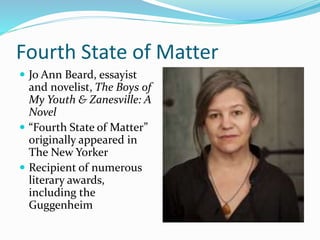
 Jo Ann Beard, essayist
and novelist, The Boys of
My Youth & Zanesville: A
Novel
 “Fourth State of Matter”
originally appeared in
The New Yorker
 Recipient of numerous
literary awards,
including the
Guggenheim
Fourth State of Matter
 The piece employs elements of creative nonfiction,
including: personal narrative, reportage, voice,
structure, metaphor & theme.
 To start:
 What events are reported in this piece? In other words,
what events are happening?
Fourth State of Matter
 Dog is dying
 Husband is gone
 Squirrels have taken over a room in her house
 Narrator has a job editing a physics journal
 Coworkers are murdered in a killing spree
 http://www.nytimes.com/1991/11/03/us/gunman-in-
iowa-wrote-of-plans-in-five-letters.html
Elements of CNF
 • What structure does Beard use in this essay? Is there a “visual”
shape to it? • Identify the author’s use of the elements of Creative
Nonfiction, and bring examples of: scene, dialogue, description.
How are these elements used?
 • “Sourcing” is an important aspect of the reported essay.
Sourcing just means research: finding people and documents
that help strengthen the writer and readers’ understanding of
the topic. Where do we see reportage in this piece?
 • Point of view: What is the point of view and the tone of this
piece? What makes this a personal essay, not a memoir and not
journalism?
 • Theme: What is the underlying message of these piece? What
unifying metaphor doe the author use to convey the theme?
What does it say beyond what it says?
Group Activity
 Group 1: Analyze the structure of this piece, and the
metaphor and theme. How would you describe the
theme—what is the message/larger context of this story?
What hints are given in the text?
 Group 2: Find examples of where the author uses reportage
and research to amplify the personal narrative. Be specific
and think about where the information came from and
how it’s presented.
 Group 3: Discuss the POV and voice in this piece. Does
POV shift in any spots? If so how and in what way does it
change the story? (first person? Third person?)
Structural Set-up
 The collie wakes me up about three
times a night, summoning me from a
great distance as I row my boat through a
dim, complicated dream. She’s on the
shoreline, barking. Wake up. She’s
staring at me with her head slightly
tipped to the side, long nose, gazing
eyes, toenails clenched to get a purchase
on the wood floor. We used to call her
the face of love.
 She totters on her broomstick legs into
the hallway and over the doorsill into the
kitchen, makes a sharp left at the
refrigerator—careful, almost went
down—then a straightaway to the door. I
sleep on my feet in the cold of the
doorway, waiting. Here she comes. Lift
her down the two steps. She pees and
then stands, Lassie in a ratty coat, gazing
out at the yard.
 In the porch light the trees shiver, the
squirrels turn over in their sleep. The
Milky Way is a long smear on the sky,
like something erased on a blackboard.
Over the neighbor’s house, Mars flashes
white, then red, then white again. Jupiter
is hidden among the anonymous blinks
and glitterings. It has a moon with
sulfur-spewing volcanoes and a beautiful
name: Io. I learned it at work, from the
group of men who surround me there.
Space physicists, guys who spend days on
end with their heads poked through the
fabric of the sky, listening to the sounds
of the universe. Guys whose own lives
are ticking like alarm clocks getting
ready to go off, although none of us are
aware of it yet.
Structural Set-up: Foreshadowing
& POV
 It’s Gang Lu, the doctoral student. Everyone
lights up again. Gang Lu stands stiffly talking
to Chris, while Bob holds a match to his pipe
and puffs fiercely; nose daggers waft up and
out, right in my direction. I give him a sugary
smile and he gives me one back.
Unimaginable, really, that less than two
months from now one of his colleagues from
abroad, a woman with delicate, birdlike
features, will appear at the door to my office
and identify herself as a friend of Bob’s. When
she asks, I take her down the hall to the room
with the long table and then to his empty
office. I do this without saying anything,
because there’s nothing to say, and she takes it
all in with small, serious nods until the
moment she sees his blackboard covered with
scribbles and arrows and equations. At that
point her face loosens and she starts to cry in
long ragged sobs. An hour later I go back and
the office is empty. When I erase the
blackboard finally, I can see where she laid her
hands carefully, where the numbers are ghostly
and blurred.
 Gang Lu looks around the room with
expressionless eyes. He’s sick of physics and
sick of the buffoons who practice it. The tall
glacial German, Chris, who tells him what to
do; the crass idiot Bob, who talks to him as if
he is a dog; the student Shan, whose ideas
about plasma physics are treated with
reverence and praised at every meeting. The
woman who puts her feet on the desk and
dismisses him with her eyes. Gang Lu no
longer spends his evenings in the computer lab
down the hall, running simulations and
thinking about magnetic forces and invisible
particles; he now spends them at the firing
range, learning to hit a moving target with the
gun he purchased last spring. He pictures
himself holding the gun with both hands,
arms straight out and steady; Clint Eastwood,
only smarter.
Time slows down/ stories merge
 The collie fell down the basement stairs.
I don’t know if she was disoriented and
was looking for me, or what. But when I
was at work she used her long nose like a
lever and got the door open and tried to
go down there, except her legs wouldn’t
do it and she fell. I found her sleeping on
the concrete floor in an unnatural
position, one leg still awkwardly resting
on the last step. I repositioned the leg
and sat down and petted her. We used to
play a game called Maserati, where I’d
grab her long nose like a gearshift and
put her through all the gears—first
second third fourth—until we were
going a hundred miles an hour through
town. She thought it was funny.
 Before I leave the building I pass Gang
Lu in the hallway and say hello. He has a
letter in his hand and he’s wearing his
coat. He doesn’t answer, and I don’t
expect him to. At the end of the hallway
are the double doors leading to the rest
of my life. I push them open and walk
through.
Reportage
 One room over, at a desk, Gang Lu works on a letter to his sister
in China. The study of physics is more and more disappointing,
he tells her. Modern physics is self-delusion, and All my life I
have been honest and straightforward, and I have most of all
detested cunning, fawning sycophants and dishonest
bureaucrats who think they are always right in everything.
Delicate Chinese characters all over a page. She was a kind and
gentle sister, and he thanks her for that. He’s going to kill
himself. You yourself should not be too sad about it, for at least I
have found a few traveling companions to accompany me to the
grave. Inside the coat on the back of his chair are a .38-calibre
handgun and a .22-calibre revolver. They’re heavier than they
look and weigh the pockets down. My beloved second elder
sister, I take my eternal leave of you.
Metaphor & Theme
 How are these threads connected?
“Currently he is obsessed with the dust in the plasma of
Saturn’s rings. Plasma is the fourth state of matter.
You’ve got your solid, your liquid, your gas, and then
your plasma. In outer space there’s the plasmasphere
and the plasmapause.”
What is the unifying theme in this piece?
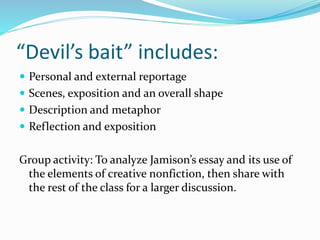
“Devil’s Bait: Most important
question:
Did reading this essay make you feel itchy?
“Devil’s bait” includes:
 Personal and external reportage
 Scenes, exposition and an overall shape
 Description and metaphor
 Reflection and exposition
Group activity: To analyze Jamison’s essay and its use of
the elements of creative nonfiction, then share with
the rest of the class for a larger discussion.
The Devil’s Bait
“For Paul, it started with a fishing trip. For Lenny, it was an addict whose
knuckles were covered in sores. Dawn found pimples clustered around
her swimming goggles. Kendra noticed ingrown hairs. Patricia was
attacked by sand flies on a Gulf Coast beach. Sometimes the sickness
starts as blisters, or lesions, or itching, or simply a terrible fog settling
over the mind, over the world.
For me, Morgellons disease started as a novelty: people said they had a
strange ailment, and no one — or hardly anyone — believed them. But
there were a lot of them, reportedly 12,000, and their numbers were
growing. Their illness manifested in many ways, including fatigue,
pain, and formication (a sensation of insects crawling over the skin).
But the defining symptom was always the same: fibers emerging from
their bodies. Not just fibers but fuzz, specks, and crystals. They didn’t
know what this stuff was, or where it came from, or why it was there,
but they knew — and this was what mattered, the important word —
that it was real.”
(The Devil’s Bait, Leslie Jamison)
Structure
 After the piece’s establishing shots, it provides a
chronological condensed history of Morgellons.
 The scenes or real-time elements of the story take
place at the Morgellon’s conference and the story
weaves in and out of the conference into research and
Jamison’s own memoir.
 What type of shape does this internal/external
structure create for the reader?
Reportage
 The characters/people introduced in the opening are re-introduced as Jamison
meets/interviews them at the conference:
Paul’s disease is different in that you can see it. His right ear is the most obvious sign of his
affliction. It’s a little twisted, almost mashed, and it has the smooth, shiny texture of scar
tissue all along the juncture between ear and jaw. His face is dotted with red pockmarks; the
skin is stained with milky patterns, and he’s got teardrop scars around his eyes. Paul says he
came home from the fishing trip with his legs covered in chigger bites.
“You could feel the heat coming out of my pants,” hesays. His whole body was inflamed.
I ask about his symptoms now. He simply shakes his head: “You can never tell what’s
coming next.”
I ask whether he gets support from anyone in his life. He does, he says. That’s when he tells
me about his sister.
At first, she wasn’t sympathetic. She assumed Paul was on drugs when he told her about his
symptoms. But she was the one who eventually discovered Morgellons, just about a year
ago, and told him about it.
“So she’s become a source of support?” I ask.
“Well,” he says. “Now she has it, too.”
Reflection
“When Dawn talks about her body as something that’s done
her wrong, I fall into the easy groove of identification. Her
condition seems like a crystallization of what I’ve always felt
about myself—a wrongness in my being that I could never
name and so pinned on my body, my thighs, my face. This
resonance is part of what compels me about Morgellons. But
my willingness to turn Morgellons into metaphor—a physical
manifestation of some abstract human tendency—is
dangerous. It obscures the particular and unbidden nature of
the suffering in front of me. I feel how conveniently these
lives could be sculpted to fit the metaphoric strictures of the
essay itself.”
Reflection
“Sometimes we’re all trying to purge something, and
what we’re trying to purge resists our efforts. These
demons belong to all of us: an obsession with our
boundaries and visible shapes, a fear of invasion or
contamination, an understanding of ourselves as
perpetually misunderstood. But doesn’t this search for
meaning obfuscate the illness itself? It’s another kind of
bait, another tied and-painted fly: the notion that if we
understand something well enough, we can make it go
away.” (Devil’s Bait, Jamison)
Personal Reported Essay
 This is not a term paper—it’s a reported personal essay,
so the topic should be something you’re:
• Interested in learning more about and writing about
• Able to report/research
• An experience you’ve had that you want to investigate
outside of just personal memories
• Able to bring personal reflection or personal
investigation to
Why report?
 Interviewing sources, and research, can enhance and
deepen our topics
 Interviews and research provide credibility
 Moving outside our own brains and experiences broadens
our expertise, knowledge and ideas for all writing
 This is why so many nonfiction and fiction writers work in
both genres—because there is so much cross-over in the
techniques of gathering information for a story and for the
techniques of writing fiction and creative nonfiction
 (And also because non-fiction provides more opportunities
to publish and get paid to write)
Forms of reportage
 Interviewing: Finding people to talk to whose own
experiences/ideas can enhance your story
 Immersive experience: Using the opportunity of an
experience to create real-time structure/scene
 Reading (books, articles, reports): looking for credible
materials that allow you to understand your
topic/interest in a larger context
Personal Essay Prompt, adapted
from brevity magazine
 Make a list of 10 things of which you’re a master or fan. Include talents,
skills, hobbies, qualities of character. Be as specific as possible. Examples:
Daydreaming in bed; baking cupcakes; hiking mountains; playing videogames,
the zombie apocalypse.
 Choose one item on your list and free-write about it. Describe how to do it,
when you learned it, what you accomplish, where you do it, why you’re
interested in it
 Now write about another person connected with this topic. Include
characterizing details that capture the person’s personality or mannerisms.
 Next, write about a particular scene or event that involves your topic and/or
your person. Look for opportunities to add dialogue and setting.
(https://www.creativenonfiction.org/brevity/craft/craft_simpson9_08.htm)
Next steps
 Take what you’ve written, and write a complete draft.
 Begin creating a “reporting/research” plan: what do you
need to know? What do you want to know? What are some
possible sources for continuing your exploration of the
topic?
 If you hate your topic from class, you can pick a new one,
but you need to bring two copies of a complete first draft to
our next class.
 Length is not important (two to three pages is sufficient if
they are fleshed out)
 We’ll be working in pairs in the next class to solidify the
reportage elements.

Fourth State of Matter

  • 1.
    The Personal ReportedEssay  In memoir, the emphasis is on internal reporting and reflection—using events from the personal past to consider a larger question.  In the personal essay, the writer blends the internal with the external—considering issues, ideas, events, topics from the world and merging those with personal reflection  As such, the reportage, gathering of information, becomes less dependent on memory and more on information gathered from the outside world.
  • 2.
    Historical Selves, LargerWorld  In Tell It Slant, the authors discuss “gathering the threads of history” or using an historical frame for a personal story  In personal reporting, writers merge elements from techniques employed in memoir, such as point of view, voice and memory, with observations and reportage from the larger world.  They also incorporate other elements from all genres of writing: structure, visual imagery, theme and metaphor.
  • 3.
    Inside World +outside world “This is one of the central imperatives of combining personal material with history or criticism or reportage: each thread must do some work that isn’t being done by another; that can’t be done by another.” —Leslie Jamison (Empathy Exams)
  • 4.
    Fourth State ofMatter  Jo Ann Beard, essayist and novelist, The Boys of My Youth & Zanesville: A Novel  “Fourth State of Matter” originally appeared in The New Yorker  Recipient of numerous literary awards, including the Guggenheim
  • 5.
    Fourth State ofMatter  The piece employs elements of creative nonfiction, including: personal narrative, reportage, voice, structure, metaphor & theme.  To start:  What events are reported in this piece? In other words, what events are happening?
  • 6.
    Fourth State ofMatter  Dog is dying  Husband is gone  Squirrels have taken over a room in her house  Narrator has a job editing a physics journal  Coworkers are murdered in a killing spree  http://www.nytimes.com/1991/11/03/us/gunman-in- iowa-wrote-of-plans-in-five-letters.html
  • 7.
    Elements of CNF • What structure does Beard use in this essay? Is there a “visual” shape to it? • Identify the author’s use of the elements of Creative Nonfiction, and bring examples of: scene, dialogue, description. How are these elements used?  • “Sourcing” is an important aspect of the reported essay. Sourcing just means research: finding people and documents that help strengthen the writer and readers’ understanding of the topic. Where do we see reportage in this piece?  • Point of view: What is the point of view and the tone of this piece? What makes this a personal essay, not a memoir and not journalism?  • Theme: What is the underlying message of these piece? What unifying metaphor doe the author use to convey the theme? What does it say beyond what it says?
  • 8.
    Group Activity  Group1: Analyze the structure of this piece, and the metaphor and theme. How would you describe the theme—what is the message/larger context of this story? What hints are given in the text?  Group 2: Find examples of where the author uses reportage and research to amplify the personal narrative. Be specific and think about where the information came from and how it’s presented.  Group 3: Discuss the POV and voice in this piece. Does POV shift in any spots? If so how and in what way does it change the story? (first person? Third person?)
  • 9.
    Structural Set-up  Thecollie wakes me up about three times a night, summoning me from a great distance as I row my boat through a dim, complicated dream. She’s on the shoreline, barking. Wake up. She’s staring at me with her head slightly tipped to the side, long nose, gazing eyes, toenails clenched to get a purchase on the wood floor. We used to call her the face of love.  She totters on her broomstick legs into the hallway and over the doorsill into the kitchen, makes a sharp left at the refrigerator—careful, almost went down—then a straightaway to the door. I sleep on my feet in the cold of the doorway, waiting. Here she comes. Lift her down the two steps. She pees and then stands, Lassie in a ratty coat, gazing out at the yard.  In the porch light the trees shiver, the squirrels turn over in their sleep. The Milky Way is a long smear on the sky, like something erased on a blackboard. Over the neighbor’s house, Mars flashes white, then red, then white again. Jupiter is hidden among the anonymous blinks and glitterings. It has a moon with sulfur-spewing volcanoes and a beautiful name: Io. I learned it at work, from the group of men who surround me there. Space physicists, guys who spend days on end with their heads poked through the fabric of the sky, listening to the sounds of the universe. Guys whose own lives are ticking like alarm clocks getting ready to go off, although none of us are aware of it yet.
  • 10.
    Structural Set-up: Foreshadowing &POV  It’s Gang Lu, the doctoral student. Everyone lights up again. Gang Lu stands stiffly talking to Chris, while Bob holds a match to his pipe and puffs fiercely; nose daggers waft up and out, right in my direction. I give him a sugary smile and he gives me one back. Unimaginable, really, that less than two months from now one of his colleagues from abroad, a woman with delicate, birdlike features, will appear at the door to my office and identify herself as a friend of Bob’s. When she asks, I take her down the hall to the room with the long table and then to his empty office. I do this without saying anything, because there’s nothing to say, and she takes it all in with small, serious nods until the moment she sees his blackboard covered with scribbles and arrows and equations. At that point her face loosens and she starts to cry in long ragged sobs. An hour later I go back and the office is empty. When I erase the blackboard finally, I can see where she laid her hands carefully, where the numbers are ghostly and blurred.  Gang Lu looks around the room with expressionless eyes. He’s sick of physics and sick of the buffoons who practice it. The tall glacial German, Chris, who tells him what to do; the crass idiot Bob, who talks to him as if he is a dog; the student Shan, whose ideas about plasma physics are treated with reverence and praised at every meeting. The woman who puts her feet on the desk and dismisses him with her eyes. Gang Lu no longer spends his evenings in the computer lab down the hall, running simulations and thinking about magnetic forces and invisible particles; he now spends them at the firing range, learning to hit a moving target with the gun he purchased last spring. He pictures himself holding the gun with both hands, arms straight out and steady; Clint Eastwood, only smarter.
  • 11.
    Time slows down/stories merge  The collie fell down the basement stairs. I don’t know if she was disoriented and was looking for me, or what. But when I was at work she used her long nose like a lever and got the door open and tried to go down there, except her legs wouldn’t do it and she fell. I found her sleeping on the concrete floor in an unnatural position, one leg still awkwardly resting on the last step. I repositioned the leg and sat down and petted her. We used to play a game called Maserati, where I’d grab her long nose like a gearshift and put her through all the gears—first second third fourth—until we were going a hundred miles an hour through town. She thought it was funny.  Before I leave the building I pass Gang Lu in the hallway and say hello. He has a letter in his hand and he’s wearing his coat. He doesn’t answer, and I don’t expect him to. At the end of the hallway are the double doors leading to the rest of my life. I push them open and walk through.
  • 12.
    Reportage  One roomover, at a desk, Gang Lu works on a letter to his sister in China. The study of physics is more and more disappointing, he tells her. Modern physics is self-delusion, and All my life I have been honest and straightforward, and I have most of all detested cunning, fawning sycophants and dishonest bureaucrats who think they are always right in everything. Delicate Chinese characters all over a page. She was a kind and gentle sister, and he thanks her for that. He’s going to kill himself. You yourself should not be too sad about it, for at least I have found a few traveling companions to accompany me to the grave. Inside the coat on the back of his chair are a .38-calibre handgun and a .22-calibre revolver. They’re heavier than they look and weigh the pockets down. My beloved second elder sister, I take my eternal leave of you.
  • 13.
    Metaphor & Theme How are these threads connected? “Currently he is obsessed with the dust in the plasma of Saturn’s rings. Plasma is the fourth state of matter. You’ve got your solid, your liquid, your gas, and then your plasma. In outer space there’s the plasmasphere and the plasmapause.” What is the unifying theme in this piece?
  • 14.
    “Devil’s Bait: Mostimportant question: Did reading this essay make you feel itchy?
  • 15.
    “Devil’s bait” includes: Personal and external reportage  Scenes, exposition and an overall shape  Description and metaphor  Reflection and exposition Group activity: To analyze Jamison’s essay and its use of the elements of creative nonfiction, then share with the rest of the class for a larger discussion.
  • 16.
    The Devil’s Bait “ForPaul, it started with a fishing trip. For Lenny, it was an addict whose knuckles were covered in sores. Dawn found pimples clustered around her swimming goggles. Kendra noticed ingrown hairs. Patricia was attacked by sand flies on a Gulf Coast beach. Sometimes the sickness starts as blisters, or lesions, or itching, or simply a terrible fog settling over the mind, over the world. For me, Morgellons disease started as a novelty: people said they had a strange ailment, and no one — or hardly anyone — believed them. But there were a lot of them, reportedly 12,000, and their numbers were growing. Their illness manifested in many ways, including fatigue, pain, and formication (a sensation of insects crawling over the skin). But the defining symptom was always the same: fibers emerging from their bodies. Not just fibers but fuzz, specks, and crystals. They didn’t know what this stuff was, or where it came from, or why it was there, but they knew — and this was what mattered, the important word — that it was real.” (The Devil’s Bait, Leslie Jamison)
  • 17.
    Structure  After thepiece’s establishing shots, it provides a chronological condensed history of Morgellons.  The scenes or real-time elements of the story take place at the Morgellon’s conference and the story weaves in and out of the conference into research and Jamison’s own memoir.  What type of shape does this internal/external structure create for the reader?
  • 18.
    Reportage  The characters/peopleintroduced in the opening are re-introduced as Jamison meets/interviews them at the conference: Paul’s disease is different in that you can see it. His right ear is the most obvious sign of his affliction. It’s a little twisted, almost mashed, and it has the smooth, shiny texture of scar tissue all along the juncture between ear and jaw. His face is dotted with red pockmarks; the skin is stained with milky patterns, and he’s got teardrop scars around his eyes. Paul says he came home from the fishing trip with his legs covered in chigger bites. “You could feel the heat coming out of my pants,” hesays. His whole body was inflamed. I ask about his symptoms now. He simply shakes his head: “You can never tell what’s coming next.” I ask whether he gets support from anyone in his life. He does, he says. That’s when he tells me about his sister. At first, she wasn’t sympathetic. She assumed Paul was on drugs when he told her about his symptoms. But she was the one who eventually discovered Morgellons, just about a year ago, and told him about it. “So she’s become a source of support?” I ask. “Well,” he says. “Now she has it, too.”
  • 19.
    Reflection “When Dawn talksabout her body as something that’s done her wrong, I fall into the easy groove of identification. Her condition seems like a crystallization of what I’ve always felt about myself—a wrongness in my being that I could never name and so pinned on my body, my thighs, my face. This resonance is part of what compels me about Morgellons. But my willingness to turn Morgellons into metaphor—a physical manifestation of some abstract human tendency—is dangerous. It obscures the particular and unbidden nature of the suffering in front of me. I feel how conveniently these lives could be sculpted to fit the metaphoric strictures of the essay itself.”
  • 20.
    Reflection “Sometimes we’re alltrying to purge something, and what we’re trying to purge resists our efforts. These demons belong to all of us: an obsession with our boundaries and visible shapes, a fear of invasion or contamination, an understanding of ourselves as perpetually misunderstood. But doesn’t this search for meaning obfuscate the illness itself? It’s another kind of bait, another tied and-painted fly: the notion that if we understand something well enough, we can make it go away.” (Devil’s Bait, Jamison)
  • 21.
    Personal Reported Essay This is not a term paper—it’s a reported personal essay, so the topic should be something you’re: • Interested in learning more about and writing about • Able to report/research • An experience you’ve had that you want to investigate outside of just personal memories • Able to bring personal reflection or personal investigation to
  • 22.
    Why report?  Interviewingsources, and research, can enhance and deepen our topics  Interviews and research provide credibility  Moving outside our own brains and experiences broadens our expertise, knowledge and ideas for all writing  This is why so many nonfiction and fiction writers work in both genres—because there is so much cross-over in the techniques of gathering information for a story and for the techniques of writing fiction and creative nonfiction  (And also because non-fiction provides more opportunities to publish and get paid to write)
  • 23.
    Forms of reportage Interviewing: Finding people to talk to whose own experiences/ideas can enhance your story  Immersive experience: Using the opportunity of an experience to create real-time structure/scene  Reading (books, articles, reports): looking for credible materials that allow you to understand your topic/interest in a larger context
  • 24.
    Personal Essay Prompt,adapted from brevity magazine  Make a list of 10 things of which you’re a master or fan. Include talents, skills, hobbies, qualities of character. Be as specific as possible. Examples: Daydreaming in bed; baking cupcakes; hiking mountains; playing videogames, the zombie apocalypse.  Choose one item on your list and free-write about it. Describe how to do it, when you learned it, what you accomplish, where you do it, why you’re interested in it  Now write about another person connected with this topic. Include characterizing details that capture the person’s personality or mannerisms.  Next, write about a particular scene or event that involves your topic and/or your person. Look for opportunities to add dialogue and setting. (https://www.creativenonfiction.org/brevity/craft/craft_simpson9_08.htm)
  • 25.
    Next steps  Takewhat you’ve written, and write a complete draft.  Begin creating a “reporting/research” plan: what do you need to know? What do you want to know? What are some possible sources for continuing your exploration of the topic?  If you hate your topic from class, you can pick a new one, but you need to bring two copies of a complete first draft to our next class.  Length is not important (two to three pages is sufficient if they are fleshed out)  We’ll be working in pairs in the next class to solidify the reportage elements.

Editor's Notes

  • #4 Talk about this essay as part of the book
  • #7 What’s the most important part of this story? A plasma is a gas that has been energized to the point that some of the electrons break free from, but travel with, their nucleus. Syntax: Find example of where length of sentences change in response to the events. How does the opening section establish a working metaphor for the whole piece. have someone read the opening. what is the tone?
  • #8 These are some of the things we’re going to look at in groups now:
  • #10 First three paragraphs
  • #11 How does Beard know enough about Gang Lu to switch POV like this?
  • #12 http://www.newyorker.com/magazine/1996/06/24/the-fourth-state-of-matter
  • #14 99 percento f the observable universe is made up of plasma, including basically our entire solar system. Basially it’s an ionized gas with equal parts of positively charged ions and negatively charged electrons.
  • #17 What is the effect of starting this way? How would you describe this beginning? Establishing shot, we know we are going to hear other people’s stories and that we also will find out what the author’s stake in Morgellon’s disease is.
  • #20 What is jamison concerned about in terms of her own writing process? What is she saying here?
  • #21 Is this an essay just about Morgellon’s?
  • #23 Let’s look first at “Devil’s Bait” by Leslie Jamison