FOURFOLD PATH TO EFFECTIVE 
THINKING 
 
Do all normal persons engage in effective thinking? No, not all normal persons think effectively.                             
This is why I am proposing the “Fourfold Path to Effective Thinking.”  
 
A Complete Cycle 
 
Effective thinking proposed here should be used as a brainstorming activity in problem solving.                           
We should begin by asking what the root problems are. Next, we should propose solutions for                               
them. Then, we should anticipate the possible outcomes that might result from the proposed                           
solutions. And lastly, we should ask whether the outcomes are acceptable? if necessary, we                           
should refine the whole process from step 1 to 3 to reproduce better outcomes. Now, let's                               
examine each of these four steps in detail. 
 
What Are the Root Problems? 
 
 
In step 1, we ask the questions, what are the root problems and                         
how do we identify them?   
 
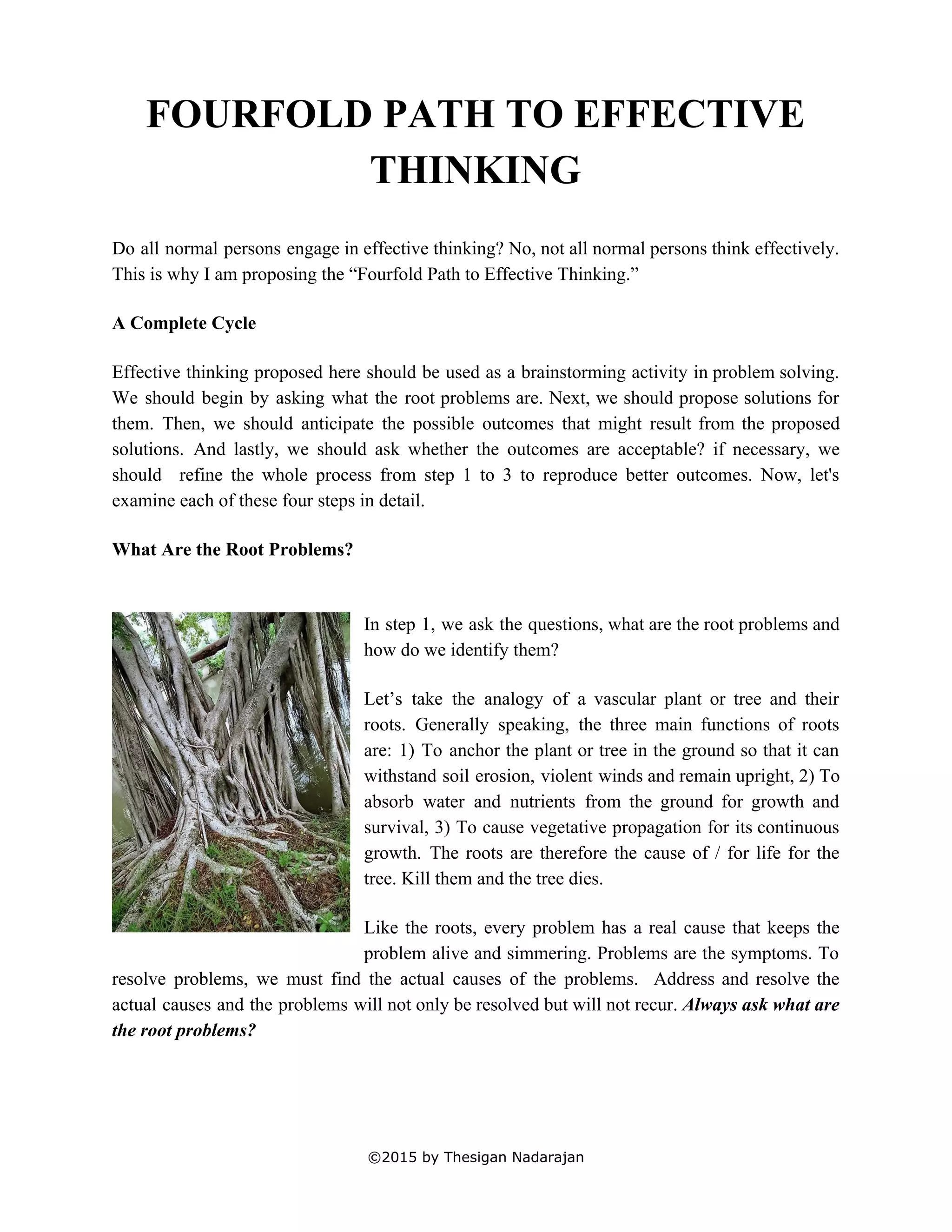
Let’s take the analogy of a vascular plant or tree and their                       
roots. Generally speaking, the three main functions of roots                 
are: 1) To anchor the plant or tree in the ground so that it can                             
withstand soil erosion, violent winds and remain upright, 2) To                   
absorb water and nutrients from the ground for growth and                   
survival, 3) To cause vegetative propagation for its continuous                 
growth. The roots are therefore the cause of / for life for the                         
tree. Kill them and the tree dies.  
 
Like the roots, every problem has a real cause that keeps the                       
problem alive and simmering. Problems are the symptoms. To                 
resolve problems, we must find the actual causes of the problems. Address and resolve the                             
actual causes and the problems will not only be resolved but will not recur. Always ask what are                                   
the root problems? 


©2015 by Thesigan Nadarajan 
 
FOURFOLD PATH TO EFFECTIVE 
THINKING 
 
What Are the Proposed Solutions? 
 
For step 2, in proposing solutions to resolve the actual causes of problems, ​the principles of                               
relevancy, all­inclusiveness and moderation ​should be observed. What does these three terms                       
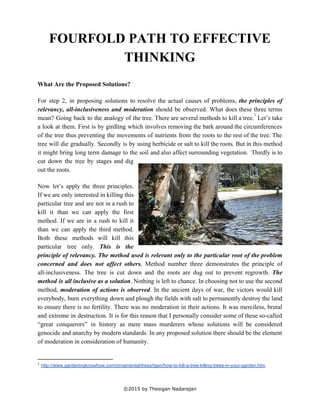
mean? Going back to the analogy of the tree. There are several methods to kill a tree. Let’s take                                     
1
a look at them. First is by girdling which involves removing the bark around the circumferences                               
of the tree thus preventing the movements of nutrients from the roots to the rest of the tree. The                                     
tree will die gradually. Secondly is by using herbicide or salt to kill the roots. But in this method                                     
it might bring long term damage to the soil and also affect surrounding vegetation. Thirdly is to                                 
cut down the tree by stages and dig               
out the roots.  
 
Now let’s apply the three principles.           
If we are only interested in killing this               
particular tree and are not in a rush to                 
kill it than we can apply the first               
method. If we are in a rush to kill it                   
than we can apply the third method.             
Both these methods will kill this           
particular tree only. ​This is the           
principle of relevancy. ​The method used is relevant only to the particular root of the problem                               
concerned and does not affect others. Method number three demonstrates the principle of                         
all­inclusiveness. The tree is cut down and the roots are dug out to prevent regrowth. ​The                               
method is all inclusive as a solution​. Nothing is left to chance. In choosing not to use the second                                     
method, ​moderation of actions is observed​. In the ancient days of war, the victors would kill                               
everybody, burn everything down and plough the fields with salt to permanently destroy the land                             
to ensure there is no fertility. There was no moderation in their actions. It was merciless, brutal                                 
and extreme in destruction. It is for this reason that I personally consider some of these so­called                                 
“great conquerors” in history as mere mass murderers whose solutions will be considered                         
genocide and anarchy by modern standards. In any proposed solution there should be the element                             
of moderation in consideration of humanity. 
 
1
 ​http://www.gardeningknowhow.com/ornamental/trees/tgen/how­to­kill­a­tree­killing­trees­in­your­garden.htm 
 
 
©2015 by Thesigan Nadarajan 
 
FOURFOLD PATH TO EFFECTIVE 
THINKING 
What Are the Possible Outcomes? 
 
Care and caution should be observed in the choice of solutions as the possible outcomes from                               
them could be positive or negative. In the example above, if the second methodology had been                               
applied than the possible outcome would be negative, damaging the fertility of the soil and its                               
surrounding vegetation. ​This proves that the possible outcomes are dependent on the preceding                         
possible solutions. ​In step 3, we should examine the outcomes based on the following criteria: 
 
1. The outcome(s) must be reasonably positive and constructive, 
2. The outcome(s) in itself must not generate new problems (symptoms), 
3. The outcome(s) must be reasonably satisfactory to concerned stakeholders, 
4.  The outcome(s) must ensure that the resolved problems (symptoms) must not recur. 
 
Are the Outcomes Acceptable? 
 
Based on the four criteria in step 3, step 4 will be the evaluative stage for the effective thinking                                     
process.. If the outcome(s) are not positive and constructive than it is an indication that the                               
preceding steps 1 and 2 are not refined enough. And if the outcome(s) generate new problems                               
than steps 1 to 2 are definitely defective. If the outcome(s) does not satisfy the concerned                               
stakeholders than it is not client­centered. And if the outcome(s) show the problems might recur                             
again then everything should be reexamined. But if everything is okay then the process is                             
complete.  
 
How you think is what you will 
become  
And what you will eventually do 


©2015 by Thesigan Nadarajan 

Fourfold path to effective thinking

  • 1.
      FOURFOLD PATH TO EFFECTIVE  THINKING    Do all normalpersons engage in effective thinking? No, not all normal persons think effectively.                              This is why I am proposing the “Fourfold Path to Effective Thinking.”     A Complete Cycle    Effective thinking proposed here should be used as a brainstorming activity in problem solving.                            We should begin by asking what the root problems are. Next, we should propose solutions for                                them. Then, we should anticipate the possible outcomes that might result from the proposed                            solutions. And lastly, we should ask whether the outcomes are acceptable? if necessary, we                            should refine the whole process from step 1 to 3 to reproduce better outcomes. Now, let's                                examine each of these four steps in detail.    What Are the Root Problems?      In step 1, we ask the questions, what are the root problems and                          how do we identify them?      Let’s take the analogy of a vascular plant or tree and their                        roots. Generally speaking, the three main functions of roots                  are: 1) To anchor the plant or tree in the ground so that it can                              withstand soil erosion, violent winds and remain upright, 2) To                    absorb water and nutrients from the ground for growth and                    survival, 3) To cause vegetative propagation for its continuous                  growth. The roots are therefore the cause of / for life for the                          tree. Kill them and the tree dies.     Like the roots, every problem has a real cause that keeps the                        problem alive and simmering. Problems are the symptoms. To                  resolve problems, we must find the actual causes of the problems. Address and resolve the                              actual causes and the problems will not only be resolved but will not recur. Always ask what are                                    the root problems?          ©2015 by Thesigan Nadarajan 
  • 2.
      FOURFOLD PATH TO EFFECTIVE  THINKING    What Are the Proposed Solutions?    For step 2,in proposing solutions to resolve the actual causes of problems, ​the principles of                                relevancy, all­inclusiveness and moderation ​should be observed. What does these three terms                        mean? Going back to the analogy of the tree. There are several methods to kill a tree. Let’s take                                      1 a look at them. First is by girdling which involves removing the bark around the circumferences                                of the tree thus preventing the movements of nutrients from the roots to the rest of the tree. The                                      tree will die gradually. Secondly is by using herbicide or salt to kill the roots. But in this method                                      it might bring long term damage to the soil and also affect surrounding vegetation. Thirdly is to                                  cut down the tree by stages and dig                out the roots.     Now let’s apply the three principles.            If we are only interested in killing this                particular tree and are not in a rush to                  kill it than we can apply the first                method. If we are in a rush to kill it                    than we can apply the third method.              Both these methods will kill this            particular tree only. ​This is the            principle of relevancy. ​The method used is relevant only to the particular root of the problem                                concerned and does not affect others. Method number three demonstrates the principle of                          all­inclusiveness. The tree is cut down and the roots are dug out to prevent regrowth. ​The                                method is all inclusive as a solution​. Nothing is left to chance. In choosing not to use the second                                      method, ​moderation of actions is observed​. In the ancient days of war, the victors would kill                                everybody, burn everything down and plough the fields with salt to permanently destroy the land                              to ensure there is no fertility. There was no moderation in their actions. It was merciless, brutal                                  and extreme in destruction. It is for this reason that I personally consider some of these so­called                                  “great conquerors” in history as mere mass murderers whose solutions will be considered                          genocide and anarchy by modern standards. In any proposed solution there should be the element                              of moderation in consideration of humanity.    1  ​http://www.gardeningknowhow.com/ornamental/trees/tgen/how­to­kill­a­tree­killing­trees­in­your­garden.htm      ©2015 by Thesigan Nadarajan 
  • 3.
      FOURFOLD PATH TO EFFECTIVE  THINKING  What Are the Possible Outcomes?    Care and cautionshould be observed in the choice of solutions as the possible outcomes from                                them could be positive or negative. In the example above, if the second methodology had been                                applied than the possible outcome would be negative, damaging the fertility of the soil and its                                surrounding vegetation. ​This proves that the possible outcomes are dependent on the preceding                          possible solutions. ​In step 3, we should examine the outcomes based on the following criteria:    1. The outcome(s) must be reasonably positive and constructive,  2. The outcome(s) in itself must not generate new problems (symptoms),  3. The outcome(s) must be reasonably satisfactory to concerned stakeholders,  4.  The outcome(s) must ensure that the resolved problems (symptoms) must not recur.    Are the Outcomes Acceptable?    Based on the four criteria in step 3, step 4 will be the evaluative stage for the effective thinking                                      process.. If the outcome(s) are not positive and constructive than it is an indication that the                                preceding steps 1 and 2 are not refined enough. And if the outcome(s) generate new problems                                than steps 1 to 2 are definitely defective. If the outcome(s) does not satisfy the concerned                                stakeholders than it is not client­centered. And if the outcome(s) show the problems might recur                              again then everything should be reexamined. But if everything is okay then the process is                              complete.     How you think is what you will  become   And what you will eventually do          ©2015 by Thesigan Nadarajan