Presented by Qasim Ibrar
1
 Physical principles related to operation
 Basic parts of the engine assembly
 Four stroke operating theory
2
 Energy conversion
 Atmospheric pressure
 Vacuum
 Pressure
 The relationship between temperature, pressure
and volume.
 The three states of matter.
3
 Engines take heat
energy and convert
it into mechanical
energy.
 Motors take
electrical energy
and convert it into
mechanical energy.
4
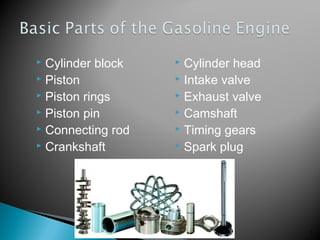
 Cylinder block
 Piston
 Piston rings
 Piston pin
 Connecting rod
 Crankshaft
 Cylinder head
 Intake valve
 Exhaust valve
 Camshaft
 Timing gears
 Spark plug
5
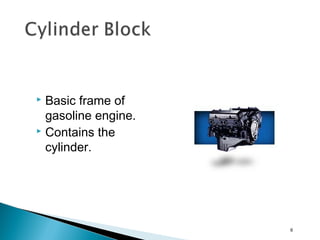
 Basic frame of
gasoline engine.
 Contains the
cylinder.
6
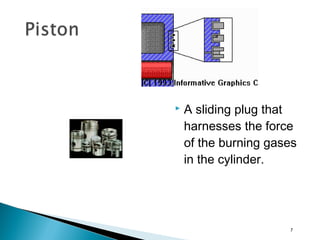
 A sliding plug that
harnesses the force
of the burning gases
in the cylinder.
7
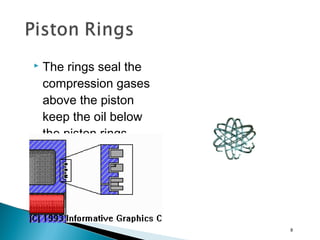
 The rings seal the
compression gases
above the piston
keep the oil below
the piston rings.
8
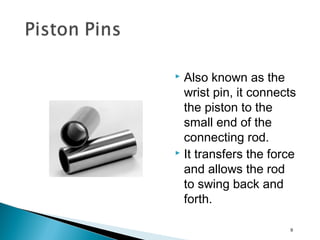
 Also known as the
wrist pin, it connects
the piston to the
small end of the
connecting rod.
 It transfers the force
and allows the rod
to swing back and
forth.
9
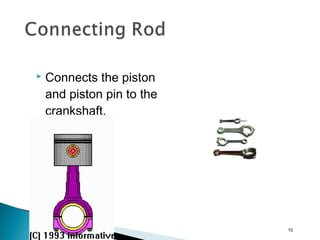
 Connects the piston
and piston pin to the
crankshaft.
10
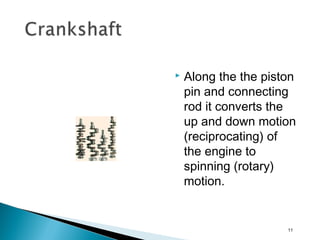
 Along the the piston
pin and connecting
rod it converts the
up and down motion
(reciprocating) of
the engine to
spinning (rotary)
motion.
11
12
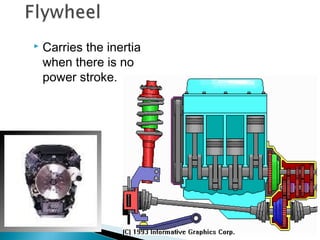
 Carries the inertia
when there is no
power stroke.
13
14
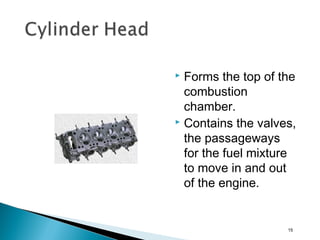
 Forms the top of the
combustion
chamber.
 Contains the valves,
the passageways
for the fuel mixture
to move in and out
of the engine.
15
16
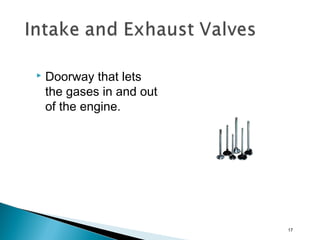
 Doorway that lets
the gases in and out
of the engine.
17
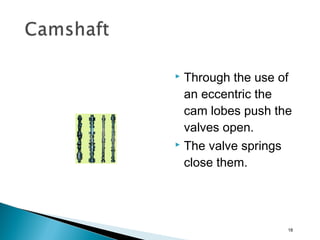
 Through the use of
an eccentric the
cam lobes push the
valves open.
 The valve springs
close them.
18
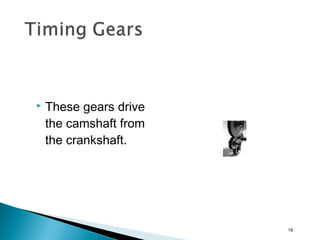
 These gears drive
the camshaft from
the crankshaft.
19
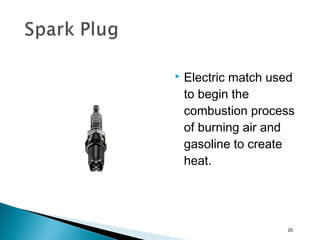
 Electric match used
to begin the
combustion process
of burning air and
gasoline to create
heat.
20
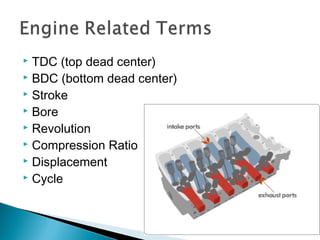
 TDC (top dead center)
 BDC (bottom dead center)
 Stroke
 Bore
 Revolution
 Compression Ratio
 Displacement
 Cycle
21
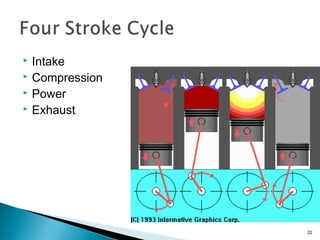
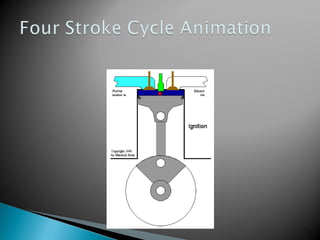
 Intake
 Compression
 Power
 Exhaust
22
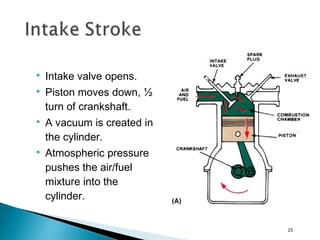
 Intake valve opens.
 Piston moves down, ½
turn of crankshaft.
 A vacuum is created in
the cylinder.
 Atmospheric pressure
pushes the air/fuel
mixture into the
cylinder.
23
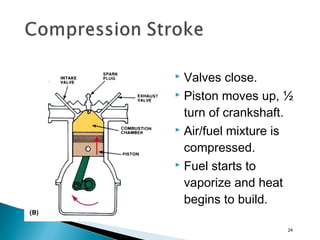
 Valves close.
 Piston moves up, ½
turn of crankshaft.
 Air/fuel mixture is
compressed.
 Fuel starts to
vaporize and heat
begins to build.
24
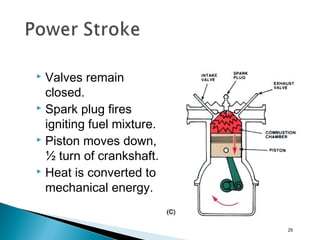
 Valves remain
closed.
 Spark plug fires
igniting fuel mixture.
 Piston moves down,
½ turn of crankshaft.
 Heat is converted to
mechanical energy.
25
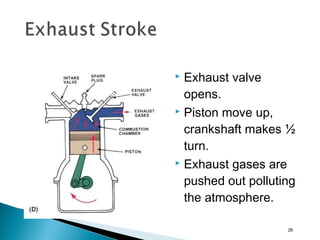
 Exhaust valve
opens.
 Piston move up,
crankshaft makes ½
turn.
 Exhaust gases are
pushed out polluting
the atmosphere.
26
27
28
29
30
31
32
1. Diesel engines, because they have much
higher compression ratios (20:1 for a typical
diesel vs. 8:1 for a typical gasoline engine),
tend to be heavier than an equivalent
gasoline engine.
2. Diesel engines also tend to be more
expensive.
33
3. Diesel engines, because of the weight and
compression ratio, tend to have lower
maximum RPM ranges than gasoline engines
(see Question 381 for details). This makes
diesel engines high torque rather than high
horsepower, and that tends to make diesel
cars slow in terms of acceleration.
4. Diesel engines must be fuel injected, and in the
past fuel injection was expensive and less
reliable
34
5. Diesel engines tend to produce more smoke
and "smell funny".
6. Diesel engines are harder to start in cold
weather, and if they contain glow plugs, diesel
engines can require you to wait before starting
the engine so the glow plugs can heat up.
7. Diesel engines are much noisier and tend to
vibrate.
8. Diesel fuel is less readily available than gasoline
35
 One or two of these disadvantages would be
OK, but a group of disadvantages this large is
a big deterrent for lots of people.
36
 The two things working in favor of diesel
engines are better fuel economy and longer
engine life. Both of these advantages mean
that, over the life of the engine, you will tend
to save money with a diesel. However, you
also have to take the initial high cost of the
engine into account. You have to own and
operate a diesel engine for a fairly long time
before the fuel economy overcomes the
increased purchase price of the engine. The
equation works great in a big diesel tractor-
trailer rig that is running 400 miles every day,
but it is not nearly so beneficial in a
passenger car. 37
 How many revolutions of the crankshaft does it
take to complete the four strokes?
 If an engine idles at 500 rpm, how many power
strokes occur per minute?
 How many power strokes per second?
 How about at 5000 rpm or 10,000 rpm?
38

Four stroke theory

  • 1.
  • 2.
     Physical principlesrelated to operation  Basic parts of the engine assembly  Four stroke operating theory 2
  • 3.
     Energy conversion Atmospheric pressure  Vacuum  Pressure  The relationship between temperature, pressure and volume.  The three states of matter. 3
  • 4.
     Engines takeheat energy and convert it into mechanical energy.  Motors take electrical energy and convert it into mechanical energy. 4
  • 5.
     Cylinder block Piston  Piston rings  Piston pin  Connecting rod  Crankshaft  Cylinder head  Intake valve  Exhaust valve  Camshaft  Timing gears  Spark plug 5
  • 6.
     Basic frameof gasoline engine.  Contains the cylinder. 6
  • 7.
     A slidingplug that harnesses the force of the burning gases in the cylinder. 7
  • 8.
     The ringsseal the compression gases above the piston keep the oil below the piston rings. 8
  • 9.
     Also knownas the wrist pin, it connects the piston to the small end of the connecting rod.  It transfers the force and allows the rod to swing back and forth. 9
  • 10.
     Connects thepiston and piston pin to the crankshaft. 10
  • 11.
     Along thethe piston pin and connecting rod it converts the up and down motion (reciprocating) of the engine to spinning (rotary) motion. 11
  • 12.
  • 13.
     Carries theinertia when there is no power stroke. 13
  • 14.
  • 15.
     Forms thetop of the combustion chamber.  Contains the valves, the passageways for the fuel mixture to move in and out of the engine. 15
  • 16.
  • 17.
     Doorway thatlets the gases in and out of the engine. 17
  • 18.
     Through theuse of an eccentric the cam lobes push the valves open.  The valve springs close them. 18
  • 19.
     These gearsdrive the camshaft from the crankshaft. 19
  • 20.
     Electric matchused to begin the combustion process of burning air and gasoline to create heat. 20
  • 21.
     TDC (topdead center)  BDC (bottom dead center)  Stroke  Bore  Revolution  Compression Ratio  Displacement  Cycle 21
  • 22.
     Intake  Compression Power  Exhaust 22
  • 23.
     Intake valveopens.  Piston moves down, ½ turn of crankshaft.  A vacuum is created in the cylinder.  Atmospheric pressure pushes the air/fuel mixture into the cylinder. 23
  • 24.
     Valves close. Piston moves up, ½ turn of crankshaft.  Air/fuel mixture is compressed.  Fuel starts to vaporize and heat begins to build. 24
  • 25.
     Valves remain closed. Spark plug fires igniting fuel mixture.  Piston moves down, ½ turn of crankshaft.  Heat is converted to mechanical energy. 25
  • 26.
     Exhaust valve opens. Piston move up, crankshaft makes ½ turn.  Exhaust gases are pushed out polluting the atmosphere. 26
  • 27.
  • 28.
  • 29.
  • 30.
  • 31.
  • 32.
  • 33.
    1. Diesel engines,because they have much higher compression ratios (20:1 for a typical diesel vs. 8:1 for a typical gasoline engine), tend to be heavier than an equivalent gasoline engine. 2. Diesel engines also tend to be more expensive. 33
  • 34.
    3. Diesel engines,because of the weight and compression ratio, tend to have lower maximum RPM ranges than gasoline engines (see Question 381 for details). This makes diesel engines high torque rather than high horsepower, and that tends to make diesel cars slow in terms of acceleration. 4. Diesel engines must be fuel injected, and in the past fuel injection was expensive and less reliable 34
  • 35.
    5. Diesel enginestend to produce more smoke and "smell funny". 6. Diesel engines are harder to start in cold weather, and if they contain glow plugs, diesel engines can require you to wait before starting the engine so the glow plugs can heat up. 7. Diesel engines are much noisier and tend to vibrate. 8. Diesel fuel is less readily available than gasoline 35
  • 36.
     One ortwo of these disadvantages would be OK, but a group of disadvantages this large is a big deterrent for lots of people. 36
  • 37.
     The twothings working in favor of diesel engines are better fuel economy and longer engine life. Both of these advantages mean that, over the life of the engine, you will tend to save money with a diesel. However, you also have to take the initial high cost of the engine into account. You have to own and operate a diesel engine for a fairly long time before the fuel economy overcomes the increased purchase price of the engine. The equation works great in a big diesel tractor- trailer rig that is running 400 miles every day, but it is not nearly so beneficial in a passenger car. 37
  • 38.
     How manyrevolutions of the crankshaft does it take to complete the four strokes?  If an engine idles at 500 rpm, how many power strokes occur per minute?  How many power strokes per second?  How about at 5000 rpm or 10,000 rpm? 38