OBJECTIVES
• describe the four spheres of the
earth;
• draw a representation for each
sphere; and
• realize the importance of each
sphere to support life on Earth
and how they are interconnected
HABITABLE
• Only Earth can support life
1. The star should survive long
enough for planets to develop life.
2. Water should remain liquid.
Goldilocks Zone, remember?
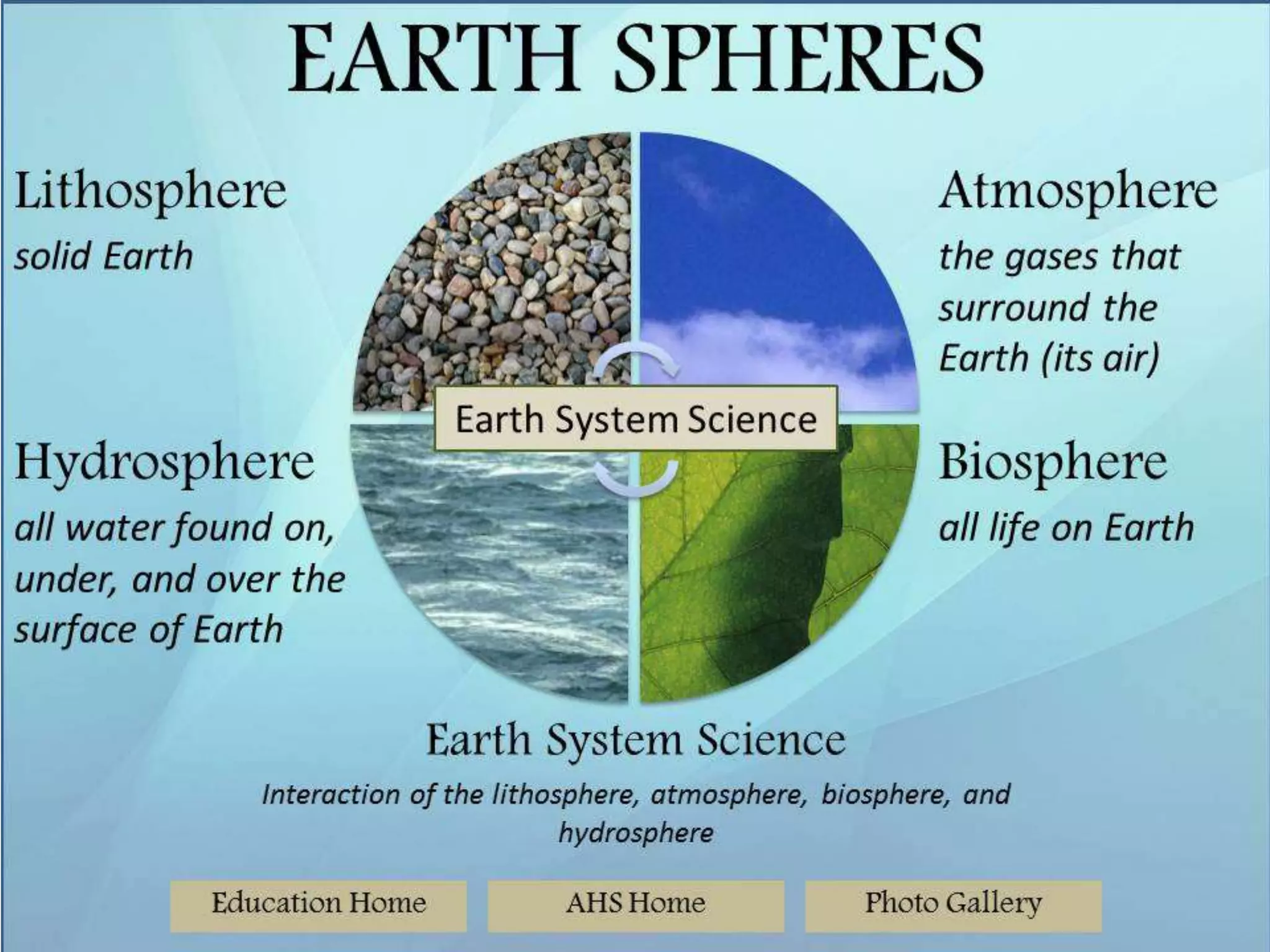
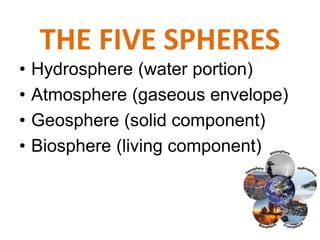
THE FIVE SPHERES
• Hydrosphere (water portion)
• Atmosphere (gaseous envelope)
• Geosphere (solid component)
• Biosphere (living component)
HYDROSPHERE
Earth is called the “blue planet”
or the “blue marble” because of
its water component. Water in
Earth is unique because it
naturally exists in three phases.
HYDROSPHERE
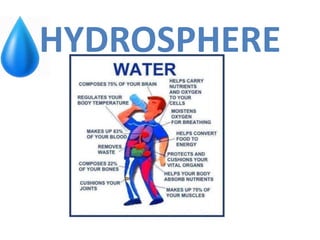
The hydrosphere makes up
71% of the Earth’s surface, and
most of it is saltwater found in
oceans.
HYDROSPHERE
HYDROSPHERE
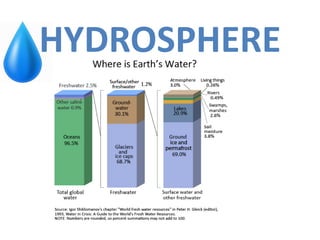
GROUNDWATER is the largest
reservoir of freshwater available
to humans.
HYDROSPHERE
How does the
hydrosphere interact
with the other
spheres?
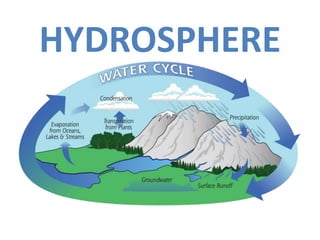
HYDROSPHEREHydrosphere
EVAPORATION
Atmosphere
PRECIPITATION
Geosphere
RUNOFF
Hydrosphere
HYDROSPHERE
HYDROSPHERE
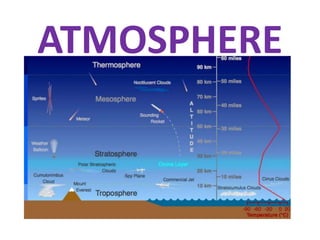
ATMOSPHERE
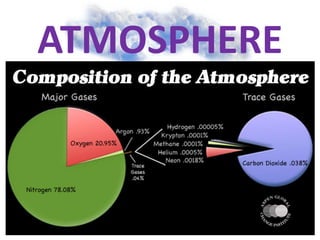
This is the thin, life-giving gaseous
envelope of the Earth. Its composition
is divided into:
A. major components (N,O)
B. variable components (water
vapor and aerosols)
ATMOSPHERE
ATMOSPHEREWATER VAPOR is the gaseous phase
of water able to trap heat on.
An AEROSOL is a suspension of fine
solid or liquid particles in a gas
(smoke, fog, mist).
ATMOSPHERE
ATMOSPHERE
The major components are
responsible for the air that people
breathe, and trap outgoing infrared
radiation to keep Earth warm.
ATMOSPHERE
The variable components are
responsible for weather and climate.
Weather and climate are
experienced on Earth because of the
interaction of the atmosphere with the
hydrosphere and geosphere.
ATMOSPHEREWater vapor is needed for cloud
formation and atmospheric heat
relention.
Aerosols serves as condensation
nuclei for the water vapor because it
can absorb, reflect and scatter
incoming solar radiation.
ATMOSPHERE
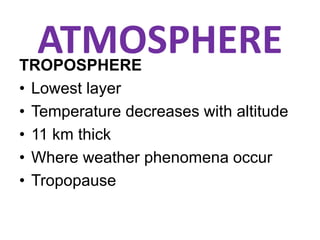
ATMOSPHERETROPOSPHERE
• Lowest layer
• Temperature decreases with altitude
• 11 km thick
• Where weather phenomena occur
• Tropopause
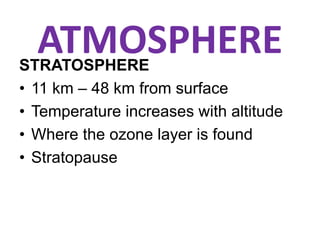
ATMOSPHERESTRATOSPHERE
• 11 km – 48 km from surface
• Temperature increases with altitude
• Where the ozone layer is found
• Stratopause
ATMOSPHERE
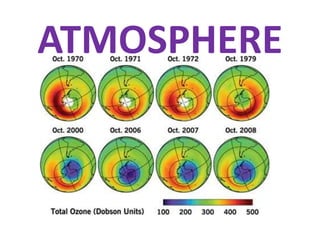
Ozone Layer is the component of the
atmosphere that protects Earth from
the harmful UVR of the sun.
ATMOSPHERE
ATMOSPHEREMESOSPHERE
• Temperature decreases with altitude
• Coldest layer (-90 deg. Celsius)
• Where asteroids/meteors burn up
• Mesopause
ATMOSPHERETHERMOSPHERE
• 55 km – Karman Line
• Least amount of atmospheric
molecules
• Receives most of HE radiation
• Increase in temperature as altitude
increases
ATMOSPHERE
LAYERS OF THE
ATMOSPHERE
PLOTTING
GEOSPHERE
The solid region of the Earth
which comprises not only the
solid visible layer but extends
to the center of the earth.
GEOSPHERE
CRUST
• outermost layer of the Earth
• relatively thin (1% of the Earth’s
volume)
• continental and oceanic crust
• crust is thickest at mountainous
regions
GEOSPHERE
MANTLE
• The Moho
• 82% of the Earth’s volume
• upper and lower mantle
• rocky lithosphere (upper mantle)
• plastic asthenosphere
GEOSPHERE
CORE
• Gutenburg Discontinuity
• Bullen/Lehman Discontinuity
• liquid outer core
• solid inner core
• iron-nickel (outer core of high
viscosity)
BIOSPHERE
• biological component of the Earth
• includes all microbes, plants and
animals from air to the oceans
• anthroposphere – “human
sphere”

Four spheres