During Reading Strategies

  Jigsaw and Four Quadrants


                              2.11.10, OHMC
Jigsaw
                         Procedure

• Divide the reading material into 5 segments

• Divide students into 5 groups, and give each group a
  segment

• Instruct students to, individually, read carefully, taking
  notes on most important points.

• When all groups are finished summarizing, instruct
  them to share their notes with their group and discuss.
  (set a time limit)
Jigsaw
                       Procedure

• Form new groups making sure that one student from
  each original group is represented

• Each member of the new group teaches the material
  from his reading segment

• Other students take notes

• Discuss as whole class to check for understanding
Jigsaw
                     What have we done?

Every student has:
• Read (A)

• Summarized text in writing (A)

• Discussed text in small groups (S)

• Taught text content (A)

• Discussed text in as a whole group (T)
Four Quadrants
                    Rationale

• Activates prior knowledge
• Helps students organize information
• Provides students opportunity to connect
  activity with their lives (genuine purpose =
  intrinsic motivation)
• Encourages students to ask questions which
  will inform subsequent instruction
Four Quadrants
                     Procedure


• Students read individually

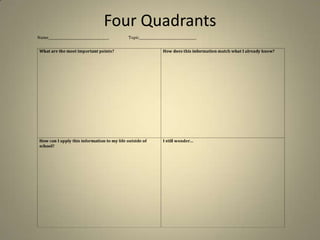
• Students fill out top half of the organizer as
  they read

• Students fill out bottom half of the organizer
  after they read
Four Quadrants
                       Procedure

• Students, in pairs, discuss their organizers.

• Discuss organizers as a class.

• Record student questions from “I still wonder”
  section.

• Small groups come up with methods to answer
  the remaining questions.
Four Quadrants
Four Quadrants
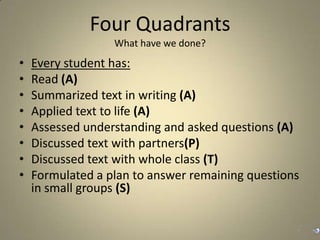
                  What have we done?
•   Every student has:
•   Read (A)
•   Summarized text in writing (A)
•   Applied text to life (A)
•   Assessed understanding and asked questions (A)
•   Discussed text with partners(P)
•   Discussed text with whole class (T)
•   Formulated a plan to answer remaining questions
    in small groups (S)

Four quadrants and jigsaw presentation

  • 1.
    During Reading Strategies Jigsaw and Four Quadrants 2.11.10, OHMC
  • 2.
    Jigsaw Procedure • Divide the reading material into 5 segments • Divide students into 5 groups, and give each group a segment • Instruct students to, individually, read carefully, taking notes on most important points. • When all groups are finished summarizing, instruct them to share their notes with their group and discuss. (set a time limit)
  • 3.
    Jigsaw Procedure • Form new groups making sure that one student from each original group is represented • Each member of the new group teaches the material from his reading segment • Other students take notes • Discuss as whole class to check for understanding
  • 4.
    Jigsaw What have we done? Every student has: • Read (A) • Summarized text in writing (A) • Discussed text in small groups (S) • Taught text content (A) • Discussed text in as a whole group (T)
  • 5.
    Four Quadrants Rationale • Activates prior knowledge • Helps students organize information • Provides students opportunity to connect activity with their lives (genuine purpose = intrinsic motivation) • Encourages students to ask questions which will inform subsequent instruction
  • 6.
    Four Quadrants Procedure • Students read individually • Students fill out top half of the organizer as they read • Students fill out bottom half of the organizer after they read
  • 7.
    Four Quadrants Procedure • Students, in pairs, discuss their organizers. • Discuss organizers as a class. • Record student questions from “I still wonder” section. • Small groups come up with methods to answer the remaining questions.
  • 8.
  • 9.
    Four Quadrants What have we done? • Every student has: • Read (A) • Summarized text in writing (A) • Applied text to life (A) • Assessed understanding and asked questions (A) • Discussed text with partners(P) • Discussed text with whole class (T) • Formulated a plan to answer remaining questions in small groups (S)