Promoting interaction
  through materials
       design

        Matthew Coomber
          Ritsumeikan University
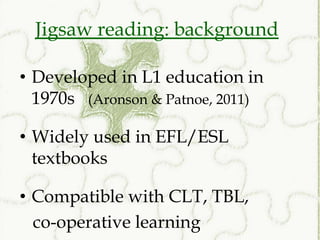
Jigsaw reading: background

• Developed in L1 education in
  1970s (Aronson & Patnoe, 2011)

• Widely used in EFL/ESL
  textbooks

• Compatible with CLT, TBL,
  co-operative learning
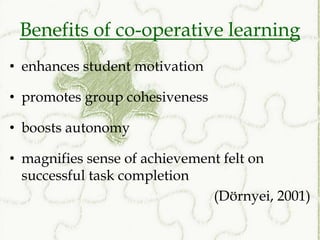
Benefits of co-operative learning
• enhances student motivation

• promotes group cohesiveness

• boosts autonomy

• magnifies sense of achievement felt on
  successful task completion
                               (Dörnyei, 2001)
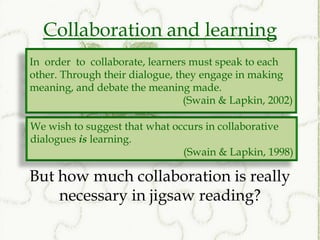
Collaboration and learning
In order to collaborate, learners must speak to each
other. Through their dialogue, they engage in making
meaning, and debate the meaning made.
                                 (Swain & Lapkin, 2002)

We wish to suggest that what occurs in collaborative
dialogues is learning.
                               (Swain & Lapkin, 1998)

But how much collaboration is really
    necessary in jigsaw reading?
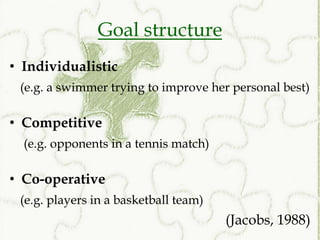
Goal structure
• Individualistic
 (e.g. a swimmer trying to improve her personal best)

• Competitive
  (e.g. opponents in a tennis match)

• Co-operative
 (e.g. players in a basketball team)
                                       (Jacobs, 1988)
Types of co-operative
           goal structure

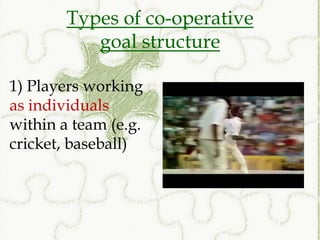
1) Players working
as individuals
within a team (e.g.
cricket, baseball)
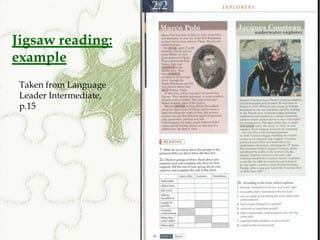
Jigsaw reading:
example
 Taken from Language
 Leader Intermediate,
 p.15
Types of co-operative
          goal structure

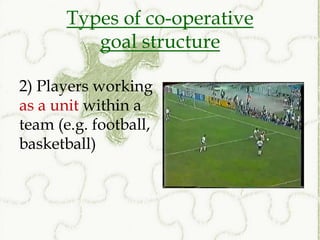
2) Players working
as a unit within a
team (e.g. football,
basketball)
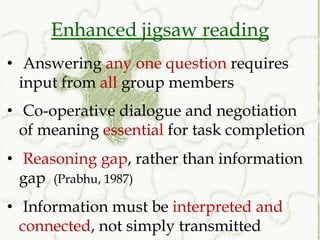
Enhanced jigsaw reading
• Answering any one question requires
  input from all group members
• Co-operative dialogue and negotiation
  of meaning essential for task completion
• Reasoning gap, rather than information
  gap (Prabhu, 1987)
• Information must be interpreted and
  connected, not simply transmitted
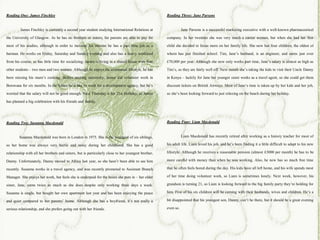
Reading One: James Finchley                                                                          Reading Three: Jane Parsons


         James Finchley is currently a second year student studying International Relations at                  Jane Parsons is a successful marketing executive with a well-known pharmaceutical

the University of Glasgow. As he has no brothers or sisters, his parents are able to pay for         company. In her twenties she was very much a career woman, but when she had her first

most of his studies, although in order to increase his income he has a part time job as a            child she decided to focus more on her family life. She now has four children, the oldest of

barman. He works on Friday, Saturday and Sunday evening and also has a heavy workload                whom has just finished school. Tim, Jane’s husband, is an engineer, and earns just over

from his course, so has little time for socializing. James is living in a shared house with four     £70,000 per year. Although she now only works part time, Jane’s salary is almost as high as

other students – two men and two women. Although he enjoys the communal lifestyle, he has            Tim’s, so they are fairly well off. Next month she’s taking the kids to visit their Uncle Danny

been missing his mum’s cooking. Before starting university, James did volunteer work in              in Kenya – luckily for Jane her younger sister works as a travel agent, so she could get them

Botswana for six months. In the future he’d like to work for a development agency, but he’s          discount tickets on British Airways. Most of Jane’s time is taken up by her kids and her job,

worried that the salary will not be good enough. Next Thursday is his 21st birthday, so James        so she’s been looking forward to just relaxing on the beach during her holiday.

has planned a big celebration with his friends and family.


Reading Two: Susanna Macdonald                                                                       Reading Four: Liam Macdonald


        Susanna Macdonald was born in London in 1975. She is the youngest of six siblings,                      Liam Macdonald has recently retired after working as a history teacher for most of

so her home was always very hectic and noisy during her childhood. She has a good                    his adult life. Liam loved his job, and he’s been finding it a little difficult to adapt to his new

relationship with all her brothers and sisters, but is particularly close to her youngest brother,   lifestyle. Although he receives a reasonable pension (almost £3000 per month) he has to be

Danny. Unfortunately, Danny moved to Africa last year, so she hasn’t been able to see him            more careful with money than when he was working. Also, he now has so much free time

recently. Susanna works in a travel agency, and was recently promoted to Assistant Branch            that he often feels bored during the day. His kids have all left home, and his wife spends most

Manager. She enjoys her work, but feels she is underpaid for the hours she puts in – her older       of her time doing volunteer work, so Liam is sometimes lonely. Next week, however, his

sister, Jane, earns twice as much as she does despite only working three days a week.                grandson is turning 21, so Liam is looking forward to the big family party they’re holding for

Susanna is single, but bought her own apartment last year and has been enjoying the peace            him. Five of his six children will be coming with their husbands, wives and children. He’s a

and quiet compared to her parents’ home. Although she has a boyfriend, it’s not really a             bit disappointed that his youngest son, Danny, can’t be there, but it should be a great evening

serious relationship, and she prefers going out with her friends.                                    even so.
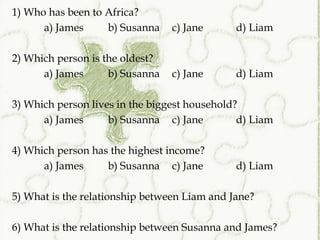
1) Who has been to Africa?
      a) James     b) Susanna    c) Jane      d) Liam

2) Which person is the oldest?
      a) James      b) Susanna   c) Jane      d) Liam

3) Which person lives in the biggest household?
      a) James      b) Susanna c) Jane         d) Liam

4) Which person has the highest income?
      a) James     b) Susanna c) Jane         d) Liam

5) What is the relationship between Liam and Jane?

6) What is the relationship between Susanna and James?
Enhanced jigsaw reading
• Answering any one question requires
  input from all group members
• Co-operative dialogue and negotiation
  of meaning essential for task completion
• Reasoning gap, rather than information
  gap (Prabhu, 1987)
• Information must be interpreted and
  connected, not simply transmitted
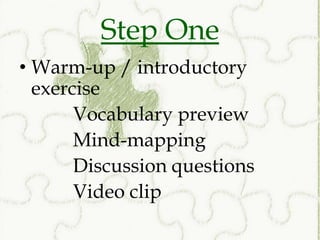
Step One
• Warm-up / introductory
  exercise
       Vocabulary preview
       Mind-mapping
       Discussion questions
       Video clip
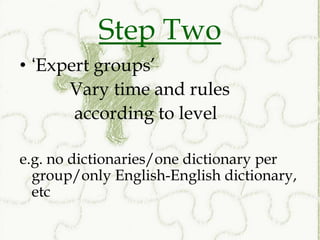
Step Two
• ‘Expert groups’
      Vary time and rules
       according to level

e.g. no dictionaries/one dictionary per
  group/only English-English dictionary,
  etc
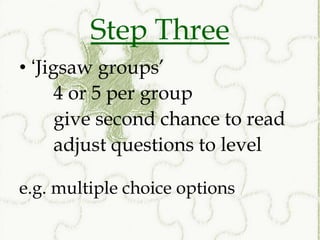
Step Three
• ‘Jigsaw groups’
      4 or 5 per group
      give second chance to read
      adjust questions to level

e.g. multiple choice options
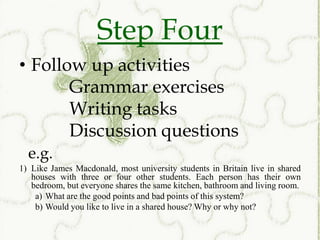
Step Four
• Follow up activities
       Grammar exercises
       Writing tasks
       Discussion questions
  e.g.
1) Like James Macdonald, most university students in Britain live in shared
   houses with three or four other students. Each person has their own
   bedroom, but everyone shares the same kitchen, bathroom and living room.
    a) What are the good points and bad points of this system?
    b) Would you like to live in a shared house? Why or why not?
Issues and problems
• Designing tasks is time
  consuming

• May appear contrived to native
  English speakers

• Focus is on speaking rather than
  reading
Conclusion
• Task design necessitates
  interpretation and negotiation, not
  just exchange of information.
• Learners must use logic and
  reasoning skills.
• Input from all group members is
  necessary for success.
References
Aronson, E., & Patnoe, S. (2011). Cooperation in the classroom: The Jigsaw
       Method. London: Pinter and Martin.

Dörnyei, Z. (2001). Motivational Strategies in the Language Classroom.
        Cambridge: Cambridge University Press.

Jacobs, G. (1988). Cooperative goal structure: a way to improve group
        activities. ELT Journal, 42 (2), 97-101.

Prabhu, N. (1987). Second language pedagogy: a perspective. Oxford:
       Oxford University Press.

Swain, M. & Lapkin, S. (2002). Interaction and Second Language
       Learning: Two Adolescent French Immersion Students
       Working Together. The Modern Language Journal, 82, 320-337.

Promoting interaction through materials design

  • 1.
    Promoting interaction through materials design Matthew Coomber Ritsumeikan University
  • 2.
    Jigsaw reading: background •Developed in L1 education in 1970s (Aronson & Patnoe, 2011) • Widely used in EFL/ESL textbooks • Compatible with CLT, TBL, co-operative learning
  • 3.
    Benefits of co-operativelearning • enhances student motivation • promotes group cohesiveness • boosts autonomy • magnifies sense of achievement felt on successful task completion (Dörnyei, 2001)
  • 4.
    Collaboration and learning Inorder to collaborate, learners must speak to each other. Through their dialogue, they engage in making meaning, and debate the meaning made. (Swain & Lapkin, 2002) We wish to suggest that what occurs in collaborative dialogues is learning. (Swain & Lapkin, 1998) But how much collaboration is really necessary in jigsaw reading?
  • 5.
    Goal structure • Individualistic (e.g. a swimmer trying to improve her personal best) • Competitive (e.g. opponents in a tennis match) • Co-operative (e.g. players in a basketball team) (Jacobs, 1988)
  • 6.
    Types of co-operative goal structure 1) Players working as individuals within a team (e.g. cricket, baseball)
  • 7.
    Jigsaw reading: example Takenfrom Language Leader Intermediate, p.15
  • 8.
    Types of co-operative goal structure 2) Players working as a unit within a team (e.g. football, basketball)
  • 9.
    Enhanced jigsaw reading •Answering any one question requires input from all group members • Co-operative dialogue and negotiation of meaning essential for task completion • Reasoning gap, rather than information gap (Prabhu, 1987) • Information must be interpreted and connected, not simply transmitted
  • 10.
    Reading One: JamesFinchley Reading Three: Jane Parsons James Finchley is currently a second year student studying International Relations at Jane Parsons is a successful marketing executive with a well-known pharmaceutical the University of Glasgow. As he has no brothers or sisters, his parents are able to pay for company. In her twenties she was very much a career woman, but when she had her first most of his studies, although in order to increase his income he has a part time job as a child she decided to focus more on her family life. She now has four children, the oldest of barman. He works on Friday, Saturday and Sunday evening and also has a heavy workload whom has just finished school. Tim, Jane’s husband, is an engineer, and earns just over from his course, so has little time for socializing. James is living in a shared house with four £70,000 per year. Although she now only works part time, Jane’s salary is almost as high as other students – two men and two women. Although he enjoys the communal lifestyle, he has Tim’s, so they are fairly well off. Next month she’s taking the kids to visit their Uncle Danny been missing his mum’s cooking. Before starting university, James did volunteer work in in Kenya – luckily for Jane her younger sister works as a travel agent, so she could get them Botswana for six months. In the future he’d like to work for a development agency, but he’s discount tickets on British Airways. Most of Jane’s time is taken up by her kids and her job, worried that the salary will not be good enough. Next Thursday is his 21st birthday, so James so she’s been looking forward to just relaxing on the beach during her holiday. has planned a big celebration with his friends and family. Reading Two: Susanna Macdonald Reading Four: Liam Macdonald Susanna Macdonald was born in London in 1975. She is the youngest of six siblings, Liam Macdonald has recently retired after working as a history teacher for most of so her home was always very hectic and noisy during her childhood. She has a good his adult life. Liam loved his job, and he’s been finding it a little difficult to adapt to his new relationship with all her brothers and sisters, but is particularly close to her youngest brother, lifestyle. Although he receives a reasonable pension (almost £3000 per month) he has to be Danny. Unfortunately, Danny moved to Africa last year, so she hasn’t been able to see him more careful with money than when he was working. Also, he now has so much free time recently. Susanna works in a travel agency, and was recently promoted to Assistant Branch that he often feels bored during the day. His kids have all left home, and his wife spends most Manager. She enjoys her work, but feels she is underpaid for the hours she puts in – her older of her time doing volunteer work, so Liam is sometimes lonely. Next week, however, his sister, Jane, earns twice as much as she does despite only working three days a week. grandson is turning 21, so Liam is looking forward to the big family party they’re holding for Susanna is single, but bought her own apartment last year and has been enjoying the peace him. Five of his six children will be coming with their husbands, wives and children. He’s a and quiet compared to her parents’ home. Although she has a boyfriend, it’s not really a bit disappointed that his youngest son, Danny, can’t be there, but it should be a great evening serious relationship, and she prefers going out with her friends. even so.
  • 11.
    1) Who hasbeen to Africa? a) James b) Susanna c) Jane d) Liam 2) Which person is the oldest? a) James b) Susanna c) Jane d) Liam 3) Which person lives in the biggest household? a) James b) Susanna c) Jane d) Liam 4) Which person has the highest income? a) James b) Susanna c) Jane d) Liam 5) What is the relationship between Liam and Jane? 6) What is the relationship between Susanna and James?
  • 12.
    Enhanced jigsaw reading •Answering any one question requires input from all group members • Co-operative dialogue and negotiation of meaning essential for task completion • Reasoning gap, rather than information gap (Prabhu, 1987) • Information must be interpreted and connected, not simply transmitted
  • 13.
    Step One • Warm-up/ introductory exercise Vocabulary preview Mind-mapping Discussion questions Video clip
  • 14.
    Step Two • ‘Expertgroups’ Vary time and rules according to level e.g. no dictionaries/one dictionary per group/only English-English dictionary, etc
  • 15.
    Step Three • ‘Jigsawgroups’ 4 or 5 per group give second chance to read adjust questions to level e.g. multiple choice options
  • 16.
    Step Four • Followup activities Grammar exercises Writing tasks Discussion questions e.g. 1) Like James Macdonald, most university students in Britain live in shared houses with three or four other students. Each person has their own bedroom, but everyone shares the same kitchen, bathroom and living room. a) What are the good points and bad points of this system? b) Would you like to live in a shared house? Why or why not?
  • 17.
    Issues and problems •Designing tasks is time consuming • May appear contrived to native English speakers • Focus is on speaking rather than reading
  • 18.
    Conclusion • Task designnecessitates interpretation and negotiation, not just exchange of information. • Learners must use logic and reasoning skills. • Input from all group members is necessary for success.
  • 19.
    References Aronson, E., &Patnoe, S. (2011). Cooperation in the classroom: The Jigsaw Method. London: Pinter and Martin. Dörnyei, Z. (2001). Motivational Strategies in the Language Classroom. Cambridge: Cambridge University Press. Jacobs, G. (1988). Cooperative goal structure: a way to improve group activities. ELT Journal, 42 (2), 97-101. Prabhu, N. (1987). Second language pedagogy: a perspective. Oxford: Oxford University Press. Swain, M. & Lapkin, S. (2002). Interaction and Second Language Learning: Two Adolescent French Immersion Students Working Together. The Modern Language Journal, 82, 320-337.