Promotion of Technology for
Utilization of Slag Waste from
Foundries
in
Paver Block Making
Kolkata
20 January 2016
NSTEDB
Department of Science & Technology
Government of India
1
NSTEDB
Department of Science & Technology
Government of India
2
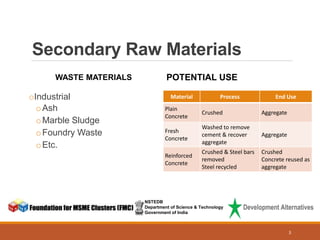
Secondary Raw Materials
WASTE MATERIALS
oIndustrial
oAsh
oMarble Sludge
oFoundry Waste
oEtc.
POTENTIAL USE
Material Process End Use
Plain
Concrete
Crushed Aggregate
Fresh
Concrete
Washed to remove
cement & recover
aggregate
Aggregate
Reinforced
Concrete
Crushed & Steel bars
removed
Steel recycled
Crushed
Concrete reused as
aggregate
NSTEDB
Department of Science & Technology
Government of India
3
What is foundry slag waste?
NSTEDB
Department of Science & Technology
Government of India
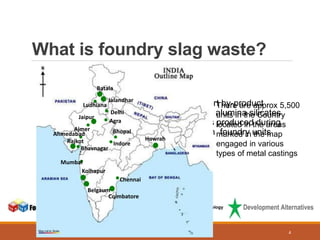
o The slag is a non-metallic inert by-product
primarily consists of silicates, alumina silicates
and calcium alumina-silicates produced during
production of iron and steel in foundry units
Batala
Jalandhar
Ludhiana
Delhi
Agra
Indore
HowrahRajkot
Ajmer
Mumbai
Kolhapur
Chennai
Jaipur
Ahmedabad Bhopal
Bhavnagar
Belgaum
Coimbatore
There are approx 5,500
units in the Country
located in the areas
marked in the map
engaged in various
types of metal castings
4
Indian foundry sector… at a glance
NSTEDB
Department of Science & Technology
Government of India
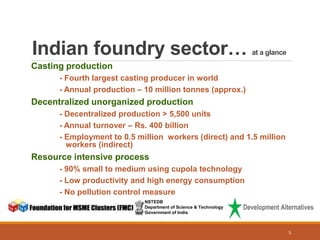
Casting production
- Fourth largest casting producer in world
- Annual production – 10 million tonnes (approx.)
Decentralized unorganized production
- Decentralized production > 5,500 units
- Annual turnover – Rs. 400 billion
- Employment to 0.5 million workers (direct) and 1.5 million
workers (indirect)
Resource intensive process
- 90% small to medium using cupola technology
- Low productivity and high energy consumption
- No pollution control measure
5
Indian foundry sector… at a glance
NSTEDB
Department of Science & Technology
Government of India
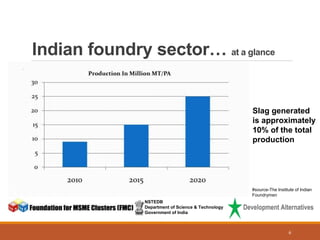
Slag generated
is approximately
10% of the total
production
#source-The Institute of Indian
Foundrymen
6
Challenge identified
NSTEDB
Department of Science & Technology
Government of India
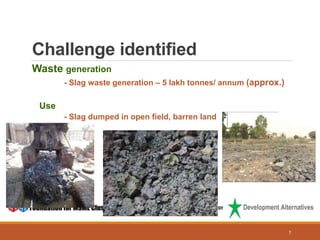
Waste generation
- Slag waste generation – 5 lakh tonnes/ annum (approx.)
Use
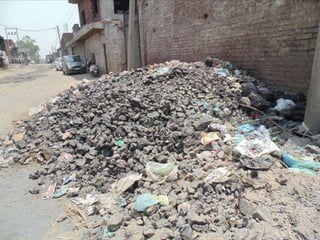
- Slag dumped in open field, barren land
7
NSTEDB
Department of Science & Technology
Government of India
8
NSTEDB
Department of Science & Technology
Government of India
9
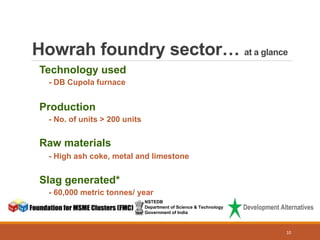
Howrah foundry sector… at a glance
NSTEDB
Department of Science & Technology
Government of India
Technology used
- DB Cupola furnace
Production
- No. of units > 200 units
Raw materials
- High ash coke, metal and limestone
Slag generated*
- 60,000 metric tonnes/ year
10
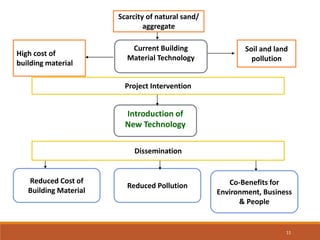
Current Building
Material Technology
Scarcity of natural sand/
aggregate
Soil and land
pollution
High cost of
building material
Introduction of
New Technology
Project Intervention
Reduced Pollution
Reduced Cost of
Building Material
Dissemination
Co-Benefits for
Environment, Business
& People
Dissemination
11
NSTEDB
Department of Science & Technology
Government of India
Innovative Solutions
12
Technology developed
NSTEDB
Department of Science & Technology
Government of India
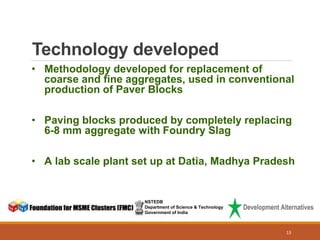
• Methodology developed for replacement of
coarse and fine aggregates, used in conventional
production of Paver Blocks
• Paving blocks produced by completely replacing
6-8 mm aggregate with Foundry Slag
• A lab scale plant set up at Datia, Madhya Pradesh
13
NSTEDB
Department of Science & Technology
Government of India
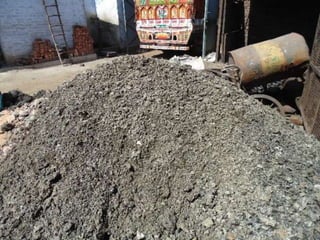
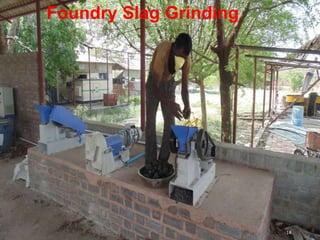
Foundry Slag Grinding
14
NSTEDB
Department of Science & Technology
Government of India
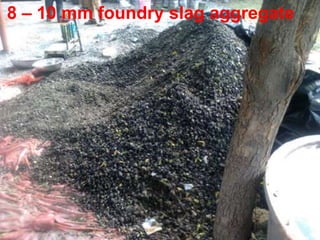
8 – 10 mm foundry slag aggregate
15
NSTEDB
Department of Science & Technology
Government of India
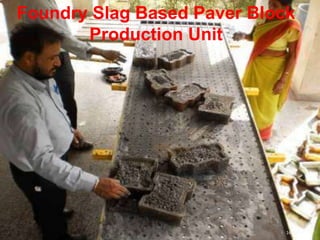
Foundry Slag Based Paver Block
Production Unit
16
17
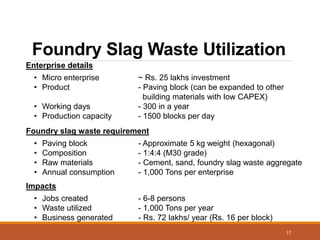
Foundry Slag Waste Utilization
Enterprise details
• Micro enterprise ~ Rs. 25 lakhs investment
• Product - Paving block (can be expanded to other
building materials with low CAPEX)
• Working days - 300 in a year
• Production capacity - 1500 blocks per day
Foundry slag waste requirement
• Paving block - Approximate 5 kg weight (hexagonal)
• Composition - 1:4:4 (M30 grade)
• Raw materials - Cement, sand, foundry slag waste aggregate
• Annual consumption - 1,000 Tons per enterprise
Impacts
• Jobs created - 6-8 persons
• Waste utilized - 1,000 Tons per year
• Business generated - Rs. 72 lakhs/ year (Rs. 16 per block)
Product certification
NSTEDB
Department of Science & Technology
Government of India
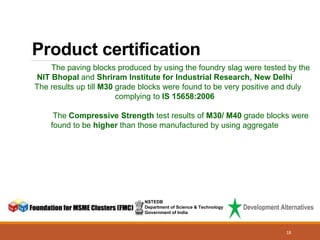
The paving blocks produced by using the foundry slag were tested by the
NIT Bhopal and Shriram Institute for Industrial Research, New Delhi
The results up till M30 grade blocks were found to be very positive and duly
complying to IS 15658:2006
The Compressive Strength test results of M30/ M40 grade blocks were
found to be higher than those manufactured by using aggregate
18
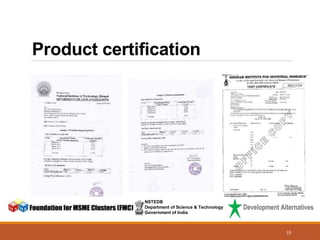
Product certification
NSTEDB
Department of Science & Technology
Government of India
19
NSTEDB
Department of Science & Technology
Government of India
20
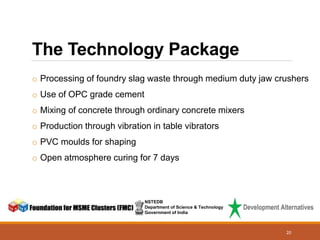
The Technology Package
o Processing of foundry slag waste through medium duty jaw crushers
o Use of OPC grade cement
o Mixing of concrete through ordinary concrete mixers
o Production through vibration in table vibrators
o PVC moulds for shaping
o Open atmosphere curing for 7 days
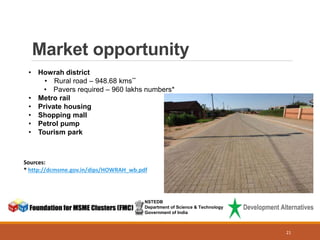
Market opportunity
NSTEDB
Department of Science & Technology
Government of India
• Howrah district
• Rural road – 948.68 kms**
• Pavers required – 960 lakhs numbers*
• Metro rail
• Private housing
• Shopping mall
• Petrol pump
• Tourism park
Sources:
* http://dcmsme.gov.in/dips/HOWRAH_wb.pdf
21
The business
NSTEDB
Department of Science & Technology
Government of India
22
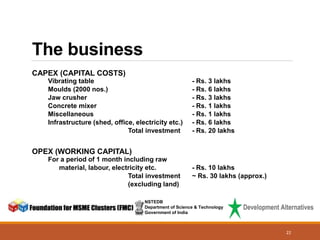
CAPEX (CAPITAL COSTS)
Vibrating table - Rs. 3 lakhs
Moulds (2000 nos.) - Rs. 6 lakhs
Jaw crusher - Rs. 3 lakhs
Concrete mixer - Rs. 1 lakhs
Miscellaneous - Rs. 1 lakhs
Infrastructure (shed, office, electricity etc.) - Rs. 6 lakhs
Total investment - Rs. 20 lakhs
OPEX (WORKING CAPITAL)
For a period of 1 month including raw
material, labour, electricity etc. - Rs. 10 lakhs
Total investment ~ Rs. 30 lakhs (approx.)
(excluding land)
The business
NSTEDB
Department of Science & Technology
Government of India
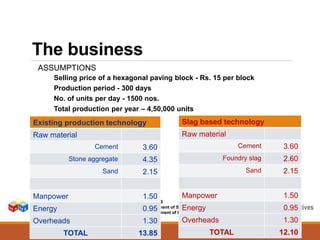
ASSUMPTIONS
Selling price of a hexagonal paving block - Rs. 15 per block
Production period - 300 days
No. of units per day - 1500 nos.
Total production per year – 4,50,000 units
23
Existing production technology
Raw material
Cement 3.60
Stone aggregate 4.35
Sand 2.15
Manpower 1.50
Energy 0.95
Overheads 1.30
TOTAL 13.85
Slag based technology
Raw material
Cement 3.60
Foundry slag 2.60
Sand 2.15
Manpower 1.50
Energy 0.95
Overheads 1.30
TOTAL 12.10
The business
NSTEDB
Department of Science & Technology
Government of India
24
ASSUMPTIONS
Selling price of a hexagonal paving block - Rs. 16 per block
Production period - 300 days
No. of units per day - 1500 nos.
Total production per year – 4,50,000 units
PROFITABILITY IN EXISTING PAVING BLOCK PRODUCTION (FROM SINGLE
MACHINE)
Production cost - Rs. 13.85 per block
(including expenses and bank loan returns)
 Profitability - Rs. 9.5 lakhs per year
PROFITABILITY IN FOUNDRY SLAG WASTE BASED PAVING BLOCK
PRODUCTION (FROM SINGLE MACHINE)
Production cost - Rs. 12 per block
(including expenses and bank loan returns)
 Profitability - Rs. 18 lakhs per year
The enterprise establishment cost
NSTEDB
Department of Science & Technology
Government of India
The establishment of an enterprise can be financed through the PMEGP scheme of the
Ministry of MSME
Total project cost – Rs. 25 lakhs
• Entrepreneur’s contribution – 2.5 lakhs
• Term loan (from Banks) – 15.75 lakhs
• Govt. of India subsidy – 6.75 lakhs
PMEGP (Prime Minister’s Employment Generation Programme) scheme (KVIC)
• General Category
• Urban – 15%
• Rural – 25%
• Entrepreneur’s contribution – 10%
• Special Category
• Urban – 25%
• Rural – 35%
• Entrepreneur’s contribution – 5%
25
NSTEDB
Department of Science & Technology
Government of India
Thanks
26

Foundry Slag Waste to Building Material

  • 1.
    Promotion of Technologyfor Utilization of Slag Waste from Foundries in Paver Block Making Kolkata 20 January 2016 NSTEDB Department of Science & Technology Government of India 1
  • 2.
    NSTEDB Department of Science& Technology Government of India 2
  • 3.
    Secondary Raw Materials WASTEMATERIALS oIndustrial oAsh oMarble Sludge oFoundry Waste oEtc. POTENTIAL USE Material Process End Use Plain Concrete Crushed Aggregate Fresh Concrete Washed to remove cement & recover aggregate Aggregate Reinforced Concrete Crushed & Steel bars removed Steel recycled Crushed Concrete reused as aggregate NSTEDB Department of Science & Technology Government of India 3
  • 4.
    What is foundryslag waste? NSTEDB Department of Science & Technology Government of India o The slag is a non-metallic inert by-product primarily consists of silicates, alumina silicates and calcium alumina-silicates produced during production of iron and steel in foundry units Batala Jalandhar Ludhiana Delhi Agra Indore HowrahRajkot Ajmer Mumbai Kolhapur Chennai Jaipur Ahmedabad Bhopal Bhavnagar Belgaum Coimbatore There are approx 5,500 units in the Country located in the areas marked in the map engaged in various types of metal castings 4
  • 5.
    Indian foundry sector…at a glance NSTEDB Department of Science & Technology Government of India Casting production - Fourth largest casting producer in world - Annual production – 10 million tonnes (approx.) Decentralized unorganized production - Decentralized production > 5,500 units - Annual turnover – Rs. 400 billion - Employment to 0.5 million workers (direct) and 1.5 million workers (indirect) Resource intensive process - 90% small to medium using cupola technology - Low productivity and high energy consumption - No pollution control measure 5
  • 6.
    Indian foundry sector…at a glance NSTEDB Department of Science & Technology Government of India Slag generated is approximately 10% of the total production #source-The Institute of Indian Foundrymen 6
  • 7.
    Challenge identified NSTEDB Department ofScience & Technology Government of India Waste generation - Slag waste generation – 5 lakh tonnes/ annum (approx.) Use - Slag dumped in open field, barren land 7
  • 8.
    NSTEDB Department of Science& Technology Government of India 8
  • 9.
    NSTEDB Department of Science& Technology Government of India 9
  • 10.
    Howrah foundry sector…at a glance NSTEDB Department of Science & Technology Government of India Technology used - DB Cupola furnace Production - No. of units > 200 units Raw materials - High ash coke, metal and limestone Slag generated* - 60,000 metric tonnes/ year 10
  • 11.
    Current Building Material Technology Scarcityof natural sand/ aggregate Soil and land pollution High cost of building material Introduction of New Technology Project Intervention Reduced Pollution Reduced Cost of Building Material Dissemination Co-Benefits for Environment, Business & People Dissemination 11
  • 12.
    NSTEDB Department of Science& Technology Government of India Innovative Solutions 12
  • 13.
    Technology developed NSTEDB Department ofScience & Technology Government of India • Methodology developed for replacement of coarse and fine aggregates, used in conventional production of Paver Blocks • Paving blocks produced by completely replacing 6-8 mm aggregate with Foundry Slag • A lab scale plant set up at Datia, Madhya Pradesh 13
  • 14.
    NSTEDB Department of Science& Technology Government of India Foundry Slag Grinding 14
  • 15.
    NSTEDB Department of Science& Technology Government of India 8 – 10 mm foundry slag aggregate 15
  • 16.
    NSTEDB Department of Science& Technology Government of India Foundry Slag Based Paver Block Production Unit 16
  • 17.
    17 Foundry Slag WasteUtilization Enterprise details • Micro enterprise ~ Rs. 25 lakhs investment • Product - Paving block (can be expanded to other building materials with low CAPEX) • Working days - 300 in a year • Production capacity - 1500 blocks per day Foundry slag waste requirement • Paving block - Approximate 5 kg weight (hexagonal) • Composition - 1:4:4 (M30 grade) • Raw materials - Cement, sand, foundry slag waste aggregate • Annual consumption - 1,000 Tons per enterprise Impacts • Jobs created - 6-8 persons • Waste utilized - 1,000 Tons per year • Business generated - Rs. 72 lakhs/ year (Rs. 16 per block)
  • 18.
    Product certification NSTEDB Department ofScience & Technology Government of India The paving blocks produced by using the foundry slag were tested by the NIT Bhopal and Shriram Institute for Industrial Research, New Delhi The results up till M30 grade blocks were found to be very positive and duly complying to IS 15658:2006 The Compressive Strength test results of M30/ M40 grade blocks were found to be higher than those manufactured by using aggregate 18
  • 19.
    Product certification NSTEDB Department ofScience & Technology Government of India 19
  • 20.
    NSTEDB Department of Science& Technology Government of India 20 The Technology Package o Processing of foundry slag waste through medium duty jaw crushers o Use of OPC grade cement o Mixing of concrete through ordinary concrete mixers o Production through vibration in table vibrators o PVC moulds for shaping o Open atmosphere curing for 7 days
  • 21.
    Market opportunity NSTEDB Department ofScience & Technology Government of India • Howrah district • Rural road – 948.68 kms** • Pavers required – 960 lakhs numbers* • Metro rail • Private housing • Shopping mall • Petrol pump • Tourism park Sources: * http://dcmsme.gov.in/dips/HOWRAH_wb.pdf 21
  • 22.
    The business NSTEDB Department ofScience & Technology Government of India 22 CAPEX (CAPITAL COSTS) Vibrating table - Rs. 3 lakhs Moulds (2000 nos.) - Rs. 6 lakhs Jaw crusher - Rs. 3 lakhs Concrete mixer - Rs. 1 lakhs Miscellaneous - Rs. 1 lakhs Infrastructure (shed, office, electricity etc.) - Rs. 6 lakhs Total investment - Rs. 20 lakhs OPEX (WORKING CAPITAL) For a period of 1 month including raw material, labour, electricity etc. - Rs. 10 lakhs Total investment ~ Rs. 30 lakhs (approx.) (excluding land)
  • 23.
    The business NSTEDB Department ofScience & Technology Government of India ASSUMPTIONS Selling price of a hexagonal paving block - Rs. 15 per block Production period - 300 days No. of units per day - 1500 nos. Total production per year – 4,50,000 units 23 Existing production technology Raw material Cement 3.60 Stone aggregate 4.35 Sand 2.15 Manpower 1.50 Energy 0.95 Overheads 1.30 TOTAL 13.85 Slag based technology Raw material Cement 3.60 Foundry slag 2.60 Sand 2.15 Manpower 1.50 Energy 0.95 Overheads 1.30 TOTAL 12.10
  • 24.
    The business NSTEDB Department ofScience & Technology Government of India 24 ASSUMPTIONS Selling price of a hexagonal paving block - Rs. 16 per block Production period - 300 days No. of units per day - 1500 nos. Total production per year – 4,50,000 units PROFITABILITY IN EXISTING PAVING BLOCK PRODUCTION (FROM SINGLE MACHINE) Production cost - Rs. 13.85 per block (including expenses and bank loan returns)  Profitability - Rs. 9.5 lakhs per year PROFITABILITY IN FOUNDRY SLAG WASTE BASED PAVING BLOCK PRODUCTION (FROM SINGLE MACHINE) Production cost - Rs. 12 per block (including expenses and bank loan returns)  Profitability - Rs. 18 lakhs per year
  • 25.
    The enterprise establishmentcost NSTEDB Department of Science & Technology Government of India The establishment of an enterprise can be financed through the PMEGP scheme of the Ministry of MSME Total project cost – Rs. 25 lakhs • Entrepreneur’s contribution – 2.5 lakhs • Term loan (from Banks) – 15.75 lakhs • Govt. of India subsidy – 6.75 lakhs PMEGP (Prime Minister’s Employment Generation Programme) scheme (KVIC) • General Category • Urban – 15% • Rural – 25% • Entrepreneur’s contribution – 10% • Special Category • Urban – 25% • Rural – 35% • Entrepreneur’s contribution – 5% 25
  • 26.
    NSTEDB Department of Science& Technology Government of India Thanks 26