Daniel Howe
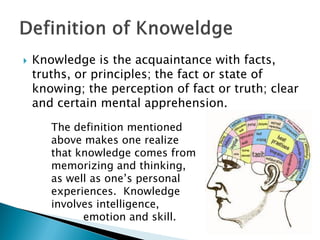
   Knowledge is the acquaintance with facts,
    truths, or principles; the fact or state of
    knowing; the perception of fact or truth; clear
    and certain mental apprehension.
       The definition mentioned
       above makes one realize
       that knowledge comes from
       memorizing and thinking,
       as well as one’s personal
       experiences. Knowledge
       involves intelligence,
             emotion and skill.
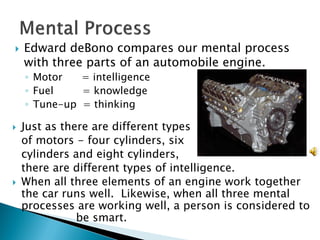
   Edward deBono compares our mental process
    with three parts of an automobile engine.
    ā—¦ Motor   = intelligence
    ā—¦ Fuel    = knowledge
    ā—¦ Tune-up = thinking

   Just as there are different types
    of motors - four cylinders, six
    cylinders and eight cylinders,
    there are different types of intelligence.
   When all three elements of an engine work together
    the car runs well. Likewise, when all three mental
    processes are working well, a person is considered to
               be smart.
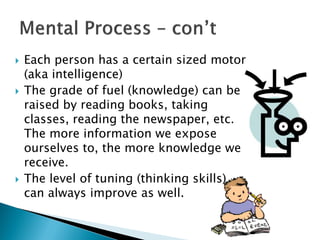
   Each person has a certain sized motor
    (aka intelligence)
   The grade of fuel (knowledge) can be
    raised by reading books, taking
    classes, reading the newspaper, etc.
    The more information we expose
    ourselves to, the more knowledge we
    receive.
   The level of tuning (thinking skills)
    can always improve as well.
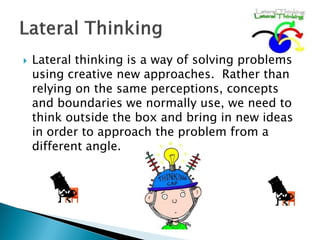
   Lateral thinking is a way of solving problems
    using creative new approaches. Rather than
    relying on the same perceptions, concepts
    and boundaries we normally use, we need to
    think outside the box and bring in new ideas
    in order to approach the problem from a
    different angle.
   Edward deBono defines lateral
    thinking using four aspects:
    ā—¦ 1) recognize main ideas
    ā—¦ 2) search for different ways of looking
         at things
    ā—¦ 3) be flexible in your thinking
    ā—¦ 4) use change to encourage other ideas
   Lateral thinking can:
    ā—¦ turn problems into opportunities
    ā—¦ find alternative solutions
    ā—¦ increase the number of new ideas using
      unconventional thinking
    ā—¦ give a new starting point to come up with new
      solutions
   Traditional IQ focused on two types of
    intelligence.
    ā—¦ Linguistic intelligence (using words and language)
    ā—¦ Logical-mathematical intelligence (reasoning)

   Michael Gardner goes beyond this and
    defines eight types of intelligence.
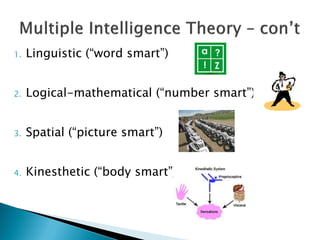
1.   Linguistic (ā€œword smartā€)


2.   Logical-mathematical (ā€œnumber smartā€)


3.   Spatial (ā€œpicture smartā€)


4.   Kinesthetic (ā€œbody smartā€)
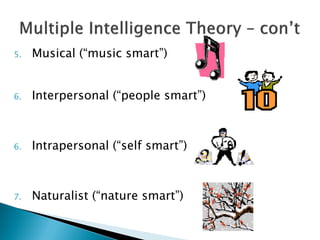
5.   Musical (ā€œmusic smartā€)


6.   Interpersonal (ā€œpeople smartā€)


6.   Intrapersonal (ā€œself smartā€)


7.   Naturalist (ā€œnature smartā€)
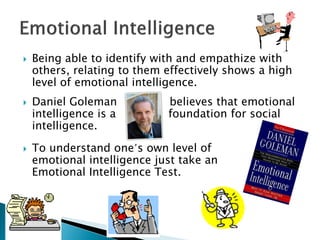
   Being able to identify with and empathize with
    others, relating to them effectively shows a high
    level of emotional intelligence.
   Daniel Goleman           believes that emotional
    intelligence is a        foundation for social
    intelligence.

   To understand one’s own level of
    emotional intelligence just take an
    Emotional Intelligence Test.
   There is a difference between
    intelligence and thinking
   There are different types of intelligence
   Thinking is a skill that can be improved
   Emotions need to be understood and used
   No matter how ā€œsmartā€ a person is, they can
    always improve.

Foundations of knowledge ppt

  • 1.
  • 2.
     Knowledge is the acquaintance with facts, truths, or principles; the fact or state of knowing; the perception of fact or truth; clear and certain mental apprehension. The definition mentioned above makes one realize that knowledge comes from memorizing and thinking, as well as one’s personal experiences. Knowledge involves intelligence, emotion and skill.
  • 3.
     Edward deBono compares our mental process with three parts of an automobile engine. ā—¦ Motor = intelligence ā—¦ Fuel = knowledge ā—¦ Tune-up = thinking  Just as there are different types of motors - four cylinders, six cylinders and eight cylinders, there are different types of intelligence.  When all three elements of an engine work together the car runs well. Likewise, when all three mental processes are working well, a person is considered to be smart.
  • 4.
     Each person has a certain sized motor (aka intelligence)  The grade of fuel (knowledge) can be raised by reading books, taking classes, reading the newspaper, etc. The more information we expose ourselves to, the more knowledge we receive.  The level of tuning (thinking skills) can always improve as well.
  • 5.
     Lateral thinking is a way of solving problems using creative new approaches. Rather than relying on the same perceptions, concepts and boundaries we normally use, we need to think outside the box and bring in new ideas in order to approach the problem from a different angle.
  • 6.
     Edward deBono defines lateral thinking using four aspects: ā—¦ 1) recognize main ideas ā—¦ 2) search for different ways of looking at things ā—¦ 3) be flexible in your thinking ā—¦ 4) use change to encourage other ideas
  • 7.
     Lateral thinking can: ā—¦ turn problems into opportunities ā—¦ find alternative solutions ā—¦ increase the number of new ideas using unconventional thinking ā—¦ give a new starting point to come up with new solutions
  • 8.
     Traditional IQ focused on two types of intelligence. ā—¦ Linguistic intelligence (using words and language) ā—¦ Logical-mathematical intelligence (reasoning)  Michael Gardner goes beyond this and defines eight types of intelligence.
  • 9.
    1. Linguistic (ā€œword smartā€) 2. Logical-mathematical (ā€œnumber smartā€) 3. Spatial (ā€œpicture smartā€) 4. Kinesthetic (ā€œbody smartā€)
  • 10.
    5. Musical (ā€œmusic smartā€) 6. Interpersonal (ā€œpeople smartā€) 6. Intrapersonal (ā€œself smartā€) 7. Naturalist (ā€œnature smartā€)
  • 11.
     Being able to identify with and empathize with others, relating to them effectively shows a high level of emotional intelligence.  Daniel Goleman believes that emotional intelligence is a foundation for social intelligence.  To understand one’s own level of emotional intelligence just take an Emotional Intelligence Test.
  • 12.
     There is a difference between intelligence and thinking  There are different types of intelligence  Thinking is a skill that can be improved  Emotions need to be understood and used  No matter how ā€œsmartā€ a person is, they can always improve.