1 - 1Copyright © 2006, The McGraw-Hill Companies, Inc. All rights reserved.
Foundations of
Information Systems
in Business
Chapter
1
1 - 2Copyright © 2006, The McGraw-Hill Companies, Inc. All rights reserved.
What is an Information System?
Any organized combination of people,
hardware, software, communications
networks, and data resources that stores,
retrieves, transforms, and disseminates
information in an organization.
1 - 3Copyright © 2006, The McGraw-Hill Companies, Inc. All rights reserved.
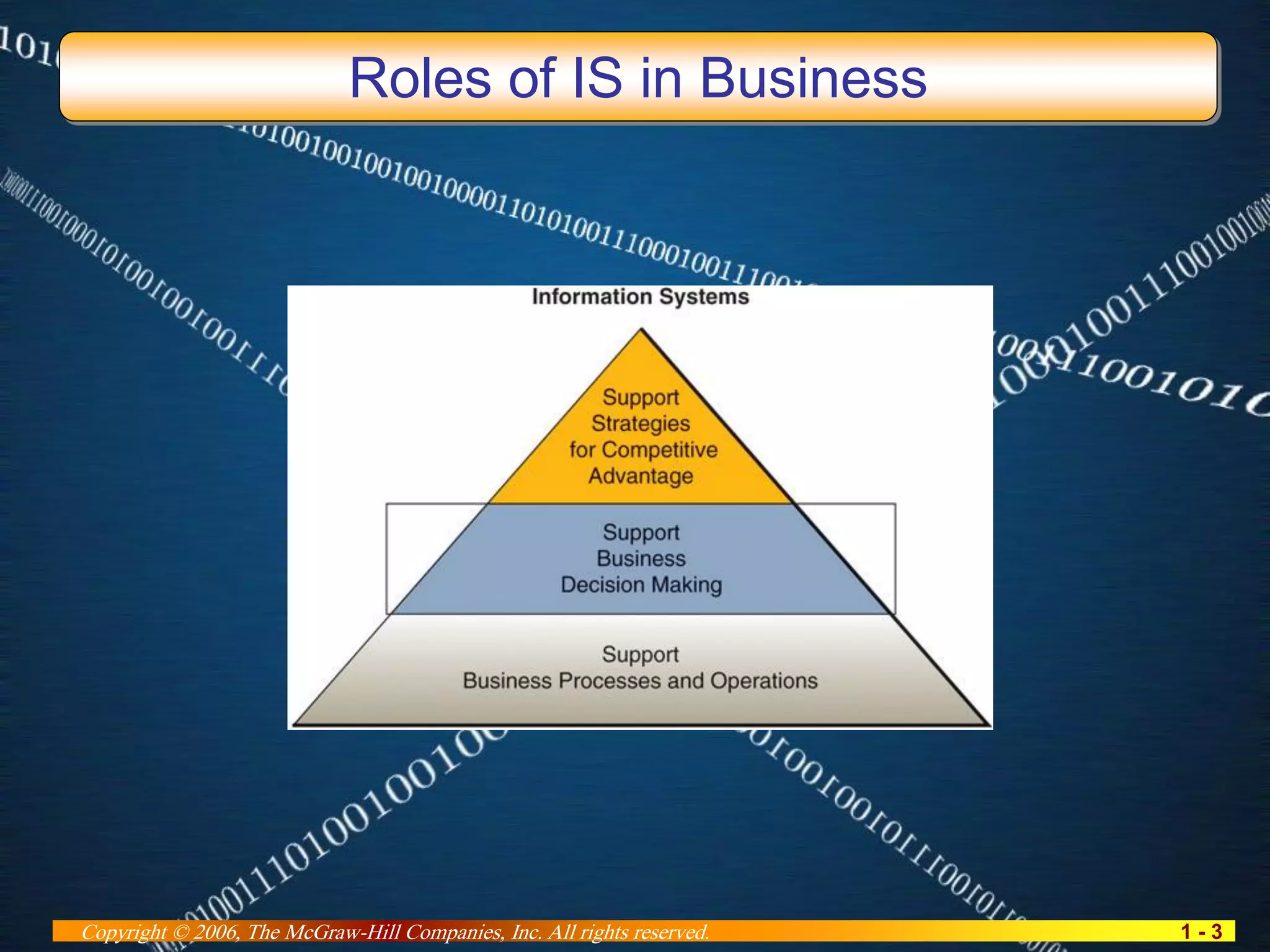
Roles of IS in Business
1 - 4Copyright © 2006, The McGraw-Hill Companies, Inc. All rights reserved.
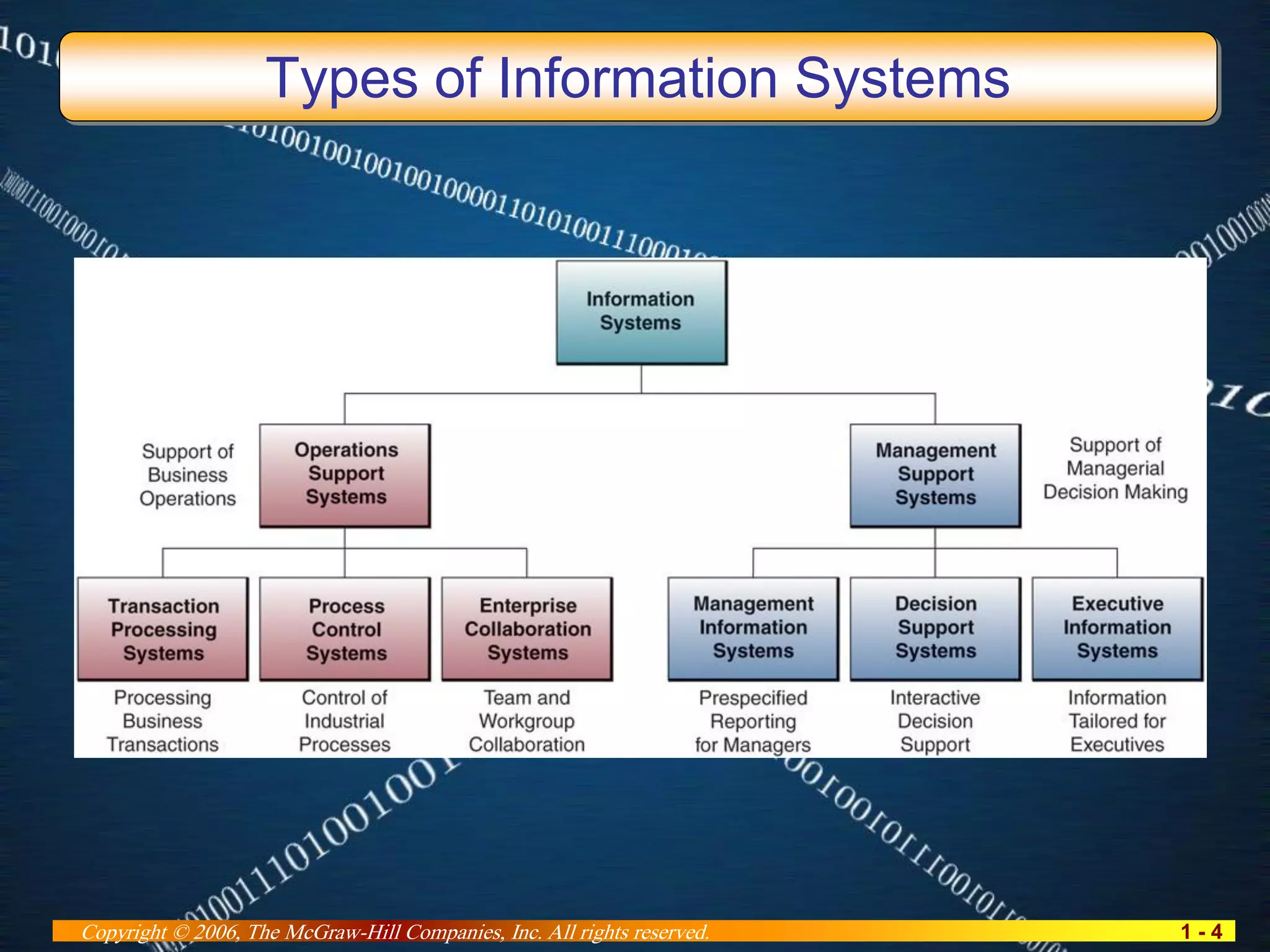
Types of Information Systems
1 - 5Copyright © 2006, The McGraw-Hill Companies, Inc. All rights reserved.
Operation Support Systems
Definition:
• Information systems that process data
generated by and used in business
operations
• Goal is to efficiently process business
transactions, control industrial processes,
support enterprise communications and
collaboration, and update corporate
databases
1 - 6Copyright © 2006, The McGraw-Hill Companies, Inc. All rights reserved.
Examples of Operations Support Systems
• Transaction Processing Systems (TPS) –
process data resulting from business
transactions, update operational databases, and
produce business documents.
• Process Control Systems (PCS) – monitor and
control industrial processes.
• Enterprise Collaboration Systems – support
team, workgroup, and enterprise
communications an collaboration.
1 - 7Copyright © 2006, The McGraw-Hill Companies, Inc. All rights reserved.
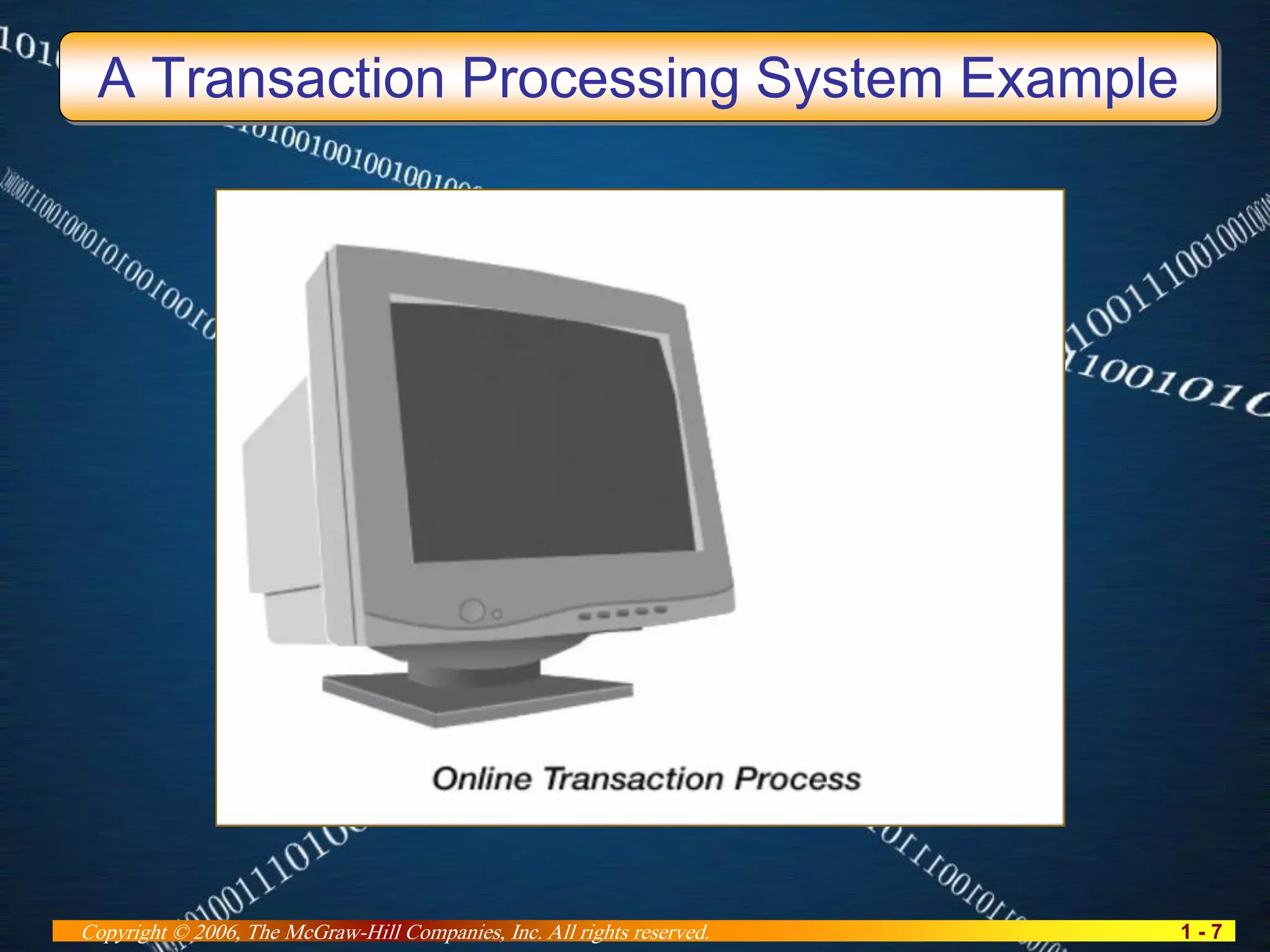
A Transaction Processing System Example
1 - 8Copyright © 2006, The McGraw-Hill Companies, Inc. All rights reserved.
Management Support Systems
Definition:
• Information systems that focus on
providing information and support for
effective decision making by managers
1 - 9Copyright © 2006, The McGraw-Hill Companies, Inc. All rights reserved.
Management Support Systems
• Management Information Systems (MIS) –
provide information in the form of pre-specified
reports and displays to support business
decision making.
• Decision Support Systems (DSS) – provide
interactive ad hoc support for the decision
making processes of managers and other
business professionals.
• Executive Information Systems (EIS) – provide
critical information from MIS, DSS, and other
sources tailored to the information needs of
executives.
1 - 10Copyright © 2006, The McGraw-Hill Companies, Inc. All rights reserved.
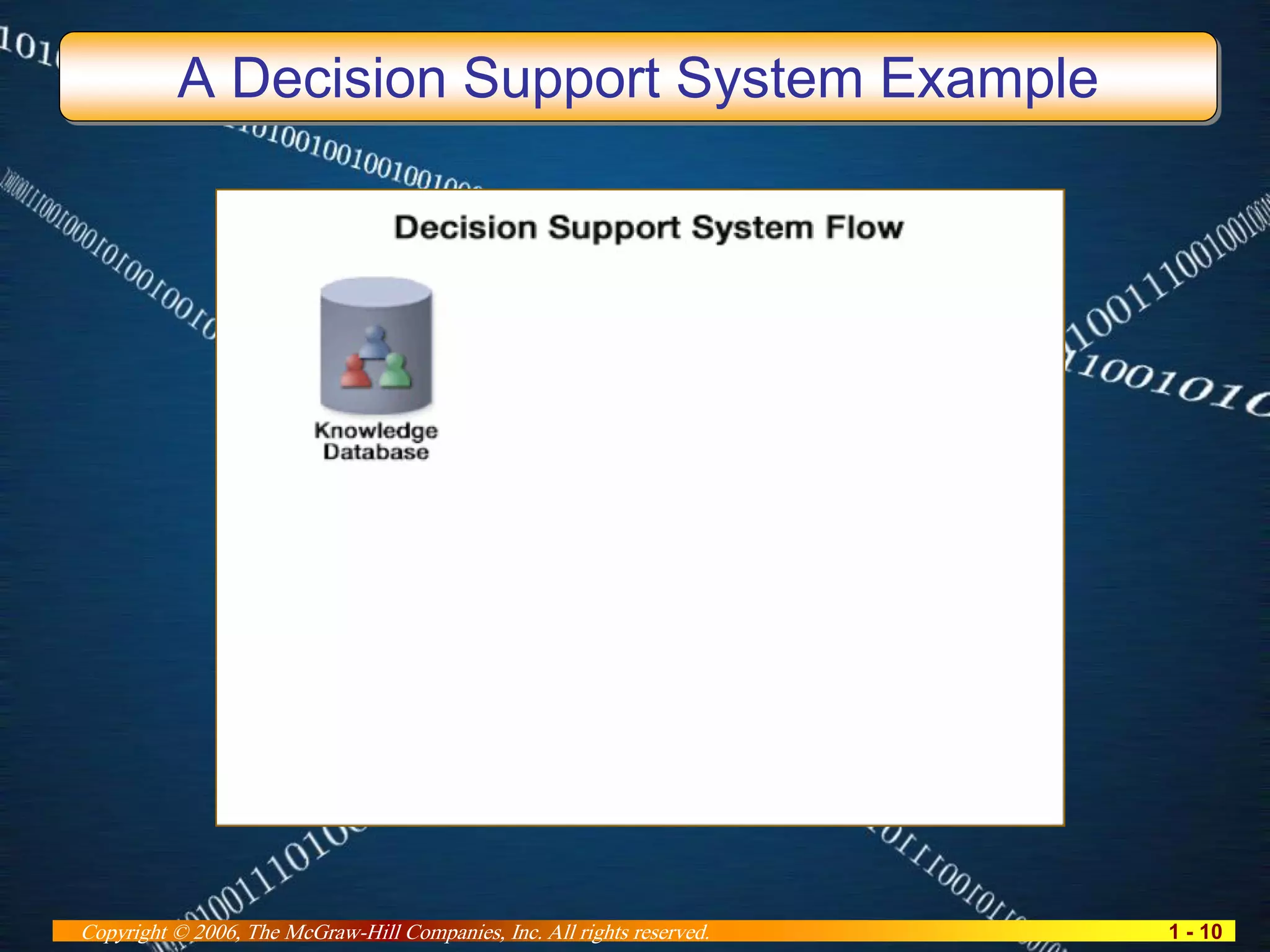
A Decision Support System Example
1 - 11Copyright © 2006, The McGraw-Hill Companies, Inc. All rights reserved.
Operational & Managerial IS
• Expert Systems – provide expert advice
for operational chores or managerial
decisions
• Knowledge Management Systems –
support the creation, organization, and
dissemination of business knowledge to
employees and managers
1 - 12Copyright © 2006, The McGraw-Hill Companies, Inc. All rights reserved.
IS Classifications by Scope
• Functional Business Systems – support basic
business functions
• Strategic Information Systems – support
processes that provide a firm with strategic
products, services, and capabilities for
competitive advantage
• Cross-functional Information Systems –
integrated combinations of information systems
1 - 13Copyright © 2006, The McGraw-Hill Companies, Inc. All rights reserved.
Measures of Success
• Efficiency
• Minimize costs
• Minimize time
• Minimize the use of information resources
• Effectiveness
• Support an organization’s business strategies
• Enable its business processes
• Enhance its organizational structure and culture
• Increase the customer business value of the
enterprise
1 - 14Copyright © 2006, The McGraw-Hill Companies, Inc. All rights reserved.
What is a System?
Definition:
A group of interrelated components, with
a clearly defined boundary, working
together toward a common goal by
accepting inputs and producing outputs in
an organized transformation process.
1 - 15Copyright © 2006, The McGraw-Hill Companies, Inc. All rights reserved.
System Components
• Input – capturing and assembling
elements that enter the system to be
processed
• Processing – transformation steps that
convert input into output
• Output – transferring elements that have
been produced by a transformation
process to their ultimate destination
1 - 16Copyright © 2006, The McGraw-Hill Companies, Inc. All rights reserved.
Cybernetic Systems
Definition:
a self-monitoring, self-regulating system.
• Feedback – data about the performance
of a system
• Control – monitoring and evaluating
feedback to determine whether a system
is moving toward the achievement of its
goal
1 - 17Copyright © 2006, The McGraw-Hill Companies, Inc. All rights reserved.
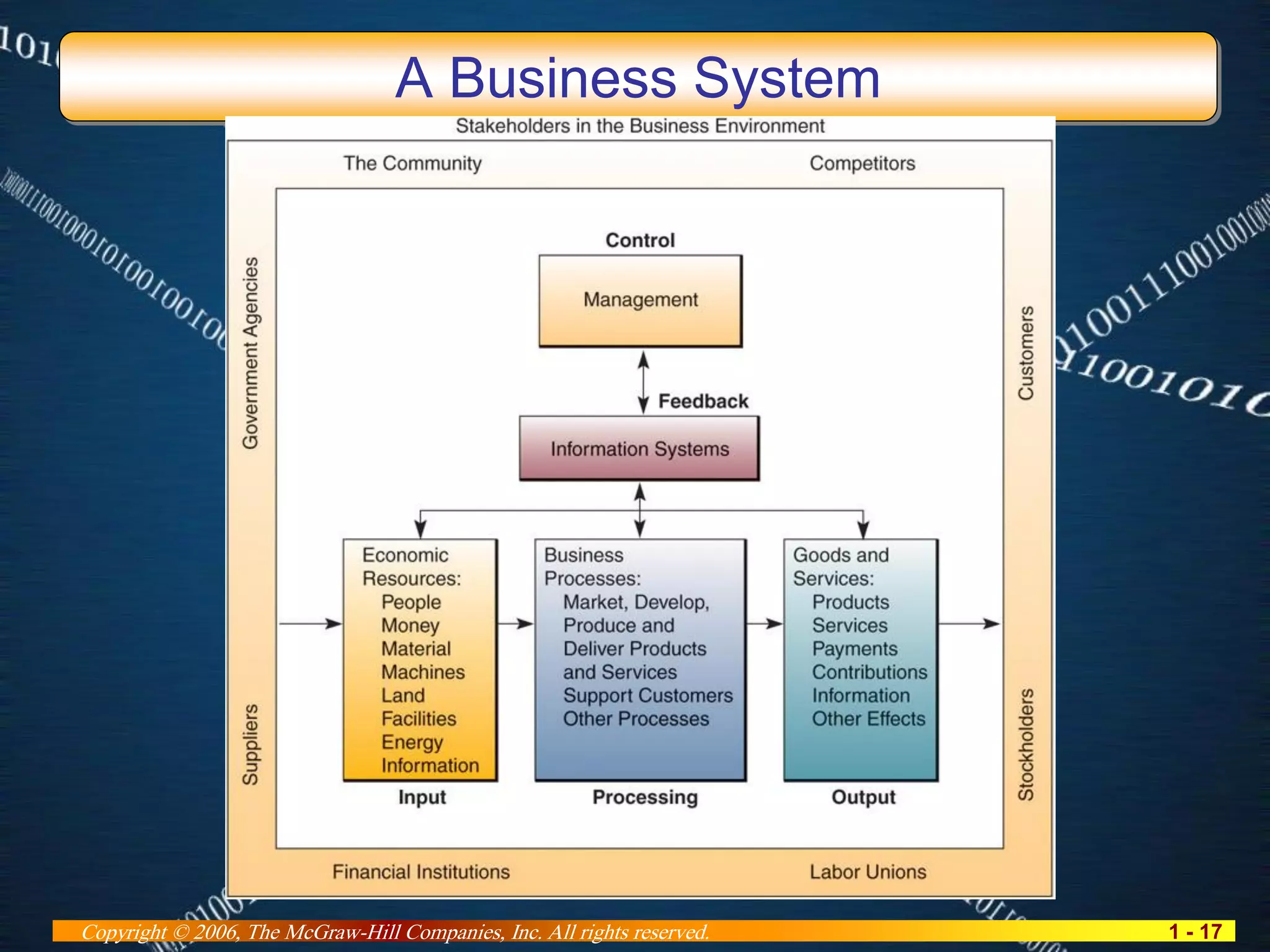
A Business System
1 - 18Copyright © 2006, The McGraw-Hill Companies, Inc. All rights reserved.
Information System Resources
• People – end users and IS specialists
• Hardware – physical devices and
materials used in information processing
including computer systems, peripherals,
and media
• Software – sets of information processing
instructions including system software,
application software and procedures
1 - 19Copyright © 2006, The McGraw-Hill Companies, Inc. All rights reserved.
Information Systems Resources (con’t)
• Data – facts or observations about
physical phenomena or business
transactions
• Network – communications media and
network infrastructure
1 - 20Copyright © 2006, The McGraw-Hill Companies, Inc. All rights reserved.
Data vs. Information
• Data – raw facts or observations typically
about physical phenomena or business
transactions
• Information – data that have been
converted into a meaningful and useful
context for specific end users
1 - 21Copyright © 2006, The McGraw-Hill Companies, Inc. All rights reserved.
Network Resources
• Communications Media – examples
include twisted-pair wire, coaxial and
fiber-optic cables, microwave, cellular,
and satellite wireless technologies
• Network Infrastructure – examples include
communications processors such as
modems and internetwork processors,
and communications control software
such as network operating systems and
Internet browser packages.
1 - 22Copyright © 2006, The McGraw-Hill Companies, Inc. All rights reserved.
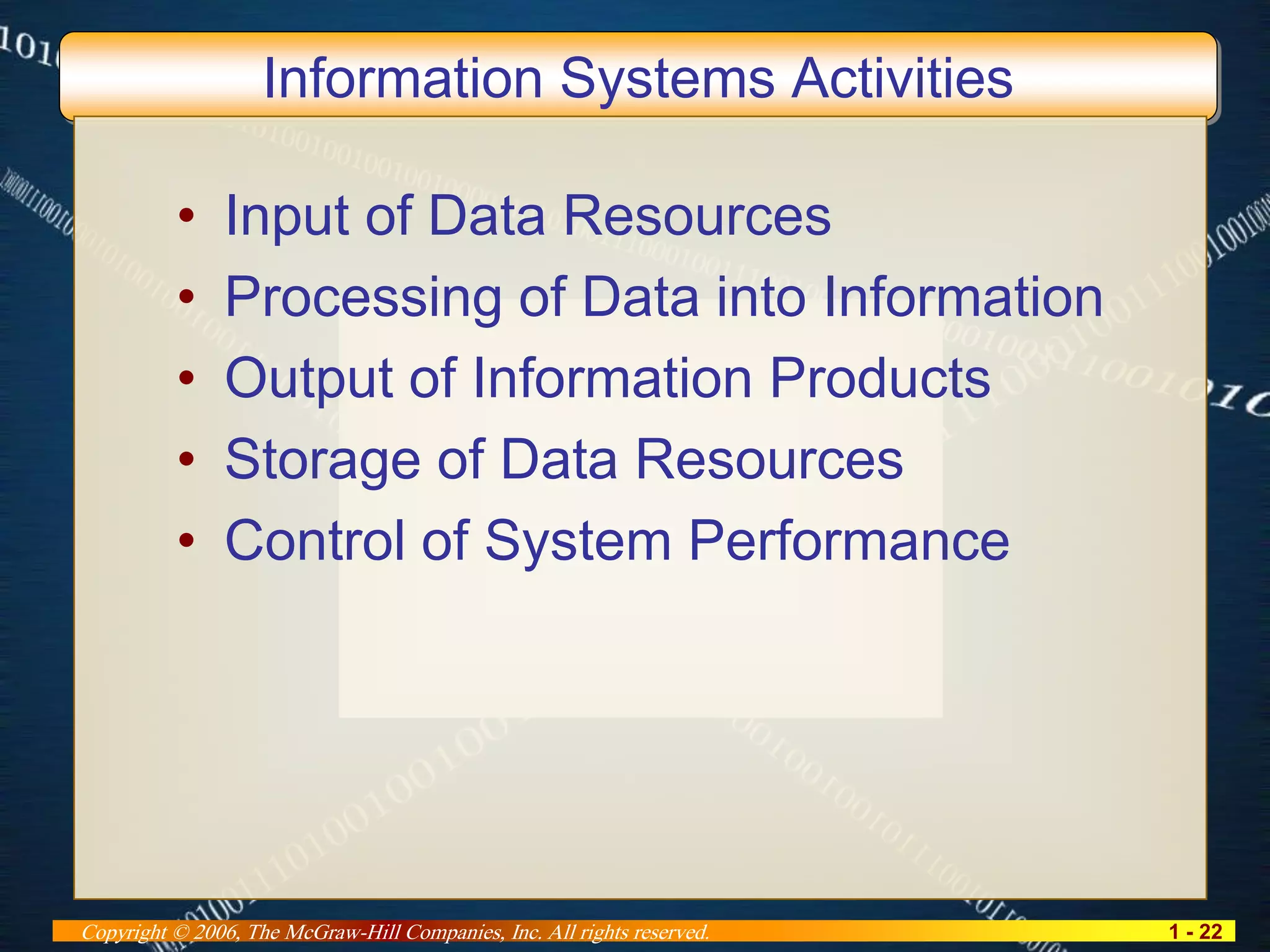
Information Systems Activities
• Input of Data Resources
• Processing of Data into Information
• Output of Information Products
• Storage of Data Resources
• Control of System Performance
1 - 23Copyright © 2006, The McGraw-Hill Companies, Inc. All rights reserved.
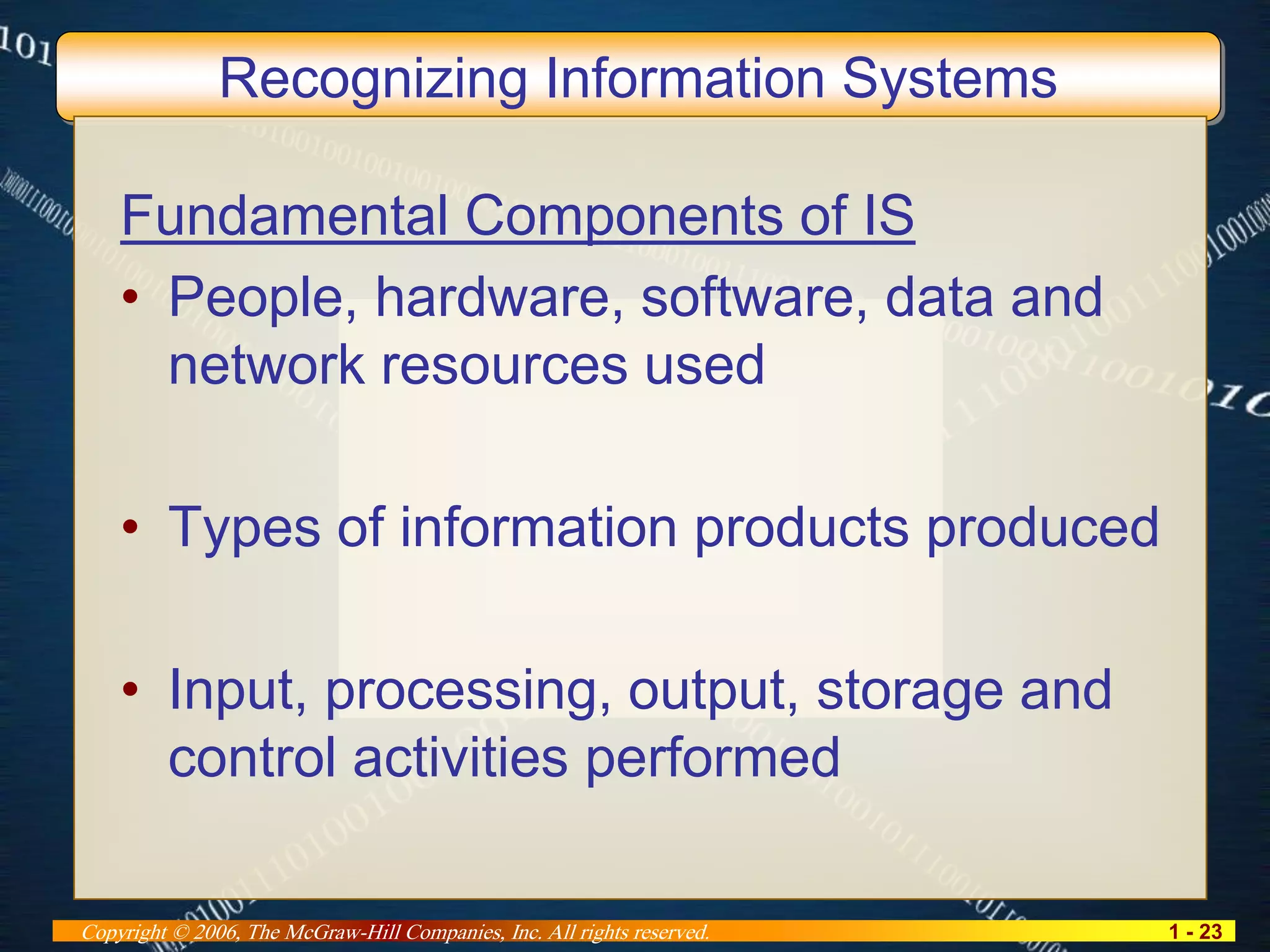
Recognizing Information Systems
Fundamental Components of IS
• People, hardware, software, data and
network resources used
• Types of information products produced
• Input, processing, output, storage and
control activities performed

Foundation of Information Systems in Business

  • 1.
    1 - 1Copyright© 2006, The McGraw-Hill Companies, Inc. All rights reserved. Foundations of Information Systems in Business Chapter 1
  • 2.
    1 - 2Copyright© 2006, The McGraw-Hill Companies, Inc. All rights reserved. What is an Information System? Any organized combination of people, hardware, software, communications networks, and data resources that stores, retrieves, transforms, and disseminates information in an organization.
  • 3.
    1 - 3Copyright© 2006, The McGraw-Hill Companies, Inc. All rights reserved. Roles of IS in Business
  • 4.
    1 - 4Copyright© 2006, The McGraw-Hill Companies, Inc. All rights reserved. Types of Information Systems
  • 5.
    1 - 5Copyright© 2006, The McGraw-Hill Companies, Inc. All rights reserved. Operation Support Systems Definition: • Information systems that process data generated by and used in business operations • Goal is to efficiently process business transactions, control industrial processes, support enterprise communications and collaboration, and update corporate databases
  • 6.
    1 - 6Copyright© 2006, The McGraw-Hill Companies, Inc. All rights reserved. Examples of Operations Support Systems • Transaction Processing Systems (TPS) – process data resulting from business transactions, update operational databases, and produce business documents. • Process Control Systems (PCS) – monitor and control industrial processes. • Enterprise Collaboration Systems – support team, workgroup, and enterprise communications an collaboration.
  • 7.
    1 - 7Copyright© 2006, The McGraw-Hill Companies, Inc. All rights reserved. A Transaction Processing System Example
  • 8.
    1 - 8Copyright© 2006, The McGraw-Hill Companies, Inc. All rights reserved. Management Support Systems Definition: • Information systems that focus on providing information and support for effective decision making by managers
  • 9.
    1 - 9Copyright© 2006, The McGraw-Hill Companies, Inc. All rights reserved. Management Support Systems • Management Information Systems (MIS) – provide information in the form of pre-specified reports and displays to support business decision making. • Decision Support Systems (DSS) – provide interactive ad hoc support for the decision making processes of managers and other business professionals. • Executive Information Systems (EIS) – provide critical information from MIS, DSS, and other sources tailored to the information needs of executives.
  • 10.
    1 - 10Copyright© 2006, The McGraw-Hill Companies, Inc. All rights reserved. A Decision Support System Example
  • 11.
    1 - 11Copyright© 2006, The McGraw-Hill Companies, Inc. All rights reserved. Operational & Managerial IS • Expert Systems – provide expert advice for operational chores or managerial decisions • Knowledge Management Systems – support the creation, organization, and dissemination of business knowledge to employees and managers
  • 12.
    1 - 12Copyright© 2006, The McGraw-Hill Companies, Inc. All rights reserved. IS Classifications by Scope • Functional Business Systems – support basic business functions • Strategic Information Systems – support processes that provide a firm with strategic products, services, and capabilities for competitive advantage • Cross-functional Information Systems – integrated combinations of information systems
  • 13.
    1 - 13Copyright© 2006, The McGraw-Hill Companies, Inc. All rights reserved. Measures of Success • Efficiency • Minimize costs • Minimize time • Minimize the use of information resources • Effectiveness • Support an organization’s business strategies • Enable its business processes • Enhance its organizational structure and culture • Increase the customer business value of the enterprise
  • 14.
    1 - 14Copyright© 2006, The McGraw-Hill Companies, Inc. All rights reserved. What is a System? Definition: A group of interrelated components, with a clearly defined boundary, working together toward a common goal by accepting inputs and producing outputs in an organized transformation process.
  • 15.
    1 - 15Copyright© 2006, The McGraw-Hill Companies, Inc. All rights reserved. System Components • Input – capturing and assembling elements that enter the system to be processed • Processing – transformation steps that convert input into output • Output – transferring elements that have been produced by a transformation process to their ultimate destination
  • 16.
    1 - 16Copyright© 2006, The McGraw-Hill Companies, Inc. All rights reserved. Cybernetic Systems Definition: a self-monitoring, self-regulating system. • Feedback – data about the performance of a system • Control – monitoring and evaluating feedback to determine whether a system is moving toward the achievement of its goal
  • 17.
    1 - 17Copyright© 2006, The McGraw-Hill Companies, Inc. All rights reserved. A Business System
  • 18.
    1 - 18Copyright© 2006, The McGraw-Hill Companies, Inc. All rights reserved. Information System Resources • People – end users and IS specialists • Hardware – physical devices and materials used in information processing including computer systems, peripherals, and media • Software – sets of information processing instructions including system software, application software and procedures
  • 19.
    1 - 19Copyright© 2006, The McGraw-Hill Companies, Inc. All rights reserved. Information Systems Resources (con’t) • Data – facts or observations about physical phenomena or business transactions • Network – communications media and network infrastructure
  • 20.
    1 - 20Copyright© 2006, The McGraw-Hill Companies, Inc. All rights reserved. Data vs. Information • Data – raw facts or observations typically about physical phenomena or business transactions • Information – data that have been converted into a meaningful and useful context for specific end users
  • 21.
    1 - 21Copyright© 2006, The McGraw-Hill Companies, Inc. All rights reserved. Network Resources • Communications Media – examples include twisted-pair wire, coaxial and fiber-optic cables, microwave, cellular, and satellite wireless technologies • Network Infrastructure – examples include communications processors such as modems and internetwork processors, and communications control software such as network operating systems and Internet browser packages.
  • 22.
    1 - 22Copyright© 2006, The McGraw-Hill Companies, Inc. All rights reserved. Information Systems Activities • Input of Data Resources • Processing of Data into Information • Output of Information Products • Storage of Data Resources • Control of System Performance
  • 23.
    1 - 23Copyright© 2006, The McGraw-Hill Companies, Inc. All rights reserved. Recognizing Information Systems Fundamental Components of IS • People, hardware, software, data and network resources used • Types of information products produced • Input, processing, output, storage and control activities performed