https://unihub.mdx.ac.uk/study/library
SMART Nov 2021
Finding good information
In this workshop we will look at..
• Search terms
• Finding information
• Evaluating
Thinking about keywords
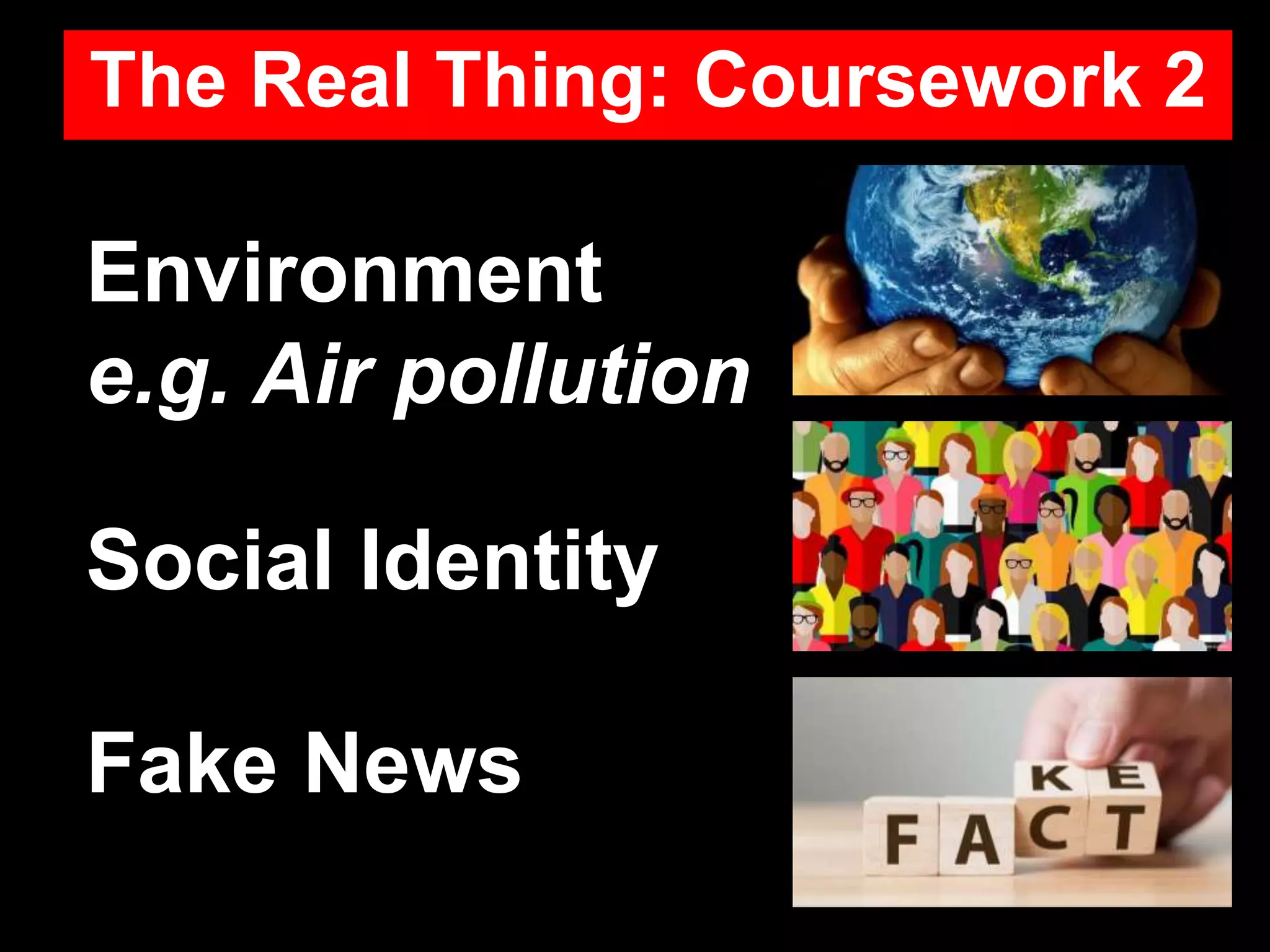
The Real Thing: Coursework 2
Environment
e.g. Air pollution
Social Identity
Fake News
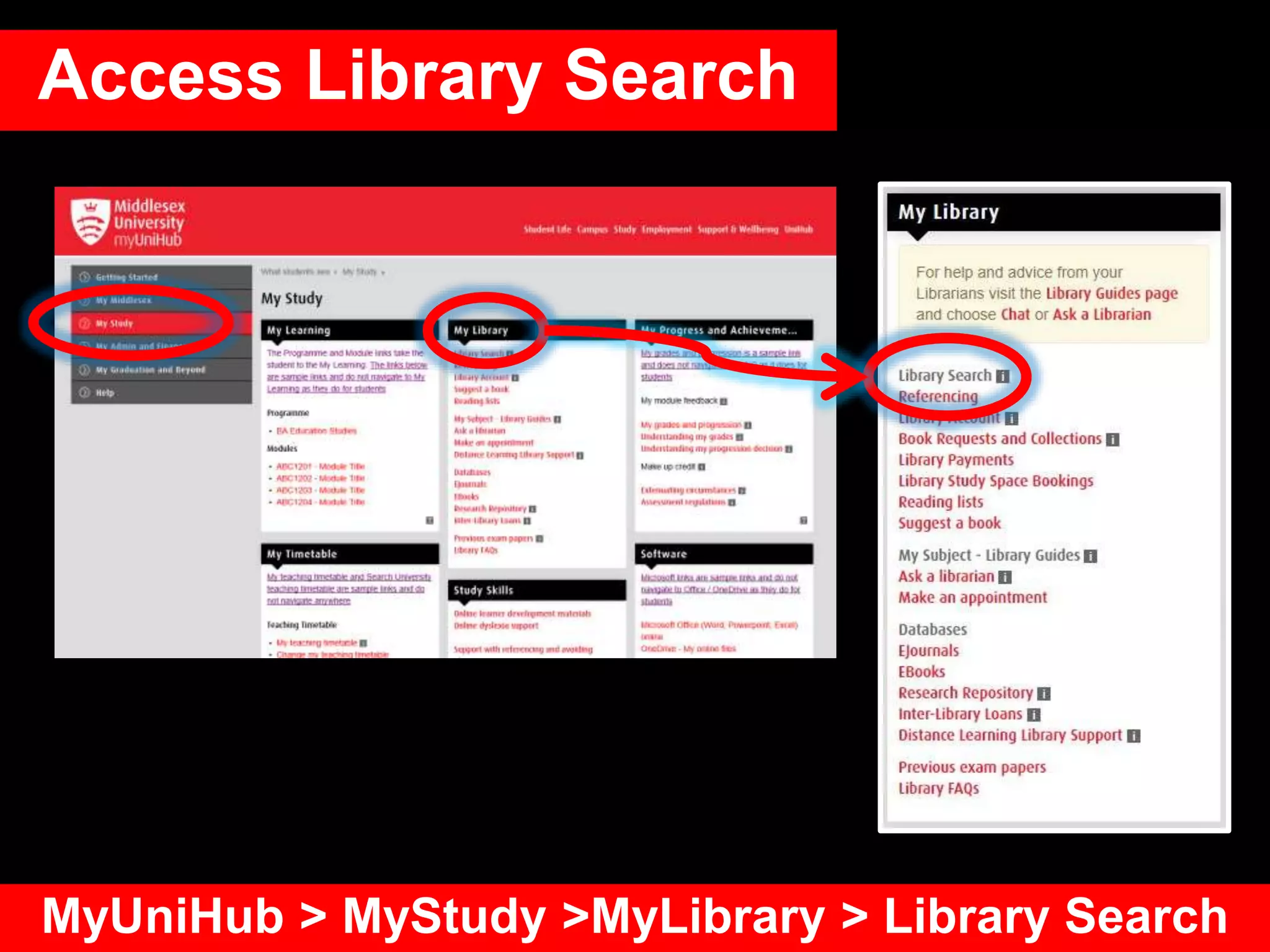
Access Library Search
MyUniHub > MyStudy >MyLibrary > Library Search
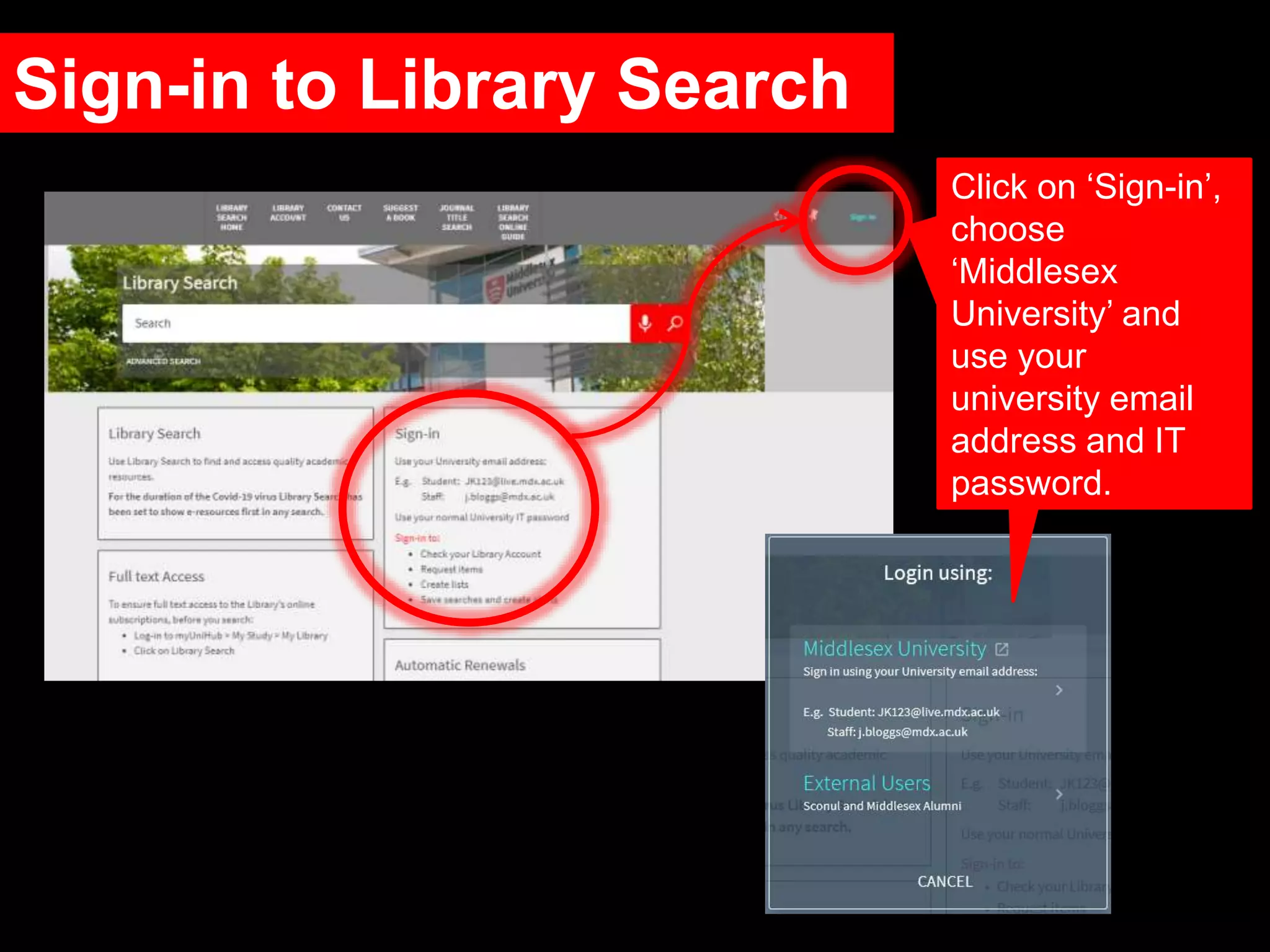
Sign-in to Library Search
Click on ‘Sign-in’,
choose
‘Middlesex
University’ and
use your
university email
address and IT
password.
Using Library Search
https://libguides.mdx.ac.uk/SMART/LibrarySearch
Library Search: Creating references
MyUniHub > MyStudy > MyLibrary > Library Search
Streamlining your search
http://www.flickr.com/photos/mike_miley/2614472057/
environ*
“Fake news”
https://libguides.mdx.ac.uk/SMART/SearchTips
Library Search – have a go
• Go to Library Search
• Search for a journal article on social identity,
fake news or one of the environment topics
e.g. air pollution
• Article must be:
• From a peer reviewed journal
• No more than 5 years old
• Create a Harvard Reference
• Add reference to: https://padlet.com/hendonmdx/VH1
MyUniHub > MyStudy > MyLibrary > Library Search
Post reference on Padlet
1. Go to
Padlet and
click on
pink circle.
2. Type your
name and topic
here and add
your reference
here (copy and
paste from
Library
Search). Then
select ‘Publish’
to post.
• https://padlet.com/hendonmdx/VH1
Other useful resources
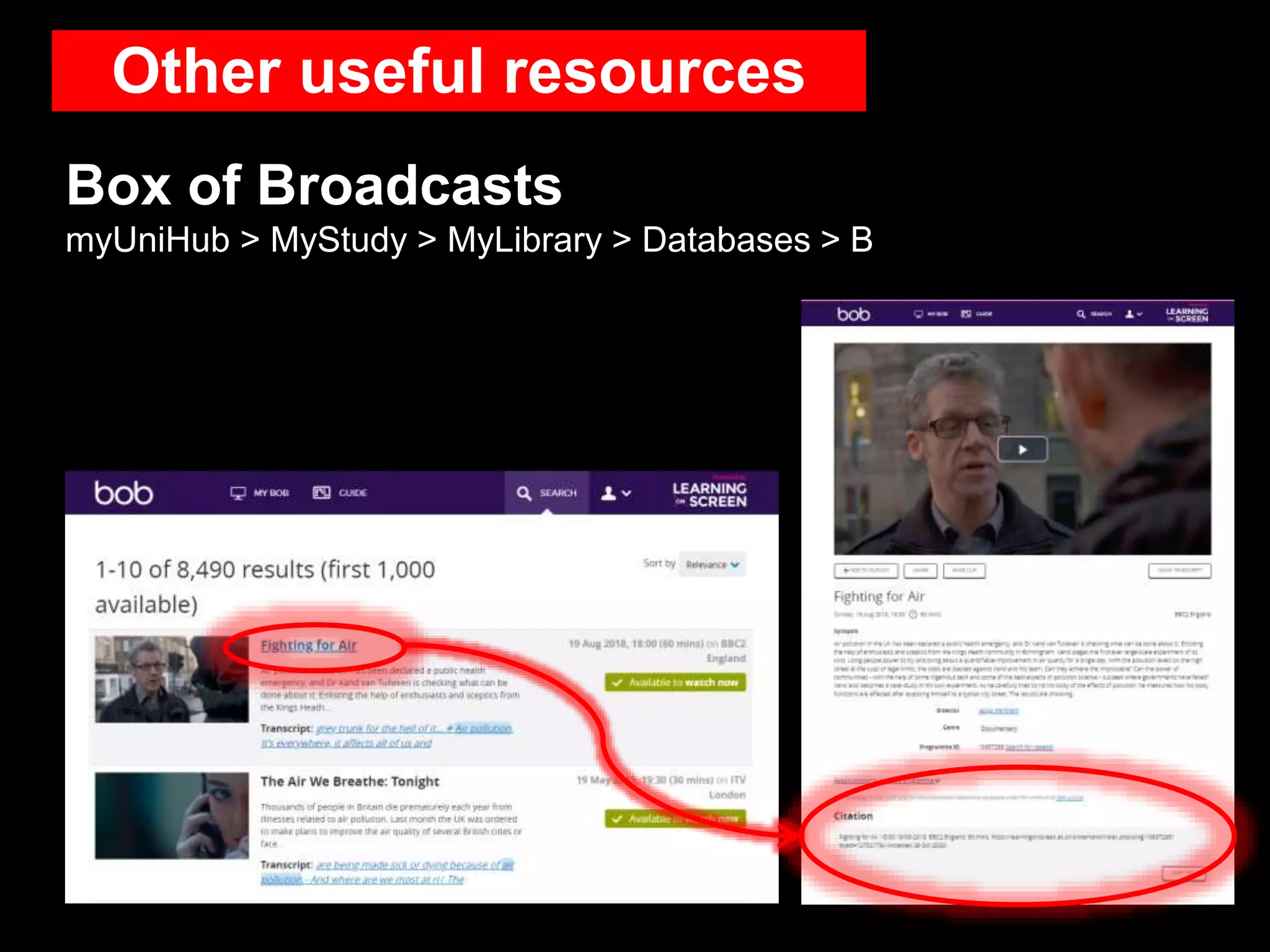
Box of Broadcasts
myUniHub > MyStudy > MyLibrary > Databases > B
Other useful resources
Britannica
myUniHub > MyStudy > MyLibrary > Databases > B
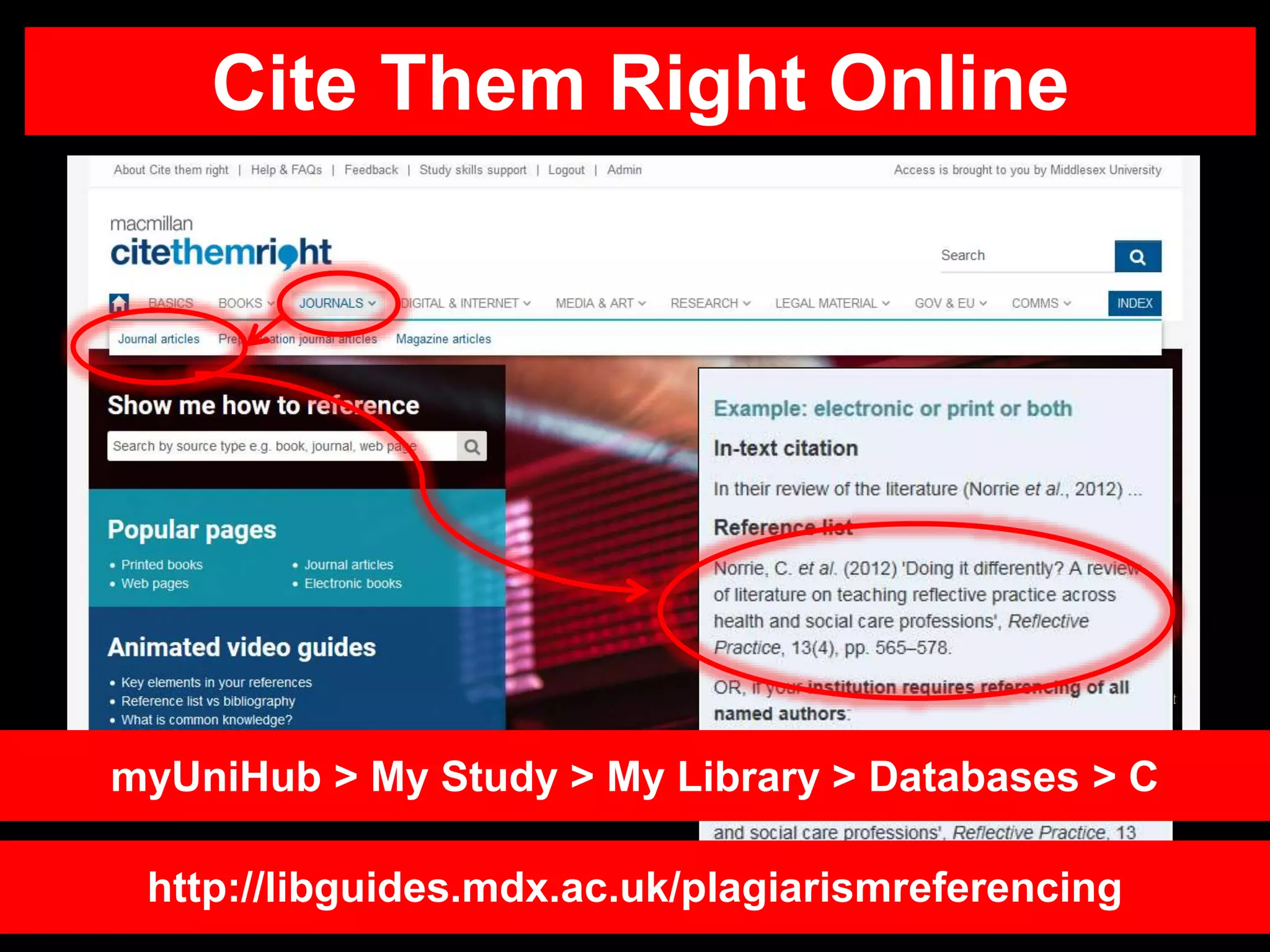
Cite Them Right Online
myUniHub > My Study > My Library > Databases > C
http://libguides.mdx.ac.uk/plagiarismreferencing
• Go to http://libguides.mdx.ac.uk/Brexit
• Have a look at the 4 items
• Which item is the most reliable?
Evaluating information
• Authority
• Relevance
• Intent
• Objectivity
• Currency
Evaluating information
Find out more
MyUniHub > MyStudy > MyLibrary > My Subject Library Guides
https://libguides.mdx.ac.uk/linkedinlearning
LinkedIn Learning
myUniHub > MyStudy > MyLibrary > Databases > L
https://youtu.be/6ldMgi8bl4k
Need further help?
Contact your Librarian:
http://libguides.mdx.ac.uk/liaisonlibrarians
Ask a question online
https://libguides.mdx.ac.uk/chat

Foundation Nov 2021

Editor's Notes

  • #2 Introductions (the lab tutor will also be there). Workshop will last about 1.5-2 hours (depending on class size) and will help you find information for your coursework 2 essay on environment, social identity or fake news. Coursework 2 due Sunday 6th Feb 2022. This presentation is on MyLearning. *************************************************** AV tel. number is 020 8411 5810 in case you have any problems. Librarians you will need (all available behind Vanessa’s desk): Flip chart paper for group work (keyword exercises). Marker pens. 9 x keyword exercise images You will also need to change Padlet address on slide 10 and 11 in advance of each session: VH’s padlets: https://padlet.com/hendonmdx/VH1 https://padlet.com/HendonMDX/VH2 https://padlet.com/HendonMDX/VH3 SP’s padlets: https://padlet.com/HendonMDX/SP1 https://padlet.com/HendonMDX/SP2 https://padlet.com/HendonMDX/SP3 AW’s padlets: https://padlet.com/HendonMDX/AW1 https://padlet.com/HendonMDX/AW2 https://padlet.com/HendonMDX/AW3 LD’s padlets: https://padlet.com/HendonMDX/LD1 https://padlet.com/HendonMDX/LD2 https://padlet.com/HendonMDX/LD3 AE’s padlet: https://padlet.com/HendonMDX/AE
  • #3 This is what we are going to cover in workshop: Look at how you can develop an effective search strategy e.g. Identify keywords and other search terms to help you find information. This will be useful for this coursework, but also in the future when you need to find information for other assignments. How to find and access books, journals and other sources of information for your essay (the students are expected to use between 4-8 sources of academic credibility for this coursework). Evaluating the information that you find for reliability i.e. how to be a critical searcher. Some of the skills that they will learn will also be useful in your everyday life. Throughout our lives it is important to know how to find accurate and reliable information that we can trust, as well as evaluating the information that is presented to us, for example on social media.
  • #4 First of all we’ll be looking at search terms which you use to find the information that you need whether you are using library resources for your Uni assignments or Google in your personal lives. Using a range of quality search terms will enable you to find information which is relevant. Search terms/keywords exercise: ******************************************** Librarians for this exercise you will need: Flip chart paper Marker pens Keyword exercise images ******************************************** Divide students into groups (3 or 5 depending on class numbers) and hand out an image (you have 9 to choose from) to each group plus a marker pen and sheet of flip chart paper. Ask them to make sure that students in other groups cannot see their image. On the paper note down as many words (not phrases) as possible to describe the image without using the word/s given on their image e.g. if the image is of a ‘iceberg’ they can’t use the words ‘ice’, ’berg’ or ‘iceberg’, but could use frozen, water, Antarctic, ocean, Titanic, Arctic, white, sea, block etc. The idea is that their keywords will be good enough to enable the rest of the class to guess what their image is. Allow approx. 5 mins. Feedback: Each group shows the rest of the class their words (hold up flip chart paper). Class has to guess what their image is. If the class guesses straight away, then the group have done well. If the class can’t guess ask which words would have been useful. Stress the importance of using lots of different words when they search for information. *********************Please collect back ‘Keyword Exercise Images’ so that we don’t loose any**************************** Let the students come up with the keywords, only prompt if absolutely necessary. Some possible terms are listed below: Sandcastle: beach, structure, fort, children, grains, bucket, mould, building, build, seaside, fortress etc. Roundabout: road, junction, exits, circle, one-way, cars, traffic, island etc. Black Cab: taxi, The Knowledge, cabbie, London, classic, hackney carriage, hire, meter etc Cup of tea: refreshment, mug, leaves, water, milk, bag, Indian, China, PG Tips, Ceylon, Assam traditional, British, Breakfast, Afternoon, brew, fairtrade etc Car Keys: Ignition, vehicle, electronic, lock, unlock, fob etc. Butterfly: Insect, coloured, wings, Red Admiral, flutter, chrysalis, nectar, antennae, larva etc Armchair: lounge, sofa, comfy, limbs, relax, leather, fabric, cushions, single, seat etc. Penknife: Swiss, multi-tools, Victorinox, pocket, foldable, corkscrew, tools etc. Lightbulb: illumination, glass, ceiling, lamp, halogen, watt, energy saving, element, incandescent, LED etc
  • #5 All coursework information is in the module handbook with all of the deadlines. In the lecture for that week (pre-recorded ppt slides) they are told in detail about the coursework. Students will also be asked to read the coursework brief before they come to library workshops. The students have been asked to write an essay on either (note – this is slightly different to previous years): Environment: 1. Outline a current local or global environmental issue -see sample topics on Coursework 2 brief e.g. air pollution, water pollution, energy conservation, genetic engineering, deforestation, waste etc) – identify key players, policies to combat problem and make own recommendations. 2. Discuss the reasons why young people have become involved in environmental movements based on Greta Thunberg’s example. Evaluate the impact of Greta Thunberg’s environmental activism (Greta Thunberg’s effect) and discuss changes that have come about from Greta’s activity.  Social identity: 1. Identifying and belonging to different groups [see brief for example groups] influence of other people on student’s own identity/identities, academic theories, and expert opinion. 2. ‘Your identity as a student’ - According to Tajfel (1978), groups give us a sense of social identity and belonging to the social world. In many ways, interaction with a social or cultural group can affect an individual's self-perception.  From a university student’s perspective, discuss the impact belonging to a social group of students has had on your perception of yourself and your achievements.   Fake news: 1. The decline of traditional media outlets and the rise of non-traditional media outlets has had an increasingly powerful effect on domestic and world events. Discuss how and why this has occurred. Choose a recent political or economic event and explain how fake news contributed to its outcome. Provide some possible solutions to how fake news can be curtailed. 2. With a large amount of fake news entering our information stream it is crucial to develop the ability to select trustworthy information. Critical thinking, as a form of information literacy, provides tools to engage with online content. How can critical thinking be used to assess the credibility of online Information?  Select definition of fake news and discuss how critical thinking can help combat it. *************Slide shows the essay/report options that the students have to choose from******************* Search term exercise (real thing): Use the same groups as previous exercise. In groups ask students to choose one of the broad headings (Coursework 2) on screen and to note down as many words as they can think of including: alternative words/synonyms, detail/broader topics, acronyms/abbreviations, common/scientific/professional/academic terminology, international spellings/variations, related topics). Although they are using one of the broad headings for this exercise, when they do this for real for their assignment, they will have to consider all the different elements of the essay question e.g. fake news, political/economic event, critical thinking etc. Students are obviously not tied to the topic they choose in this exercise and can choose any of the topics when they start the coursework (this has been a question in the past) – it is the principles that count. Allow 5-10 mins to come up with words and then take feedback as a whole group. Students will be able to use some of their keyword to find information on their chosen subject later. Example keywords: Environment (a few examples): Air pollution: Causes - transportation, diesel cars/lorries, combustion of fossil fuels, pollutants/exhaust fumes/emissions, factory emissions, power plants, dust, pollen, smoke, mould spores, volcanos/eruptions, wildfires, gases (nitrogen dioxide, ozone, sulphur dioxide, carbon monoxide, carbon dioxide/CO2, methane gas (landfills)), harmful gases e.g. ozone depleting chlorofluorocarbons. Effects – air quality, smog, atmosphere, health, breathing, respiratory disease, asthma/emphysema, other health issues (cardio-vascular, cancer, psychological complications, birth defects/low birth weight, Alzheimer’s/Parkinson’s etc), global warming, climate change, acid rain, deterioration of fields/land, extinction of animals, health problems, deterioration of buildings/building materials, ozone depletion. Prevention - public transport, electric cars, alternative energy (solar/wind/geothermal), clean energy, 3Rs (reduce, reuse, recycle). Water pollution: hydrology, ocean acidification, acid rain, algal bloom, marine pollution, urban run-off, thermal pollution, soda lake, oil spills, ocean dumping, anoxic water, sewage. Noise pollution: aeroplanes/transport/machines, urban planning, noise-induced hearing loss, tinnitus, decibels, insulation. Energy conservation: fossil fuels, green energy, wind farms, solar, electric cars, renewable. Genetic engineering: DNA, genetically modified, selective breeding, stem cells, modification, genome, biotechnology, artificial synthesizing, molecular cloning. Food safety: hygiene, environmental health, genetically modified food. Biological pollutants: toxins, birth defects, ecosystems, waste water, environmental hazards. Deforestation: Amazon, flooding, reforestation, over exploitation, logging/clear cutting. Sustainable communities: renewable energy, green, organic farming, restorative ecology, sustainable consumption, waste minimalization. Over population: family planning/birth control, humans, optimum/overshoot, population density, population growth/dynamics, fertility rate, urbanisation, burial, gender imbalance. Toxins: lead poisoning, chemicals, depleted uranium, asbestos, herbicides, contamination, pesticides. Waste: recycling, electronic waste, garbage/dumping, incineration, litter, waste disposal, medical waste, landfill, toxic/hazardous waste, natural resources. Climate change/global warming: Ozone, CFCs, greenhouse gas. Wildlife conservation: extinct, habitat destruction, invasive species, endangered species, WWF, pollination decline, biodiversity threats. Social Identity: Group membership/social world/social groups/social diversity Different groups: gender, race, ethnicity, religion/belief system, social class, age, sport/team (football for example), music, occupation/job, education, family. Cultural norms/socialisation Henri Tajfel – Social Identity Theory Pride/self esteem/emotional significance/self image/Individual self-concept/Social selves Sense of belonging Status Out-group/In-group Prejudice/discrimination Social categorisation/social identification/social comparison/Social perception Interpersonal communication Stereotype/conformity Intergroup behaviour Interpersonal-intergroup continuum Social structure Collective narcissism Fake News: Journalism ethics and standards Newspapers/Traditional print and broadcast media Social media Consumers Hoax/misinformation/misleading Propaganda/yellow journalism Sensationalist/exaggerated/false/fabricated/manipulated News parody ‘clickbait’ Post truth politics Imposter/manipulated content Parody/satire Fact checking network Mainstream media Social, political or cultural events Trump Presidential campaign/2020 US presidential elections/ Coronavirus/COVID-19/C-19 Brexit Internet trolls Critical thinking/evaluating/reasoning/analysis/judgement etc
  • #6 We’re now going to look at how you can find information for your essay. For this essay they need to find a min of 4 and max of 8 sources which have academic credibility. Briefly discuss what ‘academic credibility’ means. We’ll be using Library Search. Explain what Library Search is and how to access it along with all the other library resources. Provides access to books, journal articles, newspaper articles etc. Newspaper articles might be useful sources of information for their essay as well as books and journal articles. Students will be able to use some of the keywords/search terms that we they came up with to find information for their essay.
  • #7 Signing-in enables you to do lots of things including: Save items to ‘Favourites’/Create lists for future reference. Good practice, so don’t lose good items that you have found. Save searches and create alerts Check your library record to see what you have on loan, although lots of information is available online. Request items that are only located in the library and not available online.
  • #8  Point out how to refine their search (resource type, date, scholarly & peer-reviewed etc), save items to ‘Favourites’ and create references (more info on next slide). It is important that students know how to refine search by resource type (article), peer review and publication date (last 5 years), and create a reference for the next exercise. Guides available on using Library Search at URL on the screen (Library Search: Getting Started, Library Search: Extras, Finding books and Finding journal articles).
  • #9 Its possible to create a reference using a variety of referencing styles.​ Students will be using Harvard (including Psychology and Law Foundation). Explain how to create a reference on Library Search i.e.: Search ‘Library Search’ to find information Click on ‘speech mark’ symbol A box opens with various options Choose ‘Harvard’ You can then save the reference in a variety of ways including emailing it to yourself and copying.
  • #10  Run through these search tips which work well on Library Search. environ* ……..Truncates your search by finding everything which contains the same bit of a word e.g. Environment, environments, environmentalist, environmental etc “Fake news” ……….Allows you to search for a phrase i.e. where words appear together and in a specific order. This is particularly useful if words are quite common. *****More search tips at the URL on the screen which can be used when searching the Internet*****
  • #11 ********************Remember to change Padlet URL**************************** Students are now going to have a go at searching Library Search using one of the topics– fake news, social identity or one of the environmental topics such as air pollution. They can do this individually or in pairs depending on circumstances. In order to encourage the students to use the refining tools they need to find a journal article which is: Peer reviewed No more than 5 years old Then students need to create a Harvard Reference. Remind students to copy the reference as this is going to be posted on a padlet – link on screen. In case they have not used Padlets before, instructions on how to do this are on next slide or you can demonstrate this. Leave this slide up whilst they are searching Library Search, so that they know what to do. Allow about c15 mins for the exercise. Feedback: Display Padlet on big screen and discuss references (include LET tutor). Things to consider: Is it a journal article? Is it relevant to topic? Less than 5 years old? Available online? ****************You will need to change the Padlet URL on this slide for each session********************* VH’s padlets: https://padlet.com/hendonmdx/VH1 https://padlet.com/HendonMDX/VH2 https://padlet.com/HendonMDX/VH3 SP’s padlets: https://padlet.com/HendonMDX/SP1 https://padlet.com/HendonMDX/SP2 https://padlet.com/HendonMDX/SP3 AW’s padlets: https://padlet.com/HendonMDX/AW1 https://padlet.com/HendonMDX/AW2 https://padlet.com/HendonMDX/AW3 LD’s padlets: https://padlet.com/HendonMDX/LD1 https://padlet.com/HendonMDX/LD2 https://padlet.com/HendonMDX/LD3 AE’s padlet: https://padlet.com/HendonMDX/AE
  • #12 ********************Remember to change Padlet URL****************************
  • #13 Explain what Bob is and how it might be useful i.e. access to good quality TV and radio broadcasts. E.g. David Attenborough’s ‘Blue Planet’ (water pollution/plastics etc) It’s a bit like Netflix but free. Its possible to create a reference on Bob (see screen) but need to check against Cite Them Right Online (they should have been told about CTRO during the SMART module). For info: 'Box of Broadcasts' (BoB) is a resource that enables you to record and view programmes from over 75 UK TV and radio online. You can select programmes to be recorded and added to a searchable archive one week before broadcast and up to 30 days after broadcast. The searchable archive of recorded programmes consists of over 2.2 million broadcasts. Whilst the quality of TV and radio broadcasting varies from channel to channel, many good quality programmes/documentaries are available which you can use in your academic work. BoB allows you to access these. Available from myUniHub>MyStudy>My Library>Databases. Go to Databases > B Select 'Box of Broadcasts' Click on the words 'click here to access database'. Type 'Middlesex University' into the 'choose your organisation'  box. The first time you access BoB you will be asked to 'update your account'.  Enter your university email address, agree the terms and conditions. You will only have to do this once.  If asked, enter your university computer log in and password.
  • #14 Another useful resource is Britannica. Explain what it is and how it might be useful i.e. good for finding background information, definitions etc It is possible to create a reference on Britannica, but need to check against Cite Them Right Online. For info: 'Britannica Online' is an encyclopedia which includes over 100,000 professionally edited, researched and peer reviewed articles in all subject areas. It includes a dictionary, images, videos and access to over 800,00 external full text journal and magazine articles plus ebooks and primary sources. A great resource if you need an overview of a subject, background information or history.
  • #15  Citations, referencing and avoiding plagiarism will be covered in this module (SMART), so this is just a reminder that students need to use Cite Them Right to check that references created on Library Search/Bob/Britannica are correct. All students including Psychology and Law Foundation students need to use Harvard for this module need reference in Harvard for this essay.
  • #16 Finally it is important to evaluate the quality of the information found. It is easy to find information, so it is more important than ever to make sure what you select is good. Evaluation exercise In groups ask students to go to the website noted on the screen. They will find links to 4 items on the subject of Brexit (click on red links). Look at each item and decide which item is the most reliable and why (c10mins). After 10 mins take feedback/discuss. Assuming students all agree that item 4 (LSE paper) is most reliable, ask them why the other items are not so reliable. These are the four items with some pointers: Item 1 Wikipedia: Good overview Lots of references, but eclectic mix. Can see contributors if click on ‘View history’ (top right) but authors often use pseudonyms such as BurritoBazooka, Luigi Boy, David in DC etc Can click on contributors names to see a profile, but not useful. No idea of who they are and what they do/know etc Item 2: Get Britain out Blog: Has a derogatory tone e.g. “Cameron & Co.”, “interfering busybodies” etc. Jingoist, historic overview of Britain success and power and how we can cope without Europe. Author is knowledgeable, but has a very particular perspective. No references. Item 3: Guardian newspaper article: Left wing paper so some bias. Author is the Science Editor, although this might not mean that he is a science expert. However if you click on his name you can get an overview of his science background. The article is well written and cross-referenced against other Guardian articles and refers to expert opinion. No other references. Item 4: LSE Centre for Economic Performance paper: Reputable, academic source. Contact and biographical details. We are told that the centre has no institutional ties, the views are those of the authors and that one of the authors did not and does not support joining the Euro. Funding for the centre is made explicit. The paper is well written. Citations, cross-references, expert sources, further reading etc.
  • #17  Authority : Who is the author? What is their knowledge base/qualifications? How have they carried out their research? Relevance : Is this what I need? Will it answer my question? Is it at the right level? Intent : What is the purpose of information e.g. financial gain, propaganda, academic etc? Objectivity : Balanced view? Opposing views represented? Links to supporting information? Currency: How old is this information? When was it last updated and by whom?
  • #18  You can also find out more about the resources for different subject areas area using our Library Guides plus details of your subject specialist librarian.
  • #19 Finally as a student at Middlesex University you have free access to LinkedIn Learning, a website packed with video tutorials and courses covering business, technology and creative skills. With more than 5,000 courses taught by industry experts—and more added every week—LinkedIn Learning is designed for all levels of learners, and it’s available whenever you’re ready to learn. The LinkedIn Learning app, means that you can also view courses from your mobile device, so you can learn on the bus to uni. Go to our LinkedIn Learning Library Guide (link on screen) to discover how to activate your account, connect it to your LinkedIn profile, showcase your learning to future employers and network with your peers.  You can watch a You Tube video all about LinkedIn Learning at the URL on the screen.
  • #20 Any questions? Here’s how to get help: Contact the subject specialist librarian Ask a question online using Chat. Librarians available Mon-Fri 9-5.