Nursing Diagnosis
Revised by
Ms.Romana Javed
Nursing Instructor
5/18/2020 1Nursing Diagnosis
Objectives
By the end of the presentation student will be
able to :
• Define nursing diagnosis
• Explain different types of Nursing diagnosis
• Differentiate the medical and nursing
diagnosis
• Discuss components of nursing diagnosis
5/18/2020 2Nursing Diagnosis
Nursing Diagnosis
Nursing diagnosis is the second
phase of the nursing process.
In this phase nurse uses critical
thinking skills to interpret
assessment data and identify
client strength and problems
5/18/2020 3Nursing Diagnosis
Nursing Diagnosis
• The north American diagnosis Association
(NANDA, 2007) defines nursing diagnosis as
follows:
“A clinical judgment about the patient’s
response to actual or potential health
conditions or needs. This data provides the
basis for determination of a plan of care to
achieve expected outcomes.”
5/18/2020 4Nursing Diagnosis
Nursing Diagnosis
For Example:
Nurses are not educated to diagnoses or treat
diseases such as diabetic mellitus. This is
legally defined as within the practice of
medicine . Yet nurses can diagnose and treat
Deficient knowledge, Ineffective Coping or
imbalance nutrition all which are the human
responses to the medical diagnosis of
diabetics mellitus.
5/18/2020 5Nursing Diagnosis
Cont….
• A nursing diagnosis is a judgment made only
after thorough systematic data collection.
• Nursing diagnosis describe a continuum of
health states in deviation from health,
presence of risk factors and areas of enhanced
personal growth.
5/18/2020 6Nursing Diagnosis
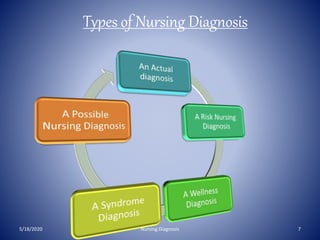
Types of Nursing Diagnosis
5/18/2020 7Nursing Diagnosis
Types of Nursing Diagnosis
An Actual Nursing diagnosis is a client problem that
is present at the time of the nursing assessment.
• An Actual Nursing Diagnosis is based on the
presence of associated signs and symptoms.
• For Examples :
Ineffective breathing pattern and Anxiety.
5/18/2020 8Nursing Diagnosis
Types of Nursing Diagnosis
It is a clinical judgment that a problem doesn't exist
but the presence of risk factors indicates that a
problem is likely to develop unless nurses
intervene.
• For example:
All people admitted to hospital have a some possibility
of acquiring an infection: however a client with a
diabetes or a compromised immune system is at
higher Risk than others. Therefore, the nurse would
appropriately use the label of Risk for infection to
describe the client’s health status.5/18/2020 9Nursing Diagnosis
Types of Nursing Diagnosis
• It describes human responses to levels of wellness in an
individual , family or community that have a readiness
for enhancement.
(NANDA International , 2007)
• For Examples
wellness diagnosis would be Readiness for enhanced
spiritual well being or readiness for enhanced Family
Coping
5/18/2020 10Nursing Diagnosis
Types of Nursing Diagnosis
It is a diagnosis that is associated with a cluster of other
diagnosis.
(Carpenito – Moyet, 2006)
Currently six syndrome diagnosis are on the NANDA list .
Disuse Syndrome for example May be experienced by
long term bedridden clients. Cluster of diagnosis
associated with this syndrome include impaired physical
mobility, risk for constipation, risk for infection,
powerlessness and so on.
5/18/2020 11Nursing Diagnosis
Types of Nursing Diagnosis
• It is one in which evidence about a health problem is
incomplete or unclear. A possible diagnosis requires more
data either to support or to refute it.
• For example:
An elderly widow who live alone is admitted to hospital .
The nurse notice that she has no visitor and is pleased
with attention and conversation from the nursing staff.
Until the more data collected , the nurse may write a
nursing diagnosis of Possible Social Isolation related to
unknown etiology.
5/18/2020 12Nursing Diagnosis
Differentiating Nursing diagnosis form medical
diagnosis
• A medical diagnosis made by physician and refers
to a condition that only treat by a physician.
• It refers to disease process and specific
pathophysiologic responses that are fairly uniform
form one client to another.
5/18/2020 13Nursing Diagnosis
Differentiating Nursing diagnosis form medical
diagnosis
• Nursing Diagnosis describe the human response, a
client ‘s socio cultural , psychologic and spiritual
response to an illness or a health problem.
• A nursing diagnosis is a statement of the high risk
or actual problems in the client’s health status that
the nurse is licensed and competent to treat.
5/18/2020 14Nursing Diagnosis
Nursing Diagnosis Questions
• Are there problems here?
• If so, what are the specific problems?
• What are some possible causes?
• Is there a situation involving risk factors?
• What are the risk factors?
• What are the client’s strengths?
• What data are available to answer these questions?
• Is more data needed?
• If so, what are the possible sources of further data? 15
Components of nursing Diagnosis
5/18/2020 16Nursing Diagnosis
Components of nursing Diagnosis
• Problem (Diagnostic Label ) and Definition
The problem statement or diagnostic label, describes the
client’s health problem or response for which nursing
therapy is given. Its describes the client's health status
clearly and concisely in a few words.
The purpose of diagnostic label is to direct the formation of
client’s goal and desired outcomes. It may also suggest
some nursing interventions.
5/18/2020 17Nursing Diagnosis
Components of nursing Diagnosis
• To be clinically useful , diagnostic labels need to be
specific follows a NANDA label , the nurse states the
area in which the problem occurs
For example
• Deficient knowledge (Medication)
• Deficient knowledge (Dietary Adjustments)
5/18/2020 18Nursing Diagnosis
Components of nursing Diagnosis
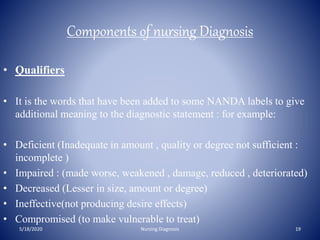
• Qualifiers
• It is the words that have been added to some NANDA labels to give
additional meaning to the diagnostic statement : for example:
• Deficient (Inadequate in amount , quality or degree not sufficient :
incomplete )
• Impaired : (made worse, weakened , damage, reduced , deteriorated)
• Decreased (Lesser in size, amount or degree)
• Ineffective(not producing desire effects)
• Compromised (to make vulnerable to treat)
5/18/2020 19Nursing Diagnosis
Components of nursing Diagnosis
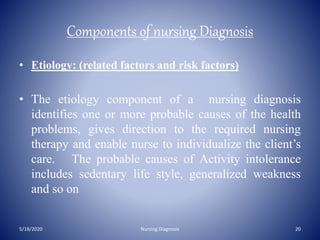
• Etiology: (related factors and risk factors)
• The etiology component of a nursing diagnosis
identifies one or more probable causes of the health
problems, gives direction to the required nursing
therapy and enable nurse to individualize the client’s
care. The probable causes of Activity intolerance
includes sedentary life style, generalized weakness
and so on
5/18/2020 20Nursing Diagnosis
Components of nursing Diagnosis
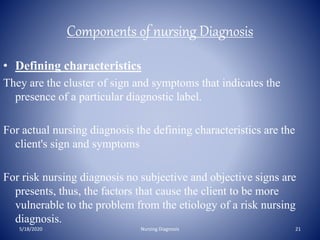
• Defining characteristics
They are the cluster of sign and symptoms that indicates the
presence of a particular diagnostic label.
For actual nursing diagnosis the defining characteristics are the
client's sign and symptoms
For risk nursing diagnosis no subjective and objective signs are
presents, thus, the factors that cause the client to be more
vulnerable to the problem from the etiology of a risk nursing
diagnosis.
5/18/2020 21Nursing Diagnosis
Components of nursing Diagnosis
Diagnosis and
Definition
• Activity Intolerance
Insufficient
physiological and
psychological
energy to endure or
complete required
or desire daily
activities
Related Factors
• Bed rest or
immobility
• Generalized
Weakness
• Imbalance between
oxygen supply and
demands
• Sedentary lifestyle
Defining
Characteristics
• Verbal report of
fatigue or weakness
• Abnormal heart rate
or blood pressure
• Electrocardiographic
changes reflecting
arrhythmias or
ischemia
• Exertional
discomfort or
dyspnea
5/18/2020 22Nursing Diagnosis
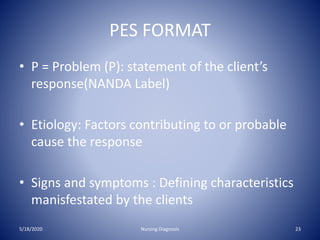
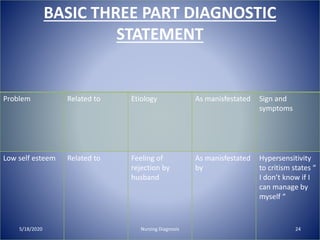
PES FORMAT
• P = Problem (P): statement of the client’s
response(NANDA Label)
• Etiology: Factors contributing to or probable
cause the response
• Signs and symptoms : Defining characteristics
manisfestated by the clients
5/18/2020 23Nursing Diagnosis
BASIC THREE PART DIAGNOSTIC
STATEMENT
Problem Related to Etiology As manisfestated Sign and
symptoms
Low self esteem Related to Feeling of
rejection by
husband
As manisfestated
by
Hypersensitivity
to critism states “
I don’t know if I
can manage by
myself “
5/18/2020 24Nursing Diagnosis
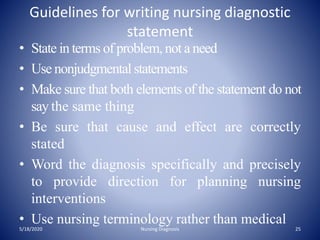
Guidelines for writing nursing diagnostic
statement
• State in terms of problem, not a need
• Use nonjudgmental statements
• Make sure that both elements of the statement do not
say the same thing
• Be sure that cause and effect are correctly
stated
• Word the diagnosis specifically and precisely
to provide direction for planning nursing
interventions
• Use nursing terminology rather than medical
5/18/2020 25Nursing Diagnosis
Thank you
5/18/2020 26Nursing Diagnosis

Nursing Diagnosis (nursing process)

  • 1.
    Nursing Diagnosis Revised by Ms.RomanaJaved Nursing Instructor 5/18/2020 1Nursing Diagnosis
  • 2.
    Objectives By the endof the presentation student will be able to : • Define nursing diagnosis • Explain different types of Nursing diagnosis • Differentiate the medical and nursing diagnosis • Discuss components of nursing diagnosis 5/18/2020 2Nursing Diagnosis
  • 3.
    Nursing Diagnosis Nursing diagnosisis the second phase of the nursing process. In this phase nurse uses critical thinking skills to interpret assessment data and identify client strength and problems 5/18/2020 3Nursing Diagnosis
  • 4.
    Nursing Diagnosis • Thenorth American diagnosis Association (NANDA, 2007) defines nursing diagnosis as follows: “A clinical judgment about the patient’s response to actual or potential health conditions or needs. This data provides the basis for determination of a plan of care to achieve expected outcomes.” 5/18/2020 4Nursing Diagnosis
  • 5.
    Nursing Diagnosis For Example: Nursesare not educated to diagnoses or treat diseases such as diabetic mellitus. This is legally defined as within the practice of medicine . Yet nurses can diagnose and treat Deficient knowledge, Ineffective Coping or imbalance nutrition all which are the human responses to the medical diagnosis of diabetics mellitus. 5/18/2020 5Nursing Diagnosis
  • 6.
    Cont…. • A nursingdiagnosis is a judgment made only after thorough systematic data collection. • Nursing diagnosis describe a continuum of health states in deviation from health, presence of risk factors and areas of enhanced personal growth. 5/18/2020 6Nursing Diagnosis
  • 7.
    Types of NursingDiagnosis 5/18/2020 7Nursing Diagnosis
  • 8.
    Types of NursingDiagnosis An Actual Nursing diagnosis is a client problem that is present at the time of the nursing assessment. • An Actual Nursing Diagnosis is based on the presence of associated signs and symptoms. • For Examples : Ineffective breathing pattern and Anxiety. 5/18/2020 8Nursing Diagnosis
  • 9.
    Types of NursingDiagnosis It is a clinical judgment that a problem doesn't exist but the presence of risk factors indicates that a problem is likely to develop unless nurses intervene. • For example: All people admitted to hospital have a some possibility of acquiring an infection: however a client with a diabetes or a compromised immune system is at higher Risk than others. Therefore, the nurse would appropriately use the label of Risk for infection to describe the client’s health status.5/18/2020 9Nursing Diagnosis
  • 10.
    Types of NursingDiagnosis • It describes human responses to levels of wellness in an individual , family or community that have a readiness for enhancement. (NANDA International , 2007) • For Examples wellness diagnosis would be Readiness for enhanced spiritual well being or readiness for enhanced Family Coping 5/18/2020 10Nursing Diagnosis
  • 11.
    Types of NursingDiagnosis It is a diagnosis that is associated with a cluster of other diagnosis. (Carpenito – Moyet, 2006) Currently six syndrome diagnosis are on the NANDA list . Disuse Syndrome for example May be experienced by long term bedridden clients. Cluster of diagnosis associated with this syndrome include impaired physical mobility, risk for constipation, risk for infection, powerlessness and so on. 5/18/2020 11Nursing Diagnosis
  • 12.
    Types of NursingDiagnosis • It is one in which evidence about a health problem is incomplete or unclear. A possible diagnosis requires more data either to support or to refute it. • For example: An elderly widow who live alone is admitted to hospital . The nurse notice that she has no visitor and is pleased with attention and conversation from the nursing staff. Until the more data collected , the nurse may write a nursing diagnosis of Possible Social Isolation related to unknown etiology. 5/18/2020 12Nursing Diagnosis
  • 13.
    Differentiating Nursing diagnosisform medical diagnosis • A medical diagnosis made by physician and refers to a condition that only treat by a physician. • It refers to disease process and specific pathophysiologic responses that are fairly uniform form one client to another. 5/18/2020 13Nursing Diagnosis
  • 14.
    Differentiating Nursing diagnosisform medical diagnosis • Nursing Diagnosis describe the human response, a client ‘s socio cultural , psychologic and spiritual response to an illness or a health problem. • A nursing diagnosis is a statement of the high risk or actual problems in the client’s health status that the nurse is licensed and competent to treat. 5/18/2020 14Nursing Diagnosis
  • 15.
    Nursing Diagnosis Questions •Are there problems here? • If so, what are the specific problems? • What are some possible causes? • Is there a situation involving risk factors? • What are the risk factors? • What are the client’s strengths? • What data are available to answer these questions? • Is more data needed? • If so, what are the possible sources of further data? 15
  • 16.
    Components of nursingDiagnosis 5/18/2020 16Nursing Diagnosis
  • 17.
    Components of nursingDiagnosis • Problem (Diagnostic Label ) and Definition The problem statement or diagnostic label, describes the client’s health problem or response for which nursing therapy is given. Its describes the client's health status clearly and concisely in a few words. The purpose of diagnostic label is to direct the formation of client’s goal and desired outcomes. It may also suggest some nursing interventions. 5/18/2020 17Nursing Diagnosis
  • 18.
    Components of nursingDiagnosis • To be clinically useful , diagnostic labels need to be specific follows a NANDA label , the nurse states the area in which the problem occurs For example • Deficient knowledge (Medication) • Deficient knowledge (Dietary Adjustments) 5/18/2020 18Nursing Diagnosis
  • 19.
    Components of nursingDiagnosis • Qualifiers • It is the words that have been added to some NANDA labels to give additional meaning to the diagnostic statement : for example: • Deficient (Inadequate in amount , quality or degree not sufficient : incomplete ) • Impaired : (made worse, weakened , damage, reduced , deteriorated) • Decreased (Lesser in size, amount or degree) • Ineffective(not producing desire effects) • Compromised (to make vulnerable to treat) 5/18/2020 19Nursing Diagnosis
  • 20.
    Components of nursingDiagnosis • Etiology: (related factors and risk factors) • The etiology component of a nursing diagnosis identifies one or more probable causes of the health problems, gives direction to the required nursing therapy and enable nurse to individualize the client’s care. The probable causes of Activity intolerance includes sedentary life style, generalized weakness and so on 5/18/2020 20Nursing Diagnosis
  • 21.
    Components of nursingDiagnosis • Defining characteristics They are the cluster of sign and symptoms that indicates the presence of a particular diagnostic label. For actual nursing diagnosis the defining characteristics are the client's sign and symptoms For risk nursing diagnosis no subjective and objective signs are presents, thus, the factors that cause the client to be more vulnerable to the problem from the etiology of a risk nursing diagnosis. 5/18/2020 21Nursing Diagnosis
  • 22.
    Components of nursingDiagnosis Diagnosis and Definition • Activity Intolerance Insufficient physiological and psychological energy to endure or complete required or desire daily activities Related Factors • Bed rest or immobility • Generalized Weakness • Imbalance between oxygen supply and demands • Sedentary lifestyle Defining Characteristics • Verbal report of fatigue or weakness • Abnormal heart rate or blood pressure • Electrocardiographic changes reflecting arrhythmias or ischemia • Exertional discomfort or dyspnea 5/18/2020 22Nursing Diagnosis
  • 23.
    PES FORMAT • P= Problem (P): statement of the client’s response(NANDA Label) • Etiology: Factors contributing to or probable cause the response • Signs and symptoms : Defining characteristics manisfestated by the clients 5/18/2020 23Nursing Diagnosis
  • 24.
    BASIC THREE PARTDIAGNOSTIC STATEMENT Problem Related to Etiology As manisfestated Sign and symptoms Low self esteem Related to Feeling of rejection by husband As manisfestated by Hypersensitivity to critism states “ I don’t know if I can manage by myself “ 5/18/2020 24Nursing Diagnosis
  • 25.
    Guidelines for writingnursing diagnostic statement • State in terms of problem, not a need • Use nonjudgmental statements • Make sure that both elements of the statement do not say the same thing • Be sure that cause and effect are correctly stated • Word the diagnosis specifically and precisely to provide direction for planning nursing interventions • Use nursing terminology rather than medical 5/18/2020 25Nursing Diagnosis
  • 26.