FORMULATION AND EVALUATION
OF HERBAL TOOTHPASTE
Author: VaibhavShende*
Kamla Nehru College of Pharmacy, Butibori, Nagpur - 441108
Introduction:
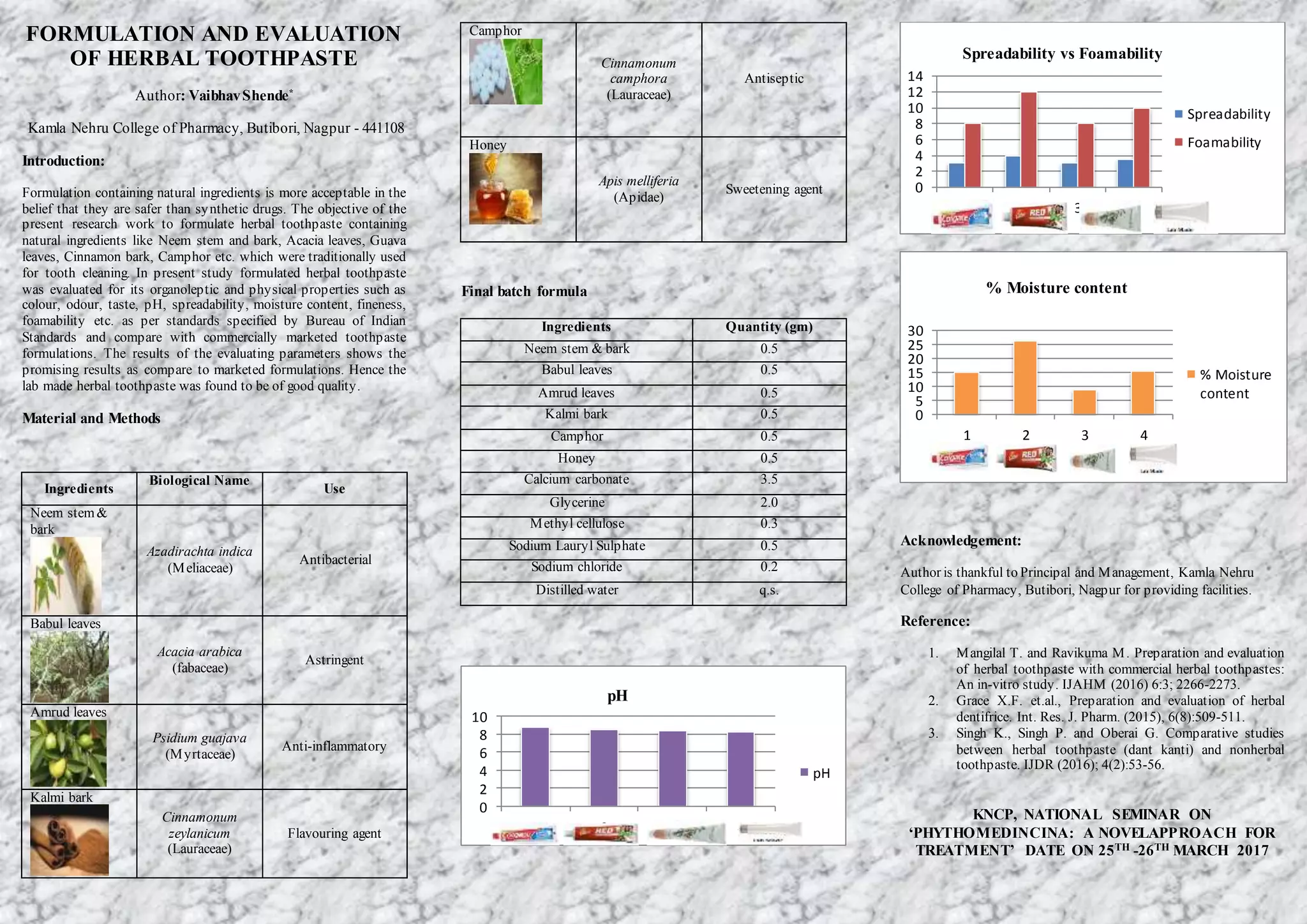
Formulation containing natural ingredients is more acceptable in the
belief that they are safer than synthetic drugs. The objective of the
present research work to formulate herbal toothpaste containing
natural ingredients like Neem stem and bark, Acacia leaves, Guava
leaves, Cinnamon bark, Camphor etc. which were traditionally used
for tooth cleaning. In present study formulated herbal toothpaste
was evaluated for its organoleptic and physical properties such as
colour, odour, taste, pH, spreadability, moisture content, fineness,
foamability etc. as per standards specified by Bureau of Indian
Standards and compare with commercially marketed toothpaste
formulations. The results of the evaluating parameters shows the
promising results as compare to marketed formulations. Hence the
lab made herbal toothpaste was found to be of good quality.
Material and Methods
Ingredients
Biological Name
Use
Neem stem&
bark
Azadirachta indica
(Meliaceae)
Antibacterial
Babul leaves
Acacia arabica
(fabaceae)
Astringent
Amrud leaves
Psidium guajava
(Myrtaceae)
Anti-inflammatory
Kalmi bark
Cinnamonum
zeylanicum
(Lauraceae)
Flavouring agent
Camphor
Cinnamonum
camphora
(Lauraceae)
Antiseptic
Honey
Apis melliferia
(Apidae)
Sweetening agent
Final batch formula
Acknowledgement:
Author is thankful to Principal and Management, Kamla Nehru
College of Pharmacy, Butibori, Nagpur for providing facilities.
Reference:
1. Mangilal T. and Ravikuma M. Preparation and evaluation
of herbal toothpaste with commercial herbal toothpastes:
An in-vitro study. IJAHM (2016) 6:3; 2266-2273.
2. Grace X.F. et.al., Preparation and evaluation of herbal
dentifrice. Int. Res. J. Pharm. (2015), 6(8):509-511.
3. Singh K., Singh P. and Oberai G. Comparative studies
between herbal toothpaste (dant kanti) and nonherbal
toothpaste. IJDR (2016); 4(2):53-56.
KNCP, NATIONAL SEMINAR ON
‘PHYTHOMEDINCINA: A NOVELAPPROACH FOR
TREATMENT’ DATE ON 25TH -26TH MARCH 2017
0
2
4
6
8
10
1 2 3 4
pH
pH
0
2
4
6
8
10
12
14
1 2 3 4
Spreadability
Foamability
Spreadability vs Foamability
0
5
10
15
20
25
30
1 2 3 4
% Moisture content
% Moisture
content
Ingredients Quantity (gm)
Neem stem & bark 0.5
Babul leaves 0.5
Amrud leaves 0.5
Kalmi bark 0.5
Camphor 0.5
Honey 0.5
Calcium carbonate 3.5
Glycerine 2.0
Methyl cellulose 0.3
Sodium Lauryl Sulphate 0.5
Sodium chloride 0.2
Distilled water q.s.

FORMULATION AND EVALUATION OF HERBAL TOOTHPASTE

  • 1.
    FORMULATION AND EVALUATION OFHERBAL TOOTHPASTE Author: VaibhavShende* Kamla Nehru College of Pharmacy, Butibori, Nagpur - 441108 Introduction: Formulation containing natural ingredients is more acceptable in the belief that they are safer than synthetic drugs. The objective of the present research work to formulate herbal toothpaste containing natural ingredients like Neem stem and bark, Acacia leaves, Guava leaves, Cinnamon bark, Camphor etc. which were traditionally used for tooth cleaning. In present study formulated herbal toothpaste was evaluated for its organoleptic and physical properties such as colour, odour, taste, pH, spreadability, moisture content, fineness, foamability etc. as per standards specified by Bureau of Indian Standards and compare with commercially marketed toothpaste formulations. The results of the evaluating parameters shows the promising results as compare to marketed formulations. Hence the lab made herbal toothpaste was found to be of good quality. Material and Methods Ingredients Biological Name Use Neem stem& bark Azadirachta indica (Meliaceae) Antibacterial Babul leaves Acacia arabica (fabaceae) Astringent Amrud leaves Psidium guajava (Myrtaceae) Anti-inflammatory Kalmi bark Cinnamonum zeylanicum (Lauraceae) Flavouring agent Camphor Cinnamonum camphora (Lauraceae) Antiseptic Honey Apis melliferia (Apidae) Sweetening agent Final batch formula Acknowledgement: Author is thankful to Principal and Management, Kamla Nehru College of Pharmacy, Butibori, Nagpur for providing facilities. Reference: 1. Mangilal T. and Ravikuma M. Preparation and evaluation of herbal toothpaste with commercial herbal toothpastes: An in-vitro study. IJAHM (2016) 6:3; 2266-2273. 2. Grace X.F. et.al., Preparation and evaluation of herbal dentifrice. Int. Res. J. Pharm. (2015), 6(8):509-511. 3. Singh K., Singh P. and Oberai G. Comparative studies between herbal toothpaste (dant kanti) and nonherbal toothpaste. IJDR (2016); 4(2):53-56. KNCP, NATIONAL SEMINAR ON ‘PHYTHOMEDINCINA: A NOVELAPPROACH FOR TREATMENT’ DATE ON 25TH -26TH MARCH 2017 0 2 4 6 8 10 1 2 3 4 pH pH 0 2 4 6 8 10 12 14 1 2 3 4 Spreadability Foamability Spreadability vs Foamability 0 5 10 15 20 25 30 1 2 3 4 % Moisture content % Moisture content Ingredients Quantity (gm) Neem stem & bark 0.5 Babul leaves 0.5 Amrud leaves 0.5 Kalmi bark 0.5 Camphor 0.5 Honey 0.5 Calcium carbonate 3.5 Glycerine 2.0 Methyl cellulose 0.3 Sodium Lauryl Sulphate 0.5 Sodium chloride 0.2 Distilled water q.s.