

How we design our electric Formula SAE
car using Hyperworks
WHO WE ARE
The Squadra Corse of Polytechnic University of Turin is an Italian team
formed in 2005 by a group of automotive engineering students, brought
together by the passion for motorsports.
WHAT WE DO
The team deals with the design, production and testing of a new single-seater
open-wheel racecar each year, in order to compete with it in Formula SAE
events.
It is the occasion where the team’s skills are evaluated by automotive experts.
Teams from universities all over the world participate to these competitions.
They take place in world’s famous circuits (Silverstone, Hockenheim, RedBull
Ring, Varano….).
FORMULA SAE EVENTS
SCXV
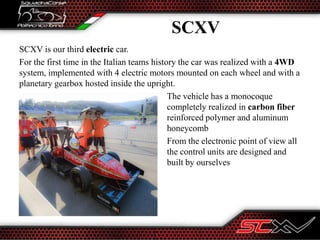
SCXV is our third electric car.
For the first time in the Italian teams history the car was realized with a 4WD
system, implemented with 4 electric motors mounted on each wheel and with a
planetary gearbox hosted inside the upright.
The vehicle has a monocoque
completely realized in carbon fiber
reinforced polymer and aluminum
honeycomb
From the electronic point of view all
the control units are designed and
built by ourselves
HOW ALTAIR HELPS US
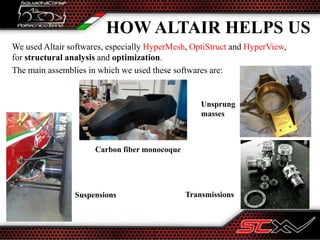
We used Altair softwares, especially HyperMesh, OptiStruct and HyperView,
for structural analysis and optimization.
The main assemblies in which we used these softwares are:
Carbon fiber monocoque
Unsprung
masses
TransmissionsSuspensions
MONOCOQUE
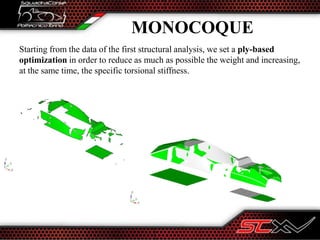
Starting from the data of the first structural analysis, we set a ply-based
optimization in order to reduce as much as possible the weight and increasing,
at the same time, the specific torsional stiffness.
MONOCOQUE
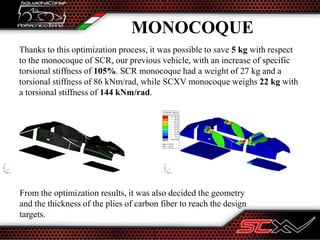
Thanks to this optimization process, it was possible to save 5 kg with respect
to the monocoque of SCR, our previous vehicle, with an increase of specific
torsional stiffness of 105%. SCR monocoque had a weight of 27 kg and a
torsional stiffness of 86 kNm/rad, while SCXV monocoque weighs 22 kg with
a torsional stiffness of 144 kNm/rad.
From the optimization results, it was also decided the geometry
and the thickness of the plies of carbon fiber to reach the design
targets.
MONOCOQUE
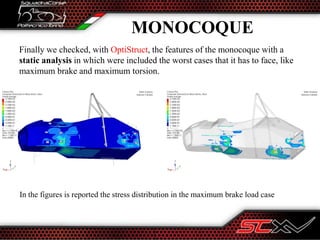
Finally we checked, with OptiStruct, the features of the monocoque with a
static analysis in which were included the worst cases that it has to face, like
maximum brake and maximum torsion.
In the figures is reported the stress distribution in the maximum brake load case
MONOCOQUE
In the figures below are reported the displacement distribution and the
maximum stress distribution in the case of maximum torsion load.
UNSPRUNG MASSES
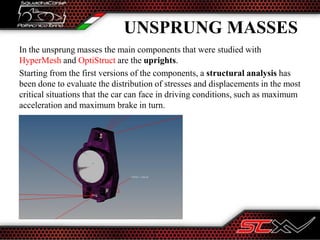
In the unsprung masses the main components that were studied with
HyperMesh and OptiStruct are the uprights.
Starting from the first versions of the components, a structural analysis has
been done to evaluate the distribution of stresses and displacements in the most
critical situations that the car can face in driving conditions, such as maximum
acceleration and maximum brake in turn.
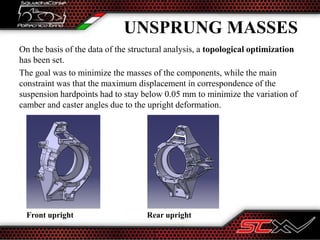
On the basis of the data of the structural analysis, a topological optimization
has been set.
The goal was to minimize the masses of the components, while the main
constraint was that the maximum displacement in correspondence of the
suspension hardpoints had to stay below 0.05 mm to minimize the variation of
camber and caster angles due to the upright deformation.
UNSPRUNG MASSES
Front upright Rear upright
UNSPRUNG MASSES
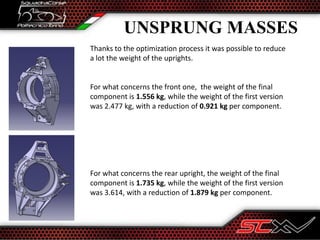
Thanks to the optimization process it was possible to reduce
a lot the weight of the uprights.
For what concerns the front one, the weight of the final
component is 1.556 kg, while the weight of the first version
was 2.477 kg, with a reduction of 0.921 kg per component.
For what concerns the rear upright, the weight of the final
component is 1.735 kg, while the weight of the first version
was 3.614, with a reduction of 1.879 kg per component.
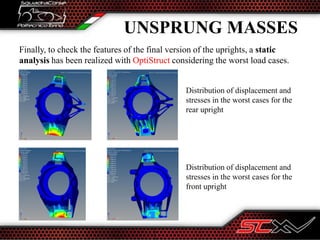
Finally, to check the features of the final version of the uprights, a static
analysis has been realized with OptiStruct considering the worst load cases.
UNSPRUNG MASSES
Distribution of displacement and
stresses in the worst cases for the
rear upright
Distribution of displacement and
stresses in the worst cases for the
front upright
SUSPENSIONS
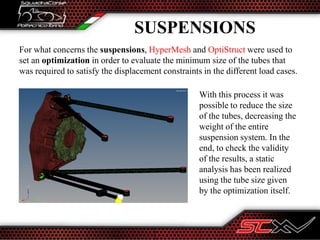
For what concerns the suspensions, HyperMesh and OptiStruct were used to
set an optimization in order to evaluate the minimum size of the tubes that
was required to satisfy the displacement constraints in the different load cases.
With this process it was
possible to reduce the size
of the tubes, decreasing the
weight of the entire
suspension system. In the
end, to check the validity
of the results, a static
analysis has been realized
using the tube size given
by the optimization itself.
TRANSMISSION
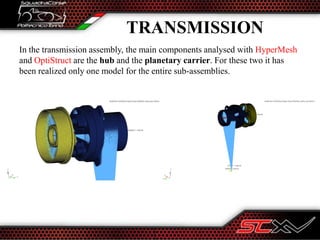
In the transmission assembly, the main components analysed with HyperMesh
and OptiStruct are the hub and the planetary carrier. For these two it has
been realized only one model for the entire sub-assemblies.
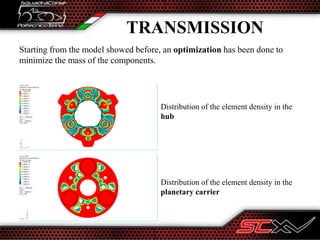
Starting from the model showed before, an optimization has been done to
minimize the mass of the components.
Distribution of the element density in the
hub
Distribution of the element density in the
planetary carrier
TRANSMISSION
Thanks for the attention and special thanks to Altair for the
support during these years.
We hope to continue our collaboration in the future to reach
together new victories.

Formula SAE vehicle

  • 1.
    How we designour electric Formula SAE car using Hyperworks
  • 2.
    WHO WE ARE TheSquadra Corse of Polytechnic University of Turin is an Italian team formed in 2005 by a group of automotive engineering students, brought together by the passion for motorsports.
  • 3.
    WHAT WE DO Theteam deals with the design, production and testing of a new single-seater open-wheel racecar each year, in order to compete with it in Formula SAE events.
  • 4.
    It is theoccasion where the team’s skills are evaluated by automotive experts. Teams from universities all over the world participate to these competitions. They take place in world’s famous circuits (Silverstone, Hockenheim, RedBull Ring, Varano….). FORMULA SAE EVENTS
  • 5.
    SCXV SCXV is ourthird electric car. For the first time in the Italian teams history the car was realized with a 4WD system, implemented with 4 electric motors mounted on each wheel and with a planetary gearbox hosted inside the upright. The vehicle has a monocoque completely realized in carbon fiber reinforced polymer and aluminum honeycomb From the electronic point of view all the control units are designed and built by ourselves
  • 6.
    HOW ALTAIR HELPSUS We used Altair softwares, especially HyperMesh, OptiStruct and HyperView, for structural analysis and optimization. The main assemblies in which we used these softwares are: Carbon fiber monocoque Unsprung masses TransmissionsSuspensions
  • 7.
    MONOCOQUE Starting from thedata of the first structural analysis, we set a ply-based optimization in order to reduce as much as possible the weight and increasing, at the same time, the specific torsional stiffness.
  • 8.
    MONOCOQUE Thanks to thisoptimization process, it was possible to save 5 kg with respect to the monocoque of SCR, our previous vehicle, with an increase of specific torsional stiffness of 105%. SCR monocoque had a weight of 27 kg and a torsional stiffness of 86 kNm/rad, while SCXV monocoque weighs 22 kg with a torsional stiffness of 144 kNm/rad. From the optimization results, it was also decided the geometry and the thickness of the plies of carbon fiber to reach the design targets.
  • 9.
    MONOCOQUE Finally we checked,with OptiStruct, the features of the monocoque with a static analysis in which were included the worst cases that it has to face, like maximum brake and maximum torsion. In the figures is reported the stress distribution in the maximum brake load case
  • 10.
    MONOCOQUE In the figuresbelow are reported the displacement distribution and the maximum stress distribution in the case of maximum torsion load.
  • 11.
    UNSPRUNG MASSES In theunsprung masses the main components that were studied with HyperMesh and OptiStruct are the uprights. Starting from the first versions of the components, a structural analysis has been done to evaluate the distribution of stresses and displacements in the most critical situations that the car can face in driving conditions, such as maximum acceleration and maximum brake in turn.
  • 12.
    On the basisof the data of the structural analysis, a topological optimization has been set. The goal was to minimize the masses of the components, while the main constraint was that the maximum displacement in correspondence of the suspension hardpoints had to stay below 0.05 mm to minimize the variation of camber and caster angles due to the upright deformation. UNSPRUNG MASSES Front upright Rear upright
  • 13.
    UNSPRUNG MASSES Thanks tothe optimization process it was possible to reduce a lot the weight of the uprights. For what concerns the front one, the weight of the final component is 1.556 kg, while the weight of the first version was 2.477 kg, with a reduction of 0.921 kg per component. For what concerns the rear upright, the weight of the final component is 1.735 kg, while the weight of the first version was 3.614, with a reduction of 1.879 kg per component.
  • 14.
    Finally, to checkthe features of the final version of the uprights, a static analysis has been realized with OptiStruct considering the worst load cases. UNSPRUNG MASSES Distribution of displacement and stresses in the worst cases for the rear upright Distribution of displacement and stresses in the worst cases for the front upright
  • 15.
    SUSPENSIONS For what concernsthe suspensions, HyperMesh and OptiStruct were used to set an optimization in order to evaluate the minimum size of the tubes that was required to satisfy the displacement constraints in the different load cases. With this process it was possible to reduce the size of the tubes, decreasing the weight of the entire suspension system. In the end, to check the validity of the results, a static analysis has been realized using the tube size given by the optimization itself.
  • 16.
    TRANSMISSION In the transmissionassembly, the main components analysed with HyperMesh and OptiStruct are the hub and the planetary carrier. For these two it has been realized only one model for the entire sub-assemblies.
  • 17.
    Starting from themodel showed before, an optimization has been done to minimize the mass of the components. Distribution of the element density in the hub Distribution of the element density in the planetary carrier TRANSMISSION
  • 18.
    Thanks for theattention and special thanks to Altair for the support during these years. We hope to continue our collaboration in the future to reach together new victories.