F1 TRACK DESIGN AND SAFETY
CONTENT
 Introduction
 Track design
 Circuit and safety analysis system (CSAS)
 Barriers
 Conclusion
 References
INTRODUCTION
• We are engineers and our job is to enhance and develop the technical
world but at the same time we have to take precautions for the safety of
users.
• Our inventions and m/c are not more precious than anyone’s life.
• In F1 Cars, Drivers and their experience and most of all, the race track
which helps these high techniques cars zoom at an excess of 320 kmph
safely with the minimum of injuries or zero injuries in case of a crash or
an accident.
• These tracks with their high tech safety barriers and other safety features
which go into the making of the track like the use of CSAS( Circuit And
Safety Analysis System) and barrier crash test makes it so safe and
thrilling to watch.
TRACK DESIGN
 Some of the important safety factors are:-
• Road surface
• Tires
• Barriers
• Driver cockpit
• Track design, etc
 The tracks used in motor sport all are designed to meet
certain standards and its design and layout must be
approved by the FIA, before any construction commences.
TRACK SPECIFICATION
 Track width– 12 to 15 metre
• This avoids bad congestion.
 There should be 3 m minimum clear space along both sides of
the track, usually consisting of grass.
 The maximum length of track - 7km.
• To allow drivers to be able to familiarize themselves with all
corners on the track
 The minimum length of track - 3.5km.
 If the probable angle of impact is less than 30o then a
continuous, smooth, vertical barrier is preferable, and where the
probable angle is high, a system of deceleration (e.g. gravel bed)
and stopping (eg. tyre barrier) devices should be used."
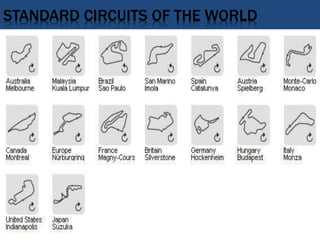
STANDARD CIRCUITS OF THE WORLD
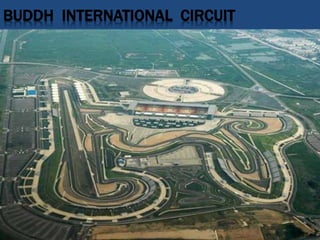
BUDDH INTERNATIONAL CIRCUIT
CIRCUIT AND SAFETY ANALYSIS SYSTEM (CSAS)
• Predicting the trajectory and velocity of a racing car when it is
driven at the limit within the confines of a racing track was
manual work done by the engineers. But
• But now this can now also be analyzed though in the same sort
of detail, to assess the safety features of the circuits on which it
is raced.
• FIA had to start almost from scratch when it set out to develop
software for its Circuit and Safety Analysis System (CSAS).
• The pace of development has been set by the availability of
powerful PC's and suitably qualified graduates to carry out the
work.
• Their task is to be able to model and predict the effects of every
nuance of aerodynamic, tire, engine, damper etc., characteristic
on the speed of their car at every point on a given circuit.
Fig. Examples of straight trajectories.
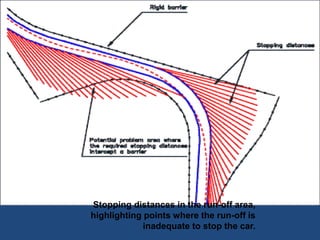
Stopping distances in the run-off area,
highlighting points where the run-off is
inadequate to stop the car.
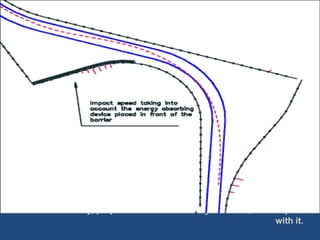
Residual velocity, perpendicular to a 2-row tyre barrier, after impact
with it.
• CSAS has facilitated the synthesis of the results from a number
of safety R&D programs that are gradually putting motorsport
safety on a sound scientific basis.
• It uses the actual speed of the cars at any point on a circuit
• representative deceleration rates on- and off-track
• tested barrier performance to size and specify circuit safety
features.
• Changes to the specification of the cars,
• It is providing detailed insights into how existing circuits can be
upgraded in the continual quest for greater safety.
• The development of CSAS is ongoing.
•The ideal crash barrier is no barrier at all.
• Barriers are necessary on race circuits to enable spectators and TV cameras
to get close enough to the action, without being exposed to the danger of being
hit by an out of control car.
•Road and racing car barrier systems work in a fashion: both cars and barriers
have energy absorbing devices, which engage and dissipate the kinetic energy
of the car.
• Cars can hit a barrier pointing in any direction, at any height, and either
spinning, rolling, tumbling end over end, or some complex combination of all of
them.
•The energy must be dissipated without either subjecting the car to loads that
cause the driver protection structure (safety cell) to fail and injure the driver by
intrusion, or subject the driver to decelerations that cause internal injuries or
result in him striking the safety cell, especially with his head.
•The magnitude of the energy to be absorbed and dissipated increases as the
square of the speed: at 100kph it is the equivalent of dropping the car from a
height of 78 meters; at 200kph - 314 meters; at 300kph - 707 meters.
• Loss of control of a racing car at the end of a straight is the equivalent of
falling from an aircraft flying at a height of nearly one kilometer.
BARRIERS
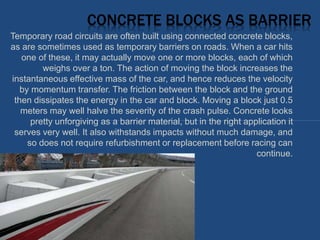
Temporary road circuits are often built using connected concrete blocks,
as are sometimes used as temporary barriers on roads. When a car hits
one of these, it may actually move one or more blocks, each of which
weighs over a ton. The action of moving the block increases the
instantaneous effective mass of the car, and hence reduces the velocity
by momentum transfer. The friction between the block and the ground
then dissipates the energy in the car and block. Moving a block just 0.5
meters may well halve the severity of the crash pulse. Concrete looks
pretty unforgiving as a barrier material, but in the right application it
serves very well. It also withstands impacts without much damage, and
so does not require refurbishment or replacement before racing can
continue.
CONCRETE BLOCKS AS BARRIER
• Barrier absorb energy by deflection, dissipating some of it via the damper part, and
storing and releasing again the remainder, via the spring. This latter causes rebound.
• Some barriers also slow the car by momentum transfer: the car collects heavy parts of
the barrier, and by the principle of conservation of momentum, its speed is reduced
proportional to the increase in the mass of the car plus the barrier. Fig. on next slide
shows a car hitting a two-row tire barrier, spaced in front of a three-row barrier. When it
hits the first rows it collects an ever-increasing mass of tires, which combines with the
mass of the car to reduce its velocity by momentum transfer, prior to impacting the
second set of tires.
•In fact, most barriers combine momentum transfer, material failure, spring and damper
in a complex interaction.
• By far the biggest challenge facing a circuit barrier designer is to come up with a
construction that accommodates a variety of angles of impact and is stiff enough when
impacted with the front or rear of the car, but not too stiff when hit with the full length of
the car traveling sideways.
• Modern single-seaters have sharp pointed noses, reinforced to absorb frontal impacts.
They are just like stilettos, and tend to penetrate barriers like a knife through butter.
• No one-barrier system is ideal for all situations, and the solutions vary according to the
site on a circuit.
• It is not possible to accurately predict how and where a car will impact, but it is possible
to make reasonable estimates of where they are most likely.
Fig. - 2-row tire, momentum transfer barrier
in a short distance.
• The approach taken is to use as much space as is available to
slow the car.
• Run-off areas are provided to generate a low level of
deceleration (around 1g), and to enable the driver to attempt to
sort it out and rejoin the track.
•However, if the barrier is too thick and soft, the car may penetrate
it so deeply that the barrier face reaches the driver's cockpit and
injures him, or traps him and hinders rescue.
• Similarly in an oblique impact, where the velocity along the
barrier is high, penetrating the barrier can snag the car, and then
the car stops so abruptly that the driver is injured by the high
deceleration, or the car turns over.
• There is no perfect barrier for safety purposes but we can
choose perfect one for particular conditions by skills and
knowledge.
CONCLUSION
 The purpose of this seminar is to show how the advanced technology of
the world’s fastest and largest spectator-sport can be used in the normal
superhighways and expressways setting standards of safety for the general
public who drive on the highways.
 Use of barriers similar to those used in formula one can reduce the
amount of injury in case of accidents on these highways. Even the use of
CSAS (Circuit and Safety Analysis System) can be used to build safer
highways.
 As for F1 different circuits and different conditions present challenges for
all connected with the engineering side of F1 and it is those who predict and
cope best with these complications who eventually triumph.
REFERENCE
 Books:
• F1 Technology and the Sport
• F1 Racing magazine
• Auto car Magazine
 Websites:
• www.grandprix.com
• www.f1atlas.com
• www.formulaone.com
Made by :- Mohammad Sohel Khan
Section :- “B”
Branch :- Mechanical
Year : second

Formula 1 Track Design & Safety

  • 1.
    F1 TRACK DESIGNAND SAFETY
  • 2.
    CONTENT  Introduction  Trackdesign  Circuit and safety analysis system (CSAS)  Barriers  Conclusion  References
  • 3.
    INTRODUCTION • We areengineers and our job is to enhance and develop the technical world but at the same time we have to take precautions for the safety of users. • Our inventions and m/c are not more precious than anyone’s life. • In F1 Cars, Drivers and their experience and most of all, the race track which helps these high techniques cars zoom at an excess of 320 kmph safely with the minimum of injuries or zero injuries in case of a crash or an accident. • These tracks with their high tech safety barriers and other safety features which go into the making of the track like the use of CSAS( Circuit And Safety Analysis System) and barrier crash test makes it so safe and thrilling to watch.
  • 5.
    TRACK DESIGN  Someof the important safety factors are:- • Road surface • Tires • Barriers • Driver cockpit • Track design, etc  The tracks used in motor sport all are designed to meet certain standards and its design and layout must be approved by the FIA, before any construction commences.
  • 6.
    TRACK SPECIFICATION  Trackwidth– 12 to 15 metre • This avoids bad congestion.  There should be 3 m minimum clear space along both sides of the track, usually consisting of grass.  The maximum length of track - 7km. • To allow drivers to be able to familiarize themselves with all corners on the track  The minimum length of track - 3.5km.  If the probable angle of impact is less than 30o then a continuous, smooth, vertical barrier is preferable, and where the probable angle is high, a system of deceleration (e.g. gravel bed) and stopping (eg. tyre barrier) devices should be used."
  • 7.
  • 8.
  • 9.
    CIRCUIT AND SAFETYANALYSIS SYSTEM (CSAS) • Predicting the trajectory and velocity of a racing car when it is driven at the limit within the confines of a racing track was manual work done by the engineers. But • But now this can now also be analyzed though in the same sort of detail, to assess the safety features of the circuits on which it is raced. • FIA had to start almost from scratch when it set out to develop software for its Circuit and Safety Analysis System (CSAS). • The pace of development has been set by the availability of powerful PC's and suitably qualified graduates to carry out the work. • Their task is to be able to model and predict the effects of every nuance of aerodynamic, tire, engine, damper etc., characteristic on the speed of their car at every point on a given circuit.
  • 10.
    Fig. Examples ofstraight trajectories.
  • 11.
    Stopping distances inthe run-off area, highlighting points where the run-off is inadequate to stop the car.
  • 12.
    Residual velocity, perpendicularto a 2-row tyre barrier, after impact with it.
  • 13.
    • CSAS hasfacilitated the synthesis of the results from a number of safety R&D programs that are gradually putting motorsport safety on a sound scientific basis. • It uses the actual speed of the cars at any point on a circuit • representative deceleration rates on- and off-track • tested barrier performance to size and specify circuit safety features. • Changes to the specification of the cars, • It is providing detailed insights into how existing circuits can be upgraded in the continual quest for greater safety. • The development of CSAS is ongoing.
  • 14.
    •The ideal crashbarrier is no barrier at all. • Barriers are necessary on race circuits to enable spectators and TV cameras to get close enough to the action, without being exposed to the danger of being hit by an out of control car. •Road and racing car barrier systems work in a fashion: both cars and barriers have energy absorbing devices, which engage and dissipate the kinetic energy of the car. • Cars can hit a barrier pointing in any direction, at any height, and either spinning, rolling, tumbling end over end, or some complex combination of all of them. •The energy must be dissipated without either subjecting the car to loads that cause the driver protection structure (safety cell) to fail and injure the driver by intrusion, or subject the driver to decelerations that cause internal injuries or result in him striking the safety cell, especially with his head. •The magnitude of the energy to be absorbed and dissipated increases as the square of the speed: at 100kph it is the equivalent of dropping the car from a height of 78 meters; at 200kph - 314 meters; at 300kph - 707 meters. • Loss of control of a racing car at the end of a straight is the equivalent of falling from an aircraft flying at a height of nearly one kilometer. BARRIERS
  • 16.
    Temporary road circuitsare often built using connected concrete blocks, as are sometimes used as temporary barriers on roads. When a car hits one of these, it may actually move one or more blocks, each of which weighs over a ton. The action of moving the block increases the instantaneous effective mass of the car, and hence reduces the velocity by momentum transfer. The friction between the block and the ground then dissipates the energy in the car and block. Moving a block just 0.5 meters may well halve the severity of the crash pulse. Concrete looks pretty unforgiving as a barrier material, but in the right application it serves very well. It also withstands impacts without much damage, and so does not require refurbishment or replacement before racing can continue. CONCRETE BLOCKS AS BARRIER
  • 17.
    • Barrier absorbenergy by deflection, dissipating some of it via the damper part, and storing and releasing again the remainder, via the spring. This latter causes rebound. • Some barriers also slow the car by momentum transfer: the car collects heavy parts of the barrier, and by the principle of conservation of momentum, its speed is reduced proportional to the increase in the mass of the car plus the barrier. Fig. on next slide shows a car hitting a two-row tire barrier, spaced in front of a three-row barrier. When it hits the first rows it collects an ever-increasing mass of tires, which combines with the mass of the car to reduce its velocity by momentum transfer, prior to impacting the second set of tires. •In fact, most barriers combine momentum transfer, material failure, spring and damper in a complex interaction. • By far the biggest challenge facing a circuit barrier designer is to come up with a construction that accommodates a variety of angles of impact and is stiff enough when impacted with the front or rear of the car, but not too stiff when hit with the full length of the car traveling sideways. • Modern single-seaters have sharp pointed noses, reinforced to absorb frontal impacts. They are just like stilettos, and tend to penetrate barriers like a knife through butter. • No one-barrier system is ideal for all situations, and the solutions vary according to the site on a circuit. • It is not possible to accurately predict how and where a car will impact, but it is possible to make reasonable estimates of where they are most likely.
  • 18.
    Fig. - 2-rowtire, momentum transfer barrier
  • 19.
    in a shortdistance. • The approach taken is to use as much space as is available to slow the car. • Run-off areas are provided to generate a low level of deceleration (around 1g), and to enable the driver to attempt to sort it out and rejoin the track. •However, if the barrier is too thick and soft, the car may penetrate it so deeply that the barrier face reaches the driver's cockpit and injures him, or traps him and hinders rescue. • Similarly in an oblique impact, where the velocity along the barrier is high, penetrating the barrier can snag the car, and then the car stops so abruptly that the driver is injured by the high deceleration, or the car turns over. • There is no perfect barrier for safety purposes but we can choose perfect one for particular conditions by skills and knowledge.
  • 20.
    CONCLUSION  The purposeof this seminar is to show how the advanced technology of the world’s fastest and largest spectator-sport can be used in the normal superhighways and expressways setting standards of safety for the general public who drive on the highways.  Use of barriers similar to those used in formula one can reduce the amount of injury in case of accidents on these highways. Even the use of CSAS (Circuit and Safety Analysis System) can be used to build safer highways.  As for F1 different circuits and different conditions present challenges for all connected with the engineering side of F1 and it is those who predict and cope best with these complications who eventually triumph.
  • 21.
    REFERENCE  Books: • F1Technology and the Sport • F1 Racing magazine • Auto car Magazine  Websites: • www.grandprix.com • www.f1atlas.com • www.formulaone.com
  • 22.
    Made by :-Mohammad Sohel Khan Section :- “B” Branch :- Mechanical Year : second