The Goa Land Development and Building
Construction Regulations, 2010
VARADI MANOJ,
M.URP,
2180400098.
GOA ACT 6 OF 2008.
TABLE OF CONTENTS
Procedure and requirements for building permission & completion certificate.
 Standard colour notations to be made in plans.
 Deviation during development and revocation of permission.
 Revocations of development permission.
General Requirements for Development.
 Roof pattern in buildings.
 Means of access to the building within the plot.
 Restriction on development within line of sight at the road intersections.
 Front, Side and Rear Setbacks.
Zoning Regulations and Use provisions.
 Land use zones.
 Regulations applicable to various zones.
 Special Zones.
 Conservation Zone.
Parking.
Group Housing.
Sub-Division Regulations.
 Regulations regarding sloping sites.
 Regulations regarding open spaces.
 General requirements regarding development of plots, open spaces and roads.
 Regulations regarding minimum size of the plot, frontage, means of access and right of way of roads.
 Accessibility to the plot to be sub-divided.
Building By-Laws .
 Minimum Ceiling Height of Rooms.
 Minimum size of Rooms.
 Lighting and Ventilation of Rooms.
 Bath Room and Water Closet.
 Kitchens.
 Shops.
 Staircase, corridors and Passages.
Building Services.
 Water Supply.
 Wells.
 Electric Supply.
Fire Safety Requirements.
 Requirement for Fire Dept Clearance.
 Occupant load.
 Control on erection of hoardings along on roads/on roof of Buildings.
Coastal Regulation Zone.
 Prohibitions.
 Regulations.
PROCEDURE AND REQUIREMENTS FOR BUILDING PERMISSION &
COMPLETION CERTIFICATE.
REQUIREMENTS FOR OBTAINING PERMISSION
Every applicant seeking development permission/sub-division permission/building
permission shall be required to submit the following:
 to Planning and Development Authority for Development Permission.
 to Town Planning Department for Technical Clearance.
 to Municipal Council for Building License/Permit.
 to Village Panchayat for Building License/Permit.
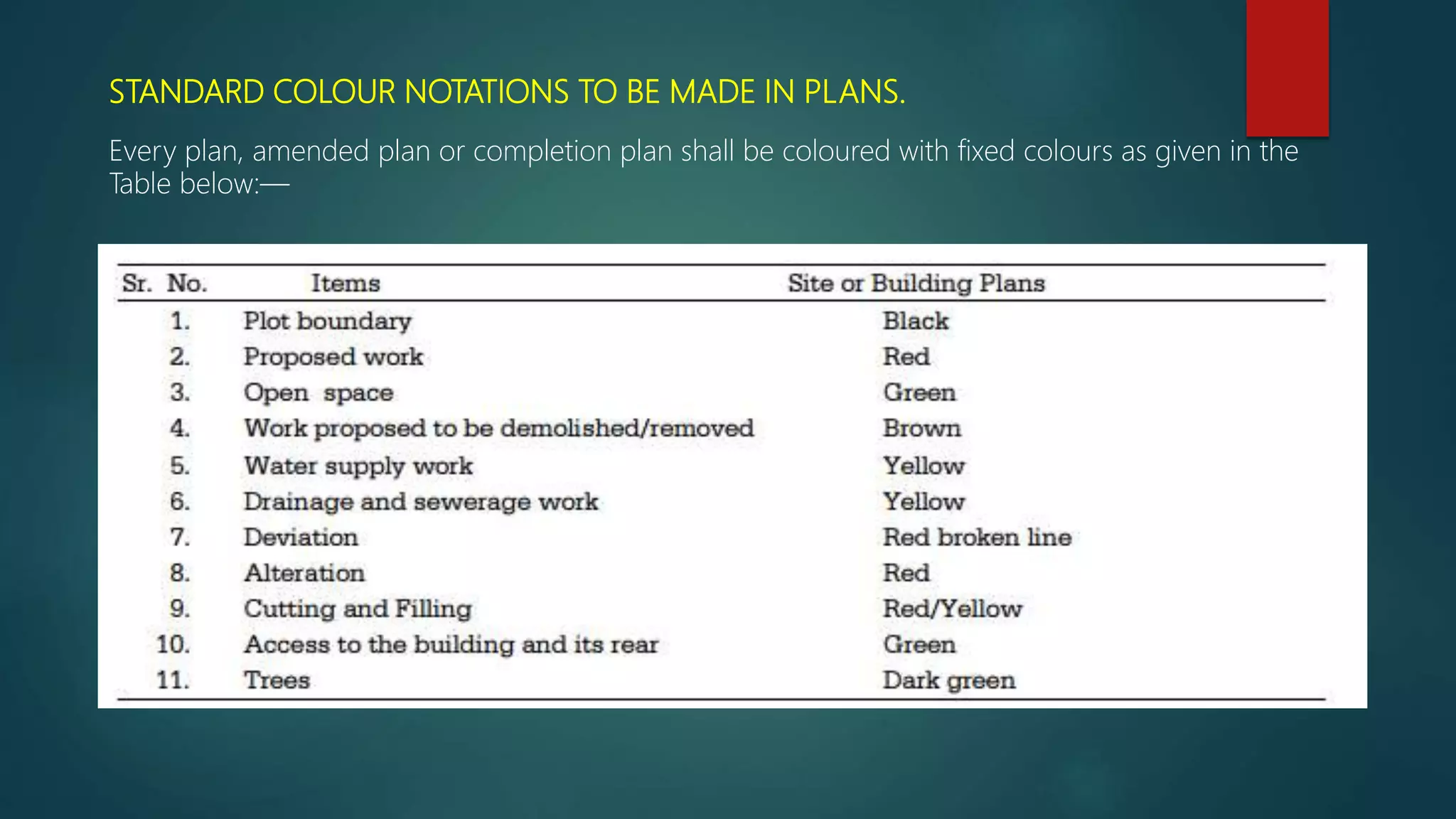
STANDARD COLOUR NOTATIONS TO BE MADE IN PLANS.
Every plan, amended plan or completion plan shall be coloured with fixed colours as given in the
Table below:—
DEVIATION DURING DEVELOPMENT AND REVOCATION OF PERMISSION.
In case deviation occurs which, in the opinion of the owner and his Architect/Engineer/Structural
Engineer/Town Planner/Landscape Architect/Urban Designer, is within the framework of these
Regulations, the holder may carry out such deviation and should apply and obtain revised approval,
clearly showing such deviation in the plans, as soon as possible or at least at the time of applying for
Occupancy Certificate. However, this will not apply to Conservation Zone, where no deviation shall be
carried without prior approval of the Conservation Committee.
REVOCATIONS OF DEVELOPMENT PERMISSION
The Planning and Development Authority (PDA)/Municipal Council/Village Panchayat may, subject to
the provisions of the relevant Act, revoke any development permission/building licence, issued under
the provisions of these Regulations, wherever there has been any false statements suppression or any
misrepresentation of material facts in the application or plans on which the development
permission/building licence was based or non-compliance of provisions.
GENERAL REQUIREMENTS FOR DEVELOPMENT
ROOF PATTERN IN BUILDINGS
All buildings in residential zone should have sloping roof, flat type roof may be permitted
to a maximum extent of 25% of covered area of the building.
Means of access to the building within the plot
Every person who erects a building shall provide a means of access to such building a
way of not less than 3.00 mts.
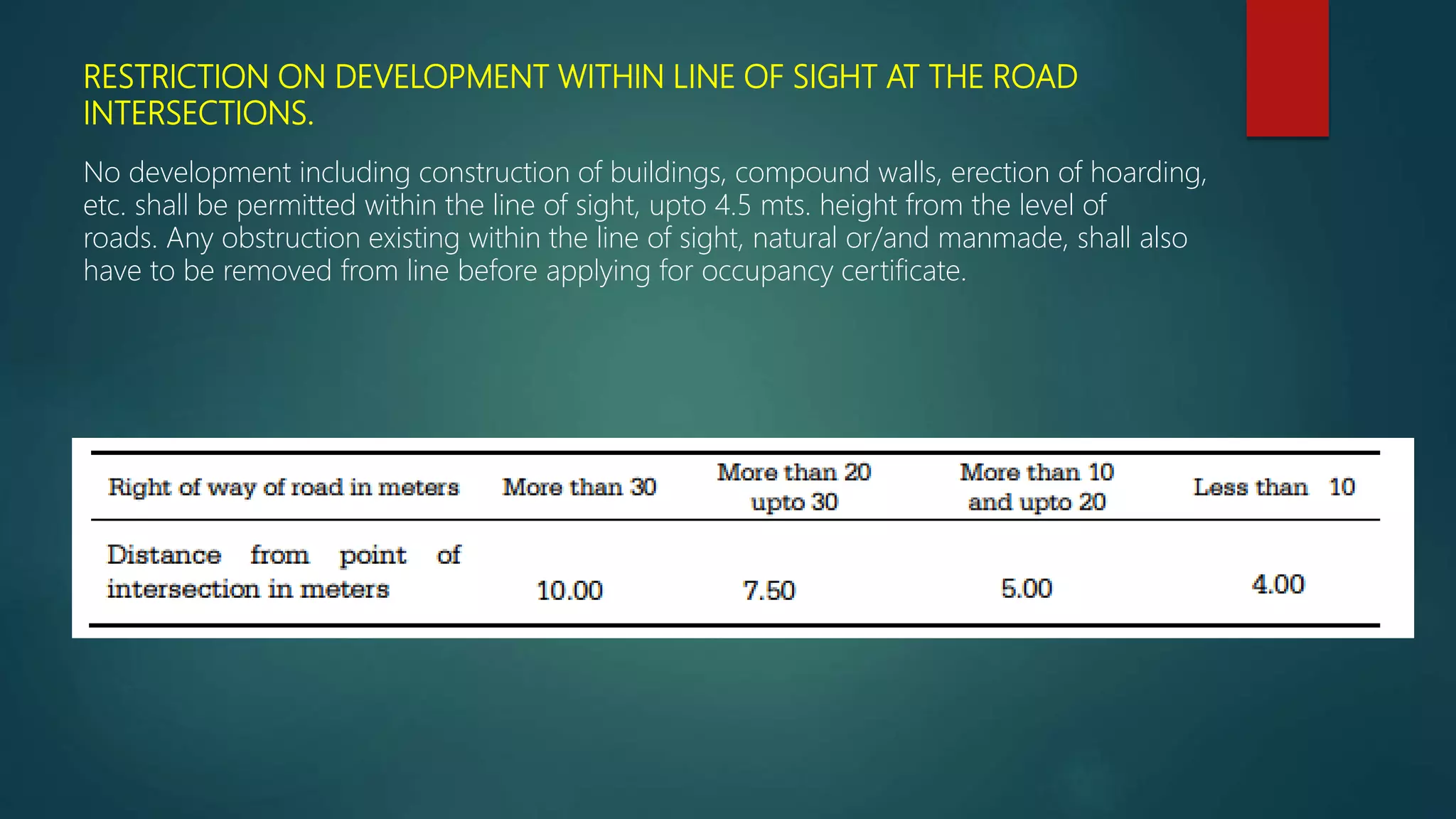
RESTRICTION ON DEVELOPMENT WITHIN LINE OF SIGHT AT THE ROAD
INTERSECTIONS.
No development including construction of buildings, compound walls, erection of hoarding,
etc. shall be permitted within the line of sight, upto 4.5 mts. height from the level of
roads. Any obstruction existing within the line of sight, natural or/and manmade, shall also
have to be removed from line before applying for occupancy certificate.
FRONT SETBACK.
Every building shall have minimum front setback as per the TABLE given below:–
Note:
Whenever commercial use is proposed in S1 S2 S3 S4, the front setback shall be minimum 5.00
meters if the plot is located on a road of 10 meters and below. In commercial zones, plots which are
abutting roads of 10 meters and below shall have 5 meters front setback.
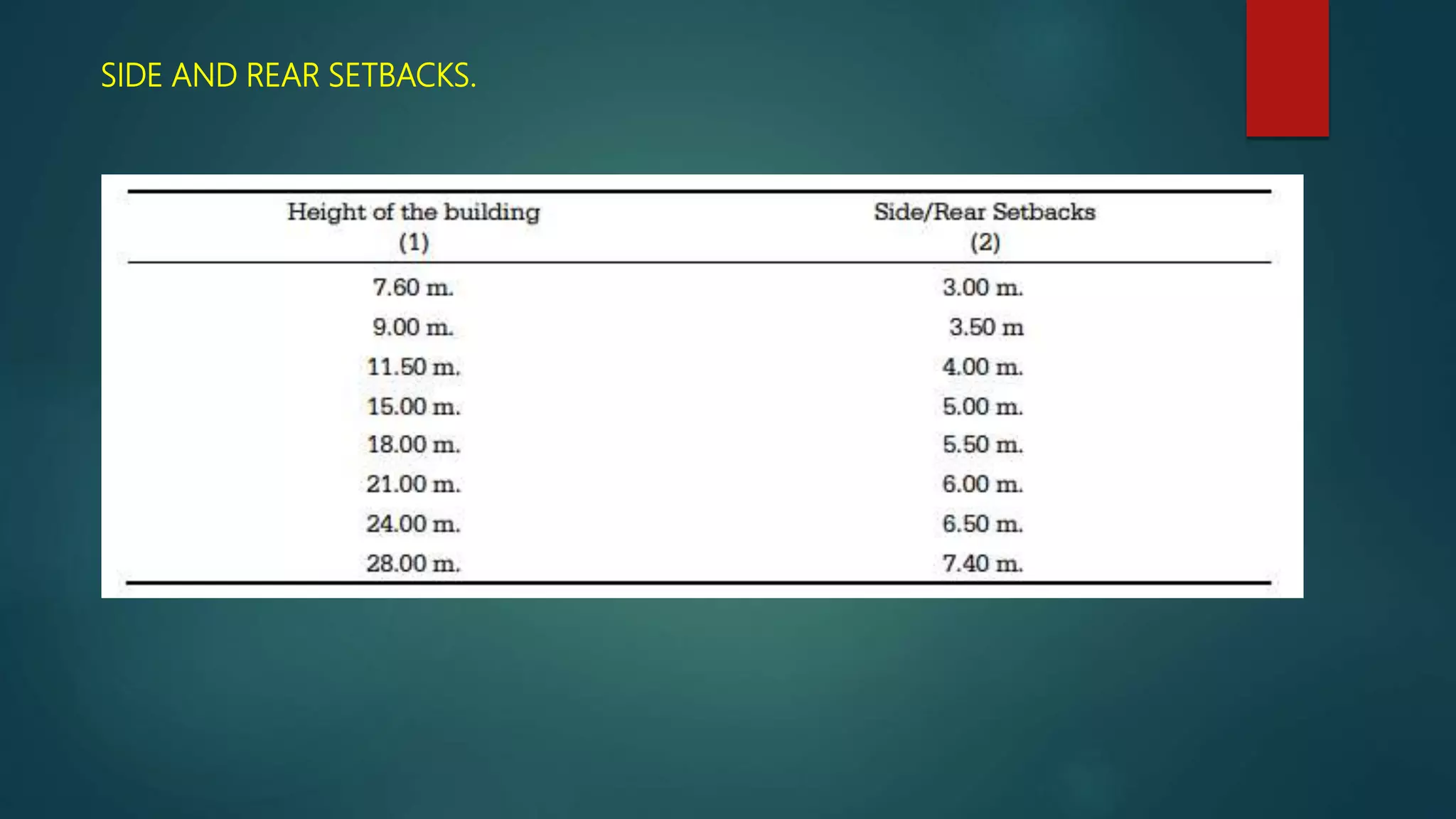
SIDE AND REAR SETBACKS.
ZONING REGULATIONS AND USE PROVISIONS.
LAND USE ZONES.
In these regulations, the land use shall be as per TABLE given below, for the zones marked in
the Regional Plan/Outline Development Plan/Sub-- Regional Plan/Zoning Plan/Town
Scheme.
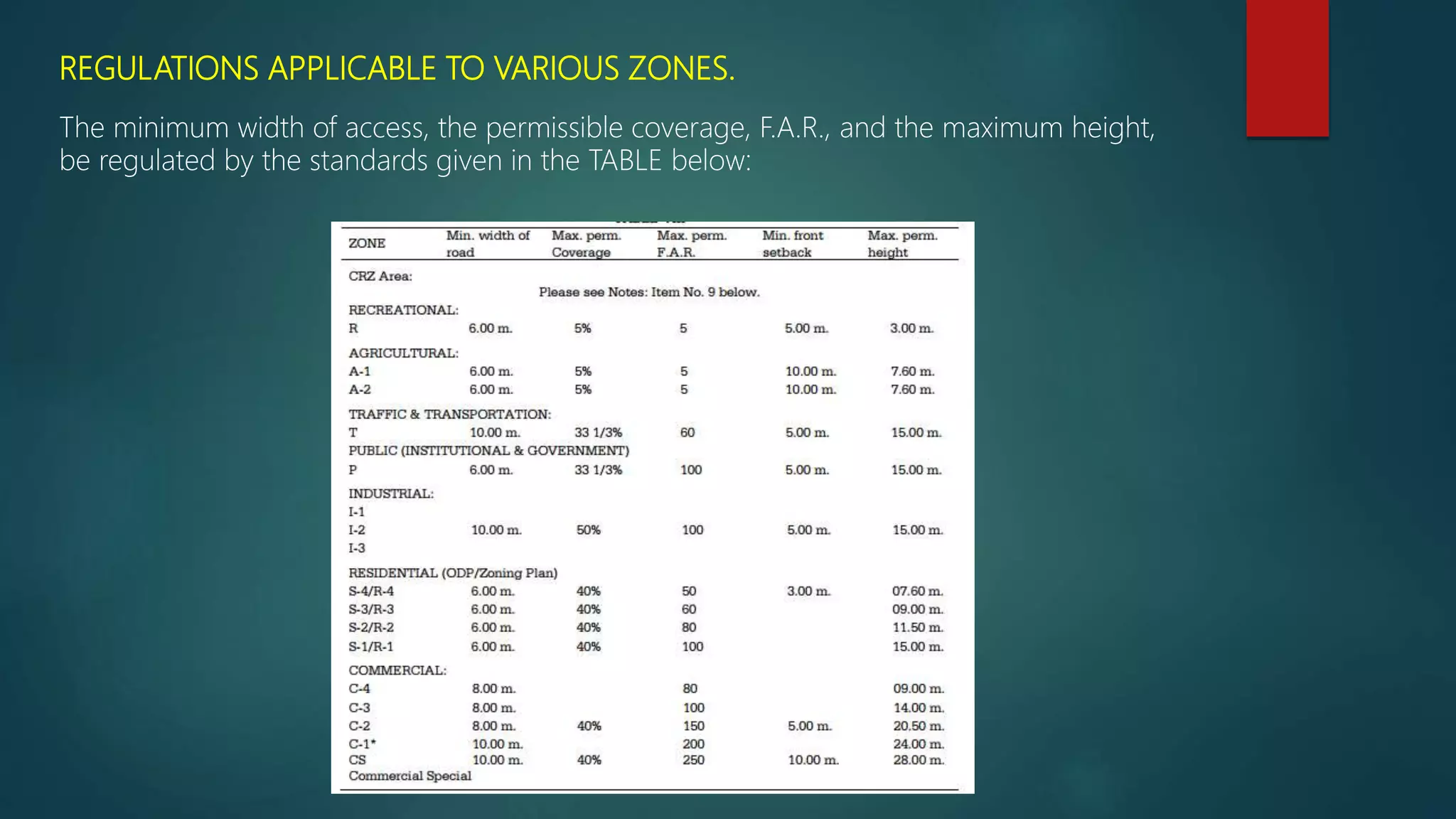
REGULATIONS APPLICABLE TO VARIOUS ZONES.
The minimum width of access, the permissible coverage, F.A.R., and the maximum height,
be regulated by the standards given in the TABLE below:
SPECIAL ZONES:
Conservation Zone
Note: In cases of existing 100% coverage, additional FAR totalling to max of 200 FAR could be
considered and granted by the Conservation Committee on case to case basis in Commercial
Conservation Zone in Panaji.
PARKING
PARKING.
Off street parking spaces for vehicles shall be provided in case of every new building
to be constructed or when new additions are made to the existing building, as specified in
TABLE , depending on the use of the building.
GROUP HOUSING
GROUP HOUSING:
When a plot, having an area of more than 4000 m2 but less than 20000 m2, is used for
construction of group of buildings, an open space, as per the provisions in sub-division
regulations
All the buildings should be provided with a minimum pedestrian access of 3.00 m. and
minimum setback of 1.50 mts. on either side of the access shall be applicable.
All parking areas shall be accessible by an internal road having a minimum width of 6.00
meters.
In case of plots exceeding 20,000 m² in area, the same shall have to be subdivided into
of 20,000 m²
No part of building shall be allowed to be projected over the road/access including
SUB-DIVISION REGULATIONS
REGULATIONS REGARDING SLOPING SITES:
(a) When submitting plans of sub-division of land or layout of private street proposals in a plot which
a gradient of 1:10 or more, the plan should indicate block levels at 5.00 m. centre to centre or
alternatively contour plans at 1.00 m. intervals prepared by a Chartered Surveyor.
(b) The levels/contours should be drawn with reference to a bench mark clearly indicated on the site
(c) Such block levels/contour plans prepared by a Chartered Surveyor are obligatory in case the site
exceeds 10,000 m2 in area.
(d) No part of the plot which is having an inclination of more than 25% slope shall be permitted for
development as useable/saleable plots.
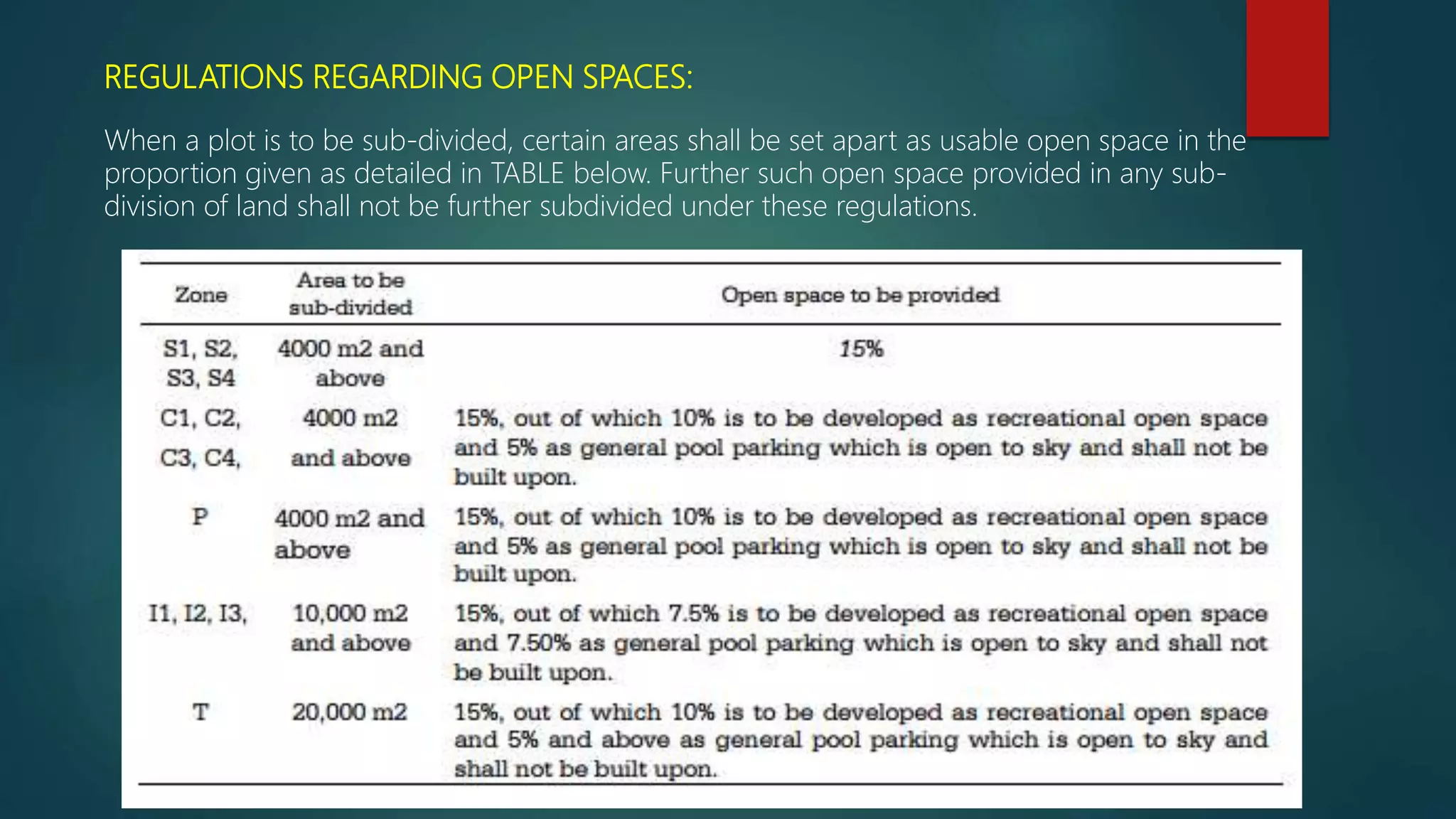
REGULATIONS REGARDING OPEN SPACES:
When a plot is to be sub-divided, certain areas shall be set apart as usable open space in the
proportion given as detailed in TABLE below. Further such open space provided in any sub-
division of land shall not be further subdivided under these regulations.
GENERAL REQUIREMENTS REGARDING DEVELOPMENT OF PLOTS, OPEN SPACES
AND ROADS:
(a) All plots should be properly developed to make them suitable for construction and so as
prevent water logging.
(b) The roads and open spaces should be developed so as to prevent water logging and
flooding.
(c) Every sub-divided plot as well as all open spaces should have an independent motorable
means of access from a public road.
(d) All plots and open spaces shall be clearly demarcated with boundary stones fixed at all
corners.
REGULATIONS REGARDING MINIMUM SIZE OF THE PLOT, FRONTAGE, MEANS OF
ACCESS AND RIGHT OF WAY OF ROADS:
All sub-divided plots shall have minimum sizes, frontage, means of access and widths of
hall be as given in the below tables.
Minimum area of plot and minimum length of side of plot:
ACCESSIBILITY TO THE PLOT TO BE SUB-
DIVIDED.
In case of existing plots having an area up to 5000 m2 and is abutting on a public road of 3.00 m
only, development may be permitted by relaxing the minimum road/right of way requirement,
provided the length of the road/right of way to the plot does not exceed 100.00 m from the main
road.
MINIMUM WIDTH OF ROADS WITHIN THE SUB-DIVISION
OF LAND:
(1) In settlement zones, 3.00 m. road serving only one plot of 500.00 m² or less shall be permitted.
No cul-de-sac head shall be required to be provided.
(2) In Industrial and Transport zones, the minimum width of the road shall be 10.00 m. if the road is
looped and 15.00 m. if the road ends in cul-de-sac head.
(3) In commercial zones, the minimum width of road shall be 8.00 m. if the road is looped and 10.00
m. if the road ends in cul-de-sac head.
BUILDING BY-LAWS
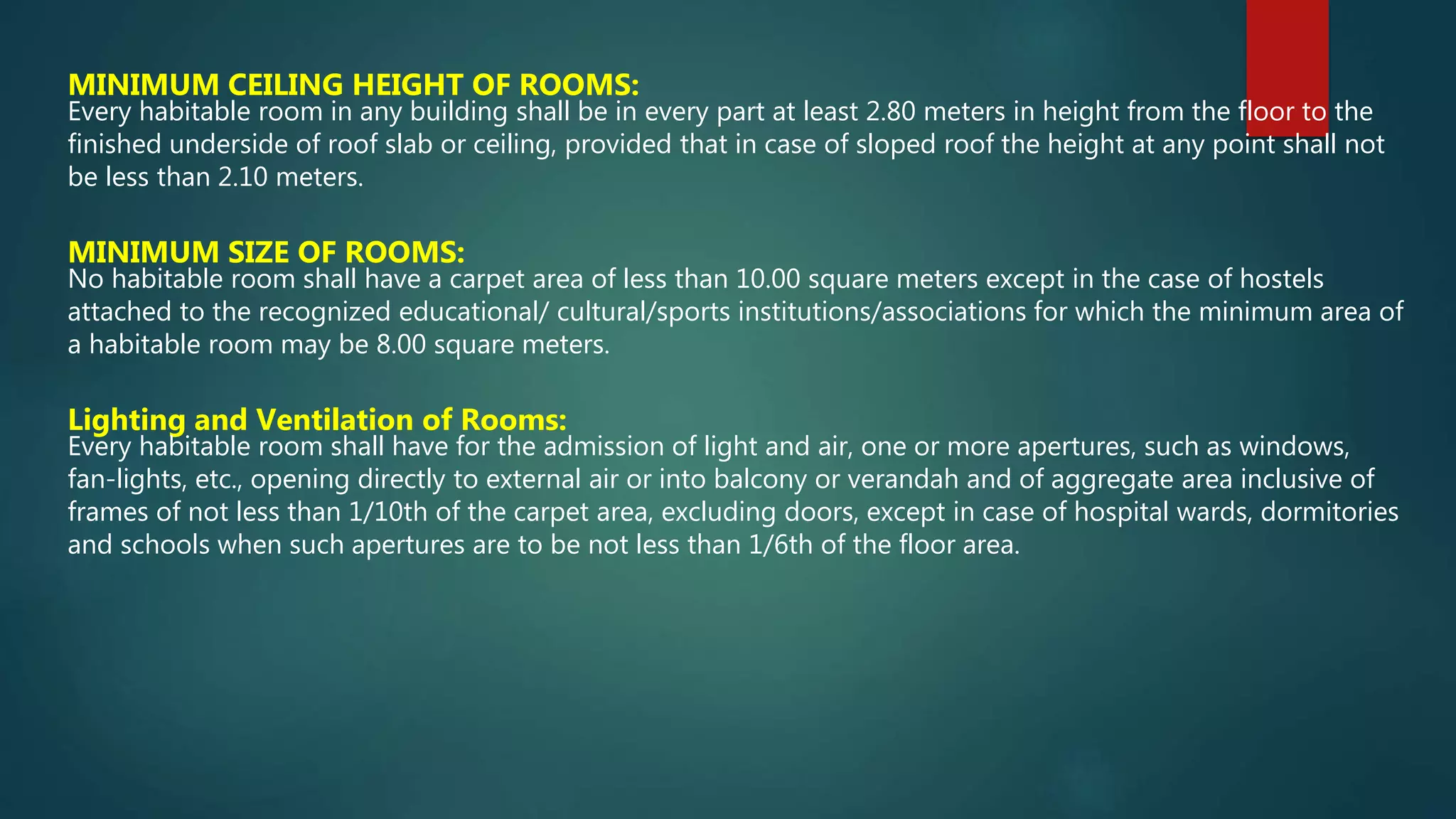
MINIMUM CEILING HEIGHT OF ROOMS:
Every habitable room in any building shall be in every part at least 2.80 meters in height from the floor to the
finished underside of roof slab or ceiling, provided that in case of sloped roof the height at any point shall not
be less than 2.10 meters.
MINIMUM SIZE OF ROOMS:
No habitable room shall have a carpet area of less than 10.00 square meters except in the case of hostels
attached to the recognized educational/ cultural/sports institutions/associations for which the minimum area of
a habitable room may be 8.00 square meters.
Lighting and Ventilation of Rooms:
Every habitable room shall have for the admission of light and air, one or more apertures, such as windows,
fan-lights, etc., opening directly to external air or into balcony or verandah and of aggregate area inclusive of
frames of not less than 1/10th of the carpet area, excluding doors, except in case of hospital wards, dormitories
and schools when such apertures are to be not less than 1/6th of the floor area.
BATH ROOM AND WATER CLOSET:
Be so situated that at least one of its walls shall be open to external air or open
balcony not more than 2.00 meters in width or interior open air space as prescribed in these
Regulations.
KITCHENS:
A kitchen shall have a carpet area of not less than 7.00 m2 and shall not be less than 2.00
in width.
SHOPS:
(a) The minimum carpet area of a shop shall be 6.00 m2 and the least dimension of 2.00 mts.
(b) (b) Shops having carpet area between 6.00 m2 and 9.99 m2 shall not be permitted with
mezzanine. The minimum frontage/width shall be 2.00 mts.
(c) Shops having area of 10.00 m2 and above the minimum width shall be 2.50 mts.
(d) All shops shall have full opening on its front for the purpose of ventilation.
(e) Shops having depth of more than 7.50 meters shall be provided additional ventilation from
other side, as required for a habitable room.
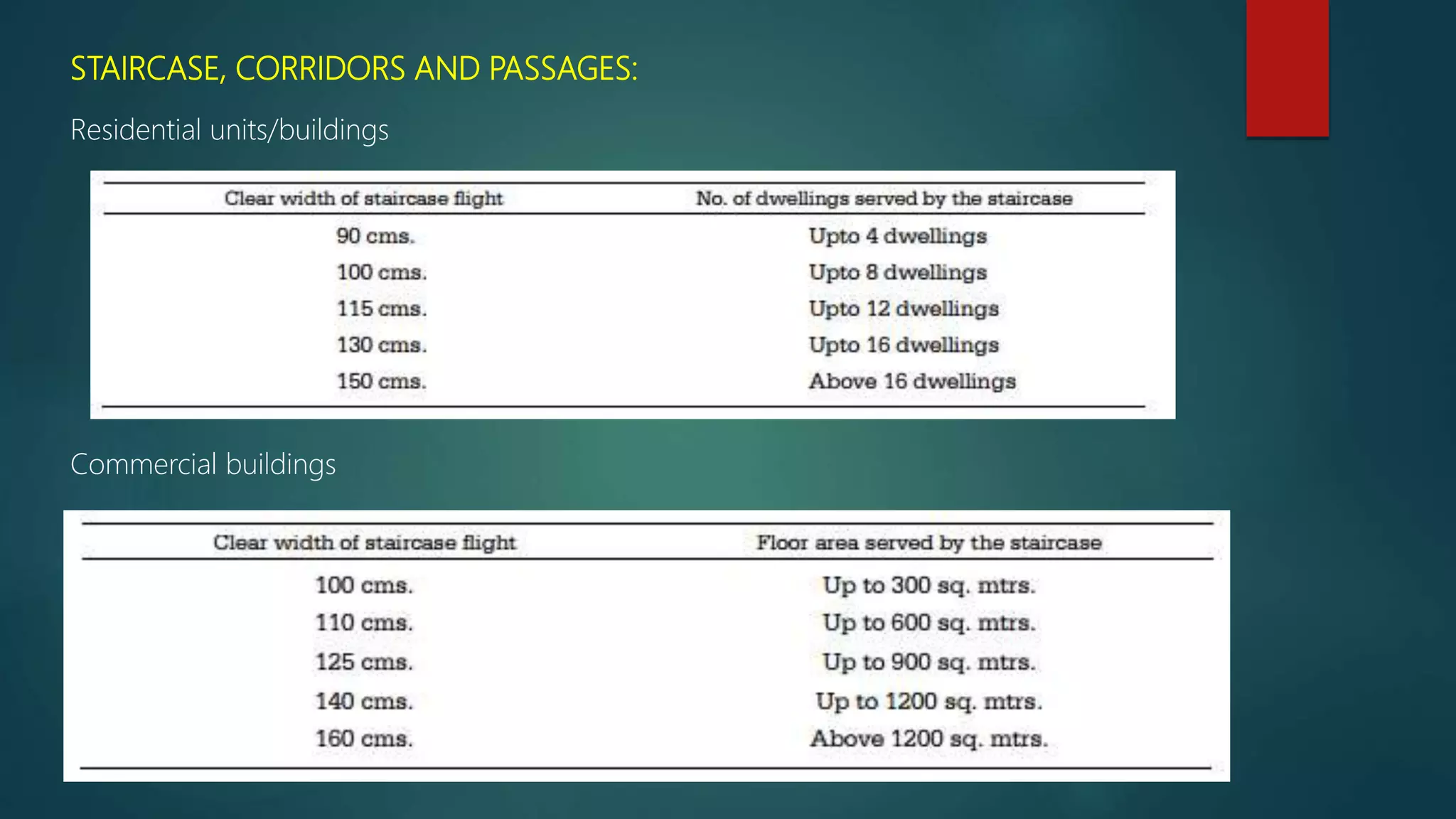
STAIRCASE, CORRIDORS AND PASSAGES:
Residential units/buildings
Commercial buildings
Industrial/Hazardous building
The regulations applicable to Industries or Hazardous buildings shall be as specified in the
National Building Code 2005 or as amended by time to time.
Public utility buildings and institutional buildings
BUILDING SERVICES
WATER SUPPLY
WELLS
(a) Wells intended to supply water for human consumption or for domestic purpose shall be–
(i) Not less than 15 meters away from any ash pit, refuse pit, soak pit, earth closet or privy
shall be located on a site upward from the earth closet or privy;
(ii) so situated that contamination by the movement of sub-soil of other water is unlikely;
(iii) of a minimum internal diameter of not less than 1.00 meter;
(iv) of permanent and sound quality construction throughout.
DRAINAGE AND SANITATION
Every sanitary/drainage installation from any existing building shall be connected to a public sewer
wherever available. All the structures created for Drainage and Sanitary installation i.e. inspection
chambers and septic tank has to abide by the provisions of the design and specifications as laid down in
Goa Public Health Act, 1985 (Goa Act 25 of 1985) for prevention of Vector Borne Diseases.
ELECTRIC SUPPLY
In buildings where multiple connections are likely to come up, the owner/ promoter of the
building shall assure a built-up premises of 2 x 2 sq. meters, nearest to the public road in
the ground floor. Buildings having 1000 m2 of floor area or above have to compulsorily
provide built-up room of size 2 mts. x 3 mts. with fire barriers on the ground floor nearest
to the public road to put transformer and distribution board or as may be permitted by
Electricity Department.
FIRE SAFETY REQUIREMENTS
REQUIREMENT FOR FIRE DEPT CLEARANCE
For all buildings, above 15.00 meters in height, which are of low occupancy in the following
categories, the NOC from Director, Directorate of Fire & Emergency Services shall be
by the Owners/Developer before starting the work on site. The NOC from Director,
of Fire & Emergency Services shall also be obtained by the Owners/Developer for
of building.
• Institutional, Assembly and Educational buildings of more than two storeys and built up
exceeding 1000 sq. mts. • Business building, where plot area exceeds 500.00 sq. mts.
• Hotel building
• Hospital building/Nursing home building
• Underground complexes
• Meeting/Banquet hall building
• Industrial Building for storage of hazardous goods
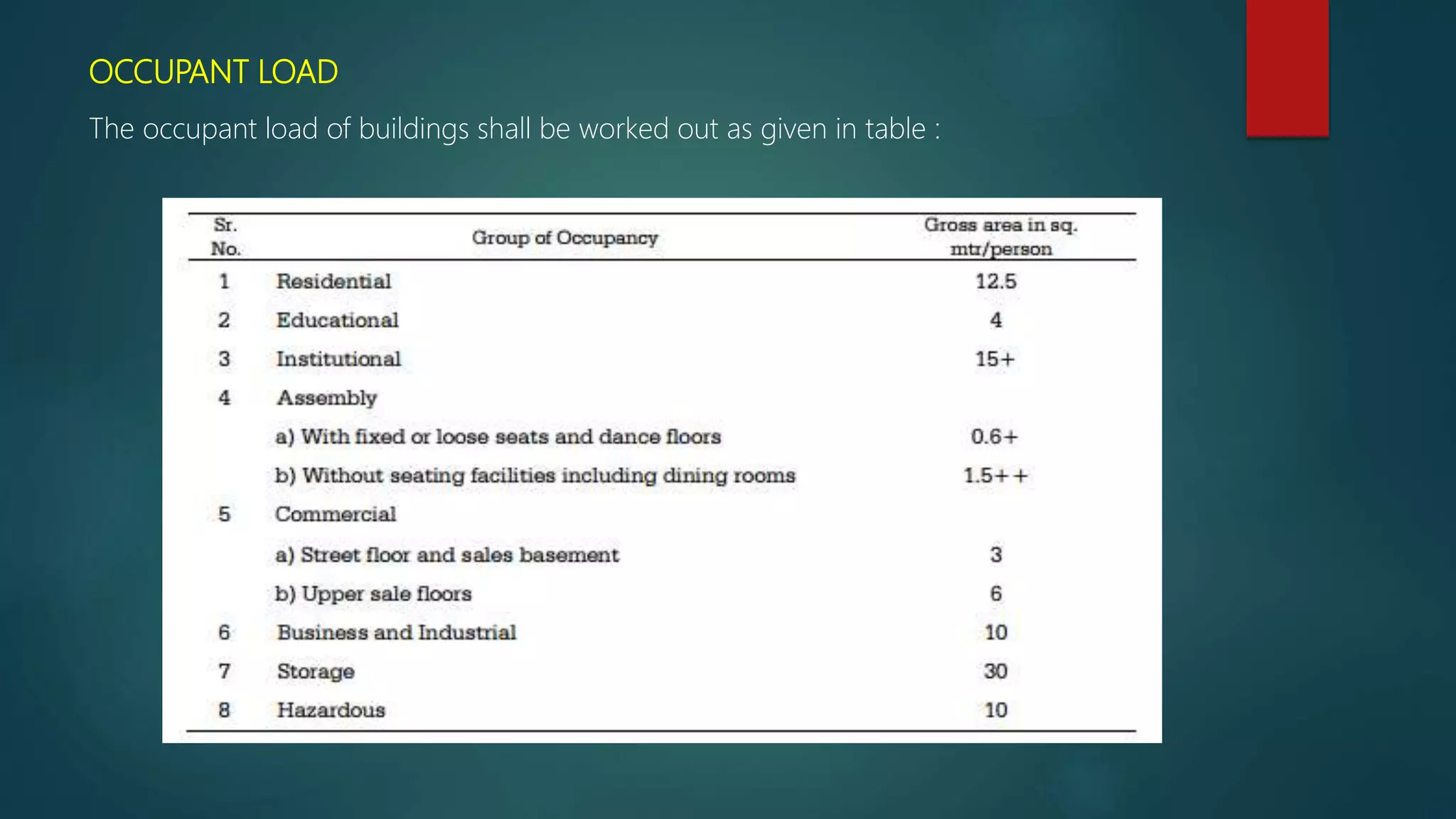
OCCUPANT LOAD
The occupant load of buildings shall be worked out as given in table :
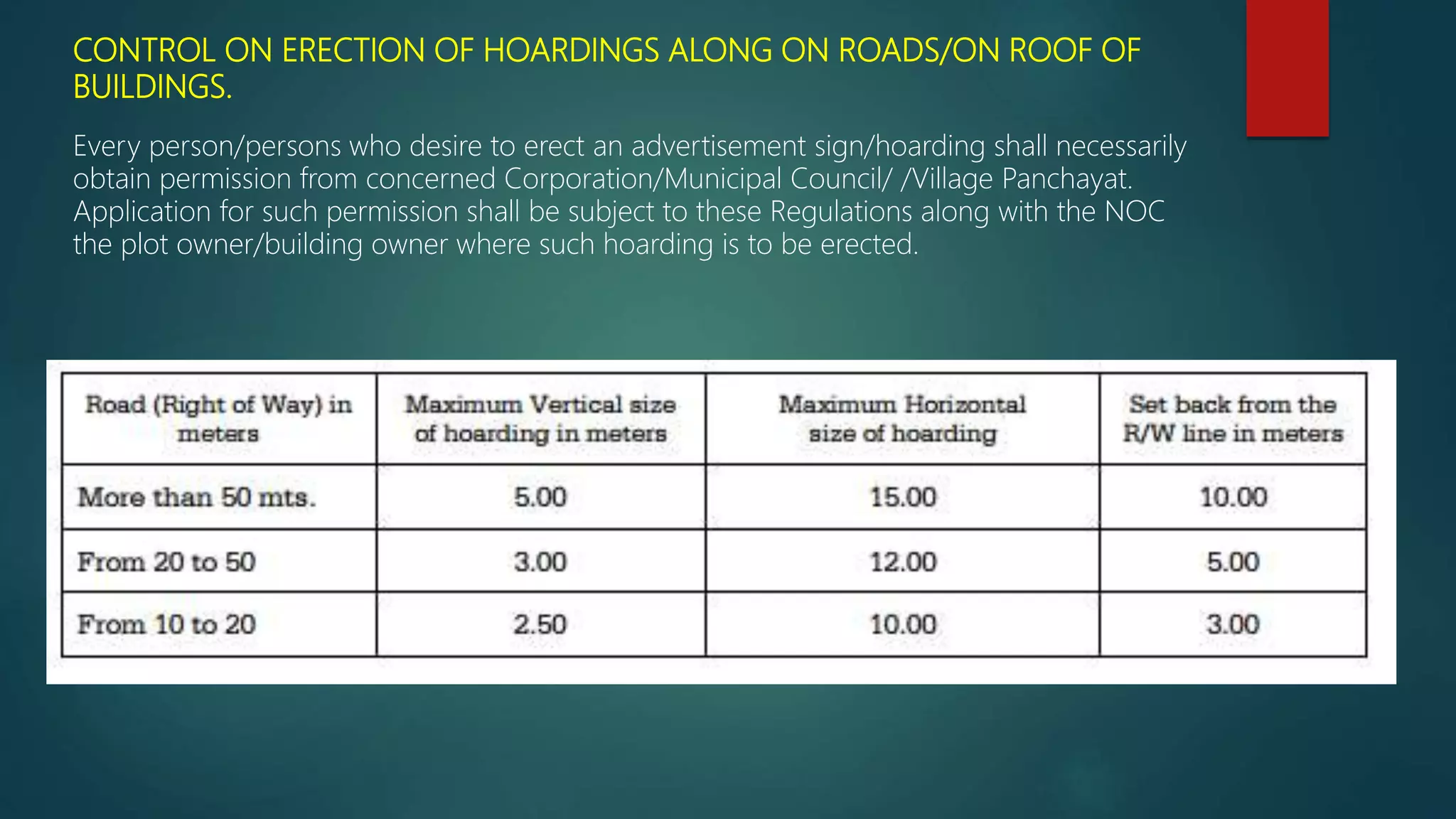
CONTROL ON ERECTION OF HOARDINGS ALONG ON ROADS/ON ROOF OF
BUILDINGS.
Every person/persons who desire to erect an advertisement sign/hoarding shall necessarily
obtain permission from concerned Corporation/Municipal Council/ /Village Panchayat.
Application for such permission shall be subject to these Regulations along with the NOC
the plot owner/building owner where such hoarding is to be erected.
COASTAL REGULATION ZONE
PROHIBITIONS
Setting up of new industries and expansion of existing industries, except (a) those directly
related to water front or directly needing foreshore facilities and (b) Projects of Department
Atomic Energy .are prohibited.
Manufacture or handling or storage or disposal of hazardous substances , except transfer of
hazardous substances from ships to port, terminals and refineries and vice versa in the port
area.
Setting up and expansion of fish processing units including warehousing (Excluding hatchery
and natural fish drying in permitted areas).
Discharge of untreated wastes and effluents from industries, cities or towns and other
settlements.
Mining of sands, rocks and other sub-starta materials, except exploration and extraction of
and Natural Gas.
REGULATIONS
For regulating development activities, the coastal stretches within 500 meters of High Tide
on the landward side are classified into four categories, namely:
Category-I (CRZ-I):
Areas that are ecologically sensitive, Area between the Low Tide Line and the High Tide Line.
Category – II (CRZ-II):
The areas that have been developed up to or close to the shore-line. For this purpose,
“developed area” is referred to as that area within the municipal limits or in other legally
designated urban areas which is already substantially built up and which has been provided
with drainage and approach roads and other infrastructural facilities, such as water supply
sewage mains.
Category-III (CRZ-III):
Area that are relatively undistributed and those do not belong to either Category-I or II.
Development of vacant plots between 200 and 500 meters of High Tide Line in designated
areas of CRZ-III with prior approval of Ministry of Environment and Forests (MEF)
DEVELOPMENT RESTRICTIONS
RESTRICTION ON DEVELOPMENT/REDEVELOPMENT/REPAIRS:
For Archaeological sites/monuments declared protected sites and monuments in GOA and
within a minimum area up to 300 meters from the Protected monuments notified under the
Ancient Monuments and Archaeological Sites and Remains Act, 1958 (Central Act 24 of 1958)
NOC from the designated authority of the Director General, Archaeological Survey of India,
Delhi is required in addition to 2(a).
Grade I: 1. Definition:
Grade I comprises of buildings and precincts of national or historic importance embodying
excellence in architectural style, design, technology and material usage; they may be
with a great historic event, personality movement or institution. They may have been or
currently are Urban or Rural landmarks.
Grade II A & Grade II B:
Grade II A and II B comprise of buildings of regional or local importance, possessing special
architectural or aesthetic merit, cultural or historic values although of a lower scale than Grade
Grade III:
Grade III comprises of buildings and precinct of importance from the point of view of their
being part of a townscape.
THANK YOU

The goa land development and building 2010.

  • 1.
    The Goa LandDevelopment and Building Construction Regulations, 2010 VARADI MANOJ, M.URP, 2180400098. GOA ACT 6 OF 2008.
  • 2.
    TABLE OF CONTENTS Procedureand requirements for building permission & completion certificate.  Standard colour notations to be made in plans.  Deviation during development and revocation of permission.  Revocations of development permission. General Requirements for Development.  Roof pattern in buildings.  Means of access to the building within the plot.  Restriction on development within line of sight at the road intersections.  Front, Side and Rear Setbacks. Zoning Regulations and Use provisions.  Land use zones.  Regulations applicable to various zones.  Special Zones.  Conservation Zone. Parking. Group Housing.
  • 3.
    Sub-Division Regulations.  Regulationsregarding sloping sites.  Regulations regarding open spaces.  General requirements regarding development of plots, open spaces and roads.  Regulations regarding minimum size of the plot, frontage, means of access and right of way of roads.  Accessibility to the plot to be sub-divided. Building By-Laws .  Minimum Ceiling Height of Rooms.  Minimum size of Rooms.  Lighting and Ventilation of Rooms.  Bath Room and Water Closet.  Kitchens.  Shops.  Staircase, corridors and Passages. Building Services.  Water Supply.  Wells.  Electric Supply. Fire Safety Requirements.  Requirement for Fire Dept Clearance.  Occupant load.  Control on erection of hoardings along on roads/on roof of Buildings. Coastal Regulation Zone.  Prohibitions.  Regulations.
  • 4.
    PROCEDURE AND REQUIREMENTSFOR BUILDING PERMISSION & COMPLETION CERTIFICATE.
  • 5.
    REQUIREMENTS FOR OBTAININGPERMISSION Every applicant seeking development permission/sub-division permission/building permission shall be required to submit the following:  to Planning and Development Authority for Development Permission.  to Town Planning Department for Technical Clearance.  to Municipal Council for Building License/Permit.  to Village Panchayat for Building License/Permit.

  • 6.
    STANDARD COLOUR NOTATIONSTO BE MADE IN PLANS. Every plan, amended plan or completion plan shall be coloured with fixed colours as given in the Table below:—
  • 7.
    DEVIATION DURING DEVELOPMENTAND REVOCATION OF PERMISSION. In case deviation occurs which, in the opinion of the owner and his Architect/Engineer/Structural Engineer/Town Planner/Landscape Architect/Urban Designer, is within the framework of these Regulations, the holder may carry out such deviation and should apply and obtain revised approval, clearly showing such deviation in the plans, as soon as possible or at least at the time of applying for Occupancy Certificate. However, this will not apply to Conservation Zone, where no deviation shall be carried without prior approval of the Conservation Committee.
  • 8.
    REVOCATIONS OF DEVELOPMENTPERMISSION The Planning and Development Authority (PDA)/Municipal Council/Village Panchayat may, subject to the provisions of the relevant Act, revoke any development permission/building licence, issued under the provisions of these Regulations, wherever there has been any false statements suppression or any misrepresentation of material facts in the application or plans on which the development permission/building licence was based or non-compliance of provisions.
  • 9.
  • 10.
    ROOF PATTERN INBUILDINGS All buildings in residential zone should have sloping roof, flat type roof may be permitted to a maximum extent of 25% of covered area of the building. Means of access to the building within the plot Every person who erects a building shall provide a means of access to such building a way of not less than 3.00 mts.
  • 11.
    RESTRICTION ON DEVELOPMENTWITHIN LINE OF SIGHT AT THE ROAD INTERSECTIONS. No development including construction of buildings, compound walls, erection of hoarding, etc. shall be permitted within the line of sight, upto 4.5 mts. height from the level of roads. Any obstruction existing within the line of sight, natural or/and manmade, shall also have to be removed from line before applying for occupancy certificate.
  • 12.
    FRONT SETBACK. Every buildingshall have minimum front setback as per the TABLE given below:– Note: Whenever commercial use is proposed in S1 S2 S3 S4, the front setback shall be minimum 5.00 meters if the plot is located on a road of 10 meters and below. In commercial zones, plots which are abutting roads of 10 meters and below shall have 5 meters front setback.
  • 13.
    SIDE AND REARSETBACKS.
  • 14.
    ZONING REGULATIONS ANDUSE PROVISIONS.
  • 15.
    LAND USE ZONES. Inthese regulations, the land use shall be as per TABLE given below, for the zones marked in the Regional Plan/Outline Development Plan/Sub-- Regional Plan/Zoning Plan/Town Scheme.
  • 16.
    REGULATIONS APPLICABLE TOVARIOUS ZONES. The minimum width of access, the permissible coverage, F.A.R., and the maximum height, be regulated by the standards given in the TABLE below:
  • 17.
    SPECIAL ZONES: Conservation Zone Note:In cases of existing 100% coverage, additional FAR totalling to max of 200 FAR could be considered and granted by the Conservation Committee on case to case basis in Commercial Conservation Zone in Panaji.
  • 18.
  • 19.
    PARKING. Off street parkingspaces for vehicles shall be provided in case of every new building to be constructed or when new additions are made to the existing building, as specified in TABLE , depending on the use of the building.
  • 20.
  • 21.
    GROUP HOUSING: When aplot, having an area of more than 4000 m2 but less than 20000 m2, is used for construction of group of buildings, an open space, as per the provisions in sub-division regulations All the buildings should be provided with a minimum pedestrian access of 3.00 m. and minimum setback of 1.50 mts. on either side of the access shall be applicable. All parking areas shall be accessible by an internal road having a minimum width of 6.00 meters. In case of plots exceeding 20,000 m² in area, the same shall have to be subdivided into of 20,000 m² No part of building shall be allowed to be projected over the road/access including
  • 22.
  • 23.
    REGULATIONS REGARDING SLOPINGSITES: (a) When submitting plans of sub-division of land or layout of private street proposals in a plot which a gradient of 1:10 or more, the plan should indicate block levels at 5.00 m. centre to centre or alternatively contour plans at 1.00 m. intervals prepared by a Chartered Surveyor. (b) The levels/contours should be drawn with reference to a bench mark clearly indicated on the site (c) Such block levels/contour plans prepared by a Chartered Surveyor are obligatory in case the site exceeds 10,000 m2 in area. (d) No part of the plot which is having an inclination of more than 25% slope shall be permitted for development as useable/saleable plots.
  • 24.
    REGULATIONS REGARDING OPENSPACES: When a plot is to be sub-divided, certain areas shall be set apart as usable open space in the proportion given as detailed in TABLE below. Further such open space provided in any sub- division of land shall not be further subdivided under these regulations.
  • 25.
    GENERAL REQUIREMENTS REGARDINGDEVELOPMENT OF PLOTS, OPEN SPACES AND ROADS: (a) All plots should be properly developed to make them suitable for construction and so as prevent water logging. (b) The roads and open spaces should be developed so as to prevent water logging and flooding. (c) Every sub-divided plot as well as all open spaces should have an independent motorable means of access from a public road. (d) All plots and open spaces shall be clearly demarcated with boundary stones fixed at all corners.
  • 26.
    REGULATIONS REGARDING MINIMUMSIZE OF THE PLOT, FRONTAGE, MEANS OF ACCESS AND RIGHT OF WAY OF ROADS: All sub-divided plots shall have minimum sizes, frontage, means of access and widths of hall be as given in the below tables. Minimum area of plot and minimum length of side of plot:
  • 27.
    ACCESSIBILITY TO THEPLOT TO BE SUB- DIVIDED. In case of existing plots having an area up to 5000 m2 and is abutting on a public road of 3.00 m only, development may be permitted by relaxing the minimum road/right of way requirement, provided the length of the road/right of way to the plot does not exceed 100.00 m from the main road.
  • 28.
    MINIMUM WIDTH OFROADS WITHIN THE SUB-DIVISION OF LAND: (1) In settlement zones, 3.00 m. road serving only one plot of 500.00 m² or less shall be permitted. No cul-de-sac head shall be required to be provided. (2) In Industrial and Transport zones, the minimum width of the road shall be 10.00 m. if the road is looped and 15.00 m. if the road ends in cul-de-sac head. (3) In commercial zones, the minimum width of road shall be 8.00 m. if the road is looped and 10.00 m. if the road ends in cul-de-sac head.
  • 29.
  • 30.
    MINIMUM CEILING HEIGHTOF ROOMS: Every habitable room in any building shall be in every part at least 2.80 meters in height from the floor to the finished underside of roof slab or ceiling, provided that in case of sloped roof the height at any point shall not be less than 2.10 meters. MINIMUM SIZE OF ROOMS: No habitable room shall have a carpet area of less than 10.00 square meters except in the case of hostels attached to the recognized educational/ cultural/sports institutions/associations for which the minimum area of a habitable room may be 8.00 square meters. Lighting and Ventilation of Rooms: Every habitable room shall have for the admission of light and air, one or more apertures, such as windows, fan-lights, etc., opening directly to external air or into balcony or verandah and of aggregate area inclusive of frames of not less than 1/10th of the carpet area, excluding doors, except in case of hospital wards, dormitories and schools when such apertures are to be not less than 1/6th of the floor area.
  • 31.
    BATH ROOM ANDWATER CLOSET: Be so situated that at least one of its walls shall be open to external air or open balcony not more than 2.00 meters in width or interior open air space as prescribed in these Regulations. KITCHENS: A kitchen shall have a carpet area of not less than 7.00 m2 and shall not be less than 2.00 in width. SHOPS: (a) The minimum carpet area of a shop shall be 6.00 m2 and the least dimension of 2.00 mts. (b) (b) Shops having carpet area between 6.00 m2 and 9.99 m2 shall not be permitted with mezzanine. The minimum frontage/width shall be 2.00 mts. (c) Shops having area of 10.00 m2 and above the minimum width shall be 2.50 mts. (d) All shops shall have full opening on its front for the purpose of ventilation. (e) Shops having depth of more than 7.50 meters shall be provided additional ventilation from other side, as required for a habitable room.
  • 32.
    STAIRCASE, CORRIDORS ANDPASSAGES: Residential units/buildings Commercial buildings
  • 33.
    Industrial/Hazardous building The regulationsapplicable to Industries or Hazardous buildings shall be as specified in the National Building Code 2005 or as amended by time to time. Public utility buildings and institutional buildings
  • 34.
  • 35.
  • 36.
    WELLS (a) Wells intendedto supply water for human consumption or for domestic purpose shall be– (i) Not less than 15 meters away from any ash pit, refuse pit, soak pit, earth closet or privy shall be located on a site upward from the earth closet or privy; (ii) so situated that contamination by the movement of sub-soil of other water is unlikely; (iii) of a minimum internal diameter of not less than 1.00 meter; (iv) of permanent and sound quality construction throughout. DRAINAGE AND SANITATION Every sanitary/drainage installation from any existing building shall be connected to a public sewer wherever available. All the structures created for Drainage and Sanitary installation i.e. inspection chambers and septic tank has to abide by the provisions of the design and specifications as laid down in Goa Public Health Act, 1985 (Goa Act 25 of 1985) for prevention of Vector Borne Diseases.
  • 37.
    ELECTRIC SUPPLY In buildingswhere multiple connections are likely to come up, the owner/ promoter of the building shall assure a built-up premises of 2 x 2 sq. meters, nearest to the public road in the ground floor. Buildings having 1000 m2 of floor area or above have to compulsorily provide built-up room of size 2 mts. x 3 mts. with fire barriers on the ground floor nearest to the public road to put transformer and distribution board or as may be permitted by Electricity Department.
  • 38.
  • 39.
    REQUIREMENT FOR FIREDEPT CLEARANCE For all buildings, above 15.00 meters in height, which are of low occupancy in the following categories, the NOC from Director, Directorate of Fire & Emergency Services shall be by the Owners/Developer before starting the work on site. The NOC from Director, of Fire & Emergency Services shall also be obtained by the Owners/Developer for of building. • Institutional, Assembly and Educational buildings of more than two storeys and built up exceeding 1000 sq. mts. • Business building, where plot area exceeds 500.00 sq. mts. • Hotel building • Hospital building/Nursing home building • Underground complexes • Meeting/Banquet hall building • Industrial Building for storage of hazardous goods
  • 40.
    OCCUPANT LOAD The occupantload of buildings shall be worked out as given in table :
  • 41.
    CONTROL ON ERECTIONOF HOARDINGS ALONG ON ROADS/ON ROOF OF BUILDINGS. Every person/persons who desire to erect an advertisement sign/hoarding shall necessarily obtain permission from concerned Corporation/Municipal Council/ /Village Panchayat. Application for such permission shall be subject to these Regulations along with the NOC the plot owner/building owner where such hoarding is to be erected.
  • 42.
  • 43.
    PROHIBITIONS Setting up ofnew industries and expansion of existing industries, except (a) those directly related to water front or directly needing foreshore facilities and (b) Projects of Department Atomic Energy .are prohibited. Manufacture or handling or storage or disposal of hazardous substances , except transfer of hazardous substances from ships to port, terminals and refineries and vice versa in the port area. Setting up and expansion of fish processing units including warehousing (Excluding hatchery and natural fish drying in permitted areas). Discharge of untreated wastes and effluents from industries, cities or towns and other settlements. Mining of sands, rocks and other sub-starta materials, except exploration and extraction of and Natural Gas.
  • 44.
    REGULATIONS For regulating developmentactivities, the coastal stretches within 500 meters of High Tide on the landward side are classified into four categories, namely: Category-I (CRZ-I): Areas that are ecologically sensitive, Area between the Low Tide Line and the High Tide Line. Category – II (CRZ-II): The areas that have been developed up to or close to the shore-line. For this purpose, “developed area” is referred to as that area within the municipal limits or in other legally designated urban areas which is already substantially built up and which has been provided with drainage and approach roads and other infrastructural facilities, such as water supply sewage mains. Category-III (CRZ-III): Area that are relatively undistributed and those do not belong to either Category-I or II. Development of vacant plots between 200 and 500 meters of High Tide Line in designated areas of CRZ-III with prior approval of Ministry of Environment and Forests (MEF)
  • 45.
  • 46.
    RESTRICTION ON DEVELOPMENT/REDEVELOPMENT/REPAIRS: ForArchaeological sites/monuments declared protected sites and monuments in GOA and within a minimum area up to 300 meters from the Protected monuments notified under the Ancient Monuments and Archaeological Sites and Remains Act, 1958 (Central Act 24 of 1958) NOC from the designated authority of the Director General, Archaeological Survey of India, Delhi is required in addition to 2(a). Grade I: 1. Definition: Grade I comprises of buildings and precincts of national or historic importance embodying excellence in architectural style, design, technology and material usage; they may be with a great historic event, personality movement or institution. They may have been or currently are Urban or Rural landmarks. Grade II A & Grade II B: Grade II A and II B comprise of buildings of regional or local importance, possessing special architectural or aesthetic merit, cultural or historic values although of a lower scale than Grade Grade III: Grade III comprises of buildings and precinct of importance from the point of view of their being part of a townscape.
  • 47.