Presentation on FORMS OF TECHNICAL   COMMUNICATION
FORMS OFTECHNICALCOMMUNICATION
BUSINESS CORRESPONDANCEBusiness correspondence refers to all modes of written communication.This include letters, telegrams, fax, e-mail, memos, notice & reports etc…3
A telegram is a quick & easy way of transmitting message. It has a format.Fax uses a box machine through which message is transmitted in no time.E-mail doesn’t require any paper work. It is the fastest means of transmitting message.Memos, circulars, & notices are not part of inter-official communication. Report is a formal document on some issue & it is passed to someone who was not present on the event.4
Meaning of Business LettersBusiness letters are written to establish & making contacts with suppliers, government departments & public in general.These letters may relate to make an inquiry, reply an inquiry, placing an order, acknowledging an order, applying for credit, granting credit, etc.5
Important Features of a Business LettersA business letter is an official letter having a proper structure. It is written in limited words.Readers with their interests & tastes should be borne in mind while writing a letter.The language should be simple, precise, & easy to understand. Different & out-dated words should be avoided to avoid ambiguity.It should be effective, pervasive & clear cut in its idea.The tone of a business letter should be direct, polite, positive & friendly. 6
Functions of a Business LetterRecord & Reference…Building Goodwill…To widen the scope…An Authoritative Proof…A Lasting Impression…Providing Information…7
Organizational Approach to Business LettersDirect Approach of Letter Writing:It is adopted when receiver & sender are             familiar to each other & there is a high             possibility of positive response.Indirect Approach of Letter Writing:It is used when a message is             expected to get negative response.8
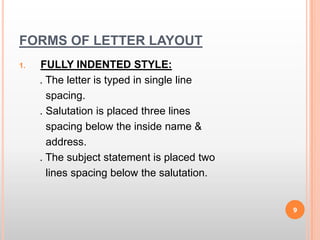
FORMS OF LETTER LAYOUTFULLY INDENTED STYLE:       . The letter is typed in single line         spacing.       . Salutation is placed three lines           spacing below the inside name &           address.       . The subject statement is placed two         lines spacing below the salutation.    9
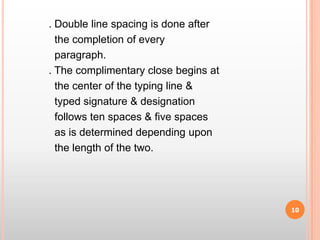
          . Double line spacing is done after             the completion of every              paragraph.          . The complimentary close begins at             the center of the typing line &             typed signature & designation              follows ten spaces & five spaces                  as is determined depending upon               the length of the two.10
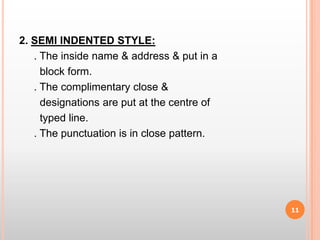
2. SEMI INDENTED STYLE:     . The inside name & address & put in a        block form.     . The complimentary close &          designations are put at the centre of         typed line.     . The punctuation is in close pattern.11
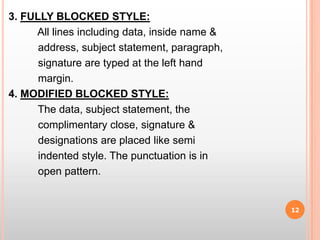
3. FULLY BLOCKED STYLE:          All lines including data, inside name &          address, subject statement, paragraph,          signature are typed at the left hand          margin.4. MODIFIED BLOCKED STYLE:          The data, subject statement, the          complimentary close, signature &             designations are placed like semi            indented style. The punctuation is in            open pattern.12
STRUCTURE OF A BUSINESS LETTERHeading: The letter consists of the name & address of the company, its telephone number & telegraphic address.Date: Date should include month, date & year.Reference Number: Reference number is put for record purpose.13
Inside Address: It includes the addressee's name or the name of the company & address. If it includes the name of the company, ‘Messer's’ should be written before name of the companySalutation: It should be placed two spaces below the inside address. ‘Dear Sir’ should be used if the recipient is man. ‘Dear Sirs’ is used in case the letter is addressed to the company.Subject Matter: It states the purpose of the letter. It should be underlined.14
Do’s & Don’ts for a Good Business Letter1. Do follow rules of a standard business letter.2. Do target your correspondence to the audience/      employer. (ex: avoid “To whom it may concern, Dear      Sir/Mam”).3. Do make sure there are no spelling,      grammar or punctuation errors.4. Do limit to one page.5. Do keep a copy of everything that you send out.6. Do make sure there is an original signature on all the documents that you mail out.15
7.   Do close with a direct request for some        type of action. (Ex: interview, phone call,        etc.)8.   Do use high-quality stationary for hard       copies.9.   Don’t be generic & impersonal.10. Don’t start every sentence with “I”.11. Don’t use language that is unprofessional     (Don’t try to be a comic).12. Don’t include personal information that is       not relevant to the position.13. Don’t give false impressions.16
Types of Business LettersSales LettersCredit LettersLetters of EnquiryLetters of QuotationLetters of OrderLetters of Claim or ComplaintLetters of AdjustmentLetters of Acceptance, Withdrawal, Rejection17
SALES LETTERSSales letters are written to draw the attention of the customers towards the sale of a product. It should be persuasive & action oriented.Sales letter has two functions:        -> To introduce your company & your            products.        -> To direct the customers towards            your product.18
Format of a Sales Letter Salutation… Subject Matter Your Name & Address…19
Objectives of Sales Letters G       Gaining attention of the readers. A       Arousing interest & desire in              them. T       Tactfully convince the readers.              that his/her product is the best. E       Ensuring action through motivation.20
Credit LettersA letter of credit is issued by bank.It acts as an irrevocable guarantee of payment to a beneficiary.This means that if don’t perform your obligations, your bank pays.21
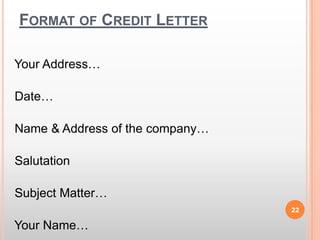
Format of Credit Letter Your Address… Date… Name & Address of the company… Salutation Subject Matter… Your Name…22
Types of Credit LettersRequesting for CreditEnquiries about StatusResponse to Status EnquiriesLetters Granting CreditsLetter Refusing Credits23
A Quotation by Mr. H.N. Casson“ A good letter is a master key that opens the door. It opens the way for your goods or services. It tells the story of real character of your firm. “ 24
Thank You

Forms of business correspondance

  • 1.
    Presentation onFORMS OF TECHNICAL COMMUNICATION
  • 2.
  • 3.
    BUSINESS CORRESPONDANCEBusiness correspondencerefers to all modes of written communication.This include letters, telegrams, fax, e-mail, memos, notice & reports etc…3
  • 4.
    A telegram isa quick & easy way of transmitting message. It has a format.Fax uses a box machine through which message is transmitted in no time.E-mail doesn’t require any paper work. It is the fastest means of transmitting message.Memos, circulars, & notices are not part of inter-official communication. Report is a formal document on some issue & it is passed to someone who was not present on the event.4
  • 5.
    Meaning of BusinessLettersBusiness letters are written to establish & making contacts with suppliers, government departments & public in general.These letters may relate to make an inquiry, reply an inquiry, placing an order, acknowledging an order, applying for credit, granting credit, etc.5
  • 6.
    Important Features ofa Business LettersA business letter is an official letter having a proper structure. It is written in limited words.Readers with their interests & tastes should be borne in mind while writing a letter.The language should be simple, precise, & easy to understand. Different & out-dated words should be avoided to avoid ambiguity.It should be effective, pervasive & clear cut in its idea.The tone of a business letter should be direct, polite, positive & friendly. 6
  • 7.
    Functions of aBusiness LetterRecord & Reference…Building Goodwill…To widen the scope…An Authoritative Proof…A Lasting Impression…Providing Information…7
  • 8.
    Organizational Approach toBusiness LettersDirect Approach of Letter Writing:It is adopted when receiver & sender are familiar to each other & there is a high possibility of positive response.Indirect Approach of Letter Writing:It is used when a message is expected to get negative response.8
  • 9.
    FORMS OF LETTERLAYOUTFULLY INDENTED STYLE: . The letter is typed in single line spacing. . Salutation is placed three lines spacing below the inside name & address. . The subject statement is placed two lines spacing below the salutation. 9
  • 10.
    . Double line spacing is done after the completion of every paragraph. . The complimentary close begins at the center of the typing line & typed signature & designation follows ten spaces & five spaces as is determined depending upon the length of the two.10
  • 11.
    2. SEMI INDENTEDSTYLE: . The inside name & address & put in a block form. . The complimentary close & designations are put at the centre of typed line. . The punctuation is in close pattern.11
  • 12.
    3. FULLY BLOCKEDSTYLE: All lines including data, inside name & address, subject statement, paragraph, signature are typed at the left hand margin.4. MODIFIED BLOCKED STYLE: The data, subject statement, the complimentary close, signature & designations are placed like semi indented style. The punctuation is in open pattern.12
  • 13.
    STRUCTURE OF ABUSINESS LETTERHeading: The letter consists of the name & address of the company, its telephone number & telegraphic address.Date: Date should include month, date & year.Reference Number: Reference number is put for record purpose.13
  • 14.
    Inside Address: Itincludes the addressee's name or the name of the company & address. If it includes the name of the company, ‘Messer's’ should be written before name of the companySalutation: It should be placed two spaces below the inside address. ‘Dear Sir’ should be used if the recipient is man. ‘Dear Sirs’ is used in case the letter is addressed to the company.Subject Matter: It states the purpose of the letter. It should be underlined.14
  • 15.
    Do’s & Don’tsfor a Good Business Letter1. Do follow rules of a standard business letter.2. Do target your correspondence to the audience/ employer. (ex: avoid “To whom it may concern, Dear Sir/Mam”).3. Do make sure there are no spelling, grammar or punctuation errors.4. Do limit to one page.5. Do keep a copy of everything that you send out.6. Do make sure there is an original signature on all the documents that you mail out.15
  • 16.
    7. Do close with a direct request for some type of action. (Ex: interview, phone call, etc.)8. Do use high-quality stationary for hard copies.9. Don’t be generic & impersonal.10. Don’t start every sentence with “I”.11. Don’t use language that is unprofessional (Don’t try to be a comic).12. Don’t include personal information that is not relevant to the position.13. Don’t give false impressions.16
  • 17.
    Types of BusinessLettersSales LettersCredit LettersLetters of EnquiryLetters of QuotationLetters of OrderLetters of Claim or ComplaintLetters of AdjustmentLetters of Acceptance, Withdrawal, Rejection17
  • 18.
    SALES LETTERSSales lettersare written to draw the attention of the customers towards the sale of a product. It should be persuasive & action oriented.Sales letter has two functions: -> To introduce your company & your products. -> To direct the customers towards your product.18
  • 19.
    Format of aSales Letter Salutation… Subject Matter Your Name & Address…19
  • 20.
    Objectives of SalesLetters G Gaining attention of the readers. A Arousing interest & desire in them. T Tactfully convince the readers. that his/her product is the best. E Ensuring action through motivation.20
  • 21.
    Credit LettersA letterof credit is issued by bank.It acts as an irrevocable guarantee of payment to a beneficiary.This means that if don’t perform your obligations, your bank pays.21
  • 22.
    Format of CreditLetter Your Address… Date… Name & Address of the company… Salutation Subject Matter… Your Name…22
  • 23.
    Types of CreditLettersRequesting for CreditEnquiries about StatusResponse to Status EnquiriesLetters Granting CreditsLetter Refusing Credits23
  • 24.
    A Quotation byMr. H.N. Casson“ A good letter is a master key that opens the door. It opens the way for your goods or services. It tells the story of real character of your firm. “ 24
  • 25.