Dr. Bhim Rao
Ambedkar University ,AGRA
In Guidance Of: Presented By:
Dr. Ravi Shekhar Kumari Supriya
Sharma B.PharmaVIII Sem
Roll No:158287361009
Business letter is a form of written
communication within an organization or
between two organizations. It is
differentiated from a general letter by
its layout and form which is well
established by convention and practice.
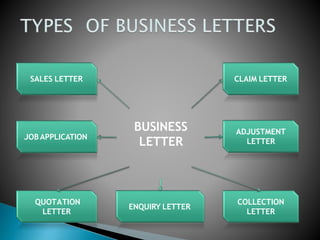
BUSINESS
LETTER
CLAIM LETTER
QUOTATION
LETTER
SALES LETTER
COLLECTION
LETTER
ENQUIRY LETTER
JOBAPPLICATION
ADJUSTMENT
LETTER
 Sales letter is used to convince the customers
for an existing product or a new particular
product.
 A sales letter should be persuasive and contain
the main features of the product.
*Get attention from attractive opening.
*Arouse interest in the product.
*Present reader benefit information.
*Close with a clincher sentence.
*Mention about enclosures if added.
A claim letter is also called as complaint
letter.
It is written to rectify the mistakes made or
wrongs done.
*Explain clearly what has gone wrong.
*Give sufficient data if necessary.
*Motivate prompt action.
*Specify clearly what adjustment you would
consider fair.
*Address the letter to a senior officer of
the organization.
Adjustment letter is a reply to a claim
letter. It should not be sent in a moment of
excitement or anger. Take sometime to
restore to one’s usual self before writing
such letter.
*Convey good news first.
*Explain why things went wrong.
*Give additional information for the same
product.
A collection letter is written to persuade the
customers to make them the delayed
payment. Utmost tact should be used in
reminding them which should not affect the
business link.
*Tone should be persuasive.
*Purpose is to get the money and maintain
the business link.
*Do not use straightforward language to ask
for the payment.
An enquiry letter is written to seek
information from other organizations. It may
deal with a simple matter or a matter of
wider dimensions.
*Indicate the nature of enquiry at the beginning.
*State reasons for the enquiry.
*Clearly state what information you are seeking.
*Close with a statement which would elicit quick
response.
QUOTATION LETTER
A quotation letter is sent in reply to an enquiry
letter. It should contain point by point detailed
information.
*Mention the letter number and date of enquiry
letter to which reply is made.
*Give detailed information in points.
*Mention the terms and conditioned involved.
*Keep in mind that the letter will be examined from
several points of view: quality, price, promptness in
reply, etc.
A job application letter is like a sales letter;
it is written to sell one’s services. A job
application should be drafted carefully as it
is related with one’s career.
It carries sequence of information regarding
the qualification and experience.
The sequence of information in job application
letter usually follows the following pattern.
*Personal details.
*Educational details.
*Training its nature and duration.
1. Heading
2. Date Line
3. Inside Address
4. Attention Line
5. Salutation
6. Subject Line
7. Body Of The Letter
8. Complimentary Closing
9. Signature Lines
10. Enclosures
11. Reference Initials
• Heading :- Includes the company’s logo/
symbol/name,address,ZIP,telephone number,
fax number, email address and website of the
company.
• Date Line :- Consist date,month,year.
• Inside Address :- 1.Personal or professional
title .
2.Name of reciver
3.His/Her professional
position.
4.Company Name
5.Complete Address
• Attention Line :- A line of text denoting the
intended recipient of organizations.
• Salutation :- The greeting that opens the letter
and is placed a double space below the letter
address.
• Subject Line :- It is use so that the reader
immediately knows what your letter is about.
• Body :- Contains the message or the information
to be communicated.
It has three parts :- 1. Introductory Paragraph
2. Middle Paragraph
3.Closing Paragraph
• Complimentary Closing :- It is written two
spaces below the last line of the body.
It is depend upon tone and degree of
formality.
Formal :- Respectfully yours,Sincerely,Yours
faithfully.
Informal :- Cordially yours,Warm Regards,Best
Wishes.
• Signature :- Written double space below
complimentary closing.
• Enclosures :- This line tells the reader to look
In the envelope for more.
• Reference Initials :- If someone else has
composed typed the letter for you , it is common
for them to indicate so with initials.
 OPENING
 Mention the best news or summarise the main idea.
 MIDDLE
 Explanations, details, reader benefits, background.
 END
 Use goodwill ending.
 Positive friendly, clear statement of action desired,
 motivation to action, willingness to help further,
 appreciation .
 OPENING
 Buffer
 Begin with reader interest information.
 Agreement, Appreciation, Assurance, Compliment,
 Cooperation
 Give good news(if you can grant only)
 MIDDLE
 Present negative element as positively as possible.
 Explanation and analysis of the circumstances.
 Decision, implied or expressed with resale and or
 helpful suggestions.
 END
 Positive, courteous, friendly, firm and forward
looking ending.
Business Letter

Business Letter

  • 1.
    Dr. Bhim Rao AmbedkarUniversity ,AGRA In Guidance Of: Presented By: Dr. Ravi Shekhar Kumari Supriya Sharma B.PharmaVIII Sem Roll No:158287361009
  • 2.
    Business letter isa form of written communication within an organization or between two organizations. It is differentiated from a general letter by its layout and form which is well established by convention and practice.
  • 3.
  • 4.
     Sales letteris used to convince the customers for an existing product or a new particular product.  A sales letter should be persuasive and contain the main features of the product.
  • 5.
    *Get attention fromattractive opening. *Arouse interest in the product. *Present reader benefit information. *Close with a clincher sentence. *Mention about enclosures if added.
  • 6.
    A claim letteris also called as complaint letter. It is written to rectify the mistakes made or wrongs done.
  • 7.
    *Explain clearly whathas gone wrong. *Give sufficient data if necessary. *Motivate prompt action. *Specify clearly what adjustment you would consider fair. *Address the letter to a senior officer of the organization.
  • 8.
    Adjustment letter isa reply to a claim letter. It should not be sent in a moment of excitement or anger. Take sometime to restore to one’s usual self before writing such letter.
  • 9.
    *Convey good newsfirst. *Explain why things went wrong. *Give additional information for the same product.
  • 10.
    A collection letteris written to persuade the customers to make them the delayed payment. Utmost tact should be used in reminding them which should not affect the business link.
  • 11.
    *Tone should bepersuasive. *Purpose is to get the money and maintain the business link. *Do not use straightforward language to ask for the payment.
  • 12.
    An enquiry letteris written to seek information from other organizations. It may deal with a simple matter or a matter of wider dimensions.
  • 13.
    *Indicate the natureof enquiry at the beginning. *State reasons for the enquiry. *Clearly state what information you are seeking. *Close with a statement which would elicit quick response.
  • 14.
    QUOTATION LETTER A quotationletter is sent in reply to an enquiry letter. It should contain point by point detailed information.
  • 15.
    *Mention the letternumber and date of enquiry letter to which reply is made. *Give detailed information in points. *Mention the terms and conditioned involved. *Keep in mind that the letter will be examined from several points of view: quality, price, promptness in reply, etc.
  • 16.
    A job applicationletter is like a sales letter; it is written to sell one’s services. A job application should be drafted carefully as it is related with one’s career. It carries sequence of information regarding the qualification and experience.
  • 17.
    The sequence ofinformation in job application letter usually follows the following pattern. *Personal details. *Educational details. *Training its nature and duration.
  • 18.
    1. Heading 2. DateLine 3. Inside Address 4. Attention Line 5. Salutation 6. Subject Line 7. Body Of The Letter 8. Complimentary Closing 9. Signature Lines 10. Enclosures 11. Reference Initials
  • 19.
    • Heading :-Includes the company’s logo/ symbol/name,address,ZIP,telephone number, fax number, email address and website of the company. • Date Line :- Consist date,month,year. • Inside Address :- 1.Personal or professional title . 2.Name of reciver 3.His/Her professional position. 4.Company Name 5.Complete Address
  • 20.
    • Attention Line:- A line of text denoting the intended recipient of organizations. • Salutation :- The greeting that opens the letter and is placed a double space below the letter address. • Subject Line :- It is use so that the reader immediately knows what your letter is about. • Body :- Contains the message or the information to be communicated. It has three parts :- 1. Introductory Paragraph 2. Middle Paragraph 3.Closing Paragraph
  • 21.
    • Complimentary Closing:- It is written two spaces below the last line of the body. It is depend upon tone and degree of formality. Formal :- Respectfully yours,Sincerely,Yours faithfully. Informal :- Cordially yours,Warm Regards,Best Wishes. • Signature :- Written double space below complimentary closing. • Enclosures :- This line tells the reader to look In the envelope for more.
  • 22.
    • Reference Initials:- If someone else has composed typed the letter for you , it is common for them to indicate so with initials.
  • 23.
     OPENING  Mentionthe best news or summarise the main idea.  MIDDLE  Explanations, details, reader benefits, background.  END  Use goodwill ending.  Positive friendly, clear statement of action desired,  motivation to action, willingness to help further,  appreciation .
  • 24.
     OPENING  Buffer Begin with reader interest information.  Agreement, Appreciation, Assurance, Compliment,  Cooperation  Give good news(if you can grant only)  MIDDLE  Present negative element as positively as possible.  Explanation and analysis of the circumstances.  Decision, implied or expressed with resale and or  helpful suggestions.  END  Positive, courteous, friendly, firm and forward looking ending.