Form + ContentReading:Artforms, ch. 13Terms/Concepts:Form, Content, Meaning, Subject Matter, Intent,  Theory, Formalism, Art for Art’s Sake, Greenbergian Formalism, Expression Theory, Catharsis, Arousal Theory, Contextual, Social History of Art, Zeitgeist, Marxism, Capitalist, Bourgeoisie, Proletariat, Base, Superstructure, Psychoanalysis, Id, Ego, Superego, Conscious, Subconscious, Postcolonialism,
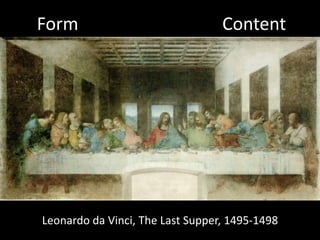
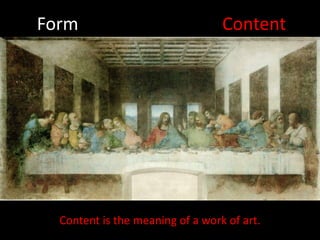
FormContentLeonardo da Vinci, The Last Supper, 1495-1498
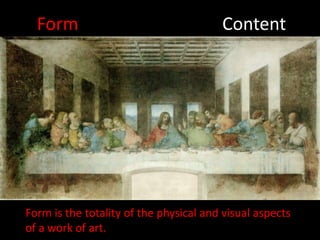
FormContentForm is the totality of the physical and visual aspects of a work of art.
FormContentContent is the meaning of a work of art.
What specifically is content?Subject MatterArtist’s IntentViewer’s InterpretationThe “Message”
the·o·rynoun \ˈthē-ə-rē, ˈthir-ē\pluralthe·o·ries1:the analysis of a set of facts in their relation to one another 2:abstract thought : speculation 3:the general or abstract principles of a body of fact, a science, or an art <music theory> 4a: a belief, policy, or procedure proposed or followed as the basis of action <her method is based on the theory that all children want to learn> b: an ideal or hypothetical set of facts, principles, or circumstances —often used in the phrase in theory <in theory, we have always advocated freedom for all> 5:a plausible or scientifically acceptable general principle or body of principles offered to explain phenomena <the wave theory of light> 6a: a hypothesis assumed for the sake of argument or investigation b: an unproved assumption : conjecture c: a body of theorems presenting a concise systematic view of a subject <theory of equations>
Basic QuestionsWhat is my first response to the work?When and where was the work made?  By whom and for whom was it made?What did the work originally look like?What does the form contribute to the works meaning?Where would the work originally have been seen?What purpose did the work serve?What is the title?  Does it contribute to the works meaning?
Major Theories of Art CriticismFormalist TheoriesExpression TheoriesContextual TheoriesMarxist TheoriesPsychoanalytic TheoriesPostcolonialist TheoriesGeneral Approaches(In Artforms, ch. 13)Specific Theories
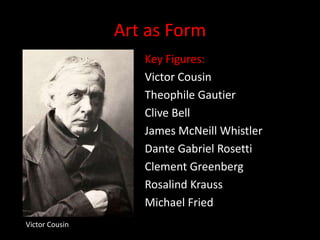
Art as FormKey Figures:Victor CousinTheophile GautierClive BellJames McNeill WhistlerDante Gabriel RosettiClement GreenbergRosalind KraussMichael FriedVictor Cousin
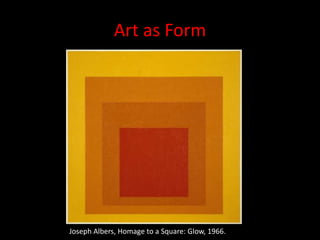
Art as FormJoseph Albers, Homage to a Square: Glow, 1966.
Useful QuestionsWhat does the work look like?How does the work use the “elements of design” (i.e. composition, color, line, etc.)?How are the “principles of design” (i.e. rhythm, balance, emphasis, etc.) present in the work?How do the “elements” and “principles” interact with one another?What do you reactions to the work’s form say about your taste?
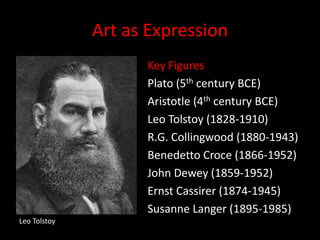
Art as ExpressionKey FiguresPlato (5th century BCE)Aristotle (4th century BCE)Leo Tolstoy (1828-1910)R.G. Collingwood (1880-1943)Benedetto Croce (1866-1952)John Dewey (1859-1952)Ernst Cassirer (1874-1945)Susanne Langer (1895-1985)Leo Tolstoy
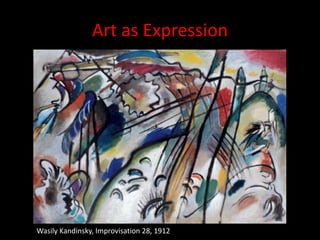
Art as ExpressionWasily Kandinsky, Improvisation 28, 1912
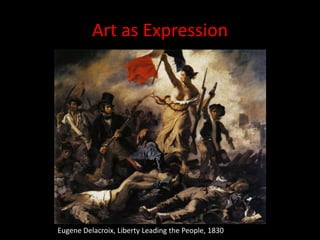
Art as ExpressionEugene Delacroix, Liberty Leading the People, 1830
Useful QuestionsWhat is your instinctual reaction to the work of art?What emotions are present in the work?  How are they present?Who was the artist?What were the emotions of the artist was trying to express?What message was the artist trying to convey?
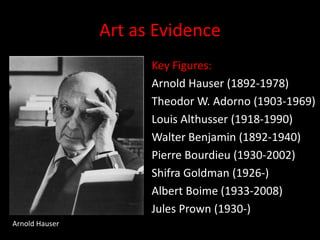
Art as EvidenceKey Figures:Arnold Hauser (1892-1978)Theodor W. Adorno (1903-1969)Louis Althusser (1918-1990)Walter Benjamin (1892-1940)Pierre Bourdieu (1930-2002)Shifra Goldman (1926-)Albert Boime (1933-2008)Jules Prown (1930-)Arnold Hauser
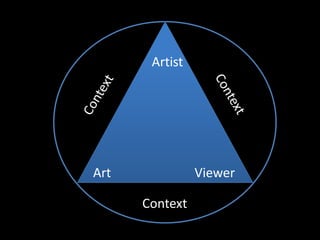
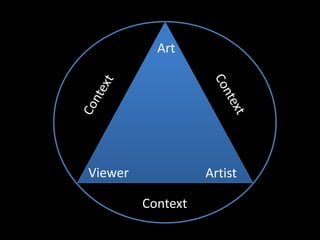
ArtistContextContextArtViewerContext
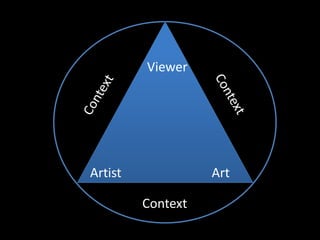
ViewerContextContextArtistArtContext
ArtContextContextViewerArtistContext
Useful QuestionsWhen and where was the work of art made?How does the work of art illustrate the values or social conditions of this time?Does the work of art conform to or rebel against prevailing ideals of this context?What was life like for people when this work was made?What were the social and economic conditions of the time and place the work was made?Who was the artist?  How did they fit in this cultural context?
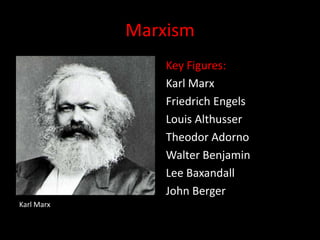
MarxismKey Figures:Karl MarxFriedrich EngelsLouis AlthusserTheodor AdornoWalter BenjaminLee BaxandallJohn BergerKarl Marx
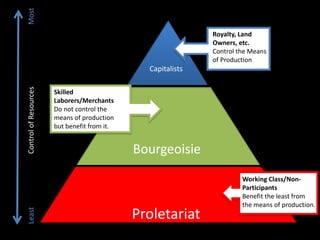
MostRoyalty, Land Owners, etc.Control the Means of ProductionCapitalistsSkilled Laborers/MerchantsDo not control the means of production but benefit from it.Control of ResourcesBourgeoisieWorking Class/Non-ParticipantsBenefit the least from the means of production.ProletariatLeast
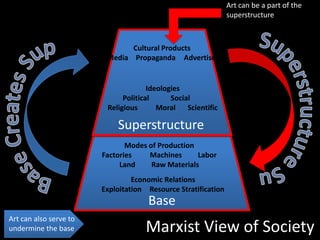
Art can be a part of the superstructureCultural ProductsMass Media	Propaganda	Advertisements	Superstructure Supports BaseBase Creates SuperstructureIdeologiesPolitical 		Social	Religious		Moral	ScientificSuperstructureModes of ProductionFactories		Machines		Labor Land		Raw MaterialsEconomic RelationsExploitation	Resource StratificationBaseArt can also serve to undermine the baseMarxist View of Society
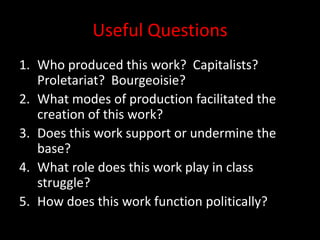
Useful QuestionsWho produced this work?  Capitalists? Proletariat?  Bourgeoisie? What modes of production facilitated the creation of this work?Does this work support or undermine the base?What role does this work play in class struggle?How does this work function politically?
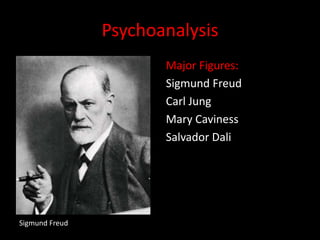
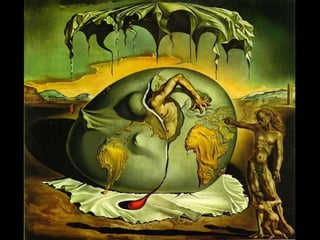
PsychoanalysisMajor Figures:Sigmund FreudCarl JungMary CavinessSalvador DaliSigmund Freud
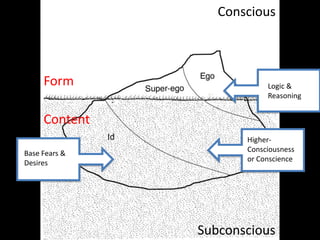
ConsciousFormLogic & ReasoningContentHigher-Consciousness or ConscienceBase Fears & DesiresSubconscious
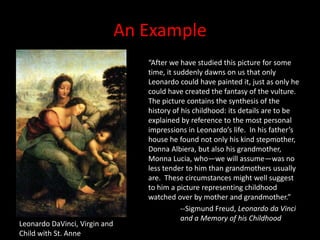
An Example“After we have studied this picture for some time, it suddenly dawns on us that only Leonardo could have painted it, just as only he could have created the fantasy of the vulture.  The picture contains the synthesis of the history of his childhood: its details are to be explained by reference to the most personal impressions in Leonardo’s life.  In his father’s house he found not only his kind stepmother, Donna Albiera, but also his grandmother, Monna Lucia, who—we will assume—was no less tender to him than grandmothers usually are.  These circumstances might well suggest to him a picture representing childhood watched over by mother and grandmother.”--Sigmund Freud, Leonardo da Vinci 	and a Memory of his ChildhoodLeonardo DaVinci, Virgin and Child with St. Anne
Useful QuestionsWhat unconscious motives are present in the form of the work?What might your interpretation of a work say about your unconscious psychological motivations?Could this work be the representation of a dream?What might the work say about the artist’s suppressed fears and desires?
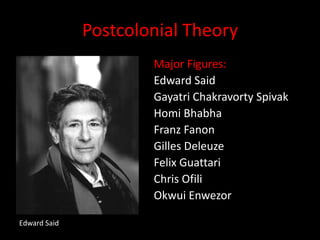
Postcolonial TheoryMajor Figures:Edward SaidGayatriChakravortySpivakHomiBhabhaFranz FanonGilles DeleuzeFelix GuattariChris OfiliOkwuiEnwezorEdward Said
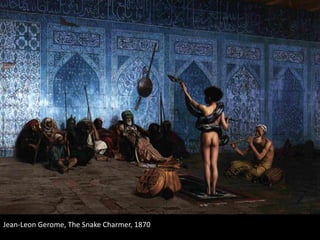
Jean-Leon Gerome, The Snake Charmer, 1870
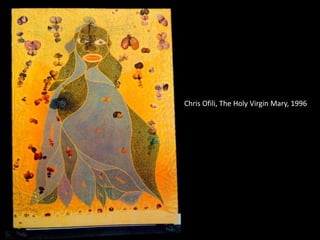
Chris Ofili, The Holy Virgin Mary, 1996
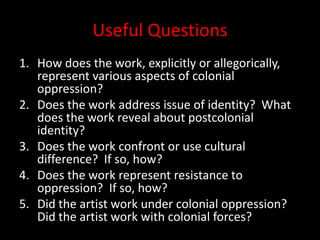
Useful QuestionsHow does the work, explicitly or allegorically, represent various aspects of colonial oppression?Does the work address issue of identity?  What does the work reveal about postcolonial identity?Does the work confront or use cultural difference?  If so, how?Does the work represent resistance to oppression?  If so, how?Did the artist work under colonial oppression?  Did the artist work with colonial forces?
Other TheoriesGender Theories

Form and content upload

  • 1.
    Form + ContentReading:Artforms,ch. 13Terms/Concepts:Form, Content, Meaning, Subject Matter, Intent, Theory, Formalism, Art for Art’s Sake, Greenbergian Formalism, Expression Theory, Catharsis, Arousal Theory, Contextual, Social History of Art, Zeitgeist, Marxism, Capitalist, Bourgeoisie, Proletariat, Base, Superstructure, Psychoanalysis, Id, Ego, Superego, Conscious, Subconscious, Postcolonialism,
  • 2.
    FormContentLeonardo da Vinci,The Last Supper, 1495-1498
  • 3.
    FormContentForm is thetotality of the physical and visual aspects of a work of art.
  • 4.
    FormContentContent is themeaning of a work of art.
  • 5.
    What specifically iscontent?Subject MatterArtist’s IntentViewer’s InterpretationThe “Message”
  • 6.
    the·o·rynoun \ˈthē-ə-rē, ˈthir-ē\pluralthe·o·ries1:theanalysis of a set of facts in their relation to one another 2:abstract thought : speculation 3:the general or abstract principles of a body of fact, a science, or an art <music theory> 4a: a belief, policy, or procedure proposed or followed as the basis of action <her method is based on the theory that all children want to learn> b: an ideal or hypothetical set of facts, principles, or circumstances —often used in the phrase in theory <in theory, we have always advocated freedom for all> 5:a plausible or scientifically acceptable general principle or body of principles offered to explain phenomena <the wave theory of light> 6a: a hypothesis assumed for the sake of argument or investigation b: an unproved assumption : conjecture c: a body of theorems presenting a concise systematic view of a subject <theory of equations>
  • 8.
    Basic QuestionsWhat ismy first response to the work?When and where was the work made? By whom and for whom was it made?What did the work originally look like?What does the form contribute to the works meaning?Where would the work originally have been seen?What purpose did the work serve?What is the title? Does it contribute to the works meaning?
  • 9.
    Major Theories ofArt CriticismFormalist TheoriesExpression TheoriesContextual TheoriesMarxist TheoriesPsychoanalytic TheoriesPostcolonialist TheoriesGeneral Approaches(In Artforms, ch. 13)Specific Theories
  • 10.
    Art as FormKeyFigures:Victor CousinTheophile GautierClive BellJames McNeill WhistlerDante Gabriel RosettiClement GreenbergRosalind KraussMichael FriedVictor Cousin
  • 11.
    Art as FormJosephAlbers, Homage to a Square: Glow, 1966.
  • 12.
    Useful QuestionsWhat doesthe work look like?How does the work use the “elements of design” (i.e. composition, color, line, etc.)?How are the “principles of design” (i.e. rhythm, balance, emphasis, etc.) present in the work?How do the “elements” and “principles” interact with one another?What do you reactions to the work’s form say about your taste?
  • 13.
    Art as ExpressionKeyFiguresPlato (5th century BCE)Aristotle (4th century BCE)Leo Tolstoy (1828-1910)R.G. Collingwood (1880-1943)Benedetto Croce (1866-1952)John Dewey (1859-1952)Ernst Cassirer (1874-1945)Susanne Langer (1895-1985)Leo Tolstoy
  • 14.
    Art as ExpressionWasilyKandinsky, Improvisation 28, 1912
  • 15.
    Art as ExpressionEugeneDelacroix, Liberty Leading the People, 1830
  • 16.
    Useful QuestionsWhat isyour instinctual reaction to the work of art?What emotions are present in the work? How are they present?Who was the artist?What were the emotions of the artist was trying to express?What message was the artist trying to convey?
  • 17.
    Art as EvidenceKeyFigures:Arnold Hauser (1892-1978)Theodor W. Adorno (1903-1969)Louis Althusser (1918-1990)Walter Benjamin (1892-1940)Pierre Bourdieu (1930-2002)Shifra Goldman (1926-)Albert Boime (1933-2008)Jules Prown (1930-)Arnold Hauser
  • 18.
  • 19.
  • 20.
  • 21.
    Useful QuestionsWhen andwhere was the work of art made?How does the work of art illustrate the values or social conditions of this time?Does the work of art conform to or rebel against prevailing ideals of this context?What was life like for people when this work was made?What were the social and economic conditions of the time and place the work was made?Who was the artist? How did they fit in this cultural context?
  • 22.
    MarxismKey Figures:Karl MarxFriedrichEngelsLouis AlthusserTheodor AdornoWalter BenjaminLee BaxandallJohn BergerKarl Marx
  • 23.
    MostRoyalty, Land Owners,etc.Control the Means of ProductionCapitalistsSkilled Laborers/MerchantsDo not control the means of production but benefit from it.Control of ResourcesBourgeoisieWorking Class/Non-ParticipantsBenefit the least from the means of production.ProletariatLeast
  • 24.
    Art can bea part of the superstructureCultural ProductsMass Media Propaganda Advertisements Superstructure Supports BaseBase Creates SuperstructureIdeologiesPolitical Social Religious Moral ScientificSuperstructureModes of ProductionFactories Machines Labor Land Raw MaterialsEconomic RelationsExploitation Resource StratificationBaseArt can also serve to undermine the baseMarxist View of Society
  • 25.
    Useful QuestionsWho producedthis work? Capitalists? Proletariat? Bourgeoisie? What modes of production facilitated the creation of this work?Does this work support or undermine the base?What role does this work play in class struggle?How does this work function politically?
  • 26.
    PsychoanalysisMajor Figures:Sigmund FreudCarlJungMary CavinessSalvador DaliSigmund Freud
  • 27.
    ConsciousFormLogic & ReasoningContentHigher-Consciousnessor ConscienceBase Fears & DesiresSubconscious
  • 28.
    An Example“After wehave studied this picture for some time, it suddenly dawns on us that only Leonardo could have painted it, just as only he could have created the fantasy of the vulture. The picture contains the synthesis of the history of his childhood: its details are to be explained by reference to the most personal impressions in Leonardo’s life. In his father’s house he found not only his kind stepmother, Donna Albiera, but also his grandmother, Monna Lucia, who—we will assume—was no less tender to him than grandmothers usually are. These circumstances might well suggest to him a picture representing childhood watched over by mother and grandmother.”--Sigmund Freud, Leonardo da Vinci and a Memory of his ChildhoodLeonardo DaVinci, Virgin and Child with St. Anne
  • 30.
    Useful QuestionsWhat unconsciousmotives are present in the form of the work?What might your interpretation of a work say about your unconscious psychological motivations?Could this work be the representation of a dream?What might the work say about the artist’s suppressed fears and desires?
  • 31.
    Postcolonial TheoryMajor Figures:EdwardSaidGayatriChakravortySpivakHomiBhabhaFranz FanonGilles DeleuzeFelix GuattariChris OfiliOkwuiEnwezorEdward Said
  • 32.
    Jean-Leon Gerome, TheSnake Charmer, 1870
  • 33.
    Chris Ofili, TheHoly Virgin Mary, 1996
  • 34.
    Useful QuestionsHow doesthe work, explicitly or allegorically, represent various aspects of colonial oppression?Does the work address issue of identity? What does the work reveal about postcolonial identity?Does the work confront or use cultural difference? If so, how?Does the work represent resistance to oppression? If so, how?Did the artist work under colonial oppression? Did the artist work with colonial forces?
  • 35.

Editor's Notes

  • #3 Leonardo DaVinci’s last supper is a good example of a work that can be described by these terms. In describing what you see, it is sometimes best to start with the big picture. To do this, you can start with the 3 terms: Shape, Space, and Composition.
  • #4 Leonardo DaVinci’s last supper is a good example of a work that can be described by these terms. In describing what you see, it is sometimes best to start with the big picture. To do this, you can start with the 3 terms: Shape, Space, and Composition.
  • #5 Leonardo DaVinci’s last supper is a good example of a work that can be described by these terms. In describing what you see, it is sometimes best to start with the big picture. To do this, you can start with the 3 terms: Shape, Space, and Composition.
  • #27 PsychoanalysisHistorySigmund FreudConscious/Subconscious (Repressed)Id/Ego/SuperegoFocused on suppressed memories and desiresCarl JungContemporary ApplicationsMajor IdeasArt is the making conscious of repressed or unconscious desires, anxieties or compulsions of the artist.Through psychoanalysis those “unseen forces” are made visible to a viewer regardless of the chronological distance between the viewer and the creator of the work.Psychoanalysis is also able to delve into the psychology of the viewer based on Art is neither good nor bad, merely an indication of these “unseen” forces.QuestionsHow does the work, explicitly or allegorically, represent various aspects of colonial oppression?Does the work address issue of identity? What does the work reveal about postcolonial identity?Does the work confront or use cultural difference? If so, how?Does the work represent resistance to oppression? If so, how?Does the work conform to or rebel against currently colonial structures? How?ProblemsThere is no evidence that really supports the explicit application of these theories to the unconscious of dead artists.Very controversialWhile there some art historians that practice psychoanalysis today, it has long since fallen out of favor.
  • #28 PsychoanalysisHistorySigmund FreudConscious/Subconscious (Repressed)Id/Ego/SuperegoFocused on suppressed memories and desiresCarl JungContemporary ApplicationsMajor IdeasArt is the making conscious of repressed or unconscious desires, anxieties or compulsions of the artist.Through psychoanalysis those “unseen forces” are made visible to a viewer regardless of the chronological distance between the viewer and the creator of the work.Psychoanalysis is also able to delve into the psychology of the viewer based on Art is neither good nor bad, merely an indication of these “unseen” forces.QuestionsHow does the work, explicitly or allegorically, represent various aspects of colonial oppression?Does the work address issue of identity? What does the work reveal about postcolonial identity?Does the work confront or use cultural difference? If so, how?Does the work represent resistance to oppression? If so, how?Does the work conform to or rebel against currently colonial structures? How?ProblemsThere is no evidence that really supports the explicit application of these theories to the unconscious of dead artists.Very controversialWhile there some art historians that practice psychoanalysis today, it has long since fallen out of favor.
  • #29 PsychoanalysisHistorySigmund FreudConscious/Subconscious (Repressed)Id/Ego/SuperegoFocused on suppressed memories and desiresCarl JungContemporary ApplicationsMajor IdeasArt is the making conscious of repressed or unconscious desires, anxieties or compulsions of the artist.Through psychoanalysis those “unseen forces” are made visible to a viewer regardless of the chronological distance between the viewer and the creator of the work.Psychoanalysis is also able to delve into the psychology of the viewer based on Art is neither good nor bad, merely an indication of these “unseen” forces.QuestionsHow does the work, explicitly or allegorically, represent various aspects of colonial oppression?Does the work address issue of identity? What does the work reveal about postcolonial identity?Does the work confront or use cultural difference? If so, how?Does the work represent resistance to oppression? If so, how?Does the work conform to or rebel against currently colonial structures? How?ProblemsThere is no evidence that really supports the explicit application of these theories to the unconscious of dead artists.Very controversialWhile there some art historians that practice psychoanalysis today, it has long since fallen out of favor.
  • #30 PsychoanalysisHistorySigmund FreudConscious/Subconscious (Repressed)Id/Ego/SuperegoFocused on suppressed memories and desiresCarl JungContemporary ApplicationsMajor IdeasArt is the making conscious of repressed or unconscious desires, anxieties or compulsions of the artist.Through psychoanalysis those “unseen forces” are made visible to a viewer regardless of the chronological distance between the viewer and the creator of the work.Psychoanalysis is also able to delve into the psychology of the viewer based on Art is neither good nor bad, merely an indication of these “unseen” forces.QuestionsHow does the work, explicitly or allegorically, represent various aspects of colonial oppression?Does the work address issue of identity? What does the work reveal about postcolonial identity?Does the work confront or use cultural difference? If so, how?Does the work represent resistance to oppression? If so, how?Does the work conform to or rebel against currently colonial structures? How?ProblemsThere is no evidence that really supports the explicit application of these theories to the unconscious of dead artists.Very controversialWhile there some art historians that practice psychoanalysis today, it has long since fallen out of favor.
  • #32 Postcolonial TheoryHistoryPolitical History19th Century: Age of ColonialismColonies in Africa, Polynesia, Middle East, the Americas, etc.Oppressive trade relationsOppression of indigenous peoples and their cultures and religions.Overly romanticized vision of suppressed cultures20th Century: Age of RevolutionColonies began to gain independence after WWII.People began to explore the relationship between oppressing culture and oppressed culturePolitical advocacy for independence.Edward SaidWrote OrientalismMajor IdeasColonizing powers control the colonized through colonial discourse, the rhetoric that promotes the cultural and intellectual superiority of colonizing powers and the inferiority of the colonized culture.During the 19th century and even today, we hold a Eurocentric view of the world that holds European culture above all other cultures.Colonized people (colonial subjects) are made to feel displaced in their own land, so no place feels like the place that the belong.Colonization causes the mixture of different cultures, causing hybridity that is performed under oppressive circumstances.The marks of colonization are found in the art and literature of colonized countries.QuestionsHow does the work, explicitly or allegorically, represent various aspects of colonial oppression?Does the work address issue of identity? What does the work reveal about postcolonial identity?Does the work confront or use cultural difference? If so, how?Does the work represent resistance to oppression? If so, how?Did the artist work under colonial oppression? Did the artist work with colonial forces?ProblemsFar too politically motivatedVery limited means of explaining phenomena other than political oppression.
  • #33 Postcolonial TheoryHistoryPolitical History19th Century: Age of ColonialismColonies in Africa, Polynesia, Middle East, the Americas, etc.Oppressive trade relationsOppression of indigenous peoples and their cultures and religions.Overly romanticized vision of suppressed cultures20th Century: Age of RevolutionColonies began to gain independence after WWII.People began to explore the relationship between oppressing culture and oppressed culturePolitical advocacy for independence.Edward SaidWrote OrientalismMajor IdeasColonizing powers control the colonized through colonial discourse, the rhetoric that promotes the cultural and intellectual superiority of colonizing powers and the inferiority of the colonized culture.During the 19th century and even today, we hold a Eurocentric view of the world that holds European culture above all other cultures.Colonized people (colonial subjects) are made to feel displaced in their own land, so no place feels like the place that the belong.Colonization causes the mixture of different cultures, causing hybridity that is performed under oppressive circumstances.The marks of colonization are found in the art and literature of colonized countries.QuestionsHow does the work, explicitly or allegorically, represent various aspects of colonial oppression?Does the work address issue of identity? What does the work reveal about postcolonial identity?Does the work confront or use cultural difference? If so, how?Does the work represent resistance to oppression? If so, how?Did the artist work under colonial oppression? Did the artist work with colonial forces?ProblemsFar too politically motivatedVery limited means of explaining phenomena other than political oppression.
  • #34 Postcolonial TheoryHistoryPolitical History19th Century: Age of ColonialismColonies in Africa, Polynesia, Middle East, the Americas, etc.Oppressive trade relationsOppression of indigenous peoples and their cultures and religions.Overly romanticized vision of suppressed cultures20th Century: Age of RevolutionColonies began to gain independence after WWII.People began to explore the relationship between oppressing culture and oppressed culturePolitical advocacy for independence.Edward SaidWrote OrientalismMajor IdeasColonizing powers control the colonized through colonial discourse, the rhetoric that promotes the cultural and intellectual superiority of colonizing powers and the inferiority of the colonized culture.During the 19th century and even today, we hold a Eurocentric view of the world that holds European culture above all other cultures.Colonized people (colonial subjects) are made to feel displaced in their own land, so no place feels like the place that the belong.Colonization causes the mixture of different cultures, causing hybridity that is performed under oppressive circumstances.The marks of colonization are found in the art and literature of colonized countries.QuestionsHow does the work, explicitly or allegorically, represent various aspects of colonial oppression?Does the work address issue of identity? What does the work reveal about postcolonial identity?Does the work confront or use cultural difference? If so, how?Does the work represent resistance to oppression? If so, how?Did the artist work under colonial oppression? Did the artist work with colonial forces?ProblemsFar too politically motivatedVery limited means of explaining phenomena other than political oppression.
  • #35 Postcolonial TheoryHistoryPolitical History19th Century: Age of ColonialismColonies in Africa, Polynesia, Middle East, the Americas, etc.Oppressive trade relationsOppression of indigenous peoples and their cultures and religions.Overly romanticized vision of suppressed cultures20th Century: Age of RevolutionColonies began to gain independence after WWII.People began to explore the relationship between oppressing culture and oppressed culturePolitical advocacy for independence.Edward SaidWrote OrientalismMajor IdeasColonizing powers control the colonized through colonial discourse, the rhetoric that promotes the cultural and intellectual superiority of colonizing powers and the inferiority of the colonized culture.During the 19th century and even today, we hold a Eurocentric view of the world that holds European culture above all other cultures.Colonized people (colonial subjects) are made to feel displaced in their own land, so no place feels like the place that the belong.Colonization causes the mixture of different cultures, causing hybridity that is performed under oppressive circumstances.The marks of colonization are found in the art and literature of colonized countries.QuestionsHow does the work, explicitly or allegorically, represent various aspects of colonial oppression?Does the work address issue of identity? What does the work reveal about postcolonial identity?Does the work confront or use cultural difference? If so, how?Does the work represent resistance to oppression? If so, how?Did the artist work under colonial oppression? Did the artist work with colonial forces?ProblemsFar too politically motivatedVery limited means of explaining phenomena other than political oppression.