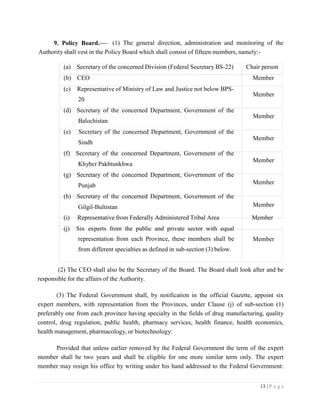
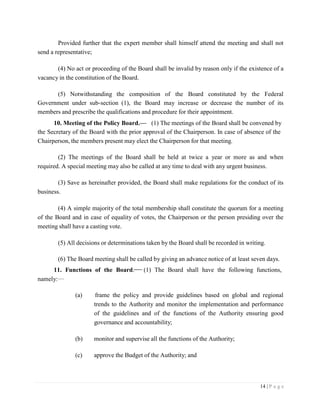
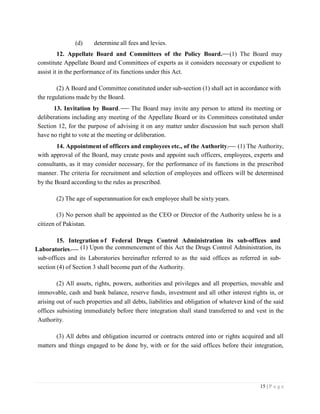
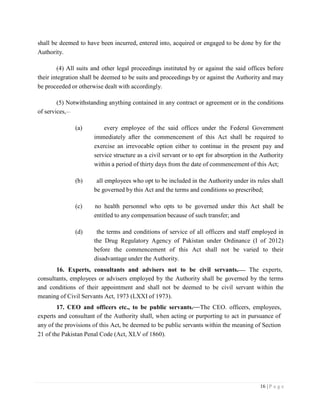
FORENSIC PHARMACY
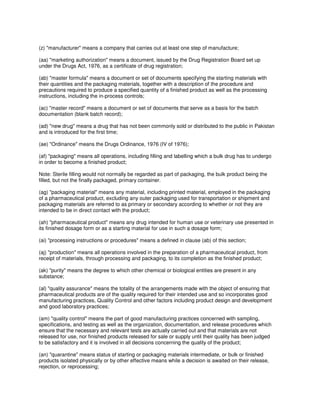
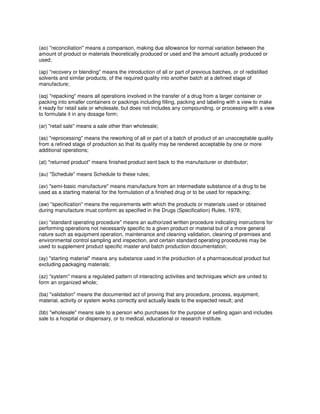
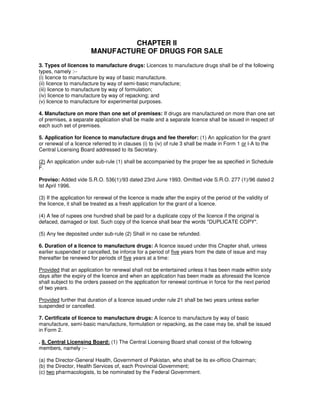
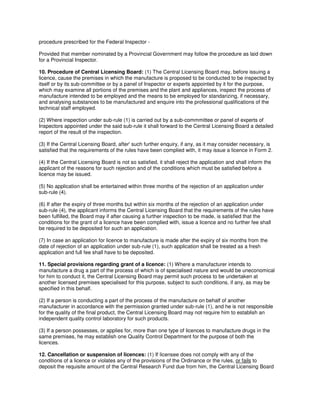
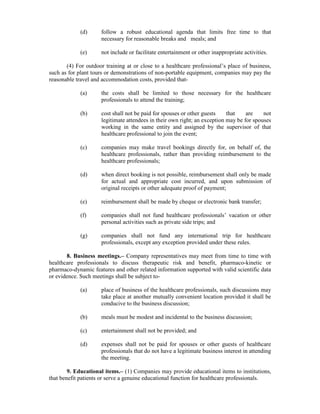
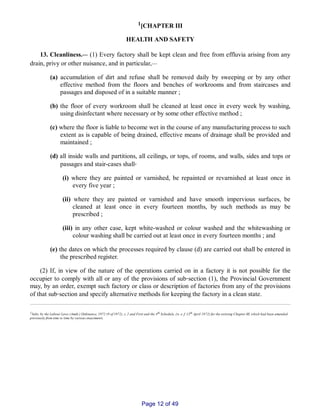
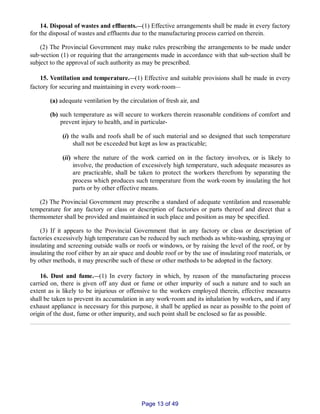
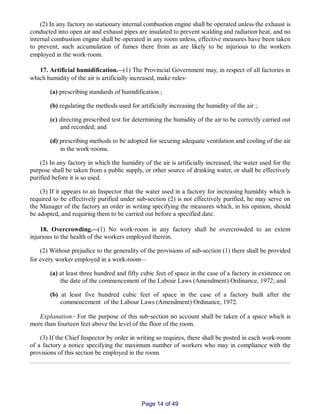
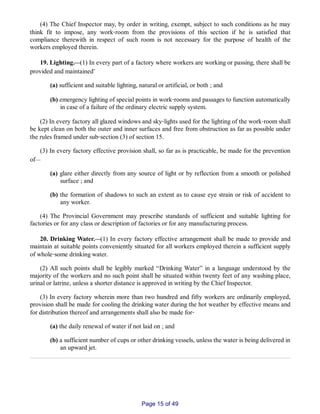
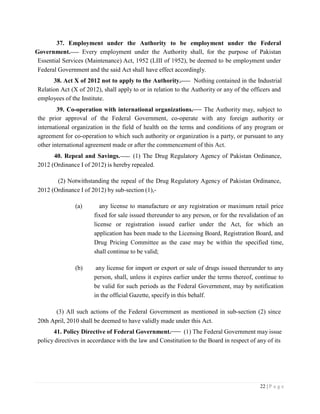
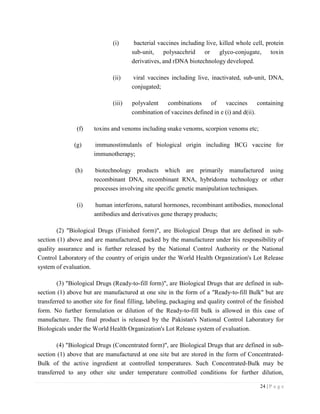
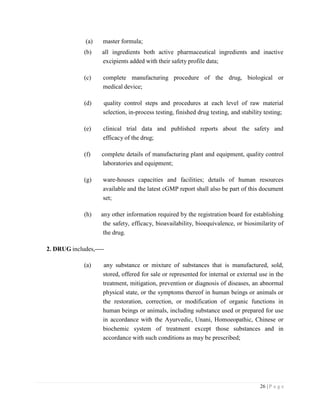
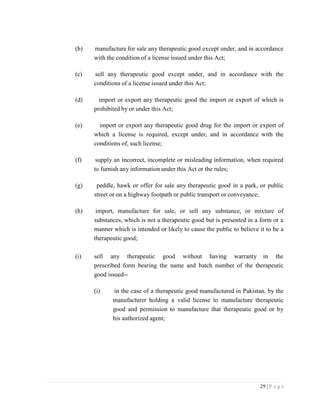
Forensic Pharmacy Final Professional syllabus as per PharmD Curriculum 2013
Compiled by:
USAMA ALI
The University of Lahore
2020-2025
References:
Drug Regulatory Authority of Pakistan, NHSRC
The Pakistan Code, MoLaw
The Punjab Code, GoP
U
s
a
m
a
A
l
i
9th Semester
U
s
a
m
a
A
l
i
GENERAL INTRODUCTION
Forensic Pharmacy
Forensic (application of science for detection of crime).
Forensic pharmacy is the application of the drug sciences to legal issues.
● Domain of forensic pharmacy includes Clinical, Distributive, Administrative aspects of
Pharmacy, and the Basic Pharmaceutical Sciences.
● It overlaps with many other forensic fields e.g. Forensic medicine, forensic psychology,
forensic toxicology, forensic accounting, fraud examination, forensic chemistry, forensic
document examination, polygraph examination, death investigation, forensic nursing,
forensic optometry, and accident reconstruction.
Forensic Pharmacist
Forensic pharmacists engage in professional work relating to litigation, regulatory affairs and
process, or the criminal justice system.
● Almost every pharmacist does some type of forensic work whether he realizes it or not.
○ A community pharmacist needs to scrutinize a prescription for possible forgery.
○ A hospital pharmacist develops systems to detect and prevent drug diversion.
○ A psychiatric pharmacist may monitor patients for signs of substance abuse.
● Specific issues involving forensic pharmacists include professional malpractice, patient
confidentiality, drug diversion, impaired capacity, drug-induced violence, appropriate
use of chemical restraints, adverse drug reactions, drug interactions, product tampering,
medication errors, quackery and health care fraud, and poisoning.
History of Drug Legislation and Pharmacy Profession in Pakistan
● The initiative to start a first pharmacy professional course was taken by the Philadelphia
College of Pharmacy (PCP), North America. In 1821, PCP started their first pharmacy
professional course i.e. the Bachelor of Pharmacy (B Pharm) a two-year professional
course which was later upgraded to four years.
● However, in Europe, the first degree in pharmacy (BSc Pharmacy) was offered by
Manchester University in 1904. Later, in the mid-19th
century Americans took
initiatives to incorporate the role of the pharmacist into direct patient care and in the
1960s the PharmD programme existed as a post-bachelor’s degree in America. Those
attaining a BPharm degree will be allowed to do clinical practice only if they have a
PharmD qualification with one to three years of optional residency.
● In 1990, the American Association of Colleges of Pharmacy (AACP) and
Accreditation Council for Pharmacy Education mandated that a doctor with a pharmacy
U
s
a
m
a
A
l
i
degree would be the new first-professional degree which is essential to practice in the
United States of America.
● Historical records reveal that the first pharmacy in the subcontinent was founded in
1863 when the late Sheikh Nabi Buksh, in Gujrat started a general store with a
pharmacy.
● After the independence of Pakistan (14 August 1947), the University of Punjab became
the first institution to develop a pharmacy department in Pakistan in 1948.
● The University of Karachi and Gomal University followed suit. The first pharmacy
programme was a three-year bachelor programme which was then extended to four
years in 1978-1979. Like most countries, the initial goal of the programme was to
produce pharmacists to fulfil the needs of the pharmaceutical industry.
● By 2000, there was a high demand for pharmacists in the pharmaceutical industry, but
because only about 10 public universities were offering the BPharm programme and the
annual number of graduates was not sufficient to fulfil the needs of the pharmaceutical
industry.
● In 2003 a step towards change was effected with the willingness of most universities to
upgrade the BPharm programme to a five-year Doctor of Pharmacy (PharmD)
programme.
● After 2020 the PPC gives accreditation to numerous institutions and now the job market
is very saturated. Currently (2024) There are a total 190 institutes of pharmacy working
in pakistan.
Legislation history
● Drug act 1940
● Pharmacy act 1967
● Drug act 1976
● DRAP act 2012
● Punjab drug rules 2007
National Health Policy (2016-2025)
Vision statement
To improve the health of all Pakistanis, particularly women and children by providing universal
access to affordable, quality, essential health services which are delivered through a resilient
and responsive health system, capable of attaining the Sustainable Development Goals and
fulfilling its other global health responsibilities.
The principle values include:
a) Good governance
b) Innovation and transformation
c) Equity and pro-poor approach
d) Responsiveness
e) Transparency and accountability
U
s
a
m
a
A
l
i
f) Integration and cross-sectoral synergies
National Drug Policy (DRAP Act 2012 and Drug act 1976)
The specific objective of the National Drug Policy are as under:
● To develop and promote the concept of essential drugs and to ensure regular,
uninterrupted and adequate availability of such drugs of acceptable quality and at
reasonable prices.
● To inculcate in all related sectors and personnel the concept of rational use of drugs
with a view to safeguarding public health from overuse, mis-use or inappropriate use of
drugs.
● To encourage the availability and accessibility of drugs in all parts of the country with
emphasis on those which are included in the National Essential Drugs List.
● To attain self sufficiency in formulation of finished drugs and to encourage production
of pharmaceutical raw materials by way of basic manufacture of active ingredients.
● To protect the public from hazards of substandard, counterfeit and unsafe drugs.
● To develop adequately trained manpower in all fields related to drugs management.
● To develop a research base particularly for operational and applied research with a view
to achieving the above mentioned objectives.
● To develop the pharmaceutical industry in Pakistan with a view to meeting the
requirement of drugs within the country and with a view to promoting their exports to
other countries.
Essential Drugs
National Essential Medicine List NEML is a critical document which provides and supports
quality of health services across the country. The list is based on disease prevalence, evidence
on efficacy and safety, and comparative cost-effectiveness and parameters adapted by W.H.O
in its latest edition of Model List of Essential Medicines.
Essential medications are those that satisfy the priority healthcare needs of the population at all
times.
Criteria of selection:
● Established by a committee
● Benefit safety evaluation based selection
● Generic names
● Ensure quality of selected drugs
● Cost represents a major factor
● Consideration for prescribers to make correct diagnosis
● Effect of local disease on kinetic and dynamics parameters
● Benefit/risk ratio (when several same drugs are available)
● Preference for therapeutic equivalents
U
s
a
m
a
A
l
i
○ thoroughly investigated
○ favourable kinetics
○ Reliable mfg. facilities
○ Favourable stability
● Fixed ratio combo are only accepted if
○ justified documentation of concomitant use
○ therapeutic effect > sum of effects of each
○ cost of combi < individual cost
○ compliance improve
○ dosage adj. satisfactory for majority of population
● Reviewed at least once a year so addition or deletion may be made
Prescription handling at Retail level and Recordkeeping
HANDLING OF PRESCRIPTION
1. Receiving
2. Reading And Checking
3. Collecting And Weighing The Materials
4. Compounding, Packaging And Labelling
RECORD KEEPING OF PRESCRIPTION
● The source of the product i.e. manufacturer details.
● If the product is in response to a prescription, the records must also include the patient’s
details, prescription details and the date of dispensing.
● The date the product was supplied – as this may differ from the date of manufacture.
● Maintain a register upon Narcotics and controlled drugs’ dispensing.
Drug Control Administration at Federal and Provincial level
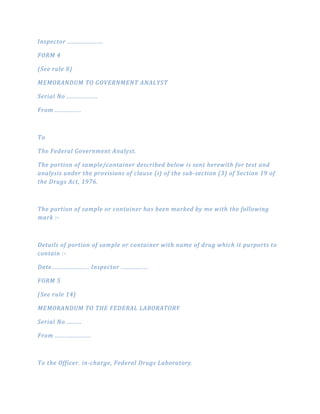
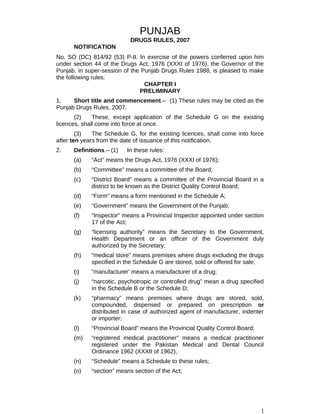
(THE DRUGS (FEDERAL INSPECTORS, FEDERAL DRUG LABORATORY AND
FEDERAL GOVERNMENT ANALYSTS) RULES, 1976 )
APPOINTMENT OF PROVINCIAL AND FEDERAL INSPECTORS
The Federal government or a Provincial government shall by notification
in official gazette appoint such person having appropriate qualifications (PharmD)
as federal or provincial inspector.
POWERS OF PROVINCIAL AND FEDERAL INSPECTORS
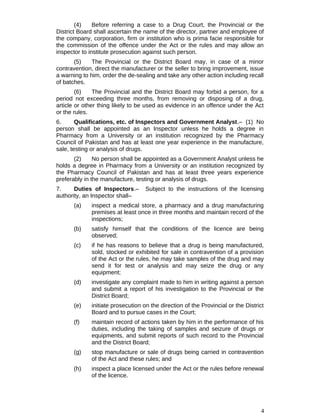
An inspector may with the permission of the licensing authority shall:
● Inspect any premises where any drug is manufactured, the plant and process of
manufacture.
● Inspect any premises where any drug is sold or is stocked or exhibited for sale or is
distributed.
U
s
a
m
a
A
l
i
● Take samples of any drug which is being manufactured or being sold or is stocked or
exhibited for sale or is being distributed.
● Enter and search, any building, vessel or place, which he believes offensive. Call any
person to be present as witness in the course of search or seizure.
● Seize such drugs and all materials used in the manufacture and any other articles,
including registers, cash memos, invoices and bills, which he considers offensive.
● Require any person to appear before him at any reasonable time and place to give a
statement, assistance or information relating to investigation of an offence.
● Lock and seal any factory, laboratory, shop, building, storehouse or godown where any
drug is or is being manufactured, stored, sold or exhibited for sale against the rules.
● Forbid for 2 weeks or 3 months as the inspector may ask any person in-charge of any
premises from removing or dispensing of any drug, article or other things likely to be
used in evidence against the offence.
QUALITY CONTROL BOARDS
PROVINCIAL QUALITY CONTROL BOARD (PQCB)
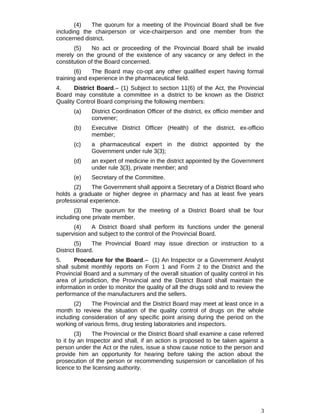
Each provincial government shall set up a Provincial Quality Control Board consisting of
members and a chairman.
The provincial government shall appoint a person to be the secretary to the PQCB.
The PQCB shall, with the approval of the provincial government and by notification in the
Official Gazette, make regulations to regulate the conduct of its business.
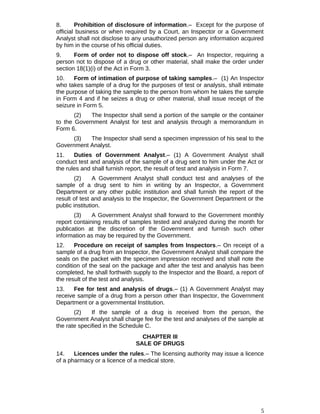
GOVERNMENT ANALYST
APPOINTMENT OF GOVERNMENT ANALYST
The Federal government or a Provincial government shall by notification in the official gazette
appoint such person having appropriate qualifications as Federal or Provincial Government
Analyst.
ROLE OF FORENSIC PHARMACIST
Engage in work relating to litigation, the regulatory process, and the criminal justice system.
INTERNATIONAL PERSPECTIVE
● Scrutinize a prescription for possible forgery.
● Detect and prevent drug diversion.
● Monitor patients for signs of substance abuse.
● Pharmacists in drug utilization review programs have fraud detection responsibilities.
● Nuclear pharmacists may serve as radiation safety officers for their organizations.
● Pharmacists in hospitals and academia may serve on Institutional Review Boards which
protect the rights of human subjects.
● Many pharmacists give presentations about drugs of abuse to elementary and high
school students with the intent of discouraging illegal use of drugs.
U
s
a
m
a
A
l
i
Locally Perspective
● Import, export, manufacture, storage, distribution and sale of drugs.
● Drug Testing Laboratory.
● Pharmaceutical care, selection, posology, counselling, dispensing, use, administration,
prescription monitoring, pharmacoepidemiology, therapeutic goods information and
poison control, Pharmacovigilance, Pharmacoeconomics, storage, sales, procurement,
forecasting, supply chain management, distribution, drug utilization evaluation, drug
utilization review, formulary based drug utilization and managing therapeutic goods at
all levels including pharmacy, clinic, medical store, hospital or medical institution
● Medicine Procurement Process, review inclusion of essential medicines in the list, help
and monitor selection of quality medicines and their rational use in the health institution.
Forensic drug Measurement
Certain drugs have a narrow therapeutic range and need to be closely monitored (e.g. digoxin,
theophylline, lithium, etc). Clinical reasons for which to draw blood samples include high doses
and borderline doses, signs of toxicity occurring, lack of a therapeutic effect, or suspected poor
adherence. Toxicology analysis is a common part of the forensic autopsy and often forensic
pharmacists are consulted to interpret drug levels.
Post-mortem redistribution (PMR)
Postmortem redistribution (PMR) refers to the changes that occur in drug concentrations after
death. It involves the redistribution of drugs into blood from solid organs such as the lungs,
liver, and myocardium. Drug properties such as volume of distribution, lipophilicity, and pKa
are important factors.
Basic, highly lipophilic drugs with a volume of distribution greater than 3 l/kg are most likely to
undergo PMR. Examples include the tricyclic antidepressants, digoxin, and amphetamines.
Medication errors, prescription forgery
● Can review insurance claims relating to medication therapy, especially where new and
unusual uses of medications are prescribed.
● Patients, medical professionals, and health care organisations often submit claims to
insurance companies, seeking payment for unlabelled uses. This may raise ‘‘red flags’’
with the insurance company. A forensic pharmacist can review such claims and offer an
opinion whether the use is reasonable and common practice.
● Off-label use may be brought up in malpractice lawsuits as a standard of care issue.
Prescribing off-label medications is in itself not malpractice. Many off-label uses of
medications are appropriate and medically necessary. The forensic pharmacist may offer
testimony about the need for unlabelled indications and provide insight into appropriate
use of that medication.
U
s
a
m
a
A
l
i
Use of drugs or alcohol in car accidents or violent actions
● The forensic pharmacist can interpret the levels of blood alcohol and discuss the typical
effects from different alcohol levels.
● Pharmacists can apply pharmacokinetics to estimate the level of alcohol at the time of
the alleged event. Pharmacokinetics calculations can especially be helpful if an
extended time period exists between the incident and time of collection.
● Drug interactions can be relevant to DUI cases. Certain medications can have additive
effects with ethanol, that is lower levels of ethanol will produce greater effects. Other
medications can alter the absorption or metabolism of ethanol. Certain disease states
may make a person susceptible to the effects of ethanol.
● Pharmacists can provide input regarding these other factors relating to alcohol
consumption such as personal injury cases.
Legal and illegal pharmaceutical evidence in criminal
investigations
● Medications impair the mental capacity of the defendant or victim.
● Drugs as a causative factor for aggression have been used as a criminal defence. This
defence is more likely to be successful if the drug is a prescribed medication rather than
a substance of abuse. This defence is more likely to be accepted with involuntary
ingestion rather than voluntary intoxication. Medication effects can be an issue in
determining whether a defendant is competent to stand trial.
● Medications are often used as agents for suicide and in suicide attempts.
● Drugs and poisons have been used as tools of homicide.
● Drugs have been used to facilitate sexual assault, especially in dating situations. The
most well-known date rape drugs are flunitrazepam, gamma-hydroxybutyrate (GHB),
ketamine and alcohol.
Professional malpractice
● Pharmacists have been sued for many reasons including dispensing the wrong
medication, compounding errors, failure to detect interactions, failure to contact
prescribers about excessive dosages, and failure to warn patients about side effects.
Clinical pharmacists can be liable for improperly monitoring drug therapy.
Malpractice cases against pharmacists generally require testimony from another
pharmacist; the exception being an error that is so obvious that even a layperson can
understand it without expert testimony.
Most lawyers will not file lawsuits against pharmacists unless an affidavit is obtained
from another pharmacist expressing an opinion of negligence. This pharmacist expert
witness would express an opinion supporting the allegations of malpractice.
The defence may have pharmacists as expert witnesses for rebuttals.
U
s
a
m
a
A
l
i
● The forensic pharmacist can assist lawyers regarding malpractice cases of other health
professionals, for example physicians and nurses.
Generally, pharmacists cannot testify as to the professional standards of other
professionals. However, if the case involves an adverse drug reaction, the pharmacist
can testify about causation.
Can also testify about alternative therapies with less risk. Can provide opinions about
medications that can prevent disease complications. For example, if a patient develops
renal failure from diabetes or hypertension, the pharmacist can discuss medications that
would have prevented or reduced the risk of kidney damage.
Quackery and health care fraud
Quackery is a health scam that promotes bogus products and services that do not have scientific
and proven quality or effects.
Guidelines For Spotting Quacks
● He may offer a “special” or “secret formula” or device.
● He advertises “case histories” and testimonials from satisfied “patients.”
● He may claim to know the “cause” of arthritis and talk about “cleansing your body of
“poisons” and “pepping up” your health. He may say surgery, x-rays and drugs
prescribed by a physician are unnecessary.
● He may accuse the “medical establishment” of deliberately thwarting progress, or of
persecuting him but he doesn’t allow his method to be tested in tried and proven ways.
PHARMACEUTICAL ETHICS
Patents and Generics
Patent
● When a pharmaceutical company first develops a new drug to be used for a disease
condition, it is initially sold under a brand name by which clinicians can prescribe the
drug for use by patients. The drug is covered under patent protection, which means that
only the pharmaceutical company that holds the patent is allowed to manufacture,
market the drug and eventually make profit from it.
● In most cases, the drug patent is awarded for around twenty years in the United States.
The lifetime of the patent varies between countries and also between drugs. Since the
company applies for a patent long before the clinical trial to assess a drug’s safety and
efficacy has commenced, the effective patent period after the drug has finally received
approval is often around seven to twelve years.
U
s
a
m
a
A
l
i
Generics
● A generic drug is an agent that is similar to a branded or reference-listed drug in terms
of dosage, administration and performance. A generic drug is marketed when the
original patent protection that was applied to the drug expires or when the owner of the
patent waives its rights.
● Once the patent has expired, the drug can be manufactured and sold by other
companies. At this point, the drug is referred to as a generic drug. According to
guidelines in most countries, including those from the US FDA, generic drugs have to
be identical to the branded drug in terms of efficacy, safety, usage, route of drug
administration, pharmacokinetics and pharmacodynamics.
Ethics in Sale and Industry
Ethics in the pharmaceutical industry are important for ensuring companies avoid legal issues
and losses, and for demonstrating fairness, integrity, and responsibility. Some ethical
considerations in the pharmaceutical industry include:
● Marketing
Pharmaceutical companies have made efforts to ensure their marketing and promotion
practices comply with ethical standards. However, direct-to-consumer advertising
(DTCA) is illegal in many parts of the world.
● Clinical trials
Clinical trials are considered ethical if they contribute valuable knowledge that
promotes health and well-being.
● Patient safety
Clinical trials and patient safety are an ethical consideration in the pharmaceutical
industry.
● Pricing
Pricing practices are an ethical consideration in the pharmaceutical industry.
● Patent protection
Patents are considered an important legal instrument for protecting the commercial
rights of pharmaceutical products.
● Conflict of interest
Conflict of interest and industry influence are an ethical consideration in the
pharmaceutical industry.
● Transparency
Transparency is an ethical behaviour in the pharmaceutical industry.
Ethics in Research
NIH Clinical Center researchers published seven main principles to guide the conduct of ethical
research:
● Social and clinical value
● Scientific validity
U
s
a
m
a
A
l
i
● Fair subject selection
● Favourable risk-benefit ratio
● Independent review
● Informed consent
● Respect for potential and enrolled subjects
U
s
a
m
a
A
l
i
The Drug Act 1976 and Rules
U
s
a
m
a
A
l
i
gs Act,
D t,
197
Drugs A
The Drugs
Act, 1976
1976
1
1
THE DRUGS ACT, 1976
Contents
CHAPTER-I: INTRODUCTORY................................................................................... 1
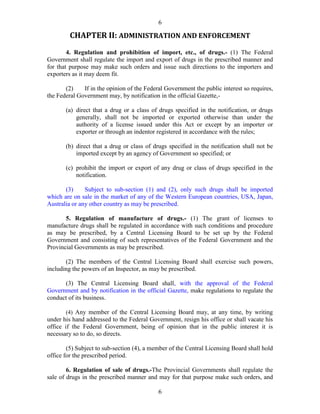
CHAPTER II: ADMINISTRATION AND ENFORCEMENT........................................ 6
CHAPTER III: PROHIBITIONS .................................................................................... 16
CHAPTER IV: OFFENCES, PENALTIES AND PROCEDURE .................................. 18
CHAPTER V: MISCELLANEOUS............................................................................... 24
Part II THE GAZETTE OF PAKISTAN EXTRA, MAY 18, 1976
[ACT NO. XXXI OF 1976
(As amended vide Ordinance No. CXXVIII, dated 15th
November, 2002)
These amendments are in blue color
An Act to regulate the import, export, manufacture, storage, distribution and
sale of drugs
Preamble: Whereas it is expedient to regulate the import, export, manufacture, storage,
distribution and sale of drugs;
It is hereby enacted as follows:-
CHAPTER-I: INTRODUCTORY
1. Short title, extent and commencement: (1) This Act may be called the Drugs
Act, 1976.
(2) It extends to the whole of Pakistan.
(3) It shall come into force at once.
2. Application of other laws not barred: The provisions of this Act, shall be in
addition to, and not in derogation of, the Dangerous Drugs Act, 1930 (II of 1930), and
any other law for the time being in force.
3. Definitions: In this Act, unless there is anything repugnant in the subject or
context,-
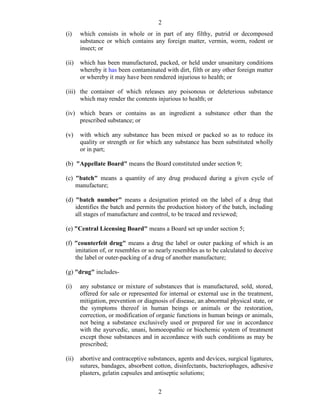
(a) "adulterated drugs" means a drug-
2
2
(i) which consists in whole or in part of any filthy, putrid or decomposed
substance or which contains any foreign matter, vermin, worm, rodent or
insect; or
(ii) which has been manufactured, packed, or held under unsanitary conditions
whereby it has been contaminated with dirt, filth or any other foreign matter
or whereby it may have been rendered injurious to health; or
(iii) the container of which releases any poisonous or deleterious substance
which may render the contents injurious to health; or
(iv) which bears or contains as an ingredient a substance other than the
prescribed substance; or
(v) with which any substance has been mixed or packed so as to reduce its
quality or strength or for which any substance has been substituted wholly
or in part;
(b) "Appellate Board" means the Board constituted under section 9;
(c) "batch" means a quantity of any drug produced during a given cycle of
manufacture;
(d) "batch number" means a designation printed on the label of a drug that
identifies the batch and permits the production history of the batch, including
all stages of manufacture and control, to be traced and reviewed;
(e) "Central Licensing Board" means a Board set up under section 5;
(f) "counterfeit drug" means a drug the label or outer packing of which is an
imitation of, or resembles or so nearly resembles as to be calculated to deceive
the label or outer-packing of a drug of another manufacture;
(g) "drug" includes-
(i) any substance or mixture of substances that is manufactured, sold, stored,
offered for sale or represented for internal or external use in the treatment,
mitigation, prevention or diagnosis of disease, an abnormal physical state, or
the symptoms thereof in human beings or animals or the restoration,
correction, or modification of organic functions in human beings or animals,
not being a substance exclusively used or prepared for use in accordance
with the ayurvedic, unani, homoeopathic or biochemic system of treatment
except those substances and in accordance with such conditions as may be
prescribed;
(ii) abortive and contraceptive substances, agents and devices, surgical ligatures,
sutures, bandages, absorbent cotton, disinfectants, bacteriophages, adhesive
plasters, gelatin capsules and antiseptic solutions;
3
3
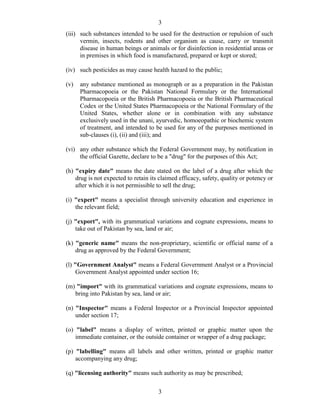
(iii) such substances intended to be used for the destruction or repulsion of such
vermin, insects, rodents and other organism as cause, carry or transmit
disease in human beings or animals or for disinfection in residential areas or
in premises in which food is manufactured, prepared or kept or stored;
(iv) such pesticides as may cause health hazard to the public;
(v) any substance mentioned as monograph or as a preparation in the Pakistan
Pharmacopoeia or the Pakistan National Formulary or the International
Pharmacopoeia or the British Pharmacopoeia or the British Pharmaceutical
Codex or the United States Pharmacopoeia or the National Formulary of the
United States, whether alone or in combination with any substance
exclusively used in the unani, ayurvedic, homoeopathic or biochemic system
of treatment, and intended to be used for any of the purposes mentioned in
sub-clauses (i), (ii) and (iii); and
(vi) any other substance which the Federal Government may, by notification in
the official Gazette, declare to be a "drug" for the purposes of this Act;
(h) "expiry date" means the date stated on the label of a drug after which the
drug is not expected to retain its claimed efficacy, safety, quality or potency or
after which it is not permissible to sell the drug;
(i) "expert" means a specialist through university education and experience in
the relevant field;
(j) "export", with its grammatical variations and cognate expressions, means to
take out of Pakistan by sea, land or air;
(k) "generic name" means the non-proprietary, scientific or official name of a
drug as approved by the Federal Government;
(l) "Government Analyst" means a Federal Government Analyst or a Provincial
Government Analyst appointed under section 16;
(m) "import" with its grammatical variations and cognate expressions, means to
bring into Pakistan by sea, land or air;
(n) "Inspector" means a Federal Inspector or a Provincial Inspector appointed
under section 17;
(o) "label" means a display of written, printed or graphic matter upon the
immediate container, or the outside container or wrapper of a drug package;
(p) "labelling" means all labels and other written, printed or graphic matter
accompanying any drug;
(q) "licensing authority" means such authority as may be prescribed;
4
4
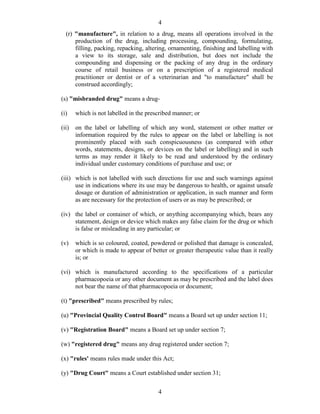
(r) "manufacture", in relation to a drug, means all operations involved in the
production of the drug, including processing, compounding, formulating,
filling, packing, repacking, altering, ornamenting, finishing and labelling with
a view to its storage, sale and distribution, but does not include the
compounding and dispensing or the packing of any drug in the ordinary
course of retail business or on a prescription of a registered medical
practitioner or dentist or of a veterinarian and "to manufacture" shall be
construed accordingly;
(s) "misbranded drug" means a drug-
(i) which is not labelled in the prescribed manner; or
(ii) on the label or labelling of which any word, statement or other matter or
information required by the rules to appear on the label or labelling is not
prominently placed with such conspicuousness (as compared with other
words, statements, designs, or devices on the label or labelling) and in such
terms as may render it likely to be read and understood by the ordinary
individual under customary conditions of purchase and use; or
(iii) which is not labelled with such directions for use and such warnings against
use in indications where its use may be dangerous to health, or against unsafe
dosage or duration of administration or application, in such manner and form
as are necessary for the protection of users or as may be prescribed; or
(iv) the label or container of which, or anything accompanying which, bears any
statement, design or device which makes any false claim for the drug or which
is false or misleading in any particular; or
(v) which is so coloured, coated, powdered or polished that damage is concealed,
or which is made to appear of better or greater therapeutic value than it really
is; or
(vi) which is manufactured according to the specifications of a particular
pharmacopoeia or any other document as may be prescribed and the label does
not bear the name of that pharmacopoeia or document;
(t) "prescribed" means prescribed by rules;
(u) "Provincial Quality Control Board" means a Board set up under section 11;
(v) "Registration Board" means a Board set up under section 7;
(w) "registered drug" means any drug registered under section 7;
(x) "rules' means rules made under this Act;
(y) "Drug Court" means a Court established under section 31;
5
5
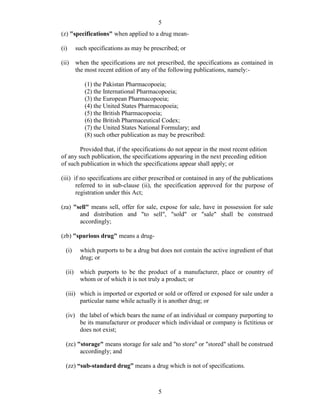
(z) "specifications" when applied to a drug mean-
(i) such specifications as may be prescribed; or
(ii) when the specifications are not prescribed, the specifications as contained in
the most recent edition of any of the following publications, namely:-
(1) the Pakistan Pharmacopoeia;
(2) the International Pharmacopoeia;
(3) the European Pharmacopoeia;
(4) the United States Pharmacopoeia;
(5) the British Pharmacopoeia;
(6) the British Pharmaceutical Codex;
(7) the United States National Formulary; and
(8) such other publication as may be prescribed:
Provided that, if the specifications do not appear in the most recent edition
of any such publication, the specifications appearing in the next preceding edition
of such publication in which the specifications appear shall apply; or
(iii) if no specifications are either prescribed or contained in any of the publications
referred to in sub-clause (ii), the specification approved for the purpose of
registration under this Act;
(za) "sell" means sell, offer for sale, expose for sale, have in possession for sale
and distribution and "to sell", "sold" or "sale" shall be construed
accordingly;
(zb) "spurious drug" means a drug-
(i) which purports to be a drug but does not contain the active ingredient of that
drug; or
(ii) which purports to be the product of a manufacturer, place or country of
whom or of which it is not truly a product; or
(iii) which is imported or exported or sold or offered or exposed for sale under a
particular name while actually it is another drug; or
(iv) the label of which bears the name of an individual or company purporting to
be its manufacturer or producer which individual or company is fictitious or
does not exist;
(zc) "storage" means storage for sale and "to store" or "stored" shall be construed
accordingly; and
(zz) “sub-standard drug” means a drug which is not of specifications.
6
6
CHAPTER II: ADMINISTRATION AND ENFORCEMENT
4. Regulation and prohibition of import, etc., of drugs.- (1) The Federal
Government shall regulate the import and export of drugs in the prescribed manner and
for that purpose may make such orders and issue such directions to the importers and
exporters as it may deem fit.
(2) If in the opinion of the Federal Government the public interest so requires,
the Federal Government may, by notification in the official Gazette,-
(a) direct that a drug or a class of drugs specified in the notification, or drugs
generally, shall not be imported or exported otherwise than under the
authority of a license issued under this Act or except by an importer or
exporter or through an indentor registered in accordance with the rules;
(b) direct that a drug or class of drugs specified in the notification shall not be
imported except by an agency of Government so specified; or
(c) prohibit the import or export of any drug or class of drugs specified in the
notification.
(3) Subject to sub-section (1) and (2), only such drugs shall be imported
which are on sale in the market of any of the Western European countries, USA, Japan,
Australia or any other country as may be prescribed.
5. Regulation of manufacture of drugs.- (1) The grant of licenses to
manufacture drugs shall be regulated in accordance with such conditions and procedure
as may be prescribed, by a Central Licensing Board to be set up by the Federal
Government and consisting of such representatives of the Federal Government and the
Provincial Governments as may be prescribed.
(2) The members of the Central Licensing Board shall exercise such powers,
including the powers of an Inspector, as may be prescribed.
(3) The Central Licensing Board shall, with the approval of the Federal
Government and by notification in the official Gazette, make regulations to regulate the
conduct of its business.
(4) Any member of the Central Licensing Board may, at any time, by writing
under his hand addressed to the Federal Government, resign his office or shall vacate his
office if the Federal Government, being of opinion that in the public interest it is
necessary so to do, so directs.
(5) Subject to sub-section (4), a member of the Central Licensing Board shall hold
office for the prescribed period.
6. Regulation of sale of drugs.-The Provincial Governments shall regulate the
sale of drugs in the prescribed manner and may for that purpose make such orders, and
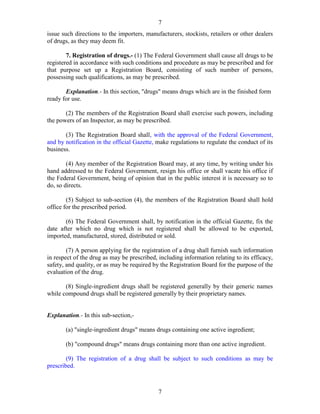
7
7
issue such directions to the importers, manufacturers, stockists, retailers or other dealers
of drugs, as they may deem fit.
7. Registration of drugs.- (1) The Federal Government shall cause all drugs to be
registered in accordance with such conditions and procedure as may be prescribed and for
that purpose set up a Registration Board, consisting of such number of persons,
possessing such qualifications, as may be prescribed.
Explanation.- In this section, "drugs" means drugs which are in the finished form
ready for use.
(2) The members of the Registration Board shall exercise such powers, including
the powers of an Inspector, as may be prescribed.
(3) The Registration Board shall, with the approval of the Federal Government,
and by notification in the official Gazette, make regulations to regulate the conduct of its
business.
(4) Any member of the Registration Board may, at any time, by writing under his
hand addressed to the Federal Government, resign his office or shall vacate his office if
the Federal Government, being of opinion that in the public interest it is necessary so to
do, so directs.
(5) Subject to sub-section (4), the members of the Registration Board shall hold
office for the prescribed period.
(6) The Federal Government shall, by notification in the official Gazette, fix the
date after which no drug which is not registered shall be allowed to be exported,
imported, manufactured, stored, distributed or sold.
(7) A person applying for the registration of a drug shall furnish such information
in respect of the drug as may be prescribed, including information relating to its efficacy,
safety, and quality, or as may be required by the Registration Board for the purpose of the
evaluation of the drug.
(8) Single-ingredient drugs shall be registered generally by their generic names
while compound drugs shall be registered generally by their proprietary names.
Explanation.- In this sub-section,-
(a) "single-ingredient drugs" means drugs containing one active ingredient;
(b) "compound drugs" means drugs containing more than one active ingredient.
(9) The registration of a drug shall be subject to such conditions as may be
prescribed.
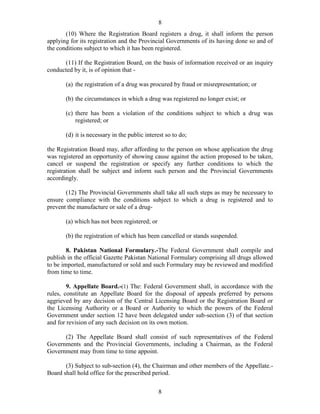
8
8
(10) Where the Registration Board registers a drug, it shall inform the person
applying for its registration and the Provincial Governments of its having done so and of
the conditions subject to which it has been registered.
(11) If the Registration Board, on the basis of information received or an inquiry
conducted by it, is of opinion that -
(a) the registration of a drug was procured by fraud or misrepresentation; or
(b) the circumstances in which a drug was registered no longer exist; or
(c) there has been a violation of the conditions subject to which a drug was
registered; or
(d) it is necessary in the public interest so to do;
the Registration Board may, after affording to the person on whose application the drug
was registered an opportunity of showing cause against the action proposed to be taken,
cancel or suspend the registration or specify any further conditions to which the
registration shall be subject and inform such person and the Provincial Governments
accordingly.
(12) The Provincial Governments shall take all such steps as may be necessary to
ensure compliance with the conditions subject to which a drug is registered and to
prevent the manufacture or sale of a drug-
(a) which has not been registered; or
(b) the registration of which has been cancelled or stands suspended.
8. Pakistan National Formulary.-The Federal Government shall compile and
publish in the official Gazette Pakistan National Formulary comprising all drugs allowed
to be imported, manufactured or sold and such Formulary may be reviewed and modified
from time to time.
9. Appellate Board.-(1) The: Federal Government shall, in accordance with the
rules, constitute an Appellate Board for the disposal of appeals preferred by persons
aggrieved by any decision of the Central Licensing Board or the Registration Board or
the Licensing Authority or a Board or Authority to which the powers of the Federal
Government under section 12 have been delegated under sub-section (3) of that section
and for revision of any such decision on its own motion.
(2) The Appellate Board shall consist of such representatives of the Federal
Governments and the Provincial Governments, including a Chairman, as the Federal
Government may from time to time appoint.
(3) Subject to sub-section (4), the Chairman and other members of the Appellate.-
Board shall hold office for the prescribed period.
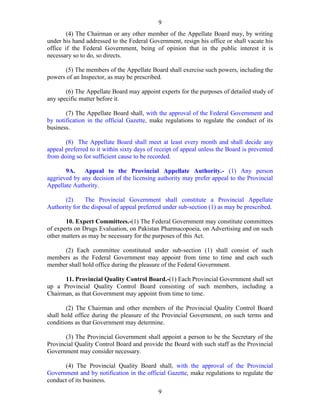
9
9
(4) The Chairman or any other member of the Appellate Board may, by writing
under his hand addressed to the Federal Government, resign his office or shall vacate his
office if the Federal Government, being of opinion that in the public interest it is
necessary so to do, so directs.
(5) The members of the Appellate Board shall exercise such powers, including the
powers of an Inspector, as may be prescribed.
(6) The Appellate Board may appoint experts for the purposes of detailed study of
any specific matter before it.
(7) The Appellate Board shall, with the approval of the Federal Government and
by notification in the official Gazette, make regulations to regulate the conduct of its
business.
(8) The Appellate Board shall meet at least every month and shall decide any
appeal preferred to it within sixty days of receipt of appeal unless the Board is prevented
from doing so for sufficient cause to be recorded.
9A. Appeal to the Provincial Appellate Authority.- (1) Any person
aggrieved by any decision of the licensing authority may prefer appeal to the Provincial
Appellate Authority.
(2) The Provincial Government shall constitute a Provincial Appellate
Authority for the disposal of appeal preferred under sub-section (1) as may be prescribed.
10. Expert Committees.-(1) The Federal Government may constitute committees
of experts on Drugs Evaluation, on Pakistan Pharmacopoeia, on Advertising and on such
other matters as may be necessary for the purposes of this Act.
(2) Each committee constituted under sub-section (1) shall consist of such
members as the Federal Government may appoint from time to time and each such
member shall hold office during the pleasure of the Federal Government.
11. Provincial Quality Control Board.-(1) Each Provincial Government shall set
up a Provincial Quality Control Board consisting of such members, including a
Chairman, as that Government may appoint from time to time.
(2) The Chairman and other members of the Provincial Quality Control Board
shall hold office during the pleasure of the Provincial Government, on such terms and
conditions as that Government may determine.
(3) The Provincial Government shall appoint a person to be the Secretary of the
Provincial Quality Control Board and provide the Board with such staff as the Provincial
Government may consider necessary.
(4) The Provincial Quality Board shall, with the approval of the Provincial
Government and by notification in the official Gazette, make regulations to regulate the
conduct of its business.
10
10
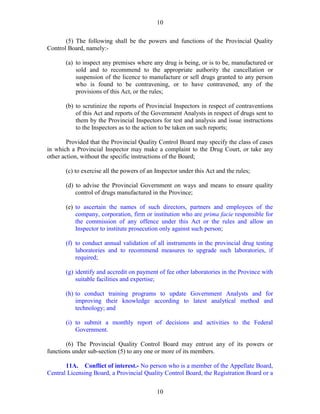
(5) The following shall be the powers and functions of the Provincial Quality
Control Board, namely:-
(a) to inspect any premises where any drug is being, or is to be, manufactured or
sold and to recommend to the appropriate authority the cancellation or
suspension of the licence to manufacture or sell drugs granted to any person
who is found to be contravening, or to have contravened, any of the
provisions of this Act, or the rules;
(b) to scrutinize the reports of Provincial Inspectors in respect of contraventions
of this Act and reports of the Government Analysts in respect of drugs sent to
them by the Provincial Inspectors for test and analysis and issue instructions
to the Inspectors as to the action to be taken on such reports;
Provided that the Provincial Quality Control Board may specify the class of cases
in which a Provincial Inspector may make a complaint to the Drug Court, or take any
other action, without the specific instructions of the Board;
(c) to exercise all the powers of an Inspector under this Act and the rules;
(d) to advise the Provincial Government on ways and means to ensure quality
control of drugs manufactured in the Province;
(e) to ascertain the names of such directors, partners and employees of the
company, corporation, firm or institution who are prima facie responsible for
the commission of any offence under this Act or the rules and allow an
Inspector to institute prosecution only against such person;
(f) to conduct annual validation of all instruments in the provincial drug testing
laboratories and to recommend measures to upgrade such laboratories, if
required;
(g) identify and accredit on payment of fee other laboratories in the Province with
suitable facilities and expertise;
(h) to conduct training programs to update Government Analysts and for
improving their knowledge according to latest analytical method and
technology; and
(i) to submit a monthly report of decisions and activities to the Federal
Government.
(6) The Provincial Quality Control Board may entrust any of its powers or
functions under sub-section (5) to any one or more of its members.
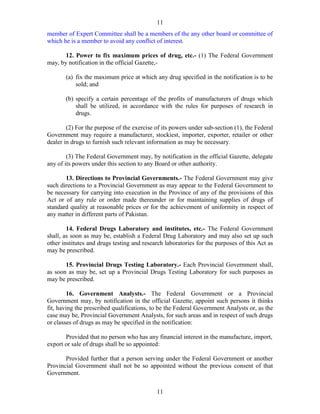
11A. Conflict of interest.- No person who is a member of the Appellate Board,
Central Licensing Board, a Provincial Quality Control Board, the Registration Board or a
11
11
member of Expert Committee shall be a members of the any other board or committee of
which he is a member to avoid any conflict of interest.
12. Power to fix maximum prices of drug, etc.- (1) The Federal Government
may, by notification in the official Gazette,-
(a) fix the maximum price at which any drug specified in the notification is to be
sold; and
(b) specify a certain percentage of the profits of manufacturers of drugs which
shall be utilized, in accordance with the rules for purposes of research in
drugs.
(2) For the purpose of the exercise of its powers under sub-section (1), the Federal
Government may require a manufacturer, stockiest, importer, exporter, retailer or other
dealer in drugs to furnish such relevant information as may be necessary.
(3) The Federal Government may, by notification in the official Gazette, delegate
any of its powers under this section to any Board or other authority.
13. Directions to Provincial Governments.- The Federal Government may give
such directions to a Provincial Government as may appear to the Federal Government to
be necessary for carrying into execution in the Province of any of the provisions of this
Act or of any rule or order made thereunder or for maintaining supplies of drugs of
standard quality at reasonable prices or for the achievement of uniformity in respect of
any matter in different parts of Pakistan.
14. Federal Drugs Laboratory and institutes, etc.- The Federal Government
shall, as soon as may be, establish a Federal Drug Laboratory and may also set up such
other institutes and drugs testing and research laboratories for the purposes of this Act as
may be prescribed.
15. Provincial Drugs Testing Laboratory.- Each Provincial Government shall,
as soon as may be, set up a Provincial Drugs Testing Laboratory for such purposes as
may be prescribed.
16. Government Analysts.- The Federal Government or a Provincial
Government may, by notification in the official Gazette, appoint such persons it thinks
fit, having the prescribed qualifications, to be the Federal Government Analysts or, as the
case may be, Provincial Government Analysts, for such areas and in respect of such drugs
or classes of drugs as may be specified in the notification:
Provided that no person who has any financial interest in the manufacture, import,
export or sale of drugs shall be so appointed:
Provided further that a person serving under the Federal Government or another
Provincial Government shall not be so appointed without the previous consent of that
Government.
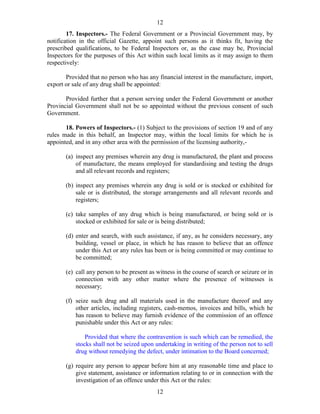
12
12
17. Inspectors.- The Federal Government or a Provincial Government may, by
notification in the official Gazette, appoint such persons as it thinks fit, having the
prescribed qualifications, to be Federal Inspectors or, as the case may be, Provincial
Inspectors for the purposes of this Act within such local limits as it may assign to them
respectively:
Provided that no person who has any financial interest in the manufacture, import,
export or sale of any drug shall be appointed:
Provided further that a person serving under the Federal Government or another
Provincial Government shall not be so appointed without the previous consent of such
Government.
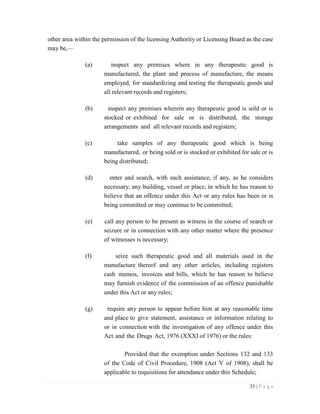
18. Powers of Inspectors.- (1) Subject to the provisions of section 19 and of any
rules made in this behalf, an Inspector may, within the local limits for which he is
appointed, and in any other area with the permission of the licensing authority,-
(a) inspect any premises wherein any drug is manufactured, the plant and process
of manufacture, the means employed for standardising and testing the drugs
and all relevant records and registers;
(b) inspect any premises wherein any drug is sold or is stocked or exhibited for
sale or is distributed, the storage arrangements and all relevant records and
registers;
(c) take samples of any drug which is being manufactured, or being sold or is
stocked or exhibited for sale or is being distributed;
(d) enter and search, with such assistance, if any, as he considers necessary, any
building, vessel or place, in which he has reason to believe that an offence
under this Act or any rules has been or is being committed or may continue to
be committed;
(e) call any person to be present as witness in the course of search or seizure or in
connection with any other matter where the presence of witnesses is
necessary;
(f) seize such drug and all materials used in the manufacture thereof and any
other articles, including registers, cash-memos, invoices and bills, which he
has reason to believe may furnish evidence of the commission of an offence
punishable under this Act or any rules:
Provided that where the contravention is such which can be remedied, the
stocks shall not be seized upon undertaking in writing of the person not to sell
drug without remedying the defect, under intimation to the Board concerned;
(g) require any person to appear before him at any reasonable time and place to
give statement, assistance or information relating to or in connection with the
investigation of an offence under this Act or the rules:
13
13
Provided that the exemptions under Sections 132 and 133 of the Code of
Civil Procedure, 1908 (Act V of 1908), shall be applicable to requisitions for
attendance under this clause;
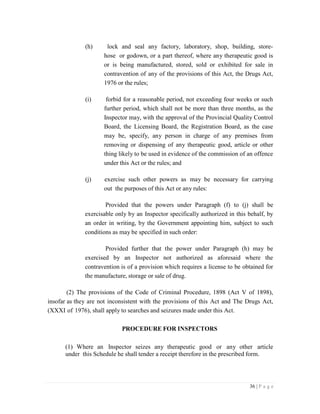
(h) lock and seal any factory, laboratory, shop, building, store-house or godown,
or a part thereof, where any drug is or is being manufactured, stored, sold or
exhibited for sale in contravention of any of the provisions of this Act or the
rules;
(i) forbid for a reasonable period, not exceeding two weeks or such further
period, which shall not be more than three months, as the Inspector may, with
the approval of the Provincial Quality Control Board, the Central Licensing
Board, the Registration Board, or the licensing authority, as the case may be,
specify, any person in charge of any premises from removing or dispensing of
any drug, article or other thing likely to be used in evidence of the
commission of an offence under this Act or the rules; and
(j) exercise such other powers as may be necessary for carrying out the purposes
of this Act or any rules:
Provided that the powers under causes (f) to (j) shall be exercisable only
by an Inspector specifically authorized in this behalf, by an order in writing,
by the Government appointing him, subject to such conditions as may be
specified in such order.
[Second proviso omitted]
(2) The provisions of the Code of Criminal Procedure, 1898 (Act V of 1898), in
so far as they are not inconsistent with the provisions of this Act, shall apply to searches
and seizures made under this Act.
19. Procedure for Inspectors.- (1) Where an Inspector seizes any drug or any
other article under section 18, he shall tender a receipt therefore in the prescribed form.
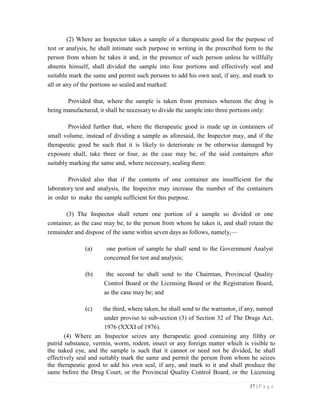
(2) Where an Inspector takes a sample of a drug for the purpose of test or
analysis, he shall intimate such purpose in writing in the prescribed form to the person
from whom he takes it and, in the presence of such person unless he willfully absents
himself, shall divide the sample into five portions and effectively seal and suitably mark
the same and permit such persons to add his own seal, if any, and mark to all or any of
the portions so sealed and marked:
Provided that, where the sample is taken from premises whereon the drug is being
manufactured, it shall be necessary to divide the sample into three portions only:
Provided further that, where the drug is made up in containers of small volume,
instead of dividing a sample as aforesaid, the Inspector may, and if the drug be such that
it is likely to deteriorate or be otherwise damaged by exposure shall, take three or four, as
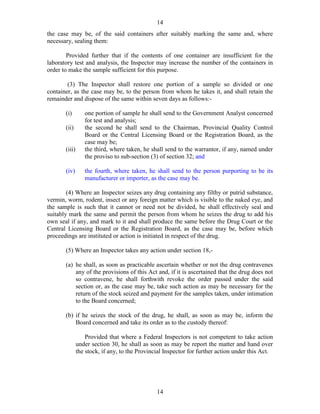
14
14
the case may be, of the said containers after suitably marking the same and, where
necessary, sealing them:
Provided further that if the contents of one container are insufficient for the
laboratory test and analysis, the Inspector may increase the number of the containers in
order to make the sample sufficient for this purpose.
(3) The Inspector shall restore one portion of a sample so divided or one
container, as the case may be, to the person from whom he takes it, and shall retain the
remainder and dispose of the same within seven days as follows:-
(i) one portion of sample he shall send to the Government Analyst concerned
for test and analysis;
(ii) the second he shall send to the Chairman, Provincial Quality Control
Board or the Central Licensing Board or the Registration Board, as the
case may be;
(iii) the third, where taken, he shall send to the warrantor, if any, named under
the proviso to sub-section (3) of section 32; and
(iv) the fourth, where taken, he shall send to the person purporting to be its
manufacturer or importer, as the case may be.
(4) Where an Inspector seizes any drug containing any filthy or putrid substance,
vermin, worm, rodent, insect or any foreign matter which is visible to the naked eye, and
the sample is such that it cannot or need not be divided, he shall effectively seal and
suitably mark the same and permit the person from whom he seizes the drug to add his
own seal if any, and mark to it and shall produce the same before the Drug Court or the
Central Licensing Board or the Registration Board, as the case may be, before which
proceedings are instituted or action is initiated in respect of the drug.
(5) Where an Inspector takes any action under section 18,-
(a) he shall, as soon as practicable ascertain whether or not the drug contravenes
any of the provisions of this Act and, if it is ascertained that the drug does not
so contravene, he shall forthwith revoke the order passed under the said
section or, as the case may be, take such action as may be necessary for the
return of the stock seized and payment for the samples taken, under intimation
to the Board concerned;
(b) if he seizes the stock of the drug, he shall, as soon as may be, inform the
Board concerned and take its order as to the custody thereof:
Provided that where a Federal Inspectors is not competent to take action
under section 30, he shall as soon as may be report the matter and hand over
the stock, if any, to the Provincial Inspector for further action under this Act.
15
15
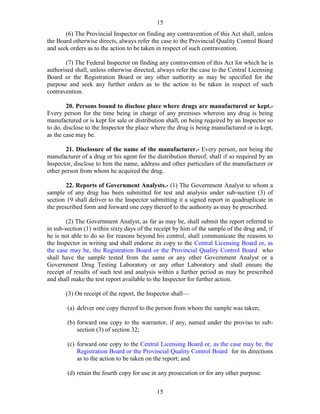
(6) The Provincial Inspector on finding any contravention of this Act shall, unless
the Board otherwise directs, always refer the case to the Provincial Quality Control Board
and seek orders as to the action to be taken in respect of such contravention.
(7) The Federal Inspector on finding any contravention of this Act for which he is
authorised shall, unless otherwise directed, always refer the case to the Central Licensing
Board or the Registration Board or any other authority as may be specified for the
purpose and seek any further orders as to the action to be taken in respect of such
contravention.
20. Persons bound to disclose place where drugs are manufactured or kept.-
Every person for the time being in charge of any premises whereon any drug is being
manufactured or is kept for sale or distribution shall, on being required by an Inspector so
to do, disclose to the Inspector the place where the drug is being manufactured or is kept,
as the case may be.
21. Disclosure of the name of the manufacturer.- Every person, not being the
manufacturer of a drug or his agent for the distribution thereof, shall if so required by an
Inspector, disclose to him the name, address and other particulars of the manufacturer or
other person from whom he acquired the drug.
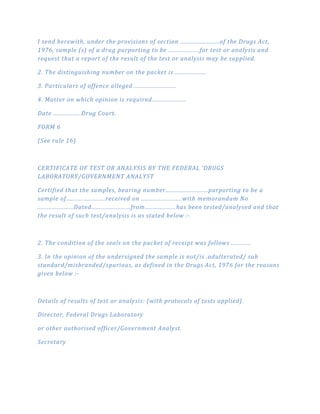
22. Reports of Government Analysts.- (1) The Government Analyst to whom a
sample of any drug has been submitted for test and analysis under sub-section (3) of
section 19 shall deliver to the Inspector submitting it a signed report in quadruplicate in
the prescribed form and forward one copy thereof to the authority as may be prescribed.
(2) The Government Analyst, as far as may be, shall submit the report referred to
in sub-section (1) within sixty days of the receipt by him of the sample of the drug and, if
he is not able to do so for reasons beyond his control, shall communicate the reasons to
the Inspector in writing and shall endorse its copy to the Central Licensing Board or, as
the case may be, the Registration Board or the Provincial Quality Control Board who
shall have the sample tested from the same or any other Government Analyst or a
Government Drug Testing Laboratory or any other Laboratory and shall ensure the
receipt of results of such test and analysis within a further period as may be prescribed
and shall make the test report available to the Inspector for further action.
(3) On receipt of the report, the Inspector shall—
(a) deliver one copy thereof to the person from whom the sample was taken;
(b) forward one copy to the warrantor, if any, named under the proviso to sub-
section (3) of section 32;
(c) forward one copy to the Central Licensing Board or, as the case may be, the
Registration Board or the Provincial Quality Control Board for its directions
as to the action to be taken on the report; and
(d) retain the fourth copy for use in any prosecution or for any other purpose.
16
16
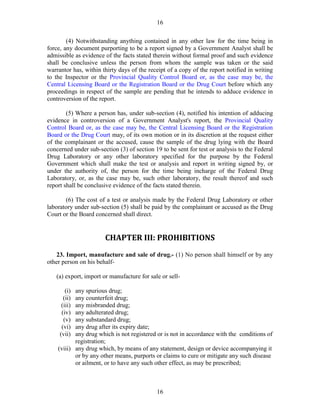
(4) Notwithstanding anything contained in any other law for the time being in
force, any document purporting to be a report signed by a Government Analyst shall be
admissible as evidence of the facts stated therein without formal proof and such evidence
shall be conclusive unless the person from whom the sample was taken or the said
warrantor has, within thirty days of the receipt of a copy of the report notified in writing
to the Inspector or the Provincial Quality Control Board or, as the case may be, the
Central Licensing Board or the Registration Board or the Drug Court before which any
proceedings in respect of the sample are pending that he intends to adduce evidence in
controversion of the report.
(5) Where a person has, under sub-section (4), notified his intention of adducing
evidence in controversion of a Government Analyst's report, the Provincial Quality
Control Board or, as the case may be, the Central Licensing Board or the Registration
Board or the Drug Court may, of its own motion or in its discretion at the request either
of the complainant or the accused, cause the sample of the drug lying with the Board
concerned under sub-section (3) of section 19 to be sent for test or analysis to the Federal
Drug Laboratory or any other laboratory specified for the purpose by the Federal
Government which shall make the test or analysis and report in writing signed by, or
under the authority of, the person for the time being incharge of the Federal Drug
Laboratory, or, as the case may be, such other laboratory, the result thereof and such
report shall be conclusive evidence of the facts stated therein.
(6) The cost of a test or analysis made by the Federal Drug Laboratory or other
laboratory under sub-section (5) shall be paid by the complainant or accused as the Drug
Court or the Board concerned shall direct.
CHAPTER III: PROHIBITIONS
23. Import, manufacture and sale of drug.- (1) No person shall himself or by any
other person on his behalf-
(a) export, import or manufacture for sale or sell-
(i) any spurious drug;
(ii) any counterfeit drug;
(iii) any misbranded drug;
(iv) any adulterated drug;
(v) any substandard drug;
(vi) any drug after its expiry date;
(vii) any drug which is not registered or is not in accordance with the conditions of
registration;
(viii) any drug which, by means of any statement, design or device accompanying it
or by any other means, purports or claims to cure or mitigate any such disease
or ailment, or to have any such other effect, as may be prescribed;
17
17
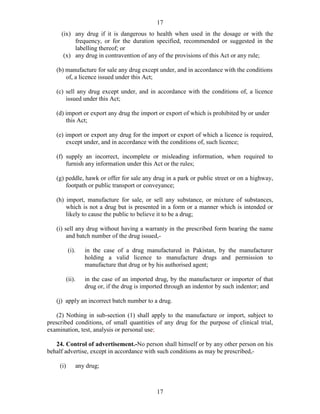
(ix) any drug if it is dangerous to health when used in the dosage or with the
frequency, or for the duration specified, recommended or suggested in the
labelling thereof; or
(x) any drug in contravention of any of the provisions of this Act or any rule;
(b) manufacture for sale any drug except under, and in accordance with the conditions
of, a licence issued under this Act;
(c) sell any drug except under, and in accordance with the conditions of, a licence
issued under this Act;
(d) import or export any drug the import or export of which is prohibited by or under
this Act;
(e) import or export any drug for the import or export of which a licence is required,
except under, and in accordance with the conditions of, such licence;
(f) supply an incorrect, incomplete or misleading information, when required to
furnish any information under this Act or the rules;
(g) peddle, hawk or offer for sale any drug in a park or public street or on a highway,
footpath or public transport or conveyance;
(h) import, manufacture for sale, or sell any substance, or mixture of substances,
which is not a drug but is presented in a form or a manner which is intended or
likely to cause the public to believe it to be a drug;
(i) sell any drug without having a warranty in the prescribed form bearing the name
and batch number of the drug issued,-
(i). in the case of a drug manufactured in Pakistan, by the manufacturer
holding a valid licence to manufacture drugs and permission to
manufacture that drug or by his authorised agent;
(ii). in the case of an imported drug, by the manufacturer or importer of that
drug or, if the drug is imported through an indentor by such indentor; and
(j) apply an incorrect batch number to a drug.
(2) Nothing in sub-section (1) shall apply to the manufacture or import, subject to
prescribed conditions, of small quantities of any drug for the purpose of clinical trial,
examination, test, analysis or personal use;
24. Control of advertisement.-No person shall himself or by any other person on his
behalf advertise, except in accordance with such conditions as may be prescribed,-
(i) any drug;
18
18
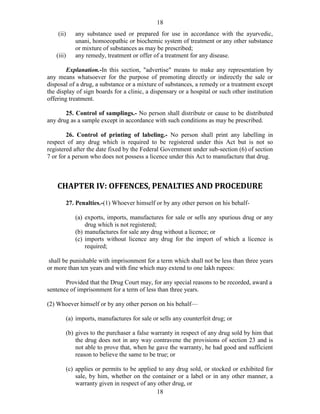
(ii) any substance used or prepared for use in accordance with the ayurvedic,
unani, homoeopathic or biochemic system of treatment or any other substance
or mixture of substances as may be prescribed;
(iii) any remedy, treatment or offer of a treatment for any disease.
Explanation.-In this section, "advertise" means to make any representation by
any means whatsoever for the purpose of promoting directly or indirectly the sale or
disposal of a drug, a substance or a mixture of substances, a remedy or a treatment except
the display of sign boards for a clinic, a dispensary or a hospital or such other institution
offering treatment.
25. Control of samplings.- No person shall distribute or cause to be distributed
any drug as a sample except in accordance with such conditions as may be prescribed.
26. Control of printing of labeling.- No person shall print any labelling in
respect of any drug which is required to be registered under this Act but is not so
registered after the date fixed by the Federal Government under sub-section (6) of section
7 or for a person who does not possess a licence under this Act to manufacture that drug.
CHAPTER IV: OFFENCES, PENALTIES AND PROCEDURE
27. Penalties.-(1) Whoever himself or by any other person on his behalf-
(a) exports, imports, manufactures for sale or sells any spurious drug or any
drug which is not registered;
(b) manufactures for sale any drug without a licence; or
(c) imports without licence any drug for the import of which a licence is
required;
shall be punishable with imprisonment for a term which shall not be less than three years
or more than ten years and with fine which may extend to one lakh rupees:
Provided that the Drug Court may, for any special reasons to be recorded, award a
sentence of imprisonment for a term of less than three years.
(2) Whoever himself or by any other person on his behalf—
(a) imports, manufactures for sale or sells any counterfeit drug; or
(b) gives to the purchaser a false warranty in respect of any drug sold by him that
the drug does not in any way contravene the provisions of section 23 and is
not able to prove that, when he gave the warranty, he had good and sufficient
reason to believe the same to be true; or
(c) applies or permits to be applied to any drug sold, or stocked or exhibited for
sale, by him, whether on the container or a label or in any other manner, a
warranty given in respect of any other drug, or
19
19
(d) imports, manufactures for sales or sells any drug under a name other than the
registered name; or
(e) exports, imports, manufactures for sale or sells any drug with which any
substance, which should not actually be its component, has been mixed or
packed so as to reduce its quality or strength or for which any such substance
has been substituted wholly or in part;
shall be punishable with imprisonment for a term which may extend to seven years, or
with fine which may extend to one lakh rupees, or with both.
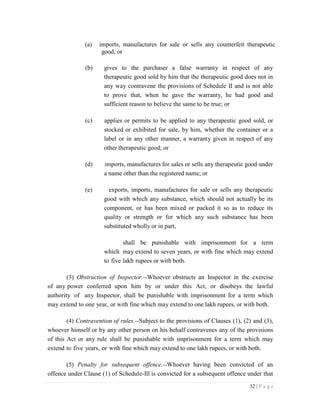
(3) Whoever obstructs an Inspector in the exercise of any power conferred upon
him by or under this Act, or disobeys the lawful authority of any Inspector, shall be
punishable with imprisonment for a term which may extend to one year, or with fine
which may extend to ten thousand rupees, or with both.
(4) Subject to the provisions of sub-section (1), sub-section (2) and sub-section
(3), whoever himself or by any other person on his behalf contravenes any of the
provisions of this Act or any rule shall be punishable with imprisonment for a term which
may extend to five years, or with fine which may extend to fifty thousand rupees, or with
both.
28. Penalty for subsequent offence.-(1) Whoever having been convicted of an
offence under sub-section (1) of section 27 is convicted for a subsequent offence under
that sub-section shall be punishable with imprisonment for life or with imprisonment
which shall not be less than five years and with fine which may extend to two lakh
rupees.
(2) Whoever having been convicted of an offence under sub-section (2) of section
27 is convicted for a subsequent offence under that sub-section shall be punishable with
imprisonment for a term which shall not be less than two years or more than ten years, or
with fine which may extend to two lakh rupees, or with both.
(3) Whoever having been convicted of an offence under sub-section (4) of section
27 is convicted for a subsequent offence under that sub-section shall be punishable with
imprisonment for a term which may extend to seven years, or with fine which may extend
to one lakh rupees, or with both.
29. Forfeiture.-(1) Where any person has been convicted under this Act, for
contravening any such provisions of this Act or any rule as may be prescribed in this
behalf, the Drug Court may order that the stock of drug or substance by means of or in
relation to which the offence was committed or anything of a similar nature belonging to
or in the possession of the accused or found with such drug or substance, and if such
contravention is punishable under sub-section (1) of section 27, any implements used in
manufacture or sale of such drug and any receptacles, packages or coverings in which
such drug is contained and the animals, vehicles, vessels or other conveyances, used in
carrying such drug, be forfeited to the Federal Government or, as the case may be, the
Provincial Government and, upon such order being made, such drug, substance,
20
20
implements, receptacles, packages or coverings, animals, vehicles, vessels or conveyance
may be disposed of as that Government may direct.
(2) Without prejudice to the provisions of sub-section (1), where the Drug Court
is satisfied, on the application of an Inspector or otherwise, and after such inquiry as may
be necessary, that a drug contravenes the provisions of this Act, the Drug Court may
order that such drug be forfeited to the Federal Government or, as the case may be, the
Provincial Government and, upon such order being made, such drug may be destroyed or
otherwise disposed of as that Government may direct.
(3) An Inspector shall release any drug or article seized by him under this Act
when he is satisfied that all the provisions of this Act and the rules with respect there to
have been complied with.
30. Cognizance of offences.- (1) Subject to the provisions of section 19, no
prosecution shall be instituted under this Chapter except-
(a) by a Federal Inspector, where the prosecution is in respect of a contravention
of clause (h) of sub-section (1) of section 23 or section 24 or any of the
provisions of this Act or the rules relating to the import or export of drugs or
the manufacture for sale, or sale, of a drug which is not for the time being
registered or for the manufacture for sale of which a licence is not for the time
being in force; or
(b) by a Provincial Inspector:
Provided that, where the public interest so requires, the Federal Inspector may,
with the prior permission of the Federal Government, institute a prosecution for a
contravention of any other provision of this Act.
(2) Notwithstanding anything contained in the Code of Criminal Procedure, 1898
(Act V of 1898),-
(a) an offence punishable under this Chapter other than an offence mentioned in
sub-section (1) of section 27, shall be non-cognizable, and
(b) no court other than a Drug Court shall try an offence punishable under this
Chapter.
(3) Nothing contained in this Chapter shall be deemed to prevent any person from
being prosecuted under any other law for any act or omission which constitutes an
offence punishable under this Chapter or to require the transfer to a Drug Court of any
case which may be pending in any Court immediately before the establishment of the
Drug Court.
31. Drug Courts.-(1) The Federal Government may, by notification in the official
Gazette, establish as many Drug Courts as it considers necessary and, where it establishes
more than one Drug Court, shall specify in the notification the territorial limits within
21
21
which, or the class of cases in respect of which, each one of them shall exercise
jurisdiction under this Act.
(2) A Drug Court shall consist of a person who is, or has been, or is qualified for
appointment as, a Judge of a High Court, who shall be the Chairman, and two members
being persons who, in the opinion of the Federal Government, are experts in the medical
or pharmaceutical fields:
Provided that for deciding applications of bail the Chairman and any one member
shall constitute full quorum of a Drug Court.
(3) A Drug Court shall sit at such place or places as the Federal Government may
direct.
(4) A Drug Court shall have all the powers conferred by the Code of Criminal
Procedure, 1898 (Act V of 1898), on a Court of Session exercising original jurisdiction.
(5) A Drug Court shall not, merely by reason of a change in its composition, be
bound to recall and rehear any witness who has given evidence, and may act on the
evidence already recorded by or produced before it.
(6) A Drug Court shall, in all matters with respect to which no procedure has been
prescribed by this Act, follow the procedure prescribed by the Code of Criminal
Procedure, 1898 (Act V of 1898), for the trial of summons cases by Magistrates.
(7) A person sentenced by a Drug Court may prefer an appeal to a Bench of the
High Court consisting of not less than two Judges within thirty days of the judgment.
(8) The provisions of sections 5 and 12 of the Limitation Act, 1908 (IX of 1908),
shall be applicable to an appeal referred to in sub-section (7).
32. Pleas.- (1) Save as hereafter provided in this section, it shall be no defence in
a prosecution under this Act to prove merely that the accused was ignorant of the nature,
substance or quality of the drug in respect of which the offence has been committed or of
the circumstances of its manufacture or import, or that a purchaser, having bought only
for the purpose of test or analysis, has not been prejudiced by the sale.
(2) A drug shall not be deemed to be misbranded or adulterated or sub-standard
only by reason of the fact that there has been added thereto some innocuous substance or
ingredient because the same is required for the manufacture or preparation of the drug fit
for carriage or consumption and not to increase the bulk, weight or measure of the drug
or to conceal its inferior quality or other defect or there is a decomposed substance which
is the result of a natural process of decomposition:
Provided that such decomposition is not due to any negligence on the part of the
manufacturer of the drug or the dealer thereof and that it does not render the drug
injurious to health or does not make it substandard.
22
22
(3) A person, not being the manufacturer of a drug or his agent for the distribution
thereof, shall not be liable for a contravention of section 23 if he proves—
(a) that he did not know, and could not with reasonable diligence have
ascertained, that the drug in any way contravened the provision of this Act
and that the drug while in his possession remained in the same state as
when he acquired it; and
(b) that he acquired the drug from a duly licensed manufacturer or his
authorised agent or an importer or an indentor resident in Pakistan under a
written warrant, in the prescribed form stating, in particular, the batch
number of the drug and signed by such person that the drug does not in
any way contravene the provisions of Section 23 and that the drug while in
his possession was properly stored and remained in the same state as when
he acquired it and that the drug has been manufactured by a manufacturer
holding a valid licence to manufacture drugs and permission to
manufacture that drug:
Provided that a defence under clause (b) shall be open to a person only-
(i) if he has, within seven days of the service on him of the summons, sent to
the Inspector a copy of the warranty with a written notice statings that he
intends to rely upon it and giving the name and address of the warrantor,
and
(ii) if he proves that he has, within the same period, sent written notice of such
intention to the said warrantor.
33. Application of law relating to customs and powers of officers of customs.-
(1) The law for the time being in force relating to customs and to goods the import of
which is prohibited by or under the Customs Act, 1969 (IV of 1969), shall, subject to the
provisions of section 27 of this Act, apply in respect of drugs the import of which is
prohibited under this Act, and officers of customs and officers to whom any of the
functions of an officer of customs have been entrusted under the said Act shall have the
same powers in respect of such drugs as they have for the time being in respect of such
goods as aforesaid.
(2) Without prejudice to the provisions of sub-section (1), an officer of customs or
a Federal Inspector or any other person as may be authorized by the Federal Government
in this behalf may detain any imported package which he suspects to contain any drug the
import of which is prohibited under this Act, and shall forthwith report such detention to
the licensing authority and, if required by it, forward the package or samples of any
suspected drug found therein to a laboratory specified by it.
34. Offences by companies, etc.-Where the person guilty of an offence under this
Act, is a company, corporation, firm or institution, every director, partner and employee
of the company, corporation, firm or institution with whose knowledge or consent the
offence was committed shall be guilty of the offence.
23
23
35. Publication of offender's name.-(1) If any person is convicted of an offence
under this Act, it shall be lawful for the Drug Court to cause the offender's name, place of
residence, the offence of which he has been convicted and the penalty which has been
inflicted upon him, to be published at the expense of such person in such newspapers or
in such other manner as the Court may direct.
(2) The expenses of such publication shall be recoverable in the same manner as a
fine is recoverable.
36. Powers to exempt.- Notwithstanding anything contained in this Act, the
Federal Government may, if it is of opinion that the public interest so requires, at any
time, of its own motion or on a representation made to it, by notification in the official
Gazette, exempt any drug or class of drugs from the operation of any of the provisions of
this Act, subject to such conditions, if any, and for such period, as may be specified in the
notification.
37. Inspectors to be public servants.- Every Inspector shall be deemed to be a
public servant within the meaning of section 21 of the Pakistan Penal Code (Act XLV of
1860), and shall be officially subordinate to such authority as the Government appointing
him may specify in this behalf.
38. Indemnity.- Except as otherwise expressly provided in this Act, no suit,
prosecution or other legal proceeding shall lie against Government or any other authority
or person for anything which is in good faith done or intended to be done under this Act
or any rule.
39. Finality of order, etc.- Save as otherwise expressly provided in this Act,
every order passed or decision given by any Board, a Drug Court or any other authority
under this Act shall be final and shall not be called in question by or before any Court or
other authority.
40. Publication of result of test or analysis, etc.- (1) It shall be lawful for the
Federal Government to publish, in such manner as it may deem fit, the result of any test
or analysis of any drug for public information and to pass such orders relating to the
withdrawal of such drug from sale and its disposal as it may consider necessary.
(2) The Federal Government may, if it considers it necessary in the public interest
so to do, publish for public information, in such manner as it may deem fit, any
information relating to a drug or to the use of a drug in specified circumstances.
41. Cancellation or suspension of licences.- Where any person has been found to
have contravened any of the provisions of this Act, or the rules in respect of any drug and
the contravention is of such a nature that the import, export, manufacture or sale of any
drug by such person is, in the opinion of the licensing authority or the Central Licensing
Board, likely to endanger public health, that authority may, after giving such person an
opportunity of being heard, cancel the licence to import, export, manufacture or sell drugs
issued to such person or suspend such licence for a specified period.
24
24
42. Cancellation or suspension of registration of registered drugs.- Where any
person has been found to have contravened any of the provisions of this Act, or the rules
in respect of any registered drug, the Registration Board may, after giving such person an
opportunity of being heard, cancel the registration of such drug or suspend such
registration for a specified period.
CHAPTER V: MISCELLANEOUS
43. Power of Federal Government to make rules.- (1) Subject to section 44, the
Federal Government may, by notification in the official Gazette, make rules for carrying
out the purposes of this Act.
(2) In particular and without prejudice to the generality of the foregoing provision,
such rules may-
(a) prescribe the functions of the Federal Drug Laboratory and any other laboratory
set up under section 14 or specified under section 22 or section 33 and the
procedure for the submission to any such laboratory of samples of drugs for
analysis or test, the forms of the laboratory's reports thereon and the fees payable
in. respect of such reports; and such other matters as may be necessary for any
such laboratory to perform its functions;
(b) prescribe specifications, including the strength, potency, purity, quality or other
property, of any drug, and the methods of test or analysis to be employed in
determining whether a drug is of required specifications;
(c) prescribe the maximum proportion of any poisonous or other substance which
may be added to or contained in any drug, or extracted or omitted therefrom;
prohibit the import, manufacture, sale or stocking or exhibition for sale or
distribution of any drug in which that proportion is exceeded and specify
substances which shall be deemed to be poisonous;
(d) specify the drugs or classes of drugs for the import or export of which a licence is
required, the testing of such drugs, and prescribe the form and conditions of such
licences, the authority empowered to issue the same, and the fees payable
therefor;
(e) prescribe the places at which any specific drug or drugs may be imported, prohibit
their import at any other place, and control their import through any specified
agency;
(f) prescribe the evidence to be supplied, whether by accompanying documents or
otherwise, of the quality of drugs sought to be imported, the procedure of officers,
of customs in dealing with such evidence and the manner of storage at places of
import of drugs detained pending admission;
25
25
(g) prescribe the forms of licences for the manufacture for sale of drugs or any
specified drugs or class of drugs, the form of application for such licences, the
conditions subject to which such licence may be issued, the person under whose
signature the same be issued and the fees payable therefor;
(h) require the date of manufacture and the date of expiry of potency to be clearly and
truly stated on the label and container of any specified drug or class of drugs and
prohibit the sale, stocking or exhibition for sale or distribution of the said drug or
class of drugs after the expiry of a specified period from the date of manufacture
or after the expiry date and prescribe the manner of disposal of such drug or class
of drugs;
(i) prescribe the conditions to be observed in the packing in bottles, packages and
other containers of drugs and prohibit the sale, stocking or exhibition for sale or
distribution of drugs packed in contravention of such conditions;
(j) regulate the mode of packing and packaging, including its size, dimensions, fill
and other specifications, the material used therefor and mode of labelling packed
drugs and prescribe the matters which shall or shall not be included in such labels
or on the leaflets accompanying the drugs;
(k) require that the non-proprietary or chemical or accepted scientific name or the
proprietary name of any specified drug or any ingredient thereof shall be
displayed in the prescribed manner;
(l) prescribe the requirements and conditions in respect of good practices in the
manufacture and quality control of drugs;
(m)prescribe conditions for distribution of samples for sales promotion of drugs;
(n) prescribe the procedure for introduction in Pakistan of a new drug;
(o) prescribe terms and conditions of members of the Central Licensing Board and
the Registration Board;
(p) prescribe types of registration of drugs, the form of application for such
registration, the conditions subject to which such registration may be granted, the
manner of registration and post-registration surveillance and deregistration of
registered drugs and the fees payable therefor;
(q) prescribe conditions for registration of indentors, importers, wholesalers and
distributors within Pakistan and any establishment within any foreign country
engaged in the manufacture for export of a drug and prescribe conditions
providing effective and adequate means, by arrangement with the Government of
such foreign country or otherwise, to enable the licensing authority or the
Registration Board to determine from time to time whether drugs manufactured in
such establishment, if imported or offered for import into Pakistan, shall be
refused admission where the public interest so requires;
26
26
(r) prescribe the form of warranty for manufactured drugs;
(s) specify offences in relation to which the stock of drugs, articles or things shall be
liable to forfeiture under this Act;
(t) prescribe the qualifications, and regulate the procedure for exercise of powers and
performance of functions, of Federal Inspectors;
(u) prescribe the laboratories to which the Federal Inspectors shall submit samples of
drugs taken for the purpose of test and analysis and the form and procedure for
submitting the report of such test and analysis and the fee payable therefor, where
so required;
(v) prescribe measures for securing and maintaining supplies of drugs at reasonable
prices, conditions to be met in respect of manufacture, production, pricing,
keeping, movement and disposal of drugs and to fix prices, commissions, discount
of the manufacturer, wholesaler, distributor, retailer or any other dealer of drugs,
to control giving of bonus in cash or kind or in any other manner to any of the
said parties and for collecting or calling for any information, statistics, records or
books with a view to regulating the matters aforesaid;
(w)specify drugs which may be advertised and the conditions subject to which such
drugs may be advertised;
(x) prescribe conditions subject to which small quantities of drugs may be imported
or manufactured or exported for the purpose of examination, test or analysis,
clinical trial or personal use; and
(y) prescribe any other matter which is to be, or may be, prescribed by the Federal
Government.
(3) The power to make rules conferred by this section shall, except on the first
occasion of the exercise thereof, be subject to the condition of previous publication.
44. Power of the Provincial Government to make rules.-(1) The Provincial
Government may by notification in the official Gazette, make rules in respect of the
following matters, namely :-
(a) the establishment of laboratories for testing and analysing drugs;
(b) the qualifications and the procedure, for exercise of powers and performance of
functions of Provincial Inspectors;
(c) the forms of reports to be given by Government Analysts and the manner of
application for test or analysis and the fees payable therefor;
(d) the conditions to regulate sale or storage or distribution of drugs or any specific
drug or class of drugs;
27
27
(e) the offences against this Act or any rule in relation to which the stock of drugs
shall be liable to confiscation and destruction under this Act;
(f) the forms of licences for the sale or distribution of drugs or any specified drug or
class of drugs, the authority empowered to issue the same, the form of
applications for such licences, the fees payable therefor and the condition subject
to which such licences may be issued;
(g) the procedure to be followed by the Provincial Quality Control Board; and
(h) any other matter which is to be or may be, prescribed by the Provincial
Government.
(2) The power to make rules conferred by this section shall, except on the first
occasion of the exercise thereof, be subject to the condition of previous publication.
45. Repeal and savings.- (1) The Drugs Act, 1940 (XXIII of 1940), the Drugs
(Generic Names) Act, 1972 (XXIV of 1972), and the Drugs Ordinance, 1976 (IV of
1976), are hereby repealed.
(2) Notwithstanding the repeal of the Drugs Act, 1940 (XXIII of 1940), by sub-
section (1),-
(a) any licence to manufacture for sale issued thereunder to any person, for the
revalidation of which an application has already been made to the Central
Licensing Board within the date specified by the Federal Government shall
continue to be valid until orders are passed by the said Board in this behalf;
(b) any licence for import or export or sale of drugs issued thereunder to any person,
shall, unless it expires earlier under the terms thereof, continue to be valid for
such periods as the Federal Government, or as the case may be, the Provincial
Government may by notification in the official Gazette, specify in this behalf:
Provided that in case of drugs to be imported or exported licences may continue to be
issued under the rules framed under the Drugs Act, 1940, till the rules under this Act are
framed or as the case may be, a date is fixed under sub-section (6) of section 7 in respect
of drugs in the finished form ready for use.
End of the document.
DRUGS (LICENSING, REGISTERING AND ADVERTISING)
RULES, 1976
S.R.O. 145 (I)/76 dated 12th February 1976:- In exercise of the powers conferred by Section 41 of the
Drugs Ordinance, 1976 (IV of 1976), the Federal Government is pleased to make the following rules,
namely :--
CHAPTER I Preliminary.
CHAPTER II Manufacture Of Drugs For Sale.
CHAPTER III Registration Of Drugs.
CHAPTER IV Advertising Of Drugs, Etc.
Schedule A
Schedule B
Schedule C
Schedule D
Schedule E
Schedule F
Schedule G
DRUGS (LICENSING, REGISTERING AND ADVERTISING)
RULES, 1976
S.R.O. 145 (I)/76 dated 12th February 1976:- In exercise of the powers conferred by Section 41 of the
Drugs Ordinance, 1976 (IV of 1976), the Federal Government is pleased to make the following rules,
namely :--
CHAPTER I - PRELIMINARY
1. Short title and commencement: .(1) These rules may be called the Drugs (Licensing, Registering
and Advertising) Rules, 1976.
(2) They shall come into force at once.
2. Definitions.-- In these rules, unless there is anything repugnant in the subject or context:--
(a) "active pharmaceutical ingredient" means a substance or compound that is intended to be used in
the manufacture of a pharmaceutical product as a pharmacologically active compound (ingredient);
(b) "airlock" means an enclosed space with two or more doors, which is interposed between two or
more rooms of differing classes of cleanliness for the purpose of controlling the airflow between those
rooms when they need to be entered and an airlock is designed for and used by either people or
goods;
(c) "authorized person" means a person responsible for the release of batches of product for sale;
(d) "basic manufacture" means manufacture of a drug from basic raw material to a product which is
ready for use as a starting material for the formulation of a finished drug or for repacking and such
manufacture may involve chemical, bio-chemical, photochemical, microbial or such other processes
or a combination of any of such processes;
(e) "batch (or lot)" means a defined quantity of starting material, packaging material, or finish product
processed in a single process or series of processes so that it could be expected to be homogeneous
in the case of continuous manufacture the batch must correspond to a defined fraction of the
production, characterized by its intended homogeneity, and to complete certain stages of manufacture
it may sometimes be necessary to divide a batch into a number of sub-batches, which are later
brought together to from a final homogeneous batch;
(f) "batch number (or lot number)" means a distinctive combination of numbers and or letters which
specifically identifies a batch on the labels, the batch records, the certificates of analysis, and that
permit the production history of the batch to be traced and revived.
(g) "batch numbering system" means a standard operating procedure describing the details of the
batch numbering;
(h) "batch records" means all documents associated with the manufacture of a batch of bulk product
or finished product showing a history of each batch of product and of all circumstances pertinent to
the quality of the final product;
(i) "biological agents" means micro-organisms, including genetically engineered micro-organisms, cell
cultures and endoparasites, whether pathogenic or not;
(j) "bulk product" means any product that has completed all processing stages up to, but not including,
final packaging;
(k) "calibration" means the set of operations that establish, under specified conditions, the relationship
between values indicated by a instrument or measuring system for especially weighing, recording and
controlling, or the values represented by a material measure and the corresponding known values of a
reference standard and the limits for acceptance of the results of measuring;
(l) "clean area" means an area with defined environmental control of particulate and microbial
contamination, constructed and used in such a way as to reduce and or eliminate introduction,
generation and retention of contaminants within the area;
(m) "compounding" means scientific combination of two or more ingredients with a view to make a
finished drug;
(n) "consignment or delivery" means the quantity of starting material or of a drug product, made by
one manufacturer and supplied one time in response to a particular request or order, a consignment
may comprise one or more packages or containers and may include material belonging to more than
one batch;
(o) "critical process" means a process that may cause variation in the quality of the pharmaceutical
product;
(p) "cross-contamination" means contamination of a staring material intermediate product, or finished
product with another starting material or drug during production;
(q) "finished product" means a product that has undergone all stages of production, including
packaging in its final container and labeling;
(r) "Form" means a form set forth in Schedule A;
(s) "formulation" means all operations involved in converting a drug into a final pharmaceutical dosage
form ready for use as a finished drug including compounding, processing, formulating, filling, packing,
finishing, labelling and other like processes;
(t) "good manufacturing practices for pharmaceutical products" means part of quality assurance
which:--
(i) ensure that products are consistently produced and controlled to the quality standards appropriate
to their intended use are as required by the marketing authorization or product specification; and
(ii) diminish the risks, inherent in any pharmaceutical production, including contamination, cross
contamination and mix ups (confusion) that cannot be detected completely through the testing of final
products;
(u) "half-finished product" means any material or mixture of materials that has to undergo further
manufacture;
(v) "in-process control" means checks performed during production in order to monitor and if
necessary to adjust the process to ensure that the product conforms to its specifications and control of
the environment or equipment may also be regarded as a part of in-process control;
(w) "intermediate product" means partly processed material that must undergo further manufacturing
steps before it becomes a bulk product;
(x) "large-volume parenterals" means sterile solutions intended for parenteral application with a
volume of more than 100ml in one container of the finished dosage form;
(y) "manufacture" means all operations of production, quality control, release, storage and the related
controls;
(z) "manufacturer" means a company that carries out at least one step of manufacture;
(aa) "marketing authorization" means a document, issued by the Drug Registration Board set up
under the Drugs Act, 1976, as a certificate of drug registration;
(ab) "master formula" means a document or set of documents specifying the starting materials with
their quantities and the packaging materials, together with a description of the procedure and
precautions required to produce a specified quantity of a finished product as well as the processing
instructions, including the in-process controls;
(ac) "master record" means a document or set of documents that serve as a basis for the batch
documentation (blank batch record);
(ad) "new drug" means a drug that has not been commonly sold or distributed to the public in Pakistan
and is introduced for the first time;
(ae) "Ordinance" means the Drugs Ordinance, 1976 (IV of 1976);
(af) "packaging" means all operations, including filling and labelling which a bulk drug has to undergo
in order to become a finished product;
Note: Sterile filling would not normally be regarded as part of packaging, the bulk product being the
filled, but not the finally packaged, primary container.
(ag) "packaging material" means any material, including printed material, employed in the packaging
of a pharmaceutical product, excluding any outer packaging used for transportation or shipment and
packaging materials are referred to as primary or secondary according to whether or not they are
intended to be in direct contact with the product;
(ah) "pharmaceutical product" means any drug intended for human use or veterinary use presented in
its finished dosage form or as a starting material for use in such a dosage form;
(ai) "processing instructions or procedures" means a defined in clause (ab) of this section;
(aj) "production" means all operations involved in the preparation of a pharmaceutical product, from
receipt of materials, through processing and packaging, to its completion as the finished product;
(ak) "purity" means the degree to which other chemical or biological entities are present in any
substance;
(al) "quality assurance" means the totality of the arrangements made with the object of ensuring that
pharmaceutical products are of the quality required for their intended use and so incorporates good
manufacturing practices, Quality Control and other factors including product design and development
and good laboratory practices;
(am) "quality control" means the part of good manufacturing practices concerned with sampling,
specifications, and testing as well as the organization, documentation, and release procedures which
ensure that the necessary and relevant tests are actually carried out and that materials are not
released for use, nor finished products released for sale or supply until their quality has been judged
to be satisfactory and it is involved in all decisions concerning the quality of the product;
(an) "quarantine" means status of starting or packaging materials intermediate, or bulk or finished
products isolated physically or by other effective means while a decision is awaited on their release,
rejection, or reprocessing;
(ao) "reconciliation" means a comparison, making due allowance for normal variation between the
amount of product or materials theoretically produced or used and the amount actually produced or
used;
(ap) "recovery or blending" means the introduction of all or part of previous batches, or of redistilled
solvents and similar products, of the required quality into another batch at a defined stage of
manufacture;
(aq) "repacking" means all operations involved in the transfer of a drug from a larger container or
packing into smaller containers or packings including filling, packing and labeling with a view to make
it ready for retail sale or wholesale, but does not includes any compounding, or processing with a view
to formulate it in any dosage form;
(ar) "retail sale" means a sale other than wholesale;
(as) "reprocessing" means the reworking of all or part of a batch of product of an unacceptable quality
from a refined stage of production so that its quality may be rendered acceptable by one or more
additional operations;
(at) "returned product" means finished product sent back to the manufacturer or distributor;
(au) "Schedule" means Schedule to these rules;
(av) "semi-basic manufacture" means manufacture from an intermediate substance of a drug to be
used as a starting material for the formulation of a finished drug or to be used for repacking;
(aw) "specification" means the requirements with which the products or materials used or obtained
during manufacture must conform as specified in the Drugs (Specification) Rules, 1978;
(ax) "standard operating procedure" means an authorized written procedure indicating instructions for
performing operations not necessarily specific to a given product or material but of a more general
nature such as equipment operation, maintenance and cleaning validation, cleaning of premises and
environmental control sampling and inspection, and certain standard operating procedures may be
used to supplement product specific master and batch production documentation;
(ay) "starting material" means any substance used in the production of a pharmaceutical product but
excluding packaging materials;
(az) "system" means a regulated pattern of interacting activities and techniques which are united to
form an organized whole;
(ba) "validation" means the documented act of proving that any procedure, process, equipment,
material, activity or system works correctly and actually leads to the expected result; and
(bb) "wholesale" means sale to a person who purchases for the purpose of selling again and includes
sale to a hospital or dispensary, or to medical, educational or research institute.
CHAPTER II
MANUFACTURE OF DRUGS FOR SALE
3. Types of licences to manufacture drugs: Licences to manufacture drugs shall be of the following
types, namely :--
(i) licence to manufacture by way of basic manufacture.
(ii) licence to manufacture by way of semi-basic manufacture;
(iii) licence to manufacture by way of formulation;
(iv) licence to manufacture by way of repacking; and
(v) licence to manufacture for experimental purposes.
4. Manufacture on more than one set of premises: If drugs are manufactured on more than one set
of premises, a separate application shall be made and a separate licence shall be issued in respect of
each such set of premises.
5. Application for licence to manufacture drugs and fee therefor: (1) An application for the grant
or renewal of a licence referred to in clauses (i) to (iv) of rule 3 shall be made in Form 1 or l-A to the
Central Licensing Board addressed to its Secretary.
(2) An application under sub-rule (1) shall be accompanied by the proper fee as specified in Schedule
F.
Proviso: Added vide S.R.O. 536(1)/93 dated 23rd June 1993. Omitted vide S.R.O. 277 (1)/96 dated 2
lst April 1996.
(3) If the application for renewal of the licence is made after the expiry of the period of the validity of
the licence, it shall be treated as a fresh application for the grant of a licence.
(4) A fee of rupees one hundred shall be paid for a duplicate copy of the licence if the original is
defaced, damaged or lost. Such copy of the licence shall bear the words "DUPLICATE COPY".
(5) Any fee deposited under sub-rule (2) Shall in no case be refunded.
6. Duration of a licence to manufacture drugs: A licence issued under this Chapter shall, unless
earlier suspended or cancelled, be inforce for a period of five years from the date of issue and may
thereafter be renewed for periods of five years at a time:
Provided that an application for renewal shall not be entertained unless it has been made within sixty
days after the expiry of the licence and when an application has been made as aforesaid the licence
shall subject to the orders passed on the application for renewal continue in force for the next period
of two years.
Provided further that duration of a licence issued under rule 21 shall be two years unless earlier
suspended or cancelled.
7. Certificate of licence to manufacture drugs: A licence to manufacture by way of basic
manufacture, semi-basic manufacture, formulation or repacking, as the case may be, shall be issued
in Form 2.
. 8. Central Licensing Board: (1) The Central Licensing Board shall consist of the following
members, namely :--
(a) the Director-General Health, Government of Pakistan, who shall be its ex-officio Chairman;
(b) the Director, Health Services of, each Provincial Government;
(c) two pharmacologists, to be nominated by the Federal Government.
(d) one pharmacist, to be nominated by the Federal Government;
(e) one medical specialist from the Army Medical Corps. to be nominated by the Federal Government.
(f) one pharmaceutical chemist or expert in quality control, to be nominated by the Federal
Government;
(g) the Drugs Controller, Ministry of Health, Government of Pakistan who shall be its ex-officio
Secretary;
(h) one representative, not below the status of an officer of BBPS- 19 [.....], of each of the Ministries of
Commerce Industries & Justice to be nominated by the Federal Government; and
(i) one representative of the Central Board of Revenue, not below the status of an officer of B-20, to
be nominated by the Federal Government;
(j) Cost Accountant of the Ministry of Health;
(k) One physician, to be nominated by the Federal Government;
(j) One Surgeon, to be nominated by the Federal Government. or an officer of the Provincial Health
Department not below the status of Additional Secretary, to be nominated by the Secretary, Health
Department of that Province. and
(m) one expert in veterinary medicine to be nominated by the Federal Government.
(2) No person who is a member of the Appellate Board shall be nominated to the Central Licensing
Board.
(3) The members of the Central licensing Board, other than its ex officio members, shall hold office for
three years and shall be eligible for renomination.
(4) The Central Licensing Board may co-opt any other person who is expert in the pharmaceutical or
medical profession for advice on any particular matter under consideration.
(5) The meetings of the Central Licensing Board may be held at such time as the Board may deem fit
and, on the request of any of its members, the Chairman may at any time call a meeting if there is any
important matter for its consideration.
(6) In the absence of the Chairman, the Board may elect one of its members to preside over a
meeting.
(6-A) The quorum to constitute a meeting of the Board shall be one third of its total membership.
(7) The Central Licensing Board may authorise the Chairman to any of its members to perform any
specific function of the Board for a specified period.
(8) The Central Licensing Board shall follow such policy directing as the Federal Government may
issue from time to time.
(9) No act or proceeding of the Central Licensing Board shall be invalid merely on the ground of the
existence of any vacancy in, or any defect in the constitution of the Board.
(10) The chairman and the Secretary of the Central Licensing Board shall, after the Board has
approved the issuance of a licence sign the licence.
(11) Subject to rule 14, the Central Licensing Board may appoint a licensing authority or authorities for
such purpose as it may deem fit.
9. Powers of the Central Licensing Board: (1) The members of the Central Licensing Board shall
exercise all the powers of an Inspector without restriction as to area, and shall have the powers of a
Provincial Inspector in relation to Section 30.
(2) In the exercise of their powers the members of the Central Licensing Board shall follow the
procedure prescribed for the Federal Inspector -
Provided that member nominated by a Provincial Government may follow the procedure as laid down
for a Provincial Inspector.
10. Procedure of Central Licensing Board: (1) The Central Licensing Board may, before issuing a
licence, cause the premises in which the manufacture is proposed to be conducted to be inspected by
itself or by its sub-committee or by a panel of Inspector or experts appointed by it for the purpose,
which may examine all portions of the premises and the plant and appliances, inspect the process of
manufacture intended to be employed and the means to be employed for standarizing, if necessary,
and analysing substances to be manufactured and enquire into the professional qualifications of the
technical staff employed.
(2) Where inspection under sub-rule (1) is carried out by a sub-commmittee or panel of experts of
Inspectors appointed under the said sub-rule it shall forward to the Central Licensing Board a detailed
report of the result of the inspection.
(3) If the Central Licensing Board, after' such further enquiry, if any, as it may consider necessary, is
satisfied that the requirements of the rules have been complied with, it may issue a licence in Form 2.
(4) If the Central Licensing Board is not so satisfied, it shall reject the application and shall inform the
applicant of the reasons for such rejection and of the conditions which must be satisfied before a
licence may be issued.
(5) No application shall be entertained within three months of the rejection of an application under
sub-rule (4).
(6) If after the expiry of three months but within six months of the rejection of an application under
sub-rule (4), the applicant informs the Central Licensing Board that the requirements of the rules have
been fulfilled, the Board may if after causing a further inspection to be made, is satisfied that the
conditions for the grant of a licence have been complied with, issue a licence and no further fee shall
be required to be deposited for such an application.
(7) In case an application for licence to manufacture is made after the expiry of six months from the
date of rejection of an application under sub-rule (1), such application shall be treated as a fresh
application and full fee shall have to be deposited.
11. Special provisions regarding grant of a licence: (1) Where a manufacturer intends to
manufacture a drug a part of the process of which is of specialised nature and would be uneconomical
for him to conduct it, the Central Licensing Board may permit such process to be undertaken at
another licensed premises specialised for this purpose, subject to such conditions, if any, as may be
specified in this behalf.
(2) If a person is conducting a part of the process of the manufacture on behalf of another
manufacturer in accordance with the permission granted under sub-rule (1), and he is not responsible
for the quality of the final product, the Central Licensing Board may not require him to establish an
independent quality control laboratory for such products.
(3) If a person possesses, or applies for, more than one type of licences to manufacture drugs in the
same premises, he may establish one Quality Control Department for the purpose of both the
licences.
12. Cancellation or suspension of licences: (1) If licensee does not comply with any of the
conditions of a licence or violates any of the provisions of the Ordinance or the rules, or fails to
deposit the requisite amount of the Central Research Fund due from him, the Central Licensing Board
may, by an order in writing stating the reasons thereof, cancel a licence or suspend it for such period
as it thinks fit, either wholly or in respect of some of the drugs to which it relates.
(2) The Central Licensing Board shall, before cancelling or suspending a licence under sub-rule (1),
provide an opportunity of being heard to the licensee.
(3) When a licence is cancelled or suspended, an entry to that effect shall be recorded on the licence.
(4) A licensee whose licence has been cancelled or suspended may appeal to the Appellate Board
within sixty days of the date of receipt of the decision of the Central Licensing Board by the licensee
and until the Appellate Board has given its order, the licence shall remain cancelled or suspended, as
the case may be.
13. Renewal of a licence: On application being made for renewal, the Central Licensing Board may
cause an inspection to be made, and if satisfied that the conditions of the licence and the rules are
and will continue to be observed, shall issue a certificate of renewal or otherwise reject the application
and inform the licencee accordingly.
14. Licensing authority: For the purpose of Section 18 of the Ordinance the Secretary to the
Government of Province in the Health Department shall be the licensing authority for that Province.
15. Conditions for grant or renewal of a licence to manufacture drugs by way of basic or semi-
basic manufacture: (1) Before a licence to manufacture by way of basic or semi-basic manufacture
is granted or rehewed, the Central Licensing Board shall satisfy itself that the following conditions are
complied with by the applicant, namely :--
(a) The applicant shall provide premises which shall be suitable for intended use, in size and
construction and shall be located in an area free from offensive and obnoxious odours and other
possible sources of contamination.
(b) The applicant shall provide adequate space, plant and equipment for the manufacturing
operations;
(c) The manufacture shall be conducted under the active directions and personal supervision of
competent technical staff consisting of. at least one person holding a degree in pharmacy, medicine,
science with chemistry or chemical engineering from a university in Pakistan or any other institution,
recognised by the Federal Government for the purposes of the Ordinance, and shall possess
qualifications and experience which, in the opinion of the Central Licensing Board, is appropriate and
adequate for the manufacture and handling of the drug to be, or being, manufactured.
(d) The applicant shall establish an independent Quality Control Department and maintain separate
staff, premises and adequate laboratory equipment for carrying out tests of the strength, potency,
quality and purity of the substances being or to be used in the manufacture.
(e) The Quality Control Department shall be independent of the manufacturing units and its incharge
shall be a whole-time employee of the manufacturer and shall possess a degree in pharmacy, or a
degree in science with chemistry, or a degree in medicine, microbiology, pharmacology, or
bacteriology from a university in Pakistan or any other institution recognised by the Federal
Government for the purposes of Ordinance, as the Central Licensing Board may deem fit for any
particular unit; and shall be independent of the incharge of the manufacture (Production Units).
(f) the applicant shall ensure that--
(i) the manufacturing premises shall be maintained propedy and shall, as far as possible, be ordedy,
clean and free from accumulated waste and vermin;
(ii) unhygienic practices eating and smoking shall not take place in any production or quality control
area;
(ii) sufficiently clean, appropriately ventilated toilet facilities, including facilities for washing and room
for changing clothes, shall be available for the use of manufacturing personnel where required;
(iv) hygienic garments shall be worn by all staff in processing and packaging areas;
(v) high standard of personnel hygiene shall be observed by all persons concerned with production
processes, and
(vi) no person known to be suffering from communicable disease or to be a carrier of such a disease
and no person with. open lesions or skin infection shall be engaged in production areas.
(g) The applicant shall provide--
(i) adequate facilities for first aid;
(ii) medical inspection of workers at the time of employment and periodical check up thereafter at least
once a year;
(iii) facilities for vaccination and inocculation against the enteric or any other epidemic group of
diseases; and
(iv) adequate precautions for safe-guarding the health of the workers, including measures to avoid
industrial accidents or diseases.
Provided that where a person possess or applies for a licence to manufacture by way of basic and he
also intends to conduct semi-basic manufacture of drugs, he may conduct such manufacture under
the same license, subject to the approval of, and under such conditions as, the Central Licensing
Board may specify, and
16. Conditions for the grant or renewal of licence to manufacture drugs by way of formulation:
Before a licence to manufacture drugs by way of formulation is granted or renewed, the Central
Licensing Board shall satisfy itself that the following conditions are being complied with by the
applicant namely :--
(a) The factory premises shall comply with the conditions specified in Schedule B.
(b) The applicant shall provide adequate space, plant and equipment for the manufacturing
operations, the minimum space, plant and equipment for various operations are specified in Schedule
B-1.
(bb) An applicant for registration of insecticides, pesticides and household disinfectants shall, in
addition to the conditions specified in Schedule B and Schedule B-l, comply with the conditions
specified in Schedule B-l, A.
(c) The manufacture shall be conducted under the 'active directions and personal supervisions of
competent technical staff conisting of at least one person who is a whole-time employee and who has-
-
(i) a degree in Pharmacy from a university in Pakistan or any other institution recognised by the
Federal Government for the purpose of the Ordinance and has at least twelve months of practical
experience in the manufacture of drugs; or
(ii) a degree in science with chemistry or pharmaceutical chemistry as the principal subject who, for
the time being is working as incharge of a licensed pharmaceutical manufacturing unit, has not less
than ten years practical experience in the manufacture of drugs intended to be manufactured
knowledge of pharmacy which, in the opinion of the Central Licensing Board is adequate for the
purposes; or
(iii) any foreign qualification the quality and content of the training of which are comparable with those
described in sub-clause (i) or sub-clause (ii) and is approved for the purposes, of this sub-rule by the
Central Licensing Board: Provided that the Central Licensing Board may, in the case of manufacture
of drugs included in Schedule C, permit the manufacture of such drugs under the active direction and
personal supervision or a person holding a degree in medicine or veterinary sciences of a university in
Pakistan or any other institution recognised by the Federal Government, with at least three years
experience in the manufacture, testing and analysis of biological products which are intended to be
produced:
Provided further that the Central Licensing Board, may, in the case of anufacture of disinfectant fluids,
insecticides liquid paraffin, medicinal gases, non-chemical contraceptives, plaster of paris, surgical
dressing or chemicals for the manufacture of which the knowledge of pharmacy or pharmaceutical
chemistry is not essential, permit manufacture of the drug under the active direction and personal
supervision of competent staff who, […..] has in the opinion of the Central Licensing Board, adequate
knowledge and experience in the manufacture of the drug (s) to be produced.
(d) The applicant shall establish an independent Quality Control Department and maintain separate
staff, premises and adequate laboratory equipment for carrying out tests of strength, quality and purity
of the substances being or to be used in the manufacture.
Provided further that a person already approved by the Central Licensing Board as the production
incharge of a pharmaceutical firm shall continue to be the technical supervisor of that firm for the
purposes of this rule.
(e) The Quality Control Department shall be independent of the manufacturing unit and its incharge
shall be whole time employee of the manufacturer and shall possess a degree in pharmacy, or a
degree in science with chemistry or a degree in medicine or pharmacology (for pharmacological
testing) or a degree in microbiology (for microbiological testing) and has sufficient experience in
testing of drugs:
Provided that in the case of drugs specified in Schedule C, the Central Licensing Board may allow the
applicant to make arrangements with some other institution approved by the Central Licensing Board
for such tests to be regularly carried out on his behalf by that institution.
17. Licence to manufacture drugs by way of repacking: (1) A licence to manufacture drugs by way
of repacking is required for the repacking of such drugs, and under such conditions, as are specified
in Schedule D.
(2) Where a person possesses or applies for a licence to manufacture by way of formulation and he
also intends to conduct repacking of drugs, he may conduct such repacking under the same licence
subject to the approval of, and under such conditions as, the Central Licensing Board may specify.
18. Condition for the grant or renewal of a licence to manufacture drugs by way of repacking:
Before a licence to manufacture drugs by way of repacking is granted or renewed, the Central
Licensing Board shall satisfy itself that the following conditions are complied with by the applicant,
namely :--
(a) adequate space and equipment shall be provided;
(b) repacking operation shall be carried out under hgygienic conditions and under supervision of
technical staff provided for in clause (c) of rule 16;
(c) adequate arrangements shall be provided for carrying out the tests for strength potency, quality
and purity of the drugs to be repacked.
19. Conditions of licence to manufacture, by way of basic manufacture, semi-basic
manufacture formulation and repacking of drugs: (1) A licence to manufacture by way of basic,
semi-basic manufacture, formulation or repacking of drugs shall be subject to the conditions stated
herein, if any, and to the further condition that the licensee shall continue to maintain conditions on the
basis of which he was granted a licence.
(2) The licence shall be kept on the licenced premises and shall be produced at the request of any
member of the Central Licensing Board or of Provincial Quality Control Board or an Inspector.
(3) Any change in the expert staff or significant alteration in the licensed premises or equipment shall
be immediately notified to the Central Licensing Board.
(4) The licensee shall maintain in the inspection book provided by the Central Licensing Board at the
time of the issuance of the licence on which a member of the said Board or of a Provincial Quality
Control Board or an Inspector shall record proceedings of each of his visits, his impressions and the
defect or irregularities noticed, if any, by him and such inspection book shall be signed by him as well
as the licensee or his authorised agent.
(5) If any defects or irregularities are recorded in the inspection book under sub-rule (4) the
manufacturer shall take steps to remove such defects or irregularities.
(6) A licensee who for any purpose is engaged in the culture or manipulation of pathogenic spore
bearing micro-organisms shall provide, to the satisfaction of the Central Licensing Board, separate
laboratories, utensils and apparatus required for the culture or manipulation of such .micro-organisms,
and they shall not be used for the manufacture of any other substance.
(7) The licensee shall comply with the provisions of the Ordinance and the rules and with such further
requirements, if any, as may be specified in any rule subsequently made-in this behalf or any other
condition that may be imposed at the time of grant of a licence in the special circumstances of each
case.
(8) The licensee shall allow any member of the Central Licensing Board or of a Provincial Quality
Control Board or an Inspector to enter, withg or without prior notice, any premises and to inspect the
plant and the process of manufacture & the means employed in standardising and testing the drugs
and to take samples for test and analysis.
(9) The licensee shall allow any member of the Central Licensing "Board or of a Provincial Quality
Control Board of an Inspector to inspect all registers and records maintained under these rules and to
take samples of the manufactured drugs and shall supply to such member or Inspector such
information as he may require for the purpose of ascertaining whether the provisions of the Ordinance
and the rules have been observed.
(10) The Licensee shall, on demand, furnish to the Central Licensing Board or the Provincial Quality
Control Board or to such authority as the Central Licensing Board may direct, from every batch of a
drug, or from such batch or batches of drugs as it may from time to time specify, a sample for
examination and, if required, furnish full Protocols of the tests which have been applied.
(11) If the Central Licensing Board or a Provincial Quality Control Board so directs, the licensee shall
not sell or offer for sale any batch of a drug in respect of which a sample is, or protocols are, furnished
under clause (10) until a certificate authorising the sale of the batch of such drug has been issued to
him by or on behalf of the Central Licensing Board or the Provincial Quality Control Board, as the
case may be.
(12) The licensee shall on being informed by the Central Licensing Board or a Provincial Quality
Control Board that any part of any batch of a drug has been found not to conform with the
requirements of the Ordinance or the rules and on being directed so to do, withdraw the remainder of
the batch of such drug from sale and, so far as may in the particular circumstances of the case be
practicable, recall all issues already made from that batch and dispose it of in such manner as may be
directed by the said Board.
(13) No drug manufactured under licence shall be sold unless the precautions necessary for
preserving its properties have been observed throughout the period after manufacture.
(13-A) The licensee or his authorised agent shall issue a warranty in Form 2-A For any drug sold by
him for the purpose of re-sale or distribution.
(14) The Licensee shall , by the 30th June and the 31st December each year, Whichever is
immediately after the annual financial closing of the company. contribute one per cent of his gross
profit before deduction of income-tax towards the Central Research Fund to be maintained by the
Federal Government and utilised by it in accordance with the Drugs (Research) Rules, 1978:
Provided that the Central Licensing Board may aliow a portion of such contribution to be spent by the
firm itself for research and development of new drugs or for establishing research laboratories when it
is fully satisfied that such expenditure will be utilised for the said purpose effectively and properly.
Explanation: In this sub-rule, "profit" means gross profit before payment of income tax or other tax.
(14-A) The contributions made towards the Central 'Research Fund under sub-rule (14) shall be kept
in such bank as the Federal Government may specify and shall be utilised in accordance with the
Drugs (Research) Rules, 1978.
(15) The licensee shall, on or before the 31st July each year, submit a duly Signed profit and loss
statement as per "PROFORMA" given in FORM-1 of SCHEDULE-A alongwith an evidence of deposit
of 1 per cent of profit towards the Central Research Fund;
20. Additional conditions of licence to manufacture drugs by way of formulation: A licence to
manufacture drugs by way of formulation shall, in addition to the conditions laid down in rule 19, be
subject to the following further conditions, namely :--
(a) The licensee shall comply with the requirements and the conditions in respect of goods practices
in the manufacture and quality control of drug; as specified in Schedule B-II.
(b) The licensee shall record in Schedule B-Ill the particulars of manufacture of each batch of drugs
manufactured by him and shall retain such records, in the case of a substance for which expiry date is
fixed for a period of two years from the expiry of such date and, in the case of other substances, for a
period of five years from the date of manufacture.
(c) The licensee shall either in his own laboratory or, where so authorised under the proviso to clause
(e) of rule 16, in any other laboratory approved by the Central Licensing Board, test each batch of the
raw materials used by him for the manufacture of drugs and also each batch of the final drug, shall
maintain records showing the particulars in respect of such tests as specified in Schedule B-III and
shall retain such records, in the case of a substance for which expiry date is fixed for a period of two
years from the expiry of such date and, in the case of other substances, for a period of five years from
the date of manufacture.
20A. Contract Manufacture.-- Manufacture or analysis on contract is permissible on behalf of a
licensee or of a pharmaceutical company whose products are registered in Pakistan for sale subject
to the conditions laid down in Schedule G," as a special case and for genuine reasons as approved by
the Registration Board.
SCHEDULE ‘G’
1. Contract production and analysis
1.1 Contract of manufacture shall be undertaken only by a manufacturer who hold a valid drug
manufacturing license, and the contract acceptor shall/have adequate facilities, knowledge,
experience and competent personnel to satisfactorily carry out the work ordered by the contract giver.
1.2 General.-- Contract production and analysis shall be correctly defined, agreed and controlled in
order to avoid misunderstandings that could result in a drug or work or analysis of unsatisfactory
quality. A written contract between the contract giver and the contract acceptor shall clearly establish
the duties of each party had state the way in which the authorized person shall exercise his full
responsibility in releasing each batch of product for sale or issuing the certificate of analysis and a
copy of such a contract shall be supplied to the Central Licensing Board also.
1.3 All arrangements for contract manufacture and analysis, including any proposed changes in
technical or other arrangements, shall be in accordance with the registration of the drug concerned.
1.4 There shall be a written contract covering the manufacture and or analysis arranged, under
contract and any technical arrangements made in connection with it.
1.5 The contract shall permit the contract giver to audit the facilities of the contract acceptor.
1.6 In the case of contract analysis, the final approval for release must be given by the authorised
person(s).
2. Contract Giver
2.1 The contract giver shall be responsible for assessing the competence of the contract acceptor in
successfully carrying out the work or tests required and for ensuring by means of the contract that the
principles of good manufacturing practices are followed.
2.2 The contract giver shall provide the contract acceptor with all the information necessary to carry
out the contracted operations correctly in accordance with the registration and any other legal
requirements and the contract giver shall ensure that the contract acceptor is fully aware of any
problem associated with the product, work, or tests that might pose a hazard to premises, equipment ,
personnel, other materials or other products.
2.3 The contract giver shall ensure that all processed products and materials delivered by the contract
acceptor to comply with their specifications or that the product has been released by the authorised
person(s).
3. Contract acceptor
3.1 The contract acceptor shall not pass to a third party any of the work entrusted to him or her under
the contract without the written consent of the contract giver and prior evaluation and approval by the
arrangements of the Central Licensing Board, and arrangements made between the contract acceptor
and any third party shall ensure that the manufacturing and analytical information is made available in
the same way as between the original contract giver and contract acceptor.
3.2 The contract acceptor shall refrain from any activity that may adversely affect the quality of the
product manufactured and or analyzed for the contract giver.
4. The contract
4.1 A contract shall be drawn up between the contract giver and contract acceptor that specifies their
respective responsibilities relating to the manufacture and control of the product, and technical
aspects of the contract shall be drawn up by competent persons suitably knowledgeable in
pharmaceutical technology, analysis, and good manufacturing practices. All arrangements for
production and analysis must be in accordance with the registration and agreed by both parties.
4.2 The contract shall specify the way in which the authorized person releasing the batch for sale
ensures that each batch has been manufactured in, and checked for, compliance with the
requirements of the marketing authorization.
4.3 The contract shall be describe clearly who is responsible for purchasing, testing and releasing
materials and for undertaking production and quality controls, including in-process controls, and who
has responsibility for sampling and analysis, and in the case of contract analysis, the contract shall
state whether or not the contract acceptor shall take samples at the premises of the manufacturer.
4.4 Manufacturing, analytical and distribution records and reference samples shall be kept by, or be
available to, the contract giver, and any records relevant to assessing the quality of a product in the
event of complaints or a suspected defect shall be accessible and specified in the defect or recall
procedures of the contract giver.
4.5 The contract shall describe the handling of starting materials, intermediate and bulk products and
finished products if they are rejected and it shall also describe the processing of information if the
contract analysis shows that the tested product must be rejected.
21. Licence to manufacture drugs for experimental purposes: (1) If a person intending to
manufacture a drug for experimental purposes does not hold a licence to manufacture drugs, he shall
before commencing such manufacture, apply in Form 3 for the grant or renewal of a licence to the
Central Licensing Board addressed to its Secretary.
(2) An application under sub-rule (1) shall be countersigned by the head of the institution in which,. or
the director or manager of the firm or company by which, the drug will be manufactured.
(3) The licence for the manufacture of drugs for experimental purposes shall be in Form 4.
22. Conditions of licence to manufacture drugs for experimental proposes: A licence issuing
under rule 21 shall be subject to the following conditions, namely :--
(a) That licensee shall use the drugs manufactured under the licence exclusively for experimental
purposes and shall carry on the manufacture and experimental work at the place specified in the
licence.
(b) The licensee shall allow a member of the Central Licensing Board or of a Provincial Quality
Control Board or an Inspector to enter, with or without notice, the premises where the drugs are
manufactured and to satisfy himself that the manufacture is being conducted for experimental
purposes.
(C) The licensee shall comply with such further requirements, if any, as may be specified under any
rule subsequently made.
23. Labeling of drugs manufactured for experimental purposes: (l) Any d-rug manufactured for
experimental purposes shall be kept in containers bearing labels indicating the purpose for which it
has been manufactured.
(2) If any drug manufactured for experimental purposes is supplied by the manufacturer to any other
person, the container shall bear a label on which shall be stated the name and address of the
manufacturer, the accepted scientific name of the drug, if known, or, if not known, a reference which
will enable the drug to be identified and the purpose for which it has been manufactured.
CHAPTER 3
REGISTRATION OF DRUGS
24. Registration Board: (1) The Registration Board shall consist of such members, including the
Chairman and the Secretary, and its members-shall hold office for such term, as is prescribed for the
Central Licensing Board set up under rule 8.
(2) The Registration Board may refer any case for detailed .examination to the committee of experts
on the Drugs Evaluation constituted under Section 10 of the Act.
(3) The Registration Board may appoint a sub-committee consisting of at least one Clinical Professor,
one pharmacologist and one pharmacist to make a detailed examination of each case and to submit a
report for the consideration of the Board.
(4) The Registration Board may appoint a panel of experts or inspectors to inspect on behalf of the
Board the premises of a manufacturer of drugs and to submit its report to the Board.
(5) The Chairman and the Secretary of the Registration Board shall, after the Board has approved the
registration of a drug, sign the certificate of registration.
(6) For the manner and conduct of the meetings of the Registration Board, the provisions of sub-rules
(3), (4), (5), (6), (7), (8), and (9) of rule 8 shall mutatis mutandis apply.
25. Powers of Registration Board: The members of the Registration Board shall exercise all the
powers of Inspector without restriction as the area, and shall have the powers of a Provincial
Inspector in relation to Section 30.
26. Application for registration of drugs and fees thereof: (1) An application for registration of a
drug shall be made in Form 5 or 5-A in duplicate to the Registration Board addressed to its Secretary,
and separate application shall be made for each drug.
(2) The applicant shall furnish such further information and material as may be required by the
Registration Board for the proper evaluation of the drug.
(3) An application under sub-rule (1) shall be accompanied by fee or--
(a) rupees one thousand for the registration of new drug;
(b) rupees five hundred for the registration of any other drug; and
(c) rupees two hundred and fifty for the renewal of the registration of a new or any other drug:
Provided that the application for the renewal of registration is made before the expiry of the validity of
the certificate of registration.
(3-A) Application for renewal of registration of a drug shall be made in Form 5-B.
(3-B) Any application under sub-rule (1) or sub-rule (3) shall be accompanied by the proper fee
specified in Schedule F.
(4) If the application for renewal of registration is made after the expiry of the period of the validity of
the certificate or registration, it shall be treated as a fresh application for the registration of drug.
(5) A fee of rupees fifty shall be paid for a duplicate copy of the certificate of registration if the original
is defaced, damaged or lost, and such copy of the certificate shall bear the words "Duplicate Copy".
(6) Any fee deposited under sub-rule (3)shall in no case be refunded.
27. Duration of certificate of registration: A certificate of registration under this chapter, shall,
unless earlier suspended or cancelled, be. in force for a period of five years from the date of
Registration of the drug and may thereafter be renewed for periods not exceeding 5 years at a time.
Provided that an application for the renewal of registration shall not be entertained unless it has been
made within sixty days after the expiry of the registration and when an application has been made as
aforesaid the registration shall subject to the orders passed on the application for the renewal
continue in force for the next period of five years :
Provided further that, if in the opinion of the Registration Board it is necessary so to do in the Public
interest, it may provisionally register a [....] drug for period of two years.
28. Certificate of registration: A certificate of registration of drug shall be issued in Form 6.
29. Procedure for registration: (1) The Registration Board may, if it considers necessary, cause the
application for registration and the information and material supplied to it under rule 26 to be
evaluated by a Committee on Drugs Evaluation consisting of experts related to the aspect of the drug
to be evaluated and obtain its report.
(2) The Registration (2) The Registration Board may, before issuing a registration], cause the
premises in which the manufacture is proposed to be conducted to be inspected by itself or by its sub-
committee or by a panel of Inspectors or experts appointed by it for the purpose, which may examine
all portions of the premises and the plant and appliances, inspect the process of manufacture
intended to be employed and the means to be employed for standardising, if necessary, and testing
the substances to be manufactured and enquire into the professional qualifications of the technical
staff employed.
(3) Where inspection under sub-rule (2) is carried out by a Sub-Committee or panel of experts or
Inspectors appointed under the said sub-rule, it shall forward to the Registration Board a detailed
report of ;he result of the inspection.
(4) If the Registration Board, after such further enquiry, if any, as it may consider necessary, is
satisfied of its safety, efficacy, quality and economical value or where the public interest so requires, it
may register the drug and issue a certificate of registration in Form 6, subject to such specific
conditions as it may specify.'
(5) The Registration Board may, while registering a drug under sub-rule (4), approve the details as
supplied by the applicant or approve them with amendments as it may deem fit in respect of the
following particulars, namely :--
(a) the name under which the drug may be sold;
(b) the labelling;
(c) the statement of all the representations to be made for the promotion of the drug in respect of--
(i) the claims to be made for the drug;
(ii) the route of administration;
(iii) the dosage;
(iv) the contra-indications, the side effects and precautions if any; and
(d) Omitted by S.R.O. 551(1)//93, dated 3. 7. 1993.
(5-A) Where the Registration Board registers a new drug, it may recommend to the Federal
Government for fixation of maximum price of such drug.
(6) The Registration Board shall, before registering a new drug for which the research work has been
conducted in other countries and its efficacy, safety and quality has been established therein, require
the investigation on such pharmaceutical, pharmacological and other aspects, to be conducted and
clinical trials to be made as are necessary to establish its quality and, where applicable, the biological,
availability, and its safety and efficacy to be established under the local conditions:
Provided that under special circumstances to be recorded in writing, the Registration Board may
register a drug and require such investigations and clinical trials to be conducted after its registration.
(7) A new drug, where new method of manufacture is contemplated or a change is proposed in
source, standard or specification of the active ingredient or the finished product, may not require full
investigations and clinical trials except in so far as they are necessary for the purpose of establishing
bio-equivalence, absorption, acceptability or other such features.
(8) Where it is necessary in the public interest so to do, the Registration Board may register a drug on
its own motion without having received any application for registration.
(9) If the Registration Board is not satisfied as to the safety, efficacy, quality or economic value of a
drug, or where the public interest so requires it may, [ .]..., reject the application for registration and
inform the applicant of the reasons for such rejection in writing.
(10) Rejection of an application for the registration of a drug shall not debar an applicant from
submitting a fresh application under rule 26.
30. Conditions or registration of drug: (1) The relevant provisions of the Ordinance and the rules in
respect of the registered drug, shall be complied with.
(2) The import, manufacture and sale of drugs shall be in accordance with the information contained
in the applications in respect of those drugs or in any supplementary information or, where such
information was amended by the Registration Board, in accordance with such amended information
on the basis of which such drugs were registered:
Provided that deviations from any such information may be made only after obtaining prior approval of
the Registration Board.
(3) The indications, contra-indication, side effects, the dosage and cautions, if any, as have been
approved for the purpose of registration of a drug shall be clearly specified in the labelling and
promotion.
(4) Every drug shall be produced in sufficient quantity so as to ensure its regular and adequate supply
in the market.
(5) The manufacture of any drug shall not, without the prior approval of the Registration Board, be
discontinued for period which may result in its shortage:
Provided that in the circumstances beyond the control of a manufacturer,, of a drug which may lead to
reduction in the production of that drug, the circumstances may be intimated to the Registration
Board.
(6) A record of quarterly production and disposal of a drug shall be maintained and supplied to the
Chairman of the Registration Board in Form 7 in the months of January, April, July and October each
year.
(7) In case of an imported drug, the indenter or any other approved representative in Pakistan of the
foreign firm shall ensure regular and adequate supply of tee drug in Pakistan.
(7-A) The indenter, importer or manufacturer's authorised agent shall issue a warranty in Form 2-A for
any drug indented or sold by him for the purpose of re-sale or distribution; and
(8) In respect of new drug, records, including adequately organised and indexed files, shall be
maintained containing full information regarding--
(a) animal or clinical investigations and tests conducted by the manufacturer or reported to him by any
person concerning
that drug;
(b) reports from the scientific literature or the bibliography therefrom that are available to him
concerning that drug;
(c) experiences, investigations, studies and tests involving the chemical or physical properties or any
other properties of that drug;
(d) any substitution of another substance for that drug or any mixing of another substance with that
drug;
(e) any error in the labelling of that drug;
(f) any bacteriological or any significant chemical or physical or other change or deterioration in any
batch of that drug;
(g) any failure of one or more distributed batches of that drug to meet the required specifications;
(h) any unexpected side effects, injury, toxicity or sensitivity reaction associated with the clinical uses,
studies, investigations and tests respecting that drug; and
(i) any unusual failure of that drug to product it expected pharmacological activity.
(9) The following information shall be supplied to the Registration Board--
(a) on request, report in duplicate of all records respecting the information contemplated by
paragraphs (d), (e), and (f) of
sub-rule (8); and
(b) immediately upon receipt by him, reports in duplicate of all records respecting the information
contemplated by paragraphs (d), (e) and (f) of sub-rule (8); and
(c) as soon as possible and in any event within fifteen working days of their receipt by him, reports in
duplicate of all records respecting the information contemplated by paragraphs (g), (h) and (i) of sub-
rule (8).
(10) If a drug or any of its ingredients, which is imported or manufactured by a company in Pakistan is
also approved for registration and free sale by its subsidiary, sister concern, associate or parent
company in the country where it was originally developed or in any of the countries namely, USA,
European Union Countries, Canada, Japan, Australia, and--
(a) if that drug at any time, for safety reasons is withdrawn or banned or certain restrictions are
imposed in any of the said countries, then it shall be the responsibility of the manufacturer in Pakistan
or as the case may be, the indentor, to immediately withdraw the drug from the market in Pakistan or,
as the case may be to impose similar restriction and to inform the registration Board within fourteen
days of such an information having come to his knowledge and haviong taken the necessary action.
The Registration Board after getting the said intimation shall take similar action for the same drug
available from other sources within the shortest possible time;
(b) if a climical information for a drug is approved by the Drug Regulatory Authority in any of the said
countries, the same clinical information shall be considered as approved for drug registration in
Pakistan unless modified by the Registration Board on the basis of scientific data available to it, and
such clinical information may include indication, contra-indications, side effects, precautions, dosage,
etc;
(c) if any adverse drug reaction not otherwise included in the application for registration, is
registration, is registered in any of the said countries, it shall be the responsibility of the concerned
manufacturer or in case of imported drugs the indentor or manufacturer's agent in Pakistan, to be
aware of such adverse action and to report to the Registration Board within thirty days of becoming so
aware.
(11) The manufacturer or as the case may be, the indentor shall follow the ethical criteria for medical
drug promotion as given in Schedule G.
(12) The manufacturer or, as the case may be, the indentor shall supply the information in relation to
safety, efficacy, production, quality, or availability of the drugs as and when required by the
Registration Board with a view to ensure safety, efficacy or quality of the drug, and
CHAPTER IV
ADVERTISING OF DRUGS, Etc.
31. Conditions for Advertising: (1) The Federal Government may, after seeking advice of the
Committee on Advertising, allow the advertisement of a drug, or any substance or a remedy as
specified in Schedule D-1 or a treatment or offer of a treatment for any disease. approve the contents
of such advertisement and specify conditions subject to which such advertisement shall be made:
Provided that the Federal Government may, if in its opinion the public interest so required, withdraw
the approval granted to any advertisement or modify or alter any condition subject to which the
advertisement was approved.
(1-A) An application for advertisement of any drug, substance, remdy, treatment or offer of treatment
for any disease shall be made it Form-8, addressed to the Secretary of the Commissioner on
Advertising and there shal be made a separate application for each advertisement.
(l-B) An application under sub-rule (l-A) shall be accompanied by the proper fee specified in Schedule
F : and
(1-C) The approval of the advertisement, granted under sub-rule (1), shall be valid for a period of two
years only.
(2) A drug or any substance referred to in clause (ii) of Sec. 24 may be advertised to the medical,
pharmaceutical and allied professions, without referring to the Federal Government, through medical
representatives or through professional journals and publication which are meant for circulation
exclusively amongst the members of the medical, pharmaceutical and allied professions ·
Provided that:
(i)one copy of each issue of such journal or publication is sent to the Drug Administration of the Health
Division; and
(ii) the Federal Government may, after giving an opportunity of being heard, prohibit the publication of
any advertisement in any such journal as it is found to violate any of the conditions specified under
sub-rule (1).
(3) Advertisements under sub-rule (2) shall be subjected to the following conditions, namely :--
(i)All claims shall be made in accordance with these approved for registration of that drug.
(ii) Where the usual information on indications and dosage is provided, that advertisement material
shall contain information on contra-indications, side effects and other necessary precautions as may
be applicable.
(4) A drug or any substance referred to in clause (ii) of Section 24, may be advertised through Press
without reference to the Federal Government if it is merely intended to inform the public of the
availability or the price of such drug or any substance referred to in clause (ii) of Section 24 subject to
the condition that the Federal Government may prohibit such advertisement if, in its opinion, the public
interest so requires.
(5) A drug or any substance referred to in clause (ii) of Section 24, may be advertised to the medical,
pharmaceutical and allied professions through a documentary film.
(6) No advertisement under this rule shall contain any direct or indirect comparison in any way with
any other drug or substance or remedy for any disease for the purpose of attracting customers or with
a view to discredit other such product.
(7) Advertisement material shall be presented with courtesy and good taste and words and phrases
implying urgency, uniqueness or such expressions which are absolute in character, such as "the most
potent", "the most rapid", "the most efficacious", or which make exaggerated claims or to general
claims, such as "effective in all cases" or "effective against all complaints" or superlatives shall be
avoided.
(8) Advertisement of a drug or any substance referred to in clause (ii) of Section 24 shall include such
information or any risks and other precautions as may be necessary for the protection of public health,
and in the case of drug also its maximum retail price fixed under Section 12.
(9) No drug or any other substance shall be advertised in a manner which encourages self-medication
or use to the extent that it endangers health.
(10) No drug or any remedy, treatment or after treatment of any disease specified in Schedule 'E' shall
be advertised except as provided in sub-rule (2).
(11) Reminder publications for the medical, pharmaceutical and allied professions shall include the
name of the drug and its exact composition, the price, the name and address of the manufacturer and
a statement to the effect that "Full information is available on request".
32. Sampling of drugs: Samples of drugs may be provided to the physicians or dentists or
Pharmacists or Veterinarians or a medical institution in a reasonable quantity and in reduced packings
marked with the words "Physicians Sample Not for Sale".
33. Expenditure on advertisement: No person shall spend more than five per cent of his turnover on
advertisement, sampling and other promotional activities in respect of drugs,
Explanation: The expenditure on pay and allowances of the field force connected with the
promotional activities shall not be included in expenditure for the purpose of this rule.
34. Substances required to be prescribed under Section 24: Any substance or a mixture of
substances offered for sale which is injurious, or likely to become hazardous, to the health of a person
shall be deemed to be a substance for the purpose of Section 24 of the Ordinance.
35. Retailer's discount: The retailers discount shall be 15% of the maximum retail price.
SCHEDULE A
[See rule 2 (e)]
Form 1
[See rule 5 (/)]
APPLICATION FORM GRANT OF A LICENCE TO MANUFACTURE BY WAY OF
FORMULATION/BASIC MANUFACTURE/SEMI-BASIC MANUFACTURE/REPACKING
I/We ...........of .........hereby apply for the grant of a licence to manufacture by way of........................on
premises situated at ...................
2. The drug(s) or class(es) of drugs intended to be manufactured :-
(1) Class(es) of drugs.
(2) Dosage form(s) of drugs.
(3) Name of the drug(s).
3. I enclose :-
(i) Particulars regarding the legal status of the applicant (i.e. in case of proprietorship the names) of
proprietors and their address (es), in the case of firm the name and names and addresses of its
partners and in the case of company the name and address of the company and its directors).
(ii) Details of the premises including layout plan of the factory.
(iii) Details of the section-wise equipment and machinery for manufacture and quality control.
(iv) Names and qualifications of the Production Incharge and Quality Control Incharge for supervising
manufacturing processes and Quality Control Department, and other technical staff working in these
departments.
4. The premises and plan will be ready for inspectionon or are ready for inspection.
Dated.................. Signed……………………
Place.................... Name, designation and address ........................
-----------------------
PROFORMA
DETAILS OF THE FIRM
Name of the Company ...................Type of ownership (Partnership, Proprietorship, Public limited,
Private limited, etc.)
Name(s) of Proprietor(s)/Director(s)/Partner(s).
Date of Establishment.
Initial investment (and details of equity shares).
Present investment (and details of equity shares).
Profit and loss statement as per audited accounts for the last five years :
Year Investment
Turnover
Profit
before tax
Percentage 1% before tax for
Central Research Fund
percentage of Profit
Calculated Paid investment Turnover
Note: Copies of balance sheets to be enclosed with the application for renewal only"; and
(6) in. Schedule B, in paragraph (2), in clause (k), for the semi colon and word"; and" a colon shall be
substituted and thereafter the following proviso shall be inserted, namely:
Provided that the conditions of location may be relaxed by the Board in suitable cases for grant or
renewal or a licence subject to such conditions as it may deem fit, if the surroundings and the
premises, in the opinion of the Board, are satisfactory for the intended manufacture.
----------------
FORM 1-A
[See rule (5(I)]
APPLICATION FORM FOR RENEWAL OF A LICENCE TO MANUFACTURE DURGS BY WAY OF
FORMULATION/BASIC MANUFACTURE/SEMI-BA SIC MANUFACTURE/REPACKING
I/We ............................ of ........................ hereby apply for the renewal of a licence to manufacture by
way of on premises situated at ....................................
2. The drug(s) or class(es)of drugs intended to be continued to be manufactured:-
(i) Class(es) of drugs.
(ii) Dossage form(s) of drugs.
(iii) Name of the drug(s) registered/approved.
3. There have been/have not been any change in respect of
(i) Name of the proprietor/directors/partner(s)
(ii) Details of the premises including layout plan of the factory.
(iii) Details of the section-wise equipment and machinery for manufacture and quality control.
(iv) Names and qualifications of the Production Incharge and Quality Control Incharge for supervision
of manufacturing processes and Quality Control Departments, and other technical staff working in
these departments
4. Statement of the Central Research Fund.
Attested copies of the last two income tax assessment orders of the Income Tax Department
attached.
Following statement, as per audited accounts/based on Income Tax Return for the last five years:-
Year Investment Turn-over CRF due C R F paid as per Col. 4
1 2 3 4 5
Date Signed………………………….
Place Name, designation and address
of the signatory .......................
Note:-Strike off which is not applicable
----------------------
FORM 2
[See rule 7] GOVERNMENT OF PAKISTAN
Licence to Manufacture
is/are hereby licensed to manufacture by way of Basic Manufacture/Semi Basic
manufacture/Formulation/Repacking at the following premises:-
2. This licence permits the manufacture of
3. This licence shall, in addition to the conditions specified in the rules made under the Drugs
Ordinance/Act, 1976, be subject to the following conditions namely:-
(i) The licence will be in force for a period of five years from the date of issue unless earlier
suspended or cancelled.
(ii) The licence authorises the sale by way of wholesale dealing and storage for sale by the licensee of
the products manufactured under this licence, subject to the conditions applicable to licences for sale.
(iii) Name of the approved expert staff.
.......................................
.......................................
.......................................
.......................................
Date of issue .................
Secretary, Central Licensing
Board.
(Seal) Chairman, Central Licensing
Board.
FORM 2A
(See rules 19 and 30)
Warranty under Section 23(I)(i) of the Drugs Act, 1976
I...................being a person resident in Pakistan, carrying on business at (full address) ..................
under the name of.....................(and being an importer/indenter/authorised agent of ..................), do
hereby give this warranty that the drugs here-under described as sold/indented by me/specified and
contained in the bill of sale, invoice, bill of lading or other document describing the goods referred to
herein do not contravene in any way the provisions of section 23 of the Drugs Act, 19.76.
Dated (Signed)
1. Name(s)· of the drug(s):
(i)
(ii)
Batch number(s)
2. Description of bill of sale, invoice, bill of lading or other document (if any).
Signed ..............................
------------------------
FORM 3
[See rule 21(I)]
APPLICATION FOR LlCENCE TO MANUFACTURE DRUG(S) FOR EXPERIMENTAL PURPOSES.
I/We ............... of ........... hereby apply for a licence to manufacture drug(s) specified below for
experimental purposes at .......................... and I/We undertake to comply with the conditions
applicable to the licence under rule 22 of the Drugs (Licensing, Registering and Advertising) Rules,
1976.
1. Name and quantity of drug(s) to be manufactured for the said purposes:.
Signature............................
Name ..............................
Address ...........................
Countersigned by .......................
FORM 4
[See rule 21(3)]
LICENCE TO MANUFACTURE DRUG(S)
FOR EXPERIMENTAL PURPOSES
Mr./Messrs .................... of .................. is/are hereby licensed to manufacture the drug(s) specified
below for experimental purposes at ........................... :. or at such other place(s) at the. Central
Licensing Board may from time to time permit.
2. The licence is subject to the conditions prescribed in rule 22 of the Drugs (Licensing, Registering
and Advertising) Rules, 1976, and such other conditions as n3ay be subsequently prescribed or
Specified by the Central Licensing Board in this behalf.
3. This licence shall unless previously suspended or cancelled be in force for a period of two years
from the date specified below:-
Name of drugs with quantity to be manufactured.
Date:.................
Place:.................
Licensing Authority.
FORM 5
[See rule 26(I)]
APPLICATION FORM FOR REGISTRATION OF A DRUG FOR LOCAL MANUFACTURE
I/we.........................of ................hereby apply for registration of the drug namely ..................details of
which are enclosed.
Date .......................
Place ......................
ENCLOSURE OF THE APPLICATION FOR REGISTRATION OF A DRUG
1. Name and address of the manufacturer ·
2, Name of drug ·
(a) Generic/international non-proprietory name:
(b) Proprietory name, if any:
3 Name under which drug is proposed to be sold
4. Dosage from of the drug:
5. Composition of the drug, stating quantity of each active and non-active ingredient(s) per
unit or as a percent age of total formulation :
6. Proposed dosage :
(a) for adults.
(b) children by age group.
(c) infant
(d) special groups.
7. Main Pharmacological group to which the drug belongs:
8. Pharmacological and clinical data :
(a) recommended clinical use and the claims to be made for the drug.
(b) contra-indications.
(c) toxicity or the side-effects.
(d) any directions for the use to be included in the labelling, warning and precautions in use :
symptoms of over dosage should be given alongwith the treatment including antidotes, where
required.
9. Proposed route of administration.
10. Description of the method of manufacture and quality control with details of the
equipment.
11. Specifications, with details of analytical procedure for each ingredient and the finished
drugs (not required in case of a drug for which pharmacopocial standards recognised under
the Drugs Act, 1976, are claimed).
12. Bio-availability, Bio-equivalence and Pharmacokinetics Analysis (For Dosage Form
Introducing first time in Pakistan).
13. Stability Summary :
(a) A complete description of and date derived from studies on the stability of new drug,
including information pertaining to the suitability of the analytical methods used
(b) Shelf-life when stored under expected or directed storage conditions.
(c) Recommended storage conditions and expiration date to be assigned to the specific
formulation and package..
(d) Extreme Temperature Fluctuations Study for all liquid and semi-solid preparations. (Such
observations should be utilized for appropriate labelled storage conditions or warning
statements).
(e) Type of container/package, with the nature of material, package testing (chemical,
mechanical, environmental).
14. Labelling : Specimen or draft with colour scheme, alongwith the undertaking to refrain
from counterfeiting shall also be submitted.
15. Pack size (s) and proposed maximum retail price with the following details:-
(i) Cost per retail pack of each active and non-active. Ingredients :
(ii) Cost of each packing material.
(iii) Cost of direct labour,
16. Justification : (Only in case of a new entity).
17. Patent number, if any, with date and its date of expiry.
18. In case of a new drug (entity) not yet registered in Pakistan :
(i) enclose certificate of registration and Free Sale from any of the following countries:
Japan, USA and European Company Member countries.
(ii) Any other relevant information that may be required by the Board for consideration of this
application.
FORM -5(A)
[See rule 26 (1)]
APPLICATION FORM FOR REGISTRATION OF AN IMPORTED DRUG
I/We ........................of ..........................hereby apply for registration of the drug,
namely....................details of which are enclosed.
Date .......................
Place ......................
Signed...........................
ENCLOSURES OF THE APPLICATION FOR REGISTRATION OF A DRUG
1. Name, address and status of the applicant:
2. Name and address of the manufacturer:
3. Name of the drug:
(a) Generic international non-proprietory name:
(b) Proprietory name, if any:
4. Name of drug, under which it is proposed to be sod:
5. Dosage form of the drug:
6. Composition of the drug stating quantity of each active and non-active ingredients per unit dose or
percentage of total formulation:
7. Proposed dosage:
(a) for adults.
(b) children by age group.
(c) infants.
(d) special groups,
8. Main Pharmacological group to which the drug belongs:
9. Proposed route of administration:
10. Pharmacological and clinical data :
(a) recommended clinical use and the claim to be made for the drug.
(b) contra-indications.
(c) toxicity or the side-effects.
(d) any directions for. use to be included in the labelling warnings and precautions in use: symptoms
of overdosage should be given alongwith the treatment including antidotes where required.
11. Specifications with details of analytical procedure (not required in case of a drug for which the
pharmacopocial standards recognised under the Drugs Act, 1976 are claimed):
12. Bio-availability studies:
13. Stability studies :
14. Proposed shelf life with storage conditions, if any :
15 Type of container :
16. Labelling : (Specimen to be enclosed alongwith a .sample and undertaking to refrain from
counterfeiting shall also be submitted) :
17. Proposed C and F and maximum retail price (in case of imported drug) :
18. Justification :
19. Certificate regarding sale and G.M.P. in the country of origin (in English and in Form 5 (c) :
20. Certificate of registration by F.D.A. of USA. Committee on Safety of Medicines of U.K. or
corresponding agencies of France, West Germany, Japan, Sweden. and Denmark.
21. Patent number, if any, with date and its date of expiry :
22. Undertaking to manufacture drug locally within two years. If it is not possible, the reasons therefor.
FORM-5B
[See rule 26(3A)]
APPLICATION FORM FOR RENEWAL OF REGISTRATION OF ALL KINDS OF DRUGS
I/We .................... of ................. hereby apply for renewal of registration of the drug, namely
.................details of which are as follows ·
1. Name and address of the manufacturer:
2. Name and address of the agent or indentor in case of imported drug -
3. Whether the drug is registered for local manufacture or import ·
4. Name of the registered drug, with its registration number and date or initial ,registration and last
renewal '
5. Changes, if any, in information furnished at the time of initial registration or last renewal
6. If withdrawn from the market anywhere ·
(i) Country.
(ii) Reasons thereof.
Place..................... Signature ..................
Date....................... Name, and address of the
signatory ............................
FORM-5C
TO WHOM IT MAY CONCERN CERTIFICATE OF DRUGS REGISTERED UNDER
THE DRUGS ACT, 1976
Name and dosage form of product .........................................
Name and amount of each active ingredient
.............................................................................................
Manufacturer and or when applicable the person responsible for Placing the Product on the market
............................ Address(es)......................................................................
It is certified :
* This product has been authorised to be place of the market for use in this country.
*Number of Registration and date of issue if plicable.
*This product has not been authorised to be placed on the market for use in this country for the
following reason-
..........................................................................................................................
..........................................................................................................................
..................................................................................
........................................
It is also certified that (a) the manufacturing plant in which the product is produced is subject in
inspections at suitable intervals, and (b) the manufacturer conforms to requirements for good
practices in the manufacture and quality control, in respect of products to be sold or distributed within
the country of origin or to be exported.
(Signature of designated authority (Place and date)
FORM 6
[See rules 28 and 29(4)]
GOVERNMENT OF PAKISTAN
CERTIFICATE OF REGISTRATION
Certified that following drug(s) are hereby registered under the Drugs Ordinance/Act, 1976:-
Name of Drug(s).
Name of Manufacturer.
Name of Indenter/Manufacturer's agent/Importer (in case of imported drugs only).
2. This registration shall be valid for a period of five years unless earlier suspended or cancelled.
3. This registration is subject to the conditions specified in the Drugs Ordinance/Act, 1976, and .the
rules thereunder and to the conditions specified in the enclosure.
Date of Registration Secretary
Registration Board
(Seal) Chairman. Registration Board
FORM 7
[See rule 30(6)]
STATEMENT SHOWING QUARTERLY PRODUCTION TO BE SUBMITTED IN DUPLICATE
Name of drug. _________________________
Pharmacological group _________________________
Name of the Firm. _________________________
Address. _________________________
For the quarter ending. _________________________
Pack size. No. of Pack Total quantity in terms of individual units e.g., total No.
of tablets, injections tubes litres etc.
1 2 3
VALUE (in Rs.) Details of Disposal
On trade price On retail
price
Indicate whether supplied through
normal distribution, channels or
exported or supplied to any specific
institution.
Value of raw
materials used
(Active & inactive) (in
Rs.)
4 5 6 7
Total.
SCHEDULE B
CONDITIONS FOR GRANT OF A LICENSE TO MANUFACTURE BY WAY OF FORMULATION
SECTION-I
PREMISES
1. Location and Surroundings .
1.1 Location
1.2 Surroundings
2. Building Layout And Its Pre-Approval
3. Building Design And Construction (General)
3.1 General
3.2 Services
3.3 Protection Against Insects etc.
3.4 Surfaces
4. Storage Areas
4.1 Capacity
4.2 Design
4.3 Bays
4.4 Quarantine
4.5 Sampling
4.6 Rejected Materials
4.7 Special Materials
4.8 Packaging Materials
4.9 Weighing Area
5. Production Department
5.1 General Facilities
5.2 Dedicated Facilities for Production
5.3 General Requirements for Production Areas
(i) Layout
(ii) Adequacy
(iii) Surfaces
(iv) Services
(v) Drains
(vi) Environmental Controls
(vii) Packaging
(viii) Light
6. Ancillary Areas
6.1 Rest Rooms
6.2 Changing Rooms
6.3 Workshops
6.4 Animal House
SECTION--2
EQUIPMENT FOR PRODUCTION
2.1 General
2.2 Layout
2.3 Construction
2.4 Piping
2.5 Tanks
2.6 Filters
2.7 Cleaning Equipment
2.8 Defective Equipment
SECTION--3
QUALITY CONTROL DEPARTMENT
3.1 General
3.2 Laboratories
3.3 Areas
3.4 Facilities
(i) Equipment
(ii) Others
(iii) Written Procedures
(iv) Validation
(v) Storage
SECTION--4
DOCUMENTATION
4.1 General
4.2 Specification & Testing Procedures
(i) Reference Books
(ii) Testing Procedures
(iii) Specifications
4.3 Specifications for Starting and Packaging Materials
4.4 Specifications for Finished Products
4.5 Master Formula
4.6 Packaging Instructions
4.7 Standard Operating Procedures (SOPs) and Records
4.8 S.O.Ps for Testing
4.9 S.O.Ps for Sanitation
4.10 S.O.Ps Miscellaneous
4.11 Labels
4.12 Batch processing records
SECTION--5
SANITATION AND HYGIENE
5.1 Sanitation
5.2 Hygiene
SCHEDULE B-I
[See rule 16 (6) (b)]
REQUIREMENTS OF PLANT AND EQUIPMENT
(A) The following equipment is required for the manufacture of drugs for external appliances or
suspense:
(1) Mixing tanks where applicable:
(2) Kettles, steam, gas or electrically heated.
(3) A suitable power driven mixer.
(4) Storage tanks or pots.
(5) A calloid mill or a suitable emulsifier or homogeniser, where applicable.
(6) A triple-roller mill or an ointment mill, where applicable.
(7) Liquid filling equipment.
(8) Jar or tube filling equipment, where applicable.
Area of minimum of 200 square feet is required for the basic installation.
(B) The following equipment is required for manufacture of Syrups, Exlixirs and Solutions :--
(1) Mixing and storage tanks.
(2) Mixer.
(3) Filter press or other suitable filtering equipment such as metafilter or sparklet filter or Also-pad
filter.
(4) Water still or Deioniser.
(5) Various liquid measures and weighing scale.
An area of maximum 300 square feet is required for the basic installations.
(C) Equipment for the manufacture of Pills and Compressed Tablets including Hypodermic Tablets.
For efficient operation, the tablet production department shall be divided into the following three
distinct and separate sections situated in different rooms,
(i) Granulating Section;
(ii) Tableting Section;
(iii) Coating Section.
The following equipment is required in each of the three sections :-
1. Granulating Section: (1) Disintegrator, where applicable.
(2) Power Mixer or granulation mixer with stainless steel cabinet
(3} Granular
(4) Oven thermostatically controlled.
2. Tableting Section:
(1) Tablet machine, single punch or rotary.
(2) Pill machine, where applicable.
(3) Punch and dyes storages cabinet.
The Tableting Section shall be free from dust and floating particles. For this purpose, it is desirable
that each tablet machine is connected either to an exhaust system or isolated into cubicles.
3. Coating Section:
(1) Jacketed kettle, or equivalent steam, gas or dect£1cally heated for preparing solution.
(2) Coating pan.
(3) Polishing pan, where applicable,
{4) Heater and exhaust system, where applicable.
The coating section shall be made dust-free and suitable exhaust provided to remove excess powder
and the fumes resulting from solvent evaporation.
A total area of not less than 900 square feet for the three Sections is required for basic installations.
The manufacture of Hypodermic Tablets shall be conducted under aseptic conditions in a separate
air-conditioned room, the walls of which shall be smooth and washable. The granulation, tableting and
packing shall be done in this room.
(D) The following equipment is required for the manufacture of Powders :--
(1) Disintegrator, where applicable.
(2) Mixer.
(3) Sifter or sieve.
(4) Stainless steel vessels and scoops of suitable material,
(5) Filling equipment,
In the case of operations involving floating particles of fine powder or dust a suitable exhaust system
shall be provided, Workers shall be provided with suitable marks during operation.
If a manufacturer has e tablet section where the powder of the granules can be manufactured,
provided that such granules or powder or non toxic, no separate equipment will be required for
manufacture of such powder as granules.
(E) The following equipment is required for filling of Hard Gelatin Capsules:-
(1) Mixing and blending equipment.
(2) Capsule filling units.
An area of minimum of 200 square feet is required for the basic installations. The room shall be air-
conditioned and also dehumidified wherever necessary.
(F) The following equipment is required for ,the manufacture of Surgical Dressings other than
Absorbent Cotton Wool
(1) Rolling machine.
(2) Trimming machine.
(3) Cutting equipment.
(4) Folding and pressing machine for gauze.
(5) Mixing tanks for processing medicated dressings.
(6) Hot air drying ovens.
(7) Steam steriliser or dry heat steriliser.
An area of minimum of 300 square feet is required for the basic installations. In case medicated
dressings are to be manufactured, room with an area of minimum of 300 square feet shall be
provided.
(G) The following equipment is required for the manufacture under aseptic conditions of Eye-
Ointments, Eye-Drops, Eye-Lotions and other use :-
(1) Hot air oven electrically heated with thermostatic control.
(2) Kettle, gas or electrically heated with suitable mixing arrangement.
(3) Colloid mill or homogeniser.
(4) Tube filling equipment.
(5) Mixing and storage tanks of stainless steel or of other suitable material.
(6) Sintered glass funnel, seitz filter or filter candle.
(7) Liquid filling equipment.
(8) Autoclave.
An area of minimum of 250 square feet is required for the basic installation. The manufacture and
filling shall be carried out in art air-conditioned room under aseptic conditions. The room shall be
further dehumidified if preparations containing antibiotics are manufactured.
(H) The following equipment is required for the manufacture of Pessaries and Suppositories :-
(1) Mixing and pouring equipment.
(2) Moulding equipment.
An area of minimum of 200, square feet required far the basic installation,
In case of pessaries manufactured by granulation compression, if the licence does not have a tablet
section, a separate area of minimum of 300 squared feet and the following equipment is necessary :--
(1) Mixer.
(2) Granulator.
(3) Drier.
(4) Compressing machine.
(5) Pessary and tablet counter.
(I) The following equipment is required for the manufacture of inhalers end Vitrallae:
(1) Mixing equipment.
(2) Graduated delivery equipment for measurement of the medicament.
(3) Sealing equipment,
An area of minimum of 200 square feet is required for the basic installations.
(J) The following equipment is required for the repacking installation of drugs and Pharmaceutical
Chemicals
(1) Sifter.
(2) Stainless steel scoops end vessels.
(3) Weighing and measuring equipment.
(4) Filling equipment.
An area of minimum of 300 square feet is required for basic packing operations. In the case of
operations involving floating particles of fine powder or dust, a suitable exhaust system should be
provided.
(K) Requirements for the manufacture of Parenteral Preparations: The whole process of the
manufacture of parenteral preparations may be divided into the following separate operations:
(a) Preparations of the container: This includes, cutting. washing, drying sterilisation of ampoules or
vials prior to
(b) Preparation of solution: This includes preparation and filteration of solution.
(c) Filling and sealing: This includes filling and sealing of ampoules or filling and capping of vials.
(d) Sterilisation.
(e) Testing,
The following basic hygienic requirement shall be complied with
(1) Strict sanitation shall be maintained throughout the entire plant in order to prevent contamination
and to keep out pyrogens, Masks end overalls shall be worn wherever necessary.
(2) The preparation room where the solution ate prepared shall be of such a nature that may be kept
scrupulously clean. This room shall be air-conditioned.
(3) The filling and sealing rooms shall likewise be air-conditioned under positive pressure with air
locks provided to. prevent, the entry of air from outside. The walls and floor shall be such as may
permit their being sprayed and washed with an antiseptic solution. The benches shall preferably have
stainless steel or laminated plastic tops capable of being washed.
(4) In the room provided for aseptic filling and sealing, necessary measures for maintaining sterility
and to preventing contamination shall be adopted.
(5) A separate room shall be provided .for sterilisation, testing (for leaks and floating particles) and
dryin
(6) Finished products shall be stored in a suitable separate place.
The following equipment required :-
Manufacturing Area :
(1) Storage equipment for ampoules and vials
(2) Ampoule washing and drying equipment.
(3) Dust proof storage Cabinets.
(4) Water still.
(5) Mixing and preparation tanks or other containers. The tanks or containers shall be made of either
glass or such material which will not react with the liquid
(6) Filtering equipments such as filter press or sintered glass funnel.
(7) Autoclave,
(8) Hot Air Steriliser,
Filling and Sealing Room:
(9) Benches for filling and sealing.
(10) Filling and sealing unit
Aseptic Filling and sealing room:
(11) Bacteriological filters such as Seitz filter, candles or sintered glass filters,
(12} Filling and. sealing unit,
General Room:
(13) Inspection table with draft and light background
(14) Leak tasting equipment.
(15) Labelling and packing benches,
(16) Storage equipment including cold storage and refrigerators, if necessary
Note /: The above requirements of this schedule are subject to modifications, at the discretion of the
Central Licensing Board if it is of the opinion that having regard to the nature and extent of the
manufacturing operations it is necessary to relax or alter in the circumstances of a particular case:
Provided that such variation shall be recorded in writing with reasons therefor and also communicated
in writing to the manufacturer for his record,
Note//: This Schedule gives equipment and space required for certain categories of drugs only. There
are, in addition, other categories such as drugs miscellaneous pharmaceuticals such as Ferries
Ammonii Citras. Potassium Citras, Glycerin, Paraffin, Oxygen gas, Disinfectant fluids, mechanical
contraceptives, surgical cotton and tinctures which are not listed in this Schedule. The Central
Licensing Board shall, in respect of such categories of drugs, have the discretion to examine the
adequacy or otherwise of factory premises, space, plant, machinery and other requirements having
regard to the nature and extent of the manufacture to carry out necessary modifications in them and,
on the modification. having been made, approve of the manufacture of such categories of drugs. Any
drug so permitted to be manufactured by the Central Licensing. Board shall be deemed to be an
additional category of drug for the purpose of this Schedule.
SCHEDULE B I-A.
[See rule 16 (bb)-7]
CONDITIONS OF FACTORY PREMISES
1. Location and surrounding: The premises should be away from drinking water sources and an
area liable to flooding.
2. (a) Building: Building should be provided with both good general ventilation and protection against
direct sunlight, with easy access for fire-fighting equipment including fire-extinguishers, fire-blankets,
.hose, reels and fire-alarm, etc. Sufficient water must be available for fire-fighting.
(b) Wells: Walls as far as possible should be protected by non-flammable or slow burning material.
(c) Doors; Doors must be fire resistant preferably with self-closing system,
(d) Floors: Floors should be impermeable to liquids, smooth and free from cracks. There should be no
drains at all in plants and in warehouse. If drains are absolutely necessary they must not contract
directly with waterways or public sewers,
(e) Signs: Signs indicating smoking restrictions, location of emergency kits, fire-fighting equipment,
telephone end escape routes must be prominently displayed. Local exhaust system must be
effective,.
3. Personnel: To void intoxication by skin contact, inhalation of fumes, vapours and dust, accidental
ingestion, the protected clothing and equipments, e.g., protective helmet or cloth cap, eye protection
(safety spectacles, goggles or face shield) dust or light fume masks, one piece worksuit with closely
fitting trouser bottoms, rubber or plastic gloves Or gauntlets, rubber or plastic apron, and workboots
with protective toecaps, must be provided.
Staff must not be allowed to go home wearing the same clothing they wore at work; emergency
showers and eye washing facilities must be provided in the premises. Safety instructions should be
strategically displayed in local language. All emergency and safety equipment must be frequently and
regularly checked and maintained to ensure its conditions satisfactory.
4. Medical Services: There must be pre-employment medical; , examination for all staff members
whether working permanently or on contract basis. When organophosphates or carbamates are
handled, pre-exposure baseline blood cholinesterase level must be determined for all operational
staff. Staff regularly engaged in formulation and packing procedures and maintenances must have
their cholinesterase levels checked regularly and detailed records must be kept. The checks should
be carried .out by a properly equipped hospital or laboratory under qualified expert.
"Levels of cholinesterase activity should be interpreted by a doctor, but the following guide might be
helpful :--
(i) A decease of more than 20% in blood cholinesterase activity,. from the pre-exposure value
indicates that the cause should be investigated.
(ii) A decrease of more than 40% in blood cholinesterase activity from the pre-exposure value
indicates that the worker concerned should be removed from further exposure to organophosphates
or carbamates.
Workers should not be exposed again to cholinesterase inhibiting compounds until further tests show
a blood cholinesterase activity within 20% of the pre-exposure value.
SCHEDULE B-II
GOOD MANUFACTURING PRACTICES (GMPs) FOR LICENCE TO
MANUFACTURE BY WAY OF FORMULATION
CONTENTS
PART-I
GENERAL CONDITIONS
SECTION-1
1.1 Responsibility of licensee for drugs fitness for use.
SECTION-2
2. Quality assurance system.
SECTION-3
3. Quality control.
3.1 Quality Control Department
3.2 Basic requirements
3.3 Control procedures
3.3.1 General
3.3.2 Sampling
3.3.3 Test requirement for starting and packaging materials
3.3.4 Test requirement for in-process controls
3.3.5 Test Requirement for Finished Products
3.3.6 Production record/batch review
3.3.7 Stability studies
3.4 Self inspection
3.4.1 General
3.4.2 Items for self inspection
3.4.3 Self inspection team
3.4.4 Frequency of self inspection
3.4.5 Self inspection report
3.4.6 Follow-up Action
3.5 Quality Audit
3.5.1 Audit by independent specialist
3.5.2 Supplier’s audits
3.6 Complaints
3.6.1 Review of complaints
3.6.2 Person authorized
3.6.3 Written procedures
3.6.4 Recording defects and investigation
3.6.5 Investigations
3.6.6 Follow-up action
3.6.7 Recording measures
3.6.8 Review for Reviewing Problem
3.7 Product recalls
3.7.1 System
3.7.2 Authorized procedures
3.7.3 Written procedures
3.7.4 Recall with promptness
3.7.5 Distribution records
3.7.6 Recording and progress
3.7.7 Evaluation
3.7.8 Storage of recalled drugs
3.7.9 All concerned to be informed
SECTION--4
4. Personnel
4.1 General
4.2 Written duties
4.3 GMP awareness
4.4 Prohibition of unauthorized person
4.5 Duties of Heads of Departments
4.6 Duties of Production Incharges
4.7 Duties of Quality Control Incharges
4.8 Training
4.8.1 Written programme
4.8.2 Training appropriate to duties
4.8.3 Specific training
4.8.4 Understanding concepts
4.8.5 Visitor and untrained personnel discouraged
4.9 Personal hygiene
4.9.1 Health examination
4.9.2 Practices in personal hygiene
4.9.3 Illness
4.9.4 Reporting health problems
4.9.5 Avoiding direct contact with materials
4.9.6 Appropriate clothing and covering
4.9.7 Foods and drinks prohibited
SECTION -- 5
GOOD PRACTICES IN MANUFACTURING PROCESSING
5.1 General responsibility of licensee
SECTION--6
MATERIALS
6.1 Material, general
6.1.1 Quarantine
6.1.2 Appropriate storage
6.2 Starting materials
6.2.1 Purchase
6.2.2 Purchase from producer or established supplier
6.2.3 Checking of containers
6.2.4 Damaged container
6.2.5 Delivery from different batches
6.2.6 Labelling
6.2.7 Identity of contents
6.2.8 Released materials to be used
6.2.9 Correct dispensing
6.2.10 Checking
6.2.11 Labelling
6.3 Packaging materials
6.3.1 Purchase
6.3.2 Printed materials
6.3.3 Reference numbers
6.3.4 Obsolete materials
6.3.5 Checking before delivery
6.4 Intermediate and bulk products
6.4.1 Storage
6.4.2 Handling
6.5 Finished Pharmaceutical Products
6.5.1 Quarantine
6.5.2 Release
6.6 Rejected and recovered materials
6.6.1 Storage and disposal
6.6.2 Reprocessing
6.6.3 Batch recovers
6.6.4 Additional testing of reprocessed materials
6.7 Recalled and returned products
6.7.1 Recalled products
6.7.2 Returned goods
6.8 Reagents and culture media
6.9 Reference standards
6.9.1 Testing prepared reference standard
6.9.2 Use
6.9.3 Working standards
6.9.4 Storage
6.10 Waste materials
6.10.1 Storage
6.10.2 Disposal
6.11 Miscellaneous
SECTION -- 7
7.1 Processing operations
7.1.1 General
7.1.2 Material handling
7.1.3 Avoiding deviation
7.1.4 Yield checks
7.1.5 Avoiding mix-ups
7.1.6 Labelling
7.1.7 Unauthorized entry prohibited
7.1.8 In price controls
7.2 Prevention of cross-contamination and bacterial contamination in production
7.2.1 Precautions against dust
7.2.2 Measures against contamination
7.2.3 Cross contamination checks
7.2.4 Microbiological monitory
7.3 Processing operations intermediate and bulk products
7.3.1 Pre-Processing cleanliness checks
7.3.2 In-process controls
7.3.3 Defective equipment
7.3.4 Cleaning containers
7.3.5 Yield deviations
7.3.6 Product pipelines
7.3.7 Water pipes
7.3.8 Equipment calibration
7.3.9 Repair or maintenance
7.4 Packaging operations
7.4.1 Avoiding mix-ups
7.4.2 Pre-packaging checks
7.4.3 Labeling packaging line
7.4.4 Process continuity
7.4.5 Printing operation checks
7.4.6 Label verification
7.4.7 Resistant printing on labels
7.4.8 On-line packaging checks
7.4.9 Product re-introduction on packaging line
7.4.10 Discrepancies to be investigated
7.4.11 Destruction of un-used packaging materials
SECTION -- 8
8. Sanitation and hygiene
SECTION -- 9
9. Validation
9.1 General
9.2 Process validation
9.2.1 Validation of critical processes
9.2.2 Validation of new master formula
9.2.3 Validation of equipment if materials
SECTION -- 10
10.1 Documents
10.1.1 Maintenance of documents
10.1.2 Recording actions
10.1.3 Documentation system
10.1.4 Status identification
10.1.5 Product labelling
10.1.6 Reference standards identification
10.1.7 Specification approvals
10.1.8 Revision of specification
10.1.9 Packaging material specification
10.1.10 Starting material re-assay
10.2 Specification for intermediate and bulk products
10.3 Batch processing records
10.3.1 General
10.3.2 Checking work station
10.3.3 Recording process operation
10.4 Batch packaging records
10.4.1 General
10.4.2 Pre-packaging line checks
10.4.3 Recording packaging operation
10.4.4 Recording batch numbers
10.4.5 Analytical records
10.4.6 Finished product release procedure
10.4.7 Recording batch distribution
10.4.8 Standard operating procedures
10.4.9 Equipment logbooks
10.4.10 Equipment utilization record
PART-II
ADDITIONAL CONDITIONS FOR MANUFACTURE OF STERILE PRODUCT
SECTION -1
1. General
Air Classification system for manufacture of sterile products
2. Manufacture of sterile preparations
2.1 Manufacturing operations
2.2 Terminally sterilized products
2.3 Products sterilized by filtration
2.4 Products manufactured under aseptic conditions
3. Personnel
General
Personnel training
Entry restricted
Hygiene and cleanliness
Use of protective garments
Clothing requirements
Protective garments in grade B room
Washing of clothing
Prohibitions
SECTION--2
4. Maintenance of clean area
General
Airlock system
Air supply system
Maintenance of equipment
Water supply
SECTION -- 3
5. Equipment maintenance
Documentation
SECTION -- 4
6. Sanitation
Procedure
Use of disinfectants and detergents
Fumigation
Monitoring of clean areas
SECTION -- 5
7. Processing
Precautions against contamination
Preparation of live organisms
Simulation of aseptic operations validation
Monitoring water supply of sources
Activities in clean areas kept minimum
Care of starting materials
Care against fibers
Care after final cleaning of materials
Interval between operations to be minimal
Sterilization of gases used
Bioburden to be minimal
Asepsis of articles in clean areas
New processes to be validated
SECTION -- 6
8. Sterilization
General
Validation
Suitability of process
Care for biological indicators
Sterilized non-sterilizer products differentiation
9. Sterilization by heat
Recording sterilization cycle
Sufficient time allowed to reach required temperature
Precautions during cooling
10. Sterilization by moist heat
General
Wrapping materials
11. Sterilization by dry heat
12. Sterilization by radiation
General
Outside contractor
Measurement of radiation
Validation
Handling procedures
13. Sterilization by ethylene oxide
General
Ensure contact between gas and microbial cells
Equilibrium with humidity and temperature
Monitoring each cycle
Biological indicators
Record maintenance
Validation
14. Filtration of pharmaceutical products that cannot be sterilized in the final container
General
Using double filter layer
Eliminate fibers
Checking integrity of filters
Frequency of use of filter
Filter safety
15. Finishing of sterile products
General
Use of vacuum
Inspection of containers
SECTION -- 7
16. Quality control
Sterility testing
Sterility test as the last measures
Monitoring endotoxin
SCHEDULE B-III
[See rule 20 (b)]
PARTICULARS TO BE SHOWN IN MANUFACTURING RECORDS
A. Substances Parenteral preparation in general:
1. Serial Number.
2. Name of the drug.
3, Batch Size,
4. Batch number.
5. Date of commencement of manufacture and date when manufecture was completed,
6. Name of all ingredients, quantities required for the batch size, quantities actually used. (All
weighings and measurements shall be checked initiated b¥ the competent person in the section).
7. Control reference numbers in respect of raw materials used in formulation.
8. Date of mixing in case of dry products, e.g., powder, powder mixture for capsule products, etc.
9. Date of granulation wherever applicable.
10. Weight of granules.
11. Date of compression in case of tablets/date of filling in case of capsules.
12. Dates of coating wherever applicable.
13. Records of test to be carried out in case of tablets as under
(a) Average weight every thirty minutes.
(b) Disintegration time as often as practicable.
14. Records of readings taken to check weight variation in case of capsules,
15. Reference to Analytical Report number stating whether of standard quality or otherwise.
16, Records on the disposal of rejected batches and batches with-drawn from the market.
17, Actual production and packing particulars indicating the size and quantity of finished packings,
18. Date of release of finished packings for distribution or sale,
19. in case of Hypodermic tablets and ophthalmic preparations which are required to be manufactured
under aseptic conditions, records shall be maintained indicating the precautions taken during the
process of manufacture to ensure that aseptic conditions are maintained,
20. Signature of the expert staff responsible for the manufacture,
B. Parenteral preparation:
1. Serial Number,
2. Name of the drug,
3. Batch Size,
4. Batch number (if bulk lot is divided into various batches and processed separately, a batch number
distinctly different from that of the bulk lot should be assigned to each of the processed batch),
5. Date of commencement of manufacture and date of completion.
6. Name of all ingredients, quantities required for the lot size, quantities actually used. (All weighings
and measurements shall be checked and initialled by the competent person in the section).
7. Control reference numbers in respect of raw materials used.
8. PH of the solution wherever applicable.
9. Date and methods of filtration.
10. Sterility test reference on bulk batch wherever applicable. (If bulk lot is divided into various
batches and processed separately, a batch number distinctly different from that of the bulk lot should
be assigned to each of the processed batch.
11. Date of filling.
12. Records of tests employed :--
(a) To ensure that sealed ampules are leak-proof,
(b) To check the presence of foreign particles.
(c) For pyrogens wherever applicable.
13. Records of sterilisation in case of parenteral preparation which are heat sterilised including
particulars of time temperature and pressure employed.
14. Number and size of containers filed and number rejected.
15, Reference to Analytical Report numbers stating whether of standard quality or otherwise.
16. Records of the disposal of rejected batch and batches with-drawn from the market.
17. Actual production and packing particulars.
18. Date of release finished packings for distribution or sale.
19. Particulars regarding the precautions taken during manufacture to ensure that aseptic conditions
are maintained.
20. Control reference numbers in respect of the lot of glass containers used for filling.
21. Signature of the expert staff responsible for manufacture.
II. RECORDS OF RAW MATERIALS
Records in respect of each raw material shall be maintained indicating the quantity received, control
reference numbers, the quantities issued from time to time, the names and batch Nos. of the products
for the manufacture of which the quantities have been issued and the particulars relating to the proper
disposal of the stocks.
III. PARTICULARS TO BE RECORDED IN THE ANALYTICAL RECORDS
A. Tablets and capsules:
1. Analytical report number.
2. Name of the sample.
3. Date of receipt of sample,
4. Batch number.
5. Protocols of tests applied:
(a) Description.
(b) Identification.
(c) Uniformity of weight.
(d) Uniformity of diameter (if applicable).
(e) Disintegration test (time in minutes).
(f) Any other tests.
(g) Results of assay.
Note: Records racer, cling various tests applied (including reading and calculation) should be
maintained and necessary reference to these records should .be entered in serial No. 5 whenever
necessary.
6. Signature of the Analyst.
7. Opinion and signature of the approved Analyst.
B. Parenteral Preparations
1. Analytical report number.
2. Name of the sample.
3. Batch number.
4, Date of receipt of sample.
5. Number of containers filled.
6. Number of container packed
7. Protocols of tests applied
(a) Clarity,
(b) PH wherever applicable,
(c) Identification.
(d) Volume in container,
(e) Sterility--(/) Bulk sample wherever applicable (ii) container sample.
(f) Pyrogen test, wherever applicable.
(g) Toxicity test, wherever applicable.
(h) Any other teats.
(i) Results of assay.
Note: Records regarding various tests applied (including readings and calculations)should be
maintained and necessary reference to these records should be entered in Serial No.7. wherever
necessary
8. Signature of the Analyst.
9, Opinion and signature of the approved Analyst Pyrogen Tests:-
1. Test Report number.
2. Name of the sample.
3. Batch number.
4. Number of rabbits used.
5. Weight of each rabbit.
6. Normal temperature of each rabbit.
7. Mean initial temperature of each rabbit,
8. Dose and volume of solution injected into each rabbit and time of injection.
9. Temperature of each rabbit noted at suitable intervals,
10. Maximum temperature.
11. Response.
12. Summed response,
13. Signature of the Analyst,
14. Opinion and signature of the approved Analyst
Toxicity Test:
1. Test Report number.
2. Name of the Sample
3, Batch number
4. Number of mice used and weight of each mouse, Strength and volume of the drug injected,
6, Date of injection,
7. Results and remarks,
8. Signature of Analyst,
9. Opinion and signature of the approved Analyst.
C. For other drugs:
1.Analytical report number
2. Name of the sample
3. Batch number.
4, Date of receipt of sample
5. Protocols of tests applied:
(a) Description.
(b) Identification.
(c) Any other tests
(d). Results of assay.
Note: Particulars regarding various tests applied (including reading and calculations) shall be
maintained and necessary reference to these records shall be entered in serial No. 5 wherever
necessary.
6. Signature of the Analyst.
7. Opinion and signature of the approved Analyst.
D. Raw materials:
1. Serial number
2. Name of the material
3. Name of the manufacturer/supplier.
4. Quantity received.
5. Invoice/Challan number and date.
6. Protocols of tests applied.
Note: Particular regarding various tests applied (including reading and calculations) shall be
maintained and necessary reference these records shall be entered in serial No. 6 wherever
necessary.
E. Container, packing material, etc.:
1. Serial number.
2. Name of the item.
3. Name of the manufacturer/supplier.
4. Quantity received.
5. Invoice/Challan number and date.
6, Results of tests applied.
Note: Particulars regarding various tests applied shall be maintained and necessary reference to
these records shall be entered serial No. 6 wherever necessary.
7. Remarks.
8. Signature of the examiner.
Note I: The foregoing provisions represent the minimum requirements to be complied with by the
licensee. The Central Licensing Board may, however, direct the nature of records to be maintained by
the licensee for such drugs as are not covered by the categories described in this Schedule.
Note 2: The Central Licensing Board may permit the licensee to maintain records in such manner as
are considered satisfactory, provided the basic requirements laid down in the Schedule are complied
with.
Note 3: The Central Licensing Board may as its discretion direct the licensee to maintain records for
such additional particulars as it may consider necessary in the circumstances of a particular case.
SCHEDULE C
[See rule 16(c) (iii) and (e)]
1. Sera.
2. Solution of serum proteins intended for injunction.
3. Vaccines.
4. Toxins.
5. Antigen.
6. Antitoxins.
7. Insulin.
8. Pituitary (Posterior Lobe) Extract.
9. Sterilized surgical lignature and sterilized surgical suture.
10. Bacteriophages.
SCHEDULE D
[See rule 17(1)]
DRUGS FOR REPACKING
1. Alniminium Hydroxide Gel Dried.
2. Ammonium Bicarbonate.
3. Ammonium Chloride.
4. Ammonium Carbonate.
5. Benzoic Acid.
6. Bismuth Carbonate.
7. Bismuth Subnitrate.
8. Boric Acid.
9. Borax.
10. Caffein and its Salts.
11. Calamine.
12. Calcium Carbonate.
13. Calcium Lactate.
14. Calcium Gluconate.
15. Calcium Hydroxide.
16. Castor Oil.
17. Cetrimide Powder.
18. Chloral Hydrate.
19. Ephedrine Hadrochloride.
20. Ephedrine Sulphate.
21. Ferrous Sulphate.
22. Ferric Ammonium Citrate.
23. Gentian Violet.
24. Glycerin.
25. Iodine.
26. Ichthammol.
27. Kaolin.
28. Liquid Paraffin Heavy.
29. Magnesium Carbonate.
30. Magnesium Hydroxide.
31. Magnesium Sulphate.
32. Methylene Blue.
33. Magnesium Trisilicate.
34. Methyl Salicylate.
35. Phenothlazine (B. VET. C.).
36. Pix Carb.
37. Potassium Acetate.
38. Potassium Bromide.
39. Potassium Bicarb.
40. Potassium Chloride.
41. Potassium Citrate.
42. Potassium Iodine.
43. Potassium Permanganate.
44. Procaine Hydro-Chloride.
45. Pulv Gentian.
46. Resorcin.
47. Salicylic Acid.
48. Sentonin.
49. Sena.
50. Sodium Benzoate.
51. Sodium Bicarbonate.
52. Sodium Chloride.
53. Sodium Bromide.
54. Sodium Carbonate.
55. Sodium Citrate.
56. Sodium Iodide.
57. Sodium Metabisuphite.
58. Sodium Potassium Tartrate.
59. Sodium Salicylate.
60. Sodium Sulphate.
61. Sodium Thiosulphate.
62. Soft yellow Paraffin.
63. Sulphonilamide Powder (B. VET. C).
64. Sulphur Precipitated.
65. Sulphur Sublime.
66. Tannic Acid.
67. Zinc Oxide.
68. Zinc Sulphate.
SCHEDULE D-I
[See rule (31)1]
Household remedies including--
Analgesics:
Aspirin and Paracetamol in tablets and liquid forms.
(2) Analgesic Balms/Plasters.
(3) Antiseptics and disinfectants for household use, excluding those containing hormone and
antiniotics.
(4) Antidandruff preparations.
(5) Dental preparations.
(6) Antacid and carminatives:
Compound Effervescent Salts, [--] , Milk of Magnesia.
(7)
(8) Contraceptives.
(9) Miscellaneous.
Fish Liver Oil and its equivalents.
SCHEDULE E
[See rule 31 (10)]
DISEASES, ADVERTISEMENT FOR TREATMENT OF
WHICH IS PROHIBITED
1. [Omitted vide S.R.O. 871(I)/78, dated 8th July, 1978.]
2. [Omitted vide S.R.O. 871(I)/78, dated 8th July, 1978.]
3. Venereal diseases.
4. Sexual importance.
5. Amenorrhoea metrorrhagia, memorthagia, metrosalpingitis, ovaritis, fibromas, cysts.
6. Bright’s disease, cataract, glaucoma, epilepsy, [...] lacomotive ataxia, multiple sclerosis, lupus,
paralysis, blindness.
7. Complaints requiring surgical operation (e.g., appendicitis, stomach ulcers, prostatic disorders,
hernias, sinusitis, mastodities.
8. Serious illness liable to endanger the life of the patient (e.g., pneumonai, pleurisy, abscess of the
lungs).
9. Gripe Waters.
10. Cough Preparations.
SCHEDULE F
[See rule 5 (2)]
1. DRUG MANUFACTURING LICENCE FEE
(a) For the grant of licence:
Type of licence Fee
By way of basic Rs. 10,000
By way of semi-basic Rs. 10,000
By way of formulation Rs. 25,000
By way of repacking Rs. 15,000
(b) For the renewal of licence
(i) If the application for renewal if made before the expiry of period of validity of licence.
Type of licence Fee
By way of basic Rs. 5000
By way of semi-basic Rs. 5,000
By way of formulation Rs. 12,500
By way of repacking Rs. 7,500
(ii) If the application for renewal is made after the expiry of the period of validity of licence but within
sixty days after expiry of the period validity:
Type of licence Fee
By way of basic Rs. 10,000
By way of semi-basic Rs. 10,000
By way of formulation Rs. 25,000
By way of repacking Rs. 15,000
II. DRUG REGISTRATION FEE
[See rule 26 (3)]
(A) For the grant of Registration Rs. 5,000
(B) For the renewal of Registration
(i) if the application for renewal is made before the expiry of the validity of a
certificate
Rs. 2,500
(ii) if the application for renewal is made within thirty days after the expiry of
the period of validity of a certificate Rs. 5,000
III. FEE FOR ADVERTISEMENT
[See rule 31 (1A) and (1B)]
Application fee for Advertisement. Rs. 1,000 per advertisement
SCHEDULE G
[See rule 30 (11)]
ETHICAL CRITERIA FOR MEDICINAL DRUG PROMOTION
1. Promotion of drugs.- (1) For the purposes of this Schedule, "promotion" means all informational and
persuasive activities by manufacturer and distributors, the effect of which is to induce the prescription,
supply, purchase and/or use of medicinal drugs.
(2) All claims concerning a drug for the purposes of promotion shall be reliable, accurate, truthful;
informative, balanced, up to date, capable of substantiation and in good taste. Such claims shall not
contain misleading, unverifiable statements, omissions likely to induce medically unjustifiable use of a
drug or to give rise to under risks. The word "safe" shall not be used with respect to promotion unless
properly qualified. Comparison of products shall be factual, fair and capable of substantiation.
Promotional material shall not be designed so as to disguise its real nature.
(3) Scientific data in the public domain shall be made available, on request, to prescribers and any
other person entitled to receive it as appropriate to their requirements. Promotion in the form of
financial or material benefits shall not be offered to or sought by health care practitioners to influence
them in the prescription of drugs.
2. Advertisements in any form made to physicians and health-related professionals.-(1) The wording
and illustrations in advertisements to physicians and related health professionals shall be fully
consistent with the approved scientific data sheet for the drug concerned or other source of
information with similar content. The text shall be fully legible.
(2). While introducing the drug to the physician for the first time in shall contain full product
information, on the basis of the approved scientific data sheet or similar document and shall contain,
among others, the following information:-
(a) The generic name(s) of the active ingredient(s);
(b) the content of active ingredient(s) per dosage form or regimen;
(c) the generic name(s) of other ingredient(s) known to cause problem(s)
(d) the approved therapeutic uses;
(e) dosage form or regimen;
(f) side-effects and major adverse drug reactions;
(g) precautions, contra-indications and warnings;
(h) major interactions;
(i) the name and address of manufacturer or distributor; [--]
(j) reference to appropriate scientific literature ; and
(k) Price of the drug, ; and
(3) Reminder advertisements shall include, amongst others, at least the international non-proprietary
name or generic name, the name of each active ingredient and the price of drug and the name and
address for the manufacturer or distributor for the purpose of receiving further information.
3. Advertisements in any form to the general public.- (1) Advertisements to the general public, where
permissible, shall help people to make rational decisions on the use of drugs determined to be legally
available without a prescription. While advertisements shall take account of people’s legitimate desire
for information regarding their health they shall not take undue advantage of people’s concern about
their own health. Advertisement shall not generally be permitted for prescription drugs or to promote
drugs for certain serious conditions that can be treated only by qualified health practitioners. The
scheduled narcotic and psychotropic drugs shall not be advertised to the general public in connection
with fight against drug addiction and dependency. Although health education aimed at children is
highly desirable, drug advertisements shall not be directed at children. Promotional material shall be
factual and claims for cure, prevention or relieve of an ailment shall be made only if this can be
substantiated. Advertisements shall also indicate, where applicable, appropriate limitations to the use
of the drug.
(2) When lay language is used the information shall be consistent with the approved scientific data or
other legally determined scientific basis for approval. Language which brings about fear or distress
shall not be used.
(3) Taking into account the media employed, advertisements to the general public may amongst
others, contain, he following information:-
(a) The generic name(s) of the active ingredient(s);
(b) major indication(s) for use; (S.R.O. 1362(I)/96-28.11.96).
(c) major precautions, contra-indications and warnings, if any; and
(d) name of manufacturer or distributor.
4. Information on price to the consumer shall be accurately and honestly portrayed.
4. Medical Representatives.- (1) Medical representatives shall have an appropriate educational
background. They shall be adequately trained so as to posses sufficient medical and technical
knowledge and integrity to present information on products and carry out other promotional activities
in an accurate and responsible manner. Employers shall be responsible for the basic and continuing
training of their representatives. The training shall include instructions regarding appropriate ethical
conduct taking into consideration the W.H.O. criteria.
(2) Medical representatives shall make available to prescribers and dispensers complete and
unbiased information for each product discussed, such as an approved scientific data or other source
of information with similar contents.
(3) Employers shall be responsible for the statements and activities of their medical, representatives.
Medical representative shall not offer inducements to prescribers and dispensers. Prescribers and
dispenses shall not solicit such inducements. In order to avoid over-promotion, the main part of the
volume of sales they generate.
5. Free samples of prescription drugs for promotional purposes.- Free samples of drugs may be
provided in modest quantities to prescribers, preferably on request.
6. Free samples of non-prescription drugs to the general public for promotional purposes.- There shall
be no free sampling of non-prescription drug to the general public for promotional purposes.
7. Symposia and other scientific meetings.- The intimation regarding scientific symposia, seminars,
conferences and such meetings where sponsored by a pharmaceutical manufacturer or distributor
shall be clearly communicated in advance. The invitation letter should accurately reflect the
presentations and discussions to be held. Entertainment or other hospitality, offered to members of
the medical and allied professions shall be secondary to the main purpose of the meeting and shall be
kept to a modest level.
8. Post-marketing scientific studies, surveilance and disseminaion of information.- (1) The Registration
Board shall be made aware of any post-marketing clinical trials for drugs that are conducted and the
results thereafter as soon as possible.
(2) Post-marketing scientific studies and surveillance shall not be misused as a disguised form of
promotion.
(3) Substantiated information on hazards associated with the drug shall be reported to the
Registration Board as a priority.
9. Packaging and labelling.- Appropriate information being important to ensure the rational use of
drugs, all packaging and labelling material shall provide information consistent with that approved by
the Registration Board and if no such approval is available it shall be, consistent with that approved by
the drug regulatory authority of the country from which the drug is imported or other reliable sources
of information with similar content. Any wording and illustration on the package and label shall
conform to the principles of ethical criteria enunciated in this Schedule.
10. Information for patients contained in package inserts, leaflets and booklets.- (1) Adequate
information on the use of drugs shall be made available to the patients where it is necessary for
rational use of a drug. In package inserts or leaflets the manufacturers or distributors shall ensure that
the information reflected is correct. If package inserts or leaflets are used for promotional purposes,
they shall comply with the ethical criteria enunciated in this Schedule. The wording of the pcakge
inserts or leaflets, if prepared specially for patients, shall be in lay language subject to the condition
that the medical and scientific content is properly reflected.
(2) In addition to approved package inserts and leaflets wherever available the preparation and
distribution of booklets and other information material for patients and consumer shall also comply
with the ethical criteria enunciated in this schedule.
[No. F. 8-1/90--AU (Vol-11.)]
DR. F.R.Y. FAZLI,
Deputy Director General (Pharmacy)/Drugs Controller.
(S.R.O. 1362(I)/96 28.11.1997)
ppellate Board)
gust 2021)
By: Shoaib Ali Khan,
Assistant Director (Legal) DRAP
Drugs d)
Rules,
(As amended till A
Shoaib Ali Khan,
ctor (Legal) DRAP
Drugs (Appellate Bo
Drugs (A
Appellate Board)
Rules, 1976
Rules, 1976
(As amended till August 2021)
Assistant
Page | 1
DRUGS
(APPELLATE BOARD) RULES,
1976
S. R. O. 595 (1)/76, dated 2lst June, 1976: In exercise of the powers conferred by
Section 43 of the Drugs Act, 1976 (XXXI of 1976), the Federal Government is pleased to
make the following rules, the same having been previously published as required by sub-
section (3) of the said section, namely :--
1. Short title and commencements:
(1) These rules may be called the Drugs (Appellate Board) Rules, 1976.
(2) They shall come into force at once.
1
[1A. Conflict of interest. - A member of the Appellate Board or his representative shall
not participate in the proceedings or express any opinion in cases in which conflict of
interest arises in respect of matters, dealt with by such member or representative,
specified in clause (a) of sub-section (5) of section 11 of the Drugs Act , 1976 (XXXI of
1976).]
2. The Appellate Board: 2
{(1) The Appellate Board shall consist of the following
members, namely:--
3
[(a) Chief Executive Officer of the Drug Regulatory Authority of Pakistan,
who shall be its ex-officio Chairman;]
(b) Director Legal Affairs, Drug Regulatory Authority of Pakistan, who shall
be its ex-officio Secretary;
(c) Secretaries, Departments of Health of the Governments of Punjab, Sindh,
Khyber Pakhtunkhwa, Balochistan and Gilgit Baltistan or their nominees not
below the rank of an officer in BPS-20, who are experts in medicine,
pharmacology or pharmacy and a representative from Federally Administered
Tribal Areas, who shall be ex-officio members;
(d) one professor of medicine or surgery, to be nominated by the Authority;
(e) one expert in pharmaceutical manufacturing, to be nominated by the
Authority;
(f) one professor of pharmacology, to be nominated by the Authority;
(g) one professor of pharmacy, to be nominated by the Authority; and
(h) a co-opted expert in the field related to a specialty case before the
Appellate Board, to be nominated by the Chairman of the Appellate Board.}
(2) The members, other than ex-officio members, of the Appellate Board shall hold
office for a period of three years and shall be eligible for renominations.
_____________________________________________
1. Inserted by S.R.O.664(I)/2005, dated 25-06-2005.
2. Substituted by S.R.O. 475(I)/2013, dated 29-05-2013.
3. Substituted by S.R.O. 674(I)/2015, dated 10-07-2015.
Page | 2
(3) The Appellate Board shall meet as and when required to perform its functions.
(4) The Appellate Board shall have powers to appoint a Committee of Experts for
detailed investigation of any matter and report to the Board.
(5) No act or proceeding of the Appellate Board shall be invalid merely on the ground of
the existence of any vacancy in, or any defect in the constitution of the Board.
3. Powers of the Appellate Board: The 4
[ex-officio] members of the Appellate Board
shall exercise all the powers of an Inspector without restriction as to area, and such other
powers as may be necessary to perform their functions.
4. Procedure of Appeal: (1) Any person aggrieved by a decision of the Registration
Board, the Central Licensing Board 5
[, Pricing Committee] or a licensing authority may,
within sixty days of receipt of such decision, submit an appeal to the Appellate Board.
(2) An application for appeal under sub-rule (1) shall be 6
[in triplicate and be]
accompanied by a copy 7
[each of the application which has been rejected] and the
decision appealed against, and shall contain all material statements and arguments relied
on by the appellant and a fee of 8
[fifty] thousand rupees for each application.
9
[(2a) In case of appeal against the decision of the Registration rejecting an application
for registration of drug or for fixation of price the application shall be accompanied by a
statement in form A or form B of the Schedule to these rules, as the case may be.]
(3) The Appellate Board shall transmit a copy of the application for appeal referred to in
sub-rule (2) to the Registration Board or the Central Licensing Board 10
[, Pricing
Committee] or the licensing authority against whose decision the appeal has been made
and such Board or authority shall, on demand, produce before the Appellate Board the
record of the case leading to the decision.
(4) The Appellate Board shall, after giving the appellant an opportunity of being heard,
pass such orders as it thinks fit and such orders shall be final.
5. Revision: The Appellate Board may, of its own motion at any time, call for the record
of any case for the purpose of satisfying itself as to the correctness, legality or propriety
of such order and may pass such order in relation thereto as it thinks fit.
________________________________________________
4. Inserted by S.R.O. 475(I)/2013, dated 29-05-2013.
5. Substituted by S.R.O. 475(I)/2013, dated 29-05-2013.
6. Words inserted by S.R.O. 12(I)/77, dated 07-06-1978.
7. Substituted by S.R.O. 1453 (I)/78, dated 16-12-1978.
8. Substituted by S.R.O. 463 (I)/2013, dated 29-05-2013.
9. Sub-rule 2(a) inserted by S.R.O 1453(I)/78, dated 16-12-1978.
10. Inserted by S.R.O. 475(I)/2013, dated 29-05-2013.
I
2
4
5
Name ofapplicant
Name and exact composition ofthe drug.
Name of the manufacturer-
Reasons for rejection ofthe application as communicated by the
Registration Board and arguments in support ofthe appeal.
Comparative statement ofprices ofother competitive and
pharmacologically equivalent registered products ftom different
source in support ofthe economic value ofthe drug:-
Name of
Product
Name of
manufacturer
Price per unit Estimated cost of
full treatment
6. Summary ofcompetitive study and advantages ofthe safety and efficacy
with other therapeutically equivalent products.
7. In case ofa drug proposed to be manufactued locally, the capacity ofthe
manufacturing section:
lnstalled capacity Utilized capacity Un-utilized capacity
8. Pharmaceutical dosage forms ofdrugs and total number ofdrugs in each
such form in respect ofwhich registration has been granted to the
manufacturer: -
Dosage form Total number ofdrug
Tablets
Ampoules
Vial
Syrup
9. List ofdrug manufactwed in each section elc. in respect ofwhich
registration has been granted along with their registration number, stsength
and pickings.
10. Has at any time any product ofthe manufacturer been declared
substandard. If so please give details ofthe product and ffi thereof.
FORM"A'
[Under sub-rule( 2a) of Rule 4 ofthe Drugs (Appellate Boa l) Rules, 1976]
I Has the manufacturer ever been convicted ofviolating any ofthe
provisions ofthe Drug Act 1976, or the rules made thereunder?
12. Have stability studies and, where applicable bioavailability studies, been
conducted? Ifso, please enclose copies ofreport.
13. Name, qualifications and designations oftechnical staffresponsible for
manufacturing and quality conEol.
t4. Has the manufactwer satisfactory facilities for quality control and internal
and extemal specifications for the drug in respect of which appeal is
preferred? lfso, please give details.
15. Is it a new drug? If so, enclose reports of clinical trial and other material as
required by rule 29 ofthe Drugs (Licensing, Registering and Advertising)
Rule 1976.
16. In case ofan imported drug, does the appellant posses the following
documents fiom the competent authorities specified at serial No. 20 and 2 t
of Form 5-A Application form for registration of drugs in Schedule A to
the Drugs (Licensing, Registering and Advertising) Rule 1976, namely:-
a) Certificate of fee sale and G.M.p. and
b) Certificate ofregistration with a Photostat copy regarding
conditions ofregistsation and labeling in the country oforigin.
INSTRUCTION TOR FILLING THE FORM
l. The appeal form should be in foolscap.
2. Three copies ofthe form should be submitted
3. In the statement ofcomparative study ofprices and the slatement of
comparative study of safety and efficacy, the information in respect of
the drug under appeal should be given first and about other products
should follow in a tabulated form serial-wise.
4. Serial No. 7 is appticable only in respect ofa locally manufachred
drug and not to a drug to be imported in frnished form.
5. Capacity means the capacity ofnormal working ofa manufacturing
section on single-shift basis, and is to be given in terms oftotal
number ofunits (i.e. tablets, ampoules, vials, bottles with specified
sizes) in each section.
6. For the purpose ofSerial No.8, the number ofdrugs will be counted
on the basis ofnumber ofregistrations granted by the Regisrration
Board in case ofregistered drugs, or the Dumber of items on the basis
ofthe various dosage forms, as the case may be.
I inse edvi& Notificotion S.RO. 1453U)n8, dated I6t Decenbe l97E]
FORM'8"
[Under sfi-rule( 2a) of Rule 4 of the Drugs (Appellate Board) Rules, 1976J
l. Name ofthe product
Packing
2. Costing statement:
(l) Cost ofraw material (give details ofindividual components).
@ Cost ofpacking material ((give details of individual components).
(3) Direct labour.
(4) Over-head charges-
(a) Factory over heads.
(b) Sales Promotion.
(c) Miscellaneous.
(with break up showing minor items).
(5) Profit.
(6) Ex-factory price.
(7) Trade price.
(8) Maximum retail price.
3. Comparative statement of prices of competitive and pharmacologically
equivalent products registered from other sources.
I intefledli& Notifica,ion S.RO. 1453(W8, dare.l td Dece ber, 1978]
Cost item Rate (lnvoice
enclosed)
Name and
address of
the exporter
Ingredients of preparation
Quantity Actual cost
as per
column
I 2 3 4 5
Name of the
Product
Price per unit Estimated cost of full
treatment in case of
other
phannacologically
equivalent Droduct
I 2 J 4
Source
THE DRUGS (FEDERAL INSPECTORS,
FEDERAL DRUG LABORATORY
AND FEDERAL GOVERNMENT
ANALYSTS) RULES, 1976
(Copied from Manual of Drug Law, Pakistan)
S. R. O. 793 (1)176: In exercise of the powers conferred by Sec. 43 of the Drugs
Act, 1976 (XXXI of 1976), the Federal Government is pleased to make the
following rules, the same having been previously published as required by sub­
section (3) of the said section, namely
1 Short title and Commencement : (I) These rules may be called 'the Drugs
(Federal Inspectors, Federal Drug Laboratory and Federal Government Analysts)
Rules, 1976.
(2) They shall come into force at once.
2. Definitions: In these rules, unless there is anything repugnant in the subject or
context,­­
(a) "Act" means the Drugs Act, 1976 (XXX1 of 1976);
(b) "Section" means a section of the Act; and
{c) "form" means a form set forth in the Schedule.
3. Qualification of Federal Inspectors: (1) A Federal Inspector shall be a person
who­
(a) has a degree in Pharmacy from a Pakistani University or any other institution
recognised for this purpose by the Federal Government; and
(b) has for a period of, or for periods: aggregating, not less than ten years'
practical experience in, (i) the manufacture, testing or analysis of drugs, or (ii) in
drug administration:
Provided that the condition of experience may be relaxed in exceptionally
deserving cases or for persons with higher qualifications or where the candidate;
with requisite experience are not readily available:
Provided further that the Federal Government may, by notification in the official
Gazette, for the exercise of such powers as may be specified in such notification,
appoint as ex officio Inspector any officer of medical or public health department
who is a registered medical practitioner or any officer who is working in the
drugs administration of a Government who has a degree in Medicine or Science or
Pharmacy or any person having similar qualifications working as a teacher in any
pharmaceutical or medical educational institution
(2) The Federal Inspector shall be under the control of the licensing authority
referred to in Section 18.
Explanation: For the purposes of this sub­rule and rule 4, "licensing authority"
means the Director General Health, Government of Pakistan, or an officer
authorised by him in this behalf.
4. Duties of Federal Inspectors: (1) Subject to the instructions of the licensing
authority, it shall be the duty of an inspector, within the local limits for which he
is. appointed­­
(a) to inspect not less than twice a year, all premises licensed for the
manufacture of drugs including the plant and the process of manufacture, the
means employed for standardising and testing the drugs,, the methods and places
of storage, the location, construction and administration of the establishment
likely to affect the potency for purity of the product, records and registers and to
satisfy himself that the conditions of the licence and the provisions of the Act and
the rules made thereunder, are being observed ;
(b) to inspect from time to time establishment licensed for the import, export or
sale of drugs and to satisfy himself that the conditions of the licence are being
observed;
(c) to send forthwith to the licensing authority after each inspection a detailed­
report indicating the conditions of the licence and provisions of the Act and the
rules made thereunder which are being observed and the conditions and
provisions, if any, which are not being observed;
(d) to take samples of any drug which he has reason to suspect that it is being
manufactured, stocked, sold or exhibited for sale in contravention of the
provisions of the Act or the rules made thereunder. and send them for test or
analysis;
(e) to investigate any complaint in writing which may be made to him; [ ...... ]
(f) to institute, if necessary, prosecutions in respect of breaches of the Act and the
rules made thereunder. and
(g) to give advice to pharmaceutical industry on technical matters pertaining to
the manufacture of drugs in accordance with good manufacturing practices with
a view to improve the standard of industry and quality control of drugs;
(h) to conduct surveillance of the marketed drugs for ensuring quality control
and compliance of the various provisions of the Act and these rules, and
(i) to assist in organizing and conducting the programme for monitoring of the
adverse reactions of drugs.
(2) A Federal lnspector shall, for the purpose of clause (i) of sub­section(l) of
Section 18 take the approval of, and for the purpose of clause (ii) of sub­section
(3) and sub­section (5) of Section 19, send the sample to, or, as the case may be,
inform. the Registration Board in the case of registered Drugs and the Central
Licensing Board in all other cases.
5. Form of orders not to dispose of storks: An order in writing by an Inspector
under clause (i) of sub section (I) of Section 18 requiring a person not to dispose
of any stock in his possession shall Form 1.
6. Form of receipt for seized drag: A receipt by an inspector for the stock of any
drug seized under clause (f) of sub­section (.1) of Section 18 shall be in Form 2.
7. Form of Intimation of purpose of taking samples: Where an Inspector takes a
sample of a drug for the purpose of test or analysis, he shall intimate such
purpose in writing in Form 3 to the person from whom he takes it.
8. Procedure for despatch of sample to Government Analyst: (1) The portion of
sample or the container sent by an Inspector to the Government Analyst for test
or analysis under sub­section (3} of Section shall be sent by registered post or by
hand in a sealed packet enclosed together with a memorandum in Form 4 in an
outer cover addressed to the Government Analyst.
(2) A Copy of the memorandum and a specimen impression of the seal used to seal
the packet shall be sent to the Government Analyst.
9. Confiscation of drugs: When any person has been convicted under the Act for
contravening the provisions of clauses (a) to (e), (g) and (h) of Section 23, the
stock of the drug or a substance in respect of which the contravention has been
made may be confiscated if the Drug Court so directs.
10. Prohibition of disclosure of Information: Except for the purpose of official
business or when required by a Court of Law, an Inspector shall not, without the
sanction in writing of his official superior, disclose to any person any information
acquired by him in the course of his official duties.
11. The Federal Drug Laboratory: This Federal Drug Laboratory shall have the
following functions, namely :­­
(i) to test and analyse such samples of drugs as may be sent to it under sub­
section (5) of Section 22;
(ii) to test or analyses such samples as may be sent to it by the Federal
Government:
(iii) to carry out such other functions as may be entrusted to it by the Federal
Government or, with the prior approval of the Federal Government, by &
Provincial Government.
12. The Regional Drugs Testing Laboratory. The Regional Drugs Testing
Laboratories established by the Federal Government shall perform the following
functions, namely :­­
(i) to test and analyse such samples of drug as may be sent to it under sub­section
(2) of Section 33;
(ii) to analyse such samples as may be sent to it by the Registration Board,. the
Central Licensing Board or a Federal Inspector;
(iii) to carry out such other functions as may be entrusted to it by the Federal
Government or, with the prior approval of the Federal Government, by the
Provincial Government.
13. Qualifications of Federal Government Analysis: A Federal Government Analyst
shall be a person who has a degree in Pharmacy or Pharmaceutical Chemistry or
Medicine of a Pakistani University or of any other institution recognised by the
Federal Government for this purpose and has pot less than three years post­
graduate experience in the test and analysis of drugs or experience of the Drugs
Control Administration or Drugs Quality Control Administration or of both for a
period aggregating not less than five years.
14. Despatch of samples for teat or analysis: (1) Samples for test or analysis shall
be sent to the officer for the time being incharge of the Federal Laboratory by
registered post in a sealed packet, together with a memorandum in Form 5, in
case the sample is being sent under sub­section (5) of Section 22.
(2) The packet, as well as the outer cover shall be marked with a distinguishing
number.
(3) In the case of submission of samples under sub­section (5) of Section 22, a
copy of the memorandum in Form 5 and a specimen impression of the seal used to
seal the packet and a sample of the cloth and thread, if used, shall be sent to the
officer for the time being incharge of the Federal Laboratory.
15. Recording of condition of seals: (1) On receipt of the packet, it shall be opened
by the officer for the time being incharge of the Laboratory, a Government
Analyst or any responsible officer authorised in writing by any of them in this
behalf who shall record the conditions of the seals on the packet, on the form
accompanying the sample, and on a register maintained for the purpose.
(2) Immediately on receipt of the sample, the officer opening the packet
containing the sample shall examine the sample for any contravention of
provisions of the Act in respect of labelling.
16. Report of result of test or analysis: (1) After test or analysis the result thereof
together with full protocols of the test applied, shall be supplied forthwith to the
sender in Form 6.
(2) The Government Analyst shall, for the purpose of sub­section (1) of Section 22,
forward a copy of the report to the Registration Board in the case of a registered
drug and to the Central Licensing Board in all other cases.
(3) For the purpose of sub­section (2) of Section 22, the further period within
which the report should be made available to the Inspector shall be sixty days.
17. Signature on certificate: Certificates issued under these rules by the
Laboratory, or a Government Analyst shall be signed by the officer­in­charge of
the Laboratory or by an officer authorised by the Federal Government by
notification in the official Gazette to sign such certificates or by a Government
Analyst, as the case may be.
18. Fees: The fees for test or analysis of any drug shall be those specified in
Schedule II.
SCHEDULE 1
FORM 1
(See rule 5)
ORDER UNDER SECTION 18 (1) OF THE DRUGS ACT 1976, REQUIRING A PERSON
NOT TO DISPOSE OF STOCK IN HIS POSSESSION.
Whereas I have reason to believe that the stock of drugs in your possession
detailed below contravenes the provisions of the Drug. Act, 1976 or rules made
thereunder; and whereas I have reported the: facts to tee Board concerned or the
authority and have been authorised by it to take action under clause (i) of
Section 18 of the said Act;
I hereby require you not to dispose of the said stock for a period of
......................days from this date.
Date........................ Inspector ..................
Details of stock of drugs
Inspector ........................
FORM 2
(See rule 6)
RECEIPT FOR STOCK OF DRUGS SEIZED UNDER SECTION 8 (f) OF THE DRUGS ACT,
1976
The stock of drugs/materials/articles detailed below has this day been seized by
me under the provision of clause (f) of Section 19 of the Drugs Act, 1976, from the
premises of............................... situated............................
Date ....................... Inspector .....................
Details of drugs seized
Inspector.............................
FORM 3
(See rule 7)
INTIMATION TO PERSON FROM WHOM SAMPLE IS TAKEN.
I have this day taken from the premises of .........................situated at
....................samples of the drugs specified below for the purposes of test or
analysis.
Inspector ................ Date ...................
Details of sample taken
Inspector ......................
FORM 4
(See rule 8)
MEMORANDUM TO GOVERNMENT ANALYST
Serial No ...................
From ................
To
The Federal Government Analyst.
The portion of sample/container described below is sent herewith for test and
analysis under the provisions of clause (i) of the sub­section (3) of Section 19 of
the Drugs Act, 1976.
The portion of sample or container has been marked by me with the following
mark :­
Details of portion of sample or container with name of drug which it purports to
contain :­
Date....................... Inspector .................
FORM 5
(See rule 14)
MEMORANDUM TO THE FEDERAL LABORATORY
Serial No .........
From ......................
To the Officer. in­charge, Federal Drugs Laboratory.
I send herewith, under the provisions of section ........................of the Drugs Act,
1976, sample (s) of a drug purporting to be ...................for test or analysis and
request that a report of the result of the test or analysis may be supplied.
2. The distinguishing number on the packet is ...................
3. Particulars of offence alleged ..........................
4. Matter on which opinion is required.....................
Date .................Drug Court.
FORM 6
(See rule 16)
CERTIFICATE OF TEST OR ANALYSIS BY THE FEDERAL 'DRUGS
LABORATORY/GOVERNMENT ANALYST
Certified that the samples, bearing number..........................purporting to be a
sample of........................received on .........................with memorandum No
......................Dated........................from...................has been tested/analysed and that
the result of such test/analysis is as stated below :­
2. The condition of the seals on the packet of receipt was follows ............
3. In the opinion of the undersigned the sample is not/is .adulterated/ sub
standard/misbranded/spurious, as defined in the Drugs Act, 1976 for the reasons
given below :­
Details of results of test or analysis: (with protocols of tests applied}.
Director, Federal Drugs Laboratory
or other authorised officer/Government Analyst.
Secretary
Punjab Drug Rules 2007
U
s
a
m
a
A
l
i
PUNJAB DRUG RULES
2007
PUNJAB
DRUGS RULES, 2007
NOTIFICATION
No. SO (DC) 814/92 (53) P-II. In exercise of the powers conferred upon him
under section 44 of the Drugs Act, 1976 (XXXI of 1976), the Governor of the
Punjab, in super-session of the Punjab Drugs Rules 1988, is pleased to make
the following rules:
CHAPTER I
PRELIMINARY
1. Short title and commencement.– (1) These rules may be cited as the
Punjab Drugs Rules, 2007.
(2) These, except application of the Schedule G on the existing
licences, shall come into force at once.
(3) The Schedule G, for the existing licences, shall come into force
after ten years from the date of issuance of this notification.
2. Definitions.– (1) In these rules:
(a) “Act” means the Drugs Act, 1976 (XXXI of 1976);
(b) “Committee” means a committee of the Board;
(c) “District Board” means a committee of the Provincial Board in a
district to be known as the District Quality Control Board;
(d) “Form” means a form mentioned in the Schedule A;
(e) “Government” means the Government of the Punjab;
(f) “Inspector” means a Provincial Inspector appointed under section
17 of the Act;
(g) “licensing authority” means the Secretary to the Government,
Health Department or an officer of the Government duly
authorized by the Secretary;
(h) “medical store” means premises where drugs excluding the drugs
specified in the Schedule G are stored, sold or offered for sale;
(i) “manufacturer’ means a manufacturer of a drug;
(j) “narcotic, psychotropic or controlled drug” mean a drug specified
in the Schedule B or the Schedule D;
(k) “pharmacy” means premises where drugs are stored, sold,
compounded, dispensed or prepared on prescription or
distributed in case of authorized agent of manufacturer, indenter
or importer;
(l) “Provincial Board” means the Provincial Quality Control Board;
(m) “registered medical practitioner” means a medical practitioner
registered under the Pakistan Medical and Dental Council
Ordinance 1962 (XXXII of 1962);
(n) “Schedule” means a Schedule to these rules;
(o) “section” means section of the Act;
1
(q) “seller” means the seller of a drug; and
(p) “wholesale” means sale to a person, buying for the purpose of
selling again who is the authorized agent of a manufacturer or
importer or indenter.
(2) A word or an expression used in these rules but not defined shall
mean the same as defined in the Act.
CHAPTER II
PROVINCIAL BOARD, DISTRICT BOARD,
GOVERNMENT ANALYST AND INSPECTOR
3. Provincial Quality Control Board.– (1) The Board shall consist of the
following:
(a) Secretary to the Government, Health Department, ex
officio member and chairperson;
(b) Additional Secretary (Technical) to the Government, Health
Department, ex officio member and vice-chairperson who
shall act as chairperson in the absence of the Secretary
Health;
(c) Provincial Drugs Controller of the Government or a senior
most officer of the Provincial Drugs Control administration
who shall be a pharmacy graduate, Health Department, ex-
officio member;
(d) a pharmacy professional who holds a graduate or higher
degree in Pharmacy and has more than five years
professional experience, appointed as a private member
by the Government for a term of four years;
(e) a pharmacologist preferably a professor of pharmacology,
appointed as a private member by the Government for a
term of four years;
(f) a professor of medicine, appointed as a private member by
the Government for a term of four years;
(g) District Coordination Officer of a district, ex officio member,
in respect of cases pertaining to the district;
(h) Executive District Officer (Health) of a district, ex-officio
member, in respect of cases pertaining to the district; and
(i) a pharmacist of the Government, Health Department, in a
district, appointed [ ]by the Government for a term of four
years who shall be the Secretary of the District Board.
(2) The Government shall appoint a secretary of the Provincial
Board, who holds a graduate or higher degree in pharmacy and has at least ten
years professional experience who shall also be member of the Provincial
Board.
(3) The Government may appoint a pharmaceutical expert and an
expert of medicine as members of the Provincial Board in respect of a district
for a term of four years.
2
(4) The quorum for a meeting of the Provincial Board shall be five
including the chairperson or vice-chairperson and one member from the
concerned district.
(5) No act or proceeding of the Provincial Board shall be invalid
merely on the ground of the existence of any vacancy or any defect in the
constitution of the Board concerned.
(6) The Board may co-opt any other qualified expert having formal
training and experience in the pharmaceutical field.
4. District Board.– (1) Subject to section 11(6) of the Act, the Provincial
Board may constitute a committee in a district to be known as the District
Quality Control Board comprising the following members:
(a) District Coordination Officer of the district, ex officio member and
convener;
(b) Executive District Officer (Health) of the district, ex-officio
member;
(c) a pharmaceutical expert in the district appointed by the
Government under rule 3(3);
(d) an expert of medicine in the district appointed by the Government
under rule 3(3), private member; and
(e) Secretary of the Committee.
(2) The Government shall appoint a Secretary of a District Board who
holds a graduate or higher degree in pharmacy and has at least five years
professional experience.
(3) The quorum for the meeting of a District Board shall be four
including one private member.
(4) A District Board shall perform its functions under the general
supervision and subject to the control of the Provincial Board.
(5) The Provincial Board may issue direction or instruction to a
District Board.
5. Procedure for the Board.– (1) An Inspector or a Government Analyst
shall submit monthly reports on Form 1 and Form 2 to the District and the
Provincial Board and a summary of the overall situation of quality control in his
area of jurisdiction, the Provincial and the District Board shall maintain the
information in order to monitor the quality of all the drugs sold and to review the
performance of the manufacturers and the sellers.
(2) The Provincial and the District Board may meet at least once in a
month to review the situation of the quality control of drugs on the whole
including consideration of any specific point arising during the period on the
working of various firms, drug testing laboratories and inspectors.
(3) The Provincial or the District Board shall examine a case referred
to it by an Inspector and shall, if an action is proposed to be taken against a
person under the Act or the rules, issue a show cause notice to the person and
provide him an opportunity for hearing before taking the action about the
prosecution of the person or recommending suspension or cancellation of his
licence to the licensing authority.
3
(4) Before referring a case to a Drug Court, the Provincial or the
District Board shall ascertain the name of the director, partner and employee of
the company, corporation, firm or institution who is prima facie responsible for
the commission of the offence under the Act or the rules and may allow an
inspector to institute prosecution against such person.
(5) The Provincial or the District Board may, in case of a minor
contravention, direct the manufacturer or the seller to bring improvement, issue
a warning to him, order the de-sealing and take any other action including recall
of batches.
(6) The Provincial and the District Board may forbid a person, for a
period not exceeding three months, from removing or disposing of a drug,
article or other thing likely to be used as evidence in an offence under the Act
or the rules.
6. Qualifications, etc. of Inspectors and Government Analyst.– (1) No
person shall be appointed as an Inspector unless he holds a degree in
Pharmacy from a University or an institution recognized by the Pharmacy
Council of Pakistan and has at least one year experience in the manufacture,
sale, testing or analysis of drugs.
(2) No person shall be appointed as a Government Analyst unless he
holds a degree in Pharmacy from a University or an institution recognized by
the Pharmacy Council of Pakistan and has at least three years experience
preferably in the manufacture, testing or analysis of drugs.
7. Duties of Inspectors.– Subject to the instructions of the licensing
authority, an Inspector shall–
(a) inspect a medical store, a pharmacy and a drug manufacturing
premises at least once in three months and maintain record of the
inspections;
(b) satisfy himself that the conditions of the licence are being
observed;
(c) if he has reasons to believe that a drug is being manufactured,
sold, stocked or exhibited for sale in contravention of a provision
of the Act or the rules, he may take samples of the drug and may
send it for test or analysis and may seize the drug or any
equipment;
(d) investigate any complaint made to him in writing against a person
and submit a report of his investigation to the Provincial or the
District Board;
(e) initiate prosecution on the direction of the Provincial or the District
Board and to pursue cases in the Court;
(f) maintain record of actions taken by him in the performance of his
duties, including the taking of samples and seizure of drugs or
equipments, and submit reports of such record to the Provincial
and the District Board;
(g) stop manufacture or sale of drugs being carried in contravention
of the Act and these rules; and
(h) inspect a place licensed under the Act or the rules before renewal
of the licence.
4
8. Prohibition of disclosure of information.– Except for the purpose of
official business or when required by a Court, an Inspector or a Government
Analyst shall not disclose to any unauthorized person any information acquired
by him in the course of his official duties.
9. Form of order not to dispose off stock.– An Inspector, requiring a
person not to dispose of a drug or other material, shall make the order under
section 18(1)(i) of the Act in Form 3.
10. Form of intimation of purpose of taking samples.– (1) An Inspector
who takes sample of a drug for the purposes of test or analysis, shall intimate
the purpose of taking the sample to the person from whom he takes the sample
in Form 4 and if he seizes a drug or other material, shall issue receipt of the
seizure in Form 5.
(2) The Inspector shall send a portion of the sample or the container
to the Government Analyst for test and analysis through a memorandum in
Form 6.
(3) The Inspector shall send a specimen impression of his seal to the
Government Analyst.
11. Duties of Government Analyst.– (1) A Government Analyst shall
conduct test and analysis of the sample of a drug sent to him under the Act or
the rules and shall furnish report, the result of test and analysis in Form 7.
(2) A Government Analyst shall conduct test and analyses of the
sample of a drug sent to him in writing by an Inspector, a Government
Department or any other public institution and shall furnish the report of the
result of test and analysis to the Inspector, the Government Department or the
public institution.
(3) A Government Analyst shall forward to the Government monthly
report containing results of samples tested and analyzed during the month for
publication at the discretion of the Government and furnish such other
information as may be required by the Government.
12. Procedure on receipt of samples from Inspectors.– On receipt of a
sample of a drug from an Inspector, the Government Analyst shall compare the
seals on the packet with the specimen impression received and shall note the
condition of the seal on the package and after the test and analysis has been
completed, he shall forthwith supply to the Inspector and the Board, a report of
the result of the test and analysis.
13. Fee for test and analysis of drugs.– (1) A Government Analyst may
receive sample of a drug from a person other than Inspector, the Government
Department or a governmental Institution.
(2) If the sample of a drug is received from the person, the
Government Analyst shall charge fee for the test and analyses of the sample at
the rate specified in the Schedule C.
CHAPTER III
SALE OF DRUGS
14. Licences under the rules.– The licensing authority may issue a licence
of a pharmacy or a licence of a medical store.
5
15. Application and fee for licence.– (1) A person may apply to the
licensing authority for the grant or renewal of a licence referred to in rule 14 in
Form 8(A) or Form 8(B).
(2) The applicant shall deposit the fee for a licence in the Head of
Account No. 1252-Health-Other Receipt, at the following rates:
(a) three thousand rupees for a licence of a pharmacy and two
thousand rupees for a licence of a medical store; and
(b) two thousand rupees for renewal of a licence of a
pharmacy and one thousand rupees for renewal of a
licence of a medical store.
(3) The licensing authority shall issue or renew a licence subject to
the conditions prescribed in the Act and the rules.
(4) The applicant shall pay 50% of the fee for change of the qualified
person or the duplicate copy of the licence.
16. Forms of licenses to sell drugs.– The licensing authority shall issue a
licence of a pharmacy in Form 9 and a licence of a medical store in Form 10.
17. Sale at more than one place.– (1) If a person desires to sell, store,
exhibit for sale or distribute drugs at more than one place, he shall apply for a
separate licence in respect of each place.
(2) Provision of sub-rule (1) shall not apply in case the drugs are
properly stored in a godown, used only for storage of drugs and which meets
the storage conditions and is enlisted along with its complete address on the
licence.
18. Duration of licences.– (1) A licence issued or renewed under these
rules shall unless suspended or cancelled earlier, remain in force for two years
from the date of issue.
(2) If a person fails to apply for the renewal of a licence within thirty
days after the expiry of the licence, his licence shall stand cancelled.
(3) If a person applies for the renewal of a licence within thirty days
after the expiry of the licence, his licence shall remain enforce until an order on
the application is passed by the licensing authority.
(4) The licensing authority shall issue a receipt of an application of a
licence or renewal of a licence.
(5) The licensing authority shall dispose of an application for a
licence or renewal of a licence within 45 days of the receipt of the application.
(6) If the licensing authority fails to dispose of the application within
the specified time, it shall record reasons for its failure.
(7) If in the opinion of the licensing authority, it is not expedient in
public interest to grant a license, it may refuse the application.
(8) The licensing authority shall not renew a licence without an
inspection report of the Inspector.
19. Conditions for issuance of licences.– (1) The licensing authority shall
not issue a licence in Form 9 (pharmacy) and Form 10 (medical store) unless-
6
(a) the premises has proper and adequate facility for storage of drugs
and for their protection from direct sunlight, dust or dirt, including
refrigeration facility;
(b) the premises is clean, hygienic and in tidy condition;
(c) in the case of a licence of a pharmacy in which preparation or
compounding of a drug is undertaken, the premises has fulfilled
the requirements contained in the Schedule F;
(d) the covered area of the premises of a pharmacy is not be less
than 140 square feet with minimum breadth of 8 feet in the front
and height of 8 feet and in case of a medical store, 96 square feet
with minimum breadth of 8 feet and height of 8 feet;
(e) the applicant is not a convict who has been sentenced for
imprisonment for a period of one year or more or sentenced to
pay fine of thirty thousand rupees or more for manufacturing or
selling spurious drugs; and
(f) a person who is registered under section 24(1)(a) of the
Pharmacy Act 1967 (XI of 1967) has agreed to personally
supervise the sale of drugs for licence in Form 9 (pharmacy) and
a person who is registered under section 24(1)(a) & (b) of the said
Act has agreed to supervise sale of drugs for licence in Form 10
(medical store).
Provided that provision of this rule for the licences already issued
shall come into force after ten years from the notification of these
rules.
(2) The licensing authority shall not issue a licence without inspection
report by a committee comprising of Secretary of the District Board or the Area
Drugs Inspector.
20. Conditions of licences.– (1) The licensing authority shall issue a
licence in Form 9 or Form 10 subject to the conditions stated in the licence and
to the following general conditions:
(a) in the case of a pharmacy, the person shall display the word
“Pharmacy” outside wall of the pharmacy in white writing on a
green coloured signboard having minimum length of 5 feet and
width of 2.5 feet and in the case of a medical store, the person
shall display the words “Medical Store” in white writing on a blue
coloured signboard with the same minimum dimensions as
required for a pharmacy;
(b) a person who is registered under section 24(1)(a) of the
Pharmacy Act 1967 (XI of 1967) shall personally supervise the
sale of drugs under licence in Form 9 (pharmacy) and a person
who is registered under section 24(1) of the said Act shall
personally supervise sale of drugs under license in Form 10
(medical store);
(c) the supply of a drug shall be recorded suitably and the records,
the bills or the counterfoils shall be preserved for a period of at
least three years from the date of the sale;
(d) a drug specified in the Schedules B and D and a preparation
containing such drug shall not be sold except on and in
7
accordance with the prescription (original to be retained by the
pharmacy or the medical store) of a registered medical
practitioner; a prescription may be dispensed with in case of an
emergency (recorded in writing in the register); and no such
prescription shall be required for sale of the drug to a registered
medical practitioner, a hospital dispensary or any other institution;
(e) subject to rule 1, a licensee of a medical store shall not sell or
store a drug mentioned in the Schedule G; and
(f) the sale of a drug specified in the Schedules B and D shall be
recorded at the time of supply in a register specially maintained
for the purpose and the serial number of the entry in the register
shall be entered in the prescription, and the following particulars
shall be entered in the register:
(i) S. No., (ii) Date of Sale; (iii) Name of the prescriber;
(iv) Name of the patient; (v) Name of the drug;
(vi) Name of the manufacturer; (vii) Quantity sold;
(viii) Batch No; (ix) Signature of the qualified person; and
(x) Quantity purchased and balance.
Explanation.– If the drug specified in the Schedule D is sold on a
prescription on which the drug has been sold on a previous
occasion, it shall be sufficient if the entry in the register includes
Sr. No., the date of sale; the quantity sold; and a sufficient
reference to an entry in the register recording the sale of the drug
on the previous occasion.
(2) For the purpose of this rule, a prescription shall-
(i) be in writing and be signed by the person giving it with his
usual signature and be dated by him;
(ii) specify the name and address of the person for whose
treatment it is given; and
(iii) indicate the total quantity of the drug to be supplied and
dose to be taken.
(3) An invoice or a bill for the purchase of a drug shall be preserved
for a period of at least three years.
(4) A manufacturer, importer or the seller of a drug shall sell the drug
only to a holder of a valid drug sale licence or to a registered medical
practitioner and shall issue an invoice and warranty at the time of sale of the
drug.
(5) In case of sale of a drug to a registered medical practitioner, the
manufacturer, importer or seller of a drug shall send a copy of the invoice and
warranty to the Inspector.
(6) A registered medical practitioner or a doctor of veterinary
medicine is exempted from the requirement of a drug sale licence, if:
(a) the drug is for his patients; and
(b) the record of a drug specified in the Schedules B and D is
maintained as prescribed under this rule.
8
Provided that no pharmacy or medical store shall be
allowed except and in accordance with the provisions of
these rules.
(7) The invoice and warranty shall bear the full name and address of
the purchaser and shall be signed by the warrantor clearly indicating his name
and shall be dated.
(8) The manufacturer, importer or seller of a drug shall maintain
record of purchase or sale of a drug and shall preserve the record for a at least
three years containing the following particulars:
(a) the date of purchase or sale;
(b) the name and address of the concern from which the drug
is purchased or the concern to whom the drug is sold;
(c) the name of the drug, its batch number, the date of its
expiry and the quantity of the drug;
(d) the name of the manufacturer.
(9) Except as otherwise provided in these rules, a record required to
be maintained under these rules shall be preserved for a period of not less than
three years from the date of the last entry.
(10) The licensee shall produce for inspection by an Inspector on
demand a register or record maintained under these rules, and shall supply to
the Inspector such information as the Inspector may require.
(11) A substance specified in the Schedule E and that fall under the
list of poisons and the drug specified in the Schedule B shall be stored in:
(a) in a part of the promises to which customers do not have
access; or
(b) in a locked almirah, cupboard or drawer, reserved solely
for the storage of the substance or the drug.
(12) A substance that falls under the list of poisons in the Schedule E
shall be stored in a container, impervious to the poison, and sufficiently stout to
prevent leakage arising from the ordinary risks of handling and transport.
(13) A substance that fall in the list of poisons under the Schedule E
when compounded and dispensed shall be labeled with the word “Poison”.
21. Cancellation or suspension of licences.– The licensing authority may,
on the report of an Inspector or the Provincial and the District Board, after
giving the licensee an opportunity to show cause and by an order in writing
stating the reasons, cancel a licence issued under these rules or suspend it for
such period as it deems fit, if in its opinion the licensee has failed to comply
with any of the conditions of the licence or with any of the provisions of the Act
or these rules.
22. Provincial Appellate Authority.– (1) A person aggrieved by an order
of the licensing authority may prefer an appeal to the Provincial Appellate
Authority within thirty days of the date of the order.
(2) The Additional Chief Secretary of the Government shall be the
Provincial Appellate Authority for the purpose of hearing appeals against an
order of the licensing authority.
9
(3) The Provincial Appellate Authority may direct an officer or an
official of the Government to assist the Authority.
(4) The Provincial Appellate Authority shall, after giving the appellant
an opportunity of hearing, pass such order as it deems fit and the order of the
Authority shall be final and cannot be called in question before any forum.
BY THE ORDER OF THE GOVERNOR
SECRETARY TO THE GOVERNMENT OF THE PUNJAB
HEALTH DEPARTMENT
10
SCHEDULE A
[See rule 2(n)]
FORM 1
[See rule 5(1)]
MONTHLY REPORT FROM INSPECTOR
For the month of __________
(A) SUMMARY OF INSPECTIONS
Place
Inspected
No of Firms
Inspected
No of Firms found
violating law
------Specify main
offences
No of
samples
drawn, if
any
Remarks
Manufacturer
s
Pharmacies &
medical
stores
Others,
please specify
(B) DETAILS OF VIOLATIONS IN RESPECT OF DRUGS
Report of samples of drugs not in compliance with law
Name
of
Drug
Regd No and
Manufacturer’s
Name
Batch
No
Place of
taking
sample
Date of
dispatch
& Name
of Lab
Date of
receipt
of test
report
with
nature
of result
Action
taken
including
details of
seizure
and sale
restriction
(C) Copy of inspection report of Pharmaceuticals Manufacturing units should be
supplied alongwith comments about the compliance of GMP.
FORM 2
[See rule 5(1)]
DRUGS TESTING LABORATORY -----------
PROGRESS REPORT FOR THE MONTH OF --------
No of
samples
in the
beginning
of the
month
Samples
received
during
the
month
Total Tested Samples
up to
standard
with
percentage
Samples
below
standard
Details
of
samples
pending
for more
than 60
days
Rema
rks /
Reas
on
New Ol
d
Total
Spurious =
Substandard =
Adulterated =
Drugs /Medicines of other
systems found to contain
allopathic ingredients =
11
Total =
DETAILS OF DRUGS FOUND IN CONTRAVENTION OF LAW DURING THE
MONTH OF __________
Sr. No. Name & Regd No
of the drug
Batch No Manufactured
by
Test Report No,
date and nature
of contravention
12
FORM 3
[See rule 9]
Order under section 18(1) of the Drugs Act, 1976 regarding person not to
dispose of stock in his possession.
Whereas I have reason to believe that the stock of drugs, article or other
things in your possession detailed below contravenes the provisions of section
…………. of the Drugs Act, 1976. Now, therefore I hereby direct you not to
dispose of the stock for a period of ………….. days from this date.
Date………….. Inspector……………………
Details of stock of drugs.
Date…………………. Inspector…………………….
FORM 4
[See rule 10(1)]
Intimation of purpose to person from whom the sample (s) is taken.
To
………………………….
I have this day taken from the premises of ……………………..situated at
samples of the drugs specified below for the purpose of test/analysis.
Date………………………… Inspector
…………………..
Details of samples drawn
Name of
drug
Name of
manufacturer
Registration
No
Batch
No
Quantity Bill No Mfg & Exp date
Date………………………… Inspector
…………………..
FORM 5
[See rule 10(1)]
Receipt for stock of drug and other material articles seized under section
18(1) of the Drugs Act, 1976.
The stock of drugs materials/articles detailed below has this day been
seized by me under the provisions of clause (f) of sub-section (1) of section 18
of the Drugs Act, 1976 from the premises of…………………………………….
Situated at ……………..
Date………………………… Inspector
…………………..
Details of Drugs, other material and articles seized including;
Sr No Name of
drug
Batch
No
Name of
manufacturer
Quantity Reason for
seizure
13
Date………………………… Inspector
…………………..
14
FORM 6
MEMORANDUM TO GOVERNMENT ANALYST)
[See rule 10(2)]
Serial No of Memorandum ……………………………………………….
From
-----------------------
-----------------------
To
The Government Analyst
--------------------------------
The portion of sample/container described below is sent herewith for test
or analysis under the provisions of clause (i) of sub-section (3) of Section 19 of
the Drugs Act, 1976.
The portion of sample/container has been marked by me with the
following marks.
(Seal---------)
Details of portion of sample/container with name of drug which it
purports to contain including;
Name of
drug
Name of
manufacturer
Registration
No
Batch
No
Mfg &
Exp date
Quantity
Dated ………………… Inspector……………….
=================================================
FORM 7
DRUGS ACT, 1976 AND DRUGS RULES, 1988 FRAMED THERE UNDER
[See rule (11)(1)]
Report of Test/Analysis by Government Analyst, Punjab
1. Name of Inspector of Drugs from whom received
…………………
2. Serial Number and date of Inspectors memorandum
……………….
3. Date of
receipt……………………………………………………….
4. Name of Drug purporting to be contained in the sample
……………
5. The condition of the
seals……………………………………………
6. Result of test/analysis with specifications
applied………………….
In the opinion of the undersigned, the sample referred to above is of
standard quality as defined in the Drugs Act, 1976 and rules there-under;
Is adulterated/substandard/misbranded/spurious, as defined in the
Drugs Act, 1976 for the reason given above.
(Please score out which is not applicable)
15
No. TRA……………../DTL. Dated ……………………..
1. The Inspector of Drugs ……………………………………………..……
2. The Chairman Provincial Quality Control Board, Government of the
Punjab, Health Department
Government Analyst ________
=================================================
16
FORM NO. 8(A)
{See rule 15 (1)}
Application for the license to sell, store and exhibit for sale & distribute
drugs by way of pharmacy.
1. I / We
____________________________________________________.of M/S
_______________________________________hereby apply for
Licence of Pharmacy;
2. The sale of drugs will be under the personal supervision of;
(name, registration No, NIC No & address with qualification).
1.________________________________________________________
________________________________________________________
2.________________________________________________________
________________________________________________________
3. I / We am / are submitting herewith the following documents;
A) Testimonials of the person (s), registered under section 24(1)(a) of the
Pharmacy Act 1967, who has agreed to personally supervise the sale of
drugs for licence in Form 9 (pharmacy)and the proprietor (s)
i) three attested copies of registration certificate issued by a
pharmacy council.
ii) four attested copies of National Identity Card & passport size
photographs of the proprietor (s) and person (s) incharge who has
agreed to personally supervise the sale of the drugs.
iii) Affidavit of the person who will supervise the sale of drugs and
the proprietor, duly verified, to the effect that they:-
a) shall comply with the provision of the Drugs Act, 1976
and rules framed there under;
b) have not been convicted of any offence from any Court of
law. [See rule 19 (1) (e)];
c) shall inform the Licensing Authority for any change in
supervisory staff etc.
d) are not working in any government / semi government /
autonomous organization.
e) shall not sell / stock any expired, spurious, substandard,
unregistered misbranded, counterfeit or any drugs in violation
to the drugs laws in force.
B) Plan indicating the exact location and specification of the
premises including covered area, dimensions, signboard, air
conditioning and refrigeration facilities and addresses of go-down
(if any).
C) Treasury receipt / challan No & dated ------- amounting to
Rs.-------
in the Head of Account 1252-Health & Other receipts.
Dated:___________
17
Signature: -------------------------
Name, address and Permanent Home
Address of the person (s) who will
personally supervise the sale of drugs.
Signature: ---------------------------
Name, address and Permanent Home
Address of the proprietor (s)
=====================================================
18
FORM NO. 8(B)
{See rule 15 (1)}
Application for the license to sell, store, exhibit for sale & to distribute
drugs excluding the drugs specified in Schedule “G” by way of Medical
Store
1. I / We
____________________________________________________.of M/S
_______________________________________hereby apply for
Licence of Medical Store;
2. The sale of drugs will be under the personal supervision of;
(name, registration No, NIC No & address with qualification).
1.________________________________________________________
________________________________________________________
2.________________________________________________________
________________________________________________________
3. I / We am / are submitting herewith the following documents;
A) Testimonials of the person (s), registered under section 24(1)(a) or (b) of
the Pharmacy Act 1967, who will supervise the sale of drugs for
licence in Form 10 (medical store)and the proprietor (s); and
Testimonials of the person (s), registered under section 24(1) of the
Pharmacy Act 1967, who will personally supervise the sale of drugs for
licence in Form 10 (medical store)and the proprietor (s).
i) three attested copies of registration certificate issued by a
pharmacy council.
ii) four attested copies of National Identity Card & passport size
photographs of the proprietor (s) and person (s) incharge who has
agreed to personally supervise the sale of the drugs.
iii) Affidavit of the person who will supervise the sale of drugs and
the proprietor, duly verified, to the effect that they:-
f) shall comply with the provision of the Drugs Act, 1976
and rules framed there under;
g) have not been convicted of any offence from any Court of
law. [See rule 19 (1) (e)];
h) shall inform the Licensing Authority for any change in
supervisory staff etc.
i) are not working in any government / semi government /
autonomous organization.
j) shall not sell / stock any expired, spurious, substandard,
unregistered misbranded, counterfeit or any drugs in violation
to the drugs laws in force.
B) Plan indicating the exact location and specification of the
premises including covered area, dimensions, signboard, air
conditioning and refrigeration facilities and addresses of go-
down (if any).
C) Treasury receipt /challan No & dated ------- amounting to Rs.-------
in the Head of Account 1252-Health & Other receipts.
Dated:___________
19
Signature: -------------------------
(i) Name, address and Permanent Home
Address of the person (s) who will
personally supervise the sale of drugs.
(ii) Name, address and Permanent Home
Address of the person (s) who will
supervise the sale of drugs (if different
from (i) above.
Signature: ---------------------------
Name, address and Permanent Home
Address of the proprietor (s)
=====================================================
20
FORM NO. 9
{See rule 16}
License to sell drugs in a Pharmacy
1. M/S.______________________________________________________
is hereby licensed to sell / compound or prepare on prescription the
drugs and sell or distribute all types of registered drugs on the
premises situated at
_________________________________________________ subject to
the conditions specified below and to the provisions of the Drugs Act,
1976 and the rules framed there under.
2. Name of proprietor(s) along with residential address and National
Identity Card No(s).
1. _________________________________________
2. _________________________________________
3. Name(s) of the person(s) incharge who will personally supervise the sale
of drugs along with registration number, residential address and National
Identity Card No.
1._______________________________________________________
2._______________________________________________________
4. Address(s) of go-down(s) if any, where the drugs will be stored. ______
_________________________________________________________
5. This license shall be valid up to ___________________.
Dated: ________________________ Licensing Authority
CONDITIONS OF LICENCE
1. The person (s) registered under section 24(1)(a) of the Pharmacy Act
1967 (XI of 1967) shall personally supervise the sale of drugs.
2. This license and registration certificate (from pharmacy council) of the
person(s) incharge, personally supervising the sale of drugs shall be
displayed in a prominent place in part of the premises open to the public.
3. The licensee shall comply with the provisions of the Drugs Act, 1976 and
the rules framed there under for the time being in force.
4. The licensee shall report forthwith to the Licensing Authority, any change
in person (s) incharge, personally supervising the sale of drugs.
5. No drug requiring special storage conditions of temperature and
humidity shall be stored or sold unless the precautions necessary for
preserving the properties of the contents have been observed
throughout the period during which it remained in possession of the
licensee.
6. The fee for change of premises or name & title of the business will be
the same as that for a new license subject to satisfactory inspection
report.
21
7. The licensee shall comply with the requirements of the Schedule F, if the
drugs are, compounded, dispensed or prepared on prescription.
Licensing Authority
22
FORM NO 10
{See rule 16}
License to sell drugs in “Medical Store”
1. M/S __________________________________________________ is
hereby licensed to sell, stock and exhibit for sale and distribute or sale
by way of wholesale the drugs excluding the drugs specified in
schedule “G” on the premises situated at
__________________________________________subject to the
conditions specified below and to the provisions of the Drugs Act, 1976
and the rules made there under.
2. Name of proprietor(s) along with residential address and National
Identity Card No(s).
1. _____________________________________________________
2. _____________________________________________________
3. Name(s) of the person(s) incharge who will personally supervise the sale
of drugs along with registration number, residential address and National
Identity Card No.
1._______________________________________________________
2._______________________________________________________
4. Address(s) of go-down(s) if any, where the drugs will be stored. ______
_________________________________________________________
5. This license shall be valid up to ___________________.
Dated: ___________________ Licensing Authority
CONDITIONS OF LICENCE.
1. The person (s) registered under section 24(1) of the Pharmacy Act 1967
(XI of 1967) shall personally supervise the sale of drugs.
2. This license and registration certificate (from pharmacy council) of the
person(s), personally supervising the sale of drugs shall be displayed in
a prominent place in part of the premises open to the public.
3. The licensee shall comply with the provisions of the Drugs Act, 1976
and the rules framed there under for the time being in force.
4. The licensee shall report forthwith to the Licensing Authority, any
change in person (s) incharge, personally supervising the sale of drugs.
5. No drug requiring special storage conditions of temperature and
humidity shall be stored or sold unless the precautions necessary for
preserving the properties of the contents have been observed
throughout the period during which it remained in possession of the
licensee.
6. The fee for change of premises or name & title of the business will be
the same as that for a new license subject to satisfactory inspection
report.
23
7. The fee for change of premises or name & title of the business will be
the same as that for a new license subject to satisfactory inspection
report.
8. The licensee shall not sell or store a drug mentioned in the Schedule G;
Licensing Authority
24
SCHEDULE ‘B’
[See rules 20]
NARCOTICS PSYCHOTROPIC, ANTI DEPRESSANT AND OTHER
CONTROLLED DRUGS
Acetorphine Acetylmethadol Allyiprodine
Alphacelylemethadol Alphamethadol Alphaprodine
Atileridine Benzethidin Benzylmorpine
Betacoylethadol Betaprodine Betamethadol
Betaprodine Bezitramide Bezodiazepine
Buprenorphene
Cannabis Clonitazone Coca Leaf
Codoxime Concentrate of poppy
straw
Desmorphine
Dextromoramide Diampromid Diethylthiambutene
Difenoxin Dihydromorphine Dimenoxadol
Dimepheptenol Dimethylthiambutene Dioxaphetyl butyrate
Diphenoxylate Dipipanone Dextropropxyphene
Dorotebano Ecoonino Ethylmothylhiambutone
Etonitazene Etorphine Etoxeridne
Fantayl Furethidine Heroin
Hydrocodone Hydromorphinof Hydromorphone
Hydroxyperthidine Isomethadone Katobemidone
Levomethorphen Levomeramide Levophenacylmorphen
Levorphanol Methazocine Methadone
Methadone intermediate Methyldeserphine Methyldihydromorphine
Metopen Moramide intermediate Morpheridine
Morphine, Morphine Methorbromide and other pentavalent nitrogen morphine
derivatives include in particular the morphine-N-oxide derivatives, one of which
is Codeine-N-oxideand the Drugs listed in schedule to CNS Act 1997.
Morphine M - oxide. Myrophine Nicomorphine
Noracynethadol Norlevorphanol Normathadone
Normorphine Norpipnene Opium
Oxycodone Oxymorphone Pethidine
Pethidine intermediate
A
Pethidine Intermediate B Pethidine Intermediate
C
Phenadoxone Phenampromide Phenazocine
Phenomorphan Phenoperidine Piminodine
Piritrameide Propheptazine Properidine
Pentazocine Recamethorphane Recomoramide
Racemorphan Surfatnil Steroids except topical
preparations
Thebacon Thebaine Tramadol
Trimeperidine Acetyl di hydro codein Ethlmorphine
Nicocodiene Norcodein Pholcodein
Propyiyam
International Non
Proprietary
Names
Other non
proprietary or
trivial names
Chemical Names
DET
DMHP
N N Diethyl trptamine, 3-(1,2
dimethyl heptyl) 1 hydroxy 7,8,9,10
25
trimethyl + 6 H, di-benzo(b,d) pyran
DMT N N dimethyl trptamine
(+) = Lysergide LSD, LSD-25 (+) N N diethyl lysergomide
Mescaline 3,4,5 trimethoxy phenethyl amine
Parahexyl 3 hexyl 1 hydroxy 7,8,9,10 tetra
hydro 6 6 9 trimethyl + 6 H dibenzo(b
d) pyran
Psilicocybine Psilocine,
Psilotsin
3 (2 di methyl amino ethyl) 4
hydrooxynidole
3 (2 di methyl amino ethyl) indol 4 di
hydrogen phosphate
STP, DBM 2 amino 1 (2,5 dimethoxy 4 methyl)
phenyl propane
Tetra hydro
canne binoles, all
isomers
1 hydoxy 3 pentyl 6,a, 7,1, 10a +
tetra hydr 6 6 9 trimethyl 6 H dibenze
(b,d) pyran
Amphetamine (+) 2-amino 1-phenyl propane
Dexamphetamine (+) 2-amino 1, 1 phenyl phenyl
propane
Methamphetamine (+) 2-methyl amino 1-phenyl propane
Methylphenidate 2+ phenyl +2 +(2+ piperidyl) + acetic
acid, methyl ester
Phencyclidine 1-(1 phenyl cyclohescyl) pupe
Phenmetrazine 3+ metyl 2 phenyl morpoline
Amobarbital 5+ ethyl +1, 5 +(3 methyl butyl
barbituric) acid
Cyclobarbital 5-(1 cyclihexen+1+yl) 5 ethyl
barbituric acid
Glutethimide 2 ethyl 2 phenyl glutarimide
Pentobarbital 5 ethyl 5 (L methyl butyl) barbituric
acid
Secobarbital 5 allyl 5 (L methyl butyl) barbituric
acid
Ampetramone 2 ( di ethyl amino) propiophenone
Barbital 5,5 diethyl barbituric acid
Ethchloro vinyol Ethyl 1 2 chloro vinyl ethanyl carbinol
Ethinamate 1-ethinyl cyclo hexanol carbamate
Meprobamate 2 methyl 1,2 propyl 1,3 propanediol
dicarbamate
Methaqualone 2 methyl 3 ethyl 1, 4 ( 3 H)
quinazolinone
Methyl
Phenobarbital
5 ethyl 1 methyl 5 phenyl barbituric
acid
Methyprylon 3, 3 diethyl 5 methyl 2 4 piperidine
Phenobarbital 5 ethyl 5 phenyl barbituric acid
Pipradrol 1 1 di phenyl 1 (2 pipridyl) methanol
SPA (-) 1 dimethyl amine , 2 2 diphenyl
ethane
=======================================================
26
SCHEDULE ‘C’
[See rules 13 (2)]
1 Short conclusion/judgment (without experimentation) Rs.
50
2 Preliminary examination of character e.g. color taste smell
form solubility, miscibility, etc.
115
3 Clarity of solution,
(1) Physical Examination 70
(2) Chemical Examination 115
4 Completeness of solution 150
5 Identity test, chemical
(A) (a) Inorganic substance 120
(b) Organic substances 125
(B) Unknown sample
(a) Inorganic 170
(b) Organic 225
(i) Element each 150
(ii) group each 130
6 Leakage test Injectable 140
7 Disintegration test, dissolution test, weight variation
(uniformity of weight) uniformity of diameter, etc.
340
8 Determination of solubility quantitatively in one solvent 260
9 Determination of melting point
(a) In-capillary 130
(b) In non declared substances 240
10 Micro melting point in non-declared substance 250
11 Crystallizing point, freezing point, setting point and
solidifying point each
200
12 Distillation range and boiling point, etc. 140
13 Determination of water/humidity
(a) In ointments. 140
(b) In other material 230
14 Residue after evaporation or loss on drying Quantitatively 130
15 Weight per ml, density, specific gravity, etc. 240
16 Determination of viscosity 250
17 Determination of jelly strength. 240
18 Determination of ash, acid insoluble ash, water soluble ash
sulphated ash, alcohol soluble extractive total solids, etch
each.
240
19 Readily carbonisable substances test 225
20 Determination of alcohol in the preparations. 160
21 Extraction with organic solvents 290
22 Continuous extraction of drugs 385
23 Isolation by distillation 260
24 Steam distillation 240
25 Vacuum distillation 350
26 Determination of unsaponifiabe matter free menthol, cineol,
total balsamicacids, etc. each
250
27 Determination of Acid value, Iodine value, saponfication
value Acetyl value, eaters value, etc, each
150
27
28 Determination of volatile oils in drugs 170
29 Test for the absence of
(a) a rachis oil in other oils 230
(b) cotton seeds oil in other oils 230
(c) seas am oil in other oil 230
(d) similar other tests 230
30 Determination of Nitrogen Kieldahi 270
31 Determination of water Karl Fischer 285
32 Impurity Limit test for the presence of
(a) ions each 250
(b) Organic substances each 250
33 Quantitative tests for Lead, Arsenic, Heavy metals etc. 300
34 Determination of Foreign organic matter 250
35 Determination of acidity or alkalinity chemical 180
36 Determination of P.H. electrometrically. 280
37 Test for alkalinity of glass 170
38 Determination of
(a) Sulphur dioxide 160
(b) Methoxyl 160
(c) Absorption of carbon dioxide by soda lime 160
(d) similar other tests 160
39 Assay Chemical
(a) gravimetric each 160
(b) Titrimetric each 260
(c) Non aqueous titration each 260
(d) Complexometric titration each 290
40 Gasemetric assay 160
41 Potentionmetric titration 150
42 Oxygen Combustion method 150
43 Refractomotry 230
44 Polarimetry 140
45 Spectrophotometery in
(A) Visible region
(a) Sample determination 360
(b) sample Quantitative determination 390
(c) Absorption Curves 320
(d) Flame and atomic absorption 350
(B) UV-Region
(a) Simple Determination 270
(b) simple Quantitative determination 250
(c) Absorption curves 240
(C) IR-Region. 220
46 Fluorimetry assay 390
47 Naphelometry Assay 250
48 Polarography every component 250
49 Chromatography
(a) paper or ion-exchange or TLC 570
(b) Gas 460
50 Zone Electrophoresis 270
51 Paper Electrophoresis 310
52 Proteolytic, amylolytic activity 270
28
53 Activity of trypsin or chymotrysin 370
54 Disinfectants/Insecticides.
(i) Complete chemical test 470
(ii) Bacterio static / bactericidal activity 320
55 Test for complete extraction of alkaloids 630
56 Test for complete extraction of dextrants 440
57 Saponification 250
58 Surgical ligatures and sutures
(a) Measurement of length 130
(b) Measurement of Diameter 130
(c) Tensile strength 140
(d) Softening point 130
(e) other test 250
59 Surgical dressing etc.
(a) determination of Yarn number each 220
(b) Thread count (warp and weft) etc. 120
(c) Elasticity 120
(d) Wt. Per unit area 130
(d) determination of content of wool 230
(f) setting time 120
(g) other chemical test each 230
(h) Absorbency 220
(i) Naps etc. 120
(j) Adhesive strength of plasters 120
(k) other tests 150
60 Determination of starch in dressing 230
61 Identity test in vegetable drugs 530
(a) Pharmacopoeial each -
(b) Non official each -
62 Identity test in Pulverized drugs in mixture 550
(a) Official drugs each -
(b) Non official each -
63 Un known vegetable drugs -
64 Microscopic evaluation 250
65 Syringability test 220
66 Air Tightness 250
67 Microbiological tests -
(i) Sterility of Antibiotics, plasma and other blood
preparations
770
(ii) sterility test -
(iii) sterility of sutures -
(iv) Vaccines and Sera etc. -
(v) test for presence of fungi etc. -
68 Test for infusion bags microbiological 790
69 Activity, potency test. 250
(i) Antibiotics per ingredients 330
(ii) vitamin etc. 350
70 Other bacteriological examination 370
71 Toxicity/abnormal toxicity /undue, toxicity safety test 320
72 Depressor substances test 320
73 Presser substance test 360
29
74 Biological adequacy test 400
75 Biological assay 360
76 Pyrogen test 360
77 *Other pharmacological test 250
78 *Clinical pharmacological trials 250
Note. i. The exact fee will be calculated by the government analyst on the basis
of the time spend, reagents and animals etc used.
ii. Fee for the other tests not given above is to be calculated by the
government analyst.
====================================================
SCHEDULE ‘D’
(See rules 20)
To be sold by a retailer strictly on the prescription of registered medical
practitioner.
andrenocortiotrophic hormone (ACTH), androgenic anabolic, oestrogenic, and
progestational substance, benzeestrol, derivatives of stilbene, dibenzyl or
naphtalene with oesterogenic activity, their esters, steroids compound with
androgenic or anabolic oestrogenic progress to the activity and their esters
Antibiotics specified below, their salts, derivatives and salts of their
derivatives
Bacitracine. Carbomycin. Chloramphenicol
Chlortetracycline Colimycin Dihydro streptomycin
Erythromycin Framyceten Gramicidin
Griseofulvin. Kanamycin Neomycin
Novobiocine Nystatin Oleandomycin
Oxytetracycline. Pencilline Paromomycin
Polymyxin. Spiramycin Streptomycin
Tetracycline Tyrothyricin Vanocomycin
Viomycin Cephalosporines Amitriptylline, its salts
Antihistamine substance, their salts and derivatives salts of their derivatives.
Antazoline Bromazine Bucidine
Chlorocyclizine Diphenhydramine Diphenpyraline
3 Di Nebutyl, aminoethly,
1-4, 5, 6, tri
hydroxyphathalide.
Isothidtendyl, N-Dimethly
amino iso propyl
thiophenyl, Pyridalamine.
Meclozine.
Phenindamine. Promethazine Prophen pyridamine
Thenalidine, (1 Methyl 4
amine N – Phenyl N 2
Phenyl). pioridine
tartrate, Substance being
tetra substituted N-
Derivatives of Ethylenedi
amine or propylene di
amine.
Azapetine its salts
Aenactyzine its salts
Benzodiazepienes
Bendrofluaxide
Pentazocine,
Buprenorphines,
Tramadols
30
Brethyliun Tesylats. Captodine, its salts Chlorisondamine
Cholordies
Chlormozanene Chlorpyomazine,its salts Chlorprothixene.
Chlorthiazide. Citrated Calcium
Carbimide.
Clidinium Bromide.
Cortisone,
hydrocortisone,
Prednision,
prednisolone,
triamcinolone and
dexamethasone , their
esters, their derivatives
and esters, of their
derivative .
Cyclopenthiazide. Dithlazinine lodide.
Ethionamide Glutethimide, its salts,
guanethidine,
Hexocyclium Methyl
sulphate.
Hexadimethrine
Bromide.
Hydrochlorth Iazide Hydroflume thiazide Hydroxyzine, it salts.
Impiramine, its salts. Iron preparations for
parenteral use
Isocarbon acids
Isonicotinic acid
hydrazide and other
hydrazine derivatives of
isoncotinic acid, their
derivatives, salts.
Isoxsurprine. Mepromade.
Methaqualone, its salts. Methypenpynol , its ester
an other derivatives .
Metronidazole
Mialamide, its salts. Oxytocin, prepaid from the
pituitary body or by
synthesis,
Para aminosalicylic
acid, its salts, its
derivatives, their salts,
Pempidine, its salts, Pecazine, its salts. Pherelzine, its salts.
Phenothiazine,
derivatives and salts of
its derivatives not other
wise specified in this
schedule.
Phenynamidol, its salts. Pituitary gland, the
active principles of not
otherwise specified in
this schedule, and their
salts.
Pivazide. Polythiazide. Promazine, its salts.
Pyrvinium its salt. Sorbide Nitrate. Spironolactone.
Thiopropazate, its salts Trranyllocypromine, its
salts.
Trimeprazine, its salts.
Vasopressin, prepared
from the pituitary body of
by synthesis.
Note:- Preparations containing the above substances, excluding preparations
intended for topical or external use, also covered by this schedule.
===================================================
SCHEDULE ‘E’
(See rule 20)
31
Name of Poisonous substances Percentage of poison content below
which the substance or its preparation
is exempted from the provision of rule
Acetanilide, alkyl acetanilides -
Acetylmethadol, its salts -
Aconits, roots -
Alkaldoids the following, their salts,
their esters, salts of their esters, their
Quanternary compounds
-
Acetyldihdrocodeins -
Acetyldihdrocodeinone -
Aconite, alkaloids 0.20
Apomorphine 0.15
Atropine 0.15
Bellodona, alkoloids calculated as
hoseyamine
0.15
Benzolymorphine -
Brucine 0.20
Calabar beans alkaloids of Cocoa,
alkaloids
0.10
Cocaine 0.10
Codeine 0.10
Colchicum 0.50 calculated as colchicines
Conine 0.10
Coternine 0.20
Curare alkoloids of curare basis -
Diamorphine (Diacetylmorphine
hydrocholoride)
-
Dihydrocodeine -
Dihydrocodeinone -
Dihydroxy di oxy codein 0.1.
Dihydromorphine -
Ecgonin -
Emetine 1.0
Ephedra Alkaloids 1.0
Ergot Alkaloids -
Ethylmorphine 0.20
Gelsemium Alkaloids 0.1
Home Atropine 0.15
Hyoscymine 0.15
Daborandi Alkaloids 0.50
Lobellia Alkaloids 0.50
Morphine 0.20
Calculated as anhydrous Morphine
Nicotine 0.20
Papaverine 1.0
Pomegrante Alkaloids 0.15
Quberacho Alkaloids other than the
alkaloids of quebracho red
-
Rauvolfia Alkaloids -
Sabadilla Alkaloids 1.0
32
Solananceous Alkaloids not other
wise specified in the list
0.15
Caculated as Hyosimine
Stav sacre, Alkaloids of 0.20
Strychnine 0.20
Thebane 1.0
Tropi cocaine (Benzyl Pseudo
Tropine)
-
Veratrum Alkaloids 1.0
Youhimba Alkaloids of -
Allyl iso propyl acetyl urea -
N-Allyl Morphine and other
Pentavalent Morphine Derivatives
-
Allyl prodine, its salts -
Alpha Acetylmethadol, its salts -
Amidopyrine, its salts, Amidopyrine
Shlphonates and its derivatives &
salts
-
Amino alcohol esterified with benzoic
acid, phenyl propionic acid or the
derivatives of these acids, their salts
1.0
Aminopetrine -
Ammonia Smelling salts
Amylnitrie -
Aniloridine, its salts -
Antimony, Oxide of Antimony,
Ssulphides of Antimony, Organic
compounds of antimony
Equivalent of 1.0% of trioxide
Barbituric acid, its salts, Compounds
of barbituric acid, its salts,
derivatives, their salts with any other
substance
-
Barium Chloride -
Barium Sulphate -
Beta acetyl methadol, its salts -
Amphetamine, its N-Alkyl
derivatives, their salts
-
Beta meprodine, its salts -
Beta methadol, its salts -
Busulphan (1,4 dimethane sulpha
oxy butane), its salts
-
Butyl chloride hydrate -
Cannabis (Indian hemp)
cannabisersin, Galenical
preparations of cannabis, extract and
tincture of cannabis and cannabin
tannates
-
Canthridine, Cantharidates 0.10 of canthridine
Carbacol, 4 cabamthoxy 1,3 dimethyl
4 phenyl hexa methyleneminie, its
salts, Carbutamide
-
Chloral formamide, chloral hydrate -
33
Chlorambucil, its salts -
Chloroform Substances containing 1% of 10%
chloroform
Chlorpropamide its salts -
Clonatazene, its salts -
Creosote from wood Substances containing 50% creosote
Crotonall and seeds -
Cyclo phosphamide, its salts -
Datura herb and seeds, preparation
of datura
0.15
calculated as hyoscyamine
Deso morphine, its salts 1.5
Dextrometharphine, its salts 1.50
Dextro mormide, its salts -
Dextrophane, its salts -
Di acetyl N – allyl morphine, its salts -
Di amono di phenyl sulphene, its
salts and derivatives
-
Diditalis, Glycosides of other active
principles of digitalis
-
Di iso propyl fluro phosphonates -
Dimenaoxadol, its salts -
Di methyl thiambutene, its salts -
Di nitro cresets, their compounds
with a metal or a base
-
Di nitro naphthols, di nitro phenols, di
nitro thynols
-
Do oxy phetane butyrate, its salt -
Diphenoxylate, its salts -
Di phenyl norpholino hephta none,
its salts
-
Di pipanone, its salts -
Di sod stilbestrol di phosphate -
Di sulpharim -
Di thienyl allyl amines -
Epinephrine, its salts -
Ergot, the sclerotia of any species
claviceps, extract of ergot, tincture of
ergot
-
Erythrityl tetra nitrate -
Etho sulphide -
Ethl metryl thiambutene, its salts -
Etoxeridine, salts -
Formaldehyde
Formic acid
Substances containing less than 5%
of formaldehyde
Furethidine, its salts -
Callamine, its salts, its quaternary
compounds
-
Glyceryl trinitrate (Nitroglycerin) -
Guinadines, Poly mthylene di
guanidine, di para enisyl phenotyl
guanidine
-
34
Hydanton, its salts, its derivaties
their slts
-
Hydrochloric acids Substances containing 9% of Hcl
Hydro cyanic acid, cyanides 0.15
Hydromerphinol, its salts -
12 Hydroxy 5,9 dimethyl(2 phenyl)
6,7 benzentorphene, it salts
-
Hydroxy pethadine, its salts -
Insulin -
Iso propyl ester of 1 methyl 4 phenyl
carboxylic acid (Phroperidino) its
salts
-
Laudeaxium, its salts -
Lead acetate, compounds of lead
with acids from fixed oils
-
Levariernol its salts -
Levo 3 hydoxyl N propyl morphinan,
its salts
-
Levo metharphane, its salts -
Leverphanol, its salts -
Mannomustine, its salts -
Mannothyl hexanitrate -
6 mercaptopurine, its salts -
Mercury, Mercuric chloride, Mercuric
aluminium chloride
1.00
of mercuric chloride
Mercuric Iodine 2.0
Mercuric Nitrate Equivalent of 3% of mercury
Mercury or inorganic compounds of
mercury
Equivalent of 2% of mercury
Mercury, Oxides of mercury oxy
cyanides of mercuric pot. Iodine
Equivalent of 1% of mercury
Metamizole -
Metazocine, its salts -
Metformin, its salts -
Sulphonyl urea salts -
Methanol -
Mthotraxate, its salts -
Metheruzine -
Methyl des orphine, its salts -
Methyl hydro morphine, its salts -
Methyl 4 phenyl piperidine 4
carboxylic acid, esters their salts
-
Metapone (Methyl di hydro
morphinone) its salts
-
N-(2 methyl phenethyl amino) propyl
propionalit, its salts
-
Morpheridine, its salts -
Morphine N oxide, its derivatives,
their salts
-
Mustine, its salts -
Nalorphine, its salts -
35
Nitric Acid Substances containing 9% of Nitric
acid
Nitrobenzene -
Nitrophenols of Meta and Para
Norcodeine, its salts
-
Norlevorphanol, its salts -
Normethadane, its salts -
Nux Vomica, seeds of nux vomica,
preparation of nux vomica
0.20,
Calculated as strychnine
Opium 0.20, Calculated as anhydrous
morphine
Orthocaine, its salts -
Quabain -
Oxazolidine, its derivative -
Oxy chinchoninic acid, derivatives of
their salts, esters
-
Oxymorphone, its salts -
Para aminobenzene sulphonamide,
its salts, derivatives of para amino
benzene sulphonamide having any
of the hydrogen atom of the para
amino group of the sulphonamide
group substituted by another radical,
their salts
Substances intended for topical or
external use
Para amino benzoic acids its salt,
esters, their salts
-
Para amethadione -
Phenam promide, it salts Phenformin, its salts
Phenols (Any member of the series
of phenol of which the first member
is phenol and of which the molecular
composition varies by one atom of
carbon and two atoms of hydrogen,
halogens derivatives of phenol,
compounds of phenols with a metal
Substances containing less than 1a5
of phenol
Nasal Sprays, mouth washes,
pastilles lozer capsules, ointments
less than 2.5%of phenol
Phenomorphan, its salts -
Phenoperidine, its salts -
Phensuxamide -
Phenyl acetyl urea -
Phenylbutazone, its salts, its
derivatives, their salts
-
Phenyl chinchoninic acid, its salts,
esters, the salts of its esters
-
Pholcodine, its salts 1.50
Phosphorus yellow -
Picric acid Substances containing less than 9%
of picric acid
Picrotoxin -
Piminodine, its salts -
Piperdine 1Phenyl bicycle heptanyl
propanol
-
Potassium Flouride Substances containing less than 1%
36
of Pot fluoride
Potassium Hydroxide -
Procaine, salts of procaine Combination of procaine with
antibiotics
Proheptazine, its salts -
Propoxyphene, its salts -
Recomthorphan, its salts -
Reserpine, its salts, its derivatives,
their salts
-
Salicylconchoninic acid, its salts,
esters, the salts of its esters
-
Savin oil of sodium fluoride Substances containing less than 1%
of sodium fluoride
Sodium Hydroxide Substances containing less than 12%
of NaOH
Sodium Nitrate -
Strophanthus, its Glycosides -
Sulphuric Acid Substances containing less than 9%
of Sulphuric Acid
Thallium, its salts -
Thiocarbonalide -
Thyroid, glands, the active principle
of their salts
-
Tolbutamide -
Tribromomethyl alcohol -
Tri(2 Chlorethyl) Amines, its salts -
Tri ethylene thio phosphoramide -
Trimeperidine, its salts -
Tropine di phenyl methyl esters, their
salts
-
Roxidone -
Nephosphide -
============================================
SCHEDULE ‘F’
[See rule 19(1) (c)]
LIST OF MINIMUM REQUIREMENTS FOR A PHARMACY
1. Entrance; The front of a Pharmacy shall be an inscription
“Pharmacy”.
II. Premises; The premises of a pharmacy shall be separated from room
for private use. The premises shall be built dry, well lit and ventilated and shall
of sufficient dimensions to allow the goods in stock, especially drugs and
poison to be kept in a clearly visible and appropriate manner. The area of the
section to be used at dispensing department shall not be less than 6 sq Meters
for one person working therein with additional 2 sq Meters for each additional
person. The height of the premises shall at least be 2.5 sq Meters.
The floor of the Pharmacy shall be smooth and washable. The walls
shall be plastered or tiled or oil painted so as to maintain smooth durable and
washable surface devoid of holes cracks and cervices.
A Pharmacy shall be provided with good quality of water. The dispensing
department shall be separated by a barrier to prevent the entry of public.
37
III. Furniture & Apparatus; The furniture and apparatus of the Pharmacy
shall be adopted to the uses for which they are intended and correspond to the
size to the size and requirement of the establishment.
The drugs and chemicals shall be kept in a room appropriate to their
properties and in such special containers as will prevent any deterioration of
contents or of contents of containers kept near them. Drawer glasses and other
containers used for keeping medicaments shall be of suitable size and capable
of being closed tightly to prevent the entry of dust.
Every container shall bear label appropriate size, easily readable, with
names of medicaments as given in Pharmacopoeias.
A Pharmacy shall be provided with a dispensing bench, the top of which
shall be covered with washable and impervious material like stainless steel,
laminated or plastics etc.
The containers of concentrated solutions shall bear special label or
marked with the word “Poison” in red letters on a white background.
A Pharmacy shall be provided with the following minimum apparatus and
books necessary for masking of official preparation and prescriptions:-
Apparatus
Balances with dispensing sensitivity of 30 mg
Balances Counter, capacity 3 kg, sensitivity 1 gm
Beakers lipped, assorted sizes
Bottles prescription, un graduated assorted size
Choric extractors
Evaporating dishes, porcelain
Filter papers, Funnels, Glasses
Litmus papers, blue and red
Measure glasses cylindrical 10ml, 25ml, 100ml and 500ml
Mortar and pestle glass
Ointment slab, porcelain, Ointment pot with bakelite or suitable cap.
Pipettes graduated, 2ml, 5ml and 10 ml
Ring stand (retort) iron, complete with rings
Rubber stamps and pad, scissors, spatula
Spirit lamp or gas burner
Glass stirring rods, Thermometers, 0 to 200C
Tripot stand, Watch glasses, Water bath
Water distillation still in case eye drops are prepared
Weight metric, 1mg to 100mg
Wire gauze, Pill finisher, Boxwood
Pills Machine, Pill box and suppository mould
Books-
The United State Pharmacopoeia or British Pharmacopoeia (Current
Edition)
National Formulary of Pakistan (Current Edition)
The Drugs Act 1976 and rules framed there under
The Pharmacy Act 1967
The Dangerous Drug Act and CNS Act 1997
IV. General Provisions- A Pharmacy shall be conducted under the continuous
personal supervision of a qualified person referred to in rule 19 whose name
shall be displayed conspicuously in the premises.
The qualified person shall always put on clean white overalls.
The premises and the fittings of the Pharmacy shall be properly kept and
maintained and every thing must be in good order and clean.
38
All records and register shall be maintained in accordance with the laws
in force
Any container taken from the poison cup board shall be replaced therein
immediately after use and the cupboard locked. The keys of the poison
cupboard shall be kept in the personal custody of the responsible person.
Drugs when supplied shall have labels conforming to the provisions of
laws in force.
Note; The above requirements are subject to modification or the directions of
the Licensing Authority, if the Authority is of the opinion that having regards to
the nature of drugs dispensed, compounded or prepared by the licensee it is
necessary to relax the above requirements in the circumstances of a particular
case.
================================
Schedule G
[See rule 20(1)(e)]
DRUGS NOT TO BE SOLD/STORED BY LICENCEE IN FORM NO.10
1. Antileprosy
i Rifampicin Injection iv Ethionamide
ii Dapsone v Prothionemide
iii Clofamazine
2. immunological products, Vaccines, Sera / Anti Sera
i Anthrax Vaccine ix Rubella Vaccine
ii BCG Vaccine x Pneumococcal vaccine
iii Botulisms Antitoxin xi Poliomyelitis Vaccine
iv Cholera Vaccine xii Smallpox Vaccine
v Diphtheria Vaccine xiii Typhoid Vaccine
vi Influenza Vaccine xiv Immunoglobulins
vii Measles Vaccine xv Rabies Vaccine
viii MMR Vaccine xvi Homophiles Influenza-
Type B Vaccine
3. Products Related with Malignant Diseases and Immunosupression
i Folinic Acid xiii Mitozantrone
ii Doxorubicin HCl xiv Methotrexate
iii Mercaptopurine xv Vinblastine
iv Thioguanine xv Carboplatin
v Vincristine xvii Bleoimycin
vi Cisplastin xviii Dactinomycin
vii Busulphan xix Chlorambucil
viii Carmustine xx Dacarbazine
ix Lomustine xxi Amasascrine
x Cyclophosphamide xxii Azathioprine
xi Melphalan xxiii Cyclosporin etc
xii Fluorouracil
4. Drugs of Anesthesia and Inhalation Anesthetics
i Propofol viii Mitazolam
ii Enfluran ix Naloxone Hcl
iii Isofluran xv Vancuronium
iv Halothane xi Pancuronium
v Bupivacain xii Tubocuraine
vi Thiopentone xiii Suxamethonium
vii Benzodiazepine xiv Neostigmine
39
5. Antibiotics
i Spectinomycin ii Vancomycin
iii Teicoplanon iv Colistin
v Sodium Fusidate vi Imipenem
6. Inotropics
i Primacor ii Milrinone
iii Enoximone
7. Injection Prostaglandins
i Dinoprostone ii Carboprost
iii Gemeprost
8. Alpha Blocker
i Prazosin HCl ii Indoramine
iii Daxazosing iv Alfuzosin
9. Biotechnological Products
i Interferon ii Erythropoetin
10. Narcotics, Psychotropic / Tri Cyclic Anti Depressant
i Morphine xviii Chlorpromazine
ii Buprenorphine xix Meprobamate
iii Nalbuphine xx Chlordiazepoxide
iv Fantanil xxi Alprozolam
v Pethidine xxii Clonazepam
vi Lorazepam xxiii Flurazepam
vii Temazepam xxiv Loprazolam
viii Oxazepam xxv Dothiepin
ix Amoxapine xxvi Doxepin
x Iprine Dole Codine xxvii Nortriptyline
xi Pentazocine xxviii Trimipramine
xii Phenelzine xxix Tranycypromine
xiii Lithium xxx Flupenthixol
xiv Dextropropoxyphene xxxi Tryptophan
xv Clomipramine xxxii Imipramine
xvi Mianserin xxxiii Amipriptyline etc
xvii Maprotiline
11. Antiviral
i Acyclovir Vii Idoxuridine
ii Amantadine HCl viii Ribavirin
iii Famciclovir ix Vidarabin
iv Inosine Pranolsex x Trifluridine
v Zidovudine xi Methisozone etc
vi Ganciclovir
12. Thrombolytic Enzymes
i Alteplase ii Anislreplase
iii Streptokinase iv Urokinase
13. Product Used in Dialysis
i Peritoneal Dialysis &
Haemodialysis
ii Lysine Solution
(Irrigation Solution)
iii Hyper tonic Solution iv Isotonic Solution
14. Creams and aerosols Steroidal Preparations
i Prednisolone ii Methylprednislone
iii Tramcionolone iv Dexamethasone
v Beclomethasone vi Hydrocortisone
15. Hormones
i Vasopressin vi Finasteride
40
ii Desmopressin vii Finasteriode
iii Stanozolol viii Somatropin
iv Nandrolone ix Testosterone
v Mesterolone x Progestrogens
41
PUNJAB DRUG RULES
Amendment in 2010
?4, eh;"-.
1 'l'
PAlLl'-l THE PUNJAB WEEKLY GAZETTE FEBRUARY 10,2OIO 951
GOVERNMENT OF THE PUI"IJAB
HEALTH DEPARTMENT'
Dated 2nd FebruarY 2010
NOTIFICATION:
No. SO (DC) 814/2003 (A-97) (P) ln exercise of powers conferred upon him under section 44. of
il; ild; e"t, reZO (XiXl oi iSZO; *ni"f, empowers the Provincial Government to make rules
under thL Act subject to previous publication, .
And whereas tfre-Governor of the Punjab was pleased to make the Punjab Drugs Rules
1988 and substitute tn", *itn tf'" Punjab Drugs Rules, 2007, under the said provision;
- ..
And whereas tn"'Cor"inoi or tn" piunjab is further .pl."a-s."d
to make the following
amendments in the punjlbiiug. Rrr"., 2OO7
-aier
previorls publication of these arnendments:
" - _
EIVTEruDMENTS IN PUNJAB DRUGS RULES' 2OO7
ln Rule 1-
i; ;c 1, sub rule (3) for the word
,,three,,, the word ,,ten" shall be substituted.
in clause (k) after the word "prescription" the following shall be
i
I
$
:
I
i
I
i
1
added;
,,ar distributed in case of authorized agent of manufacturer, indenter or impoder"
tn rute 2,
"uu
,ure-iri-rii"i
"rrr."-tpl
the folowing new clause (q) shall be inserted;
,,(q) ,,wholesale"'means sale to a person, bulng for the. purpose of selling again
who is tire authorized agent of a manufacturer or importer or indenter'
3. ln Rule 3-
ln rule 3, sub rule (1), clause (b) after the word "vice-chairperson" the following shall be
inserted;
..whoshallactaschairpersoninth-eabsenceofthesecretaryHealth',.
ln rule 3, .rO |.uL tJi clause (c;, after the word "Government", the following shall be
inserted;
.,or a senior most officer of the provincial drugs control administration who shall
be a pharmacY graduate".
lnr:ule3,suorutelt;,clause(i),thewords,.asaprivatemember',,shallbeomittedand
after the word "year", tL *'orJ., ;*ho shall be the Secretary of the district board" shall be
inserted.
, ln rule 3, sub rule (2), after the word
..experience,,, the following shall be inserted:
"who shall also be'member of provincial board"'
ln rule 3, atter suO iute (5), the foilowing nev'' sub rule shall be inserted:
"(6) the Uorra ,i"!'"o opt any olhJr. Oualified expert having formal training and
eiperience in the pharmaceutical field"
4. ln Rule 18-
ln rule 18, the sub rule (1), shall be substituted with the following;
,,A licence i"".]"j;; ';*"*"0 under these rules shall unless suspended. or
cancelled earlier, remain in force for two years from the date of issue" I
5 ln Rule 18- hall be substituted with
lnrulelS,subrule(2)aftertheword..within',,theword..Sixty''S
ln Rule 2-
ln rule 2, sub rule (1),
lhe word "Thirty"
i lrt Rule 19-
ln rule 19 (1) (e) after the word "more" the words "for manufacturing or selling
spurious drugs" shall be inserted'^ rt L^ arrrra^.
tn rutJ"t-g til "it"|.
sub rute (f) the following proviso shall be added;
,f roiiOoi tirai provision ii tt i" rule foi iicences.already issued shall come into
force after terr years from the notification of these rules"
secretary
f n ,"uf" f'S, sub rule (2), the word, "s6cretary of the.provincial board or the
eif ttre district board" shall be substiiuted with t-he word "by a committee comprising of
SecretaryoftheDistrictBoardortheareaDrugslnspector,'.
7. ln Rule 20-
tn ruie zo, sub rule (6), after clause (b), the following proviso shall be added;
,,provided that no pharmacy or medical store shall be allowed except and in
accordance with the provisions of these rules'
8. ln Schedule A-
f n foim b at serial No '1
, after the word "and sell", the word "or distribute" shall be
inserted
9. ln Schedule A-
4 f n noim i0 at seriat No 1, after the word "distribute" the words "or sale by way of
wholesale" shall be inserted'
. ay rHE oRDER oF THE GovERNoR
$ECRETARY TO THE GOVERNMENT OF THE PUNJAB
HEALTH DEPARTMENT
PUNJAB DRUG RULES
Amendment in 2014
Other Related Rules
U
s
a
m
a
A
l
i
The Gazette of Pakistan
EXTRAORDINARY
PUBLISHED BY AUTHORITY
ISLAMABAD, WEDNESDAY, NOVEMBER 17, 2021
PART II
Statutory Notifications (S.R.O.)
GOVERNMENT OF PAKISTAN
Ministry of National Health Services, Regulations and Coordination
Drug Regulatory Authority of Pakistan
NOTIFICATION
Islamabad, the 12th November, 2021
S.R.O. 1472(I)/2021.– In exercise of the powers conferred by section 23 of the Drug
Regulatory Authority of Pakistan Act, 2012 (XXI of 2012), the Drug Regulatory Authority of
Pakistan, with the approval of the Federal Government, is pleased to make the following rules,
namely: -
1. Short title and commencement.– (1) These rules shall be called the Ethical
Marketing to Healthcare Professionals Rules, 2021.
(2) They shall come into force at once.
2. Definitions.– (1) In these rules, unless there is anything repugnant in the subject or
context,-
(a) “Act” means the Drug Regulatory Authority of Pakistan Act, 2012
(XXI of 2012);
(b) “company” means organization including its agents, affiliates,
contractors and outsources entities etc. that develop, manufacture, sell,
market or distribute therapeutic goods and medical technologies in
Pakistan;
(c) “demonstration product” means product that is used for training of
healthcare professionals or patient education;
(d) “evaluation Product” means product provided for human use, either as
free samples of single-use products, or loans of reusable products or
capital equipment;
(e) “gift” means item provided to individual healthcare professional that do
not fit into any of the category set out in these rules. These might be
tangible or intangible in nature, have monetary value and include but
are not limited to cash, gift cards, food, gift baskets, courtesy gift,
flowers or any type of branded promotional items;
(f) “healthcare professional” means any member of the medical, dental,
pharmacy, nursing professions, any allied health professional or any
other person who in the course of his professional activities may
prescribe, recommend, purchase, supply, sell or administer a
therapeutic goods including medical technologies as registered or
enlisted by the Authority;
(g) “healthcare industry” comprises of providers of diagnostic, preventive,
remedial and therapeutic services such as doctors, nurses, hospitals and
other private, public, and voluntary organizations. It also includes
medical equipment and therapeutic goods manufacturers and health
insurance firms. The key sectors of healthcare industry can be broadly
classified into following four sub-segments, namely:-
(i) pharmaceuticals and therapeutic goods manufacturers;
(ii) medical devices, equipment and hospital supplies
manufacturers;
(iii) health care services and facilities; and
(iv) medical insurance, medical services and managed care;
(h) “institution” means healthcare institution either public, private, non-
profit organization and International Non-governmental Organizations
which provide healthcare and related services, including but not limited
to the provision of inpatient and outpatient care, diagnostic or
therapeutic services, laboratory services, medicinal drugs, nursing
care, assisted living, elderly care and housing, including retirement
communities, and equipment used or useful for the provision of
healthcare and related services;
(i) “medical technology” means product, technology, related service and
therapy used to diagnose, treat, monitor, manage and alleviate health
conditions and disabilities;
(j) “outsourcing” means any type of interaction between healthcare
professionals and the companies, in order to promote, sell, market or
distribute their therapeutic goods, allied medical technologies,
demonstration products and evaluation products through third party
arrangements;
(k) “promotion” means any activity undertaken, organized or sponsored by
a company which is directed at healthcare professional to promote the
prescription, recommendation, supply, use, purchase, administration
or consumption of its therapeutic good or medical technology through
all methods of communications including the internet; and
(l) “representative” means a representative of healthcare industry calling
on healthcare professionals and administrative staff in relation to the
promotion of therapeutic goods.
(2) The words and expressions used but not defined herein shall have the same
meanings as assigned to them in the Act.
3. Benefits of ethical interactions.– Ethical interactions between companies and
healthcare professionals shall be for the purposes to facilitate ethical interactions between
companies having marketing authorization of therapeutic goods and healthcare professionals
in Pakistan and also to-
(a) ensure that medical decisions are made in the best interest of the
patient;
(b) increase public confidence in the medical device and diagnostic
industry;
(c) enhance patient access to safe and effective use of medical
technologies and ensuring appropriate training of healthcare
professionals by companies and therapeutic goods industry;
(d) promote innovation and development of medical technologies through
legitimate and transparent collaboration; and
(e) facilitate open and transparent business environment, free from
extravagant expense, enhancing the ability of companies to participate
in global markets, activities and conferences etc.
4. Interaction of healthcare industry and healthcare professionals.– Interaction
between industry and healthcare professionals shall be based on principles that-
(a) neither misused by influence through improper advantages, purchasing
decisions nor should such interactions be contingent upon sales
transactions or use or recommendation of therapeutic goods and
medical technologies by the companies and healthcare industry;
(b) transparent and in compliance with national and local laws, regulations
or professional codes of conduct. Companies shall maintain appropriate
transparency by submitting a prior written notification made to the
hospital administration, the healthcare professional’s superior or other
locally-designated competent authority, fully disclosing the purpose
and scope of the interaction; and
(c) where services are performed by a healthcare professional for or on
behalf of a company, there must be a written agreement setting out,
inter alia, the purpose of the interaction, the services to be performed,
the method for reimbursement of expenses as well as the remuneration
to be paid by the company. The activities envisaged under any
agreement must be substantiated and evidenced by activity reports. The
adequate documentation such as the agreement, related reports,
invoices etc. must be retained by the company for a period of five years
to support the need for, and materiality of the services as well as the
reasonableness of the remuneration paid.
5. Consulting arrangements with healthcare professionals.– (1) Companies shall
engage healthcare professionals to provide services which support research and development
in medical science, new technologies, improve existing products, services, awareness of safe
and effective use of company products or enhance the quality and efficacy of patient care.
(2) Consulting arrangements between companies and healthcare professionals shall be
based on following conditions, namely:-
(a) a legitimate need and purpose for the services shall be identified clearly
in advance with proper justification for selecting any specific
healthcare professional;
(b) only the healthcare professional or technical assistant or helper of
relevant field, required to perform such services shall be engaged;
(c) healthcare professionals shall be selected on the basis of qualification
and experience to perform the services and not on the basis of volume
or value of business generated or potentially generated by them;
(d) compensation to be paid to a healthcare professional consultant shall be
for the services actually performed;
(e) compensation shall be paid after the services have been performed and
upon sufficient evidence of performance of services, retainer fees or
other advance payments shall not be permitted;
(f) compensation shall be paid by cheque or electronic bank transfer not in
cash, which shall be declared in the recipient’s annual income tax
statement;
(g) the services and compensation to be paid, if any, shall be in written
agreement prior to the services to be performed; and
(h) consulting arrangements shall be disclosed in advance and in writing to
the healthcare professional consultant’s institution or employer by the
healthcare professional, unless applicable laws, regulations or
institutional rules specifically require disclosure to a different body, in
such cases disclosure shall be made in accordance with the applicable
laws, regulations or rules.
(3) If it is necessary for the healthcare professional consultant to travel for official
services, companies shall pay for or reimburse reasonable expenses of travel, accommodation
and meal, subject to the following conditions, namely:-
(a) the expenses shall be limited to those that are necessary for the
healthcare professionals to perform the services;
(b) no expenses shall be paid for spouses or other guests accompanying the
healthcare professional;
(c) companies shall make travel bookings directly on behalf of the
healthcare professionals on recommendation or approval by the
institution, rather than providing reimbursement to the healthcare
professionals;
(d) direct bookings are not possible, reimbursement shall be only made for
actual cost incurred and upon submission of original receipts or other
adequate proof of payment;
(e) reimbursement shall be made by cheque or electronic bank transfer;
and
(f) companies shall not fund or reimburse any international trip of
healthcare professional unless a no objection letter is received from the
employer of that particular healthcare professional.
6. Third party educational conference.– (1) Third party educational conference,
sponsored or conducted by or on behalf of a national professional association or organization,
shall be of an educational, scientific, policy-making nature and for the purpose of promoting
scientific knowledge, medical advancement or delivery of effective healthcare.
(2) Companies may support such conference through grants to conference organizers
or institutions to support individual attendance at the conference, provided that-
(a) such support preserves the independence of medical education and
must not be used as a means of inappropriate inducement;
(b) the grants shall be made only, following a written request from the
conference organizer or institution or company, including sufficient
information to allow the conference organizer or institution or company
to evaluate the scientific and educational merit of the conference as
well as the appropriateness of the venue and agenda;
(c) the conference venue and agenda does not bring the industry’s
reputation into disrepute;
(d) the support shall be consistent with relevant guidelines established by
the conference organizer and any accrediting body;
(e) the conference organizer shall independently control and be responsible
for the selection of program content, faculty, educational methods and
materials;
(f) the funding provided shall be proportionate to the overall costs of the
conference and may be reimbursable via checks or electronic bank
transfer;
(g) companies must not directly pay for or reimburse the expenses of any
individual healthcare professional delegates to attend the conference
and grants must not inappropriately benefit individual healthcare
professional or provide for side trips, recreation, entertainment or
lavish meals or accommodations;
(h) all grant arrangements must be appropriately documented;
(i) the conference must be held within the country; and
(j) organizing committees of third-party conferences must publish
sponsorship tariffs that are applicable to all the sponsors, subsequently,
must publish an audited statement of expenses and sponsorship fees.
(3) Where consistent with the conference organizer’s guidelines, companies may
sponsor or organize appropriate meals in connection with conference, provided that-
(a) such meals shall be modest in cost;
(b) shall not include entertainment or recreational activities;
(c) shall be subordinate in time and focus on the scientific or educational
purpose of the conference; and
(d) shall only be provided to healthcare professional attendees of the
conference.
(4) Companies may purchase advertisements and lease booth space for company
displays at conference.
(5) Companies may also sponsor satellite symposia at conferences and provide
content and facility for these symposia:
Provided that the arrangements shall be disclosed in writing of all materials relating to
the satellite event. If healthcare professional consultant engaged for these symposia, the
provisions relating to healthcare professional consultants also apply.
7. Company-sponsored training and educational meetings.– (1) Companies may
provide training and education of healthcare professionals on the safe and effective use of
company products, including hands-on training sessions, cadaver workshops, wet lab sessions,
live surgeries, lectures and presentations.
(2) Companies may provide reasonably priced meals in connection with training and
education meetings.
(3) Training and education meeting must-
(a) be held in a location, town or city, that is logistically sensible
considering the location of the majority of participants and those
providing the educational learning, an exception may be for
technologies not locally available;
(b) be held in appropriate venues such as the healthcare professionals’
premises, company’s premises, clinical laboratory, educational or
conference facilities, including hotel meeting rooms, that enable
effective learning;
(c) be conducted by qualified personnel, which may include sales
personnel with appropriate technical expertise;
(d) follow a robust educational agenda that limits free time to that
necessary for reasonable breaks and meals; and
(e) not include or facilitate entertainment or other inappropriate activities.
(4) For outdoor training at or close to a healthcare professional’s place of business,
such as for plant tours or demonstrations of non-portable equipment, companies may pay the
reasonable travel and accommodation costs, provided that-
(a) the costs shall be limited to those necessary for the healthcare
professionals to attend the training;
(b) cost shall not be paid for spouses or other guests that are not
legitimate attendees in their own right; an exception may be for spouses
working in the same entity and assigned by the supervisor of that
healthcare professional to join the event;
(c) companies may make travel bookings directly for, on behalf of, the
healthcare professionals, rather than providing reimbursement to the
healthcare professionals;
(d) when direct booking is not possible, reimbursement shall only be made
for actual and appropriate cost incurred, and upon submission of
original receipts or other adequate proof of payment;
(e) reimbursement shall be made by cheque or electronic bank transfer;
(f) companies shall not fund healthcare professionals’ vacation or other
personal activities such as private side trips; and
(g) companies shall not fund any international trip for healthcare
professionals, except any exception provided under these rules.
8. Business meetings.– Company representatives may meet from time to time with
healthcare professionals to discuss therapeutic risk and benefit, pharmaco-kinetic or
pharmaco-dynamic features and other related information supported with valid scientific data
or evidence. Such meetings shall be subject to-
(a) place of business of the healthcare professionals, such discussions may
take place at another mutually convenient location provided it shall be
conducive to the business discussion;
(b) meals must be modest and incidental to the business discussion;
(c) entertainment shall not be provided; and
(d) expenses shall not be paid for spouses or other guests of healthcare
professionals that do not have a legitimate business interest in attending
the meeting.
9. Educational items.– (1) Companies may provide educational items to institutions,
that benefit patients or serve a genuine educational function for healthcare professionals.
(2) Educational items shall be unpretentious in cost, as determined by local standards.
(3) Certain educational items may be permissible, such as textbooks, anatomical
models and other therapeutic goods information sources which may be higher in cost but not
be extravagant.
10. Gifts and entertainment.– (1) Companies shall not provide gifts to individual
beneficiary healthcare professionals in any shape whatsoever.
(2) Companies shall not provide, organize or pay for recreational or entertainment
activities for healthcare professionals, including but not limited to tours, cultural and artistic
activities.
11. Grants and donations.– Companies may provide research, educational,
charitable grant and donation. The company shall-
(a) adopt objective criteria for providing grants and donation that do not
take into account the volume or value of purchase made by or
anticipated from, the grant recipient or affiliated healthcare
professional;
(b) implement appropriate procedures to evaluate grant and donation
requests against those objective criteria and to ensure that they shall not
be used as a condition of purchase of the company’s products or to
improperly obtain any other form of advantage;
(c) ensure that sales representatives do not control or unduly influence
decision for grant and donation but they may provide input to help
evaluate the suitability of a proposed program or recipient;
(d) not provide grant for inappropriate activities, such as holiday parties or
entertainment activities;
(e) not link the grant or donation directly or indirectly to the purchase of
medical technologies;
(f) provide the grant or donation in response to a written request from a
bonafide organization or institution and not to individual healthcare
professionals; and
(g) make the payment through electronic bank transfer or cross cheques
and cash grants shall not be made.
12. Demonstration and evaluation products.– Companies may provide medical
technology to institution free of charge for demonstration and evaluation purposes, provided
that-
(a) they shall not be given or intended as an improper inducement;
(b) demonstration product shall be marked “for demonstration purpose
only” in visible font size or otherwise to indicate that these are solely
for demonstration purposes;
(c) evaluation product shall be provided in quantities or for a duration that
is determined reasonable to enable healthcare professional for adequate
evaluation;
(d) evaluation product shall be appropriately disclosed and documented;
(e) companies shall ensure that loaned product is retrieved or returned if
not purchased by the end of the evaluation period;
(f) drug product sample given or supplied to medical practitioners for their
clinical evaluation or support shall be subject to additional labelling
requirements such as physician’s samples, not for sale, reduced pack
size etc. duly marked with indelible ink; and
(g) the quantification shall be based on minimum requirement allowed and
shall be given to patient free of cost, in compliance with other
prevailing rules on the subject matter.
13. Effective implementation.– For effective implementation of these rules, each
company shall ensure that-
(a) a senior executive is appointed who is responsible overseeing the
company’s compliance with these rules;
(b) practical, useful, and meaningful policies, guidance and tools are
adopted which are intended to ensure compliance with these rules;
(c) effective ongoing training and education is provided, on the code of
conduct for ethical marketing and on company policies implemented to
ensure compliance with these rules;
(d) senior management, the company’s board of directors or any other
governing body are expressly committed to support these rules;
(e) institute appropriate internal monitoring and annual auditing
mechanisms are in effect;
(f) safe mechanisms are created for employees who raise concerns and
encouragement is given;
(g) third party intermediaries including consultants, distributors, sales
agents, and brokers that may interact with healthcare professionals in
connection with the company’s medical technologies are required and
must agree to comply with these rules; and
(h) head of the company shall provide a certification to the Authority at the
end of each year annually, that the company has complied with the
rules of ethical marketing.
14. Enforcement.– (1) To ascertain breach of these rules, authority shall have the
power to carry out financial audit of any healthcare industry, either itself or through any
external auditor appointed for the purpose under the prevailing laws.
(2) Each company shall provide a detailed summary of all expenditures incurred on
institutions or healthcare professionals on account of marketing, honoraria, travel, subsistence
expenses, grants and any other related financial transaction to the relevant tax authorities as
well as to the Authority on annual basis as per Schedule. This summary shall include the full
name, National Tax Number and National Identification Card Numbers of all individuals who
have benefited from such support.
(3) Healthcare professionals shall disclose any conflict of interest, funding received
and other relevant activities during the course of interaction, with companies or company
representatives, to their institutions.
15. Contravention and punishment.– Whoever, himself or by any other person on
his behalf contravenes any provision of these rules shall be punishable in accordance with the
provisions of the Act and Schedules made there under.
16. Cognizance of offence.– (1) Cognizance of offence shall be in accordance with
the provisions of the Act and Schedules made there under.
(2) In case of complaints and non-compliance of the rules by a healthcare professional
or the healthcare industry, the recommendation shall be referred to concerned Division of the
Federal Government, department of concerned governments, regulatory bodies or directorate
to take necessary action as per prevailing laws.
(3) All such complaints shall be handled and processed by the Authority through
relevant Divisions.
SCHEDULE
[see rule 14(2)]
DETAILS OF EXPENDITURE
Company Name: Turnover: PKR
Financial Year:
Sr.
Advertising
Physician’s
Sample
Promotional
Printed
Material
Give
Aways
Expenditure
on Seminar,
Conference,
Workshop,
Exhibition
Sponsorship Any
Outsourcing
Activities
Miscellaneous
Expenses
under the
Rules
Total
Electronic
Media
Print
Media
Local Foreign
(1) (2) (3) (4) (5) (6) (7) (8) (9) (10)
Signature & Stamp
[No. F.13-2/2017-DD(PS)]
DR. ABDUR RASHID,
Director (Pharmacy Services).
The Drugs (Labeling and Packing)
Rules, 1986
1. Short title and commencement : (1) These rules may be called the Drugs (Labeling and
Packing) Rules. 1986.
2. They shall come into force on the expiration of the period of one year beginning with
their publication in the official Gazette.
3. Definitions :‐ In these rules, unless there is anything repugnant in the subject or context;
(a) International non‐proprietary name means the name of drug as recommended by the
World Health Organization or such other name as may be notified by the federal
Government in the official gazette;
(b) Pharmacopoeial means a publication mentioned in sub‐clause (ii) of clause (2) of section
(3) of drugs Act, 1976 (XXXI of 1976).
(c) Pharmacopoeial name “means the name of a drug as mentioned in the
pharmacopoeia”.
(d) “Schedule” means a schedule to these rules; and
(e) “Registered Medical Practitioners” means a Medical Practitioner registered or
provincially registered under the medical and Dental Council Ordinance, 1962(XXXII of
1962).
(3) Manner of Labeling : The following particulars shall appear either in print or in writing in
inedible ink in a conspicuous manner on a label of the innermost container of drug and
also on the in which such container is packed namely :‐
(a) The registered name of the drug;
(b) If the registered name is a proprietary name, then immediately following the registered
name, the international non‐proprietary name, and if no such non‐proprietary name is
known the Pharmacopoeial name or any other name, if any, approved by the
registration board for this purpose in conspicuous manner;
(c) The international non‐proprietary name of the pharmacopoeial name of the generic
name, and if no such name is known the chemical name of each active ingredient of a
drug with weight.
Added by SRC 1122 (i) 86 dated 23‐12‐1986
Manual of Drug Laws
Or measures in metric system, or the number of units of activity as the cause may
be, expressed :‐
(i) In the case of oral liquid preparations in terms of contents per specified volume, the
volume being indicated in militaries;
(ii) In the case of liquid parenteral preparations ready for administration in terms of
militaries or percentage by volume or dose.
Provided that in the case of a preparation contained in ampoule, it shall be sufficient
if the ingredients are shown on the label or wrapper affixed to any package in which
such ampoule is issued for sale.
(iii) In the case of drugs in solid form intended for parenteral administration in terms of
weight or unitage per milligram or gram or per container.
(iv) In the case of tablets, capsules pill or other units as the case may be; and
(v) In the case of other preparations in terms of percentage by weight or volume or unitage
per gram or milliliter as the case may be;
(d) The name and principal place of business of the manufacturer
(e) The drug manufacturing license number.
(f) The drug registration number.
(g) The date of expiry.
(h) Urdu version of the following namely;
(i) Name of drug
(ii) dosage; and
(iii) Instructions;
(i) The distinctive batch number date of manufacture and the maximum retail price;
Provided that in the case of a drug packed in a strip of paper or blister or foil or
contained in an ampoule of a capacity of not more that two milliliter or in an
ampoule containing a sterile suture or ligature and such strip foil blister or ampoule
is placed in other package and also in the case of printed collapsible tubes it shall be
sufficient to give the information on the outer packing containing such strips, foils,
blister or ampoule.
Provided further that the registration board may allow relaxation of any of these
conditions.
4. Labelling of Drugs for internal use :‐ The label of container of a drug meant for internal
use, except a Drug contained in a strip or foil or blister or collapsible tube shall in
additions to the particulars required to be given under rule 3, bear in a conspicuous
manner.
(i) If it contains a substance specified in the schedule the words “to be sold on
prescription of a registered medical practitioner only” and ;
(ii) If it contains not less then three percent by volume and alcohol a statement giving
the quantity of alcohol in terms of average percentage by volume of absolute
alcohol in the finished product.
5. Labelling of Drugs of external use only :‐The label of a container of ointment,
cream, liniment, lotion, antiseptic or any drug for external application shall in
addition to the particular required to be given under rule 3, bear in a conspicuous
manner :‐
(i) The words “For external use only “ and;
6. Labelling of physician’s sample :‐ The label of a container of every drug intended for
distribution to the medical profession as free sample shall in addition to the
particulars required to be given under these rules bear the words “Physician sample
not for Sale” which shall be over printed or stamped.
Provided that if the drug is packed in a strip of paper or blister or foil or contained in
an ampoule of a capacity of not more than three milliliters or in a collapsible tube, it
shall be to label the outer packing only with the said words.
7. Labelling of Drugs for Government supply :‐ T he label of a container of every drug
intended for the supply to any Government agency including an autonomous body or a
semi‐Government Agency shall. While complying with the other labelling requirements of
these rules, bear the words or mark reading “Government supply” or such other words or
mark as may be required by the agency concerned.
8. Labelling of Drugs for Veterinary use:‐ The label of a container of drug for veterinary
use shall bear in a conspicuous manner the words “ For veterinary use only”
9. Outer transparent wrapper not to require labeling :‐ Nothing in these rules shall be
deemed to require the labeling of any transport cover, wrapper, case, or other covering
used solely for the purpose of packing, transport or delivery of a drug.
10. Labelling of Non‐Sterile Surgical ligature and suture :‐ Every container of and every
wrapper enclosing a surgical ligature or suture, other than a ligature or suture certified to be
sterile and fit for surgical use without further sterilization., shall bear a label or which shall
be printed or written in a conspicuous manner in indelible red ink the word “ Non‐Sterile
Surgical ligature/suture, Not to be used for operations upon human body unless properly
sterilized”.
11. Use of letters to indicate specifications :‐ Subject to these rules the letters “P.P”, “Ph.I”,
“Eur.P”, “B.P”, “B.P.C” and “U.S.N.F”. shall be printed or written in indelible ink on the label
to indicate so that the drug is manufactured in accordance with the specifications set out in
the Pakistan Pharmacopoeia, international Pharmacopoeia, European Pharmacopoeia,
United States Pharmacopoeia, British Pharmacopoeia, British Pharmaceuticals Codex or the
United States National Formulary, as the case may be.
12. Packing of finished drugs :‐ Each finished drugs ready for use shall be packed in
containers intended for retail sale to a hospital dispensary, clinic, or any other such
institutions.
13. Labelling of Drugs manufactured for export :‐ Noting contained in rules 3 to 12 shall
apply to a drug manufactured for export the label on the package or container of
which has
has bee adopted to meet the specific requirements of the country to which the drug
is exported. The label on the package or container of such drug shall bear the
following particulars at a conspicuous place on the innermost container in which the
container is packed namely :‐
(i) The Name of the drug
(ii) The name and principle place of business of the manufacturer and ;
(iii) Batch number of the drug date of manufacture and the date of expiry.
Provided that in the case of a drug packed in strips of paper or foils or blister or
contained in ampoules of a capacity of not more than two milliliters or in printed
collapsible tubes, except for expiry date it shall be sufficient if these particulars are
given on the outer packing containing such strips, foil, blister, ampoules or tubes.
14. Exemption :‐ These rules should not be applicable in respect of a drug made up ready
for treatment, whether after or without dilution and is supplied by a person licensed
to sell drugs on the prescription a registered medical practitioner.
Provided that the label bears the following particulars namely :‐
(i) The name and the address of the suppliers of the drug;
(ii) The name of the patient;
(iii) The number representing the serial number of the entries in the prescription
register.
(iv) If the drug is for internal use the dosage
(v) If the drug is for external use and does not contains a substance specified in the
schedule the words, “For external use only” and;
(vi) If he drug is for external use and contains a substance specified in the schedule
the words “Poison for external use only”
THE SCHEDULE
TO BE SOLD BY A RETAILER ON THE PRESCRIPTION OF
REGISTERED MEDICAL PRACTITIONERS.
1. C.N.C. stimulants
2. Drugs affecting Uterine motility.
3. Drugs inhibiting hormonal production.
4. Hormones and other steroidal preparation excluding preparations for external and topical
use.
5. Narcotic drugs as per single convention on Narcotic drugs 1961.
6. Psychotropic substances, 1971.
10th Semester
U
s
a
m
a
A
l
i
Pharmacy Act 1967
U
s
a
m
a
A
l
i
Page 1 of 14
THE PHARMACY ACT, 1967
CONTENTS
1. Short title, extent and commencement
2. Definitions
3. Establishment of Pharmacy Councils
4. Composition of Central Council
5. Composition of the Provincial Council
6. Disqualification for membership
7. Publication of names
8. Term of office
9. Filling of casual vacancy
10. Vacancy, etc., not to invalidate the proceedings of a Council
11. Election of Vice-President
12. Committees of a Council
13. Meetings of a Council
14. Annual report
15. Appointment of Secretary, officers and staff of the Council
16. Finances
17. Functions of the Central Council
Page 2 of 14
18. Approval of examinations
19. Approval of courses of study
20. Furnishing of information
21. Inspectors
22. Withdrawal of approval
23. Functions of a Provincial Council
24. Preparation and maintenance of Registers
25. Qualifications for registration as a pharmacist or as an apprentice in pharmacy
26. Procedure for registration
27. Certificate of registration
28. Revocation of certificate
29. Examination for registration as pharmacists
30. Qualifications for admission to an examination
31. Prohibition of practice without registration
32. Cognizance of offences, etc.
33. Indemnity
34. Power to make bye-laws
Page 3 of 14
THE PHARMACY ACT, 1967
ACT No. XI OF 1967
[20th
June 1967]
An Act to establish Pharmacy Councils to regulate the practice of pharmacy
WHEREAS it is expedient to establish Pharmacy Councils to regulate the practice of
pharmacy and to provide for matters connected therewith and incidental thereto ;
AND WHEREAS the national interest of Pakistan in relation to the achievement of
uniformity within the meaning of clause (2) of Article 131 of the Constitution requires Central
legislation in the matter ;
It is hereby enacted as follows:⸻
1. Short title, extent and commencement.⸻(1) This Act may be called the Pharmacy Act,
1967.
(2) It extends to the whole of Pakistan.
(3) It shall come into force at once.
2. Definitions.⸻In this Act, unless there is anything repugnant in the subject or
context,⸻
(a) “approved” means approved under section 18 or, as the case may be, section 19;
(b) “Central Council” means the Pharmacy Council of Pakistan established under
section 3;
(c) “Council” means a Pharmacy Council established under section 3 ;
(d) “Medical Institution” means an institution whose medical qualifications are
recognised under the 1
[Medical and Dental Council Ordinance, 1962 (XXX of
1962)];
2
[(e) ‘Pakistan Pharmacists Association’ means the association registered under the
Societies Registration Act, 1860 (XXI of 1860), and known at the
commencement of the Pharmacy (Amendment) Act, 1973, by that name ;
(f) ‘Pharmacist’ means a person who, is registered under section 24 in Register A
or Register B;
(g) ‘Provincial Council’ means the Pharmacy Council of a Province established under
section 3.].
1
Subs. by the Federal Laws (Revision and Declaration) Ordinance No. XXVII of 1981, s. 3 and Sch., II.
2
Subs. by Act No. XXII of 1973, s. 2.
Page 4 of 14
3. Establishment of Pharmacy Councils.⸻(1) Within a period of one year from the
commencement of this Act,—
(a) The 1
[Federal Government] shall, by notification in the official Gazette,
establish a Central Pharmacy Council to be known by the name of the
Pharmacy Council of Pakistan ; and
2
[(b) each Provincial Government shall, in like manner, establish a Provincial
Pharmacy Council to be known by the name of the Province concerned.”.
(2) Each of the Pharmacy Councils established under sub-section (1) shall be a body
corporate having perpetual succession and common seal, with power, among others, to acquire, hold
and dispose of property, and shall by its name sue and be sued.
4. Composition of Central Council.⸻(1) The Central Council shall, subject to the
provisions of sub-section (2), consist of the following members, namely:—
(a) the Director-General of Health, Government of Pakistan, ex-officio, who shall,
unless the 1
[Federal Government] appoints any other officer to be the President,
also be the President of the Council ;
(b) the officer, if any, appointed under clause (a) to be the President of the Council ;
2
“[(c) eight persons, to be nominated by the Federal Government, out of whom one
from each Province shall be nominated in consultation with the Provincial
Government concerned, one shall be a teacher of pharmaceutics and one a
teacher of pharmaceutical chemistry ;
(d) one person from each Province, to be nominated by the Federal Government, so
far as may be, in consultation with the Provincial Council concerned ;
(e) one person, to be nominated by the Federal Government in consultation with the
Pakistan Pharmacists Association ; and
(f) the Drugs Controller, Government of Pakistan.” ; and
(2) The 1
[Federal Government] may, by notification in the official Gazette, increase or
decrease the number of persons to be nominated by it under clause (c) of sub-section (1).2
* * :
Provided that the decrease in the number of members shall not affect the continuance in
office of, and the performance of functions by, any member until the expiry of his term.
5. Composition of the Provincial Council.⸻(1) A Provincial Council shall, subject to the
provisions of sub-section (2), consist of the following members, namely :—
1
Subs. by F.A.O., 1975, Art. 2 and Table.
2
Subs. and omitted by Act No. XXII of 1973, ss. 3 and 4.
Page 5 of 14
2
“(a) The Secretaries to the Provincial Governments in the Health Department, ex-
officio, who shall, unless the Provincial Government appoints any other officer
to be the President, also be the Presidents of the respective Councils ” ; and
(b) the officer, if any, appointed under clause (a) to be the President of the
Council ;
2
“(c) five persons to be nominated by the Provincial Government, of whom one
shall be an officer of that Government ; and
(d) one person to be nominated by the Provincial Branch of the Pakistan
Pharmacists Association “.
(2) The Provincial Government may, by notification in the official Gazette, increase or
decrease the number of persons to be nominated by it under clause (c) of sub-section (1) :
Provided that the decrease in the number of members shall not affect the continuance in office
of, and the performance of functions by, any member until the expiry of his term.
2
[6. Disqualification for membership.⸻A person, other than a professor of medical
institution or a pharmacy institution or an officer of the Provincial Government nominated under
clause (c) of sub-section (1) of section 5, shall not be eligible for nomination as a member of the
Council unless he is a pharmacist registered in Register A :
3
[* * * * * * *]
7. Publication of names.⸻The 1
[Federal Government] or, as the case may be, the Provincial
Government shall publish in the official Gazette the names or the official titles of the members of the
Council.
8. Term of office.⸻(1) Subject to the provisions of sub-section (2), a member other than an
ex-officio member shall hold office for a period of three years commencing on the day on which he
assumes office and shall be eligible for re-nomination :
Provided that notwithstanding the expiry of his term a member shall continue to function
until his successor assumes office.
(2) Where the 1
[Federal Government] or, as the case may be, the Provincial Government,
upon the recommendation of a majority of the members of the Council, is satisfied that a member of
the Council is negligent in the discharge of his duties or is guilty of any unprofessional or
dishonorable conduct or is otherwise not competent to perform the functions of a member, it may, by
notification in the official Gazette, remove such member ; and upon the publication of such
notification the seat of the member shall become vacant.
9. Filling of casual vacancy.⸻A casual vacancy in the office of a member shall be filled for
the remainder of the term of such member, not being less than six months, by nominating another
person in his place, in the same manner in which such member was nominated.
1
Subs. by F. A. O., 1975, Art. 2 and Table.
2
Subs. by Act No. XXII of 1973, ss. 5 and 6.
3
Omitted by the Federal Laws (Revision and Declaration) Ordinance No. XXVII of 1981, s. 3 and Sch. II.
Page 6 of 14
10. Vacancy, etc., not to invalidate the proceedings of a Council.⸻No act or proceedings
of a Council shall be invalid merely on the ground of the existence of any vacancy in, or any defect
in the composition of the Council.
11. Election of Vice-President.⸻(1) A Council shall every year elect one of its members to
be the Vice-President of the Council and the Vice-President so elected shall hold office for a period
of one year and shall be eligible for re-election :
Provided that a Vice-President shall, notwithstanding the expiry of his term, continue to
function until his successor is elected.
(2) The Vice-President shall perform such functions as may be entrusted to him by the
Council and, in the absence of the President, also the functions of the President.
12. Committees of a Council.⸻(1) A Council may constitute such committees as it deems
fit for the purpose of advising and assisting it in the performance of its functions.
(2) A committee constituted under sub-section (1) may co-opt as its member any person
whose assistance or advice it may consider necessary for the efficient performance of its functions.
13. Meetings of a Council.⸻(1) A Council shall meet at such time and place, and a meeting
of the Council shall be summoned and conducted in such manner, as may be laid down by its bye-
laws :
Provided that, until such bye-laws are made, the President of the Council may, by notice
addressed to each member, summon and conduct a meeting at such time and place and in
such manner as he may deem expedient.
(2) The President and, in his absence, the Vice-President shall preside at every meeting of the
2
[Council] and, in the absence of both the President and the Vice-President, the members present
shall elect one amongst them to preside.
2
“[(3) The quorum for a meeting of the Council shall be one-third of the total number of
members, a fraction being counted as one. ”.
14. Annual report.⸻As soon as may be after the close of every year, the Central Council
shall submit to the 1
[Federal Government] and a Provincial Council to the Provincial Government,
an annual report giving an account of its proceedings together with a statement of moneys received
and expenses incurred by it during that year.
15. Appointment of Secretary, officers and staff of the Council.⸻(1) A Council shall,
with the approval in the case of the Central Council of the 1
[Federal Government] and in the case of
a Provincial Council of the Provincial Government, appoint a Secretary from amongst persons
eligible for registration as pharmacists 2
[in Register A] on such terms and conditions as it may deem
fit.
(2) The Council may also appoint such officers and staff as may be necessary for the efficient
performance of its functions.
1
Subs. by F.A.O., 1975, Art. 2 and Table.
2
Subs. and ins. by Act No. XXII of 1973, ss. 7 and 8.
Page 7 of 14
16. Finances.⸻(1) The funds of the Central Council shall consist of such moneys as may be
placed at its disposal by the 1
[Federal Government].
(2) The funds of a Provincial Council shall consist of the fees received by it under this Act
and of such moneys as may be placed at its disposal by the Provincial Government.
17. Functions of the Central Council.⸻(1) The functions of the Central Council shall be—
(a) to approve examinations in pharmacy for the purpose of qualifying persons for
registration as pharmacists ;
(b) to prescribe the subjects in which approved examinations shall be held ;
(c) to approve the courses of study and practical training in pharmacy for the
purpose of admission to approved examinations ;
(d) to prescribe the conditions and procedure for admission of candidates to an
approved examination ;
(e) to lay down the standard of teaching to be maintained by institutions
conducting the approved courses of study ;
(f) to prescribe the equipment and facilities to be made available to the students ;
(g) to recognise degree or diplomas in pharmacy for the purpose of registration as
pharmacists ;
(h) to cause inspection of institutions which conduct any courses of study in
pharmacy and of the teachings imparted and examinations held by them ; and
(i) to do such other acts and things at it may be empowered or required to do by
or under this Act.
(2) The Central Council, with the previous approval of the 1
[Federal Government] may, by
notification in the official Gazette, make regulations for the purposes of sub-section (1).
18. Approval of examinations.⸻(1) Any institution or authority, including a Provincial
Council, which holds an examination in pharmacy, may apply to the Central Council for approval of
the examination for the purpose of qualifying a person for registration as a pharmacist under this Act.
(2) The Central Council, if it is satisfied after such enquiry as it may think fit that the
examination for the approval of which an application has been made under sub-section (1) is in
conformity with this Act and the regulations, shall approve the examination and, by notification in
the official Gazette, declare it to be an approved examination for the purpose of qualifying a person
for registration as a pharmacist under this Act.
19. Approval of courses of study.⸻(1) Any institution or authority which conducts a course
of study in pharmacy may apply to the Central Council for approval of such course of study for the
purpose of admission to an approved examination.
1
Subs. by F.A.O., 1975, Art. 2 and Table.
Page 8 of 14
(2) The Central Council, if it is satisfied after such enquiry as it may think fit that the course
of study for the approval of which an application has been made under sub-section (1) is in
conformity with this Act and the regulations, shall submit the application together with its
recommendation to the 1
[Federal Government] and shall, upon the approval of the course of study by
the 1
[Federal Government], declare it, by notification in the official Gazette, to be an approved
course of study for the purpose of admission to an approved examination.
20. Furnishing of information.⸻Every institution or authority which applies for the
approval of an examination under section 18 or of a course of study under section 19, or holds an
approved examination, or conducts an approved course of study, shall furnish to the Central Council
such information as the Council may, from time to time, require relating to—
(a) the course of study conducted and training given ;
(b) the examination held ;
(c) the ages at which the students may undergo the course of study ;
(d) the equipment and facilities provided for the students ; and
(e) matters generally pertinent to the course of study, training and examinations and
standard of teaching.
21. Inspectors.⸻(1) The Central Council may appoint such Inspectors for the inspection of
institutions as it may consider necessary.
(2) An Inspector appointed under sub-section (1) may, if he is so authorised in writing by
the President of the Council,—
(a) inspect any institution which holds an approved examination or conducts an
approved course of study and may attend any such examination held by such
institution ;
(b) inspect any institution which has applied for the approval of the examination held,
or course of study conducted, by it and attend any examination held by such
institution.
(3) An Inspector who attends any examination shall not interfere with the conduct thereof but
shall submit to the Central Council a report on the sufficiency or otherwise of such examination and
on any other matter in regard to which the Central Council may require him to report.
22. Withdrawal of approval.⸻(1) Where, upon a report by an Inspector, it appears to the
Central Council that an approved course of study or an approved examination does not continue to be
in conformity with this Act and the regulations, the Central Council shall give notice to the
institution or authority concerned calling upon it to explain in writing why the approval of its course
of study or examination should not be withdrawn.
(2) The institution or authority to whom a notice has been given under sub-section (1) shall,
within sixty days from the receipt of such notice, comply with the notice and may also make such
representation to the Central Council, through the Provincial Government, as it may wish to make.
1
Subs. by F.A.O., 1975 Art. 2 and Tabl
Page 9 of 14
(3) The Central Council, after considering the explanation given and any representation
made under sub-section (2) and any observations on the representation which the Provincial
Government may think fit to make, may, by notification in the official Gazette, declare that its
approval of the course of study or examination conducted or held by the institution or authority
concerned shall stand withdrawn with effect from such date as may be specified therein ; and every
such declaration shall state that the course of study or examination conducted or held by such
institution or authority shall be deemed to be approved only when completed or passed, as the case
may be, before the date so specified.
23. Functions of a Provincial Council.⸻The functions of a Provincial Council shall be⸻
(a) to prepare and maintain registers of pharmacists and apprentices in pharmacy ;
(b) to register pharmacists and grant certificates of registration ;
(c) to conduct examinations for the purpose of registration as pharmacists ; and
(d) to do such other acts and things as it may be empowered or required to do by
this Act.
24. Preparation and maintenance of Registers.⸻(1) The Provincial Council shall prepare
or cause to be prepared and maintained the following Registers of Pharmacists and apprentices for
the Province, namely :—
1
“[(a) Register A—in which shall be registered the persons specified in clause (a) of
sub-section (1) of section 25 ;
(b) Register B—in which shall be registered the persons specified in clauses (b)
and (c) of the said sub-section ; and ”.
(c) Register C—in which shall be registered the apprentices in pharmacy :
Provided that the Provincial Council may, with the previous approval of the Provincial
Government, discontinue the registration of apprentices in pharmacy and may, with like
approval re-open such registration after it has been discontinued and shall, upon such
discontinuance or re-opening, publish in the official Gazette a notice thereof specifying
the date of such discontinuance or re-opening.
(2) Every Register prepared and maintained under sub-section (1) shall include the following
particulars relating to a person registered, namely :—
(a) full name ;
(b) residential address ;
(c) professional address ;
(d) father’s name ;
(e) date and place of birth ;
(f) nationality ;
(g) qualifications ;
1
Subs. by Act No. XXII of 1973, s. 9.
Page 10 of 14
(h) date on which registered ; and
(i) such other particulars as may be prescribed by bye-laws.
25. Qualifications for registration as a pharmacist or as an apprentice in
pharmacy.⸻(1) The following persons shall, subject to the provision of sub-section (3), be
qualified for registration as pharmacists under this Act, namely :—
(a) persons who hold a degree in pharmacy conferred by a University or an institution
affiliated thereto, where the degree is recognised by the Central Council ;
(b) persons who hold a diploma in pharmacy granted by any institution recognised by
the Central Council ; and
(c) persons who pass the examination in pharmacy held by a Provincial Council 1
[*]
2
[* * * * * * *]
2
“ [(1A) Subject to the provisions of sub-section (3), during the period of one year from the
commencement of the Pharmacy (Amendment) Act, 1973, a person who was, on the 19th
day of
June, 1972, to be deemed to be qualified for registration as a pharmacist shall be deemed to be so
qualified. ” ; and
2
[(2) The following persons shall, subject to the provisions of sub-section (3), be qualified to
be registered as an apprentice in pharmacy, namely :—
(i) an Inspector of Drugs and a Government Analyst appointed under the 2
[Drugs
Act, 1976 (XXXI of 1976)], if not otherwise eligible for registration ;
(ii) a person certified by a Government Hospital to be a qualified compounder and
dispenser ;
(iii) a person who has been taken as a student or apprentice in pharmacy by, and
produces a certificate to that effect from, a pharmacist registered in Register A
and approved for the purpose, by notification in the official Gazette, by the
Provincial Government ; and
(iv) a person who is a qualified person within the meaning of rule 65 of the West
Pakistan Drugs Rules, 1958, if not otherwise eligible for registration.].
(3) No person shall be qualified for registration as a pharmacist or as an apprentice in
pharmacy⸻
(a) if he is of unsound mind and stands so declared by a court ; or
(b) if he has been convicted by a court of any offence which in the opinion of the
Provincial Council involves moral turpitude.
26. Procedure for registration.⸻(1) As soon as may be after the opening of the Registers
under section 24, the Provincial Council shall, by notification in the official Gazette, invite applications
from persons desirous of being registered as pharmacists or as apprentices in pharmacy.
1
Subs., ins., and omitted by Act No. XXII of 1973, s. 10.
2
Subs. by the Federal Law (Revision and Declaration) Ordinance No. XXII of 1981, s. 3 and Sch. II.
Page 11 of 14
(2) An application for registration shall contain such particulars and be made in such form as
may be specified by the Provincial Council and shall be accompanied by such fee as may be
prescribed by the bye-laws.
(3) The Provincial Council shall examine every application received by it and, if it is satisfied
that the applicant is qualified for registration under section 25, direct the entry of the name of the
applicant in the appropriate Register.
(4) The Provincial Council shall, if it rejects the application of any person, inform the applicant
in writing of such rejection within ninety days from the date of receipt of the application, and the
applicant may within sixty days of the receipt of the information appeal against such rejection to the
Provincial Government whose decision thereon shall be final.
(5) Failure to inform the applicant of the rejection within the period specified in sub-section (4)
shall be treated as acceptance of the application for registration.
27. Certificate of registration.⸻(1) The Provincial Council shall issue a certificate of
registration to a person who has been registered under section 26.
(2) A certificate of registration issued under sub-section (1) shall bear a number and the official
seal of the Council and be signed by its President and the Secretary and shall contain the following,
namely :—
(a) a passport size photograph of the person registered ;
(b) the full signature of the person registered ; and
(c) an endorsement of any mark of identification of the person registered.
(3) A copy of the certificate with all the particulars specified in sub-section (2) shall be kept in
the official records of the Council.
(4) A person to whom a certificate of registration has been issued may, if the original is lost,
defaced or mutilated or for any other reason, obtain a duplicate thereof on payment of the same fee
as was paid for the original.
28. Revocation of certificate.⸻(1) The Provincial Council may, after giving the person
concerned an opportunity to make representation and of being heard, revoke the certificate of
registration issued to him, if such person⸻
(a) incurs any disqualification specified in sub-section (3) of section 25 ; or
(b) contravenes any of the provisions of the Poisons Act, 1919 (XII of 1919), the
Dangerous Drugs Act, 1930 (II of 1930), the 1
[Drugs Act, 1976 (XXXI of 1976)],
or this Act or of the rules made under any of those Acts ; or
(c) fails or neglects to comply with any directive in respect of the profession of a
pharmacist with the 2
[Federal Government] or the Provincial Government may,
from time to time, issue ; or
1
Subs. by the Federal Laws (Revision and Declaration) Ordinance, 1981, s. 3 and Sch., II.
2
Subs. by F. A. O., 1975, Art. 2 and Table.
Page 12 of 14
(d) is guilty of such professional misconduct as may be laid down by the Provincial
Council in this behalf.
(2) Where any certificate of registration is revoked under sub-section (1), the name of the person
whose certificate has been so revoked shall, after he has been given a notice in writing of such
revocation, be struck off the register in which his name was entered and his registration shall thereupon
stand cancelled.
(3) The Provincial Council may, of its own motion, and shall, upon an application made in this
behalf within thirty days of the receipt of the notice under sub-section (2) by the person concerned,
review its decision to revoke a certificate of registration ; and the decision of the Council upon such
review shall be final.
29. Examination for registration as pharmacists.⸻(1) For the purpose of registration as
pharmacists, the Provincial Council shall, after giving notice in this behalf hold examinations twice in
every year.
(2) An examination under sub-section (1) shall be held 1
[at such place in a Province as the
Provincial Council may decide”].
(3) Notice of an examination shall be published for a continuous period of not less than one
week in at least one newspaper in English and one newspaper in the local language, each having wide
circulation in the Province.
(4) Every application for admission to an examination shall be made in such manner and in such
form as may be specified by the Provincial Council and shall be accompanied by⸻
(a) such fee as may be prescribed by the bye-laws ;
(b) a certificate of good moral character from a respectable person ; and
(c) such other papers or particulars as may be required by the Provincial Council.
30. Qualifications for admission to an examination.⸻An applicant for admission to an
examination under section 29,⸻
(a) shall not be below seventeen years of age on the date fixed for the examination
;
(b) must have passed the matriculation examination or an equivalent Higher
Secondary or Senior Cambridge examination with general science as one of
the subjects,
1
[* * *] ; and
(c) must have been registered as an apprentice in pharmacy for a period of not
less than two years before the date fixed for the examination :
1
Subs. by Act No. XXII of 1973, s. 11.
Page 13 of 14
Provided that clause (c) shall not apply during any period during which registration of
apprentices in pharmacy remains discontinued under the proviso to sub-section (1) of
Section 24 and the period of two years thereafter 1
[:]
1
[Provided further that, notwithstanding anything contained in this Act, it shall not be
necessary for any apprentice in pharmacy to attend any regular classes or to complete any number of
days or lectures at any institution, for the purpose of being qualified to be admitted to an
examination under Section 29.].
31. Prohibition of practice without registration.⸻(1) Subject to the provisions of sub-
section (4), no person shall, after the expiry of five years from the commencement of this Act or such
later date as the 2
[Federal Government] may, by notification in the official Gazette, specify in this
behalf, practice as a pharmacist unless he is a registered pharmacist and displays his certificate of
registration in a conspicuous place within the premises in which he so practices.
(2) Whoever employs any pharmacist for the purpose of any business in pharmacy shall
cause the certificate of registration of the pharmacist so employed to be displayed in a conspicuous
place within the premises in which such business is carried on.
1
[(3) Whoever contravenes the provisions of sub-section (1) or sub-section (2) shall be
punishable, with imprisonment of either description for a term which may extend to six months, or
with fine which may extend to one thousand rupees, or with both.” ; and
(4) Nothing in sub-section (1) shall apply to⸻
(a) a registered medical practitioner as defined in the 3
[Medical and Dental
Council Ordinance, 1962], or a person authorized to prescribe antibiotic and
dangerous drugs under the Allopathic System (Prevention of Misuse)
Ordinance, 1962 (LXV of 1962), who dispenses medicine to his own patients
or serves his own prescriptions ;
(b) a person who deals in non-poisonous household remedies in original and
unopened container at any store or place or prepares non-poisonous household
remedies in accordance with the rules made under the 1
[Drugs Act, 1940
(XXIII of 1940)] ;
(c) a person who manufactures, sells or distributes drugs and medicines which fall
exclusively under the unani, ayurvedic, biochemic or homeopathic system of
medicine ;
(d) a person engaged as a health or veterinary technician in a Government hospital
or institution ; 2
[*]
(e) a foreign pharmacist who is engaged, with the approval of the Central
Council, for the purposes of consultation, advice or instruction 2
[; and]
1
Omitted, subs. and added by Act No. XXII of 1973 ss. 12 and 13.
2
Subs. by F.A.O., 1975, Art. 2 and Table.
Page 14 of 14
“ 2
[(f) an apprentice in pharmacy, during the period of four years from the
commencement of the Pharmacy (Amendment) Act, 1973, or during such
further period as the Federal Government may, by notification in the official
Gazette, specify in this behalf.].
32. Cognizance of offences, etc.⸻No court shall take cognizance of an offence under this
Act except upon a complaint in writing made by an Inspector appointed under the 1
[Drugs Act,
1976], or an officer specially empowered in this behalf by the Provincial Government.
33. Indemnity.⸻No suit, prosecution or other legal proceeding shall lie against any person
for anything which is in good faith done or intended to be done under this Act.
34. Power to make bye-laws.⸻(1) A Council may with the previous approval, in the case of
the Central Council of the 1
[Federal Government], and in the case of a Provincial Council of the
Provincial Government, make bye-laws for carrying out the purposes of this Act.
(2) In particular and without prejudice to the generality of the foregoing power, such bye-
laws may provide for all or any of the following matters, namely :⸻
(a) the procedure for the meetings of the Council and of its committees ;
(b) the management of the property of the Council ;
(c) maintenance and audit of the accounts of the Council ;
(d) the procedure for election of the Vice-President ;
(e) the powers and duties of the President, Vice-President and other members of
the Council ;
(f) the terms and conditions of service of the Secretary and other officers and
staff of the Council ;
(g) fees to be prescribed under this Act ; and
(h) such other matters as are required by this Act to be provided for by bye-laws
or are considered necessary for the efficient performance of the functions of
the Council.
(3) Until such time as the bye-laws are made, the President of the Council may issue such
instructions as he may consider necessary to regulate all or any of the matters specified in sub-
section (2) ; and any such instructions shall stand rescinded upon the making of bye-laws by the
Council.
__________
Date: 13-09-2024
1
Subs. by F.A.O., 1975, Art. 2 and Table.
2
Omitted and added by Act No. XXII of 1973 s. 13.
CONTROL OF NARCOTICS SUBSTANCES ACT
1997
U
s
a
m
a
A
l
i
Page 1 of 50
Updated till 04.08.2023
THE CONTROL OF NARCOTIC SUBSTANCES ACT,
1997
CONTENTS
CHAPTER I
PRELIMINARY
1. Short title and commencement.
2. Definitions.
3. Calculation of percentages in liquid preparations.
CHAPTER II
PROHIBITION AND PUNISHMENT
4. Prohibition of cultivation of narcotic plants.
5. Punishment for contravention of section 4.
6. Prohibition of possession of narcotic drugs, etc.
7. Prohibition of import or export of narcotic drugs, etc.
8. Prohibition on trafficking or financing the trafficking of narcotic drugs etc.
9. Punishment for contravention of sections 6, 7 and 8.
10. Prohibition on owning, operating premises or machinery for manufacture of narcotic drugs,
etc.
11. Punishment for contravention of section 10.
12. Prohibition of acquisition and possession of assets derived from narcotic offences.
13. Punishment for contravention of section 12.
14. Prohibition on aiding, abetment or association in narcotic offences.
15. Punishment for contravention of section 14.
Page 2 of 50
16. Punishment for offence for which no punishment is provided.
17. Obstructions to officers.
18. Limit of fine, etc.
19. Forfeiture of assets of an offender.
CHAPTER III
SEARCH AND INVESTIGATION
20. Power to issue warrants.
21. Power of entry, search, seizure and arrest without warrant.
22. Power to seizure and arrest in public places.
23. Power to stop and search conveyance.
24. Undercover and controlled delivery operations.
25. Mode of making searches and arrest.
26. Punishment for vexatious entry, search, seizure or arrest.
27. Disposal of persons arrested and articles seized.
28. Powers to invest officers of law enforcement agencies with powers of an officer-in-charge
of a police station.
29. Presumption from possession of illicit articles.
30. Presumption as to documents in certain cases.
31. Power to call for information.
32. Articles connected with narcotics.
33. Procedure for making confiscation.
34. Federal Narcotics Testing Laboratory, etc.
35. Government Analyst.
36. Reports of Government Analysts.
CHAPTER IV
FREEZING AND FORFEITURE OF ASSETS
37. Freezing of assets, etc.
38. Tracing of assets.
39. Order for forfeiture of assets.
40. Forfeiture of assets of person convicted abroad.
40A. Jurisdiction of special court.
41. Prohibition of alienation of freezed property.
Page 3 of 50
42. Punishment for acquiring property in relation to which proceedings have been taken under
this act.
43. Power to take possession.
44. Management of assets frozen or forfeited under the Act.
CHAPTER V
SPECIAL COURTS
45. Jurisdiction to try offences.
46. Establishment of Special Courts.
47. Application of the Code of Criminal Procedure, 1898.
48. Appeal.
49. Transfer of cases.
49A. Remand.
50. Special Prosecutor.
51. No bail to be granted in respect of certain offences.
CHAPTER VI
TREATMENT AND REHABILITATION OF ADDICTS
52. Registration of addicts.
53. Powers of the Government to establish centers for treatment of addicts.
CHAPTER VII
NATIONAL FUND FOR CONTROL OF DRUG ABUSE
54. National fund for control of drug abuse.
55. Annual Report of the activities financed out of the Fund.
CHAPTER VIII
INTERNATIONAL CO-OPERATION.
56. Authority to make and act on mutual legal assistance requests.
57. Mutual legal assistance requests by Pakistan.
58. Foreign requests for assistance.
59. Foreign requests for an evidence-gathering Order or a search warrant.
60. Foreign requests for assistance from detained persons.
61. Foreign persons in Pakistan in response to a Pakistan request.
62. Foreign requests for Pakistan restraining orders.
63. Requests for enforcement of foreign confiscation or restraining orders.
Page 4 of 50
64. Requests to recover foreign fines.
65. Sharing forfeited property with foreign States.
66. Extradition.
CHAPTER IX
GENERAL
67. Reporting of suspicious financial transactions.
68. Presumption to the assets acquired through dealing in narcotics.
69. Departments to render assistance to the Special Courts, etc.
70. Notice or order not to be invalid for error in description.
71. Delegation.
72. Application of the Customs Act, 1969.
73. Saving of Provincial and special laws.
74. Application of other laws.
74A. Power to amend Schedules.
75. Indemnity.
76. Act to override other laws.
77. Power to make rules.
78. Repeal and saving.
SCHEDULE
___________________
Page 5 of 50
THE CONTROL OF NARCOTIC SUBSTANCES ACT, 1997
1ACT NO. XXV OF 1997
An Act to consolidate and amend the laws relating to narcotic drugs and psychotropic substances
WHEREAS it is expedient to consolidate and amend the laws relating to narcotics drugs,
psychotropic substances, 2
[controlled substances] and control the production, processing and
trafficking of such drugs and 2
[to provide for forfeiture of property derived from or used in illicit
traffic in narcotic drugs, psychotropic substances and controlled substances and to implement the
provisions of the international conventions on narcotic drugs, psychotropic substances and
controlled substances].
AND WHEREAS it is expedient to regulate the treatment and rehabilitation of narcotic addicts
and for matters connected therewith and incidental thereto;
It is hereby enacted as follows :___
CHAPTER I
PRELIMINARY
1. Short title and commencement.__(1) This Act may be called the Control of Narcotic
Substances Act, 1997.
(2) It extends to the whole of Pakistan.
(3) It shall come into force at once.
2. Definitions.___In this Act, unless there is anything repugnant in the subject or context,___
(a) “addict” means a person physically or mentally dependent on any narcotic
drug or psychotropic substance or a person who habitually uses narcotic
drugs or psychotropic substances;
(b) “assets” means any property owned, controlled or belonging to an accused,
whether directly or indirectly, or in the name of his spouse or relatives
or associates whether within or without Pakistan for which they cannot
reasonably account ;
(c) “associate”, in relation to an accused, means__
(i) any individual who is, or has, at the relevant time been
ordinarily residing in the residential premises including out-houses
and servant-quarters of an accused;
(ii) any individual who, is or has, at the relevant time been
managing the affairs or keeping the accounts of an accused ;
1
This Act shall apply to FATA, vide S.R.O. No. 1295(I)/98, dated 16-11-1998.
2
Ins. and subs. by the control of narcotic substances (Amdt.) Act 2022 (XX of 2022) s. 2.
Page 6 of 50
(iii) any association of persons, body of individuals, firm or private
limited company within the meaning of 1
[Companies Act, 2017 (XIX
of 2017) and the Limited Liability Partnership Act, 2017 (XV of
2017)], of which an accused is, or has, at the relevant time been a
member, partner or director;
(iv) any individual who is, or has, been at the relevant time a member,
partner or director of any association of persons, body of individuals,
firm or a private limited company referred to in sub-clause (iii);
(v) a trustee of any trust created by an accused; or
(vi) where the Special Court, for reasons to be recorded, considers that
any property of an accused is held on his behalf by any other person,
such other person;
(d) “cannabis (hemp)” means___
(i) cannabis resin (charas) that is, the separated resin, whether crude
or purified, obtained from the cannabis plant and also includes
concentrated preparation and resin known as hashish oil or liquid
hashish;
(ii) the flowering or fruiting tops of the cannabis plant (excluding the
seed and leaves when not accompanied by the tops) from which the
resin has not been extracted, by whatever name they may be
designated or known 1
[and include all forms known as bhang, siddhi
or ganja]; and
(iii) any mixture with or without neutral materials of any of the above
forms of cannabis or any drink prepared therefrom;
(e) “cannabis plant” means any plant of the genus cannabis;
(f) “coca bush” means the plant of any species of the genus Erythroxylon;
(g) “coca derivative” means__
(i) crude cocaine, that is, any extract of coca leaf which can be used,
directly or indirectly for the manufacture or production of cocaine;
(ii) ecgonine, that is, leave-ecgonine having the chemical formula
C9H15NO3H2O and all chemical derivatives of leavo-ecgonine
including benzoylecgonine from which it can be recovered;
(iii) cocaine, that is, methyl-benzoyl-leave-ecgonine having the chemical
formula C17H21NO4 and its salts; and
(iv) all preparations containing more than 0.1 per cent of cocaine;
1
Subs. and Ins. by the control of narcotic substances (Amdt.) Act 2022 (XX of 2022) s. 3.
Page 7 of 50
(h) “coca leaf” means__
(i) the leave of the coca bush except a leaf from which all ecgonine,
cocaine or any other ecgonine alkaloids have been removed;
(ii) any mixture thereof, with or without neutral material, but does not
include any preparation containing not more than 0.1 per cent of
cocaine;
(j) “controlled delivery” means the technique of allowing illicit or suspect
consignments of narcotic drugs, psychotropic substances or chemical
precursors to pass out of, through or into Pakistan, with the knowledge and
under the supervision of the Federal Government with a view to
identifying persons involved in the commission of offences cognizable under
this Act;
(k) “controlled substance” means any substance which may be used for the
production or manufacture of narcotic drugs or psychotropic
substance 1
[or which is declared to be a controlled substance and given in the
Schedule-II pursuant to the provision of any international convention, and by
notification in the official Gazette by the divison concerned,];
(l) “conveyance” means a conveyance of any description whatsoever and
includes, any aircraft, vehicle, vessel, railways or animal;
(m) “Director-General” means Director-General of the Anti-Narcotics Force or
anyother officer appointed by the Federal Government to perform the duties
and functions of the Director-General under this Act; and
(n) “foreign court” means a court of competent jurisdiction of a foreign
country recognised by the Federal-Government from time to time;
(o) “freezing” means prohibiting by an order made by the Special Court or an
officer authorised under this Act the transfer, conversion, disposal or
movement of any assets and includes the holding, controlling, assuming
custody or managing any assets in pursuance of such order and, in the case
of assets which are perishable the disposal thereof;
1
[(oa) “illicit traffic” in the relation to narcotic drugs, psychotropic substances or
controlled substances means __
(i) cultivating any coca plant or gathering any portion of cocoa plant;
(ii) cultivating the opium poppy or any cannabis plant or gathering in any
portion of opium poppy or cannabis plant;
1
Ins. by the control of narcotic substances (Amdt.) Act 2022 (XX of 2022) s. 3.
Page 8 of 50
(iii) engaging in the production, manufacture, possession, sale, purchase,
transportation, warehousing, concealment, use or consumption, import
into Pakistan, export from Pakistan or transship any narcotic drugs or
psychotropic substances or controlled substances;
(iv) dealing in any activities in narcotic drugs or psychotropic substances or
controlled substances other than those referred to in sub-clauses (i) to
(iii);
(v) handling or letting out any premises for the carrying on of any of the
activities referred to in sub-clauses (i) to (iv);
(vi) financing directly or indirectly any of the aforementioned activities;
(vii) abetting or conspiring in the furtherance of or in support of doing any of
the aforementioned activities; or
(viii) harboring persons engaged in any of the aforementioned activities.;
(ob) “international convention” means__
(i) the Single Convention on Narcotic Drugs done at New York on the
30th
March, 1961, as amended by the 1972 Protocol done at Geneva on
the 25th
March, 1972;
(ii) the Convention Against Psychotropic Substances done at Vienna on
the 21st
February, 1971;
(iii) the United Nations Convention Against Illicit Traffic in Narcotic
Drugs and Psychotropic Substances done at Vienna on the 20th
December, 1988; and
(iv) any other international convention to which Pakistan may become
party in future relating in whole or in part to the control of drugs of
abuse, controlled chemicals or controlled equipments;]
(p) “manufacture”, in relation to narcotic drugs or psychotropic substances,
includes__
(i) all processes by which such drugs or substances may be
obtained;
(ii) refining of such drugs or substances;
(iii) transformation of such drugs or substances; and
(iv) making or preparing such drugs or substances;
(q) “manufactured drug” includes__
(i) all coca derivatives, medicinal hemp, opium derivatives, cannabis
in any form and any mixture of stalks and flowering or fruiting
tops of the Indian hemp plant (cannabis sativa L.), Acetic Anhydride;
and
Page 9 of 50
(ii) any other narcotic substance which the Federal Government may, by
notification in the official Gazette made in pursuance of
recommendations of any International Convention or otherwise,
declare to be a manufactured drug;
(r) “medicinal hemp” means any extract or tincture of hemp;
(s) “narcotic drug” means coca leaf, cannabis, heroin, opium, poppy straw and
all manufactured drugs;
(t) “opium” means__
(i) poppy straw, that is to say, all parts of the poppy plant (Papaver
somniferum or any other species of Papaver) after mowing other than
the seeds;
(ii) the spontaneously coagulated juice of capsules of poppy which has
notbeen submitted to any manipulations other than those necessary
for packing and transport; and
(iii) any mixture, with or without natural materials, of any of the above
forms of opium, but does not include any preparation containing not
more than 0.2 per cent of morphine;
(u) “opium derivative” includes__
(i) medicinal opium, that is, opium which has undergone the process
necessary to adapt it for medicinal use;
(ii) prepared opium, that is, any product of opium obtained by any series
of operations designed to transform opium into an extract suitable
for smoking, and the dross or other residue remaining after opium is
smoked;
(iii) morphine, that is, the principal alkaloid of opium having the
chemical formula C17H19NO3 and its salts;
(iv) diacetylmorphine, that is, the semisynthetic substance, also known as
diamorphine or heroin, having the chemical formula C21 H23NO5 and
its salts; and
(v) all preparations containing more than 0.2 per cent of morphine, or
containing any diacetylmorphine ;
(v) “opium poppy” means the plant of the species Papaver Somniferum L;
(w) “poppy straw” means all the parts, except the seeds, of the opium poppy
after mowing;
(x) “poppy straw concentrate” means the material obtained after the poppy
straw has been subjected to a process for the concentration of its alkaloids;
Page 10 of 50
(y) “prescribed” means prescribed by rules made under this Act;
(z) “property” includes__
(i) all forms of property, whether corporeal or incorporeal, movable
or immovable, tangible or intangible, real estate or personal
propertyof every description;
(ii) property used to commit, or to abet the commission of, an offence
punishable under this Act;
(iii) all kinds of shares or interest in any corporate body, company, firm,
business concern, society or fund; and
(iv) all documents of title to land, goods or property wherever situated,
money or valuable security issued by the Government;
(za) “psychotropic substance” means the substances, specified in the 1
[Schedule-I]
to this Act and such substances as the Federal Government may, by
notification in the official Gazette, declare to be a psychotropic substance;
(zb) “relative”, in relation to an accused, means the spouse or any lineal
descendant of the accused and includes any other person holding property
for or on his behalf;
(zc) “Special Court” means the Special Court established under section 46 or any
other court empowered to exercise the powers of the Special Court under
this Act; and
(zd) “tracing” means the finding out the true nature, source, disposition, movement
or ownership of assets and includes determining the movement or
conversion of assets by any means, and “trace” shall be construed
accordingly.
3. Calculation of percentages in liquid preparations.___ The Federal Government may
make rules prescribing the methods by which percentages in the case of liquid preparations shall be
calculated for the purposes of clauses (g), (h), (t) and (u) of section 2 :
Provided that, unless and until such rules are made, such percentages shall be calculated on
the basis that a preparation containing one per cent of a substance means a preparation in which
one gram of the substance, if a solid, or one milliliter of the substance, if a liquid, is contained in
every one hundred milliliters of the preparation, and so in proportion for any greater or less
percentage.
1
Subs. by the control of narcotic substances (Amdt.) Act 2022 (XX of 2022) s. 3.
Page 11 of 50
CHAPTER II
PROHIBITION AND PUNISHMENT
4. Prohibition of cultivation of narcotic plants.__ No one shall cultivate 1
[or let his land
for cultivation or give possession for cultivation of] any cannabis plant, coca bush or opium poppy,
or gather any portion of a cannabis plant, coca bush or opium poppy:
Provided that the Federal Government or a Provincial Government authorised by the
Federal Government may, subject to such conditions as it may prescribe, permit under a licence
cultivation or gathering of any such narcotic plant or any portion thereof exclusively for
medical, scientific or industrial purposes.
5. Punishment for contravention of section 4.__ Whoever contravenes the provisions of
section 4 shall be punishable with imprisonment which may extend to seven years 1
[but shall not be
less than one year and also be liable to fine].
6. Prohibition of possession of narcotic drugs, etc.__ No one shall produce, manufacture,
extract, prepare, possess, offer for sale, sell, purchase, distribute, deliver on any terms whatsoever,
transport, despatch, any narcotic drug, psychotropic substance or controlled substance, except for
medical, scientific or industrial purposes in the manner and subject to such conditions as may be
specified by or under this Act or any other law for the time being in force.
7. Prohibition of import or export of narcotic drugs, etc.__ (1) No one shall__
(a) import into Pakistan;
(b) export from Pakistan;
(c) transport within Pakistan; or
(d) transship.
any narcotic drug, psychotropic substance or controlled substance, save in accordance with rules
made under sub-section (2) and in accordance with the conditions of any licence, permit or
authorization for that purpose which may be required to be obtained under those rules.
(2) The Federal Government may make rules permitting and regulating the import into and
export from Pakistan, transport within Pakistan and transhipment of narcotic drugs, psychotropic
substances or controlled substances, and such rules may prescribe the ports or places at which any
kind of narcotic drug, psychotropic substance or controlled substance may be imported, exported,
transported within Pakistan or transhipped, the form and conditions of licence, permit or authorities
by which such licences, permits or authorization may be granted, the fees that may be charged
therefor, any other matter required to have effective control of the Federal Government over such
import, export, transportation and transshipment.
8. Prohibition on trafficking or financing the trafficking of narcotic drugs etc.__
No one shall—
(a) organize, manage, traffic in, or finance the import, transport, manufacturing or
trafficking of, narcotic drugs, psychotropic substances or controlled
substances; or
(b) use violence or arms for committing or attempt to commit an offence
punishable under this Act.
1
Ins. and subs. by the control of narcotic substances (Amdt.) Act 2022 (XX of 2022) ss.4 - 5.
Page 12 of 50
1[9.Punishment for contravention of Sections 6, 7 and 8. ___ (1) Whoever contravenes
the provisions of section 6,7 and 8 regarding narcotic drugs shall be punished with punishment as
given in column (3) of the TABLE below with regard to offence committed as mentioned in column
(2) thereof, namely:___
TABLE
S.
No
Offence Punishment
Type of Narcotics Quantity
(1) (2) (3)
1 Bhang (a) Up to 999 grams. imprisonment which may extend to three years but
shall not be less than six months along-with fine
which may be up to ten thousand rupees.
(b) 1000 grams to 9999 grams. imprisonment which may extend to seven years but
shall not be less than three years along-with fine
which may be up to one hundred thousand rupees
but not less than ten thousand rupees.
(c) 10000 grams to 19999 grams. imprisonment which may extend to fourteen years
but shall not be less than seven years along-with
fine which may be up to two hundred thousand
rupees but not less than one hundred thousand
rupees.
(d) 20000 grams or more. imprisonment which may extend to life
imprisonment but shall not be less than fourteen
years along-with fine which shall not be less than
two hundred thousand rupees.
2 Post or poppy straw (a) Up to 999 grams. imprisonment which may extend to four years but
shall not be less than eight months along-with fine
which may be up to twenty thousand rupees.
(b) 1000 grams to 9999 grams. imprisonment which may extend to eight years but
shall not be less than four years along-with fine
which may be up to two hundred thousand rupees
but shall not be less than twenty thousand rupees.
(c) 10000 grams to 14999 grams. imprisonment which may extend to fourteen years
but shall not be less than eight years along-with fine
which may be up to three hundred thousand rupees
but not less than two hundred thousand rupees.
(d) 15000 grams or more. imprisonment which may extend to life
imprisonment but shall not be less than fourteen
years along-with fine which shall not be less than
three hundred thousand rupees.
1
Subs. by the control of narcotic substances (Amdt) substances Act 2022 (XX of 2022) s.6.
Page 13 of 50
S.
No
Offence Punishment
Type of Narcotics Quantity
(1) (2) (3)
3 Charas (a) Up to 499 grams. imprisonment which may extend to five years but
shall not be less than ten months along-with fine
which may be up to forty thousand rupees.
(b) 500 grams to 999 grams. imprisonment which may extend to nine years but
shall not be less than five years along-with fine
which may be up to eighty thousand rupees but not
less than forty thousand rupees.
(c) 1000 grams to 4999 grams. imprisonment which may extend to fourteen years
but shall not be less than nine years along-with fine
which may be up to four hundred thousand rupees
but not less than eighty thousand rupees.
(d) 5000 grams to 9999 grams. imprisonment which may extend to twenty years
but shall not be less than fourteen years along-with
fine which may be up to eight hundred thousand
rupees but not less than four hundred thousand
rupees.
(e) 10000 grams or more. imprisonment which may extend to life
imprisonment but shall not be less than twenty years
along-with fine which shall not be less than eight
hundred thousand rupees.
4 Hashish oil and
liquid Hashish
(a) Up to 499 grams. imprisonment which may extend to seven
years but shall not be less than fourteen months
along-with fine which may be up to forty thousand
rupees.
(b) 500 grams to 999 grams. imprisonment which may extend to fourteen years
but shall not be less than seven years along-with
fine which may be up to eighty thousand rupees but
not less than forty thousand rupees.
(c) 1000 grams to 4999 grams. imprisonment which may extend to twenty years
but shall not be less than fourteen years along-with
fine which may be up to four hundred thousand
rupees but not less than eighty thousand rupees.
(d) 5000 grams or more. imprisonment which may extend to life
imprisonment but shall not be less than twenty years
along-with fine which shall not be less than four
hundred thousand rupees.
5 Opium (a) Up to 499 grams. imprisonment which may extend to six years but
shall not be less than one year along-with fine
which may be up to fifty thousand rupees.
Page 14 of 50
S.
No
Offence Punishment
Type of Narcotics Quantity
(1) (2) (3)
(b) 500 grams to 999 grams. imprisonment which may extend to nine years but
shall not be less than six years along-with fine which
may be up to one hundred thousand rupees but not
less than fifty thousand rupees.
(c) 1000 grams to 2999 grams. imprisonment which may extend to twelve years but
shall not be less than nine years along-with fine
which may be up to three hundred thousand rupees
but not less than one hundred thousand rupees.
(d) 3000 grams to 4999 grams. imprisonment which may extend to fifteen years but
shall not be less than twelve years along-with fine
which may be up to five hundred thousand rupees
but not less than three hundred thousand rupees.
(e) 5000 grams to 7999 grams. imprisonment which may extend to twenty years but
shall not be less than fifteen years along-with fine
which may be up to eight hundred thousand rupees
but not less than five hundred thousand rupees.
(f) 8000 grams or more. imprisonment which may extend to life
imprisonment but shall not be less than twenty years
along-with fine which shall not be less than eight
hundred thousand rupees.
6 Heroin and morphine (a) Up to 99 grams. imprisonment which may extend to seven
years but shall not be less than eighteen months
along-with fine which may be up to twenty five
thousand rupees.
(b) 100 grams to 499 grams. imprisonment which may extend to ten years but
shall not be less than seven years along-with fine
which may be up to one hundred and twenty-five
thousand rupees but not less than twenty five
thousand rupees.
(c) 500 grams to 1999 grams. imprisonment which may extend to fourteen years
but shall not be less than ten years along-with fine
which may be up to five hundred thousand rupees
but not less than one hundred and twenty-five
thousand rupees.
(d) 2000 grams to 3999 grams. imprisonment which may extend to twenty years but
shall not be less than fourteen years along-with fine
which may be up to one million rupees but not less
than five hundred thousand rupees.
(e) 4000 grams to 5999 grams. imprisonment may be for life but shall not be less
than twenty years along-with fine which may be up
to one and half million rupees but shall not be less
than one million rupees.
Page 15 of 50
S.
No
Offence Punishment
Type of Narcotics Quantity
(1) (2) (3)
(f) 6000 grams or more.
1
[* * *] imprisonment which shall not be less than life
along-with fine which may extend to two million but
shall not be less than one and half million rupees.
7 Cocaine (a) Up to 99 grams. imprisonment which may extend to seven
years but shall not be less than eighteen months
along-with fine up to fifty thousand rupees.
(b) 100 grams to 999 grams. imprisonment which may extend to fifteen years but
shall not be less than seven years along-with fine
which may be up to five hundred thousand rupees
but not less than fifty thousand rupees.
(c) 1000 grams to 4999 grams. imprisonment which may extend to twenty years but
shall not be less than fifteen years along-with fine
which may be up to two million and five hundred
thousand rupees but not less than five hundred
thousand rupees.
(d) 5000 grams or more.
1
[* * *] imprisonment for life but imprisonment shall
not be less than twenty years along-with fine which
shall not be less than two million and five hundred
thousand rupees.
Provided that if an offence is committed relating to narcotic drug inside or near a school,
college, university, educational setting or any other educational institution maximum punishment
provided for that offence shall be awarded:
Provided further that if any person who has previously been convicted for any offence under
this Act is subsequently convicted for the offence relating to narcotic drug, he shall be convicted
with maximum punishment provided for that offence.
(2) Whoever contravenes the provisions of sections 6, 7 and 8 regarding psychotropic
substances shall be punished with punishment as given in column (3) of the TABLE below with
regard to quantity of psychotropic substances given in column (2) thereof, namely:___
TABLE
Sr.
No
Offence with regard to quantity of psychotropic substance Punishment
(1) (2) (3)
1 Up to 20 grams. Imprisonment which may extend to one year but
shall not be less than two months along-with fine
which may be up to fifty thousand rupees.
1
Omitted by Act XXXVIII of 2023, s.2.
Page 16 of 50
Sr.
No
Offence with regard to quantity of psychotropic substance Punishment
(1) (2) (3)
2 More than 20 grams and up to 50 grams. Imprisonment which may extend to two years but
shall not be less than one year along-with fine which
may be up to one hundred thousand rupees.
3 More than 50-grams and up to 100 grams. Imprisonment which may extend to three years but
shall not be less than two years along-with fine
which may be up to two hundred thousand rupees.
4 More than 100-grams and up to 500 grams. Imprisonment which may extend to five years but
shall not be less than three years along-with fine
which may be up to four hundred thousand rupees.
5 More than 500-grams and up to one kilo grams. Imprisonment which may extend to seven years but
shall not be less than five years along-with fine
which may be up to eight hundred thousand rupees.
6 More than one kilo grams and up to two kilo grams. Imprisonment which may extend to ten years but
shall not be less than seven years along-with fine
which may be up to twelve hundred thousand rupees.
7 More than two kilo grams and up to three kilo grams. Imprisonment which may extend to fourteen years
but shall not be less than ten years along-with fine
which may be up to sixteen hundred thousand
rupees.
8 More than three kilo grams and up to four kilo grams. Imprisonment which may extend to twenty years but
shall not be less than fourteen years along-with fine
which may be up to eighteen hundred thousand
rupees.
9 Exceeding four kilo grams. Imprisonment which shall not be less than life
imprisonment along-with fine which shall not be less
than two million rupees.
Provided that if any offence is committed relating to psychotropic substance inside or near a
school, college, university, educational setting or any other educational institution, he shall be
punishable with maximum punishment provided for that offence:
Provided further that if any person who has previously been convicted for any offence under
this Act is subsequently convicted for the offence relating to psychotropic substance and quantity
does not exceed two kilograms than he shall be convicted with maximum punishment provided for
that offence:
Provided also that if the quantity of psychotropic substance in subsequent offence exceeds
two kilograms, the punishment shall not be less than life imprisonment.
Provided furher that if recovered psychotropic substance is methamphetamine (ICE) given at
serial number 47 of the Schedule-I to this Act and quantity exceeds four kilograms, punishment
1
[shall be] life imprisonment and fine which may not be less than two and half million.
(3) Whoever contravenes the provisions of sections 6, 7 and 8 regarding controlled
substances specified in Table-I and Table-II of the Schedule-II shall be punishable with punishment
1
Subs. by Act XXXVIII of 2023, s.2.
Page 17 of 50
given in column (3) of the following Table-I and Table-II respectively with regard to offence
committed as mentioned in column (2) thereof, namely:___
TABLE-I
Sr.
No
Offence with regard to quantity of controlled substance Punishment
(1) (2) (3)
1 Up to 100 grams. Imprisonment which may extend to six months but
shall not be less than two months along-with fine
which may be up to twenty-five thousand rupees.
2 More than 100 grams and up to 500 grams. Imprisonment which may extend to one year but
shall not be less than six months along-with fine
which may be up to fifty thousand rupees.
3 More than 500 grams and up to one kilo grams. Imprisonment which may extend to three years but
shall not be less than one year along-with fine which
may be up to one hundred thousand rupees.
4 More than one kilo grams and up to two kilo grams. Imprisonment which may extend to five years but
shall not be less than three years along-with fine
which may be up to one hundred and fifty thousand
rupees.
5 More than two kilo grams and up to five kilo grams. Imprisonment which may extend to seven years but
shall not be less than five years along-with fine
which may be up to three hundred thousand rupees.
6 More than five kilo grams and up to seven kilo grams. Imprisonment which may extend to ten years but
shall not be less than seven years along-with fine
which may be up to five hundred thousand rupees.
7 More than seven kilo grams and up to ten kilo grams. Imprisonment which may extend to fourteen years
but shall not be less than ten years along-with fine
which may be up to seven hundred thousand rupees.
8 Exceeding ten kilo grams. Imprisonment which shall not be less than life
imprisonment along-with fine which may be up to
one million rupees.
TABLE-II
Sr.
No
Offence with regard to quantity of controlled substance Punishment
(1) (2) (3)
1 Up to one kilo grams. Imprisonment which may extend to six months but
shall not be less than two months along-with fine
which may be up to ten thousand rupees.
2 More than one kilo grams and up to three kilo grams. Imprisonment which may extend to one year but
shall not be less than six months along-with fine
which may be up to fifty thousand rupees.
Page 18 of 50
Sr.
No
Offence with regard to quantity of controlled substance Punishment
(1) (2) (3)
3 More than three kilo grams and up to five kilo grams. Imprisonment which may extend to three years but
shall not be less than one year along-with fine
which may be up to one hundred thousand rupees.
4 More than five kilo grams and up to ten kilo grams. Imprisonment which may extend to five years but
shall not be less than three years along-with fine
which may be up to two hundred thousand rupees.
5 More than ten kilo grams and up to twenty kilo grams. Imprisonment which may extend to seven years but
shall not be less than five years along-with fine
which may be up to three hundred thousand rupees.
6 More than twenty kilo grams and up to thirty kilo grams. Imprisonment which may extend to ten years but
shall not be less than five years along-with fine
which may be up to five hundred thousand rupees.
7 More than thirty kilo grams and up to fifty kilo grams. Imprisonment which may extend to fourteen years
but shall not be less than ten years along-with fine
which may be up to seven hundred thousand
rupees.
8 Exceeding fifty kilo grams. Imprisonment shall not be less than life
imprisonment along-with fine which may be up to
one million rupees.
Provided that if any person who has previously been convicted for any offence under this
Act, is subsequently convicted for the offence relating to controlled substances and quantity does not
exceed from six kilograms then he shall be convicted with maximum punishment provided for that
offence:
Provided further that when the quantity of controlled substances in subsequent offence
exceeds from six kilograms the accused shall be punished not less than life imprisonment:
Provided further also that if any accused is found guilty of trafficking narcotic drug,
psychotropic substance or controlled substance into Pakistan or from Pakistan, he shall be convicted
with maximum punishment provided for that offence.
9(A) (l) Notwithstanding anything contained in any other law or prison rules for the time
being in force, no remissions in any sentence shall be allowed to a person, who is convicted under
this Act:
Provided that in case of a juvenile or female convicted and sentenced for an offence under
this Act, remission, may be granted as deemed appropriate by the Federal Government.
(2) Notwithstanding anything contained in any law or rules for the time being in force,
neither probation in any sentence shall be allowed nor any accused convicted under this Act shall be
released on parole:
Provided that if the convicted accused is a juvenile or female, he can be released on probation
Page 19 of 50
on parole as per relevant laws and rules.
(3) Notwithstanding anything contained in any other law for time being in force, imprisonment
for life under this Act means imprisonment in jail for the period of twenty-five years.]
10. Prohibition on owning, operating premises or machinery for manufacture of narcotic
drugs, etc.___
No one shall own, manage, operate or control any premises, place, equipment or
machinery for the purpose of manufacture or production of cannabis, cocaine, opium, opium derivatives,
narcotic drugs, psychotropic substance or controlled substance save in accordance with the conditions of
a licence and payment of such fees as may be prescribed.
11. Punishment for contravention of Section 10.__
Whoever contravenes the provisions of
section 10 shall be punishable with imprisonment which may extend to twenty-five years but shall not be
less than ten years and shall also be liable to fine which shall not be less than one million rupees.
12. Prohibition of acquisition and possession of assets derived from narcotic offences.__
No one shall knowingly___
(a) possess, acquire, use, convert, assign or transfer any assets which have been
derived, generated or obtained, directly or indirectly, either in his own name or in
the name of his associates, relatives or any other person through an act or
omission relating to narcotic substances which constitutes an offence punishable
under this Act, the Customs Act, 1969 (IV of 1969), the Prohibition
(Enforcement of Hadd) Order, 1979 (P.O. No. 4 of 1979), under any other law for
the time being in force, or constituted an offence under any law repealed by this
Act, the Control of Narcotic Substances Ordinance, 1996 (XCIV of 1996) or any
other law repealed by this Act;
(b) hold or possess on behalf of any other person any assets referred to in clause (a);
and
(c) conceal or disguise the true nature, source, location, disposition, movement, title,
or ownership of such assets by making false declaration 1
[or by employing any
other means of concealment] in relation thereto.
13. Punishment for contravention of section 12.__
Whoever contravenes the provisions of
section 12 shall be punishable with imprisonment which may extend to fourteen years but shall notbe
less than five years and shall also be liable to fine which shall not be less than the prevailing valueof the
assets and such assets shall also be liable to forfeiture to the Federal Government.
14. Prohibition on aiding, abetment or association in narcotic offences.__ No one shall,
within or outside Pakistan, participate in, associate or conspire to commit, attempt to commit, aid, abet,
facilitate, incite induce or counsel the commission of an offence punishable under this Act.
Explanation. For the purpose of this section, a person shall be deemed to have associated
with, conspired, aided, abetted, facilitated, incited, induced or counselled an offence within the meaning
of this section if he does anything in a place beyond Pakistan which__
(a) would constitute an offence if committed within Pakistan; or
(b) under the laws of such other place, is an offence relating to narcotic drugs,
psychotropic substances or controlled substances having all the legal oranalogous
conditions required to constitute it as an offence punishable under this Act.
1
Ins. by the control of narcotic substances (Amdt) Act 2020 (XXIV of 2020), s. 2
Page 20 of 50
15. Punishment for contravention of section 14.__ Whoever participates in, associates,
conspires to commit, attempts to commit, aids, abets, facilitates, incites, induces or counsels
the commission of an offence in contravention of section 14 shall, whether such offence be or be not
committed in consequence of such participation, association, conspiracy, aid, abetment, facilitation,
incitement, inducement or counselling, and notwithstanding anything contained in section 116 of the
Pakistan Penal Code (Act XLV of 1860), be punishable with the punishment provided for the
offence or such lesser punishment as may be awarded by the Court.
16. Punishment for offence for which no punishment is provided. __ Whoever
contravenes any provision of this Act or any rule or order made, or any licence, permit or
authorisation issued hereunder, for which no punishment is separately provided in this Chapter, shall
be punishable with imprisonment for a term which may extend to 1
[three years and fine].
17. Obstructions to officers.___ Whoever hinders or obstructs any officer in the
performanceof his functions under this Act or willfully furnishes to such officer any information
which is, to his knowledge or belief, false in material particulars shall be punishable with rigorous
imprisonment for a term which may extend to three years, 1
[and fine but shall not be less than one
year and fine].
18. Limit of fine, etc.__ Where for any offence under this Act no amount of minimum fine
has been fixed, the Special Court shall impose a fine keeping in view the quality and quantity of the
narcotic drug, psychotropic substance or controlled substance involved in the commission of such
offence.
19. Forfeiture of assets of an offender.__ Notwithstanding anything contained in section
13, where the Special Court finds a person guilty of an offence punishable under this Act and
sentences him to imprisonment for 1
[one year or above], the Court shall order that his assets
derivable from trafficking in narcotic substances shall stand forfeited to the Federal Government
unless it is satisfied, for which the burden of proof shall rest on the accused, that they or any part
thereof, have not been so acquired.
_______________
1
Subs. by the control of narcotic substances (Amdt.) Act 2022 (XX of 2022) ss.7-9.
Page 21 of 50
CHAPTER III
SEARCH AND INVESTIGATION
20. Power to issue warrants.__ (1) A Special Court may issue a warrant for the arrest of
any person whom it has reason to believe to have committed an offence punishable under this Act, or
for the search, whether by day or by night, of any building, place, premises or conveyance in which
he has reason to believe any narcotic drug, psychotropic substance or controlled substance in respect
of which an offence punishable under this Act has been committed is kept or concealed.
(2) The officer to whom a search warrant under sub-section (1) is addressed shall have all the
powers of an officer acting under section 21.
21. Power of entry, search, seizure and arrest without warrant.__ (1) Where an officer,
not below the rank of Sub-Inspector of Police or equivalent authorized in this behalf by the Federal
Government or the Provincial Government, who from his personal knowledge or from information
given to him by any person is of opinion that any narcotic drug, psychotropic substance or
controlled substance in respect of which an offence punishable under this Act has been
committed is kept or concealed in any building, place, premises or conveyance, and a warrant for
arrest or search cannot be obtained against such person without affording him an opportunity for the
concealment of evidence or facility for his escape, such officer may—
(a) enter into any such building, place, premises or conveyance;
(b) break-open any door and remove any other obstacle to such entry in case of
resistance;
(c) seize such narcotic drugs, psychotropic substances and controlled substances
and other materials used in the manufacture thereof and any other article
which he has reason to believe to be liable to confiscation under this Act and
any document or other article which he has reason to believe may furnish
evidence of the commission of an offence punishable under this Act; and
(d) detain, search and, if he thinks proper, arrest any person whom he has reason
to believe to have committed an offence punishable under this Act.
(2) Before or immediately after taking any action under sub-section (1), the officer
referred to in that sub-section shall record the grounds and basis of his information and proposed
action and forthwith send a copy thereof to his immediate superior officer.
22. Power to seizure and arrest in public places.__ An officer authorized under section
21 may—
(a) seize, in any public place or in transit, any narcotic drug, psychotropic
substance or controlled substance in respect of which he has reason to believe
that an offence punishable under this Act has been committed, and, along with
such drug, substance or any other article liable to confiscation under this
Act and any document or other article which he has reason to believe
may furnish evidence of the commission of an offence punishable under this
Act; and
Page 22 of 50
(b) detain and search any person whom he has reason to believe to have
committed an offence punishable under this Act, and if such person has any
narcotic drug, psychotropic substance or controlled substance in his
possession and such possession appears to him to be unlawful, arrest him.
Explanation.__ For the purpose of this section, the expression “public place” includes
any public conveyance, hotel, shop or any other place intended for use by, or accessible to, the
public.
23. Power to stop and search conveyance.__ An officer referred to in Section 1
[21], may,
if he has reason to suspect that any conveyance is, or is about to be, used for the transport of any
narcotic drug, psychotropic substance or controlled substance in respect of which he suspects that
any provision of this Act has been, or is being, or is about to be, contravened at any time, stop such
conveyance or, in the case of an aircraft, compel it to land and—
(a) rummage and search the conveyance or part thereof;
(b) examine and search any goods on or in the conveyance; or
(c) if it becomes necessary to stop the conveyance, he may use all reasonable
force for stopping it.
24. Undercover and controlled delivery operations.__ (1) Subject to sub-section (2) and
to any treaty, arrangement or understanding with any foreign State to which Pakistan may from
time to time be party, the Federal Government may give approval in writing to controlled delivery
operations, for the purpose of gathering evidence in Pakistan or elsewhere relating to the
commission of any offence against this Act or a similar law of a foreign State.
(2) Approval may not be given under sub-section (1) unless the Federal
Government__
(a) suspects that persons, whose identity may or may not be known, have
engaged in, are engaging in or are about to engage in, conduct constituting
an offence against this Act or a similar law of a foreign State; and
(b) is satisfied that the proposed operations are properly designed to give such
persons an opportunity to manifest that conduct or provide other evidence
of it.
(3) The Federal Government may give approval from time to time for a period not
exceeding three months.
(4) Without limiting the generality of sub-section (1), the activities which may be
undertaken by an authorised participant in the course of and for the purposes of a controlled
delivery and undercover operation include__
(a) allowing any conveyance to enter or leave Pakistan;
(b) allowing any narcotic drug, psychotropic substance, manufactured drug,
controlled substance, property or other thing in or on the conveyance to be
delivered or collected;
1
Subs. by the control of narcotic substances (Amdt.) Act 2022 (XX of 2022) s.10.
Page 23 of 50
(c) using such force as may be reasonable in the circumstances to enter and
search the conveyance;
(d) placing a tracking device in or on the conveyance; and
(e) allowing any person who has possession or custody of the narcotic drug,
psychotropic substance, manufactured drug, controlled substance, property
or other thing to enter or leave Pakistan.
(5) Notwithstanding anything contained in any other law for the time being in force an
authorized participant in an undercover operation or a controlled delivery shall not incur any
criminal liability by taking part in it in accordance with the terms of approval.
(6) Any drug of dependence, controlled chemical, controlled equipment or controlled
material imported into Pakistan in the course of an approved undercover operation or
controlled delivery shall be liable to be dealt with as if it were a prohibited import for the
purposes of the Customs Act, 1969 (IV of 1969).
25. Mode of making searches and arrest.__ The provisions of the Code of Criminal
Procedure, 1898, except those of section 103, shall, mutatis mutandis, apply to all searches and
arrests in so far as they are not inconsistent with the provisions of sections 20, 21, 22 and 23 to all
warrants issued and arrests and searches made under these sections.
26. Punishment for vexatious entry, search, seizure or arrest.__ Any person empowered
under section 20 or section 21 who__
(a) without reasonable grounds of suspicion, enters or searches, or causes to be
entered or searched, any building, place, premises or conveyance;
(b) vexatiously and unnecessarily seizes the property of any person on the
pretence of seizing or searching for any narcotic drug, psychotropic substance,
controlled substance or any other article or document relating to any offence
under this Act; and
(c) vexatiously and unnecessarily detains, searches or arrests any person,
shall be punished with imprisonment for a term which may extend to three years and shall also
be liable to fine which may extend to twenty-five thousand rupees.
27. Disposal of persons arrested and articles seized.__ (1) Every person arrested and
articles seized under a warrant issued under section 20 shall be forwarded without delay to the
authority by whom the warrant was issued; and every person arrested and article seized under
section 20 or section 21 shall be forwarded without delay to __
(a) the officer-in-charge of the nearest police station; and
(b) the Special Court having jurisdiction.
(2) The authority or officer to whom any person or article is forwarded under this section
shall, with all convenient despatch take such measures as may be necessary under the law for the
disposal of such person or article.
Page 24 of 50
28. Powers to invest officers of law enforcement agencies with powers of an officer-in-
charge of a police station.__ The Federal Government may invest any officer of law enforcement
agency or any other officer within their respective jurisdiction with the powers of an officer-in-
charge of a police station for the investigation of offence under this Act.
29. Presumption from possession of illicit articles.__ In trials under this Act, it may be
presumed, unless and until the contrary is proved, that the accused has committed an offence under
this Act in respect of___
(a) any narcotic drug, psychotropic substance or controlled substance;
(b) any cannabis, coca or opium poppy plant growing on any land which he has
cultivated;
(c) any apparatus specially designed or any group of utensils specially adapted for
the production or manufacture of any narcotic drug, psychotropic substance or
controlled substance; or
(d) any materials which have undergone any process towards the production or
manufacture of narcotic drug, psychotropic substance or controlled substance
or any residue left of the materials from which a narcotic drug, psychotropic
substance or controlled substance has been produced or manufactured, for the
possession of which he fails to account satisfactorily.
30. Presumption as to documents in certain cases.__ Where in the course of an
investigation for an offence committed under this Act or any other law for the time being in force
any document is produced or furnished, or has been seized from the custody or control of any
person, the Special Court shall—
(a) presume, unless the contrary is proved, that the signature and every other part
of such document which purports to be in the hand-writing of any
particular person or which the Special Court may reasonably assume to have
been signed by, or to be in the hand-writing of, any particular person, is
in that person’s hand-writing, and in the case of a document executed or
attested, that it was executed or attested by the person by whom it purports to
have been so executed or attested;
(b) admit the document in evidence, notwithstanding that it is not duly stamped, if
such document is otherwise admissible in evidence; and
(c) presume, unless the contrary is proved, the truth of the contents of such
document.
31. Power to call for information.__ (1) An officer authorised under section 21 may, during
the course of an enquiry 1
[or investigation] in connection with the contravention of any
provision of this Act,__
1
Ins. by the control of narcotic substances (Amdt.) Act 2022 (XX of 2022) s.11.
Page 25 of 50
(a) call for information from any person for the purpose of satisfying himself
whether there has been any contravention of the provisions of this Act or any
rule or order made thereunder;
(b) require any person to produce or deliver any document or thing useful or
relevant to the inquiry ;
(c) examine any person acquainted with the facts and circumstances of the case;
and
(d) require any bank or financial institution, notwithstanding anything contained
in any other law for the time being in force, to provide any information
whatsoever.
1
[(2) Notwithstanding anything contained in any provision of the Income Tax Ordinance
2001 (XLI of 2001), the Sales Tax Act, 1990, the Federal Excise Act, 2005 or any other law for the
time being in force relating to information, submitted by any person with respect to tax purposes, no
government department or authority shall refuse to provide documents and information called by the
officer authorized under this Act.]
32. Articles connected with narcotics.__ (1) Whenever an offence has been committed
which is punishable under this Act, the narcotic drug, psychotropic substance or controlled
substance, materials, apparatus and utensils in respect of which, or by means of which, such
offence has been committed shall be liable to confiscation.
(2) Any narcotic drug, psychotropic substance or controlled substance lawfully imported,
transported, manufactured, possessed, or sold along with, or in addition to, any narcotic drug,
psychotropic substance or controlled substance which is liable to confiscation under sub-section (1)
and the receptacles or packages, and the vehicles, vessels and other conveyances used in carrying
such drugs and substances shall likewise be liable to confiscation:
Provided that no vehicle, vessel or other conveyance shall be liable to confiscation
unless it is proved that the owner thereof knew that the offence was being, or was to be, committed
2
[:]
2
[Provided further that if any currency whether local or foreign or any valuable item having
monetary value used for the commission of the offence under this Act is seized it shall be
confiscated along-with other articles.]
33. Procedure for making confiscation.__(1) In the trial of offences under this Act,
whether the accused is convicted or acquitted, the Special Court shall decide whether any
article frozen or seized in connection with such offence is liable to confiscation.
(2) Where any article seized under this Act appears to be liable to confiscation under
section 32, but the person who committed the offence in connection therewith is not known or
cannot be found, the Special Court may inquire into and decide such liability, and may order
confiscation accordingly:
Provided that no order of confiscation of an article shall be made until the expiry of one
month from the date of freezing or seizure, or without hearing any person who may claim any right
thereto and the evidence, if any, which he produces in respect of his claim:
1
Added by the control of narcotic substances (Amdt.) Act 2022 (XX of 2022) s.11.
2
Subs. and added by the control of narcotic substances (Amdt.) Act 2022 (XX of 2022) s.12.
Page 26 of 50
1
[Provided further that if any such article other than a narcotic drug, psychotropic substance
or controlled substance is liable to speedy and natural decay or in case of a vehicle, the Director
General, Anti-Narcotic Force, or any other officer authorized by notification in the official Gazette
by the Federal Government, is of opinion that the sale of such article or vehicle is for the benefit of
its owner, he may, with the approval of the Special Court, after due notice to the owner and by
public auction, direct that the article or, as the case may be, the vehicle be sold in accordance with
the rules made under this Act and the sale proceeds shall be deposited in the National Fund for
Drug Abuse till the final judgment of the court.]
1
[(3) If on adjudication or, as the case may be, in case of appeal the vehicle or, as the case
may be, an article so sold is found not to have been liable to such confiscation, the entire sale
proceeds shall be handed over to the owner.]
(4) A narcotic drug, psychotropic substance or controlled substance seized under this Act
shall be disposed of under Section 516A of the Code of Criminal Procedure, 1898 (Act V of 1898)
2
[:]
2
[Provided that the Federal Government may exempt any narcotic drugs, psychotropic
substance and controlled substance for disposal under section 516A of the Code by making rules
under this Act.]
34. Federal Narcotics Testing Laboratory, etc.__ (1) The Federal Government may, as
soon as may be after the commencement of this Act, set-up a Federal Narcotic Testing Laboratory
and such other institutes and narcotics testing research laboratories or notify any other laboratory or
institute to be a Federal Narcotics Testing Laboratory for carrying out the purposes of this Act.
(2) The Provincial Government may, wherever deems appropriate, set-up Provincial
Narcotics Testing Laboratories.
35. Government Analyst.__ The Federal Government or a Provincial Government may, by
notification in the official Gazette, appoint such persons as it thinks fit, having the prescribed
qualifications, to be Federal Government Analysts or, as the case may be, Provincial Government
Analysts, for such areas and in respect of such narcotic drugs, psychotropic substances or
controlled substances as may be specified in the notification.
36. Reports of Government Analysts.___(1) The Government Analyst to whom a sample
of any narcotic drugs, psychotropic substance or controlled substance has been submitted for test
and analysis shall deliver to the person submitting it, a signed report in quadruplicate in the
prescribed form and forward one copy thereof to such authority as may be prescribed.
(2) Notwithstanding anything contained in any other law for the time being in force, any
document purporting to be a report signed by a Government Analyst shall be admissible as
evidence of the facts stated therein without formal proof and such evidence shall, unless rebutted,
be conclusive.
1
Subs. by Ord. 66 of 2000, s.2.
2
Subs. & added by the control of narcotic substances (Amdt.) Act 2022 (XX of 2022) s.13.
Page 27 of 50
CHAPTER IV
FREEZING AND FORFEITURE OF ASSETS
37. Freezing of assets, etc.___(1) Where the Special Court trying an offence punishable
under this Act is satisfied that there appear reasonable grounds for believing that the accused has
committed such an offence, it may order the freezing of the assets of the accused, his relatives and
associates.
(2) Where in the opinion of the Director-General or an officer authorised under section 21
an offence is being or has been committed, he may freeze the assets of such accused and within
1
[thirty] days of the freezing shall place before the Court the material on basis of which the freezing
was made and further continuation of the freezing or otherwise shall be decided by the Court.
(3) The said officer shall trace, identify and freeze the assets during the investigation or trial
for the purpose of forfeiture by the Special Court:
Provided that the Director-General, or as the case may be, the officer freezing any asset
shall, within three days, inform the Special Court about such freezing and the Special Court shall,
after notice to the person whose assets have been frozen, by an order in writing, confirm, rescind or
vary such freezing.
38. Tracing of assets.__(1) On receipt of a complaint or credible information or where a
reasonable suspicion exists about any person that he has acquired assets through illicit involvement
in narcotics, within or without Pakistan, an officer empowered under section 21 or any other person
authorised under section 37, shall proceed to trace and identify such assets.
(2) On receipt of authenticated information from a foreign court of competent jurisdiction
that a citizen of Pakistan has been charged for an offence which is also an offence under this Act,
an officer empowered under section 21 or any other person authorised under section 37 shall
proceed to trace and identify the assets of the said person, and subject to the provision of sub-
section (3) may freeze the said assets.
(3) Information about such assets shall be laid before to the Special Court for the purpose of
section 13 and section 19 in case action under this Act or any other law for the time being in force
is initiated and in case of the person who has committed the offence is outside Pakistan, before the
High Court for the purpose of forfeiture of assets under section 40.
(4) The actions referred to in sub-sections (1) and (2) may include any inquiry,
investigation or survey in respect of any person, premises, place, property, conveyance, documents
and books of accounts.
39. Order for forfeiture of assets.__ (1) Where the Special Court convicts an accused
under section 13, or sentences him to imprisonment for 1
[one year or more], the Director-General
or an officer authorised by him may request the said Court by an application in writing alongwith a
list of the assets of the convict or, as the case may be, his associates, relatives or any other person
holding or possessing such assets on his behalf, for forfeiture thereof.
(2) Where the Special Court is satisfied that any assets specified in the list referred
to in sub-section (1) were derived, generated or obtained in contravention of section 12 or are
liable to be forfeited under section 19, it may order that such assets shall stand forfeited to the
Federal Government 1
[and shall vest in that Government free from all encumbrances]:
1
Subs. and added by the control of narcotic substances (Amdt.) Act 2022 (XX of 2022) ss.14-15.
Page 28 of 50
Provided that no order under this section shall be made without issuing a notice to show
cause and providing a reasonable opportunity of being heard to the person being affected by such
order:
Provided further that if such person fails to tender any explanation or defaults in making
appearance before the Special Court on any date appointed by it, the Special Court may proceed to
record an order ex-parte on the basis of the evidence available before it.
(3) Where any shares in a company are forfeited to the Federal Government under sub-
section (2), notwithstanding anything contained in the Companies Ordinance, 1984 (XLVII of
1984), or any other law for the time being in force or Articles of Association of the Company, such
shares shall be registered in the name of the Federal Government.
40. Forfeiture of assets of person convicted abroad.__ (1) Notwithstanding anything
contained in any other law for the time being in force, where a citizen of Pakistan is convicted by a
foreign court for an offence which is also an offence punishable under this Act, the Special Court
may, on an application made by the Director-General or any other officer authorised by the Federal
Government, order that the assets acquired in Pakistan by such citizen shall be forfeited to the
Federal Government.
(2) The Special Court shall presume, upon the production of any document purporting to be
a certified copy of a foreign judgment that such judgment was pronounced by a court of competent
jurisdiction, unless the contrary appears on the record, but such presumption may be displaced by
proving want of jurisdiction :
Provided that the judgment or order of conviction__
(a) is passed by the foreign court of competent jurisdiction;
(b) has been pronounced on the merits of the case;
(c) has not been obtained by fraud;
(d) has not been made in contravention of any law in force in Pakistan;
(e) has assumed finality through appeal, revision or review and is not
subjudice before any appellate forum :
Provided further no order under this section shall be made without providing
an opportunity of being heard to such citizen:
Provided also that, notwithstanding anything contained in clauses (a) to (e) of
the first proviso, during the pendency of the application the Court may, by an order,
freeze all or any of the assets or restrain such citizen, his associates and relatives from
alienating such assets bylease, sale, gift, transfer or in any other manner.
Explanation. __ For the purpose of this section, the expression “Court” means the
High Court of the Province where the assets or any part thereof are located.
Page 29 of 50
1[40A. Jurisdiction of special court. __ No court other than the Special Court established
under this Act shall have the power to entertain any suit or claim relating to the property, which is
pending for adjudication before the Special Court for the purpose of forfeiture of assets under
section 39 or section 40.]
41. Prohibition of alienation of freezed property.__ (1) Where any order under section 37
or section 40 is made for freezing of any asset, any alienation or transfer of such asset by any
manneror mode shall, till the conclusion of the proceedings under this Act, or until such order is
vacated be void, and if such asset is subsequently forfeited to the Federal Government, any such
alienation or transfer of assets shall be deemed to be of no effect whatsoever.
(2) Any person who knowingly alienates or transfers any assets in respect whereof an order
has been made under section 37 or section 40 shall be guilty of an offence punishable, on
conviction,with imprisonment for a term which may extend to three years, or with fine, or with
both.
42. Punishment for acquiring property in relation to which proceedings have been
taken under this Act.__ Any person who knowingly acquires any assets which have been frozen
under this Act shall be punishable with imprisonment for a term which may extend to three years
and with fine.
43. Power to take possession.__ (1) Where any asset is ordered to be forfeited to the Federal
Government under section 39, the Special Court may direct the person holding or possessing
such asset to surrender or deliver its possession to the Administrator appointed under section
44 or any other person authorised by the Special Court in this behalf, within such time as may be
directed by it.
(2) If any person refuses or fails to comply with a direction issued under sub-section
(1), the Special Court may require the Superintendent of Police of the district where such assets are
located to provide police assistance to the Administrator for securing possession thereof, and it
shall be the duty of the Superintendent of Police to comply with such requisition.
44. Management of assets frozen or forfeited under the Act. __ (1) The Federal
Government may, by a notification in the official Gazette, appoint any officer of the Federal
Government or a Provincial Government as it may think fit to perform the functions of an
Administrator of the assets frozen or forfeited under this order.
(2) The Administrator appointed under sub-section (1) shall take such actions and exercise
such powers as the Federal Government may direct for the maintenance and disposal of the assets
which are frozen or forfeited to the Federal Government.
___________
CHAPTER V
SPECIAL COURTS
45. Jurisdiction to try offences.__ The Special Court established under this Act shall have
the exclusive jurisdiction to try an offence cognizable under this Act 1
[and when trying an offence
under this Act, a Special Court may also try in offence other than an offence under this Act when
so authorized by Federal Government in this regard and with which the accused may, under the
Code of Criminal Procedure, 1898 (Act V of 1898), be charged jointly at the same trial.]
1
Ins. by the control of narcotic substances (Amdt.) Act 2022 (XX of 2022) ss. 16-17.
Page 30 of 50
46. Establishment of Special Courts.__(1) The Federal Government and, if so directed by
the Federal Government, the Provincial Government shall, by notification in the official Gazette,
establish as many Special Courts as it considers necessary and appoint a Judge for each of such
Courts and where it establishes more than one Special Court, it shall specify in the notification
the place of sitting of each Special Court and the territorial limits within which it shall exercise
jurisdiction under this Act.
(2) There shall be two classes of Special Courts to try offences under this Act, namely :__
(i) Special Courts having the power to try all offences; and
(ii) Special Courts having the power to try offences punishable with imprisonment
for two years or less.
(3) No person shall be appointed a Judge of a Special Court referred to
(i) in sub-section (2) (i) unless he is or has been a Sessions Judge or an Additional
Sessions Judge; and
(ii) in sub-section (2) (ii) unless he is a Judicial Magistrate of the First Class.
(4) A person shall be appointed as Judge of a Special Court after consultation with the
Chief Justice of the High Court of the Province in which the Special Court is established.
(5) The Federal Government or the Provincial Government may, in consultation with the
Chief Justice of the High Court, confer the powers of a Special Court referred to__
(i) in sub-section (2) (i), on any Sessions Judge or Additional Sessions Judge ;
and
(ii) in sub-section (2) (ii), on any Judicial Magistrate of the First Class.
47. Application of the Code of Criminal Procedure, 1898.__ Except as otherwise
provided in this Act, the provisions of the Code of Criminal Procedure, 1898 (Act V of 1898)
hereinafter referred to as the Code (including provisions relating to confirmation of a death
sentence) shall apply, to trials and appeals before a Special Court under this Act.
48. Appeal.__ (1) An appeal against the order of a Special Court comprising a Sessions
Judge or an Additional Sessions Judge shall lie to the High Court and shall be heard by a bench of
not less than two Judges of that Court.
(2) An appeal against the order of a Special Court comprising a Judicial Magistrate shall lie
to a Special Court comprising a Sessions Judge or an Additional Sessions Judge.
49. Transfer of cases.___(1) Where more Special Courts than one are established within the
territorial jurisdiction of a High Court, the High Court may, by order in writing, transfer a case, at
any stage, from one Special Court to another Special Court in accordance with section 526 of the
Code as if the Special Court were a Court of Sessions.
Page 31 of 50
(2) On the establishment of Special Courts under sections 45 and 46, all cases where the
sentence of an offence is two years or less, shall stand transferred to the respective Special Court
comprising a Judicial Magistrate of the First Class and all other cases to the respective
Special Courts comprising of Sessions Judges or Additional Sessions Judges.
(3) Notwithstanding anything hereinbefore contained, a remand may be granted by the
nearest 1
[* * * *] Judicial Magistrate of the First Class.
2[49A. Remand.__ Notwithstanding anything contained in the Code of Criminal Procedure,
1898 (Act V of 1898) or any law for the time being in force, the person arrested under this Act shall
having regard to the facts and circumstances of the case be liable to be detained in custody for the
purpose of inquiry and investigation for a period not exceeding ninety days and court may remand an
accused person to custody not exceeding fifteen days at a time and for every subsequent remand, the
court shall record reasons in writing.]
50. Special Prosecutor.__ (1) The Federal Government may appoint a person who is an
advocate of a High Court to be a Special Prosecutor on such terms and conditions as may be
determined by it and any person so appointed shall be competent to conduct proceedings under this
Act before a Special Court and 2
[any appellate court], if so directed by the Federal Government, to
withdraw such proceedings.
(2) When a Special Prosecutor appointed under sub-section (1) is, for any reason,
temporarily unable to conduct proceedings before the Special Court, the proceedings shall be
conducted by such person as may be authorised in this behalf by the Special Court.
51. No bail to be granted in respect of certain offences.__ (1) Notwithstanding anything
contained in sections 496 and 497 of the Criminal Procedure Code, 1898 (V of 1898) bail shall not
be granted to an accused person charged with an offence under this Act or under any other law
relating to narcotics where the offence is punishable with death.
(2) In the case of other offences punishable under this Act, bail shall not be normally
granted unless the Court is of the opinion that it is a fit case for the grant of bail and against the
security of a substantial amount.
____________
CHAPTER VI
TREATMENT AND REHABILITATION OF ADDICTS
52. Registration of addicts.__ (1) Each Provincial Government shall register all addicts
within their respective jurisdiction for the purpose of treatment and rehabilitation of addicts.
(2) The Federal Government shall bear all expenses for first time compulsory de-
toxification or de-addiction of an addict.
(3) The addict shall carry a registration card in such form as may be prescribed and
produce it to any public authority on demand.
53. Powers of the Government to establish centres for treatment of addicts. __
The
Provincial Government shall establish as many centres as may be deemed necessary for de-
toxification, de-addiction, education, after-care, rehabilitation, social integration of addicts and for
supply of such medicines as are considered necessary for the de-toxification of the addicts.
1
Omitted by the control of narcotic substances (Amdt.) Act 2022 (XX of 2022) s.18.
2
Ins. by the control of narcotic substances (Amdt.) Act 2022 (XX of 2022) ss.19-20.
Page 32 of 50
CHAPTER VII
NATIONAL FUND FOR CONTROL OF DRUG ABUSE
54. National fund for control of drug abuse.___
(1) The Federal Government may, by
notification in the official Gazette, constitute a Fund to be called the National Fund for Control of
Drug Abuse, hereinafter to be called the Fund, consisting of___
(a) grants from the Federal Government or Provincial Governments;
(b) the sale proceeds of any assets forfeited under this Act or any other law for the
time being in force;
(c) the sale proceeds of unserviceable commodities and vehicles provided by
the donor for narcotics control purposes;
(d) any grants made by any person or institution; and
(e) any income from the investment of the amounts credited to the Fund.
(2) All receipts mentioned in sub-clauses (a) to (e) of sub-section (1) shall be credited to a
Head of Account in the Public Account duly authorised by the Auditor General of Pakistan.
(3) The purpose and object of the Fund shall be to meet the expenditure incurred in
connection with the control and eradication of trafficking in, and abuse of, narcotic drugs,
psychotropic substances, controlled substances, or treatment and rehabilitation of drug addicts and
for all or any of the related purposes, as may be specified by the Federal Government.
(4) The management, overall control and supervision of the affairs of the Fund shall vest in
a Governing Body consisting of a Chairman and such other members as may be appointed by the
Federal Government by a notification in the official Gazette, on such terms and conditions as may
be prescribed.
(5) The Governing Body shall have the powers to regulate its own procedures and co-opt
members as it may deem appropriate.
55. Annual Report of the activities financed out of the Fund.__ The Governing Body
shall, after the end of each financial year, submit to the Federal Government a report giving an
account of its activities and the activities financed out of the Fund during the financial year,
together with a statement of accounts.
_____________
CHAPTER VIII
INTERNATIONAL CO-OPERATION
56. Authority to make and act on mutual legal assistance requests.__ (1) This Chapter is
subject to any treaty, arrangement or understanding with foreign States to which Pakistan may from
time to time be party, and nothing in the Chapter shall be taken to limit the nature or extent of
assistance which Pakistan may otherwise lawfully give to, or receive from, foreign States.
Page 33 of 50
(2) The Federal Government may
(a) make request on behalf of Pakistan to the appropriate authority of a foreign State
for mutual legal assistance in any investigation commenced, or proceeding
instituted, in Pakistan relating to an offence committed, or suspected on
reasonable grounds to have been committed, under Chapter II of this Act;
(b) grant or postpone in whole or in part similar requests from foreign States onsuch
terms and conditions as it thinks fit; and
(c) refuse (in whole or in part) such requests from foreign States on the ground that
to grant the request would be likely to prejudice the sovereignty, security, public
order or other essential public interest of Pakistan.
(3) Requests on behalf of the Federal Government to the appropriate authorities of foreign
States for the assistance referred to in sub-section (2) shall be made by the Federal Government, or
an officer authorised by the Federal Government, and requests for any other form of international
assistance in investigations or proceedings relating to criminal matters may be made by any person
authorised by the Federal Government in this behalf.
57. Mutual legal assistance requests by Pakistan.__ (1) The Federal Government or
an officer authorised by the Federal Government under sub-section (3) of section 56 may request a foreign
State to__
(a) have evidence taken, or documents or other articles produced;
(b) obtain and execute search warrants or other lawful instruments authorising a
search for things relevant to investigations or proceedings in Pakistan believed
to be located in that State, and if found, seize them;
(c) freeze assets, the subject of actions or orders under sub-section (2) of section
37, by whatever processes are lawfully available in that State, to the extent to
which the assets are believed on reasonable grounds to be located in that State;
(d) confiscate articles the subject of orders under sub-section (2) of section 33 and
forfeit assets the subject of orders under sub-section (2) of section 39 to the
extent to which the articles or assets, as the case may be, are believed to be
located in that State;
(e) transmit to Pakistan any such evidence, documents, things, articles, assets or
proceeds realized from the disposal of such articles or assets; and
(f) transfer in custody to Pakistan a person detained in the foreign State who
consents to assist Pakistan in the relevant investigation or proceedings.
58. Foreign requests for assistance.__ (1) The Federal Government may authorise the
giving of mutual legal assistance to a foreign State of a kind similar to that specified in
section 57 in investigations commenced or proceedings instituted in such state.
Page 34 of 50
(2) Such requests shall__
(a) give the name of the authority concerned with the criminal matter to which
the request relates;
(b) give a description of a nature of the criminal matter and a statement
setting out a summary of the relevant facts and laws;
(c) give a description of the purpose of the request and of the nature of the
assistance being sought;
(d) in the case of a request to freeze or forfeit assets believed on reasonable
grounds to be located in Pakistan, give details of the offence, particulars of
any investigation or proceedings commenced in respect of the offence, and
be accompanied by a copy of any relevant freezing or forfeiture order of the
Court;
(e) give details of any procedure that the foreign State wishes to be followed by
Pakistan in giving effect to the request, particularly in the case of a request to
take evidence;
(f) contain a statement setting out any wishes of the foreign State concerning
any confidentiality relating to the request and the reasons for those wishes;
(g) give details of the period within which the foreign State wishes the request
to be complied with;
(h) state, where applicable, the grounds for believing that the relevant assets or
things to be traced, frozen or seized are located in Pakistan; and
(i) contain any other information that may assist in giving effect to the request.
(3) A request may be accepted, after consultation, notwithstanding that the request, as
originally made, does not comply with sub-section (2).
59. Foreign requests for an evidence-gathering Order or a search warrant.__ (1)
Notwithstanding anything contained in any law for the time being in force, where the Federal
Government approves a request of a foreign State pursuant to section 1
[58] to obtain evidence in
Pakistan, or be able to be given by a person believed to be in Pakistan, the Director-General or an
officer authorised by him may apply to the High Court for__
(a) a search warrant; or
(b) an evidence-gathering order.
1
Subs. by the control of narcotic substances (Amdt.) Act 2022 (XX of 2022) s.21.
Page 35 of 50
(2) The High Court to which an application is made under sub-section (1) may issue an
evidence-gathering order or a search warrant under this sub-section, where it is satisfied that there
are reasonable grounds to believe that__
(a) an offence has been committed, or is suspected on reasonable grounds
to have been committed against the laws of the requesting State which, if
committed in Pakistan, would have constituted an offence under this Act;
(b) evidence of the commission of the foreign offence or information that would
reveal the whereabouts of a person who is suspected of committing the
foreign offence is likely to be found in a building, receptacle or place in
Pakistan; and
(c) in the case of an application for a search warrant, it would not, in all the
circumstances, be more appropriate to grant an evidence-gathering order.
(3) An evidence-gathering order__
(a) shall provide for the manner in which the evidence is to be obtained in
order to give proper effect to the foreign request unless prohibited under the
law of Pakistan, and in particular, may require any person named therein to__
(i) make a record from data or make a copy of record;
(ii) attend Court to give evidence on oath or otherwise until excused;
and
(iii) produce to the High Court or to any person designated by the
Court, anything, including any record, or copy thereof; and
(b) may include such terms and conditions as the High Court considers
desirable, including those relating to the interests of the person named
therein or of third party.
(4) A person named in an evidence-gathering order may refuse to answer a question or
to produce a record or thing where the refusal is based on__
(a) a law in force in Pakistan;
(b) a privilege recognized by a law in force in the foreign State that made the
request; or
(c) a law in force in the foreign State that would render the answering of that
question or the production of that record or thing by that person in its own
jurisdiction an offence.
(5) Where a person refuses to answer a question or to produce a record or thing under sub-
section (4), the High Court shall report the matter to the Federal Government which shall notify to
the foreign State accordingly and request it to provide a written statement on whether the person’s
refusalwas well-founded under the law of the foreign State.
(6) Any written statement received by the Federal Government from the foreign State in
response to a request under sub-section (5) shall, notwithstanding anything contained in the Qanun-
e-Shahadat, 1984, be admissible in the evidence-gathering proceedings, and be determinative of
whether the person’s refusal is well-founded under the foreign law.
Page 36 of 50
(7) A person who, without reasonable excuse, refuses to comply with a lawful order of the
High Court made under this section, or who having refused under sub-section (4), continues to
refuse notwithstanding the admission in evidence of a statement under sub-section (6) to the effect
that the refusal is not well-founded, commits a contempt of court.
(8) The High Court may issue a warrant for the arrest of a person named in an evidence-
gathering order where it is satisfied that the person__
(a) did not attend or remain in attendance as required or is about to abscond; and
(b) was personally served with the order.
(9) A person arrested in pursuance of a warrant issued under sub-section (8) shall be
forthwith brought before the High Court, to ensure compliance with the order made under sub-
section (2), and the Court may order that the person be detained in custody or released on
recognizance, with or without sureties.
(10) A search warrant__
(a) shall be issued in accordance with the provisions of Criminal Procedure
Code, 1898 (V of 1898);
(b) shall specify a time and date when the High Court will hear any
representations from any person from whom, a record or thing is seized
pursuant to the warrant, before any order is made to send it to the foreign
State; and
(c) may include such terms and conditions as the High Court considers desirable,
including conditions relating to the time or manner of its execution.
(11) The person executing a search warrant issued under sub-section (2)__
(a) may seize anything that he believes on reasonable grounds will afford
evidence of, or has been obtained for, or used in, or is intended to be used in,
the commission of an offence under this Act;
(b) shall, at least five days before the time of the hearing to consider its execution,
file in the High Court a written report concerning the execution of the warrant,
including a description of the records or things seized.
(12) At the hearing to consider the execution of a search warrant the High Court, after
considering any representations made by the Director General or an officer authorised by
him, or any person from whom a record or thing was seized pursuant to the warrant, and any
person who claims to have an interest in the record or thing, may__
(a) order that the record or thing be returned to the person from whom it was
seized, or to the person lawfully entitled to its possession, if satisfied that the
warrant was not executed according to its terms and that it would be in the
public interest to so return it;
(b) in any other case, order that the record or thing be sent to the foreign State,
and include in the order such terms and conditions as the High Court
considers necessary__
Page 37 of 50
(i) to give effect to the request from the foreign State;
(ii) with respect to the preservation and return to Pakistan of any record
or thing seized; or
(iii) with respect to the interest of a third party.
(13) No record or thing seized and ordered to be sent to a foreign State shall be sent until
the Director-General is satisfied that the foreign State has agreed to comply with any terms or
conditions imposed in respect of the sending abroad of the record or thing.
60. Foreign requests for assistance from detained persons.__(1) Where the Federal
Government approves a request of a foreign State to have a detained person, who is serving a term
of imprisonment in Pakistan, transferred to a foreign State for a fixed period to give evidence or
assist in an investigation or proceedings in that State relating to an offence committed, or suspected
on reasonable grounds to have been committed against the laws of the requesting State, in respect
of conduct which had it occurred in Pakistan would have constituted an offence under this Act, the
Director-General may apply to the High Court for a transfer order.
(2) The High Court to which an application is made under sub-section (1) may make a
transfer order where it is satisfied, having considered, among other things, any documents filed, or
information given, in support of the application that the detained person consents to the transfer.
(3) A transfer order made under sub-section (2) __
(a) shall set out the name of the detained person and his place of confinement;
(b) shall order the person who has custody of the detained person to deliver him
into the custody of a person who is designated in the order or who is a
member of the class of persons so designated;
(c) shall order the person receiving him into custody to take him to the foreign
State and, on return of the detained person to Pakistan, to return that person
to the place of confinement where he was when the order was made, or to
such other place of confinement as the Federal Government subsequently
may notify to the foreign State;
(d) shall state the reasons for the transfer;
(e) shall fix the period of time at, or before the expiration of, which the detained
person must be returned or unless varied on the application of the Federal
Government for the purposes of the request;
(f) may include such terms or conditions relating to the protection of the
interests of the detained persons as the High Court considers desirable.
(4) The time spent in custody by a person pursuant to a transfer order shall, so long as such
person remains in such custody and is of good behaviour, be deemed to have been spent in service
of the sentence being served when the order was made.
Page 38 of 50
61. Foreign persons in Pakistan in response to a Pakistan request.___(1) The Federal
Government may, by written notice, authorize the temporary detention in Pakistan of a person in
detention in a foreign State who is transferred from that State to Pakistan pursuant to a request
under clause (f) of (1) of Section 1
[57], for such period as may be agreed with that State for the
purposes of the request, and the return in custody of the person to the foreign State.
(2) A person in respect of whom a notice is issued under sub-section (1) shall, so long as the
notice is in force__
(a) be permitted to enter Pakistan and remain in Pakistan for the purposes of
the request, and to leave Pakistan when no longer required for those
purposes, notwithstanding any Pakistan law to the contrary; and
(b) while in custody in Pakistan for the purposes of the request, be deemed to be
in lawful custody.
(3) The Federal Government may at any time vary a notice under sub-section (1), and
where the foreign State requests the release of the person from custody, either immediately or on a
specified date, the Federal Government shall direct that the person be released from custody
accordingly.
(4) The provisions of this section shall apply, mutates mutandis, in the case of any detained
person in transit through Pakistan from one foreign State to another pursuant to a request for
assistance of the kind referred to in this section.
(5) Any person, whether or not a detained person, who is in Pakistan in response to a
Pakistan request under this Chapter to give evidence in a proceeding or to give assistance in
relation to an investigation, prosecution or the related proceeding may not, while in Pakistan, be__
(a) detained, prosecuted or punished; or
(b) subjected to civil process, before the person’s departure from the foreign
State pursuant to the request in respect of any act or omission that occurred.
62. Foreign requests for Pakistan restraining orders.__(1) Notwithstanding anything
contained in any law for the time being in force, where the Federal Government approves a request
of a foreign State pursuant to 1
[sub-section (1) of section 63] to restrain dealings in any assets,
some or all of which are believed on reasonable grounds to be located in Pakistan, the Federal
Government may apply to the High Court for a restraining order.
(2) The High Court, to which an application is made under sub-section (1), may issue
a freezing order, where it is satisfied that there are reasonable grounds to believe that__
(a) an offence has been committed, or is suspected on reasonable grounds to
have been committed by a person against the laws of the requesting State
which, if committed in Pakistan, would have constituted an offence under
this Act ;
(b) an investigation or proceeding has commenced in the foreign State relating
to that offence ;
1
Subs. by the control of narcotic substances (Amdt.) A0ct 2022 (XX of 2022) ss.22-23.
Page 39 of 50
(c) assets derived by the person, his relatives and associates from the
commission of the offence are located in Pakistan ; and
(d) an order has been made, or is likely to be made in the foreign country
having, to the effect of forfeiting such assets, this 1
[Act] shall apply as if the
offence had been committed in Pakistan, whereupon the freezing order had
been made under sub-section (2) of section 38.
63. Requests for enforcement of foreign confiscation or restraining orders.__
(1) This
section does not apply to cases falling within section 40 of this Act.
(2) Where a foreign State requests the Federal Government to make arrangements for the
enforcement of a__
(a) foreign restraining order; or
(b) foreign forfeiture order,
the Director-General may apply to the High Court for registration of the orders
issued by a Court of that State.
(3) The High Court shall, on application by the Director-General, register the foreign
restraining order if the Court is satisfied that the order is in force in the foreign State.
(4) The High Court shall, on application by the Director-General or an officer authorised by
him, register the foreign forfeiture order if the Court is satisfied__
(a) the order is in force in the foreign State and is not subject to appeal; and
(b) where the person, the subject of the order, did not appear in the foreign
forfeiture order proceedings in the foreign State, that__
(i) the person was given notice of the proceedings in sufficient time to
enable him or her to defend him; or
(ii) the person died or absconded before such notice could be given.
(5) Where a foreign restraining order or foreign forfeiture order is registered in accordance
with this section, a copy of any amendments made in the order in the foreign State (whether before
or after registration), may be registered in the same way as the order, but shall not have effect for
the purposes of this Act until they are so registered.
(6) The High Court shall, on application by the Director-General or an officer authorised by
him, cancel the registration of__
(a) a foreign restraining order if it appears to the Court that the order has ceased
to have effect; and
(b) a foreign forfeiture order if it appears to the Court that the order has been
satisfied or has ceased to have effect.
1
Subs. by the control of narcotic substances (Amdt.) Act 2022 (XX of 2022) s.23.
Page 40 of 50
(7) Subject to sub-section (8), where the foreign restraining order or foreign forfeiture order
comprises a facsimile copy of a duly authenticated foreign order, or amendment made to such
an order, the facsimile shall be regarded for the purposes of this Ordinance as the same as the
duly authenticated foreign order.
(8) Registration effected by means of a facsimile shall cease to have effect at the end of the
period of fourteen days commencing on the date of registration, unless a duly authenticated
original of the order has been registered by that time.
(9) Where a foreign restraining order or a foreign forfeiture order has been registered
pursuant to this section, this Act shall be deemed to apply in relation to the order as if the offence
the subject of the order had been committed in Pakistan, and the order had been made pursuant to
Chapter IV of this Act.
64. Requests to recover foreign fines.__
(1) Where the Federal Government approves a
request from a foreign State to enforce the payment of a fine imposed by a court of that State, a
court in Pakistan shall enforce the payment of the fine as if the fine has been imposed by a court in
Pakistan.
Explanation__For the purpose of this section the expression “fine” shall include any
pecuniary penalty determined by a foreign court to represent the value of any property, benefit,
advantage, obtained or derived directly or immediately as a result of the commission of an offence
relating to narcotic substances.
(2) No proceedings under sub-section (1) shall be instituted after the expiry of five years
from the date the fine was imposed.
65. Sharing forfeited property with foreign States.__ The Federal Government may enter
into an arrangement with the competent authorities of a foreign State for the reciprocal sharing with
that State of such part of any property realized pursuant to this Act__
(a) in the foreign State, as a result of action taken by the Federal Government; and
(b) in Pakistan, as a result of action taken in Pakistan, on such terms andconditions
as the Federal Government may prescribe.
66. Extradition.__ Notwithstanding anything contained in the Extradition Act, 1972 (XXI
of 1972) all offences against Chapter II of this Act shall be deemed to__
(a) be extraditable offences; and
(b) not be political offences.
Page 41 of 50
CHAPTER IX
GENERAL
67. Reporting of suspicious financial transactions. __ (1) Notwithstanding anything
contained in any law for the time being in force, all banks and financial institutions shall pay
special attention to all unusual patterns of transactions, which have no apparent economic or lawful
purpose and upon suspicion that such transactions could constitute or be related to illicit
narcotics activities, the manager or director of such financial institution shall report the suspicious
transactions to the Director-General.
(2) Whoever fails to supply the information in accordance with sub-section (1) shall be
punishable with rigorous imprisonment which may extend to three years, or with fine, or with both.
68. Presumption to the assets acquired through dealing in narcotics.__ Where there is
reasonable ground to believe that the assets of a person or any part thereof were acquired before or
at the time of, or after the commission of an offence under this Act and there was no other likely
source of acquiring such assets or part thereof, it shall be presumed, unless the contrary is proved,
that such assets or part thereof were acquired, generated or obtained through cultivation,
manufacture, production, sale, purchase, dealing or trafficking of narcotic drugs, psychotropic
substances or controlled substances.
69. Departments to render assistance to the Special Courts, etc.__ All departments of the
Government, banks, financial institutions, corporate bodies, companies, societies and agencies
shall assist the Special Court, Director-General or any other officer authorised by the Federal
Government for the purposes of any inquiry, tracing of any assets or for ascertaining whether any
assets held by any person, his associate or relative were acquired by committing any offence under
this Act.
70. Notice or order not to be invalid for error in description.__ No notice issued, or
order passed, under this Act shall be invalid by reason of any error in the description of the person
or assets specified therein if such person or assets are otherwise identifiable from the description
specified in such notice or order.
71. Delegation.__ (1) The Federal Government may, by notification in the official Gazette
and subject to such conditions and limitations as may be specified in the notification, delegate all
or anyof its powers and functions under this Act as it may deem necessary or expedient to the
Provincial Government, Director-General or any other authority or officer of the Federal
Government.
(2) The Provincial Government may, by notification in the official Gazette, subject to
such conditions and limitations as may be specified in the notification, delegate all or any of its
powers and functions under this Act as it may deem necessary or expedient, to any authority or
officer of that Government.
72. Application of the Customs Act, 1969.__ All prohibitions and restrictions imposed by
or under this 1
[Act] on the import into, export from, Pakistan and transshipment of narcotic
drugs, psychotropic substances or controlled substances shall be deemed to be prohibitions and
restrictions imposed by or under the Customs Act, 1969 (IV of 1969), and the provisions of this
Act shall apply accordingly:
1
Subs. by the control of narcotic substances (Amdt.) Act 2022 (XX of 2022) s.24.
Page 42 of 50
Provided that, notwithstanding anything contained in the Customs Act, 1969 (IV of 1969),
or any other law for the time being in force, all offences relating to narcotic drugs, psychotropic
substances or controlled substances shall be tried under the provisions of this Act :
Provided further that where the Officers of Customs apprehends a person involved in
any offence relating to narcotic drugs, psychotropic substances or controlled substances shall be
empowered to carry out inquiry and investigation in the same manner as an officer authorised
under this Act.
73. Saving of Provincial and special laws.__ (1) Nothing contained in this Act or in the
rules made thereunder shall affect the validity of any Federal or Provincial law for the time being in
force, or of any rule made thereunder which imposes any restriction or provides for a punishment
not imposed by or provided for under this Act or imposes a restriction or provides for a punishment
greater in degree than a corresponding restriction imposed by or a corresponding punishment
provided for by or under this Act for the cultivation of cannabis plant or consumption of, or traffic
in, any narcotic drug or psychotropic substance within Pakistan or other similar matters.
74. Application of other laws.__ If an offence punishable under this Act, is also an offence
in any other law for the time being in force, nothing in that law shall prevent the offender from
being punished under this Act :
Provided that nothing contained in section 523 of the Code of Criminal Procedure, 1898
(Act V of 1898), or any other provision of the said Code or any other law for time being in force,
the custody of narcotic drugs, psychotropic substances, controlled substances, any material utensils
used for production or manufacture of such drugs or substances or any conveyance used in import,
export, transport or transhipment thereof or for commission of an offence under this Act, shall not
be given on custody to the accused or any of his associate or relative or any private individual till
the conclusion of the case 1
[except as provided in the second proviso to sub-section (2) of section
33].
2[74A.Power to amend Schedules.__ The Federal Government may, by notification in the
official Gazette, amend the Schedules so as to add any entry thereto, amend any entry therein or
omit any entry there from if it is satisfied that it is necessary or expedient so to do on the basis of
following, namely:__
(a) the information and evidence which has become available to it with respect to
the nature and effects of and the abuse or the scope for abuse of any substance
(natural or synthetic) or natural material or preparation of such substance or
material; or
(b) the modifications or provisions, if any, which have been made to or in any
international convention with respect to such substance, natural material or any
salt or preparation of such substances or material.]
75. Indemnity.__ No suit, prosecution or other proceedings shall lie against the Federal
Government or Provincial Government or any officer of the Federal Government or of a Provincial
Government for anything in good faith, done or intended to be done in pursuance of this Act or the
rules made thereunder.
76. Act to override other laws.__ The provisions of this Act shall have effect
notwithstanding anything contained in any other law for the time being in force.
1
Added by Ord. 66 of 2000, s.3.
2
Ins. by the control of narcotic substances (Amdt.) Act 2022 (XX of 2022) s.25.
Page 43 of 50
77. Power to make rules.__ (1) The Federal Government may, by notification in the
official Gazette, make rules for carrying out the purposes of this Act.
(2) In particular, and without prejudice to the generality of the foregoing power, such rules
may provide for all or any of the following matters, namely:__
(a) the administration, management and disposal of the property forfeited under
this Act; and
(b) terms and conditions of Special Prosecutors.
78. Repeal and savings. __ (1) The Opium Act, 1857 (XIII of 1857), the Opium Act, 1878
(I of 1878), the Dangerous Drugs Act, 1930 (II of 1930), and the Control of Narcotic Substances
Ordinance, 1997 (XLIII of 1997), are hereby repealed.
(2) Notwithstanding the repeal of any law under sub-section (1), the repeal shall not, except
asotherwise provided in this Act,__
(a) affect the previous law or anything duly done or suffered there-under;
(b) affect any right, privilege, obligation or liability acquired, accrued under
such law;
(c) affect any penalty, forfeiture or punishment incurred in respect of any
offence committed against such law;
(d) affect any investigation, legal proceedings or remedy in respect of any such
right, privilege, obligation, liability, penalty, forfeiture or punishment; and
(e) affect any such investigation, legal proceedings or remedy may be instituted,
continued or enforced or any such penalty, forfeiture or punishment which
may be imposed, by the courts or authorities competent to investigate, try an
offence under such law if the said law had not been repealed.
___________
Page 44 of 50
1
[SCHEDULE - I]
[See Section 2(za)]
PSYCHOTROPIC SUBSTANCES
_______________________________________________________________________________________________________________
International
non-proprietary
names
Other
non-proprietary
or trivial names
Chemical Name
1 2 3
1. AMFETAMINE Amphetamine (+/-)-a-methylpenethylamine.
2. AMOBARBITAL 5-ethyl-5-barbituric acid.
3. ALLOBARBITAL 5,5-deallylbarturic acid.
4. ALPRAZOLAM 8-chloro-l-methyl-6-phenyl-4H-s-triazoIo
[4, 3-a] [1,4] benzodiazepine.
5. AMFPRAMONE 2-(diethyiamino) propiolphenone.
6. BROLAMFETAM1NE DOB (+/-)4-bromo-2, 5-dimethoxy-a-
methylphenethylamine.
7. BUPRENORPHINE
21-cyclopropyl-7-a-[(s)-1-hydroxy-1,
2,2-trimethylporpyI]-6, 14-endo-ethano-6,
7,8,14-tetrahydrooripavine.
8. BUTALB1TAL 5-allyl-5-isobutyIbarbituric acid.
9. BARBITAL 5,5-diethylbarbituric acid.
10. BENZFETAM1NE benzphnetamine N-benzyl-N, a-dimethylphenethylmine.
11. BROMAZEPAM
butobarbital
7-bromo-l, 3-dihydro-5 (2-pyridyl)
2H-1, 4-benzodiazepin-2-one.
5-butyl-5-thylbarbituric acid.
12. CATHINONE
DET
(-)-(S)-2 aminopropiophenone.
3-[2(diethylamino) ethyl] indole.
DMA (+/-)-2,5-dimethoxy-a-methylphenethy lamine.
DMHP 3-(1,2-dimethyheptyle)-7,8,9,10-tetrahy-
dro-6,6,9-trimethyl-6H-dibenzo [b,d] [pyran-1-
01].
13. CATHINE (+)-norpseudo
ephedrine
(+)-(R)-a-[(RO-l-aminoethyI] benzyl
alcohol.
[DMT 3-[2-diethylamino)ethyl] indole.
[DOET (+/-)-4-ethyl-2,5-dimethoxy-a-Phenethly-amine.
1
Subs. by the control of narcotic substances (Amdt.) Act 2022 (XX of 2022) s.26.
Page 45 of 50
1 2 3
14. CYCLOBARBITAL 5-(I-cychlohexen-l-yl)-5-ethylbarbituric acid.
15. CAMAZEPAM 7-chloro-1,3-dihydro-3-hydroxy-1-methyl-5-
phenyl-2Hl,4- benzodiazepin-2-one
dimethylcarbamate (ester).
16. CHLORDIAZEPOXIDE 7-chloro-2-methylmino-5-phenyl-3H-1, 4
benzodiazepine-4-oxide.
17. CLOBAZAM 7-chloro-1 (methyl)-5-phenyl-1H-5-
benzodiazepine-2,4 (3H,5H)-dione.
(+/-)-4-ethyl-2,5-dimethoxy-a-Phenethly-
amine.
5-(l-cychlohexen-l-yl)-5-ethylbarbituric acid.
18. CLONAZEPAM 5-(0-chlorophgenyl)-1,3-dihydro-7-nitro-2H-
1,4-benzodiazpine-2-one.
19. CLORAEPATE 7-chloro-2,3-dihydro-2-oxo-5-phenyl-lH-l,4-
benzodiazepine-3- carboxylic acid.
20. CLOTIAZEPAM 5-(o-chlorphenyl)-7-ethyl-1,3-dihydro-1-
methyl-2H-thieno [2,3-e]-1,4-diazepin-2-one.
21. CLOXAZOLAM 10-chloro-llb-(0-chlorphenyl)-2-3,7,11b-
tetraphydrooxazolo [3,2- d][l,4]
benzodiazepin-6(5H)-one.
22. DEXAMPHETA-
MINE
dexamphe (+)-a-methylphenethylamine
23. DELORAZEPAM 7-Chloro-5-(0-chlorophenyl)-1,3-dihydro-2H-
1,4-bezodiazepin-2-one
24. DIAZEPAM 7-chloro-1,3-dihydro-1-methyl-5-phenyl-2H-
1,4-benzodiazepine-2-one.
25. ESTAZOLAM 8-chloro-6-penyl-4H-S-triazolo-[4,3-a][1,4]
benzodiazepine.
26. ETHCHLORVYNOL 1-chloro-3-ethyl-1-penten-4yn-3-01.
27. ETHYL LOFLAZEPATE ethyl 7-chloro-5-(0-flurophenyl)-2,3-dihydro-
2-oxo-1H, 4-benzodiaze-pine-3-carboxylate.
28. ETILAMFETA M1NE N-ethylampetamine N-ethyl-a-methylphenethylamine.
29. ETHINAMATE 1-eithynycychlohexanol-carbamate.
30. ETICYCLIDINE PCE N-ethyl-1-phenylcychlohexylamine.
31. FENETYLLINE 7-[2-[a-methlyphenthyl) amino]ethyle]
theophylline.
32. FENCAMFAMIN N-ethyl-3-phenyl-2-norbornanamine.
33. FENPROPOREX [+/-)-3-](a-methlyphenthyl)amino]
propionitrile.
34. FLUD1AZEPAM 7-chloro-5-(0-fluorophenyl)-1,3-dihydro-
1-methyl-2H-1, 4- benzodiazepin-2-one.
Page 46 of 50
1 2 3
35. FLUNITRAZEPAM 5-(0-fluorophenyl)-1,3-dihydro-1-methyl-7-
nitro-2H-1,4- benzodiazepin-2-one.
36. FLURAZEPAM 7-chloro-1-[2-diethylamino)ethyl]5-(0-
fluorophenyl)-1,3-dihydro-2H-1,4-
benzodiazepine-2-one.
37. GLUTETHIM1DE 2-ethyl-2-phenylglutarimide 4-benzodiazepin-
2-one.
38. HALAZEPAM 7-chloro-1, 3-dihydro-5-phenyl-1(2,2,2-
trifluororethyyl)-2H-1,4-benzodiazepin-2-one.
39. HALOXAZOLAM 10-bromo-11 b(0-fluorophenyl)-2, 3, 7, 11 b-
tetrahydrooxazolo [3,2-d] [1.4]
benzodiazepine-6 (5H)-one.
40. KETAZOLAM 11-chloro-8, 12b-dihydro-2,8-dimethyl-12b-
phenyl-4H-[l,3] oxazino [3,2,-d][1,4]
benzodiazepine-4,7(6H)-clione.
41. (+)-LYSERGIDE LSD,
LSD-25
9, 10-didehydro-N, diethyl-6
methylergoline-8B-Carboxamide.
MDMA (+/-) N, a-demethyl-3, 4-(methylinendioxy)
phenethylamine.
Mescaline 3,4,5-trimethoxyphenethylamine.
4-methylaminorex (+ /-)-cis-2-amno-4-methyl-5-phenyl-2-
oxazoline.
MMDA 2-methoxy-a-methyl-4,5-(methylenedioxy)
phyenthylamine.
N-ethyl
MDA
(+ /-)-N-ethyl-a- methyl-3, 4-
methylendedioxy) phenethylamine.
N-hydroxy MDA (+ /-)-N-[a-methyl-3,4-(methylendedioxy)
phenethyl] hydroxylamine.
Parahexyl 3-hexyl-7,8,9,10-tetrahydro-6,6,9-trimethyl-
6H- dibenzo [b,d] pyran-1-01.
PMA p-methoxy-a-methylphenethylamine.
psilcine, psilotsin 3-[2-dimethylamino) ethyl]indol-4-01.
42. LEFETAMINE SPA (-)-N,N-dimethyl-l,2-diphenyiethylamine.
43. LOPRAZOLAM 6-(0-chlorophenyl)-2,4-dihydro-2- [(4-methyl-
1-peperazinyl) methylene]-8-nitro-lH-imidazo
[l,2- a][l,4] benzodiazepin-1-one.
44. LOPRAZEPAM 7-chloro-5-(0-chlorophenyl)-l,3-dihydro-3-
hydroxy-2H-1,4-benzodiazepin-2-one.
45. LORMETAZEPAM 7-chloro-5-(0-chlorophenyl)-l,3-dihydro-3-
hydroxy-1-methyl-2H-1,4-benzodiazepine-2-
one.
Page 47 of 50
1 2 3
46. LEVAMFETAMINE Levamphe-
Tamine
levomethamphetamine
(-)(R)-a-methylphetyphenethylamine.
(-)-N,a-dimethylphenethylamine.
47. METAFETAMINE methamphetamine (+)-(S)-N, a-dimethylphethylamine.
48. METAFETAMINE
RACEMATE
metafetamine racemate (+ /-)-N,a-dimethylphethylamine.
49. METHYLPHENIDATE Methyl a-phenyl-2-piperidinoacetate.
50. MEPROBAMATE 2-methyl-2-propyl-l,3-propanediol
dicarbamate.
51. METHAQUALONE 2-methyl-3-0-tolyl-4(3H)-quinazolinone.
52. METHYLPHENOBARBITAL 5-ethyl-l-methyl-5-phenyl-barbituric acid.
53. METHYPRYLON 3,3-diethyl-5-methyl-2,4-piperidine-dione.
54. MAZINDOL 5-(p-chlorophenyl)-2,5-dihydro-3H-
imidazo[2,1-a]isoindol-5-01.
55. MEDAZEPAM 7-chloro-2, 3-dihydro-l-methyl-5-phenyl- IH-
1,4-benzodiazepine.
56. MEFENOREX N-(3-chloroporpyl)-a-methylphenethyla-
mine.
57. MIDAZOLAM** 8-chloro-6-(0-fluorophenyl)-l-methyl-
4H-imidazo [1.5-a][l,4]benzodiazepine.
58. NIMETAZEPAM 1, 3-dihydro-l-methyl-7-nitro-5-phenyl-
2H-1,4-benzodiazepin-2-one.
59. NITRAZEPAM 1,3-dihydro-7-nitro-5-phenyl-2H-1, 4-
benzdiazepin-2-one.
60. NORDAZEPAM 7-chloro-1, 3-dihydro-5-phenyl-2H-1, 4-
benzodiazepin-2-one.
61. OXAZEPAM 7-chloro-1,3-dihydro-5-phenyl-2H-1, 4-
benzodiazepine-2-one.
62. OXAZOLAM 10-chloro-2,3,7,11b-tetrahydro-2-methyl-11b-
phenyloxazolo [3,2-d][1,4] benzodiazepine-6-
(5H)-one.
63. PHENCYCLIDINE PCP 1-(1-phencylcychlohenxyl) piperidine.
64. PENTAZOSINE
(2R, 6R, 11R)-1,2,3,4,5,6-hexahydro-6,
ll-dimethyl-3-(3-methyl-2-butenyl)-2, 6-
methono-3-benzazocin-8-01.
65. PHENMETRAZINE
3-methyl-2-phenylmorpholine.
Page 48 of 50
1 2 3
66. PENTOBARBITAL
5-ethyl-5-(l-methylbutyl) barbituric acid.
67. PHENOBARBITAL
5-ethyl-5-phenyl barbituric acid.
68. PIPRADROL a,a-diphenyl-2-piperidinemethanol.
69. PSILOCYBINE 3-(2 dimethylamino) ethyl)-indol-4-yl-
dihydrogen phosphate.
70. PEMOLINE 2-amono-5-phenyl-2-oxazolin-4-one (-2-
imino-5-phenyl-4-oxazolidinone).
71. PHENDIMETRAZINE (+)-(2s,3S)-3,4-dimethyl-2-phenylmorpholine
72. PHENTERMINE a,a-dimethylphenethylamine.
73. PINAZEPAM 7-chloro-l-cyclopropylmethyl)-l, 3- dihydro-5-
phenyl-2H-1,4-benzodiazepin-2-one.
74. PRAZEPAM 7-chloro-1-cyclopropyimethyl)-1, 3-dihydro-
5- phenyl-2H-1,4-benzodia-zepin-2-one
75. PYROVALERONE 4’-methyl-2-(1-pyrrolidinyl) valerophenone.
76. ROLICYCLIDINE PHP, PCPY
STP, DOM
1-(I-phenylcyclohexyl) pyrrolidine 2, 5-
dimethoxy-a,4-dimethylphenethylamine.
77. SECOBARBITAL 5-allyl-5-(l-methylbutyl) barbituric acid.
Delta-9-tetrahydrocannabinol
and its stero-chemical variants.
(6aR, 10aR)-6a, 7,8, 10a-tetrahydro-6,6,9-
trimethyl-3-pentyl-6H-dibenzo [b, d] pyran-1-
01.
78. SECBUTABARBITAL 5-sec-butyl-5-ethylbarbituric acid.
79. TEMAZEPAM 7-chloro-1,3-dihydro-3-hydroxy-1-methyl-5-
phenyl-2H-1,4-benzodiazepin-2-one.
80. TETRAZEPAM 7-chloro-5-(l-cyclohexen-l-yl)-l,3-dihydro-1-
methyl-2H-1,4-benzodiazepin-2-one.
81. TRIAZOLAM 8-chloro-6(0-chlorophenyl)-l-methyl-4H-s-
trizazolo[4, 3a][l,4] bezodiazepine.
82. TENAMFETAMINE MDA a-methyl-3,4-(methylenedioxy),
phenethylamine.
83. TENOCYCLINDINE TCP l-[l-(2-thienyl) clohexyl) piperidine.
Page 49 of 50
1 2 3
tetrahydrocannabinol the following isomers and their stereochemical variants.
7,8,9,10-tetrahydro-6, 6, 9-trimethyl-3-pentyl-
6H-dibenzo [b,d] pyran-1-01.
(9R, 10aR)-8,9,10,10a-tetraphydro-6,6, 9-
trimethyl-3-pentyl-6H-dibenzo [b,d] pyran-1-
01.
(6aR, 9R, l0aR) 6a, 9, l0a-tetrahydro-6,6,9-
trimethyl-3-pentyl-6H-dibenzo [b,d] pyran-1-
01.
(6aR, 9R, l0aR) 6a,7, 10, 10a-tetrahydro-
6,6,9-trimethyl-3-pentyl-6H-dibenzo [b,d]
pyran-1-01.
6a. 7, 8, 9-tetrahydor-6,6,9-trimethyl-3-
pentyl-6H-dibenzo [b,d] pyran-1-01.
6a, 7, 8, 9-tetrahydor-6,6,9-trimethyl-3-
pentyl-6H-dibenzo [b,d] pyran-1-01.
(6a R, I0aR)-6a,7, 8,9, 10, 10a-hexahiydro-6,
6,9- trimethyl-3-pentyl-6H-dibenzo [b,d]
pyran 1-01.
84. VINYBITAL 5-(l-methylbutyl)-vinylbarbituric acid.
85. MECLOQUALONE 3(0-chlorophenyl)-2-methyl-4(3H)-
quinazolione.
______________________
1[SCHEDULE-II
[see section 2(k)]
Division –I
(Table-I of the 1988 Convention)
Ephedrine N-acetylanthranilic acid
Erogometrine Isosafrole
Ergotamine 3,4 methylnedeioxphenyl-
Lysergic acid 2- propanone
4-pheny 1-2 propanone Piperonal
Pseudoephedrine Safrole
1
Added. by the control of narcotic substances (Amdt.) Act 2022 (XX of 2022) s.26.
Page 50 of 50
Division-II
(Table-II of the 1988 Convention)
Acetic anhydride Hydrochloric acid
Acetone Methyl ethyl
Anthranilic acid Ketone
Ethyle eter Potassium permanaganate
Phenylacetic acid Sulphuric acid
Vb Piperidine Toluene ]
THE POISONS ACT 1919
U
s
a
m
a
A
l
i
Page 1 of 4
THE POISONS ACT, 1919
CONTENTS
1. Short title and extent
2. Power of the Provincial Government to regulate possession for sale and sale of any poison
3. Power to prohibit importation into Pakistan of any poison except under licence
4. Power to regulate possession of any poison in certain areas
5. Presumption as to specified poisons
6. Penalty for unlawful importation, etc.
7. Power to issue search warrants
8. Rules
9. Savings
10. [Repeal]
Page 2 of 4
THE POISONS ACT, 1919
2
ACT No. XII OF 1919
[3rd September, 1919]
An Act to consolidate and amend the law regulating the importation, possession and sale of poisons
3
* * *.
WHEREAS it is expedient to consolidate and amend the law regulating the importation,
possession and sale of poisons 4
* * *;
It is hereby enacted as follows:-
1. Short title and extent.___
(1) This Act may be called the Poisons Act, 1919.
5
[(2) It extends to the whole of Pakistan.]
2. Power of the Provincial Government to regulate possession for sale and sale of any
poison.___
(1) 6
* * *, the 7
[Provincial Government] may by rule regulate within the whole or any part
of the territories under its administration the possession for sale and the sale, whether wholesale or
retail, of any specified poison.
(2) In particular, and without prejudice to the generality of the foregoing power, such rules may
provide for–
(a) the grant of licences to possess any specified poison for sale, wholesale or retail,
and the fixing of the fee (if any) to be charged for such licences ;
(b) the classes of persons to whom alone such licences may be granted ;
(c) the classes of persons to whom alone any such poison may be sold ;
(d) the maximum quantity of any such poison which may be sold to any one person;
(e) the maintenance by vendors of any such poison of registers of sales, the
particulars to be entered in such registers, and the inspection of the same ;
(f) the safe custody of such poisons and the labelling of the vessels, packages or
coverings in which any such poison is sold or possessed for sale ; and
(g) the inspection and examination of any such poison when possessed for sale by
any such vendor.
2
For Statement of Objects and Reasons, see Gazette of India, 1919, Pt. V, p. 22 ; and for Proceedings in Council, s., 1919, Pt. VI, pp. 170 and 872.
This Act has been applied to Phulera in the Excluded Area of Upper Tanawal to the extent the Act is applicable in the N.-W.F.P., subject to certain
modifications ; and extended to the Excluded Area of Upper Tanawal (N.- W.F.P.) other than Phulera with effect from such date and subject to such
modifications as may be notified, see N.- W.F.P. (Upper Tanawal) (Excluded Area) Laws Regulation, 1950.
It has also been extended to the Leased Areas of Baluchistan, see the Leased Areas (Laws) Order, 1950 (G. G. O. 3 of 1950) ; and applied in the Federated
Areas of Baluchistan, see Gazette of India, 1937, Pt. 1, p. 1499.
3
The words "throughout British India" omitted by A. O., 1949 Sch.
4
Subs. by the Central Laws (Statute Reform) Ordinance, 1960 (21 of 1960), s. 3 and 2nd Sch. (with effect from the 14th October, 1955), for the original
sub-section (2) as amended by A. O., 1949, and the Federal Laws (Revision and Declaration) Act, 1951 (26 of 1951), s. 8.)
5
The words "Subject to the control of the G. G. in C." rep. by A. O., 1937.
6
Subs. ibid., for "L. G.".
Page 3 of 4
3. Power to prohibit importation into Pakistan of any poison except under licence. The
1
[Federal Government] may, by notification in the 2
[official Gazette], prohibit, except under and in
accordance with the conditions of a licence, the importation into 3
[Pakistan] 4
[across any customs
frontier defined by the 5
[Federal Government]] of any specified poison, and may by rule regulate the
grant of licences.
4. Power to regulate possession of any poison in certain areas.___
(1) The 6
[Provincial
Government] 7
* * * may by rule regulate the possession of any specified poison in any local area in
which the use of such poison for the purpose of committing murder or mischief by poisoning cattle
appears to it to be of such frequent occurrence as to render restrictions on the possession thereof
desirable.
(2) In making any rule under sub-section (1), the 6
[Provincial Government] may direct that any
breach thereof shall be punishable with imprisonment for a term which may extend to one year, or with
fine which may extend to one thousand rupees, or with both, together with confiscation of the poison
in respect of which the breach has been committed, and of the vessels, packages or coverings in which
the same is found.
5. Presumption as to specified poisons. Any substance specified as a poison in a rule made
or notification issued under this Act shall be deemed to be a poison for the purposes of this Act.
6. Penalty for unlawful importation, etc.___
(1) Whoever-
(a) commits a breach of any rule made under section 2, or
(b) imports 8
* * * without a licence 9
[into 3
[Pakistan] across a customs frontier
defined by the 10
[Federal Government]] any poison the importation of which is
for the time being restricted under section 3, or
(c) breaks any condition of a licence for the importation of any poison granted to
him under section 3, shall be punishable,___
(i) on a first conviction, with imprisonment for a term which may extend to
three months, or with fine which may extend to five hundred rupees, or
with both, and
(ii) on a second or subsequent conviction, with imprisonment for a term
which may extend to six months, or with fine which may extend to one
thousand rupees, or with both.
1
Subs. by F.A.O., 1975, Art. 2 and Table, for "Central Government", which was previously amended by A. O., 1937, for "G. G. in C.".
2
Subs. by A.O. 1937 for "Gazette of India".
3
Subs. by the Central Laws (Statute Reform) Ordinance, 1960 (21 of 1960), s. 3 and 2nd Sch. (with effect from the 74th October, 1955), for " the Provinces
and the Capital of the Federation" which had been subs. by A. O., 1949, Arts. 3 (2) and 4, for "British India".
4
Ins. by A. O., 1937.
5
Subs. by F.A.O., 1975 Art. 2 and Table, for "Central Government".
6
Subs. by A. O., 1937 for "L. G.".)
7
The words “subject to the control of the G.G. in C." were rep. by A. O., 1937. The word s"subject to the control" had been substituted for the words
“with the previous sanction" by the Devolution Act, 1920 (38 of 1920), s. 2 and Sch. I.
8
The words "into British India" rep. by. A. O., 1937.
9
Ins., ibid.
10
Subs. by F. A. O., 1975, Art. 2 and Table, for “Central Government”.
Page 4 of 4
(2) Any poison in respect of which an offence has been committed under this section, together
with the vessels, packages or coverings in which the same is found, shall be liable to confiscation.
7. Power to issue search warrants.___
(1) The District Magistrate, 1
[and] the Sub-divisional
Magistrate 2
* * *, may issue a warrant for the search of any place in which he has reason to believe or
to suspect that any poison is possessed or sold in contravention of this Act or any rule thereunder, or
that any poison liable to confiscation under this Act is kept or concealed.
(2) The person to whom the warrant is directed may enter and search the place in accordance
therewith, and the provisions of the Code of Criminal Procedure, 1898 (V of 1898), relating to search
of warrants shall as far as may be, be deemed to apply to the execution of the warrant.
8. Rules.-(1) In addition to any other power to make rules hereinbefore conferred 3
* * * the
4
[Provincial Government] may make rules generally to carry out the purposes and objects of this Act
5
[except section 3].
(2) Every power to make rules conferred by this Act shall be subject to the condition of the
rules being made after previous publication.
(3) All rules made by the 6
[Federal Government] or by the 7
[Provincial Government] under this
Act shall be published in the 8
[official Gazette] and on such publication shall have effect as if enacted
in this Act.
9. Savings.___
(1) Nothing in this Act or in any licence granted or rule made thereunder shall
extend to, or interfere with, anything done in good faith in the exercise of his profession as such by a
medical or veterinary practitioner.
(2) Notwithstanding anything hereinbefore contained, the 7
[Provincial Government] may 9
* *
* by general or special order declare that all or any of the provisions of this Act 10
[except section 3]
shall be deemed not to apply to any article or class of articles of commerce specified in such order, or
to any poison or class of poisons used for any purpose so specified.
(3) The authority on which any power to make rules under this Act is conferred may, by general
or special order, either wholly or partially-
(a) exempt from the operation of any such rules, or
(b) exclude from the scope of the exemption provided by sub-section (1),
any person or class of persons either generally or in respect of any poisons specified in
the order.
10. [Repeal of Act I of 1904.] Rep. by the Repealing Act. 1927 (XII of 1927).
Date: 11-09-2024
1
Ins. by A. O., 1949, Sch
2
The words and commas "and, in a Presidency-town, the Commissioner of Police" omitted ibid.
3
The words "and subject to the control of the G. G. in C." were rep. by A. O., 1937. The word "and" had been subs., for the words "the G. G.. in C. or"
by the Devolution Act, 1920 (38 of 1920), s. 2 and Sch. I.
4
Subs. by A.O 1937 for “L.G”
5
Ins. A. O., 1937.
6
Subs. ibid., for "L. G."
7
Subs. by para. 4 of A. O., 1937, for "Gazette of India or the local official Gazette, as the case may be". Strictly the substitution would read "official
Gazette or the official Gazette, as the case may be" but the last nine words have been omitted as being obviously redundant
8
The words "in its discretion" rep. by A. O., 1937
9
Ins. ibid.
THE FACTORIES ACT 1934
U
s
a
m
a
A
l
i
THE FACTORIES ACT, 1934
CONTENTS
CHAPTER I.
PRELIMINARY
1 Short title, extent and commencement.
2 Definitions.
3 References to time of day.
4 Seasonal factories.
5 Power to apply provisions applicable to factories to certain other places.
6 Power to declare departments to be separate factories.
7 Power to exempt on a change in the factory.
7 A Exemption from Certain provisions of the Act.
8 Power to exempt during public emergency.
9 Notice to Inspector before commencement of work.
CHAPTER II.
THE INSPECTING STAFF
10 Inspectors.
11 Powers of Inspector.
12 Certifying surgeons.
CHAPTER III.
HEALTH AND SAFETY
13 Cleanliness.
14 Disposal of wastes and effluents.
15 Ventilation and temperature.
16 Dust and fume.
17 Artificial humidification.
18 Overcrowding.
19 Lighting.
20 Drinking water.
21 Latrines and urinals.
22 Spittoons.
Page 1 of 49
23 Precaution against contagious or infectious disease.
23 A Compulsory vaccination and inoculation.
24 Power to make rules for the provision of canteens.
24 A Welfare Officers.
25 Precautions in case of fire.
26 Fencing of machinery.
27 Work on or near machinery in motion.
28 Employment of young persons on dangerous machines.
29 Striking gear and devices for cutting off power.
30 Self­acting machines.
31 Casing of new machinery.
32 Prohibition of employment of women and children near cotton openers.
33 Cranes and other lifting machinery.
33 A Hoists and lifts.
33 B Revolving machinery.
33 C Pressure plant.
33 D Floors, stairs and means of access.
33 E Pits, sumps, opening, in floors, etc.
33 F Excessive weights.
33 G Protection of eyes.
33 H Powers to require specifications of defective parts or tests of stability.
33 I Safety of building, machinery and manufacturing process.
33 J Power to make rules to supplement this Chapter.
33 K Precautions against dangerous fumes.
33 L Explosive or inflammable dust, gas, etc.
33 M Power to exclude children.
33 N Notice of certain accidents.
33 P Appeals.
33 Q Additional power to make health and safety rules relating to shelters during rest.
CHAPTER IV.
RESTRICTIONS ON WORKING HOURS OF ADULTS
34 Weekly hours.
35 Weekly holiday.
35 A Compensatory holidays.
36 Daily hours.
37 Intervals for rest.
38 Spread over.
39 Notice of Periods for work for Adults and preparation thereof.
40 Copy of Notice of Periods for Work to be sent to Inspector.
41 Register of Adult Workers.
42
Hours of work to correspond with Notice under section 39 and Register under
section 41.
Page 2 of 49
43 Powers to make rules exempting from restrictions.
44 Power to make orders exempting from restrictions.
45 Further restrictions on the employment of women.
46 Special provision for night­shifts.
47 Extra pay for overtime.
48 Restriction on double employment.
49 Control of overlapping shifts.
CHAPTER IV A
HOLIDAYS WITH PAY
49 A Application of Chapter.
49 B Annual holidays.
49 C Pay during annual holidays.
49 D Payment when to be made.
49 E Power of Inspector to act for worker.
49 F Power to make rules.
49 G Exemption of factories from the provisions of this Chapter.
49 H Casual leave and sick leave.
49 I Festival holidays.
CHAPTER V.
SPECIAL PROVISIONS FOR ADOLESCENTS AND CHILDREN
50 Prohibition of employment of young children.
51 Non­ adult workers to carry tokens giving reference to certificates of fitness.
52 Certificates of fitness.
53 Effect of certificate granted to adolescent.
54 Restrictions on the working hours of a child.
55 Notice of Periods for Work for Children.
56 Register of Child Workers.
57 Hours of work to correspond with Notice and Register.
58 Power to require medical examination.
59 Power to make rules.
59 A Provisions to be in addition to Act XXVI of 1938.
CHAPTER VI
PENALTIES AND PROCEDURE
60 Penalty for contraventions of Act and rules.
61 Enhanced penalty in certain cases after previous conviction.
62
Penalty for failure to give notice of commencement of work or of change of
manager.
63 Penalty for obstructing Inspector.
64 Penalty for failure to give notice of accidents.
65 Penalty for failure to make returns.
66 Penalty for smoking or using naked light in vicinity of inflammable material.
67 Penalty for using false certificate.
68 Penalty on guardian for permitting double employment of a child.
Page 3 of 49
69 Penalty for failure to display certain notices.
70 Determination of "occupier" for purposes of this Chapter.
71 Exemption of occupier or manager from liability in certain cases.
72 Presumption as to employment.
73 Evidence as to age.
74 Cognizance of offences.
75 Limitation of prosecutions
CHAPTER VII
SUPPLEMENTAL
76 Display of factory notices.
77 Power of Provincial Government to make rules
78 [Repealed.]
79 Publication of rules.
80 Application to Government factories.
81 Protection to persons acting under this Act.
82 [Repealed.]
THE SCHEDULE.
[Repealed.]
Page 4 of 49
THE FACTORIES ACT, 1934
1ACT NO.XXV OF 1934
[20th August, 1934]
An Act to consolidate and amend the law regulating labour in factories.
WHEREAS it is expedient to consolidate and amend the law regulating labour in factories; it is
hereby enacted as follows:__
CHAPTER I
PRELIMINARY
1. Short title, extent and commencement.__(1). This Act may be called the Factories Act, 1934.
2[(2) It extends to the whole of Pakistan].
(3) It shall come into force on the 1st day of January, 1935.
1For Statement of Objects and Reasons, see Gazette of India 1933, Pt. V, pp. 175 and 176; and for Report of Select Committee, see ibid., 1934, Pt. V, pp.44 and 45.
The Act has been applied to Phulera in the Excluded Area of Upper Tanawal to the extent the Act is applicable in N.W.F.P., subject to certain modifications, see N.W.F.P. (Upper
Tanawal) (Excluded Area) Laws Regulation, 1950, and extended to the Excluded Area of Upper Tanawal (N.W.F.P.) other than Phulera with effect from such date and subject to such
modifications as may be notified, see N.W.F.P. (Upper Tanawal) (Excluded Area) Laws Regulation, 1950.
The Act in its application in the Punjab has been amended by Factories (Punjab Amdt.) Act, 1940 (Punjab 7 of 1940), in N.W.F.P., by the Factories (North­West Frontier Province
Amdt.) Act, 1940 (N.W.F.P.7 of 1947),
This Act has been extended to the__
(i) Leased Areas of Baluchistan, see the Leased Areas (Laws) Order, 1950 (G.G.O.3 of 1950); and also applied in the Federated Areas of Baluchistan, see Gazette of India, 1937, Pt.I,
p.1499;
(ii) Baluchistan States Union, see the Baluchistan States Union (Federal Laws) (Extension) Order, 1953 (G.G.O.4 of 1953), as amended;
(iii) Khairpur State, see G.G.O.5 of 1953, as amended; and
(iv) State of Bahawalpur by the Bahawalpur (Extension of Federal Laws) Order, 1953 (G.G.O.11 of 1953), as amended.
The Act has been and shall be deemed to have been brought into force in Gwadur (with effect from the 18th September, 1958), by the Gwadur (Application of Central Laws)
Ordinance, 1960 (37 of 1960),s.2.
The Act has been applied to the Provincially Administered Tribal Areas or to the parts or those areas to which it does not already, apply see Regulation No. I of 1972, s.2 and Sch.
2Subs. by the Central Laws (Statute Reform) Ordinance, 1960 (21 of 1960) s.3 and 2nd Sch., (with effect from the 14th October, 1955), for the original sub­section (2) as amended by
A.O., 1949, and the Federal Laws(Revision and Declaration) Act, 1951 (26 of 1951), s.8.
Page 5 of 49
2. Definitions.__ In this Act, unless there is anything repugnant in the subject or context,‑
(a) “adolescent” means a person who has completed his fifteenth but has not completed his
seventeenth year ;
(b) “adult” means a person who has completed his seventeenth year ;
(c) “child” means a person who has not completed his fifteenth year ;
(d) “day” means a period of twenty­four hours beginning at midnight;
(e) “week” means a period of seven days beginning at midnight on Saturday night;
(f) “power” means electrical energy, and any other form of energy which is mechanically
transmitted and is not generated by human or animal agency ;
(g) “manufacturing process” means any process‑
(i) for making, altering, repairing, ornamenting, finishing or packing, or otherwise
treating any article or substance with a view to its use, sale, transport, delivery or
disposal, or
(ii) for pumping oil, water or sewage, or
(iii) for generating, transforming or transmitting power;
(h) “worker” means a person employed, 1[directly or through an agency] whether for wages
or not, in any manufacturing process, or in cleaning any part of the machinery or premises
used for a manufacturing process, or in any other kind of work whatsoever incidental to
or connected with the manufacturing process or connected with the subject of the
manufacturing process, but does not include any person solely employed in a clerical
capacity in any room or place where no manufacturing process is being carried on;
(j) “factory” means any premises, including the precincts thereof whereon 2[ten] or more
workers are working, or were working on any day of the preceding twelve months, and in
any part of which a manufacturing process is being carried on 3[or is ordinarily carried on
whether with or without the aid of power];
but does not include a mine subject to the operation of the Mines Act, 1923 (IV of 1923).
(k) “machinery” includes all plant whereby power is generated, transformed, transmitted or
applied;
1Ins., by the Factories (Amdt) Act, 1973 (16 of 1973), s. 2 (w.e. f. 7th February, 1973).
2Subs., ibid for “twenty”,
3Subs., ibid., for certain words.
Page 6 of 49
(l) “occupier” of a factory means the person who has ultimate control over the affairs of the
factory:
Provided that where the affairs of a factory are entrusted to a managing agent, such
agent shall be deemed to be the occupier of the factory;
(m) where work of the same kind is carried out by two or more sets of workers working
during different periods of the day, each of such sets is called a “relay”, and the period or
periods for which it works is called a “shift”; and
(n) “prescribed” means prescribed by rules made by the 1[Provincial Government] under this
Act.
3. References to time of day. Reference to time of day in this Act are references__ 2* * * 3*
*, to 4* Standard Time, which is five 4* * * hours ahead of Greenwich Mean Time,5*
6* * * * * * *
Provided that for any area 7* * * in which 4* Standard Time is not ordinarily observed the
8[Provincial Government] may make rules__
(i) specifying the area,
(ii) defining the local mean time ordinarily observed therein, and
(iii) permitting such time to be observed in all or any of the factories situated in the area.
1Subs. by A. O., 1937, for “L. G.”.
2The brackets, letter and words “(a) in British India” omitted by A. O., 1949, (w. e. f. 28th March, 1949).
3The words “excluding Burma” omitted by A. O., 1937.
4The words “Indian” and “and a half” omitted by the Factories (Amdt.) Act, 1973 (16 of 1973) (w. e. f. 7th Feburary, 1973), s. 3.
5The word “and” omitted by A.O., 1949.
6Clause (b) omitted by A.O., 1937.
7The words “in British India” omitted by A. O. 1949.
8Subs. by A.O., 1937, for “L.G.”.
Page 7 of 49
4. Seasonal factories.___(1) For the purposes of this Act, a factory which is exclusively engaged
in one or more of the following manufacturing processes, namely, cotton ginning, cotton or jute
pressing, the decortication of groundnuts, the manufacture of coffee, indigo, lac, rubber, sugar
(including gur) or tea, or any manufacturing process which is incidental to or connected with any of
the aforesaid processes, is a seasonal factory:
(1) Provided that the 1[Provincial Government] may, by notification in the 2[official Gazette],
declare any such factory in which manufacturing processes are ordinarily carried on for more than
one hundred and eighty working days in the year, not to be a seasonal factory for the purposes of this
Act.
(2) The 1[Provincial Government] may, by notification in the 2[official Gazette], declare any
specified factory in which manufacturing processes are ordinarily carried on for not more than one
hundred and eighty working days in the year and cannot be carried on except during particular
seasons or at times dependent on the irregular action of natural forces, to be a seasonal factory for the
purposes of this Act.
3[5. Power to apply provisions applicable to factories to certain other places.__ (1) The
Provincial Government may, by notification in official Gazette, declare that all or any of the
provisions of this Act applicable to factories shall apply to any place wherein a manufacturing process
is being carried on or is ordinarily carried on whether with or without the use of power whenever
4[five] or more workers are working therein or have worked therein any one day of the twelve
months immediately preceding.
(2) A notification under sub‑section (1) may be made in respect of any one such place or in
respect of any class of such places or generally in respect of all such places.
(3) Notwithstanding anything contained in clause (j) of section 2, a place, to which all or any of
the provisions of this Act applicable to factories are for the time being applicable in pursuance of a
declaration under sub‑section (1), shall, to the extent to which such provisions are so made applicable
but not otherwise, be deemed to be a factory.]
6. Power to declare departments to be separate factories.__The 1[Provincial Government]
may, by order in writing, direct that the different departments or branches of a specified factory shall
be treated as separate factories for all or any of the purposes of this Act.
7. Power to exempt on a change in the factory.__ Where the 1[Provincial Government] is
satisfied that, following upon a change of occupier of a factory or in the manufacturing processes
carried on therein, the number of workers for the time being working in the factory is less than twenty
and is not likely to be twenty or more on any day during the ensuing twelve months, it may, by order
in writing, exempt such factory from operation of this Act:
Provided that any exemption so granted shall cease to have effect on and after any day on which
twenty or more workers work in the factory.
1Subs.by A. O., 1937, for “L.G.”.
2Subs. ibid. for “local official Gazette”.
3Subs. by the Factories (Amdt.) Act, 1941 (16 of 1941), s. 2, for the original section 5.
4Subs. by the Factories (Amdt.) Act 16 of 1973, s. 4, for “ten”.
Page 8 of 49
1[7A. Exemption from certain provisions of the Act. The provisions of section 14, clause (b) of
sub‑section (1) of section 15 sections 16, 17, 18, 21, 22, 23, 25 and sub­section (3) of section 33Q
shall not apply in the first instance to any factory wherein not more than nineteen workers are
working or were working on any one of the twelve months immediately proceeding:
Provided that the Provincial Government may, by notification in the official Gazette, apply all or
any of the said provisions to any such factory or any class of such factories.]
8. Power to exempt during public emergency. In any case of public emergency the
2[Provincial Government] may, by notification in the 3[official Gazette], exempt any factory from
any or all of the provisions of this Act for such period as 4[it] may think fit.
9. Notice to Inspector before commencement of work.__ (1) Before work is begun in any
factory after the commencement of this Act, or before work is begun in any seasonal factory each
season, the occupier shall send to the Inspector a written notice containing‑
(a) the name of the factory and its situation,
(b) the address to which communications relating to the factory should be sent,
(c) the nature of the manufacturing processes to be carried on in the factory,
(d) the nature and amount of the power to be used, 5*
(e) the name of the person who shall be the manager of the factory for the purposes of this
Act, 6[and
(f) such other particulars as may be prescribed for the purposes of this Act].
7[(1‑A) In respect of all factories which come within the scope of this Act for the first time on the
commencement of the Factories (Amendment) Ordinance, 1972 (XLII of 1972) the occupier shall
send a written notice to the Inspector containing particulars specified in sub‑section (1) within thirty
days of such commencement.]
(2) Whenever another person is appointed as manager, the occupier shall send to the Inspector a
written notice of the change, within seven days from the date in which the new manager assumes
charge.
(3) During any period for which no person has been designated as manager of a factory under this
section, or during which the person designated does not manage the factory, any person found acting
as manager, or, if no such person is found, the occupier himself, shall be deemed to be the manager of
the factory for the purposes of this Act.
1Ins. by the Factories (Amdt.) Act, 1973 (16 of 1973), s. 5.
2Subs. by A. O. 1937, for “G.G. in C.”.
3Subs. ibid., for "Gazette of India".
4Subs. ibid., for "he".
5The word “and” at the end of clause (d) omitted by the Factories (Amdt.) Act, 1944 (14 of 1944), s. 2.
6The word “and” and cl. (f) added by the Factories (Amdt.) Act, 1944 (14 of 1944), s. 2.
7Ins. by the Factories (Amdt.) Act, 1973 (16 of 1973), s. 6.
Page 9 of 49
CHAPTER II
THE INSPECTING STAFF
10. Inspectors.__ (1) The 1[Provincial Government] may, by notification in the 2[official
Gazette], appoint such persons as it thinks fit to be Inspectors for the purposes of this Act within such
local limits as it may assign to them respectively.
(2) The 1[Provincial Government] may, by notification as aforesaid, appoint any person to be a
Chief Inspector, who shall, in addition to the powers conferred on a Chief Inspector under this Act,
exercise the powers of an Inspector throughout the Province.
(3) No person shall be appointed to be an Inspector under sub‑section (1) or a Chief Inspector
under sub‑section (2) or, having been so appointed, shall continue to hold office, who is or becomes
directly or indirectly interested in a factory or in any process or business carried on therein or in any
patent or machinery connected therewith.
(4) Every District Magistrate shall be an Inspector for his district.
(5) The 1[Provincial Government] may also, by notification as aforesaid, appoint such public
officers as it thinks fit to be additional Inspectors for all or any of the purposes of this Act, within
such local limits as it may assign to them respectively.
(6) In any area where there are more Inspectors than one, the 1[Provincial Government] may, by
notification as aforesaid, declare the powers which such Inspector shall respectively exercise, and the
Inspector to whom the prescribed notices are to be sent.
(7) Every Chief Inspector and Inspector shall be deemed to be a public servant within the
meaning of the Pakistan Penal Code (XLV of 1860) and shall be officially sub­ordinate to such
authority as the 1[Provincial Government] may specify in this behalf.
11. Powers of Inspector. Subject to any rules made by the 1[Provincial Government] in this
behalf, an Inspector may, within the local limits for which he is appointed,‑
(a) enter, with such assistants (if any), being persons 3[in the service of the State] or of any
municipal or other public authority, as he thinks fit, any place which is, or which he has
reason to believe to be, used as a factory or capable of being declared to be a factory
under the provisions of section 5;
1Subs by A. O.,1937 for “L.G.”.
2Subs. ibid., for “local official Gazette”.
3The original words “in the employment of Government”, were first subs. by A. O., 1937 and then amended by A. O., 1961, Art. 2 and Sch. (with effect from the 23 March, 1956), to
read as above.
Page 10 of 49
(b) make such examination of the premises and plant and of any prescribed registers, and take
on the spot or otherwise such evidence of any persons as he may deem necessary for
carrying out the purposes of this Act; and
(c) exercise such other powers as may be necessary for carrying out the purposes of this
Act:
Provided that no one shall be required under this section to answer any question or give any
evidence tending to criminate himself.
12. Certifying surgeons.__(1) The 1[Provincial Government] may appoint such registered
medical practitioners as it thinks fit to be certifying surgeons for the purposes of this Act within such
local limits as it may assign to them respectively.
(2) A certifying surgeon may authorise any registered medical practitioner to exercise any of his
powers under this Act:
Provided that a certificate of fitness for employment granted by such authorised practitioner shall
be valid for a period of three months only, unless it is confirmed by the certifying surgeon himself
after examination of the person concerned.
Explanation.‑ In this section a “registered medical practitioner” means any person registered 2* *
* under any Act of 3[the 4[Federal] Legislature or any Provincial Legislature (21 & 22 Vict., c 90.)]
providing for the maintenance of a register of medical practitioners, and includes, in any area where
no such register is maintained, any person declared by the 5[Provincial Government], by notification
in the 6[official Gazette], to be a registered medical practitioner for the purposes of this section.
1 Subs. by A.O., 1937, for "L.G.".
2 Certain words omitted by the Federal Laws (Revision and Declaration) Ordinance, 1981 (27 of 1981), s. 3 and Sch., II.
3Subs. by A.O., 1949 (w.e.f. 28th March, 1949), for certain words.
4 Subs. by F.A.O., 1975, Art. 2 and Table (w.e.f. 28th July, 1975), for "Central".
5Subs. by A.O., 1937 (w.e.f. 1st April, 1937), for "L.G.".
6Subs. ibid., for "Local official Gazette".
Page 11 of 49
1[CHAPTER III
HEALTH AND SAFETY
13. Cleanliness.__ (1) Every factory shall be kept clean and free from effluvia arising from any
drain, privy or other nuisance, and in particular,__
(a) accumulation of dirt and refuse shall be removed daily by sweeping or by any other
effective method from the floors and benches of workrooms and from staircases and
passages and disposed of in a suitable manner ;
(b) the floor of every workroom shall be cleaned at least once in every week by washing,
using disinfectant where necessary or by some other effective method ;
(c) where the floor is liable to become wet in the course of any manufacturing process to such
extent as is capable of being drained, effective means of drainage shall be provided and
maintained ;
(d) all inside walls and partitions, all ceilings, or tops, of rooms, and walls, sides and tops or
passages and stair­cases shall‑
(i) where they are painted or varnished, be repainted or revarnished at least once in
every five year ;
(ii) where they are painted or varnished and have smooth impervious surfaces, be
cleaned at least once in every fourteen months, by such methods as may be
prescribed ;
(iii) in any other case, kept white­washed or colour washed and the whitewashing or
colour washing shall be carried out at least once in every fourteen months ; and
(e) the dates on which the processes required by clause (d) are carried out shall be entered in
the prescribed register.
(2) If, in view of the nature of the operations carried on in a factory it is not possible for the
occupier to comply with all or any of the provisions of sub‑section (1), the Provincial Government
may, by an order, exempt such factory or class or description of factories from any of the provisions
of that sub‑section and specify alternative methods for keeping the factory in a clean state.
1Subs. by the Labour Laws (Amdt.) Ordinance, 1972 (9 of 1972), s. 2 and First and the 4th Schedule, (w. e. f. 13th April 1972) for the exitsing Chapter III, which had been amended
previously from time to time by various enactments.
Page 12 of 49
14. Disposal of wastes and effluents.__(1) Effective arrangements shall be made in every factory
for the disposal of wastes and effluents due to the manufacturing process carried on therein.
(2) The Provincial Government may make rules prescribing the arrangements to be made under
sub‑section (1) or requiring that the arrangements made in accordance with that sub‑section shall be
subject to the approval of such authority as may be prescribed.
15. Ventilation and temperature.__(1) Effective and suitable provisions shall be made in every
factory for securing and maintaining in every work‑room__
(a) adequate ventilation by the circulation of fresh air, and
(b) such temperature as will secure to workers therein reasonable conditions of comfort and
prevent injury to health, and in particular­
(i) the walls and roofs shall be of such material and so designed that such temperature
shall not be exceeded but kept as low as practicable;
(ii) where the nature of the work carried on in the factory involves, or is likely to
involve, the production of excessively high temperature, such adequate measures as
are practicable, shall be taken to protect the workers therefrom by separating the
process which produces such temperature from the work‑room by insulating the hot
parts or by other effective means.
(2) The Provincial Government may prescribe a standard of adequate ventilation and reasonable
temperature for any factory or class or description of factories or parts thereof and direct that a
thermometer shall be provided and maintained in such place and position as may be specified.
(3) If it appears to the Provincial Government that in any factory or class or description of
factories excessively high temperature can be reduced by such methods as white­washing, spraying or
insulating and screening outside walls or roofs or windows, or by raising the level of the roof, or by
insulating the roof either by an air space and double roof or by the use of insulating roof materials, or
by other methods, it may prescribe such of these or other methods to be adopted in the factory.
16. Dust and fume.__(1) In every factory in which, by reason of the manufacturing process
carried on, there is given off any dust or fume or other impurity of such a nature and to such an
extent as is likely to be injurious or offensive to the workers employed therein, effective measures
shall be taken to prevent its accumulation in any work‑room and its inhalation by workers, and if any
exhaust appliance is necessary for this purpose, it shall be applied as near as possible to the point of
origin of the dust, fume or other impurity, and such point shall be enclosed so far as possible.
Page 13 of 49
(2) In any factory no stationary internal combustion engine shall be operated unless the exhaust is
conducted into open air and exhaust pipes are insulated to prevent scalding and radiation heat, and no
internal combustion engine shall be operated in any room unless, effective measures have been taken
to prevent, such accumulation of fumes there from as are likely to be injurious to the workers
employed in the work‑room.
17. Artificial humidification.__(1) The Provincial Government may, in respect of all factories in
which humidity of the air is artificially increased, make rules‑
(a) prescribing standards of humidification ;
(b) regulating the methods used for artificially increasing the humidity of the air ;
(c) directing prescribed test for determining the humidity of the air to be correctly carried out
and recorded; and
(d) prescribing methods to be adopted for securing adequate ventilation and cooling of the air
in the work‑rooms.
(2) In any factory in which the humidity of the air is artificially increased, the water used for the
purpose shall be taken from a public supply, or other source of drinking water, or shall be effectively
purified before it is so used.
(3) If it appears to an Inspector that the water used in a factory for increasing humidity which is
required to be effectively purified under sub­section (2) is not effectively purified, he may serve on
the Manager of the factory an order in writing specifying the measures which, in his opinion, should
be adopted, and requiring them to be carried out before a specified date.
18. Overcrowding.__(1) No work‑room in any factory shall be overcrowded to an extent
injurious to the health of the workers employed therein.
(2) Without prejudice to the generality of the provisions of sub­section (1) there shall be provided
for every worker employed in a work­room__
(a) at least three hundred and fifty cubic feet of space in the case of a factory in existence on
the date of the commencement of the Labour Laws (Amendment) Ordinance, 1972; and
(b) at least five hundred cubic feet of space in the case of a factory built after the
commencement of the Labour Laws (Amendment) Ordinance, 1972.
Explanation.‑ For the purpose of this sub‑section no account shall be taken of a space which is
more than fourteen feet above the level of the floor of the room.
(3) If the Chief Inspector by order in writing so requires, there shall be posted in each work­room
of a factory a notice specifying the maximum number of workers who may in compliance with the
provisions of this section be employed in the room.
Page 14 of 49
(4) The Chief Inspector may, by order in writing, exempt, subject to such conditions as he may
think fit to impose, any work‑room from the provisions of this section if he is satisfied that
compliance therewith in respect of such room is not necessary for the purpose of health of the
workers employed therein.
19. Lighting.__(1) In every part of a factory where workers are working or passing, there shall be
provided and maintained­
(a) sufficient and suitable lighting, natural or artificial, or both ; and
(b) emergency lighting of special points in work‑rooms and passages to function automatically
in case of a failure of the ordinary electric supply system.
(2) In every factory all glazed windows and sky‑lights used for the lighting of the work‑room shall
be kept clean on both the outer and inner surfaces and free from obstruction as far as possible under
the rules framed under sub‑section (3) of section 15.
(3) In every factory effective provision shall, so far as is practicable, be made for the prevention
of__
(a) glare either directly from any source of light or by reflection from a smooth or polished
surface ; and
(b) the formation of shadows to such an extent as to cause eye strain or risk of accident to
any worker.
(4) The Provincial Government may prescribe standards of sufficient and suitable lighting for
factories or for any class or description of factories or for any manufacturing process.
20. Drinking Water.__(1) In every factory effective arrangement shall be made to provide and
maintain at suitable points conveniently situated for all workers employed therein a sufficient supply
of whole‑some drinking water.
(2) All such points shall be legibly marked “Drinking Water” in a language understood by the
majority of the workers and no such point shall be situated within twenty feet of any washing place,
urinal or latrine, unless a shorter distance is approved in writing by the Chief Inspector.
(3) In every factory wherein more than two hundred and fifty workers are ordinarily employed,
provision shall be made for cooling the drinking water during the hot weather by effective means and
for distribution thereof and arrangements shall also be made for‑
(a) the daily renewal of water if not laid on ; and
(b) a sufficient number of cups or other drinking vessels, unless the water is being delivered in
an upward jet.
Page 15 of 49
(4) The Provincial Government may, in respect of all factories or any class or description of
factories, make rules for securing compliance with the provisions of this section.
21. Latrines and urinals.__(1) In every factory__
(a) sufficient latrines and urinals of prescribed types shall be provided conveniently situated
and accessible to workers at all times while they are in the factory;
(b) enclosed latrines and urinals shall be provided separately for male and female workers;
(c) such latrines and urinals shall be adequately lighted and ventilated and no latrine and
urinal shall, unless specially exempted in writing by the Chief Inspector, communicate
with any work­room except through an intervening open space or ventilated passage;
(d) all such latrines and urinals shall be maintained in a clean and sanitary condition at all
times with suitable detergents or disinfectants or with both ;
(e) the floors and internal walls of the latrines and urinals and the sanitary blocks shall, up to
a height of three feet, be finished to provide a smooth polished impervious surface; and
(f) washing facilities shall be provided near every sanitary convenience.
(2) The Provincial Government may prescribe the number of latrines and urinals to be provided in
any factory in proportion to the number of male and female workers ordinarily employed therein and
such further matters in respect of sanitation in the factories as it may deem fit.
22. Spittoons.__(1) In every factory there shall be provided, at convenient places, a sufficient
number of spittoons which shall be maintained in a clean and hygienic condition.
(2) The Provincial Government may make rules prescribing the type and the number of spittoons
to be provided and their location in any factory and such further matters as may be deemed necessary
relating to their maintenance in a clean and hygienic condition.
(3) No person shall spit within the premises of a factory except in the spittoons provided for the
purpose. A notice containing this provision and the penalty for its violation shall be prominently dis­
played at suitable places in the premises.
(4) Whosoever spits in contravention of sub‑section (3) shall be punishable with a fine not
exceeding two rupees.
Page 16 of 49
23. Precaution against contagious or infectious disease.__ (1) Each worker in a factory shall be
provided with a 'Hygiene Card' in which during 1[the months of January and July every year entries]
shall be recorded after examination by appointed factory doctor to the effect that the worker is not
suffering from any contagious or infectious disease, the fee of such an examination shall be fixed by
the Provincial Government and will be borne by the occupier or manager of the factory.
(2) If a worker is found to be suffering from any contagious or infectious disease on an
examination under sub‑section (1), he shall not be appointed on work till he is declared free of such a
disease.
2[23A. Compulsory vaccination and inoculation.__ Each worker in a factory shall be
vaccinated and inoculated against such diseases and at such intervals as may be prescribed. The
expenses, if any, of such vaccination and inoculation shall be borne by the occupier or manager of the
factory.]
24. Power to make rules for provision of canteens.__(1) The Provincial Government may make
rules requiring that in any specified factory wherein more than two hundred and fifty workers are
ordinarily employed, an adequate canteen shall be provided for the use of the workers.
(2) Without prejudice to the generality of the foregoing power such rules may provide for__
(a) the date by which such canteen shall be provided;
(b) the standards in respect of construction, accommodation, furniture and other equipment
of the canteen;
(c) the foodstuffs to be served therein and the charges which may be made, therefor ;
(d) representation of the workmen in the management of the canteens ;
(e) enabling, subject to such conditions, if any, as may be specified, the power to make rules
under clause (c) to be exercised also by the Chief Inspector.
3[24A. Welfare Officer.__ In every factory wherein not less than five hundred workers are
ordinarily employed, the occupier or manager shall employ such number of welfare Officers, having
such qualifications, to perform such duties and on such terms and conditions as may be prescribed.]
1Subs. by the Factories (Amdt.) Act 1973 (16 of 1973), s. 7, for “first fortnight of every calendar month and entry”.
2Ins. ibid., ss. 8 and 9.
3Ins. by the Factories (Amdt.) Act, 1973 (16 of 1973), ss. 8 and 9.
Page 17 of 49
25. Precautions in case of fire.__(1) Every factory shall be provided with such means of escape
in case of fire as may be prescribed.
(2) If it appears to the Inspector that any factory is not provided with the means of escape
prescribed under sub‑section (1), he may serve on the manager of the factory an order in writing
specifying the measures which, in his opinion, should be adopted before a date specified in the order.
(3) In every factory the doors affording exit from any room shall not be locked or fastened so that
they can be easily and immediately opened from inside while any person is within the room, and all
such doors, unless they are of the sliding type, shall be constructed to open outwards or where the
door is between two rooms, in the direction of the nearest exit from the building and such door shall
not be locked or obstructed while work is being carried on in the room and shall at all times be kept
free from any obstruction.
(4) In every factory every window, door, or other exit affording means of escape in case of fire,
other than means of exit in ordinary use, shall be distinctively marked in a language understood by
the majority of the workers and in red letters of adequate size or by some other effective and clearly
understood sign.
(5) In every factory there shall be provided effective and clearly audible means of giving warning
in case of fire to every person employed therein.
(6) A free passage‑way giving access to each means of escape in case of fire shall be maintained
for the use of all workers in every room of the factory.
(7) In every factory wherein more than ten workers are ordinarily employed in any place above
the ground floor, or explosive or highly inflammable materials are used or stored, effective measures
shall be taken to ensure that all the workers are familiar with the means of escape in case of fire and
have been adequately trained in the routine to be followed in such case.
(8) The Provincial Government may make rules prescribing in respect of any factory, or class or
description of factories, the means of escape to be provided in case of fire and the nature and amount
of fire fighting apparatus to be provided and maintained.
26. Fencing of machinery.__(1) In every factory the following shall be securely fenced by the
safeguards of substantial construction which shall be kept in position while the parts of machinery
required to be fenced are in motion or in use, namely__
(a) every moving part of a prime mover, and every fly wheel connected to a prime mover ;
(b) the headrace and tailrace of every water wheel and water turbine ;
(c) any part of a stock‑bar which projects beyond the head stock of a lathe ; and
Page 18 of 49
(d) unless they are in such position or of such construction as to be as safe to every person
employed in the factory as they would be if they were securely fenced__
(i) every part of an electric generator, a motor or rotary convertor;
(ii) every part of transmission machinery ; and
(iii) every dangerous part of any machinery:
Provided that, in the case of dangerous parts of machinery that cannot be securely fenced by
reason of the nature of operation, such fencing may be substituted by other adequate measures, such
as__
(i) devices automatically preventing the operation from coming into contact with the
dangerous parts ; and
(ii) automatic stopping devices:
Provided further that, for the purpose of determining whether any part of machinery is in such
position or is of such construction as to be safe as aforesaid, account shall not be taken of any
occasion when it being necessary to make an examination of the machinery while it is in motion or, as
a result of such examination, to carry out any mounting or shipping of belts, lubrication or other
adjusting operation while the machinery is in motion, such examination or operation is made or
carried out in accordance with the provisions of section 27.
(2) Without prejudice to any other provisions of this Act relating to the fencing of machinery,
every set screw, belt and key on any revolving shaft, spindle wheel or pinion and all spur, worm and
other toothed or friction gearing in motion with which such worker would otherwise be liable to come
into contact, shall be securely fenced to prevent such contact.
(3) The Provincial Government may exempt, subject to such conditions as may be imposed, for
securing the safety of the workers, any particular machinery or part from the provisions of this
section.
(4) The Provincial Government may, by rules, prescribe such further precautions as it may
consider necessary in respect of any particular machinery or part thereof.
27. Work on or near machinery in motion.__ (1) Where in any factory it becomes necessary to
examine any part of machinery referred to in section 26 while the machinery is in motion, or as a
result of such examination, to carry out any mounting or shipping of belts, lubrication or other
adjusting operation while the machinery is in motion, such examination or operation shall be made or
carried out only by a specially trained adult male worker wearing tight fitting clothing whose name
has been recorded in the register prescribed in this behalf and while he is so engaged, such worker
shall not handle a belt at a moving pulley unless the belt is less than six inches in width and unless the
belt joint is either laced or flush with the belt.
Page 19 of 49
(2) No woman or child shall be allowed in any factory to clean, lubricate or adjust any part of
machinery while that part is in motion, or to work between moving parts or between fixed and
moving parts of any machinery which is in motion.
(3) The Provincial Government may, by notification in the official Gazette, prohibit, in any
specified factory or class or description of factories, the cleaning, lubricating or adjusting by any
person, of specified parts of machinery when those parts are in motion.
28. Employment of young persons on dangerous machines.__ (1) No 1[child or adolescent]
shall work at any machine unless he has been fully instructed as to the dangers arising in connection
with the machine and the precautions to be observed and__
(a) has received sufficient training in work at the machine, or
(b) is under adequate supervision by a person who has thorough knowledge and experience of
the machine.
(2) This section shall apply to such machines as may be notified by the Provincial Government to
be of such a dangerous character that 2[children or adolescents] ought not to work at them unless the
foregoing requirements are complied with.
29. Striking gear and devices for cutting off power.___(1) In every factory‑
(a) suitable striking gear or other efficient mechanical appliances shall be provided and
maintained and used to move driving belts to and from fast and loose pulleys which form
part of the transmission machinery, and such gear or appliances shall be so constructed,
placed and maintained as to prevent the belt from creeping back on the fast pulleys ;
(b) driving belts when not in use shall not be allowed to rest or ride upon shafting in motion.
(2) In every factory suitable devices for cutting off power in emergencies from running machinery
shall be provided and maintained in every work­room.
(3) In respect of factories in operation before the commencement of this Ordinance3 the
provisions of sub‑section (2) shall apply only to work­rooms in which electricity is used for power.
30. Self‑acting machines. No traversing part of a self_acting machine in any factory and no
material carried thereon shall, if the space over which it runs is a space over which any person is
liable to pass whether in the course of his employment or otherwise be allowed to run on its outward
or inward traverse within a distance of eighteen inches from any fixed structure which is not part of
the machine:
1Subs. by the Factories (Amdt.) Act, 1973 (16 of 1973), s. 10, for “young person”.
2Subs. ibid., for “young persons”.
3I.e., the Labour Laws (Amendment) Ordinance, 1972 (9 of 1972).
Page 20 of 49
Provided that the Chief Inspector may permit the continued use of a machine installed before the
commencement of the Labour Laws (Amendment) Ordinance, 1972, which does not comply with the
requirements of this section on such conditions for ensuring safety as he may think fit to impose.
31. Casing of new machinery.__(1) In all machinery driven by power and installed in any factory
after the commencement of the Labour Laws (Amendment) Ordinance, 1972__
(a) every set screw, belt or key on any revolving shaft, spindle, wheel or pinion shall be so
sunk, encased or otherwise effectively guarded as to prevent danger; and
(b) all spur, worm and other toothed or friction gearing which does not require frequent
adjustment while in motion shall be completely encased unless it is so situated as to be as
safe as it would be if it were completely encased.
(2) Whoever sells or lets on hire or, as agent of a seller or hirer, causes or procures to be sold or
let on hire, for use in a factory any machinery driven by power which does not comply with the
provisions of sub‑section (1), shall be punishable with imprisonment, for a term which may extend to
three months, or with fine which may extend to five hundred rupees, or with both.
(3) The Provincial Government may make rules specifying further safe­guards to be provided in
respect of any other dangerous part of any particular machine or class or description of machines.
32. Prohibition of employment of women and children near cotton openers.__ No woman or
child shall be employed in any part of a factory for pressing cotton in which a cotton opener is at
work:
Provided that if the feed end of a cotton opener is in a room separated from the delivery end by a
partition extending to the roof or to such height as the Inspector may in any particular case specify in
writing, women and children may be employed on the side of the partition where the feed end is
situated.
33. Cranes and other lifting machinery.__ (1) The following provisions shall apply in respect of
cranes and all other lifting machinery, other than hoists and lifts in any factory__
(a) every part thereof, including the working gear, whether fixed or moveable, ropes and
chains and anchoring and fixing appliances shall be__
(i) of good construction, sound material and adequate strength ;
(ii) properly maintained ;
(iii) thoroughly examined by a competent person at least once in every period of twelve
months, and a register shall be kept containing the prescribed particulars of every
such examination ;
Page 21 of 49
(b) no such machinery shall be loaded beyond the safe working load which shall be plainly
marked thereon ;
(c) while any person is employed or working on or near the wheel tract of a travelling crane in
any place where he would be liable to be struck by the crane effective measures shall be
taken to ensure that the crane does not approach within twenty feet of that place or come
into accidental contact with live electrical lines ;
(d) limit switches shall be provided to prevent over running ; and
(e) jib cranes, permitting the raising or lowering of the jib shall be provided with an automatic
safe load indicator or have attached to them a table indicating the safe working load at
corresponding inclinations of the jib.
(2) The Provincial Government may make rules in respect of any lifting machinery or class or
description of lifting machinery in factories__
(a) prescribing requirements to be complied with in addition to those set out in this section ;
or
(b) exempting from compliance with all or any of the requirements of this section, where in
its opinion such compliance is unnecessary or impracticable.
33­A. Hoists and lifts.__(1) In every factory__
(a) every hoist and lift shall be__
(i) of good mechanical construction, sound material and adequate strength ;
(ii) properly maintained, and shall be thoroughly examined by a competent person
authorised by the Chief Inspector in this behalf at least once in every period of six
months, and a register shall be kept containing the prescribed particulars of every
such examination of which a copy shall be forwarded to the Chief Inspector;
(b) every hoistway and liftway shall be sufficiently protected by an enclosure fitted with
gates, and the hoist or lift and every such enclosure shall be so constructed as to prevent
any person or thing from being trapped between any part of the hoist or lift and any fixed
structure or moving part ;
(c) the maximum safe working load shall be plainly marked on every hoist or lift, and no load
greater than such load shall be carried thereon ;
(d) the cage of every hoist or lift used for carrying persons shall he fitted with a gate on each
side from which access is afforded to a landing;
Page 22 of 49
(e) every gate referred to in clause (b) or clause (d) shall be fitted with interlocking or other
efficient device to secure that the gate cannot be opened except when the cage is at the
landing and that the cage cannot be moved unless the gate is closed.
(2) The following additional requirements shall apply to hoists and lifts used for carrying persons
and installed or reconstructed in a factory after the commencement of the Labour Laws
(Amendment), 1972, namely:__
(a) where the cage is supported by rope or chain there shall be at least two ropes or chains
separately connected with the cage and balance weight, and each rope or chain with its
attachment shall be capable or carrying the whole weight of the cage together with its
maximum load ;
(b) efficient devices shall be provided and maintained capable of supporting the cage together
with its maximum load in the event of breakage of the ropes, chains or attachments ;
(c) an efficient automatic device shall be provided and maintained to prevent the cage from
over‑running.
(3) The Chief Inspector may permit the continued use of a hoist or lift installed in a factory before
the commencement of this Ordinance1 which does not fully comply with the provisions of
sub‑section (1) upon such conditions for ensuring safety as he may think fit to impose.
(4) The Provincial Government may, if, in respect of class or description of hoist or lift, it is of
opinion that it would unreasonable to enforce any requirement of sub‑sections (1) and (2), by order
direct that such requirements shall not apply to such class or description of hoist or lift.
33‑B. Revolving machinery.__(1) In every room in a factory in which the process of grinding is
carried on there shall be permanently affixed to, or placed near, each machine in use a notice
indicating the maximum safe working peripheral speed of every grind stone or abrasive wheel, the
speed of the shaft or spindle upon which the wheel is mounted and the diameter of the pully upon
such shaft or spindle necessary to secure such sale working peripheral speed.
(2) The speeds indicated in the notice under sub‑section (1) shall not be exceeded.
(3) Effective measures shall be taken in every factory to ensure that the safe working peripheral
speed of every revolving vessel, cage basket, flywheel, pulley disc or similar appliance driven by
power is not exceeded.
1I.e.the Labour Laws (Amendment) Ordinance, 1972 (9 of 1972).
Page 23 of 49
33‑C. Pressure plant.__(1) If in any factory any part of the plant or machinery used in a
manufacturing process is operated at a pressure above atmospheric pressure, effective measures shall
be taken to ensure that safe working pressure of such part is not exceeded.
(2) The Provincial Government may make rules providing for the examination and testing of any
plant or machinery such as is referred to in sub‑section (1) and prescribing such other safety measures
in relation thereto as may, in its opinion, be necessary in any factory or class or description of
factories.
33‑D. Floors, stairs and means of access.__ In every factory__
(a) all floors, stairs, passages and gangways shall be of sound construction and properly
maintained and where it is necessary to ensure safety, steps, stairs, ladders, passages and
gangways shall be provided with substantial handrails ;
(b) there shall so far as is reasonably practicable be provided and maintained safe means of
access to every place at which any person is at any time required to work ;
(c) all places of work from which a worker may be liable to fall a distance exceeding three
feet and six inches shall be provided with fencing or there suitable safeguards ; and
(d) adequate provision shall be made for the drainage of floors in wet processes and for the
use of slatted stands and platforms.
33‑E. Pits, sumps, opening, in floors, etc.__(1) In every factory, every fixed vessel, sump, tank
pit or opening in the ground or in a floor which by reason of its depth, situation, construction or
contents, is or may be a source of danger, shall be either securely covered or securely fenced.
(2) The Provincial Government may, by order in writing, exempt, subject to such conditions as
may be, imposed, any factory or class or description of factories in respect of any vessel, sump, tank
pit or opening from compliance with the provisions of this section.
33­F. Excessive weights.__(1) No person shall be employed in any factory to lift carry or move
any load so heavy as to be likely to cause him injury.
(2) The Provincial Government may make rules prescribing the maximum weights which may be
lifted, carried or moved by adult men, adult women, adolescents and children employed in factories
or in any class or description of factories or in carrying on any specified process.
Page 24 of 49
33‑G. Protection of eyes. The Provincial Government may, in respect of any manufacturing
process carried on in any factory, by rules require that effective screens or suitable goggles shall be
provided for the protection of persons employed on, or in the immediate vicinity of, a process which
involves:__
(a) risk of injury to the eyes from particles or fragments thrown off in the course of the
process, or
(b) risk to the eyes by reason of exposure to excessive light or heat.
33‑H. Powers to require specifications of defective parts or tests of stability.__ If it appears to
the Inspector that any building, or part of a building, or any part of the ways, machinery or plant in a
factory, is in such a condition that it may be dangerous to human life or safety, he may serve on the
Manager of the factory an order in writing, requiring him before a specified date__
(a) to furnish such drawings, specifications and other particulars as may be necessary to
determine whether such building, ways, machinery or plant can be used with safety, or
(b) to carry out such tests as may be necessary to determine the strength or quality of any
specified parts and to inform the Inspector of the results thereof.
33‑I. Safety of building, machinery and manufacturing process.__ (1) If it appears to the
Inspector that any building or part of a building or any part of the ways, machinery or plant or
manufacturing process in a factory is in such a condition that it is dangerous to human health or
safety, he may serve on the Manager of the factory an order in writing specifying the measures which,
in his opinion, should be adopted, and requiring them to be carried out before a specified date.
(2) If it appears to the Chief Inspector that the requisitions made under sub‑section (1) are not
satisfactorily fulfilled thereby involving exposure of workers to serious hazards, he may serve on the
Manager of the factory an order in writing, containing a statement of the grounds of his opinion,
prohibiting until the danger is removed, the employment, in or about the factory or part thereof, of
any person whose employment is not in his opinion reasonably necessary for the purpose of removing
the danger.
(3) If it appears to the Inspector that the use of any building or part of a building or of any part of
the ways, machinery or plant or manufacturing process in a factory involves imminent danger to
human health or safety he may serve on the Manager of the factory an order in writing prohibiting,
until the danger is removed, the employment, in or about the factory or part thereof, of any person
whose employment is not in his opinion reasonably necessary for the purpose of removing the danger.
(4) Nothing in sub‑section (2) or (3) shall be deemed to affect the continuance in the employment
of the factory of a person whose employment in or about the factory or part thereof is prohibited
under that sub‑section.
Page 25 of 49
33J. Power to make rules to supplement this Chapter. The Provincial Government may make
rules requiring that__
(1) in any factory or in any class or description of factories, such further devices and measures for
securing the safety of the persons employed therein as it may deem necessary shall be adopted ; and
(2) work on a manufacturing process carried on with the aid of power shall not be begun in any
building or part of a building erected or taken into use as a factory until a certificate of stability in the
prescribed form and signed by a person possessing the prescribed qualifications has been sent to the
Chief Inspector.
33K. Precautions against dangerous fumes.__ (1) In any factory no person shall enter or be
permitted to enter any chamber, tank, vat, pit, pipe, flue or other confined space in which dangerous
fumes are likely to be present to such an extent as to involve risk of persons being overcome thereby,
unless it is provided with a mainhole of adequate size of other effective means of egress.
(2) No portable electric light of voltage exceeding twenty‑four volts shall be permitted in any
factory for use inside any confined space such as is referred to in sub­section (1) and, where the
fumes present are likely to be inflammable, a lamp or light other than of flame proof construction
shall not be permitted to be used in such confined space.
(3) No person in any factory shall enter or be permitted to enter any confined space such as is
referred to in sub‑section (1) until all practicable measures have been taken to remove any fumes
which may be present and to prevent ingress of fumes and unless either—
(a) A certificate in writing has been given by a competent person, based on a test carried out
by himself, that the space is free from dangerous fumes and fit for persons to enter, or
(b) the worker is wearing suitable breathing apparatus and a belt securely attached to a rope,
the free end of which is held by a person standing outside the confined space.
(4) Suitable breathing apparatus, reviving apparatus and belts and ropes shall in every factory be
kept ready for instant use beside any such confined space as aforesaid which any person has entered,
and all such apparatus shall be periodically examined and certified by a competent person to be fit for
use; and a sufficient number of persons employed in every factory shall be trained and practised in
the use of all such apparatus and in the method of restoring respiration.
(5) No person shall be permitted to enter in any factory, any boiler furnace, boiler flue, chamber,
tank, vat, pipe or other confined space for the purpose of working or making any examination therein
until it has been sufficiently cooled by ventilation or otherwise to be safe for persons to enter.
Page 26 of 49
(6) The Provincial Government may make rules prescribing the maximum dimensions of the
main­holes referred to in sub‑section (1) and may, by order in writing, exempt, subject to such
conditions as it may think fit to impose, any factory or class or description of factories from
compliance with any of the provisions of this section.
33‑L. Explosive or inflammable dust, gas, etc.__(1) Where in any factory any manufacturing
process produces dust, gas, fume or vapour of such character and to such extent as to be likely to
explode on ignition, all practicable measures shall be taken to prevent any such explosion by__
(a) effective enclosure of the plant or machinery used in the process;
(b) removal or prevention of the accumulation of such dust, gas, fume or vapour;
(c) exclusion or effective enclosure of all possible sources of ignition.
(2) Where in any factory the plant or machinery used in a process such as is referred to in
sub‑section (1) is not so constructed as to withstand the probable pressure which such an explosion as
aforesaid would produce, all practicable measures shall be taken to restrict the spread and effects of
the explosion by the provision in the plant or machinery of chokes, Baffles, vents or other effective
appliances.
(3) Where any part of the plant or machinery in a factory contains any explosive or inflammable
gas or vapour under pressure greater than atmospheric pressure, that part shall not be opened except
in accordance with the following provisions, namely:__
(a) before the fastening of any joint of any pipe connected with the part of the fastening of
the cover of any opening into the part is loosened any flow of the gas or vapour into the
part or any such pipe shall be effectively stopped by a stop‑valve or other means ;
(b) before any such fastening as aforesaid is removed, all practicable measures shall be taken
to reduce the pressure of the gas or vapour in the part or pipe to atmospheric pressure ;
(c) where any such fastening as aforesaid has been loosened or removed, effective measures
shall be taken to prevent any explosive or inflammable gas or vapour from entering the
part or pipe until the fastening has been secured or, as the case may be, securely replaced:
Provided that the provisions of this sub‑section shall not apply in the case of plant or
machinery installed in the open air.
(4) No plant, tank or vessel which contains or has contained any explosive or inflammable
substance shall be subjected in any factory to any welding, brazing, soldering or cutting operation
which involves the application of heat or to any drilling or other operation which is likely to create
heat or sparks, unless adequate measures have first been taken to remove such substance and any
fumes arising therefrom or to render such substance and fumes non‑explosive or non‑inflammable
and no such substance shall be allowed to enter
Page 27 of 49
such plant, tank or vessel after any such operation until the metal has cooled sufficiently to prevent
any risk of igniting the substance.
(5) The Provincial Government may by rules exempt, subject to such condition as may be
prescribed, any factory or class or description of factories from compliance with all or any of the
provisions of this section.
33‑M. Power to exclude children.__(1) The Provincial Government may make rules prohibiting
the admission to any specified class of factories, or to specified parts thereof, of children who cannot
be lawfully employed therein.
(2) If it appears to the Inspector that the presence in any factory or part of a factory of children
who cannot be lawfully employed therein may be dangerous to them or injurious to their health, he
may serve on the manager of the factory an order in writing directing him to prevent the admission of
such children to the factory or any part of it.
33‑N. Notice of certain accident. Where in any factory an accident occurs which causes death,
or which causes any bodily injury whereby any person injured is prevented from resuming his work in
the factory during the forty‑eight hours after the accident occurred, or which is of any nature which
may be prescribed in this behalf, the manager of the factory shall send notice thereof to such
authorities, and in such form and within such time, as may be prescribed.
33‑P. Appeals.__ (1) The manager of a factory on whom an order in writing by an Inspector has
been served under the provisions of this Chapter, or the occupier of the factory, may, within thirty
days of service of the order, appeal against it to the Provincial Government, or to such authority as
the Provincial Government may appoint in this behalf, and the Provincial Government or appointed
authority may, subject to rules made in this behalf by the Provincial Government, confirm modify or
reverse the order.
(2) The appellate authority may, and if so required in the petition or appeal shall, hear the appeal
with the aid of assessors, one of whom shall be appointed by the appellate authority and the other by
such body representing the industry concerned as the Provincial Government may prescribe in this
behalf:
Provided that if no assessor is appointed by such body, or if the assessor so appointed fails to
attend at the time and place fixed for hearing the appeal, the appellate authority may, unless satisfied
that the failure to attend is due to sufficient cause, proceed to hear the appeal without the aid of such
assessor, or if it thinks fit, without the aid of any assessor.
(3) Except in the case of an appeal against an order under sub‑section (3) of section 33 or
sub‑section (2) of section 33M the appellate authority may, suspend the order appealed against
pending the decision of the appeal, subject however to such conditions as to partial compliance or the
adoption of temporary measures as it may choose to impose in any case.
Page 28 of 49
33‑Q. Additional power to make health and safety rules relating to shelters during rest.__
(1) The Provincial Government may make rules requiring that in any specified factory wherein more
than one hundred and fifty workers are ordinarily employed, an adequate shelter shall be provided for
the use of workers during periods of rest, and such rules may prescribe the standards of such shelters.
(2) rooms for children.__ The Provincial Government may also make rules__
(a) requiring that in any specified factory, wherein more than fifty women workers are
ordinarily employed, a suitable room shall be reserved for the use of children under the
age of six years belonging to such women, and
(b) prescribing the standards for such rooms and the nature of the supervision to be exercised
over the children therein.
(3) certificates of stability.__ The Provincial Government may also make rules, for any class of
factories and for the whole or any part of the Province, requiring that work on a manufacturing
process carried on with the aid of power shall not be begun in any building or part of a building
erected or taken into use as a factory after the commencement of this Act, until a certificate of
stability in the prescribed form signed by a person possessing the prescribed qualifications, has been
sent to the Inspector.
(4) hazardous operations.__ Where the Provincial Government is satisfied that any operation in
a factory exposes any persons employed upon it to a serious risk of bodily injury, poisoning or
disease, it may make rules applicable to any factory or class of factories in which the operation is
carried on‑
(a) specifying the operation and declaring it to be hazardous,
(b) prohibiting or restricting the employment of women, adolescents or children upon the
operation.
(c) providing for the medical examination of persons employed or seeking to be employed
upon the operation and prohibiting the employment of persons not certified as fit for such
employment, and
(d) providing for the protection of all persons employed upon the operation or in the vicinity
of the places where it is carried on.”.
1[(5) The Provincial Government may also make rules requiring the occupiers or managers of
factories to maintain stores of first­aid appliances and provide for their proper custody and use.]
1 Added by the Factories (Amdt.) Act, 1973 (16 of 1973), s. 11.
Page 29 of 49
CHAPTER IV
RESTRICTIONS ON WORKING HOURS OF ADULTS
134. Weekly hours. No adult worker shall be allowed to work in a factory for more than 2[forty­
eight] hours in any week, or, where the factory is a seasonal one, for more than 3[fifty] hours in any
week:
Provided that an adult worker in a 4*factory engaged in work which for technical reasons must be
continuous throughout the day may work for fifty­six hours in any week.
35. Weekly holiday.__(1) No adult worker shall be allowed to work in a factory on a Sunday
unless__
(a) he has had or will have a holiday for a whole day on one of the three days immediately
before or after that Sunday, and
(b) the manager of the factory has, before that Sunday or the substituted day, whichever is
earlier,__
(i) delivered a notice to the office of the Inspector of his intention to require the worker
to work on the Sunday and of the day which is to be substituted, and
(ii) displayed a notice to that effect in the factory :
Provided that no substitution shall be made which will result in any worker working for more than
ten days consecutively without a holiday for a whole day.
(2) Notices given under sub­section (1) may be cancelled by a notice delivered to the office of the
Inspector and a notice displayed in the factory not later than the day before the Sunday or the holiday
to be cancelled, whichever is earlier.
(3) Where, in accordance with the provisions of sub‑section (1), any worker works on a Sunday
and has had a holiday on one of the three days immediately before it, that Sunday shall, for the
purpose of calculating his weekly hours of work, be included in the preceding week.
1For Notifin. under this section, see Gazette of Karachi, 1958, Pt. II, p. 52.
2Subs. by the Factories (Amdt.) Act 1946 (10 of 1946), s. 2 (with effect from the Ist August, 1946), for “fifty­four”
3Subs.ibid. for “sixty”.
4 The word “non­seasonal” omitted by the Factories (Amdt.) Act, 1947 (5 of 1947), s. 3.
Page 30 of 49
1[35‑A. Compensatory holidays.__(1) Where, as a result of the passing of an order or the
making of a rule under the provisions of this Act exempting a factory or the workers therein from the
provisions of section 35, a worker is deprived of any of the weekly holidays for which provision is
made by sub‑section (1) of that section, he shall be allowed, as soon as circumstances permit,
compensatory holidays of equal number to the holidays so lost.
(2) The Provincial Government may make rules prescribing the manner in which the holidays, for
which provision is made in sub‑section (1), shall be allowed.]
236. Daily hours. No adult worker shall be allowed to work in a factory for more than 3[nine]
hours in any day:
Provided that a male adult worker in a seasonal factory may work for 4[ten] hours in any day.
37. Intervals for rest. The periods of work of adult workers in a factory during each day shall be
fixed either‑
(a) so that no period shall exceed six hours, and so that no worker shall work for more than
six hours before he has had an interval for rest of at least one hour; or
(b) so that no period shall exceed five hours and so that no worker shall work for more than
five hours before he has had an interval for rest of at least half an hours, or for more than
eight and a half hours before he has had at least two such intervals.
1S.35A ins. by the Factories (Amdt.) Act, 1945 (3 of 1945), s. 2. (with effect from 1st January 1946).
2For Notifn., under this section, see Gazette of Karachi, 1958, Pt. II, p. 52.
3Subs. by the Factories (Amdt.) Act 1946 (10 of 1946), s. 3 (with effect from the Ist August, 1946), for “ten”
4Subs. Ibid., for “eleven”.
Page 31 of 49
138. Spread over. The periods of work of an adult worker in a factory shall be so arranged that
alongwith his intervals for rest under section 37, they shall not spread over more than 2[twelve] hours,
or where the factory is a seasonal one, eleven and a half] hours in any day, save with the permission
of the 3[Provincial Government] and subject to such conditions as it may impose, either generally or
in the case of any particular factory.
39. Notice of Periods for Work for Adults and preparation thereof.__ (1) There shall be
displayed and correctly maintained in every factory in accordance with the provisions of sub‑section
(2) of section 76 a Notice of Periods for Work for Adults showing clearly the periods within which
adult workers may be required to work.
(2) The periods shown in the notice required by sub‑section (1) shall be fixed before hand in
accordance with the following provisions of this section and shall be such that workers working for
those periods would not be working in contravention of any of the provisions of sections 34, 35, 36,
37 and 38.
(3) Where all the adult workers in a factory are required to work within the same periods, the
manager of the factory shall fix those periods for such workers generally.
(4) Where all the adult workers in a factory are not required to work within the same periods, the
manager of the factory shall classify them into groups according to the nature of their work.
(5) For each group which is not required to work on a system of shifts, the manager of the factory
shall fix the periods within which the group may be required to work.
(6) Where any group is required to work on a system of shifts and the relays are not to be subject
to predetermined periodical changes of shift, the manager of the factory shall fix the periods within
which each relay of the group may be required to work.
(7) Where any group is to work on a system of shifts and the relays are to be subject to
predetermined periodical changes of shifts, the manager of the factory shall draw up a scheme of
shifts whereunder the periods within which any relay of the group may be required to work and the
relay which will be working at any time of the day shall be known for any day.
(8) The 4[Provincial Government] may make rules prescribing forms for the Notice of Periods for
Work for Adults and the manner in which it shall be maintained.
40. Copy of Notice of Periods for Work to be sent to Inspector._(1) A copy of the Notice
referred to in sub‑section (1) of section 39 shall be sent in duplicate to the Inspector within fourteen
days after the commencement of this Act, or, if the factory begins work after the commencement of
this Act, before the day on which it begins work.
(2) Any proposed change in the system of work in a factory which will necessitate a change in the
Notice shall be notified to the Inspector in duplicate before the change is made, and, except with the
previous sanction of the Inspector, no such change shall be made until one week has elapsed since the
last change.
1For Notifn., under this section, see Gazette of Karachi, 1958, Pt. II, p. 52.
2Subs. by Act III of 06, s. 3.
3Subs. by A. O., 1937, for “L. G.”.
4Subs. by A. O., 1937, for “L.G.”.
Page 32 of 49
41. Register of Adult Workers.__ (1) The manager of every factory shall maintain a Register of
Adult Workers showing__
(a) the name 1[and age] of each adult worker in the factory,
(b) the nature of his work,
(c) the group, if any, in which he is included,
(d) where his group works on shifts, the relay to which he is allotted, and
(e) such other particulars as may be prescribed:
Provided that, if the Inspector is of opinion that any muster roll or register maintained as part of
the routine of a factory gives in respect of any or all of the workers in the factory the particulars
required under this section, he may, by order in writing, direct that such muster roll or register shall to
the corresponding extent be maintained in place of and be treated as the Register of Adult Workers in
that factory:
Provided further that, where the 2[Provincial Government] is satisfied that the conditions of work
in any factory or class of factories are such that there is no appreciable risk of contravention of the
provisions of this Chapter in the case of that factory or factories of that class, as the case may be, the
2[Provincial Government] may, by written order, exempt, on such conditions as it may impose, that
factory or all factories of that class, as the case may be, from the provisions of this section.
(2) The 2[Provincial Government] may make rules prescribing the form of the Register of Adult
Workers, the manner in which it shall be maintained and the period for which it shall be preserved.
42. Hours of work to correspond with Notice under section 39 and Register under section
41. No adult worker shall be allowed to work otherwise than in accordance with the Notice of Periods
for Work for Adults displayed under sub­section (1) of section 39 and the entries made beforehand
against his name in the Register of Adult Workers maintained under section 41.
1Ins. by the Factories (Amdt.) Act, 1973(16 of 1973), s.12.
2Subs. by A. O., 1937, for “L.G.”.
Page 33 of 49
43. Powers to make rules exempting from restrictions.__(1) The 1[Provincial Government]
may make rules defining the persons who hold positions of supervision or management or are
employed in a confidential position in a factory, and the provisions of this Chapter, 2[other than the
provisions of clause (b) of sub‑section (1) of section 45 and of the provisos to that sub­section], shall
not apply to any person so defined.
(2) The 1[Provincial Government] may make rules for adult workers providing for the
exemption3, to such extent and subject to such conditions as may be prescribed in such rules,__
(a) of workers engaged on urgent repairs__ from the provisions of sections 34, 35, 36, 37 and
38 ;
(b) of workers engaged in work in the nature of preparatory or complementary work which
must necessarily be carried on outside the limits laid down for the general working of the
factory__from the provisions of sections 34, 36, 37 and 38 ;
(c) of workers engaged in work which is necessarily so intermittent that the intervals during
which they do not work while on duty ordinarily amount to more than intervals for rest
required under section 37 from the provisions of sections 34, 36, 37 and 38;
(d) of workers engaged in any work which for technical reasons must be carried on
continuously throughout the day__from the provisions of sections 34, 35, 36, 37 and 38;
(e) of workers engaged in making or supplying articles of prime necessity which must be
made or supplied every day__from the provisions of section 35;
(f) of workers engaged in a manufacturing process which cannot be carried on except during
fixed seasons__from the provisions of section 35 ;
(g) of workers engaged in a manufacturing process which cannot be carried on except at
times dependent on the irregular action of natural forces__from the provisions of section
35 and section 37; and
(h) of workers engaged in engine­rooms or boiler‑houses from the provisions of section 35.
(3) Rules made under sub‑section (2) providing for any exemption may also provide for any
consequential exemption from the provisions of sections 39 and 40 which the 1[Provincial
Government] may deem to be expedient, subject to such conditions as it may impose.
(4) In making rules under this section the 1[Provincial Government] shall prescribe the maximum
limits for the weekly hours of work for all classes of workers, and any exemption given, other than an
exemption under clause (a) of sub‑section (2), shall be subject to such limits.
(5) Rules made under this section shall remain in force for not more than three years.
1Subs. by A. O., 1937, for “L.G.”.
2Ins. by the Factories (Amdt.) Act, 1935, (11 of 1935), s. 2.
3For the Karachi Factories (Adult Exemption) Rules, 1958, see Gazette of Karachi, 1959, Pt. II, pp. 83­90.
Page 34 of 49
44. Power to make orders exempting from restrictions.__ (1) Where the 1[Provincial
Government] is satisfied that, owing to the nature of the work carried on or to other circumstances, it
is unreasonable to require that the periods of work of any adult workers in any factory or class of
factories should be fixed beforehand, it may, by written order, relax or modify the provisions of
sections 39 and 40 in respect of such workers to such extent and in such manner as it may think fit,
and subject to such conditions as it may deem expedient to ensure control over periods of work.
(2). The 1[Provincial Government], or subject to the control of the 1[Provincial Government] the
Chief Inspector, may, by written order2, exempt, on such conditions as it or he may deem expedient,
any or all of the adult workers in any factory, or group or class of factories, from any or all of the
provisions of sections 34, 35, 36, 37, 38, 39 and 40, on the ground that the exemption is required to
enable the factory or factories to deal with an exceptional press of work.
(3) Any exemption given under sub‑section (2) in respect of weekly hours of work shall be
subject to the maximum limits prescribed under sub‑section (4) of section 43.
3[(4) An order under sub‑section (2) shall remain in force for such period, not exceeding two
months from the date on which notice thereof is given to the manager of the factory, as may be
specified in the order:
Provided that if in the opinion of the Provincial Government the public interest so requires, the
Provincial Government may from time to time, by notification in the official Gazette, extend the
operation of any such order for a period, not exceeding six months at any one time, as may be
specified in the notification.]
45. Further restrictions on the employment of women.__(1) The provisions of this Chapter
shall, in their application to women workers in factories, be supplemented by the following further
restrictions, namely__
(a) no exemption from the provisions of section 36 may be granted in respect of any woman;
and
(b) no woman shall be allowed to work in a factory except between 6 A. M. and 7 P.M. :
1Subs. by A. O. 1937, for “L.G.”.
2For an instance of such Order, see the Punjab Gazette, 1951, Pt.I,p. 87
3Subs. by the Factories (Amdt.) Act, 1946 (10 of 1946), s. 5 (with effect from 1st August, 1946), for original sub­section (4).
Page 35 of 49
1[Provided that if the employer arranges for the transport facilities, a woman with her consent
may work up to 10.00 p.m. in two shifts.]
(2) The 2[Provincial Government] may make rules providing for the exemption from the above
restrictions, to such extent and subject to such conditions as it may prescribe, of women working in
fish­curing or fish­canning factories where the employment of women beyond the said hours is
necessary to prevent damage to or deterioration in any raw material.
(3) Rules made under sub‑section (2) shall remain in force for not more than three year.
46. Special provision for night­shifts. Where a worker works on a shift which extends over
midnight, the ensuing day for him shall be deemed to be the period of twenty­four hours beginning
when such shift ends, and the hours he has worked after midnight shall be counted towards the
previous day:
Provided that the 2[Provincial Government] may, by order in writing, direct that in the case of
any specified factory or any specified class of workers therein the ensuing day shall be deemed to be
the period of twenty­four hours beginning when such shift begins and that the hours worked before
midnight shall be counted towards the ensuing day.
47. Extra pay for overtime.__ 3[(1) Where a worker__
(a) in a non‑seasonal factory works for more than nine hours in any day or for more than
forty­eight hours in any week, or
(b) in a seasonal factory works for more than nine hours in any day or for more than fifty
hours in any week,‑
he shall be entitled in respect of the overtime worked to pay at the rate of twice his ordinary rate
of a pay.]
4[Explanation.­ In this sub‑section, ‘ordinary rate of pay’ means all remuneration capable of
being expressed in terms of money which would, if the terms of the contract of employment, express
or implied, were fulfilled, be payable to a worker in respect of his employment or of work done in
such employment, but does not include__
(i) the value of any house­accommodation, supply of light, water, medical attendance or other
amenity ;
(ii) any contribution paid by the employer to any pension fund or provident fund ;
(iii) any travelling allowance or the value of travelling concession ; or
(iv) any gratuity, bonus or share in the profits of the factory.]
1Subs. & omitted by Act III of 06, s. 3.
2Subs. by A. O., 1937, for “L.G.”.
3Subs. by the Factories (Amdt.) Act, 1946 (10 of 1946). s. 7, for the original sub‑sections (1) and (2) (with effect from 1st August, 1946).
4Explanation added the Factories (Amdt.) Act, 1973 (16 of 1973), s. 13.
Page 36 of 49
(3) Where any workers are paid on a piece rate basis, the 1[Provincial Government] in
consultation with the industry concerned may for the purposes of this section fix time rates as nearly
as possible equivalent to the average rate of earnings of those workers, and the rates so fixed shall be
deemed to be the ordinary rates of pay of those workers for the purposes of this section.
(4) The 1[Provincial Government] may prescribe the registers that shall be maintained in a factory
for the purpose of securing compliance with the provisions of this section.
48. Restriction on double employment. No adult worker shall be allowed to work in any factory
on any day on which he has already been working in any other factory, save in such circumstances as
may be prescribed.
49. Control of overlapping shifts. The 1[Provincial Government] may make rules providing that
in any specified class or classes of factories work shall not be carried on by a system of shifts so
arranged that more than one relay of workers is engaged in work for the same kind at the same time
save with the permission of the 1[Provincial Government] and subject to such conditions as it may
impose, either generally or in the case of any particular factory.
_____________
2[CHAPTER IV A
HOLIDAYS WITH PAY
49‑A. Application of Chapter.__(1) The provisions of this Chapter shall not apply to a seasonal
factory.
(2) The provisions of this Chapter shall not operate to the prejudice of any rights to which a
worker may be entitled under any other enactment, or under the terms of any award, agreement or
contract of service.
1Subs. by A.O., 1937, for "L.G.".
2Chapter IV A ins. by the Factories (Amdt.) Act, 1945 (3 of 1945), s. 3 (with effect from the 1st January, 1946).
Page 37 of 49
49­B. Annual holidays.__(1) Every worker who has completed a period of twelve months
continuous service in a factory shall be allowed, during the subsequent period of twelve months,
holidays for a period of 1* * * fourteen consecutive days, inclusive of the day or days, if any, on
which he is entitled to a holiday under sub‑section (1) of section 35.
(2) If a worker fails in any one such period of twelve months to take the whole of the holidays
allowed to him under sub‑section (1), any holidays not taken by him shall be added to the holidays to
be allowed to him under sub‑section (1) in the succeeding period of twelve months, so however that
the total number of days holidays which may be carried forward to a succeeding period shall not
exceed 1* * * fourteen.
(3) If a worker entitled to holidays under sub‑section (1) is discharged by his employer before he
has been allowed the holidays, or if, having applied for and having been refused the holidays, he quits
his employment before he has been allowed the holidays, the employer shall pay him the amount
payable under section 49C in respect of the holidays.
Explanation.__ A worker shall be deemed to have completed a period of twelve months
continuous service in a factory notwithstanding any interruption in service during those twelve
months brought about by sickness, accident of authorised leave not exceeding ninety days in the
aggregate for all three, or by a lock‑out, or by a strike which is not an illegal strike, or by intermittent
periods of involuntary unemployment not exceeding thirty days in the aggregate; and authorised leave
shall be deemed not to include any weekly holiday allowed under section 35 which occurs at
beginning or end of an interruption brought about by the leave.
49C. Pay during annual holidays. Without prejudice to the conditions governing the day or
days, if any, on which the worker is entitled to a holiday under sub­section (1) of section 35, the
worker shall, for the remaining days of the holidays allowed to him under section 49B, be paid at a
rate equivalent to the daily average of his wages as defined in the Payment of Wages Act, 1936, (IV
of 1936) for the days on which he actually worked during the preceding three months, exclusive of
any earnings in respect of overtime.
49D. Payment when to be made. A worker who has been allowed holidays under section 49B
shall, before his holidays begin, be paid half the total pay due for the period of holidays.
49E. Power of Inspector to act for worker. Any Inspector may institute proceedings on behalf
of any worker to recover any sum required to be paid under this Chapter by an employer which the
employer has not paid.
49F. Power to make rules.__(1) The Provincial Government may make rules2 to carry into effect
the provisions of this Chapter.
(2) Without prejudice to the generality of the foregoing power rules may be made under this
section prescribing the keeping by employers of registers showing such particulars as may be
prescribed and requiring such registers to be made available for examination by Inspectors.
3* * * * * * *
1Certain words omitted by the Factories (Amdt.) Act, 1973 (16 of 1973), s. 14.
2For the Karachi Factories (Holidays) Rules, see Gazette of Karachi, 1960, Pt. II, pp. 239­245.
3Sub‑section (3) omitted by A. O. 1964, Art. 2 and Sch.
Page 38 of 49
49G. Exemption of factories from provisions of this Chapter. Where the Provincial
Government is satisfied that the leave rules applicable to workers in a factory provide benefits
substantially similar to those for which this Chapter makes provision, it may, by written order, exempt
the factory from the provisions of this Chapter.]
1[49H. Casual leave and sicks leave.__ (1) Every worker shall entitled to casual leave with full
pay for ten days in a year.
(2) Every worker shall be entitled to sixteen days, sick leave on half average pay in a year.
49I. Festival holidays.__(1) Every worker shall be allowed holidays with pay on all days declared
by the Provincial Government to be festival holidays.
(2) A worker may be required to work on any festival holiday but one day additional
compensatory holiday with full pay and a substitute holiday shall be allowed to him in accordance
with the provisions of section 35.]
___________
CHAPTER V
SPECIAL PROVISIONS FOR ADOLESCENTS AND CHILDREN
50. Prohibition of employment of young children. No child who has not completed his
2[fourteenth] year shall be allowed to work in any factory.
51. Non­adult workers to carry tokens giving reference to certificates of fitness. No child
who has completed his 2[fourteenth] year and no adolescent shall be allowed to work in any factory
unless__
(a) a certificate of fitness granted to him under section 52 is in the custody of the manager of
the factory, and
(b) he carries while he is at work a token giving a reference to such certificate.
1Added by the Factories (Amdt.) Act, 1973 (16 of 1973), s. 15.
2Subs. by the Labour Laws (Amdt.), Act, 1977 (17 of 1977), s. 2 and First Schedule for “twelfth”.
Page 39 of 49
52. Certificates of fitness.__(1) A certifying surgeon shall, on the application of any 1[child or
adolescent] who wishes to work in a factory, or of the parent or guardian of such person, or of the
manager of the factory in which such person wishes to work, examine such person and ascertain his
fitness for such work.
(2) The certifying surgeon, after examination, may grant to such person, in the prescribed form,__
(a) a certificate of fitness to work in a factory as a child, if he is satisfied that such person has
completed his 2[fourteenth] year, that he has attained the prescribed physical standards (if
any), and that he is fit for such work; or
(b) a certificate of fitness to work in a factory as an adult, if he is satisfied that such person
has completed his fifteenth year and is fit for full day’s work in a factory.
(3) A certifying surgeon may revoke any certificate granted under sub‑section (2) if, in his
opinion, the holder of it is no longer fit to work in the capacity stated therein in a factory.
(4) Where a certifying surgeon or a practitioner authorised under sub‑section (2) of section 12
refuses to grant a certificate or a certificate of the kind requested, or revokes a certificate, he shall, if
so requested by any person who could have applied for the certificate, state his reasons in writing for
so doing.
53. Effect of certificate granted to adolescent.__ (1) An adolescent who has been granted a
certificate of fitness to work in a factory as an adult, under clause (b) of sub‑section (2) of section 52,
and who, while at work in a factory, carries a token giving reference to the certificate, shall be
deemed to be an adult for all the purposes of Chapter IV.
(2) An adolescent who has not been granted a certificate of fitness to work in a factory as an
adult under sub‑section (2) of section 52 shall, notwithstanding his age, be deemed to be a child for
the purposes of this Act.
54. Restrictions of the working hours of a child.__(1) No child shall be allowed to work in a
factory for more than five hours in any day.
(2) The hours of work of a child shall be so arranged that they shall not spread over more than
seven‑and‑a‑half hours in any day.
1Subs. by Act, 16 of 1973, s. 16. for “young person”.
2Subs. by the Labour Laws (Amdt.), Act, 1977 (17 of 1977), s. 2 and First Schedule for “twelfth”.
Page 40 of 49
(3) No child 1[or adolescent] shall be allowed to work in a factory except between 6 A. M. and 7
P.M. :
Provided that the 2[Provincial Government] may, by notification in the 3[official Gazette], in
respect of any class or classes of factories and for the whole year or any part of it, vary these limits to
any span of thirteen hours between 5 A. M. and 4[7‑30 P.M.].
(4) The provisions of section 35 shall apply also to child workers, but no exemption from the
provisions of that section may be granted in respect of any child.
(5) No child shall be allowed to work in any factory on any day on which he has already been
working in another factory.
55. Notice of Periods for Work for Children.__(1) There shall be displayed and correctly
maintained in every factory, in accordance with the provisions of sub‑section (2) of section 76, a
Notice of Periods for Work for Children, showing clearly the periods within which children may be
required to work.
(2) The periods shown in the Notice required by sub‑section (1) shall be fixed beforehand in
accordance with the method laid down for adults in section 39 and shall be such that children working
for those periods would not be working in contravention of section 54.
(3) The provisions of section 40 shall apply also to the Notice of Periods for Work for Children.
(4) The 2[Provincial Government] may make rules prescribing forms for the Notice of Periods for
Work for Children and the manner in which it shall be maintained.
56. Register of Child Workers.__ (1) The manager of every factory in which children are
employed shall maintain a Register of Child Workers showing__
(a) the name 5[and age] of each child worker in the factory
(b) the nature of his work,
(c) the group, if any, in which he is included,
1Ins. by the Factories (Amdt.) Act. 1973 (16 of 1973), s. 17.
2Subs. by A. O. 1937, for “L. G.”.
3Subs. ibid., for “local official Gazette”.
4For these figures and letters the figures and letters “8­30 P.M” were temporarily subs, for the duration of the war by the Factories (Amdt.), Act, 1944 (14 of 1944), s. 5.
5Ins. by the Labour Laws (Amdt), Act, 1973 (16 of 1973), s. 18.
Page 41 of 49
(d) where his group works on shifts, the relay to which he is allotted,
(e) the number of his certificate of fitness granted under section 52, and
(f) such other particulars as may be prescribed.
(2) The 1[Provincial Government] may make rules prescribing the form of the Register of Child
Workers, the manner in which it shall be maintained and the period for which it shall be preserved.
57. Hours of work to correspond with Notice and Register. No child shall be allowed to work
otherwise than in accordance with the Notice of Periods for Work for Children displayed under
sub‑section (1) of section 55 and the entries made before hand against his name in the Register of
Child Workers maintained under sub‑section (1) of section 56.
58. Power to require medical examination. Where an Inspector is of opinion—
(a) that any person working in a factory without a certificate of fitness is a child or an
adolescent, or
(b) that a child or adolescent working in a factory with a certificate is no longer fit to work in
the capacity stated therein,
he may serve on the manager of the factory a notice requiring that such person, or that such child
or adolescent, as the case may be, shall be examined by a certifying surgeon or by a practitioner
authorised under sub‑section (2) of section 12, and such person, child or adolescent shall not, if the
Inspector so directs, be allowed to work in any factory until he has been so examined and has
been granted a certificate of fitness or a fresh certificate of fitness, as the case may be.
59. Power to make rules. The 1[Provincial Government] may make rules__
(a) prescribing the forms of certificates of fitness to be granted under section 52, providing
for the grant of duplicates in the event of loss of the original certificates, and fixing the
fees which may be charged for such certificates and such duplicates;
(b) prescribing the physical standards to be attained by children and adolescents ;
(c) regulating the procedure of certifying surgeons under this Chapter, and specifying other
duties which they may be required to perform in connection with the employment of
children and adolescents in factories; and
(d) providing for any other matter which may be expedient in order to give effect to the
provisions of this Chapter.
1Subs, by A.O. ,1937, for “L. G.”.
Page 42 of 49
1[59­A. Provisions to be in addition to Act XXVI of 1938.__The provisions of this Chapter shall
be in addition to, and not in derogation of, the provisions of the Employment of Children Act, 1938
(XXVI of 1938)] .
_________
CHAPTER VI
PENALTIES AND PROCEDURE
60. Penalty for contraventions of Act and rules. If in any factory—
(a) there is any contravention__
(i) of any of the provisions of sections 13 to 2[32] inclusive, or
(ii) of any order made under any of the said sections, or
(iii) of any of the said sections read with rules made in pursuance thereof under
3[section 33J] or
(iv) of any rules made under any of the said sections or under 4[sections 33J and 33Q],
or
(v) of any condition imposed under sub‑section (3) of section 5[33P], or
(b) any person is allowed to work in contravention__
(i) of any of the provisions of sections 34 to 38 inclusive, 42, 45, 6[48, 49H and 49I], or
(ii) of any rule made under any of the said sections, or under section 49, or
(iii) of any condition attached or any exemption granted under section 43 or section 44
or section 45 or to any permission granted under section 38 or section 49, or
(c) there is any contravention of any of the provisions of sections 39 to 41 inclusive or of any
rule made under section 39, section 41 or section 47, or of any condition attached to any
exemption granted under section 41 or to any modification or relaxation made under
section 44, or
1Subs. by the Factories (Amdt.), Act, 1973 (16 of 1973),s.19, for Chapter VA, which had been ins. by the Factories (Amdt.) Act, 1940 (17 of 1940) s.2 and amended by the Labour
Laws (Amdt.) Ordinance, 1972 (9 of 1972),s.2 and Ist. Sch. (w.e.f. 13th April, 1972).
2Subs. by the Labour Laws (Amdt.) Ordinance, 1972 (9 of 1972), s. 2 and First Schedule for “29”.
3Subs. ibid., for “clause (a) of section 32”.
4Subs. ibid., for "clause (b), clause (c) or clause (g) of section 32 or section “33”.
5Subs. ibid., for “31”.
6Subs. by the Laboure Laws (Amdt.) Act. 1975 (11 of 1975) s.2 and Sch. (w. e. f 25th January, 1975), for the word and figures “and 48”.
Page 43 of 49
(d) any person is not paid any extra pay to which he is entitled under the provisions of section
47, or
(e) any adolescent or child is allowed to work in contravention of any of the provisions of
sections 50, 51, 54, 55, 57 and 58, or
(f) there is any contravention of section 55 or section 56 or of any rules made under either of
these sections, or under clause (d) of section 59, 1[or]
2[(g) there is any contravention of section 49B, 49C, or 49D, or of any rule made under
section 49F,]
the manager and occupier of the factory shall each be punishable with fine which may extend to
five hundred rupees :
Provided that if both the manager and the occupier are convicted, the aggregate of the fines
inflicted in respect of the same contravention shall not exceed this amount.
61. Enhanced penalty in certain cases after previous conviction. If any person who has been
convicted of any offence punishable under clauses (b) to 3[(g)] inclusive of section 60 is again guilty
of an offence involving a contravention of the same provision, he shall be punishable on the second
conviction with fine which may extend to seven hundred and fifty rupees and shall not be less than
one hundred rupees, and if he is again so guilty, shall be punishable on the third or any subsequent
conviction with fine which may extend to one thousand rupees and shall not be less than two hundred
and fifty rupees:
Provided that for the purposes of this section no cognizance shall be taken of any conviction
made more than two years before the commission of the offence which is being punished :
Provided further that the Court, if it is satisfied that there are exceptional circumstances
warranting such a course, may, after recording its reasons in writing, impose a smaller fine than is
required by this section.
62. Penalty for failure to give notice of commencement of work or of change of manager. An
occupier of a factory who fails to give any notice required by sub‑section (1) 4[sub­section (1A)] or
sub‑section 2 of section 9 shall be punishable with fine which may extend to five hundred rupees.
1The word “or” added by the Factories (Amdt.) Act, 1945 (3 of 1945), s. 4 (with effect from the 1st January, 1946).
2Cl. (g) ins ibid.
3Subs. by the the Factories (Amdt.) Act, 1945 (3 of 1945), s.5, for the brackets and the letter “(f)”.
4Ins. by the Factories (Amdt.) Act, 1973 (16 of 1973), s.20.
Page 44 of 49
63. Penalty for obstructing Inspector. Whoever willfully obstructs an Inspector in the exercise
of any power under section 11, or fails to produce on demand by an Inspector any registers or other
documents in his custody kept in pursuance of this Act or of any of the rules made there­under, or
conceals or prevents any worker in a factory from appearing before or being examined by an
Inspector, shall be punishable with fine which may extend to five hundred rupees.
64. Penalty for failure to give notice of accidents. A manager of a factory who fails to give
notice of an accident as required under section 1[33‑N] shall be punishable with fine which may
extend to five hundred rupees.
65. Penalty for failure to make returns. If in respect of any factory any return is not furnished
as required under section 77, the manager and the occupier of the factory shall each be liable to fine
which may extend to five hundred rupees :
Provided that if both the manager and the occupier are convicted, the aggregate of the fines
inflicted shall not exceed this amount.
66. Penalty for smoking or using naked light in vicinity of inflammable material. Whoever
smokes, or uses a naked light or causes or permits any such light to be used in the vicinity of any
inflammable material in a factory shall be punishable with fine which may extend to five hundred
rupees.
Exception.__This provision does not extend to the use, in accordance with such precautions as
may be prescribed, of a naked light in the course of a manufacturing process.
67. Penalty for using false certificate. Whoever knowingly uses or attempts to use, as a
certificate granted to himself under section 52, a certificate granted to another person under that
section, or who, having procured such a certificate, knowingly allows it to be used, or an attempt to
use it to be made, by another person, shall be punishable with fine which may extend to twenty
rupees.
68. Penalty on guardian for permitting double employment of a child. lf a child works in a
factory on any day on which he has already been working in another factory, the parent or guardian
of the child or the person having custody of or control over him, or obtaining any direct benefit from
his wages, shall be punishable with fine which may extend to twenty rupees, unless it appears to the
Court that the child so worked without the consent, connivance or wilful default of such parent,
guardian or person.
69. Penalty for failure to display certain notices. A manager of a factory who fails to display
the notice required under sub‑section (1) of section 76 or by any rule made under this Act, or to
display or maintain any such notice as required by sub‑section (2) of that section, shall be punishable
with fine which may extend to five hundred rupees.
1Subs. by the Labour Laws (Amdt.), Ordinance, 1972 (9 of 1972), s. 2 and First Schedule for “30”.
Page 45 of 49
70. Determination of “occupier” for purposes of this Chapter.__ (1) Where the occupier of a
factory is a firm or other association of individuals, any one of the individual partners or members
thereof may be prosecuted and punished under this Chapter for any offence for which the occupier of
the factory is punishable:
Provided that the firm or association may give notice to the Inspector that it has nominated one of
its member who is resident in 1[Pakistan] to be the occupier of the factory for the purposes of this
Chapter, and such individual shall so long as he is so resident be deemed to be the occupier for the
purposes of this Chapter until further notice cancelling his nomination is received by the Inspector or
until he ceases to be a partner or member of the firm or association.
(2) Where the occupier of a factory is a company, any one of the directors thereof, or, in the case
of a private company, any one of the shareholders thereof, may be prosecuted and punished under
this Chapter for any offence for which the occupier of the factory is punishable:
Provided that the company may give notice to the Inspector that it has nominated a director, or, in
the case of a private company, a shareholder, who is resident in either case in1[Pakistan] to be the
occupier of the factory for the purposes of this Chapter, and such director or shareholder shall so long
as he is so resident be deemed to be the occupier of the factory for the purposes of this Chapter until
further notice cancelling his nomination is received by the Inspector or until he ceases to be director
or shareholder.
71. Exemption of occupier or manager from liability in certain cases.__ (1) Where the
occupier or manager of a factory is charged with an offence against this Act, he shall be entitled upon
complaint duly made by him to have any other person whom he charges as the actual offender
brought before the Court at the time appointed for hearing the charge; and if, after the commission of
the offence has been proved, the occupier or manager of the factory proves to the satisfaction of the
Court__
(a) that he has used due diligence to enforce the execution of this Act, and
(b) that the said other person committed the offence in question without his knowledge,
consent or connivance,
that other person shall be convicted of the offence and shall be liable to the like fine as if he were
the occupier or manager and the occupier or manager, shall be discharged from any liability under this
Act.
(2) When it is made to appear to the satisfaction of the Inspector at any time prior to the
institution of the proceedings__
(a) that the occupier of manager of the factory has used all due diligence to enforce the
execution of this Act, and
(b) by what person the offence has been committed, and
1Subs. by the Central Laws (Statue Reform) Ordinance, 1960 (21 of 1960), s. 3 and 2nd Sch. (with effect from 14th October, 1955), for “the Provinces and the Capital of the
Federation” which had been subs. by A. O., 1949, for “British India”.
Page 46 of 49
(c) that it has been committed without the knowledge, consent or connivance of the occupier
or manager, and in contravention of his orders,
the Inspector shall proceed against the person whom he believes to be the actual offender without
first proceeding against the occupier or manager of the factory, and such person shall be liable to the
like fine as if he were the occupier or manager.
72. Presumption as to employment. If a child over the age of six years is found inside any part
of a factory in which children are working, he shall, until the contrary is proved, be deemed to be
working in the factory.
73. Evidence as to age.__(1) When an act or omission would, if a person were under or over a
certain age, be an offence punishable under this Act, and such person is in the opinion of the Court
apparently under or over such age, the burden shall be on the accused to prove that such person is not
under or over such age.
(2) A declaration in writing by a certifying surgeon relating to a worker that he has personally
examined him and believes him to be under or over the age set forth in such declaration shall, for the
purposes of this Act, be admissible as evidence of the age of that worker.
74. Cognizance of offences.__ (1) No prosecution under this Act, except a prosecution under
section 66, shall be instituted except by or with the previous sanction of the Inspector.
(2) No Court inferior to that 1* * * of a Magistrate of the first class shall try any offence against
this Act or any rule or order made thereunder, other than an offence under section 66 or section 67.
2* * * * * * *
75. Limitation of prosecution. No Court shall take cognizance of any offence under this Act or
any rule or order thereunder, other than an offence under section 62 or section 64, unless complaint
thereof is made within six months of the date on which the offence is alleged to have been
committed:
Provided that when the offence consists of disobeying a written order made by an Inspector,
complaint thereof may be made within twelve months of the date on which the offence is alleged to
have been committed.
1The words “of a Presidency Magistrate or” omitted by Federal Laws (Revision and Declaration) Act, 1951 (26 of 1951). s. 3 and Sch.II.
2Sub‑section (3) omitted by the Factories (Amdt.) Act, 1973 (16 of 1973), s.21, which was previously added by Ordinance 9 of 1972, s. 2 and First Schedule.
Page 47 of 49
CHAPTER VII
SUPPLEMENTAL
76 Display of factory notices.___(1) In addition to the notices required to be displayed in any
factory by this Act or the rules made thereunder, there shall be displayed in every factory a notice
containing such abstracts of this Act and of the rules made thereunder, in English and in the ver­
nacular of the majority of the workers as the 1[Provincial Government] may prescribe.
(2) All notices required to be displayed in a factory shall be displayed at some conspicuous place
at or near the main entrance to the factory, and shall be maintained in a clean and legible condition.
77. Power of Provincial Government to make rules. The 2[Provincial Government] may make
rules3 requiring occupiers or managers of factories to submit such returns occasional or periodical, as
may in 4[its] opinion be required for the purposes of this Act.
78. [Control of rules made by L. Gs.]—Rep. by A.O., 1937.
79. Publication of rules.__ (1) All rules made under this Act shall be subject to the condition of
previous publication, and the date to be specified under clause (3) of section 23 of the General
Clauses Act, 1897 (X of 1897), shall not be less than three months from the date on which the draft
of the proposed rules was published.
(2) All such rules shall be published in 5* * * the 6[official Gazette] 7* * * and shall,
unless some later date is appointed, come into force on the date of such publication.
80. Application to Government factories. This Act shall apply to factories belonging to the
8[Government].
81. Protection to persons acting under this Act. No suit, prosecution or other legal proceeding
shall lie against any person for anything which is in good faith done or intended to be done under this
Act.
82. [Repeal and Savings.] Rep. by the Repealing and Amending Act, 1937 (XX of 1937) s.3 and
2nd Sch.
THE SCHEDULE.__Rep. by Act XX of 1937, s.3 and Sch.II.
_______
1Subs. by A. O. 1937, for “L.G”.
2Subs. ibid, for “G.G. in C”.
3For the Karachi Factories (Returns) Rules, see Gazette of Karachi 1960, Pt. II, pp 246­256.
4Subs. by A.O., 1937 for “his”.
5The words “The Gazette of India or” omitted by A. O., 1937.
6Subs. ibid, for “local official Gazette”.
7The words “as the case may be,” omitted ibid.
8Subs. by A. O. 1961, Art. 2, for “Crown” (with effect from the 23rd March 1956).
Page 48 of 49
Page 49 of 49
SHOPS AND ESTABLISHMENTS ORDINANCE
1969 WITH RULES
U
s
a
m
a
A
l
i
THE PUNJAB SHOPS AND ESTABLISHMENTS
ORDINANCE, 1969
(VIII of 1969)
CONTENTS
1. Short title, extent, commencement and application
2. Definitions
3. Reference to time of day
4. Power to grant exemptions
5. Ordinance not applicable to certain establishments and persons
6. Weekly holiday in establishments
7. Opening and closing hours of establishments
8. Daily, weekly hours and over-time
9. Over-time wages
10. Spread-over
10-A. Daycare rooms for children
11. Time and conditions of payment of wages
12. Claims arising out of delay in payment of wages and penalty for
malicious or vexatious claims
13. Bar of suits
14. Annual leave
15. Casual and sick leave
16. Festival holidays
17. Wages during leave or holiday period
18. Sections 14, 15, 16 and 17 not to apply to certain establishments
19. Termination of employment
20. Prohibition of employment of children
20-A. Adolescent to carry card giving reference to certificate of age
20-B. Register of adolescents on work
21. Contracting out
21-A. Compulsory vaccination and inoculation
21-B. Provision of canteen
21-C. Prohibition on lifting excessive weight
21-D. Provision of separate toilets
22. Guarding of machinery
23. Maintenance of records and registers
24. Registration of establishment and fee for registration
25. Appointment of Chief Inspector, Deputy Chief Inspectors and Inspectors
26. Powers of Inspectors
27. Penalties
28. Procedure
28-A. Presumption as to employment
29. Limitation of prosecutions
30. Indemnity
31. Delegation of powers
32. Power to make rules
33. Saving of certain rights and privileges
34. Repeal and saving
TEXT
1
THE 2
[PUNJAB] SHOPS AND ESTABLISHMENTS ORDINANCE, 1969
(VIII of 1969)
[3rd June, 1969]
An
Ordinance
to amend and consolidate the law relating to the hours and other conditions of work
and employment of persons employed in shops and commercial, industrial and other
establishments in 3
[the Punjab] and matters connected therewith.
Preamble.– WHEREAS it is expedient to amend and consolidate the law relating to
the hours and other conditions of work and employment of persons employed in
shops and commercial, industrial and other establishments
4
[in the Punjab] and
matters connected therewith;
NOW, THEREFORE, in pursuance of the Martial Law Proclamation of 25th
March, 1969, read with the Provisional Constitution Order, the Administrator of
Martial Law, Zone A, in exercise of the powers of the Governor of West Pakistan
conferred on him by the Chief Martial Law Administrator, is pleased to make and
promulgate the following Ordinance:–
1. Short title, extent, commencement and application.– (1) This Ordinance
may be called the 5
[Punjab] Shops and Establishments Ordinance, 1969.
(2) It extends to the whole of 6
[the Punjab].
(3) It shall come into force at once in such areas, and its provisions shall
automatically apply to such establishments or classes thereof, to which any law on
the subject was applicable immediately before the coming into force of this
Ordinance.
(4) Government may, by notification in the official Gazette, extend the
operation of this Ordinance or any provisions thereof to any other area or
establishment, or exclude any area or establishment to which it extends, from its
operation.
1
This Ordinance was promulgated by the Administrator Martial Law, Zone ‘A’ on 30th June, 1969; published in the West
Pakistan Gazette (Extraordinary), dated 30th July, 1969, pages 1057-1076; saved by Article 281 of the Interim Constitution of
Pakistan (1972); and, validated by the Validation of Laws Act, 1975 (LXIII of 1975).
2
Substituted for the words “West Pakistan” by the Punjab Shops Establishments (Amendment) Act 2014 (II of 2014),
w.e.f.24.2.2014, s.2; and published in the Punjab Gazette (Extraordinary), pages 2647-2648.
3
Substituted for the words “West Pakistan” by the Punjab Shops Establishments (Amendment) Act 2014 (II of 2014),
w.e.f.24.2.2014, s.2; and published in the Punjab Gazette (Extraordinary), pages 2647-2648.
4
Substituted for the words “in West Pakistan” by the Punjab Shops Establishments (Amendment) Act 2014 (II of 2014),
w.e.f.24.2.2014, s.2; and published in the Punjab Gazette (Extraordinary), pages 2647-2648.
5
Substituted for the words “West Pakistan” by the Punjab Shops Establishments (Amendment) Act 2014 (II of 2014),
w.e.f.24.2.2014, s.2; and published in the Punjab Gazette (Extraordinary), pages 2647-2648.
6
Substituted for the words “Pakistan” by the Punjab Shops Establishments (Amendment) Act 2014 (II of 2014), w.e.f.24.2.2014,
s.2; and published in the Punjab Gazette (Extraordinary), pages 2647-2648. Which were earlier substitutedfor the words and
comma“West Pakistan, except the Tribal Areas” by the Federal Adaptation of Laws Order, 1975 (P.O. No.4 of 1975),
w.e.f.1.8.1975, Article 2 and the Schedule; and published in the Gazette of Pakistan (Extraordinary), pages 435-467.
2. Definitions.– In this Ordinance, unless the context otherwise requires–
7[(a) “adolescent” means a person who has attained the age of fifteen years
but has not attained the age of eighteen years;]
8[(aa) “adult” means a person who has completed his eighteenth year of age;]
(b) “apprentice” means a person who is employed, whether on payment of
wages or not, for the purposes of being trained in any trade, craft or
employment in any establishment;
9[(bb) “Authority” means the Authority appointed under section 15 of the
Payment of Wages Act, 1936 (IV of 1936);]
(c) “child” means a person who has not completed his 10
[11
[fifteenth]] year of
age;
(d) “closed” means not open for the service of any customer or to any
business connected with the establishment;
(e) “commercial establishment” means an establishment which carries on
any business, trade or profession or any work in connection with, or
incidental or ancillary to, any business, trade or profession, and
includes–
(i) a society registered under the Societies Registration Act, 1860
(XXI of 1860), and a charitable or other trust, whether registered
or not, which carries on, whether for purposes of gain or not, any
business, trade or profession, or any work in connection with or
incidental or ancillary thereto;
(ii) an establishment wherein there is conducted the business of
advertising, commission, forwarding or a commercial agency;
(iii) a clerical department 12[*****] of any industrial or commercial
undertaking;
13[iv) an insurance company, joint stock company, Information
Technology (IT) company, software house, bank, brokers’ offices
or exchange and office of lawyers, income-tax practitioners, IT
7
Substituted by the Punjab Shops and Establishments (Amendment) Act 2023 (VI of 2023), published in the Punjab Gazette
(Extraordinary), dated: 17 February 2023, pp. 3869-3874, s.2.
8
Substituted by the Punjab Shops and Establishments (Amendment) Act 2023 (VI of 2023), published in the Punjab Gazette
(Extraordinary), dated: 17 February 2023, pp. 3869-3874, s.2.
9
Inserted by the Punjab Shops and Establishments (Amendment) Act 2023 (VI of 2023), published in the Punjab Gazette
(Extraordinary), dated: 17 February 2023, pp. 3869-3874, s.2.
10
Substituted for the word “twelfth” by the West Pakistan Shops and Establishments (Punjab Amendment) Act, 1975 (X of 1975),
w.e.f.5.3.1975, s.2; and published in the Punjab Gazette (Extraordinary), pages 147-YY to 147-ZZ, and the same substituted by
the Labour Laws (Amendment) Act, 1977 (XVII of 1977), w.e.f.9.5.1977, s.2 and the first Schedule; and published in the Gazette
of Pakistan (Extraordinary), pages 339-344 .
11
Substituted for the word “fourteenth” by the Punjab Shops and Establishments (Amendment) Act 2023 (VI of 2023), published
in the Punjab Gazette (Extraordinary), dated: 17 February 2023, pp. 3869-3874, s.2.
12
Omitted the words “of a factory or” by the Punjab Shops and Establishments (Amendment) Act 2023 (VI of 2023), published in
the Punjab Gazette (Extraordinary), dated: 17 February 2023, pp. 3869-3874, s.2.
13
Substituted by the Punjab Shops and Establishments (Amendment) Act 2023 (VI of 2023), published in the Punjab Gazette
(Extraordinary), dated: 17 February 2023, pp. 3869-3874, s.2.
professionals, registered accountants, contractors, engineers
and private clinics of doctors;]
(v) such other professional establishment or class thereof as
Government may, by notification in the official Gazette, declare
to be commercial establishment for the purposes of this
Ordinance;
but does not include a factory, shop, residential hotel, restaurant,
eating house, theatre or other place of public amusement or
entertainment;
(f) “day” means the period of twenty four hours beginning at mid-night,
provided that in the case of an employee, whose hours of work extend
beyond mid-night, day means the period of twenty four hours beginning
when such employment commences, irrespective of mid-night;
(g) “employee” means any person employed whether directly or otherwise,
about the business of an establishment for the owner or occupier
thereof, even though he receives no reward or remuneration for his
labour, but does not include a member of the employer’s family;
(h) “employer” means a person owning or having charge of the business of
an establishment, and includes an agent or manager or any other
person acting on behalf of such person in the general management or
control of such establishment;
(i) “employer’s family” means the employer’s husband or wife, as the case
may be, sons, daughters, father, mother, and brothers and sisters living
with and dependent on the employer;
14[(j) “establishment” means a shop, commercial establishment, industrial
establishment, private healthcare facilities, residential hotel, restaurant,
eating house, cafe, cinema, theatre, circus, or other place of public
amusement or entertainment, schools, educational institutions, teaching
academies, technical and vocational training institutes and such other
establishments or class thereof as Government may, by notification in
the official Gazette, declare to be establishments for the purposes of
this Ordinance;]
(k) “factory” means a factory as defined in clause (j) of section 2 of the
Factories Act, 1934 (XXV of 1934);
(l) “form” means a form specified in the Schedule;
15
[(m) “Government” means Government of the Punjab;]
(n) “hours of work” or “working hours” with reference to an establishment
means the time during which the employees in the establishment are at
14
Substituted by the Punjab Shops and Establishments (Amendment) Act 2023 (VI of 2023), published in the Punjab Gazette
(Extraordinary), dated: 17 February 2023, pp. 3869-3874, s.2.
15
Substituted by the Punjab Shops Establishments (Amendment) Act 2014 (II of 2014), w.e.f.24.2.2014, s.3; and published in the
Punjab Gazette (Extraordinary), pages 2647-2648.which were earlier Substituted for the words “ Government of West Pakistan ”
by the Federal Adaptation of Laws Order, 1975 (P.O. No.4 of 1975), w.e.f.1.8.1975, Article 2 and the Schedule; and published in
the Gazette of Pakistan (Extraordinary), pages 435-467.
the disposal of the employer, exclusive of any interval allowed for rest
and meals;
(o) “industrial establishment” means a workshop or other establishment in
which the work of 16[mending, assembling, fabricating, blending,
construction of building, erection of machinery,] making, altering,
repairing, ornamenting, finishing or packing or otherwise treating any
article or substance with a view to its use, sale, transport, delivery, or
disposal is carried on, or where any such service is rendered to a
customer, and includes such other class or classes of establishments
as Government may, by notification in the official Gazette, declare to be
industrial establishments for the purposes of this Ordinance, but does
not include a factory;
(p) “permanent employee” means an employee who has been engaged on
a permanent basis, and includes an employee who has completed nine
months continuous service in one or different occupations in the same
establishment, including breaks due to sickness, accident, leave, illegal
lock outs, legal strikes or involuntary closure of the establishment, and
has satisfactorily completed a probationary period of three months;
(q) “prescribed” means prescribed by rules made under this Ordinance;
(r) “residential hotel” means any premises in which a bona fide business is
carried on for the supply of dwelling accommodation and meals on
payment of a sum of money by a traveller or any other member of the
public or class of the public and includes a club;
(s) “restaurant” and “eating house” mean any premises in which is carried
on wholly or principally the business of the supply of meals or
refreshments to the public or a class of the public for consumption on
the premises;
(t) “retail trade” includes the business of a barber or hair-dresser, the sale
of refreshments or intoxicating liquors, and sales by auctions;
(u) “shop” means any premises used wholly or in part for the whole-sale or
retail sale of commodities or articles, either for cash or on credit, or
where services are rendered to customers, and includes an office, a
store room, godown, warehouse or place of work, whether in the same
premises or otherwise, mainly used in connection with such trade or
business;
(v) “temporary employee” means an employee who has been engaged for
work which is of an essentially temporary nature likely to be finished
within a period not exceeding nine months;
(w) “wages” means wages as defined in the Payment of Wages Act, 1936
(IV of 1936);
16
Inserted by the Punjab Shops and Establishments (Amendment) Act 2023 (VI of 2023), published in the Punjab Gazette
(Extraordinary), dated: 17 February 2023, pp. 3869-3874, s.2.
(x) “week” means a period of seven days beginning at mid-night on
Saturday night17[.]
18[* * * * * * * * * * * *]
3. References to time of day.– References to time of day in this Ordinance are
references to 19
[Pakistan] Standard time.
4. Power to grant exemptions.– Government may, by notification in the official
Gazette, exempt from the operation of all or any of the provisions of this Ordinance
any establishment or any class thereof or any employer or employee or class of
employers or employees on such conditions as it may think fit.
5. Ordinance not applicable to certain establishments and persons.– (1)
Nothing in this Ordinance shall apply to–
20
[(i) Offices of the Government 21[as mentioned in the Punjab Government
Rules of Business] or the Federal Government;]
(ii) offices of or under the Pakistan
22
[*] Railway Board, including railway
stations;
(iii) offices of or under any 23[local government,] local authority, a trust, a
corporation or any other public statutory body, which is not run for profit
or gain or in the course of its business does not make any profit or gain;
(iv) shops or stalls in any public exhibition or show, in so far as such shops
or stalls deal in retail trade which is solely subsidiary or ancillary to the
main purpose of such exhibition or show;
(v) shops or stalls in any public fair or bazar held for religious or charitable
purposes;
(vi) clubs, hostels and messes not maintained for profit or gain;
(vii) establishments for the treatment or care of the sick, infirm, destitute or
mentally unfit persons 24[financed and managed by the Government,
Federal Government, local government or any local authority of the
Government];
17
Substituted for the “semi colon” by the Punjab Shops and Establishments (Amendment) Act 2023 (VI of 2023), published in the
Punjab Gazette (Extraordinary), dated: 17 February 2023, pp. 3869-3874, s.2.
18
Omitted the “clause y” by the Punjab Shops and Establishments (Amendment) Act 2023 (VI of 2023), published in the Punjab
Gazette (Extraordinary), dated: 17 February 2023, pp. 3869-3874, s.2.
19
Substituted for the words “West Pakistan” by the Federal Adaptation of Laws Order, 1975 (P.O. No.4 of 1975), w.e.f.1.8.1975,
Article 2 and the Schedule; and published in the Gazette of Pakistan (Extraordinary), pages 435-467.
20
Substituted by the Punjab Shops Establishments (Amendment) Act 2014 (II of 2014), w.e.f.24.2.2014, s.4; and published in the
Punjab Gazette (Extraordinary), pages 2647-2648.
21
Inserted by the Punjab Shops and Establishments (Amendment) Act 2023 (VI of 2023), published in the Punjab Gazette
(Extraordinary), dated: 17 February 2023, pp. 3869-3874, s.3.
22
Omitted the words “Western”by the Federal Adaptation of Laws Order, 1975 (P.O. No.4 of 1975), w.e.f.1.8.1975, Article 2 and
the Schedule; and published in the Gazette of Pakistan (Extraordinary), pages 435-467.
23
Inserted by the Punjab Shops and Establishments (Amendment) Act 2023 (VI of 2023), published in the Punjab Gazette
(Extraordinary), dated: 17 February 2023, pp. 3869-3874, s.3.
24
Inserted by the Punjab Shops and Establishments (Amendment) Act 2023 (VI of 2023), published in the Punjab Gazette
(Extraordinary), dated: 17 February 2023, pp. 3869-3874, s.3.
(viii) stalls and refreshment rooms at railway stations, steamer and launch
stations, docks, wharves and air ports, and on trains, steamers or air
crafts, so far as the sale of commodities is concerned;
(ix) any person employed as manager, travelling agent, canvasser,
messenger, watchman, caretaker or conservancy staff or any person
employed exclusively in connection with the collection, despatch,
delivery, and conveyance of, or custom formalities on, goods;
(x) any person employed for the business of any shop or commercial
establishment mentioned in clauses (i) to (viii).
(2) Nothing 25[*****] in section 7 shall apply to–
(i) clubs, hostels and messes maintained for profit or gain, so far as
service and attendance upon customers is concerned;
(ii) shops dealing solely in any vegetables, meat, fish, dairy products,
bread, pastries, sweet-meats and flowers, so far as the sale of these
articles is concerned;
(iii) shops dealing mainly in medicines, surgical appliances, bandages or
other medical requisites, so far as the sale of these articles is
concerned;
(iv) shops dealing in articles required for funerals, burials or cremations, so
far as the sale of these articles is concerned;
(v) shops dealing mainly in tobacco, cigars, cigarettes, biries, pan, liquid
refreshments sold retail for consumption on the premises, ice,
newspapers or periodicals, so far as the sale of these articles is
concerned;
(vi) automobile service stations (not being repair shops) and petrol pumps
for the retail sale of petrol;
(vii) barbers and hair-dressers’ shops, so far as service to customers is
concerned;
(viii) cinemas, theatres and other places of public entertainment.
(3) Notwithstanding anything contained in sub-section (2), Government
may, by general or special order, fix the opening and closing hours for all or any of
the classes of establishments specified therein.
(4) Notwithstanding anything contained in sub-sections (1) and (2),
Government may, by notification in the official Gazette, direct that any of the
establishments or persons specified therein shall not be exempted from the operation
of such provisions of this Ordinance as are specified in such notification, and
thereupon the provisions of this Ordinance specified in such notification shall apply to
such establishments or persons.
6. Weekly holiday in establishments.–
26
[(1) Except as otherwise provided in
this Ordinance, every person employed in any establishment shall, in addition to the
25
Omitted by the Punjab Shops and Establishments (Amendment) Act 2023 (VI of 2023), published in the Punjab Gazette
(Extraordinary), dated: 17 February 2023, pp. 3869-3874, s.3.
leave and holidays as may be admissible to him under sections 14, 15 and 16, be
allowed as holiday, one day in each week.]
(2) No deduction on account of any holiday allowed under sub-section (1)
shall be made from the wages of any employee of any establishment.
(3) If an employee is employed on daily wages, he shall none-the-less be
paid his daily wages for the holiday, and where an employee is paid on piece-rate, he
shall receive for the holiday the average of the wages received during the week.
27
[(4) * * * * * * * * * * * ]
(5) The choice of a closed day shall rest with the employer, who shall
intimate such choice to the 28[Inspector appointed under section 25 of this Ordinance:]
(a) in the case of an establishment existing at the time this Ordinance
comes into force, within two months thereof; and
(b) in the case of an establishment set up after the coming into force of this
Ordinance, or to which the provisions of this Ordinance are
subsequently applied, within two months of the setting up of the
establishment or the application of the provisions of this section thereto,
as the case may be.
(6) An employer who has intimated his choice of a closed day under the
provisions of sub-section (5), shall not change the closed day for the establishment
without the prior approval in writing of the 29[Inspector].
30
[7. Opening and closing hours of establishments.– (1) No establishment shall
on any day remain open after 8:00 p.m.:
Provided that any customer who was being or was waiting in the establishment
to be served at such hour, may be served during the period of thirty minutes
immediately following such hour:
Provided further that Government may, by notification in the official Gazette, fix
any other hour after 31[or before] which establishments generally or any class of
establishment shall not remain open.
(2) Every employer shall display, at a prominent place in the establishment,
a board specifying the hours during which the establishment will remain open.
(3) No employee shall be required or permitted to work continuously in any
establishment for more than six hours in the case of an adult and for more than three
26
Substituted by the Finance Act, 2006 (III of 2006), w.e.f.1.7.2006, s.9; and published in the Gazette of Pakistan
(Extraordinary), pages 183-567.
27
Omitted by the Finance Act, 2006 (III of 2006), w.e.f.1.7.2006, s.9; and published in the Gazette of Pakistan(Extraordinary),
pages 183-567.
28
Substituted by the Punjab Shops and Establishments (Amendment) Act 2023 (VI of 2023), published in the Punjab Gazette
(Extraordinary), dated: 17 February 2023, pp. 3869-3874, s.4.
29
Substituted by the Punjab Shops and Establishments (Amendment) Act 2023 (VI of 2023), published in the Punjab Gazette
(Extraordinary), dated: 17 February 2023, pp. 3869-3874, s.4.
30
Substituted by the West Pakistan Shops and Establishment (Amendment) Ordinance, 1969 (XVII of 1969), w.e.f.16.8.1969,
s.2; and published in the Gazette of West Pakistan (Extraordinary), pages 1325-A to 1325-B.
31
Substituted by the Punjab Shops and Establishments (Amendment) Act 2023 (VI of 2023), published in the Punjab Gazette
(Extraordinary), dated: 17 February 2023, pp. 3869-3874, s.5.
32[*****] hours in the case of a 33[an adolescent], unless he has been allowed an
interval for rest or meal of not less than one hour.
(4) Except with the permission of Government, no woman 34[*****] shall be
employed in any establishment otherwise than between the hours of 9:00 a.m. to
35[8]:00 p.m.]
36[8. Daily, weekly hours and overtime.– (1) Save as otherwise expressly
provided in this Ordinance, no adult employee shall be required or permitted to work
in any establishment in excess of nine hours a day and forty-eight hours a week, and
no adolescent in excess of seven hours a day and forty-two hours a week:
Provided that in any day or in any week, in which there occurs stock-taking,
making up of accounts, settlement or such other business operation, and during such
other periods as may be prescribed, an adult employee of an establishment may be
required or permitted to work over-time in such establishment for more than nine
hours in such day and for more than forty-eight hours in such week, but so that the
total number of hours so worked by an adult does not exceed six hundred and twenty
four hours in any one year.
(2) The employer shall not:
(a) allow an adolescent to work in an establishment except
between 9:00 a.m. and 8:00 p.m.;
(b) allow an adolescent to work in any establishment on any day
on which he has already been working in another
establishment;
(c) fix the hours of an adolescent in such manner that the working
hours are in conflict with the timings of the educational or
vocational institution, where he is enrolled; and
(d) allow an adolescent to work overtime.]
9. Over-time wages.– When any employee is required to work over-time in any
establishment, as provided in the proviso to section 8, the wages payable to such
employee in respect of such over-time work shall be calculated at double the ordinary
rate of wages payable to him37
[:]
38
[Provided that no overtime shall be payable to the contract worker employed
on piece rate basis.]
32
Omitted the words “and half” by the Punjab Shops and Establishments (Amendment) Act 2023 (VI of 2023), published in the
Punjab Gazette (Extraordinary), dated: 17 February 2023, pp. 3869-3874, s.5.
33
Substituted for the words “young person” by the Punjab Shops and Establishments (Amendment) Act 2023 (VI of 2023),
published in the Punjab Gazette (Extraordinary), dated: 17 February 2023, pp. 3869-3874, s.5.
34
Omitted the words “or young persons” by the Punjab Shops and Establishments (Amendment) Act 2023 (VI of 2023),
published in the Punjab Gazette (Extraordinary), dated: 17 February 2023, pp. 3869-3874, s.5.
35
Substituted for the figure “7” by the Punjab Shops and Establishments (Amendment) Act 2023 (VI of 2023), published in the
Punjab Gazette (Extraordinary), dated: 17 February 2023, pp. 3869-3874, s.5.
36
Substituted by the Punjab Shops and Establishments (Amendment) Act 2023 (VI of 2023), published in the Punjab Gazette
(Extraordinary), dated: 17 February 2023, pp. 3869-3874, s.6.
37
Substituted for the full-stop by the Finance Act, 2006 (III of 2006), w.e.f.1.7.2006, s.9; and published in the Gazette of Pakistan
(Extraordinary), pages 183-567.
38
Added by the Finance Act, 2006 (III of 2006), w.e.f.1.7.2006, s.9; and published in the Gazette of Pakistan (Extraordinary),
pages 183-567.
39[10. Spread-over.– The period of work of an adult and adolescent shall be so
arranged that inclusive of the interval for rest or meals under section 7, it shall not
spread-over more than twelve hours in the case of adult and seven hours in the case
of adolescent:
Provided that the total period of work so worked out, in case of an adult
employee, shall not exceed sixty hours and by an adolescent forty-two hours in a
week.]
40
[10-A. Daycare rooms for children.– (1) Where twenty-five or more women are
employed in an establishment, the employer shall reserve a suitable daycare room
for under-six years old children of the women.
(2) The daycare room shall be established, managed and conformed to
such standards, as may be prescribed.]
11. Time and conditions of payment of wages.– (1) Every employer or his
agent or the manager of an establishment shall fix the period in respect of which
wages to employees shall be payable and shall be responsible for the payment to
persons employed by him of all wages required to be paid under this Ordinance.
(2) No wage period, so fixed, shall exceed one month.
(3) The wages of every employee in any establishment shall be paid on a
working day before the expiry of the seventh day of the last day of the wage period in
respect of which the wages are payable.
41[(4) All wages shall be paid in legal tender in such manner as may be
prescribed.]
(5) Where the employment of any person is terminated by or on behalf of
the employer, the wages and other dues earned by such person shall be paid before
the expiry of the second working day after the day on which his employment is
terminated.
12. Claims arising out of delay in payment of wages and penalty for
malicious or vexatious claims.– 42[(1) The Authority shall hear and decide all
claims arising out of delay in the payment or non-payment of the wages of employees
in the area assigned to it.]
(2) When contrary to the provisions of this Ordinance, wages of any
employee have been delayed or withheld, such employee himself or through any
39
Substituted by the Punjab Shops and Establishments (Amendment) Act 2023 (VI of 2023), published in the Punjab Gazette
(Extraordinary), dated: 17 February 2023, pp. 3869-3874, s.7.
40
Inserted by the Punjab Shops Establishments (Amendment) Act 2014 (II of 2014), w.e.f.24.2.2014, s.5; and published in the
Punjab Gazette (Extraordinary), pages 2647-2648.
41
Substituted by the Punjab Shops and Establishments (Amendment) Act 2023 (VI of 2023), published in the Punjab Gazette
(Extraordinary), dated: 17 February 2023, pp. 3869-3874, s.8.
42
Substituted by the Punjab Shops and Establishments (Amendment) Act 2023 (VI of 2023), published in the Punjab Gazette
(Extraordinary), dated: 17 February 2023, pp. 3869-3874, s.9.
other person, whom he may authorise in this behalf, may within 43
[one year] from the
day on which such payment was to be made, apply to the Authority 44[*****]:
Provided that an application may be admitted after the said period of 45
[one
year] but not later than 46
[one year and six months], if the applicant satisfies the
Authority that he had sufficient cause for not making the application within such
period.
(3) When any application under sub-section (2) is entertained, the Authority
shall hear the applicant and the employer or other person responsible for the
payment of wages or give them an opportunity of being heard and, after such further
inquiry, if any, as may be necessary, may without prejudice to any other penalty to
which such employer or other person is liable under this Ordinance, direct that
payment be made to the applicant of delayed wages together with the payment of
such penalty, not exceeding 47
[two thousand] rupees, as the Authority may fix:
Provided that no direction for the payment of penalty shall be made in the case
of delayed wages if the Authority is satisfied that the delay was due to–
(a) a bona fide error or bona fide dispute as to the amount payable to the
employee; or
(b) the occurrence of an emergency, or the existence of such exceptional
circumstances that the person responsible for the payment of the
wages was unable to make prompt payment; or
(c) the fault of the employee.
(4) If the Authority hearing any application under this section is satisfied
that 48[the application] was either malicious or vexatious, the Authority may direct that
a penalty not exceeding 49[five hundred] rupees be paid to the employer or other
person responsible for the payment of wages by the person presenting the
application.
(5) Any amount directed to be paid under this section may be recovered–
(a) if the Authority is a Magistrate, by the Authority as if it were a fine
imposed by him as Magistrate; and
50[(b) if the Authority is not a Magistrate, by the Authority as arrears of land
revenue or, in the prescribed manner by distress and sale of the
43
Substituted for the words “four months” by the Punjab Shops Establishments (Amendment) Act 2014 (II of 2014),
w.e.f.24.2.2014, s.6; and published in the Punjab Gazette (Extraordinary), pages 2647-2648.
44
Omitted by the Punjab Shops and Establishments (Amendment) Act 2023 (VI of 2023), published in the Punjab Gazette
(Extraordinary), dated: 17 February 2023, pp. 3869-3874, s.9.
45
Substituted for the words “four months” by the Punjab Shops Establishments (Amendment) Act 2014 (II of 2014),
w.e.f.24.2.2014, s.6; and published in the Punjab Gazette (Extraordinary), pages 2647-2648.
46
Substituted for the words “six months” by the Punjab Shops Establishments (Amendment) Act 2014 (II of 2014),
w.e.f.24.2.2014, s.6; and published in the Punjab Gazette (Extraordinary), pages 2647-2648.
47
Substituted for the words “fifty” by the Punjab Shops Establishments (Amendment) Act 2014 (II of 2014), w.e.f.24.2.2014, s.6;
and published in the Punjab Gazette (Extraordinary), pages 2647-2648.
48
Substituted the word “it” by the Punjab Shops and Establishments (Amendment) Act 2023 (VI of 2023), published in the Punjab
Gazette (Extraordinary), dated: 17 February 2023, pp. 3869-3874, s.9.
49
Substituted the word “fifty” by the Punjab Shops and Establishments (Amendment) Act 2023 (VI of 2023), published in the
Punjab Gazette (Extraordinary), dated: 17 February 2023, pp. 3869-3874, s.9.
50
Substituted for the word “fifty” by the Punjab Shops and Establishments (Amendment) Act 2023 (VI of 2023), published in the
Punjab Gazette (Extraordinary), dated: 17 February 2023, pp. 3869-3874, s.9.
moveable property belonging to the person by whom the amount is to
be paid, or by the attachment and sale of the immovable property
belonging to such person.]
(6) An appeal against a direction made by the Authority under sub-section
(3) or sub-section (4) may be referred to the 51
[Labour Court establishment under the
Punjab Industrial Relations Act, 2010 (XIX of 2010)] within thirty days of the date on
which the direction was made–
(a) by the employer or other person responsible for the payment of wages
under section 11 if the total sum directed to be paid by way of wages
and penalty exceeds 52[two] 53
[thousand] rupees; or
(b) by an employee, if the total amount of wages claimed to have been
withheld from him or from the unpaid group to which he belonged,
exceeds 54[one hundred] rupees; or
(c) by any person directed to pay a penalty under sub-section (4).
(7) If there is no appeal, the direction of the Authority made under sub-
section (3) or sub-section (4) shall be final, and where there is an appeal as provided
in sub-section (6), the decision in appeal shall be final.
(8) 55[The Authority] shall, for the purposes of determining any matter
referred to in sub-section (3) or sub-section (4)–
(a) have all the powers as are vested in a Civil Court under the Code of
Civil Procedure, 1908 (V of 1908), for enforcing the attendance of
witnesses, compelling the production of documents , and taking of
evidence; and
(b) be deemed to a Civil Court for all the purposes of section 195 and
Chapter XXXV of the Code of Criminal Procedure, 1898 (V of 1898).
13. Bar of suits.– No Court shall entertain any suit for the recovery of wages in so
far as the sum so claimed–
(a) forms the subject of an application made under sub-section (2) of
section 12, which is pending before the Authority 56[*****], or of an
appeal under sub-section (6) of the said section;
(b) has formed the subject of a direction made under sub-section (3) of
section 12;
51
Substituted for the words “District Court” by the Punjab Shops Establishments (Amendment) Act 2014 (II of 2014),
w.e.f.24.2.2014, s.6; and published in the Punjab Gazette (Extraordinary), pages 2647-2648.
52
Substituted for the word “one” by the Punjab Shops and Establishments (Amendment) Act 2023 (VI of 2023), published in the
Punjab Gazette (Extraordinary), dated: 17 February 2023, pp. 3869-3874, s.9.
53
Substituted for the words “hundred” by the Punjab Shops Establishments (Amendment) Act 2014 (II of 2014), w.e.f.24.2.2014,
s.6; and published in the Punjab Gazette (Extraordinary), pages 2647-2648.
54
Substituted for the word “fifty” by the Punjab Shops and Establishments (Amendment) Act 2023 (VI of 2023), published in the
Punjab Gazette (Extraordinary), dated: 17 February 2023, pp. 3869-3874, s.9.
55
Substituted by the Punjab Shops and Establishments (Amendment) Act 2023 (VI of 2023), published in the Punjab Gazette
(Extraordinary), dated: 17 February 2023, pp. 3869-3874, s.9.
56
Omitted by the Punjab Shops and Establishments (Amendment) Act 2023 (VI of 2023), published in the Punjab Gazette
(Extraordinary), dated: 17 February 2023, pp. 3869-3874, s.10.
(c) has been adjudged in any proceedings under section 12 not to be owed
to an employee; or
(d) could have been recovered by an application under section 12.
14. Annual leave.– (1) Every employee shall be allowed leave with full wages for
a period of fourteen days after continuous employment in an establishment, whether
in the same or different capacities, for a period of twelve months.
(2) If an employee does not in any period of twelve months avail of the
whole or any part of the leave allowed to him under sub-section (1)–
(a) any leave not availed of by him shall be added to the leave to be
allowed to him under that sub-section in the succeeding period of
twelve months; provided that when the total leave due to an employee
under this section amounts to thirty days, no further accumulation of or
addition to such leave will be permissible;
(b) he may, at his request, in lieu of the leave not availed of by him, be paid
by the employer full wages for such leave.
(3) For the purposes of computing the period during which an employee
has been in continuous employment within the meaning of sub-section (1), the period
during which he was on leave under this section, or sections 15 and 16, shall be
included.
15. Casual and sick leave.– (1) Every employee shall be entitled to casual leave
with full wages for ten days in a calendar year. Such leave shall not ordinarily be
granted for more than three days at a time and shall not be accumulated.
(2) Every employee shall be entitled to sick leave with full wages for a total
period of eight days in every year. Such leave, if not availed of by any employee
during a calendar year, may be carried forward, but the total accumulation of such
leave shall not exceed sixteen days at any one time.
16. Festival holidays.– Every employee shall be allowed ten days festival
holidays with full wages in a year. The days and dates for such festival holidays shall
be notified to the employees by the employer in the beginning of the calendar year.
17. Wages during leave or holiday period.– (1) For each day of the leave or
holidays allowed to an employee under sections 14, 15 and 16, he shall be paid at
the rate equivalent to the daily average amount, which, during the three months
preceding the leave or holidays, was being earned by the employee.
(2) An employee, who has been allowed leave under section 14 for any
period not less than four days in the case of an adult and five days in the case of 57[an
adolescent], shall before the leave begins, be paid his wages for the period of the
leave allowed.
18. Sections 14, 15, 16 and 17 not to apply to certain establishments.– The
provisions of sections 14, 15, 16 and 17 shall not apply in relation to employees
employed in commercial establishments as defined in clause (b) of section 2 of the
57
Substituted by the Punjab Shops and Establishments (Amendment) Act 2023 (VI of 2023), published in the Punjab Gazette
(Extraordinary), dated: 17 February 2023, pp. 3869-3874, s.11.
West Pakistan Industrial and Commercial Employment (Standing Orders) Ordinance,
1968 (West Pakistan Ordinance VI of 1968).
19. Termination of employment.– (1) For terminating employment of a
permanent employee, one month’s notice in writing shall be given either by the
employer or by the employee and in lieu of notice, one month’s wages calculated on
the basis of average of wages earned during the preceding three months shall be
paid.
(2) No temporary employee, whether monthly rated, weekly rated or daily
rated, and no apprentice shall be entitled to any notice or pay in lieu thereof if his
services are terminated, but the services of a temporary employee shall not be
terminated as a punishment unless he has been given an opportunity of explaining
the charges levelled against him.
20. Prohibition of employment of children.– No child shall be required or
allowed to work in any establishment.
58[20-A. Adolescent to carry card giving reference to certificate of age.– No
adolescent shall be allowed to work in any establishment unless:
(a) a certificate of his registration with the National Database and
Registration Authority (NADRA) or a certificate of his birth registration
with the respective local government are in the custody of the employer;
and
(b) he carries, while at work, the card issued by the employer giving a
reference to such certificate.]
59[20-B. Register of adolescents on work.– The employer of every
establishment shall maintain a register containing the following particulars of the
adolescents working in his establishment:
(a) name and date of birth of each adolescent in employment of the
establishment;
(b) date of start of employment of the adolescent;
(c) nature of work assigned to the adolescent and his working hours, which
shall not be in conflict with the provisions of the Punjab Restriction on
Employment of Children Act 2016 (L of 2016);
(d) reference number of certificate mentioned in section 20-A and its date
of issuance;
(e) blood group of the adolescent;
(f) contact number of the adolescent and his near relative for contact in
case of an emergency; and
(g) such other particulars of the adolescent as may be prescribed.]
21. Contracting out.– Any contract or agreement, whether made before or after
the commencement of this Ordinance, whereby an employee relinquished any right
58
Inserted by the Punjab Shops and Establishments (Amendment) Act 2023 (VI of 2023), published in the Punjab Gazette
(Extraordinary), dated: 17 February 2023, pp. 3869-3874, s.12.
59
Inserted by the Punjab Shops and Establishments (Amendment) Act 2023 (VI of 2023), published in the Punjab Gazette
(Extraordinary), dated: 17 February 2023, pp. 3869-3874, s.12.
conferred by this Ordinance shall be null and void in so far as it purports to deprive
him of such right.
60[21-A. Compulsory vaccination and inoculation.– (1) Every employee in an
establishment shall be vaccinated and inoculated against such diseases and at such
intervals as may be prescribed.
(2) The expenses of compulsory vaccination and inoculation as mentioned
at sub-section (1) shall be borne by the employer of the establishment.]
61[21-B. Provision of canteen.– (1) The Government may direct that in an
establishment wherein more than one hundred employees are ordinarily employed,
an adequate canteen shall be provided for the employees in such manner as may be
prescribed.
(2) Without prejudice to the generality of sub-section (1), the rules under
that sub-section may provide for:
(a) the date by which such canteen shall be made functional;
(b) the standards of construction, accommodation, furniture and
other necessities of the canteen;
(c) the foodstuff to be served therein and the charges thereof; and
(d) representation of the employees in the management of canteen.]
62[21-C. Prohibition on lifting excessive weight.– (1) No person shall be
employed in any establishment to lift, carry or move any load so heavy as to likely
cause him an injury.
(2) The Government may make rules prescribing the maximum weights
which may be lifted, carried or moved by an adult man, adult woman and adolescent
employed in an establishment or in any class or description of establishments or in
carrying on any specified process.]
63[21-D. Provision of separate toilets.– The employer shall make provision of
enclosed and separate toilets for male and female employees, and such toilets shall
be maintained in a clean and sanitary condition at all times.]
64[22. Guarding of machinery.– In every industrial establishment, all mechanically
or electrically propelled machinery shall be properly guarded by the employer to avoid
any occupational hazard or injury to the employee in such manner as may be
prescribed.]
60
Inserted by the Punjab Shops and Establishments (Amendment) Act 2023 (VI of 2023), published in the Punjab Gazette
(Extraordinary), dated: 17 February 2023, pp. 3869-3874, s.13.
61
Inserted by the Punjab Shops and Establishments (Amendment) Act 2023 (VI of 2023), published in the Punjab Gazette
(Extraordinary), dated: 17 February 2023, pp. 3869-3874, s.13.
62
Inserted by the Punjab Shops and Establishments (Amendment) Act 2023 (VI of 2023), published in the Punjab Gazette
(Extraordinary), dated: 17 February 2023, pp. 3869-3874, s.13.
63
Inserted by the Punjab Shops and Establishments (Amendment) Act 2023 (VI of 2023), published in the Punjab Gazette
(Extraordinary), dated: 17 February 2023, pp. 3869-3874, s.13.
64
Substituted by the Punjab Shops and Establishments (Amendment) Act 2023 (VI of 2023), published in the Punjab Gazette
(Extraordinary), dated: 17 February 2023, pp. 3869-3874, s.14.
23. Maintenance of records and registers.– Every employer shall, for the
purpose of this Ordinance, maintain such records and registers and furnish such
information 65[to the Authority on demand] as may be prescribed.
24. Registration of establishment 66
[*****].– (1) Every establishment, other than
a one man shop, as hereinafter defined, and factories employing clerical staff within
the factory premises, shall be registered with the Deputy Chief Inspector for the area
within which such establishment is situated.
67[68[(2)An application for registration of an establishment shall be made by the
employer as per format in Form ‘A’.
Explanation– For the purposes of this section, “one man shop” means a shop
run by an employer or by any member of employer’s family without engaging an
employee.]
(3) An application for registration of an establishment shall be made–
(a) in the case of an establishment existing at the time this Ordinance
comes into force, within three months thereof; and
(b) in the case of an establishment set up after the coming into force of this
Ordinance or to which the provisions of this Ordinance are
subsequently applied, within two months of the setting up of the
establishment or the application of this Ordinance thereto, as the case
may be.
(4) On receipt of the application 69[*****] specified in sub-section (2), the
Deputy Chief Inspector shall, on being satisfied about the correctness of the
application, register the establishment in the Register of Establishments to be
maintained in form ‘B’ and shall issue a registration certificate to the employer in form
‘C’70[:]
71[Provided that such registration and issuance of registration certificate may
be done through electronic mode online.]
(5) The registration certificate shall be prominently displayed by the
employer at the establishment and shall be renewed after every two years 72[or such
other interval as the Government may notify in the official Gazette].
65
Inserted by the Punjab Shops and Establishments (Amendment) Act 2023 (VI of 2023), published in the Punjab Gazette
(Extraordinary), dated: 17 February 2023, pp. 3869-3874, s.15.
66
Omitted by the Punjab Shops and Establishments (Amendment) Act 2023 (VI of 2023), published in the Punjab Gazette
(Extraordinary), dated: 17 February 2023, pp. 3869-3874, s.16.
67
Substituted by the Punjab Shops and Establishments (Amendment) Ordinance 2018 (VI of 2018), published in the Punjab
Gazette (Extraordinary), dated: 01 June 2018, pp,8415-8416 s.2
68
Substituted by the Punjab Shops and Establishments (Amendment) Act 2023 (VI of 2023), published in the Punjab Gazette
(Extraordinary), dated: 17 February 2023, pp. 3869-3874, s.16.
69
Omitted the words “and the fees” by the Punjab Shops and Establishments (Amendment) Act 2023 (VI of 2023), published in
the Punjab Gazette (Extraordinary), dated: 17 February 2023, pp. 3869-3874, s.16.
70
Substituted for the “full stop” by the Punjab Shops and Establishments (Amendment) Act 2023 (VI of 2023), published in the
Punjab Gazette (Extraordinary), dated: 17 February 2023, pp. 3869-3874, s.16.
71
Inserted by the Punjab Shops and Establishments (Amendment) Act 2023 (VI of 2023), published in the Punjab Gazette
(Extraordinary), dated: 17 February 2023, pp. 3869-3874, s.16.
72
Substituted by the Punjab Shops and Establishments (Amendment) Act 2023 (VI of 2023), published in the Punjab Gazette
(Extraordinary), dated: 17 February 2023, pp. 3869-3874, s.16.
25. Appointment of Chief Inspector, Deputy Chief Inspectors and
Inspectors.– (1) Government may, by notification in the official Gazette, appoint–
(a) a Chief Inspector of Shops for the whole of the Province;
(b) Deputy Chief Inspectors of Shops for such areas as may be notified;
and
(c) such persons or class of persons as it thinks fit to be Inspectors for the
purposes of this Ordinance within such local limits as may be specified
by the Chief Inspector of Shops.
(2) The Chief Inspector of Shops and the Deputy Chief Inspectors of
Shops–
(a) shall supervise the work of Inspectors appointed under clause (c) of
sub-section (1) in such manner as may be prescribed; and
(b) may exercise all or any of the powers of an Inspector.
(3) The Chief Inspector of Shops, Deputy Chief Inspectors of Shops and
Inspectors appointed under sub-section (1) shall be deemed to be public servants
within the meaning of section 21 of the Pakistan Penal Code (XLV of 1860).
26. Powers of Inspectors.– An Inspector appointed under section 25 may, for the
purposes of this Ordinance and within the local limits for which he is appointed, at all
reasonable times enter into any place which is, or which he has reason to believe is,
an establishment, with such assistants, if any, being persons in the service of
Government, and make such examination of that place or of any prescribed record,
register, or other documents maintained therein, and may require such explanation of
any prescribed record, register or other documents and do all such things as he
considers necessary for the purpose of this Ordinance.
27. Penalties.– (1) If any employer, with intent to deceive, makes or causes or
allows to be made, in any register, record or notice required to be maintained under
the provisions of this Ordinance or the rules made thereunder, any entry, or wilfully
omits or causes or allows to be omitted from any such register, record or notice, any
entry which is required to be made thereunder, or maintains or causes or allows to be
maintained more than one set of any such register, record or notice except the office
copy of such notice, or sends or causes or allows to be sent to an Inspector any
statement, information or notice required to be sent under the provisions of this
Ordinance or the rules made thereunder, which to his knowledge is false in any
material particulars, he shall, on conviction, be punished with fine which shall not be
less than 73
[74[two thousand]] rupees and which may extend to 75
[five thousand]
rupees.
(2) Whoever contravenes any of the provisions of section 6, 7, 19 or 20
shall, on conviction, be punishable with fine which for the first offence may extend to
73
Substituted for the word “fifty” by the Punjab Shops Establishments (Amendment) Act 2014 (II of 2014), w.e.f.24.2.2014, s.8;
and published in the Punjab Gazette (Extraordinary), pages 2647-2648.
74
Substituted for the words “one thousand” by the Punjab Shops and Establishments (Amendment) Act 2023 (VI of 2023),
published in the Punjab Gazette (Extraordinary), dated: 17 February 2023, pp. 3869-3874, s.17.
75
Substituted for the words “two hundred and fifty” by the Punjab Shops Establishments (Amendment) Act 2014 (II of 2014),
w.e.f.24.2.2014, s.8; and published in the Punjab Gazette (Extraordinary), pages 2647-2648.
rupees 76
[five thousand], and for a second or subsequent offence with fine which may
extend to rupees 77
[ten thousand] or with simple imprisonment which may extend to
three months, or with both.
(3) Whoever contravenes any other provisions of this Ordinance shall, on
conviction, be punishable with fine which for the first offence may extend to rupees
78
[three thousand], and for a second or any subsequent offence, to rupees 79
[five
thousand] or with simple imprisonment which may extend to three months, or with
both.
28. Procedure.– (1) No prosecution under this Ordinance or any rules made
thereunder shall be instituted except by or with the previous sanction of an Inspector,
or other officer or authority specially empowered by Government in this behalf.
(2) No Court inferior to that of a Magistrate of the first class shall try an
offence punishable under this Ordinance or any rule made thereunder.
80[(3) Every offence under section 27 shall be cognizable on the complaint
made by an Inspector appointed under this Ordinance, and may be tried summarily.]
81[28-A. Presumption as to employment.– If a child over the age of six years is
found inside any part of an establishment in which adolescents are employed, he
shall, until the contrary is proved, be deemed to be working in the establishment.]
29. Limitation of prosecutions.– No Court shall take cognizance of any offence
punishable under this Ordinance or any rule made thereunder unless complaint
thereof is made within three months from the date on which the alleged commission
of the offence comes to the knowledge of an Inspector.
30. Indemnity.– No suit, prosecution or legal proceedings shall lie against any
person in respect of anything done in good faith under this Ordinance or the rules
thereunder.
31. Delegation of powers.– Government may, by notification in the official
Gazette, delegate all or any of its powers under this Ordinance or the rules
thereunder to any subordinate authority 82[,the concerned Secretary to the
Government] or agency as may be considered expedient by it.
32. Power to make rules.– (1) Government may, by notification in the official
Gazette, make rules for carrying out the purposes of this Ordinance.
76
Substituted for the words “two hundred and fifty” by the Punjab Shops Establishments (Amendment) Act 2014 (II of 2014),
w.e.f.24.2.2014, s.8; and published in the Punjab Gazette (Extraordinary), pages 2647-2648.
77
Substituted for the words “five hundred” by the Punjab Shops Establishments (Amendment) Act 2014 (II of 2014),
w.e.f.24.2.2014, s.8; and published in the Punjab Gazette (Extraordinary), pages 2647-2648.
78
Substituted for the words “one hundred and fifty” by the Punjab Shops Establishments (Amendment) Act 2014 (II of 2014),
w.e.f.24.2.2014, s.8; and published in the Punjab Gazette (Extraordinary), pages 2647-2648.
79
Substituted for the words “two hundred and fifty” by the Punjab Shops Establishments (Amendment) Act 2014 (II of 2014),
w.e.f.24.2.2014, s.8; and published in the Punjab Gazette (Extraordinary), pages 2647-2648.
80
Inserted by the Punjab Shops and Establishments (Amendment) Act 2023 (VI of 2023), published in the Punjab Gazette
(Extraordinary), dated: 17 February 2023, pp. 3869-3874, s.18.
81
Inserted by the Punjab Shops and Establishments (Amendment) Act 2023 (VI of 2023), published in the Punjab Gazette
(Extraordinary), dated: 17 February 2023, pp. 3869-3874, s.19.
82
Inserted by the Punjab Shops and Establishments (Amendment) Act 2023 (VI of 2023), published in the Punjab Gazette
(Extraordinary), dated: 17 February 2023, pp. 3869-3874, s.20.
(2) In making rules under this section, Government may direct that any
person committing breach thereof shall, on conviction, be punishable with fine which
may extend to 83[one thousand] rupees, and where the breach is a continuing one,
with a further fine which may extend to 84[fifty] rupees for every day, after the first,
during which the breach continues.
33. Saving of certain rights and privileges.– Nothing in this Ordinance shall
affect any right or privilege to which an employee is entitled on the date of the
commencement of this Ordinance under any law for the time being in force or under
any award, agreement, settlement, contract, custom or usage which is in force on
that date, if such right or privilege is more favourable to him than any right or privilege
conferred upon him by this Ordinance.
34. Repeal and saving.– (1) The following enactments, hereinafter referred to as
the said Acts, are hereby repealed:–
(a) The Sindh Shops and Establishments Act, 1940 ( Sind XVIII of 1940);
(b) The Punjab Trade Employees Act, 1940 (Punjab X of 1940);
(c) The North-West Frontier Trade Employees Act, 1947 (N.W.F.P. XX of
1947); and
(d) The Weekly Holidays Act, 1942 (XVIII of 1942).
(2) Notwithstanding the repeal of the said Acts, everything done, orders
passed, action taken, obligation, liability, penalty or punishment incurred, enquiry or
proceeding commenced, officer appointed or person authorised, jurisdiction or power
conferred, rule made or notification issued, under any of the provisions of the said
Acts, shall, if not inconsistent with the provisions of this Ordinance, continue in force
and be deemed to have been done, passed, taken, incurred, commenced, appointed,
authorised, conferred, made or issued under the provisions of this Ordinance.
83
Substituted for the word “fifty” by the Punjab Shops and Establishments (Amendment) Act 2023 (VI of 2023), published in the
Punjab Gazette (Extraordinary), dated: 17 February 2023, pp. 3869-3874, s.21.
84
Substituted for the word “ten” by the Punjab Shops and Establishments (Amendment) Act 2023 (VI of 2023), published in the
Punjab Gazette (Extraordinary), dated: 17 February 2023, pp. 3869-3874, s.21.
SCHEDULE
[See SECTION (2) (l) AND SECTION 24]
85[FORM ‘A’
APPLICATION FORM
1. Name of the establishment, if any.
2. Complete Postal address of the establishment including name of city,
tehsil and the district.
3. E-mail and web address of the establishment.
4. GPS coordinates of the location of the establishment.
5. Full name of the employer (including his father’s/ husband’s name).
6. CNIC Number of the employer.
7. Gender of the employer.
8. Mobile contact number of the employer.
9. E-mail address of the employer.
10. Name, gender, date of birth and relation of employer’s family
members with the employer.
11. Full name of the Manager, if any (including his father’s name).
12. CNIC Number of the Manager.
13. Gender of the Manager.
14. Mobile contact number of the Manager.
15. E-mail address of the Manager.
16. Category of the establishment, i.e., whether a shop, industrial
establishment, commercial establishment, residential hotel, restaurant,
eating house, theatre or other place of public amusement or
entertainment etc.
17. Name of the Chamber of Commerce and Industry with which the
establishment is registered/ affiliated (if any).
18. Total number of employees (state separately the number of men,
women and/or adolescents, if any along with their category as
permanent employee or temporary employee).
19. Date, month and year in which the establishment commenced its work.
20. I hereby declare that the details given above are correct to the best of
my knowledge.
Dated Signature of the employer
Note–This statement shall be sent to the Deputy Chief Inspector of the area
concerned.
(b) in Form B, for the words “Young persons” wherever appearing, the word
“Adolescents” shall be substituted.
(c) for Form C, the following shall be substituted:
85
Substituted by the Punjab Shops and Establishments (Amendment) Act 2023 (VI of 2023), published in the Punjab Gazette
(Extraordinary), dated: 17 February 2023, pp. 3869-3874, s.22.
“Registration No.;
Registration Date;
REGISTRATION CERTIFICATE
______________________________________________________________
_______________
It is hereby certified that the establishment---------------------------------------
located at ------------------------------------------TEHSIL---------------------DISTRICT---
------------ has been registered under THE PUNJAB SHOPS AND
ESTABLISHMENT ORDINANCE, 1969.
Registration valid till ------------- Chief Inspector of Shops & Establishments”]
FORM ‘B’
REGISTER OF ESTABLISHMENTS
Part I–Shops.
Part II–Commercial Establishments.
Part III–Residential Hotels.
Part IV–Restaurants and Eating Houses.
Part V–Theaters and other places of Public Amusements or Entertainment
Serial
No.
Registration
certificate
No.
Name
of
the
Manager,
if
any.
Name
of
employer.
Postal
address
of
the
establishment.
Name
of
the
establishment
Nature
of
the
business.
NUMBER OF MEMBERS
OF EMPLOYER’S FAMILY
Number
of
other
persons
occupying
managerial
positions
and
employees
engaged
in
confidential
capacity.
TOTAL NUMBER
OF EMPLOYEES.
Date
of
Inspection.
Date
of
registration.
Date
of
renewal.
Male Female
Young
persons
Adult
Young
persons
FORM ‘C’
REGISTRATION CERTIFICATE
Name of the Establishment, if any.
Name of the employer.
Postal address of the establishment.
Registration No.
It is hereby certified that the establishment as mentioned herein has been registered as
a *___________________ under the
86
West Pakistan Shops and Establishments Ordinance,
1969, this _________________ day of _________________
Chief Inspector of Shops, 87
West Pakistan
RENEWALS
Date of
renewal
From To Signature of
the Chief
Inspector of
Shops with
seal
1.
2.
3.
*Here insert category of the establishment.
86
Now Punjab.
87
Now Punjab.
DRAP Act 2012
U
s
a
m
a
A
l
i
atory Authority
n-
12
ry, 2022)
Drug rity
of Pakis
Act
(Act No.XXI OF 2012)
(As amended till Febru
(As amended till Februaary, 2022)
Drug Regulatory A
Drug Regulatory Authority
of Pakistan Act, 2012
of Pakistan-
Act, 2012
(As amended till February, 2022)
1 | P a g e
Act No.XXI OF 2012
THE DRUG REGULATORY AUTHORITY OF PAKISTAN ACT, 2012
An Act to provide for the establishment of Drug Regulatory Authority of Pakistan
No. F. 9(12)/2012-Legis. The following Act of Majlis-e-Shoora (Parliament)
received the assent of the President on 12th November, 2012, is hereby published for general
information:-
WHEREAS it is expedient to establish a Drug Regulatory Authority of Pakistan to
provide for effective co-ordination and enforcement of The Drugs Act, 1976 (XXXI of 1976)
and to bring harmony in inter-provincial trade and commerce of therapeutic goods;
AND WHEREAS it is expedient to regulate, manufacture, import, export, storage,
distribution and sale of therapeutic goods;
AND WHEREAS the Provincial Assemblies of Khyber Paktunkhwa, Punjab and Sindh
have passed resolution under Article 144 of the Constitution of the Islamic Republic of Pakistan
to the effect that Majlis-e-Shoora (Parliament) may by law regulate the issue;
It is hereby enacted as follows:
CHAPTER-I
PRELIMINARY
1. Short title, extent and commencement.
Regulatory Authority of Pakistan Act, 2012.
(2) It extends to the whole of Pakistan.
(3) It shall come into force at once.
(1) This Act may be called the Drug
2. Definitions.--In this Act, unless there is anything repugnant in the subject or
context,
(i) "Act" means the Drugs Act, 1976 (XXXI of 1976);
2 | P a g e
(ii) "Alternative Medicine" means a product used exclusively in Homeopathic,
Unani, Ayurvedic, Biochemic, Chinese or other traditional system of
treatment;
(iii) "Appellate Board" means an Appellate Board constituted under Section
12 for the disposal of appeals against the decisions of the Licensing Board
or the Registration Board or Pricing Committee;
(iv) "Authority" means the Drugs Regulatory Authority of Pakistan
established under Section 3;
(v) "Biologicals" means biological drugs as defined in Schedule-I;
(vi) "Board" means the Policy Board of the Authority constituted under
Section 9;
(vii) "CEO" means the Chief Executive Officer of the Authority appointed
under Section 5;
(viii) "Chairperson" means the Chairperson of the Board;
(ix) "civil servant" means a civil servant as defined in the Civil Servants Act,
1973 (LXXI of 1973);
(x) "decision" includes an order, determination or direction of the Authority
or the Board made in accordance with laws, rules and regulations;
(xi) "Director" means director of a department of the Authority;
(xii) "drug" means drug as defined in Schedule-I;
(xiii) "fee" means fee prescribed by the Board for any service;
(xiv) "Fund" means the Drug Regulatory Authority of Pakistan Fund created
under Section 19;
(xv) "health and OTC Products (non-drugs)" include probiotics and
disinfectant, nutritional products, food supplements, baby milk and foods,
medicated cosmetics, medicated soaps and medicated shampoos;
3 | P a g e
(xvi) "Inspector" means the Inspector appointed under the Act as specified in
Schedule-V;
(xvii) "Licensing Board" means a Licensing Board constituted under Section 7
sub-section (u) of this Act to regulate the grant of licenses for the
manufacture of therapeutic goods;
(xviii) "Medical Device" means medical devices as specified in Schedule-I;
(xix) "Medicated Cosmetics" means cosmetics containing drugs as specified in
Schedule-1;
(xx) "Member" means a member of the Board;
(xxi) "OTC" mean over-the-counter non-prescription products;
(xxii) "penalty" means penalty as specified in Schedule III;
(xxiii) "person" means any individual or any legal entity;
(xxiv) "Pension Endowment Fund" means an endowment fund separate from the
Fund of the Authority dedicated only for the payment of pension benefits
of Authority's employees;
(xxv) "pharmaceutical field" means regulation, manufacturing, quality control,
quality assurance, research, academia, import, export, and pharmacy
services in drugs;
(xxvi) "pharmacy services" means services rendered by a pharmacist in
pharmaceutical care, selection, posology, counseling, dispensing, use,
administration, prescription monitoring, pharmacoepidemiology,
therapeutic goods information and poison control, pharmacovigillance,
pharmacoeconomics, storage, sales, procurement, forecasting, supply
chain management, distribution, drug utilization evaluation, drug
utilization review, formulary based drug utilization and managing
therapeutic goods at all levels including pharmacy, clinic, medical store,
hospital or medical institution;
4 | P a g e
(xxvii) "pharmaceutical evaluation" means the assessment of a detailed
pharmaceutical dossier submitted for the registration of a therapeutic
good;
(xxviii) "pharmaceutical dossier" means a set of documents, as specified in
Schedule-I;
(xxix) "prescribed" means prescribed by rules or regulations under this Act;
(xxx) "Prohibitions" means Prohibitions as specified in Schedule-II;
(xxxi) "regulation" means the regulations made under this Act;
(xxxii) "Registration Board" means a Registration Board constituted under
Section 7 sub-section (u) of this Act to regulate the grant of registration to
therapeutic goods;
(xxxiii) "rules" means the rules made under this Act;
(xxxiv) "Secretary" means Secretary of the Board;
(xxxv) "Schedule" means Schedule to this Act; and
(xxxvi) "Therapeutic goods" includes drugs or alternative medicine or
medical devices or biologicals or other related products as may be notified
by the Authority.
CHAPTER-II
AUTHORITY AND BOARD
3. Establishment of the Authority. (1) As soon as may be, after the commencement of
this Act, the Federal Government shall, by notification in the official Gazette, establish an
Authority to be known as the Drug Regulatory Authority of Pakistan, to carry out the purposes of
this Act.
(2) The Authority shall be a body corporate having perpetual succession and a common
seal, and may sue and be sued in its own name and, subject to and for the purposes of this Act,
may enter into contracts and may acquire, purchase, take, hold and enjoy moveable and
5 | P a g e
immovable property of every description and may convey, assign, surrender, yield up, charge,
mortgage, demise, reassign, transfer or otherwise dispose of or deal with, any moveable or
immovable property or any interest vested in it.
(3) The Authority shall be an autonomous body under the administrative control of the
Federal Government with its headquarters at Islamabad.
(4) The Authority may set up its establishments including sub-offices and laboratories at
provincial capitals and such other places, as it may deem necessary from time to time. The
existing Federal Drugs Control Administration and the sub-offices set up in all provinces and
laboratories called the Central Drugs Laboratory, Karachi; the National Control Laboratory for
Biologicals, Islamabad; and the Federal Drug Surveillance Laboratory, Islamabad shall, upon the
commencement of this Act, become part of the Authority.
(5) The common seal of the Authority shall be kept in the custody of the Chief Executive
Officer or such other person as may be prescribed by regulations and documents required or
permitted to be executed under the common seal shall be specified and authenticated in such
manner as may be prescribed by regulations.
4. Composition of the Authority. (1) The Authority shall consist of a full time Chief
Executive Officer (CEO) and thirteen Directors who shall be appointed by the Federal
Government on the recommendation of Board, whose qualifications, terms and conditions shall
be such as may be prescribed. The Directors shall be designated as:-
(a) Director Pharmaceutical Evaluations and Registration.--He shall be
incharge of the Division of Pharmaceutical Evaluations and Registration
which shall be responsible for the evaluation, assessment and registration
of Pharmaceuticals drugs for human beings, animals and to perform other
functions connected therewith and assigned by the Board;
(b) Director Drug Licensing.--He shall be the incharge of the Division of
Drug Licensing which shall be responsible for the licensing of the drugs
manufacturing facilities and to perform other functions connected
therewith;
(c) Director Quality Assurance and Laboratory testing.--He shall be incharge
of the Division of Quality Assurance and Laboratory testing which shall
be responsible for enforcement of current Good Manufacturing Practices
6 | P a g e
under the Act, and for testing or research of drugs and to perform other
functions connected therewith. The Division will also perform the
functions related to post marketing surveillance and shall be responsible
for the evaluation, co-ordination and monitoring of safety, efficacy and
quality of registered drugs and inactive materials including the clinical and
toxicological study, drug recalls and with drawls, and to perform other
functions connected therewith;
(d) Director Medical Devices and Medicated Cosmetics.--He shall be
incharge of the Division of Medical Devices and Medicated Cosmetics
which shall be responsible for the assessment, enlistment or registration of
medical devices and medicated cosmetics, medicated shampoos and
medicated soaps for human beings, animals and to perform other functions
connected therewith;
(e) Director Biological Drugs.--He shall be incharge of the Division of
Biological Evaluation and Research which shall be responsible for the
evaluation, assessment, registration and licensing of Biologicals for human
beings, animals and to perform other functions connected therewith
including all the functions of national control authority for biologicals as
required for the prequalification by World Health Organizations of locally
manufactured human biological drugs;
(f) Director Controlled Drugs.--He shall be incharge of the Division of
Controlled Drugs which shall in consultation with the Federal Government
be responsible for regulation and allocation of quota of narcotic drugs,
psychotropic substances and precursor chemicals and to perform other
functions connected therewith;
(g) Director Pharmacy Services.--He shall be incharge of the Division of
Pharmacy Services which shall be responsible for the development and
promotion of pharmacy services and to perform other functions connected
therewith;
(h) Director Health and OTC Products (non-drugs).--He shall be incharge of
the Division of Health and OTC Products (non-drugs) which shall be
responsible for the assessment, licensing and registration of Alternative
Medicines such as Ayurvedic, Chinese, Unani and Homeopathy,
7 | P a g e
enlistment or registration of nutritional products and food supplements for
human beings, animals and to perform other functions connected
therewith;
(i) Director Costing and Pricing.--He shall be incharge of the Division of
Costing and Pricing which shall be responsible for the costing and pricing
of therapeutic goods and to perform other functions corrected therewith;
(j) Director Budget and Accounts.--He shall be incharge of the Division for
Budget and Accounts which shall be responsible for budgetary and
financial aspects of the Authority and other daily accounting matters
connected therewith or ancillary thereto;
(k) Director Administration, Human Resource and Logistics.--He shall be
incharge of the Division for Administration, Human Resource and
Logistics which shall be responsible for administration, recruitment,
appointment, capacity building and development for the Authority and
other matters connected therewith and ancillary there to;
(l) Director Legal Affairs.--He shall be incharge of the Division for Legal
Affairs which shall be responsible for legal aspects of the Authority and
other matters connected with Drug Court and other Court cases therewith
or ancillary thereto; and
(m) Director Management Information Services.--He shall be incharge of the
Division for Management Information Services which shall be responsible
for development of automation of functions using information technology
for the Authority and other matters connected therewith and ancillary there
to;
(2) The Federal Government, on the recommendations of the Board may increase or
decrease the number of Divisions or Director and prescribe their functions and the relevant
experience, qualification, terms, mode and manner of appointment of Directors and related staff
in each Division.
5. Chief Executive Officer. (1) The Federal Government may, on the
recommendations of the Board appoint a person as Chief Executive Officer who,--
8 | P a g e
(a) has a post graduate degree in Pharmacy or medicine with an age not less
than 45 years or more than 56 years, with a minimum of twenty years
experience in management or pharmaceutical field or regulatory affairs, in
public sector, or if no such person of aforesaid qualifications is available
in the public sector, then a person possessing above qualifications and
experience from the private sector;
(b) the tenure of appointment of CEO shall be for a period of three years,
extendable on the recommendation of the Board for one year only; and
(c) the CEO shall exercise general Control and supervision over the affairs of
the Authority and shall ensure the provisions of the Act, the rules, and that
the regulations, policies and directions of the Board are properly executed;
(2) The CEO shall discharge such duties and perform such functions as are assigned to
him by or under this Act or as may be prescribed by the Board and in particular shall,—
(a) keep in custody the records and seal of the Authority;
(b) submit plan of work and budget estimates of the Authority for approval of
the Board; and
(c) submit to the Board, in accordance with the rules and regulations reports
on the activities of the Authority.
(3) The CEO shall also have the power to,—
(a) supervise the activities connected with the execution of programs for
training, research, institutional consultancies, and other services;
(b) authorize expenditure provided for in the budget in accordance with the
rules and regulations;
(c) re-appropriate funds within the approved budget;
(d) delegate his powers to appropriate levels of management subject to such
conditions as he may deem fit;
9 | P a g e
(e) issue notices of meetings of the Board and Appellate Board and to
maintain proper record of the minutes and proceedings thereof;
(f) execute deeds and documents on behalf of the Board; and
(g) perform any other duty assigned to him by the Board.
(4) The CEO shall not, except with the prior approval of the Board in each case or unless
already approved in the budget duly itemized, allow expenditure on items of civil works, or
capital expenditure on office or laboratory equipment or automobiles,
(5) The CEO may tender his resignation under his own hand.
(6) In case of occurrence of vacancy of CEO the Federal Government is authorised to
appoint any person having prescribed qualification as CEO for a period of three months or till the
appointment of CEO, whichever is earlier.
6. Meeting of the Authority.
regulate the procedure for its meetings.
(1) Save as hereinafter provided, the Authority shall
(2) The meetings of the Authority shall be convened by the CEO at any time on his own
or as directed by the Policy Board on any matter requiring decision by the Authority.
7. Powers and functions of the Authority.
shall be to,—
The powers and functions of the Authority
(a) administer the laws specified in the Schedule-VI that apply to Federal
Government, and advise the Provincial Governments for the laws that are
applicable to the Provinces;
(b) monitor the enforcement of laws specified in the Schedule-VI and collect
relevant data and information;
(c) issue guidelines and monitor the enforcement of,—
(i) licensing of the manufacture of therapeutic goods;
(ii) registration of therapeutic goods;
10 | P a g e
(iii) regulation for the advertisement;
(iv) drug specifications and laboratory practices;
(v) prosecution and appeals under this Act and the Drugs Act, 1976
(XXXI of 1976) relating to Federal subject;
(vi) regulation and allocation of quota of narcotic drugs, psychotropic
substances and precursor substances (chemicals) in consultation
with Federal Government;
(vii) regulation for pricing and mechanism for fixation of prices of
various therapeutic goods under its ambit;
(viii) determining standards for biological manufacturing and testing;
(ix) implementation of internationally recognized standards such as
good laboratory practices, current good manufacturing practices,
good distribution practices, cold chain management,
bioequivalence studies, stability studies, anti-spurious codes,
clinical trials, biosimilar evaluations, and endorsement and
systematic implementation of World Health Organization,
International Conference on Harmonizations and Food and Drug
Administration guidelines etc.;
(x) regulation, enforcement and monitoring of advertisement rule and
ban on false advertisement;
(xi) manufacturing of active pharmaceutical ingredients in all its forms;
and
(xii) use of central research fund.
(d) co-ordinate, monitor or engage, in conjunction with other organizations,
Provincial Governments and international agencies, in training, study or
project related to therapeutic goods. The Authority may engage any
individual or counsel to advise or work for managing national and
international opportunities for training, education, seminars, conferences
etc., with a view to improve capacity building;
11 | P a g e
(e) facilitate advancement and up gradation of the sector to meet international
standards and also to promote manufacture and export of active
pharmaceutical ingredients and therapeutic goods;
(f) co-ordinate at policy level and provide policy guidance to the Provincial
Government in the performance of their functions with a purpose to bring
uniformity;
(g) facilitate the procurement and implementation of foreign aided technical
assistance on therapeutic goods where such expertise does not exist but its
existence would promote public good;
(h) take steps for development and promotion of pharmacy services;
(i) undertake awareness campaigns regarding prevention of diseases,
patients' rights, healthcare privileges etc., through media, seminars,
publications, and other available means of information technology;
(j) issue guidelines and monitor proceedings and funding and accounts of
health seminars, workshops and conferences;
(k) advise the Federal Government on issues related to obligations and
commitments related to therapeutic goods;
(l) appoint such employees, consultants and experts as deemed necessary on
prescribed terms and conditions including their salaries and remunerations
with consultation and approval of the Board. Such recruitment,
continuation and remuneration shall be based on merit and productivity;
(m) prescribe rules for seniority, promotion, code of conduct and terms and
condition of service of its employees;
(n) levy such charges or fees as may be prescribed for services and facilities
provided by the Authority and its offices;
(o) enter into contract for the supply of materials or for the execution of
works as may be necessary for the discharge of any of its duties and
functions;
12 | P a g e
(p) prepare annual budget to be approved by the Board;
(q) to monitor and regulate the marketing practices, so as to ensure rational
use of drugs, and ethical criteria for promotion of therapeutic goods in line
with international practices;
(r) develop working manuals, guidelines, references, materials and
procedures in order to improve the working environment of offices etc.,
set up under the Authority;
(s) prescribe, regulate or implement measures and standards on matters
related or connected with the Authority;
(t) develop, issue, adopt, and enforce the standards and guidelines to ensure
safety, efficacy, and quality of therapeutic goods with rational use at
reasonable price;
(u) perform licensing, registration, pricing and appellate function thereof;
(v) co-ordinate with Provincial Governments and International agencies for
smooth implementation of laws, capacity building and training of the
regulatory staff;
(w) develop standard operating procedures, manuals, guidelines for
transparent working of offices and conduct quality audits for conformance
of the same;
(x) establish system of cost recovery to ensure financial autonomy and
efficient functioning of the authority without becoming burden on the
Government; and
(y) perform and carry out any other act, duty or function as may be assigned
to it by the Policy Board and the Federal Government for furthering the
provisions of this Act.
8. Delegation of powers. The Authority may with the approval of the Board, by
general or special order in writing subject to such conditions or limitations, delegate any of its
powers and functions to any of its officers as it may deem appropriate.
13 | P a g e
9. Policy Board. (1) The general direction, administration and monitoring of the
Authority shall vest in the Policy Board which shall consist of fifteen members, namely:-
(a) Secretary of the concerned Division (Federal Secretary BS-22) Chair person
(b) CEO Member
(c) Representative of Ministry of Law and Justice not below BPS-
20
(d) Secretary of the concerned Department, Government of the
Balochistan
(e) Secretary of the concerned Department, Government of the
Sindh
(f) Secretary of the concerned Department, Government of the
Khybcr Pakhtunkhwa
(g) Secretary of the concerned Department, Government of the
Punjab
(h) Secretary of the concerned Department, Government of the
Gilgil-Bultistan
Member
Member
Member
Member
Member
Member
(i) Representative from Federally Administered Tribal Area Member
(j) Six experts from the public and private sector with equal
representation from each Province, these members shall be
from different specialties as defined in sub-section (3) below.
Member
(2) The CEO shall also be the Secretary of the Board. The Board shall look after and be
responsible for the affairs of the Authority.
(3) The Federal Government shall, by notification in the official Gazette, appoint six
expert members, with representation from the Provinces, under Clause (j) of sub-section (1)
preferably one from each province having specialty in the fields of drug manufacturing, quality
control, drug regulation, public health, pharmacy services, health finance, health economics,
health management, pharmacology, or biotechnology:
Provided that unless earlier removed by the Federal Government the term of the expert
member shall be two years and shall be eligible for one more similar term only. The expert
member may resign his office by writing under his hand addressed to the Federal Government:
14 | P a g e
Provided further that the expert member shall himself attend the meeting and shall not
send a representative;
(4) No act or proceeding of the Board shall be invalid by reason only if the existence of a
vacancy in the constitution of the Board.
(5) Notwithstanding the composition of the Board constituted by the Federal
Government under sub-section (1), the Board may increase or decrease the number of its
members and prescribe the qualifications and procedure for their appointment.
10. Meeting of the Policy Board. (1) The meetings of the Board shall be convened by
the Secretary of the Board with the prior approval of the Chairperson. In case of absence of the
Chairperson, the members present may elect the Chairperson for that meeting.
(2) The meetings of the Board shall be held at twice a year or more as and when
required. A special meeting may also be called at any time to deal with any urgent business.
(3) Save as hereinafter provided, the Board shall make regulations for the conduct of its
business.
(4) A simple majority of the total membership shall constitute the quorum for a meeting
of the Board and in case of equality of votes, the Chairperson or the person presiding over the
meeting shall have a casting vote.
(5) All decisions or determinations taken by the Board shall be recorded in writing.
(6) The Board meeting shall be called by giving an advance notice of at least seven days.
11. Functions of the Board.
namely:
(1) The Board shall have the following functions,
(a) frame the policy and provide guidelines based on global and regional
trends to the Authority and monitor the implementation and performance
of the guidelines and of the functions of the Authority ensuring good
governance and accountability;
(b) monitor and supervise all the functions of the Authority;
(c) approve the Budget of the Authority; and
15 | P a g e
(d) determine all fees and levies.
12. Appellate Board and Committees of the Policy Board. (1) The Board may
constitute Appellate Board and Committees of experts as it considers necessary or expedient to
assist it in the performance of its functions under this Act.
(2) A Board and Committee constituted under sub-section (1) shall act in accordance with
the regulations made by the Board.
13. Invitation by Board. The Board may invite any person to attend its meeting or
deliberations including any meeting of the Appellate Board or its Committees constituted under
Section 12, for the purpose of advising it on any matter under discussion but such person shall
have no right to vote at the meeting or deliberation.
14. Appointment of officers and employees etc., of the Authority. (1) The Authority,
with approval of the Board, may create posts and appoint such officers, employees, experts and
consultants, as it may consider necessary, for the performance of its functions in the prescribed
manner. The criteria for recruitment and selection of employees and officers will be determined
by the Board according to the rules as prescribed.
(2) The age of superannuation for each employee shall be sixty years.
(3) No person shall be appointed as the CEO or Director of the Authority unless he is a
citizen of Pakistan.
15. Integration of Federal Drugs Control Administration its sub-offices and
Laboratories. (1) Upon the commencement of this Act the Drugs Control Administration, its
sub-offices and its Laboratories hereinafter referred to as the said offices as referred in sub-
section (4) of Section 3 shall become part of the Authority.
(2) All assets, rights, powers, authorities and privileges and all properties, movable and
immovable, cash and bank balance, reserve funds, investment and all other interest rights in, or
arising out of such properties and all debts, liabilities and obligation of whatever kind of the said
offices subsisting immediately before there integration shall stand transferred to and vest in the
Authority.
(3) All debts and obligation incurred or contracts entered into or rights acquired and all
matters and things engaged to be done by, with or for the said offices before their integration,
16 | P a g e
shall be deemed to have been incurred, entered into, acquired or engaged to be done by for the
Authority.
(4) All suits and other legal proceedings instituted by or against the said offices before
their integration shall be deemed to be suits and proceedings by or against the Authority and may
be proceeded or otherwise dealt with accordingly.
(5) Notwithstanding anything contained in any contract or agreement or in the conditions
of services,
(a) every employee of the said offices under the Federal Government
immediately after the commencement of this Act shall be required to
exercise an irrevocable option either to continue in the present pay and
service structure as a civil servant or to opt for absorption in the Authority
within a period of thirty days from the date of commencement of this Act;
(b) all employees who opt to be included in the Authority under its rules shall
be governed by this Act and the terms and conditions so prescribed;
(c) no health personnel who opts to be governed under this Act shall be
entitled to any compensation because of such transfer; and
(d) the terms and conditions of service of all officers and staff employed in
the Drug Regulatory Agency of Pakistan under Ordinance (I of 2012)
before the commencement of this Act shall not be varied to their
disadvantage under the Authority.
16. Experts, consultants and advisers not to be civil servants. The experts,
consultants, employees or advisers employed by the Authority shall be governed by the terms
and conditions of their appointment and shall not be deemed to be civil servant within the
meaning of Civil Servants Act, 1973 (LXXI of 1973).
17. CEO and officers etc., to be public servants. The CEO. officers, employees,
experts and consultant of the Authority shall, when acting or purporting to act in pursuance of
any of the provisions of this Act, be deemed to be public servants within the meaning of Section
21 of the Pakistan Penal Code (Act, XLV of 1860).
17 | P a g e
18. Conflict of interest. (1) No person shall be appointed as CEO, Director, consultant,
advisor, officer or employee of the Authority if he or she has any financial or professional
conflict of interest.
(2) No person shall be member of the Board or Director if he has immediate family
members (parent, child, sibling or spouse) as senior officials or owners of concerns dealing in
therapeutic goods.
CHAPTER-III
FUND, BUDGET AND ACCOUNTS
19. Drug Regulatory Authority of Pakistan Fund. (1) There shall be a fund to be
known as the Drug Regulatory Authority of Pakistan Fund which shall vest in the Authority and
shall be utilized by the Authority to meet us expenses and charges properly incurred in
connection with the carrying out of its functions and duties assigned or transferred to it under this
Act, including but not limited to the payment of salaries and other remuneration to the CEO,
Director, members of the different Boards, employees, experts, consultants and advisers of the
Authority.
(2) The Drug Regulatory Authority Funds shall be financed from the following sources
namely:--
(a) grant-in-aid in terms of salaries and retirement benefits of the existing
staff to be provided by the Federal Government;
(b) donations and endowments;
(c) grants and loans by the Federal Government or a Provincial Government;
(d) loans and grants from the national and international agencies received by
the Federal Government and Provincial Governments to finance the
function of the Authority;
(e) charges and fees collected by the Authority to recover the costs of
regulated activities under this Act;
18 | P a g e
(f) proceeds of any investments made by the Authority which are not
required for immediate use. All investments to be made by the Authority
shall be with the approval of the Board;
(g) proceeds from any other service rendered by the Authority, including
Inspection Services, foreign or local, or sale of any publication; and
(h) Central Research Fund collected from the pharmaceutical industry.
(3) At the end of each financial year, the balance sheet shall be prepared and any un-
spent remaining amount and all other collections including Central Research Fund shall be
securely invested only in Government schemes in order to achieve self-sufficiency of the
Authority.
(4) A separate pension endowment fund shall be established for the payment of pensions
of employees recruited in the Authority.
20. Fees and other charges to be levied by the Authority. (1) The Authority shall
levy and collect such fees, in respect of any of its functions at such rates as may be determined,
from time to time by the Authority, with the approval of the Policy Board, in accordance with
rules.
(2) The Central Research Fund fee shall be deposited in the non-lapsable sub-account of
the Authority to be utilized as per existing rules.
(3) The existing Central Research Fund kept with the Federal Government shall be
transferred to the Authority immediately after the notification of establishment of the Authority.
21. Budget. (1) The Authority shall, in respect of each financial year prepare on such
date as may be prescribed a statement of the estimated receipts and expenditure, including the
revised and estimated budgets, requirements of grant-in-aid from Federal Government, and
foreign exchange for the next financial year for consideration and approval of the Board. Any
foreign exchange requirements within the overall annual approved budget by the Board shall be
sent to Federal Government for appropriate provision and allocation.
(2) It shall not be necessary for the Authority to take prior approval from the Government
to spend money from its own generated funds, and shall practice financial freedom as the Board
deem fit for furtherance of its functions.
19 | P a g e
22. Accounting and Audit. (1) The Authority may open its accounts with any
scheduled Bank or financial institution within the framework of the prescribed rules. The
Authority may approach the Government, for the grant of initial funds in this respect.
(2) The accounts of the Authority shall be maintained as a double entry system and in the
manner prescribed by the Controller General of Accounts.
(3) The Authority shall cause to be carried out audit of its accounts by one or more
auditors registered as chartered accountants within the meaning of the Chartered Accountants
Act, 1961 (X of 1961).
(4) Notwithstanding the audit provided by in sub-section (3) the Auditor General shall
have the power to audit or cause to be audited the accounts of the Authority.
(5) A copy of the audit report shall be sent to the Federal Government along with the
comments of the Authority.
(6) The Authority shall take the requisite steps for the rectification of any objection raised
by the Auditor-General of Pakistan.
CHAPTER-IV
RULES AND REGULATIONS
23. Power to make rules. The Authority may, with the approval of the Federal
Government, by notification in the official Gazette, make rules for carrying out the purposes of
this Act.
24. Power to make regulations. The Authority may, by notification in the official
Gazette, with the approval of the Board, make regulations, for its internal working and terms and
condition of employees not inconsistent with the provisions of the Act or the rules, for the carrying
out of its functions under this Act.
CHAPTER-V
MISCELLANEOUS
25. Submission of annual reports and returns. (1) Within three months of the
conclusion of each financial year, the Authority shall submit an annual report to the Federal
Government in respect of the activities of the Authority including the status of its existing
programs, projects and further plans formulated in furtherance of its aims and objectives.
20 | P a g e
(2) The Federal Government may require the Authority to furnish:-
(a) any return, statement, estimate, statistics or other information regarding
any matter under the control of the Authority;
(b) a report on any subject related to the Authority; and
(c) a copy of any document in the custody of the Authority;
(3) The Authority shall expeditiously comply with such directions.
26. Power to call for information. The Authority may call for any person, involved
directly or indirectly, and reasonably believed to having such information in his control or
possession which is required for carrying out the purposes of this Act. The person so called upon
to provide such information shall do so within the period prescribed by the Authority and in case
of failure to do so he shall be punished by imposition of such penalty which may not exceed one
hundred thousand rupees.
III.
27. Offences, penalties etc. (1) The offences shall be such as specified in Schedule-
(2) The prohibition specified in Schedule-II shall be punished in accordance with
Schedule-III.
28. Offences by companies etc. Where the person guilty of an offence under this Act
or the Drugs Act, 1976 (XXXI of 1976), is a company, corporation, firm or institution, every
director, partner and employee of the company, corporation, firm or institution with whose
knowledge or consent the offence was committed shall be guilty of the offence.
29. Cognizance of offences.
the manner specified in Schedule-IV.
Cognizance of offences shall be taken by the Inspector in
30. Complaints. (1) Any aggrieved person may file a written complaint with the
Authority against contravention of any provision of this Act or any law specified in Schedule-VI.
(2) The Authority shall, on receipt of a complaint cause it to be investigated as may be
prescribed and provide an opportunity to the complainant as well as the person against whom
such complaints has been made. The Authority may, on completion of investigation, take any
21 | P a g e
action as may be prescribed under this Act or as the case may be subject to the provisions of any
law specified in the Schedule-VI.
(3) Appeals against the decisions of the Authority shall be referred to the Board, which
shall formulate an Appellate Board from among its members, who shall decide the case on merit.
31. Confidential information. (1) Except as provided under the regulations, no person
shall communicate, or allow to be communicated, any record or information obtained under this
Act to a person not legally entitled to that record or information or allows any person not legally
entitled to that record or information to have access to any record obtained under this Act.
(2) A person who knowingly receives records or information obtained under this Act
shall hold the record or information subject to the same restrictions under sub-section (1) as
apply to the person from who the records or information were received.
32. Act not to override other laws. (1) The provisions of this Act shall be in addition
to and not in derogation of the provisions made in the Drugs Act, 1976 (XXXI of 1976) and any
other law for the time being in force.
(2) In case of inconsistency between the provisions of this Act and any other law for the
time being in force, the provisions of this Act shall prevail.
33. Recovery of arrears.
arrears of land revenue.
All amounts due to the Authority may be recovered as
34. Indemnity. No suit prosecution or other legal proceeding shall lie against any
person for anything which is in good faith done or intended to be done under this Act or any
rules or regulations made there under.
35. Power to amend Schedule. The Federal Government may, by notification in the
official Gazette, amend the Schedule so as to add any entry thereto or modify or omit any entry
therefrom on the recommendation of the Board.
36. Removal of difficulties. If any difficulty arises in giving effect to any of the
provisions of this Act, the Federal Government may make such Order by notification in the
Official Gazette, not inconsistent with the provisions of this Act, for the purpose of removing the
difficulty.
22 | P a g e
37. Employment under the Authority to be employment under the Federal
Government. Every employment under the Authority shall, for the purpose of Pakistan
Essential Services (Maintenance) Act, 1952 (LIII of 1952), be deemed to be employment under
Federal Government and the said Act shall have effect accordingly.
38. Act X of 2012 not to apply to the Authority. Nothing contained in the Industrial
Relation Act (X of 2012), shall apply to or in relation to the Authority or any of the officers and
employees of the Institute.
39. Co-operation with international organizations. The Authority may, subject to
the prior approval of the Federal Government, co-operate with any foreign authority or
international organization in the field of health on the terms and conditions of any program or
agreement for co-operation to which such authority or organization is a party, or pursuant to any
other international agreement made or after the commencement of this Act.
40. Repeal and Savings. (1) The Drug Regulatory Agency of Pakistan Ordinance,
2012 (Ordinance I of 2012) is hereby repealed.
(2) Notwithstanding the repeal of the Drug Regulatory Agency of Pakistan Ordinance,
2012 (Ordinance I of 2012) by sub-section (1),-
(a) any license to manufacture or any registration or maximum retail price
fixed for sale issued thereunder to any person, or for the revalidation of an
license or registration issued earlier under the Act, for which an
application has been made to the Licensing Board, Registration Board, and
Drug Pricing Committee as the case may be within the specified time,
shall continue to be valid;
(b) any license for import or export or sale of drugs issued thereunder to any
person, shall, unless it expires earlier under the terms thereof, continue to
be valid for such periods as the Federal Government, may by notification
in the official Gazette, specify in this behalf.
(3) All such actions of the Federal Government as mentioned in sub-section (2) since
20th April, 2010 shall be deemed to have validly made under this Act.
41. Policy Directive of Federal Government. (1) The Federal Government may issue
policy directives in accordance with the law and Constitution to the Board in respect of any of its
23 | P a g e
activities, powers and functions and whose compliance shall be binding on the Authority, within
a stipulated time.
(2) Notwithstanding anything contained in sub-section (1) if there is any difficulty in
implementation of the directions and guidelines of the Policy Board or the Federal Government,
the Authority shall refer the case back to the Federal Government for its review specifying
reasons for non-implementation, within the stipulated time, whose decision in this respect shall
be final.
42. Winding up of Authority. No provision of any law relating to winding up of
bodies corporate shall apply to the Authority. The Authority shall only be wound up by the law
to be enacted by the Parliament for winding up of the Authority).
SCHEDULE-I
[See Section 2 (v, xii, xviii, xix, & xxviii)]
1. BIOLOGICALS includes,
(1) Biological drugs produced by biological systems and which require standardization
by biological assays according to the relevant and updated recommendations of the World Health
Organization published in Technical Report Series and Biological Standardization Report and
includes--
(a) blood products including Plasma, Albumin, Clotting Factors, Factors VIII,
IX, Mixed Clotting Factors Tractions, Fibrinogens, Immunoglobulins:
(b) immunological products including Antisera, Antitoxins, specific
Immunoglobulins;
(c) in vivo diagnostics including Tuberculins, Lepronin, Histoplasmin,
Coccidioidin, Allergens, Allergens Extracts, Antibodies conjugated with
isotopes for imaging studies;
(d) antigens, cytokines/antibodies/cells injected to elicit a biological response;
(e) vaccines, including:--
24 | P a g e
(i) bacterial vaccines including live, killed whole cell, protein
sub-unit, polysacchrid or glyco-conjugate, toxin
derivatives, and rDNA biotechnology developed.
(ii) viral vaccines including live, inactivated, sub-unit, DNA,
conjugated;
(iii) polyvalent combinations of vaccines containing
combination of vaccines defined in e (i) and d(ii).
(f) toxins and venoms including snake venoms, scorpion venoms etc;
(g) immunostimulanls of biological origin including BCG vaccine for
immunotherapy;
(h) biotechnology products which are primarily manufactured using
recombinant DNA, recombinant RNA, hybridoma technology or other
processes involving site specific genetic manipulation techniques.
(i) human interferons, natural hormones, recombinant antibodies, monoclonal
antibodies and derivatives gene therapy products;
(2) "Biological Drugs (Finished form)", are Biological Drugs that are defined in sub-
section (1) above and are manufactured, packed by the manufacturer under his responsibility of
quality assurance and is further released by the National Control Authority or the National
Control Laboratory of the country of origin under the World Health Organization's Lot Release
system of evaluation.
(3) "Biological Drugs (Ready-to-fill form)", are Biological Drugs that are defined in sub-
section (1) above but are manufactured at one site in the form of a "Ready-to-fill Bulk" but are
transferred to another site for final filling, labeling, packaging and quality control of the finished
form. No further formulation or dilution of the Ready-to-fill bulk is allowed in this case of
manufacture. The final product is released by the Pakistan's National Control Laboratory for
Biologicals under the World Health Organization's Lot Release system of evaluation.
(4) "Biological Drugs (Concentrated form)", are Biological Drugs that are defined in sub-
section (1) above that are manufactured at one site but are stored in the form of Concentrated-
Bulk of the active ingredient at controlled temperatures. Such Concentrated-Bulk may be
transferred to any other site under temperature controlled conditions for further dilution,
25 | P a g e
stabilization, filling and packaging. The diluted and stabilized bulk requires its own set of quality
control test and the final finished form of such Biological Drugs under go another set of
complete quality control tests. The final product is released by the Pakistan's National Control
Laboratory for Biologicals under the World Health Organization's Lot Release system of
evaluation.
(5) ''Biological Drugs (Naked vials)", are Biologicals Drugs that are defined in sub-
section (1) above that are manufactured and filled at one site but the final containers are neither
labeled nor packed in cartons. These drugs are imported in unlabeled vials and are labeled and
packed in carton locally. In such cases at least an identity test is required to confirm the positive
identification of the required antigen. The final product is released by the Pakistan's National
Control Laboratory for Biologicals under the World Health Organization's Lot Release system of
evaluation.
(6) Originator Biological Drugs means a biological drug which has been licensed by the
national regulatory authorities on the basis of a full registration dossier; i.e. the approved
indication(s) for use were granted on the basis of full quality, efficacy and safety data:
(a) reference biotherapeutic product (RBP) means an originator biological
drug product that was licensed on the basis of a full registration dossier. It
does not refer to measurement standards such as international,
pharmacopoeial, or national standards or reference standards;
(b) biosimilar biological drugs mean Similar Biotherapeutic Product (SBP)
which is similar in terms of quality, safety and efficacy to an already
licensed reference biotherapeutic product;
(c) similarity means absence of a relevant difference in the parameter of
interest.
1
[(7) No human vaccines, blood products (plasma derivatives medicinal products) and
anti-sera (antivenoms and anti-rabies) shall be sold and used until a "Lot Release Certificate"
from the Federal Government Analyst of the National Control Laboratory for Biologicals,
Islamabad has been obtained.]
(8) Pharmaceutical dossier includes a set of documents submitted by a Person for the
registration of a therapeutic good, containing complete information about:
1
Substituted vide Notification No. S.R.O 219(I)/2022 dated 14th
February, 2022
26 | P a g e
(a) master formula;
(b) all ingredients both active pharmaceutical ingredients and inactive
excipients added with their safety profile data;
(c) complete manufacturing procedure of the drug, biological or
medical device;
(d) quality control steps and procedures at each level of raw material
selection, in-process testing, finished drug testing, and stability testing;
(e) clinical trial data and published reports about the safety and
efficacy of the drug;
(f) complete details of manufacturing plant and equipment, quality control
laboratories and equipment;
(g) ware-houses capacities and facilities; details of human resources
available and the latest cGMP report shall also be part of this document
set;
(h) any other information required by the registration board for establishing
the safety, efficacy, bioavailability, bioequivalence, or biosimilarity of
the drug.
2. DRUG includes,
(a) any substance or mixture of substances that is manufactured, sold,
stored, offered for sale or represented for internal or external use in the
treatment, mitigation, prevention or diagnosis of diseases, an abnormal
physical state, or the symptoms thereof in human beings or animals or
the restoration, correction, or modification of organic functions in
human beings or animals, including substance used or prepared for use
in accordance with the Ayurvedic, Unani, Homoeopathic, Chinese or
biochemic system of treatment except those substances and in
accordance with such conditions as may be prescribed;
27 | P a g e
2
[(b) abortive and contraceptive substances and agents, disinfectants,
bacteriophages, gelatin capsules and antiseptic solution.]
(c) such substances intended to be used for the destruction or repulsion of
such vermin, insects, rodents and other organism as cause, carry or
transmit disease in human beings or animals or for disinfection in
residential areas or in premises in which food is manufactured,
prepared or kept or stored;
(d) such pesticides as may cause health hazard to the public;
(e) any substance mentioned as monograph or as a preparation in the
Pakistan Pharmacopoeia or the Pakistan National Formulary or the
International Pharmacopoeia or the British Pharmacopoeia or the
British Pharmaceutical Codex or the United States Pharmacopoeia or
the National Formulary of the United States, whether alone or in
combination with any substance exclusively used in the Unani,
Ayurvedic, Homoeopathic, Chinese or Biochemic system of treatment,
and intended to be used for any of the purposes mentioned in sub-
Clauses (a), (b) and (c); and
(f) any other substance which the Federal Government may by notification
in the official Gazette, declare to be a drug for the purpose of this Act.
3. MEDICAL DEVICES include,
(a) instruments, medical equipment, implants, disposables and
software, used mainly for the purpose of diagnosis, monitoring and
treatment of disease, or
(b) any other item which the Federal Government may, by notification
in the official Gazette, declare as medical device;
4. MEDICATED COSMETICS include,
Cosmetics containing drugs and are defined as articles containing active drug
ingredients intended to be rubbed, poured, sprinkled, or- sprayed on, or introduced into, or
2
Substituted vide Notification No. S.R.O 824(I)/2018 dated 26th
June, 2018. Before substitution, sub-paragraph (2) of ,
for sub-para (b) read as under:
“(abortive and contraceptive substances, agents and devices, surgical ligatures, sutures, bandages, absorbent
cotton, disinfectants, bacteriophages, adhesive plasters, gelatin capsules and antiseptic solution;.”
28 | P a g e
otherwise applied to human body or part thereof for cleansing, beautifying, promoting
attractiveness, or altering the appearance, and articles intended for use as a component of any
such articles; except that such term shall not include soap.
SCHEDULE-II
[See Section 2(xxx)]
PROHIBITIONS
A. Import, manufacture and sale of therapeutic goods:
(1) No person shall himself or by any other person on his behalf,—
(a) Export, import or manufacture for sale or sell,—
(i) any spurious therapeutic good;
(ii) any counterfeit therapeutic good;
(iii) any misbranded therapeutic good;
(iv) any adulterated therapeutic good;
(v) any substandard therapeutic good;
(vi) any therapeutic good after its expiry date;
(vii) any therapeutic good which is not registered or is not in
accordance with conditions of registration as disclosed in the
registration dossier and that has undergone pharmaceutical
evaluation;
(viii) any therapeutic good which, by means of any statement, design or
device accompanying it or by any other means, purports or claims
to cure or mitigate any such disease or ailment, or to have any such
other effect, as may be prescribed;
(ix) any drug if it is dangerous to health when used in the dosage or
with the frequency, or for the duration specified, recommended or
suggested in the labeling thereof; or
(x) any therapeutic good in contravention of any of the provisions of
this Act or rules made thereunder;
29 | P a g e
(b) manufacture for sale any therapeutic good except under, and in accordance
with the condition of a license issued under this Act;
(c) sell any therapeutic good except under, and in accordance with the
conditions of a license issued under this Act;
(d) import or export any therapeutic good the import or export of which is
prohibited by or under this Act;
(e) import or export any therapeutic good drug for the import or export of
which a license is required, except under, and in accordance with the
conditions of, such license;
(f) supply an incorrect, incomplete or misleading information, when required
to furnish any information under this Act or the rules;
(g) peddle, hawk or offer for sale any therapeutic good in a park, or public
street or on a highway footpath or public transport or conveyance;
(h) import, manufacture for sale, or sell any substance, or mixture of
substances, which is not a therapeutic good but is presented in a form or a
manner which is intended or likely to cause the public to believe it to be a
therapeutic good;
(i) sell any therapeutic good without having warranty in the
prescribed form bearing the name and batch number of the therapeutic
good issued--
(i) in the case of a therapeutic good manufactured in Pakistan, by the
manufacturer holding a valid license to manufacture therapeutic
good and permission to manufacture that therapeutic good or by
his authorized agent;
30 | P a g e
(ii) in the case of an imported drug, by the manufacture or
importer of that therapeutic good or if the therapeutic good
is imported through an indenter by such indenter; and
(iii) apply an incorrect batch number to a therapeutic good.
(2) Nothing in Paragraph (1) shall apply to the manufacture of small quantities
of any therapeutic good for the purpose of clinical trial examination, test, analysis or
personal use in small quantities.
3
[(3) No person shall himself or by any other person on his behalf sell or offer for
sale, any drug in the finished form over and above the maximum retail price as may be
fixed by the Federal Government or determined under the provisions of the Drug Pricing
Policy, as notified by the Authority.
Explanation.- For the purpose of this paragraphs, the drug shall also include
biologicals.]
B. Control of advertisement:—
No person shall himself or by any other person on his behalf advertise,
except in accordance with such conditions as may be prescribed,—
(a) any therapeutic good;
(b) any substance used or prepared for use in accordance with the
Ayurvedic, Unani, Homoeopathic, Chinese or Biochemic system
of treatment or any other substance or mixture of substances as
may he prescribed;
(c) any remedy, treatment or offer of a treatment for any disease.
Explanation.--For the purpose of this entry "Advertise" means to
make any representation by any means whatsoever for the purpose
of promoting directly or indirectly the sale or disposal of
therapeutic good, a substance or a mixture of substances, a
remedy or a treatment except the display of sign boards for a
clinic, a dispensary or a hospital or such other institution offering
treatment.
3
Added vide Notification No. S.R.O 913(I)/2017 dated 6th
September, 2017.
31 | P a g e
C. Control of samplings:—
No person shall distribute or cause to be distributed any therapeutic good as a
sample except in accordance with such conditions as may be prescribed.
D. Control of printing of labeling:—
No person shall print any label in respect of any therapeutic good which is
required to be registered under this Act but is not so registered after the date fixed by the
Federal Government under sub-section (6) of Section 7 of Act, or for a person who does
not possess a license under that Act to manufacture that therapeutic good.
SCHEDULE-III
[See Section 27]
OFFENCE
(1) Whoever himself or by any other person on his behalf,—
(a) exports, imports, manufactures for sale or sells any spurious
therapeutic good or any therapeutic good which is not registered;
(b) manufactures for sale any therapeutic good without a license;
(c) imports without license any therapeutic good for the import of
which a license is required;
Shall be punishable with imprisonment for a term which
shall not be less than three years or more than ten years and with
fine which may extend to ten lakh rupees:
Provided that the Drug Court may, for any special reasons
to be recorded, award a sentence of imprisonment for a term of
less than three years.
(2) Whoever himself or by any other person on his behalf,--
32 | P a g e
(a) imports, manufactures for sale or sells any counterfeit therapeutic
good; or
(b) gives to the purchaser a false warranty in respect of any
therapeutic good sold by him that the therapeutic good does not in
any way contravene the provisions of Schedule II and is not able
to prove that, when he gave the warranty, he had good and
sufficient reason to believe the same to be true; or
(c) applies or permits to be applied to any therapeutic good sold, or
stocked or exhibited for sale, by him, whether the container or a
label or in any other manner, a warranty given in respect of any
other therapeutic good; or
(d) imports, manufactures for sales or sells any therapeutic good under
a name other than the registered name; or
(e) exports, imports, manufactures for sale or sells any therapeutic
good with which any substance, which should not actually be its
component, or has been mixed or packed it so as to reduce its
quality or strength or for which any such substance has been
substituted wholly or in part,
shall be punishable with imprisonment for a term
which may extend to seven years, or with fine which may extend
to five lakh rupees or with both.
(3) Obstruction of Inspector.--Whoever obstructs an Inspector in the exercise
of any power conferred upon him by or under this Act, or disobeys the lawful
authority of any Inspector, shall be punishable with imprisonment for a term which
may extend to one year, or with fine which may extend to one lakh rupees, or with both.
(4) Contravention of rules.--Subject to the provisions of Clauses (1), (2) and (3),
whoever himself or by any other person on his behalf contravenes any of the provisions
of this Act or any rule shall be punishable with imprisonment for a term which may
extend to five years, or with fine which may extend to one lakh rupees, or with both.
(5) Penalty for subsequent offence.--Whoever having been convicted of an
offence under Clause (1) of Schedule-Ill is convicted for a subsequent offence under that
33 | P a g e
section shall be punishable with imprisonment for life or with imprisonment which shall
not be less than five years and with fine which may extend to five hundred thousand
rupees.
(6) Penalty for violating the prohibitions.--Whoever himself or by any other
person on his behalf violates any prohibitions specified in Schedule-II shall be punished
with imprisonment for a term up to five years and with fine up to five hundred thousand
rupees.
(7) Recovery for overcharging.- Where any person has been convicted under the
provisions of paragraph (3) of heading “A” of Schedule-II, he shall be liable to the
punishment as below.-
(i) a fine equal to overcharged amount based on country-wide average sale of
the respective drug in the last three financial years along-with 20%
surcharge, if he is a manufacturer or importer;
(ii) a fine of rupees 02 million to 10 million, if he is a distributor;
(iii) a fine of rupees 0.1 million to 01 million, if he is a retailer.
Provided that all amounts due from a person under this paragraph shall be
deposited in the Government treasury.
Explanation.- For the purpose of this paragraph, the drug shall also include
biologicals.4
SCHEDULE-IV
[See Section 29]
COGNIZANCE OF OFFENCES
(1) Subject to the provisions of Schedule-V no prosecution shall be instituted
under this Act except,—
(a) by a Federal Inspector, where the prosecution is in respect
of a contravention of Clause (h) of Paragraph (1) of heading A of
Schedule-II or any of the provisions of this Act or the rules
4
Added vide Notification No. S.R.O 913(I)/2017 dated 6th
September, 2017.
34 | P a g e
relating to the import or export of therapeutic goods or the
manufacture for sale, or sale, of a therapeutic good which is not
for the time being registered or for the manufacture for sale of
which a license is not for the time being in force; or
(b) by a Provincial Inspector:
Provided that, where the public interest so requires, the
Federal Inspector may, with the prior permission of the
Registration Board or Licensing Board as the case may be,
institute a prosecution for a contravention of any other provision
of this Act and The Drugs Act, 1976 (XXXI of 1976).
(2) Notwithstanding anything contained in the Code of Criminal Procedure, 1898
(Act V of 1898):
(a) an offence punishable under Schedule-III other than an offence
mentioned in Clause (1) of that Schedule shall be non-cognizable,
and
(b) no Court other than a Drug Court established under The Drugs
Act, 1976, (XXXI of 1976) shall try an offence punishable under
this Act and Drugs Act, 1976 (XXXI of 1976);
(c) nothing contained in this Schedule shall be deemed to prevent any
person from being prosecuted under any other law for any act or
omission which constitutes an offence punishable under this Act
or The Drugs Act, 1976 (XXXI of 1976) or to require the
transfer to a drug Court of any case which may be pending in
any Court immediately before the establishment of Drug Court.
SCHEDULE-V
[See Section 2(xvi)]
POWERS OF INSPECTORS
(1) Subject to the provisions of this Schedule and of any rules made in this
behalf, an Inspector may, within the local limits for which he is appointed, and in any
35 | P a g e
other area within the permission of the licensing Authority or Licensing Board as the case
may be,—
(a) inspect any premises where in any therapeutic good is
manufactured, the plant and process of manufacture, the means
employed, for standardizing and testing the therapeutic goods and
all relevant records and registers;
(b) inspect any premises wherein any therapeutic good is sold or is
stocked or exhibited for sale or is distributed, the storage
arrangements and all relevant records and registers;
(c) take samples of any therapeutic good which is being
manufactured, or being sold or is stocked or exhibited for sale or is
being distributed;
(d) enter and search, with such assistance, if any, as he considers
necessary, any building, vessel or place, in which he has reason to
believe that an offence under this Act or any rules has been or is
being committed or may continue to be committed;
(e) call any person to be present as witness in the course of search or
seizure or in connection with any other matter where the presence
of witnesses is necessary;
(f) seize such therapeutic good and all materials used in the
manufacture thereof and any other articles, including registers
cash memos, invoices and bills, which he has reason to believe
may furnish evidence of the commission of an offence punishable
under this Act or any rules;
(g) require any person to appear before him at any reasonable time
and place to give statement, assistance or information relating to
or in connection with the investigation of any offence under this
Act and the Drugs Act, 1976 (XXXI of 1976) or the rules:
Provided that the exemption under Sections 132 and 133
of the Code of Civil Procedure, 1908 (Act V of 1908), shall be
applicable to requisitions for attendance under this Schedule;
36 | P a g e
(h) lock and seal any factory, laboratory, shop, building, store-
hose or godown, or a part thereof, where any therapeutic good is
or is being manufactured, stored, sold or exhibited for sale in
contravention of any of the provisions of this Act, the Drugs Act,
1976 or the rules;
(i) forbid for a reasonable period, not exceeding four weeks or such
further period, which shall not be more than three months, as the
Inspector may, with the approval of the Provincial Quality Control
Board, the Licensing Board, the Registration Board, as the case
may be, specify, any person in charge of any premises from
removing or dispensing of any therapeutic good, article or other
thing likely to be used in evidence of the commission of an offence
under this Act or the rules; and
(j) exercise such other powers as may be necessary for carrying
out the purposes of this Act or any rules:
Provided that the powers under Paragraph (f) to (j) shall be
exercisable only by an Inspector specifically authorized in this behalf, by
an order in writing, by the Government appointing him, subject to such
conditions as may be specified in such order:
Provided further that the power under Paragraph (h) may be
exercised by an Inspector not authorized as aforesaid where the
contravention is of a provision which requires a license to be obtained for
the manufacture, storage or sale of drug.
(2) The provisions of the Code of Criminal Procedure, 1898 (Act V of 1898),
insofar as they are not inconsistent with the provisions of this Act and The Drugs Act,
(XXXI of 1976), shall apply to searches and seizures made under this Act.
PROCEDURE FOR INSPECTORS
(1) Where an Inspector seizes any therapeutic good or any other article
under this Schedule he shall tender a receipt therefore in the prescribed form.
37 | P a g e
(2) Where an Inspector takes a sample of a therapeutic good for the purpose of
test or analysis, he shall intimate such purpose in writing in the prescribed form to the
person from whom he takes it and, in the presence of such person unless he willfully
absents himself, shall divided the sample into four portions and effectively seal and
suitable mark the same and permit such persons to add his own seal, if any, and mark to
all or any of the portions so sealed and marked:
Provided that, where the sample is taken from premises whereon the drug is
being manufactured, it shall be necessary to divide the sample into three portions only:
Provided further that, where the therapeutic good is made up in containers of
small volume, instead of dividing a sample as aforesaid, the Inspector may, and if the
therapeutic good be such that it is likely to deteriorate or be otherwise damaged by
exposure shall, take three or four, as the case may be, of the said containers after
suitably marking the same and, where necessary, sealing them:
Provided also that if the contents of one container are insufficient for the
laboratory test and analysis, the Inspector may increase the number of the containers
in order to make the sample sufficient for this purpose.
(3) The Inspector shall return one portion of a sample so divided or one
container, as the case may be, to the person from whom he takes it, and shall retain the
remainder and dispose of the same within seven days as follows, namely,—
(a) one portion of sample he shall send to the Government Analyst
concerned for test and analysis;
(b) the second he shall send to the Chairman, Provincial Quality
Control Board or the Licensing Board or the Registration Board,
as the case may be; and
(c) the third, where taken, he shall send to the warrantor, if any, named
under proviso to sub-section (3) of Section 32 of The Drugs Act,
1976 (XXXI of 1976).
(4) Where an Inspector seizes any therapeutic good containing any filthy or
putrid substance, vermin, worm, rodent, insect or any foreign matter which is visible to
the naked eye, and the sample is such that it cannot or need not be divided, he shall
effectively seal and suitably mark the same and permit the person from whom he seizes
the therapeutic good to add his own seal, if any, and mark to it and shall produce the
same before the Drug Court, or the Provincial Quality Control Board, or the Licensing
38 | P a g e
Board or the Registration Board, as the case may be, before which proceedings are
instituted or action is initiated in respect of the drug.
(5) Where an Inspector takes any action under section this Schedule,--
(a) he shall as soon as practicable ascertain whether or not the
therapeutic good contravenes any of the provisions of this Act
and, it is ascertained that the drug does not so contravene, he
shall forthwith revoke the order passed under the said section or,
as the case may be, take such action as may be necessary for the
return of the stock seized and payment for the samples taken,
under intimation to the Board concerned;
(b) if he seizes the stock of the therapeutic good he shall, as soon as
may be inform the Board concerned and take its order as to the
custody thereof:
Provided that where a Federal Inspector is not competent to take
action under Schedule-IV, he shall as soon as may be, report the matter
and hand over the stock, if any, to the Provincial Inspector for further
action under this Act or The Drugs Act, 1976.
(6) The Provincial Inspector on finding any contravention of this Act or the
Drugs Act, 1976 (XXXI of 1976) shall, unless the Board otherwise directs, always refer
the case to the Provincial Quality Control Board and seek orders as to the action to be
taken in respect of such contraventions.
(7) The Federal Inspector on finding any contravention of this Act or the Drugs
Act, 1976 (XXXI of 1976) for which he is authorized shall unless otherwise directed,
always refer the case to the Licensing Board or the Registration Board or any other
authority as may be specified for the purpose and seek any further orders as to the action
to be taken in respect of such contravention.
SCHEDULE-VI
[See Section 2(i)]
(1) The Drugs Act, 1976 (XXXI of 1976).
(2) Rules made under the Drugs Act, 1976 (XXXI of 1976).
--------------------------

Forensic Pharmacy - Final Professional Complete Syllabus - PharmD.pdf

  • 1.
    FORENSIC PHARMACY Forensic PharmacyFinal Professional syllabus as per PharmD Curriculum 2013 Compiled by: USAMA ALI The University of Lahore 2020-2025 References: Drug Regulatory Authority of Pakistan, NHSRC The Pakistan Code, MoLaw The Punjab Code, GoP U s a m a A l i
  • 2.
  • 3.
    GENERAL INTRODUCTION Forensic Pharmacy Forensic(application of science for detection of crime). Forensic pharmacy is the application of the drug sciences to legal issues. ● Domain of forensic pharmacy includes Clinical, Distributive, Administrative aspects of Pharmacy, and the Basic Pharmaceutical Sciences. ● It overlaps with many other forensic fields e.g. Forensic medicine, forensic psychology, forensic toxicology, forensic accounting, fraud examination, forensic chemistry, forensic document examination, polygraph examination, death investigation, forensic nursing, forensic optometry, and accident reconstruction. Forensic Pharmacist Forensic pharmacists engage in professional work relating to litigation, regulatory affairs and process, or the criminal justice system. ● Almost every pharmacist does some type of forensic work whether he realizes it or not. ○ A community pharmacist needs to scrutinize a prescription for possible forgery. ○ A hospital pharmacist develops systems to detect and prevent drug diversion. ○ A psychiatric pharmacist may monitor patients for signs of substance abuse. ● Specific issues involving forensic pharmacists include professional malpractice, patient confidentiality, drug diversion, impaired capacity, drug-induced violence, appropriate use of chemical restraints, adverse drug reactions, drug interactions, product tampering, medication errors, quackery and health care fraud, and poisoning. History of Drug Legislation and Pharmacy Profession in Pakistan ● The initiative to start a first pharmacy professional course was taken by the Philadelphia College of Pharmacy (PCP), North America. In 1821, PCP started their first pharmacy professional course i.e. the Bachelor of Pharmacy (B Pharm) a two-year professional course which was later upgraded to four years. ● However, in Europe, the first degree in pharmacy (BSc Pharmacy) was offered by Manchester University in 1904. Later, in the mid-19th century Americans took initiatives to incorporate the role of the pharmacist into direct patient care and in the 1960s the PharmD programme existed as a post-bachelor’s degree in America. Those attaining a BPharm degree will be allowed to do clinical practice only if they have a PharmD qualification with one to three years of optional residency. ● In 1990, the American Association of Colleges of Pharmacy (AACP) and Accreditation Council for Pharmacy Education mandated that a doctor with a pharmacy U s a m a A l i
  • 4.
    degree would bethe new first-professional degree which is essential to practice in the United States of America. ● Historical records reveal that the first pharmacy in the subcontinent was founded in 1863 when the late Sheikh Nabi Buksh, in Gujrat started a general store with a pharmacy. ● After the independence of Pakistan (14 August 1947), the University of Punjab became the first institution to develop a pharmacy department in Pakistan in 1948. ● The University of Karachi and Gomal University followed suit. The first pharmacy programme was a three-year bachelor programme which was then extended to four years in 1978-1979. Like most countries, the initial goal of the programme was to produce pharmacists to fulfil the needs of the pharmaceutical industry. ● By 2000, there was a high demand for pharmacists in the pharmaceutical industry, but because only about 10 public universities were offering the BPharm programme and the annual number of graduates was not sufficient to fulfil the needs of the pharmaceutical industry. ● In 2003 a step towards change was effected with the willingness of most universities to upgrade the BPharm programme to a five-year Doctor of Pharmacy (PharmD) programme. ● After 2020 the PPC gives accreditation to numerous institutions and now the job market is very saturated. Currently (2024) There are a total 190 institutes of pharmacy working in pakistan. Legislation history ● Drug act 1940 ● Pharmacy act 1967 ● Drug act 1976 ● DRAP act 2012 ● Punjab drug rules 2007 National Health Policy (2016-2025) Vision statement To improve the health of all Pakistanis, particularly women and children by providing universal access to affordable, quality, essential health services which are delivered through a resilient and responsive health system, capable of attaining the Sustainable Development Goals and fulfilling its other global health responsibilities. The principle values include: a) Good governance b) Innovation and transformation c) Equity and pro-poor approach d) Responsiveness e) Transparency and accountability U s a m a A l i
  • 5.
    f) Integration andcross-sectoral synergies National Drug Policy (DRAP Act 2012 and Drug act 1976) The specific objective of the National Drug Policy are as under: ● To develop and promote the concept of essential drugs and to ensure regular, uninterrupted and adequate availability of such drugs of acceptable quality and at reasonable prices. ● To inculcate in all related sectors and personnel the concept of rational use of drugs with a view to safeguarding public health from overuse, mis-use or inappropriate use of drugs. ● To encourage the availability and accessibility of drugs in all parts of the country with emphasis on those which are included in the National Essential Drugs List. ● To attain self sufficiency in formulation of finished drugs and to encourage production of pharmaceutical raw materials by way of basic manufacture of active ingredients. ● To protect the public from hazards of substandard, counterfeit and unsafe drugs. ● To develop adequately trained manpower in all fields related to drugs management. ● To develop a research base particularly for operational and applied research with a view to achieving the above mentioned objectives. ● To develop the pharmaceutical industry in Pakistan with a view to meeting the requirement of drugs within the country and with a view to promoting their exports to other countries. Essential Drugs National Essential Medicine List NEML is a critical document which provides and supports quality of health services across the country. The list is based on disease prevalence, evidence on efficacy and safety, and comparative cost-effectiveness and parameters adapted by W.H.O in its latest edition of Model List of Essential Medicines. Essential medications are those that satisfy the priority healthcare needs of the population at all times. Criteria of selection: ● Established by a committee ● Benefit safety evaluation based selection ● Generic names ● Ensure quality of selected drugs ● Cost represents a major factor ● Consideration for prescribers to make correct diagnosis ● Effect of local disease on kinetic and dynamics parameters ● Benefit/risk ratio (when several same drugs are available) ● Preference for therapeutic equivalents U s a m a A l i
  • 6.
    ○ thoroughly investigated ○favourable kinetics ○ Reliable mfg. facilities ○ Favourable stability ● Fixed ratio combo are only accepted if ○ justified documentation of concomitant use ○ therapeutic effect > sum of effects of each ○ cost of combi < individual cost ○ compliance improve ○ dosage adj. satisfactory for majority of population ● Reviewed at least once a year so addition or deletion may be made Prescription handling at Retail level and Recordkeeping HANDLING OF PRESCRIPTION 1. Receiving 2. Reading And Checking 3. Collecting And Weighing The Materials 4. Compounding, Packaging And Labelling RECORD KEEPING OF PRESCRIPTION ● The source of the product i.e. manufacturer details. ● If the product is in response to a prescription, the records must also include the patient’s details, prescription details and the date of dispensing. ● The date the product was supplied – as this may differ from the date of manufacture. ● Maintain a register upon Narcotics and controlled drugs’ dispensing. Drug Control Administration at Federal and Provincial level (THE DRUGS (FEDERAL INSPECTORS, FEDERAL DRUG LABORATORY AND FEDERAL GOVERNMENT ANALYSTS) RULES, 1976 ) APPOINTMENT OF PROVINCIAL AND FEDERAL INSPECTORS The Federal government or a Provincial government shall by notification in official gazette appoint such person having appropriate qualifications (PharmD) as federal or provincial inspector. POWERS OF PROVINCIAL AND FEDERAL INSPECTORS An inspector may with the permission of the licensing authority shall: ● Inspect any premises where any drug is manufactured, the plant and process of manufacture. ● Inspect any premises where any drug is sold or is stocked or exhibited for sale or is distributed. U s a m a A l i
  • 7.
    ● Take samplesof any drug which is being manufactured or being sold or is stocked or exhibited for sale or is being distributed. ● Enter and search, any building, vessel or place, which he believes offensive. Call any person to be present as witness in the course of search or seizure. ● Seize such drugs and all materials used in the manufacture and any other articles, including registers, cash memos, invoices and bills, which he considers offensive. ● Require any person to appear before him at any reasonable time and place to give a statement, assistance or information relating to investigation of an offence. ● Lock and seal any factory, laboratory, shop, building, storehouse or godown where any drug is or is being manufactured, stored, sold or exhibited for sale against the rules. ● Forbid for 2 weeks or 3 months as the inspector may ask any person in-charge of any premises from removing or dispensing of any drug, article or other things likely to be used in evidence against the offence. QUALITY CONTROL BOARDS PROVINCIAL QUALITY CONTROL BOARD (PQCB) Each provincial government shall set up a Provincial Quality Control Board consisting of members and a chairman. The provincial government shall appoint a person to be the secretary to the PQCB. The PQCB shall, with the approval of the provincial government and by notification in the Official Gazette, make regulations to regulate the conduct of its business. GOVERNMENT ANALYST APPOINTMENT OF GOVERNMENT ANALYST The Federal government or a Provincial government shall by notification in the official gazette appoint such person having appropriate qualifications as Federal or Provincial Government Analyst. ROLE OF FORENSIC PHARMACIST Engage in work relating to litigation, the regulatory process, and the criminal justice system. INTERNATIONAL PERSPECTIVE ● Scrutinize a prescription for possible forgery. ● Detect and prevent drug diversion. ● Monitor patients for signs of substance abuse. ● Pharmacists in drug utilization review programs have fraud detection responsibilities. ● Nuclear pharmacists may serve as radiation safety officers for their organizations. ● Pharmacists in hospitals and academia may serve on Institutional Review Boards which protect the rights of human subjects. ● Many pharmacists give presentations about drugs of abuse to elementary and high school students with the intent of discouraging illegal use of drugs. U s a m a A l i
  • 8.
    Locally Perspective ● Import,export, manufacture, storage, distribution and sale of drugs. ● Drug Testing Laboratory. ● Pharmaceutical care, selection, posology, counselling, dispensing, use, administration, prescription monitoring, pharmacoepidemiology, therapeutic goods information and poison control, Pharmacovigilance, Pharmacoeconomics, storage, sales, procurement, forecasting, supply chain management, distribution, drug utilization evaluation, drug utilization review, formulary based drug utilization and managing therapeutic goods at all levels including pharmacy, clinic, medical store, hospital or medical institution ● Medicine Procurement Process, review inclusion of essential medicines in the list, help and monitor selection of quality medicines and their rational use in the health institution. Forensic drug Measurement Certain drugs have a narrow therapeutic range and need to be closely monitored (e.g. digoxin, theophylline, lithium, etc). Clinical reasons for which to draw blood samples include high doses and borderline doses, signs of toxicity occurring, lack of a therapeutic effect, or suspected poor adherence. Toxicology analysis is a common part of the forensic autopsy and often forensic pharmacists are consulted to interpret drug levels. Post-mortem redistribution (PMR) Postmortem redistribution (PMR) refers to the changes that occur in drug concentrations after death. It involves the redistribution of drugs into blood from solid organs such as the lungs, liver, and myocardium. Drug properties such as volume of distribution, lipophilicity, and pKa are important factors. Basic, highly lipophilic drugs with a volume of distribution greater than 3 l/kg are most likely to undergo PMR. Examples include the tricyclic antidepressants, digoxin, and amphetamines. Medication errors, prescription forgery ● Can review insurance claims relating to medication therapy, especially where new and unusual uses of medications are prescribed. ● Patients, medical professionals, and health care organisations often submit claims to insurance companies, seeking payment for unlabelled uses. This may raise ‘‘red flags’’ with the insurance company. A forensic pharmacist can review such claims and offer an opinion whether the use is reasonable and common practice. ● Off-label use may be brought up in malpractice lawsuits as a standard of care issue. Prescribing off-label medications is in itself not malpractice. Many off-label uses of medications are appropriate and medically necessary. The forensic pharmacist may offer testimony about the need for unlabelled indications and provide insight into appropriate use of that medication. U s a m a A l i
  • 9.
    Use of drugsor alcohol in car accidents or violent actions ● The forensic pharmacist can interpret the levels of blood alcohol and discuss the typical effects from different alcohol levels. ● Pharmacists can apply pharmacokinetics to estimate the level of alcohol at the time of the alleged event. Pharmacokinetics calculations can especially be helpful if an extended time period exists between the incident and time of collection. ● Drug interactions can be relevant to DUI cases. Certain medications can have additive effects with ethanol, that is lower levels of ethanol will produce greater effects. Other medications can alter the absorption or metabolism of ethanol. Certain disease states may make a person susceptible to the effects of ethanol. ● Pharmacists can provide input regarding these other factors relating to alcohol consumption such as personal injury cases. Legal and illegal pharmaceutical evidence in criminal investigations ● Medications impair the mental capacity of the defendant or victim. ● Drugs as a causative factor for aggression have been used as a criminal defence. This defence is more likely to be successful if the drug is a prescribed medication rather than a substance of abuse. This defence is more likely to be accepted with involuntary ingestion rather than voluntary intoxication. Medication effects can be an issue in determining whether a defendant is competent to stand trial. ● Medications are often used as agents for suicide and in suicide attempts. ● Drugs and poisons have been used as tools of homicide. ● Drugs have been used to facilitate sexual assault, especially in dating situations. The most well-known date rape drugs are flunitrazepam, gamma-hydroxybutyrate (GHB), ketamine and alcohol. Professional malpractice ● Pharmacists have been sued for many reasons including dispensing the wrong medication, compounding errors, failure to detect interactions, failure to contact prescribers about excessive dosages, and failure to warn patients about side effects. Clinical pharmacists can be liable for improperly monitoring drug therapy. Malpractice cases against pharmacists generally require testimony from another pharmacist; the exception being an error that is so obvious that even a layperson can understand it without expert testimony. Most lawyers will not file lawsuits against pharmacists unless an affidavit is obtained from another pharmacist expressing an opinion of negligence. This pharmacist expert witness would express an opinion supporting the allegations of malpractice. The defence may have pharmacists as expert witnesses for rebuttals. U s a m a A l i
  • 10.
    ● The forensicpharmacist can assist lawyers regarding malpractice cases of other health professionals, for example physicians and nurses. Generally, pharmacists cannot testify as to the professional standards of other professionals. However, if the case involves an adverse drug reaction, the pharmacist can testify about causation. Can also testify about alternative therapies with less risk. Can provide opinions about medications that can prevent disease complications. For example, if a patient develops renal failure from diabetes or hypertension, the pharmacist can discuss medications that would have prevented or reduced the risk of kidney damage. Quackery and health care fraud Quackery is a health scam that promotes bogus products and services that do not have scientific and proven quality or effects. Guidelines For Spotting Quacks ● He may offer a “special” or “secret formula” or device. ● He advertises “case histories” and testimonials from satisfied “patients.” ● He may claim to know the “cause” of arthritis and talk about “cleansing your body of “poisons” and “pepping up” your health. He may say surgery, x-rays and drugs prescribed by a physician are unnecessary. ● He may accuse the “medical establishment” of deliberately thwarting progress, or of persecuting him but he doesn’t allow his method to be tested in tried and proven ways. PHARMACEUTICAL ETHICS Patents and Generics Patent ● When a pharmaceutical company first develops a new drug to be used for a disease condition, it is initially sold under a brand name by which clinicians can prescribe the drug for use by patients. The drug is covered under patent protection, which means that only the pharmaceutical company that holds the patent is allowed to manufacture, market the drug and eventually make profit from it. ● In most cases, the drug patent is awarded for around twenty years in the United States. The lifetime of the patent varies between countries and also between drugs. Since the company applies for a patent long before the clinical trial to assess a drug’s safety and efficacy has commenced, the effective patent period after the drug has finally received approval is often around seven to twelve years. U s a m a A l i
  • 11.
    Generics ● A genericdrug is an agent that is similar to a branded or reference-listed drug in terms of dosage, administration and performance. A generic drug is marketed when the original patent protection that was applied to the drug expires or when the owner of the patent waives its rights. ● Once the patent has expired, the drug can be manufactured and sold by other companies. At this point, the drug is referred to as a generic drug. According to guidelines in most countries, including those from the US FDA, generic drugs have to be identical to the branded drug in terms of efficacy, safety, usage, route of drug administration, pharmacokinetics and pharmacodynamics. Ethics in Sale and Industry Ethics in the pharmaceutical industry are important for ensuring companies avoid legal issues and losses, and for demonstrating fairness, integrity, and responsibility. Some ethical considerations in the pharmaceutical industry include: ● Marketing Pharmaceutical companies have made efforts to ensure their marketing and promotion practices comply with ethical standards. However, direct-to-consumer advertising (DTCA) is illegal in many parts of the world. ● Clinical trials Clinical trials are considered ethical if they contribute valuable knowledge that promotes health and well-being. ● Patient safety Clinical trials and patient safety are an ethical consideration in the pharmaceutical industry. ● Pricing Pricing practices are an ethical consideration in the pharmaceutical industry. ● Patent protection Patents are considered an important legal instrument for protecting the commercial rights of pharmaceutical products. ● Conflict of interest Conflict of interest and industry influence are an ethical consideration in the pharmaceutical industry. ● Transparency Transparency is an ethical behaviour in the pharmaceutical industry. Ethics in Research NIH Clinical Center researchers published seven main principles to guide the conduct of ethical research: ● Social and clinical value ● Scientific validity U s a m a A l i
  • 12.
    ● Fair subjectselection ● Favourable risk-benefit ratio ● Independent review ● Informed consent ● Respect for potential and enrolled subjects U s a m a A l i
  • 13.
    The Drug Act1976 and Rules U s a m a A l i
  • 14.
    gs Act, D t, 197 DrugsA The Drugs Act, 1976 1976
  • 15.
    1 1 THE DRUGS ACT,1976 Contents CHAPTER-I: INTRODUCTORY................................................................................... 1 CHAPTER II: ADMINISTRATION AND ENFORCEMENT........................................ 6 CHAPTER III: PROHIBITIONS .................................................................................... 16 CHAPTER IV: OFFENCES, PENALTIES AND PROCEDURE .................................. 18 CHAPTER V: MISCELLANEOUS............................................................................... 24 Part II THE GAZETTE OF PAKISTAN EXTRA, MAY 18, 1976 [ACT NO. XXXI OF 1976 (As amended vide Ordinance No. CXXVIII, dated 15th November, 2002) These amendments are in blue color An Act to regulate the import, export, manufacture, storage, distribution and sale of drugs Preamble: Whereas it is expedient to regulate the import, export, manufacture, storage, distribution and sale of drugs; It is hereby enacted as follows:- CHAPTER-I: INTRODUCTORY 1. Short title, extent and commencement: (1) This Act may be called the Drugs Act, 1976. (2) It extends to the whole of Pakistan. (3) It shall come into force at once. 2. Application of other laws not barred: The provisions of this Act, shall be in addition to, and not in derogation of, the Dangerous Drugs Act, 1930 (II of 1930), and any other law for the time being in force. 3. Definitions: In this Act, unless there is anything repugnant in the subject or context,- (a) "adulterated drugs" means a drug-
  • 16.
    2 2 (i) which consistsin whole or in part of any filthy, putrid or decomposed substance or which contains any foreign matter, vermin, worm, rodent or insect; or (ii) which has been manufactured, packed, or held under unsanitary conditions whereby it has been contaminated with dirt, filth or any other foreign matter or whereby it may have been rendered injurious to health; or (iii) the container of which releases any poisonous or deleterious substance which may render the contents injurious to health; or (iv) which bears or contains as an ingredient a substance other than the prescribed substance; or (v) with which any substance has been mixed or packed so as to reduce its quality or strength or for which any substance has been substituted wholly or in part; (b) "Appellate Board" means the Board constituted under section 9; (c) "batch" means a quantity of any drug produced during a given cycle of manufacture; (d) "batch number" means a designation printed on the label of a drug that identifies the batch and permits the production history of the batch, including all stages of manufacture and control, to be traced and reviewed; (e) "Central Licensing Board" means a Board set up under section 5; (f) "counterfeit drug" means a drug the label or outer packing of which is an imitation of, or resembles or so nearly resembles as to be calculated to deceive the label or outer-packing of a drug of another manufacture; (g) "drug" includes- (i) any substance or mixture of substances that is manufactured, sold, stored, offered for sale or represented for internal or external use in the treatment, mitigation, prevention or diagnosis of disease, an abnormal physical state, or the symptoms thereof in human beings or animals or the restoration, correction, or modification of organic functions in human beings or animals, not being a substance exclusively used or prepared for use in accordance with the ayurvedic, unani, homoeopathic or biochemic system of treatment except those substances and in accordance with such conditions as may be prescribed; (ii) abortive and contraceptive substances, agents and devices, surgical ligatures, sutures, bandages, absorbent cotton, disinfectants, bacteriophages, adhesive plasters, gelatin capsules and antiseptic solutions;
  • 17.
    3 3 (iii) such substancesintended to be used for the destruction or repulsion of such vermin, insects, rodents and other organism as cause, carry or transmit disease in human beings or animals or for disinfection in residential areas or in premises in which food is manufactured, prepared or kept or stored; (iv) such pesticides as may cause health hazard to the public; (v) any substance mentioned as monograph or as a preparation in the Pakistan Pharmacopoeia or the Pakistan National Formulary or the International Pharmacopoeia or the British Pharmacopoeia or the British Pharmaceutical Codex or the United States Pharmacopoeia or the National Formulary of the United States, whether alone or in combination with any substance exclusively used in the unani, ayurvedic, homoeopathic or biochemic system of treatment, and intended to be used for any of the purposes mentioned in sub-clauses (i), (ii) and (iii); and (vi) any other substance which the Federal Government may, by notification in the official Gazette, declare to be a "drug" for the purposes of this Act; (h) "expiry date" means the date stated on the label of a drug after which the drug is not expected to retain its claimed efficacy, safety, quality or potency or after which it is not permissible to sell the drug; (i) "expert" means a specialist through university education and experience in the relevant field; (j) "export", with its grammatical variations and cognate expressions, means to take out of Pakistan by sea, land or air; (k) "generic name" means the non-proprietary, scientific or official name of a drug as approved by the Federal Government; (l) "Government Analyst" means a Federal Government Analyst or a Provincial Government Analyst appointed under section 16; (m) "import" with its grammatical variations and cognate expressions, means to bring into Pakistan by sea, land or air; (n) "Inspector" means a Federal Inspector or a Provincial Inspector appointed under section 17; (o) "label" means a display of written, printed or graphic matter upon the immediate container, or the outside container or wrapper of a drug package; (p) "labelling" means all labels and other written, printed or graphic matter accompanying any drug; (q) "licensing authority" means such authority as may be prescribed;
  • 18.
    4 4 (r) "manufacture", inrelation to a drug, means all operations involved in the production of the drug, including processing, compounding, formulating, filling, packing, repacking, altering, ornamenting, finishing and labelling with a view to its storage, sale and distribution, but does not include the compounding and dispensing or the packing of any drug in the ordinary course of retail business or on a prescription of a registered medical practitioner or dentist or of a veterinarian and "to manufacture" shall be construed accordingly; (s) "misbranded drug" means a drug- (i) which is not labelled in the prescribed manner; or (ii) on the label or labelling of which any word, statement or other matter or information required by the rules to appear on the label or labelling is not prominently placed with such conspicuousness (as compared with other words, statements, designs, or devices on the label or labelling) and in such terms as may render it likely to be read and understood by the ordinary individual under customary conditions of purchase and use; or (iii) which is not labelled with such directions for use and such warnings against use in indications where its use may be dangerous to health, or against unsafe dosage or duration of administration or application, in such manner and form as are necessary for the protection of users or as may be prescribed; or (iv) the label or container of which, or anything accompanying which, bears any statement, design or device which makes any false claim for the drug or which is false or misleading in any particular; or (v) which is so coloured, coated, powdered or polished that damage is concealed, or which is made to appear of better or greater therapeutic value than it really is; or (vi) which is manufactured according to the specifications of a particular pharmacopoeia or any other document as may be prescribed and the label does not bear the name of that pharmacopoeia or document; (t) "prescribed" means prescribed by rules; (u) "Provincial Quality Control Board" means a Board set up under section 11; (v) "Registration Board" means a Board set up under section 7; (w) "registered drug" means any drug registered under section 7; (x) "rules' means rules made under this Act; (y) "Drug Court" means a Court established under section 31;
  • 19.
    5 5 (z) "specifications" whenapplied to a drug mean- (i) such specifications as may be prescribed; or (ii) when the specifications are not prescribed, the specifications as contained in the most recent edition of any of the following publications, namely:- (1) the Pakistan Pharmacopoeia; (2) the International Pharmacopoeia; (3) the European Pharmacopoeia; (4) the United States Pharmacopoeia; (5) the British Pharmacopoeia; (6) the British Pharmaceutical Codex; (7) the United States National Formulary; and (8) such other publication as may be prescribed: Provided that, if the specifications do not appear in the most recent edition of any such publication, the specifications appearing in the next preceding edition of such publication in which the specifications appear shall apply; or (iii) if no specifications are either prescribed or contained in any of the publications referred to in sub-clause (ii), the specification approved for the purpose of registration under this Act; (za) "sell" means sell, offer for sale, expose for sale, have in possession for sale and distribution and "to sell", "sold" or "sale" shall be construed accordingly; (zb) "spurious drug" means a drug- (i) which purports to be a drug but does not contain the active ingredient of that drug; or (ii) which purports to be the product of a manufacturer, place or country of whom or of which it is not truly a product; or (iii) which is imported or exported or sold or offered or exposed for sale under a particular name while actually it is another drug; or (iv) the label of which bears the name of an individual or company purporting to be its manufacturer or producer which individual or company is fictitious or does not exist; (zc) "storage" means storage for sale and "to store" or "stored" shall be construed accordingly; and (zz) “sub-standard drug” means a drug which is not of specifications.
  • 20.
    6 6 CHAPTER II: ADMINISTRATIONAND ENFORCEMENT 4. Regulation and prohibition of import, etc., of drugs.- (1) The Federal Government shall regulate the import and export of drugs in the prescribed manner and for that purpose may make such orders and issue such directions to the importers and exporters as it may deem fit. (2) If in the opinion of the Federal Government the public interest so requires, the Federal Government may, by notification in the official Gazette,- (a) direct that a drug or a class of drugs specified in the notification, or drugs generally, shall not be imported or exported otherwise than under the authority of a license issued under this Act or except by an importer or exporter or through an indentor registered in accordance with the rules; (b) direct that a drug or class of drugs specified in the notification shall not be imported except by an agency of Government so specified; or (c) prohibit the import or export of any drug or class of drugs specified in the notification. (3) Subject to sub-section (1) and (2), only such drugs shall be imported which are on sale in the market of any of the Western European countries, USA, Japan, Australia or any other country as may be prescribed. 5. Regulation of manufacture of drugs.- (1) The grant of licenses to manufacture drugs shall be regulated in accordance with such conditions and procedure as may be prescribed, by a Central Licensing Board to be set up by the Federal Government and consisting of such representatives of the Federal Government and the Provincial Governments as may be prescribed. (2) The members of the Central Licensing Board shall exercise such powers, including the powers of an Inspector, as may be prescribed. (3) The Central Licensing Board shall, with the approval of the Federal Government and by notification in the official Gazette, make regulations to regulate the conduct of its business. (4) Any member of the Central Licensing Board may, at any time, by writing under his hand addressed to the Federal Government, resign his office or shall vacate his office if the Federal Government, being of opinion that in the public interest it is necessary so to do, so directs. (5) Subject to sub-section (4), a member of the Central Licensing Board shall hold office for the prescribed period. 6. Regulation of sale of drugs.-The Provincial Governments shall regulate the sale of drugs in the prescribed manner and may for that purpose make such orders, and
  • 21.
    7 7 issue such directionsto the importers, manufacturers, stockists, retailers or other dealers of drugs, as they may deem fit. 7. Registration of drugs.- (1) The Federal Government shall cause all drugs to be registered in accordance with such conditions and procedure as may be prescribed and for that purpose set up a Registration Board, consisting of such number of persons, possessing such qualifications, as may be prescribed. Explanation.- In this section, "drugs" means drugs which are in the finished form ready for use. (2) The members of the Registration Board shall exercise such powers, including the powers of an Inspector, as may be prescribed. (3) The Registration Board shall, with the approval of the Federal Government, and by notification in the official Gazette, make regulations to regulate the conduct of its business. (4) Any member of the Registration Board may, at any time, by writing under his hand addressed to the Federal Government, resign his office or shall vacate his office if the Federal Government, being of opinion that in the public interest it is necessary so to do, so directs. (5) Subject to sub-section (4), the members of the Registration Board shall hold office for the prescribed period. (6) The Federal Government shall, by notification in the official Gazette, fix the date after which no drug which is not registered shall be allowed to be exported, imported, manufactured, stored, distributed or sold. (7) A person applying for the registration of a drug shall furnish such information in respect of the drug as may be prescribed, including information relating to its efficacy, safety, and quality, or as may be required by the Registration Board for the purpose of the evaluation of the drug. (8) Single-ingredient drugs shall be registered generally by their generic names while compound drugs shall be registered generally by their proprietary names. Explanation.- In this sub-section,- (a) "single-ingredient drugs" means drugs containing one active ingredient; (b) "compound drugs" means drugs containing more than one active ingredient. (9) The registration of a drug shall be subject to such conditions as may be prescribed.
  • 22.
    8 8 (10) Where theRegistration Board registers a drug, it shall inform the person applying for its registration and the Provincial Governments of its having done so and of the conditions subject to which it has been registered. (11) If the Registration Board, on the basis of information received or an inquiry conducted by it, is of opinion that - (a) the registration of a drug was procured by fraud or misrepresentation; or (b) the circumstances in which a drug was registered no longer exist; or (c) there has been a violation of the conditions subject to which a drug was registered; or (d) it is necessary in the public interest so to do; the Registration Board may, after affording to the person on whose application the drug was registered an opportunity of showing cause against the action proposed to be taken, cancel or suspend the registration or specify any further conditions to which the registration shall be subject and inform such person and the Provincial Governments accordingly. (12) The Provincial Governments shall take all such steps as may be necessary to ensure compliance with the conditions subject to which a drug is registered and to prevent the manufacture or sale of a drug- (a) which has not been registered; or (b) the registration of which has been cancelled or stands suspended. 8. Pakistan National Formulary.-The Federal Government shall compile and publish in the official Gazette Pakistan National Formulary comprising all drugs allowed to be imported, manufactured or sold and such Formulary may be reviewed and modified from time to time. 9. Appellate Board.-(1) The: Federal Government shall, in accordance with the rules, constitute an Appellate Board for the disposal of appeals preferred by persons aggrieved by any decision of the Central Licensing Board or the Registration Board or the Licensing Authority or a Board or Authority to which the powers of the Federal Government under section 12 have been delegated under sub-section (3) of that section and for revision of any such decision on its own motion. (2) The Appellate Board shall consist of such representatives of the Federal Governments and the Provincial Governments, including a Chairman, as the Federal Government may from time to time appoint. (3) Subject to sub-section (4), the Chairman and other members of the Appellate.- Board shall hold office for the prescribed period.
  • 23.
    9 9 (4) The Chairmanor any other member of the Appellate Board may, by writing under his hand addressed to the Federal Government, resign his office or shall vacate his office if the Federal Government, being of opinion that in the public interest it is necessary so to do, so directs. (5) The members of the Appellate Board shall exercise such powers, including the powers of an Inspector, as may be prescribed. (6) The Appellate Board may appoint experts for the purposes of detailed study of any specific matter before it. (7) The Appellate Board shall, with the approval of the Federal Government and by notification in the official Gazette, make regulations to regulate the conduct of its business. (8) The Appellate Board shall meet at least every month and shall decide any appeal preferred to it within sixty days of receipt of appeal unless the Board is prevented from doing so for sufficient cause to be recorded. 9A. Appeal to the Provincial Appellate Authority.- (1) Any person aggrieved by any decision of the licensing authority may prefer appeal to the Provincial Appellate Authority. (2) The Provincial Government shall constitute a Provincial Appellate Authority for the disposal of appeal preferred under sub-section (1) as may be prescribed. 10. Expert Committees.-(1) The Federal Government may constitute committees of experts on Drugs Evaluation, on Pakistan Pharmacopoeia, on Advertising and on such other matters as may be necessary for the purposes of this Act. (2) Each committee constituted under sub-section (1) shall consist of such members as the Federal Government may appoint from time to time and each such member shall hold office during the pleasure of the Federal Government. 11. Provincial Quality Control Board.-(1) Each Provincial Government shall set up a Provincial Quality Control Board consisting of such members, including a Chairman, as that Government may appoint from time to time. (2) The Chairman and other members of the Provincial Quality Control Board shall hold office during the pleasure of the Provincial Government, on such terms and conditions as that Government may determine. (3) The Provincial Government shall appoint a person to be the Secretary of the Provincial Quality Control Board and provide the Board with such staff as the Provincial Government may consider necessary. (4) The Provincial Quality Board shall, with the approval of the Provincial Government and by notification in the official Gazette, make regulations to regulate the conduct of its business.
  • 24.
    10 10 (5) The followingshall be the powers and functions of the Provincial Quality Control Board, namely:- (a) to inspect any premises where any drug is being, or is to be, manufactured or sold and to recommend to the appropriate authority the cancellation or suspension of the licence to manufacture or sell drugs granted to any person who is found to be contravening, or to have contravened, any of the provisions of this Act, or the rules; (b) to scrutinize the reports of Provincial Inspectors in respect of contraventions of this Act and reports of the Government Analysts in respect of drugs sent to them by the Provincial Inspectors for test and analysis and issue instructions to the Inspectors as to the action to be taken on such reports; Provided that the Provincial Quality Control Board may specify the class of cases in which a Provincial Inspector may make a complaint to the Drug Court, or take any other action, without the specific instructions of the Board; (c) to exercise all the powers of an Inspector under this Act and the rules; (d) to advise the Provincial Government on ways and means to ensure quality control of drugs manufactured in the Province; (e) to ascertain the names of such directors, partners and employees of the company, corporation, firm or institution who are prima facie responsible for the commission of any offence under this Act or the rules and allow an Inspector to institute prosecution only against such person; (f) to conduct annual validation of all instruments in the provincial drug testing laboratories and to recommend measures to upgrade such laboratories, if required; (g) identify and accredit on payment of fee other laboratories in the Province with suitable facilities and expertise; (h) to conduct training programs to update Government Analysts and for improving their knowledge according to latest analytical method and technology; and (i) to submit a monthly report of decisions and activities to the Federal Government. (6) The Provincial Quality Control Board may entrust any of its powers or functions under sub-section (5) to any one or more of its members. 11A. Conflict of interest.- No person who is a member of the Appellate Board, Central Licensing Board, a Provincial Quality Control Board, the Registration Board or a
  • 25.
    11 11 member of ExpertCommittee shall be a members of the any other board or committee of which he is a member to avoid any conflict of interest. 12. Power to fix maximum prices of drug, etc.- (1) The Federal Government may, by notification in the official Gazette,- (a) fix the maximum price at which any drug specified in the notification is to be sold; and (b) specify a certain percentage of the profits of manufacturers of drugs which shall be utilized, in accordance with the rules for purposes of research in drugs. (2) For the purpose of the exercise of its powers under sub-section (1), the Federal Government may require a manufacturer, stockiest, importer, exporter, retailer or other dealer in drugs to furnish such relevant information as may be necessary. (3) The Federal Government may, by notification in the official Gazette, delegate any of its powers under this section to any Board or other authority. 13. Directions to Provincial Governments.- The Federal Government may give such directions to a Provincial Government as may appear to the Federal Government to be necessary for carrying into execution in the Province of any of the provisions of this Act or of any rule or order made thereunder or for maintaining supplies of drugs of standard quality at reasonable prices or for the achievement of uniformity in respect of any matter in different parts of Pakistan. 14. Federal Drugs Laboratory and institutes, etc.- The Federal Government shall, as soon as may be, establish a Federal Drug Laboratory and may also set up such other institutes and drugs testing and research laboratories for the purposes of this Act as may be prescribed. 15. Provincial Drugs Testing Laboratory.- Each Provincial Government shall, as soon as may be, set up a Provincial Drugs Testing Laboratory for such purposes as may be prescribed. 16. Government Analysts.- The Federal Government or a Provincial Government may, by notification in the official Gazette, appoint such persons it thinks fit, having the prescribed qualifications, to be the Federal Government Analysts or, as the case may be, Provincial Government Analysts, for such areas and in respect of such drugs or classes of drugs as may be specified in the notification: Provided that no person who has any financial interest in the manufacture, import, export or sale of drugs shall be so appointed: Provided further that a person serving under the Federal Government or another Provincial Government shall not be so appointed without the previous consent of that Government.
  • 26.
    12 12 17. Inspectors.- TheFederal Government or a Provincial Government may, by notification in the official Gazette, appoint such persons as it thinks fit, having the prescribed qualifications, to be Federal Inspectors or, as the case may be, Provincial Inspectors for the purposes of this Act within such local limits as it may assign to them respectively: Provided that no person who has any financial interest in the manufacture, import, export or sale of any drug shall be appointed: Provided further that a person serving under the Federal Government or another Provincial Government shall not be so appointed without the previous consent of such Government. 18. Powers of Inspectors.- (1) Subject to the provisions of section 19 and of any rules made in this behalf, an Inspector may, within the local limits for which he is appointed, and in any other area with the permission of the licensing authority,- (a) inspect any premises wherein any drug is manufactured, the plant and process of manufacture, the means employed for standardising and testing the drugs and all relevant records and registers; (b) inspect any premises wherein any drug is sold or is stocked or exhibited for sale or is distributed, the storage arrangements and all relevant records and registers; (c) take samples of any drug which is being manufactured, or being sold or is stocked or exhibited for sale or is being distributed; (d) enter and search, with such assistance, if any, as he considers necessary, any building, vessel or place, in which he has reason to believe that an offence under this Act or any rules has been or is being committed or may continue to be committed; (e) call any person to be present as witness in the course of search or seizure or in connection with any other matter where the presence of witnesses is necessary; (f) seize such drug and all materials used in the manufacture thereof and any other articles, including registers, cash-memos, invoices and bills, which he has reason to believe may furnish evidence of the commission of an offence punishable under this Act or any rules: Provided that where the contravention is such which can be remedied, the stocks shall not be seized upon undertaking in writing of the person not to sell drug without remedying the defect, under intimation to the Board concerned; (g) require any person to appear before him at any reasonable time and place to give statement, assistance or information relating to or in connection with the investigation of an offence under this Act or the rules:
  • 27.
    13 13 Provided that theexemptions under Sections 132 and 133 of the Code of Civil Procedure, 1908 (Act V of 1908), shall be applicable to requisitions for attendance under this clause; (h) lock and seal any factory, laboratory, shop, building, store-house or godown, or a part thereof, where any drug is or is being manufactured, stored, sold or exhibited for sale in contravention of any of the provisions of this Act or the rules; (i) forbid for a reasonable period, not exceeding two weeks or such further period, which shall not be more than three months, as the Inspector may, with the approval of the Provincial Quality Control Board, the Central Licensing Board, the Registration Board, or the licensing authority, as the case may be, specify, any person in charge of any premises from removing or dispensing of any drug, article or other thing likely to be used in evidence of the commission of an offence under this Act or the rules; and (j) exercise such other powers as may be necessary for carrying out the purposes of this Act or any rules: Provided that the powers under causes (f) to (j) shall be exercisable only by an Inspector specifically authorized in this behalf, by an order in writing, by the Government appointing him, subject to such conditions as may be specified in such order. [Second proviso omitted] (2) The provisions of the Code of Criminal Procedure, 1898 (Act V of 1898), in so far as they are not inconsistent with the provisions of this Act, shall apply to searches and seizures made under this Act. 19. Procedure for Inspectors.- (1) Where an Inspector seizes any drug or any other article under section 18, he shall tender a receipt therefore in the prescribed form. (2) Where an Inspector takes a sample of a drug for the purpose of test or analysis, he shall intimate such purpose in writing in the prescribed form to the person from whom he takes it and, in the presence of such person unless he willfully absents himself, shall divide the sample into five portions and effectively seal and suitably mark the same and permit such persons to add his own seal, if any, and mark to all or any of the portions so sealed and marked: Provided that, where the sample is taken from premises whereon the drug is being manufactured, it shall be necessary to divide the sample into three portions only: Provided further that, where the drug is made up in containers of small volume, instead of dividing a sample as aforesaid, the Inspector may, and if the drug be such that it is likely to deteriorate or be otherwise damaged by exposure shall, take three or four, as
  • 28.
    14 14 the case maybe, of the said containers after suitably marking the same and, where necessary, sealing them: Provided further that if the contents of one container are insufficient for the laboratory test and analysis, the Inspector may increase the number of the containers in order to make the sample sufficient for this purpose. (3) The Inspector shall restore one portion of a sample so divided or one container, as the case may be, to the person from whom he takes it, and shall retain the remainder and dispose of the same within seven days as follows:- (i) one portion of sample he shall send to the Government Analyst concerned for test and analysis; (ii) the second he shall send to the Chairman, Provincial Quality Control Board or the Central Licensing Board or the Registration Board, as the case may be; (iii) the third, where taken, he shall send to the warrantor, if any, named under the proviso to sub-section (3) of section 32; and (iv) the fourth, where taken, he shall send to the person purporting to be its manufacturer or importer, as the case may be. (4) Where an Inspector seizes any drug containing any filthy or putrid substance, vermin, worm, rodent, insect or any foreign matter which is visible to the naked eye, and the sample is such that it cannot or need not be divided, he shall effectively seal and suitably mark the same and permit the person from whom he seizes the drug to add his own seal if any, and mark to it and shall produce the same before the Drug Court or the Central Licensing Board or the Registration Board, as the case may be, before which proceedings are instituted or action is initiated in respect of the drug. (5) Where an Inspector takes any action under section 18,- (a) he shall, as soon as practicable ascertain whether or not the drug contravenes any of the provisions of this Act and, if it is ascertained that the drug does not so contravene, he shall forthwith revoke the order passed under the said section or, as the case may be, take such action as may be necessary for the return of the stock seized and payment for the samples taken, under intimation to the Board concerned; (b) if he seizes the stock of the drug, he shall, as soon as may be, inform the Board concerned and take its order as to the custody thereof: Provided that where a Federal Inspectors is not competent to take action under section 30, he shall as soon as may be report the matter and hand over the stock, if any, to the Provincial Inspector for further action under this Act.
  • 29.
    15 15 (6) The ProvincialInspector on finding any contravention of this Act shall, unless the Board otherwise directs, always refer the case to the Provincial Quality Control Board and seek orders as to the action to be taken in respect of such contravention. (7) The Federal Inspector on finding any contravention of this Act for which he is authorised shall, unless otherwise directed, always refer the case to the Central Licensing Board or the Registration Board or any other authority as may be specified for the purpose and seek any further orders as to the action to be taken in respect of such contravention. 20. Persons bound to disclose place where drugs are manufactured or kept.- Every person for the time being in charge of any premises whereon any drug is being manufactured or is kept for sale or distribution shall, on being required by an Inspector so to do, disclose to the Inspector the place where the drug is being manufactured or is kept, as the case may be. 21. Disclosure of the name of the manufacturer.- Every person, not being the manufacturer of a drug or his agent for the distribution thereof, shall if so required by an Inspector, disclose to him the name, address and other particulars of the manufacturer or other person from whom he acquired the drug. 22. Reports of Government Analysts.- (1) The Government Analyst to whom a sample of any drug has been submitted for test and analysis under sub-section (3) of section 19 shall deliver to the Inspector submitting it a signed report in quadruplicate in the prescribed form and forward one copy thereof to the authority as may be prescribed. (2) The Government Analyst, as far as may be, shall submit the report referred to in sub-section (1) within sixty days of the receipt by him of the sample of the drug and, if he is not able to do so for reasons beyond his control, shall communicate the reasons to the Inspector in writing and shall endorse its copy to the Central Licensing Board or, as the case may be, the Registration Board or the Provincial Quality Control Board who shall have the sample tested from the same or any other Government Analyst or a Government Drug Testing Laboratory or any other Laboratory and shall ensure the receipt of results of such test and analysis within a further period as may be prescribed and shall make the test report available to the Inspector for further action. (3) On receipt of the report, the Inspector shall— (a) deliver one copy thereof to the person from whom the sample was taken; (b) forward one copy to the warrantor, if any, named under the proviso to sub- section (3) of section 32; (c) forward one copy to the Central Licensing Board or, as the case may be, the Registration Board or the Provincial Quality Control Board for its directions as to the action to be taken on the report; and (d) retain the fourth copy for use in any prosecution or for any other purpose.
  • 30.
    16 16 (4) Notwithstanding anythingcontained in any other law for the time being in force, any document purporting to be a report signed by a Government Analyst shall be admissible as evidence of the facts stated therein without formal proof and such evidence shall be conclusive unless the person from whom the sample was taken or the said warrantor has, within thirty days of the receipt of a copy of the report notified in writing to the Inspector or the Provincial Quality Control Board or, as the case may be, the Central Licensing Board or the Registration Board or the Drug Court before which any proceedings in respect of the sample are pending that he intends to adduce evidence in controversion of the report. (5) Where a person has, under sub-section (4), notified his intention of adducing evidence in controversion of a Government Analyst's report, the Provincial Quality Control Board or, as the case may be, the Central Licensing Board or the Registration Board or the Drug Court may, of its own motion or in its discretion at the request either of the complainant or the accused, cause the sample of the drug lying with the Board concerned under sub-section (3) of section 19 to be sent for test or analysis to the Federal Drug Laboratory or any other laboratory specified for the purpose by the Federal Government which shall make the test or analysis and report in writing signed by, or under the authority of, the person for the time being incharge of the Federal Drug Laboratory, or, as the case may be, such other laboratory, the result thereof and such report shall be conclusive evidence of the facts stated therein. (6) The cost of a test or analysis made by the Federal Drug Laboratory or other laboratory under sub-section (5) shall be paid by the complainant or accused as the Drug Court or the Board concerned shall direct. CHAPTER III: PROHIBITIONS 23. Import, manufacture and sale of drug.- (1) No person shall himself or by any other person on his behalf- (a) export, import or manufacture for sale or sell- (i) any spurious drug; (ii) any counterfeit drug; (iii) any misbranded drug; (iv) any adulterated drug; (v) any substandard drug; (vi) any drug after its expiry date; (vii) any drug which is not registered or is not in accordance with the conditions of registration; (viii) any drug which, by means of any statement, design or device accompanying it or by any other means, purports or claims to cure or mitigate any such disease or ailment, or to have any such other effect, as may be prescribed;
  • 31.
    17 17 (ix) any drugif it is dangerous to health when used in the dosage or with the frequency, or for the duration specified, recommended or suggested in the labelling thereof; or (x) any drug in contravention of any of the provisions of this Act or any rule; (b) manufacture for sale any drug except under, and in accordance with the conditions of, a licence issued under this Act; (c) sell any drug except under, and in accordance with the conditions of, a licence issued under this Act; (d) import or export any drug the import or export of which is prohibited by or under this Act; (e) import or export any drug for the import or export of which a licence is required, except under, and in accordance with the conditions of, such licence; (f) supply an incorrect, incomplete or misleading information, when required to furnish any information under this Act or the rules; (g) peddle, hawk or offer for sale any drug in a park or public street or on a highway, footpath or public transport or conveyance; (h) import, manufacture for sale, or sell any substance, or mixture of substances, which is not a drug but is presented in a form or a manner which is intended or likely to cause the public to believe it to be a drug; (i) sell any drug without having a warranty in the prescribed form bearing the name and batch number of the drug issued,- (i). in the case of a drug manufactured in Pakistan, by the manufacturer holding a valid licence to manufacture drugs and permission to manufacture that drug or by his authorised agent; (ii). in the case of an imported drug, by the manufacturer or importer of that drug or, if the drug is imported through an indentor by such indentor; and (j) apply an incorrect batch number to a drug. (2) Nothing in sub-section (1) shall apply to the manufacture or import, subject to prescribed conditions, of small quantities of any drug for the purpose of clinical trial, examination, test, analysis or personal use; 24. Control of advertisement.-No person shall himself or by any other person on his behalf advertise, except in accordance with such conditions as may be prescribed,- (i) any drug;
  • 32.
    18 18 (ii) any substanceused or prepared for use in accordance with the ayurvedic, unani, homoeopathic or biochemic system of treatment or any other substance or mixture of substances as may be prescribed; (iii) any remedy, treatment or offer of a treatment for any disease. Explanation.-In this section, "advertise" means to make any representation by any means whatsoever for the purpose of promoting directly or indirectly the sale or disposal of a drug, a substance or a mixture of substances, a remedy or a treatment except the display of sign boards for a clinic, a dispensary or a hospital or such other institution offering treatment. 25. Control of samplings.- No person shall distribute or cause to be distributed any drug as a sample except in accordance with such conditions as may be prescribed. 26. Control of printing of labeling.- No person shall print any labelling in respect of any drug which is required to be registered under this Act but is not so registered after the date fixed by the Federal Government under sub-section (6) of section 7 or for a person who does not possess a licence under this Act to manufacture that drug. CHAPTER IV: OFFENCES, PENALTIES AND PROCEDURE 27. Penalties.-(1) Whoever himself or by any other person on his behalf- (a) exports, imports, manufactures for sale or sells any spurious drug or any drug which is not registered; (b) manufactures for sale any drug without a licence; or (c) imports without licence any drug for the import of which a licence is required; shall be punishable with imprisonment for a term which shall not be less than three years or more than ten years and with fine which may extend to one lakh rupees: Provided that the Drug Court may, for any special reasons to be recorded, award a sentence of imprisonment for a term of less than three years. (2) Whoever himself or by any other person on his behalf— (a) imports, manufactures for sale or sells any counterfeit drug; or (b) gives to the purchaser a false warranty in respect of any drug sold by him that the drug does not in any way contravene the provisions of section 23 and is not able to prove that, when he gave the warranty, he had good and sufficient reason to believe the same to be true; or (c) applies or permits to be applied to any drug sold, or stocked or exhibited for sale, by him, whether on the container or a label or in any other manner, a warranty given in respect of any other drug, or
  • 33.
    19 19 (d) imports, manufacturesfor sales or sells any drug under a name other than the registered name; or (e) exports, imports, manufactures for sale or sells any drug with which any substance, which should not actually be its component, has been mixed or packed so as to reduce its quality or strength or for which any such substance has been substituted wholly or in part; shall be punishable with imprisonment for a term which may extend to seven years, or with fine which may extend to one lakh rupees, or with both. (3) Whoever obstructs an Inspector in the exercise of any power conferred upon him by or under this Act, or disobeys the lawful authority of any Inspector, shall be punishable with imprisonment for a term which may extend to one year, or with fine which may extend to ten thousand rupees, or with both. (4) Subject to the provisions of sub-section (1), sub-section (2) and sub-section (3), whoever himself or by any other person on his behalf contravenes any of the provisions of this Act or any rule shall be punishable with imprisonment for a term which may extend to five years, or with fine which may extend to fifty thousand rupees, or with both. 28. Penalty for subsequent offence.-(1) Whoever having been convicted of an offence under sub-section (1) of section 27 is convicted for a subsequent offence under that sub-section shall be punishable with imprisonment for life or with imprisonment which shall not be less than five years and with fine which may extend to two lakh rupees. (2) Whoever having been convicted of an offence under sub-section (2) of section 27 is convicted for a subsequent offence under that sub-section shall be punishable with imprisonment for a term which shall not be less than two years or more than ten years, or with fine which may extend to two lakh rupees, or with both. (3) Whoever having been convicted of an offence under sub-section (4) of section 27 is convicted for a subsequent offence under that sub-section shall be punishable with imprisonment for a term which may extend to seven years, or with fine which may extend to one lakh rupees, or with both. 29. Forfeiture.-(1) Where any person has been convicted under this Act, for contravening any such provisions of this Act or any rule as may be prescribed in this behalf, the Drug Court may order that the stock of drug or substance by means of or in relation to which the offence was committed or anything of a similar nature belonging to or in the possession of the accused or found with such drug or substance, and if such contravention is punishable under sub-section (1) of section 27, any implements used in manufacture or sale of such drug and any receptacles, packages or coverings in which such drug is contained and the animals, vehicles, vessels or other conveyances, used in carrying such drug, be forfeited to the Federal Government or, as the case may be, the Provincial Government and, upon such order being made, such drug, substance,
  • 34.
    20 20 implements, receptacles, packagesor coverings, animals, vehicles, vessels or conveyance may be disposed of as that Government may direct. (2) Without prejudice to the provisions of sub-section (1), where the Drug Court is satisfied, on the application of an Inspector or otherwise, and after such inquiry as may be necessary, that a drug contravenes the provisions of this Act, the Drug Court may order that such drug be forfeited to the Federal Government or, as the case may be, the Provincial Government and, upon such order being made, such drug may be destroyed or otherwise disposed of as that Government may direct. (3) An Inspector shall release any drug or article seized by him under this Act when he is satisfied that all the provisions of this Act and the rules with respect there to have been complied with. 30. Cognizance of offences.- (1) Subject to the provisions of section 19, no prosecution shall be instituted under this Chapter except- (a) by a Federal Inspector, where the prosecution is in respect of a contravention of clause (h) of sub-section (1) of section 23 or section 24 or any of the provisions of this Act or the rules relating to the import or export of drugs or the manufacture for sale, or sale, of a drug which is not for the time being registered or for the manufacture for sale of which a licence is not for the time being in force; or (b) by a Provincial Inspector: Provided that, where the public interest so requires, the Federal Inspector may, with the prior permission of the Federal Government, institute a prosecution for a contravention of any other provision of this Act. (2) Notwithstanding anything contained in the Code of Criminal Procedure, 1898 (Act V of 1898),- (a) an offence punishable under this Chapter other than an offence mentioned in sub-section (1) of section 27, shall be non-cognizable, and (b) no court other than a Drug Court shall try an offence punishable under this Chapter. (3) Nothing contained in this Chapter shall be deemed to prevent any person from being prosecuted under any other law for any act or omission which constitutes an offence punishable under this Chapter or to require the transfer to a Drug Court of any case which may be pending in any Court immediately before the establishment of the Drug Court. 31. Drug Courts.-(1) The Federal Government may, by notification in the official Gazette, establish as many Drug Courts as it considers necessary and, where it establishes more than one Drug Court, shall specify in the notification the territorial limits within
  • 35.
    21 21 which, or theclass of cases in respect of which, each one of them shall exercise jurisdiction under this Act. (2) A Drug Court shall consist of a person who is, or has been, or is qualified for appointment as, a Judge of a High Court, who shall be the Chairman, and two members being persons who, in the opinion of the Federal Government, are experts in the medical or pharmaceutical fields: Provided that for deciding applications of bail the Chairman and any one member shall constitute full quorum of a Drug Court. (3) A Drug Court shall sit at such place or places as the Federal Government may direct. (4) A Drug Court shall have all the powers conferred by the Code of Criminal Procedure, 1898 (Act V of 1898), on a Court of Session exercising original jurisdiction. (5) A Drug Court shall not, merely by reason of a change in its composition, be bound to recall and rehear any witness who has given evidence, and may act on the evidence already recorded by or produced before it. (6) A Drug Court shall, in all matters with respect to which no procedure has been prescribed by this Act, follow the procedure prescribed by the Code of Criminal Procedure, 1898 (Act V of 1898), for the trial of summons cases by Magistrates. (7) A person sentenced by a Drug Court may prefer an appeal to a Bench of the High Court consisting of not less than two Judges within thirty days of the judgment. (8) The provisions of sections 5 and 12 of the Limitation Act, 1908 (IX of 1908), shall be applicable to an appeal referred to in sub-section (7). 32. Pleas.- (1) Save as hereafter provided in this section, it shall be no defence in a prosecution under this Act to prove merely that the accused was ignorant of the nature, substance or quality of the drug in respect of which the offence has been committed or of the circumstances of its manufacture or import, or that a purchaser, having bought only for the purpose of test or analysis, has not been prejudiced by the sale. (2) A drug shall not be deemed to be misbranded or adulterated or sub-standard only by reason of the fact that there has been added thereto some innocuous substance or ingredient because the same is required for the manufacture or preparation of the drug fit for carriage or consumption and not to increase the bulk, weight or measure of the drug or to conceal its inferior quality or other defect or there is a decomposed substance which is the result of a natural process of decomposition: Provided that such decomposition is not due to any negligence on the part of the manufacturer of the drug or the dealer thereof and that it does not render the drug injurious to health or does not make it substandard.
  • 36.
    22 22 (3) A person,not being the manufacturer of a drug or his agent for the distribution thereof, shall not be liable for a contravention of section 23 if he proves— (a) that he did not know, and could not with reasonable diligence have ascertained, that the drug in any way contravened the provision of this Act and that the drug while in his possession remained in the same state as when he acquired it; and (b) that he acquired the drug from a duly licensed manufacturer or his authorised agent or an importer or an indentor resident in Pakistan under a written warrant, in the prescribed form stating, in particular, the batch number of the drug and signed by such person that the drug does not in any way contravene the provisions of Section 23 and that the drug while in his possession was properly stored and remained in the same state as when he acquired it and that the drug has been manufactured by a manufacturer holding a valid licence to manufacture drugs and permission to manufacture that drug: Provided that a defence under clause (b) shall be open to a person only- (i) if he has, within seven days of the service on him of the summons, sent to the Inspector a copy of the warranty with a written notice statings that he intends to rely upon it and giving the name and address of the warrantor, and (ii) if he proves that he has, within the same period, sent written notice of such intention to the said warrantor. 33. Application of law relating to customs and powers of officers of customs.- (1) The law for the time being in force relating to customs and to goods the import of which is prohibited by or under the Customs Act, 1969 (IV of 1969), shall, subject to the provisions of section 27 of this Act, apply in respect of drugs the import of which is prohibited under this Act, and officers of customs and officers to whom any of the functions of an officer of customs have been entrusted under the said Act shall have the same powers in respect of such drugs as they have for the time being in respect of such goods as aforesaid. (2) Without prejudice to the provisions of sub-section (1), an officer of customs or a Federal Inspector or any other person as may be authorized by the Federal Government in this behalf may detain any imported package which he suspects to contain any drug the import of which is prohibited under this Act, and shall forthwith report such detention to the licensing authority and, if required by it, forward the package or samples of any suspected drug found therein to a laboratory specified by it. 34. Offences by companies, etc.-Where the person guilty of an offence under this Act, is a company, corporation, firm or institution, every director, partner and employee of the company, corporation, firm or institution with whose knowledge or consent the offence was committed shall be guilty of the offence.
  • 37.
    23 23 35. Publication ofoffender's name.-(1) If any person is convicted of an offence under this Act, it shall be lawful for the Drug Court to cause the offender's name, place of residence, the offence of which he has been convicted and the penalty which has been inflicted upon him, to be published at the expense of such person in such newspapers or in such other manner as the Court may direct. (2) The expenses of such publication shall be recoverable in the same manner as a fine is recoverable. 36. Powers to exempt.- Notwithstanding anything contained in this Act, the Federal Government may, if it is of opinion that the public interest so requires, at any time, of its own motion or on a representation made to it, by notification in the official Gazette, exempt any drug or class of drugs from the operation of any of the provisions of this Act, subject to such conditions, if any, and for such period, as may be specified in the notification. 37. Inspectors to be public servants.- Every Inspector shall be deemed to be a public servant within the meaning of section 21 of the Pakistan Penal Code (Act XLV of 1860), and shall be officially subordinate to such authority as the Government appointing him may specify in this behalf. 38. Indemnity.- Except as otherwise expressly provided in this Act, no suit, prosecution or other legal proceeding shall lie against Government or any other authority or person for anything which is in good faith done or intended to be done under this Act or any rule. 39. Finality of order, etc.- Save as otherwise expressly provided in this Act, every order passed or decision given by any Board, a Drug Court or any other authority under this Act shall be final and shall not be called in question by or before any Court or other authority. 40. Publication of result of test or analysis, etc.- (1) It shall be lawful for the Federal Government to publish, in such manner as it may deem fit, the result of any test or analysis of any drug for public information and to pass such orders relating to the withdrawal of such drug from sale and its disposal as it may consider necessary. (2) The Federal Government may, if it considers it necessary in the public interest so to do, publish for public information, in such manner as it may deem fit, any information relating to a drug or to the use of a drug in specified circumstances. 41. Cancellation or suspension of licences.- Where any person has been found to have contravened any of the provisions of this Act, or the rules in respect of any drug and the contravention is of such a nature that the import, export, manufacture or sale of any drug by such person is, in the opinion of the licensing authority or the Central Licensing Board, likely to endanger public health, that authority may, after giving such person an opportunity of being heard, cancel the licence to import, export, manufacture or sell drugs issued to such person or suspend such licence for a specified period.
  • 38.
    24 24 42. Cancellation orsuspension of registration of registered drugs.- Where any person has been found to have contravened any of the provisions of this Act, or the rules in respect of any registered drug, the Registration Board may, after giving such person an opportunity of being heard, cancel the registration of such drug or suspend such registration for a specified period. CHAPTER V: MISCELLANEOUS 43. Power of Federal Government to make rules.- (1) Subject to section 44, the Federal Government may, by notification in the official Gazette, make rules for carrying out the purposes of this Act. (2) In particular and without prejudice to the generality of the foregoing provision, such rules may- (a) prescribe the functions of the Federal Drug Laboratory and any other laboratory set up under section 14 or specified under section 22 or section 33 and the procedure for the submission to any such laboratory of samples of drugs for analysis or test, the forms of the laboratory's reports thereon and the fees payable in. respect of such reports; and such other matters as may be necessary for any such laboratory to perform its functions; (b) prescribe specifications, including the strength, potency, purity, quality or other property, of any drug, and the methods of test or analysis to be employed in determining whether a drug is of required specifications; (c) prescribe the maximum proportion of any poisonous or other substance which may be added to or contained in any drug, or extracted or omitted therefrom; prohibit the import, manufacture, sale or stocking or exhibition for sale or distribution of any drug in which that proportion is exceeded and specify substances which shall be deemed to be poisonous; (d) specify the drugs or classes of drugs for the import or export of which a licence is required, the testing of such drugs, and prescribe the form and conditions of such licences, the authority empowered to issue the same, and the fees payable therefor; (e) prescribe the places at which any specific drug or drugs may be imported, prohibit their import at any other place, and control their import through any specified agency; (f) prescribe the evidence to be supplied, whether by accompanying documents or otherwise, of the quality of drugs sought to be imported, the procedure of officers, of customs in dealing with such evidence and the manner of storage at places of import of drugs detained pending admission;
  • 39.
    25 25 (g) prescribe theforms of licences for the manufacture for sale of drugs or any specified drugs or class of drugs, the form of application for such licences, the conditions subject to which such licence may be issued, the person under whose signature the same be issued and the fees payable therefor; (h) require the date of manufacture and the date of expiry of potency to be clearly and truly stated on the label and container of any specified drug or class of drugs and prohibit the sale, stocking or exhibition for sale or distribution of the said drug or class of drugs after the expiry of a specified period from the date of manufacture or after the expiry date and prescribe the manner of disposal of such drug or class of drugs; (i) prescribe the conditions to be observed in the packing in bottles, packages and other containers of drugs and prohibit the sale, stocking or exhibition for sale or distribution of drugs packed in contravention of such conditions; (j) regulate the mode of packing and packaging, including its size, dimensions, fill and other specifications, the material used therefor and mode of labelling packed drugs and prescribe the matters which shall or shall not be included in such labels or on the leaflets accompanying the drugs; (k) require that the non-proprietary or chemical or accepted scientific name or the proprietary name of any specified drug or any ingredient thereof shall be displayed in the prescribed manner; (l) prescribe the requirements and conditions in respect of good practices in the manufacture and quality control of drugs; (m)prescribe conditions for distribution of samples for sales promotion of drugs; (n) prescribe the procedure for introduction in Pakistan of a new drug; (o) prescribe terms and conditions of members of the Central Licensing Board and the Registration Board; (p) prescribe types of registration of drugs, the form of application for such registration, the conditions subject to which such registration may be granted, the manner of registration and post-registration surveillance and deregistration of registered drugs and the fees payable therefor; (q) prescribe conditions for registration of indentors, importers, wholesalers and distributors within Pakistan and any establishment within any foreign country engaged in the manufacture for export of a drug and prescribe conditions providing effective and adequate means, by arrangement with the Government of such foreign country or otherwise, to enable the licensing authority or the Registration Board to determine from time to time whether drugs manufactured in such establishment, if imported or offered for import into Pakistan, shall be refused admission where the public interest so requires;
  • 40.
    26 26 (r) prescribe theform of warranty for manufactured drugs; (s) specify offences in relation to which the stock of drugs, articles or things shall be liable to forfeiture under this Act; (t) prescribe the qualifications, and regulate the procedure for exercise of powers and performance of functions, of Federal Inspectors; (u) prescribe the laboratories to which the Federal Inspectors shall submit samples of drugs taken for the purpose of test and analysis and the form and procedure for submitting the report of such test and analysis and the fee payable therefor, where so required; (v) prescribe measures for securing and maintaining supplies of drugs at reasonable prices, conditions to be met in respect of manufacture, production, pricing, keeping, movement and disposal of drugs and to fix prices, commissions, discount of the manufacturer, wholesaler, distributor, retailer or any other dealer of drugs, to control giving of bonus in cash or kind or in any other manner to any of the said parties and for collecting or calling for any information, statistics, records or books with a view to regulating the matters aforesaid; (w)specify drugs which may be advertised and the conditions subject to which such drugs may be advertised; (x) prescribe conditions subject to which small quantities of drugs may be imported or manufactured or exported for the purpose of examination, test or analysis, clinical trial or personal use; and (y) prescribe any other matter which is to be, or may be, prescribed by the Federal Government. (3) The power to make rules conferred by this section shall, except on the first occasion of the exercise thereof, be subject to the condition of previous publication. 44. Power of the Provincial Government to make rules.-(1) The Provincial Government may by notification in the official Gazette, make rules in respect of the following matters, namely :- (a) the establishment of laboratories for testing and analysing drugs; (b) the qualifications and the procedure, for exercise of powers and performance of functions of Provincial Inspectors; (c) the forms of reports to be given by Government Analysts and the manner of application for test or analysis and the fees payable therefor; (d) the conditions to regulate sale or storage or distribution of drugs or any specific drug or class of drugs;
  • 41.
    27 27 (e) the offencesagainst this Act or any rule in relation to which the stock of drugs shall be liable to confiscation and destruction under this Act; (f) the forms of licences for the sale or distribution of drugs or any specified drug or class of drugs, the authority empowered to issue the same, the form of applications for such licences, the fees payable therefor and the condition subject to which such licences may be issued; (g) the procedure to be followed by the Provincial Quality Control Board; and (h) any other matter which is to be or may be, prescribed by the Provincial Government. (2) The power to make rules conferred by this section shall, except on the first occasion of the exercise thereof, be subject to the condition of previous publication. 45. Repeal and savings.- (1) The Drugs Act, 1940 (XXIII of 1940), the Drugs (Generic Names) Act, 1972 (XXIV of 1972), and the Drugs Ordinance, 1976 (IV of 1976), are hereby repealed. (2) Notwithstanding the repeal of the Drugs Act, 1940 (XXIII of 1940), by sub- section (1),- (a) any licence to manufacture for sale issued thereunder to any person, for the revalidation of which an application has already been made to the Central Licensing Board within the date specified by the Federal Government shall continue to be valid until orders are passed by the said Board in this behalf; (b) any licence for import or export or sale of drugs issued thereunder to any person, shall, unless it expires earlier under the terms thereof, continue to be valid for such periods as the Federal Government, or as the case may be, the Provincial Government may by notification in the official Gazette, specify in this behalf: Provided that in case of drugs to be imported or exported licences may continue to be issued under the rules framed under the Drugs Act, 1940, till the rules under this Act are framed or as the case may be, a date is fixed under sub-section (6) of section 7 in respect of drugs in the finished form ready for use. End of the document.
  • 42.
    DRUGS (LICENSING, REGISTERINGAND ADVERTISING) RULES, 1976 S.R.O. 145 (I)/76 dated 12th February 1976:- In exercise of the powers conferred by Section 41 of the Drugs Ordinance, 1976 (IV of 1976), the Federal Government is pleased to make the following rules, namely :-- CHAPTER I Preliminary. CHAPTER II Manufacture Of Drugs For Sale. CHAPTER III Registration Of Drugs. CHAPTER IV Advertising Of Drugs, Etc. Schedule A Schedule B Schedule C Schedule D Schedule E Schedule F Schedule G
  • 43.
    DRUGS (LICENSING, REGISTERINGAND ADVERTISING) RULES, 1976 S.R.O. 145 (I)/76 dated 12th February 1976:- In exercise of the powers conferred by Section 41 of the Drugs Ordinance, 1976 (IV of 1976), the Federal Government is pleased to make the following rules, namely :-- CHAPTER I - PRELIMINARY 1. Short title and commencement: .(1) These rules may be called the Drugs (Licensing, Registering and Advertising) Rules, 1976. (2) They shall come into force at once. 2. Definitions.-- In these rules, unless there is anything repugnant in the subject or context:-- (a) "active pharmaceutical ingredient" means a substance or compound that is intended to be used in the manufacture of a pharmaceutical product as a pharmacologically active compound (ingredient); (b) "airlock" means an enclosed space with two or more doors, which is interposed between two or more rooms of differing classes of cleanliness for the purpose of controlling the airflow between those rooms when they need to be entered and an airlock is designed for and used by either people or goods; (c) "authorized person" means a person responsible for the release of batches of product for sale; (d) "basic manufacture" means manufacture of a drug from basic raw material to a product which is ready for use as a starting material for the formulation of a finished drug or for repacking and such manufacture may involve chemical, bio-chemical, photochemical, microbial or such other processes or a combination of any of such processes; (e) "batch (or lot)" means a defined quantity of starting material, packaging material, or finish product processed in a single process or series of processes so that it could be expected to be homogeneous in the case of continuous manufacture the batch must correspond to a defined fraction of the production, characterized by its intended homogeneity, and to complete certain stages of manufacture it may sometimes be necessary to divide a batch into a number of sub-batches, which are later brought together to from a final homogeneous batch; (f) "batch number (or lot number)" means a distinctive combination of numbers and or letters which specifically identifies a batch on the labels, the batch records, the certificates of analysis, and that permit the production history of the batch to be traced and revived. (g) "batch numbering system" means a standard operating procedure describing the details of the batch numbering; (h) "batch records" means all documents associated with the manufacture of a batch of bulk product or finished product showing a history of each batch of product and of all circumstances pertinent to the quality of the final product; (i) "biological agents" means micro-organisms, including genetically engineered micro-organisms, cell cultures and endoparasites, whether pathogenic or not; (j) "bulk product" means any product that has completed all processing stages up to, but not including, final packaging;
  • 44.
    (k) "calibration" meansthe set of operations that establish, under specified conditions, the relationship between values indicated by a instrument or measuring system for especially weighing, recording and controlling, or the values represented by a material measure and the corresponding known values of a reference standard and the limits for acceptance of the results of measuring; (l) "clean area" means an area with defined environmental control of particulate and microbial contamination, constructed and used in such a way as to reduce and or eliminate introduction, generation and retention of contaminants within the area; (m) "compounding" means scientific combination of two or more ingredients with a view to make a finished drug; (n) "consignment or delivery" means the quantity of starting material or of a drug product, made by one manufacturer and supplied one time in response to a particular request or order, a consignment may comprise one or more packages or containers and may include material belonging to more than one batch; (o) "critical process" means a process that may cause variation in the quality of the pharmaceutical product; (p) "cross-contamination" means contamination of a staring material intermediate product, or finished product with another starting material or drug during production; (q) "finished product" means a product that has undergone all stages of production, including packaging in its final container and labeling; (r) "Form" means a form set forth in Schedule A; (s) "formulation" means all operations involved in converting a drug into a final pharmaceutical dosage form ready for use as a finished drug including compounding, processing, formulating, filling, packing, finishing, labelling and other like processes; (t) "good manufacturing practices for pharmaceutical products" means part of quality assurance which:-- (i) ensure that products are consistently produced and controlled to the quality standards appropriate to their intended use are as required by the marketing authorization or product specification; and (ii) diminish the risks, inherent in any pharmaceutical production, including contamination, cross contamination and mix ups (confusion) that cannot be detected completely through the testing of final products; (u) "half-finished product" means any material or mixture of materials that has to undergo further manufacture; (v) "in-process control" means checks performed during production in order to monitor and if necessary to adjust the process to ensure that the product conforms to its specifications and control of the environment or equipment may also be regarded as a part of in-process control; (w) "intermediate product" means partly processed material that must undergo further manufacturing steps before it becomes a bulk product; (x) "large-volume parenterals" means sterile solutions intended for parenteral application with a volume of more than 100ml in one container of the finished dosage form; (y) "manufacture" means all operations of production, quality control, release, storage and the related controls;
  • 45.
    (z) "manufacturer" meansa company that carries out at least one step of manufacture; (aa) "marketing authorization" means a document, issued by the Drug Registration Board set up under the Drugs Act, 1976, as a certificate of drug registration; (ab) "master formula" means a document or set of documents specifying the starting materials with their quantities and the packaging materials, together with a description of the procedure and precautions required to produce a specified quantity of a finished product as well as the processing instructions, including the in-process controls; (ac) "master record" means a document or set of documents that serve as a basis for the batch documentation (blank batch record); (ad) "new drug" means a drug that has not been commonly sold or distributed to the public in Pakistan and is introduced for the first time; (ae) "Ordinance" means the Drugs Ordinance, 1976 (IV of 1976); (af) "packaging" means all operations, including filling and labelling which a bulk drug has to undergo in order to become a finished product; Note: Sterile filling would not normally be regarded as part of packaging, the bulk product being the filled, but not the finally packaged, primary container. (ag) "packaging material" means any material, including printed material, employed in the packaging of a pharmaceutical product, excluding any outer packaging used for transportation or shipment and packaging materials are referred to as primary or secondary according to whether or not they are intended to be in direct contact with the product; (ah) "pharmaceutical product" means any drug intended for human use or veterinary use presented in its finished dosage form or as a starting material for use in such a dosage form; (ai) "processing instructions or procedures" means a defined in clause (ab) of this section; (aj) "production" means all operations involved in the preparation of a pharmaceutical product, from receipt of materials, through processing and packaging, to its completion as the finished product; (ak) "purity" means the degree to which other chemical or biological entities are present in any substance; (al) "quality assurance" means the totality of the arrangements made with the object of ensuring that pharmaceutical products are of the quality required for their intended use and so incorporates good manufacturing practices, Quality Control and other factors including product design and development and good laboratory practices; (am) "quality control" means the part of good manufacturing practices concerned with sampling, specifications, and testing as well as the organization, documentation, and release procedures which ensure that the necessary and relevant tests are actually carried out and that materials are not released for use, nor finished products released for sale or supply until their quality has been judged to be satisfactory and it is involved in all decisions concerning the quality of the product; (an) "quarantine" means status of starting or packaging materials intermediate, or bulk or finished products isolated physically or by other effective means while a decision is awaited on their release, rejection, or reprocessing;
  • 46.
    (ao) "reconciliation" meansa comparison, making due allowance for normal variation between the amount of product or materials theoretically produced or used and the amount actually produced or used; (ap) "recovery or blending" means the introduction of all or part of previous batches, or of redistilled solvents and similar products, of the required quality into another batch at a defined stage of manufacture; (aq) "repacking" means all operations involved in the transfer of a drug from a larger container or packing into smaller containers or packings including filling, packing and labeling with a view to make it ready for retail sale or wholesale, but does not includes any compounding, or processing with a view to formulate it in any dosage form; (ar) "retail sale" means a sale other than wholesale; (as) "reprocessing" means the reworking of all or part of a batch of product of an unacceptable quality from a refined stage of production so that its quality may be rendered acceptable by one or more additional operations; (at) "returned product" means finished product sent back to the manufacturer or distributor; (au) "Schedule" means Schedule to these rules; (av) "semi-basic manufacture" means manufacture from an intermediate substance of a drug to be used as a starting material for the formulation of a finished drug or to be used for repacking; (aw) "specification" means the requirements with which the products or materials used or obtained during manufacture must conform as specified in the Drugs (Specification) Rules, 1978; (ax) "standard operating procedure" means an authorized written procedure indicating instructions for performing operations not necessarily specific to a given product or material but of a more general nature such as equipment operation, maintenance and cleaning validation, cleaning of premises and environmental control sampling and inspection, and certain standard operating procedures may be used to supplement product specific master and batch production documentation; (ay) "starting material" means any substance used in the production of a pharmaceutical product but excluding packaging materials; (az) "system" means a regulated pattern of interacting activities and techniques which are united to form an organized whole; (ba) "validation" means the documented act of proving that any procedure, process, equipment, material, activity or system works correctly and actually leads to the expected result; and (bb) "wholesale" means sale to a person who purchases for the purpose of selling again and includes sale to a hospital or dispensary, or to medical, educational or research institute.
  • 47.
    CHAPTER II MANUFACTURE OFDRUGS FOR SALE 3. Types of licences to manufacture drugs: Licences to manufacture drugs shall be of the following types, namely :-- (i) licence to manufacture by way of basic manufacture. (ii) licence to manufacture by way of semi-basic manufacture; (iii) licence to manufacture by way of formulation; (iv) licence to manufacture by way of repacking; and (v) licence to manufacture for experimental purposes. 4. Manufacture on more than one set of premises: If drugs are manufactured on more than one set of premises, a separate application shall be made and a separate licence shall be issued in respect of each such set of premises. 5. Application for licence to manufacture drugs and fee therefor: (1) An application for the grant or renewal of a licence referred to in clauses (i) to (iv) of rule 3 shall be made in Form 1 or l-A to the Central Licensing Board addressed to its Secretary. (2) An application under sub-rule (1) shall be accompanied by the proper fee as specified in Schedule F. Proviso: Added vide S.R.O. 536(1)/93 dated 23rd June 1993. Omitted vide S.R.O. 277 (1)/96 dated 2 lst April 1996. (3) If the application for renewal of the licence is made after the expiry of the period of the validity of the licence, it shall be treated as a fresh application for the grant of a licence. (4) A fee of rupees one hundred shall be paid for a duplicate copy of the licence if the original is defaced, damaged or lost. Such copy of the licence shall bear the words "DUPLICATE COPY". (5) Any fee deposited under sub-rule (2) Shall in no case be refunded. 6. Duration of a licence to manufacture drugs: A licence issued under this Chapter shall, unless earlier suspended or cancelled, be inforce for a period of five years from the date of issue and may thereafter be renewed for periods of five years at a time: Provided that an application for renewal shall not be entertained unless it has been made within sixty days after the expiry of the licence and when an application has been made as aforesaid the licence shall subject to the orders passed on the application for renewal continue in force for the next period of two years. Provided further that duration of a licence issued under rule 21 shall be two years unless earlier suspended or cancelled. 7. Certificate of licence to manufacture drugs: A licence to manufacture by way of basic manufacture, semi-basic manufacture, formulation or repacking, as the case may be, shall be issued in Form 2. . 8. Central Licensing Board: (1) The Central Licensing Board shall consist of the following members, namely :-- (a) the Director-General Health, Government of Pakistan, who shall be its ex-officio Chairman; (b) the Director, Health Services of, each Provincial Government; (c) two pharmacologists, to be nominated by the Federal Government.
  • 48.
    (d) one pharmacist,to be nominated by the Federal Government; (e) one medical specialist from the Army Medical Corps. to be nominated by the Federal Government. (f) one pharmaceutical chemist or expert in quality control, to be nominated by the Federal Government; (g) the Drugs Controller, Ministry of Health, Government of Pakistan who shall be its ex-officio Secretary; (h) one representative, not below the status of an officer of BBPS- 19 [.....], of each of the Ministries of Commerce Industries & Justice to be nominated by the Federal Government; and (i) one representative of the Central Board of Revenue, not below the status of an officer of B-20, to be nominated by the Federal Government; (j) Cost Accountant of the Ministry of Health; (k) One physician, to be nominated by the Federal Government; (j) One Surgeon, to be nominated by the Federal Government. or an officer of the Provincial Health Department not below the status of Additional Secretary, to be nominated by the Secretary, Health Department of that Province. and (m) one expert in veterinary medicine to be nominated by the Federal Government. (2) No person who is a member of the Appellate Board shall be nominated to the Central Licensing Board. (3) The members of the Central licensing Board, other than its ex officio members, shall hold office for three years and shall be eligible for renomination. (4) The Central Licensing Board may co-opt any other person who is expert in the pharmaceutical or medical profession for advice on any particular matter under consideration. (5) The meetings of the Central Licensing Board may be held at such time as the Board may deem fit and, on the request of any of its members, the Chairman may at any time call a meeting if there is any important matter for its consideration. (6) In the absence of the Chairman, the Board may elect one of its members to preside over a meeting. (6-A) The quorum to constitute a meeting of the Board shall be one third of its total membership. (7) The Central Licensing Board may authorise the Chairman to any of its members to perform any specific function of the Board for a specified period. (8) The Central Licensing Board shall follow such policy directing as the Federal Government may issue from time to time. (9) No act or proceeding of the Central Licensing Board shall be invalid merely on the ground of the existence of any vacancy in, or any defect in the constitution of the Board. (10) The chairman and the Secretary of the Central Licensing Board shall, after the Board has approved the issuance of a licence sign the licence. (11) Subject to rule 14, the Central Licensing Board may appoint a licensing authority or authorities for such purpose as it may deem fit. 9. Powers of the Central Licensing Board: (1) The members of the Central Licensing Board shall exercise all the powers of an Inspector without restriction as to area, and shall have the powers of a Provincial Inspector in relation to Section 30. (2) In the exercise of their powers the members of the Central Licensing Board shall follow the
  • 49.
    procedure prescribed forthe Federal Inspector - Provided that member nominated by a Provincial Government may follow the procedure as laid down for a Provincial Inspector. 10. Procedure of Central Licensing Board: (1) The Central Licensing Board may, before issuing a licence, cause the premises in which the manufacture is proposed to be conducted to be inspected by itself or by its sub-committee or by a panel of Inspector or experts appointed by it for the purpose, which may examine all portions of the premises and the plant and appliances, inspect the process of manufacture intended to be employed and the means to be employed for standarizing, if necessary, and analysing substances to be manufactured and enquire into the professional qualifications of the technical staff employed. (2) Where inspection under sub-rule (1) is carried out by a sub-commmittee or panel of experts of Inspectors appointed under the said sub-rule it shall forward to the Central Licensing Board a detailed report of the result of the inspection. (3) If the Central Licensing Board, after' such further enquiry, if any, as it may consider necessary, is satisfied that the requirements of the rules have been complied with, it may issue a licence in Form 2. (4) If the Central Licensing Board is not so satisfied, it shall reject the application and shall inform the applicant of the reasons for such rejection and of the conditions which must be satisfied before a licence may be issued. (5) No application shall be entertained within three months of the rejection of an application under sub-rule (4). (6) If after the expiry of three months but within six months of the rejection of an application under sub-rule (4), the applicant informs the Central Licensing Board that the requirements of the rules have been fulfilled, the Board may if after causing a further inspection to be made, is satisfied that the conditions for the grant of a licence have been complied with, issue a licence and no further fee shall be required to be deposited for such an application. (7) In case an application for licence to manufacture is made after the expiry of six months from the date of rejection of an application under sub-rule (1), such application shall be treated as a fresh application and full fee shall have to be deposited. 11. Special provisions regarding grant of a licence: (1) Where a manufacturer intends to manufacture a drug a part of the process of which is of specialised nature and would be uneconomical for him to conduct it, the Central Licensing Board may permit such process to be undertaken at another licensed premises specialised for this purpose, subject to such conditions, if any, as may be specified in this behalf. (2) If a person is conducting a part of the process of the manufacture on behalf of another manufacturer in accordance with the permission granted under sub-rule (1), and he is not responsible for the quality of the final product, the Central Licensing Board may not require him to establish an independent quality control laboratory for such products. (3) If a person possesses, or applies for, more than one type of licences to manufacture drugs in the same premises, he may establish one Quality Control Department for the purpose of both the licences. 12. Cancellation or suspension of licences: (1) If licensee does not comply with any of the conditions of a licence or violates any of the provisions of the Ordinance or the rules, or fails to deposit the requisite amount of the Central Research Fund due from him, the Central Licensing Board
  • 50.
    may, by anorder in writing stating the reasons thereof, cancel a licence or suspend it for such period as it thinks fit, either wholly or in respect of some of the drugs to which it relates. (2) The Central Licensing Board shall, before cancelling or suspending a licence under sub-rule (1), provide an opportunity of being heard to the licensee. (3) When a licence is cancelled or suspended, an entry to that effect shall be recorded on the licence. (4) A licensee whose licence has been cancelled or suspended may appeal to the Appellate Board within sixty days of the date of receipt of the decision of the Central Licensing Board by the licensee and until the Appellate Board has given its order, the licence shall remain cancelled or suspended, as the case may be. 13. Renewal of a licence: On application being made for renewal, the Central Licensing Board may cause an inspection to be made, and if satisfied that the conditions of the licence and the rules are and will continue to be observed, shall issue a certificate of renewal or otherwise reject the application and inform the licencee accordingly. 14. Licensing authority: For the purpose of Section 18 of the Ordinance the Secretary to the Government of Province in the Health Department shall be the licensing authority for that Province. 15. Conditions for grant or renewal of a licence to manufacture drugs by way of basic or semi- basic manufacture: (1) Before a licence to manufacture by way of basic or semi-basic manufacture is granted or rehewed, the Central Licensing Board shall satisfy itself that the following conditions are complied with by the applicant, namely :-- (a) The applicant shall provide premises which shall be suitable for intended use, in size and construction and shall be located in an area free from offensive and obnoxious odours and other possible sources of contamination. (b) The applicant shall provide adequate space, plant and equipment for the manufacturing operations; (c) The manufacture shall be conducted under the active directions and personal supervision of competent technical staff consisting of. at least one person holding a degree in pharmacy, medicine, science with chemistry or chemical engineering from a university in Pakistan or any other institution, recognised by the Federal Government for the purposes of the Ordinance, and shall possess qualifications and experience which, in the opinion of the Central Licensing Board, is appropriate and adequate for the manufacture and handling of the drug to be, or being, manufactured. (d) The applicant shall establish an independent Quality Control Department and maintain separate staff, premises and adequate laboratory equipment for carrying out tests of the strength, potency, quality and purity of the substances being or to be used in the manufacture. (e) The Quality Control Department shall be independent of the manufacturing units and its incharge shall be a whole-time employee of the manufacturer and shall possess a degree in pharmacy, or a degree in science with chemistry, or a degree in medicine, microbiology, pharmacology, or bacteriology from a university in Pakistan or any other institution recognised by the Federal Government for the purposes of Ordinance, as the Central Licensing Board may deem fit for any particular unit; and shall be independent of the incharge of the manufacture (Production Units). (f) the applicant shall ensure that-- (i) the manufacturing premises shall be maintained propedy and shall, as far as possible, be ordedy, clean and free from accumulated waste and vermin;
  • 51.
    (ii) unhygienic practiceseating and smoking shall not take place in any production or quality control area; (ii) sufficiently clean, appropriately ventilated toilet facilities, including facilities for washing and room for changing clothes, shall be available for the use of manufacturing personnel where required; (iv) hygienic garments shall be worn by all staff in processing and packaging areas; (v) high standard of personnel hygiene shall be observed by all persons concerned with production processes, and (vi) no person known to be suffering from communicable disease or to be a carrier of such a disease and no person with. open lesions or skin infection shall be engaged in production areas. (g) The applicant shall provide-- (i) adequate facilities for first aid; (ii) medical inspection of workers at the time of employment and periodical check up thereafter at least once a year; (iii) facilities for vaccination and inocculation against the enteric or any other epidemic group of diseases; and (iv) adequate precautions for safe-guarding the health of the workers, including measures to avoid industrial accidents or diseases. Provided that where a person possess or applies for a licence to manufacture by way of basic and he also intends to conduct semi-basic manufacture of drugs, he may conduct such manufacture under the same license, subject to the approval of, and under such conditions as, the Central Licensing Board may specify, and 16. Conditions for the grant or renewal of licence to manufacture drugs by way of formulation: Before a licence to manufacture drugs by way of formulation is granted or renewed, the Central Licensing Board shall satisfy itself that the following conditions are being complied with by the applicant namely :-- (a) The factory premises shall comply with the conditions specified in Schedule B. (b) The applicant shall provide adequate space, plant and equipment for the manufacturing operations, the minimum space, plant and equipment for various operations are specified in Schedule B-1. (bb) An applicant for registration of insecticides, pesticides and household disinfectants shall, in addition to the conditions specified in Schedule B and Schedule B-l, comply with the conditions specified in Schedule B-l, A. (c) The manufacture shall be conducted under the 'active directions and personal supervisions of competent technical staff conisting of at least one person who is a whole-time employee and who has- - (i) a degree in Pharmacy from a university in Pakistan or any other institution recognised by the Federal Government for the purpose of the Ordinance and has at least twelve months of practical experience in the manufacture of drugs; or (ii) a degree in science with chemistry or pharmaceutical chemistry as the principal subject who, for the time being is working as incharge of a licensed pharmaceutical manufacturing unit, has not less than ten years practical experience in the manufacture of drugs intended to be manufactured knowledge of pharmacy which, in the opinion of the Central Licensing Board is adequate for the purposes; or (iii) any foreign qualification the quality and content of the training of which are comparable with those described in sub-clause (i) or sub-clause (ii) and is approved for the purposes, of this sub-rule by the Central Licensing Board: Provided that the Central Licensing Board may, in the case of manufacture
  • 52.
    of drugs includedin Schedule C, permit the manufacture of such drugs under the active direction and personal supervision or a person holding a degree in medicine or veterinary sciences of a university in Pakistan or any other institution recognised by the Federal Government, with at least three years experience in the manufacture, testing and analysis of biological products which are intended to be produced: Provided further that the Central Licensing Board, may, in the case of anufacture of disinfectant fluids, insecticides liquid paraffin, medicinal gases, non-chemical contraceptives, plaster of paris, surgical dressing or chemicals for the manufacture of which the knowledge of pharmacy or pharmaceutical chemistry is not essential, permit manufacture of the drug under the active direction and personal supervision of competent staff who, […..] has in the opinion of the Central Licensing Board, adequate knowledge and experience in the manufacture of the drug (s) to be produced. (d) The applicant shall establish an independent Quality Control Department and maintain separate staff, premises and adequate laboratory equipment for carrying out tests of strength, quality and purity of the substances being or to be used in the manufacture. Provided further that a person already approved by the Central Licensing Board as the production incharge of a pharmaceutical firm shall continue to be the technical supervisor of that firm for the purposes of this rule. (e) The Quality Control Department shall be independent of the manufacturing unit and its incharge shall be whole time employee of the manufacturer and shall possess a degree in pharmacy, or a degree in science with chemistry or a degree in medicine or pharmacology (for pharmacological testing) or a degree in microbiology (for microbiological testing) and has sufficient experience in testing of drugs: Provided that in the case of drugs specified in Schedule C, the Central Licensing Board may allow the applicant to make arrangements with some other institution approved by the Central Licensing Board for such tests to be regularly carried out on his behalf by that institution. 17. Licence to manufacture drugs by way of repacking: (1) A licence to manufacture drugs by way of repacking is required for the repacking of such drugs, and under such conditions, as are specified in Schedule D. (2) Where a person possesses or applies for a licence to manufacture by way of formulation and he also intends to conduct repacking of drugs, he may conduct such repacking under the same licence subject to the approval of, and under such conditions as, the Central Licensing Board may specify. 18. Condition for the grant or renewal of a licence to manufacture drugs by way of repacking: Before a licence to manufacture drugs by way of repacking is granted or renewed, the Central Licensing Board shall satisfy itself that the following conditions are complied with by the applicant, namely :-- (a) adequate space and equipment shall be provided; (b) repacking operation shall be carried out under hgygienic conditions and under supervision of technical staff provided for in clause (c) of rule 16; (c) adequate arrangements shall be provided for carrying out the tests for strength potency, quality and purity of the drugs to be repacked. 19. Conditions of licence to manufacture, by way of basic manufacture, semi-basic manufacture formulation and repacking of drugs: (1) A licence to manufacture by way of basic, semi-basic manufacture, formulation or repacking of drugs shall be subject to the conditions stated herein, if any, and to the further condition that the licensee shall continue to maintain conditions on the basis of which he was granted a licence.
  • 53.
    (2) The licenceshall be kept on the licenced premises and shall be produced at the request of any member of the Central Licensing Board or of Provincial Quality Control Board or an Inspector. (3) Any change in the expert staff or significant alteration in the licensed premises or equipment shall be immediately notified to the Central Licensing Board. (4) The licensee shall maintain in the inspection book provided by the Central Licensing Board at the time of the issuance of the licence on which a member of the said Board or of a Provincial Quality Control Board or an Inspector shall record proceedings of each of his visits, his impressions and the defect or irregularities noticed, if any, by him and such inspection book shall be signed by him as well as the licensee or his authorised agent. (5) If any defects or irregularities are recorded in the inspection book under sub-rule (4) the manufacturer shall take steps to remove such defects or irregularities. (6) A licensee who for any purpose is engaged in the culture or manipulation of pathogenic spore bearing micro-organisms shall provide, to the satisfaction of the Central Licensing Board, separate laboratories, utensils and apparatus required for the culture or manipulation of such .micro-organisms, and they shall not be used for the manufacture of any other substance. (7) The licensee shall comply with the provisions of the Ordinance and the rules and with such further requirements, if any, as may be specified in any rule subsequently made-in this behalf or any other condition that may be imposed at the time of grant of a licence in the special circumstances of each case. (8) The licensee shall allow any member of the Central Licensing Board or of a Provincial Quality Control Board or an Inspector to enter, withg or without prior notice, any premises and to inspect the plant and the process of manufacture & the means employed in standardising and testing the drugs and to take samples for test and analysis. (9) The licensee shall allow any member of the Central Licensing "Board or of a Provincial Quality Control Board of an Inspector to inspect all registers and records maintained under these rules and to take samples of the manufactured drugs and shall supply to such member or Inspector such information as he may require for the purpose of ascertaining whether the provisions of the Ordinance and the rules have been observed. (10) The Licensee shall, on demand, furnish to the Central Licensing Board or the Provincial Quality Control Board or to such authority as the Central Licensing Board may direct, from every batch of a drug, or from such batch or batches of drugs as it may from time to time specify, a sample for examination and, if required, furnish full Protocols of the tests which have been applied. (11) If the Central Licensing Board or a Provincial Quality Control Board so directs, the licensee shall not sell or offer for sale any batch of a drug in respect of which a sample is, or protocols are, furnished under clause (10) until a certificate authorising the sale of the batch of such drug has been issued to him by or on behalf of the Central Licensing Board or the Provincial Quality Control Board, as the case may be. (12) The licensee shall on being informed by the Central Licensing Board or a Provincial Quality Control Board that any part of any batch of a drug has been found not to conform with the requirements of the Ordinance or the rules and on being directed so to do, withdraw the remainder of the batch of such drug from sale and, so far as may in the particular circumstances of the case be practicable, recall all issues already made from that batch and dispose it of in such manner as may be directed by the said Board.
  • 54.
    (13) No drugmanufactured under licence shall be sold unless the precautions necessary for preserving its properties have been observed throughout the period after manufacture. (13-A) The licensee or his authorised agent shall issue a warranty in Form 2-A For any drug sold by him for the purpose of re-sale or distribution. (14) The Licensee shall , by the 30th June and the 31st December each year, Whichever is immediately after the annual financial closing of the company. contribute one per cent of his gross profit before deduction of income-tax towards the Central Research Fund to be maintained by the Federal Government and utilised by it in accordance with the Drugs (Research) Rules, 1978: Provided that the Central Licensing Board may aliow a portion of such contribution to be spent by the firm itself for research and development of new drugs or for establishing research laboratories when it is fully satisfied that such expenditure will be utilised for the said purpose effectively and properly. Explanation: In this sub-rule, "profit" means gross profit before payment of income tax or other tax. (14-A) The contributions made towards the Central 'Research Fund under sub-rule (14) shall be kept in such bank as the Federal Government may specify and shall be utilised in accordance with the Drugs (Research) Rules, 1978. (15) The licensee shall, on or before the 31st July each year, submit a duly Signed profit and loss statement as per "PROFORMA" given in FORM-1 of SCHEDULE-A alongwith an evidence of deposit of 1 per cent of profit towards the Central Research Fund; 20. Additional conditions of licence to manufacture drugs by way of formulation: A licence to manufacture drugs by way of formulation shall, in addition to the conditions laid down in rule 19, be subject to the following further conditions, namely :-- (a) The licensee shall comply with the requirements and the conditions in respect of goods practices in the manufacture and quality control of drug; as specified in Schedule B-II. (b) The licensee shall record in Schedule B-Ill the particulars of manufacture of each batch of drugs manufactured by him and shall retain such records, in the case of a substance for which expiry date is fixed for a period of two years from the expiry of such date and, in the case of other substances, for a period of five years from the date of manufacture. (c) The licensee shall either in his own laboratory or, where so authorised under the proviso to clause (e) of rule 16, in any other laboratory approved by the Central Licensing Board, test each batch of the raw materials used by him for the manufacture of drugs and also each batch of the final drug, shall maintain records showing the particulars in respect of such tests as specified in Schedule B-III and shall retain such records, in the case of a substance for which expiry date is fixed for a period of two years from the expiry of such date and, in the case of other substances, for a period of five years from the date of manufacture. 20A. Contract Manufacture.-- Manufacture or analysis on contract is permissible on behalf of a licensee or of a pharmaceutical company whose products are registered in Pakistan for sale subject to the conditions laid down in Schedule G," as a special case and for genuine reasons as approved by the Registration Board. SCHEDULE ‘G’ 1. Contract production and analysis 1.1 Contract of manufacture shall be undertaken only by a manufacturer who hold a valid drug manufacturing license, and the contract acceptor shall/have adequate facilities, knowledge, experience and competent personnel to satisfactorily carry out the work ordered by the contract giver. 1.2 General.-- Contract production and analysis shall be correctly defined, agreed and controlled in
  • 55.
    order to avoidmisunderstandings that could result in a drug or work or analysis of unsatisfactory quality. A written contract between the contract giver and the contract acceptor shall clearly establish the duties of each party had state the way in which the authorized person shall exercise his full responsibility in releasing each batch of product for sale or issuing the certificate of analysis and a copy of such a contract shall be supplied to the Central Licensing Board also. 1.3 All arrangements for contract manufacture and analysis, including any proposed changes in technical or other arrangements, shall be in accordance with the registration of the drug concerned. 1.4 There shall be a written contract covering the manufacture and or analysis arranged, under contract and any technical arrangements made in connection with it. 1.5 The contract shall permit the contract giver to audit the facilities of the contract acceptor. 1.6 In the case of contract analysis, the final approval for release must be given by the authorised person(s). 2. Contract Giver 2.1 The contract giver shall be responsible for assessing the competence of the contract acceptor in successfully carrying out the work or tests required and for ensuring by means of the contract that the principles of good manufacturing practices are followed. 2.2 The contract giver shall provide the contract acceptor with all the information necessary to carry out the contracted operations correctly in accordance with the registration and any other legal requirements and the contract giver shall ensure that the contract acceptor is fully aware of any problem associated with the product, work, or tests that might pose a hazard to premises, equipment , personnel, other materials or other products. 2.3 The contract giver shall ensure that all processed products and materials delivered by the contract acceptor to comply with their specifications or that the product has been released by the authorised person(s). 3. Contract acceptor 3.1 The contract acceptor shall not pass to a third party any of the work entrusted to him or her under the contract without the written consent of the contract giver and prior evaluation and approval by the arrangements of the Central Licensing Board, and arrangements made between the contract acceptor and any third party shall ensure that the manufacturing and analytical information is made available in the same way as between the original contract giver and contract acceptor. 3.2 The contract acceptor shall refrain from any activity that may adversely affect the quality of the product manufactured and or analyzed for the contract giver. 4. The contract 4.1 A contract shall be drawn up between the contract giver and contract acceptor that specifies their respective responsibilities relating to the manufacture and control of the product, and technical aspects of the contract shall be drawn up by competent persons suitably knowledgeable in pharmaceutical technology, analysis, and good manufacturing practices. All arrangements for production and analysis must be in accordance with the registration and agreed by both parties. 4.2 The contract shall specify the way in which the authorized person releasing the batch for sale ensures that each batch has been manufactured in, and checked for, compliance with the requirements of the marketing authorization. 4.3 The contract shall be describe clearly who is responsible for purchasing, testing and releasing materials and for undertaking production and quality controls, including in-process controls, and who
  • 56.
    has responsibility forsampling and analysis, and in the case of contract analysis, the contract shall state whether or not the contract acceptor shall take samples at the premises of the manufacturer. 4.4 Manufacturing, analytical and distribution records and reference samples shall be kept by, or be available to, the contract giver, and any records relevant to assessing the quality of a product in the event of complaints or a suspected defect shall be accessible and specified in the defect or recall procedures of the contract giver. 4.5 The contract shall describe the handling of starting materials, intermediate and bulk products and finished products if they are rejected and it shall also describe the processing of information if the contract analysis shows that the tested product must be rejected. 21. Licence to manufacture drugs for experimental purposes: (1) If a person intending to manufacture a drug for experimental purposes does not hold a licence to manufacture drugs, he shall before commencing such manufacture, apply in Form 3 for the grant or renewal of a licence to the Central Licensing Board addressed to its Secretary. (2) An application under sub-rule (1) shall be countersigned by the head of the institution in which,. or the director or manager of the firm or company by which, the drug will be manufactured. (3) The licence for the manufacture of drugs for experimental purposes shall be in Form 4. 22. Conditions of licence to manufacture drugs for experimental proposes: A licence issuing under rule 21 shall be subject to the following conditions, namely :-- (a) That licensee shall use the drugs manufactured under the licence exclusively for experimental purposes and shall carry on the manufacture and experimental work at the place specified in the licence. (b) The licensee shall allow a member of the Central Licensing Board or of a Provincial Quality Control Board or an Inspector to enter, with or without notice, the premises where the drugs are manufactured and to satisfy himself that the manufacture is being conducted for experimental purposes. (C) The licensee shall comply with such further requirements, if any, as may be specified under any rule subsequently made. 23. Labeling of drugs manufactured for experimental purposes: (l) Any d-rug manufactured for experimental purposes shall be kept in containers bearing labels indicating the purpose for which it has been manufactured. (2) If any drug manufactured for experimental purposes is supplied by the manufacturer to any other person, the container shall bear a label on which shall be stated the name and address of the manufacturer, the accepted scientific name of the drug, if known, or, if not known, a reference which will enable the drug to be identified and the purpose for which it has been manufactured.
  • 57.
    CHAPTER 3 REGISTRATION OFDRUGS 24. Registration Board: (1) The Registration Board shall consist of such members, including the Chairman and the Secretary, and its members-shall hold office for such term, as is prescribed for the Central Licensing Board set up under rule 8. (2) The Registration Board may refer any case for detailed .examination to the committee of experts on the Drugs Evaluation constituted under Section 10 of the Act. (3) The Registration Board may appoint a sub-committee consisting of at least one Clinical Professor, one pharmacologist and one pharmacist to make a detailed examination of each case and to submit a report for the consideration of the Board. (4) The Registration Board may appoint a panel of experts or inspectors to inspect on behalf of the Board the premises of a manufacturer of drugs and to submit its report to the Board. (5) The Chairman and the Secretary of the Registration Board shall, after the Board has approved the registration of a drug, sign the certificate of registration. (6) For the manner and conduct of the meetings of the Registration Board, the provisions of sub-rules (3), (4), (5), (6), (7), (8), and (9) of rule 8 shall mutatis mutandis apply. 25. Powers of Registration Board: The members of the Registration Board shall exercise all the powers of Inspector without restriction as the area, and shall have the powers of a Provincial Inspector in relation to Section 30. 26. Application for registration of drugs and fees thereof: (1) An application for registration of a drug shall be made in Form 5 or 5-A in duplicate to the Registration Board addressed to its Secretary, and separate application shall be made for each drug. (2) The applicant shall furnish such further information and material as may be required by the Registration Board for the proper evaluation of the drug. (3) An application under sub-rule (1) shall be accompanied by fee or-- (a) rupees one thousand for the registration of new drug; (b) rupees five hundred for the registration of any other drug; and (c) rupees two hundred and fifty for the renewal of the registration of a new or any other drug: Provided that the application for the renewal of registration is made before the expiry of the validity of the certificate of registration. (3-A) Application for renewal of registration of a drug shall be made in Form 5-B. (3-B) Any application under sub-rule (1) or sub-rule (3) shall be accompanied by the proper fee specified in Schedule F. (4) If the application for renewal of registration is made after the expiry of the period of the validity of the certificate or registration, it shall be treated as a fresh application for the registration of drug. (5) A fee of rupees fifty shall be paid for a duplicate copy of the certificate of registration if the original is defaced, damaged or lost, and such copy of the certificate shall bear the words "Duplicate Copy". (6) Any fee deposited under sub-rule (3)shall in no case be refunded. 27. Duration of certificate of registration: A certificate of registration under this chapter, shall, unless earlier suspended or cancelled, be. in force for a period of five years from the date of Registration of the drug and may thereafter be renewed for periods not exceeding 5 years at a time. Provided that an application for the renewal of registration shall not be entertained unless it has been
  • 58.
    made within sixtydays after the expiry of the registration and when an application has been made as aforesaid the registration shall subject to the orders passed on the application for the renewal continue in force for the next period of five years : Provided further that, if in the opinion of the Registration Board it is necessary so to do in the Public interest, it may provisionally register a [....] drug for period of two years. 28. Certificate of registration: A certificate of registration of drug shall be issued in Form 6. 29. Procedure for registration: (1) The Registration Board may, if it considers necessary, cause the application for registration and the information and material supplied to it under rule 26 to be evaluated by a Committee on Drugs Evaluation consisting of experts related to the aspect of the drug to be evaluated and obtain its report. (2) The Registration (2) The Registration Board may, before issuing a registration], cause the premises in which the manufacture is proposed to be conducted to be inspected by itself or by its sub- committee or by a panel of Inspectors or experts appointed by it for the purpose, which may examine all portions of the premises and the plant and appliances, inspect the process of manufacture intended to be employed and the means to be employed for standardising, if necessary, and testing the substances to be manufactured and enquire into the professional qualifications of the technical staff employed. (3) Where inspection under sub-rule (2) is carried out by a Sub-Committee or panel of experts or Inspectors appointed under the said sub-rule, it shall forward to the Registration Board a detailed report of ;he result of the inspection. (4) If the Registration Board, after such further enquiry, if any, as it may consider necessary, is satisfied of its safety, efficacy, quality and economical value or where the public interest so requires, it may register the drug and issue a certificate of registration in Form 6, subject to such specific conditions as it may specify.' (5) The Registration Board may, while registering a drug under sub-rule (4), approve the details as supplied by the applicant or approve them with amendments as it may deem fit in respect of the following particulars, namely :-- (a) the name under which the drug may be sold; (b) the labelling; (c) the statement of all the representations to be made for the promotion of the drug in respect of-- (i) the claims to be made for the drug; (ii) the route of administration; (iii) the dosage; (iv) the contra-indications, the side effects and precautions if any; and (d) Omitted by S.R.O. 551(1)//93, dated 3. 7. 1993. (5-A) Where the Registration Board registers a new drug, it may recommend to the Federal Government for fixation of maximum price of such drug. (6) The Registration Board shall, before registering a new drug for which the research work has been conducted in other countries and its efficacy, safety and quality has been established therein, require the investigation on such pharmaceutical, pharmacological and other aspects, to be conducted and clinical trials to be made as are necessary to establish its quality and, where applicable, the biological, availability, and its safety and efficacy to be established under the local conditions: Provided that under special circumstances to be recorded in writing, the Registration Board may
  • 59.
    register a drugand require such investigations and clinical trials to be conducted after its registration. (7) A new drug, where new method of manufacture is contemplated or a change is proposed in source, standard or specification of the active ingredient or the finished product, may not require full investigations and clinical trials except in so far as they are necessary for the purpose of establishing bio-equivalence, absorption, acceptability or other such features. (8) Where it is necessary in the public interest so to do, the Registration Board may register a drug on its own motion without having received any application for registration. (9) If the Registration Board is not satisfied as to the safety, efficacy, quality or economic value of a drug, or where the public interest so requires it may, [ .]..., reject the application for registration and inform the applicant of the reasons for such rejection in writing. (10) Rejection of an application for the registration of a drug shall not debar an applicant from submitting a fresh application under rule 26. 30. Conditions or registration of drug: (1) The relevant provisions of the Ordinance and the rules in respect of the registered drug, shall be complied with. (2) The import, manufacture and sale of drugs shall be in accordance with the information contained in the applications in respect of those drugs or in any supplementary information or, where such information was amended by the Registration Board, in accordance with such amended information on the basis of which such drugs were registered: Provided that deviations from any such information may be made only after obtaining prior approval of the Registration Board. (3) The indications, contra-indication, side effects, the dosage and cautions, if any, as have been approved for the purpose of registration of a drug shall be clearly specified in the labelling and promotion. (4) Every drug shall be produced in sufficient quantity so as to ensure its regular and adequate supply in the market. (5) The manufacture of any drug shall not, without the prior approval of the Registration Board, be discontinued for period which may result in its shortage: Provided that in the circumstances beyond the control of a manufacturer,, of a drug which may lead to reduction in the production of that drug, the circumstances may be intimated to the Registration Board. (6) A record of quarterly production and disposal of a drug shall be maintained and supplied to the Chairman of the Registration Board in Form 7 in the months of January, April, July and October each year. (7) In case of an imported drug, the indenter or any other approved representative in Pakistan of the foreign firm shall ensure regular and adequate supply of tee drug in Pakistan. (7-A) The indenter, importer or manufacturer's authorised agent shall issue a warranty in Form 2-A for any drug indented or sold by him for the purpose of re-sale or distribution; and (8) In respect of new drug, records, including adequately organised and indexed files, shall be maintained containing full information regarding--
  • 60.
    (a) animal orclinical investigations and tests conducted by the manufacturer or reported to him by any person concerning that drug; (b) reports from the scientific literature or the bibliography therefrom that are available to him concerning that drug; (c) experiences, investigations, studies and tests involving the chemical or physical properties or any other properties of that drug; (d) any substitution of another substance for that drug or any mixing of another substance with that drug; (e) any error in the labelling of that drug; (f) any bacteriological or any significant chemical or physical or other change or deterioration in any batch of that drug; (g) any failure of one or more distributed batches of that drug to meet the required specifications; (h) any unexpected side effects, injury, toxicity or sensitivity reaction associated with the clinical uses, studies, investigations and tests respecting that drug; and (i) any unusual failure of that drug to product it expected pharmacological activity. (9) The following information shall be supplied to the Registration Board-- (a) on request, report in duplicate of all records respecting the information contemplated by paragraphs (d), (e), and (f) of sub-rule (8); and (b) immediately upon receipt by him, reports in duplicate of all records respecting the information contemplated by paragraphs (d), (e) and (f) of sub-rule (8); and (c) as soon as possible and in any event within fifteen working days of their receipt by him, reports in duplicate of all records respecting the information contemplated by paragraphs (g), (h) and (i) of sub- rule (8). (10) If a drug or any of its ingredients, which is imported or manufactured by a company in Pakistan is also approved for registration and free sale by its subsidiary, sister concern, associate or parent company in the country where it was originally developed or in any of the countries namely, USA, European Union Countries, Canada, Japan, Australia, and-- (a) if that drug at any time, for safety reasons is withdrawn or banned or certain restrictions are imposed in any of the said countries, then it shall be the responsibility of the manufacturer in Pakistan or as the case may be, the indentor, to immediately withdraw the drug from the market in Pakistan or, as the case may be to impose similar restriction and to inform the registration Board within fourteen days of such an information having come to his knowledge and haviong taken the necessary action. The Registration Board after getting the said intimation shall take similar action for the same drug available from other sources within the shortest possible time; (b) if a climical information for a drug is approved by the Drug Regulatory Authority in any of the said countries, the same clinical information shall be considered as approved for drug registration in Pakistan unless modified by the Registration Board on the basis of scientific data available to it, and such clinical information may include indication, contra-indications, side effects, precautions, dosage, etc; (c) if any adverse drug reaction not otherwise included in the application for registration, is registration, is registered in any of the said countries, it shall be the responsibility of the concerned manufacturer or in case of imported drugs the indentor or manufacturer's agent in Pakistan, to be aware of such adverse action and to report to the Registration Board within thirty days of becoming so aware. (11) The manufacturer or as the case may be, the indentor shall follow the ethical criteria for medical drug promotion as given in Schedule G.
  • 61.
    (12) The manufactureror, as the case may be, the indentor shall supply the information in relation to safety, efficacy, production, quality, or availability of the drugs as and when required by the Registration Board with a view to ensure safety, efficacy or quality of the drug, and
  • 62.
    CHAPTER IV ADVERTISING OFDRUGS, Etc. 31. Conditions for Advertising: (1) The Federal Government may, after seeking advice of the Committee on Advertising, allow the advertisement of a drug, or any substance or a remedy as specified in Schedule D-1 or a treatment or offer of a treatment for any disease. approve the contents of such advertisement and specify conditions subject to which such advertisement shall be made: Provided that the Federal Government may, if in its opinion the public interest so required, withdraw the approval granted to any advertisement or modify or alter any condition subject to which the advertisement was approved. (1-A) An application for advertisement of any drug, substance, remdy, treatment or offer of treatment for any disease shall be made it Form-8, addressed to the Secretary of the Commissioner on Advertising and there shal be made a separate application for each advertisement. (l-B) An application under sub-rule (l-A) shall be accompanied by the proper fee specified in Schedule F : and (1-C) The approval of the advertisement, granted under sub-rule (1), shall be valid for a period of two years only. (2) A drug or any substance referred to in clause (ii) of Sec. 24 may be advertised to the medical, pharmaceutical and allied professions, without referring to the Federal Government, through medical representatives or through professional journals and publication which are meant for circulation exclusively amongst the members of the medical, pharmaceutical and allied professions · Provided that: (i)one copy of each issue of such journal or publication is sent to the Drug Administration of the Health Division; and (ii) the Federal Government may, after giving an opportunity of being heard, prohibit the publication of any advertisement in any such journal as it is found to violate any of the conditions specified under sub-rule (1). (3) Advertisements under sub-rule (2) shall be subjected to the following conditions, namely :-- (i)All claims shall be made in accordance with these approved for registration of that drug. (ii) Where the usual information on indications and dosage is provided, that advertisement material shall contain information on contra-indications, side effects and other necessary precautions as may be applicable. (4) A drug or any substance referred to in clause (ii) of Section 24, may be advertised through Press without reference to the Federal Government if it is merely intended to inform the public of the availability or the price of such drug or any substance referred to in clause (ii) of Section 24 subject to the condition that the Federal Government may prohibit such advertisement if, in its opinion, the public interest so requires. (5) A drug or any substance referred to in clause (ii) of Section 24, may be advertised to the medical, pharmaceutical and allied professions through a documentary film. (6) No advertisement under this rule shall contain any direct or indirect comparison in any way with any other drug or substance or remedy for any disease for the purpose of attracting customers or with a view to discredit other such product. (7) Advertisement material shall be presented with courtesy and good taste and words and phrases implying urgency, uniqueness or such expressions which are absolute in character, such as "the most
  • 63.
    potent", "the mostrapid", "the most efficacious", or which make exaggerated claims or to general claims, such as "effective in all cases" or "effective against all complaints" or superlatives shall be avoided. (8) Advertisement of a drug or any substance referred to in clause (ii) of Section 24 shall include such information or any risks and other precautions as may be necessary for the protection of public health, and in the case of drug also its maximum retail price fixed under Section 12. (9) No drug or any other substance shall be advertised in a manner which encourages self-medication or use to the extent that it endangers health. (10) No drug or any remedy, treatment or after treatment of any disease specified in Schedule 'E' shall be advertised except as provided in sub-rule (2). (11) Reminder publications for the medical, pharmaceutical and allied professions shall include the name of the drug and its exact composition, the price, the name and address of the manufacturer and a statement to the effect that "Full information is available on request". 32. Sampling of drugs: Samples of drugs may be provided to the physicians or dentists or Pharmacists or Veterinarians or a medical institution in a reasonable quantity and in reduced packings marked with the words "Physicians Sample Not for Sale". 33. Expenditure on advertisement: No person shall spend more than five per cent of his turnover on advertisement, sampling and other promotional activities in respect of drugs, Explanation: The expenditure on pay and allowances of the field force connected with the promotional activities shall not be included in expenditure for the purpose of this rule. 34. Substances required to be prescribed under Section 24: Any substance or a mixture of substances offered for sale which is injurious, or likely to become hazardous, to the health of a person shall be deemed to be a substance for the purpose of Section 24 of the Ordinance. 35. Retailer's discount: The retailers discount shall be 15% of the maximum retail price.
  • 64.
    SCHEDULE A [See rule2 (e)] Form 1 [See rule 5 (/)] APPLICATION FORM GRANT OF A LICENCE TO MANUFACTURE BY WAY OF FORMULATION/BASIC MANUFACTURE/SEMI-BASIC MANUFACTURE/REPACKING I/We ...........of .........hereby apply for the grant of a licence to manufacture by way of........................on premises situated at ................... 2. The drug(s) or class(es) of drugs intended to be manufactured :- (1) Class(es) of drugs. (2) Dosage form(s) of drugs. (3) Name of the drug(s). 3. I enclose :- (i) Particulars regarding the legal status of the applicant (i.e. in case of proprietorship the names) of proprietors and their address (es), in the case of firm the name and names and addresses of its partners and in the case of company the name and address of the company and its directors). (ii) Details of the premises including layout plan of the factory. (iii) Details of the section-wise equipment and machinery for manufacture and quality control. (iv) Names and qualifications of the Production Incharge and Quality Control Incharge for supervising manufacturing processes and Quality Control Department, and other technical staff working in these departments. 4. The premises and plan will be ready for inspectionon or are ready for inspection. Dated.................. Signed…………………… Place.................... Name, designation and address ........................ -----------------------
  • 65.
    PROFORMA DETAILS OF THEFIRM Name of the Company ...................Type of ownership (Partnership, Proprietorship, Public limited, Private limited, etc.) Name(s) of Proprietor(s)/Director(s)/Partner(s). Date of Establishment. Initial investment (and details of equity shares). Present investment (and details of equity shares). Profit and loss statement as per audited accounts for the last five years : Year Investment Turnover Profit before tax Percentage 1% before tax for Central Research Fund percentage of Profit Calculated Paid investment Turnover Note: Copies of balance sheets to be enclosed with the application for renewal only"; and (6) in. Schedule B, in paragraph (2), in clause (k), for the semi colon and word"; and" a colon shall be substituted and thereafter the following proviso shall be inserted, namely: Provided that the conditions of location may be relaxed by the Board in suitable cases for grant or renewal or a licence subject to such conditions as it may deem fit, if the surroundings and the premises, in the opinion of the Board, are satisfactory for the intended manufacture. ----------------
  • 66.
    FORM 1-A [See rule(5(I)] APPLICATION FORM FOR RENEWAL OF A LICENCE TO MANUFACTURE DURGS BY WAY OF FORMULATION/BASIC MANUFACTURE/SEMI-BA SIC MANUFACTURE/REPACKING I/We ............................ of ........................ hereby apply for the renewal of a licence to manufacture by way of on premises situated at .................................... 2. The drug(s) or class(es)of drugs intended to be continued to be manufactured:- (i) Class(es) of drugs. (ii) Dossage form(s) of drugs. (iii) Name of the drug(s) registered/approved. 3. There have been/have not been any change in respect of (i) Name of the proprietor/directors/partner(s) (ii) Details of the premises including layout plan of the factory. (iii) Details of the section-wise equipment and machinery for manufacture and quality control. (iv) Names and qualifications of the Production Incharge and Quality Control Incharge for supervision of manufacturing processes and Quality Control Departments, and other technical staff working in these departments 4. Statement of the Central Research Fund. Attested copies of the last two income tax assessment orders of the Income Tax Department attached. Following statement, as per audited accounts/based on Income Tax Return for the last five years:- Year Investment Turn-over CRF due C R F paid as per Col. 4 1 2 3 4 5 Date Signed…………………………. Place Name, designation and address of the signatory ....................... Note:-Strike off which is not applicable ----------------------
  • 67.
    FORM 2 [See rule7] GOVERNMENT OF PAKISTAN Licence to Manufacture is/are hereby licensed to manufacture by way of Basic Manufacture/Semi Basic manufacture/Formulation/Repacking at the following premises:- 2. This licence permits the manufacture of 3. This licence shall, in addition to the conditions specified in the rules made under the Drugs Ordinance/Act, 1976, be subject to the following conditions namely:- (i) The licence will be in force for a period of five years from the date of issue unless earlier suspended or cancelled. (ii) The licence authorises the sale by way of wholesale dealing and storage for sale by the licensee of the products manufactured under this licence, subject to the conditions applicable to licences for sale. (iii) Name of the approved expert staff. ....................................... ....................................... ....................................... ....................................... Date of issue ................. Secretary, Central Licensing Board. (Seal) Chairman, Central Licensing Board. FORM 2A (See rules 19 and 30) Warranty under Section 23(I)(i) of the Drugs Act, 1976 I...................being a person resident in Pakistan, carrying on business at (full address) .................. under the name of.....................(and being an importer/indenter/authorised agent of ..................), do hereby give this warranty that the drugs here-under described as sold/indented by me/specified and contained in the bill of sale, invoice, bill of lading or other document describing the goods referred to herein do not contravene in any way the provisions of section 23 of the Drugs Act, 19.76. Dated (Signed) 1. Name(s)· of the drug(s): (i) (ii) Batch number(s) 2. Description of bill of sale, invoice, bill of lading or other document (if any).
  • 68.
    Signed .............................. ------------------------ FORM 3 [Seerule 21(I)] APPLICATION FOR LlCENCE TO MANUFACTURE DRUG(S) FOR EXPERIMENTAL PURPOSES. I/We ............... of ........... hereby apply for a licence to manufacture drug(s) specified below for experimental purposes at .......................... and I/We undertake to comply with the conditions applicable to the licence under rule 22 of the Drugs (Licensing, Registering and Advertising) Rules, 1976. 1. Name and quantity of drug(s) to be manufactured for the said purposes:. Signature............................ Name .............................. Address ........................... Countersigned by ....................... FORM 4 [See rule 21(3)] LICENCE TO MANUFACTURE DRUG(S) FOR EXPERIMENTAL PURPOSES Mr./Messrs .................... of .................. is/are hereby licensed to manufacture the drug(s) specified below for experimental purposes at ........................... :. or at such other place(s) at the. Central Licensing Board may from time to time permit. 2. The licence is subject to the conditions prescribed in rule 22 of the Drugs (Licensing, Registering and Advertising) Rules, 1976, and such other conditions as n3ay be subsequently prescribed or Specified by the Central Licensing Board in this behalf. 3. This licence shall unless previously suspended or cancelled be in force for a period of two years from the date specified below:- Name of drugs with quantity to be manufactured. Date:................. Place:................. Licensing Authority.
  • 69.
    FORM 5 [See rule26(I)] APPLICATION FORM FOR REGISTRATION OF A DRUG FOR LOCAL MANUFACTURE I/we.........................of ................hereby apply for registration of the drug namely ..................details of which are enclosed. Date ....................... Place ...................... ENCLOSURE OF THE APPLICATION FOR REGISTRATION OF A DRUG 1. Name and address of the manufacturer · 2, Name of drug · (a) Generic/international non-proprietory name: (b) Proprietory name, if any: 3 Name under which drug is proposed to be sold 4. Dosage from of the drug: 5. Composition of the drug, stating quantity of each active and non-active ingredient(s) per unit or as a percent age of total formulation : 6. Proposed dosage : (a) for adults. (b) children by age group. (c) infant (d) special groups. 7. Main Pharmacological group to which the drug belongs: 8. Pharmacological and clinical data : (a) recommended clinical use and the claims to be made for the drug. (b) contra-indications. (c) toxicity or the side-effects. (d) any directions for the use to be included in the labelling, warning and precautions in use : symptoms of over dosage should be given alongwith the treatment including antidotes, where required. 9. Proposed route of administration. 10. Description of the method of manufacture and quality control with details of the equipment. 11. Specifications, with details of analytical procedure for each ingredient and the finished drugs (not required in case of a drug for which pharmacopocial standards recognised under the Drugs Act, 1976, are claimed).
  • 70.
    12. Bio-availability, Bio-equivalenceand Pharmacokinetics Analysis (For Dosage Form Introducing first time in Pakistan). 13. Stability Summary : (a) A complete description of and date derived from studies on the stability of new drug, including information pertaining to the suitability of the analytical methods used (b) Shelf-life when stored under expected or directed storage conditions. (c) Recommended storage conditions and expiration date to be assigned to the specific formulation and package.. (d) Extreme Temperature Fluctuations Study for all liquid and semi-solid preparations. (Such observations should be utilized for appropriate labelled storage conditions or warning statements). (e) Type of container/package, with the nature of material, package testing (chemical, mechanical, environmental). 14. Labelling : Specimen or draft with colour scheme, alongwith the undertaking to refrain from counterfeiting shall also be submitted. 15. Pack size (s) and proposed maximum retail price with the following details:- (i) Cost per retail pack of each active and non-active. Ingredients : (ii) Cost of each packing material. (iii) Cost of direct labour, 16. Justification : (Only in case of a new entity). 17. Patent number, if any, with date and its date of expiry. 18. In case of a new drug (entity) not yet registered in Pakistan : (i) enclose certificate of registration and Free Sale from any of the following countries: Japan, USA and European Company Member countries. (ii) Any other relevant information that may be required by the Board for consideration of this application.
  • 71.
    FORM -5(A) [See rule26 (1)] APPLICATION FORM FOR REGISTRATION OF AN IMPORTED DRUG I/We ........................of ..........................hereby apply for registration of the drug, namely....................details of which are enclosed. Date ....................... Place ...................... Signed........................... ENCLOSURES OF THE APPLICATION FOR REGISTRATION OF A DRUG 1. Name, address and status of the applicant: 2. Name and address of the manufacturer: 3. Name of the drug: (a) Generic international non-proprietory name: (b) Proprietory name, if any: 4. Name of drug, under which it is proposed to be sod: 5. Dosage form of the drug: 6. Composition of the drug stating quantity of each active and non-active ingredients per unit dose or percentage of total formulation: 7. Proposed dosage: (a) for adults. (b) children by age group. (c) infants. (d) special groups, 8. Main Pharmacological group to which the drug belongs: 9. Proposed route of administration: 10. Pharmacological and clinical data : (a) recommended clinical use and the claim to be made for the drug. (b) contra-indications. (c) toxicity or the side-effects. (d) any directions for. use to be included in the labelling warnings and precautions in use: symptoms of overdosage should be given alongwith the treatment including antidotes where required. 11. Specifications with details of analytical procedure (not required in case of a drug for which the pharmacopocial standards recognised under the Drugs Act, 1976 are claimed): 12. Bio-availability studies: 13. Stability studies : 14. Proposed shelf life with storage conditions, if any :
  • 72.
    15 Type ofcontainer : 16. Labelling : (Specimen to be enclosed alongwith a .sample and undertaking to refrain from counterfeiting shall also be submitted) : 17. Proposed C and F and maximum retail price (in case of imported drug) : 18. Justification : 19. Certificate regarding sale and G.M.P. in the country of origin (in English and in Form 5 (c) : 20. Certificate of registration by F.D.A. of USA. Committee on Safety of Medicines of U.K. or corresponding agencies of France, West Germany, Japan, Sweden. and Denmark. 21. Patent number, if any, with date and its date of expiry : 22. Undertaking to manufacture drug locally within two years. If it is not possible, the reasons therefor. FORM-5B [See rule 26(3A)] APPLICATION FORM FOR RENEWAL OF REGISTRATION OF ALL KINDS OF DRUGS I/We .................... of ................. hereby apply for renewal of registration of the drug, namely .................details of which are as follows · 1. Name and address of the manufacturer: 2. Name and address of the agent or indentor in case of imported drug - 3. Whether the drug is registered for local manufacture or import · 4. Name of the registered drug, with its registration number and date or initial ,registration and last renewal ' 5. Changes, if any, in information furnished at the time of initial registration or last renewal 6. If withdrawn from the market anywhere · (i) Country. (ii) Reasons thereof. Place..................... Signature .................. Date....................... Name, and address of the signatory ............................
  • 73.
    FORM-5C TO WHOM ITMAY CONCERN CERTIFICATE OF DRUGS REGISTERED UNDER THE DRUGS ACT, 1976 Name and dosage form of product ......................................... Name and amount of each active ingredient ............................................................................................. Manufacturer and or when applicable the person responsible for Placing the Product on the market ............................ Address(es)...................................................................... It is certified : * This product has been authorised to be place of the market for use in this country. *Number of Registration and date of issue if plicable. *This product has not been authorised to be placed on the market for use in this country for the following reason- .......................................................................................................................... .......................................................................................................................... .................................................................................. ........................................ It is also certified that (a) the manufacturing plant in which the product is produced is subject in inspections at suitable intervals, and (b) the manufacturer conforms to requirements for good practices in the manufacture and quality control, in respect of products to be sold or distributed within the country of origin or to be exported. (Signature of designated authority (Place and date) FORM 6 [See rules 28 and 29(4)] GOVERNMENT OF PAKISTAN CERTIFICATE OF REGISTRATION Certified that following drug(s) are hereby registered under the Drugs Ordinance/Act, 1976:- Name of Drug(s). Name of Manufacturer. Name of Indenter/Manufacturer's agent/Importer (in case of imported drugs only). 2. This registration shall be valid for a period of five years unless earlier suspended or cancelled. 3. This registration is subject to the conditions specified in the Drugs Ordinance/Act, 1976, and .the rules thereunder and to the conditions specified in the enclosure. Date of Registration Secretary Registration Board (Seal) Chairman. Registration Board
  • 74.
    FORM 7 [See rule30(6)] STATEMENT SHOWING QUARTERLY PRODUCTION TO BE SUBMITTED IN DUPLICATE Name of drug. _________________________ Pharmacological group _________________________ Name of the Firm. _________________________ Address. _________________________ For the quarter ending. _________________________ Pack size. No. of Pack Total quantity in terms of individual units e.g., total No. of tablets, injections tubes litres etc. 1 2 3 VALUE (in Rs.) Details of Disposal On trade price On retail price Indicate whether supplied through normal distribution, channels or exported or supplied to any specific institution. Value of raw materials used (Active & inactive) (in Rs.) 4 5 6 7 Total.
  • 75.
    SCHEDULE B CONDITIONS FORGRANT OF A LICENSE TO MANUFACTURE BY WAY OF FORMULATION SECTION-I PREMISES 1. Location and Surroundings . 1.1 Location 1.2 Surroundings 2. Building Layout And Its Pre-Approval 3. Building Design And Construction (General) 3.1 General 3.2 Services 3.3 Protection Against Insects etc. 3.4 Surfaces 4. Storage Areas 4.1 Capacity 4.2 Design 4.3 Bays 4.4 Quarantine 4.5 Sampling 4.6 Rejected Materials 4.7 Special Materials 4.8 Packaging Materials 4.9 Weighing Area 5. Production Department 5.1 General Facilities 5.2 Dedicated Facilities for Production 5.3 General Requirements for Production Areas (i) Layout (ii) Adequacy (iii) Surfaces (iv) Services (v) Drains (vi) Environmental Controls (vii) Packaging (viii) Light
  • 76.
    6. Ancillary Areas 6.1Rest Rooms 6.2 Changing Rooms 6.3 Workshops 6.4 Animal House SECTION--2 EQUIPMENT FOR PRODUCTION 2.1 General 2.2 Layout 2.3 Construction 2.4 Piping 2.5 Tanks 2.6 Filters 2.7 Cleaning Equipment 2.8 Defective Equipment SECTION--3 QUALITY CONTROL DEPARTMENT 3.1 General 3.2 Laboratories 3.3 Areas 3.4 Facilities (i) Equipment (ii) Others (iii) Written Procedures (iv) Validation (v) Storage SECTION--4 DOCUMENTATION 4.1 General 4.2 Specification & Testing Procedures (i) Reference Books (ii) Testing Procedures (iii) Specifications 4.3 Specifications for Starting and Packaging Materials 4.4 Specifications for Finished Products 4.5 Master Formula 4.6 Packaging Instructions 4.7 Standard Operating Procedures (SOPs) and Records 4.8 S.O.Ps for Testing 4.9 S.O.Ps for Sanitation 4.10 S.O.Ps Miscellaneous
  • 77.
    4.11 Labels 4.12 Batchprocessing records SECTION--5 SANITATION AND HYGIENE 5.1 Sanitation 5.2 Hygiene SCHEDULE B-I [See rule 16 (6) (b)] REQUIREMENTS OF PLANT AND EQUIPMENT (A) The following equipment is required for the manufacture of drugs for external appliances or suspense: (1) Mixing tanks where applicable: (2) Kettles, steam, gas or electrically heated. (3) A suitable power driven mixer. (4) Storage tanks or pots. (5) A calloid mill or a suitable emulsifier or homogeniser, where applicable. (6) A triple-roller mill or an ointment mill, where applicable. (7) Liquid filling equipment. (8) Jar or tube filling equipment, where applicable. Area of minimum of 200 square feet is required for the basic installation. (B) The following equipment is required for manufacture of Syrups, Exlixirs and Solutions :-- (1) Mixing and storage tanks. (2) Mixer. (3) Filter press or other suitable filtering equipment such as metafilter or sparklet filter or Also-pad filter. (4) Water still or Deioniser. (5) Various liquid measures and weighing scale. An area of maximum 300 square feet is required for the basic installations. (C) Equipment for the manufacture of Pills and Compressed Tablets including Hypodermic Tablets. For efficient operation, the tablet production department shall be divided into the following three distinct and separate sections situated in different rooms, (i) Granulating Section; (ii) Tableting Section; (iii) Coating Section. The following equipment is required in each of the three sections :- 1. Granulating Section: (1) Disintegrator, where applicable. (2) Power Mixer or granulation mixer with stainless steel cabinet (3} Granular (4) Oven thermostatically controlled. 2. Tableting Section: (1) Tablet machine, single punch or rotary. (2) Pill machine, where applicable. (3) Punch and dyes storages cabinet.
  • 78.
    The Tableting Sectionshall be free from dust and floating particles. For this purpose, it is desirable that each tablet machine is connected either to an exhaust system or isolated into cubicles. 3. Coating Section: (1) Jacketed kettle, or equivalent steam, gas or dect£1cally heated for preparing solution. (2) Coating pan. (3) Polishing pan, where applicable, {4) Heater and exhaust system, where applicable. The coating section shall be made dust-free and suitable exhaust provided to remove excess powder and the fumes resulting from solvent evaporation. A total area of not less than 900 square feet for the three Sections is required for basic installations. The manufacture of Hypodermic Tablets shall be conducted under aseptic conditions in a separate air-conditioned room, the walls of which shall be smooth and washable. The granulation, tableting and packing shall be done in this room. (D) The following equipment is required for the manufacture of Powders :-- (1) Disintegrator, where applicable. (2) Mixer. (3) Sifter or sieve. (4) Stainless steel vessels and scoops of suitable material, (5) Filling equipment, In the case of operations involving floating particles of fine powder or dust a suitable exhaust system shall be provided, Workers shall be provided with suitable marks during operation. If a manufacturer has e tablet section where the powder of the granules can be manufactured, provided that such granules or powder or non toxic, no separate equipment will be required for manufacture of such powder as granules. (E) The following equipment is required for filling of Hard Gelatin Capsules:- (1) Mixing and blending equipment. (2) Capsule filling units. An area of minimum of 200 square feet is required for the basic installations. The room shall be air- conditioned and also dehumidified wherever necessary. (F) The following equipment is required for ,the manufacture of Surgical Dressings other than Absorbent Cotton Wool (1) Rolling machine. (2) Trimming machine. (3) Cutting equipment. (4) Folding and pressing machine for gauze. (5) Mixing tanks for processing medicated dressings. (6) Hot air drying ovens. (7) Steam steriliser or dry heat steriliser. An area of minimum of 300 square feet is required for the basic installations. In case medicated dressings are to be manufactured, room with an area of minimum of 300 square feet shall be provided.
  • 79.
    (G) The followingequipment is required for the manufacture under aseptic conditions of Eye- Ointments, Eye-Drops, Eye-Lotions and other use :- (1) Hot air oven electrically heated with thermostatic control. (2) Kettle, gas or electrically heated with suitable mixing arrangement. (3) Colloid mill or homogeniser. (4) Tube filling equipment. (5) Mixing and storage tanks of stainless steel or of other suitable material. (6) Sintered glass funnel, seitz filter or filter candle. (7) Liquid filling equipment. (8) Autoclave. An area of minimum of 250 square feet is required for the basic installation. The manufacture and filling shall be carried out in art air-conditioned room under aseptic conditions. The room shall be further dehumidified if preparations containing antibiotics are manufactured. (H) The following equipment is required for the manufacture of Pessaries and Suppositories :- (1) Mixing and pouring equipment. (2) Moulding equipment. An area of minimum of 200, square feet required far the basic installation, In case of pessaries manufactured by granulation compression, if the licence does not have a tablet section, a separate area of minimum of 300 squared feet and the following equipment is necessary :-- (1) Mixer. (2) Granulator. (3) Drier. (4) Compressing machine. (5) Pessary and tablet counter. (I) The following equipment is required for the manufacture of inhalers end Vitrallae: (1) Mixing equipment. (2) Graduated delivery equipment for measurement of the medicament. (3) Sealing equipment, An area of minimum of 200 square feet is required for the basic installations. (J) The following equipment is required for the repacking installation of drugs and Pharmaceutical Chemicals (1) Sifter. (2) Stainless steel scoops end vessels. (3) Weighing and measuring equipment. (4) Filling equipment. An area of minimum of 300 square feet is required for basic packing operations. In the case of operations involving floating particles of fine powder or dust, a suitable exhaust system should be provided. (K) Requirements for the manufacture of Parenteral Preparations: The whole process of the manufacture of parenteral preparations may be divided into the following separate operations: (a) Preparations of the container: This includes, cutting. washing, drying sterilisation of ampoules or vials prior to (b) Preparation of solution: This includes preparation and filteration of solution. (c) Filling and sealing: This includes filling and sealing of ampoules or filling and capping of vials. (d) Sterilisation. (e) Testing, The following basic hygienic requirement shall be complied with
  • 80.
    (1) Strict sanitationshall be maintained throughout the entire plant in order to prevent contamination and to keep out pyrogens, Masks end overalls shall be worn wherever necessary. (2) The preparation room where the solution ate prepared shall be of such a nature that may be kept scrupulously clean. This room shall be air-conditioned. (3) The filling and sealing rooms shall likewise be air-conditioned under positive pressure with air locks provided to. prevent, the entry of air from outside. The walls and floor shall be such as may permit their being sprayed and washed with an antiseptic solution. The benches shall preferably have stainless steel or laminated plastic tops capable of being washed. (4) In the room provided for aseptic filling and sealing, necessary measures for maintaining sterility and to preventing contamination shall be adopted. (5) A separate room shall be provided .for sterilisation, testing (for leaks and floating particles) and dryin (6) Finished products shall be stored in a suitable separate place. The following equipment required :- Manufacturing Area : (1) Storage equipment for ampoules and vials (2) Ampoule washing and drying equipment. (3) Dust proof storage Cabinets. (4) Water still. (5) Mixing and preparation tanks or other containers. The tanks or containers shall be made of either glass or such material which will not react with the liquid (6) Filtering equipments such as filter press or sintered glass funnel. (7) Autoclave, (8) Hot Air Steriliser, Filling and Sealing Room: (9) Benches for filling and sealing. (10) Filling and sealing unit Aseptic Filling and sealing room: (11) Bacteriological filters such as Seitz filter, candles or sintered glass filters, (12} Filling and. sealing unit, General Room: (13) Inspection table with draft and light background (14) Leak tasting equipment. (15) Labelling and packing benches, (16) Storage equipment including cold storage and refrigerators, if necessary Note /: The above requirements of this schedule are subject to modifications, at the discretion of the Central Licensing Board if it is of the opinion that having regard to the nature and extent of the manufacturing operations it is necessary to relax or alter in the circumstances of a particular case: Provided that such variation shall be recorded in writing with reasons therefor and also communicated in writing to the manufacturer for his record, Note//: This Schedule gives equipment and space required for certain categories of drugs only. There
  • 81.
    are, in addition,other categories such as drugs miscellaneous pharmaceuticals such as Ferries Ammonii Citras. Potassium Citras, Glycerin, Paraffin, Oxygen gas, Disinfectant fluids, mechanical contraceptives, surgical cotton and tinctures which are not listed in this Schedule. The Central Licensing Board shall, in respect of such categories of drugs, have the discretion to examine the adequacy or otherwise of factory premises, space, plant, machinery and other requirements having regard to the nature and extent of the manufacture to carry out necessary modifications in them and, on the modification. having been made, approve of the manufacture of such categories of drugs. Any drug so permitted to be manufactured by the Central Licensing. Board shall be deemed to be an additional category of drug for the purpose of this Schedule. SCHEDULE B I-A. [See rule 16 (bb)-7] CONDITIONS OF FACTORY PREMISES 1. Location and surrounding: The premises should be away from drinking water sources and an area liable to flooding. 2. (a) Building: Building should be provided with both good general ventilation and protection against direct sunlight, with easy access for fire-fighting equipment including fire-extinguishers, fire-blankets, .hose, reels and fire-alarm, etc. Sufficient water must be available for fire-fighting. (b) Wells: Walls as far as possible should be protected by non-flammable or slow burning material. (c) Doors; Doors must be fire resistant preferably with self-closing system, (d) Floors: Floors should be impermeable to liquids, smooth and free from cracks. There should be no drains at all in plants and in warehouse. If drains are absolutely necessary they must not contract directly with waterways or public sewers, (e) Signs: Signs indicating smoking restrictions, location of emergency kits, fire-fighting equipment, telephone end escape routes must be prominently displayed. Local exhaust system must be effective,. 3. Personnel: To void intoxication by skin contact, inhalation of fumes, vapours and dust, accidental ingestion, the protected clothing and equipments, e.g., protective helmet or cloth cap, eye protection (safety spectacles, goggles or face shield) dust or light fume masks, one piece worksuit with closely fitting trouser bottoms, rubber or plastic gloves Or gauntlets, rubber or plastic apron, and workboots with protective toecaps, must be provided. Staff must not be allowed to go home wearing the same clothing they wore at work; emergency showers and eye washing facilities must be provided in the premises. Safety instructions should be strategically displayed in local language. All emergency and safety equipment must be frequently and regularly checked and maintained to ensure its conditions satisfactory. 4. Medical Services: There must be pre-employment medical; , examination for all staff members whether working permanently or on contract basis. When organophosphates or carbamates are handled, pre-exposure baseline blood cholinesterase level must be determined for all operational staff. Staff regularly engaged in formulation and packing procedures and maintenances must have their cholinesterase levels checked regularly and detailed records must be kept. The checks should be carried .out by a properly equipped hospital or laboratory under qualified expert. "Levels of cholinesterase activity should be interpreted by a doctor, but the following guide might be helpful :-- (i) A decease of more than 20% in blood cholinesterase activity,. from the pre-exposure value indicates that the cause should be investigated.
  • 82.
    (ii) A decreaseof more than 40% in blood cholinesterase activity from the pre-exposure value indicates that the worker concerned should be removed from further exposure to organophosphates or carbamates. Workers should not be exposed again to cholinesterase inhibiting compounds until further tests show a blood cholinesterase activity within 20% of the pre-exposure value. SCHEDULE B-II GOOD MANUFACTURING PRACTICES (GMPs) FOR LICENCE TO MANUFACTURE BY WAY OF FORMULATION CONTENTS PART-I GENERAL CONDITIONS SECTION-1 1.1 Responsibility of licensee for drugs fitness for use. SECTION-2 2. Quality assurance system. SECTION-3 3. Quality control. 3.1 Quality Control Department 3.2 Basic requirements 3.3 Control procedures 3.3.1 General 3.3.2 Sampling 3.3.3 Test requirement for starting and packaging materials 3.3.4 Test requirement for in-process controls 3.3.5 Test Requirement for Finished Products 3.3.6 Production record/batch review 3.3.7 Stability studies 3.4 Self inspection 3.4.1 General 3.4.2 Items for self inspection 3.4.3 Self inspection team
  • 83.
    3.4.4 Frequency ofself inspection 3.4.5 Self inspection report 3.4.6 Follow-up Action 3.5 Quality Audit 3.5.1 Audit by independent specialist 3.5.2 Supplier’s audits 3.6 Complaints 3.6.1 Review of complaints 3.6.2 Person authorized 3.6.3 Written procedures 3.6.4 Recording defects and investigation 3.6.5 Investigations 3.6.6 Follow-up action 3.6.7 Recording measures 3.6.8 Review for Reviewing Problem 3.7 Product recalls 3.7.1 System 3.7.2 Authorized procedures 3.7.3 Written procedures 3.7.4 Recall with promptness 3.7.5 Distribution records 3.7.6 Recording and progress 3.7.7 Evaluation 3.7.8 Storage of recalled drugs 3.7.9 All concerned to be informed SECTION--4 4. Personnel 4.1 General 4.2 Written duties 4.3 GMP awareness 4.4 Prohibition of unauthorized person 4.5 Duties of Heads of Departments 4.6 Duties of Production Incharges 4.7 Duties of Quality Control Incharges 4.8 Training 4.8.1 Written programme 4.8.2 Training appropriate to duties 4.8.3 Specific training 4.8.4 Understanding concepts 4.8.5 Visitor and untrained personnel discouraged 4.9 Personal hygiene 4.9.1 Health examination 4.9.2 Practices in personal hygiene 4.9.3 Illness 4.9.4 Reporting health problems 4.9.5 Avoiding direct contact with materials
  • 84.
    4.9.6 Appropriate clothingand covering 4.9.7 Foods and drinks prohibited SECTION -- 5 GOOD PRACTICES IN MANUFACTURING PROCESSING 5.1 General responsibility of licensee SECTION--6 MATERIALS 6.1 Material, general 6.1.1 Quarantine 6.1.2 Appropriate storage 6.2 Starting materials 6.2.1 Purchase 6.2.2 Purchase from producer or established supplier 6.2.3 Checking of containers 6.2.4 Damaged container 6.2.5 Delivery from different batches 6.2.6 Labelling 6.2.7 Identity of contents 6.2.8 Released materials to be used 6.2.9 Correct dispensing 6.2.10 Checking 6.2.11 Labelling 6.3 Packaging materials 6.3.1 Purchase 6.3.2 Printed materials 6.3.3 Reference numbers 6.3.4 Obsolete materials 6.3.5 Checking before delivery 6.4 Intermediate and bulk products 6.4.1 Storage 6.4.2 Handling 6.5 Finished Pharmaceutical Products 6.5.1 Quarantine 6.5.2 Release 6.6 Rejected and recovered materials 6.6.1 Storage and disposal 6.6.2 Reprocessing 6.6.3 Batch recovers 6.6.4 Additional testing of reprocessed materials
  • 85.
    6.7 Recalled andreturned products 6.7.1 Recalled products 6.7.2 Returned goods 6.8 Reagents and culture media 6.9 Reference standards 6.9.1 Testing prepared reference standard 6.9.2 Use 6.9.3 Working standards 6.9.4 Storage 6.10 Waste materials 6.10.1 Storage 6.10.2 Disposal 6.11 Miscellaneous SECTION -- 7 7.1 Processing operations 7.1.1 General 7.1.2 Material handling 7.1.3 Avoiding deviation 7.1.4 Yield checks 7.1.5 Avoiding mix-ups 7.1.6 Labelling 7.1.7 Unauthorized entry prohibited 7.1.8 In price controls 7.2 Prevention of cross-contamination and bacterial contamination in production 7.2.1 Precautions against dust 7.2.2 Measures against contamination 7.2.3 Cross contamination checks 7.2.4 Microbiological monitory 7.3 Processing operations intermediate and bulk products 7.3.1 Pre-Processing cleanliness checks 7.3.2 In-process controls 7.3.3 Defective equipment 7.3.4 Cleaning containers 7.3.5 Yield deviations 7.3.6 Product pipelines 7.3.7 Water pipes 7.3.8 Equipment calibration 7.3.9 Repair or maintenance 7.4 Packaging operations 7.4.1 Avoiding mix-ups 7.4.2 Pre-packaging checks 7.4.3 Labeling packaging line
  • 86.
    7.4.4 Process continuity 7.4.5Printing operation checks 7.4.6 Label verification 7.4.7 Resistant printing on labels 7.4.8 On-line packaging checks 7.4.9 Product re-introduction on packaging line 7.4.10 Discrepancies to be investigated 7.4.11 Destruction of un-used packaging materials SECTION -- 8 8. Sanitation and hygiene SECTION -- 9 9. Validation 9.1 General 9.2 Process validation 9.2.1 Validation of critical processes 9.2.2 Validation of new master formula 9.2.3 Validation of equipment if materials SECTION -- 10 10.1 Documents 10.1.1 Maintenance of documents 10.1.2 Recording actions 10.1.3 Documentation system 10.1.4 Status identification 10.1.5 Product labelling 10.1.6 Reference standards identification 10.1.7 Specification approvals 10.1.8 Revision of specification 10.1.9 Packaging material specification 10.1.10 Starting material re-assay 10.2 Specification for intermediate and bulk products 10.3 Batch processing records 10.3.1 General 10.3.2 Checking work station 10.3.3 Recording process operation 10.4 Batch packaging records 10.4.1 General
  • 87.
    10.4.2 Pre-packaging linechecks 10.4.3 Recording packaging operation 10.4.4 Recording batch numbers 10.4.5 Analytical records 10.4.6 Finished product release procedure 10.4.7 Recording batch distribution 10.4.8 Standard operating procedures 10.4.9 Equipment logbooks 10.4.10 Equipment utilization record PART-II ADDITIONAL CONDITIONS FOR MANUFACTURE OF STERILE PRODUCT SECTION -1 1. General Air Classification system for manufacture of sterile products 2. Manufacture of sterile preparations 2.1 Manufacturing operations 2.2 Terminally sterilized products 2.3 Products sterilized by filtration 2.4 Products manufactured under aseptic conditions 3. Personnel General Personnel training Entry restricted Hygiene and cleanliness Use of protective garments Clothing requirements Protective garments in grade B room Washing of clothing Prohibitions SECTION--2 4. Maintenance of clean area General Airlock system Air supply system Maintenance of equipment Water supply
  • 88.
    SECTION -- 3 5.Equipment maintenance Documentation SECTION -- 4 6. Sanitation Procedure Use of disinfectants and detergents Fumigation Monitoring of clean areas SECTION -- 5 7. Processing Precautions against contamination Preparation of live organisms Simulation of aseptic operations validation Monitoring water supply of sources Activities in clean areas kept minimum Care of starting materials Care against fibers Care after final cleaning of materials Interval between operations to be minimal Sterilization of gases used Bioburden to be minimal Asepsis of articles in clean areas New processes to be validated SECTION -- 6 8. Sterilization General Validation Suitability of process Care for biological indicators Sterilized non-sterilizer products differentiation 9. Sterilization by heat Recording sterilization cycle Sufficient time allowed to reach required temperature Precautions during cooling 10. Sterilization by moist heat General Wrapping materials
  • 89.
    11. Sterilization bydry heat 12. Sterilization by radiation General Outside contractor Measurement of radiation Validation Handling procedures 13. Sterilization by ethylene oxide General Ensure contact between gas and microbial cells Equilibrium with humidity and temperature Monitoring each cycle Biological indicators Record maintenance Validation 14. Filtration of pharmaceutical products that cannot be sterilized in the final container General Using double filter layer Eliminate fibers Checking integrity of filters Frequency of use of filter Filter safety 15. Finishing of sterile products General Use of vacuum Inspection of containers SECTION -- 7 16. Quality control Sterility testing Sterility test as the last measures Monitoring endotoxin
  • 90.
    SCHEDULE B-III [See rule20 (b)] PARTICULARS TO BE SHOWN IN MANUFACTURING RECORDS A. Substances Parenteral preparation in general: 1. Serial Number. 2. Name of the drug. 3, Batch Size, 4. Batch number. 5. Date of commencement of manufacture and date when manufecture was completed, 6. Name of all ingredients, quantities required for the batch size, quantities actually used. (All weighings and measurements shall be checked initiated b¥ the competent person in the section). 7. Control reference numbers in respect of raw materials used in formulation. 8. Date of mixing in case of dry products, e.g., powder, powder mixture for capsule products, etc. 9. Date of granulation wherever applicable. 10. Weight of granules. 11. Date of compression in case of tablets/date of filling in case of capsules. 12. Dates of coating wherever applicable. 13. Records of test to be carried out in case of tablets as under (a) Average weight every thirty minutes. (b) Disintegration time as often as practicable. 14. Records of readings taken to check weight variation in case of capsules, 15. Reference to Analytical Report number stating whether of standard quality or otherwise. 16, Records on the disposal of rejected batches and batches with-drawn from the market. 17, Actual production and packing particulars indicating the size and quantity of finished packings, 18. Date of release of finished packings for distribution or sale, 19. in case of Hypodermic tablets and ophthalmic preparations which are required to be manufactured under aseptic conditions, records shall be maintained indicating the precautions taken during the process of manufacture to ensure that aseptic conditions are maintained, 20. Signature of the expert staff responsible for the manufacture, B. Parenteral preparation: 1. Serial Number, 2. Name of the drug, 3. Batch Size, 4. Batch number (if bulk lot is divided into various batches and processed separately, a batch number distinctly different from that of the bulk lot should be assigned to each of the processed batch),
  • 91.
    5. Date ofcommencement of manufacture and date of completion. 6. Name of all ingredients, quantities required for the lot size, quantities actually used. (All weighings and measurements shall be checked and initialled by the competent person in the section). 7. Control reference numbers in respect of raw materials used. 8. PH of the solution wherever applicable. 9. Date and methods of filtration. 10. Sterility test reference on bulk batch wherever applicable. (If bulk lot is divided into various batches and processed separately, a batch number distinctly different from that of the bulk lot should be assigned to each of the processed batch. 11. Date of filling. 12. Records of tests employed :-- (a) To ensure that sealed ampules are leak-proof, (b) To check the presence of foreign particles. (c) For pyrogens wherever applicable. 13. Records of sterilisation in case of parenteral preparation which are heat sterilised including particulars of time temperature and pressure employed. 14. Number and size of containers filed and number rejected. 15, Reference to Analytical Report numbers stating whether of standard quality or otherwise. 16. Records of the disposal of rejected batch and batches with-drawn from the market. 17. Actual production and packing particulars. 18. Date of release finished packings for distribution or sale. 19. Particulars regarding the precautions taken during manufacture to ensure that aseptic conditions are maintained. 20. Control reference numbers in respect of the lot of glass containers used for filling. 21. Signature of the expert staff responsible for manufacture. II. RECORDS OF RAW MATERIALS Records in respect of each raw material shall be maintained indicating the quantity received, control reference numbers, the quantities issued from time to time, the names and batch Nos. of the products for the manufacture of which the quantities have been issued and the particulars relating to the proper disposal of the stocks. III. PARTICULARS TO BE RECORDED IN THE ANALYTICAL RECORDS A. Tablets and capsules: 1. Analytical report number. 2. Name of the sample. 3. Date of receipt of sample, 4. Batch number. 5. Protocols of tests applied: (a) Description. (b) Identification. (c) Uniformity of weight. (d) Uniformity of diameter (if applicable). (e) Disintegration test (time in minutes). (f) Any other tests. (g) Results of assay. Note: Records racer, cling various tests applied (including reading and calculation) should be maintained and necessary reference to these records should .be entered in serial No. 5 whenever necessary. 6. Signature of the Analyst.
  • 92.
    7. Opinion andsignature of the approved Analyst. B. Parenteral Preparations 1. Analytical report number. 2. Name of the sample. 3. Batch number. 4, Date of receipt of sample. 5. Number of containers filled. 6. Number of container packed 7. Protocols of tests applied (a) Clarity, (b) PH wherever applicable, (c) Identification. (d) Volume in container, (e) Sterility--(/) Bulk sample wherever applicable (ii) container sample. (f) Pyrogen test, wherever applicable. (g) Toxicity test, wherever applicable. (h) Any other teats. (i) Results of assay. Note: Records regarding various tests applied (including readings and calculations)should be maintained and necessary reference to these records should be entered in Serial No.7. wherever necessary 8. Signature of the Analyst. 9, Opinion and signature of the approved Analyst Pyrogen Tests:- 1. Test Report number. 2. Name of the sample. 3. Batch number. 4. Number of rabbits used. 5. Weight of each rabbit. 6. Normal temperature of each rabbit. 7. Mean initial temperature of each rabbit, 8. Dose and volume of solution injected into each rabbit and time of injection. 9. Temperature of each rabbit noted at suitable intervals, 10. Maximum temperature. 11. Response. 12. Summed response, 13. Signature of the Analyst, 14. Opinion and signature of the approved Analyst Toxicity Test: 1. Test Report number. 2. Name of the Sample 3, Batch number 4. Number of mice used and weight of each mouse, Strength and volume of the drug injected, 6, Date of injection, 7. Results and remarks, 8. Signature of Analyst, 9. Opinion and signature of the approved Analyst. C. For other drugs: 1.Analytical report number 2. Name of the sample 3. Batch number.
  • 93.
    4, Date ofreceipt of sample 5. Protocols of tests applied: (a) Description. (b) Identification. (c) Any other tests (d). Results of assay. Note: Particulars regarding various tests applied (including reading and calculations) shall be maintained and necessary reference to these records shall be entered in serial No. 5 wherever necessary. 6. Signature of the Analyst. 7. Opinion and signature of the approved Analyst. D. Raw materials: 1. Serial number 2. Name of the material 3. Name of the manufacturer/supplier. 4. Quantity received. 5. Invoice/Challan number and date. 6. Protocols of tests applied. Note: Particular regarding various tests applied (including reading and calculations) shall be maintained and necessary reference these records shall be entered in serial No. 6 wherever necessary. E. Container, packing material, etc.: 1. Serial number. 2. Name of the item. 3. Name of the manufacturer/supplier. 4. Quantity received. 5. Invoice/Challan number and date. 6, Results of tests applied. Note: Particulars regarding various tests applied shall be maintained and necessary reference to these records shall be entered serial No. 6 wherever necessary. 7. Remarks. 8. Signature of the examiner. Note I: The foregoing provisions represent the minimum requirements to be complied with by the licensee. The Central Licensing Board may, however, direct the nature of records to be maintained by the licensee for such drugs as are not covered by the categories described in this Schedule. Note 2: The Central Licensing Board may permit the licensee to maintain records in such manner as are considered satisfactory, provided the basic requirements laid down in the Schedule are complied with. Note 3: The Central Licensing Board may as its discretion direct the licensee to maintain records for such additional particulars as it may consider necessary in the circumstances of a particular case.
  • 94.
    SCHEDULE C [See rule16(c) (iii) and (e)] 1. Sera. 2. Solution of serum proteins intended for injunction. 3. Vaccines. 4. Toxins. 5. Antigen. 6. Antitoxins. 7. Insulin. 8. Pituitary (Posterior Lobe) Extract. 9. Sterilized surgical lignature and sterilized surgical suture. 10. Bacteriophages.
  • 95.
    SCHEDULE D [See rule17(1)] DRUGS FOR REPACKING 1. Alniminium Hydroxide Gel Dried. 2. Ammonium Bicarbonate. 3. Ammonium Chloride. 4. Ammonium Carbonate. 5. Benzoic Acid. 6. Bismuth Carbonate. 7. Bismuth Subnitrate. 8. Boric Acid. 9. Borax. 10. Caffein and its Salts. 11. Calamine. 12. Calcium Carbonate. 13. Calcium Lactate. 14. Calcium Gluconate. 15. Calcium Hydroxide. 16. Castor Oil. 17. Cetrimide Powder. 18. Chloral Hydrate. 19. Ephedrine Hadrochloride. 20. Ephedrine Sulphate. 21. Ferrous Sulphate. 22. Ferric Ammonium Citrate. 23. Gentian Violet. 24. Glycerin. 25. Iodine. 26. Ichthammol. 27. Kaolin. 28. Liquid Paraffin Heavy. 29. Magnesium Carbonate. 30. Magnesium Hydroxide. 31. Magnesium Sulphate. 32. Methylene Blue. 33. Magnesium Trisilicate. 34. Methyl Salicylate.
  • 96.
    35. Phenothlazine (B.VET. C.). 36. Pix Carb. 37. Potassium Acetate. 38. Potassium Bromide. 39. Potassium Bicarb. 40. Potassium Chloride. 41. Potassium Citrate. 42. Potassium Iodine. 43. Potassium Permanganate. 44. Procaine Hydro-Chloride. 45. Pulv Gentian. 46. Resorcin. 47. Salicylic Acid. 48. Sentonin. 49. Sena. 50. Sodium Benzoate. 51. Sodium Bicarbonate. 52. Sodium Chloride. 53. Sodium Bromide. 54. Sodium Carbonate. 55. Sodium Citrate. 56. Sodium Iodide. 57. Sodium Metabisuphite. 58. Sodium Potassium Tartrate. 59. Sodium Salicylate. 60. Sodium Sulphate. 61. Sodium Thiosulphate. 62. Soft yellow Paraffin. 63. Sulphonilamide Powder (B. VET. C). 64. Sulphur Precipitated. 65. Sulphur Sublime. 66. Tannic Acid. 67. Zinc Oxide. 68. Zinc Sulphate. SCHEDULE D-I [See rule (31)1] Household remedies including-- Analgesics: Aspirin and Paracetamol in tablets and liquid forms. (2) Analgesic Balms/Plasters. (3) Antiseptics and disinfectants for household use, excluding those containing hormone and antiniotics. (4) Antidandruff preparations. (5) Dental preparations. (6) Antacid and carminatives: Compound Effervescent Salts, [--] , Milk of Magnesia. (7) (8) Contraceptives. (9) Miscellaneous. Fish Liver Oil and its equivalents.
  • 97.
    SCHEDULE E [See rule31 (10)] DISEASES, ADVERTISEMENT FOR TREATMENT OF WHICH IS PROHIBITED 1. [Omitted vide S.R.O. 871(I)/78, dated 8th July, 1978.] 2. [Omitted vide S.R.O. 871(I)/78, dated 8th July, 1978.] 3. Venereal diseases. 4. Sexual importance. 5. Amenorrhoea metrorrhagia, memorthagia, metrosalpingitis, ovaritis, fibromas, cysts. 6. Bright’s disease, cataract, glaucoma, epilepsy, [...] lacomotive ataxia, multiple sclerosis, lupus, paralysis, blindness. 7. Complaints requiring surgical operation (e.g., appendicitis, stomach ulcers, prostatic disorders, hernias, sinusitis, mastodities. 8. Serious illness liable to endanger the life of the patient (e.g., pneumonai, pleurisy, abscess of the lungs). 9. Gripe Waters. 10. Cough Preparations.
  • 98.
    SCHEDULE F [See rule5 (2)] 1. DRUG MANUFACTURING LICENCE FEE (a) For the grant of licence: Type of licence Fee By way of basic Rs. 10,000 By way of semi-basic Rs. 10,000 By way of formulation Rs. 25,000 By way of repacking Rs. 15,000 (b) For the renewal of licence (i) If the application for renewal if made before the expiry of period of validity of licence. Type of licence Fee By way of basic Rs. 5000 By way of semi-basic Rs. 5,000 By way of formulation Rs. 12,500 By way of repacking Rs. 7,500 (ii) If the application for renewal is made after the expiry of the period of validity of licence but within sixty days after expiry of the period validity: Type of licence Fee By way of basic Rs. 10,000
  • 99.
    By way ofsemi-basic Rs. 10,000 By way of formulation Rs. 25,000 By way of repacking Rs. 15,000 II. DRUG REGISTRATION FEE [See rule 26 (3)] (A) For the grant of Registration Rs. 5,000 (B) For the renewal of Registration (i) if the application for renewal is made before the expiry of the validity of a certificate Rs. 2,500 (ii) if the application for renewal is made within thirty days after the expiry of the period of validity of a certificate Rs. 5,000 III. FEE FOR ADVERTISEMENT [See rule 31 (1A) and (1B)] Application fee for Advertisement. Rs. 1,000 per advertisement
  • 100.
    SCHEDULE G [See rule30 (11)] ETHICAL CRITERIA FOR MEDICINAL DRUG PROMOTION 1. Promotion of drugs.- (1) For the purposes of this Schedule, "promotion" means all informational and persuasive activities by manufacturer and distributors, the effect of which is to induce the prescription, supply, purchase and/or use of medicinal drugs. (2) All claims concerning a drug for the purposes of promotion shall be reliable, accurate, truthful; informative, balanced, up to date, capable of substantiation and in good taste. Such claims shall not contain misleading, unverifiable statements, omissions likely to induce medically unjustifiable use of a drug or to give rise to under risks. The word "safe" shall not be used with respect to promotion unless properly qualified. Comparison of products shall be factual, fair and capable of substantiation. Promotional material shall not be designed so as to disguise its real nature. (3) Scientific data in the public domain shall be made available, on request, to prescribers and any other person entitled to receive it as appropriate to their requirements. Promotion in the form of financial or material benefits shall not be offered to or sought by health care practitioners to influence them in the prescription of drugs. 2. Advertisements in any form made to physicians and health-related professionals.-(1) The wording and illustrations in advertisements to physicians and related health professionals shall be fully consistent with the approved scientific data sheet for the drug concerned or other source of information with similar content. The text shall be fully legible. (2). While introducing the drug to the physician for the first time in shall contain full product information, on the basis of the approved scientific data sheet or similar document and shall contain, among others, the following information:- (a) The generic name(s) of the active ingredient(s); (b) the content of active ingredient(s) per dosage form or regimen; (c) the generic name(s) of other ingredient(s) known to cause problem(s) (d) the approved therapeutic uses; (e) dosage form or regimen; (f) side-effects and major adverse drug reactions; (g) precautions, contra-indications and warnings; (h) major interactions; (i) the name and address of manufacturer or distributor; [--] (j) reference to appropriate scientific literature ; and (k) Price of the drug, ; and
  • 101.
    (3) Reminder advertisementsshall include, amongst others, at least the international non-proprietary name or generic name, the name of each active ingredient and the price of drug and the name and address for the manufacturer or distributor for the purpose of receiving further information. 3. Advertisements in any form to the general public.- (1) Advertisements to the general public, where permissible, shall help people to make rational decisions on the use of drugs determined to be legally available without a prescription. While advertisements shall take account of people’s legitimate desire for information regarding their health they shall not take undue advantage of people’s concern about their own health. Advertisement shall not generally be permitted for prescription drugs or to promote drugs for certain serious conditions that can be treated only by qualified health practitioners. The scheduled narcotic and psychotropic drugs shall not be advertised to the general public in connection with fight against drug addiction and dependency. Although health education aimed at children is highly desirable, drug advertisements shall not be directed at children. Promotional material shall be factual and claims for cure, prevention or relieve of an ailment shall be made only if this can be substantiated. Advertisements shall also indicate, where applicable, appropriate limitations to the use of the drug. (2) When lay language is used the information shall be consistent with the approved scientific data or other legally determined scientific basis for approval. Language which brings about fear or distress shall not be used. (3) Taking into account the media employed, advertisements to the general public may amongst others, contain, he following information:- (a) The generic name(s) of the active ingredient(s); (b) major indication(s) for use; (S.R.O. 1362(I)/96-28.11.96). (c) major precautions, contra-indications and warnings, if any; and (d) name of manufacturer or distributor. 4. Information on price to the consumer shall be accurately and honestly portrayed. 4. Medical Representatives.- (1) Medical representatives shall have an appropriate educational background. They shall be adequately trained so as to posses sufficient medical and technical knowledge and integrity to present information on products and carry out other promotional activities in an accurate and responsible manner. Employers shall be responsible for the basic and continuing training of their representatives. The training shall include instructions regarding appropriate ethical conduct taking into consideration the W.H.O. criteria. (2) Medical representatives shall make available to prescribers and dispensers complete and unbiased information for each product discussed, such as an approved scientific data or other source of information with similar contents. (3) Employers shall be responsible for the statements and activities of their medical, representatives. Medical representative shall not offer inducements to prescribers and dispensers. Prescribers and dispenses shall not solicit such inducements. In order to avoid over-promotion, the main part of the volume of sales they generate. 5. Free samples of prescription drugs for promotional purposes.- Free samples of drugs may be provided in modest quantities to prescribers, preferably on request. 6. Free samples of non-prescription drugs to the general public for promotional purposes.- There shall be no free sampling of non-prescription drug to the general public for promotional purposes. 7. Symposia and other scientific meetings.- The intimation regarding scientific symposia, seminars, conferences and such meetings where sponsored by a pharmaceutical manufacturer or distributor
  • 102.
    shall be clearlycommunicated in advance. The invitation letter should accurately reflect the presentations and discussions to be held. Entertainment or other hospitality, offered to members of the medical and allied professions shall be secondary to the main purpose of the meeting and shall be kept to a modest level. 8. Post-marketing scientific studies, surveilance and disseminaion of information.- (1) The Registration Board shall be made aware of any post-marketing clinical trials for drugs that are conducted and the results thereafter as soon as possible. (2) Post-marketing scientific studies and surveillance shall not be misused as a disguised form of promotion. (3) Substantiated information on hazards associated with the drug shall be reported to the Registration Board as a priority. 9. Packaging and labelling.- Appropriate information being important to ensure the rational use of drugs, all packaging and labelling material shall provide information consistent with that approved by the Registration Board and if no such approval is available it shall be, consistent with that approved by the drug regulatory authority of the country from which the drug is imported or other reliable sources of information with similar content. Any wording and illustration on the package and label shall conform to the principles of ethical criteria enunciated in this Schedule. 10. Information for patients contained in package inserts, leaflets and booklets.- (1) Adequate information on the use of drugs shall be made available to the patients where it is necessary for rational use of a drug. In package inserts or leaflets the manufacturers or distributors shall ensure that the information reflected is correct. If package inserts or leaflets are used for promotional purposes, they shall comply with the ethical criteria enunciated in this Schedule. The wording of the pcakge inserts or leaflets, if prepared specially for patients, shall be in lay language subject to the condition that the medical and scientific content is properly reflected. (2) In addition to approved package inserts and leaflets wherever available the preparation and distribution of booklets and other information material for patients and consumer shall also comply with the ethical criteria enunciated in this schedule. [No. F. 8-1/90--AU (Vol-11.)] DR. F.R.Y. FAZLI, Deputy Director General (Pharmacy)/Drugs Controller. (S.R.O. 1362(I)/96 28.11.1997)
  • 103.
    ppellate Board) gust 2021) By:Shoaib Ali Khan, Assistant Director (Legal) DRAP Drugs d) Rules, (As amended till A Shoaib Ali Khan, ctor (Legal) DRAP Drugs (Appellate Bo Drugs (A Appellate Board) Rules, 1976 Rules, 1976 (As amended till August 2021) Assistant
  • 104.
    Page | 1 DRUGS (APPELLATEBOARD) RULES, 1976 S. R. O. 595 (1)/76, dated 2lst June, 1976: In exercise of the powers conferred by Section 43 of the Drugs Act, 1976 (XXXI of 1976), the Federal Government is pleased to make the following rules, the same having been previously published as required by sub- section (3) of the said section, namely :-- 1. Short title and commencements: (1) These rules may be called the Drugs (Appellate Board) Rules, 1976. (2) They shall come into force at once. 1 [1A. Conflict of interest. - A member of the Appellate Board or his representative shall not participate in the proceedings or express any opinion in cases in which conflict of interest arises in respect of matters, dealt with by such member or representative, specified in clause (a) of sub-section (5) of section 11 of the Drugs Act , 1976 (XXXI of 1976).] 2. The Appellate Board: 2 {(1) The Appellate Board shall consist of the following members, namely:-- 3 [(a) Chief Executive Officer of the Drug Regulatory Authority of Pakistan, who shall be its ex-officio Chairman;] (b) Director Legal Affairs, Drug Regulatory Authority of Pakistan, who shall be its ex-officio Secretary; (c) Secretaries, Departments of Health of the Governments of Punjab, Sindh, Khyber Pakhtunkhwa, Balochistan and Gilgit Baltistan or their nominees not below the rank of an officer in BPS-20, who are experts in medicine, pharmacology or pharmacy and a representative from Federally Administered Tribal Areas, who shall be ex-officio members; (d) one professor of medicine or surgery, to be nominated by the Authority; (e) one expert in pharmaceutical manufacturing, to be nominated by the Authority; (f) one professor of pharmacology, to be nominated by the Authority; (g) one professor of pharmacy, to be nominated by the Authority; and (h) a co-opted expert in the field related to a specialty case before the Appellate Board, to be nominated by the Chairman of the Appellate Board.} (2) The members, other than ex-officio members, of the Appellate Board shall hold office for a period of three years and shall be eligible for renominations. _____________________________________________ 1. Inserted by S.R.O.664(I)/2005, dated 25-06-2005. 2. Substituted by S.R.O. 475(I)/2013, dated 29-05-2013. 3. Substituted by S.R.O. 674(I)/2015, dated 10-07-2015.
  • 105.
    Page | 2 (3)The Appellate Board shall meet as and when required to perform its functions. (4) The Appellate Board shall have powers to appoint a Committee of Experts for detailed investigation of any matter and report to the Board. (5) No act or proceeding of the Appellate Board shall be invalid merely on the ground of the existence of any vacancy in, or any defect in the constitution of the Board. 3. Powers of the Appellate Board: The 4 [ex-officio] members of the Appellate Board shall exercise all the powers of an Inspector without restriction as to area, and such other powers as may be necessary to perform their functions. 4. Procedure of Appeal: (1) Any person aggrieved by a decision of the Registration Board, the Central Licensing Board 5 [, Pricing Committee] or a licensing authority may, within sixty days of receipt of such decision, submit an appeal to the Appellate Board. (2) An application for appeal under sub-rule (1) shall be 6 [in triplicate and be] accompanied by a copy 7 [each of the application which has been rejected] and the decision appealed against, and shall contain all material statements and arguments relied on by the appellant and a fee of 8 [fifty] thousand rupees for each application. 9 [(2a) In case of appeal against the decision of the Registration rejecting an application for registration of drug or for fixation of price the application shall be accompanied by a statement in form A or form B of the Schedule to these rules, as the case may be.] (3) The Appellate Board shall transmit a copy of the application for appeal referred to in sub-rule (2) to the Registration Board or the Central Licensing Board 10 [, Pricing Committee] or the licensing authority against whose decision the appeal has been made and such Board or authority shall, on demand, produce before the Appellate Board the record of the case leading to the decision. (4) The Appellate Board shall, after giving the appellant an opportunity of being heard, pass such orders as it thinks fit and such orders shall be final. 5. Revision: The Appellate Board may, of its own motion at any time, call for the record of any case for the purpose of satisfying itself as to the correctness, legality or propriety of such order and may pass such order in relation thereto as it thinks fit. ________________________________________________ 4. Inserted by S.R.O. 475(I)/2013, dated 29-05-2013. 5. Substituted by S.R.O. 475(I)/2013, dated 29-05-2013. 6. Words inserted by S.R.O. 12(I)/77, dated 07-06-1978. 7. Substituted by S.R.O. 1453 (I)/78, dated 16-12-1978. 8. Substituted by S.R.O. 463 (I)/2013, dated 29-05-2013. 9. Sub-rule 2(a) inserted by S.R.O 1453(I)/78, dated 16-12-1978. 10. Inserted by S.R.O. 475(I)/2013, dated 29-05-2013.
  • 106.
    I 2 4 5 Name ofapplicant Name andexact composition ofthe drug. Name of the manufacturer- Reasons for rejection ofthe application as communicated by the Registration Board and arguments in support ofthe appeal. Comparative statement ofprices ofother competitive and pharmacologically equivalent registered products ftom different source in support ofthe economic value ofthe drug:- Name of Product Name of manufacturer Price per unit Estimated cost of full treatment 6. Summary ofcompetitive study and advantages ofthe safety and efficacy with other therapeutically equivalent products. 7. In case ofa drug proposed to be manufactued locally, the capacity ofthe manufacturing section: lnstalled capacity Utilized capacity Un-utilized capacity 8. Pharmaceutical dosage forms ofdrugs and total number ofdrugs in each such form in respect ofwhich registration has been granted to the manufacturer: - Dosage form Total number ofdrug Tablets Ampoules Vial Syrup 9. List ofdrug manufactwed in each section elc. in respect ofwhich registration has been granted along with their registration number, stsength and pickings. 10. Has at any time any product ofthe manufacturer been declared substandard. If so please give details ofthe product and ffi thereof. FORM"A' [Under sub-rule( 2a) of Rule 4 ofthe Drugs (Appellate Boa l) Rules, 1976]
  • 107.
    I Has themanufacturer ever been convicted ofviolating any ofthe provisions ofthe Drug Act 1976, or the rules made thereunder? 12. Have stability studies and, where applicable bioavailability studies, been conducted? Ifso, please enclose copies ofreport. 13. Name, qualifications and designations oftechnical staffresponsible for manufacturing and quality conEol. t4. Has the manufactwer satisfactory facilities for quality control and internal and extemal specifications for the drug in respect of which appeal is preferred? lfso, please give details. 15. Is it a new drug? If so, enclose reports of clinical trial and other material as required by rule 29 ofthe Drugs (Licensing, Registering and Advertising) Rule 1976. 16. In case ofan imported drug, does the appellant posses the following documents fiom the competent authorities specified at serial No. 20 and 2 t of Form 5-A Application form for registration of drugs in Schedule A to the Drugs (Licensing, Registering and Advertising) Rule 1976, namely:- a) Certificate of fee sale and G.M.p. and b) Certificate ofregistration with a Photostat copy regarding conditions ofregistsation and labeling in the country oforigin. INSTRUCTION TOR FILLING THE FORM l. The appeal form should be in foolscap. 2. Three copies ofthe form should be submitted 3. In the statement ofcomparative study ofprices and the slatement of comparative study of safety and efficacy, the information in respect of the drug under appeal should be given first and about other products should follow in a tabulated form serial-wise. 4. Serial No. 7 is appticable only in respect ofa locally manufachred drug and not to a drug to be imported in frnished form. 5. Capacity means the capacity ofnormal working ofa manufacturing section on single-shift basis, and is to be given in terms oftotal number ofunits (i.e. tablets, ampoules, vials, bottles with specified sizes) in each section. 6. For the purpose ofSerial No.8, the number ofdrugs will be counted on the basis ofnumber ofregistrations granted by the Regisrration Board in case ofregistered drugs, or the Dumber of items on the basis ofthe various dosage forms, as the case may be. I inse edvi& Notificotion S.RO. 1453U)n8, dated I6t Decenbe l97E]
  • 108.
    FORM'8" [Under sfi-rule( 2a)of Rule 4 of the Drugs (Appellate Board) Rules, 1976J l. Name ofthe product Packing 2. Costing statement: (l) Cost ofraw material (give details ofindividual components). @ Cost ofpacking material ((give details of individual components). (3) Direct labour. (4) Over-head charges- (a) Factory over heads. (b) Sales Promotion. (c) Miscellaneous. (with break up showing minor items). (5) Profit. (6) Ex-factory price. (7) Trade price. (8) Maximum retail price. 3. Comparative statement of prices of competitive and pharmacologically equivalent products registered from other sources. I intefledli& Notifica,ion S.RO. 1453(W8, dare.l td Dece ber, 1978] Cost item Rate (lnvoice enclosed) Name and address of the exporter Ingredients of preparation Quantity Actual cost as per column I 2 3 4 5 Name of the Product Price per unit Estimated cost of full treatment in case of other phannacologically equivalent Droduct I 2 J 4 Source
  • 109.
    THE DRUGS (FEDERALINSPECTORS, FEDERAL DRUG LABORATORY AND FEDERAL GOVERNMENT ANALYSTS) RULES, 1976 (Copied from Manual of Drug Law, Pakistan) S. R. O. 793 (1)176: In exercise of the powers conferred by Sec. 43 of the Drugs Act, 1976 (XXXI of 1976), the Federal Government is pleased to make the following rules, the same having been previously published as required by sub­ section (3) of the said section, namely 1 Short title and Commencement : (I) These rules may be called 'the Drugs (Federal Inspectors, Federal Drug Laboratory and Federal Government Analysts) Rules, 1976. (2) They shall come into force at once. 2. Definitions: In these rules, unless there is anything repugnant in the subject or context,­­ (a) "Act" means the Drugs Act, 1976 (XXX1 of 1976); (b) "Section" means a section of the Act; and {c) "form" means a form set forth in the Schedule. 3. Qualification of Federal Inspectors: (1) A Federal Inspector shall be a person who­
  • 110.
    (a) has adegree in Pharmacy from a Pakistani University or any other institution recognised for this purpose by the Federal Government; and (b) has for a period of, or for periods: aggregating, not less than ten years' practical experience in, (i) the manufacture, testing or analysis of drugs, or (ii) in drug administration: Provided that the condition of experience may be relaxed in exceptionally deserving cases or for persons with higher qualifications or where the candidate; with requisite experience are not readily available: Provided further that the Federal Government may, by notification in the official Gazette, for the exercise of such powers as may be specified in such notification, appoint as ex officio Inspector any officer of medical or public health department who is a registered medical practitioner or any officer who is working in the drugs administration of a Government who has a degree in Medicine or Science or Pharmacy or any person having similar qualifications working as a teacher in any pharmaceutical or medical educational institution (2) The Federal Inspector shall be under the control of the licensing authority referred to in Section 18. Explanation: For the purposes of this sub­rule and rule 4, "licensing authority" means the Director General Health, Government of Pakistan, or an officer authorised by him in this behalf. 4. Duties of Federal Inspectors: (1) Subject to the instructions of the licensing authority, it shall be the duty of an inspector, within the local limits for which he is. appointed­­
  • 111.
    (a) to inspectnot less than twice a year, all premises licensed for the manufacture of drugs including the plant and the process of manufacture, the means employed for standardising and testing the drugs,, the methods and places of storage, the location, construction and administration of the establishment likely to affect the potency for purity of the product, records and registers and to satisfy himself that the conditions of the licence and the provisions of the Act and the rules made thereunder, are being observed ; (b) to inspect from time to time establishment licensed for the import, export or sale of drugs and to satisfy himself that the conditions of the licence are being observed; (c) to send forthwith to the licensing authority after each inspection a detailed­ report indicating the conditions of the licence and provisions of the Act and the rules made thereunder which are being observed and the conditions and provisions, if any, which are not being observed; (d) to take samples of any drug which he has reason to suspect that it is being manufactured, stocked, sold or exhibited for sale in contravention of the provisions of the Act or the rules made thereunder. and send them for test or analysis; (e) to investigate any complaint in writing which may be made to him; [ ...... ] (f) to institute, if necessary, prosecutions in respect of breaches of the Act and the rules made thereunder. and (g) to give advice to pharmaceutical industry on technical matters pertaining to the manufacture of drugs in accordance with good manufacturing practices with a view to improve the standard of industry and quality control of drugs;
  • 112.
    (h) to conductsurveillance of the marketed drugs for ensuring quality control and compliance of the various provisions of the Act and these rules, and (i) to assist in organizing and conducting the programme for monitoring of the adverse reactions of drugs. (2) A Federal lnspector shall, for the purpose of clause (i) of sub­section(l) of Section 18 take the approval of, and for the purpose of clause (ii) of sub­section (3) and sub­section (5) of Section 19, send the sample to, or, as the case may be, inform. the Registration Board in the case of registered Drugs and the Central Licensing Board in all other cases. 5. Form of orders not to dispose of storks: An order in writing by an Inspector under clause (i) of sub section (I) of Section 18 requiring a person not to dispose of any stock in his possession shall Form 1. 6. Form of receipt for seized drag: A receipt by an inspector for the stock of any drug seized under clause (f) of sub­section (.1) of Section 18 shall be in Form 2. 7. Form of Intimation of purpose of taking samples: Where an Inspector takes a sample of a drug for the purpose of test or analysis, he shall intimate such purpose in writing in Form 3 to the person from whom he takes it. 8. Procedure for despatch of sample to Government Analyst: (1) The portion of sample or the container sent by an Inspector to the Government Analyst for test or analysis under sub­section (3} of Section shall be sent by registered post or by hand in a sealed packet enclosed together with a memorandum in Form 4 in an outer cover addressed to the Government Analyst. (2) A Copy of the memorandum and a specimen impression of the seal used to seal the packet shall be sent to the Government Analyst.
  • 113.
    9. Confiscation ofdrugs: When any person has been convicted under the Act for contravening the provisions of clauses (a) to (e), (g) and (h) of Section 23, the stock of the drug or a substance in respect of which the contravention has been made may be confiscated if the Drug Court so directs. 10. Prohibition of disclosure of Information: Except for the purpose of official business or when required by a Court of Law, an Inspector shall not, without the sanction in writing of his official superior, disclose to any person any information acquired by him in the course of his official duties. 11. The Federal Drug Laboratory: This Federal Drug Laboratory shall have the following functions, namely :­­ (i) to test and analyse such samples of drugs as may be sent to it under sub­ section (5) of Section 22; (ii) to test or analyses such samples as may be sent to it by the Federal Government: (iii) to carry out such other functions as may be entrusted to it by the Federal Government or, with the prior approval of the Federal Government, by & Provincial Government. 12. The Regional Drugs Testing Laboratory. The Regional Drugs Testing Laboratories established by the Federal Government shall perform the following functions, namely :­­ (i) to test and analyse such samples of drug as may be sent to it under sub­section (2) of Section 33; (ii) to analyse such samples as may be sent to it by the Registration Board,. the Central Licensing Board or a Federal Inspector;
  • 114.
    (iii) to carryout such other functions as may be entrusted to it by the Federal Government or, with the prior approval of the Federal Government, by the Provincial Government. 13. Qualifications of Federal Government Analysis: A Federal Government Analyst shall be a person who has a degree in Pharmacy or Pharmaceutical Chemistry or Medicine of a Pakistani University or of any other institution recognised by the Federal Government for this purpose and has pot less than three years post­ graduate experience in the test and analysis of drugs or experience of the Drugs Control Administration or Drugs Quality Control Administration or of both for a period aggregating not less than five years. 14. Despatch of samples for teat or analysis: (1) Samples for test or analysis shall be sent to the officer for the time being incharge of the Federal Laboratory by registered post in a sealed packet, together with a memorandum in Form 5, in case the sample is being sent under sub­section (5) of Section 22. (2) The packet, as well as the outer cover shall be marked with a distinguishing number. (3) In the case of submission of samples under sub­section (5) of Section 22, a copy of the memorandum in Form 5 and a specimen impression of the seal used to seal the packet and a sample of the cloth and thread, if used, shall be sent to the officer for the time being incharge of the Federal Laboratory. 15. Recording of condition of seals: (1) On receipt of the packet, it shall be opened by the officer for the time being incharge of the Laboratory, a Government Analyst or any responsible officer authorised in writing by any of them in this behalf who shall record the conditions of the seals on the packet, on the form accompanying the sample, and on a register maintained for the purpose.
  • 115.
    (2) Immediately onreceipt of the sample, the officer opening the packet containing the sample shall examine the sample for any contravention of provisions of the Act in respect of labelling. 16. Report of result of test or analysis: (1) After test or analysis the result thereof together with full protocols of the test applied, shall be supplied forthwith to the sender in Form 6. (2) The Government Analyst shall, for the purpose of sub­section (1) of Section 22, forward a copy of the report to the Registration Board in the case of a registered drug and to the Central Licensing Board in all other cases. (3) For the purpose of sub­section (2) of Section 22, the further period within which the report should be made available to the Inspector shall be sixty days. 17. Signature on certificate: Certificates issued under these rules by the Laboratory, or a Government Analyst shall be signed by the officer­in­charge of the Laboratory or by an officer authorised by the Federal Government by notification in the official Gazette to sign such certificates or by a Government Analyst, as the case may be. 18. Fees: The fees for test or analysis of any drug shall be those specified in Schedule II. SCHEDULE 1 FORM 1 (See rule 5) ORDER UNDER SECTION 18 (1) OF THE DRUGS ACT 1976, REQUIRING A PERSON NOT TO DISPOSE OF STOCK IN HIS POSSESSION.
  • 116.
    Whereas I havereason to believe that the stock of drugs in your possession detailed below contravenes the provisions of the Drug. Act, 1976 or rules made thereunder; and whereas I have reported the: facts to tee Board concerned or the authority and have been authorised by it to take action under clause (i) of Section 18 of the said Act; I hereby require you not to dispose of the said stock for a period of ......................days from this date. Date........................ Inspector .................. Details of stock of drugs Inspector ........................ FORM 2 (See rule 6) RECEIPT FOR STOCK OF DRUGS SEIZED UNDER SECTION 8 (f) OF THE DRUGS ACT, 1976 The stock of drugs/materials/articles detailed below has this day been seized by me under the provision of clause (f) of Section 19 of the Drugs Act, 1976, from the premises of............................... situated............................ Date ....................... Inspector ..................... Details of drugs seized Inspector............................. FORM 3 (See rule 7) INTIMATION TO PERSON FROM WHOM SAMPLE IS TAKEN. I have this day taken from the premises of .........................situated at ....................samples of the drugs specified below for the purposes of test or analysis. Inspector ................ Date ................... Details of sample taken
  • 117.
    Inspector ...................... FORM 4 (Seerule 8) MEMORANDUM TO GOVERNMENT ANALYST Serial No ................... From ................ To The Federal Government Analyst. The portion of sample/container described below is sent herewith for test and analysis under the provisions of clause (i) of the sub­section (3) of Section 19 of the Drugs Act, 1976. The portion of sample or container has been marked by me with the following mark :­ Details of portion of sample or container with name of drug which it purports to contain :­ Date....................... Inspector ................. FORM 5 (See rule 14) MEMORANDUM TO THE FEDERAL LABORATORY Serial No ......... From ...................... To the Officer. in­charge, Federal Drugs Laboratory.
  • 118.
    I send herewith,under the provisions of section ........................of the Drugs Act, 1976, sample (s) of a drug purporting to be ...................for test or analysis and request that a report of the result of the test or analysis may be supplied. 2. The distinguishing number on the packet is ................... 3. Particulars of offence alleged .......................... 4. Matter on which opinion is required..................... Date .................Drug Court. FORM 6 (See rule 16) CERTIFICATE OF TEST OR ANALYSIS BY THE FEDERAL 'DRUGS LABORATORY/GOVERNMENT ANALYST Certified that the samples, bearing number..........................purporting to be a sample of........................received on .........................with memorandum No ......................Dated........................from...................has been tested/analysed and that the result of such test/analysis is as stated below :­ 2. The condition of the seals on the packet of receipt was follows ............ 3. In the opinion of the undersigned the sample is not/is .adulterated/ sub standard/misbranded/spurious, as defined in the Drugs Act, 1976 for the reasons given below :­ Details of results of test or analysis: (with protocols of tests applied}. Director, Federal Drugs Laboratory or other authorised officer/Government Analyst. Secretary
  • 119.
    Punjab Drug Rules2007 U s a m a A l i
  • 120.
  • 121.
    PUNJAB DRUGS RULES, 2007 NOTIFICATION No.SO (DC) 814/92 (53) P-II. In exercise of the powers conferred upon him under section 44 of the Drugs Act, 1976 (XXXI of 1976), the Governor of the Punjab, in super-session of the Punjab Drugs Rules 1988, is pleased to make the following rules: CHAPTER I PRELIMINARY 1. Short title and commencement.– (1) These rules may be cited as the Punjab Drugs Rules, 2007. (2) These, except application of the Schedule G on the existing licences, shall come into force at once. (3) The Schedule G, for the existing licences, shall come into force after ten years from the date of issuance of this notification. 2. Definitions.– (1) In these rules: (a) “Act” means the Drugs Act, 1976 (XXXI of 1976); (b) “Committee” means a committee of the Board; (c) “District Board” means a committee of the Provincial Board in a district to be known as the District Quality Control Board; (d) “Form” means a form mentioned in the Schedule A; (e) “Government” means the Government of the Punjab; (f) “Inspector” means a Provincial Inspector appointed under section 17 of the Act; (g) “licensing authority” means the Secretary to the Government, Health Department or an officer of the Government duly authorized by the Secretary; (h) “medical store” means premises where drugs excluding the drugs specified in the Schedule G are stored, sold or offered for sale; (i) “manufacturer’ means a manufacturer of a drug; (j) “narcotic, psychotropic or controlled drug” mean a drug specified in the Schedule B or the Schedule D; (k) “pharmacy” means premises where drugs are stored, sold, compounded, dispensed or prepared on prescription or distributed in case of authorized agent of manufacturer, indenter or importer; (l) “Provincial Board” means the Provincial Quality Control Board; (m) “registered medical practitioner” means a medical practitioner registered under the Pakistan Medical and Dental Council Ordinance 1962 (XXXII of 1962); (n) “Schedule” means a Schedule to these rules; (o) “section” means section of the Act; 1
  • 122.
    (q) “seller” meansthe seller of a drug; and (p) “wholesale” means sale to a person, buying for the purpose of selling again who is the authorized agent of a manufacturer or importer or indenter. (2) A word or an expression used in these rules but not defined shall mean the same as defined in the Act. CHAPTER II PROVINCIAL BOARD, DISTRICT BOARD, GOVERNMENT ANALYST AND INSPECTOR 3. Provincial Quality Control Board.– (1) The Board shall consist of the following: (a) Secretary to the Government, Health Department, ex officio member and chairperson; (b) Additional Secretary (Technical) to the Government, Health Department, ex officio member and vice-chairperson who shall act as chairperson in the absence of the Secretary Health; (c) Provincial Drugs Controller of the Government or a senior most officer of the Provincial Drugs Control administration who shall be a pharmacy graduate, Health Department, ex- officio member; (d) a pharmacy professional who holds a graduate or higher degree in Pharmacy and has more than five years professional experience, appointed as a private member by the Government for a term of four years; (e) a pharmacologist preferably a professor of pharmacology, appointed as a private member by the Government for a term of four years; (f) a professor of medicine, appointed as a private member by the Government for a term of four years; (g) District Coordination Officer of a district, ex officio member, in respect of cases pertaining to the district; (h) Executive District Officer (Health) of a district, ex-officio member, in respect of cases pertaining to the district; and (i) a pharmacist of the Government, Health Department, in a district, appointed [ ]by the Government for a term of four years who shall be the Secretary of the District Board. (2) The Government shall appoint a secretary of the Provincial Board, who holds a graduate or higher degree in pharmacy and has at least ten years professional experience who shall also be member of the Provincial Board. (3) The Government may appoint a pharmaceutical expert and an expert of medicine as members of the Provincial Board in respect of a district for a term of four years. 2
  • 123.
    (4) The quorumfor a meeting of the Provincial Board shall be five including the chairperson or vice-chairperson and one member from the concerned district. (5) No act or proceeding of the Provincial Board shall be invalid merely on the ground of the existence of any vacancy or any defect in the constitution of the Board concerned. (6) The Board may co-opt any other qualified expert having formal training and experience in the pharmaceutical field. 4. District Board.– (1) Subject to section 11(6) of the Act, the Provincial Board may constitute a committee in a district to be known as the District Quality Control Board comprising the following members: (a) District Coordination Officer of the district, ex officio member and convener; (b) Executive District Officer (Health) of the district, ex-officio member; (c) a pharmaceutical expert in the district appointed by the Government under rule 3(3); (d) an expert of medicine in the district appointed by the Government under rule 3(3), private member; and (e) Secretary of the Committee. (2) The Government shall appoint a Secretary of a District Board who holds a graduate or higher degree in pharmacy and has at least five years professional experience. (3) The quorum for the meeting of a District Board shall be four including one private member. (4) A District Board shall perform its functions under the general supervision and subject to the control of the Provincial Board. (5) The Provincial Board may issue direction or instruction to a District Board. 5. Procedure for the Board.– (1) An Inspector or a Government Analyst shall submit monthly reports on Form 1 and Form 2 to the District and the Provincial Board and a summary of the overall situation of quality control in his area of jurisdiction, the Provincial and the District Board shall maintain the information in order to monitor the quality of all the drugs sold and to review the performance of the manufacturers and the sellers. (2) The Provincial and the District Board may meet at least once in a month to review the situation of the quality control of drugs on the whole including consideration of any specific point arising during the period on the working of various firms, drug testing laboratories and inspectors. (3) The Provincial or the District Board shall examine a case referred to it by an Inspector and shall, if an action is proposed to be taken against a person under the Act or the rules, issue a show cause notice to the person and provide him an opportunity for hearing before taking the action about the prosecution of the person or recommending suspension or cancellation of his licence to the licensing authority. 3
  • 124.
    (4) Before referringa case to a Drug Court, the Provincial or the District Board shall ascertain the name of the director, partner and employee of the company, corporation, firm or institution who is prima facie responsible for the commission of the offence under the Act or the rules and may allow an inspector to institute prosecution against such person. (5) The Provincial or the District Board may, in case of a minor contravention, direct the manufacturer or the seller to bring improvement, issue a warning to him, order the de-sealing and take any other action including recall of batches. (6) The Provincial and the District Board may forbid a person, for a period not exceeding three months, from removing or disposing of a drug, article or other thing likely to be used as evidence in an offence under the Act or the rules. 6. Qualifications, etc. of Inspectors and Government Analyst.– (1) No person shall be appointed as an Inspector unless he holds a degree in Pharmacy from a University or an institution recognized by the Pharmacy Council of Pakistan and has at least one year experience in the manufacture, sale, testing or analysis of drugs. (2) No person shall be appointed as a Government Analyst unless he holds a degree in Pharmacy from a University or an institution recognized by the Pharmacy Council of Pakistan and has at least three years experience preferably in the manufacture, testing or analysis of drugs. 7. Duties of Inspectors.– Subject to the instructions of the licensing authority, an Inspector shall– (a) inspect a medical store, a pharmacy and a drug manufacturing premises at least once in three months and maintain record of the inspections; (b) satisfy himself that the conditions of the licence are being observed; (c) if he has reasons to believe that a drug is being manufactured, sold, stocked or exhibited for sale in contravention of a provision of the Act or the rules, he may take samples of the drug and may send it for test or analysis and may seize the drug or any equipment; (d) investigate any complaint made to him in writing against a person and submit a report of his investigation to the Provincial or the District Board; (e) initiate prosecution on the direction of the Provincial or the District Board and to pursue cases in the Court; (f) maintain record of actions taken by him in the performance of his duties, including the taking of samples and seizure of drugs or equipments, and submit reports of such record to the Provincial and the District Board; (g) stop manufacture or sale of drugs being carried in contravention of the Act and these rules; and (h) inspect a place licensed under the Act or the rules before renewal of the licence. 4
  • 125.
    8. Prohibition ofdisclosure of information.– Except for the purpose of official business or when required by a Court, an Inspector or a Government Analyst shall not disclose to any unauthorized person any information acquired by him in the course of his official duties. 9. Form of order not to dispose off stock.– An Inspector, requiring a person not to dispose of a drug or other material, shall make the order under section 18(1)(i) of the Act in Form 3. 10. Form of intimation of purpose of taking samples.– (1) An Inspector who takes sample of a drug for the purposes of test or analysis, shall intimate the purpose of taking the sample to the person from whom he takes the sample in Form 4 and if he seizes a drug or other material, shall issue receipt of the seizure in Form 5. (2) The Inspector shall send a portion of the sample or the container to the Government Analyst for test and analysis through a memorandum in Form 6. (3) The Inspector shall send a specimen impression of his seal to the Government Analyst. 11. Duties of Government Analyst.– (1) A Government Analyst shall conduct test and analysis of the sample of a drug sent to him under the Act or the rules and shall furnish report, the result of test and analysis in Form 7. (2) A Government Analyst shall conduct test and analyses of the sample of a drug sent to him in writing by an Inspector, a Government Department or any other public institution and shall furnish the report of the result of test and analysis to the Inspector, the Government Department or the public institution. (3) A Government Analyst shall forward to the Government monthly report containing results of samples tested and analyzed during the month for publication at the discretion of the Government and furnish such other information as may be required by the Government. 12. Procedure on receipt of samples from Inspectors.– On receipt of a sample of a drug from an Inspector, the Government Analyst shall compare the seals on the packet with the specimen impression received and shall note the condition of the seal on the package and after the test and analysis has been completed, he shall forthwith supply to the Inspector and the Board, a report of the result of the test and analysis. 13. Fee for test and analysis of drugs.– (1) A Government Analyst may receive sample of a drug from a person other than Inspector, the Government Department or a governmental Institution. (2) If the sample of a drug is received from the person, the Government Analyst shall charge fee for the test and analyses of the sample at the rate specified in the Schedule C. CHAPTER III SALE OF DRUGS 14. Licences under the rules.– The licensing authority may issue a licence of a pharmacy or a licence of a medical store. 5
  • 126.
    15. Application andfee for licence.– (1) A person may apply to the licensing authority for the grant or renewal of a licence referred to in rule 14 in Form 8(A) or Form 8(B). (2) The applicant shall deposit the fee for a licence in the Head of Account No. 1252-Health-Other Receipt, at the following rates: (a) three thousand rupees for a licence of a pharmacy and two thousand rupees for a licence of a medical store; and (b) two thousand rupees for renewal of a licence of a pharmacy and one thousand rupees for renewal of a licence of a medical store. (3) The licensing authority shall issue or renew a licence subject to the conditions prescribed in the Act and the rules. (4) The applicant shall pay 50% of the fee for change of the qualified person or the duplicate copy of the licence. 16. Forms of licenses to sell drugs.– The licensing authority shall issue a licence of a pharmacy in Form 9 and a licence of a medical store in Form 10. 17. Sale at more than one place.– (1) If a person desires to sell, store, exhibit for sale or distribute drugs at more than one place, he shall apply for a separate licence in respect of each place. (2) Provision of sub-rule (1) shall not apply in case the drugs are properly stored in a godown, used only for storage of drugs and which meets the storage conditions and is enlisted along with its complete address on the licence. 18. Duration of licences.– (1) A licence issued or renewed under these rules shall unless suspended or cancelled earlier, remain in force for two years from the date of issue. (2) If a person fails to apply for the renewal of a licence within thirty days after the expiry of the licence, his licence shall stand cancelled. (3) If a person applies for the renewal of a licence within thirty days after the expiry of the licence, his licence shall remain enforce until an order on the application is passed by the licensing authority. (4) The licensing authority shall issue a receipt of an application of a licence or renewal of a licence. (5) The licensing authority shall dispose of an application for a licence or renewal of a licence within 45 days of the receipt of the application. (6) If the licensing authority fails to dispose of the application within the specified time, it shall record reasons for its failure. (7) If in the opinion of the licensing authority, it is not expedient in public interest to grant a license, it may refuse the application. (8) The licensing authority shall not renew a licence without an inspection report of the Inspector. 19. Conditions for issuance of licences.– (1) The licensing authority shall not issue a licence in Form 9 (pharmacy) and Form 10 (medical store) unless- 6
  • 127.
    (a) the premiseshas proper and adequate facility for storage of drugs and for their protection from direct sunlight, dust or dirt, including refrigeration facility; (b) the premises is clean, hygienic and in tidy condition; (c) in the case of a licence of a pharmacy in which preparation or compounding of a drug is undertaken, the premises has fulfilled the requirements contained in the Schedule F; (d) the covered area of the premises of a pharmacy is not be less than 140 square feet with minimum breadth of 8 feet in the front and height of 8 feet and in case of a medical store, 96 square feet with minimum breadth of 8 feet and height of 8 feet; (e) the applicant is not a convict who has been sentenced for imprisonment for a period of one year or more or sentenced to pay fine of thirty thousand rupees or more for manufacturing or selling spurious drugs; and (f) a person who is registered under section 24(1)(a) of the Pharmacy Act 1967 (XI of 1967) has agreed to personally supervise the sale of drugs for licence in Form 9 (pharmacy) and a person who is registered under section 24(1)(a) & (b) of the said Act has agreed to supervise sale of drugs for licence in Form 10 (medical store). Provided that provision of this rule for the licences already issued shall come into force after ten years from the notification of these rules. (2) The licensing authority shall not issue a licence without inspection report by a committee comprising of Secretary of the District Board or the Area Drugs Inspector. 20. Conditions of licences.– (1) The licensing authority shall issue a licence in Form 9 or Form 10 subject to the conditions stated in the licence and to the following general conditions: (a) in the case of a pharmacy, the person shall display the word “Pharmacy” outside wall of the pharmacy in white writing on a green coloured signboard having minimum length of 5 feet and width of 2.5 feet and in the case of a medical store, the person shall display the words “Medical Store” in white writing on a blue coloured signboard with the same minimum dimensions as required for a pharmacy; (b) a person who is registered under section 24(1)(a) of the Pharmacy Act 1967 (XI of 1967) shall personally supervise the sale of drugs under licence in Form 9 (pharmacy) and a person who is registered under section 24(1) of the said Act shall personally supervise sale of drugs under license in Form 10 (medical store); (c) the supply of a drug shall be recorded suitably and the records, the bills or the counterfoils shall be preserved for a period of at least three years from the date of the sale; (d) a drug specified in the Schedules B and D and a preparation containing such drug shall not be sold except on and in 7
  • 128.
    accordance with theprescription (original to be retained by the pharmacy or the medical store) of a registered medical practitioner; a prescription may be dispensed with in case of an emergency (recorded in writing in the register); and no such prescription shall be required for sale of the drug to a registered medical practitioner, a hospital dispensary or any other institution; (e) subject to rule 1, a licensee of a medical store shall not sell or store a drug mentioned in the Schedule G; and (f) the sale of a drug specified in the Schedules B and D shall be recorded at the time of supply in a register specially maintained for the purpose and the serial number of the entry in the register shall be entered in the prescription, and the following particulars shall be entered in the register: (i) S. No., (ii) Date of Sale; (iii) Name of the prescriber; (iv) Name of the patient; (v) Name of the drug; (vi) Name of the manufacturer; (vii) Quantity sold; (viii) Batch No; (ix) Signature of the qualified person; and (x) Quantity purchased and balance. Explanation.– If the drug specified in the Schedule D is sold on a prescription on which the drug has been sold on a previous occasion, it shall be sufficient if the entry in the register includes Sr. No., the date of sale; the quantity sold; and a sufficient reference to an entry in the register recording the sale of the drug on the previous occasion. (2) For the purpose of this rule, a prescription shall- (i) be in writing and be signed by the person giving it with his usual signature and be dated by him; (ii) specify the name and address of the person for whose treatment it is given; and (iii) indicate the total quantity of the drug to be supplied and dose to be taken. (3) An invoice or a bill for the purchase of a drug shall be preserved for a period of at least three years. (4) A manufacturer, importer or the seller of a drug shall sell the drug only to a holder of a valid drug sale licence or to a registered medical practitioner and shall issue an invoice and warranty at the time of sale of the drug. (5) In case of sale of a drug to a registered medical practitioner, the manufacturer, importer or seller of a drug shall send a copy of the invoice and warranty to the Inspector. (6) A registered medical practitioner or a doctor of veterinary medicine is exempted from the requirement of a drug sale licence, if: (a) the drug is for his patients; and (b) the record of a drug specified in the Schedules B and D is maintained as prescribed under this rule. 8
  • 129.
    Provided that nopharmacy or medical store shall be allowed except and in accordance with the provisions of these rules. (7) The invoice and warranty shall bear the full name and address of the purchaser and shall be signed by the warrantor clearly indicating his name and shall be dated. (8) The manufacturer, importer or seller of a drug shall maintain record of purchase or sale of a drug and shall preserve the record for a at least three years containing the following particulars: (a) the date of purchase or sale; (b) the name and address of the concern from which the drug is purchased or the concern to whom the drug is sold; (c) the name of the drug, its batch number, the date of its expiry and the quantity of the drug; (d) the name of the manufacturer. (9) Except as otherwise provided in these rules, a record required to be maintained under these rules shall be preserved for a period of not less than three years from the date of the last entry. (10) The licensee shall produce for inspection by an Inspector on demand a register or record maintained under these rules, and shall supply to the Inspector such information as the Inspector may require. (11) A substance specified in the Schedule E and that fall under the list of poisons and the drug specified in the Schedule B shall be stored in: (a) in a part of the promises to which customers do not have access; or (b) in a locked almirah, cupboard or drawer, reserved solely for the storage of the substance or the drug. (12) A substance that falls under the list of poisons in the Schedule E shall be stored in a container, impervious to the poison, and sufficiently stout to prevent leakage arising from the ordinary risks of handling and transport. (13) A substance that fall in the list of poisons under the Schedule E when compounded and dispensed shall be labeled with the word “Poison”. 21. Cancellation or suspension of licences.– The licensing authority may, on the report of an Inspector or the Provincial and the District Board, after giving the licensee an opportunity to show cause and by an order in writing stating the reasons, cancel a licence issued under these rules or suspend it for such period as it deems fit, if in its opinion the licensee has failed to comply with any of the conditions of the licence or with any of the provisions of the Act or these rules. 22. Provincial Appellate Authority.– (1) A person aggrieved by an order of the licensing authority may prefer an appeal to the Provincial Appellate Authority within thirty days of the date of the order. (2) The Additional Chief Secretary of the Government shall be the Provincial Appellate Authority for the purpose of hearing appeals against an order of the licensing authority. 9
  • 130.
    (3) The ProvincialAppellate Authority may direct an officer or an official of the Government to assist the Authority. (4) The Provincial Appellate Authority shall, after giving the appellant an opportunity of hearing, pass such order as it deems fit and the order of the Authority shall be final and cannot be called in question before any forum. BY THE ORDER OF THE GOVERNOR SECRETARY TO THE GOVERNMENT OF THE PUNJAB HEALTH DEPARTMENT 10
  • 131.
    SCHEDULE A [See rule2(n)] FORM 1 [See rule 5(1)] MONTHLY REPORT FROM INSPECTOR For the month of __________ (A) SUMMARY OF INSPECTIONS Place Inspected No of Firms Inspected No of Firms found violating law ------Specify main offences No of samples drawn, if any Remarks Manufacturer s Pharmacies & medical stores Others, please specify (B) DETAILS OF VIOLATIONS IN RESPECT OF DRUGS Report of samples of drugs not in compliance with law Name of Drug Regd No and Manufacturer’s Name Batch No Place of taking sample Date of dispatch & Name of Lab Date of receipt of test report with nature of result Action taken including details of seizure and sale restriction (C) Copy of inspection report of Pharmaceuticals Manufacturing units should be supplied alongwith comments about the compliance of GMP. FORM 2 [See rule 5(1)] DRUGS TESTING LABORATORY ----------- PROGRESS REPORT FOR THE MONTH OF -------- No of samples in the beginning of the month Samples received during the month Total Tested Samples up to standard with percentage Samples below standard Details of samples pending for more than 60 days Rema rks / Reas on New Ol d Total Spurious = Substandard = Adulterated = Drugs /Medicines of other systems found to contain allopathic ingredients = 11
  • 132.
    Total = DETAILS OFDRUGS FOUND IN CONTRAVENTION OF LAW DURING THE MONTH OF __________ Sr. No. Name & Regd No of the drug Batch No Manufactured by Test Report No, date and nature of contravention 12
  • 133.
    FORM 3 [See rule9] Order under section 18(1) of the Drugs Act, 1976 regarding person not to dispose of stock in his possession. Whereas I have reason to believe that the stock of drugs, article or other things in your possession detailed below contravenes the provisions of section …………. of the Drugs Act, 1976. Now, therefore I hereby direct you not to dispose of the stock for a period of ………….. days from this date. Date………….. Inspector…………………… Details of stock of drugs. Date…………………. Inspector……………………. FORM 4 [See rule 10(1)] Intimation of purpose to person from whom the sample (s) is taken. To …………………………. I have this day taken from the premises of ……………………..situated at samples of the drugs specified below for the purpose of test/analysis. Date………………………… Inspector ………………….. Details of samples drawn Name of drug Name of manufacturer Registration No Batch No Quantity Bill No Mfg & Exp date Date………………………… Inspector ………………….. FORM 5 [See rule 10(1)] Receipt for stock of drug and other material articles seized under section 18(1) of the Drugs Act, 1976. The stock of drugs materials/articles detailed below has this day been seized by me under the provisions of clause (f) of sub-section (1) of section 18 of the Drugs Act, 1976 from the premises of……………………………………. Situated at …………….. Date………………………… Inspector ………………….. Details of Drugs, other material and articles seized including; Sr No Name of drug Batch No Name of manufacturer Quantity Reason for seizure 13
  • 134.
  • 135.
    FORM 6 MEMORANDUM TOGOVERNMENT ANALYST) [See rule 10(2)] Serial No of Memorandum ………………………………………………. From ----------------------- ----------------------- To The Government Analyst -------------------------------- The portion of sample/container described below is sent herewith for test or analysis under the provisions of clause (i) of sub-section (3) of Section 19 of the Drugs Act, 1976. The portion of sample/container has been marked by me with the following marks. (Seal---------) Details of portion of sample/container with name of drug which it purports to contain including; Name of drug Name of manufacturer Registration No Batch No Mfg & Exp date Quantity Dated ………………… Inspector………………. ================================================= FORM 7 DRUGS ACT, 1976 AND DRUGS RULES, 1988 FRAMED THERE UNDER [See rule (11)(1)] Report of Test/Analysis by Government Analyst, Punjab 1. Name of Inspector of Drugs from whom received ………………… 2. Serial Number and date of Inspectors memorandum ………………. 3. Date of receipt………………………………………………………. 4. Name of Drug purporting to be contained in the sample …………… 5. The condition of the seals…………………………………………… 6. Result of test/analysis with specifications applied…………………. In the opinion of the undersigned, the sample referred to above is of standard quality as defined in the Drugs Act, 1976 and rules there-under; Is adulterated/substandard/misbranded/spurious, as defined in the Drugs Act, 1976 for the reason given above. (Please score out which is not applicable) 15
  • 136.
    No. TRA……………../DTL. Dated…………………….. 1. The Inspector of Drugs ……………………………………………..…… 2. The Chairman Provincial Quality Control Board, Government of the Punjab, Health Department Government Analyst ________ ================================================= 16
  • 137.
    FORM NO. 8(A) {Seerule 15 (1)} Application for the license to sell, store and exhibit for sale & distribute drugs by way of pharmacy. 1. I / We ____________________________________________________.of M/S _______________________________________hereby apply for Licence of Pharmacy; 2. The sale of drugs will be under the personal supervision of; (name, registration No, NIC No & address with qualification). 1.________________________________________________________ ________________________________________________________ 2.________________________________________________________ ________________________________________________________ 3. I / We am / are submitting herewith the following documents; A) Testimonials of the person (s), registered under section 24(1)(a) of the Pharmacy Act 1967, who has agreed to personally supervise the sale of drugs for licence in Form 9 (pharmacy)and the proprietor (s) i) three attested copies of registration certificate issued by a pharmacy council. ii) four attested copies of National Identity Card & passport size photographs of the proprietor (s) and person (s) incharge who has agreed to personally supervise the sale of the drugs. iii) Affidavit of the person who will supervise the sale of drugs and the proprietor, duly verified, to the effect that they:- a) shall comply with the provision of the Drugs Act, 1976 and rules framed there under; b) have not been convicted of any offence from any Court of law. [See rule 19 (1) (e)]; c) shall inform the Licensing Authority for any change in supervisory staff etc. d) are not working in any government / semi government / autonomous organization. e) shall not sell / stock any expired, spurious, substandard, unregistered misbranded, counterfeit or any drugs in violation to the drugs laws in force. B) Plan indicating the exact location and specification of the premises including covered area, dimensions, signboard, air conditioning and refrigeration facilities and addresses of go-down (if any). C) Treasury receipt / challan No & dated ------- amounting to Rs.------- in the Head of Account 1252-Health & Other receipts. Dated:___________ 17
  • 138.
    Signature: ------------------------- Name, addressand Permanent Home Address of the person (s) who will personally supervise the sale of drugs. Signature: --------------------------- Name, address and Permanent Home Address of the proprietor (s) ===================================================== 18
  • 139.
    FORM NO. 8(B) {Seerule 15 (1)} Application for the license to sell, store, exhibit for sale & to distribute drugs excluding the drugs specified in Schedule “G” by way of Medical Store 1. I / We ____________________________________________________.of M/S _______________________________________hereby apply for Licence of Medical Store; 2. The sale of drugs will be under the personal supervision of; (name, registration No, NIC No & address with qualification). 1.________________________________________________________ ________________________________________________________ 2.________________________________________________________ ________________________________________________________ 3. I / We am / are submitting herewith the following documents; A) Testimonials of the person (s), registered under section 24(1)(a) or (b) of the Pharmacy Act 1967, who will supervise the sale of drugs for licence in Form 10 (medical store)and the proprietor (s); and Testimonials of the person (s), registered under section 24(1) of the Pharmacy Act 1967, who will personally supervise the sale of drugs for licence in Form 10 (medical store)and the proprietor (s). i) three attested copies of registration certificate issued by a pharmacy council. ii) four attested copies of National Identity Card & passport size photographs of the proprietor (s) and person (s) incharge who has agreed to personally supervise the sale of the drugs. iii) Affidavit of the person who will supervise the sale of drugs and the proprietor, duly verified, to the effect that they:- f) shall comply with the provision of the Drugs Act, 1976 and rules framed there under; g) have not been convicted of any offence from any Court of law. [See rule 19 (1) (e)]; h) shall inform the Licensing Authority for any change in supervisory staff etc. i) are not working in any government / semi government / autonomous organization. j) shall not sell / stock any expired, spurious, substandard, unregistered misbranded, counterfeit or any drugs in violation to the drugs laws in force. B) Plan indicating the exact location and specification of the premises including covered area, dimensions, signboard, air conditioning and refrigeration facilities and addresses of go- down (if any). C) Treasury receipt /challan No & dated ------- amounting to Rs.------- in the Head of Account 1252-Health & Other receipts. Dated:___________ 19
  • 140.
    Signature: ------------------------- (i) Name,address and Permanent Home Address of the person (s) who will personally supervise the sale of drugs. (ii) Name, address and Permanent Home Address of the person (s) who will supervise the sale of drugs (if different from (i) above. Signature: --------------------------- Name, address and Permanent Home Address of the proprietor (s) ===================================================== 20
  • 141.
    FORM NO. 9 {Seerule 16} License to sell drugs in a Pharmacy 1. M/S.______________________________________________________ is hereby licensed to sell / compound or prepare on prescription the drugs and sell or distribute all types of registered drugs on the premises situated at _________________________________________________ subject to the conditions specified below and to the provisions of the Drugs Act, 1976 and the rules framed there under. 2. Name of proprietor(s) along with residential address and National Identity Card No(s). 1. _________________________________________ 2. _________________________________________ 3. Name(s) of the person(s) incharge who will personally supervise the sale of drugs along with registration number, residential address and National Identity Card No. 1._______________________________________________________ 2._______________________________________________________ 4. Address(s) of go-down(s) if any, where the drugs will be stored. ______ _________________________________________________________ 5. This license shall be valid up to ___________________. Dated: ________________________ Licensing Authority CONDITIONS OF LICENCE 1. The person (s) registered under section 24(1)(a) of the Pharmacy Act 1967 (XI of 1967) shall personally supervise the sale of drugs. 2. This license and registration certificate (from pharmacy council) of the person(s) incharge, personally supervising the sale of drugs shall be displayed in a prominent place in part of the premises open to the public. 3. The licensee shall comply with the provisions of the Drugs Act, 1976 and the rules framed there under for the time being in force. 4. The licensee shall report forthwith to the Licensing Authority, any change in person (s) incharge, personally supervising the sale of drugs. 5. No drug requiring special storage conditions of temperature and humidity shall be stored or sold unless the precautions necessary for preserving the properties of the contents have been observed throughout the period during which it remained in possession of the licensee. 6. The fee for change of premises or name & title of the business will be the same as that for a new license subject to satisfactory inspection report. 21
  • 142.
    7. The licenseeshall comply with the requirements of the Schedule F, if the drugs are, compounded, dispensed or prepared on prescription. Licensing Authority 22
  • 143.
    FORM NO 10 {Seerule 16} License to sell drugs in “Medical Store” 1. M/S __________________________________________________ is hereby licensed to sell, stock and exhibit for sale and distribute or sale by way of wholesale the drugs excluding the drugs specified in schedule “G” on the premises situated at __________________________________________subject to the conditions specified below and to the provisions of the Drugs Act, 1976 and the rules made there under. 2. Name of proprietor(s) along with residential address and National Identity Card No(s). 1. _____________________________________________________ 2. _____________________________________________________ 3. Name(s) of the person(s) incharge who will personally supervise the sale of drugs along with registration number, residential address and National Identity Card No. 1._______________________________________________________ 2._______________________________________________________ 4. Address(s) of go-down(s) if any, where the drugs will be stored. ______ _________________________________________________________ 5. This license shall be valid up to ___________________. Dated: ___________________ Licensing Authority CONDITIONS OF LICENCE. 1. The person (s) registered under section 24(1) of the Pharmacy Act 1967 (XI of 1967) shall personally supervise the sale of drugs. 2. This license and registration certificate (from pharmacy council) of the person(s), personally supervising the sale of drugs shall be displayed in a prominent place in part of the premises open to the public. 3. The licensee shall comply with the provisions of the Drugs Act, 1976 and the rules framed there under for the time being in force. 4. The licensee shall report forthwith to the Licensing Authority, any change in person (s) incharge, personally supervising the sale of drugs. 5. No drug requiring special storage conditions of temperature and humidity shall be stored or sold unless the precautions necessary for preserving the properties of the contents have been observed throughout the period during which it remained in possession of the licensee. 6. The fee for change of premises or name & title of the business will be the same as that for a new license subject to satisfactory inspection report. 23
  • 144.
    7. The feefor change of premises or name & title of the business will be the same as that for a new license subject to satisfactory inspection report. 8. The licensee shall not sell or store a drug mentioned in the Schedule G; Licensing Authority 24
  • 145.
    SCHEDULE ‘B’ [See rules20] NARCOTICS PSYCHOTROPIC, ANTI DEPRESSANT AND OTHER CONTROLLED DRUGS Acetorphine Acetylmethadol Allyiprodine Alphacelylemethadol Alphamethadol Alphaprodine Atileridine Benzethidin Benzylmorpine Betacoylethadol Betaprodine Betamethadol Betaprodine Bezitramide Bezodiazepine Buprenorphene Cannabis Clonitazone Coca Leaf Codoxime Concentrate of poppy straw Desmorphine Dextromoramide Diampromid Diethylthiambutene Difenoxin Dihydromorphine Dimenoxadol Dimepheptenol Dimethylthiambutene Dioxaphetyl butyrate Diphenoxylate Dipipanone Dextropropxyphene Dorotebano Ecoonino Ethylmothylhiambutone Etonitazene Etorphine Etoxeridne Fantayl Furethidine Heroin Hydrocodone Hydromorphinof Hydromorphone Hydroxyperthidine Isomethadone Katobemidone Levomethorphen Levomeramide Levophenacylmorphen Levorphanol Methazocine Methadone Methadone intermediate Methyldeserphine Methyldihydromorphine Metopen Moramide intermediate Morpheridine Morphine, Morphine Methorbromide and other pentavalent nitrogen morphine derivatives include in particular the morphine-N-oxide derivatives, one of which is Codeine-N-oxideand the Drugs listed in schedule to CNS Act 1997. Morphine M - oxide. Myrophine Nicomorphine Noracynethadol Norlevorphanol Normathadone Normorphine Norpipnene Opium Oxycodone Oxymorphone Pethidine Pethidine intermediate A Pethidine Intermediate B Pethidine Intermediate C Phenadoxone Phenampromide Phenazocine Phenomorphan Phenoperidine Piminodine Piritrameide Propheptazine Properidine Pentazocine Recamethorphane Recomoramide Racemorphan Surfatnil Steroids except topical preparations Thebacon Thebaine Tramadol Trimeperidine Acetyl di hydro codein Ethlmorphine Nicocodiene Norcodein Pholcodein Propyiyam International Non Proprietary Names Other non proprietary or trivial names Chemical Names DET DMHP N N Diethyl trptamine, 3-(1,2 dimethyl heptyl) 1 hydroxy 7,8,9,10 25
  • 146.
    trimethyl + 6H, di-benzo(b,d) pyran DMT N N dimethyl trptamine (+) = Lysergide LSD, LSD-25 (+) N N diethyl lysergomide Mescaline 3,4,5 trimethoxy phenethyl amine Parahexyl 3 hexyl 1 hydroxy 7,8,9,10 tetra hydro 6 6 9 trimethyl + 6 H dibenzo(b d) pyran Psilicocybine Psilocine, Psilotsin 3 (2 di methyl amino ethyl) 4 hydrooxynidole 3 (2 di methyl amino ethyl) indol 4 di hydrogen phosphate STP, DBM 2 amino 1 (2,5 dimethoxy 4 methyl) phenyl propane Tetra hydro canne binoles, all isomers 1 hydoxy 3 pentyl 6,a, 7,1, 10a + tetra hydr 6 6 9 trimethyl 6 H dibenze (b,d) pyran Amphetamine (+) 2-amino 1-phenyl propane Dexamphetamine (+) 2-amino 1, 1 phenyl phenyl propane Methamphetamine (+) 2-methyl amino 1-phenyl propane Methylphenidate 2+ phenyl +2 +(2+ piperidyl) + acetic acid, methyl ester Phencyclidine 1-(1 phenyl cyclohescyl) pupe Phenmetrazine 3+ metyl 2 phenyl morpoline Amobarbital 5+ ethyl +1, 5 +(3 methyl butyl barbituric) acid Cyclobarbital 5-(1 cyclihexen+1+yl) 5 ethyl barbituric acid Glutethimide 2 ethyl 2 phenyl glutarimide Pentobarbital 5 ethyl 5 (L methyl butyl) barbituric acid Secobarbital 5 allyl 5 (L methyl butyl) barbituric acid Ampetramone 2 ( di ethyl amino) propiophenone Barbital 5,5 diethyl barbituric acid Ethchloro vinyol Ethyl 1 2 chloro vinyl ethanyl carbinol Ethinamate 1-ethinyl cyclo hexanol carbamate Meprobamate 2 methyl 1,2 propyl 1,3 propanediol dicarbamate Methaqualone 2 methyl 3 ethyl 1, 4 ( 3 H) quinazolinone Methyl Phenobarbital 5 ethyl 1 methyl 5 phenyl barbituric acid Methyprylon 3, 3 diethyl 5 methyl 2 4 piperidine Phenobarbital 5 ethyl 5 phenyl barbituric acid Pipradrol 1 1 di phenyl 1 (2 pipridyl) methanol SPA (-) 1 dimethyl amine , 2 2 diphenyl ethane ======================================================= 26
  • 147.
    SCHEDULE ‘C’ [See rules13 (2)] 1 Short conclusion/judgment (without experimentation) Rs. 50 2 Preliminary examination of character e.g. color taste smell form solubility, miscibility, etc. 115 3 Clarity of solution, (1) Physical Examination 70 (2) Chemical Examination 115 4 Completeness of solution 150 5 Identity test, chemical (A) (a) Inorganic substance 120 (b) Organic substances 125 (B) Unknown sample (a) Inorganic 170 (b) Organic 225 (i) Element each 150 (ii) group each 130 6 Leakage test Injectable 140 7 Disintegration test, dissolution test, weight variation (uniformity of weight) uniformity of diameter, etc. 340 8 Determination of solubility quantitatively in one solvent 260 9 Determination of melting point (a) In-capillary 130 (b) In non declared substances 240 10 Micro melting point in non-declared substance 250 11 Crystallizing point, freezing point, setting point and solidifying point each 200 12 Distillation range and boiling point, etc. 140 13 Determination of water/humidity (a) In ointments. 140 (b) In other material 230 14 Residue after evaporation or loss on drying Quantitatively 130 15 Weight per ml, density, specific gravity, etc. 240 16 Determination of viscosity 250 17 Determination of jelly strength. 240 18 Determination of ash, acid insoluble ash, water soluble ash sulphated ash, alcohol soluble extractive total solids, etch each. 240 19 Readily carbonisable substances test 225 20 Determination of alcohol in the preparations. 160 21 Extraction with organic solvents 290 22 Continuous extraction of drugs 385 23 Isolation by distillation 260 24 Steam distillation 240 25 Vacuum distillation 350 26 Determination of unsaponifiabe matter free menthol, cineol, total balsamicacids, etc. each 250 27 Determination of Acid value, Iodine value, saponfication value Acetyl value, eaters value, etc, each 150 27
  • 148.
    28 Determination ofvolatile oils in drugs 170 29 Test for the absence of (a) a rachis oil in other oils 230 (b) cotton seeds oil in other oils 230 (c) seas am oil in other oil 230 (d) similar other tests 230 30 Determination of Nitrogen Kieldahi 270 31 Determination of water Karl Fischer 285 32 Impurity Limit test for the presence of (a) ions each 250 (b) Organic substances each 250 33 Quantitative tests for Lead, Arsenic, Heavy metals etc. 300 34 Determination of Foreign organic matter 250 35 Determination of acidity or alkalinity chemical 180 36 Determination of P.H. electrometrically. 280 37 Test for alkalinity of glass 170 38 Determination of (a) Sulphur dioxide 160 (b) Methoxyl 160 (c) Absorption of carbon dioxide by soda lime 160 (d) similar other tests 160 39 Assay Chemical (a) gravimetric each 160 (b) Titrimetric each 260 (c) Non aqueous titration each 260 (d) Complexometric titration each 290 40 Gasemetric assay 160 41 Potentionmetric titration 150 42 Oxygen Combustion method 150 43 Refractomotry 230 44 Polarimetry 140 45 Spectrophotometery in (A) Visible region (a) Sample determination 360 (b) sample Quantitative determination 390 (c) Absorption Curves 320 (d) Flame and atomic absorption 350 (B) UV-Region (a) Simple Determination 270 (b) simple Quantitative determination 250 (c) Absorption curves 240 (C) IR-Region. 220 46 Fluorimetry assay 390 47 Naphelometry Assay 250 48 Polarography every component 250 49 Chromatography (a) paper or ion-exchange or TLC 570 (b) Gas 460 50 Zone Electrophoresis 270 51 Paper Electrophoresis 310 52 Proteolytic, amylolytic activity 270 28
  • 149.
    53 Activity oftrypsin or chymotrysin 370 54 Disinfectants/Insecticides. (i) Complete chemical test 470 (ii) Bacterio static / bactericidal activity 320 55 Test for complete extraction of alkaloids 630 56 Test for complete extraction of dextrants 440 57 Saponification 250 58 Surgical ligatures and sutures (a) Measurement of length 130 (b) Measurement of Diameter 130 (c) Tensile strength 140 (d) Softening point 130 (e) other test 250 59 Surgical dressing etc. (a) determination of Yarn number each 220 (b) Thread count (warp and weft) etc. 120 (c) Elasticity 120 (d) Wt. Per unit area 130 (d) determination of content of wool 230 (f) setting time 120 (g) other chemical test each 230 (h) Absorbency 220 (i) Naps etc. 120 (j) Adhesive strength of plasters 120 (k) other tests 150 60 Determination of starch in dressing 230 61 Identity test in vegetable drugs 530 (a) Pharmacopoeial each - (b) Non official each - 62 Identity test in Pulverized drugs in mixture 550 (a) Official drugs each - (b) Non official each - 63 Un known vegetable drugs - 64 Microscopic evaluation 250 65 Syringability test 220 66 Air Tightness 250 67 Microbiological tests - (i) Sterility of Antibiotics, plasma and other blood preparations 770 (ii) sterility test - (iii) sterility of sutures - (iv) Vaccines and Sera etc. - (v) test for presence of fungi etc. - 68 Test for infusion bags microbiological 790 69 Activity, potency test. 250 (i) Antibiotics per ingredients 330 (ii) vitamin etc. 350 70 Other bacteriological examination 370 71 Toxicity/abnormal toxicity /undue, toxicity safety test 320 72 Depressor substances test 320 73 Presser substance test 360 29
  • 150.
    74 Biological adequacytest 400 75 Biological assay 360 76 Pyrogen test 360 77 *Other pharmacological test 250 78 *Clinical pharmacological trials 250 Note. i. The exact fee will be calculated by the government analyst on the basis of the time spend, reagents and animals etc used. ii. Fee for the other tests not given above is to be calculated by the government analyst. ==================================================== SCHEDULE ‘D’ (See rules 20) To be sold by a retailer strictly on the prescription of registered medical practitioner. andrenocortiotrophic hormone (ACTH), androgenic anabolic, oestrogenic, and progestational substance, benzeestrol, derivatives of stilbene, dibenzyl or naphtalene with oesterogenic activity, their esters, steroids compound with androgenic or anabolic oestrogenic progress to the activity and their esters Antibiotics specified below, their salts, derivatives and salts of their derivatives Bacitracine. Carbomycin. Chloramphenicol Chlortetracycline Colimycin Dihydro streptomycin Erythromycin Framyceten Gramicidin Griseofulvin. Kanamycin Neomycin Novobiocine Nystatin Oleandomycin Oxytetracycline. Pencilline Paromomycin Polymyxin. Spiramycin Streptomycin Tetracycline Tyrothyricin Vanocomycin Viomycin Cephalosporines Amitriptylline, its salts Antihistamine substance, their salts and derivatives salts of their derivatives. Antazoline Bromazine Bucidine Chlorocyclizine Diphenhydramine Diphenpyraline 3 Di Nebutyl, aminoethly, 1-4, 5, 6, tri hydroxyphathalide. Isothidtendyl, N-Dimethly amino iso propyl thiophenyl, Pyridalamine. Meclozine. Phenindamine. Promethazine Prophen pyridamine Thenalidine, (1 Methyl 4 amine N – Phenyl N 2 Phenyl). pioridine tartrate, Substance being tetra substituted N- Derivatives of Ethylenedi amine or propylene di amine. Azapetine its salts Aenactyzine its salts Benzodiazepienes Bendrofluaxide Pentazocine, Buprenorphines, Tramadols 30
  • 151.
    Brethyliun Tesylats. Captodine,its salts Chlorisondamine Cholordies Chlormozanene Chlorpyomazine,its salts Chlorprothixene. Chlorthiazide. Citrated Calcium Carbimide. Clidinium Bromide. Cortisone, hydrocortisone, Prednision, prednisolone, triamcinolone and dexamethasone , their esters, their derivatives and esters, of their derivative . Cyclopenthiazide. Dithlazinine lodide. Ethionamide Glutethimide, its salts, guanethidine, Hexocyclium Methyl sulphate. Hexadimethrine Bromide. Hydrochlorth Iazide Hydroflume thiazide Hydroxyzine, it salts. Impiramine, its salts. Iron preparations for parenteral use Isocarbon acids Isonicotinic acid hydrazide and other hydrazine derivatives of isoncotinic acid, their derivatives, salts. Isoxsurprine. Mepromade. Methaqualone, its salts. Methypenpynol , its ester an other derivatives . Metronidazole Mialamide, its salts. Oxytocin, prepaid from the pituitary body or by synthesis, Para aminosalicylic acid, its salts, its derivatives, their salts, Pempidine, its salts, Pecazine, its salts. Pherelzine, its salts. Phenothiazine, derivatives and salts of its derivatives not other wise specified in this schedule. Phenynamidol, its salts. Pituitary gland, the active principles of not otherwise specified in this schedule, and their salts. Pivazide. Polythiazide. Promazine, its salts. Pyrvinium its salt. Sorbide Nitrate. Spironolactone. Thiopropazate, its salts Trranyllocypromine, its salts. Trimeprazine, its salts. Vasopressin, prepared from the pituitary body of by synthesis. Note:- Preparations containing the above substances, excluding preparations intended for topical or external use, also covered by this schedule. =================================================== SCHEDULE ‘E’ (See rule 20) 31
  • 152.
    Name of Poisonoussubstances Percentage of poison content below which the substance or its preparation is exempted from the provision of rule Acetanilide, alkyl acetanilides - Acetylmethadol, its salts - Aconits, roots - Alkaldoids the following, their salts, their esters, salts of their esters, their Quanternary compounds - Acetyldihdrocodeins - Acetyldihdrocodeinone - Aconite, alkaloids 0.20 Apomorphine 0.15 Atropine 0.15 Bellodona, alkoloids calculated as hoseyamine 0.15 Benzolymorphine - Brucine 0.20 Calabar beans alkaloids of Cocoa, alkaloids 0.10 Cocaine 0.10 Codeine 0.10 Colchicum 0.50 calculated as colchicines Conine 0.10 Coternine 0.20 Curare alkoloids of curare basis - Diamorphine (Diacetylmorphine hydrocholoride) - Dihydrocodeine - Dihydrocodeinone - Dihydroxy di oxy codein 0.1. Dihydromorphine - Ecgonin - Emetine 1.0 Ephedra Alkaloids 1.0 Ergot Alkaloids - Ethylmorphine 0.20 Gelsemium Alkaloids 0.1 Home Atropine 0.15 Hyoscymine 0.15 Daborandi Alkaloids 0.50 Lobellia Alkaloids 0.50 Morphine 0.20 Calculated as anhydrous Morphine Nicotine 0.20 Papaverine 1.0 Pomegrante Alkaloids 0.15 Quberacho Alkaloids other than the alkaloids of quebracho red - Rauvolfia Alkaloids - Sabadilla Alkaloids 1.0 32
  • 153.
    Solananceous Alkaloids notother wise specified in the list 0.15 Caculated as Hyosimine Stav sacre, Alkaloids of 0.20 Strychnine 0.20 Thebane 1.0 Tropi cocaine (Benzyl Pseudo Tropine) - Veratrum Alkaloids 1.0 Youhimba Alkaloids of - Allyl iso propyl acetyl urea - N-Allyl Morphine and other Pentavalent Morphine Derivatives - Allyl prodine, its salts - Alpha Acetylmethadol, its salts - Amidopyrine, its salts, Amidopyrine Shlphonates and its derivatives & salts - Amino alcohol esterified with benzoic acid, phenyl propionic acid or the derivatives of these acids, their salts 1.0 Aminopetrine - Ammonia Smelling salts Amylnitrie - Aniloridine, its salts - Antimony, Oxide of Antimony, Ssulphides of Antimony, Organic compounds of antimony Equivalent of 1.0% of trioxide Barbituric acid, its salts, Compounds of barbituric acid, its salts, derivatives, their salts with any other substance - Barium Chloride - Barium Sulphate - Beta acetyl methadol, its salts - Amphetamine, its N-Alkyl derivatives, their salts - Beta meprodine, its salts - Beta methadol, its salts - Busulphan (1,4 dimethane sulpha oxy butane), its salts - Butyl chloride hydrate - Cannabis (Indian hemp) cannabisersin, Galenical preparations of cannabis, extract and tincture of cannabis and cannabin tannates - Canthridine, Cantharidates 0.10 of canthridine Carbacol, 4 cabamthoxy 1,3 dimethyl 4 phenyl hexa methyleneminie, its salts, Carbutamide - Chloral formamide, chloral hydrate - 33
  • 154.
    Chlorambucil, its salts- Chloroform Substances containing 1% of 10% chloroform Chlorpropamide its salts - Clonatazene, its salts - Creosote from wood Substances containing 50% creosote Crotonall and seeds - Cyclo phosphamide, its salts - Datura herb and seeds, preparation of datura 0.15 calculated as hyoscyamine Deso morphine, its salts 1.5 Dextrometharphine, its salts 1.50 Dextro mormide, its salts - Dextrophane, its salts - Di acetyl N – allyl morphine, its salts - Di amono di phenyl sulphene, its salts and derivatives - Diditalis, Glycosides of other active principles of digitalis - Di iso propyl fluro phosphonates - Dimenaoxadol, its salts - Di methyl thiambutene, its salts - Di nitro cresets, their compounds with a metal or a base - Di nitro naphthols, di nitro phenols, di nitro thynols - Do oxy phetane butyrate, its salt - Diphenoxylate, its salts - Di phenyl norpholino hephta none, its salts - Di pipanone, its salts - Di sod stilbestrol di phosphate - Di sulpharim - Di thienyl allyl amines - Epinephrine, its salts - Ergot, the sclerotia of any species claviceps, extract of ergot, tincture of ergot - Erythrityl tetra nitrate - Etho sulphide - Ethl metryl thiambutene, its salts - Etoxeridine, salts - Formaldehyde Formic acid Substances containing less than 5% of formaldehyde Furethidine, its salts - Callamine, its salts, its quaternary compounds - Glyceryl trinitrate (Nitroglycerin) - Guinadines, Poly mthylene di guanidine, di para enisyl phenotyl guanidine - 34
  • 155.
    Hydanton, its salts,its derivaties their slts - Hydrochloric acids Substances containing 9% of Hcl Hydro cyanic acid, cyanides 0.15 Hydromerphinol, its salts - 12 Hydroxy 5,9 dimethyl(2 phenyl) 6,7 benzentorphene, it salts - Hydroxy pethadine, its salts - Insulin - Iso propyl ester of 1 methyl 4 phenyl carboxylic acid (Phroperidino) its salts - Laudeaxium, its salts - Lead acetate, compounds of lead with acids from fixed oils - Levariernol its salts - Levo 3 hydoxyl N propyl morphinan, its salts - Levo metharphane, its salts - Leverphanol, its salts - Mannomustine, its salts - Mannothyl hexanitrate - 6 mercaptopurine, its salts - Mercury, Mercuric chloride, Mercuric aluminium chloride 1.00 of mercuric chloride Mercuric Iodine 2.0 Mercuric Nitrate Equivalent of 3% of mercury Mercury or inorganic compounds of mercury Equivalent of 2% of mercury Mercury, Oxides of mercury oxy cyanides of mercuric pot. Iodine Equivalent of 1% of mercury Metamizole - Metazocine, its salts - Metformin, its salts - Sulphonyl urea salts - Methanol - Mthotraxate, its salts - Metheruzine - Methyl des orphine, its salts - Methyl hydro morphine, its salts - Methyl 4 phenyl piperidine 4 carboxylic acid, esters their salts - Metapone (Methyl di hydro morphinone) its salts - N-(2 methyl phenethyl amino) propyl propionalit, its salts - Morpheridine, its salts - Morphine N oxide, its derivatives, their salts - Mustine, its salts - Nalorphine, its salts - 35
  • 156.
    Nitric Acid Substancescontaining 9% of Nitric acid Nitrobenzene - Nitrophenols of Meta and Para Norcodeine, its salts - Norlevorphanol, its salts - Normethadane, its salts - Nux Vomica, seeds of nux vomica, preparation of nux vomica 0.20, Calculated as strychnine Opium 0.20, Calculated as anhydrous morphine Orthocaine, its salts - Quabain - Oxazolidine, its derivative - Oxy chinchoninic acid, derivatives of their salts, esters - Oxymorphone, its salts - Para aminobenzene sulphonamide, its salts, derivatives of para amino benzene sulphonamide having any of the hydrogen atom of the para amino group of the sulphonamide group substituted by another radical, their salts Substances intended for topical or external use Para amino benzoic acids its salt, esters, their salts - Para amethadione - Phenam promide, it salts Phenformin, its salts Phenols (Any member of the series of phenol of which the first member is phenol and of which the molecular composition varies by one atom of carbon and two atoms of hydrogen, halogens derivatives of phenol, compounds of phenols with a metal Substances containing less than 1a5 of phenol Nasal Sprays, mouth washes, pastilles lozer capsules, ointments less than 2.5%of phenol Phenomorphan, its salts - Phenoperidine, its salts - Phensuxamide - Phenyl acetyl urea - Phenylbutazone, its salts, its derivatives, their salts - Phenyl chinchoninic acid, its salts, esters, the salts of its esters - Pholcodine, its salts 1.50 Phosphorus yellow - Picric acid Substances containing less than 9% of picric acid Picrotoxin - Piminodine, its salts - Piperdine 1Phenyl bicycle heptanyl propanol - Potassium Flouride Substances containing less than 1% 36
  • 157.
    of Pot fluoride PotassiumHydroxide - Procaine, salts of procaine Combination of procaine with antibiotics Proheptazine, its salts - Propoxyphene, its salts - Recomthorphan, its salts - Reserpine, its salts, its derivatives, their salts - Salicylconchoninic acid, its salts, esters, the salts of its esters - Savin oil of sodium fluoride Substances containing less than 1% of sodium fluoride Sodium Hydroxide Substances containing less than 12% of NaOH Sodium Nitrate - Strophanthus, its Glycosides - Sulphuric Acid Substances containing less than 9% of Sulphuric Acid Thallium, its salts - Thiocarbonalide - Thyroid, glands, the active principle of their salts - Tolbutamide - Tribromomethyl alcohol - Tri(2 Chlorethyl) Amines, its salts - Tri ethylene thio phosphoramide - Trimeperidine, its salts - Tropine di phenyl methyl esters, their salts - Roxidone - Nephosphide - ============================================ SCHEDULE ‘F’ [See rule 19(1) (c)] LIST OF MINIMUM REQUIREMENTS FOR A PHARMACY 1. Entrance; The front of a Pharmacy shall be an inscription “Pharmacy”. II. Premises; The premises of a pharmacy shall be separated from room for private use. The premises shall be built dry, well lit and ventilated and shall of sufficient dimensions to allow the goods in stock, especially drugs and poison to be kept in a clearly visible and appropriate manner. The area of the section to be used at dispensing department shall not be less than 6 sq Meters for one person working therein with additional 2 sq Meters for each additional person. The height of the premises shall at least be 2.5 sq Meters. The floor of the Pharmacy shall be smooth and washable. The walls shall be plastered or tiled or oil painted so as to maintain smooth durable and washable surface devoid of holes cracks and cervices. A Pharmacy shall be provided with good quality of water. The dispensing department shall be separated by a barrier to prevent the entry of public. 37
  • 158.
    III. Furniture &Apparatus; The furniture and apparatus of the Pharmacy shall be adopted to the uses for which they are intended and correspond to the size to the size and requirement of the establishment. The drugs and chemicals shall be kept in a room appropriate to their properties and in such special containers as will prevent any deterioration of contents or of contents of containers kept near them. Drawer glasses and other containers used for keeping medicaments shall be of suitable size and capable of being closed tightly to prevent the entry of dust. Every container shall bear label appropriate size, easily readable, with names of medicaments as given in Pharmacopoeias. A Pharmacy shall be provided with a dispensing bench, the top of which shall be covered with washable and impervious material like stainless steel, laminated or plastics etc. The containers of concentrated solutions shall bear special label or marked with the word “Poison” in red letters on a white background. A Pharmacy shall be provided with the following minimum apparatus and books necessary for masking of official preparation and prescriptions:- Apparatus Balances with dispensing sensitivity of 30 mg Balances Counter, capacity 3 kg, sensitivity 1 gm Beakers lipped, assorted sizes Bottles prescription, un graduated assorted size Choric extractors Evaporating dishes, porcelain Filter papers, Funnels, Glasses Litmus papers, blue and red Measure glasses cylindrical 10ml, 25ml, 100ml and 500ml Mortar and pestle glass Ointment slab, porcelain, Ointment pot with bakelite or suitable cap. Pipettes graduated, 2ml, 5ml and 10 ml Ring stand (retort) iron, complete with rings Rubber stamps and pad, scissors, spatula Spirit lamp or gas burner Glass stirring rods, Thermometers, 0 to 200C Tripot stand, Watch glasses, Water bath Water distillation still in case eye drops are prepared Weight metric, 1mg to 100mg Wire gauze, Pill finisher, Boxwood Pills Machine, Pill box and suppository mould Books- The United State Pharmacopoeia or British Pharmacopoeia (Current Edition) National Formulary of Pakistan (Current Edition) The Drugs Act 1976 and rules framed there under The Pharmacy Act 1967 The Dangerous Drug Act and CNS Act 1997 IV. General Provisions- A Pharmacy shall be conducted under the continuous personal supervision of a qualified person referred to in rule 19 whose name shall be displayed conspicuously in the premises. The qualified person shall always put on clean white overalls. The premises and the fittings of the Pharmacy shall be properly kept and maintained and every thing must be in good order and clean. 38
  • 159.
    All records andregister shall be maintained in accordance with the laws in force Any container taken from the poison cup board shall be replaced therein immediately after use and the cupboard locked. The keys of the poison cupboard shall be kept in the personal custody of the responsible person. Drugs when supplied shall have labels conforming to the provisions of laws in force. Note; The above requirements are subject to modification or the directions of the Licensing Authority, if the Authority is of the opinion that having regards to the nature of drugs dispensed, compounded or prepared by the licensee it is necessary to relax the above requirements in the circumstances of a particular case. ================================ Schedule G [See rule 20(1)(e)] DRUGS NOT TO BE SOLD/STORED BY LICENCEE IN FORM NO.10 1. Antileprosy i Rifampicin Injection iv Ethionamide ii Dapsone v Prothionemide iii Clofamazine 2. immunological products, Vaccines, Sera / Anti Sera i Anthrax Vaccine ix Rubella Vaccine ii BCG Vaccine x Pneumococcal vaccine iii Botulisms Antitoxin xi Poliomyelitis Vaccine iv Cholera Vaccine xii Smallpox Vaccine v Diphtheria Vaccine xiii Typhoid Vaccine vi Influenza Vaccine xiv Immunoglobulins vii Measles Vaccine xv Rabies Vaccine viii MMR Vaccine xvi Homophiles Influenza- Type B Vaccine 3. Products Related with Malignant Diseases and Immunosupression i Folinic Acid xiii Mitozantrone ii Doxorubicin HCl xiv Methotrexate iii Mercaptopurine xv Vinblastine iv Thioguanine xv Carboplatin v Vincristine xvii Bleoimycin vi Cisplastin xviii Dactinomycin vii Busulphan xix Chlorambucil viii Carmustine xx Dacarbazine ix Lomustine xxi Amasascrine x Cyclophosphamide xxii Azathioprine xi Melphalan xxiii Cyclosporin etc xii Fluorouracil 4. Drugs of Anesthesia and Inhalation Anesthetics i Propofol viii Mitazolam ii Enfluran ix Naloxone Hcl iii Isofluran xv Vancuronium iv Halothane xi Pancuronium v Bupivacain xii Tubocuraine vi Thiopentone xiii Suxamethonium vii Benzodiazepine xiv Neostigmine 39
  • 160.
    5. Antibiotics i Spectinomycinii Vancomycin iii Teicoplanon iv Colistin v Sodium Fusidate vi Imipenem 6. Inotropics i Primacor ii Milrinone iii Enoximone 7. Injection Prostaglandins i Dinoprostone ii Carboprost iii Gemeprost 8. Alpha Blocker i Prazosin HCl ii Indoramine iii Daxazosing iv Alfuzosin 9. Biotechnological Products i Interferon ii Erythropoetin 10. Narcotics, Psychotropic / Tri Cyclic Anti Depressant i Morphine xviii Chlorpromazine ii Buprenorphine xix Meprobamate iii Nalbuphine xx Chlordiazepoxide iv Fantanil xxi Alprozolam v Pethidine xxii Clonazepam vi Lorazepam xxiii Flurazepam vii Temazepam xxiv Loprazolam viii Oxazepam xxv Dothiepin ix Amoxapine xxvi Doxepin x Iprine Dole Codine xxvii Nortriptyline xi Pentazocine xxviii Trimipramine xii Phenelzine xxix Tranycypromine xiii Lithium xxx Flupenthixol xiv Dextropropoxyphene xxxi Tryptophan xv Clomipramine xxxii Imipramine xvi Mianserin xxxiii Amipriptyline etc xvii Maprotiline 11. Antiviral i Acyclovir Vii Idoxuridine ii Amantadine HCl viii Ribavirin iii Famciclovir ix Vidarabin iv Inosine Pranolsex x Trifluridine v Zidovudine xi Methisozone etc vi Ganciclovir 12. Thrombolytic Enzymes i Alteplase ii Anislreplase iii Streptokinase iv Urokinase 13. Product Used in Dialysis i Peritoneal Dialysis & Haemodialysis ii Lysine Solution (Irrigation Solution) iii Hyper tonic Solution iv Isotonic Solution 14. Creams and aerosols Steroidal Preparations i Prednisolone ii Methylprednislone iii Tramcionolone iv Dexamethasone v Beclomethasone vi Hydrocortisone 15. Hormones i Vasopressin vi Finasteride 40
  • 161.
    ii Desmopressin viiFinasteriode iii Stanozolol viii Somatropin iv Nandrolone ix Testosterone v Mesterolone x Progestrogens 41
  • 162.
  • 163.
    ?4, eh;"-. 1 'l' PAlLl'-lTHE PUNJAB WEEKLY GAZETTE FEBRUARY 10,2OIO 951 GOVERNMENT OF THE PUI"IJAB HEALTH DEPARTMENT' Dated 2nd FebruarY 2010 NOTIFICATION: No. SO (DC) 814/2003 (A-97) (P) ln exercise of powers conferred upon him under section 44. of il; ild; e"t, reZO (XiXl oi iSZO; *ni"f, empowers the Provincial Government to make rules under thL Act subject to previous publication, . And whereas tfre-Governor of the Punjab was pleased to make the Punjab Drugs Rules 1988 and substitute tn", *itn tf'" Punjab Drugs Rules, 2007, under the said provision; - .. And whereas tn"'Cor"inoi or tn" piunjab is further .pl."a-s."d to make the following amendments in the punjlbiiug. Rrr"., 2OO7 -aier previorls publication of these arnendments: " - _ EIVTEruDMENTS IN PUNJAB DRUGS RULES' 2OO7 ln Rule 1- i; ;c 1, sub rule (3) for the word ,,three,,, the word ,,ten" shall be substituted. in clause (k) after the word "prescription" the following shall be i I $ : I i I i 1 added; ,,ar distributed in case of authorized agent of manufacturer, indenter or impoder" tn rute 2, "uu ,ure-iri-rii"i "rrr."-tpl the folowing new clause (q) shall be inserted; ,,(q) ,,wholesale"'means sale to a person, bulng for the. purpose of selling again who is tire authorized agent of a manufacturer or importer or indenter' 3. ln Rule 3- ln rule 3, sub rule (1), clause (b) after the word "vice-chairperson" the following shall be inserted; ..whoshallactaschairpersoninth-eabsenceofthesecretaryHealth',. ln rule 3, .rO |.uL tJi clause (c;, after the word "Government", the following shall be inserted; .,or a senior most officer of the provincial drugs control administration who shall be a pharmacY graduate". lnr:ule3,suorutelt;,clause(i),thewords,.asaprivatemember',,shallbeomittedand after the word "year", tL *'orJ., ;*ho shall be the Secretary of the district board" shall be inserted. , ln rule 3, sub rule (2), after the word ..experience,,, the following shall be inserted: "who shall also be'member of provincial board"' ln rule 3, atter suO iute (5), the foilowing nev'' sub rule shall be inserted: "(6) the Uorra ,i"!'"o opt any olhJr. Oualified expert having formal training and eiperience in the pharmaceutical field" 4. ln Rule 18- ln rule 18, the sub rule (1), shall be substituted with the following; ,,A licence i"".]"j;; ';*"*"0 under these rules shall unless suspended. or cancelled earlier, remain in force for two years from the date of issue" I 5 ln Rule 18- hall be substituted with lnrulelS,subrule(2)aftertheword..within',,theword..Sixty''S ln Rule 2- ln rule 2, sub rule (1), lhe word "Thirty" i lrt Rule 19- ln rule 19 (1) (e) after the word "more" the words "for manufacturing or selling spurious drugs" shall be inserted'^ rt L^ arrrra^. tn rutJ"t-g til "it"|. sub rute (f) the following proviso shall be added; ,f roiiOoi tirai provision ii tt i" rule foi iicences.already issued shall come into force after terr years from the notification of these rules" secretary f n ,"uf" f'S, sub rule (2), the word, "s6cretary of the.provincial board or the eif ttre district board" shall be substiiuted with t-he word "by a committee comprising of SecretaryoftheDistrictBoardortheareaDrugslnspector,'. 7. ln Rule 20- tn ruie zo, sub rule (6), after clause (b), the following proviso shall be added; ,,provided that no pharmacy or medical store shall be allowed except and in accordance with the provisions of these rules' 8. ln Schedule A- f n foim b at serial No '1 , after the word "and sell", the word "or distribute" shall be inserted 9. ln Schedule A- 4 f n noim i0 at seriat No 1, after the word "distribute" the words "or sale by way of wholesale" shall be inserted' . ay rHE oRDER oF THE GovERNoR $ECRETARY TO THE GOVERNMENT OF THE PUNJAB HEALTH DEPARTMENT
  • 164.
  • 172.
  • 173.
    The Gazette ofPakistan EXTRAORDINARY PUBLISHED BY AUTHORITY ISLAMABAD, WEDNESDAY, NOVEMBER 17, 2021 PART II Statutory Notifications (S.R.O.) GOVERNMENT OF PAKISTAN Ministry of National Health Services, Regulations and Coordination Drug Regulatory Authority of Pakistan NOTIFICATION Islamabad, the 12th November, 2021 S.R.O. 1472(I)/2021.– In exercise of the powers conferred by section 23 of the Drug Regulatory Authority of Pakistan Act, 2012 (XXI of 2012), the Drug Regulatory Authority of Pakistan, with the approval of the Federal Government, is pleased to make the following rules, namely: - 1. Short title and commencement.– (1) These rules shall be called the Ethical Marketing to Healthcare Professionals Rules, 2021. (2) They shall come into force at once. 2. Definitions.– (1) In these rules, unless there is anything repugnant in the subject or context,- (a) “Act” means the Drug Regulatory Authority of Pakistan Act, 2012 (XXI of 2012); (b) “company” means organization including its agents, affiliates, contractors and outsources entities etc. that develop, manufacture, sell, market or distribute therapeutic goods and medical technologies in Pakistan; (c) “demonstration product” means product that is used for training of healthcare professionals or patient education; (d) “evaluation Product” means product provided for human use, either as free samples of single-use products, or loans of reusable products or capital equipment; (e) “gift” means item provided to individual healthcare professional that do not fit into any of the category set out in these rules. These might be
  • 174.
    tangible or intangiblein nature, have monetary value and include but are not limited to cash, gift cards, food, gift baskets, courtesy gift, flowers or any type of branded promotional items; (f) “healthcare professional” means any member of the medical, dental, pharmacy, nursing professions, any allied health professional or any other person who in the course of his professional activities may prescribe, recommend, purchase, supply, sell or administer a therapeutic goods including medical technologies as registered or enlisted by the Authority; (g) “healthcare industry” comprises of providers of diagnostic, preventive, remedial and therapeutic services such as doctors, nurses, hospitals and other private, public, and voluntary organizations. It also includes medical equipment and therapeutic goods manufacturers and health insurance firms. The key sectors of healthcare industry can be broadly classified into following four sub-segments, namely:- (i) pharmaceuticals and therapeutic goods manufacturers; (ii) medical devices, equipment and hospital supplies manufacturers; (iii) health care services and facilities; and (iv) medical insurance, medical services and managed care; (h) “institution” means healthcare institution either public, private, non- profit organization and International Non-governmental Organizations which provide healthcare and related services, including but not limited to the provision of inpatient and outpatient care, diagnostic or therapeutic services, laboratory services, medicinal drugs, nursing care, assisted living, elderly care and housing, including retirement communities, and equipment used or useful for the provision of healthcare and related services; (i) “medical technology” means product, technology, related service and therapy used to diagnose, treat, monitor, manage and alleviate health conditions and disabilities; (j) “outsourcing” means any type of interaction between healthcare professionals and the companies, in order to promote, sell, market or distribute their therapeutic goods, allied medical technologies, demonstration products and evaluation products through third party arrangements; (k) “promotion” means any activity undertaken, organized or sponsored by a company which is directed at healthcare professional to promote the prescription, recommendation, supply, use, purchase, administration or consumption of its therapeutic good or medical technology through all methods of communications including the internet; and (l) “representative” means a representative of healthcare industry calling on healthcare professionals and administrative staff in relation to the promotion of therapeutic goods.
  • 175.
    (2) The wordsand expressions used but not defined herein shall have the same meanings as assigned to them in the Act. 3. Benefits of ethical interactions.– Ethical interactions between companies and healthcare professionals shall be for the purposes to facilitate ethical interactions between companies having marketing authorization of therapeutic goods and healthcare professionals in Pakistan and also to- (a) ensure that medical decisions are made in the best interest of the patient; (b) increase public confidence in the medical device and diagnostic industry; (c) enhance patient access to safe and effective use of medical technologies and ensuring appropriate training of healthcare professionals by companies and therapeutic goods industry; (d) promote innovation and development of medical technologies through legitimate and transparent collaboration; and (e) facilitate open and transparent business environment, free from extravagant expense, enhancing the ability of companies to participate in global markets, activities and conferences etc. 4. Interaction of healthcare industry and healthcare professionals.– Interaction between industry and healthcare professionals shall be based on principles that- (a) neither misused by influence through improper advantages, purchasing decisions nor should such interactions be contingent upon sales transactions or use or recommendation of therapeutic goods and medical technologies by the companies and healthcare industry; (b) transparent and in compliance with national and local laws, regulations or professional codes of conduct. Companies shall maintain appropriate transparency by submitting a prior written notification made to the hospital administration, the healthcare professional’s superior or other locally-designated competent authority, fully disclosing the purpose and scope of the interaction; and (c) where services are performed by a healthcare professional for or on behalf of a company, there must be a written agreement setting out, inter alia, the purpose of the interaction, the services to be performed, the method for reimbursement of expenses as well as the remuneration to be paid by the company. The activities envisaged under any agreement must be substantiated and evidenced by activity reports. The adequate documentation such as the agreement, related reports, invoices etc. must be retained by the company for a period of five years to support the need for, and materiality of the services as well as the reasonableness of the remuneration paid.
  • 176.
    5. Consulting arrangementswith healthcare professionals.– (1) Companies shall engage healthcare professionals to provide services which support research and development in medical science, new technologies, improve existing products, services, awareness of safe and effective use of company products or enhance the quality and efficacy of patient care. (2) Consulting arrangements between companies and healthcare professionals shall be based on following conditions, namely:- (a) a legitimate need and purpose for the services shall be identified clearly in advance with proper justification for selecting any specific healthcare professional; (b) only the healthcare professional or technical assistant or helper of relevant field, required to perform such services shall be engaged; (c) healthcare professionals shall be selected on the basis of qualification and experience to perform the services and not on the basis of volume or value of business generated or potentially generated by them; (d) compensation to be paid to a healthcare professional consultant shall be for the services actually performed; (e) compensation shall be paid after the services have been performed and upon sufficient evidence of performance of services, retainer fees or other advance payments shall not be permitted; (f) compensation shall be paid by cheque or electronic bank transfer not in cash, which shall be declared in the recipient’s annual income tax statement; (g) the services and compensation to be paid, if any, shall be in written agreement prior to the services to be performed; and (h) consulting arrangements shall be disclosed in advance and in writing to the healthcare professional consultant’s institution or employer by the healthcare professional, unless applicable laws, regulations or institutional rules specifically require disclosure to a different body, in such cases disclosure shall be made in accordance with the applicable laws, regulations or rules. (3) If it is necessary for the healthcare professional consultant to travel for official services, companies shall pay for or reimburse reasonable expenses of travel, accommodation and meal, subject to the following conditions, namely:- (a) the expenses shall be limited to those that are necessary for the healthcare professionals to perform the services; (b) no expenses shall be paid for spouses or other guests accompanying the healthcare professional; (c) companies shall make travel bookings directly on behalf of the healthcare professionals on recommendation or approval by the
  • 177.
    institution, rather thanproviding reimbursement to the healthcare professionals; (d) direct bookings are not possible, reimbursement shall be only made for actual cost incurred and upon submission of original receipts or other adequate proof of payment; (e) reimbursement shall be made by cheque or electronic bank transfer; and (f) companies shall not fund or reimburse any international trip of healthcare professional unless a no objection letter is received from the employer of that particular healthcare professional. 6. Third party educational conference.– (1) Third party educational conference, sponsored or conducted by or on behalf of a national professional association or organization, shall be of an educational, scientific, policy-making nature and for the purpose of promoting scientific knowledge, medical advancement or delivery of effective healthcare. (2) Companies may support such conference through grants to conference organizers or institutions to support individual attendance at the conference, provided that- (a) such support preserves the independence of medical education and must not be used as a means of inappropriate inducement; (b) the grants shall be made only, following a written request from the conference organizer or institution or company, including sufficient information to allow the conference organizer or institution or company to evaluate the scientific and educational merit of the conference as well as the appropriateness of the venue and agenda; (c) the conference venue and agenda does not bring the industry’s reputation into disrepute; (d) the support shall be consistent with relevant guidelines established by the conference organizer and any accrediting body; (e) the conference organizer shall independently control and be responsible for the selection of program content, faculty, educational methods and materials; (f) the funding provided shall be proportionate to the overall costs of the conference and may be reimbursable via checks or electronic bank transfer; (g) companies must not directly pay for or reimburse the expenses of any individual healthcare professional delegates to attend the conference and grants must not inappropriately benefit individual healthcare professional or provide for side trips, recreation, entertainment or lavish meals or accommodations; (h) all grant arrangements must be appropriately documented;
  • 178.
    (i) the conferencemust be held within the country; and (j) organizing committees of third-party conferences must publish sponsorship tariffs that are applicable to all the sponsors, subsequently, must publish an audited statement of expenses and sponsorship fees. (3) Where consistent with the conference organizer’s guidelines, companies may sponsor or organize appropriate meals in connection with conference, provided that- (a) such meals shall be modest in cost; (b) shall not include entertainment or recreational activities; (c) shall be subordinate in time and focus on the scientific or educational purpose of the conference; and (d) shall only be provided to healthcare professional attendees of the conference. (4) Companies may purchase advertisements and lease booth space for company displays at conference. (5) Companies may also sponsor satellite symposia at conferences and provide content and facility for these symposia: Provided that the arrangements shall be disclosed in writing of all materials relating to the satellite event. If healthcare professional consultant engaged for these symposia, the provisions relating to healthcare professional consultants also apply. 7. Company-sponsored training and educational meetings.– (1) Companies may provide training and education of healthcare professionals on the safe and effective use of company products, including hands-on training sessions, cadaver workshops, wet lab sessions, live surgeries, lectures and presentations. (2) Companies may provide reasonably priced meals in connection with training and education meetings. (3) Training and education meeting must- (a) be held in a location, town or city, that is logistically sensible considering the location of the majority of participants and those providing the educational learning, an exception may be for technologies not locally available; (b) be held in appropriate venues such as the healthcare professionals’ premises, company’s premises, clinical laboratory, educational or conference facilities, including hotel meeting rooms, that enable effective learning; (c) be conducted by qualified personnel, which may include sales personnel with appropriate technical expertise;
  • 179.
    (d) follow arobust educational agenda that limits free time to that necessary for reasonable breaks and meals; and (e) not include or facilitate entertainment or other inappropriate activities. (4) For outdoor training at or close to a healthcare professional’s place of business, such as for plant tours or demonstrations of non-portable equipment, companies may pay the reasonable travel and accommodation costs, provided that- (a) the costs shall be limited to those necessary for the healthcare professionals to attend the training; (b) cost shall not be paid for spouses or other guests that are not legitimate attendees in their own right; an exception may be for spouses working in the same entity and assigned by the supervisor of that healthcare professional to join the event; (c) companies may make travel bookings directly for, on behalf of, the healthcare professionals, rather than providing reimbursement to the healthcare professionals; (d) when direct booking is not possible, reimbursement shall only be made for actual and appropriate cost incurred, and upon submission of original receipts or other adequate proof of payment; (e) reimbursement shall be made by cheque or electronic bank transfer; (f) companies shall not fund healthcare professionals’ vacation or other personal activities such as private side trips; and (g) companies shall not fund any international trip for healthcare professionals, except any exception provided under these rules. 8. Business meetings.– Company representatives may meet from time to time with healthcare professionals to discuss therapeutic risk and benefit, pharmaco-kinetic or pharmaco-dynamic features and other related information supported with valid scientific data or evidence. Such meetings shall be subject to- (a) place of business of the healthcare professionals, such discussions may take place at another mutually convenient location provided it shall be conducive to the business discussion; (b) meals must be modest and incidental to the business discussion; (c) entertainment shall not be provided; and (d) expenses shall not be paid for spouses or other guests of healthcare professionals that do not have a legitimate business interest in attending the meeting. 9. Educational items.– (1) Companies may provide educational items to institutions, that benefit patients or serve a genuine educational function for healthcare professionals.
  • 180.
    (2) Educational itemsshall be unpretentious in cost, as determined by local standards. (3) Certain educational items may be permissible, such as textbooks, anatomical models and other therapeutic goods information sources which may be higher in cost but not be extravagant. 10. Gifts and entertainment.– (1) Companies shall not provide gifts to individual beneficiary healthcare professionals in any shape whatsoever. (2) Companies shall not provide, organize or pay for recreational or entertainment activities for healthcare professionals, including but not limited to tours, cultural and artistic activities. 11. Grants and donations.– Companies may provide research, educational, charitable grant and donation. The company shall- (a) adopt objective criteria for providing grants and donation that do not take into account the volume or value of purchase made by or anticipated from, the grant recipient or affiliated healthcare professional; (b) implement appropriate procedures to evaluate grant and donation requests against those objective criteria and to ensure that they shall not be used as a condition of purchase of the company’s products or to improperly obtain any other form of advantage; (c) ensure that sales representatives do not control or unduly influence decision for grant and donation but they may provide input to help evaluate the suitability of a proposed program or recipient; (d) not provide grant for inappropriate activities, such as holiday parties or entertainment activities; (e) not link the grant or donation directly or indirectly to the purchase of medical technologies; (f) provide the grant or donation in response to a written request from a bonafide organization or institution and not to individual healthcare professionals; and (g) make the payment through electronic bank transfer or cross cheques and cash grants shall not be made. 12. Demonstration and evaluation products.– Companies may provide medical technology to institution free of charge for demonstration and evaluation purposes, provided that- (a) they shall not be given or intended as an improper inducement; (b) demonstration product shall be marked “for demonstration purpose only” in visible font size or otherwise to indicate that these are solely for demonstration purposes;
  • 181.
    (c) evaluation productshall be provided in quantities or for a duration that is determined reasonable to enable healthcare professional for adequate evaluation; (d) evaluation product shall be appropriately disclosed and documented; (e) companies shall ensure that loaned product is retrieved or returned if not purchased by the end of the evaluation period; (f) drug product sample given or supplied to medical practitioners for their clinical evaluation or support shall be subject to additional labelling requirements such as physician’s samples, not for sale, reduced pack size etc. duly marked with indelible ink; and (g) the quantification shall be based on minimum requirement allowed and shall be given to patient free of cost, in compliance with other prevailing rules on the subject matter. 13. Effective implementation.– For effective implementation of these rules, each company shall ensure that- (a) a senior executive is appointed who is responsible overseeing the company’s compliance with these rules; (b) practical, useful, and meaningful policies, guidance and tools are adopted which are intended to ensure compliance with these rules; (c) effective ongoing training and education is provided, on the code of conduct for ethical marketing and on company policies implemented to ensure compliance with these rules; (d) senior management, the company’s board of directors or any other governing body are expressly committed to support these rules; (e) institute appropriate internal monitoring and annual auditing mechanisms are in effect; (f) safe mechanisms are created for employees who raise concerns and encouragement is given; (g) third party intermediaries including consultants, distributors, sales agents, and brokers that may interact with healthcare professionals in connection with the company’s medical technologies are required and must agree to comply with these rules; and (h) head of the company shall provide a certification to the Authority at the end of each year annually, that the company has complied with the rules of ethical marketing. 14. Enforcement.– (1) To ascertain breach of these rules, authority shall have the power to carry out financial audit of any healthcare industry, either itself or through any external auditor appointed for the purpose under the prevailing laws.
  • 182.
    (2) Each companyshall provide a detailed summary of all expenditures incurred on institutions or healthcare professionals on account of marketing, honoraria, travel, subsistence expenses, grants and any other related financial transaction to the relevant tax authorities as well as to the Authority on annual basis as per Schedule. This summary shall include the full name, National Tax Number and National Identification Card Numbers of all individuals who have benefited from such support. (3) Healthcare professionals shall disclose any conflict of interest, funding received and other relevant activities during the course of interaction, with companies or company representatives, to their institutions. 15. Contravention and punishment.– Whoever, himself or by any other person on his behalf contravenes any provision of these rules shall be punishable in accordance with the provisions of the Act and Schedules made there under. 16. Cognizance of offence.– (1) Cognizance of offence shall be in accordance with the provisions of the Act and Schedules made there under. (2) In case of complaints and non-compliance of the rules by a healthcare professional or the healthcare industry, the recommendation shall be referred to concerned Division of the Federal Government, department of concerned governments, regulatory bodies or directorate to take necessary action as per prevailing laws. (3) All such complaints shall be handled and processed by the Authority through relevant Divisions. SCHEDULE [see rule 14(2)] DETAILS OF EXPENDITURE Company Name: Turnover: PKR Financial Year: Sr. Advertising Physician’s Sample Promotional Printed Material Give Aways Expenditure on Seminar, Conference, Workshop, Exhibition Sponsorship Any Outsourcing Activities Miscellaneous Expenses under the Rules Total Electronic Media Print Media Local Foreign (1) (2) (3) (4) (5) (6) (7) (8) (9) (10) Signature & Stamp [No. F.13-2/2017-DD(PS)] DR. ABDUR RASHID, Director (Pharmacy Services).
  • 183.
    The Drugs (Labelingand Packing) Rules, 1986 1. Short title and commencement : (1) These rules may be called the Drugs (Labeling and Packing) Rules. 1986. 2. They shall come into force on the expiration of the period of one year beginning with their publication in the official Gazette. 3. Definitions :‐ In these rules, unless there is anything repugnant in the subject or context; (a) International non‐proprietary name means the name of drug as recommended by the World Health Organization or such other name as may be notified by the federal Government in the official gazette; (b) Pharmacopoeial means a publication mentioned in sub‐clause (ii) of clause (2) of section (3) of drugs Act, 1976 (XXXI of 1976). (c) Pharmacopoeial name “means the name of a drug as mentioned in the pharmacopoeia”. (d) “Schedule” means a schedule to these rules; and (e) “Registered Medical Practitioners” means a Medical Practitioner registered or provincially registered under the medical and Dental Council Ordinance, 1962(XXXII of 1962). (3) Manner of Labeling : The following particulars shall appear either in print or in writing in inedible ink in a conspicuous manner on a label of the innermost container of drug and also on the in which such container is packed namely :‐ (a) The registered name of the drug; (b) If the registered name is a proprietary name, then immediately following the registered name, the international non‐proprietary name, and if no such non‐proprietary name is known the Pharmacopoeial name or any other name, if any, approved by the registration board for this purpose in conspicuous manner; (c) The international non‐proprietary name of the pharmacopoeial name of the generic name, and if no such name is known the chemical name of each active ingredient of a drug with weight. Added by SRC 1122 (i) 86 dated 23‐12‐1986
  • 184.
    Manual of DrugLaws Or measures in metric system, or the number of units of activity as the cause may be, expressed :‐ (i) In the case of oral liquid preparations in terms of contents per specified volume, the volume being indicated in militaries; (ii) In the case of liquid parenteral preparations ready for administration in terms of militaries or percentage by volume or dose. Provided that in the case of a preparation contained in ampoule, it shall be sufficient if the ingredients are shown on the label or wrapper affixed to any package in which such ampoule is issued for sale. (iii) In the case of drugs in solid form intended for parenteral administration in terms of weight or unitage per milligram or gram or per container. (iv) In the case of tablets, capsules pill or other units as the case may be; and (v) In the case of other preparations in terms of percentage by weight or volume or unitage per gram or milliliter as the case may be; (d) The name and principal place of business of the manufacturer (e) The drug manufacturing license number. (f) The drug registration number. (g) The date of expiry. (h) Urdu version of the following namely; (i) Name of drug (ii) dosage; and (iii) Instructions; (i) The distinctive batch number date of manufacture and the maximum retail price; Provided that in the case of a drug packed in a strip of paper or blister or foil or contained in an ampoule of a capacity of not more that two milliliter or in an ampoule containing a sterile suture or ligature and such strip foil blister or ampoule is placed in other package and also in the case of printed collapsible tubes it shall be sufficient to give the information on the outer packing containing such strips, foils, blister or ampoule. Provided further that the registration board may allow relaxation of any of these conditions. 4. Labelling of Drugs for internal use :‐ The label of container of a drug meant for internal use, except a Drug contained in a strip or foil or blister or collapsible tube shall in
  • 185.
    additions to theparticulars required to be given under rule 3, bear in a conspicuous manner. (i) If it contains a substance specified in the schedule the words “to be sold on prescription of a registered medical practitioner only” and ; (ii) If it contains not less then three percent by volume and alcohol a statement giving the quantity of alcohol in terms of average percentage by volume of absolute alcohol in the finished product. 5. Labelling of Drugs of external use only :‐The label of a container of ointment, cream, liniment, lotion, antiseptic or any drug for external application shall in addition to the particular required to be given under rule 3, bear in a conspicuous manner :‐ (i) The words “For external use only “ and; 6. Labelling of physician’s sample :‐ The label of a container of every drug intended for distribution to the medical profession as free sample shall in addition to the particulars required to be given under these rules bear the words “Physician sample not for Sale” which shall be over printed or stamped. Provided that if the drug is packed in a strip of paper or blister or foil or contained in an ampoule of a capacity of not more than three milliliters or in a collapsible tube, it shall be to label the outer packing only with the said words. 7. Labelling of Drugs for Government supply :‐ T he label of a container of every drug intended for the supply to any Government agency including an autonomous body or a semi‐Government Agency shall. While complying with the other labelling requirements of these rules, bear the words or mark reading “Government supply” or such other words or mark as may be required by the agency concerned. 8. Labelling of Drugs for Veterinary use:‐ The label of a container of drug for veterinary use shall bear in a conspicuous manner the words “ For veterinary use only” 9. Outer transparent wrapper not to require labeling :‐ Nothing in these rules shall be deemed to require the labeling of any transport cover, wrapper, case, or other covering used solely for the purpose of packing, transport or delivery of a drug. 10. Labelling of Non‐Sterile Surgical ligature and suture :‐ Every container of and every wrapper enclosing a surgical ligature or suture, other than a ligature or suture certified to be sterile and fit for surgical use without further sterilization., shall bear a label or which shall be printed or written in a conspicuous manner in indelible red ink the word “ Non‐Sterile Surgical ligature/suture, Not to be used for operations upon human body unless properly sterilized”. 11. Use of letters to indicate specifications :‐ Subject to these rules the letters “P.P”, “Ph.I”, “Eur.P”, “B.P”, “B.P.C” and “U.S.N.F”. shall be printed or written in indelible ink on the label to indicate so that the drug is manufactured in accordance with the specifications set out in
  • 186.
    the Pakistan Pharmacopoeia,international Pharmacopoeia, European Pharmacopoeia, United States Pharmacopoeia, British Pharmacopoeia, British Pharmaceuticals Codex or the United States National Formulary, as the case may be. 12. Packing of finished drugs :‐ Each finished drugs ready for use shall be packed in containers intended for retail sale to a hospital dispensary, clinic, or any other such institutions. 13. Labelling of Drugs manufactured for export :‐ Noting contained in rules 3 to 12 shall apply to a drug manufactured for export the label on the package or container of which has has bee adopted to meet the specific requirements of the country to which the drug is exported. The label on the package or container of such drug shall bear the following particulars at a conspicuous place on the innermost container in which the container is packed namely :‐ (i) The Name of the drug (ii) The name and principle place of business of the manufacturer and ; (iii) Batch number of the drug date of manufacture and the date of expiry. Provided that in the case of a drug packed in strips of paper or foils or blister or contained in ampoules of a capacity of not more than two milliliters or in printed collapsible tubes, except for expiry date it shall be sufficient if these particulars are given on the outer packing containing such strips, foil, blister, ampoules or tubes. 14. Exemption :‐ These rules should not be applicable in respect of a drug made up ready for treatment, whether after or without dilution and is supplied by a person licensed to sell drugs on the prescription a registered medical practitioner. Provided that the label bears the following particulars namely :‐ (i) The name and the address of the suppliers of the drug; (ii) The name of the patient; (iii) The number representing the serial number of the entries in the prescription register. (iv) If the drug is for internal use the dosage (v) If the drug is for external use and does not contains a substance specified in the schedule the words, “For external use only” and; (vi) If he drug is for external use and contains a substance specified in the schedule the words “Poison for external use only”
  • 187.
    THE SCHEDULE TO BESOLD BY A RETAILER ON THE PRESCRIPTION OF REGISTERED MEDICAL PRACTITIONERS. 1. C.N.C. stimulants 2. Drugs affecting Uterine motility. 3. Drugs inhibiting hormonal production. 4. Hormones and other steroidal preparation excluding preparations for external and topical use. 5. Narcotic drugs as per single convention on Narcotic drugs 1961. 6. Psychotropic substances, 1971.
  • 188.
  • 189.
  • 190.
    Page 1 of14 THE PHARMACY ACT, 1967 CONTENTS 1. Short title, extent and commencement 2. Definitions 3. Establishment of Pharmacy Councils 4. Composition of Central Council 5. Composition of the Provincial Council 6. Disqualification for membership 7. Publication of names 8. Term of office 9. Filling of casual vacancy 10. Vacancy, etc., not to invalidate the proceedings of a Council 11. Election of Vice-President 12. Committees of a Council 13. Meetings of a Council 14. Annual report 15. Appointment of Secretary, officers and staff of the Council 16. Finances 17. Functions of the Central Council
  • 191.
    Page 2 of14 18. Approval of examinations 19. Approval of courses of study 20. Furnishing of information 21. Inspectors 22. Withdrawal of approval 23. Functions of a Provincial Council 24. Preparation and maintenance of Registers 25. Qualifications for registration as a pharmacist or as an apprentice in pharmacy 26. Procedure for registration 27. Certificate of registration 28. Revocation of certificate 29. Examination for registration as pharmacists 30. Qualifications for admission to an examination 31. Prohibition of practice without registration 32. Cognizance of offences, etc. 33. Indemnity 34. Power to make bye-laws
  • 192.
    Page 3 of14 THE PHARMACY ACT, 1967 ACT No. XI OF 1967 [20th June 1967] An Act to establish Pharmacy Councils to regulate the practice of pharmacy WHEREAS it is expedient to establish Pharmacy Councils to regulate the practice of pharmacy and to provide for matters connected therewith and incidental thereto ; AND WHEREAS the national interest of Pakistan in relation to the achievement of uniformity within the meaning of clause (2) of Article 131 of the Constitution requires Central legislation in the matter ; It is hereby enacted as follows:⸻ 1. Short title, extent and commencement.⸻(1) This Act may be called the Pharmacy Act, 1967. (2) It extends to the whole of Pakistan. (3) It shall come into force at once. 2. Definitions.⸻In this Act, unless there is anything repugnant in the subject or context,⸻ (a) “approved” means approved under section 18 or, as the case may be, section 19; (b) “Central Council” means the Pharmacy Council of Pakistan established under section 3; (c) “Council” means a Pharmacy Council established under section 3 ; (d) “Medical Institution” means an institution whose medical qualifications are recognised under the 1 [Medical and Dental Council Ordinance, 1962 (XXX of 1962)]; 2 [(e) ‘Pakistan Pharmacists Association’ means the association registered under the Societies Registration Act, 1860 (XXI of 1860), and known at the commencement of the Pharmacy (Amendment) Act, 1973, by that name ; (f) ‘Pharmacist’ means a person who, is registered under section 24 in Register A or Register B; (g) ‘Provincial Council’ means the Pharmacy Council of a Province established under section 3.]. 1 Subs. by the Federal Laws (Revision and Declaration) Ordinance No. XXVII of 1981, s. 3 and Sch., II. 2 Subs. by Act No. XXII of 1973, s. 2.
  • 193.
    Page 4 of14 3. Establishment of Pharmacy Councils.⸻(1) Within a period of one year from the commencement of this Act,— (a) The 1 [Federal Government] shall, by notification in the official Gazette, establish a Central Pharmacy Council to be known by the name of the Pharmacy Council of Pakistan ; and 2 [(b) each Provincial Government shall, in like manner, establish a Provincial Pharmacy Council to be known by the name of the Province concerned.”. (2) Each of the Pharmacy Councils established under sub-section (1) shall be a body corporate having perpetual succession and common seal, with power, among others, to acquire, hold and dispose of property, and shall by its name sue and be sued. 4. Composition of Central Council.⸻(1) The Central Council shall, subject to the provisions of sub-section (2), consist of the following members, namely:— (a) the Director-General of Health, Government of Pakistan, ex-officio, who shall, unless the 1 [Federal Government] appoints any other officer to be the President, also be the President of the Council ; (b) the officer, if any, appointed under clause (a) to be the President of the Council ; 2 “[(c) eight persons, to be nominated by the Federal Government, out of whom one from each Province shall be nominated in consultation with the Provincial Government concerned, one shall be a teacher of pharmaceutics and one a teacher of pharmaceutical chemistry ; (d) one person from each Province, to be nominated by the Federal Government, so far as may be, in consultation with the Provincial Council concerned ; (e) one person, to be nominated by the Federal Government in consultation with the Pakistan Pharmacists Association ; and (f) the Drugs Controller, Government of Pakistan.” ; and (2) The 1 [Federal Government] may, by notification in the official Gazette, increase or decrease the number of persons to be nominated by it under clause (c) of sub-section (1).2 * * : Provided that the decrease in the number of members shall not affect the continuance in office of, and the performance of functions by, any member until the expiry of his term. 5. Composition of the Provincial Council.⸻(1) A Provincial Council shall, subject to the provisions of sub-section (2), consist of the following members, namely :— 1 Subs. by F.A.O., 1975, Art. 2 and Table. 2 Subs. and omitted by Act No. XXII of 1973, ss. 3 and 4.
  • 194.
    Page 5 of14 2 “(a) The Secretaries to the Provincial Governments in the Health Department, ex- officio, who shall, unless the Provincial Government appoints any other officer to be the President, also be the Presidents of the respective Councils ” ; and (b) the officer, if any, appointed under clause (a) to be the President of the Council ; 2 “(c) five persons to be nominated by the Provincial Government, of whom one shall be an officer of that Government ; and (d) one person to be nominated by the Provincial Branch of the Pakistan Pharmacists Association “. (2) The Provincial Government may, by notification in the official Gazette, increase or decrease the number of persons to be nominated by it under clause (c) of sub-section (1) : Provided that the decrease in the number of members shall not affect the continuance in office of, and the performance of functions by, any member until the expiry of his term. 2 [6. Disqualification for membership.⸻A person, other than a professor of medical institution or a pharmacy institution or an officer of the Provincial Government nominated under clause (c) of sub-section (1) of section 5, shall not be eligible for nomination as a member of the Council unless he is a pharmacist registered in Register A : 3 [* * * * * * *] 7. Publication of names.⸻The 1 [Federal Government] or, as the case may be, the Provincial Government shall publish in the official Gazette the names or the official titles of the members of the Council. 8. Term of office.⸻(1) Subject to the provisions of sub-section (2), a member other than an ex-officio member shall hold office for a period of three years commencing on the day on which he assumes office and shall be eligible for re-nomination : Provided that notwithstanding the expiry of his term a member shall continue to function until his successor assumes office. (2) Where the 1 [Federal Government] or, as the case may be, the Provincial Government, upon the recommendation of a majority of the members of the Council, is satisfied that a member of the Council is negligent in the discharge of his duties or is guilty of any unprofessional or dishonorable conduct or is otherwise not competent to perform the functions of a member, it may, by notification in the official Gazette, remove such member ; and upon the publication of such notification the seat of the member shall become vacant. 9. Filling of casual vacancy.⸻A casual vacancy in the office of a member shall be filled for the remainder of the term of such member, not being less than six months, by nominating another person in his place, in the same manner in which such member was nominated. 1 Subs. by F. A. O., 1975, Art. 2 and Table. 2 Subs. by Act No. XXII of 1973, ss. 5 and 6. 3 Omitted by the Federal Laws (Revision and Declaration) Ordinance No. XXVII of 1981, s. 3 and Sch. II.
  • 195.
    Page 6 of14 10. Vacancy, etc., not to invalidate the proceedings of a Council.⸻No act or proceedings of a Council shall be invalid merely on the ground of the existence of any vacancy in, or any defect in the composition of the Council. 11. Election of Vice-President.⸻(1) A Council shall every year elect one of its members to be the Vice-President of the Council and the Vice-President so elected shall hold office for a period of one year and shall be eligible for re-election : Provided that a Vice-President shall, notwithstanding the expiry of his term, continue to function until his successor is elected. (2) The Vice-President shall perform such functions as may be entrusted to him by the Council and, in the absence of the President, also the functions of the President. 12. Committees of a Council.⸻(1) A Council may constitute such committees as it deems fit for the purpose of advising and assisting it in the performance of its functions. (2) A committee constituted under sub-section (1) may co-opt as its member any person whose assistance or advice it may consider necessary for the efficient performance of its functions. 13. Meetings of a Council.⸻(1) A Council shall meet at such time and place, and a meeting of the Council shall be summoned and conducted in such manner, as may be laid down by its bye- laws : Provided that, until such bye-laws are made, the President of the Council may, by notice addressed to each member, summon and conduct a meeting at such time and place and in such manner as he may deem expedient. (2) The President and, in his absence, the Vice-President shall preside at every meeting of the 2 [Council] and, in the absence of both the President and the Vice-President, the members present shall elect one amongst them to preside. 2 “[(3) The quorum for a meeting of the Council shall be one-third of the total number of members, a fraction being counted as one. ”. 14. Annual report.⸻As soon as may be after the close of every year, the Central Council shall submit to the 1 [Federal Government] and a Provincial Council to the Provincial Government, an annual report giving an account of its proceedings together with a statement of moneys received and expenses incurred by it during that year. 15. Appointment of Secretary, officers and staff of the Council.⸻(1) A Council shall, with the approval in the case of the Central Council of the 1 [Federal Government] and in the case of a Provincial Council of the Provincial Government, appoint a Secretary from amongst persons eligible for registration as pharmacists 2 [in Register A] on such terms and conditions as it may deem fit. (2) The Council may also appoint such officers and staff as may be necessary for the efficient performance of its functions. 1 Subs. by F.A.O., 1975, Art. 2 and Table. 2 Subs. and ins. by Act No. XXII of 1973, ss. 7 and 8.
  • 196.
    Page 7 of14 16. Finances.⸻(1) The funds of the Central Council shall consist of such moneys as may be placed at its disposal by the 1 [Federal Government]. (2) The funds of a Provincial Council shall consist of the fees received by it under this Act and of such moneys as may be placed at its disposal by the Provincial Government. 17. Functions of the Central Council.⸻(1) The functions of the Central Council shall be— (a) to approve examinations in pharmacy for the purpose of qualifying persons for registration as pharmacists ; (b) to prescribe the subjects in which approved examinations shall be held ; (c) to approve the courses of study and practical training in pharmacy for the purpose of admission to approved examinations ; (d) to prescribe the conditions and procedure for admission of candidates to an approved examination ; (e) to lay down the standard of teaching to be maintained by institutions conducting the approved courses of study ; (f) to prescribe the equipment and facilities to be made available to the students ; (g) to recognise degree or diplomas in pharmacy for the purpose of registration as pharmacists ; (h) to cause inspection of institutions which conduct any courses of study in pharmacy and of the teachings imparted and examinations held by them ; and (i) to do such other acts and things at it may be empowered or required to do by or under this Act. (2) The Central Council, with the previous approval of the 1 [Federal Government] may, by notification in the official Gazette, make regulations for the purposes of sub-section (1). 18. Approval of examinations.⸻(1) Any institution or authority, including a Provincial Council, which holds an examination in pharmacy, may apply to the Central Council for approval of the examination for the purpose of qualifying a person for registration as a pharmacist under this Act. (2) The Central Council, if it is satisfied after such enquiry as it may think fit that the examination for the approval of which an application has been made under sub-section (1) is in conformity with this Act and the regulations, shall approve the examination and, by notification in the official Gazette, declare it to be an approved examination for the purpose of qualifying a person for registration as a pharmacist under this Act. 19. Approval of courses of study.⸻(1) Any institution or authority which conducts a course of study in pharmacy may apply to the Central Council for approval of such course of study for the purpose of admission to an approved examination. 1 Subs. by F.A.O., 1975, Art. 2 and Table.
  • 197.
    Page 8 of14 (2) The Central Council, if it is satisfied after such enquiry as it may think fit that the course of study for the approval of which an application has been made under sub-section (1) is in conformity with this Act and the regulations, shall submit the application together with its recommendation to the 1 [Federal Government] and shall, upon the approval of the course of study by the 1 [Federal Government], declare it, by notification in the official Gazette, to be an approved course of study for the purpose of admission to an approved examination. 20. Furnishing of information.⸻Every institution or authority which applies for the approval of an examination under section 18 or of a course of study under section 19, or holds an approved examination, or conducts an approved course of study, shall furnish to the Central Council such information as the Council may, from time to time, require relating to— (a) the course of study conducted and training given ; (b) the examination held ; (c) the ages at which the students may undergo the course of study ; (d) the equipment and facilities provided for the students ; and (e) matters generally pertinent to the course of study, training and examinations and standard of teaching. 21. Inspectors.⸻(1) The Central Council may appoint such Inspectors for the inspection of institutions as it may consider necessary. (2) An Inspector appointed under sub-section (1) may, if he is so authorised in writing by the President of the Council,— (a) inspect any institution which holds an approved examination or conducts an approved course of study and may attend any such examination held by such institution ; (b) inspect any institution which has applied for the approval of the examination held, or course of study conducted, by it and attend any examination held by such institution. (3) An Inspector who attends any examination shall not interfere with the conduct thereof but shall submit to the Central Council a report on the sufficiency or otherwise of such examination and on any other matter in regard to which the Central Council may require him to report. 22. Withdrawal of approval.⸻(1) Where, upon a report by an Inspector, it appears to the Central Council that an approved course of study or an approved examination does not continue to be in conformity with this Act and the regulations, the Central Council shall give notice to the institution or authority concerned calling upon it to explain in writing why the approval of its course of study or examination should not be withdrawn. (2) The institution or authority to whom a notice has been given under sub-section (1) shall, within sixty days from the receipt of such notice, comply with the notice and may also make such representation to the Central Council, through the Provincial Government, as it may wish to make. 1 Subs. by F.A.O., 1975 Art. 2 and Tabl
  • 198.
    Page 9 of14 (3) The Central Council, after considering the explanation given and any representation made under sub-section (2) and any observations on the representation which the Provincial Government may think fit to make, may, by notification in the official Gazette, declare that its approval of the course of study or examination conducted or held by the institution or authority concerned shall stand withdrawn with effect from such date as may be specified therein ; and every such declaration shall state that the course of study or examination conducted or held by such institution or authority shall be deemed to be approved only when completed or passed, as the case may be, before the date so specified. 23. Functions of a Provincial Council.⸻The functions of a Provincial Council shall be⸻ (a) to prepare and maintain registers of pharmacists and apprentices in pharmacy ; (b) to register pharmacists and grant certificates of registration ; (c) to conduct examinations for the purpose of registration as pharmacists ; and (d) to do such other acts and things as it may be empowered or required to do by this Act. 24. Preparation and maintenance of Registers.⸻(1) The Provincial Council shall prepare or cause to be prepared and maintained the following Registers of Pharmacists and apprentices for the Province, namely :— 1 “[(a) Register A—in which shall be registered the persons specified in clause (a) of sub-section (1) of section 25 ; (b) Register B—in which shall be registered the persons specified in clauses (b) and (c) of the said sub-section ; and ”. (c) Register C—in which shall be registered the apprentices in pharmacy : Provided that the Provincial Council may, with the previous approval of the Provincial Government, discontinue the registration of apprentices in pharmacy and may, with like approval re-open such registration after it has been discontinued and shall, upon such discontinuance or re-opening, publish in the official Gazette a notice thereof specifying the date of such discontinuance or re-opening. (2) Every Register prepared and maintained under sub-section (1) shall include the following particulars relating to a person registered, namely :— (a) full name ; (b) residential address ; (c) professional address ; (d) father’s name ; (e) date and place of birth ; (f) nationality ; (g) qualifications ; 1 Subs. by Act No. XXII of 1973, s. 9.
  • 199.
    Page 10 of14 (h) date on which registered ; and (i) such other particulars as may be prescribed by bye-laws. 25. Qualifications for registration as a pharmacist or as an apprentice in pharmacy.⸻(1) The following persons shall, subject to the provision of sub-section (3), be qualified for registration as pharmacists under this Act, namely :— (a) persons who hold a degree in pharmacy conferred by a University or an institution affiliated thereto, where the degree is recognised by the Central Council ; (b) persons who hold a diploma in pharmacy granted by any institution recognised by the Central Council ; and (c) persons who pass the examination in pharmacy held by a Provincial Council 1 [*] 2 [* * * * * * *] 2 “ [(1A) Subject to the provisions of sub-section (3), during the period of one year from the commencement of the Pharmacy (Amendment) Act, 1973, a person who was, on the 19th day of June, 1972, to be deemed to be qualified for registration as a pharmacist shall be deemed to be so qualified. ” ; and 2 [(2) The following persons shall, subject to the provisions of sub-section (3), be qualified to be registered as an apprentice in pharmacy, namely :— (i) an Inspector of Drugs and a Government Analyst appointed under the 2 [Drugs Act, 1976 (XXXI of 1976)], if not otherwise eligible for registration ; (ii) a person certified by a Government Hospital to be a qualified compounder and dispenser ; (iii) a person who has been taken as a student or apprentice in pharmacy by, and produces a certificate to that effect from, a pharmacist registered in Register A and approved for the purpose, by notification in the official Gazette, by the Provincial Government ; and (iv) a person who is a qualified person within the meaning of rule 65 of the West Pakistan Drugs Rules, 1958, if not otherwise eligible for registration.]. (3) No person shall be qualified for registration as a pharmacist or as an apprentice in pharmacy⸻ (a) if he is of unsound mind and stands so declared by a court ; or (b) if he has been convicted by a court of any offence which in the opinion of the Provincial Council involves moral turpitude. 26. Procedure for registration.⸻(1) As soon as may be after the opening of the Registers under section 24, the Provincial Council shall, by notification in the official Gazette, invite applications from persons desirous of being registered as pharmacists or as apprentices in pharmacy. 1 Subs., ins., and omitted by Act No. XXII of 1973, s. 10. 2 Subs. by the Federal Law (Revision and Declaration) Ordinance No. XXII of 1981, s. 3 and Sch. II.
  • 200.
    Page 11 of14 (2) An application for registration shall contain such particulars and be made in such form as may be specified by the Provincial Council and shall be accompanied by such fee as may be prescribed by the bye-laws. (3) The Provincial Council shall examine every application received by it and, if it is satisfied that the applicant is qualified for registration under section 25, direct the entry of the name of the applicant in the appropriate Register. (4) The Provincial Council shall, if it rejects the application of any person, inform the applicant in writing of such rejection within ninety days from the date of receipt of the application, and the applicant may within sixty days of the receipt of the information appeal against such rejection to the Provincial Government whose decision thereon shall be final. (5) Failure to inform the applicant of the rejection within the period specified in sub-section (4) shall be treated as acceptance of the application for registration. 27. Certificate of registration.⸻(1) The Provincial Council shall issue a certificate of registration to a person who has been registered under section 26. (2) A certificate of registration issued under sub-section (1) shall bear a number and the official seal of the Council and be signed by its President and the Secretary and shall contain the following, namely :— (a) a passport size photograph of the person registered ; (b) the full signature of the person registered ; and (c) an endorsement of any mark of identification of the person registered. (3) A copy of the certificate with all the particulars specified in sub-section (2) shall be kept in the official records of the Council. (4) A person to whom a certificate of registration has been issued may, if the original is lost, defaced or mutilated or for any other reason, obtain a duplicate thereof on payment of the same fee as was paid for the original. 28. Revocation of certificate.⸻(1) The Provincial Council may, after giving the person concerned an opportunity to make representation and of being heard, revoke the certificate of registration issued to him, if such person⸻ (a) incurs any disqualification specified in sub-section (3) of section 25 ; or (b) contravenes any of the provisions of the Poisons Act, 1919 (XII of 1919), the Dangerous Drugs Act, 1930 (II of 1930), the 1 [Drugs Act, 1976 (XXXI of 1976)], or this Act or of the rules made under any of those Acts ; or (c) fails or neglects to comply with any directive in respect of the profession of a pharmacist with the 2 [Federal Government] or the Provincial Government may, from time to time, issue ; or 1 Subs. by the Federal Laws (Revision and Declaration) Ordinance, 1981, s. 3 and Sch., II. 2 Subs. by F. A. O., 1975, Art. 2 and Table.
  • 201.
    Page 12 of14 (d) is guilty of such professional misconduct as may be laid down by the Provincial Council in this behalf. (2) Where any certificate of registration is revoked under sub-section (1), the name of the person whose certificate has been so revoked shall, after he has been given a notice in writing of such revocation, be struck off the register in which his name was entered and his registration shall thereupon stand cancelled. (3) The Provincial Council may, of its own motion, and shall, upon an application made in this behalf within thirty days of the receipt of the notice under sub-section (2) by the person concerned, review its decision to revoke a certificate of registration ; and the decision of the Council upon such review shall be final. 29. Examination for registration as pharmacists.⸻(1) For the purpose of registration as pharmacists, the Provincial Council shall, after giving notice in this behalf hold examinations twice in every year. (2) An examination under sub-section (1) shall be held 1 [at such place in a Province as the Provincial Council may decide”]. (3) Notice of an examination shall be published for a continuous period of not less than one week in at least one newspaper in English and one newspaper in the local language, each having wide circulation in the Province. (4) Every application for admission to an examination shall be made in such manner and in such form as may be specified by the Provincial Council and shall be accompanied by⸻ (a) such fee as may be prescribed by the bye-laws ; (b) a certificate of good moral character from a respectable person ; and (c) such other papers or particulars as may be required by the Provincial Council. 30. Qualifications for admission to an examination.⸻An applicant for admission to an examination under section 29,⸻ (a) shall not be below seventeen years of age on the date fixed for the examination ; (b) must have passed the matriculation examination or an equivalent Higher Secondary or Senior Cambridge examination with general science as one of the subjects, 1 [* * *] ; and (c) must have been registered as an apprentice in pharmacy for a period of not less than two years before the date fixed for the examination : 1 Subs. by Act No. XXII of 1973, s. 11.
  • 202.
    Page 13 of14 Provided that clause (c) shall not apply during any period during which registration of apprentices in pharmacy remains discontinued under the proviso to sub-section (1) of Section 24 and the period of two years thereafter 1 [:] 1 [Provided further that, notwithstanding anything contained in this Act, it shall not be necessary for any apprentice in pharmacy to attend any regular classes or to complete any number of days or lectures at any institution, for the purpose of being qualified to be admitted to an examination under Section 29.]. 31. Prohibition of practice without registration.⸻(1) Subject to the provisions of sub- section (4), no person shall, after the expiry of five years from the commencement of this Act or such later date as the 2 [Federal Government] may, by notification in the official Gazette, specify in this behalf, practice as a pharmacist unless he is a registered pharmacist and displays his certificate of registration in a conspicuous place within the premises in which he so practices. (2) Whoever employs any pharmacist for the purpose of any business in pharmacy shall cause the certificate of registration of the pharmacist so employed to be displayed in a conspicuous place within the premises in which such business is carried on. 1 [(3) Whoever contravenes the provisions of sub-section (1) or sub-section (2) shall be punishable, with imprisonment of either description for a term which may extend to six months, or with fine which may extend to one thousand rupees, or with both.” ; and (4) Nothing in sub-section (1) shall apply to⸻ (a) a registered medical practitioner as defined in the 3 [Medical and Dental Council Ordinance, 1962], or a person authorized to prescribe antibiotic and dangerous drugs under the Allopathic System (Prevention of Misuse) Ordinance, 1962 (LXV of 1962), who dispenses medicine to his own patients or serves his own prescriptions ; (b) a person who deals in non-poisonous household remedies in original and unopened container at any store or place or prepares non-poisonous household remedies in accordance with the rules made under the 1 [Drugs Act, 1940 (XXIII of 1940)] ; (c) a person who manufactures, sells or distributes drugs and medicines which fall exclusively under the unani, ayurvedic, biochemic or homeopathic system of medicine ; (d) a person engaged as a health or veterinary technician in a Government hospital or institution ; 2 [*] (e) a foreign pharmacist who is engaged, with the approval of the Central Council, for the purposes of consultation, advice or instruction 2 [; and] 1 Omitted, subs. and added by Act No. XXII of 1973 ss. 12 and 13. 2 Subs. by F.A.O., 1975, Art. 2 and Table.
  • 203.
    Page 14 of14 “ 2 [(f) an apprentice in pharmacy, during the period of four years from the commencement of the Pharmacy (Amendment) Act, 1973, or during such further period as the Federal Government may, by notification in the official Gazette, specify in this behalf.]. 32. Cognizance of offences, etc.⸻No court shall take cognizance of an offence under this Act except upon a complaint in writing made by an Inspector appointed under the 1 [Drugs Act, 1976], or an officer specially empowered in this behalf by the Provincial Government. 33. Indemnity.⸻No suit, prosecution or other legal proceeding shall lie against any person for anything which is in good faith done or intended to be done under this Act. 34. Power to make bye-laws.⸻(1) A Council may with the previous approval, in the case of the Central Council of the 1 [Federal Government], and in the case of a Provincial Council of the Provincial Government, make bye-laws for carrying out the purposes of this Act. (2) In particular and without prejudice to the generality of the foregoing power, such bye- laws may provide for all or any of the following matters, namely :⸻ (a) the procedure for the meetings of the Council and of its committees ; (b) the management of the property of the Council ; (c) maintenance and audit of the accounts of the Council ; (d) the procedure for election of the Vice-President ; (e) the powers and duties of the President, Vice-President and other members of the Council ; (f) the terms and conditions of service of the Secretary and other officers and staff of the Council ; (g) fees to be prescribed under this Act ; and (h) such other matters as are required by this Act to be provided for by bye-laws or are considered necessary for the efficient performance of the functions of the Council. (3) Until such time as the bye-laws are made, the President of the Council may issue such instructions as he may consider necessary to regulate all or any of the matters specified in sub- section (2) ; and any such instructions shall stand rescinded upon the making of bye-laws by the Council. __________ Date: 13-09-2024 1 Subs. by F.A.O., 1975, Art. 2 and Table. 2 Omitted and added by Act No. XXII of 1973 s. 13.
  • 204.
    CONTROL OF NARCOTICSSUBSTANCES ACT 1997 U s a m a A l i
  • 205.
    Page 1 of50 Updated till 04.08.2023 THE CONTROL OF NARCOTIC SUBSTANCES ACT, 1997 CONTENTS CHAPTER I PRELIMINARY 1. Short title and commencement. 2. Definitions. 3. Calculation of percentages in liquid preparations. CHAPTER II PROHIBITION AND PUNISHMENT 4. Prohibition of cultivation of narcotic plants. 5. Punishment for contravention of section 4. 6. Prohibition of possession of narcotic drugs, etc. 7. Prohibition of import or export of narcotic drugs, etc. 8. Prohibition on trafficking or financing the trafficking of narcotic drugs etc. 9. Punishment for contravention of sections 6, 7 and 8. 10. Prohibition on owning, operating premises or machinery for manufacture of narcotic drugs, etc. 11. Punishment for contravention of section 10. 12. Prohibition of acquisition and possession of assets derived from narcotic offences. 13. Punishment for contravention of section 12. 14. Prohibition on aiding, abetment or association in narcotic offences. 15. Punishment for contravention of section 14.
  • 206.
    Page 2 of50 16. Punishment for offence for which no punishment is provided. 17. Obstructions to officers. 18. Limit of fine, etc. 19. Forfeiture of assets of an offender. CHAPTER III SEARCH AND INVESTIGATION 20. Power to issue warrants. 21. Power of entry, search, seizure and arrest without warrant. 22. Power to seizure and arrest in public places. 23. Power to stop and search conveyance. 24. Undercover and controlled delivery operations. 25. Mode of making searches and arrest. 26. Punishment for vexatious entry, search, seizure or arrest. 27. Disposal of persons arrested and articles seized. 28. Powers to invest officers of law enforcement agencies with powers of an officer-in-charge of a police station. 29. Presumption from possession of illicit articles. 30. Presumption as to documents in certain cases. 31. Power to call for information. 32. Articles connected with narcotics. 33. Procedure for making confiscation. 34. Federal Narcotics Testing Laboratory, etc. 35. Government Analyst. 36. Reports of Government Analysts. CHAPTER IV FREEZING AND FORFEITURE OF ASSETS 37. Freezing of assets, etc. 38. Tracing of assets. 39. Order for forfeiture of assets. 40. Forfeiture of assets of person convicted abroad. 40A. Jurisdiction of special court. 41. Prohibition of alienation of freezed property.
  • 207.
    Page 3 of50 42. Punishment for acquiring property in relation to which proceedings have been taken under this act. 43. Power to take possession. 44. Management of assets frozen or forfeited under the Act. CHAPTER V SPECIAL COURTS 45. Jurisdiction to try offences. 46. Establishment of Special Courts. 47. Application of the Code of Criminal Procedure, 1898. 48. Appeal. 49. Transfer of cases. 49A. Remand. 50. Special Prosecutor. 51. No bail to be granted in respect of certain offences. CHAPTER VI TREATMENT AND REHABILITATION OF ADDICTS 52. Registration of addicts. 53. Powers of the Government to establish centers for treatment of addicts. CHAPTER VII NATIONAL FUND FOR CONTROL OF DRUG ABUSE 54. National fund for control of drug abuse. 55. Annual Report of the activities financed out of the Fund. CHAPTER VIII INTERNATIONAL CO-OPERATION. 56. Authority to make and act on mutual legal assistance requests. 57. Mutual legal assistance requests by Pakistan. 58. Foreign requests for assistance. 59. Foreign requests for an evidence-gathering Order or a search warrant. 60. Foreign requests for assistance from detained persons. 61. Foreign persons in Pakistan in response to a Pakistan request. 62. Foreign requests for Pakistan restraining orders. 63. Requests for enforcement of foreign confiscation or restraining orders.
  • 208.
    Page 4 of50 64. Requests to recover foreign fines. 65. Sharing forfeited property with foreign States. 66. Extradition. CHAPTER IX GENERAL 67. Reporting of suspicious financial transactions. 68. Presumption to the assets acquired through dealing in narcotics. 69. Departments to render assistance to the Special Courts, etc. 70. Notice or order not to be invalid for error in description. 71. Delegation. 72. Application of the Customs Act, 1969. 73. Saving of Provincial and special laws. 74. Application of other laws. 74A. Power to amend Schedules. 75. Indemnity. 76. Act to override other laws. 77. Power to make rules. 78. Repeal and saving. SCHEDULE ___________________
  • 209.
    Page 5 of50 THE CONTROL OF NARCOTIC SUBSTANCES ACT, 1997 1ACT NO. XXV OF 1997 An Act to consolidate and amend the laws relating to narcotic drugs and psychotropic substances WHEREAS it is expedient to consolidate and amend the laws relating to narcotics drugs, psychotropic substances, 2 [controlled substances] and control the production, processing and trafficking of such drugs and 2 [to provide for forfeiture of property derived from or used in illicit traffic in narcotic drugs, psychotropic substances and controlled substances and to implement the provisions of the international conventions on narcotic drugs, psychotropic substances and controlled substances]. AND WHEREAS it is expedient to regulate the treatment and rehabilitation of narcotic addicts and for matters connected therewith and incidental thereto; It is hereby enacted as follows :___ CHAPTER I PRELIMINARY 1. Short title and commencement.__(1) This Act may be called the Control of Narcotic Substances Act, 1997. (2) It extends to the whole of Pakistan. (3) It shall come into force at once. 2. Definitions.___In this Act, unless there is anything repugnant in the subject or context,___ (a) “addict” means a person physically or mentally dependent on any narcotic drug or psychotropic substance or a person who habitually uses narcotic drugs or psychotropic substances; (b) “assets” means any property owned, controlled or belonging to an accused, whether directly or indirectly, or in the name of his spouse or relatives or associates whether within or without Pakistan for which they cannot reasonably account ; (c) “associate”, in relation to an accused, means__ (i) any individual who is, or has, at the relevant time been ordinarily residing in the residential premises including out-houses and servant-quarters of an accused; (ii) any individual who, is or has, at the relevant time been managing the affairs or keeping the accounts of an accused ; 1 This Act shall apply to FATA, vide S.R.O. No. 1295(I)/98, dated 16-11-1998. 2 Ins. and subs. by the control of narcotic substances (Amdt.) Act 2022 (XX of 2022) s. 2.
  • 210.
    Page 6 of50 (iii) any association of persons, body of individuals, firm or private limited company within the meaning of 1 [Companies Act, 2017 (XIX of 2017) and the Limited Liability Partnership Act, 2017 (XV of 2017)], of which an accused is, or has, at the relevant time been a member, partner or director; (iv) any individual who is, or has, been at the relevant time a member, partner or director of any association of persons, body of individuals, firm or a private limited company referred to in sub-clause (iii); (v) a trustee of any trust created by an accused; or (vi) where the Special Court, for reasons to be recorded, considers that any property of an accused is held on his behalf by any other person, such other person; (d) “cannabis (hemp)” means___ (i) cannabis resin (charas) that is, the separated resin, whether crude or purified, obtained from the cannabis plant and also includes concentrated preparation and resin known as hashish oil or liquid hashish; (ii) the flowering or fruiting tops of the cannabis plant (excluding the seed and leaves when not accompanied by the tops) from which the resin has not been extracted, by whatever name they may be designated or known 1 [and include all forms known as bhang, siddhi or ganja]; and (iii) any mixture with or without neutral materials of any of the above forms of cannabis or any drink prepared therefrom; (e) “cannabis plant” means any plant of the genus cannabis; (f) “coca bush” means the plant of any species of the genus Erythroxylon; (g) “coca derivative” means__ (i) crude cocaine, that is, any extract of coca leaf which can be used, directly or indirectly for the manufacture or production of cocaine; (ii) ecgonine, that is, leave-ecgonine having the chemical formula C9H15NO3H2O and all chemical derivatives of leavo-ecgonine including benzoylecgonine from which it can be recovered; (iii) cocaine, that is, methyl-benzoyl-leave-ecgonine having the chemical formula C17H21NO4 and its salts; and (iv) all preparations containing more than 0.1 per cent of cocaine; 1 Subs. and Ins. by the control of narcotic substances (Amdt.) Act 2022 (XX of 2022) s. 3.
  • 211.
    Page 7 of50 (h) “coca leaf” means__ (i) the leave of the coca bush except a leaf from which all ecgonine, cocaine or any other ecgonine alkaloids have been removed; (ii) any mixture thereof, with or without neutral material, but does not include any preparation containing not more than 0.1 per cent of cocaine; (j) “controlled delivery” means the technique of allowing illicit or suspect consignments of narcotic drugs, psychotropic substances or chemical precursors to pass out of, through or into Pakistan, with the knowledge and under the supervision of the Federal Government with a view to identifying persons involved in the commission of offences cognizable under this Act; (k) “controlled substance” means any substance which may be used for the production or manufacture of narcotic drugs or psychotropic substance 1 [or which is declared to be a controlled substance and given in the Schedule-II pursuant to the provision of any international convention, and by notification in the official Gazette by the divison concerned,]; (l) “conveyance” means a conveyance of any description whatsoever and includes, any aircraft, vehicle, vessel, railways or animal; (m) “Director-General” means Director-General of the Anti-Narcotics Force or anyother officer appointed by the Federal Government to perform the duties and functions of the Director-General under this Act; and (n) “foreign court” means a court of competent jurisdiction of a foreign country recognised by the Federal-Government from time to time; (o) “freezing” means prohibiting by an order made by the Special Court or an officer authorised under this Act the transfer, conversion, disposal or movement of any assets and includes the holding, controlling, assuming custody or managing any assets in pursuance of such order and, in the case of assets which are perishable the disposal thereof; 1 [(oa) “illicit traffic” in the relation to narcotic drugs, psychotropic substances or controlled substances means __ (i) cultivating any coca plant or gathering any portion of cocoa plant; (ii) cultivating the opium poppy or any cannabis plant or gathering in any portion of opium poppy or cannabis plant; 1 Ins. by the control of narcotic substances (Amdt.) Act 2022 (XX of 2022) s. 3.
  • 212.
    Page 8 of50 (iii) engaging in the production, manufacture, possession, sale, purchase, transportation, warehousing, concealment, use or consumption, import into Pakistan, export from Pakistan or transship any narcotic drugs or psychotropic substances or controlled substances; (iv) dealing in any activities in narcotic drugs or psychotropic substances or controlled substances other than those referred to in sub-clauses (i) to (iii); (v) handling or letting out any premises for the carrying on of any of the activities referred to in sub-clauses (i) to (iv); (vi) financing directly or indirectly any of the aforementioned activities; (vii) abetting or conspiring in the furtherance of or in support of doing any of the aforementioned activities; or (viii) harboring persons engaged in any of the aforementioned activities.; (ob) “international convention” means__ (i) the Single Convention on Narcotic Drugs done at New York on the 30th March, 1961, as amended by the 1972 Protocol done at Geneva on the 25th March, 1972; (ii) the Convention Against Psychotropic Substances done at Vienna on the 21st February, 1971; (iii) the United Nations Convention Against Illicit Traffic in Narcotic Drugs and Psychotropic Substances done at Vienna on the 20th December, 1988; and (iv) any other international convention to which Pakistan may become party in future relating in whole or in part to the control of drugs of abuse, controlled chemicals or controlled equipments;] (p) “manufacture”, in relation to narcotic drugs or psychotropic substances, includes__ (i) all processes by which such drugs or substances may be obtained; (ii) refining of such drugs or substances; (iii) transformation of such drugs or substances; and (iv) making or preparing such drugs or substances; (q) “manufactured drug” includes__ (i) all coca derivatives, medicinal hemp, opium derivatives, cannabis in any form and any mixture of stalks and flowering or fruiting tops of the Indian hemp plant (cannabis sativa L.), Acetic Anhydride; and
  • 213.
    Page 9 of50 (ii) any other narcotic substance which the Federal Government may, by notification in the official Gazette made in pursuance of recommendations of any International Convention or otherwise, declare to be a manufactured drug; (r) “medicinal hemp” means any extract or tincture of hemp; (s) “narcotic drug” means coca leaf, cannabis, heroin, opium, poppy straw and all manufactured drugs; (t) “opium” means__ (i) poppy straw, that is to say, all parts of the poppy plant (Papaver somniferum or any other species of Papaver) after mowing other than the seeds; (ii) the spontaneously coagulated juice of capsules of poppy which has notbeen submitted to any manipulations other than those necessary for packing and transport; and (iii) any mixture, with or without natural materials, of any of the above forms of opium, but does not include any preparation containing not more than 0.2 per cent of morphine; (u) “opium derivative” includes__ (i) medicinal opium, that is, opium which has undergone the process necessary to adapt it for medicinal use; (ii) prepared opium, that is, any product of opium obtained by any series of operations designed to transform opium into an extract suitable for smoking, and the dross or other residue remaining after opium is smoked; (iii) morphine, that is, the principal alkaloid of opium having the chemical formula C17H19NO3 and its salts; (iv) diacetylmorphine, that is, the semisynthetic substance, also known as diamorphine or heroin, having the chemical formula C21 H23NO5 and its salts; and (v) all preparations containing more than 0.2 per cent of morphine, or containing any diacetylmorphine ; (v) “opium poppy” means the plant of the species Papaver Somniferum L; (w) “poppy straw” means all the parts, except the seeds, of the opium poppy after mowing; (x) “poppy straw concentrate” means the material obtained after the poppy straw has been subjected to a process for the concentration of its alkaloids;
  • 214.
    Page 10 of50 (y) “prescribed” means prescribed by rules made under this Act; (z) “property” includes__ (i) all forms of property, whether corporeal or incorporeal, movable or immovable, tangible or intangible, real estate or personal propertyof every description; (ii) property used to commit, or to abet the commission of, an offence punishable under this Act; (iii) all kinds of shares or interest in any corporate body, company, firm, business concern, society or fund; and (iv) all documents of title to land, goods or property wherever situated, money or valuable security issued by the Government; (za) “psychotropic substance” means the substances, specified in the 1 [Schedule-I] to this Act and such substances as the Federal Government may, by notification in the official Gazette, declare to be a psychotropic substance; (zb) “relative”, in relation to an accused, means the spouse or any lineal descendant of the accused and includes any other person holding property for or on his behalf; (zc) “Special Court” means the Special Court established under section 46 or any other court empowered to exercise the powers of the Special Court under this Act; and (zd) “tracing” means the finding out the true nature, source, disposition, movement or ownership of assets and includes determining the movement or conversion of assets by any means, and “trace” shall be construed accordingly. 3. Calculation of percentages in liquid preparations.___ The Federal Government may make rules prescribing the methods by which percentages in the case of liquid preparations shall be calculated for the purposes of clauses (g), (h), (t) and (u) of section 2 : Provided that, unless and until such rules are made, such percentages shall be calculated on the basis that a preparation containing one per cent of a substance means a preparation in which one gram of the substance, if a solid, or one milliliter of the substance, if a liquid, is contained in every one hundred milliliters of the preparation, and so in proportion for any greater or less percentage. 1 Subs. by the control of narcotic substances (Amdt.) Act 2022 (XX of 2022) s. 3.
  • 215.
    Page 11 of50 CHAPTER II PROHIBITION AND PUNISHMENT 4. Prohibition of cultivation of narcotic plants.__ No one shall cultivate 1 [or let his land for cultivation or give possession for cultivation of] any cannabis plant, coca bush or opium poppy, or gather any portion of a cannabis plant, coca bush or opium poppy: Provided that the Federal Government or a Provincial Government authorised by the Federal Government may, subject to such conditions as it may prescribe, permit under a licence cultivation or gathering of any such narcotic plant or any portion thereof exclusively for medical, scientific or industrial purposes. 5. Punishment for contravention of section 4.__ Whoever contravenes the provisions of section 4 shall be punishable with imprisonment which may extend to seven years 1 [but shall not be less than one year and also be liable to fine]. 6. Prohibition of possession of narcotic drugs, etc.__ No one shall produce, manufacture, extract, prepare, possess, offer for sale, sell, purchase, distribute, deliver on any terms whatsoever, transport, despatch, any narcotic drug, psychotropic substance or controlled substance, except for medical, scientific or industrial purposes in the manner and subject to such conditions as may be specified by or under this Act or any other law for the time being in force. 7. Prohibition of import or export of narcotic drugs, etc.__ (1) No one shall__ (a) import into Pakistan; (b) export from Pakistan; (c) transport within Pakistan; or (d) transship. any narcotic drug, psychotropic substance or controlled substance, save in accordance with rules made under sub-section (2) and in accordance with the conditions of any licence, permit or authorization for that purpose which may be required to be obtained under those rules. (2) The Federal Government may make rules permitting and regulating the import into and export from Pakistan, transport within Pakistan and transhipment of narcotic drugs, psychotropic substances or controlled substances, and such rules may prescribe the ports or places at which any kind of narcotic drug, psychotropic substance or controlled substance may be imported, exported, transported within Pakistan or transhipped, the form and conditions of licence, permit or authorities by which such licences, permits or authorization may be granted, the fees that may be charged therefor, any other matter required to have effective control of the Federal Government over such import, export, transportation and transshipment. 8. Prohibition on trafficking or financing the trafficking of narcotic drugs etc.__ No one shall— (a) organize, manage, traffic in, or finance the import, transport, manufacturing or trafficking of, narcotic drugs, psychotropic substances or controlled substances; or (b) use violence or arms for committing or attempt to commit an offence punishable under this Act. 1 Ins. and subs. by the control of narcotic substances (Amdt.) Act 2022 (XX of 2022) ss.4 - 5.
  • 216.
    Page 12 of50 1[9.Punishment for contravention of Sections 6, 7 and 8. ___ (1) Whoever contravenes the provisions of section 6,7 and 8 regarding narcotic drugs shall be punished with punishment as given in column (3) of the TABLE below with regard to offence committed as mentioned in column (2) thereof, namely:___ TABLE S. No Offence Punishment Type of Narcotics Quantity (1) (2) (3) 1 Bhang (a) Up to 999 grams. imprisonment which may extend to three years but shall not be less than six months along-with fine which may be up to ten thousand rupees. (b) 1000 grams to 9999 grams. imprisonment which may extend to seven years but shall not be less than three years along-with fine which may be up to one hundred thousand rupees but not less than ten thousand rupees. (c) 10000 grams to 19999 grams. imprisonment which may extend to fourteen years but shall not be less than seven years along-with fine which may be up to two hundred thousand rupees but not less than one hundred thousand rupees. (d) 20000 grams or more. imprisonment which may extend to life imprisonment but shall not be less than fourteen years along-with fine which shall not be less than two hundred thousand rupees. 2 Post or poppy straw (a) Up to 999 grams. imprisonment which may extend to four years but shall not be less than eight months along-with fine which may be up to twenty thousand rupees. (b) 1000 grams to 9999 grams. imprisonment which may extend to eight years but shall not be less than four years along-with fine which may be up to two hundred thousand rupees but shall not be less than twenty thousand rupees. (c) 10000 grams to 14999 grams. imprisonment which may extend to fourteen years but shall not be less than eight years along-with fine which may be up to three hundred thousand rupees but not less than two hundred thousand rupees. (d) 15000 grams or more. imprisonment which may extend to life imprisonment but shall not be less than fourteen years along-with fine which shall not be less than three hundred thousand rupees. 1 Subs. by the control of narcotic substances (Amdt) substances Act 2022 (XX of 2022) s.6.
  • 217.
    Page 13 of50 S. No Offence Punishment Type of Narcotics Quantity (1) (2) (3) 3 Charas (a) Up to 499 grams. imprisonment which may extend to five years but shall not be less than ten months along-with fine which may be up to forty thousand rupees. (b) 500 grams to 999 grams. imprisonment which may extend to nine years but shall not be less than five years along-with fine which may be up to eighty thousand rupees but not less than forty thousand rupees. (c) 1000 grams to 4999 grams. imprisonment which may extend to fourteen years but shall not be less than nine years along-with fine which may be up to four hundred thousand rupees but not less than eighty thousand rupees. (d) 5000 grams to 9999 grams. imprisonment which may extend to twenty years but shall not be less than fourteen years along-with fine which may be up to eight hundred thousand rupees but not less than four hundred thousand rupees. (e) 10000 grams or more. imprisonment which may extend to life imprisonment but shall not be less than twenty years along-with fine which shall not be less than eight hundred thousand rupees. 4 Hashish oil and liquid Hashish (a) Up to 499 grams. imprisonment which may extend to seven years but shall not be less than fourteen months along-with fine which may be up to forty thousand rupees. (b) 500 grams to 999 grams. imprisonment which may extend to fourteen years but shall not be less than seven years along-with fine which may be up to eighty thousand rupees but not less than forty thousand rupees. (c) 1000 grams to 4999 grams. imprisonment which may extend to twenty years but shall not be less than fourteen years along-with fine which may be up to four hundred thousand rupees but not less than eighty thousand rupees. (d) 5000 grams or more. imprisonment which may extend to life imprisonment but shall not be less than twenty years along-with fine which shall not be less than four hundred thousand rupees. 5 Opium (a) Up to 499 grams. imprisonment which may extend to six years but shall not be less than one year along-with fine which may be up to fifty thousand rupees.
  • 218.
    Page 14 of50 S. No Offence Punishment Type of Narcotics Quantity (1) (2) (3) (b) 500 grams to 999 grams. imprisonment which may extend to nine years but shall not be less than six years along-with fine which may be up to one hundred thousand rupees but not less than fifty thousand rupees. (c) 1000 grams to 2999 grams. imprisonment which may extend to twelve years but shall not be less than nine years along-with fine which may be up to three hundred thousand rupees but not less than one hundred thousand rupees. (d) 3000 grams to 4999 grams. imprisonment which may extend to fifteen years but shall not be less than twelve years along-with fine which may be up to five hundred thousand rupees but not less than three hundred thousand rupees. (e) 5000 grams to 7999 grams. imprisonment which may extend to twenty years but shall not be less than fifteen years along-with fine which may be up to eight hundred thousand rupees but not less than five hundred thousand rupees. (f) 8000 grams or more. imprisonment which may extend to life imprisonment but shall not be less than twenty years along-with fine which shall not be less than eight hundred thousand rupees. 6 Heroin and morphine (a) Up to 99 grams. imprisonment which may extend to seven years but shall not be less than eighteen months along-with fine which may be up to twenty five thousand rupees. (b) 100 grams to 499 grams. imprisonment which may extend to ten years but shall not be less than seven years along-with fine which may be up to one hundred and twenty-five thousand rupees but not less than twenty five thousand rupees. (c) 500 grams to 1999 grams. imprisonment which may extend to fourteen years but shall not be less than ten years along-with fine which may be up to five hundred thousand rupees but not less than one hundred and twenty-five thousand rupees. (d) 2000 grams to 3999 grams. imprisonment which may extend to twenty years but shall not be less than fourteen years along-with fine which may be up to one million rupees but not less than five hundred thousand rupees. (e) 4000 grams to 5999 grams. imprisonment may be for life but shall not be less than twenty years along-with fine which may be up to one and half million rupees but shall not be less than one million rupees.
  • 219.
    Page 15 of50 S. No Offence Punishment Type of Narcotics Quantity (1) (2) (3) (f) 6000 grams or more. 1 [* * *] imprisonment which shall not be less than life along-with fine which may extend to two million but shall not be less than one and half million rupees. 7 Cocaine (a) Up to 99 grams. imprisonment which may extend to seven years but shall not be less than eighteen months along-with fine up to fifty thousand rupees. (b) 100 grams to 999 grams. imprisonment which may extend to fifteen years but shall not be less than seven years along-with fine which may be up to five hundred thousand rupees but not less than fifty thousand rupees. (c) 1000 grams to 4999 grams. imprisonment which may extend to twenty years but shall not be less than fifteen years along-with fine which may be up to two million and five hundred thousand rupees but not less than five hundred thousand rupees. (d) 5000 grams or more. 1 [* * *] imprisonment for life but imprisonment shall not be less than twenty years along-with fine which shall not be less than two million and five hundred thousand rupees. Provided that if an offence is committed relating to narcotic drug inside or near a school, college, university, educational setting or any other educational institution maximum punishment provided for that offence shall be awarded: Provided further that if any person who has previously been convicted for any offence under this Act is subsequently convicted for the offence relating to narcotic drug, he shall be convicted with maximum punishment provided for that offence. (2) Whoever contravenes the provisions of sections 6, 7 and 8 regarding psychotropic substances shall be punished with punishment as given in column (3) of the TABLE below with regard to quantity of psychotropic substances given in column (2) thereof, namely:___ TABLE Sr. No Offence with regard to quantity of psychotropic substance Punishment (1) (2) (3) 1 Up to 20 grams. Imprisonment which may extend to one year but shall not be less than two months along-with fine which may be up to fifty thousand rupees. 1 Omitted by Act XXXVIII of 2023, s.2.
  • 220.
    Page 16 of50 Sr. No Offence with regard to quantity of psychotropic substance Punishment (1) (2) (3) 2 More than 20 grams and up to 50 grams. Imprisonment which may extend to two years but shall not be less than one year along-with fine which may be up to one hundred thousand rupees. 3 More than 50-grams and up to 100 grams. Imprisonment which may extend to three years but shall not be less than two years along-with fine which may be up to two hundred thousand rupees. 4 More than 100-grams and up to 500 grams. Imprisonment which may extend to five years but shall not be less than three years along-with fine which may be up to four hundred thousand rupees. 5 More than 500-grams and up to one kilo grams. Imprisonment which may extend to seven years but shall not be less than five years along-with fine which may be up to eight hundred thousand rupees. 6 More than one kilo grams and up to two kilo grams. Imprisonment which may extend to ten years but shall not be less than seven years along-with fine which may be up to twelve hundred thousand rupees. 7 More than two kilo grams and up to three kilo grams. Imprisonment which may extend to fourteen years but shall not be less than ten years along-with fine which may be up to sixteen hundred thousand rupees. 8 More than three kilo grams and up to four kilo grams. Imprisonment which may extend to twenty years but shall not be less than fourteen years along-with fine which may be up to eighteen hundred thousand rupees. 9 Exceeding four kilo grams. Imprisonment which shall not be less than life imprisonment along-with fine which shall not be less than two million rupees. Provided that if any offence is committed relating to psychotropic substance inside or near a school, college, university, educational setting or any other educational institution, he shall be punishable with maximum punishment provided for that offence: Provided further that if any person who has previously been convicted for any offence under this Act is subsequently convicted for the offence relating to psychotropic substance and quantity does not exceed two kilograms than he shall be convicted with maximum punishment provided for that offence: Provided also that if the quantity of psychotropic substance in subsequent offence exceeds two kilograms, the punishment shall not be less than life imprisonment. Provided furher that if recovered psychotropic substance is methamphetamine (ICE) given at serial number 47 of the Schedule-I to this Act and quantity exceeds four kilograms, punishment 1 [shall be] life imprisonment and fine which may not be less than two and half million. (3) Whoever contravenes the provisions of sections 6, 7 and 8 regarding controlled substances specified in Table-I and Table-II of the Schedule-II shall be punishable with punishment 1 Subs. by Act XXXVIII of 2023, s.2.
  • 221.
    Page 17 of50 given in column (3) of the following Table-I and Table-II respectively with regard to offence committed as mentioned in column (2) thereof, namely:___ TABLE-I Sr. No Offence with regard to quantity of controlled substance Punishment (1) (2) (3) 1 Up to 100 grams. Imprisonment which may extend to six months but shall not be less than two months along-with fine which may be up to twenty-five thousand rupees. 2 More than 100 grams and up to 500 grams. Imprisonment which may extend to one year but shall not be less than six months along-with fine which may be up to fifty thousand rupees. 3 More than 500 grams and up to one kilo grams. Imprisonment which may extend to three years but shall not be less than one year along-with fine which may be up to one hundred thousand rupees. 4 More than one kilo grams and up to two kilo grams. Imprisonment which may extend to five years but shall not be less than three years along-with fine which may be up to one hundred and fifty thousand rupees. 5 More than two kilo grams and up to five kilo grams. Imprisonment which may extend to seven years but shall not be less than five years along-with fine which may be up to three hundred thousand rupees. 6 More than five kilo grams and up to seven kilo grams. Imprisonment which may extend to ten years but shall not be less than seven years along-with fine which may be up to five hundred thousand rupees. 7 More than seven kilo grams and up to ten kilo grams. Imprisonment which may extend to fourteen years but shall not be less than ten years along-with fine which may be up to seven hundred thousand rupees. 8 Exceeding ten kilo grams. Imprisonment which shall not be less than life imprisonment along-with fine which may be up to one million rupees. TABLE-II Sr. No Offence with regard to quantity of controlled substance Punishment (1) (2) (3) 1 Up to one kilo grams. Imprisonment which may extend to six months but shall not be less than two months along-with fine which may be up to ten thousand rupees. 2 More than one kilo grams and up to three kilo grams. Imprisonment which may extend to one year but shall not be less than six months along-with fine which may be up to fifty thousand rupees.
  • 222.
    Page 18 of50 Sr. No Offence with regard to quantity of controlled substance Punishment (1) (2) (3) 3 More than three kilo grams and up to five kilo grams. Imprisonment which may extend to three years but shall not be less than one year along-with fine which may be up to one hundred thousand rupees. 4 More than five kilo grams and up to ten kilo grams. Imprisonment which may extend to five years but shall not be less than three years along-with fine which may be up to two hundred thousand rupees. 5 More than ten kilo grams and up to twenty kilo grams. Imprisonment which may extend to seven years but shall not be less than five years along-with fine which may be up to three hundred thousand rupees. 6 More than twenty kilo grams and up to thirty kilo grams. Imprisonment which may extend to ten years but shall not be less than five years along-with fine which may be up to five hundred thousand rupees. 7 More than thirty kilo grams and up to fifty kilo grams. Imprisonment which may extend to fourteen years but shall not be less than ten years along-with fine which may be up to seven hundred thousand rupees. 8 Exceeding fifty kilo grams. Imprisonment shall not be less than life imprisonment along-with fine which may be up to one million rupees. Provided that if any person who has previously been convicted for any offence under this Act, is subsequently convicted for the offence relating to controlled substances and quantity does not exceed from six kilograms then he shall be convicted with maximum punishment provided for that offence: Provided further that when the quantity of controlled substances in subsequent offence exceeds from six kilograms the accused shall be punished not less than life imprisonment: Provided further also that if any accused is found guilty of trafficking narcotic drug, psychotropic substance or controlled substance into Pakistan or from Pakistan, he shall be convicted with maximum punishment provided for that offence. 9(A) (l) Notwithstanding anything contained in any other law or prison rules for the time being in force, no remissions in any sentence shall be allowed to a person, who is convicted under this Act: Provided that in case of a juvenile or female convicted and sentenced for an offence under this Act, remission, may be granted as deemed appropriate by the Federal Government. (2) Notwithstanding anything contained in any law or rules for the time being in force, neither probation in any sentence shall be allowed nor any accused convicted under this Act shall be released on parole: Provided that if the convicted accused is a juvenile or female, he can be released on probation
  • 223.
    Page 19 of50 on parole as per relevant laws and rules. (3) Notwithstanding anything contained in any other law for time being in force, imprisonment for life under this Act means imprisonment in jail for the period of twenty-five years.] 10. Prohibition on owning, operating premises or machinery for manufacture of narcotic drugs, etc.___ No one shall own, manage, operate or control any premises, place, equipment or machinery for the purpose of manufacture or production of cannabis, cocaine, opium, opium derivatives, narcotic drugs, psychotropic substance or controlled substance save in accordance with the conditions of a licence and payment of such fees as may be prescribed. 11. Punishment for contravention of Section 10.__ Whoever contravenes the provisions of section 10 shall be punishable with imprisonment which may extend to twenty-five years but shall not be less than ten years and shall also be liable to fine which shall not be less than one million rupees. 12. Prohibition of acquisition and possession of assets derived from narcotic offences.__ No one shall knowingly___ (a) possess, acquire, use, convert, assign or transfer any assets which have been derived, generated or obtained, directly or indirectly, either in his own name or in the name of his associates, relatives or any other person through an act or omission relating to narcotic substances which constitutes an offence punishable under this Act, the Customs Act, 1969 (IV of 1969), the Prohibition (Enforcement of Hadd) Order, 1979 (P.O. No. 4 of 1979), under any other law for the time being in force, or constituted an offence under any law repealed by this Act, the Control of Narcotic Substances Ordinance, 1996 (XCIV of 1996) or any other law repealed by this Act; (b) hold or possess on behalf of any other person any assets referred to in clause (a); and (c) conceal or disguise the true nature, source, location, disposition, movement, title, or ownership of such assets by making false declaration 1 [or by employing any other means of concealment] in relation thereto. 13. Punishment for contravention of section 12.__ Whoever contravenes the provisions of section 12 shall be punishable with imprisonment which may extend to fourteen years but shall notbe less than five years and shall also be liable to fine which shall not be less than the prevailing valueof the assets and such assets shall also be liable to forfeiture to the Federal Government. 14. Prohibition on aiding, abetment or association in narcotic offences.__ No one shall, within or outside Pakistan, participate in, associate or conspire to commit, attempt to commit, aid, abet, facilitate, incite induce or counsel the commission of an offence punishable under this Act. Explanation. For the purpose of this section, a person shall be deemed to have associated with, conspired, aided, abetted, facilitated, incited, induced or counselled an offence within the meaning of this section if he does anything in a place beyond Pakistan which__ (a) would constitute an offence if committed within Pakistan; or (b) under the laws of such other place, is an offence relating to narcotic drugs, psychotropic substances or controlled substances having all the legal oranalogous conditions required to constitute it as an offence punishable under this Act. 1 Ins. by the control of narcotic substances (Amdt) Act 2020 (XXIV of 2020), s. 2
  • 224.
    Page 20 of50 15. Punishment for contravention of section 14.__ Whoever participates in, associates, conspires to commit, attempts to commit, aids, abets, facilitates, incites, induces or counsels the commission of an offence in contravention of section 14 shall, whether such offence be or be not committed in consequence of such participation, association, conspiracy, aid, abetment, facilitation, incitement, inducement or counselling, and notwithstanding anything contained in section 116 of the Pakistan Penal Code (Act XLV of 1860), be punishable with the punishment provided for the offence or such lesser punishment as may be awarded by the Court. 16. Punishment for offence for which no punishment is provided. __ Whoever contravenes any provision of this Act or any rule or order made, or any licence, permit or authorisation issued hereunder, for which no punishment is separately provided in this Chapter, shall be punishable with imprisonment for a term which may extend to 1 [three years and fine]. 17. Obstructions to officers.___ Whoever hinders or obstructs any officer in the performanceof his functions under this Act or willfully furnishes to such officer any information which is, to his knowledge or belief, false in material particulars shall be punishable with rigorous imprisonment for a term which may extend to three years, 1 [and fine but shall not be less than one year and fine]. 18. Limit of fine, etc.__ Where for any offence under this Act no amount of minimum fine has been fixed, the Special Court shall impose a fine keeping in view the quality and quantity of the narcotic drug, psychotropic substance or controlled substance involved in the commission of such offence. 19. Forfeiture of assets of an offender.__ Notwithstanding anything contained in section 13, where the Special Court finds a person guilty of an offence punishable under this Act and sentences him to imprisonment for 1 [one year or above], the Court shall order that his assets derivable from trafficking in narcotic substances shall stand forfeited to the Federal Government unless it is satisfied, for which the burden of proof shall rest on the accused, that they or any part thereof, have not been so acquired. _______________ 1 Subs. by the control of narcotic substances (Amdt.) Act 2022 (XX of 2022) ss.7-9.
  • 225.
    Page 21 of50 CHAPTER III SEARCH AND INVESTIGATION 20. Power to issue warrants.__ (1) A Special Court may issue a warrant for the arrest of any person whom it has reason to believe to have committed an offence punishable under this Act, or for the search, whether by day or by night, of any building, place, premises or conveyance in which he has reason to believe any narcotic drug, psychotropic substance or controlled substance in respect of which an offence punishable under this Act has been committed is kept or concealed. (2) The officer to whom a search warrant under sub-section (1) is addressed shall have all the powers of an officer acting under section 21. 21. Power of entry, search, seizure and arrest without warrant.__ (1) Where an officer, not below the rank of Sub-Inspector of Police or equivalent authorized in this behalf by the Federal Government or the Provincial Government, who from his personal knowledge or from information given to him by any person is of opinion that any narcotic drug, psychotropic substance or controlled substance in respect of which an offence punishable under this Act has been committed is kept or concealed in any building, place, premises or conveyance, and a warrant for arrest or search cannot be obtained against such person without affording him an opportunity for the concealment of evidence or facility for his escape, such officer may— (a) enter into any such building, place, premises or conveyance; (b) break-open any door and remove any other obstacle to such entry in case of resistance; (c) seize such narcotic drugs, psychotropic substances and controlled substances and other materials used in the manufacture thereof and any other article which he has reason to believe to be liable to confiscation under this Act and any document or other article which he has reason to believe may furnish evidence of the commission of an offence punishable under this Act; and (d) detain, search and, if he thinks proper, arrest any person whom he has reason to believe to have committed an offence punishable under this Act. (2) Before or immediately after taking any action under sub-section (1), the officer referred to in that sub-section shall record the grounds and basis of his information and proposed action and forthwith send a copy thereof to his immediate superior officer. 22. Power to seizure and arrest in public places.__ An officer authorized under section 21 may— (a) seize, in any public place or in transit, any narcotic drug, psychotropic substance or controlled substance in respect of which he has reason to believe that an offence punishable under this Act has been committed, and, along with such drug, substance or any other article liable to confiscation under this Act and any document or other article which he has reason to believe may furnish evidence of the commission of an offence punishable under this Act; and
  • 226.
    Page 22 of50 (b) detain and search any person whom he has reason to believe to have committed an offence punishable under this Act, and if such person has any narcotic drug, psychotropic substance or controlled substance in his possession and such possession appears to him to be unlawful, arrest him. Explanation.__ For the purpose of this section, the expression “public place” includes any public conveyance, hotel, shop or any other place intended for use by, or accessible to, the public. 23. Power to stop and search conveyance.__ An officer referred to in Section 1 [21], may, if he has reason to suspect that any conveyance is, or is about to be, used for the transport of any narcotic drug, psychotropic substance or controlled substance in respect of which he suspects that any provision of this Act has been, or is being, or is about to be, contravened at any time, stop such conveyance or, in the case of an aircraft, compel it to land and— (a) rummage and search the conveyance or part thereof; (b) examine and search any goods on or in the conveyance; or (c) if it becomes necessary to stop the conveyance, he may use all reasonable force for stopping it. 24. Undercover and controlled delivery operations.__ (1) Subject to sub-section (2) and to any treaty, arrangement or understanding with any foreign State to which Pakistan may from time to time be party, the Federal Government may give approval in writing to controlled delivery operations, for the purpose of gathering evidence in Pakistan or elsewhere relating to the commission of any offence against this Act or a similar law of a foreign State. (2) Approval may not be given under sub-section (1) unless the Federal Government__ (a) suspects that persons, whose identity may or may not be known, have engaged in, are engaging in or are about to engage in, conduct constituting an offence against this Act or a similar law of a foreign State; and (b) is satisfied that the proposed operations are properly designed to give such persons an opportunity to manifest that conduct or provide other evidence of it. (3) The Federal Government may give approval from time to time for a period not exceeding three months. (4) Without limiting the generality of sub-section (1), the activities which may be undertaken by an authorised participant in the course of and for the purposes of a controlled delivery and undercover operation include__ (a) allowing any conveyance to enter or leave Pakistan; (b) allowing any narcotic drug, psychotropic substance, manufactured drug, controlled substance, property or other thing in or on the conveyance to be delivered or collected; 1 Subs. by the control of narcotic substances (Amdt.) Act 2022 (XX of 2022) s.10.
  • 227.
    Page 23 of50 (c) using such force as may be reasonable in the circumstances to enter and search the conveyance; (d) placing a tracking device in or on the conveyance; and (e) allowing any person who has possession or custody of the narcotic drug, psychotropic substance, manufactured drug, controlled substance, property or other thing to enter or leave Pakistan. (5) Notwithstanding anything contained in any other law for the time being in force an authorized participant in an undercover operation or a controlled delivery shall not incur any criminal liability by taking part in it in accordance with the terms of approval. (6) Any drug of dependence, controlled chemical, controlled equipment or controlled material imported into Pakistan in the course of an approved undercover operation or controlled delivery shall be liable to be dealt with as if it were a prohibited import for the purposes of the Customs Act, 1969 (IV of 1969). 25. Mode of making searches and arrest.__ The provisions of the Code of Criminal Procedure, 1898, except those of section 103, shall, mutatis mutandis, apply to all searches and arrests in so far as they are not inconsistent with the provisions of sections 20, 21, 22 and 23 to all warrants issued and arrests and searches made under these sections. 26. Punishment for vexatious entry, search, seizure or arrest.__ Any person empowered under section 20 or section 21 who__ (a) without reasonable grounds of suspicion, enters or searches, or causes to be entered or searched, any building, place, premises or conveyance; (b) vexatiously and unnecessarily seizes the property of any person on the pretence of seizing or searching for any narcotic drug, psychotropic substance, controlled substance or any other article or document relating to any offence under this Act; and (c) vexatiously and unnecessarily detains, searches or arrests any person, shall be punished with imprisonment for a term which may extend to three years and shall also be liable to fine which may extend to twenty-five thousand rupees. 27. Disposal of persons arrested and articles seized.__ (1) Every person arrested and articles seized under a warrant issued under section 20 shall be forwarded without delay to the authority by whom the warrant was issued; and every person arrested and article seized under section 20 or section 21 shall be forwarded without delay to __ (a) the officer-in-charge of the nearest police station; and (b) the Special Court having jurisdiction. (2) The authority or officer to whom any person or article is forwarded under this section shall, with all convenient despatch take such measures as may be necessary under the law for the disposal of such person or article.
  • 228.
    Page 24 of50 28. Powers to invest officers of law enforcement agencies with powers of an officer-in- charge of a police station.__ The Federal Government may invest any officer of law enforcement agency or any other officer within their respective jurisdiction with the powers of an officer-in- charge of a police station for the investigation of offence under this Act. 29. Presumption from possession of illicit articles.__ In trials under this Act, it may be presumed, unless and until the contrary is proved, that the accused has committed an offence under this Act in respect of___ (a) any narcotic drug, psychotropic substance or controlled substance; (b) any cannabis, coca or opium poppy plant growing on any land which he has cultivated; (c) any apparatus specially designed or any group of utensils specially adapted for the production or manufacture of any narcotic drug, psychotropic substance or controlled substance; or (d) any materials which have undergone any process towards the production or manufacture of narcotic drug, psychotropic substance or controlled substance or any residue left of the materials from which a narcotic drug, psychotropic substance or controlled substance has been produced or manufactured, for the possession of which he fails to account satisfactorily. 30. Presumption as to documents in certain cases.__ Where in the course of an investigation for an offence committed under this Act or any other law for the time being in force any document is produced or furnished, or has been seized from the custody or control of any person, the Special Court shall— (a) presume, unless the contrary is proved, that the signature and every other part of such document which purports to be in the hand-writing of any particular person or which the Special Court may reasonably assume to have been signed by, or to be in the hand-writing of, any particular person, is in that person’s hand-writing, and in the case of a document executed or attested, that it was executed or attested by the person by whom it purports to have been so executed or attested; (b) admit the document in evidence, notwithstanding that it is not duly stamped, if such document is otherwise admissible in evidence; and (c) presume, unless the contrary is proved, the truth of the contents of such document. 31. Power to call for information.__ (1) An officer authorised under section 21 may, during the course of an enquiry 1 [or investigation] in connection with the contravention of any provision of this Act,__ 1 Ins. by the control of narcotic substances (Amdt.) Act 2022 (XX of 2022) s.11.
  • 229.
    Page 25 of50 (a) call for information from any person for the purpose of satisfying himself whether there has been any contravention of the provisions of this Act or any rule or order made thereunder; (b) require any person to produce or deliver any document or thing useful or relevant to the inquiry ; (c) examine any person acquainted with the facts and circumstances of the case; and (d) require any bank or financial institution, notwithstanding anything contained in any other law for the time being in force, to provide any information whatsoever. 1 [(2) Notwithstanding anything contained in any provision of the Income Tax Ordinance 2001 (XLI of 2001), the Sales Tax Act, 1990, the Federal Excise Act, 2005 or any other law for the time being in force relating to information, submitted by any person with respect to tax purposes, no government department or authority shall refuse to provide documents and information called by the officer authorized under this Act.] 32. Articles connected with narcotics.__ (1) Whenever an offence has been committed which is punishable under this Act, the narcotic drug, psychotropic substance or controlled substance, materials, apparatus and utensils in respect of which, or by means of which, such offence has been committed shall be liable to confiscation. (2) Any narcotic drug, psychotropic substance or controlled substance lawfully imported, transported, manufactured, possessed, or sold along with, or in addition to, any narcotic drug, psychotropic substance or controlled substance which is liable to confiscation under sub-section (1) and the receptacles or packages, and the vehicles, vessels and other conveyances used in carrying such drugs and substances shall likewise be liable to confiscation: Provided that no vehicle, vessel or other conveyance shall be liable to confiscation unless it is proved that the owner thereof knew that the offence was being, or was to be, committed 2 [:] 2 [Provided further that if any currency whether local or foreign or any valuable item having monetary value used for the commission of the offence under this Act is seized it shall be confiscated along-with other articles.] 33. Procedure for making confiscation.__(1) In the trial of offences under this Act, whether the accused is convicted or acquitted, the Special Court shall decide whether any article frozen or seized in connection with such offence is liable to confiscation. (2) Where any article seized under this Act appears to be liable to confiscation under section 32, but the person who committed the offence in connection therewith is not known or cannot be found, the Special Court may inquire into and decide such liability, and may order confiscation accordingly: Provided that no order of confiscation of an article shall be made until the expiry of one month from the date of freezing or seizure, or without hearing any person who may claim any right thereto and the evidence, if any, which he produces in respect of his claim: 1 Added by the control of narcotic substances (Amdt.) Act 2022 (XX of 2022) s.11. 2 Subs. and added by the control of narcotic substances (Amdt.) Act 2022 (XX of 2022) s.12.
  • 230.
    Page 26 of50 1 [Provided further that if any such article other than a narcotic drug, psychotropic substance or controlled substance is liable to speedy and natural decay or in case of a vehicle, the Director General, Anti-Narcotic Force, or any other officer authorized by notification in the official Gazette by the Federal Government, is of opinion that the sale of such article or vehicle is for the benefit of its owner, he may, with the approval of the Special Court, after due notice to the owner and by public auction, direct that the article or, as the case may be, the vehicle be sold in accordance with the rules made under this Act and the sale proceeds shall be deposited in the National Fund for Drug Abuse till the final judgment of the court.] 1 [(3) If on adjudication or, as the case may be, in case of appeal the vehicle or, as the case may be, an article so sold is found not to have been liable to such confiscation, the entire sale proceeds shall be handed over to the owner.] (4) A narcotic drug, psychotropic substance or controlled substance seized under this Act shall be disposed of under Section 516A of the Code of Criminal Procedure, 1898 (Act V of 1898) 2 [:] 2 [Provided that the Federal Government may exempt any narcotic drugs, psychotropic substance and controlled substance for disposal under section 516A of the Code by making rules under this Act.] 34. Federal Narcotics Testing Laboratory, etc.__ (1) The Federal Government may, as soon as may be after the commencement of this Act, set-up a Federal Narcotic Testing Laboratory and such other institutes and narcotics testing research laboratories or notify any other laboratory or institute to be a Federal Narcotics Testing Laboratory for carrying out the purposes of this Act. (2) The Provincial Government may, wherever deems appropriate, set-up Provincial Narcotics Testing Laboratories. 35. Government Analyst.__ The Federal Government or a Provincial Government may, by notification in the official Gazette, appoint such persons as it thinks fit, having the prescribed qualifications, to be Federal Government Analysts or, as the case may be, Provincial Government Analysts, for such areas and in respect of such narcotic drugs, psychotropic substances or controlled substances as may be specified in the notification. 36. Reports of Government Analysts.___(1) The Government Analyst to whom a sample of any narcotic drugs, psychotropic substance or controlled substance has been submitted for test and analysis shall deliver to the person submitting it, a signed report in quadruplicate in the prescribed form and forward one copy thereof to such authority as may be prescribed. (2) Notwithstanding anything contained in any other law for the time being in force, any document purporting to be a report signed by a Government Analyst shall be admissible as evidence of the facts stated therein without formal proof and such evidence shall, unless rebutted, be conclusive. 1 Subs. by Ord. 66 of 2000, s.2. 2 Subs. & added by the control of narcotic substances (Amdt.) Act 2022 (XX of 2022) s.13.
  • 231.
    Page 27 of50 CHAPTER IV FREEZING AND FORFEITURE OF ASSETS 37. Freezing of assets, etc.___(1) Where the Special Court trying an offence punishable under this Act is satisfied that there appear reasonable grounds for believing that the accused has committed such an offence, it may order the freezing of the assets of the accused, his relatives and associates. (2) Where in the opinion of the Director-General or an officer authorised under section 21 an offence is being or has been committed, he may freeze the assets of such accused and within 1 [thirty] days of the freezing shall place before the Court the material on basis of which the freezing was made and further continuation of the freezing or otherwise shall be decided by the Court. (3) The said officer shall trace, identify and freeze the assets during the investigation or trial for the purpose of forfeiture by the Special Court: Provided that the Director-General, or as the case may be, the officer freezing any asset shall, within three days, inform the Special Court about such freezing and the Special Court shall, after notice to the person whose assets have been frozen, by an order in writing, confirm, rescind or vary such freezing. 38. Tracing of assets.__(1) On receipt of a complaint or credible information or where a reasonable suspicion exists about any person that he has acquired assets through illicit involvement in narcotics, within or without Pakistan, an officer empowered under section 21 or any other person authorised under section 37, shall proceed to trace and identify such assets. (2) On receipt of authenticated information from a foreign court of competent jurisdiction that a citizen of Pakistan has been charged for an offence which is also an offence under this Act, an officer empowered under section 21 or any other person authorised under section 37 shall proceed to trace and identify the assets of the said person, and subject to the provision of sub- section (3) may freeze the said assets. (3) Information about such assets shall be laid before to the Special Court for the purpose of section 13 and section 19 in case action under this Act or any other law for the time being in force is initiated and in case of the person who has committed the offence is outside Pakistan, before the High Court for the purpose of forfeiture of assets under section 40. (4) The actions referred to in sub-sections (1) and (2) may include any inquiry, investigation or survey in respect of any person, premises, place, property, conveyance, documents and books of accounts. 39. Order for forfeiture of assets.__ (1) Where the Special Court convicts an accused under section 13, or sentences him to imprisonment for 1 [one year or more], the Director-General or an officer authorised by him may request the said Court by an application in writing alongwith a list of the assets of the convict or, as the case may be, his associates, relatives or any other person holding or possessing such assets on his behalf, for forfeiture thereof. (2) Where the Special Court is satisfied that any assets specified in the list referred to in sub-section (1) were derived, generated or obtained in contravention of section 12 or are liable to be forfeited under section 19, it may order that such assets shall stand forfeited to the Federal Government 1 [and shall vest in that Government free from all encumbrances]: 1 Subs. and added by the control of narcotic substances (Amdt.) Act 2022 (XX of 2022) ss.14-15.
  • 232.
    Page 28 of50 Provided that no order under this section shall be made without issuing a notice to show cause and providing a reasonable opportunity of being heard to the person being affected by such order: Provided further that if such person fails to tender any explanation or defaults in making appearance before the Special Court on any date appointed by it, the Special Court may proceed to record an order ex-parte on the basis of the evidence available before it. (3) Where any shares in a company are forfeited to the Federal Government under sub- section (2), notwithstanding anything contained in the Companies Ordinance, 1984 (XLVII of 1984), or any other law for the time being in force or Articles of Association of the Company, such shares shall be registered in the name of the Federal Government. 40. Forfeiture of assets of person convicted abroad.__ (1) Notwithstanding anything contained in any other law for the time being in force, where a citizen of Pakistan is convicted by a foreign court for an offence which is also an offence punishable under this Act, the Special Court may, on an application made by the Director-General or any other officer authorised by the Federal Government, order that the assets acquired in Pakistan by such citizen shall be forfeited to the Federal Government. (2) The Special Court shall presume, upon the production of any document purporting to be a certified copy of a foreign judgment that such judgment was pronounced by a court of competent jurisdiction, unless the contrary appears on the record, but such presumption may be displaced by proving want of jurisdiction : Provided that the judgment or order of conviction__ (a) is passed by the foreign court of competent jurisdiction; (b) has been pronounced on the merits of the case; (c) has not been obtained by fraud; (d) has not been made in contravention of any law in force in Pakistan; (e) has assumed finality through appeal, revision or review and is not subjudice before any appellate forum : Provided further no order under this section shall be made without providing an opportunity of being heard to such citizen: Provided also that, notwithstanding anything contained in clauses (a) to (e) of the first proviso, during the pendency of the application the Court may, by an order, freeze all or any of the assets or restrain such citizen, his associates and relatives from alienating such assets bylease, sale, gift, transfer or in any other manner. Explanation. __ For the purpose of this section, the expression “Court” means the High Court of the Province where the assets or any part thereof are located.
  • 233.
    Page 29 of50 1[40A. Jurisdiction of special court. __ No court other than the Special Court established under this Act shall have the power to entertain any suit or claim relating to the property, which is pending for adjudication before the Special Court for the purpose of forfeiture of assets under section 39 or section 40.] 41. Prohibition of alienation of freezed property.__ (1) Where any order under section 37 or section 40 is made for freezing of any asset, any alienation or transfer of such asset by any manneror mode shall, till the conclusion of the proceedings under this Act, or until such order is vacated be void, and if such asset is subsequently forfeited to the Federal Government, any such alienation or transfer of assets shall be deemed to be of no effect whatsoever. (2) Any person who knowingly alienates or transfers any assets in respect whereof an order has been made under section 37 or section 40 shall be guilty of an offence punishable, on conviction,with imprisonment for a term which may extend to three years, or with fine, or with both. 42. Punishment for acquiring property in relation to which proceedings have been taken under this Act.__ Any person who knowingly acquires any assets which have been frozen under this Act shall be punishable with imprisonment for a term which may extend to three years and with fine. 43. Power to take possession.__ (1) Where any asset is ordered to be forfeited to the Federal Government under section 39, the Special Court may direct the person holding or possessing such asset to surrender or deliver its possession to the Administrator appointed under section 44 or any other person authorised by the Special Court in this behalf, within such time as may be directed by it. (2) If any person refuses or fails to comply with a direction issued under sub-section (1), the Special Court may require the Superintendent of Police of the district where such assets are located to provide police assistance to the Administrator for securing possession thereof, and it shall be the duty of the Superintendent of Police to comply with such requisition. 44. Management of assets frozen or forfeited under the Act. __ (1) The Federal Government may, by a notification in the official Gazette, appoint any officer of the Federal Government or a Provincial Government as it may think fit to perform the functions of an Administrator of the assets frozen or forfeited under this order. (2) The Administrator appointed under sub-section (1) shall take such actions and exercise such powers as the Federal Government may direct for the maintenance and disposal of the assets which are frozen or forfeited to the Federal Government. ___________ CHAPTER V SPECIAL COURTS 45. Jurisdiction to try offences.__ The Special Court established under this Act shall have the exclusive jurisdiction to try an offence cognizable under this Act 1 [and when trying an offence under this Act, a Special Court may also try in offence other than an offence under this Act when so authorized by Federal Government in this regard and with which the accused may, under the Code of Criminal Procedure, 1898 (Act V of 1898), be charged jointly at the same trial.] 1 Ins. by the control of narcotic substances (Amdt.) Act 2022 (XX of 2022) ss. 16-17.
  • 234.
    Page 30 of50 46. Establishment of Special Courts.__(1) The Federal Government and, if so directed by the Federal Government, the Provincial Government shall, by notification in the official Gazette, establish as many Special Courts as it considers necessary and appoint a Judge for each of such Courts and where it establishes more than one Special Court, it shall specify in the notification the place of sitting of each Special Court and the territorial limits within which it shall exercise jurisdiction under this Act. (2) There shall be two classes of Special Courts to try offences under this Act, namely :__ (i) Special Courts having the power to try all offences; and (ii) Special Courts having the power to try offences punishable with imprisonment for two years or less. (3) No person shall be appointed a Judge of a Special Court referred to (i) in sub-section (2) (i) unless he is or has been a Sessions Judge or an Additional Sessions Judge; and (ii) in sub-section (2) (ii) unless he is a Judicial Magistrate of the First Class. (4) A person shall be appointed as Judge of a Special Court after consultation with the Chief Justice of the High Court of the Province in which the Special Court is established. (5) The Federal Government or the Provincial Government may, in consultation with the Chief Justice of the High Court, confer the powers of a Special Court referred to__ (i) in sub-section (2) (i), on any Sessions Judge or Additional Sessions Judge ; and (ii) in sub-section (2) (ii), on any Judicial Magistrate of the First Class. 47. Application of the Code of Criminal Procedure, 1898.__ Except as otherwise provided in this Act, the provisions of the Code of Criminal Procedure, 1898 (Act V of 1898) hereinafter referred to as the Code (including provisions relating to confirmation of a death sentence) shall apply, to trials and appeals before a Special Court under this Act. 48. Appeal.__ (1) An appeal against the order of a Special Court comprising a Sessions Judge or an Additional Sessions Judge shall lie to the High Court and shall be heard by a bench of not less than two Judges of that Court. (2) An appeal against the order of a Special Court comprising a Judicial Magistrate shall lie to a Special Court comprising a Sessions Judge or an Additional Sessions Judge. 49. Transfer of cases.___(1) Where more Special Courts than one are established within the territorial jurisdiction of a High Court, the High Court may, by order in writing, transfer a case, at any stage, from one Special Court to another Special Court in accordance with section 526 of the Code as if the Special Court were a Court of Sessions.
  • 235.
    Page 31 of50 (2) On the establishment of Special Courts under sections 45 and 46, all cases where the sentence of an offence is two years or less, shall stand transferred to the respective Special Court comprising a Judicial Magistrate of the First Class and all other cases to the respective Special Courts comprising of Sessions Judges or Additional Sessions Judges. (3) Notwithstanding anything hereinbefore contained, a remand may be granted by the nearest 1 [* * * *] Judicial Magistrate of the First Class. 2[49A. Remand.__ Notwithstanding anything contained in the Code of Criminal Procedure, 1898 (Act V of 1898) or any law for the time being in force, the person arrested under this Act shall having regard to the facts and circumstances of the case be liable to be detained in custody for the purpose of inquiry and investigation for a period not exceeding ninety days and court may remand an accused person to custody not exceeding fifteen days at a time and for every subsequent remand, the court shall record reasons in writing.] 50. Special Prosecutor.__ (1) The Federal Government may appoint a person who is an advocate of a High Court to be a Special Prosecutor on such terms and conditions as may be determined by it and any person so appointed shall be competent to conduct proceedings under this Act before a Special Court and 2 [any appellate court], if so directed by the Federal Government, to withdraw such proceedings. (2) When a Special Prosecutor appointed under sub-section (1) is, for any reason, temporarily unable to conduct proceedings before the Special Court, the proceedings shall be conducted by such person as may be authorised in this behalf by the Special Court. 51. No bail to be granted in respect of certain offences.__ (1) Notwithstanding anything contained in sections 496 and 497 of the Criminal Procedure Code, 1898 (V of 1898) bail shall not be granted to an accused person charged with an offence under this Act or under any other law relating to narcotics where the offence is punishable with death. (2) In the case of other offences punishable under this Act, bail shall not be normally granted unless the Court is of the opinion that it is a fit case for the grant of bail and against the security of a substantial amount. ____________ CHAPTER VI TREATMENT AND REHABILITATION OF ADDICTS 52. Registration of addicts.__ (1) Each Provincial Government shall register all addicts within their respective jurisdiction for the purpose of treatment and rehabilitation of addicts. (2) The Federal Government shall bear all expenses for first time compulsory de- toxification or de-addiction of an addict. (3) The addict shall carry a registration card in such form as may be prescribed and produce it to any public authority on demand. 53. Powers of the Government to establish centres for treatment of addicts. __ The Provincial Government shall establish as many centres as may be deemed necessary for de- toxification, de-addiction, education, after-care, rehabilitation, social integration of addicts and for supply of such medicines as are considered necessary for the de-toxification of the addicts. 1 Omitted by the control of narcotic substances (Amdt.) Act 2022 (XX of 2022) s.18. 2 Ins. by the control of narcotic substances (Amdt.) Act 2022 (XX of 2022) ss.19-20.
  • 236.
    Page 32 of50 CHAPTER VII NATIONAL FUND FOR CONTROL OF DRUG ABUSE 54. National fund for control of drug abuse.___ (1) The Federal Government may, by notification in the official Gazette, constitute a Fund to be called the National Fund for Control of Drug Abuse, hereinafter to be called the Fund, consisting of___ (a) grants from the Federal Government or Provincial Governments; (b) the sale proceeds of any assets forfeited under this Act or any other law for the time being in force; (c) the sale proceeds of unserviceable commodities and vehicles provided by the donor for narcotics control purposes; (d) any grants made by any person or institution; and (e) any income from the investment of the amounts credited to the Fund. (2) All receipts mentioned in sub-clauses (a) to (e) of sub-section (1) shall be credited to a Head of Account in the Public Account duly authorised by the Auditor General of Pakistan. (3) The purpose and object of the Fund shall be to meet the expenditure incurred in connection with the control and eradication of trafficking in, and abuse of, narcotic drugs, psychotropic substances, controlled substances, or treatment and rehabilitation of drug addicts and for all or any of the related purposes, as may be specified by the Federal Government. (4) The management, overall control and supervision of the affairs of the Fund shall vest in a Governing Body consisting of a Chairman and such other members as may be appointed by the Federal Government by a notification in the official Gazette, on such terms and conditions as may be prescribed. (5) The Governing Body shall have the powers to regulate its own procedures and co-opt members as it may deem appropriate. 55. Annual Report of the activities financed out of the Fund.__ The Governing Body shall, after the end of each financial year, submit to the Federal Government a report giving an account of its activities and the activities financed out of the Fund during the financial year, together with a statement of accounts. _____________ CHAPTER VIII INTERNATIONAL CO-OPERATION 56. Authority to make and act on mutual legal assistance requests.__ (1) This Chapter is subject to any treaty, arrangement or understanding with foreign States to which Pakistan may from time to time be party, and nothing in the Chapter shall be taken to limit the nature or extent of assistance which Pakistan may otherwise lawfully give to, or receive from, foreign States.
  • 237.
    Page 33 of50 (2) The Federal Government may (a) make request on behalf of Pakistan to the appropriate authority of a foreign State for mutual legal assistance in any investigation commenced, or proceeding instituted, in Pakistan relating to an offence committed, or suspected on reasonable grounds to have been committed, under Chapter II of this Act; (b) grant or postpone in whole or in part similar requests from foreign States onsuch terms and conditions as it thinks fit; and (c) refuse (in whole or in part) such requests from foreign States on the ground that to grant the request would be likely to prejudice the sovereignty, security, public order or other essential public interest of Pakistan. (3) Requests on behalf of the Federal Government to the appropriate authorities of foreign States for the assistance referred to in sub-section (2) shall be made by the Federal Government, or an officer authorised by the Federal Government, and requests for any other form of international assistance in investigations or proceedings relating to criminal matters may be made by any person authorised by the Federal Government in this behalf. 57. Mutual legal assistance requests by Pakistan.__ (1) The Federal Government or an officer authorised by the Federal Government under sub-section (3) of section 56 may request a foreign State to__ (a) have evidence taken, or documents or other articles produced; (b) obtain and execute search warrants or other lawful instruments authorising a search for things relevant to investigations or proceedings in Pakistan believed to be located in that State, and if found, seize them; (c) freeze assets, the subject of actions or orders under sub-section (2) of section 37, by whatever processes are lawfully available in that State, to the extent to which the assets are believed on reasonable grounds to be located in that State; (d) confiscate articles the subject of orders under sub-section (2) of section 33 and forfeit assets the subject of orders under sub-section (2) of section 39 to the extent to which the articles or assets, as the case may be, are believed to be located in that State; (e) transmit to Pakistan any such evidence, documents, things, articles, assets or proceeds realized from the disposal of such articles or assets; and (f) transfer in custody to Pakistan a person detained in the foreign State who consents to assist Pakistan in the relevant investigation or proceedings. 58. Foreign requests for assistance.__ (1) The Federal Government may authorise the giving of mutual legal assistance to a foreign State of a kind similar to that specified in section 57 in investigations commenced or proceedings instituted in such state.
  • 238.
    Page 34 of50 (2) Such requests shall__ (a) give the name of the authority concerned with the criminal matter to which the request relates; (b) give a description of a nature of the criminal matter and a statement setting out a summary of the relevant facts and laws; (c) give a description of the purpose of the request and of the nature of the assistance being sought; (d) in the case of a request to freeze or forfeit assets believed on reasonable grounds to be located in Pakistan, give details of the offence, particulars of any investigation or proceedings commenced in respect of the offence, and be accompanied by a copy of any relevant freezing or forfeiture order of the Court; (e) give details of any procedure that the foreign State wishes to be followed by Pakistan in giving effect to the request, particularly in the case of a request to take evidence; (f) contain a statement setting out any wishes of the foreign State concerning any confidentiality relating to the request and the reasons for those wishes; (g) give details of the period within which the foreign State wishes the request to be complied with; (h) state, where applicable, the grounds for believing that the relevant assets or things to be traced, frozen or seized are located in Pakistan; and (i) contain any other information that may assist in giving effect to the request. (3) A request may be accepted, after consultation, notwithstanding that the request, as originally made, does not comply with sub-section (2). 59. Foreign requests for an evidence-gathering Order or a search warrant.__ (1) Notwithstanding anything contained in any law for the time being in force, where the Federal Government approves a request of a foreign State pursuant to section 1 [58] to obtain evidence in Pakistan, or be able to be given by a person believed to be in Pakistan, the Director-General or an officer authorised by him may apply to the High Court for__ (a) a search warrant; or (b) an evidence-gathering order. 1 Subs. by the control of narcotic substances (Amdt.) Act 2022 (XX of 2022) s.21.
  • 239.
    Page 35 of50 (2) The High Court to which an application is made under sub-section (1) may issue an evidence-gathering order or a search warrant under this sub-section, where it is satisfied that there are reasonable grounds to believe that__ (a) an offence has been committed, or is suspected on reasonable grounds to have been committed against the laws of the requesting State which, if committed in Pakistan, would have constituted an offence under this Act; (b) evidence of the commission of the foreign offence or information that would reveal the whereabouts of a person who is suspected of committing the foreign offence is likely to be found in a building, receptacle or place in Pakistan; and (c) in the case of an application for a search warrant, it would not, in all the circumstances, be more appropriate to grant an evidence-gathering order. (3) An evidence-gathering order__ (a) shall provide for the manner in which the evidence is to be obtained in order to give proper effect to the foreign request unless prohibited under the law of Pakistan, and in particular, may require any person named therein to__ (i) make a record from data or make a copy of record; (ii) attend Court to give evidence on oath or otherwise until excused; and (iii) produce to the High Court or to any person designated by the Court, anything, including any record, or copy thereof; and (b) may include such terms and conditions as the High Court considers desirable, including those relating to the interests of the person named therein or of third party. (4) A person named in an evidence-gathering order may refuse to answer a question or to produce a record or thing where the refusal is based on__ (a) a law in force in Pakistan; (b) a privilege recognized by a law in force in the foreign State that made the request; or (c) a law in force in the foreign State that would render the answering of that question or the production of that record or thing by that person in its own jurisdiction an offence. (5) Where a person refuses to answer a question or to produce a record or thing under sub- section (4), the High Court shall report the matter to the Federal Government which shall notify to the foreign State accordingly and request it to provide a written statement on whether the person’s refusalwas well-founded under the law of the foreign State. (6) Any written statement received by the Federal Government from the foreign State in response to a request under sub-section (5) shall, notwithstanding anything contained in the Qanun- e-Shahadat, 1984, be admissible in the evidence-gathering proceedings, and be determinative of whether the person’s refusal is well-founded under the foreign law.
  • 240.
    Page 36 of50 (7) A person who, without reasonable excuse, refuses to comply with a lawful order of the High Court made under this section, or who having refused under sub-section (4), continues to refuse notwithstanding the admission in evidence of a statement under sub-section (6) to the effect that the refusal is not well-founded, commits a contempt of court. (8) The High Court may issue a warrant for the arrest of a person named in an evidence- gathering order where it is satisfied that the person__ (a) did not attend or remain in attendance as required or is about to abscond; and (b) was personally served with the order. (9) A person arrested in pursuance of a warrant issued under sub-section (8) shall be forthwith brought before the High Court, to ensure compliance with the order made under sub- section (2), and the Court may order that the person be detained in custody or released on recognizance, with or without sureties. (10) A search warrant__ (a) shall be issued in accordance with the provisions of Criminal Procedure Code, 1898 (V of 1898); (b) shall specify a time and date when the High Court will hear any representations from any person from whom, a record or thing is seized pursuant to the warrant, before any order is made to send it to the foreign State; and (c) may include such terms and conditions as the High Court considers desirable, including conditions relating to the time or manner of its execution. (11) The person executing a search warrant issued under sub-section (2)__ (a) may seize anything that he believes on reasonable grounds will afford evidence of, or has been obtained for, or used in, or is intended to be used in, the commission of an offence under this Act; (b) shall, at least five days before the time of the hearing to consider its execution, file in the High Court a written report concerning the execution of the warrant, including a description of the records or things seized. (12) At the hearing to consider the execution of a search warrant the High Court, after considering any representations made by the Director General or an officer authorised by him, or any person from whom a record or thing was seized pursuant to the warrant, and any person who claims to have an interest in the record or thing, may__ (a) order that the record or thing be returned to the person from whom it was seized, or to the person lawfully entitled to its possession, if satisfied that the warrant was not executed according to its terms and that it would be in the public interest to so return it; (b) in any other case, order that the record or thing be sent to the foreign State, and include in the order such terms and conditions as the High Court considers necessary__
  • 241.
    Page 37 of50 (i) to give effect to the request from the foreign State; (ii) with respect to the preservation and return to Pakistan of any record or thing seized; or (iii) with respect to the interest of a third party. (13) No record or thing seized and ordered to be sent to a foreign State shall be sent until the Director-General is satisfied that the foreign State has agreed to comply with any terms or conditions imposed in respect of the sending abroad of the record or thing. 60. Foreign requests for assistance from detained persons.__(1) Where the Federal Government approves a request of a foreign State to have a detained person, who is serving a term of imprisonment in Pakistan, transferred to a foreign State for a fixed period to give evidence or assist in an investigation or proceedings in that State relating to an offence committed, or suspected on reasonable grounds to have been committed against the laws of the requesting State, in respect of conduct which had it occurred in Pakistan would have constituted an offence under this Act, the Director-General may apply to the High Court for a transfer order. (2) The High Court to which an application is made under sub-section (1) may make a transfer order where it is satisfied, having considered, among other things, any documents filed, or information given, in support of the application that the detained person consents to the transfer. (3) A transfer order made under sub-section (2) __ (a) shall set out the name of the detained person and his place of confinement; (b) shall order the person who has custody of the detained person to deliver him into the custody of a person who is designated in the order or who is a member of the class of persons so designated; (c) shall order the person receiving him into custody to take him to the foreign State and, on return of the detained person to Pakistan, to return that person to the place of confinement where he was when the order was made, or to such other place of confinement as the Federal Government subsequently may notify to the foreign State; (d) shall state the reasons for the transfer; (e) shall fix the period of time at, or before the expiration of, which the detained person must be returned or unless varied on the application of the Federal Government for the purposes of the request; (f) may include such terms or conditions relating to the protection of the interests of the detained persons as the High Court considers desirable. (4) The time spent in custody by a person pursuant to a transfer order shall, so long as such person remains in such custody and is of good behaviour, be deemed to have been spent in service of the sentence being served when the order was made.
  • 242.
    Page 38 of50 61. Foreign persons in Pakistan in response to a Pakistan request.___(1) The Federal Government may, by written notice, authorize the temporary detention in Pakistan of a person in detention in a foreign State who is transferred from that State to Pakistan pursuant to a request under clause (f) of (1) of Section 1 [57], for such period as may be agreed with that State for the purposes of the request, and the return in custody of the person to the foreign State. (2) A person in respect of whom a notice is issued under sub-section (1) shall, so long as the notice is in force__ (a) be permitted to enter Pakistan and remain in Pakistan for the purposes of the request, and to leave Pakistan when no longer required for those purposes, notwithstanding any Pakistan law to the contrary; and (b) while in custody in Pakistan for the purposes of the request, be deemed to be in lawful custody. (3) The Federal Government may at any time vary a notice under sub-section (1), and where the foreign State requests the release of the person from custody, either immediately or on a specified date, the Federal Government shall direct that the person be released from custody accordingly. (4) The provisions of this section shall apply, mutates mutandis, in the case of any detained person in transit through Pakistan from one foreign State to another pursuant to a request for assistance of the kind referred to in this section. (5) Any person, whether or not a detained person, who is in Pakistan in response to a Pakistan request under this Chapter to give evidence in a proceeding or to give assistance in relation to an investigation, prosecution or the related proceeding may not, while in Pakistan, be__ (a) detained, prosecuted or punished; or (b) subjected to civil process, before the person’s departure from the foreign State pursuant to the request in respect of any act or omission that occurred. 62. Foreign requests for Pakistan restraining orders.__(1) Notwithstanding anything contained in any law for the time being in force, where the Federal Government approves a request of a foreign State pursuant to 1 [sub-section (1) of section 63] to restrain dealings in any assets, some or all of which are believed on reasonable grounds to be located in Pakistan, the Federal Government may apply to the High Court for a restraining order. (2) The High Court, to which an application is made under sub-section (1), may issue a freezing order, where it is satisfied that there are reasonable grounds to believe that__ (a) an offence has been committed, or is suspected on reasonable grounds to have been committed by a person against the laws of the requesting State which, if committed in Pakistan, would have constituted an offence under this Act ; (b) an investigation or proceeding has commenced in the foreign State relating to that offence ; 1 Subs. by the control of narcotic substances (Amdt.) A0ct 2022 (XX of 2022) ss.22-23.
  • 243.
    Page 39 of50 (c) assets derived by the person, his relatives and associates from the commission of the offence are located in Pakistan ; and (d) an order has been made, or is likely to be made in the foreign country having, to the effect of forfeiting such assets, this 1 [Act] shall apply as if the offence had been committed in Pakistan, whereupon the freezing order had been made under sub-section (2) of section 38. 63. Requests for enforcement of foreign confiscation or restraining orders.__ (1) This section does not apply to cases falling within section 40 of this Act. (2) Where a foreign State requests the Federal Government to make arrangements for the enforcement of a__ (a) foreign restraining order; or (b) foreign forfeiture order, the Director-General may apply to the High Court for registration of the orders issued by a Court of that State. (3) The High Court shall, on application by the Director-General, register the foreign restraining order if the Court is satisfied that the order is in force in the foreign State. (4) The High Court shall, on application by the Director-General or an officer authorised by him, register the foreign forfeiture order if the Court is satisfied__ (a) the order is in force in the foreign State and is not subject to appeal; and (b) where the person, the subject of the order, did not appear in the foreign forfeiture order proceedings in the foreign State, that__ (i) the person was given notice of the proceedings in sufficient time to enable him or her to defend him; or (ii) the person died or absconded before such notice could be given. (5) Where a foreign restraining order or foreign forfeiture order is registered in accordance with this section, a copy of any amendments made in the order in the foreign State (whether before or after registration), may be registered in the same way as the order, but shall not have effect for the purposes of this Act until they are so registered. (6) The High Court shall, on application by the Director-General or an officer authorised by him, cancel the registration of__ (a) a foreign restraining order if it appears to the Court that the order has ceased to have effect; and (b) a foreign forfeiture order if it appears to the Court that the order has been satisfied or has ceased to have effect. 1 Subs. by the control of narcotic substances (Amdt.) Act 2022 (XX of 2022) s.23.
  • 244.
    Page 40 of50 (7) Subject to sub-section (8), where the foreign restraining order or foreign forfeiture order comprises a facsimile copy of a duly authenticated foreign order, or amendment made to such an order, the facsimile shall be regarded for the purposes of this Ordinance as the same as the duly authenticated foreign order. (8) Registration effected by means of a facsimile shall cease to have effect at the end of the period of fourteen days commencing on the date of registration, unless a duly authenticated original of the order has been registered by that time. (9) Where a foreign restraining order or a foreign forfeiture order has been registered pursuant to this section, this Act shall be deemed to apply in relation to the order as if the offence the subject of the order had been committed in Pakistan, and the order had been made pursuant to Chapter IV of this Act. 64. Requests to recover foreign fines.__ (1) Where the Federal Government approves a request from a foreign State to enforce the payment of a fine imposed by a court of that State, a court in Pakistan shall enforce the payment of the fine as if the fine has been imposed by a court in Pakistan. Explanation__For the purpose of this section the expression “fine” shall include any pecuniary penalty determined by a foreign court to represent the value of any property, benefit, advantage, obtained or derived directly or immediately as a result of the commission of an offence relating to narcotic substances. (2) No proceedings under sub-section (1) shall be instituted after the expiry of five years from the date the fine was imposed. 65. Sharing forfeited property with foreign States.__ The Federal Government may enter into an arrangement with the competent authorities of a foreign State for the reciprocal sharing with that State of such part of any property realized pursuant to this Act__ (a) in the foreign State, as a result of action taken by the Federal Government; and (b) in Pakistan, as a result of action taken in Pakistan, on such terms andconditions as the Federal Government may prescribe. 66. Extradition.__ Notwithstanding anything contained in the Extradition Act, 1972 (XXI of 1972) all offences against Chapter II of this Act shall be deemed to__ (a) be extraditable offences; and (b) not be political offences.
  • 245.
    Page 41 of50 CHAPTER IX GENERAL 67. Reporting of suspicious financial transactions. __ (1) Notwithstanding anything contained in any law for the time being in force, all banks and financial institutions shall pay special attention to all unusual patterns of transactions, which have no apparent economic or lawful purpose and upon suspicion that such transactions could constitute or be related to illicit narcotics activities, the manager or director of such financial institution shall report the suspicious transactions to the Director-General. (2) Whoever fails to supply the information in accordance with sub-section (1) shall be punishable with rigorous imprisonment which may extend to three years, or with fine, or with both. 68. Presumption to the assets acquired through dealing in narcotics.__ Where there is reasonable ground to believe that the assets of a person or any part thereof were acquired before or at the time of, or after the commission of an offence under this Act and there was no other likely source of acquiring such assets or part thereof, it shall be presumed, unless the contrary is proved, that such assets or part thereof were acquired, generated or obtained through cultivation, manufacture, production, sale, purchase, dealing or trafficking of narcotic drugs, psychotropic substances or controlled substances. 69. Departments to render assistance to the Special Courts, etc.__ All departments of the Government, banks, financial institutions, corporate bodies, companies, societies and agencies shall assist the Special Court, Director-General or any other officer authorised by the Federal Government for the purposes of any inquiry, tracing of any assets or for ascertaining whether any assets held by any person, his associate or relative were acquired by committing any offence under this Act. 70. Notice or order not to be invalid for error in description.__ No notice issued, or order passed, under this Act shall be invalid by reason of any error in the description of the person or assets specified therein if such person or assets are otherwise identifiable from the description specified in such notice or order. 71. Delegation.__ (1) The Federal Government may, by notification in the official Gazette and subject to such conditions and limitations as may be specified in the notification, delegate all or anyof its powers and functions under this Act as it may deem necessary or expedient to the Provincial Government, Director-General or any other authority or officer of the Federal Government. (2) The Provincial Government may, by notification in the official Gazette, subject to such conditions and limitations as may be specified in the notification, delegate all or any of its powers and functions under this Act as it may deem necessary or expedient, to any authority or officer of that Government. 72. Application of the Customs Act, 1969.__ All prohibitions and restrictions imposed by or under this 1 [Act] on the import into, export from, Pakistan and transshipment of narcotic drugs, psychotropic substances or controlled substances shall be deemed to be prohibitions and restrictions imposed by or under the Customs Act, 1969 (IV of 1969), and the provisions of this Act shall apply accordingly: 1 Subs. by the control of narcotic substances (Amdt.) Act 2022 (XX of 2022) s.24.
  • 246.
    Page 42 of50 Provided that, notwithstanding anything contained in the Customs Act, 1969 (IV of 1969), or any other law for the time being in force, all offences relating to narcotic drugs, psychotropic substances or controlled substances shall be tried under the provisions of this Act : Provided further that where the Officers of Customs apprehends a person involved in any offence relating to narcotic drugs, psychotropic substances or controlled substances shall be empowered to carry out inquiry and investigation in the same manner as an officer authorised under this Act. 73. Saving of Provincial and special laws.__ (1) Nothing contained in this Act or in the rules made thereunder shall affect the validity of any Federal or Provincial law for the time being in force, or of any rule made thereunder which imposes any restriction or provides for a punishment not imposed by or provided for under this Act or imposes a restriction or provides for a punishment greater in degree than a corresponding restriction imposed by or a corresponding punishment provided for by or under this Act for the cultivation of cannabis plant or consumption of, or traffic in, any narcotic drug or psychotropic substance within Pakistan or other similar matters. 74. Application of other laws.__ If an offence punishable under this Act, is also an offence in any other law for the time being in force, nothing in that law shall prevent the offender from being punished under this Act : Provided that nothing contained in section 523 of the Code of Criminal Procedure, 1898 (Act V of 1898), or any other provision of the said Code or any other law for time being in force, the custody of narcotic drugs, psychotropic substances, controlled substances, any material utensils used for production or manufacture of such drugs or substances or any conveyance used in import, export, transport or transhipment thereof or for commission of an offence under this Act, shall not be given on custody to the accused or any of his associate or relative or any private individual till the conclusion of the case 1 [except as provided in the second proviso to sub-section (2) of section 33]. 2[74A.Power to amend Schedules.__ The Federal Government may, by notification in the official Gazette, amend the Schedules so as to add any entry thereto, amend any entry therein or omit any entry there from if it is satisfied that it is necessary or expedient so to do on the basis of following, namely:__ (a) the information and evidence which has become available to it with respect to the nature and effects of and the abuse or the scope for abuse of any substance (natural or synthetic) or natural material or preparation of such substance or material; or (b) the modifications or provisions, if any, which have been made to or in any international convention with respect to such substance, natural material or any salt or preparation of such substances or material.] 75. Indemnity.__ No suit, prosecution or other proceedings shall lie against the Federal Government or Provincial Government or any officer of the Federal Government or of a Provincial Government for anything in good faith, done or intended to be done in pursuance of this Act or the rules made thereunder. 76. Act to override other laws.__ The provisions of this Act shall have effect notwithstanding anything contained in any other law for the time being in force. 1 Added by Ord. 66 of 2000, s.3. 2 Ins. by the control of narcotic substances (Amdt.) Act 2022 (XX of 2022) s.25.
  • 247.
    Page 43 of50 77. Power to make rules.__ (1) The Federal Government may, by notification in the official Gazette, make rules for carrying out the purposes of this Act. (2) In particular, and without prejudice to the generality of the foregoing power, such rules may provide for all or any of the following matters, namely:__ (a) the administration, management and disposal of the property forfeited under this Act; and (b) terms and conditions of Special Prosecutors. 78. Repeal and savings. __ (1) The Opium Act, 1857 (XIII of 1857), the Opium Act, 1878 (I of 1878), the Dangerous Drugs Act, 1930 (II of 1930), and the Control of Narcotic Substances Ordinance, 1997 (XLIII of 1997), are hereby repealed. (2) Notwithstanding the repeal of any law under sub-section (1), the repeal shall not, except asotherwise provided in this Act,__ (a) affect the previous law or anything duly done or suffered there-under; (b) affect any right, privilege, obligation or liability acquired, accrued under such law; (c) affect any penalty, forfeiture or punishment incurred in respect of any offence committed against such law; (d) affect any investigation, legal proceedings or remedy in respect of any such right, privilege, obligation, liability, penalty, forfeiture or punishment; and (e) affect any such investigation, legal proceedings or remedy may be instituted, continued or enforced or any such penalty, forfeiture or punishment which may be imposed, by the courts or authorities competent to investigate, try an offence under such law if the said law had not been repealed. ___________
  • 248.
    Page 44 of50 1 [SCHEDULE - I] [See Section 2(za)] PSYCHOTROPIC SUBSTANCES _______________________________________________________________________________________________________________ International non-proprietary names Other non-proprietary or trivial names Chemical Name 1 2 3 1. AMFETAMINE Amphetamine (+/-)-a-methylpenethylamine. 2. AMOBARBITAL 5-ethyl-5-barbituric acid. 3. ALLOBARBITAL 5,5-deallylbarturic acid. 4. ALPRAZOLAM 8-chloro-l-methyl-6-phenyl-4H-s-triazoIo [4, 3-a] [1,4] benzodiazepine. 5. AMFPRAMONE 2-(diethyiamino) propiolphenone. 6. BROLAMFETAM1NE DOB (+/-)4-bromo-2, 5-dimethoxy-a- methylphenethylamine. 7. BUPRENORPHINE 21-cyclopropyl-7-a-[(s)-1-hydroxy-1, 2,2-trimethylporpyI]-6, 14-endo-ethano-6, 7,8,14-tetrahydrooripavine. 8. BUTALB1TAL 5-allyl-5-isobutyIbarbituric acid. 9. BARBITAL 5,5-diethylbarbituric acid. 10. BENZFETAM1NE benzphnetamine N-benzyl-N, a-dimethylphenethylmine. 11. BROMAZEPAM butobarbital 7-bromo-l, 3-dihydro-5 (2-pyridyl) 2H-1, 4-benzodiazepin-2-one. 5-butyl-5-thylbarbituric acid. 12. CATHINONE DET (-)-(S)-2 aminopropiophenone. 3-[2(diethylamino) ethyl] indole. DMA (+/-)-2,5-dimethoxy-a-methylphenethy lamine. DMHP 3-(1,2-dimethyheptyle)-7,8,9,10-tetrahy- dro-6,6,9-trimethyl-6H-dibenzo [b,d] [pyran-1- 01]. 13. CATHINE (+)-norpseudo ephedrine (+)-(R)-a-[(RO-l-aminoethyI] benzyl alcohol. [DMT 3-[2-diethylamino)ethyl] indole. [DOET (+/-)-4-ethyl-2,5-dimethoxy-a-Phenethly-amine. 1 Subs. by the control of narcotic substances (Amdt.) Act 2022 (XX of 2022) s.26.
  • 249.
    Page 45 of50 1 2 3 14. CYCLOBARBITAL 5-(I-cychlohexen-l-yl)-5-ethylbarbituric acid. 15. CAMAZEPAM 7-chloro-1,3-dihydro-3-hydroxy-1-methyl-5- phenyl-2Hl,4- benzodiazepin-2-one dimethylcarbamate (ester). 16. CHLORDIAZEPOXIDE 7-chloro-2-methylmino-5-phenyl-3H-1, 4 benzodiazepine-4-oxide. 17. CLOBAZAM 7-chloro-1 (methyl)-5-phenyl-1H-5- benzodiazepine-2,4 (3H,5H)-dione. (+/-)-4-ethyl-2,5-dimethoxy-a-Phenethly- amine. 5-(l-cychlohexen-l-yl)-5-ethylbarbituric acid. 18. CLONAZEPAM 5-(0-chlorophgenyl)-1,3-dihydro-7-nitro-2H- 1,4-benzodiazpine-2-one. 19. CLORAEPATE 7-chloro-2,3-dihydro-2-oxo-5-phenyl-lH-l,4- benzodiazepine-3- carboxylic acid. 20. CLOTIAZEPAM 5-(o-chlorphenyl)-7-ethyl-1,3-dihydro-1- methyl-2H-thieno [2,3-e]-1,4-diazepin-2-one. 21. CLOXAZOLAM 10-chloro-llb-(0-chlorphenyl)-2-3,7,11b- tetraphydrooxazolo [3,2- d][l,4] benzodiazepin-6(5H)-one. 22. DEXAMPHETA- MINE dexamphe (+)-a-methylphenethylamine 23. DELORAZEPAM 7-Chloro-5-(0-chlorophenyl)-1,3-dihydro-2H- 1,4-bezodiazepin-2-one 24. DIAZEPAM 7-chloro-1,3-dihydro-1-methyl-5-phenyl-2H- 1,4-benzodiazepine-2-one. 25. ESTAZOLAM 8-chloro-6-penyl-4H-S-triazolo-[4,3-a][1,4] benzodiazepine. 26. ETHCHLORVYNOL 1-chloro-3-ethyl-1-penten-4yn-3-01. 27. ETHYL LOFLAZEPATE ethyl 7-chloro-5-(0-flurophenyl)-2,3-dihydro- 2-oxo-1H, 4-benzodiaze-pine-3-carboxylate. 28. ETILAMFETA M1NE N-ethylampetamine N-ethyl-a-methylphenethylamine. 29. ETHINAMATE 1-eithynycychlohexanol-carbamate. 30. ETICYCLIDINE PCE N-ethyl-1-phenylcychlohexylamine. 31. FENETYLLINE 7-[2-[a-methlyphenthyl) amino]ethyle] theophylline. 32. FENCAMFAMIN N-ethyl-3-phenyl-2-norbornanamine. 33. FENPROPOREX [+/-)-3-](a-methlyphenthyl)amino] propionitrile. 34. FLUD1AZEPAM 7-chloro-5-(0-fluorophenyl)-1,3-dihydro- 1-methyl-2H-1, 4- benzodiazepin-2-one.
  • 250.
    Page 46 of50 1 2 3 35. FLUNITRAZEPAM 5-(0-fluorophenyl)-1,3-dihydro-1-methyl-7- nitro-2H-1,4- benzodiazepin-2-one. 36. FLURAZEPAM 7-chloro-1-[2-diethylamino)ethyl]5-(0- fluorophenyl)-1,3-dihydro-2H-1,4- benzodiazepine-2-one. 37. GLUTETHIM1DE 2-ethyl-2-phenylglutarimide 4-benzodiazepin- 2-one. 38. HALAZEPAM 7-chloro-1, 3-dihydro-5-phenyl-1(2,2,2- trifluororethyyl)-2H-1,4-benzodiazepin-2-one. 39. HALOXAZOLAM 10-bromo-11 b(0-fluorophenyl)-2, 3, 7, 11 b- tetrahydrooxazolo [3,2-d] [1.4] benzodiazepine-6 (5H)-one. 40. KETAZOLAM 11-chloro-8, 12b-dihydro-2,8-dimethyl-12b- phenyl-4H-[l,3] oxazino [3,2,-d][1,4] benzodiazepine-4,7(6H)-clione. 41. (+)-LYSERGIDE LSD, LSD-25 9, 10-didehydro-N, diethyl-6 methylergoline-8B-Carboxamide. MDMA (+/-) N, a-demethyl-3, 4-(methylinendioxy) phenethylamine. Mescaline 3,4,5-trimethoxyphenethylamine. 4-methylaminorex (+ /-)-cis-2-amno-4-methyl-5-phenyl-2- oxazoline. MMDA 2-methoxy-a-methyl-4,5-(methylenedioxy) phyenthylamine. N-ethyl MDA (+ /-)-N-ethyl-a- methyl-3, 4- methylendedioxy) phenethylamine. N-hydroxy MDA (+ /-)-N-[a-methyl-3,4-(methylendedioxy) phenethyl] hydroxylamine. Parahexyl 3-hexyl-7,8,9,10-tetrahydro-6,6,9-trimethyl- 6H- dibenzo [b,d] pyran-1-01. PMA p-methoxy-a-methylphenethylamine. psilcine, psilotsin 3-[2-dimethylamino) ethyl]indol-4-01. 42. LEFETAMINE SPA (-)-N,N-dimethyl-l,2-diphenyiethylamine. 43. LOPRAZOLAM 6-(0-chlorophenyl)-2,4-dihydro-2- [(4-methyl- 1-peperazinyl) methylene]-8-nitro-lH-imidazo [l,2- a][l,4] benzodiazepin-1-one. 44. LOPRAZEPAM 7-chloro-5-(0-chlorophenyl)-l,3-dihydro-3- hydroxy-2H-1,4-benzodiazepin-2-one. 45. LORMETAZEPAM 7-chloro-5-(0-chlorophenyl)-l,3-dihydro-3- hydroxy-1-methyl-2H-1,4-benzodiazepine-2- one.
  • 251.
    Page 47 of50 1 2 3 46. LEVAMFETAMINE Levamphe- Tamine levomethamphetamine (-)(R)-a-methylphetyphenethylamine. (-)-N,a-dimethylphenethylamine. 47. METAFETAMINE methamphetamine (+)-(S)-N, a-dimethylphethylamine. 48. METAFETAMINE RACEMATE metafetamine racemate (+ /-)-N,a-dimethylphethylamine. 49. METHYLPHENIDATE Methyl a-phenyl-2-piperidinoacetate. 50. MEPROBAMATE 2-methyl-2-propyl-l,3-propanediol dicarbamate. 51. METHAQUALONE 2-methyl-3-0-tolyl-4(3H)-quinazolinone. 52. METHYLPHENOBARBITAL 5-ethyl-l-methyl-5-phenyl-barbituric acid. 53. METHYPRYLON 3,3-diethyl-5-methyl-2,4-piperidine-dione. 54. MAZINDOL 5-(p-chlorophenyl)-2,5-dihydro-3H- imidazo[2,1-a]isoindol-5-01. 55. MEDAZEPAM 7-chloro-2, 3-dihydro-l-methyl-5-phenyl- IH- 1,4-benzodiazepine. 56. MEFENOREX N-(3-chloroporpyl)-a-methylphenethyla- mine. 57. MIDAZOLAM** 8-chloro-6-(0-fluorophenyl)-l-methyl- 4H-imidazo [1.5-a][l,4]benzodiazepine. 58. NIMETAZEPAM 1, 3-dihydro-l-methyl-7-nitro-5-phenyl- 2H-1,4-benzodiazepin-2-one. 59. NITRAZEPAM 1,3-dihydro-7-nitro-5-phenyl-2H-1, 4- benzdiazepin-2-one. 60. NORDAZEPAM 7-chloro-1, 3-dihydro-5-phenyl-2H-1, 4- benzodiazepin-2-one. 61. OXAZEPAM 7-chloro-1,3-dihydro-5-phenyl-2H-1, 4- benzodiazepine-2-one. 62. OXAZOLAM 10-chloro-2,3,7,11b-tetrahydro-2-methyl-11b- phenyloxazolo [3,2-d][1,4] benzodiazepine-6- (5H)-one. 63. PHENCYCLIDINE PCP 1-(1-phencylcychlohenxyl) piperidine. 64. PENTAZOSINE (2R, 6R, 11R)-1,2,3,4,5,6-hexahydro-6, ll-dimethyl-3-(3-methyl-2-butenyl)-2, 6- methono-3-benzazocin-8-01. 65. PHENMETRAZINE 3-methyl-2-phenylmorpholine.
  • 252.
    Page 48 of50 1 2 3 66. PENTOBARBITAL 5-ethyl-5-(l-methylbutyl) barbituric acid. 67. PHENOBARBITAL 5-ethyl-5-phenyl barbituric acid. 68. PIPRADROL a,a-diphenyl-2-piperidinemethanol. 69. PSILOCYBINE 3-(2 dimethylamino) ethyl)-indol-4-yl- dihydrogen phosphate. 70. PEMOLINE 2-amono-5-phenyl-2-oxazolin-4-one (-2- imino-5-phenyl-4-oxazolidinone). 71. PHENDIMETRAZINE (+)-(2s,3S)-3,4-dimethyl-2-phenylmorpholine 72. PHENTERMINE a,a-dimethylphenethylamine. 73. PINAZEPAM 7-chloro-l-cyclopropylmethyl)-l, 3- dihydro-5- phenyl-2H-1,4-benzodiazepin-2-one. 74. PRAZEPAM 7-chloro-1-cyclopropyimethyl)-1, 3-dihydro- 5- phenyl-2H-1,4-benzodia-zepin-2-one 75. PYROVALERONE 4’-methyl-2-(1-pyrrolidinyl) valerophenone. 76. ROLICYCLIDINE PHP, PCPY STP, DOM 1-(I-phenylcyclohexyl) pyrrolidine 2, 5- dimethoxy-a,4-dimethylphenethylamine. 77. SECOBARBITAL 5-allyl-5-(l-methylbutyl) barbituric acid. Delta-9-tetrahydrocannabinol and its stero-chemical variants. (6aR, 10aR)-6a, 7,8, 10a-tetrahydro-6,6,9- trimethyl-3-pentyl-6H-dibenzo [b, d] pyran-1- 01. 78. SECBUTABARBITAL 5-sec-butyl-5-ethylbarbituric acid. 79. TEMAZEPAM 7-chloro-1,3-dihydro-3-hydroxy-1-methyl-5- phenyl-2H-1,4-benzodiazepin-2-one. 80. TETRAZEPAM 7-chloro-5-(l-cyclohexen-l-yl)-l,3-dihydro-1- methyl-2H-1,4-benzodiazepin-2-one. 81. TRIAZOLAM 8-chloro-6(0-chlorophenyl)-l-methyl-4H-s- trizazolo[4, 3a][l,4] bezodiazepine. 82. TENAMFETAMINE MDA a-methyl-3,4-(methylenedioxy), phenethylamine. 83. TENOCYCLINDINE TCP l-[l-(2-thienyl) clohexyl) piperidine.
  • 253.
    Page 49 of50 1 2 3 tetrahydrocannabinol the following isomers and their stereochemical variants. 7,8,9,10-tetrahydro-6, 6, 9-trimethyl-3-pentyl- 6H-dibenzo [b,d] pyran-1-01. (9R, 10aR)-8,9,10,10a-tetraphydro-6,6, 9- trimethyl-3-pentyl-6H-dibenzo [b,d] pyran-1- 01. (6aR, 9R, l0aR) 6a, 9, l0a-tetrahydro-6,6,9- trimethyl-3-pentyl-6H-dibenzo [b,d] pyran-1- 01. (6aR, 9R, l0aR) 6a,7, 10, 10a-tetrahydro- 6,6,9-trimethyl-3-pentyl-6H-dibenzo [b,d] pyran-1-01. 6a. 7, 8, 9-tetrahydor-6,6,9-trimethyl-3- pentyl-6H-dibenzo [b,d] pyran-1-01. 6a, 7, 8, 9-tetrahydor-6,6,9-trimethyl-3- pentyl-6H-dibenzo [b,d] pyran-1-01. (6a R, I0aR)-6a,7, 8,9, 10, 10a-hexahiydro-6, 6,9- trimethyl-3-pentyl-6H-dibenzo [b,d] pyran 1-01. 84. VINYBITAL 5-(l-methylbutyl)-vinylbarbituric acid. 85. MECLOQUALONE 3(0-chlorophenyl)-2-methyl-4(3H)- quinazolione. ______________________ 1[SCHEDULE-II [see section 2(k)] Division –I (Table-I of the 1988 Convention) Ephedrine N-acetylanthranilic acid Erogometrine Isosafrole Ergotamine 3,4 methylnedeioxphenyl- Lysergic acid 2- propanone 4-pheny 1-2 propanone Piperonal Pseudoephedrine Safrole 1 Added. by the control of narcotic substances (Amdt.) Act 2022 (XX of 2022) s.26.
  • 254.
    Page 50 of50 Division-II (Table-II of the 1988 Convention) Acetic anhydride Hydrochloric acid Acetone Methyl ethyl Anthranilic acid Ketone Ethyle eter Potassium permanaganate Phenylacetic acid Sulphuric acid Vb Piperidine Toluene ]
  • 255.
    THE POISONS ACT1919 U s a m a A l i
  • 256.
    Page 1 of4 THE POISONS ACT, 1919 CONTENTS 1. Short title and extent 2. Power of the Provincial Government to regulate possession for sale and sale of any poison 3. Power to prohibit importation into Pakistan of any poison except under licence 4. Power to regulate possession of any poison in certain areas 5. Presumption as to specified poisons 6. Penalty for unlawful importation, etc. 7. Power to issue search warrants 8. Rules 9. Savings 10. [Repeal]
  • 257.
    Page 2 of4 THE POISONS ACT, 1919 2 ACT No. XII OF 1919 [3rd September, 1919] An Act to consolidate and amend the law regulating the importation, possession and sale of poisons 3 * * *. WHEREAS it is expedient to consolidate and amend the law regulating the importation, possession and sale of poisons 4 * * *; It is hereby enacted as follows:- 1. Short title and extent.___ (1) This Act may be called the Poisons Act, 1919. 5 [(2) It extends to the whole of Pakistan.] 2. Power of the Provincial Government to regulate possession for sale and sale of any poison.___ (1) 6 * * *, the 7 [Provincial Government] may by rule regulate within the whole or any part of the territories under its administration the possession for sale and the sale, whether wholesale or retail, of any specified poison. (2) In particular, and without prejudice to the generality of the foregoing power, such rules may provide for– (a) the grant of licences to possess any specified poison for sale, wholesale or retail, and the fixing of the fee (if any) to be charged for such licences ; (b) the classes of persons to whom alone such licences may be granted ; (c) the classes of persons to whom alone any such poison may be sold ; (d) the maximum quantity of any such poison which may be sold to any one person; (e) the maintenance by vendors of any such poison of registers of sales, the particulars to be entered in such registers, and the inspection of the same ; (f) the safe custody of such poisons and the labelling of the vessels, packages or coverings in which any such poison is sold or possessed for sale ; and (g) the inspection and examination of any such poison when possessed for sale by any such vendor. 2 For Statement of Objects and Reasons, see Gazette of India, 1919, Pt. V, p. 22 ; and for Proceedings in Council, s., 1919, Pt. VI, pp. 170 and 872. This Act has been applied to Phulera in the Excluded Area of Upper Tanawal to the extent the Act is applicable in the N.-W.F.P., subject to certain modifications ; and extended to the Excluded Area of Upper Tanawal (N.- W.F.P.) other than Phulera with effect from such date and subject to such modifications as may be notified, see N.- W.F.P. (Upper Tanawal) (Excluded Area) Laws Regulation, 1950. It has also been extended to the Leased Areas of Baluchistan, see the Leased Areas (Laws) Order, 1950 (G. G. O. 3 of 1950) ; and applied in the Federated Areas of Baluchistan, see Gazette of India, 1937, Pt. 1, p. 1499. 3 The words "throughout British India" omitted by A. O., 1949 Sch. 4 Subs. by the Central Laws (Statute Reform) Ordinance, 1960 (21 of 1960), s. 3 and 2nd Sch. (with effect from the 14th October, 1955), for the original sub-section (2) as amended by A. O., 1949, and the Federal Laws (Revision and Declaration) Act, 1951 (26 of 1951), s. 8.) 5 The words "Subject to the control of the G. G. in C." rep. by A. O., 1937. 6 Subs. ibid., for "L. G.".
  • 258.
    Page 3 of4 3. Power to prohibit importation into Pakistan of any poison except under licence. The 1 [Federal Government] may, by notification in the 2 [official Gazette], prohibit, except under and in accordance with the conditions of a licence, the importation into 3 [Pakistan] 4 [across any customs frontier defined by the 5 [Federal Government]] of any specified poison, and may by rule regulate the grant of licences. 4. Power to regulate possession of any poison in certain areas.___ (1) The 6 [Provincial Government] 7 * * * may by rule regulate the possession of any specified poison in any local area in which the use of such poison for the purpose of committing murder or mischief by poisoning cattle appears to it to be of such frequent occurrence as to render restrictions on the possession thereof desirable. (2) In making any rule under sub-section (1), the 6 [Provincial Government] may direct that any breach thereof shall be punishable with imprisonment for a term which may extend to one year, or with fine which may extend to one thousand rupees, or with both, together with confiscation of the poison in respect of which the breach has been committed, and of the vessels, packages or coverings in which the same is found. 5. Presumption as to specified poisons. Any substance specified as a poison in a rule made or notification issued under this Act shall be deemed to be a poison for the purposes of this Act. 6. Penalty for unlawful importation, etc.___ (1) Whoever- (a) commits a breach of any rule made under section 2, or (b) imports 8 * * * without a licence 9 [into 3 [Pakistan] across a customs frontier defined by the 10 [Federal Government]] any poison the importation of which is for the time being restricted under section 3, or (c) breaks any condition of a licence for the importation of any poison granted to him under section 3, shall be punishable,___ (i) on a first conviction, with imprisonment for a term which may extend to three months, or with fine which may extend to five hundred rupees, or with both, and (ii) on a second or subsequent conviction, with imprisonment for a term which may extend to six months, or with fine which may extend to one thousand rupees, or with both. 1 Subs. by F.A.O., 1975, Art. 2 and Table, for "Central Government", which was previously amended by A. O., 1937, for "G. G. in C.". 2 Subs. by A.O. 1937 for "Gazette of India". 3 Subs. by the Central Laws (Statute Reform) Ordinance, 1960 (21 of 1960), s. 3 and 2nd Sch. (with effect from the 74th October, 1955), for " the Provinces and the Capital of the Federation" which had been subs. by A. O., 1949, Arts. 3 (2) and 4, for "British India". 4 Ins. by A. O., 1937. 5 Subs. by F.A.O., 1975 Art. 2 and Table, for "Central Government". 6 Subs. by A. O., 1937 for "L. G.".) 7 The words “subject to the control of the G.G. in C." were rep. by A. O., 1937. The word s"subject to the control" had been substituted for the words “with the previous sanction" by the Devolution Act, 1920 (38 of 1920), s. 2 and Sch. I. 8 The words "into British India" rep. by. A. O., 1937. 9 Ins., ibid. 10 Subs. by F. A. O., 1975, Art. 2 and Table, for “Central Government”.
  • 259.
    Page 4 of4 (2) Any poison in respect of which an offence has been committed under this section, together with the vessels, packages or coverings in which the same is found, shall be liable to confiscation. 7. Power to issue search warrants.___ (1) The District Magistrate, 1 [and] the Sub-divisional Magistrate 2 * * *, may issue a warrant for the search of any place in which he has reason to believe or to suspect that any poison is possessed or sold in contravention of this Act or any rule thereunder, or that any poison liable to confiscation under this Act is kept or concealed. (2) The person to whom the warrant is directed may enter and search the place in accordance therewith, and the provisions of the Code of Criminal Procedure, 1898 (V of 1898), relating to search of warrants shall as far as may be, be deemed to apply to the execution of the warrant. 8. Rules.-(1) In addition to any other power to make rules hereinbefore conferred 3 * * * the 4 [Provincial Government] may make rules generally to carry out the purposes and objects of this Act 5 [except section 3]. (2) Every power to make rules conferred by this Act shall be subject to the condition of the rules being made after previous publication. (3) All rules made by the 6 [Federal Government] or by the 7 [Provincial Government] under this Act shall be published in the 8 [official Gazette] and on such publication shall have effect as if enacted in this Act. 9. Savings.___ (1) Nothing in this Act or in any licence granted or rule made thereunder shall extend to, or interfere with, anything done in good faith in the exercise of his profession as such by a medical or veterinary practitioner. (2) Notwithstanding anything hereinbefore contained, the 7 [Provincial Government] may 9 * * * by general or special order declare that all or any of the provisions of this Act 10 [except section 3] shall be deemed not to apply to any article or class of articles of commerce specified in such order, or to any poison or class of poisons used for any purpose so specified. (3) The authority on which any power to make rules under this Act is conferred may, by general or special order, either wholly or partially- (a) exempt from the operation of any such rules, or (b) exclude from the scope of the exemption provided by sub-section (1), any person or class of persons either generally or in respect of any poisons specified in the order. 10. [Repeal of Act I of 1904.] Rep. by the Repealing Act. 1927 (XII of 1927). Date: 11-09-2024 1 Ins. by A. O., 1949, Sch 2 The words and commas "and, in a Presidency-town, the Commissioner of Police" omitted ibid. 3 The words "and subject to the control of the G. G. in C." were rep. by A. O., 1937. The word "and" had been subs., for the words "the G. G.. in C. or" by the Devolution Act, 1920 (38 of 1920), s. 2 and Sch. I. 4 Subs. by A.O 1937 for “L.G” 5 Ins. A. O., 1937. 6 Subs. ibid., for "L. G." 7 Subs. by para. 4 of A. O., 1937, for "Gazette of India or the local official Gazette, as the case may be". Strictly the substitution would read "official Gazette or the official Gazette, as the case may be" but the last nine words have been omitted as being obviously redundant 8 The words "in its discretion" rep. by A. O., 1937 9 Ins. ibid.
  • 260.
    THE FACTORIES ACT1934 U s a m a A l i
  • 261.
    THE FACTORIES ACT,1934 CONTENTS CHAPTER I. PRELIMINARY 1 Short title, extent and commencement. 2 Definitions. 3 References to time of day. 4 Seasonal factories. 5 Power to apply provisions applicable to factories to certain other places. 6 Power to declare departments to be separate factories. 7 Power to exempt on a change in the factory. 7 A Exemption from Certain provisions of the Act. 8 Power to exempt during public emergency. 9 Notice to Inspector before commencement of work. CHAPTER II. THE INSPECTING STAFF 10 Inspectors. 11 Powers of Inspector. 12 Certifying surgeons. CHAPTER III. HEALTH AND SAFETY 13 Cleanliness. 14 Disposal of wastes and effluents. 15 Ventilation and temperature. 16 Dust and fume. 17 Artificial humidification. 18 Overcrowding. 19 Lighting. 20 Drinking water. 21 Latrines and urinals. 22 Spittoons. Page 1 of 49
  • 262.
    23 Precaution againstcontagious or infectious disease. 23 A Compulsory vaccination and inoculation. 24 Power to make rules for the provision of canteens. 24 A Welfare Officers. 25 Precautions in case of fire. 26 Fencing of machinery. 27 Work on or near machinery in motion. 28 Employment of young persons on dangerous machines. 29 Striking gear and devices for cutting off power. 30 Self­acting machines. 31 Casing of new machinery. 32 Prohibition of employment of women and children near cotton openers. 33 Cranes and other lifting machinery. 33 A Hoists and lifts. 33 B Revolving machinery. 33 C Pressure plant. 33 D Floors, stairs and means of access. 33 E Pits, sumps, opening, in floors, etc. 33 F Excessive weights. 33 G Protection of eyes. 33 H Powers to require specifications of defective parts or tests of stability. 33 I Safety of building, machinery and manufacturing process. 33 J Power to make rules to supplement this Chapter. 33 K Precautions against dangerous fumes. 33 L Explosive or inflammable dust, gas, etc. 33 M Power to exclude children. 33 N Notice of certain accidents. 33 P Appeals. 33 Q Additional power to make health and safety rules relating to shelters during rest. CHAPTER IV. RESTRICTIONS ON WORKING HOURS OF ADULTS 34 Weekly hours. 35 Weekly holiday. 35 A Compensatory holidays. 36 Daily hours. 37 Intervals for rest. 38 Spread over. 39 Notice of Periods for work for Adults and preparation thereof. 40 Copy of Notice of Periods for Work to be sent to Inspector. 41 Register of Adult Workers. 42 Hours of work to correspond with Notice under section 39 and Register under section 41. Page 2 of 49
  • 263.
    43 Powers tomake rules exempting from restrictions. 44 Power to make orders exempting from restrictions. 45 Further restrictions on the employment of women. 46 Special provision for night­shifts. 47 Extra pay for overtime. 48 Restriction on double employment. 49 Control of overlapping shifts. CHAPTER IV A HOLIDAYS WITH PAY 49 A Application of Chapter. 49 B Annual holidays. 49 C Pay during annual holidays. 49 D Payment when to be made. 49 E Power of Inspector to act for worker. 49 F Power to make rules. 49 G Exemption of factories from the provisions of this Chapter. 49 H Casual leave and sick leave. 49 I Festival holidays. CHAPTER V. SPECIAL PROVISIONS FOR ADOLESCENTS AND CHILDREN 50 Prohibition of employment of young children. 51 Non­ adult workers to carry tokens giving reference to certificates of fitness. 52 Certificates of fitness. 53 Effect of certificate granted to adolescent. 54 Restrictions on the working hours of a child. 55 Notice of Periods for Work for Children. 56 Register of Child Workers. 57 Hours of work to correspond with Notice and Register. 58 Power to require medical examination. 59 Power to make rules. 59 A Provisions to be in addition to Act XXVI of 1938. CHAPTER VI PENALTIES AND PROCEDURE 60 Penalty for contraventions of Act and rules. 61 Enhanced penalty in certain cases after previous conviction. 62 Penalty for failure to give notice of commencement of work or of change of manager. 63 Penalty for obstructing Inspector. 64 Penalty for failure to give notice of accidents. 65 Penalty for failure to make returns. 66 Penalty for smoking or using naked light in vicinity of inflammable material. 67 Penalty for using false certificate. 68 Penalty on guardian for permitting double employment of a child. Page 3 of 49
  • 264.
    69 Penalty forfailure to display certain notices. 70 Determination of "occupier" for purposes of this Chapter. 71 Exemption of occupier or manager from liability in certain cases. 72 Presumption as to employment. 73 Evidence as to age. 74 Cognizance of offences. 75 Limitation of prosecutions CHAPTER VII SUPPLEMENTAL 76 Display of factory notices. 77 Power of Provincial Government to make rules 78 [Repealed.] 79 Publication of rules. 80 Application to Government factories. 81 Protection to persons acting under this Act. 82 [Repealed.] THE SCHEDULE. [Repealed.] Page 4 of 49
  • 265.
    THE FACTORIES ACT,1934 1ACT NO.XXV OF 1934 [20th August, 1934] An Act to consolidate and amend the law regulating labour in factories. WHEREAS it is expedient to consolidate and amend the law regulating labour in factories; it is hereby enacted as follows:__ CHAPTER I PRELIMINARY 1. Short title, extent and commencement.__(1). This Act may be called the Factories Act, 1934. 2[(2) It extends to the whole of Pakistan]. (3) It shall come into force on the 1st day of January, 1935. 1For Statement of Objects and Reasons, see Gazette of India 1933, Pt. V, pp. 175 and 176; and for Report of Select Committee, see ibid., 1934, Pt. V, pp.44 and 45. The Act has been applied to Phulera in the Excluded Area of Upper Tanawal to the extent the Act is applicable in N.W.F.P., subject to certain modifications, see N.W.F.P. (Upper Tanawal) (Excluded Area) Laws Regulation, 1950, and extended to the Excluded Area of Upper Tanawal (N.W.F.P.) other than Phulera with effect from such date and subject to such modifications as may be notified, see N.W.F.P. (Upper Tanawal) (Excluded Area) Laws Regulation, 1950. The Act in its application in the Punjab has been amended by Factories (Punjab Amdt.) Act, 1940 (Punjab 7 of 1940), in N.W.F.P., by the Factories (North­West Frontier Province Amdt.) Act, 1940 (N.W.F.P.7 of 1947), This Act has been extended to the__ (i) Leased Areas of Baluchistan, see the Leased Areas (Laws) Order, 1950 (G.G.O.3 of 1950); and also applied in the Federated Areas of Baluchistan, see Gazette of India, 1937, Pt.I, p.1499; (ii) Baluchistan States Union, see the Baluchistan States Union (Federal Laws) (Extension) Order, 1953 (G.G.O.4 of 1953), as amended; (iii) Khairpur State, see G.G.O.5 of 1953, as amended; and (iv) State of Bahawalpur by the Bahawalpur (Extension of Federal Laws) Order, 1953 (G.G.O.11 of 1953), as amended. The Act has been and shall be deemed to have been brought into force in Gwadur (with effect from the 18th September, 1958), by the Gwadur (Application of Central Laws) Ordinance, 1960 (37 of 1960),s.2. The Act has been applied to the Provincially Administered Tribal Areas or to the parts or those areas to which it does not already, apply see Regulation No. I of 1972, s.2 and Sch. 2Subs. by the Central Laws (Statute Reform) Ordinance, 1960 (21 of 1960) s.3 and 2nd Sch., (with effect from the 14th October, 1955), for the original sub­section (2) as amended by A.O., 1949, and the Federal Laws(Revision and Declaration) Act, 1951 (26 of 1951), s.8. Page 5 of 49
  • 266.
    2. Definitions.__ Inthis Act, unless there is anything repugnant in the subject or context,‑ (a) “adolescent” means a person who has completed his fifteenth but has not completed his seventeenth year ; (b) “adult” means a person who has completed his seventeenth year ; (c) “child” means a person who has not completed his fifteenth year ; (d) “day” means a period of twenty­four hours beginning at midnight; (e) “week” means a period of seven days beginning at midnight on Saturday night; (f) “power” means electrical energy, and any other form of energy which is mechanically transmitted and is not generated by human or animal agency ; (g) “manufacturing process” means any process‑ (i) for making, altering, repairing, ornamenting, finishing or packing, or otherwise treating any article or substance with a view to its use, sale, transport, delivery or disposal, or (ii) for pumping oil, water or sewage, or (iii) for generating, transforming or transmitting power; (h) “worker” means a person employed, 1[directly or through an agency] whether for wages or not, in any manufacturing process, or in cleaning any part of the machinery or premises used for a manufacturing process, or in any other kind of work whatsoever incidental to or connected with the manufacturing process or connected with the subject of the manufacturing process, but does not include any person solely employed in a clerical capacity in any room or place where no manufacturing process is being carried on; (j) “factory” means any premises, including the precincts thereof whereon 2[ten] or more workers are working, or were working on any day of the preceding twelve months, and in any part of which a manufacturing process is being carried on 3[or is ordinarily carried on whether with or without the aid of power]; but does not include a mine subject to the operation of the Mines Act, 1923 (IV of 1923). (k) “machinery” includes all plant whereby power is generated, transformed, transmitted or applied; 1Ins., by the Factories (Amdt) Act, 1973 (16 of 1973), s. 2 (w.e. f. 7th February, 1973). 2Subs., ibid for “twenty”, 3Subs., ibid., for certain words. Page 6 of 49
  • 267.
    (l) “occupier” ofa factory means the person who has ultimate control over the affairs of the factory: Provided that where the affairs of a factory are entrusted to a managing agent, such agent shall be deemed to be the occupier of the factory; (m) where work of the same kind is carried out by two or more sets of workers working during different periods of the day, each of such sets is called a “relay”, and the period or periods for which it works is called a “shift”; and (n) “prescribed” means prescribed by rules made by the 1[Provincial Government] under this Act. 3. References to time of day. Reference to time of day in this Act are references__ 2* * * 3* *, to 4* Standard Time, which is five 4* * * hours ahead of Greenwich Mean Time,5* 6* * * * * * * Provided that for any area 7* * * in which 4* Standard Time is not ordinarily observed the 8[Provincial Government] may make rules__ (i) specifying the area, (ii) defining the local mean time ordinarily observed therein, and (iii) permitting such time to be observed in all or any of the factories situated in the area. 1Subs. by A. O., 1937, for “L. G.”. 2The brackets, letter and words “(a) in British India” omitted by A. O., 1949, (w. e. f. 28th March, 1949). 3The words “excluding Burma” omitted by A. O., 1937. 4The words “Indian” and “and a half” omitted by the Factories (Amdt.) Act, 1973 (16 of 1973) (w. e. f. 7th Feburary, 1973), s. 3. 5The word “and” omitted by A.O., 1949. 6Clause (b) omitted by A.O., 1937. 7The words “in British India” omitted by A. O. 1949. 8Subs. by A.O., 1937, for “L.G.”. Page 7 of 49
  • 268.
    4. Seasonal factories.___(1)For the purposes of this Act, a factory which is exclusively engaged in one or more of the following manufacturing processes, namely, cotton ginning, cotton or jute pressing, the decortication of groundnuts, the manufacture of coffee, indigo, lac, rubber, sugar (including gur) or tea, or any manufacturing process which is incidental to or connected with any of the aforesaid processes, is a seasonal factory: (1) Provided that the 1[Provincial Government] may, by notification in the 2[official Gazette], declare any such factory in which manufacturing processes are ordinarily carried on for more than one hundred and eighty working days in the year, not to be a seasonal factory for the purposes of this Act. (2) The 1[Provincial Government] may, by notification in the 2[official Gazette], declare any specified factory in which manufacturing processes are ordinarily carried on for not more than one hundred and eighty working days in the year and cannot be carried on except during particular seasons or at times dependent on the irregular action of natural forces, to be a seasonal factory for the purposes of this Act. 3[5. Power to apply provisions applicable to factories to certain other places.__ (1) The Provincial Government may, by notification in official Gazette, declare that all or any of the provisions of this Act applicable to factories shall apply to any place wherein a manufacturing process is being carried on or is ordinarily carried on whether with or without the use of power whenever 4[five] or more workers are working therein or have worked therein any one day of the twelve months immediately preceding. (2) A notification under sub‑section (1) may be made in respect of any one such place or in respect of any class of such places or generally in respect of all such places. (3) Notwithstanding anything contained in clause (j) of section 2, a place, to which all or any of the provisions of this Act applicable to factories are for the time being applicable in pursuance of a declaration under sub‑section (1), shall, to the extent to which such provisions are so made applicable but not otherwise, be deemed to be a factory.] 6. Power to declare departments to be separate factories.__The 1[Provincial Government] may, by order in writing, direct that the different departments or branches of a specified factory shall be treated as separate factories for all or any of the purposes of this Act. 7. Power to exempt on a change in the factory.__ Where the 1[Provincial Government] is satisfied that, following upon a change of occupier of a factory or in the manufacturing processes carried on therein, the number of workers for the time being working in the factory is less than twenty and is not likely to be twenty or more on any day during the ensuing twelve months, it may, by order in writing, exempt such factory from operation of this Act: Provided that any exemption so granted shall cease to have effect on and after any day on which twenty or more workers work in the factory. 1Subs.by A. O., 1937, for “L.G.”. 2Subs. ibid. for “local official Gazette”. 3Subs. by the Factories (Amdt.) Act, 1941 (16 of 1941), s. 2, for the original section 5. 4Subs. by the Factories (Amdt.) Act 16 of 1973, s. 4, for “ten”. Page 8 of 49
  • 269.
    1[7A. Exemption fromcertain provisions of the Act. The provisions of section 14, clause (b) of sub‑section (1) of section 15 sections 16, 17, 18, 21, 22, 23, 25 and sub­section (3) of section 33Q shall not apply in the first instance to any factory wherein not more than nineteen workers are working or were working on any one of the twelve months immediately proceeding: Provided that the Provincial Government may, by notification in the official Gazette, apply all or any of the said provisions to any such factory or any class of such factories.] 8. Power to exempt during public emergency. In any case of public emergency the 2[Provincial Government] may, by notification in the 3[official Gazette], exempt any factory from any or all of the provisions of this Act for such period as 4[it] may think fit. 9. Notice to Inspector before commencement of work.__ (1) Before work is begun in any factory after the commencement of this Act, or before work is begun in any seasonal factory each season, the occupier shall send to the Inspector a written notice containing‑ (a) the name of the factory and its situation, (b) the address to which communications relating to the factory should be sent, (c) the nature of the manufacturing processes to be carried on in the factory, (d) the nature and amount of the power to be used, 5* (e) the name of the person who shall be the manager of the factory for the purposes of this Act, 6[and (f) such other particulars as may be prescribed for the purposes of this Act]. 7[(1‑A) In respect of all factories which come within the scope of this Act for the first time on the commencement of the Factories (Amendment) Ordinance, 1972 (XLII of 1972) the occupier shall send a written notice to the Inspector containing particulars specified in sub‑section (1) within thirty days of such commencement.] (2) Whenever another person is appointed as manager, the occupier shall send to the Inspector a written notice of the change, within seven days from the date in which the new manager assumes charge. (3) During any period for which no person has been designated as manager of a factory under this section, or during which the person designated does not manage the factory, any person found acting as manager, or, if no such person is found, the occupier himself, shall be deemed to be the manager of the factory for the purposes of this Act. 1Ins. by the Factories (Amdt.) Act, 1973 (16 of 1973), s. 5. 2Subs. by A. O. 1937, for “G.G. in C.”. 3Subs. ibid., for "Gazette of India". 4Subs. ibid., for "he". 5The word “and” at the end of clause (d) omitted by the Factories (Amdt.) Act, 1944 (14 of 1944), s. 2. 6The word “and” and cl. (f) added by the Factories (Amdt.) Act, 1944 (14 of 1944), s. 2. 7Ins. by the Factories (Amdt.) Act, 1973 (16 of 1973), s. 6. Page 9 of 49
  • 270.
    CHAPTER II THE INSPECTINGSTAFF 10. Inspectors.__ (1) The 1[Provincial Government] may, by notification in the 2[official Gazette], appoint such persons as it thinks fit to be Inspectors for the purposes of this Act within such local limits as it may assign to them respectively. (2) The 1[Provincial Government] may, by notification as aforesaid, appoint any person to be a Chief Inspector, who shall, in addition to the powers conferred on a Chief Inspector under this Act, exercise the powers of an Inspector throughout the Province. (3) No person shall be appointed to be an Inspector under sub‑section (1) or a Chief Inspector under sub‑section (2) or, having been so appointed, shall continue to hold office, who is or becomes directly or indirectly interested in a factory or in any process or business carried on therein or in any patent or machinery connected therewith. (4) Every District Magistrate shall be an Inspector for his district. (5) The 1[Provincial Government] may also, by notification as aforesaid, appoint such public officers as it thinks fit to be additional Inspectors for all or any of the purposes of this Act, within such local limits as it may assign to them respectively. (6) In any area where there are more Inspectors than one, the 1[Provincial Government] may, by notification as aforesaid, declare the powers which such Inspector shall respectively exercise, and the Inspector to whom the prescribed notices are to be sent. (7) Every Chief Inspector and Inspector shall be deemed to be a public servant within the meaning of the Pakistan Penal Code (XLV of 1860) and shall be officially sub­ordinate to such authority as the 1[Provincial Government] may specify in this behalf. 11. Powers of Inspector. Subject to any rules made by the 1[Provincial Government] in this behalf, an Inspector may, within the local limits for which he is appointed,‑ (a) enter, with such assistants (if any), being persons 3[in the service of the State] or of any municipal or other public authority, as he thinks fit, any place which is, or which he has reason to believe to be, used as a factory or capable of being declared to be a factory under the provisions of section 5; 1Subs by A. O.,1937 for “L.G.”. 2Subs. ibid., for “local official Gazette”. 3The original words “in the employment of Government”, were first subs. by A. O., 1937 and then amended by A. O., 1961, Art. 2 and Sch. (with effect from the 23 March, 1956), to read as above. Page 10 of 49
  • 271.
    (b) make suchexamination of the premises and plant and of any prescribed registers, and take on the spot or otherwise such evidence of any persons as he may deem necessary for carrying out the purposes of this Act; and (c) exercise such other powers as may be necessary for carrying out the purposes of this Act: Provided that no one shall be required under this section to answer any question or give any evidence tending to criminate himself. 12. Certifying surgeons.__(1) The 1[Provincial Government] may appoint such registered medical practitioners as it thinks fit to be certifying surgeons for the purposes of this Act within such local limits as it may assign to them respectively. (2) A certifying surgeon may authorise any registered medical practitioner to exercise any of his powers under this Act: Provided that a certificate of fitness for employment granted by such authorised practitioner shall be valid for a period of three months only, unless it is confirmed by the certifying surgeon himself after examination of the person concerned. Explanation.‑ In this section a “registered medical practitioner” means any person registered 2* * * under any Act of 3[the 4[Federal] Legislature or any Provincial Legislature (21 & 22 Vict., c 90.)] providing for the maintenance of a register of medical practitioners, and includes, in any area where no such register is maintained, any person declared by the 5[Provincial Government], by notification in the 6[official Gazette], to be a registered medical practitioner for the purposes of this section. 1 Subs. by A.O., 1937, for "L.G.". 2 Certain words omitted by the Federal Laws (Revision and Declaration) Ordinance, 1981 (27 of 1981), s. 3 and Sch., II. 3Subs. by A.O., 1949 (w.e.f. 28th March, 1949), for certain words. 4 Subs. by F.A.O., 1975, Art. 2 and Table (w.e.f. 28th July, 1975), for "Central". 5Subs. by A.O., 1937 (w.e.f. 1st April, 1937), for "L.G.". 6Subs. ibid., for "Local official Gazette". Page 11 of 49
  • 272.
    1[CHAPTER III HEALTH ANDSAFETY 13. Cleanliness.__ (1) Every factory shall be kept clean and free from effluvia arising from any drain, privy or other nuisance, and in particular,__ (a) accumulation of dirt and refuse shall be removed daily by sweeping or by any other effective method from the floors and benches of workrooms and from staircases and passages and disposed of in a suitable manner ; (b) the floor of every workroom shall be cleaned at least once in every week by washing, using disinfectant where necessary or by some other effective method ; (c) where the floor is liable to become wet in the course of any manufacturing process to such extent as is capable of being drained, effective means of drainage shall be provided and maintained ; (d) all inside walls and partitions, all ceilings, or tops, of rooms, and walls, sides and tops or passages and stair­cases shall‑ (i) where they are painted or varnished, be repainted or revarnished at least once in every five year ; (ii) where they are painted or varnished and have smooth impervious surfaces, be cleaned at least once in every fourteen months, by such methods as may be prescribed ; (iii) in any other case, kept white­washed or colour washed and the whitewashing or colour washing shall be carried out at least once in every fourteen months ; and (e) the dates on which the processes required by clause (d) are carried out shall be entered in the prescribed register. (2) If, in view of the nature of the operations carried on in a factory it is not possible for the occupier to comply with all or any of the provisions of sub‑section (1), the Provincial Government may, by an order, exempt such factory or class or description of factories from any of the provisions of that sub‑section and specify alternative methods for keeping the factory in a clean state. 1Subs. by the Labour Laws (Amdt.) Ordinance, 1972 (9 of 1972), s. 2 and First and the 4th Schedule, (w. e. f. 13th April 1972) for the exitsing Chapter III, which had been amended previously from time to time by various enactments. Page 12 of 49
  • 273.
    14. Disposal ofwastes and effluents.__(1) Effective arrangements shall be made in every factory for the disposal of wastes and effluents due to the manufacturing process carried on therein. (2) The Provincial Government may make rules prescribing the arrangements to be made under sub‑section (1) or requiring that the arrangements made in accordance with that sub‑section shall be subject to the approval of such authority as may be prescribed. 15. Ventilation and temperature.__(1) Effective and suitable provisions shall be made in every factory for securing and maintaining in every work‑room__ (a) adequate ventilation by the circulation of fresh air, and (b) such temperature as will secure to workers therein reasonable conditions of comfort and prevent injury to health, and in particular­ (i) the walls and roofs shall be of such material and so designed that such temperature shall not be exceeded but kept as low as practicable; (ii) where the nature of the work carried on in the factory involves, or is likely to involve, the production of excessively high temperature, such adequate measures as are practicable, shall be taken to protect the workers therefrom by separating the process which produces such temperature from the work‑room by insulating the hot parts or by other effective means. (2) The Provincial Government may prescribe a standard of adequate ventilation and reasonable temperature for any factory or class or description of factories or parts thereof and direct that a thermometer shall be provided and maintained in such place and position as may be specified. (3) If it appears to the Provincial Government that in any factory or class or description of factories excessively high temperature can be reduced by such methods as white­washing, spraying or insulating and screening outside walls or roofs or windows, or by raising the level of the roof, or by insulating the roof either by an air space and double roof or by the use of insulating roof materials, or by other methods, it may prescribe such of these or other methods to be adopted in the factory. 16. Dust and fume.__(1) In every factory in which, by reason of the manufacturing process carried on, there is given off any dust or fume or other impurity of such a nature and to such an extent as is likely to be injurious or offensive to the workers employed therein, effective measures shall be taken to prevent its accumulation in any work‑room and its inhalation by workers, and if any exhaust appliance is necessary for this purpose, it shall be applied as near as possible to the point of origin of the dust, fume or other impurity, and such point shall be enclosed so far as possible. Page 13 of 49
  • 274.
    (2) In anyfactory no stationary internal combustion engine shall be operated unless the exhaust is conducted into open air and exhaust pipes are insulated to prevent scalding and radiation heat, and no internal combustion engine shall be operated in any room unless, effective measures have been taken to prevent, such accumulation of fumes there from as are likely to be injurious to the workers employed in the work‑room. 17. Artificial humidification.__(1) The Provincial Government may, in respect of all factories in which humidity of the air is artificially increased, make rules‑ (a) prescribing standards of humidification ; (b) regulating the methods used for artificially increasing the humidity of the air ; (c) directing prescribed test for determining the humidity of the air to be correctly carried out and recorded; and (d) prescribing methods to be adopted for securing adequate ventilation and cooling of the air in the work‑rooms. (2) In any factory in which the humidity of the air is artificially increased, the water used for the purpose shall be taken from a public supply, or other source of drinking water, or shall be effectively purified before it is so used. (3) If it appears to an Inspector that the water used in a factory for increasing humidity which is required to be effectively purified under sub­section (2) is not effectively purified, he may serve on the Manager of the factory an order in writing specifying the measures which, in his opinion, should be adopted, and requiring them to be carried out before a specified date. 18. Overcrowding.__(1) No work‑room in any factory shall be overcrowded to an extent injurious to the health of the workers employed therein. (2) Without prejudice to the generality of the provisions of sub­section (1) there shall be provided for every worker employed in a work­room__ (a) at least three hundred and fifty cubic feet of space in the case of a factory in existence on the date of the commencement of the Labour Laws (Amendment) Ordinance, 1972; and (b) at least five hundred cubic feet of space in the case of a factory built after the commencement of the Labour Laws (Amendment) Ordinance, 1972. Explanation.‑ For the purpose of this sub‑section no account shall be taken of a space which is more than fourteen feet above the level of the floor of the room. (3) If the Chief Inspector by order in writing so requires, there shall be posted in each work­room of a factory a notice specifying the maximum number of workers who may in compliance with the provisions of this section be employed in the room. Page 14 of 49
  • 275.
    (4) The ChiefInspector may, by order in writing, exempt, subject to such conditions as he may think fit to impose, any work‑room from the provisions of this section if he is satisfied that compliance therewith in respect of such room is not necessary for the purpose of health of the workers employed therein. 19. Lighting.__(1) In every part of a factory where workers are working or passing, there shall be provided and maintained­ (a) sufficient and suitable lighting, natural or artificial, or both ; and (b) emergency lighting of special points in work‑rooms and passages to function automatically in case of a failure of the ordinary electric supply system. (2) In every factory all glazed windows and sky‑lights used for the lighting of the work‑room shall be kept clean on both the outer and inner surfaces and free from obstruction as far as possible under the rules framed under sub‑section (3) of section 15. (3) In every factory effective provision shall, so far as is practicable, be made for the prevention of__ (a) glare either directly from any source of light or by reflection from a smooth or polished surface ; and (b) the formation of shadows to such an extent as to cause eye strain or risk of accident to any worker. (4) The Provincial Government may prescribe standards of sufficient and suitable lighting for factories or for any class or description of factories or for any manufacturing process. 20. Drinking Water.__(1) In every factory effective arrangement shall be made to provide and maintain at suitable points conveniently situated for all workers employed therein a sufficient supply of whole‑some drinking water. (2) All such points shall be legibly marked “Drinking Water” in a language understood by the majority of the workers and no such point shall be situated within twenty feet of any washing place, urinal or latrine, unless a shorter distance is approved in writing by the Chief Inspector. (3) In every factory wherein more than two hundred and fifty workers are ordinarily employed, provision shall be made for cooling the drinking water during the hot weather by effective means and for distribution thereof and arrangements shall also be made for‑ (a) the daily renewal of water if not laid on ; and (b) a sufficient number of cups or other drinking vessels, unless the water is being delivered in an upward jet. Page 15 of 49
  • 276.
    (4) The ProvincialGovernment may, in respect of all factories or any class or description of factories, make rules for securing compliance with the provisions of this section. 21. Latrines and urinals.__(1) In every factory__ (a) sufficient latrines and urinals of prescribed types shall be provided conveniently situated and accessible to workers at all times while they are in the factory; (b) enclosed latrines and urinals shall be provided separately for male and female workers; (c) such latrines and urinals shall be adequately lighted and ventilated and no latrine and urinal shall, unless specially exempted in writing by the Chief Inspector, communicate with any work­room except through an intervening open space or ventilated passage; (d) all such latrines and urinals shall be maintained in a clean and sanitary condition at all times with suitable detergents or disinfectants or with both ; (e) the floors and internal walls of the latrines and urinals and the sanitary blocks shall, up to a height of three feet, be finished to provide a smooth polished impervious surface; and (f) washing facilities shall be provided near every sanitary convenience. (2) The Provincial Government may prescribe the number of latrines and urinals to be provided in any factory in proportion to the number of male and female workers ordinarily employed therein and such further matters in respect of sanitation in the factories as it may deem fit. 22. Spittoons.__(1) In every factory there shall be provided, at convenient places, a sufficient number of spittoons which shall be maintained in a clean and hygienic condition. (2) The Provincial Government may make rules prescribing the type and the number of spittoons to be provided and their location in any factory and such further matters as may be deemed necessary relating to their maintenance in a clean and hygienic condition. (3) No person shall spit within the premises of a factory except in the spittoons provided for the purpose. A notice containing this provision and the penalty for its violation shall be prominently dis­ played at suitable places in the premises. (4) Whosoever spits in contravention of sub‑section (3) shall be punishable with a fine not exceeding two rupees. Page 16 of 49
  • 277.
    23. Precaution againstcontagious or infectious disease.__ (1) Each worker in a factory shall be provided with a 'Hygiene Card' in which during 1[the months of January and July every year entries] shall be recorded after examination by appointed factory doctor to the effect that the worker is not suffering from any contagious or infectious disease, the fee of such an examination shall be fixed by the Provincial Government and will be borne by the occupier or manager of the factory. (2) If a worker is found to be suffering from any contagious or infectious disease on an examination under sub‑section (1), he shall not be appointed on work till he is declared free of such a disease. 2[23A. Compulsory vaccination and inoculation.__ Each worker in a factory shall be vaccinated and inoculated against such diseases and at such intervals as may be prescribed. The expenses, if any, of such vaccination and inoculation shall be borne by the occupier or manager of the factory.] 24. Power to make rules for provision of canteens.__(1) The Provincial Government may make rules requiring that in any specified factory wherein more than two hundred and fifty workers are ordinarily employed, an adequate canteen shall be provided for the use of the workers. (2) Without prejudice to the generality of the foregoing power such rules may provide for__ (a) the date by which such canteen shall be provided; (b) the standards in respect of construction, accommodation, furniture and other equipment of the canteen; (c) the foodstuffs to be served therein and the charges which may be made, therefor ; (d) representation of the workmen in the management of the canteens ; (e) enabling, subject to such conditions, if any, as may be specified, the power to make rules under clause (c) to be exercised also by the Chief Inspector. 3[24A. Welfare Officer.__ In every factory wherein not less than five hundred workers are ordinarily employed, the occupier or manager shall employ such number of welfare Officers, having such qualifications, to perform such duties and on such terms and conditions as may be prescribed.] 1Subs. by the Factories (Amdt.) Act 1973 (16 of 1973), s. 7, for “first fortnight of every calendar month and entry”. 2Ins. ibid., ss. 8 and 9. 3Ins. by the Factories (Amdt.) Act, 1973 (16 of 1973), ss. 8 and 9. Page 17 of 49
  • 278.
    25. Precautions incase of fire.__(1) Every factory shall be provided with such means of escape in case of fire as may be prescribed. (2) If it appears to the Inspector that any factory is not provided with the means of escape prescribed under sub‑section (1), he may serve on the manager of the factory an order in writing specifying the measures which, in his opinion, should be adopted before a date specified in the order. (3) In every factory the doors affording exit from any room shall not be locked or fastened so that they can be easily and immediately opened from inside while any person is within the room, and all such doors, unless they are of the sliding type, shall be constructed to open outwards or where the door is between two rooms, in the direction of the nearest exit from the building and such door shall not be locked or obstructed while work is being carried on in the room and shall at all times be kept free from any obstruction. (4) In every factory every window, door, or other exit affording means of escape in case of fire, other than means of exit in ordinary use, shall be distinctively marked in a language understood by the majority of the workers and in red letters of adequate size or by some other effective and clearly understood sign. (5) In every factory there shall be provided effective and clearly audible means of giving warning in case of fire to every person employed therein. (6) A free passage‑way giving access to each means of escape in case of fire shall be maintained for the use of all workers in every room of the factory. (7) In every factory wherein more than ten workers are ordinarily employed in any place above the ground floor, or explosive or highly inflammable materials are used or stored, effective measures shall be taken to ensure that all the workers are familiar with the means of escape in case of fire and have been adequately trained in the routine to be followed in such case. (8) The Provincial Government may make rules prescribing in respect of any factory, or class or description of factories, the means of escape to be provided in case of fire and the nature and amount of fire fighting apparatus to be provided and maintained. 26. Fencing of machinery.__(1) In every factory the following shall be securely fenced by the safeguards of substantial construction which shall be kept in position while the parts of machinery required to be fenced are in motion or in use, namely__ (a) every moving part of a prime mover, and every fly wheel connected to a prime mover ; (b) the headrace and tailrace of every water wheel and water turbine ; (c) any part of a stock‑bar which projects beyond the head stock of a lathe ; and Page 18 of 49
  • 279.
    (d) unless theyare in such position or of such construction as to be as safe to every person employed in the factory as they would be if they were securely fenced__ (i) every part of an electric generator, a motor or rotary convertor; (ii) every part of transmission machinery ; and (iii) every dangerous part of any machinery: Provided that, in the case of dangerous parts of machinery that cannot be securely fenced by reason of the nature of operation, such fencing may be substituted by other adequate measures, such as__ (i) devices automatically preventing the operation from coming into contact with the dangerous parts ; and (ii) automatic stopping devices: Provided further that, for the purpose of determining whether any part of machinery is in such position or is of such construction as to be safe as aforesaid, account shall not be taken of any occasion when it being necessary to make an examination of the machinery while it is in motion or, as a result of such examination, to carry out any mounting or shipping of belts, lubrication or other adjusting operation while the machinery is in motion, such examination or operation is made or carried out in accordance with the provisions of section 27. (2) Without prejudice to any other provisions of this Act relating to the fencing of machinery, every set screw, belt and key on any revolving shaft, spindle wheel or pinion and all spur, worm and other toothed or friction gearing in motion with which such worker would otherwise be liable to come into contact, shall be securely fenced to prevent such contact. (3) The Provincial Government may exempt, subject to such conditions as may be imposed, for securing the safety of the workers, any particular machinery or part from the provisions of this section. (4) The Provincial Government may, by rules, prescribe such further precautions as it may consider necessary in respect of any particular machinery or part thereof. 27. Work on or near machinery in motion.__ (1) Where in any factory it becomes necessary to examine any part of machinery referred to in section 26 while the machinery is in motion, or as a result of such examination, to carry out any mounting or shipping of belts, lubrication or other adjusting operation while the machinery is in motion, such examination or operation shall be made or carried out only by a specially trained adult male worker wearing tight fitting clothing whose name has been recorded in the register prescribed in this behalf and while he is so engaged, such worker shall not handle a belt at a moving pulley unless the belt is less than six inches in width and unless the belt joint is either laced or flush with the belt. Page 19 of 49
  • 280.
    (2) No womanor child shall be allowed in any factory to clean, lubricate or adjust any part of machinery while that part is in motion, or to work between moving parts or between fixed and moving parts of any machinery which is in motion. (3) The Provincial Government may, by notification in the official Gazette, prohibit, in any specified factory or class or description of factories, the cleaning, lubricating or adjusting by any person, of specified parts of machinery when those parts are in motion. 28. Employment of young persons on dangerous machines.__ (1) No 1[child or adolescent] shall work at any machine unless he has been fully instructed as to the dangers arising in connection with the machine and the precautions to be observed and__ (a) has received sufficient training in work at the machine, or (b) is under adequate supervision by a person who has thorough knowledge and experience of the machine. (2) This section shall apply to such machines as may be notified by the Provincial Government to be of such a dangerous character that 2[children or adolescents] ought not to work at them unless the foregoing requirements are complied with. 29. Striking gear and devices for cutting off power.___(1) In every factory‑ (a) suitable striking gear or other efficient mechanical appliances shall be provided and maintained and used to move driving belts to and from fast and loose pulleys which form part of the transmission machinery, and such gear or appliances shall be so constructed, placed and maintained as to prevent the belt from creeping back on the fast pulleys ; (b) driving belts when not in use shall not be allowed to rest or ride upon shafting in motion. (2) In every factory suitable devices for cutting off power in emergencies from running machinery shall be provided and maintained in every work­room. (3) In respect of factories in operation before the commencement of this Ordinance3 the provisions of sub‑section (2) shall apply only to work­rooms in which electricity is used for power. 30. Self‑acting machines. No traversing part of a self_acting machine in any factory and no material carried thereon shall, if the space over which it runs is a space over which any person is liable to pass whether in the course of his employment or otherwise be allowed to run on its outward or inward traverse within a distance of eighteen inches from any fixed structure which is not part of the machine: 1Subs. by the Factories (Amdt.) Act, 1973 (16 of 1973), s. 10, for “young person”. 2Subs. ibid., for “young persons”. 3I.e., the Labour Laws (Amendment) Ordinance, 1972 (9 of 1972). Page 20 of 49
  • 281.
    Provided that theChief Inspector may permit the continued use of a machine installed before the commencement of the Labour Laws (Amendment) Ordinance, 1972, which does not comply with the requirements of this section on such conditions for ensuring safety as he may think fit to impose. 31. Casing of new machinery.__(1) In all machinery driven by power and installed in any factory after the commencement of the Labour Laws (Amendment) Ordinance, 1972__ (a) every set screw, belt or key on any revolving shaft, spindle, wheel or pinion shall be so sunk, encased or otherwise effectively guarded as to prevent danger; and (b) all spur, worm and other toothed or friction gearing which does not require frequent adjustment while in motion shall be completely encased unless it is so situated as to be as safe as it would be if it were completely encased. (2) Whoever sells or lets on hire or, as agent of a seller or hirer, causes or procures to be sold or let on hire, for use in a factory any machinery driven by power which does not comply with the provisions of sub‑section (1), shall be punishable with imprisonment, for a term which may extend to three months, or with fine which may extend to five hundred rupees, or with both. (3) The Provincial Government may make rules specifying further safe­guards to be provided in respect of any other dangerous part of any particular machine or class or description of machines. 32. Prohibition of employment of women and children near cotton openers.__ No woman or child shall be employed in any part of a factory for pressing cotton in which a cotton opener is at work: Provided that if the feed end of a cotton opener is in a room separated from the delivery end by a partition extending to the roof or to such height as the Inspector may in any particular case specify in writing, women and children may be employed on the side of the partition where the feed end is situated. 33. Cranes and other lifting machinery.__ (1) The following provisions shall apply in respect of cranes and all other lifting machinery, other than hoists and lifts in any factory__ (a) every part thereof, including the working gear, whether fixed or moveable, ropes and chains and anchoring and fixing appliances shall be__ (i) of good construction, sound material and adequate strength ; (ii) properly maintained ; (iii) thoroughly examined by a competent person at least once in every period of twelve months, and a register shall be kept containing the prescribed particulars of every such examination ; Page 21 of 49
  • 282.
    (b) no suchmachinery shall be loaded beyond the safe working load which shall be plainly marked thereon ; (c) while any person is employed or working on or near the wheel tract of a travelling crane in any place where he would be liable to be struck by the crane effective measures shall be taken to ensure that the crane does not approach within twenty feet of that place or come into accidental contact with live electrical lines ; (d) limit switches shall be provided to prevent over running ; and (e) jib cranes, permitting the raising or lowering of the jib shall be provided with an automatic safe load indicator or have attached to them a table indicating the safe working load at corresponding inclinations of the jib. (2) The Provincial Government may make rules in respect of any lifting machinery or class or description of lifting machinery in factories__ (a) prescribing requirements to be complied with in addition to those set out in this section ; or (b) exempting from compliance with all or any of the requirements of this section, where in its opinion such compliance is unnecessary or impracticable. 33­A. Hoists and lifts.__(1) In every factory__ (a) every hoist and lift shall be__ (i) of good mechanical construction, sound material and adequate strength ; (ii) properly maintained, and shall be thoroughly examined by a competent person authorised by the Chief Inspector in this behalf at least once in every period of six months, and a register shall be kept containing the prescribed particulars of every such examination of which a copy shall be forwarded to the Chief Inspector; (b) every hoistway and liftway shall be sufficiently protected by an enclosure fitted with gates, and the hoist or lift and every such enclosure shall be so constructed as to prevent any person or thing from being trapped between any part of the hoist or lift and any fixed structure or moving part ; (c) the maximum safe working load shall be plainly marked on every hoist or lift, and no load greater than such load shall be carried thereon ; (d) the cage of every hoist or lift used for carrying persons shall he fitted with a gate on each side from which access is afforded to a landing; Page 22 of 49
  • 283.
    (e) every gatereferred to in clause (b) or clause (d) shall be fitted with interlocking or other efficient device to secure that the gate cannot be opened except when the cage is at the landing and that the cage cannot be moved unless the gate is closed. (2) The following additional requirements shall apply to hoists and lifts used for carrying persons and installed or reconstructed in a factory after the commencement of the Labour Laws (Amendment), 1972, namely:__ (a) where the cage is supported by rope or chain there shall be at least two ropes or chains separately connected with the cage and balance weight, and each rope or chain with its attachment shall be capable or carrying the whole weight of the cage together with its maximum load ; (b) efficient devices shall be provided and maintained capable of supporting the cage together with its maximum load in the event of breakage of the ropes, chains or attachments ; (c) an efficient automatic device shall be provided and maintained to prevent the cage from over‑running. (3) The Chief Inspector may permit the continued use of a hoist or lift installed in a factory before the commencement of this Ordinance1 which does not fully comply with the provisions of sub‑section (1) upon such conditions for ensuring safety as he may think fit to impose. (4) The Provincial Government may, if, in respect of class or description of hoist or lift, it is of opinion that it would unreasonable to enforce any requirement of sub‑sections (1) and (2), by order direct that such requirements shall not apply to such class or description of hoist or lift. 33‑B. Revolving machinery.__(1) In every room in a factory in which the process of grinding is carried on there shall be permanently affixed to, or placed near, each machine in use a notice indicating the maximum safe working peripheral speed of every grind stone or abrasive wheel, the speed of the shaft or spindle upon which the wheel is mounted and the diameter of the pully upon such shaft or spindle necessary to secure such sale working peripheral speed. (2) The speeds indicated in the notice under sub‑section (1) shall not be exceeded. (3) Effective measures shall be taken in every factory to ensure that the safe working peripheral speed of every revolving vessel, cage basket, flywheel, pulley disc or similar appliance driven by power is not exceeded. 1I.e.the Labour Laws (Amendment) Ordinance, 1972 (9 of 1972). Page 23 of 49
  • 284.
    33‑C. Pressure plant.__(1)If in any factory any part of the plant or machinery used in a manufacturing process is operated at a pressure above atmospheric pressure, effective measures shall be taken to ensure that safe working pressure of such part is not exceeded. (2) The Provincial Government may make rules providing for the examination and testing of any plant or machinery such as is referred to in sub‑section (1) and prescribing such other safety measures in relation thereto as may, in its opinion, be necessary in any factory or class or description of factories. 33‑D. Floors, stairs and means of access.__ In every factory__ (a) all floors, stairs, passages and gangways shall be of sound construction and properly maintained and where it is necessary to ensure safety, steps, stairs, ladders, passages and gangways shall be provided with substantial handrails ; (b) there shall so far as is reasonably practicable be provided and maintained safe means of access to every place at which any person is at any time required to work ; (c) all places of work from which a worker may be liable to fall a distance exceeding three feet and six inches shall be provided with fencing or there suitable safeguards ; and (d) adequate provision shall be made for the drainage of floors in wet processes and for the use of slatted stands and platforms. 33‑E. Pits, sumps, opening, in floors, etc.__(1) In every factory, every fixed vessel, sump, tank pit or opening in the ground or in a floor which by reason of its depth, situation, construction or contents, is or may be a source of danger, shall be either securely covered or securely fenced. (2) The Provincial Government may, by order in writing, exempt, subject to such conditions as may be, imposed, any factory or class or description of factories in respect of any vessel, sump, tank pit or opening from compliance with the provisions of this section. 33­F. Excessive weights.__(1) No person shall be employed in any factory to lift carry or move any load so heavy as to be likely to cause him injury. (2) The Provincial Government may make rules prescribing the maximum weights which may be lifted, carried or moved by adult men, adult women, adolescents and children employed in factories or in any class or description of factories or in carrying on any specified process. Page 24 of 49
  • 285.
    33‑G. Protection ofeyes. The Provincial Government may, in respect of any manufacturing process carried on in any factory, by rules require that effective screens or suitable goggles shall be provided for the protection of persons employed on, or in the immediate vicinity of, a process which involves:__ (a) risk of injury to the eyes from particles or fragments thrown off in the course of the process, or (b) risk to the eyes by reason of exposure to excessive light or heat. 33‑H. Powers to require specifications of defective parts or tests of stability.__ If it appears to the Inspector that any building, or part of a building, or any part of the ways, machinery or plant in a factory, is in such a condition that it may be dangerous to human life or safety, he may serve on the Manager of the factory an order in writing, requiring him before a specified date__ (a) to furnish such drawings, specifications and other particulars as may be necessary to determine whether such building, ways, machinery or plant can be used with safety, or (b) to carry out such tests as may be necessary to determine the strength or quality of any specified parts and to inform the Inspector of the results thereof. 33‑I. Safety of building, machinery and manufacturing process.__ (1) If it appears to the Inspector that any building or part of a building or any part of the ways, machinery or plant or manufacturing process in a factory is in such a condition that it is dangerous to human health or safety, he may serve on the Manager of the factory an order in writing specifying the measures which, in his opinion, should be adopted, and requiring them to be carried out before a specified date. (2) If it appears to the Chief Inspector that the requisitions made under sub‑section (1) are not satisfactorily fulfilled thereby involving exposure of workers to serious hazards, he may serve on the Manager of the factory an order in writing, containing a statement of the grounds of his opinion, prohibiting until the danger is removed, the employment, in or about the factory or part thereof, of any person whose employment is not in his opinion reasonably necessary for the purpose of removing the danger. (3) If it appears to the Inspector that the use of any building or part of a building or of any part of the ways, machinery or plant or manufacturing process in a factory involves imminent danger to human health or safety he may serve on the Manager of the factory an order in writing prohibiting, until the danger is removed, the employment, in or about the factory or part thereof, of any person whose employment is not in his opinion reasonably necessary for the purpose of removing the danger. (4) Nothing in sub‑section (2) or (3) shall be deemed to affect the continuance in the employment of the factory of a person whose employment in or about the factory or part thereof is prohibited under that sub‑section. Page 25 of 49
  • 286.
    33J. Power tomake rules to supplement this Chapter. The Provincial Government may make rules requiring that__ (1) in any factory or in any class or description of factories, such further devices and measures for securing the safety of the persons employed therein as it may deem necessary shall be adopted ; and (2) work on a manufacturing process carried on with the aid of power shall not be begun in any building or part of a building erected or taken into use as a factory until a certificate of stability in the prescribed form and signed by a person possessing the prescribed qualifications has been sent to the Chief Inspector. 33K. Precautions against dangerous fumes.__ (1) In any factory no person shall enter or be permitted to enter any chamber, tank, vat, pit, pipe, flue or other confined space in which dangerous fumes are likely to be present to such an extent as to involve risk of persons being overcome thereby, unless it is provided with a mainhole of adequate size of other effective means of egress. (2) No portable electric light of voltage exceeding twenty‑four volts shall be permitted in any factory for use inside any confined space such as is referred to in sub­section (1) and, where the fumes present are likely to be inflammable, a lamp or light other than of flame proof construction shall not be permitted to be used in such confined space. (3) No person in any factory shall enter or be permitted to enter any confined space such as is referred to in sub‑section (1) until all practicable measures have been taken to remove any fumes which may be present and to prevent ingress of fumes and unless either— (a) A certificate in writing has been given by a competent person, based on a test carried out by himself, that the space is free from dangerous fumes and fit for persons to enter, or (b) the worker is wearing suitable breathing apparatus and a belt securely attached to a rope, the free end of which is held by a person standing outside the confined space. (4) Suitable breathing apparatus, reviving apparatus and belts and ropes shall in every factory be kept ready for instant use beside any such confined space as aforesaid which any person has entered, and all such apparatus shall be periodically examined and certified by a competent person to be fit for use; and a sufficient number of persons employed in every factory shall be trained and practised in the use of all such apparatus and in the method of restoring respiration. (5) No person shall be permitted to enter in any factory, any boiler furnace, boiler flue, chamber, tank, vat, pipe or other confined space for the purpose of working or making any examination therein until it has been sufficiently cooled by ventilation or otherwise to be safe for persons to enter. Page 26 of 49
  • 287.
    (6) The ProvincialGovernment may make rules prescribing the maximum dimensions of the main­holes referred to in sub‑section (1) and may, by order in writing, exempt, subject to such conditions as it may think fit to impose, any factory or class or description of factories from compliance with any of the provisions of this section. 33‑L. Explosive or inflammable dust, gas, etc.__(1) Where in any factory any manufacturing process produces dust, gas, fume or vapour of such character and to such extent as to be likely to explode on ignition, all practicable measures shall be taken to prevent any such explosion by__ (a) effective enclosure of the plant or machinery used in the process; (b) removal or prevention of the accumulation of such dust, gas, fume or vapour; (c) exclusion or effective enclosure of all possible sources of ignition. (2) Where in any factory the plant or machinery used in a process such as is referred to in sub‑section (1) is not so constructed as to withstand the probable pressure which such an explosion as aforesaid would produce, all practicable measures shall be taken to restrict the spread and effects of the explosion by the provision in the plant or machinery of chokes, Baffles, vents or other effective appliances. (3) Where any part of the plant or machinery in a factory contains any explosive or inflammable gas or vapour under pressure greater than atmospheric pressure, that part shall not be opened except in accordance with the following provisions, namely:__ (a) before the fastening of any joint of any pipe connected with the part of the fastening of the cover of any opening into the part is loosened any flow of the gas or vapour into the part or any such pipe shall be effectively stopped by a stop‑valve or other means ; (b) before any such fastening as aforesaid is removed, all practicable measures shall be taken to reduce the pressure of the gas or vapour in the part or pipe to atmospheric pressure ; (c) where any such fastening as aforesaid has been loosened or removed, effective measures shall be taken to prevent any explosive or inflammable gas or vapour from entering the part or pipe until the fastening has been secured or, as the case may be, securely replaced: Provided that the provisions of this sub‑section shall not apply in the case of plant or machinery installed in the open air. (4) No plant, tank or vessel which contains or has contained any explosive or inflammable substance shall be subjected in any factory to any welding, brazing, soldering or cutting operation which involves the application of heat or to any drilling or other operation which is likely to create heat or sparks, unless adequate measures have first been taken to remove such substance and any fumes arising therefrom or to render such substance and fumes non‑explosive or non‑inflammable and no such substance shall be allowed to enter Page 27 of 49
  • 288.
    such plant, tankor vessel after any such operation until the metal has cooled sufficiently to prevent any risk of igniting the substance. (5) The Provincial Government may by rules exempt, subject to such condition as may be prescribed, any factory or class or description of factories from compliance with all or any of the provisions of this section. 33‑M. Power to exclude children.__(1) The Provincial Government may make rules prohibiting the admission to any specified class of factories, or to specified parts thereof, of children who cannot be lawfully employed therein. (2) If it appears to the Inspector that the presence in any factory or part of a factory of children who cannot be lawfully employed therein may be dangerous to them or injurious to their health, he may serve on the manager of the factory an order in writing directing him to prevent the admission of such children to the factory or any part of it. 33‑N. Notice of certain accident. Where in any factory an accident occurs which causes death, or which causes any bodily injury whereby any person injured is prevented from resuming his work in the factory during the forty‑eight hours after the accident occurred, or which is of any nature which may be prescribed in this behalf, the manager of the factory shall send notice thereof to such authorities, and in such form and within such time, as may be prescribed. 33‑P. Appeals.__ (1) The manager of a factory on whom an order in writing by an Inspector has been served under the provisions of this Chapter, or the occupier of the factory, may, within thirty days of service of the order, appeal against it to the Provincial Government, or to such authority as the Provincial Government may appoint in this behalf, and the Provincial Government or appointed authority may, subject to rules made in this behalf by the Provincial Government, confirm modify or reverse the order. (2) The appellate authority may, and if so required in the petition or appeal shall, hear the appeal with the aid of assessors, one of whom shall be appointed by the appellate authority and the other by such body representing the industry concerned as the Provincial Government may prescribe in this behalf: Provided that if no assessor is appointed by such body, or if the assessor so appointed fails to attend at the time and place fixed for hearing the appeal, the appellate authority may, unless satisfied that the failure to attend is due to sufficient cause, proceed to hear the appeal without the aid of such assessor, or if it thinks fit, without the aid of any assessor. (3) Except in the case of an appeal against an order under sub‑section (3) of section 33 or sub‑section (2) of section 33M the appellate authority may, suspend the order appealed against pending the decision of the appeal, subject however to such conditions as to partial compliance or the adoption of temporary measures as it may choose to impose in any case. Page 28 of 49
  • 289.
    33‑Q. Additional powerto make health and safety rules relating to shelters during rest.__ (1) The Provincial Government may make rules requiring that in any specified factory wherein more than one hundred and fifty workers are ordinarily employed, an adequate shelter shall be provided for the use of workers during periods of rest, and such rules may prescribe the standards of such shelters. (2) rooms for children.__ The Provincial Government may also make rules__ (a) requiring that in any specified factory, wherein more than fifty women workers are ordinarily employed, a suitable room shall be reserved for the use of children under the age of six years belonging to such women, and (b) prescribing the standards for such rooms and the nature of the supervision to be exercised over the children therein. (3) certificates of stability.__ The Provincial Government may also make rules, for any class of factories and for the whole or any part of the Province, requiring that work on a manufacturing process carried on with the aid of power shall not be begun in any building or part of a building erected or taken into use as a factory after the commencement of this Act, until a certificate of stability in the prescribed form signed by a person possessing the prescribed qualifications, has been sent to the Inspector. (4) hazardous operations.__ Where the Provincial Government is satisfied that any operation in a factory exposes any persons employed upon it to a serious risk of bodily injury, poisoning or disease, it may make rules applicable to any factory or class of factories in which the operation is carried on‑ (a) specifying the operation and declaring it to be hazardous, (b) prohibiting or restricting the employment of women, adolescents or children upon the operation. (c) providing for the medical examination of persons employed or seeking to be employed upon the operation and prohibiting the employment of persons not certified as fit for such employment, and (d) providing for the protection of all persons employed upon the operation or in the vicinity of the places where it is carried on.”. 1[(5) The Provincial Government may also make rules requiring the occupiers or managers of factories to maintain stores of first­aid appliances and provide for their proper custody and use.] 1 Added by the Factories (Amdt.) Act, 1973 (16 of 1973), s. 11. Page 29 of 49
  • 290.
    CHAPTER IV RESTRICTIONS ONWORKING HOURS OF ADULTS 134. Weekly hours. No adult worker shall be allowed to work in a factory for more than 2[forty­ eight] hours in any week, or, where the factory is a seasonal one, for more than 3[fifty] hours in any week: Provided that an adult worker in a 4*factory engaged in work which for technical reasons must be continuous throughout the day may work for fifty­six hours in any week. 35. Weekly holiday.__(1) No adult worker shall be allowed to work in a factory on a Sunday unless__ (a) he has had or will have a holiday for a whole day on one of the three days immediately before or after that Sunday, and (b) the manager of the factory has, before that Sunday or the substituted day, whichever is earlier,__ (i) delivered a notice to the office of the Inspector of his intention to require the worker to work on the Sunday and of the day which is to be substituted, and (ii) displayed a notice to that effect in the factory : Provided that no substitution shall be made which will result in any worker working for more than ten days consecutively without a holiday for a whole day. (2) Notices given under sub­section (1) may be cancelled by a notice delivered to the office of the Inspector and a notice displayed in the factory not later than the day before the Sunday or the holiday to be cancelled, whichever is earlier. (3) Where, in accordance with the provisions of sub‑section (1), any worker works on a Sunday and has had a holiday on one of the three days immediately before it, that Sunday shall, for the purpose of calculating his weekly hours of work, be included in the preceding week. 1For Notifin. under this section, see Gazette of Karachi, 1958, Pt. II, p. 52. 2Subs. by the Factories (Amdt.) Act 1946 (10 of 1946), s. 2 (with effect from the Ist August, 1946), for “fifty­four” 3Subs.ibid. for “sixty”. 4 The word “non­seasonal” omitted by the Factories (Amdt.) Act, 1947 (5 of 1947), s. 3. Page 30 of 49
  • 291.
    1[35‑A. Compensatory holidays.__(1)Where, as a result of the passing of an order or the making of a rule under the provisions of this Act exempting a factory or the workers therein from the provisions of section 35, a worker is deprived of any of the weekly holidays for which provision is made by sub‑section (1) of that section, he shall be allowed, as soon as circumstances permit, compensatory holidays of equal number to the holidays so lost. (2) The Provincial Government may make rules prescribing the manner in which the holidays, for which provision is made in sub‑section (1), shall be allowed.] 236. Daily hours. No adult worker shall be allowed to work in a factory for more than 3[nine] hours in any day: Provided that a male adult worker in a seasonal factory may work for 4[ten] hours in any day. 37. Intervals for rest. The periods of work of adult workers in a factory during each day shall be fixed either‑ (a) so that no period shall exceed six hours, and so that no worker shall work for more than six hours before he has had an interval for rest of at least one hour; or (b) so that no period shall exceed five hours and so that no worker shall work for more than five hours before he has had an interval for rest of at least half an hours, or for more than eight and a half hours before he has had at least two such intervals. 1S.35A ins. by the Factories (Amdt.) Act, 1945 (3 of 1945), s. 2. (with effect from 1st January 1946). 2For Notifn., under this section, see Gazette of Karachi, 1958, Pt. II, p. 52. 3Subs. by the Factories (Amdt.) Act 1946 (10 of 1946), s. 3 (with effect from the Ist August, 1946), for “ten” 4Subs. Ibid., for “eleven”. Page 31 of 49
  • 292.
    138. Spread over.The periods of work of an adult worker in a factory shall be so arranged that alongwith his intervals for rest under section 37, they shall not spread over more than 2[twelve] hours, or where the factory is a seasonal one, eleven and a half] hours in any day, save with the permission of the 3[Provincial Government] and subject to such conditions as it may impose, either generally or in the case of any particular factory. 39. Notice of Periods for Work for Adults and preparation thereof.__ (1) There shall be displayed and correctly maintained in every factory in accordance with the provisions of sub‑section (2) of section 76 a Notice of Periods for Work for Adults showing clearly the periods within which adult workers may be required to work. (2) The periods shown in the notice required by sub‑section (1) shall be fixed before hand in accordance with the following provisions of this section and shall be such that workers working for those periods would not be working in contravention of any of the provisions of sections 34, 35, 36, 37 and 38. (3) Where all the adult workers in a factory are required to work within the same periods, the manager of the factory shall fix those periods for such workers generally. (4) Where all the adult workers in a factory are not required to work within the same periods, the manager of the factory shall classify them into groups according to the nature of their work. (5) For each group which is not required to work on a system of shifts, the manager of the factory shall fix the periods within which the group may be required to work. (6) Where any group is required to work on a system of shifts and the relays are not to be subject to predetermined periodical changes of shift, the manager of the factory shall fix the periods within which each relay of the group may be required to work. (7) Where any group is to work on a system of shifts and the relays are to be subject to predetermined periodical changes of shifts, the manager of the factory shall draw up a scheme of shifts whereunder the periods within which any relay of the group may be required to work and the relay which will be working at any time of the day shall be known for any day. (8) The 4[Provincial Government] may make rules prescribing forms for the Notice of Periods for Work for Adults and the manner in which it shall be maintained. 40. Copy of Notice of Periods for Work to be sent to Inspector._(1) A copy of the Notice referred to in sub‑section (1) of section 39 shall be sent in duplicate to the Inspector within fourteen days after the commencement of this Act, or, if the factory begins work after the commencement of this Act, before the day on which it begins work. (2) Any proposed change in the system of work in a factory which will necessitate a change in the Notice shall be notified to the Inspector in duplicate before the change is made, and, except with the previous sanction of the Inspector, no such change shall be made until one week has elapsed since the last change. 1For Notifn., under this section, see Gazette of Karachi, 1958, Pt. II, p. 52. 2Subs. by Act III of 06, s. 3. 3Subs. by A. O., 1937, for “L. G.”. 4Subs. by A. O., 1937, for “L.G.”. Page 32 of 49
  • 293.
    41. Register ofAdult Workers.__ (1) The manager of every factory shall maintain a Register of Adult Workers showing__ (a) the name 1[and age] of each adult worker in the factory, (b) the nature of his work, (c) the group, if any, in which he is included, (d) where his group works on shifts, the relay to which he is allotted, and (e) such other particulars as may be prescribed: Provided that, if the Inspector is of opinion that any muster roll or register maintained as part of the routine of a factory gives in respect of any or all of the workers in the factory the particulars required under this section, he may, by order in writing, direct that such muster roll or register shall to the corresponding extent be maintained in place of and be treated as the Register of Adult Workers in that factory: Provided further that, where the 2[Provincial Government] is satisfied that the conditions of work in any factory or class of factories are such that there is no appreciable risk of contravention of the provisions of this Chapter in the case of that factory or factories of that class, as the case may be, the 2[Provincial Government] may, by written order, exempt, on such conditions as it may impose, that factory or all factories of that class, as the case may be, from the provisions of this section. (2) The 2[Provincial Government] may make rules prescribing the form of the Register of Adult Workers, the manner in which it shall be maintained and the period for which it shall be preserved. 42. Hours of work to correspond with Notice under section 39 and Register under section 41. No adult worker shall be allowed to work otherwise than in accordance with the Notice of Periods for Work for Adults displayed under sub­section (1) of section 39 and the entries made beforehand against his name in the Register of Adult Workers maintained under section 41. 1Ins. by the Factories (Amdt.) Act, 1973(16 of 1973), s.12. 2Subs. by A. O., 1937, for “L.G.”. Page 33 of 49
  • 294.
    43. Powers tomake rules exempting from restrictions.__(1) The 1[Provincial Government] may make rules defining the persons who hold positions of supervision or management or are employed in a confidential position in a factory, and the provisions of this Chapter, 2[other than the provisions of clause (b) of sub‑section (1) of section 45 and of the provisos to that sub­section], shall not apply to any person so defined. (2) The 1[Provincial Government] may make rules for adult workers providing for the exemption3, to such extent and subject to such conditions as may be prescribed in such rules,__ (a) of workers engaged on urgent repairs__ from the provisions of sections 34, 35, 36, 37 and 38 ; (b) of workers engaged in work in the nature of preparatory or complementary work which must necessarily be carried on outside the limits laid down for the general working of the factory__from the provisions of sections 34, 36, 37 and 38 ; (c) of workers engaged in work which is necessarily so intermittent that the intervals during which they do not work while on duty ordinarily amount to more than intervals for rest required under section 37 from the provisions of sections 34, 36, 37 and 38; (d) of workers engaged in any work which for technical reasons must be carried on continuously throughout the day__from the provisions of sections 34, 35, 36, 37 and 38; (e) of workers engaged in making or supplying articles of prime necessity which must be made or supplied every day__from the provisions of section 35; (f) of workers engaged in a manufacturing process which cannot be carried on except during fixed seasons__from the provisions of section 35 ; (g) of workers engaged in a manufacturing process which cannot be carried on except at times dependent on the irregular action of natural forces__from the provisions of section 35 and section 37; and (h) of workers engaged in engine­rooms or boiler‑houses from the provisions of section 35. (3) Rules made under sub‑section (2) providing for any exemption may also provide for any consequential exemption from the provisions of sections 39 and 40 which the 1[Provincial Government] may deem to be expedient, subject to such conditions as it may impose. (4) In making rules under this section the 1[Provincial Government] shall prescribe the maximum limits for the weekly hours of work for all classes of workers, and any exemption given, other than an exemption under clause (a) of sub‑section (2), shall be subject to such limits. (5) Rules made under this section shall remain in force for not more than three years. 1Subs. by A. O., 1937, for “L.G.”. 2Ins. by the Factories (Amdt.) Act, 1935, (11 of 1935), s. 2. 3For the Karachi Factories (Adult Exemption) Rules, 1958, see Gazette of Karachi, 1959, Pt. II, pp. 83­90. Page 34 of 49
  • 295.
    44. Power tomake orders exempting from restrictions.__ (1) Where the 1[Provincial Government] is satisfied that, owing to the nature of the work carried on or to other circumstances, it is unreasonable to require that the periods of work of any adult workers in any factory or class of factories should be fixed beforehand, it may, by written order, relax or modify the provisions of sections 39 and 40 in respect of such workers to such extent and in such manner as it may think fit, and subject to such conditions as it may deem expedient to ensure control over periods of work. (2). The 1[Provincial Government], or subject to the control of the 1[Provincial Government] the Chief Inspector, may, by written order2, exempt, on such conditions as it or he may deem expedient, any or all of the adult workers in any factory, or group or class of factories, from any or all of the provisions of sections 34, 35, 36, 37, 38, 39 and 40, on the ground that the exemption is required to enable the factory or factories to deal with an exceptional press of work. (3) Any exemption given under sub‑section (2) in respect of weekly hours of work shall be subject to the maximum limits prescribed under sub‑section (4) of section 43. 3[(4) An order under sub‑section (2) shall remain in force for such period, not exceeding two months from the date on which notice thereof is given to the manager of the factory, as may be specified in the order: Provided that if in the opinion of the Provincial Government the public interest so requires, the Provincial Government may from time to time, by notification in the official Gazette, extend the operation of any such order for a period, not exceeding six months at any one time, as may be specified in the notification.] 45. Further restrictions on the employment of women.__(1) The provisions of this Chapter shall, in their application to women workers in factories, be supplemented by the following further restrictions, namely__ (a) no exemption from the provisions of section 36 may be granted in respect of any woman; and (b) no woman shall be allowed to work in a factory except between 6 A. M. and 7 P.M. : 1Subs. by A. O. 1937, for “L.G.”. 2For an instance of such Order, see the Punjab Gazette, 1951, Pt.I,p. 87 3Subs. by the Factories (Amdt.) Act, 1946 (10 of 1946), s. 5 (with effect from 1st August, 1946), for original sub­section (4). Page 35 of 49
  • 296.
    1[Provided that ifthe employer arranges for the transport facilities, a woman with her consent may work up to 10.00 p.m. in two shifts.] (2) The 2[Provincial Government] may make rules providing for the exemption from the above restrictions, to such extent and subject to such conditions as it may prescribe, of women working in fish­curing or fish­canning factories where the employment of women beyond the said hours is necessary to prevent damage to or deterioration in any raw material. (3) Rules made under sub‑section (2) shall remain in force for not more than three year. 46. Special provision for night­shifts. Where a worker works on a shift which extends over midnight, the ensuing day for him shall be deemed to be the period of twenty­four hours beginning when such shift ends, and the hours he has worked after midnight shall be counted towards the previous day: Provided that the 2[Provincial Government] may, by order in writing, direct that in the case of any specified factory or any specified class of workers therein the ensuing day shall be deemed to be the period of twenty­four hours beginning when such shift begins and that the hours worked before midnight shall be counted towards the ensuing day. 47. Extra pay for overtime.__ 3[(1) Where a worker__ (a) in a non‑seasonal factory works for more than nine hours in any day or for more than forty­eight hours in any week, or (b) in a seasonal factory works for more than nine hours in any day or for more than fifty hours in any week,‑ he shall be entitled in respect of the overtime worked to pay at the rate of twice his ordinary rate of a pay.] 4[Explanation.­ In this sub‑section, ‘ordinary rate of pay’ means all remuneration capable of being expressed in terms of money which would, if the terms of the contract of employment, express or implied, were fulfilled, be payable to a worker in respect of his employment or of work done in such employment, but does not include__ (i) the value of any house­accommodation, supply of light, water, medical attendance or other amenity ; (ii) any contribution paid by the employer to any pension fund or provident fund ; (iii) any travelling allowance or the value of travelling concession ; or (iv) any gratuity, bonus or share in the profits of the factory.] 1Subs. & omitted by Act III of 06, s. 3. 2Subs. by A. O., 1937, for “L.G.”. 3Subs. by the Factories (Amdt.) Act, 1946 (10 of 1946). s. 7, for the original sub‑sections (1) and (2) (with effect from 1st August, 1946). 4Explanation added the Factories (Amdt.) Act, 1973 (16 of 1973), s. 13. Page 36 of 49
  • 297.
    (3) Where anyworkers are paid on a piece rate basis, the 1[Provincial Government] in consultation with the industry concerned may for the purposes of this section fix time rates as nearly as possible equivalent to the average rate of earnings of those workers, and the rates so fixed shall be deemed to be the ordinary rates of pay of those workers for the purposes of this section. (4) The 1[Provincial Government] may prescribe the registers that shall be maintained in a factory for the purpose of securing compliance with the provisions of this section. 48. Restriction on double employment. No adult worker shall be allowed to work in any factory on any day on which he has already been working in any other factory, save in such circumstances as may be prescribed. 49. Control of overlapping shifts. The 1[Provincial Government] may make rules providing that in any specified class or classes of factories work shall not be carried on by a system of shifts so arranged that more than one relay of workers is engaged in work for the same kind at the same time save with the permission of the 1[Provincial Government] and subject to such conditions as it may impose, either generally or in the case of any particular factory. _____________ 2[CHAPTER IV A HOLIDAYS WITH PAY 49‑A. Application of Chapter.__(1) The provisions of this Chapter shall not apply to a seasonal factory. (2) The provisions of this Chapter shall not operate to the prejudice of any rights to which a worker may be entitled under any other enactment, or under the terms of any award, agreement or contract of service. 1Subs. by A.O., 1937, for "L.G.". 2Chapter IV A ins. by the Factories (Amdt.) Act, 1945 (3 of 1945), s. 3 (with effect from the 1st January, 1946). Page 37 of 49
  • 298.
    49­B. Annual holidays.__(1)Every worker who has completed a period of twelve months continuous service in a factory shall be allowed, during the subsequent period of twelve months, holidays for a period of 1* * * fourteen consecutive days, inclusive of the day or days, if any, on which he is entitled to a holiday under sub‑section (1) of section 35. (2) If a worker fails in any one such period of twelve months to take the whole of the holidays allowed to him under sub‑section (1), any holidays not taken by him shall be added to the holidays to be allowed to him under sub‑section (1) in the succeeding period of twelve months, so however that the total number of days holidays which may be carried forward to a succeeding period shall not exceed 1* * * fourteen. (3) If a worker entitled to holidays under sub‑section (1) is discharged by his employer before he has been allowed the holidays, or if, having applied for and having been refused the holidays, he quits his employment before he has been allowed the holidays, the employer shall pay him the amount payable under section 49C in respect of the holidays. Explanation.__ A worker shall be deemed to have completed a period of twelve months continuous service in a factory notwithstanding any interruption in service during those twelve months brought about by sickness, accident of authorised leave not exceeding ninety days in the aggregate for all three, or by a lock‑out, or by a strike which is not an illegal strike, or by intermittent periods of involuntary unemployment not exceeding thirty days in the aggregate; and authorised leave shall be deemed not to include any weekly holiday allowed under section 35 which occurs at beginning or end of an interruption brought about by the leave. 49C. Pay during annual holidays. Without prejudice to the conditions governing the day or days, if any, on which the worker is entitled to a holiday under sub­section (1) of section 35, the worker shall, for the remaining days of the holidays allowed to him under section 49B, be paid at a rate equivalent to the daily average of his wages as defined in the Payment of Wages Act, 1936, (IV of 1936) for the days on which he actually worked during the preceding three months, exclusive of any earnings in respect of overtime. 49D. Payment when to be made. A worker who has been allowed holidays under section 49B shall, before his holidays begin, be paid half the total pay due for the period of holidays. 49E. Power of Inspector to act for worker. Any Inspector may institute proceedings on behalf of any worker to recover any sum required to be paid under this Chapter by an employer which the employer has not paid. 49F. Power to make rules.__(1) The Provincial Government may make rules2 to carry into effect the provisions of this Chapter. (2) Without prejudice to the generality of the foregoing power rules may be made under this section prescribing the keeping by employers of registers showing such particulars as may be prescribed and requiring such registers to be made available for examination by Inspectors. 3* * * * * * * 1Certain words omitted by the Factories (Amdt.) Act, 1973 (16 of 1973), s. 14. 2For the Karachi Factories (Holidays) Rules, see Gazette of Karachi, 1960, Pt. II, pp. 239­245. 3Sub‑section (3) omitted by A. O. 1964, Art. 2 and Sch. Page 38 of 49
  • 299.
    49G. Exemption offactories from provisions of this Chapter. Where the Provincial Government is satisfied that the leave rules applicable to workers in a factory provide benefits substantially similar to those for which this Chapter makes provision, it may, by written order, exempt the factory from the provisions of this Chapter.] 1[49H. Casual leave and sicks leave.__ (1) Every worker shall entitled to casual leave with full pay for ten days in a year. (2) Every worker shall be entitled to sixteen days, sick leave on half average pay in a year. 49I. Festival holidays.__(1) Every worker shall be allowed holidays with pay on all days declared by the Provincial Government to be festival holidays. (2) A worker may be required to work on any festival holiday but one day additional compensatory holiday with full pay and a substitute holiday shall be allowed to him in accordance with the provisions of section 35.] ___________ CHAPTER V SPECIAL PROVISIONS FOR ADOLESCENTS AND CHILDREN 50. Prohibition of employment of young children. No child who has not completed his 2[fourteenth] year shall be allowed to work in any factory. 51. Non­adult workers to carry tokens giving reference to certificates of fitness. No child who has completed his 2[fourteenth] year and no adolescent shall be allowed to work in any factory unless__ (a) a certificate of fitness granted to him under section 52 is in the custody of the manager of the factory, and (b) he carries while he is at work a token giving a reference to such certificate. 1Added by the Factories (Amdt.) Act, 1973 (16 of 1973), s. 15. 2Subs. by the Labour Laws (Amdt.), Act, 1977 (17 of 1977), s. 2 and First Schedule for “twelfth”. Page 39 of 49
  • 300.
    52. Certificates offitness.__(1) A certifying surgeon shall, on the application of any 1[child or adolescent] who wishes to work in a factory, or of the parent or guardian of such person, or of the manager of the factory in which such person wishes to work, examine such person and ascertain his fitness for such work. (2) The certifying surgeon, after examination, may grant to such person, in the prescribed form,__ (a) a certificate of fitness to work in a factory as a child, if he is satisfied that such person has completed his 2[fourteenth] year, that he has attained the prescribed physical standards (if any), and that he is fit for such work; or (b) a certificate of fitness to work in a factory as an adult, if he is satisfied that such person has completed his fifteenth year and is fit for full day’s work in a factory. (3) A certifying surgeon may revoke any certificate granted under sub‑section (2) if, in his opinion, the holder of it is no longer fit to work in the capacity stated therein in a factory. (4) Where a certifying surgeon or a practitioner authorised under sub‑section (2) of section 12 refuses to grant a certificate or a certificate of the kind requested, or revokes a certificate, he shall, if so requested by any person who could have applied for the certificate, state his reasons in writing for so doing. 53. Effect of certificate granted to adolescent.__ (1) An adolescent who has been granted a certificate of fitness to work in a factory as an adult, under clause (b) of sub‑section (2) of section 52, and who, while at work in a factory, carries a token giving reference to the certificate, shall be deemed to be an adult for all the purposes of Chapter IV. (2) An adolescent who has not been granted a certificate of fitness to work in a factory as an adult under sub‑section (2) of section 52 shall, notwithstanding his age, be deemed to be a child for the purposes of this Act. 54. Restrictions of the working hours of a child.__(1) No child shall be allowed to work in a factory for more than five hours in any day. (2) The hours of work of a child shall be so arranged that they shall not spread over more than seven‑and‑a‑half hours in any day. 1Subs. by Act, 16 of 1973, s. 16. for “young person”. 2Subs. by the Labour Laws (Amdt.), Act, 1977 (17 of 1977), s. 2 and First Schedule for “twelfth”. Page 40 of 49
  • 301.
    (3) No child1[or adolescent] shall be allowed to work in a factory except between 6 A. M. and 7 P.M. : Provided that the 2[Provincial Government] may, by notification in the 3[official Gazette], in respect of any class or classes of factories and for the whole year or any part of it, vary these limits to any span of thirteen hours between 5 A. M. and 4[7‑30 P.M.]. (4) The provisions of section 35 shall apply also to child workers, but no exemption from the provisions of that section may be granted in respect of any child. (5) No child shall be allowed to work in any factory on any day on which he has already been working in another factory. 55. Notice of Periods for Work for Children.__(1) There shall be displayed and correctly maintained in every factory, in accordance with the provisions of sub‑section (2) of section 76, a Notice of Periods for Work for Children, showing clearly the periods within which children may be required to work. (2) The periods shown in the Notice required by sub‑section (1) shall be fixed beforehand in accordance with the method laid down for adults in section 39 and shall be such that children working for those periods would not be working in contravention of section 54. (3) The provisions of section 40 shall apply also to the Notice of Periods for Work for Children. (4) The 2[Provincial Government] may make rules prescribing forms for the Notice of Periods for Work for Children and the manner in which it shall be maintained. 56. Register of Child Workers.__ (1) The manager of every factory in which children are employed shall maintain a Register of Child Workers showing__ (a) the name 5[and age] of each child worker in the factory (b) the nature of his work, (c) the group, if any, in which he is included, 1Ins. by the Factories (Amdt.) Act. 1973 (16 of 1973), s. 17. 2Subs. by A. O. 1937, for “L. G.”. 3Subs. ibid., for “local official Gazette”. 4For these figures and letters the figures and letters “8­30 P.M” were temporarily subs, for the duration of the war by the Factories (Amdt.), Act, 1944 (14 of 1944), s. 5. 5Ins. by the Labour Laws (Amdt), Act, 1973 (16 of 1973), s. 18. Page 41 of 49
  • 302.
    (d) where hisgroup works on shifts, the relay to which he is allotted, (e) the number of his certificate of fitness granted under section 52, and (f) such other particulars as may be prescribed. (2) The 1[Provincial Government] may make rules prescribing the form of the Register of Child Workers, the manner in which it shall be maintained and the period for which it shall be preserved. 57. Hours of work to correspond with Notice and Register. No child shall be allowed to work otherwise than in accordance with the Notice of Periods for Work for Children displayed under sub‑section (1) of section 55 and the entries made before hand against his name in the Register of Child Workers maintained under sub‑section (1) of section 56. 58. Power to require medical examination. Where an Inspector is of opinion— (a) that any person working in a factory without a certificate of fitness is a child or an adolescent, or (b) that a child or adolescent working in a factory with a certificate is no longer fit to work in the capacity stated therein, he may serve on the manager of the factory a notice requiring that such person, or that such child or adolescent, as the case may be, shall be examined by a certifying surgeon or by a practitioner authorised under sub‑section (2) of section 12, and such person, child or adolescent shall not, if the Inspector so directs, be allowed to work in any factory until he has been so examined and has been granted a certificate of fitness or a fresh certificate of fitness, as the case may be. 59. Power to make rules. The 1[Provincial Government] may make rules__ (a) prescribing the forms of certificates of fitness to be granted under section 52, providing for the grant of duplicates in the event of loss of the original certificates, and fixing the fees which may be charged for such certificates and such duplicates; (b) prescribing the physical standards to be attained by children and adolescents ; (c) regulating the procedure of certifying surgeons under this Chapter, and specifying other duties which they may be required to perform in connection with the employment of children and adolescents in factories; and (d) providing for any other matter which may be expedient in order to give effect to the provisions of this Chapter. 1Subs, by A.O. ,1937, for “L. G.”. Page 42 of 49
  • 303.
    1[59­A. Provisions tobe in addition to Act XXVI of 1938.__The provisions of this Chapter shall be in addition to, and not in derogation of, the provisions of the Employment of Children Act, 1938 (XXVI of 1938)] . _________ CHAPTER VI PENALTIES AND PROCEDURE 60. Penalty for contraventions of Act and rules. If in any factory— (a) there is any contravention__ (i) of any of the provisions of sections 13 to 2[32] inclusive, or (ii) of any order made under any of the said sections, or (iii) of any of the said sections read with rules made in pursuance thereof under 3[section 33J] or (iv) of any rules made under any of the said sections or under 4[sections 33J and 33Q], or (v) of any condition imposed under sub‑section (3) of section 5[33P], or (b) any person is allowed to work in contravention__ (i) of any of the provisions of sections 34 to 38 inclusive, 42, 45, 6[48, 49H and 49I], or (ii) of any rule made under any of the said sections, or under section 49, or (iii) of any condition attached or any exemption granted under section 43 or section 44 or section 45 or to any permission granted under section 38 or section 49, or (c) there is any contravention of any of the provisions of sections 39 to 41 inclusive or of any rule made under section 39, section 41 or section 47, or of any condition attached to any exemption granted under section 41 or to any modification or relaxation made under section 44, or 1Subs. by the Factories (Amdt.), Act, 1973 (16 of 1973),s.19, for Chapter VA, which had been ins. by the Factories (Amdt.) Act, 1940 (17 of 1940) s.2 and amended by the Labour Laws (Amdt.) Ordinance, 1972 (9 of 1972),s.2 and Ist. Sch. (w.e.f. 13th April, 1972). 2Subs. by the Labour Laws (Amdt.) Ordinance, 1972 (9 of 1972), s. 2 and First Schedule for “29”. 3Subs. ibid., for “clause (a) of section 32”. 4Subs. ibid., for "clause (b), clause (c) or clause (g) of section 32 or section “33”. 5Subs. ibid., for “31”. 6Subs. by the Laboure Laws (Amdt.) Act. 1975 (11 of 1975) s.2 and Sch. (w. e. f 25th January, 1975), for the word and figures “and 48”. Page 43 of 49
  • 304.
    (d) any personis not paid any extra pay to which he is entitled under the provisions of section 47, or (e) any adolescent or child is allowed to work in contravention of any of the provisions of sections 50, 51, 54, 55, 57 and 58, or (f) there is any contravention of section 55 or section 56 or of any rules made under either of these sections, or under clause (d) of section 59, 1[or] 2[(g) there is any contravention of section 49B, 49C, or 49D, or of any rule made under section 49F,] the manager and occupier of the factory shall each be punishable with fine which may extend to five hundred rupees : Provided that if both the manager and the occupier are convicted, the aggregate of the fines inflicted in respect of the same contravention shall not exceed this amount. 61. Enhanced penalty in certain cases after previous conviction. If any person who has been convicted of any offence punishable under clauses (b) to 3[(g)] inclusive of section 60 is again guilty of an offence involving a contravention of the same provision, he shall be punishable on the second conviction with fine which may extend to seven hundred and fifty rupees and shall not be less than one hundred rupees, and if he is again so guilty, shall be punishable on the third or any subsequent conviction with fine which may extend to one thousand rupees and shall not be less than two hundred and fifty rupees: Provided that for the purposes of this section no cognizance shall be taken of any conviction made more than two years before the commission of the offence which is being punished : Provided further that the Court, if it is satisfied that there are exceptional circumstances warranting such a course, may, after recording its reasons in writing, impose a smaller fine than is required by this section. 62. Penalty for failure to give notice of commencement of work or of change of manager. An occupier of a factory who fails to give any notice required by sub‑section (1) 4[sub­section (1A)] or sub‑section 2 of section 9 shall be punishable with fine which may extend to five hundred rupees. 1The word “or” added by the Factories (Amdt.) Act, 1945 (3 of 1945), s. 4 (with effect from the 1st January, 1946). 2Cl. (g) ins ibid. 3Subs. by the the Factories (Amdt.) Act, 1945 (3 of 1945), s.5, for the brackets and the letter “(f)”. 4Ins. by the Factories (Amdt.) Act, 1973 (16 of 1973), s.20. Page 44 of 49
  • 305.
    63. Penalty forobstructing Inspector. Whoever willfully obstructs an Inspector in the exercise of any power under section 11, or fails to produce on demand by an Inspector any registers or other documents in his custody kept in pursuance of this Act or of any of the rules made there­under, or conceals or prevents any worker in a factory from appearing before or being examined by an Inspector, shall be punishable with fine which may extend to five hundred rupees. 64. Penalty for failure to give notice of accidents. A manager of a factory who fails to give notice of an accident as required under section 1[33‑N] shall be punishable with fine which may extend to five hundred rupees. 65. Penalty for failure to make returns. If in respect of any factory any return is not furnished as required under section 77, the manager and the occupier of the factory shall each be liable to fine which may extend to five hundred rupees : Provided that if both the manager and the occupier are convicted, the aggregate of the fines inflicted shall not exceed this amount. 66. Penalty for smoking or using naked light in vicinity of inflammable material. Whoever smokes, or uses a naked light or causes or permits any such light to be used in the vicinity of any inflammable material in a factory shall be punishable with fine which may extend to five hundred rupees. Exception.__This provision does not extend to the use, in accordance with such precautions as may be prescribed, of a naked light in the course of a manufacturing process. 67. Penalty for using false certificate. Whoever knowingly uses or attempts to use, as a certificate granted to himself under section 52, a certificate granted to another person under that section, or who, having procured such a certificate, knowingly allows it to be used, or an attempt to use it to be made, by another person, shall be punishable with fine which may extend to twenty rupees. 68. Penalty on guardian for permitting double employment of a child. lf a child works in a factory on any day on which he has already been working in another factory, the parent or guardian of the child or the person having custody of or control over him, or obtaining any direct benefit from his wages, shall be punishable with fine which may extend to twenty rupees, unless it appears to the Court that the child so worked without the consent, connivance or wilful default of such parent, guardian or person. 69. Penalty for failure to display certain notices. A manager of a factory who fails to display the notice required under sub‑section (1) of section 76 or by any rule made under this Act, or to display or maintain any such notice as required by sub‑section (2) of that section, shall be punishable with fine which may extend to five hundred rupees. 1Subs. by the Labour Laws (Amdt.), Ordinance, 1972 (9 of 1972), s. 2 and First Schedule for “30”. Page 45 of 49
  • 306.
    70. Determination of“occupier” for purposes of this Chapter.__ (1) Where the occupier of a factory is a firm or other association of individuals, any one of the individual partners or members thereof may be prosecuted and punished under this Chapter for any offence for which the occupier of the factory is punishable: Provided that the firm or association may give notice to the Inspector that it has nominated one of its member who is resident in 1[Pakistan] to be the occupier of the factory for the purposes of this Chapter, and such individual shall so long as he is so resident be deemed to be the occupier for the purposes of this Chapter until further notice cancelling his nomination is received by the Inspector or until he ceases to be a partner or member of the firm or association. (2) Where the occupier of a factory is a company, any one of the directors thereof, or, in the case of a private company, any one of the shareholders thereof, may be prosecuted and punished under this Chapter for any offence for which the occupier of the factory is punishable: Provided that the company may give notice to the Inspector that it has nominated a director, or, in the case of a private company, a shareholder, who is resident in either case in1[Pakistan] to be the occupier of the factory for the purposes of this Chapter, and such director or shareholder shall so long as he is so resident be deemed to be the occupier of the factory for the purposes of this Chapter until further notice cancelling his nomination is received by the Inspector or until he ceases to be director or shareholder. 71. Exemption of occupier or manager from liability in certain cases.__ (1) Where the occupier or manager of a factory is charged with an offence against this Act, he shall be entitled upon complaint duly made by him to have any other person whom he charges as the actual offender brought before the Court at the time appointed for hearing the charge; and if, after the commission of the offence has been proved, the occupier or manager of the factory proves to the satisfaction of the Court__ (a) that he has used due diligence to enforce the execution of this Act, and (b) that the said other person committed the offence in question without his knowledge, consent or connivance, that other person shall be convicted of the offence and shall be liable to the like fine as if he were the occupier or manager and the occupier or manager, shall be discharged from any liability under this Act. (2) When it is made to appear to the satisfaction of the Inspector at any time prior to the institution of the proceedings__ (a) that the occupier of manager of the factory has used all due diligence to enforce the execution of this Act, and (b) by what person the offence has been committed, and 1Subs. by the Central Laws (Statue Reform) Ordinance, 1960 (21 of 1960), s. 3 and 2nd Sch. (with effect from 14th October, 1955), for “the Provinces and the Capital of the Federation” which had been subs. by A. O., 1949, for “British India”. Page 46 of 49
  • 307.
    (c) that ithas been committed without the knowledge, consent or connivance of the occupier or manager, and in contravention of his orders, the Inspector shall proceed against the person whom he believes to be the actual offender without first proceeding against the occupier or manager of the factory, and such person shall be liable to the like fine as if he were the occupier or manager. 72. Presumption as to employment. If a child over the age of six years is found inside any part of a factory in which children are working, he shall, until the contrary is proved, be deemed to be working in the factory. 73. Evidence as to age.__(1) When an act or omission would, if a person were under or over a certain age, be an offence punishable under this Act, and such person is in the opinion of the Court apparently under or over such age, the burden shall be on the accused to prove that such person is not under or over such age. (2) A declaration in writing by a certifying surgeon relating to a worker that he has personally examined him and believes him to be under or over the age set forth in such declaration shall, for the purposes of this Act, be admissible as evidence of the age of that worker. 74. Cognizance of offences.__ (1) No prosecution under this Act, except a prosecution under section 66, shall be instituted except by or with the previous sanction of the Inspector. (2) No Court inferior to that 1* * * of a Magistrate of the first class shall try any offence against this Act or any rule or order made thereunder, other than an offence under section 66 or section 67. 2* * * * * * * 75. Limitation of prosecution. No Court shall take cognizance of any offence under this Act or any rule or order thereunder, other than an offence under section 62 or section 64, unless complaint thereof is made within six months of the date on which the offence is alleged to have been committed: Provided that when the offence consists of disobeying a written order made by an Inspector, complaint thereof may be made within twelve months of the date on which the offence is alleged to have been committed. 1The words “of a Presidency Magistrate or” omitted by Federal Laws (Revision and Declaration) Act, 1951 (26 of 1951). s. 3 and Sch.II. 2Sub‑section (3) omitted by the Factories (Amdt.) Act, 1973 (16 of 1973), s.21, which was previously added by Ordinance 9 of 1972, s. 2 and First Schedule. Page 47 of 49
  • 308.
    CHAPTER VII SUPPLEMENTAL 76 Displayof factory notices.___(1) In addition to the notices required to be displayed in any factory by this Act or the rules made thereunder, there shall be displayed in every factory a notice containing such abstracts of this Act and of the rules made thereunder, in English and in the ver­ nacular of the majority of the workers as the 1[Provincial Government] may prescribe. (2) All notices required to be displayed in a factory shall be displayed at some conspicuous place at or near the main entrance to the factory, and shall be maintained in a clean and legible condition. 77. Power of Provincial Government to make rules. The 2[Provincial Government] may make rules3 requiring occupiers or managers of factories to submit such returns occasional or periodical, as may in 4[its] opinion be required for the purposes of this Act. 78. [Control of rules made by L. Gs.]—Rep. by A.O., 1937. 79. Publication of rules.__ (1) All rules made under this Act shall be subject to the condition of previous publication, and the date to be specified under clause (3) of section 23 of the General Clauses Act, 1897 (X of 1897), shall not be less than three months from the date on which the draft of the proposed rules was published. (2) All such rules shall be published in 5* * * the 6[official Gazette] 7* * * and shall, unless some later date is appointed, come into force on the date of such publication. 80. Application to Government factories. This Act shall apply to factories belonging to the 8[Government]. 81. Protection to persons acting under this Act. No suit, prosecution or other legal proceeding shall lie against any person for anything which is in good faith done or intended to be done under this Act. 82. [Repeal and Savings.] Rep. by the Repealing and Amending Act, 1937 (XX of 1937) s.3 and 2nd Sch. THE SCHEDULE.__Rep. by Act XX of 1937, s.3 and Sch.II. _______ 1Subs. by A. O. 1937, for “L.G”. 2Subs. ibid, for “G.G. in C”. 3For the Karachi Factories (Returns) Rules, see Gazette of Karachi 1960, Pt. II, pp 246­256. 4Subs. by A.O., 1937 for “his”. 5The words “The Gazette of India or” omitted by A. O., 1937. 6Subs. ibid, for “local official Gazette”. 7The words “as the case may be,” omitted ibid. 8Subs. by A. O. 1961, Art. 2, for “Crown” (with effect from the 23rd March 1956). Page 48 of 49
  • 309.
  • 310.
    SHOPS AND ESTABLISHMENTSORDINANCE 1969 WITH RULES U s a m a A l i
  • 311.
    THE PUNJAB SHOPSAND ESTABLISHMENTS ORDINANCE, 1969 (VIII of 1969) CONTENTS 1. Short title, extent, commencement and application 2. Definitions 3. Reference to time of day 4. Power to grant exemptions 5. Ordinance not applicable to certain establishments and persons 6. Weekly holiday in establishments 7. Opening and closing hours of establishments 8. Daily, weekly hours and over-time 9. Over-time wages 10. Spread-over 10-A. Daycare rooms for children 11. Time and conditions of payment of wages 12. Claims arising out of delay in payment of wages and penalty for malicious or vexatious claims 13. Bar of suits 14. Annual leave 15. Casual and sick leave 16. Festival holidays 17. Wages during leave or holiday period 18. Sections 14, 15, 16 and 17 not to apply to certain establishments 19. Termination of employment 20. Prohibition of employment of children 20-A. Adolescent to carry card giving reference to certificate of age
  • 312.
    20-B. Register ofadolescents on work 21. Contracting out 21-A. Compulsory vaccination and inoculation 21-B. Provision of canteen 21-C. Prohibition on lifting excessive weight 21-D. Provision of separate toilets 22. Guarding of machinery 23. Maintenance of records and registers 24. Registration of establishment and fee for registration 25. Appointment of Chief Inspector, Deputy Chief Inspectors and Inspectors 26. Powers of Inspectors 27. Penalties 28. Procedure 28-A. Presumption as to employment 29. Limitation of prosecutions 30. Indemnity 31. Delegation of powers 32. Power to make rules 33. Saving of certain rights and privileges 34. Repeal and saving
  • 313.
    TEXT 1 THE 2 [PUNJAB] SHOPSAND ESTABLISHMENTS ORDINANCE, 1969 (VIII of 1969) [3rd June, 1969] An Ordinance to amend and consolidate the law relating to the hours and other conditions of work and employment of persons employed in shops and commercial, industrial and other establishments in 3 [the Punjab] and matters connected therewith. Preamble.– WHEREAS it is expedient to amend and consolidate the law relating to the hours and other conditions of work and employment of persons employed in shops and commercial, industrial and other establishments 4 [in the Punjab] and matters connected therewith; NOW, THEREFORE, in pursuance of the Martial Law Proclamation of 25th March, 1969, read with the Provisional Constitution Order, the Administrator of Martial Law, Zone A, in exercise of the powers of the Governor of West Pakistan conferred on him by the Chief Martial Law Administrator, is pleased to make and promulgate the following Ordinance:– 1. Short title, extent, commencement and application.– (1) This Ordinance may be called the 5 [Punjab] Shops and Establishments Ordinance, 1969. (2) It extends to the whole of 6 [the Punjab]. (3) It shall come into force at once in such areas, and its provisions shall automatically apply to such establishments or classes thereof, to which any law on the subject was applicable immediately before the coming into force of this Ordinance. (4) Government may, by notification in the official Gazette, extend the operation of this Ordinance or any provisions thereof to any other area or establishment, or exclude any area or establishment to which it extends, from its operation. 1 This Ordinance was promulgated by the Administrator Martial Law, Zone ‘A’ on 30th June, 1969; published in the West Pakistan Gazette (Extraordinary), dated 30th July, 1969, pages 1057-1076; saved by Article 281 of the Interim Constitution of Pakistan (1972); and, validated by the Validation of Laws Act, 1975 (LXIII of 1975). 2 Substituted for the words “West Pakistan” by the Punjab Shops Establishments (Amendment) Act 2014 (II of 2014), w.e.f.24.2.2014, s.2; and published in the Punjab Gazette (Extraordinary), pages 2647-2648. 3 Substituted for the words “West Pakistan” by the Punjab Shops Establishments (Amendment) Act 2014 (II of 2014), w.e.f.24.2.2014, s.2; and published in the Punjab Gazette (Extraordinary), pages 2647-2648. 4 Substituted for the words “in West Pakistan” by the Punjab Shops Establishments (Amendment) Act 2014 (II of 2014), w.e.f.24.2.2014, s.2; and published in the Punjab Gazette (Extraordinary), pages 2647-2648. 5 Substituted for the words “West Pakistan” by the Punjab Shops Establishments (Amendment) Act 2014 (II of 2014), w.e.f.24.2.2014, s.2; and published in the Punjab Gazette (Extraordinary), pages 2647-2648. 6 Substituted for the words “Pakistan” by the Punjab Shops Establishments (Amendment) Act 2014 (II of 2014), w.e.f.24.2.2014, s.2; and published in the Punjab Gazette (Extraordinary), pages 2647-2648. Which were earlier substitutedfor the words and comma“West Pakistan, except the Tribal Areas” by the Federal Adaptation of Laws Order, 1975 (P.O. No.4 of 1975), w.e.f.1.8.1975, Article 2 and the Schedule; and published in the Gazette of Pakistan (Extraordinary), pages 435-467.
  • 314.
    2. Definitions.– Inthis Ordinance, unless the context otherwise requires– 7[(a) “adolescent” means a person who has attained the age of fifteen years but has not attained the age of eighteen years;] 8[(aa) “adult” means a person who has completed his eighteenth year of age;] (b) “apprentice” means a person who is employed, whether on payment of wages or not, for the purposes of being trained in any trade, craft or employment in any establishment; 9[(bb) “Authority” means the Authority appointed under section 15 of the Payment of Wages Act, 1936 (IV of 1936);] (c) “child” means a person who has not completed his 10 [11 [fifteenth]] year of age; (d) “closed” means not open for the service of any customer or to any business connected with the establishment; (e) “commercial establishment” means an establishment which carries on any business, trade or profession or any work in connection with, or incidental or ancillary to, any business, trade or profession, and includes– (i) a society registered under the Societies Registration Act, 1860 (XXI of 1860), and a charitable or other trust, whether registered or not, which carries on, whether for purposes of gain or not, any business, trade or profession, or any work in connection with or incidental or ancillary thereto; (ii) an establishment wherein there is conducted the business of advertising, commission, forwarding or a commercial agency; (iii) a clerical department 12[*****] of any industrial or commercial undertaking; 13[iv) an insurance company, joint stock company, Information Technology (IT) company, software house, bank, brokers’ offices or exchange and office of lawyers, income-tax practitioners, IT 7 Substituted by the Punjab Shops and Establishments (Amendment) Act 2023 (VI of 2023), published in the Punjab Gazette (Extraordinary), dated: 17 February 2023, pp. 3869-3874, s.2. 8 Substituted by the Punjab Shops and Establishments (Amendment) Act 2023 (VI of 2023), published in the Punjab Gazette (Extraordinary), dated: 17 February 2023, pp. 3869-3874, s.2. 9 Inserted by the Punjab Shops and Establishments (Amendment) Act 2023 (VI of 2023), published in the Punjab Gazette (Extraordinary), dated: 17 February 2023, pp. 3869-3874, s.2. 10 Substituted for the word “twelfth” by the West Pakistan Shops and Establishments (Punjab Amendment) Act, 1975 (X of 1975), w.e.f.5.3.1975, s.2; and published in the Punjab Gazette (Extraordinary), pages 147-YY to 147-ZZ, and the same substituted by the Labour Laws (Amendment) Act, 1977 (XVII of 1977), w.e.f.9.5.1977, s.2 and the first Schedule; and published in the Gazette of Pakistan (Extraordinary), pages 339-344 . 11 Substituted for the word “fourteenth” by the Punjab Shops and Establishments (Amendment) Act 2023 (VI of 2023), published in the Punjab Gazette (Extraordinary), dated: 17 February 2023, pp. 3869-3874, s.2. 12 Omitted the words “of a factory or” by the Punjab Shops and Establishments (Amendment) Act 2023 (VI of 2023), published in the Punjab Gazette (Extraordinary), dated: 17 February 2023, pp. 3869-3874, s.2. 13 Substituted by the Punjab Shops and Establishments (Amendment) Act 2023 (VI of 2023), published in the Punjab Gazette (Extraordinary), dated: 17 February 2023, pp. 3869-3874, s.2.
  • 315.
    professionals, registered accountants,contractors, engineers and private clinics of doctors;] (v) such other professional establishment or class thereof as Government may, by notification in the official Gazette, declare to be commercial establishment for the purposes of this Ordinance; but does not include a factory, shop, residential hotel, restaurant, eating house, theatre or other place of public amusement or entertainment; (f) “day” means the period of twenty four hours beginning at mid-night, provided that in the case of an employee, whose hours of work extend beyond mid-night, day means the period of twenty four hours beginning when such employment commences, irrespective of mid-night; (g) “employee” means any person employed whether directly or otherwise, about the business of an establishment for the owner or occupier thereof, even though he receives no reward or remuneration for his labour, but does not include a member of the employer’s family; (h) “employer” means a person owning or having charge of the business of an establishment, and includes an agent or manager or any other person acting on behalf of such person in the general management or control of such establishment; (i) “employer’s family” means the employer’s husband or wife, as the case may be, sons, daughters, father, mother, and brothers and sisters living with and dependent on the employer; 14[(j) “establishment” means a shop, commercial establishment, industrial establishment, private healthcare facilities, residential hotel, restaurant, eating house, cafe, cinema, theatre, circus, or other place of public amusement or entertainment, schools, educational institutions, teaching academies, technical and vocational training institutes and such other establishments or class thereof as Government may, by notification in the official Gazette, declare to be establishments for the purposes of this Ordinance;] (k) “factory” means a factory as defined in clause (j) of section 2 of the Factories Act, 1934 (XXV of 1934); (l) “form” means a form specified in the Schedule; 15 [(m) “Government” means Government of the Punjab;] (n) “hours of work” or “working hours” with reference to an establishment means the time during which the employees in the establishment are at 14 Substituted by the Punjab Shops and Establishments (Amendment) Act 2023 (VI of 2023), published in the Punjab Gazette (Extraordinary), dated: 17 February 2023, pp. 3869-3874, s.2. 15 Substituted by the Punjab Shops Establishments (Amendment) Act 2014 (II of 2014), w.e.f.24.2.2014, s.3; and published in the Punjab Gazette (Extraordinary), pages 2647-2648.which were earlier Substituted for the words “ Government of West Pakistan ” by the Federal Adaptation of Laws Order, 1975 (P.O. No.4 of 1975), w.e.f.1.8.1975, Article 2 and the Schedule; and published in the Gazette of Pakistan (Extraordinary), pages 435-467.
  • 316.
    the disposal ofthe employer, exclusive of any interval allowed for rest and meals; (o) “industrial establishment” means a workshop or other establishment in which the work of 16[mending, assembling, fabricating, blending, construction of building, erection of machinery,] making, altering, repairing, ornamenting, finishing or packing or otherwise treating any article or substance with a view to its use, sale, transport, delivery, or disposal is carried on, or where any such service is rendered to a customer, and includes such other class or classes of establishments as Government may, by notification in the official Gazette, declare to be industrial establishments for the purposes of this Ordinance, but does not include a factory; (p) “permanent employee” means an employee who has been engaged on a permanent basis, and includes an employee who has completed nine months continuous service in one or different occupations in the same establishment, including breaks due to sickness, accident, leave, illegal lock outs, legal strikes or involuntary closure of the establishment, and has satisfactorily completed a probationary period of three months; (q) “prescribed” means prescribed by rules made under this Ordinance; (r) “residential hotel” means any premises in which a bona fide business is carried on for the supply of dwelling accommodation and meals on payment of a sum of money by a traveller or any other member of the public or class of the public and includes a club; (s) “restaurant” and “eating house” mean any premises in which is carried on wholly or principally the business of the supply of meals or refreshments to the public or a class of the public for consumption on the premises; (t) “retail trade” includes the business of a barber or hair-dresser, the sale of refreshments or intoxicating liquors, and sales by auctions; (u) “shop” means any premises used wholly or in part for the whole-sale or retail sale of commodities or articles, either for cash or on credit, or where services are rendered to customers, and includes an office, a store room, godown, warehouse or place of work, whether in the same premises or otherwise, mainly used in connection with such trade or business; (v) “temporary employee” means an employee who has been engaged for work which is of an essentially temporary nature likely to be finished within a period not exceeding nine months; (w) “wages” means wages as defined in the Payment of Wages Act, 1936 (IV of 1936); 16 Inserted by the Punjab Shops and Establishments (Amendment) Act 2023 (VI of 2023), published in the Punjab Gazette (Extraordinary), dated: 17 February 2023, pp. 3869-3874, s.2.
  • 317.
    (x) “week” meansa period of seven days beginning at mid-night on Saturday night17[.] 18[* * * * * * * * * * * *] 3. References to time of day.– References to time of day in this Ordinance are references to 19 [Pakistan] Standard time. 4. Power to grant exemptions.– Government may, by notification in the official Gazette, exempt from the operation of all or any of the provisions of this Ordinance any establishment or any class thereof or any employer or employee or class of employers or employees on such conditions as it may think fit. 5. Ordinance not applicable to certain establishments and persons.– (1) Nothing in this Ordinance shall apply to– 20 [(i) Offices of the Government 21[as mentioned in the Punjab Government Rules of Business] or the Federal Government;] (ii) offices of or under the Pakistan 22 [*] Railway Board, including railway stations; (iii) offices of or under any 23[local government,] local authority, a trust, a corporation or any other public statutory body, which is not run for profit or gain or in the course of its business does not make any profit or gain; (iv) shops or stalls in any public exhibition or show, in so far as such shops or stalls deal in retail trade which is solely subsidiary or ancillary to the main purpose of such exhibition or show; (v) shops or stalls in any public fair or bazar held for religious or charitable purposes; (vi) clubs, hostels and messes not maintained for profit or gain; (vii) establishments for the treatment or care of the sick, infirm, destitute or mentally unfit persons 24[financed and managed by the Government, Federal Government, local government or any local authority of the Government]; 17 Substituted for the “semi colon” by the Punjab Shops and Establishments (Amendment) Act 2023 (VI of 2023), published in the Punjab Gazette (Extraordinary), dated: 17 February 2023, pp. 3869-3874, s.2. 18 Omitted the “clause y” by the Punjab Shops and Establishments (Amendment) Act 2023 (VI of 2023), published in the Punjab Gazette (Extraordinary), dated: 17 February 2023, pp. 3869-3874, s.2. 19 Substituted for the words “West Pakistan” by the Federal Adaptation of Laws Order, 1975 (P.O. No.4 of 1975), w.e.f.1.8.1975, Article 2 and the Schedule; and published in the Gazette of Pakistan (Extraordinary), pages 435-467. 20 Substituted by the Punjab Shops Establishments (Amendment) Act 2014 (II of 2014), w.e.f.24.2.2014, s.4; and published in the Punjab Gazette (Extraordinary), pages 2647-2648. 21 Inserted by the Punjab Shops and Establishments (Amendment) Act 2023 (VI of 2023), published in the Punjab Gazette (Extraordinary), dated: 17 February 2023, pp. 3869-3874, s.3. 22 Omitted the words “Western”by the Federal Adaptation of Laws Order, 1975 (P.O. No.4 of 1975), w.e.f.1.8.1975, Article 2 and the Schedule; and published in the Gazette of Pakistan (Extraordinary), pages 435-467. 23 Inserted by the Punjab Shops and Establishments (Amendment) Act 2023 (VI of 2023), published in the Punjab Gazette (Extraordinary), dated: 17 February 2023, pp. 3869-3874, s.3. 24 Inserted by the Punjab Shops and Establishments (Amendment) Act 2023 (VI of 2023), published in the Punjab Gazette (Extraordinary), dated: 17 February 2023, pp. 3869-3874, s.3.
  • 318.
    (viii) stalls andrefreshment rooms at railway stations, steamer and launch stations, docks, wharves and air ports, and on trains, steamers or air crafts, so far as the sale of commodities is concerned; (ix) any person employed as manager, travelling agent, canvasser, messenger, watchman, caretaker or conservancy staff or any person employed exclusively in connection with the collection, despatch, delivery, and conveyance of, or custom formalities on, goods; (x) any person employed for the business of any shop or commercial establishment mentioned in clauses (i) to (viii). (2) Nothing 25[*****] in section 7 shall apply to– (i) clubs, hostels and messes maintained for profit or gain, so far as service and attendance upon customers is concerned; (ii) shops dealing solely in any vegetables, meat, fish, dairy products, bread, pastries, sweet-meats and flowers, so far as the sale of these articles is concerned; (iii) shops dealing mainly in medicines, surgical appliances, bandages or other medical requisites, so far as the sale of these articles is concerned; (iv) shops dealing in articles required for funerals, burials or cremations, so far as the sale of these articles is concerned; (v) shops dealing mainly in tobacco, cigars, cigarettes, biries, pan, liquid refreshments sold retail for consumption on the premises, ice, newspapers or periodicals, so far as the sale of these articles is concerned; (vi) automobile service stations (not being repair shops) and petrol pumps for the retail sale of petrol; (vii) barbers and hair-dressers’ shops, so far as service to customers is concerned; (viii) cinemas, theatres and other places of public entertainment. (3) Notwithstanding anything contained in sub-section (2), Government may, by general or special order, fix the opening and closing hours for all or any of the classes of establishments specified therein. (4) Notwithstanding anything contained in sub-sections (1) and (2), Government may, by notification in the official Gazette, direct that any of the establishments or persons specified therein shall not be exempted from the operation of such provisions of this Ordinance as are specified in such notification, and thereupon the provisions of this Ordinance specified in such notification shall apply to such establishments or persons. 6. Weekly holiday in establishments.– 26 [(1) Except as otherwise provided in this Ordinance, every person employed in any establishment shall, in addition to the 25 Omitted by the Punjab Shops and Establishments (Amendment) Act 2023 (VI of 2023), published in the Punjab Gazette (Extraordinary), dated: 17 February 2023, pp. 3869-3874, s.3.
  • 319.
    leave and holidaysas may be admissible to him under sections 14, 15 and 16, be allowed as holiday, one day in each week.] (2) No deduction on account of any holiday allowed under sub-section (1) shall be made from the wages of any employee of any establishment. (3) If an employee is employed on daily wages, he shall none-the-less be paid his daily wages for the holiday, and where an employee is paid on piece-rate, he shall receive for the holiday the average of the wages received during the week. 27 [(4) * * * * * * * * * * * ] (5) The choice of a closed day shall rest with the employer, who shall intimate such choice to the 28[Inspector appointed under section 25 of this Ordinance:] (a) in the case of an establishment existing at the time this Ordinance comes into force, within two months thereof; and (b) in the case of an establishment set up after the coming into force of this Ordinance, or to which the provisions of this Ordinance are subsequently applied, within two months of the setting up of the establishment or the application of the provisions of this section thereto, as the case may be. (6) An employer who has intimated his choice of a closed day under the provisions of sub-section (5), shall not change the closed day for the establishment without the prior approval in writing of the 29[Inspector]. 30 [7. Opening and closing hours of establishments.– (1) No establishment shall on any day remain open after 8:00 p.m.: Provided that any customer who was being or was waiting in the establishment to be served at such hour, may be served during the period of thirty minutes immediately following such hour: Provided further that Government may, by notification in the official Gazette, fix any other hour after 31[or before] which establishments generally or any class of establishment shall not remain open. (2) Every employer shall display, at a prominent place in the establishment, a board specifying the hours during which the establishment will remain open. (3) No employee shall be required or permitted to work continuously in any establishment for more than six hours in the case of an adult and for more than three 26 Substituted by the Finance Act, 2006 (III of 2006), w.e.f.1.7.2006, s.9; and published in the Gazette of Pakistan (Extraordinary), pages 183-567. 27 Omitted by the Finance Act, 2006 (III of 2006), w.e.f.1.7.2006, s.9; and published in the Gazette of Pakistan(Extraordinary), pages 183-567. 28 Substituted by the Punjab Shops and Establishments (Amendment) Act 2023 (VI of 2023), published in the Punjab Gazette (Extraordinary), dated: 17 February 2023, pp. 3869-3874, s.4. 29 Substituted by the Punjab Shops and Establishments (Amendment) Act 2023 (VI of 2023), published in the Punjab Gazette (Extraordinary), dated: 17 February 2023, pp. 3869-3874, s.4. 30 Substituted by the West Pakistan Shops and Establishment (Amendment) Ordinance, 1969 (XVII of 1969), w.e.f.16.8.1969, s.2; and published in the Gazette of West Pakistan (Extraordinary), pages 1325-A to 1325-B. 31 Substituted by the Punjab Shops and Establishments (Amendment) Act 2023 (VI of 2023), published in the Punjab Gazette (Extraordinary), dated: 17 February 2023, pp. 3869-3874, s.5.
  • 320.
    32[*****] hours inthe case of a 33[an adolescent], unless he has been allowed an interval for rest or meal of not less than one hour. (4) Except with the permission of Government, no woman 34[*****] shall be employed in any establishment otherwise than between the hours of 9:00 a.m. to 35[8]:00 p.m.] 36[8. Daily, weekly hours and overtime.– (1) Save as otherwise expressly provided in this Ordinance, no adult employee shall be required or permitted to work in any establishment in excess of nine hours a day and forty-eight hours a week, and no adolescent in excess of seven hours a day and forty-two hours a week: Provided that in any day or in any week, in which there occurs stock-taking, making up of accounts, settlement or such other business operation, and during such other periods as may be prescribed, an adult employee of an establishment may be required or permitted to work over-time in such establishment for more than nine hours in such day and for more than forty-eight hours in such week, but so that the total number of hours so worked by an adult does not exceed six hundred and twenty four hours in any one year. (2) The employer shall not: (a) allow an adolescent to work in an establishment except between 9:00 a.m. and 8:00 p.m.; (b) allow an adolescent to work in any establishment on any day on which he has already been working in another establishment; (c) fix the hours of an adolescent in such manner that the working hours are in conflict with the timings of the educational or vocational institution, where he is enrolled; and (d) allow an adolescent to work overtime.] 9. Over-time wages.– When any employee is required to work over-time in any establishment, as provided in the proviso to section 8, the wages payable to such employee in respect of such over-time work shall be calculated at double the ordinary rate of wages payable to him37 [:] 38 [Provided that no overtime shall be payable to the contract worker employed on piece rate basis.] 32 Omitted the words “and half” by the Punjab Shops and Establishments (Amendment) Act 2023 (VI of 2023), published in the Punjab Gazette (Extraordinary), dated: 17 February 2023, pp. 3869-3874, s.5. 33 Substituted for the words “young person” by the Punjab Shops and Establishments (Amendment) Act 2023 (VI of 2023), published in the Punjab Gazette (Extraordinary), dated: 17 February 2023, pp. 3869-3874, s.5. 34 Omitted the words “or young persons” by the Punjab Shops and Establishments (Amendment) Act 2023 (VI of 2023), published in the Punjab Gazette (Extraordinary), dated: 17 February 2023, pp. 3869-3874, s.5. 35 Substituted for the figure “7” by the Punjab Shops and Establishments (Amendment) Act 2023 (VI of 2023), published in the Punjab Gazette (Extraordinary), dated: 17 February 2023, pp. 3869-3874, s.5. 36 Substituted by the Punjab Shops and Establishments (Amendment) Act 2023 (VI of 2023), published in the Punjab Gazette (Extraordinary), dated: 17 February 2023, pp. 3869-3874, s.6. 37 Substituted for the full-stop by the Finance Act, 2006 (III of 2006), w.e.f.1.7.2006, s.9; and published in the Gazette of Pakistan (Extraordinary), pages 183-567. 38 Added by the Finance Act, 2006 (III of 2006), w.e.f.1.7.2006, s.9; and published in the Gazette of Pakistan (Extraordinary), pages 183-567.
  • 321.
    39[10. Spread-over.– Theperiod of work of an adult and adolescent shall be so arranged that inclusive of the interval for rest or meals under section 7, it shall not spread-over more than twelve hours in the case of adult and seven hours in the case of adolescent: Provided that the total period of work so worked out, in case of an adult employee, shall not exceed sixty hours and by an adolescent forty-two hours in a week.] 40 [10-A. Daycare rooms for children.– (1) Where twenty-five or more women are employed in an establishment, the employer shall reserve a suitable daycare room for under-six years old children of the women. (2) The daycare room shall be established, managed and conformed to such standards, as may be prescribed.] 11. Time and conditions of payment of wages.– (1) Every employer or his agent or the manager of an establishment shall fix the period in respect of which wages to employees shall be payable and shall be responsible for the payment to persons employed by him of all wages required to be paid under this Ordinance. (2) No wage period, so fixed, shall exceed one month. (3) The wages of every employee in any establishment shall be paid on a working day before the expiry of the seventh day of the last day of the wage period in respect of which the wages are payable. 41[(4) All wages shall be paid in legal tender in such manner as may be prescribed.] (5) Where the employment of any person is terminated by or on behalf of the employer, the wages and other dues earned by such person shall be paid before the expiry of the second working day after the day on which his employment is terminated. 12. Claims arising out of delay in payment of wages and penalty for malicious or vexatious claims.– 42[(1) The Authority shall hear and decide all claims arising out of delay in the payment or non-payment of the wages of employees in the area assigned to it.] (2) When contrary to the provisions of this Ordinance, wages of any employee have been delayed or withheld, such employee himself or through any 39 Substituted by the Punjab Shops and Establishments (Amendment) Act 2023 (VI of 2023), published in the Punjab Gazette (Extraordinary), dated: 17 February 2023, pp. 3869-3874, s.7. 40 Inserted by the Punjab Shops Establishments (Amendment) Act 2014 (II of 2014), w.e.f.24.2.2014, s.5; and published in the Punjab Gazette (Extraordinary), pages 2647-2648. 41 Substituted by the Punjab Shops and Establishments (Amendment) Act 2023 (VI of 2023), published in the Punjab Gazette (Extraordinary), dated: 17 February 2023, pp. 3869-3874, s.8. 42 Substituted by the Punjab Shops and Establishments (Amendment) Act 2023 (VI of 2023), published in the Punjab Gazette (Extraordinary), dated: 17 February 2023, pp. 3869-3874, s.9.
  • 322.
    other person, whomhe may authorise in this behalf, may within 43 [one year] from the day on which such payment was to be made, apply to the Authority 44[*****]: Provided that an application may be admitted after the said period of 45 [one year] but not later than 46 [one year and six months], if the applicant satisfies the Authority that he had sufficient cause for not making the application within such period. (3) When any application under sub-section (2) is entertained, the Authority shall hear the applicant and the employer or other person responsible for the payment of wages or give them an opportunity of being heard and, after such further inquiry, if any, as may be necessary, may without prejudice to any other penalty to which such employer or other person is liable under this Ordinance, direct that payment be made to the applicant of delayed wages together with the payment of such penalty, not exceeding 47 [two thousand] rupees, as the Authority may fix: Provided that no direction for the payment of penalty shall be made in the case of delayed wages if the Authority is satisfied that the delay was due to– (a) a bona fide error or bona fide dispute as to the amount payable to the employee; or (b) the occurrence of an emergency, or the existence of such exceptional circumstances that the person responsible for the payment of the wages was unable to make prompt payment; or (c) the fault of the employee. (4) If the Authority hearing any application under this section is satisfied that 48[the application] was either malicious or vexatious, the Authority may direct that a penalty not exceeding 49[five hundred] rupees be paid to the employer or other person responsible for the payment of wages by the person presenting the application. (5) Any amount directed to be paid under this section may be recovered– (a) if the Authority is a Magistrate, by the Authority as if it were a fine imposed by him as Magistrate; and 50[(b) if the Authority is not a Magistrate, by the Authority as arrears of land revenue or, in the prescribed manner by distress and sale of the 43 Substituted for the words “four months” by the Punjab Shops Establishments (Amendment) Act 2014 (II of 2014), w.e.f.24.2.2014, s.6; and published in the Punjab Gazette (Extraordinary), pages 2647-2648. 44 Omitted by the Punjab Shops and Establishments (Amendment) Act 2023 (VI of 2023), published in the Punjab Gazette (Extraordinary), dated: 17 February 2023, pp. 3869-3874, s.9. 45 Substituted for the words “four months” by the Punjab Shops Establishments (Amendment) Act 2014 (II of 2014), w.e.f.24.2.2014, s.6; and published in the Punjab Gazette (Extraordinary), pages 2647-2648. 46 Substituted for the words “six months” by the Punjab Shops Establishments (Amendment) Act 2014 (II of 2014), w.e.f.24.2.2014, s.6; and published in the Punjab Gazette (Extraordinary), pages 2647-2648. 47 Substituted for the words “fifty” by the Punjab Shops Establishments (Amendment) Act 2014 (II of 2014), w.e.f.24.2.2014, s.6; and published in the Punjab Gazette (Extraordinary), pages 2647-2648. 48 Substituted the word “it” by the Punjab Shops and Establishments (Amendment) Act 2023 (VI of 2023), published in the Punjab Gazette (Extraordinary), dated: 17 February 2023, pp. 3869-3874, s.9. 49 Substituted the word “fifty” by the Punjab Shops and Establishments (Amendment) Act 2023 (VI of 2023), published in the Punjab Gazette (Extraordinary), dated: 17 February 2023, pp. 3869-3874, s.9. 50 Substituted for the word “fifty” by the Punjab Shops and Establishments (Amendment) Act 2023 (VI of 2023), published in the Punjab Gazette (Extraordinary), dated: 17 February 2023, pp. 3869-3874, s.9.
  • 323.
    moveable property belongingto the person by whom the amount is to be paid, or by the attachment and sale of the immovable property belonging to such person.] (6) An appeal against a direction made by the Authority under sub-section (3) or sub-section (4) may be referred to the 51 [Labour Court establishment under the Punjab Industrial Relations Act, 2010 (XIX of 2010)] within thirty days of the date on which the direction was made– (a) by the employer or other person responsible for the payment of wages under section 11 if the total sum directed to be paid by way of wages and penalty exceeds 52[two] 53 [thousand] rupees; or (b) by an employee, if the total amount of wages claimed to have been withheld from him or from the unpaid group to which he belonged, exceeds 54[one hundred] rupees; or (c) by any person directed to pay a penalty under sub-section (4). (7) If there is no appeal, the direction of the Authority made under sub- section (3) or sub-section (4) shall be final, and where there is an appeal as provided in sub-section (6), the decision in appeal shall be final. (8) 55[The Authority] shall, for the purposes of determining any matter referred to in sub-section (3) or sub-section (4)– (a) have all the powers as are vested in a Civil Court under the Code of Civil Procedure, 1908 (V of 1908), for enforcing the attendance of witnesses, compelling the production of documents , and taking of evidence; and (b) be deemed to a Civil Court for all the purposes of section 195 and Chapter XXXV of the Code of Criminal Procedure, 1898 (V of 1898). 13. Bar of suits.– No Court shall entertain any suit for the recovery of wages in so far as the sum so claimed– (a) forms the subject of an application made under sub-section (2) of section 12, which is pending before the Authority 56[*****], or of an appeal under sub-section (6) of the said section; (b) has formed the subject of a direction made under sub-section (3) of section 12; 51 Substituted for the words “District Court” by the Punjab Shops Establishments (Amendment) Act 2014 (II of 2014), w.e.f.24.2.2014, s.6; and published in the Punjab Gazette (Extraordinary), pages 2647-2648. 52 Substituted for the word “one” by the Punjab Shops and Establishments (Amendment) Act 2023 (VI of 2023), published in the Punjab Gazette (Extraordinary), dated: 17 February 2023, pp. 3869-3874, s.9. 53 Substituted for the words “hundred” by the Punjab Shops Establishments (Amendment) Act 2014 (II of 2014), w.e.f.24.2.2014, s.6; and published in the Punjab Gazette (Extraordinary), pages 2647-2648. 54 Substituted for the word “fifty” by the Punjab Shops and Establishments (Amendment) Act 2023 (VI of 2023), published in the Punjab Gazette (Extraordinary), dated: 17 February 2023, pp. 3869-3874, s.9. 55 Substituted by the Punjab Shops and Establishments (Amendment) Act 2023 (VI of 2023), published in the Punjab Gazette (Extraordinary), dated: 17 February 2023, pp. 3869-3874, s.9. 56 Omitted by the Punjab Shops and Establishments (Amendment) Act 2023 (VI of 2023), published in the Punjab Gazette (Extraordinary), dated: 17 February 2023, pp. 3869-3874, s.10.
  • 324.
    (c) has beenadjudged in any proceedings under section 12 not to be owed to an employee; or (d) could have been recovered by an application under section 12. 14. Annual leave.– (1) Every employee shall be allowed leave with full wages for a period of fourteen days after continuous employment in an establishment, whether in the same or different capacities, for a period of twelve months. (2) If an employee does not in any period of twelve months avail of the whole or any part of the leave allowed to him under sub-section (1)– (a) any leave not availed of by him shall be added to the leave to be allowed to him under that sub-section in the succeeding period of twelve months; provided that when the total leave due to an employee under this section amounts to thirty days, no further accumulation of or addition to such leave will be permissible; (b) he may, at his request, in lieu of the leave not availed of by him, be paid by the employer full wages for such leave. (3) For the purposes of computing the period during which an employee has been in continuous employment within the meaning of sub-section (1), the period during which he was on leave under this section, or sections 15 and 16, shall be included. 15. Casual and sick leave.– (1) Every employee shall be entitled to casual leave with full wages for ten days in a calendar year. Such leave shall not ordinarily be granted for more than three days at a time and shall not be accumulated. (2) Every employee shall be entitled to sick leave with full wages for a total period of eight days in every year. Such leave, if not availed of by any employee during a calendar year, may be carried forward, but the total accumulation of such leave shall not exceed sixteen days at any one time. 16. Festival holidays.– Every employee shall be allowed ten days festival holidays with full wages in a year. The days and dates for such festival holidays shall be notified to the employees by the employer in the beginning of the calendar year. 17. Wages during leave or holiday period.– (1) For each day of the leave or holidays allowed to an employee under sections 14, 15 and 16, he shall be paid at the rate equivalent to the daily average amount, which, during the three months preceding the leave or holidays, was being earned by the employee. (2) An employee, who has been allowed leave under section 14 for any period not less than four days in the case of an adult and five days in the case of 57[an adolescent], shall before the leave begins, be paid his wages for the period of the leave allowed. 18. Sections 14, 15, 16 and 17 not to apply to certain establishments.– The provisions of sections 14, 15, 16 and 17 shall not apply in relation to employees employed in commercial establishments as defined in clause (b) of section 2 of the 57 Substituted by the Punjab Shops and Establishments (Amendment) Act 2023 (VI of 2023), published in the Punjab Gazette (Extraordinary), dated: 17 February 2023, pp. 3869-3874, s.11.
  • 325.
    West Pakistan Industrialand Commercial Employment (Standing Orders) Ordinance, 1968 (West Pakistan Ordinance VI of 1968). 19. Termination of employment.– (1) For terminating employment of a permanent employee, one month’s notice in writing shall be given either by the employer or by the employee and in lieu of notice, one month’s wages calculated on the basis of average of wages earned during the preceding three months shall be paid. (2) No temporary employee, whether monthly rated, weekly rated or daily rated, and no apprentice shall be entitled to any notice or pay in lieu thereof if his services are terminated, but the services of a temporary employee shall not be terminated as a punishment unless he has been given an opportunity of explaining the charges levelled against him. 20. Prohibition of employment of children.– No child shall be required or allowed to work in any establishment. 58[20-A. Adolescent to carry card giving reference to certificate of age.– No adolescent shall be allowed to work in any establishment unless: (a) a certificate of his registration with the National Database and Registration Authority (NADRA) or a certificate of his birth registration with the respective local government are in the custody of the employer; and (b) he carries, while at work, the card issued by the employer giving a reference to such certificate.] 59[20-B. Register of adolescents on work.– The employer of every establishment shall maintain a register containing the following particulars of the adolescents working in his establishment: (a) name and date of birth of each adolescent in employment of the establishment; (b) date of start of employment of the adolescent; (c) nature of work assigned to the adolescent and his working hours, which shall not be in conflict with the provisions of the Punjab Restriction on Employment of Children Act 2016 (L of 2016); (d) reference number of certificate mentioned in section 20-A and its date of issuance; (e) blood group of the adolescent; (f) contact number of the adolescent and his near relative for contact in case of an emergency; and (g) such other particulars of the adolescent as may be prescribed.] 21. Contracting out.– Any contract or agreement, whether made before or after the commencement of this Ordinance, whereby an employee relinquished any right 58 Inserted by the Punjab Shops and Establishments (Amendment) Act 2023 (VI of 2023), published in the Punjab Gazette (Extraordinary), dated: 17 February 2023, pp. 3869-3874, s.12. 59 Inserted by the Punjab Shops and Establishments (Amendment) Act 2023 (VI of 2023), published in the Punjab Gazette (Extraordinary), dated: 17 February 2023, pp. 3869-3874, s.12.
  • 326.
    conferred by thisOrdinance shall be null and void in so far as it purports to deprive him of such right. 60[21-A. Compulsory vaccination and inoculation.– (1) Every employee in an establishment shall be vaccinated and inoculated against such diseases and at such intervals as may be prescribed. (2) The expenses of compulsory vaccination and inoculation as mentioned at sub-section (1) shall be borne by the employer of the establishment.] 61[21-B. Provision of canteen.– (1) The Government may direct that in an establishment wherein more than one hundred employees are ordinarily employed, an adequate canteen shall be provided for the employees in such manner as may be prescribed. (2) Without prejudice to the generality of sub-section (1), the rules under that sub-section may provide for: (a) the date by which such canteen shall be made functional; (b) the standards of construction, accommodation, furniture and other necessities of the canteen; (c) the foodstuff to be served therein and the charges thereof; and (d) representation of the employees in the management of canteen.] 62[21-C. Prohibition on lifting excessive weight.– (1) No person shall be employed in any establishment to lift, carry or move any load so heavy as to likely cause him an injury. (2) The Government may make rules prescribing the maximum weights which may be lifted, carried or moved by an adult man, adult woman and adolescent employed in an establishment or in any class or description of establishments or in carrying on any specified process.] 63[21-D. Provision of separate toilets.– The employer shall make provision of enclosed and separate toilets for male and female employees, and such toilets shall be maintained in a clean and sanitary condition at all times.] 64[22. Guarding of machinery.– In every industrial establishment, all mechanically or electrically propelled machinery shall be properly guarded by the employer to avoid any occupational hazard or injury to the employee in such manner as may be prescribed.] 60 Inserted by the Punjab Shops and Establishments (Amendment) Act 2023 (VI of 2023), published in the Punjab Gazette (Extraordinary), dated: 17 February 2023, pp. 3869-3874, s.13. 61 Inserted by the Punjab Shops and Establishments (Amendment) Act 2023 (VI of 2023), published in the Punjab Gazette (Extraordinary), dated: 17 February 2023, pp. 3869-3874, s.13. 62 Inserted by the Punjab Shops and Establishments (Amendment) Act 2023 (VI of 2023), published in the Punjab Gazette (Extraordinary), dated: 17 February 2023, pp. 3869-3874, s.13. 63 Inserted by the Punjab Shops and Establishments (Amendment) Act 2023 (VI of 2023), published in the Punjab Gazette (Extraordinary), dated: 17 February 2023, pp. 3869-3874, s.13. 64 Substituted by the Punjab Shops and Establishments (Amendment) Act 2023 (VI of 2023), published in the Punjab Gazette (Extraordinary), dated: 17 February 2023, pp. 3869-3874, s.14.
  • 327.
    23. Maintenance ofrecords and registers.– Every employer shall, for the purpose of this Ordinance, maintain such records and registers and furnish such information 65[to the Authority on demand] as may be prescribed. 24. Registration of establishment 66 [*****].– (1) Every establishment, other than a one man shop, as hereinafter defined, and factories employing clerical staff within the factory premises, shall be registered with the Deputy Chief Inspector for the area within which such establishment is situated. 67[68[(2)An application for registration of an establishment shall be made by the employer as per format in Form ‘A’. Explanation– For the purposes of this section, “one man shop” means a shop run by an employer or by any member of employer’s family without engaging an employee.] (3) An application for registration of an establishment shall be made– (a) in the case of an establishment existing at the time this Ordinance comes into force, within three months thereof; and (b) in the case of an establishment set up after the coming into force of this Ordinance or to which the provisions of this Ordinance are subsequently applied, within two months of the setting up of the establishment or the application of this Ordinance thereto, as the case may be. (4) On receipt of the application 69[*****] specified in sub-section (2), the Deputy Chief Inspector shall, on being satisfied about the correctness of the application, register the establishment in the Register of Establishments to be maintained in form ‘B’ and shall issue a registration certificate to the employer in form ‘C’70[:] 71[Provided that such registration and issuance of registration certificate may be done through electronic mode online.] (5) The registration certificate shall be prominently displayed by the employer at the establishment and shall be renewed after every two years 72[or such other interval as the Government may notify in the official Gazette]. 65 Inserted by the Punjab Shops and Establishments (Amendment) Act 2023 (VI of 2023), published in the Punjab Gazette (Extraordinary), dated: 17 February 2023, pp. 3869-3874, s.15. 66 Omitted by the Punjab Shops and Establishments (Amendment) Act 2023 (VI of 2023), published in the Punjab Gazette (Extraordinary), dated: 17 February 2023, pp. 3869-3874, s.16. 67 Substituted by the Punjab Shops and Establishments (Amendment) Ordinance 2018 (VI of 2018), published in the Punjab Gazette (Extraordinary), dated: 01 June 2018, pp,8415-8416 s.2 68 Substituted by the Punjab Shops and Establishments (Amendment) Act 2023 (VI of 2023), published in the Punjab Gazette (Extraordinary), dated: 17 February 2023, pp. 3869-3874, s.16. 69 Omitted the words “and the fees” by the Punjab Shops and Establishments (Amendment) Act 2023 (VI of 2023), published in the Punjab Gazette (Extraordinary), dated: 17 February 2023, pp. 3869-3874, s.16. 70 Substituted for the “full stop” by the Punjab Shops and Establishments (Amendment) Act 2023 (VI of 2023), published in the Punjab Gazette (Extraordinary), dated: 17 February 2023, pp. 3869-3874, s.16. 71 Inserted by the Punjab Shops and Establishments (Amendment) Act 2023 (VI of 2023), published in the Punjab Gazette (Extraordinary), dated: 17 February 2023, pp. 3869-3874, s.16. 72 Substituted by the Punjab Shops and Establishments (Amendment) Act 2023 (VI of 2023), published in the Punjab Gazette (Extraordinary), dated: 17 February 2023, pp. 3869-3874, s.16.
  • 328.
    25. Appointment ofChief Inspector, Deputy Chief Inspectors and Inspectors.– (1) Government may, by notification in the official Gazette, appoint– (a) a Chief Inspector of Shops for the whole of the Province; (b) Deputy Chief Inspectors of Shops for such areas as may be notified; and (c) such persons or class of persons as it thinks fit to be Inspectors for the purposes of this Ordinance within such local limits as may be specified by the Chief Inspector of Shops. (2) The Chief Inspector of Shops and the Deputy Chief Inspectors of Shops– (a) shall supervise the work of Inspectors appointed under clause (c) of sub-section (1) in such manner as may be prescribed; and (b) may exercise all or any of the powers of an Inspector. (3) The Chief Inspector of Shops, Deputy Chief Inspectors of Shops and Inspectors appointed under sub-section (1) shall be deemed to be public servants within the meaning of section 21 of the Pakistan Penal Code (XLV of 1860). 26. Powers of Inspectors.– An Inspector appointed under section 25 may, for the purposes of this Ordinance and within the local limits for which he is appointed, at all reasonable times enter into any place which is, or which he has reason to believe is, an establishment, with such assistants, if any, being persons in the service of Government, and make such examination of that place or of any prescribed record, register, or other documents maintained therein, and may require such explanation of any prescribed record, register or other documents and do all such things as he considers necessary for the purpose of this Ordinance. 27. Penalties.– (1) If any employer, with intent to deceive, makes or causes or allows to be made, in any register, record or notice required to be maintained under the provisions of this Ordinance or the rules made thereunder, any entry, or wilfully omits or causes or allows to be omitted from any such register, record or notice, any entry which is required to be made thereunder, or maintains or causes or allows to be maintained more than one set of any such register, record or notice except the office copy of such notice, or sends or causes or allows to be sent to an Inspector any statement, information or notice required to be sent under the provisions of this Ordinance or the rules made thereunder, which to his knowledge is false in any material particulars, he shall, on conviction, be punished with fine which shall not be less than 73 [74[two thousand]] rupees and which may extend to 75 [five thousand] rupees. (2) Whoever contravenes any of the provisions of section 6, 7, 19 or 20 shall, on conviction, be punishable with fine which for the first offence may extend to 73 Substituted for the word “fifty” by the Punjab Shops Establishments (Amendment) Act 2014 (II of 2014), w.e.f.24.2.2014, s.8; and published in the Punjab Gazette (Extraordinary), pages 2647-2648. 74 Substituted for the words “one thousand” by the Punjab Shops and Establishments (Amendment) Act 2023 (VI of 2023), published in the Punjab Gazette (Extraordinary), dated: 17 February 2023, pp. 3869-3874, s.17. 75 Substituted for the words “two hundred and fifty” by the Punjab Shops Establishments (Amendment) Act 2014 (II of 2014), w.e.f.24.2.2014, s.8; and published in the Punjab Gazette (Extraordinary), pages 2647-2648.
  • 329.
    rupees 76 [five thousand],and for a second or subsequent offence with fine which may extend to rupees 77 [ten thousand] or with simple imprisonment which may extend to three months, or with both. (3) Whoever contravenes any other provisions of this Ordinance shall, on conviction, be punishable with fine which for the first offence may extend to rupees 78 [three thousand], and for a second or any subsequent offence, to rupees 79 [five thousand] or with simple imprisonment which may extend to three months, or with both. 28. Procedure.– (1) No prosecution under this Ordinance or any rules made thereunder shall be instituted except by or with the previous sanction of an Inspector, or other officer or authority specially empowered by Government in this behalf. (2) No Court inferior to that of a Magistrate of the first class shall try an offence punishable under this Ordinance or any rule made thereunder. 80[(3) Every offence under section 27 shall be cognizable on the complaint made by an Inspector appointed under this Ordinance, and may be tried summarily.] 81[28-A. Presumption as to employment.– If a child over the age of six years is found inside any part of an establishment in which adolescents are employed, he shall, until the contrary is proved, be deemed to be working in the establishment.] 29. Limitation of prosecutions.– No Court shall take cognizance of any offence punishable under this Ordinance or any rule made thereunder unless complaint thereof is made within three months from the date on which the alleged commission of the offence comes to the knowledge of an Inspector. 30. Indemnity.– No suit, prosecution or legal proceedings shall lie against any person in respect of anything done in good faith under this Ordinance or the rules thereunder. 31. Delegation of powers.– Government may, by notification in the official Gazette, delegate all or any of its powers under this Ordinance or the rules thereunder to any subordinate authority 82[,the concerned Secretary to the Government] or agency as may be considered expedient by it. 32. Power to make rules.– (1) Government may, by notification in the official Gazette, make rules for carrying out the purposes of this Ordinance. 76 Substituted for the words “two hundred and fifty” by the Punjab Shops Establishments (Amendment) Act 2014 (II of 2014), w.e.f.24.2.2014, s.8; and published in the Punjab Gazette (Extraordinary), pages 2647-2648. 77 Substituted for the words “five hundred” by the Punjab Shops Establishments (Amendment) Act 2014 (II of 2014), w.e.f.24.2.2014, s.8; and published in the Punjab Gazette (Extraordinary), pages 2647-2648. 78 Substituted for the words “one hundred and fifty” by the Punjab Shops Establishments (Amendment) Act 2014 (II of 2014), w.e.f.24.2.2014, s.8; and published in the Punjab Gazette (Extraordinary), pages 2647-2648. 79 Substituted for the words “two hundred and fifty” by the Punjab Shops Establishments (Amendment) Act 2014 (II of 2014), w.e.f.24.2.2014, s.8; and published in the Punjab Gazette (Extraordinary), pages 2647-2648. 80 Inserted by the Punjab Shops and Establishments (Amendment) Act 2023 (VI of 2023), published in the Punjab Gazette (Extraordinary), dated: 17 February 2023, pp. 3869-3874, s.18. 81 Inserted by the Punjab Shops and Establishments (Amendment) Act 2023 (VI of 2023), published in the Punjab Gazette (Extraordinary), dated: 17 February 2023, pp. 3869-3874, s.19. 82 Inserted by the Punjab Shops and Establishments (Amendment) Act 2023 (VI of 2023), published in the Punjab Gazette (Extraordinary), dated: 17 February 2023, pp. 3869-3874, s.20.
  • 330.
    (2) In makingrules under this section, Government may direct that any person committing breach thereof shall, on conviction, be punishable with fine which may extend to 83[one thousand] rupees, and where the breach is a continuing one, with a further fine which may extend to 84[fifty] rupees for every day, after the first, during which the breach continues. 33. Saving of certain rights and privileges.– Nothing in this Ordinance shall affect any right or privilege to which an employee is entitled on the date of the commencement of this Ordinance under any law for the time being in force or under any award, agreement, settlement, contract, custom or usage which is in force on that date, if such right or privilege is more favourable to him than any right or privilege conferred upon him by this Ordinance. 34. Repeal and saving.– (1) The following enactments, hereinafter referred to as the said Acts, are hereby repealed:– (a) The Sindh Shops and Establishments Act, 1940 ( Sind XVIII of 1940); (b) The Punjab Trade Employees Act, 1940 (Punjab X of 1940); (c) The North-West Frontier Trade Employees Act, 1947 (N.W.F.P. XX of 1947); and (d) The Weekly Holidays Act, 1942 (XVIII of 1942). (2) Notwithstanding the repeal of the said Acts, everything done, orders passed, action taken, obligation, liability, penalty or punishment incurred, enquiry or proceeding commenced, officer appointed or person authorised, jurisdiction or power conferred, rule made or notification issued, under any of the provisions of the said Acts, shall, if not inconsistent with the provisions of this Ordinance, continue in force and be deemed to have been done, passed, taken, incurred, commenced, appointed, authorised, conferred, made or issued under the provisions of this Ordinance. 83 Substituted for the word “fifty” by the Punjab Shops and Establishments (Amendment) Act 2023 (VI of 2023), published in the Punjab Gazette (Extraordinary), dated: 17 February 2023, pp. 3869-3874, s.21. 84 Substituted for the word “ten” by the Punjab Shops and Establishments (Amendment) Act 2023 (VI of 2023), published in the Punjab Gazette (Extraordinary), dated: 17 February 2023, pp. 3869-3874, s.21.
  • 331.
    SCHEDULE [See SECTION (2)(l) AND SECTION 24] 85[FORM ‘A’ APPLICATION FORM 1. Name of the establishment, if any. 2. Complete Postal address of the establishment including name of city, tehsil and the district. 3. E-mail and web address of the establishment. 4. GPS coordinates of the location of the establishment. 5. Full name of the employer (including his father’s/ husband’s name). 6. CNIC Number of the employer. 7. Gender of the employer. 8. Mobile contact number of the employer. 9. E-mail address of the employer. 10. Name, gender, date of birth and relation of employer’s family members with the employer. 11. Full name of the Manager, if any (including his father’s name). 12. CNIC Number of the Manager. 13. Gender of the Manager. 14. Mobile contact number of the Manager. 15. E-mail address of the Manager. 16. Category of the establishment, i.e., whether a shop, industrial establishment, commercial establishment, residential hotel, restaurant, eating house, theatre or other place of public amusement or entertainment etc. 17. Name of the Chamber of Commerce and Industry with which the establishment is registered/ affiliated (if any). 18. Total number of employees (state separately the number of men, women and/or adolescents, if any along with their category as permanent employee or temporary employee). 19. Date, month and year in which the establishment commenced its work. 20. I hereby declare that the details given above are correct to the best of my knowledge. Dated Signature of the employer Note–This statement shall be sent to the Deputy Chief Inspector of the area concerned. (b) in Form B, for the words “Young persons” wherever appearing, the word “Adolescents” shall be substituted. (c) for Form C, the following shall be substituted: 85 Substituted by the Punjab Shops and Establishments (Amendment) Act 2023 (VI of 2023), published in the Punjab Gazette (Extraordinary), dated: 17 February 2023, pp. 3869-3874, s.22.
  • 332.
    “Registration No.; Registration Date; REGISTRATIONCERTIFICATE ______________________________________________________________ _______________ It is hereby certified that the establishment--------------------------------------- located at ------------------------------------------TEHSIL---------------------DISTRICT--- ------------ has been registered under THE PUNJAB SHOPS AND ESTABLISHMENT ORDINANCE, 1969. Registration valid till ------------- Chief Inspector of Shops & Establishments”]
  • 333.
    FORM ‘B’ REGISTER OFESTABLISHMENTS Part I–Shops. Part II–Commercial Establishments. Part III–Residential Hotels. Part IV–Restaurants and Eating Houses. Part V–Theaters and other places of Public Amusements or Entertainment Serial No. Registration certificate No. Name of the Manager, if any. Name of employer. Postal address of the establishment. Name of the establishment Nature of the business. NUMBER OF MEMBERS OF EMPLOYER’S FAMILY Number of other persons occupying managerial positions and employees engaged in confidential capacity. TOTAL NUMBER OF EMPLOYEES. Date of Inspection. Date of registration. Date of renewal. Male Female Young persons Adult Young persons
  • 334.
    FORM ‘C’ REGISTRATION CERTIFICATE Nameof the Establishment, if any. Name of the employer. Postal address of the establishment. Registration No. It is hereby certified that the establishment as mentioned herein has been registered as a *___________________ under the 86 West Pakistan Shops and Establishments Ordinance, 1969, this _________________ day of _________________ Chief Inspector of Shops, 87 West Pakistan RENEWALS Date of renewal From To Signature of the Chief Inspector of Shops with seal 1. 2. 3. *Here insert category of the establishment. 86 Now Punjab. 87 Now Punjab.
  • 335.
  • 336.
    atory Authority n- 12 ry, 2022) Drugrity of Pakis Act (Act No.XXI OF 2012) (As amended till Febru (As amended till Februaary, 2022) Drug Regulatory A Drug Regulatory Authority of Pakistan Act, 2012 of Pakistan- Act, 2012 (As amended till February, 2022)
  • 337.
    1 | Pa g e Act No.XXI OF 2012 THE DRUG REGULATORY AUTHORITY OF PAKISTAN ACT, 2012 An Act to provide for the establishment of Drug Regulatory Authority of Pakistan No. F. 9(12)/2012-Legis. The following Act of Majlis-e-Shoora (Parliament) received the assent of the President on 12th November, 2012, is hereby published for general information:- WHEREAS it is expedient to establish a Drug Regulatory Authority of Pakistan to provide for effective co-ordination and enforcement of The Drugs Act, 1976 (XXXI of 1976) and to bring harmony in inter-provincial trade and commerce of therapeutic goods; AND WHEREAS it is expedient to regulate, manufacture, import, export, storage, distribution and sale of therapeutic goods; AND WHEREAS the Provincial Assemblies of Khyber Paktunkhwa, Punjab and Sindh have passed resolution under Article 144 of the Constitution of the Islamic Republic of Pakistan to the effect that Majlis-e-Shoora (Parliament) may by law regulate the issue; It is hereby enacted as follows: CHAPTER-I PRELIMINARY 1. Short title, extent and commencement. Regulatory Authority of Pakistan Act, 2012. (2) It extends to the whole of Pakistan. (3) It shall come into force at once. (1) This Act may be called the Drug 2. Definitions.--In this Act, unless there is anything repugnant in the subject or context, (i) "Act" means the Drugs Act, 1976 (XXXI of 1976);
  • 338.
    2 | Pa g e (ii) "Alternative Medicine" means a product used exclusively in Homeopathic, Unani, Ayurvedic, Biochemic, Chinese or other traditional system of treatment; (iii) "Appellate Board" means an Appellate Board constituted under Section 12 for the disposal of appeals against the decisions of the Licensing Board or the Registration Board or Pricing Committee; (iv) "Authority" means the Drugs Regulatory Authority of Pakistan established under Section 3; (v) "Biologicals" means biological drugs as defined in Schedule-I; (vi) "Board" means the Policy Board of the Authority constituted under Section 9; (vii) "CEO" means the Chief Executive Officer of the Authority appointed under Section 5; (viii) "Chairperson" means the Chairperson of the Board; (ix) "civil servant" means a civil servant as defined in the Civil Servants Act, 1973 (LXXI of 1973); (x) "decision" includes an order, determination or direction of the Authority or the Board made in accordance with laws, rules and regulations; (xi) "Director" means director of a department of the Authority; (xii) "drug" means drug as defined in Schedule-I; (xiii) "fee" means fee prescribed by the Board for any service; (xiv) "Fund" means the Drug Regulatory Authority of Pakistan Fund created under Section 19; (xv) "health and OTC Products (non-drugs)" include probiotics and disinfectant, nutritional products, food supplements, baby milk and foods, medicated cosmetics, medicated soaps and medicated shampoos;
  • 339.
    3 | Pa g e (xvi) "Inspector" means the Inspector appointed under the Act as specified in Schedule-V; (xvii) "Licensing Board" means a Licensing Board constituted under Section 7 sub-section (u) of this Act to regulate the grant of licenses for the manufacture of therapeutic goods; (xviii) "Medical Device" means medical devices as specified in Schedule-I; (xix) "Medicated Cosmetics" means cosmetics containing drugs as specified in Schedule-1; (xx) "Member" means a member of the Board; (xxi) "OTC" mean over-the-counter non-prescription products; (xxii) "penalty" means penalty as specified in Schedule III; (xxiii) "person" means any individual or any legal entity; (xxiv) "Pension Endowment Fund" means an endowment fund separate from the Fund of the Authority dedicated only for the payment of pension benefits of Authority's employees; (xxv) "pharmaceutical field" means regulation, manufacturing, quality control, quality assurance, research, academia, import, export, and pharmacy services in drugs; (xxvi) "pharmacy services" means services rendered by a pharmacist in pharmaceutical care, selection, posology, counseling, dispensing, use, administration, prescription monitoring, pharmacoepidemiology, therapeutic goods information and poison control, pharmacovigillance, pharmacoeconomics, storage, sales, procurement, forecasting, supply chain management, distribution, drug utilization evaluation, drug utilization review, formulary based drug utilization and managing therapeutic goods at all levels including pharmacy, clinic, medical store, hospital or medical institution;
  • 340.
    4 | Pa g e (xxvii) "pharmaceutical evaluation" means the assessment of a detailed pharmaceutical dossier submitted for the registration of a therapeutic good; (xxviii) "pharmaceutical dossier" means a set of documents, as specified in Schedule-I; (xxix) "prescribed" means prescribed by rules or regulations under this Act; (xxx) "Prohibitions" means Prohibitions as specified in Schedule-II; (xxxi) "regulation" means the regulations made under this Act; (xxxii) "Registration Board" means a Registration Board constituted under Section 7 sub-section (u) of this Act to regulate the grant of registration to therapeutic goods; (xxxiii) "rules" means the rules made under this Act; (xxxiv) "Secretary" means Secretary of the Board; (xxxv) "Schedule" means Schedule to this Act; and (xxxvi) "Therapeutic goods" includes drugs or alternative medicine or medical devices or biologicals or other related products as may be notified by the Authority. CHAPTER-II AUTHORITY AND BOARD 3. Establishment of the Authority. (1) As soon as may be, after the commencement of this Act, the Federal Government shall, by notification in the official Gazette, establish an Authority to be known as the Drug Regulatory Authority of Pakistan, to carry out the purposes of this Act. (2) The Authority shall be a body corporate having perpetual succession and a common seal, and may sue and be sued in its own name and, subject to and for the purposes of this Act, may enter into contracts and may acquire, purchase, take, hold and enjoy moveable and
  • 341.
    5 | Pa g e immovable property of every description and may convey, assign, surrender, yield up, charge, mortgage, demise, reassign, transfer or otherwise dispose of or deal with, any moveable or immovable property or any interest vested in it. (3) The Authority shall be an autonomous body under the administrative control of the Federal Government with its headquarters at Islamabad. (4) The Authority may set up its establishments including sub-offices and laboratories at provincial capitals and such other places, as it may deem necessary from time to time. The existing Federal Drugs Control Administration and the sub-offices set up in all provinces and laboratories called the Central Drugs Laboratory, Karachi; the National Control Laboratory for Biologicals, Islamabad; and the Federal Drug Surveillance Laboratory, Islamabad shall, upon the commencement of this Act, become part of the Authority. (5) The common seal of the Authority shall be kept in the custody of the Chief Executive Officer or such other person as may be prescribed by regulations and documents required or permitted to be executed under the common seal shall be specified and authenticated in such manner as may be prescribed by regulations. 4. Composition of the Authority. (1) The Authority shall consist of a full time Chief Executive Officer (CEO) and thirteen Directors who shall be appointed by the Federal Government on the recommendation of Board, whose qualifications, terms and conditions shall be such as may be prescribed. The Directors shall be designated as:- (a) Director Pharmaceutical Evaluations and Registration.--He shall be incharge of the Division of Pharmaceutical Evaluations and Registration which shall be responsible for the evaluation, assessment and registration of Pharmaceuticals drugs for human beings, animals and to perform other functions connected therewith and assigned by the Board; (b) Director Drug Licensing.--He shall be the incharge of the Division of Drug Licensing which shall be responsible for the licensing of the drugs manufacturing facilities and to perform other functions connected therewith; (c) Director Quality Assurance and Laboratory testing.--He shall be incharge of the Division of Quality Assurance and Laboratory testing which shall be responsible for enforcement of current Good Manufacturing Practices
  • 342.
    6 | Pa g e under the Act, and for testing or research of drugs and to perform other functions connected therewith. The Division will also perform the functions related to post marketing surveillance and shall be responsible for the evaluation, co-ordination and monitoring of safety, efficacy and quality of registered drugs and inactive materials including the clinical and toxicological study, drug recalls and with drawls, and to perform other functions connected therewith; (d) Director Medical Devices and Medicated Cosmetics.--He shall be incharge of the Division of Medical Devices and Medicated Cosmetics which shall be responsible for the assessment, enlistment or registration of medical devices and medicated cosmetics, medicated shampoos and medicated soaps for human beings, animals and to perform other functions connected therewith; (e) Director Biological Drugs.--He shall be incharge of the Division of Biological Evaluation and Research which shall be responsible for the evaluation, assessment, registration and licensing of Biologicals for human beings, animals and to perform other functions connected therewith including all the functions of national control authority for biologicals as required for the prequalification by World Health Organizations of locally manufactured human biological drugs; (f) Director Controlled Drugs.--He shall be incharge of the Division of Controlled Drugs which shall in consultation with the Federal Government be responsible for regulation and allocation of quota of narcotic drugs, psychotropic substances and precursor chemicals and to perform other functions connected therewith; (g) Director Pharmacy Services.--He shall be incharge of the Division of Pharmacy Services which shall be responsible for the development and promotion of pharmacy services and to perform other functions connected therewith; (h) Director Health and OTC Products (non-drugs).--He shall be incharge of the Division of Health and OTC Products (non-drugs) which shall be responsible for the assessment, licensing and registration of Alternative Medicines such as Ayurvedic, Chinese, Unani and Homeopathy,
  • 343.
    7 | Pa g e enlistment or registration of nutritional products and food supplements for human beings, animals and to perform other functions connected therewith; (i) Director Costing and Pricing.--He shall be incharge of the Division of Costing and Pricing which shall be responsible for the costing and pricing of therapeutic goods and to perform other functions corrected therewith; (j) Director Budget and Accounts.--He shall be incharge of the Division for Budget and Accounts which shall be responsible for budgetary and financial aspects of the Authority and other daily accounting matters connected therewith or ancillary thereto; (k) Director Administration, Human Resource and Logistics.--He shall be incharge of the Division for Administration, Human Resource and Logistics which shall be responsible for administration, recruitment, appointment, capacity building and development for the Authority and other matters connected therewith and ancillary there to; (l) Director Legal Affairs.--He shall be incharge of the Division for Legal Affairs which shall be responsible for legal aspects of the Authority and other matters connected with Drug Court and other Court cases therewith or ancillary thereto; and (m) Director Management Information Services.--He shall be incharge of the Division for Management Information Services which shall be responsible for development of automation of functions using information technology for the Authority and other matters connected therewith and ancillary there to; (2) The Federal Government, on the recommendations of the Board may increase or decrease the number of Divisions or Director and prescribe their functions and the relevant experience, qualification, terms, mode and manner of appointment of Directors and related staff in each Division. 5. Chief Executive Officer. (1) The Federal Government may, on the recommendations of the Board appoint a person as Chief Executive Officer who,--
  • 344.
    8 | Pa g e (a) has a post graduate degree in Pharmacy or medicine with an age not less than 45 years or more than 56 years, with a minimum of twenty years experience in management or pharmaceutical field or regulatory affairs, in public sector, or if no such person of aforesaid qualifications is available in the public sector, then a person possessing above qualifications and experience from the private sector; (b) the tenure of appointment of CEO shall be for a period of three years, extendable on the recommendation of the Board for one year only; and (c) the CEO shall exercise general Control and supervision over the affairs of the Authority and shall ensure the provisions of the Act, the rules, and that the regulations, policies and directions of the Board are properly executed; (2) The CEO shall discharge such duties and perform such functions as are assigned to him by or under this Act or as may be prescribed by the Board and in particular shall,— (a) keep in custody the records and seal of the Authority; (b) submit plan of work and budget estimates of the Authority for approval of the Board; and (c) submit to the Board, in accordance with the rules and regulations reports on the activities of the Authority. (3) The CEO shall also have the power to,— (a) supervise the activities connected with the execution of programs for training, research, institutional consultancies, and other services; (b) authorize expenditure provided for in the budget in accordance with the rules and regulations; (c) re-appropriate funds within the approved budget; (d) delegate his powers to appropriate levels of management subject to such conditions as he may deem fit;
  • 345.
    9 | Pa g e (e) issue notices of meetings of the Board and Appellate Board and to maintain proper record of the minutes and proceedings thereof; (f) execute deeds and documents on behalf of the Board; and (g) perform any other duty assigned to him by the Board. (4) The CEO shall not, except with the prior approval of the Board in each case or unless already approved in the budget duly itemized, allow expenditure on items of civil works, or capital expenditure on office or laboratory equipment or automobiles, (5) The CEO may tender his resignation under his own hand. (6) In case of occurrence of vacancy of CEO the Federal Government is authorised to appoint any person having prescribed qualification as CEO for a period of three months or till the appointment of CEO, whichever is earlier. 6. Meeting of the Authority. regulate the procedure for its meetings. (1) Save as hereinafter provided, the Authority shall (2) The meetings of the Authority shall be convened by the CEO at any time on his own or as directed by the Policy Board on any matter requiring decision by the Authority. 7. Powers and functions of the Authority. shall be to,— The powers and functions of the Authority (a) administer the laws specified in the Schedule-VI that apply to Federal Government, and advise the Provincial Governments for the laws that are applicable to the Provinces; (b) monitor the enforcement of laws specified in the Schedule-VI and collect relevant data and information; (c) issue guidelines and monitor the enforcement of,— (i) licensing of the manufacture of therapeutic goods; (ii) registration of therapeutic goods;
  • 346.
    10 | Pa g e (iii) regulation for the advertisement; (iv) drug specifications and laboratory practices; (v) prosecution and appeals under this Act and the Drugs Act, 1976 (XXXI of 1976) relating to Federal subject; (vi) regulation and allocation of quota of narcotic drugs, psychotropic substances and precursor substances (chemicals) in consultation with Federal Government; (vii) regulation for pricing and mechanism for fixation of prices of various therapeutic goods under its ambit; (viii) determining standards for biological manufacturing and testing; (ix) implementation of internationally recognized standards such as good laboratory practices, current good manufacturing practices, good distribution practices, cold chain management, bioequivalence studies, stability studies, anti-spurious codes, clinical trials, biosimilar evaluations, and endorsement and systematic implementation of World Health Organization, International Conference on Harmonizations and Food and Drug Administration guidelines etc.; (x) regulation, enforcement and monitoring of advertisement rule and ban on false advertisement; (xi) manufacturing of active pharmaceutical ingredients in all its forms; and (xii) use of central research fund. (d) co-ordinate, monitor or engage, in conjunction with other organizations, Provincial Governments and international agencies, in training, study or project related to therapeutic goods. The Authority may engage any individual or counsel to advise or work for managing national and international opportunities for training, education, seminars, conferences etc., with a view to improve capacity building;
  • 347.
    11 | Pa g e (e) facilitate advancement and up gradation of the sector to meet international standards and also to promote manufacture and export of active pharmaceutical ingredients and therapeutic goods; (f) co-ordinate at policy level and provide policy guidance to the Provincial Government in the performance of their functions with a purpose to bring uniformity; (g) facilitate the procurement and implementation of foreign aided technical assistance on therapeutic goods where such expertise does not exist but its existence would promote public good; (h) take steps for development and promotion of pharmacy services; (i) undertake awareness campaigns regarding prevention of diseases, patients' rights, healthcare privileges etc., through media, seminars, publications, and other available means of information technology; (j) issue guidelines and monitor proceedings and funding and accounts of health seminars, workshops and conferences; (k) advise the Federal Government on issues related to obligations and commitments related to therapeutic goods; (l) appoint such employees, consultants and experts as deemed necessary on prescribed terms and conditions including their salaries and remunerations with consultation and approval of the Board. Such recruitment, continuation and remuneration shall be based on merit and productivity; (m) prescribe rules for seniority, promotion, code of conduct and terms and condition of service of its employees; (n) levy such charges or fees as may be prescribed for services and facilities provided by the Authority and its offices; (o) enter into contract for the supply of materials or for the execution of works as may be necessary for the discharge of any of its duties and functions;
  • 348.
    12 | Pa g e (p) prepare annual budget to be approved by the Board; (q) to monitor and regulate the marketing practices, so as to ensure rational use of drugs, and ethical criteria for promotion of therapeutic goods in line with international practices; (r) develop working manuals, guidelines, references, materials and procedures in order to improve the working environment of offices etc., set up under the Authority; (s) prescribe, regulate or implement measures and standards on matters related or connected with the Authority; (t) develop, issue, adopt, and enforce the standards and guidelines to ensure safety, efficacy, and quality of therapeutic goods with rational use at reasonable price; (u) perform licensing, registration, pricing and appellate function thereof; (v) co-ordinate with Provincial Governments and International agencies for smooth implementation of laws, capacity building and training of the regulatory staff; (w) develop standard operating procedures, manuals, guidelines for transparent working of offices and conduct quality audits for conformance of the same; (x) establish system of cost recovery to ensure financial autonomy and efficient functioning of the authority without becoming burden on the Government; and (y) perform and carry out any other act, duty or function as may be assigned to it by the Policy Board and the Federal Government for furthering the provisions of this Act. 8. Delegation of powers. The Authority may with the approval of the Board, by general or special order in writing subject to such conditions or limitations, delegate any of its powers and functions to any of its officers as it may deem appropriate.
  • 349.
    13 | Pa g e 9. Policy Board. (1) The general direction, administration and monitoring of the Authority shall vest in the Policy Board which shall consist of fifteen members, namely:- (a) Secretary of the concerned Division (Federal Secretary BS-22) Chair person (b) CEO Member (c) Representative of Ministry of Law and Justice not below BPS- 20 (d) Secretary of the concerned Department, Government of the Balochistan (e) Secretary of the concerned Department, Government of the Sindh (f) Secretary of the concerned Department, Government of the Khybcr Pakhtunkhwa (g) Secretary of the concerned Department, Government of the Punjab (h) Secretary of the concerned Department, Government of the Gilgil-Bultistan Member Member Member Member Member Member (i) Representative from Federally Administered Tribal Area Member (j) Six experts from the public and private sector with equal representation from each Province, these members shall be from different specialties as defined in sub-section (3) below. Member (2) The CEO shall also be the Secretary of the Board. The Board shall look after and be responsible for the affairs of the Authority. (3) The Federal Government shall, by notification in the official Gazette, appoint six expert members, with representation from the Provinces, under Clause (j) of sub-section (1) preferably one from each province having specialty in the fields of drug manufacturing, quality control, drug regulation, public health, pharmacy services, health finance, health economics, health management, pharmacology, or biotechnology: Provided that unless earlier removed by the Federal Government the term of the expert member shall be two years and shall be eligible for one more similar term only. The expert member may resign his office by writing under his hand addressed to the Federal Government:
  • 350.
    14 | Pa g e Provided further that the expert member shall himself attend the meeting and shall not send a representative; (4) No act or proceeding of the Board shall be invalid by reason only if the existence of a vacancy in the constitution of the Board. (5) Notwithstanding the composition of the Board constituted by the Federal Government under sub-section (1), the Board may increase or decrease the number of its members and prescribe the qualifications and procedure for their appointment. 10. Meeting of the Policy Board. (1) The meetings of the Board shall be convened by the Secretary of the Board with the prior approval of the Chairperson. In case of absence of the Chairperson, the members present may elect the Chairperson for that meeting. (2) The meetings of the Board shall be held at twice a year or more as and when required. A special meeting may also be called at any time to deal with any urgent business. (3) Save as hereinafter provided, the Board shall make regulations for the conduct of its business. (4) A simple majority of the total membership shall constitute the quorum for a meeting of the Board and in case of equality of votes, the Chairperson or the person presiding over the meeting shall have a casting vote. (5) All decisions or determinations taken by the Board shall be recorded in writing. (6) The Board meeting shall be called by giving an advance notice of at least seven days. 11. Functions of the Board. namely: (1) The Board shall have the following functions, (a) frame the policy and provide guidelines based on global and regional trends to the Authority and monitor the implementation and performance of the guidelines and of the functions of the Authority ensuring good governance and accountability; (b) monitor and supervise all the functions of the Authority; (c) approve the Budget of the Authority; and
  • 351.
    15 | Pa g e (d) determine all fees and levies. 12. Appellate Board and Committees of the Policy Board. (1) The Board may constitute Appellate Board and Committees of experts as it considers necessary or expedient to assist it in the performance of its functions under this Act. (2) A Board and Committee constituted under sub-section (1) shall act in accordance with the regulations made by the Board. 13. Invitation by Board. The Board may invite any person to attend its meeting or deliberations including any meeting of the Appellate Board or its Committees constituted under Section 12, for the purpose of advising it on any matter under discussion but such person shall have no right to vote at the meeting or deliberation. 14. Appointment of officers and employees etc., of the Authority. (1) The Authority, with approval of the Board, may create posts and appoint such officers, employees, experts and consultants, as it may consider necessary, for the performance of its functions in the prescribed manner. The criteria for recruitment and selection of employees and officers will be determined by the Board according to the rules as prescribed. (2) The age of superannuation for each employee shall be sixty years. (3) No person shall be appointed as the CEO or Director of the Authority unless he is a citizen of Pakistan. 15. Integration of Federal Drugs Control Administration its sub-offices and Laboratories. (1) Upon the commencement of this Act the Drugs Control Administration, its sub-offices and its Laboratories hereinafter referred to as the said offices as referred in sub- section (4) of Section 3 shall become part of the Authority. (2) All assets, rights, powers, authorities and privileges and all properties, movable and immovable, cash and bank balance, reserve funds, investment and all other interest rights in, or arising out of such properties and all debts, liabilities and obligation of whatever kind of the said offices subsisting immediately before there integration shall stand transferred to and vest in the Authority. (3) All debts and obligation incurred or contracts entered into or rights acquired and all matters and things engaged to be done by, with or for the said offices before their integration,
  • 352.
    16 | Pa g e shall be deemed to have been incurred, entered into, acquired or engaged to be done by for the Authority. (4) All suits and other legal proceedings instituted by or against the said offices before their integration shall be deemed to be suits and proceedings by or against the Authority and may be proceeded or otherwise dealt with accordingly. (5) Notwithstanding anything contained in any contract or agreement or in the conditions of services, (a) every employee of the said offices under the Federal Government immediately after the commencement of this Act shall be required to exercise an irrevocable option either to continue in the present pay and service structure as a civil servant or to opt for absorption in the Authority within a period of thirty days from the date of commencement of this Act; (b) all employees who opt to be included in the Authority under its rules shall be governed by this Act and the terms and conditions so prescribed; (c) no health personnel who opts to be governed under this Act shall be entitled to any compensation because of such transfer; and (d) the terms and conditions of service of all officers and staff employed in the Drug Regulatory Agency of Pakistan under Ordinance (I of 2012) before the commencement of this Act shall not be varied to their disadvantage under the Authority. 16. Experts, consultants and advisers not to be civil servants. The experts, consultants, employees or advisers employed by the Authority shall be governed by the terms and conditions of their appointment and shall not be deemed to be civil servant within the meaning of Civil Servants Act, 1973 (LXXI of 1973). 17. CEO and officers etc., to be public servants. The CEO. officers, employees, experts and consultant of the Authority shall, when acting or purporting to act in pursuance of any of the provisions of this Act, be deemed to be public servants within the meaning of Section 21 of the Pakistan Penal Code (Act, XLV of 1860).
  • 353.
    17 | Pa g e 18. Conflict of interest. (1) No person shall be appointed as CEO, Director, consultant, advisor, officer or employee of the Authority if he or she has any financial or professional conflict of interest. (2) No person shall be member of the Board or Director if he has immediate family members (parent, child, sibling or spouse) as senior officials or owners of concerns dealing in therapeutic goods. CHAPTER-III FUND, BUDGET AND ACCOUNTS 19. Drug Regulatory Authority of Pakistan Fund. (1) There shall be a fund to be known as the Drug Regulatory Authority of Pakistan Fund which shall vest in the Authority and shall be utilized by the Authority to meet us expenses and charges properly incurred in connection with the carrying out of its functions and duties assigned or transferred to it under this Act, including but not limited to the payment of salaries and other remuneration to the CEO, Director, members of the different Boards, employees, experts, consultants and advisers of the Authority. (2) The Drug Regulatory Authority Funds shall be financed from the following sources namely:-- (a) grant-in-aid in terms of salaries and retirement benefits of the existing staff to be provided by the Federal Government; (b) donations and endowments; (c) grants and loans by the Federal Government or a Provincial Government; (d) loans and grants from the national and international agencies received by the Federal Government and Provincial Governments to finance the function of the Authority; (e) charges and fees collected by the Authority to recover the costs of regulated activities under this Act;
  • 354.
    18 | Pa g e (f) proceeds of any investments made by the Authority which are not required for immediate use. All investments to be made by the Authority shall be with the approval of the Board; (g) proceeds from any other service rendered by the Authority, including Inspection Services, foreign or local, or sale of any publication; and (h) Central Research Fund collected from the pharmaceutical industry. (3) At the end of each financial year, the balance sheet shall be prepared and any un- spent remaining amount and all other collections including Central Research Fund shall be securely invested only in Government schemes in order to achieve self-sufficiency of the Authority. (4) A separate pension endowment fund shall be established for the payment of pensions of employees recruited in the Authority. 20. Fees and other charges to be levied by the Authority. (1) The Authority shall levy and collect such fees, in respect of any of its functions at such rates as may be determined, from time to time by the Authority, with the approval of the Policy Board, in accordance with rules. (2) The Central Research Fund fee shall be deposited in the non-lapsable sub-account of the Authority to be utilized as per existing rules. (3) The existing Central Research Fund kept with the Federal Government shall be transferred to the Authority immediately after the notification of establishment of the Authority. 21. Budget. (1) The Authority shall, in respect of each financial year prepare on such date as may be prescribed a statement of the estimated receipts and expenditure, including the revised and estimated budgets, requirements of grant-in-aid from Federal Government, and foreign exchange for the next financial year for consideration and approval of the Board. Any foreign exchange requirements within the overall annual approved budget by the Board shall be sent to Federal Government for appropriate provision and allocation. (2) It shall not be necessary for the Authority to take prior approval from the Government to spend money from its own generated funds, and shall practice financial freedom as the Board deem fit for furtherance of its functions.
  • 355.
    19 | Pa g e 22. Accounting and Audit. (1) The Authority may open its accounts with any scheduled Bank or financial institution within the framework of the prescribed rules. The Authority may approach the Government, for the grant of initial funds in this respect. (2) The accounts of the Authority shall be maintained as a double entry system and in the manner prescribed by the Controller General of Accounts. (3) The Authority shall cause to be carried out audit of its accounts by one or more auditors registered as chartered accountants within the meaning of the Chartered Accountants Act, 1961 (X of 1961). (4) Notwithstanding the audit provided by in sub-section (3) the Auditor General shall have the power to audit or cause to be audited the accounts of the Authority. (5) A copy of the audit report shall be sent to the Federal Government along with the comments of the Authority. (6) The Authority shall take the requisite steps for the rectification of any objection raised by the Auditor-General of Pakistan. CHAPTER-IV RULES AND REGULATIONS 23. Power to make rules. The Authority may, with the approval of the Federal Government, by notification in the official Gazette, make rules for carrying out the purposes of this Act. 24. Power to make regulations. The Authority may, by notification in the official Gazette, with the approval of the Board, make regulations, for its internal working and terms and condition of employees not inconsistent with the provisions of the Act or the rules, for the carrying out of its functions under this Act. CHAPTER-V MISCELLANEOUS 25. Submission of annual reports and returns. (1) Within three months of the conclusion of each financial year, the Authority shall submit an annual report to the Federal Government in respect of the activities of the Authority including the status of its existing programs, projects and further plans formulated in furtherance of its aims and objectives.
  • 356.
    20 | Pa g e (2) The Federal Government may require the Authority to furnish:- (a) any return, statement, estimate, statistics or other information regarding any matter under the control of the Authority; (b) a report on any subject related to the Authority; and (c) a copy of any document in the custody of the Authority; (3) The Authority shall expeditiously comply with such directions. 26. Power to call for information. The Authority may call for any person, involved directly or indirectly, and reasonably believed to having such information in his control or possession which is required for carrying out the purposes of this Act. The person so called upon to provide such information shall do so within the period prescribed by the Authority and in case of failure to do so he shall be punished by imposition of such penalty which may not exceed one hundred thousand rupees. III. 27. Offences, penalties etc. (1) The offences shall be such as specified in Schedule- (2) The prohibition specified in Schedule-II shall be punished in accordance with Schedule-III. 28. Offences by companies etc. Where the person guilty of an offence under this Act or the Drugs Act, 1976 (XXXI of 1976), is a company, corporation, firm or institution, every director, partner and employee of the company, corporation, firm or institution with whose knowledge or consent the offence was committed shall be guilty of the offence. 29. Cognizance of offences. the manner specified in Schedule-IV. Cognizance of offences shall be taken by the Inspector in 30. Complaints. (1) Any aggrieved person may file a written complaint with the Authority against contravention of any provision of this Act or any law specified in Schedule-VI. (2) The Authority shall, on receipt of a complaint cause it to be investigated as may be prescribed and provide an opportunity to the complainant as well as the person against whom such complaints has been made. The Authority may, on completion of investigation, take any
  • 357.
    21 | Pa g e action as may be prescribed under this Act or as the case may be subject to the provisions of any law specified in the Schedule-VI. (3) Appeals against the decisions of the Authority shall be referred to the Board, which shall formulate an Appellate Board from among its members, who shall decide the case on merit. 31. Confidential information. (1) Except as provided under the regulations, no person shall communicate, or allow to be communicated, any record or information obtained under this Act to a person not legally entitled to that record or information or allows any person not legally entitled to that record or information to have access to any record obtained under this Act. (2) A person who knowingly receives records or information obtained under this Act shall hold the record or information subject to the same restrictions under sub-section (1) as apply to the person from who the records or information were received. 32. Act not to override other laws. (1) The provisions of this Act shall be in addition to and not in derogation of the provisions made in the Drugs Act, 1976 (XXXI of 1976) and any other law for the time being in force. (2) In case of inconsistency between the provisions of this Act and any other law for the time being in force, the provisions of this Act shall prevail. 33. Recovery of arrears. arrears of land revenue. All amounts due to the Authority may be recovered as 34. Indemnity. No suit prosecution or other legal proceeding shall lie against any person for anything which is in good faith done or intended to be done under this Act or any rules or regulations made there under. 35. Power to amend Schedule. The Federal Government may, by notification in the official Gazette, amend the Schedule so as to add any entry thereto or modify or omit any entry therefrom on the recommendation of the Board. 36. Removal of difficulties. If any difficulty arises in giving effect to any of the provisions of this Act, the Federal Government may make such Order by notification in the Official Gazette, not inconsistent with the provisions of this Act, for the purpose of removing the difficulty.
  • 358.
    22 | Pa g e 37. Employment under the Authority to be employment under the Federal Government. Every employment under the Authority shall, for the purpose of Pakistan Essential Services (Maintenance) Act, 1952 (LIII of 1952), be deemed to be employment under Federal Government and the said Act shall have effect accordingly. 38. Act X of 2012 not to apply to the Authority. Nothing contained in the Industrial Relation Act (X of 2012), shall apply to or in relation to the Authority or any of the officers and employees of the Institute. 39. Co-operation with international organizations. The Authority may, subject to the prior approval of the Federal Government, co-operate with any foreign authority or international organization in the field of health on the terms and conditions of any program or agreement for co-operation to which such authority or organization is a party, or pursuant to any other international agreement made or after the commencement of this Act. 40. Repeal and Savings. (1) The Drug Regulatory Agency of Pakistan Ordinance, 2012 (Ordinance I of 2012) is hereby repealed. (2) Notwithstanding the repeal of the Drug Regulatory Agency of Pakistan Ordinance, 2012 (Ordinance I of 2012) by sub-section (1),- (a) any license to manufacture or any registration or maximum retail price fixed for sale issued thereunder to any person, or for the revalidation of an license or registration issued earlier under the Act, for which an application has been made to the Licensing Board, Registration Board, and Drug Pricing Committee as the case may be within the specified time, shall continue to be valid; (b) any license for import or export or sale of drugs issued thereunder to any person, shall, unless it expires earlier under the terms thereof, continue to be valid for such periods as the Federal Government, may by notification in the official Gazette, specify in this behalf. (3) All such actions of the Federal Government as mentioned in sub-section (2) since 20th April, 2010 shall be deemed to have validly made under this Act. 41. Policy Directive of Federal Government. (1) The Federal Government may issue policy directives in accordance with the law and Constitution to the Board in respect of any of its
  • 359.
    23 | Pa g e activities, powers and functions and whose compliance shall be binding on the Authority, within a stipulated time. (2) Notwithstanding anything contained in sub-section (1) if there is any difficulty in implementation of the directions and guidelines of the Policy Board or the Federal Government, the Authority shall refer the case back to the Federal Government for its review specifying reasons for non-implementation, within the stipulated time, whose decision in this respect shall be final. 42. Winding up of Authority. No provision of any law relating to winding up of bodies corporate shall apply to the Authority. The Authority shall only be wound up by the law to be enacted by the Parliament for winding up of the Authority). SCHEDULE-I [See Section 2 (v, xii, xviii, xix, & xxviii)] 1. BIOLOGICALS includes, (1) Biological drugs produced by biological systems and which require standardization by biological assays according to the relevant and updated recommendations of the World Health Organization published in Technical Report Series and Biological Standardization Report and includes-- (a) blood products including Plasma, Albumin, Clotting Factors, Factors VIII, IX, Mixed Clotting Factors Tractions, Fibrinogens, Immunoglobulins: (b) immunological products including Antisera, Antitoxins, specific Immunoglobulins; (c) in vivo diagnostics including Tuberculins, Lepronin, Histoplasmin, Coccidioidin, Allergens, Allergens Extracts, Antibodies conjugated with isotopes for imaging studies; (d) antigens, cytokines/antibodies/cells injected to elicit a biological response; (e) vaccines, including:--
  • 360.
    24 | Pa g e (i) bacterial vaccines including live, killed whole cell, protein sub-unit, polysacchrid or glyco-conjugate, toxin derivatives, and rDNA biotechnology developed. (ii) viral vaccines including live, inactivated, sub-unit, DNA, conjugated; (iii) polyvalent combinations of vaccines containing combination of vaccines defined in e (i) and d(ii). (f) toxins and venoms including snake venoms, scorpion venoms etc; (g) immunostimulanls of biological origin including BCG vaccine for immunotherapy; (h) biotechnology products which are primarily manufactured using recombinant DNA, recombinant RNA, hybridoma technology or other processes involving site specific genetic manipulation techniques. (i) human interferons, natural hormones, recombinant antibodies, monoclonal antibodies and derivatives gene therapy products; (2) "Biological Drugs (Finished form)", are Biological Drugs that are defined in sub- section (1) above and are manufactured, packed by the manufacturer under his responsibility of quality assurance and is further released by the National Control Authority or the National Control Laboratory of the country of origin under the World Health Organization's Lot Release system of evaluation. (3) "Biological Drugs (Ready-to-fill form)", are Biological Drugs that are defined in sub- section (1) above but are manufactured at one site in the form of a "Ready-to-fill Bulk" but are transferred to another site for final filling, labeling, packaging and quality control of the finished form. No further formulation or dilution of the Ready-to-fill bulk is allowed in this case of manufacture. The final product is released by the Pakistan's National Control Laboratory for Biologicals under the World Health Organization's Lot Release system of evaluation. (4) "Biological Drugs (Concentrated form)", are Biological Drugs that are defined in sub- section (1) above that are manufactured at one site but are stored in the form of Concentrated- Bulk of the active ingredient at controlled temperatures. Such Concentrated-Bulk may be transferred to any other site under temperature controlled conditions for further dilution,
  • 361.
    25 | Pa g e stabilization, filling and packaging. The diluted and stabilized bulk requires its own set of quality control test and the final finished form of such Biological Drugs under go another set of complete quality control tests. The final product is released by the Pakistan's National Control Laboratory for Biologicals under the World Health Organization's Lot Release system of evaluation. (5) ''Biological Drugs (Naked vials)", are Biologicals Drugs that are defined in sub- section (1) above that are manufactured and filled at one site but the final containers are neither labeled nor packed in cartons. These drugs are imported in unlabeled vials and are labeled and packed in carton locally. In such cases at least an identity test is required to confirm the positive identification of the required antigen. The final product is released by the Pakistan's National Control Laboratory for Biologicals under the World Health Organization's Lot Release system of evaluation. (6) Originator Biological Drugs means a biological drug which has been licensed by the national regulatory authorities on the basis of a full registration dossier; i.e. the approved indication(s) for use were granted on the basis of full quality, efficacy and safety data: (a) reference biotherapeutic product (RBP) means an originator biological drug product that was licensed on the basis of a full registration dossier. It does not refer to measurement standards such as international, pharmacopoeial, or national standards or reference standards; (b) biosimilar biological drugs mean Similar Biotherapeutic Product (SBP) which is similar in terms of quality, safety and efficacy to an already licensed reference biotherapeutic product; (c) similarity means absence of a relevant difference in the parameter of interest. 1 [(7) No human vaccines, blood products (plasma derivatives medicinal products) and anti-sera (antivenoms and anti-rabies) shall be sold and used until a "Lot Release Certificate" from the Federal Government Analyst of the National Control Laboratory for Biologicals, Islamabad has been obtained.] (8) Pharmaceutical dossier includes a set of documents submitted by a Person for the registration of a therapeutic good, containing complete information about: 1 Substituted vide Notification No. S.R.O 219(I)/2022 dated 14th February, 2022
  • 362.
    26 | Pa g e (a) master formula; (b) all ingredients both active pharmaceutical ingredients and inactive excipients added with their safety profile data; (c) complete manufacturing procedure of the drug, biological or medical device; (d) quality control steps and procedures at each level of raw material selection, in-process testing, finished drug testing, and stability testing; (e) clinical trial data and published reports about the safety and efficacy of the drug; (f) complete details of manufacturing plant and equipment, quality control laboratories and equipment; (g) ware-houses capacities and facilities; details of human resources available and the latest cGMP report shall also be part of this document set; (h) any other information required by the registration board for establishing the safety, efficacy, bioavailability, bioequivalence, or biosimilarity of the drug. 2. DRUG includes, (a) any substance or mixture of substances that is manufactured, sold, stored, offered for sale or represented for internal or external use in the treatment, mitigation, prevention or diagnosis of diseases, an abnormal physical state, or the symptoms thereof in human beings or animals or the restoration, correction, or modification of organic functions in human beings or animals, including substance used or prepared for use in accordance with the Ayurvedic, Unani, Homoeopathic, Chinese or biochemic system of treatment except those substances and in accordance with such conditions as may be prescribed;
  • 363.
    27 | Pa g e 2 [(b) abortive and contraceptive substances and agents, disinfectants, bacteriophages, gelatin capsules and antiseptic solution.] (c) such substances intended to be used for the destruction or repulsion of such vermin, insects, rodents and other organism as cause, carry or transmit disease in human beings or animals or for disinfection in residential areas or in premises in which food is manufactured, prepared or kept or stored; (d) such pesticides as may cause health hazard to the public; (e) any substance mentioned as monograph or as a preparation in the Pakistan Pharmacopoeia or the Pakistan National Formulary or the International Pharmacopoeia or the British Pharmacopoeia or the British Pharmaceutical Codex or the United States Pharmacopoeia or the National Formulary of the United States, whether alone or in combination with any substance exclusively used in the Unani, Ayurvedic, Homoeopathic, Chinese or Biochemic system of treatment, and intended to be used for any of the purposes mentioned in sub- Clauses (a), (b) and (c); and (f) any other substance which the Federal Government may by notification in the official Gazette, declare to be a drug for the purpose of this Act. 3. MEDICAL DEVICES include, (a) instruments, medical equipment, implants, disposables and software, used mainly for the purpose of diagnosis, monitoring and treatment of disease, or (b) any other item which the Federal Government may, by notification in the official Gazette, declare as medical device; 4. MEDICATED COSMETICS include, Cosmetics containing drugs and are defined as articles containing active drug ingredients intended to be rubbed, poured, sprinkled, or- sprayed on, or introduced into, or 2 Substituted vide Notification No. S.R.O 824(I)/2018 dated 26th June, 2018. Before substitution, sub-paragraph (2) of , for sub-para (b) read as under: “(abortive and contraceptive substances, agents and devices, surgical ligatures, sutures, bandages, absorbent cotton, disinfectants, bacteriophages, adhesive plasters, gelatin capsules and antiseptic solution;.”
  • 364.
    28 | Pa g e otherwise applied to human body or part thereof for cleansing, beautifying, promoting attractiveness, or altering the appearance, and articles intended for use as a component of any such articles; except that such term shall not include soap. SCHEDULE-II [See Section 2(xxx)] PROHIBITIONS A. Import, manufacture and sale of therapeutic goods: (1) No person shall himself or by any other person on his behalf,— (a) Export, import or manufacture for sale or sell,— (i) any spurious therapeutic good; (ii) any counterfeit therapeutic good; (iii) any misbranded therapeutic good; (iv) any adulterated therapeutic good; (v) any substandard therapeutic good; (vi) any therapeutic good after its expiry date; (vii) any therapeutic good which is not registered or is not in accordance with conditions of registration as disclosed in the registration dossier and that has undergone pharmaceutical evaluation; (viii) any therapeutic good which, by means of any statement, design or device accompanying it or by any other means, purports or claims to cure or mitigate any such disease or ailment, or to have any such other effect, as may be prescribed; (ix) any drug if it is dangerous to health when used in the dosage or with the frequency, or for the duration specified, recommended or suggested in the labeling thereof; or (x) any therapeutic good in contravention of any of the provisions of this Act or rules made thereunder;
  • 365.
    29 | Pa g e (b) manufacture for sale any therapeutic good except under, and in accordance with the condition of a license issued under this Act; (c) sell any therapeutic good except under, and in accordance with the conditions of a license issued under this Act; (d) import or export any therapeutic good the import or export of which is prohibited by or under this Act; (e) import or export any therapeutic good drug for the import or export of which a license is required, except under, and in accordance with the conditions of, such license; (f) supply an incorrect, incomplete or misleading information, when required to furnish any information under this Act or the rules; (g) peddle, hawk or offer for sale any therapeutic good in a park, or public street or on a highway footpath or public transport or conveyance; (h) import, manufacture for sale, or sell any substance, or mixture of substances, which is not a therapeutic good but is presented in a form or a manner which is intended or likely to cause the public to believe it to be a therapeutic good; (i) sell any therapeutic good without having warranty in the prescribed form bearing the name and batch number of the therapeutic good issued-- (i) in the case of a therapeutic good manufactured in Pakistan, by the manufacturer holding a valid license to manufacture therapeutic good and permission to manufacture that therapeutic good or by his authorized agent;
  • 366.
    30 | Pa g e (ii) in the case of an imported drug, by the manufacture or importer of that therapeutic good or if the therapeutic good is imported through an indenter by such indenter; and (iii) apply an incorrect batch number to a therapeutic good. (2) Nothing in Paragraph (1) shall apply to the manufacture of small quantities of any therapeutic good for the purpose of clinical trial examination, test, analysis or personal use in small quantities. 3 [(3) No person shall himself or by any other person on his behalf sell or offer for sale, any drug in the finished form over and above the maximum retail price as may be fixed by the Federal Government or determined under the provisions of the Drug Pricing Policy, as notified by the Authority. Explanation.- For the purpose of this paragraphs, the drug shall also include biologicals.] B. Control of advertisement:— No person shall himself or by any other person on his behalf advertise, except in accordance with such conditions as may be prescribed,— (a) any therapeutic good; (b) any substance used or prepared for use in accordance with the Ayurvedic, Unani, Homoeopathic, Chinese or Biochemic system of treatment or any other substance or mixture of substances as may he prescribed; (c) any remedy, treatment or offer of a treatment for any disease. Explanation.--For the purpose of this entry "Advertise" means to make any representation by any means whatsoever for the purpose of promoting directly or indirectly the sale or disposal of therapeutic good, a substance or a mixture of substances, a remedy or a treatment except the display of sign boards for a clinic, a dispensary or a hospital or such other institution offering treatment. 3 Added vide Notification No. S.R.O 913(I)/2017 dated 6th September, 2017.
  • 367.
    31 | Pa g e C. Control of samplings:— No person shall distribute or cause to be distributed any therapeutic good as a sample except in accordance with such conditions as may be prescribed. D. Control of printing of labeling:— No person shall print any label in respect of any therapeutic good which is required to be registered under this Act but is not so registered after the date fixed by the Federal Government under sub-section (6) of Section 7 of Act, or for a person who does not possess a license under that Act to manufacture that therapeutic good. SCHEDULE-III [See Section 27] OFFENCE (1) Whoever himself or by any other person on his behalf,— (a) exports, imports, manufactures for sale or sells any spurious therapeutic good or any therapeutic good which is not registered; (b) manufactures for sale any therapeutic good without a license; (c) imports without license any therapeutic good for the import of which a license is required; Shall be punishable with imprisonment for a term which shall not be less than three years or more than ten years and with fine which may extend to ten lakh rupees: Provided that the Drug Court may, for any special reasons to be recorded, award a sentence of imprisonment for a term of less than three years. (2) Whoever himself or by any other person on his behalf,--
  • 368.
    32 | Pa g e (a) imports, manufactures for sale or sells any counterfeit therapeutic good; or (b) gives to the purchaser a false warranty in respect of any therapeutic good sold by him that the therapeutic good does not in any way contravene the provisions of Schedule II and is not able to prove that, when he gave the warranty, he had good and sufficient reason to believe the same to be true; or (c) applies or permits to be applied to any therapeutic good sold, or stocked or exhibited for sale, by him, whether the container or a label or in any other manner, a warranty given in respect of any other therapeutic good; or (d) imports, manufactures for sales or sells any therapeutic good under a name other than the registered name; or (e) exports, imports, manufactures for sale or sells any therapeutic good with which any substance, which should not actually be its component, or has been mixed or packed it so as to reduce its quality or strength or for which any such substance has been substituted wholly or in part, shall be punishable with imprisonment for a term which may extend to seven years, or with fine which may extend to five lakh rupees or with both. (3) Obstruction of Inspector.--Whoever obstructs an Inspector in the exercise of any power conferred upon him by or under this Act, or disobeys the lawful authority of any Inspector, shall be punishable with imprisonment for a term which may extend to one year, or with fine which may extend to one lakh rupees, or with both. (4) Contravention of rules.--Subject to the provisions of Clauses (1), (2) and (3), whoever himself or by any other person on his behalf contravenes any of the provisions of this Act or any rule shall be punishable with imprisonment for a term which may extend to five years, or with fine which may extend to one lakh rupees, or with both. (5) Penalty for subsequent offence.--Whoever having been convicted of an offence under Clause (1) of Schedule-Ill is convicted for a subsequent offence under that
  • 369.
    33 | Pa g e section shall be punishable with imprisonment for life or with imprisonment which shall not be less than five years and with fine which may extend to five hundred thousand rupees. (6) Penalty for violating the prohibitions.--Whoever himself or by any other person on his behalf violates any prohibitions specified in Schedule-II shall be punished with imprisonment for a term up to five years and with fine up to five hundred thousand rupees. (7) Recovery for overcharging.- Where any person has been convicted under the provisions of paragraph (3) of heading “A” of Schedule-II, he shall be liable to the punishment as below.- (i) a fine equal to overcharged amount based on country-wide average sale of the respective drug in the last three financial years along-with 20% surcharge, if he is a manufacturer or importer; (ii) a fine of rupees 02 million to 10 million, if he is a distributor; (iii) a fine of rupees 0.1 million to 01 million, if he is a retailer. Provided that all amounts due from a person under this paragraph shall be deposited in the Government treasury. Explanation.- For the purpose of this paragraph, the drug shall also include biologicals.4 SCHEDULE-IV [See Section 29] COGNIZANCE OF OFFENCES (1) Subject to the provisions of Schedule-V no prosecution shall be instituted under this Act except,— (a) by a Federal Inspector, where the prosecution is in respect of a contravention of Clause (h) of Paragraph (1) of heading A of Schedule-II or any of the provisions of this Act or the rules 4 Added vide Notification No. S.R.O 913(I)/2017 dated 6th September, 2017.
  • 370.
    34 | Pa g e relating to the import or export of therapeutic goods or the manufacture for sale, or sale, of a therapeutic good which is not for the time being registered or for the manufacture for sale of which a license is not for the time being in force; or (b) by a Provincial Inspector: Provided that, where the public interest so requires, the Federal Inspector may, with the prior permission of the Registration Board or Licensing Board as the case may be, institute a prosecution for a contravention of any other provision of this Act and The Drugs Act, 1976 (XXXI of 1976). (2) Notwithstanding anything contained in the Code of Criminal Procedure, 1898 (Act V of 1898): (a) an offence punishable under Schedule-III other than an offence mentioned in Clause (1) of that Schedule shall be non-cognizable, and (b) no Court other than a Drug Court established under The Drugs Act, 1976, (XXXI of 1976) shall try an offence punishable under this Act and Drugs Act, 1976 (XXXI of 1976); (c) nothing contained in this Schedule shall be deemed to prevent any person from being prosecuted under any other law for any act or omission which constitutes an offence punishable under this Act or The Drugs Act, 1976 (XXXI of 1976) or to require the transfer to a drug Court of any case which may be pending in any Court immediately before the establishment of Drug Court. SCHEDULE-V [See Section 2(xvi)] POWERS OF INSPECTORS (1) Subject to the provisions of this Schedule and of any rules made in this behalf, an Inspector may, within the local limits for which he is appointed, and in any
  • 371.
    35 | Pa g e other area within the permission of the licensing Authority or Licensing Board as the case may be,— (a) inspect any premises where in any therapeutic good is manufactured, the plant and process of manufacture, the means employed, for standardizing and testing the therapeutic goods and all relevant records and registers; (b) inspect any premises wherein any therapeutic good is sold or is stocked or exhibited for sale or is distributed, the storage arrangements and all relevant records and registers; (c) take samples of any therapeutic good which is being manufactured, or being sold or is stocked or exhibited for sale or is being distributed; (d) enter and search, with such assistance, if any, as he considers necessary, any building, vessel or place, in which he has reason to believe that an offence under this Act or any rules has been or is being committed or may continue to be committed; (e) call any person to be present as witness in the course of search or seizure or in connection with any other matter where the presence of witnesses is necessary; (f) seize such therapeutic good and all materials used in the manufacture thereof and any other articles, including registers cash memos, invoices and bills, which he has reason to believe may furnish evidence of the commission of an offence punishable under this Act or any rules; (g) require any person to appear before him at any reasonable time and place to give statement, assistance or information relating to or in connection with the investigation of any offence under this Act and the Drugs Act, 1976 (XXXI of 1976) or the rules: Provided that the exemption under Sections 132 and 133 of the Code of Civil Procedure, 1908 (Act V of 1908), shall be applicable to requisitions for attendance under this Schedule;
  • 372.
    36 | Pa g e (h) lock and seal any factory, laboratory, shop, building, store- hose or godown, or a part thereof, where any therapeutic good is or is being manufactured, stored, sold or exhibited for sale in contravention of any of the provisions of this Act, the Drugs Act, 1976 or the rules; (i) forbid for a reasonable period, not exceeding four weeks or such further period, which shall not be more than three months, as the Inspector may, with the approval of the Provincial Quality Control Board, the Licensing Board, the Registration Board, as the case may be, specify, any person in charge of any premises from removing or dispensing of any therapeutic good, article or other thing likely to be used in evidence of the commission of an offence under this Act or the rules; and (j) exercise such other powers as may be necessary for carrying out the purposes of this Act or any rules: Provided that the powers under Paragraph (f) to (j) shall be exercisable only by an Inspector specifically authorized in this behalf, by an order in writing, by the Government appointing him, subject to such conditions as may be specified in such order: Provided further that the power under Paragraph (h) may be exercised by an Inspector not authorized as aforesaid where the contravention is of a provision which requires a license to be obtained for the manufacture, storage or sale of drug. (2) The provisions of the Code of Criminal Procedure, 1898 (Act V of 1898), insofar as they are not inconsistent with the provisions of this Act and The Drugs Act, (XXXI of 1976), shall apply to searches and seizures made under this Act. PROCEDURE FOR INSPECTORS (1) Where an Inspector seizes any therapeutic good or any other article under this Schedule he shall tender a receipt therefore in the prescribed form.
  • 373.
    37 | Pa g e (2) Where an Inspector takes a sample of a therapeutic good for the purpose of test or analysis, he shall intimate such purpose in writing in the prescribed form to the person from whom he takes it and, in the presence of such person unless he willfully absents himself, shall divided the sample into four portions and effectively seal and suitable mark the same and permit such persons to add his own seal, if any, and mark to all or any of the portions so sealed and marked: Provided that, where the sample is taken from premises whereon the drug is being manufactured, it shall be necessary to divide the sample into three portions only: Provided further that, where the therapeutic good is made up in containers of small volume, instead of dividing a sample as aforesaid, the Inspector may, and if the therapeutic good be such that it is likely to deteriorate or be otherwise damaged by exposure shall, take three or four, as the case may be, of the said containers after suitably marking the same and, where necessary, sealing them: Provided also that if the contents of one container are insufficient for the laboratory test and analysis, the Inspector may increase the number of the containers in order to make the sample sufficient for this purpose. (3) The Inspector shall return one portion of a sample so divided or one container, as the case may be, to the person from whom he takes it, and shall retain the remainder and dispose of the same within seven days as follows, namely,— (a) one portion of sample he shall send to the Government Analyst concerned for test and analysis; (b) the second he shall send to the Chairman, Provincial Quality Control Board or the Licensing Board or the Registration Board, as the case may be; and (c) the third, where taken, he shall send to the warrantor, if any, named under proviso to sub-section (3) of Section 32 of The Drugs Act, 1976 (XXXI of 1976). (4) Where an Inspector seizes any therapeutic good containing any filthy or putrid substance, vermin, worm, rodent, insect or any foreign matter which is visible to the naked eye, and the sample is such that it cannot or need not be divided, he shall effectively seal and suitably mark the same and permit the person from whom he seizes the therapeutic good to add his own seal, if any, and mark to it and shall produce the same before the Drug Court, or the Provincial Quality Control Board, or the Licensing
  • 374.
    38 | Pa g e Board or the Registration Board, as the case may be, before which proceedings are instituted or action is initiated in respect of the drug. (5) Where an Inspector takes any action under section this Schedule,-- (a) he shall as soon as practicable ascertain whether or not the therapeutic good contravenes any of the provisions of this Act and, it is ascertained that the drug does not so contravene, he shall forthwith revoke the order passed under the said section or, as the case may be, take such action as may be necessary for the return of the stock seized and payment for the samples taken, under intimation to the Board concerned; (b) if he seizes the stock of the therapeutic good he shall, as soon as may be inform the Board concerned and take its order as to the custody thereof: Provided that where a Federal Inspector is not competent to take action under Schedule-IV, he shall as soon as may be, report the matter and hand over the stock, if any, to the Provincial Inspector for further action under this Act or The Drugs Act, 1976. (6) The Provincial Inspector on finding any contravention of this Act or the Drugs Act, 1976 (XXXI of 1976) shall, unless the Board otherwise directs, always refer the case to the Provincial Quality Control Board and seek orders as to the action to be taken in respect of such contraventions. (7) The Federal Inspector on finding any contravention of this Act or the Drugs Act, 1976 (XXXI of 1976) for which he is authorized shall unless otherwise directed, always refer the case to the Licensing Board or the Registration Board or any other authority as may be specified for the purpose and seek any further orders as to the action to be taken in respect of such contravention. SCHEDULE-VI [See Section 2(i)] (1) The Drugs Act, 1976 (XXXI of 1976). (2) Rules made under the Drugs Act, 1976 (XXXI of 1976). --------------------------