FOREIGN
EXCHANGERISK
MANAGEMENT
page 2
WHATISFOREXEXPOSURE
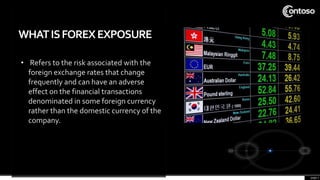
• Refers to the risk associated with the
foreign exchange rates that change
frequently and can have an adverse
effect on the financial transactions
denominated in some foreign currency
rather than the domestic currency of the
company.
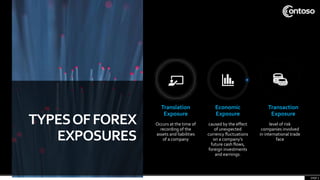
Translation
Exposure
Occurs at the time of
recording of the
assets and liabilities
of a company
Economic
Exposure
caused by the effect
of unexpected
currency fluctuations
on a company’s
future cash flows,
foreign investments
and earnings.
Transaction
Exposure
level of risk
companies involved
in international trade
face
page 3
TYPESOFFOREX
EXPOSURES
• Translation exposure is the risk that a
company's equities, assets, liabilities or
income will change in value as a result of
exchange rate changes
• This occurs when a firm denominates a
portion of its equities, assets, liabilities or
income in a foreign currency
• also known as "accounting exposure
page 4
TranslationExposure
• It is caused by the effect of unexpected
currency fluctuations on a company’s
future cash flows, foreign investments
and earnings.
• It is also known as operating exposure
• It can have a substantial impact on a
company’s market value
page 5
EconomicExposure
• Transaction exposure is the level of risk
companies involved in international trade
face
• Specifically, the risk that currency
exchange rates will change after a
company has already entered into
financial obligations
• A high level of exposure to fluctuating
exchange rates can lead to major losses
for firms
page 6
TransactionExposure
page 7
TRANSLATION
EXPOSUREHEDGING
TECHNIQUES
Current or
Non Current
Monetary
or Non
Monetary
Temporal Current
Rate
page 8
• Current / non current method-Under
this, current assets and liabilities are valued
at current rate & non- current assets and
liabilities at historical rate
• Monetary/ non monetary method-
all monetary items(cash, marketable
securities, receivables, notes payable etc) are
valued at current rates and non-monetary
items at historical rates
• Temporal method- Under this method
the inventory and investments are translated
at current rate if they are valued at the
market price
• Current Rates-Under this method all
assets, liabilities, income & expenses are
translated at current rates of exchange
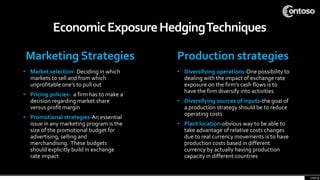
Marketing Strategies
• Market selection- Deciding in which
markets to sell and from which
unprofitable one’s to pull out
• Pricing policies- a firm has to make a
decision regarding market share
versus profit margin
• Promotional strategies-An essential
issue in any marketing program is the
size of the promotional budget for
advertising, selling and
merchandising. These budgets
should explicitly build in exchange
rate impact
Production strategies
• Diversifying operations-One possibility to
dealing with the impact of exchange rate
exposure on the firm's cash flows is to
have the firm diversify into activities
• Diversifying sources of inputs-the goal of
a production strategy should be to reduce
operating costs
• Plant location-obvious way to be able to
take advantage of relative costs changes
due to real currency movements is to have
production costs based in different
currency by actually having production
capacity in different countries
EconomicExposureHedgingTechniques
page 9
page 10
TRANSACTION
EXPOSUREHEDGING
TECHNIQUES
CONTRACTUAL HEDGES
Forward
contracts
Future
contracts
Money market
hedge
Options
Leading &
Lagging
manipulating
currency cash flows in
accordance with the
fluctuations
Re-envoicing
centers
single third-party
subsidiary used to
conduct all intra-
company trades
Currency risk
sharing
The two parties
involved in the deal
can have the
understanding to
share the transaction
risk.
page 11
NATURALHEDGES
THANK
YOU

Foreign exchange risk management

  • 1.
  • 2.
    page 2 WHATISFOREXEXPOSURE • Refersto the risk associated with the foreign exchange rates that change frequently and can have an adverse effect on the financial transactions denominated in some foreign currency rather than the domestic currency of the company.
  • 3.
    Translation Exposure Occurs at thetime of recording of the assets and liabilities of a company Economic Exposure caused by the effect of unexpected currency fluctuations on a company’s future cash flows, foreign investments and earnings. Transaction Exposure level of risk companies involved in international trade face page 3 TYPESOFFOREX EXPOSURES
  • 4.
    • Translation exposureis the risk that a company's equities, assets, liabilities or income will change in value as a result of exchange rate changes • This occurs when a firm denominates a portion of its equities, assets, liabilities or income in a foreign currency • also known as "accounting exposure page 4 TranslationExposure
  • 5.
    • It iscaused by the effect of unexpected currency fluctuations on a company’s future cash flows, foreign investments and earnings. • It is also known as operating exposure • It can have a substantial impact on a company’s market value page 5 EconomicExposure
  • 6.
    • Transaction exposureis the level of risk companies involved in international trade face • Specifically, the risk that currency exchange rates will change after a company has already entered into financial obligations • A high level of exposure to fluctuating exchange rates can lead to major losses for firms page 6 TransactionExposure
  • 7.
    page 7 TRANSLATION EXPOSUREHEDGING TECHNIQUES Current or NonCurrent Monetary or Non Monetary Temporal Current Rate
  • 8.
    page 8 • Current/ non current method-Under this, current assets and liabilities are valued at current rate & non- current assets and liabilities at historical rate • Monetary/ non monetary method- all monetary items(cash, marketable securities, receivables, notes payable etc) are valued at current rates and non-monetary items at historical rates • Temporal method- Under this method the inventory and investments are translated at current rate if they are valued at the market price • Current Rates-Under this method all assets, liabilities, income & expenses are translated at current rates of exchange
  • 9.
    Marketing Strategies • Marketselection- Deciding in which markets to sell and from which unprofitable one’s to pull out • Pricing policies- a firm has to make a decision regarding market share versus profit margin • Promotional strategies-An essential issue in any marketing program is the size of the promotional budget for advertising, selling and merchandising. These budgets should explicitly build in exchange rate impact Production strategies • Diversifying operations-One possibility to dealing with the impact of exchange rate exposure on the firm's cash flows is to have the firm diversify into activities • Diversifying sources of inputs-the goal of a production strategy should be to reduce operating costs • Plant location-obvious way to be able to take advantage of relative costs changes due to real currency movements is to have production costs based in different currency by actually having production capacity in different countries EconomicExposureHedgingTechniques page 9
  • 10.
  • 11.
    Leading & Lagging manipulating currency cashflows in accordance with the fluctuations Re-envoicing centers single third-party subsidiary used to conduct all intra- company trades Currency risk sharing The two parties involved in the deal can have the understanding to share the transaction risk. page 11 NATURALHEDGES
  • 12.