FOREIGN DIRECT INVESTMENTPrepared byRakeshRanjan Sahoo-138Chandra Sekhar Das-152Pratik Dasgupta-153Tonoy Banerjee-156Madhusudan Palo-177Farhanur Rahman-185
INTRODUCTIONForeign Direct Investment (FDI) is normally  a form of investment made in order of long-lasting interest in enterprises that are operated outside of the economy .They are usually non volatile in nature.Preferred over other forms of external finance because they are non debt creating.Their returns usually depends on the performance of the project.
DEFINITIONAccording to world bank:“Foreign direct investment are the net inflows of investment to acquire a lasting management interest (10 percent or more of voting stock) in an enterprise operating in an economy other than that of the investor. It is the sum of equity capital, reinvestment of earnings, other long-term capital, and short-term capital as shown in the balance of payments. This series shows net inflows (new investment inflows less disinvestment) in the reporting economy from foreign investors.”
Modes of FDI1) By Direction        * Inward        *Outward  2) By Target        * Mergers and Acquisitions        * Horizontal FDI        * Vertical FDI               (a) Backward Vertical FDI                (b) Forward Vertical FDI 3 )By Motive        * Resource-Seeking        * Market-Seeking        * Efficiency-Seeking 4/13/20114
FDI IN INDIA   In India, Foreign Direct Investment Policy allows for investment only in case of the following form of investments:Through financial alliance ,Through joint schemes and technical alliance ,Through capital markets,  Through private placements or preferential allotments .
Factors Affecting FDIFinancial incentives (Funds from local Government)Fiscal incentives (Exemption from import duties) Indirect incentives (Provides land and Political stability Market potential & accessibility Large economy Market size 4/13/20116
Why India?Liberal, largest democracy, Political Stability Second largest emerging market (US$ 2.4 trillion) Skilled and competitive labors force highest rates of return on investmentone hundred of the Fortune 500 have R & D facilities in IndiaSecond largest group of software developers after the U.S.lists 6,500 companies on the Bombay Stock Exchange (only the NYSE has more)4/13/20117
Why India (cont.)World's fourth largest economy & second largest pharmaceutical industrygrowth over the past few years averaging 8%has a middle class estimated at 300 million out of a total population of 1 billion Destination for business process outsourcing, Knowledge processing etc.Second largest English-speaking, scientific, technical and executive manpower  Low costs & Tax exemptions in SEZTax incentives for IT , business process outsourcing and KPO companies4/13/20118
9
Current ScenarioRanked 2nd most favored destination for foreign investments after China
India ranks among the top 12 producers of manufacturing value added (MVA).
In textiles, the country is ranked 4th after China, USA and Italy.
In electrical machinery and apparatus, it is ranked 5th. According to a United Nations Industrial Development Organization (UNIDO) analysis based on 2007 figures mentioned in the International Yearbook of Industrial Statistics 2009
Current Scenario6th  position in the basic metals category
6th position in space technology
7th in chemicals and chemical products
10th in leather, leather products, refined petroleum products and nuclear fuel
12th in machinery and equipment and motor vehicles.According to a United Nations Industrial Development Organization (UNIDO) analysis based on 2007 figures mentioned in the International Yearbook of Industrial Statistics 2009
FDI In India Across Different SectorsHotel & Tourism- 100 per cent FDI is permitted for this sector through the automatic route.Trading- For trading companies 100 per cent FDI is allowed for Exports, Bulk Imports , Cash and Carry wholesale trading.Power- FDI allowed is upto 100%Drugs and pharmaceuticals- FDI is allowed upto 100% subject to the fact that the venture does not attract compulsory licensing, does not involve use of recombinant DNA technology.
Contd…Private banking- FDI of 49 per cent is allowed in the Banking sector through the automatic route provided the investment adheres to guidelines issued by RBI.Insurance sector- For the Insurance sector FDI allowed is 26 per cent through the automatic route on condition of getting license from Insurance Regulatory and Development Authority (IRDA).BPO-  FDI of 100 per cent is permitted provided such investments satisfy certain prerequisites.NRI’S and OCB’S - They can have direct investment in industry, trade and infrastructure
Contd…Telecommunication- For basic, cellular, value added services and mobile personal communications by satellite, FDI is 49 per cent.For Internet Service Protocols with gateways, radio-paging and end to end bandwidth, FDI is allowed up to 74 per cent. But any FDI above 49 per cent would require government approval.
Sector-wise Distribution
why Services Sector ?Introduction of ‘Manmohanomics’ in 1991Liberalization of many service sectors activities (telecom, transport, finance   etc.)One of the sector which got most reform benefits
FDI contribution to Services SectorAttracted $3.12 billion FDI in the first seven months of 2009-1022 per cent of the total FDI inflows of $17.64 billion in the April-October for service sectorIn 2008-09, attracted the maximum FDI worth USD 6.11 billion.
FDI Policy in Services Sector100% FDI is permitted for many service sectors   (Real estate, construction, hotels, tourism, films, IT and IT - enabled services, consultancy, renting, medical,    education, advertising etc)Phased manner: to allow domestic companies to prepare for global competition (Banking, Insurance, Media, organisedRetail Trade )
FICCI Study in Indian Manufacturing Sector: Salient Points
FICCI’s Suggestions
Restricted sectors in ServicesAtomic Energy, Lottery Business, Gambling and Betting, Business of Chit Fund, and any activity/sector that is not opened to private sector investment. Besides the above, FDI is not allowed in plantations.
IMPACT OF FDI IN INDIAEnabled India to achieve a high degree of  growth and development.A number of projects have been announced in areas such as electricity generation, distribution and transmission, as well as the development of roads and highways, with opportunities for foreign investors.The Indian national government also provided permission to FDIs to provide up to 100% of the financing required for the construction of bridges and tunnels, but with a limit on foreign equity of INR 1,500 crores, approximately $352.5m.
FDI IN COMPARISON TO CHINA.FDI has helped the Indian economy grow, and the government continues to encourage more investments of this sort - but with $5.3 billion in FDI in 2004 India gets less than 10% of the FDI of China.By 2004, India received $5.3 billion in FDI, big growth compared to previous years, but less than 10% of the $60.6 billion that flowed into China.
Cont……Chinese approval process is complex, it includes both national and regional approval in the same process. Federal democracy is perversely an impediment for India. Local authorities are not part of the approvals process and have their own rights, and this often leads to projects getting bogged down in red tape and bureaucracy. India actually receives less than half the FDI that the federal government approves.
Share of countries
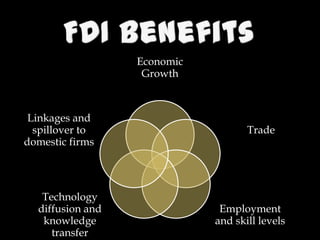
Role of FDI in economic growthHigher  capital formation.Impetus to economic growth.Domestic labours.GovernmentExternal scale of economies.Tax revenue
FDI Benefits
ADVANTAGESInflow of exchanges.Transfer of technology.Reduction in poverty and unemployment.Easy capital formation.Higher revenue for government.Global exposure for local companies in case of joint venture.
DISADVANTAGESFluctuation in value of home currency.Environment and natural cost.Inflation .Greater competition for small and  infant industriesCompromising with soveigernity .
FDI in India
Inflation Rate

Fdi

  • 1.
    FOREIGN DIRECT INVESTMENTPreparedbyRakeshRanjan Sahoo-138Chandra Sekhar Das-152Pratik Dasgupta-153Tonoy Banerjee-156Madhusudan Palo-177Farhanur Rahman-185
  • 2.
    INTRODUCTIONForeign Direct Investment(FDI) is normally a form of investment made in order of long-lasting interest in enterprises that are operated outside of the economy .They are usually non volatile in nature.Preferred over other forms of external finance because they are non debt creating.Their returns usually depends on the performance of the project.
  • 3.
    DEFINITIONAccording to worldbank:“Foreign direct investment are the net inflows of investment to acquire a lasting management interest (10 percent or more of voting stock) in an enterprise operating in an economy other than that of the investor. It is the sum of equity capital, reinvestment of earnings, other long-term capital, and short-term capital as shown in the balance of payments. This series shows net inflows (new investment inflows less disinvestment) in the reporting economy from foreign investors.”
  • 4.
    Modes of FDI1)By Direction * Inward *Outward 2) By Target * Mergers and Acquisitions * Horizontal FDI * Vertical FDI (a) Backward Vertical FDI (b) Forward Vertical FDI 3 )By Motive * Resource-Seeking * Market-Seeking * Efficiency-Seeking 4/13/20114
  • 5.
    FDI IN INDIA In India, Foreign Direct Investment Policy allows for investment only in case of the following form of investments:Through financial alliance ,Through joint schemes and technical alliance ,Through capital markets, Through private placements or preferential allotments .
  • 6.
    Factors Affecting FDIFinancialincentives (Funds from local Government)Fiscal incentives (Exemption from import duties) Indirect incentives (Provides land and Political stability Market potential & accessibility Large economy Market size 4/13/20116
  • 7.
    Why India?Liberal, largestdemocracy, Political Stability Second largest emerging market (US$ 2.4 trillion) Skilled and competitive labors force highest rates of return on investmentone hundred of the Fortune 500 have R & D facilities in IndiaSecond largest group of software developers after the U.S.lists 6,500 companies on the Bombay Stock Exchange (only the NYSE has more)4/13/20117
  • 8.
    Why India (cont.)World'sfourth largest economy & second largest pharmaceutical industrygrowth over the past few years averaging 8%has a middle class estimated at 300 million out of a total population of 1 billion Destination for business process outsourcing, Knowledge processing etc.Second largest English-speaking, scientific, technical and executive manpower Low costs & Tax exemptions in SEZTax incentives for IT , business process outsourcing and KPO companies4/13/20118
  • 9.
  • 10.
    Current ScenarioRanked 2ndmost favored destination for foreign investments after China
  • 11.
    India ranks amongthe top 12 producers of manufacturing value added (MVA).
  • 12.
    In textiles, thecountry is ranked 4th after China, USA and Italy.
  • 13.
    In electrical machineryand apparatus, it is ranked 5th. According to a United Nations Industrial Development Organization (UNIDO) analysis based on 2007 figures mentioned in the International Yearbook of Industrial Statistics 2009
  • 14.
    Current Scenario6th position in the basic metals category
  • 15.
    6th position inspace technology
  • 16.
    7th in chemicalsand chemical products
  • 17.
    10th in leather,leather products, refined petroleum products and nuclear fuel
  • 18.
    12th in machineryand equipment and motor vehicles.According to a United Nations Industrial Development Organization (UNIDO) analysis based on 2007 figures mentioned in the International Yearbook of Industrial Statistics 2009
  • 22.
    FDI In IndiaAcross Different SectorsHotel & Tourism- 100 per cent FDI is permitted for this sector through the automatic route.Trading- For trading companies 100 per cent FDI is allowed for Exports, Bulk Imports , Cash and Carry wholesale trading.Power- FDI allowed is upto 100%Drugs and pharmaceuticals- FDI is allowed upto 100% subject to the fact that the venture does not attract compulsory licensing, does not involve use of recombinant DNA technology.
  • 23.
    Contd…Private banking- FDIof 49 per cent is allowed in the Banking sector through the automatic route provided the investment adheres to guidelines issued by RBI.Insurance sector- For the Insurance sector FDI allowed is 26 per cent through the automatic route on condition of getting license from Insurance Regulatory and Development Authority (IRDA).BPO- FDI of 100 per cent is permitted provided such investments satisfy certain prerequisites.NRI’S and OCB’S - They can have direct investment in industry, trade and infrastructure
  • 24.
    Contd…Telecommunication- For basic,cellular, value added services and mobile personal communications by satellite, FDI is 49 per cent.For Internet Service Protocols with gateways, radio-paging and end to end bandwidth, FDI is allowed up to 74 per cent. But any FDI above 49 per cent would require government approval.
  • 26.
  • 28.
    why Services Sector?Introduction of ‘Manmohanomics’ in 1991Liberalization of many service sectors activities (telecom, transport, finance etc.)One of the sector which got most reform benefits
  • 29.
    FDI contribution toServices SectorAttracted $3.12 billion FDI in the first seven months of 2009-1022 per cent of the total FDI inflows of $17.64 billion in the April-October for service sectorIn 2008-09, attracted the maximum FDI worth USD 6.11 billion.
  • 30.
    FDI Policy inServices Sector100% FDI is permitted for many service sectors (Real estate, construction, hotels, tourism, films, IT and IT - enabled services, consultancy, renting, medical, education, advertising etc)Phased manner: to allow domestic companies to prepare for global competition (Banking, Insurance, Media, organisedRetail Trade )
  • 31.
    FICCI Study inIndian Manufacturing Sector: Salient Points
  • 32.
  • 33.
    Restricted sectors inServicesAtomic Energy, Lottery Business, Gambling and Betting, Business of Chit Fund, and any activity/sector that is not opened to private sector investment. Besides the above, FDI is not allowed in plantations.
  • 34.
    IMPACT OF FDIIN INDIAEnabled India to achieve a high degree of growth and development.A number of projects have been announced in areas such as electricity generation, distribution and transmission, as well as the development of roads and highways, with opportunities for foreign investors.The Indian national government also provided permission to FDIs to provide up to 100% of the financing required for the construction of bridges and tunnels, but with a limit on foreign equity of INR 1,500 crores, approximately $352.5m.
  • 35.
    FDI IN COMPARISONTO CHINA.FDI has helped the Indian economy grow, and the government continues to encourage more investments of this sort - but with $5.3 billion in FDI in 2004 India gets less than 10% of the FDI of China.By 2004, India received $5.3 billion in FDI, big growth compared to previous years, but less than 10% of the $60.6 billion that flowed into China.
  • 36.
    Cont……Chinese approval processis complex, it includes both national and regional approval in the same process. Federal democracy is perversely an impediment for India. Local authorities are not part of the approvals process and have their own rights, and this often leads to projects getting bogged down in red tape and bureaucracy. India actually receives less than half the FDI that the federal government approves.
  • 38.
  • 39.
    Role of FDIin economic growthHigher capital formation.Impetus to economic growth.Domestic labours.GovernmentExternal scale of economies.Tax revenue
  • 40.
  • 41.
    ADVANTAGESInflow of exchanges.Transferof technology.Reduction in poverty and unemployment.Easy capital formation.Higher revenue for government.Global exposure for local companies in case of joint venture.
  • 42.
    DISADVANTAGESFluctuation in valueof home currency.Environment and natural cost.Inflation .Greater competition for small and infant industriesCompromising with soveigernity .
  • 43.
  • 44.

Editor's Notes

  • #20 (cumulative inflows Apr’00 to Nov’09)
  • #23 The liberalization measures post-1990 has changed with foreign investments radically, now portfolio as well as Foreign Direct Investment are not only allowed but also actively encouraged.
  • #24 In both banking and insurance, foreign investment is permitted subject to specific caps or entry conditions. FDI in media is permitted with varying sector caps. Retail trade is currently restricted to 51% FDI permitted in single brand retail stores and 100% FDI permitted in wholesale cash and carry. Legal services are currently not open to foreign investment.
  • #25 The manufacturing sector is estimated to have a US$ 180-billion investment opportunity over the next five years, according to the Investment Commission of India.
  • #26 Besides this, FICCI study pointed-out that the technology transfer and absorption which is one of the major benefits of FDI has not taken place adequately in various manufacturing sectors in India. While there are few Indian manufacturing firms whose technological capabilities are world class, but for many manufacturers especially in SMEs, technological capabilities are limited. A concrete and comprehensive Action plan to attract FDI in important and strategic areas like Computer Hardware, Capital Goods, Ship Building, Aerospace, Electronics, Medical Devices and Food Processing. FDI Policy should aim at incentivizing maximum value addition in the country. Incentivize technology transfer by adopting ‘Swap Technology for Market’ policy as is the case in China. Rationalizing complex regulatory procedures and reducing delays in the project approvals.
  • #27 Subject to these foreign equity conditions, a foreign company can set up a registered company in India and operate under the same laws, rules and regulations as any India-owned company.India extends National Treatment to foreign investors with absolutely no discrimination against foreign-invested companies registered in India or in favor of domestic ones
  • #39 About six States in India account for more than 55 per cent of FDI receipts.This high regional concentration could pose long-term problems for both countries. Hence, it is vital to analyze the main determinants of regional differences in FDI.The studies reviewed indicate that four possible sets of factors influence interregional distribution of FDI in a given country. They are:(a) International orientation, (b) Infrastructure, (c) Education and social indicators, and (d) Prosperity and industrial development of the region.