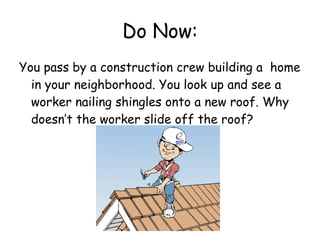
Do Now: You pass by a construction crew building a  home in your neighborhood. You look up and see a worker nailing shingles onto a new roof. Why doesn’t the worker slide off the roof?
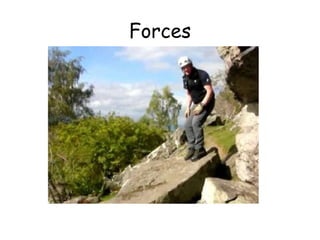
Forces
Goals: To explain how the motion of an object is affected when forces act upon it. To compare and contrast the 4 types of friction. To describe how Earth’s gravity and air resistance affect falling objects.
What is a FORCE? A force is a push or pull that acts on an object. It can cause a resting object to move or a moving object to change direction. The SI unit of Force is the  Newton (1 kg m/s 2 ).  The force needed to move a 1 kg object 1 meter/sec, every second. ( You exert about one Newton of force when you lift a small lemon)
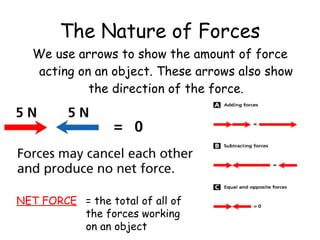
The Nature of Forces We use arrows to show the amount of force acting on an object. These arrows also show the direction of the force. NET FORCE = the total of all of the forces working on an object
Unbalanced Forces Unbalanced forces acting on an object result in a net force and cause a change in the object’s motion.
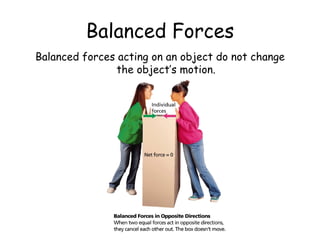
Balanced Forces Balanced forces acting on an object do not change the object’s motion.
Friction Friction is the force that opposes the motion of objects as they touch each other or move past each other. There are 4 types: static, sliding, rolling, and fluid friction.
Static Friction Always acts in the opposite direction of the applied force If the forces are equal, the plant will not move. You must apply a greater force in order to overcome friction.
Sliding Friction Opposes the direction of motion as an object slides over a surface. The force of sliding friction is less than static friction because less force is needed to keep an object moving than trying to start the object moving.
Rolling Friction The force that works on rolling objects. This force is much less than sliding friction and is usually due to the use of ball bearings.
Fluid Friction Opposes the movement of an object through a fluid. Submarines, airplanes, and cars experience fluid friction. However, the faster the object moves, the greater the fluid friction, so aerodynamic shapes are extremely important.

Forces

  • 1.
    Do Now: Youpass by a construction crew building a home in your neighborhood. You look up and see a worker nailing shingles onto a new roof. Why doesn’t the worker slide off the roof?
  • 2.
  • 3.
    Goals: To explainhow the motion of an object is affected when forces act upon it. To compare and contrast the 4 types of friction. To describe how Earth’s gravity and air resistance affect falling objects.
  • 4.
    What is aFORCE? A force is a push or pull that acts on an object. It can cause a resting object to move or a moving object to change direction. The SI unit of Force is the Newton (1 kg m/s 2 ). The force needed to move a 1 kg object 1 meter/sec, every second. ( You exert about one Newton of force when you lift a small lemon)
  • 5.
    The Nature ofForces We use arrows to show the amount of force acting on an object. These arrows also show the direction of the force. NET FORCE = the total of all of the forces working on an object
  • 6.
    Unbalanced Forces Unbalancedforces acting on an object result in a net force and cause a change in the object’s motion.
  • 7.
    Balanced Forces Balancedforces acting on an object do not change the object’s motion.
  • 8.
    Friction Friction isthe force that opposes the motion of objects as they touch each other or move past each other. There are 4 types: static, sliding, rolling, and fluid friction.
  • 9.
    Static Friction Alwaysacts in the opposite direction of the applied force If the forces are equal, the plant will not move. You must apply a greater force in order to overcome friction.
  • 10.
    Sliding Friction Opposesthe direction of motion as an object slides over a surface. The force of sliding friction is less than static friction because less force is needed to keep an object moving than trying to start the object moving.
  • 11.
    Rolling Friction Theforce that works on rolling objects. This force is much less than sliding friction and is usually due to the use of ball bearings.
  • 12.
    Fluid Friction Opposesthe movement of an object through a fluid. Submarines, airplanes, and cars experience fluid friction. However, the faster the object moves, the greater the fluid friction, so aerodynamic shapes are extremely important.