KIPM COLLEGE OF ENGINEERING & TECHNOLOGY
GIDA, GORAKHPUR
Footstep Power
Generation using
Arduino and
Piezoelectric
Sensors
01
KIPM COLLEGE OF ENGINEERING & TECHNOLOGY
GIDA, GORAKHPUR
PRESENTED BY :
NIRMA KUMARI
SAHIL GUPTA
SHUBHAM GIRI
SHAHIL KUMAR GUPTA
02
KIPM COLLEGE OF ENGINEERING & TECHNOLOGY
GIDA, GORAKHPUR
Table of content
INTRODUCTION
OBJECTIVE
COMPONENT
Circuit Diagram
Methodology
Result
Advantage &
Disadvantage
Application
Conclusion
Acrylic Sheet
Piezoelectric Sensors
Arduino UNO
LCD I2C Display
Capacitors, Resistors, Diodes
Stores the generated energy
03
KIPM COLLEGE OF ENGINEERING & TECHNOLOGY
GIDA, GORAKHPUR
INTRODUCTION
Footstep power generation is an innovative way to harness
renewable energy from daily human activity. By using
piezoelectric sensors, energy is captured from footsteps and
converted into electrical power. This project, utilizing
Arduino technology, demonstrates how energy can be
generated from foot traffic and displayed in real-time. The
system provides an environmentally friendly energy
solution, ideal for public spaces such as train stations,
airports, and malls, highlighting the potential of sustainable
power sources in everyday life.
04
KIPM COLLEGE OF ENGINEERING & TECHNOLOGY
GIDA, GORAKHPUR
OBJECTIVE
The main objective of this project is to harness
renewable energy from footsteps using
piezoelectric sensors. By converting mechanical
energy from walking into electrical energy, the
project aims to provide an eco-friendly and
sustainable power source for small-scale
applications, while also displaying real-time data
on footstep counts and energy generated using
an Arduino-controlled system.
05
KIPM COLLEGE OF ENGINEERING & TECHNOLOGY
GIDA, GORAKHPUR
COMPONENT
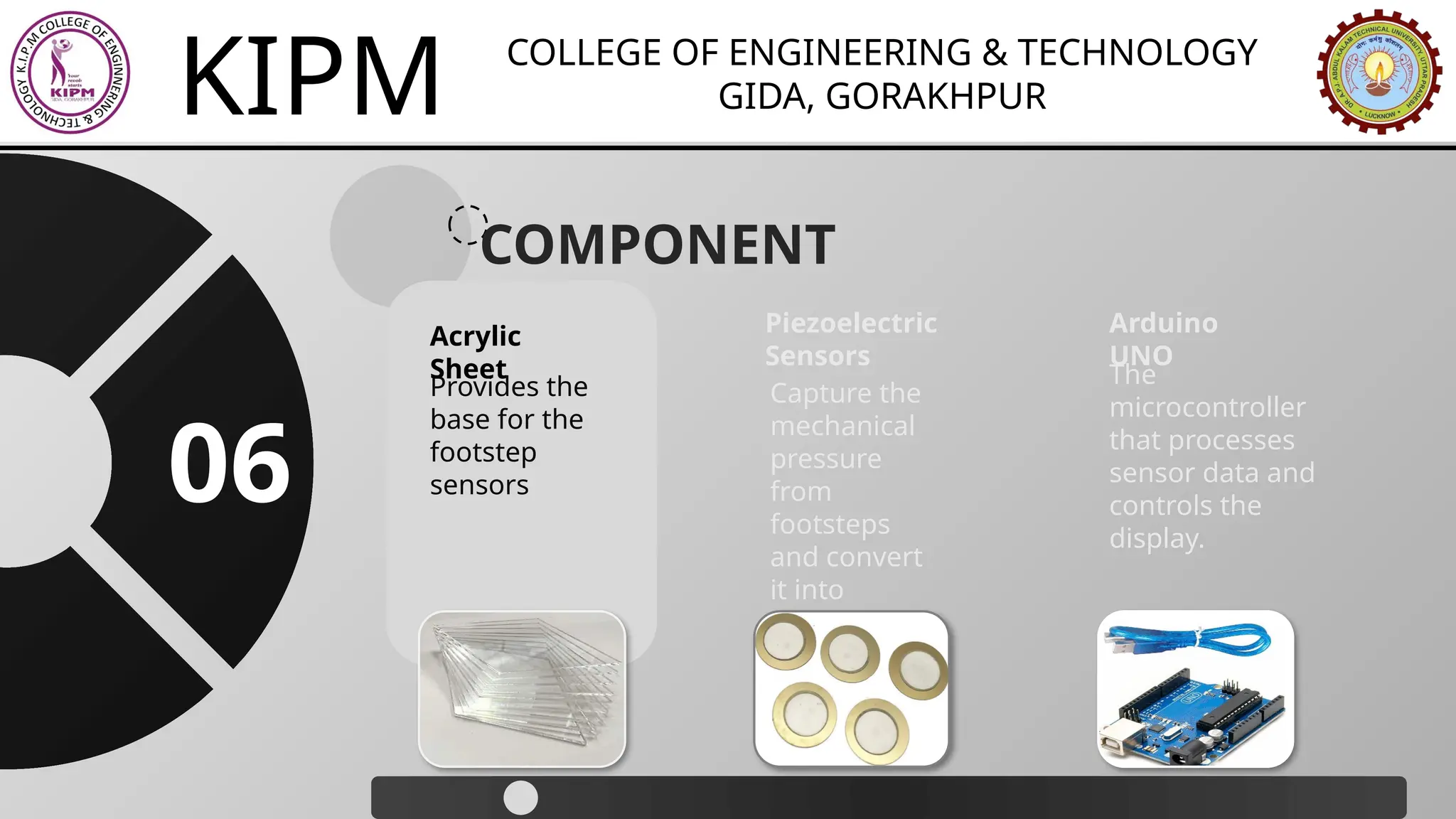
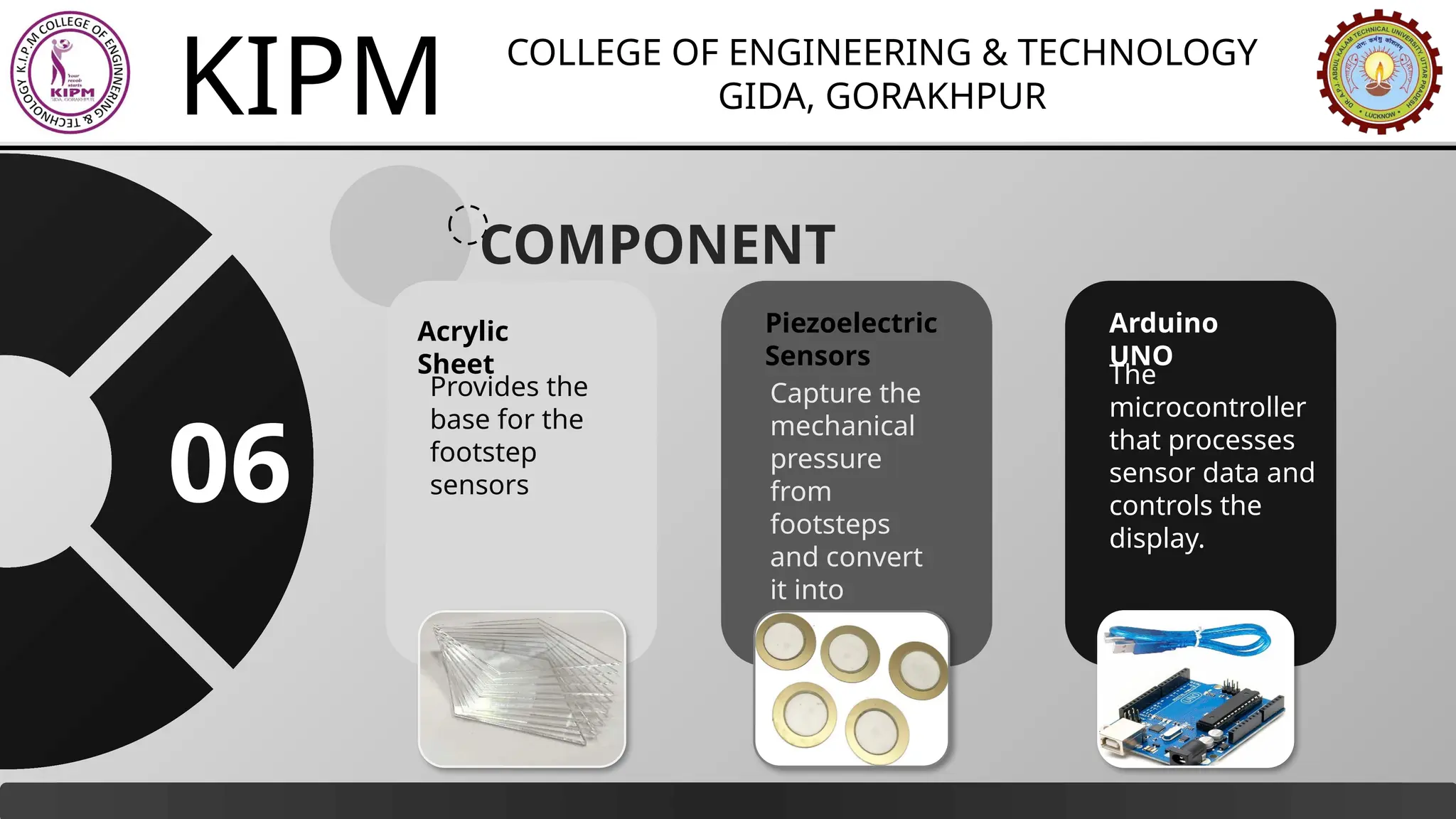
Provides the
base for the
footstep
sensors
Acrylic
Sheet
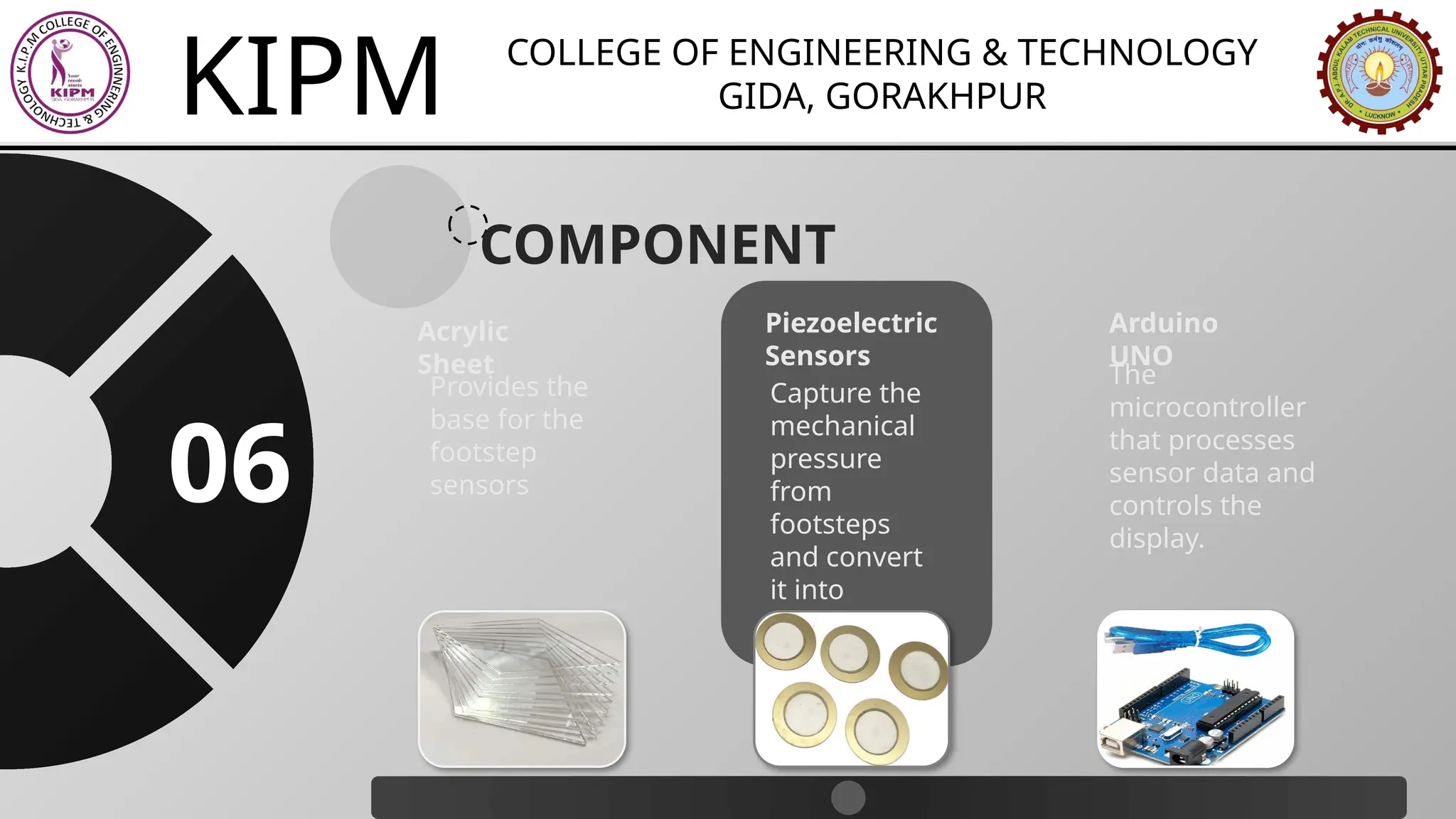
Capture the
mechanical
pressure
from
footsteps
and convert
it into
electrical
energy.
Piezoelectric
Sensors
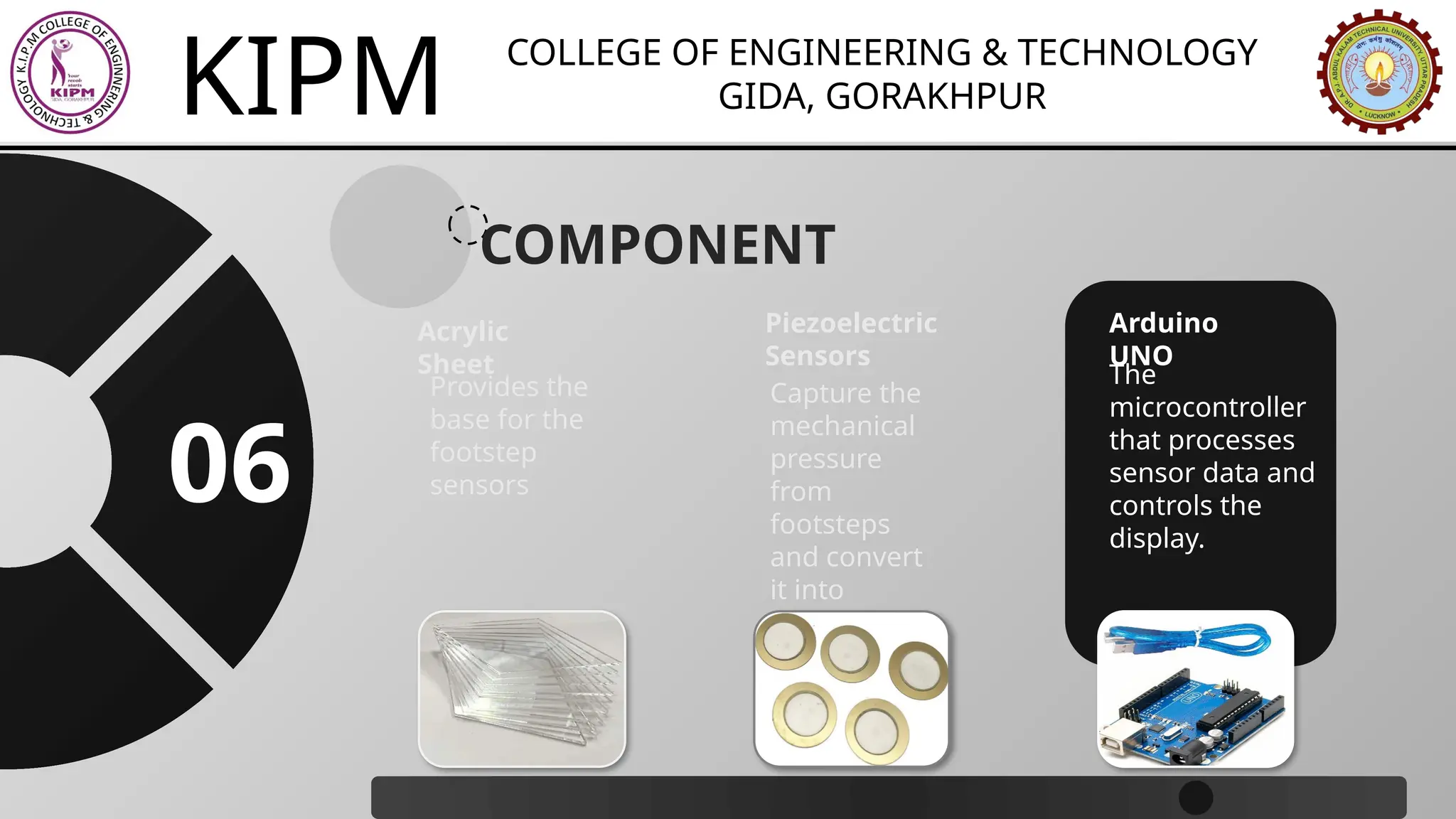
The
microcontroller
that processes
sensor data and
controls the
display.
Arduino
UNO
06
KIPM COLLEGE OF ENGINEERING & TECHNOLOGY
GIDA, GORAKHPUR
COMPONENT
Provides the
base for the
footstep
sensors
Acrylic
Sheet
Capture the
mechanical
pressure
from
footsteps
and convert
it into
electrical
energy.
Piezoelectric
Sensors
The
microcontroller
that processes
sensor data and
controls the
display.
Arduino
UNO
06
KIPM COLLEGE OF ENGINEERING & TECHNOLOGY
GIDA, GORAKHPUR
COMPONENT
Provides the
base for the
footstep
sensors
Acrylic
Sheet
Capture the
mechanical
pressure
from
footsteps
and convert
it into
electrical
energy.
Piezoelectric
Sensors
The
microcontroller
that processes
sensor data and
controls the
display.
Arduino
UNO
06
KIPM COLLEGE OF ENGINEERING & TECHNOLOGY
GIDA, GORAKHPUR
COMPONENT
Provides the
base for the
footstep
sensors
Acrylic
Sheet
Capture the
mechanical
pressure
from
footsteps
and convert
it into
electrical
energy.
Piezoelectric
Sensors
The
microcontroller
that processes
sensor data and
controls the
display.
Arduino
UNO
06
KIPM COLLEGE OF ENGINEERING & TECHNOLOGY
GIDA, GORAKHPUR
COMPONENT
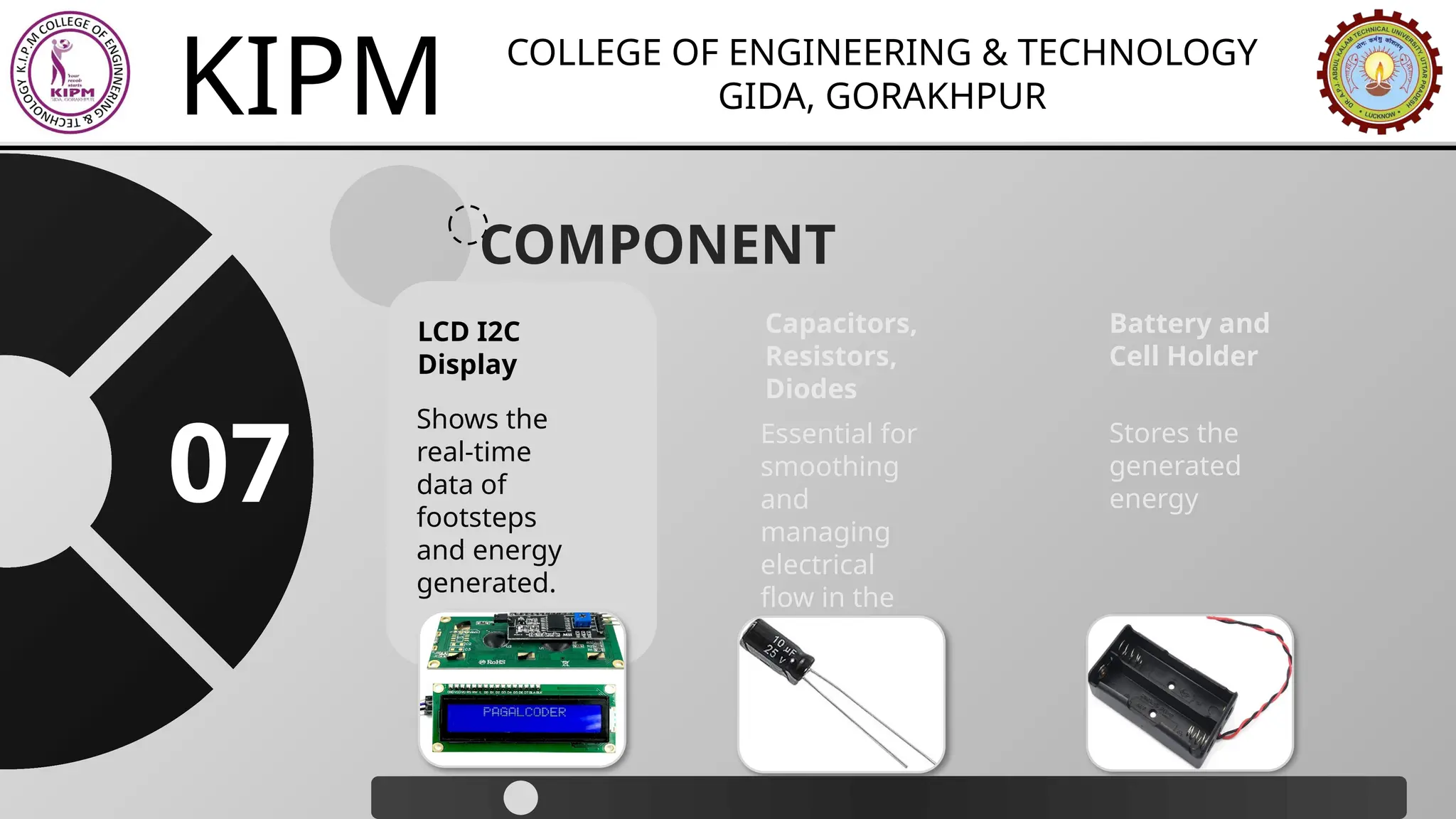
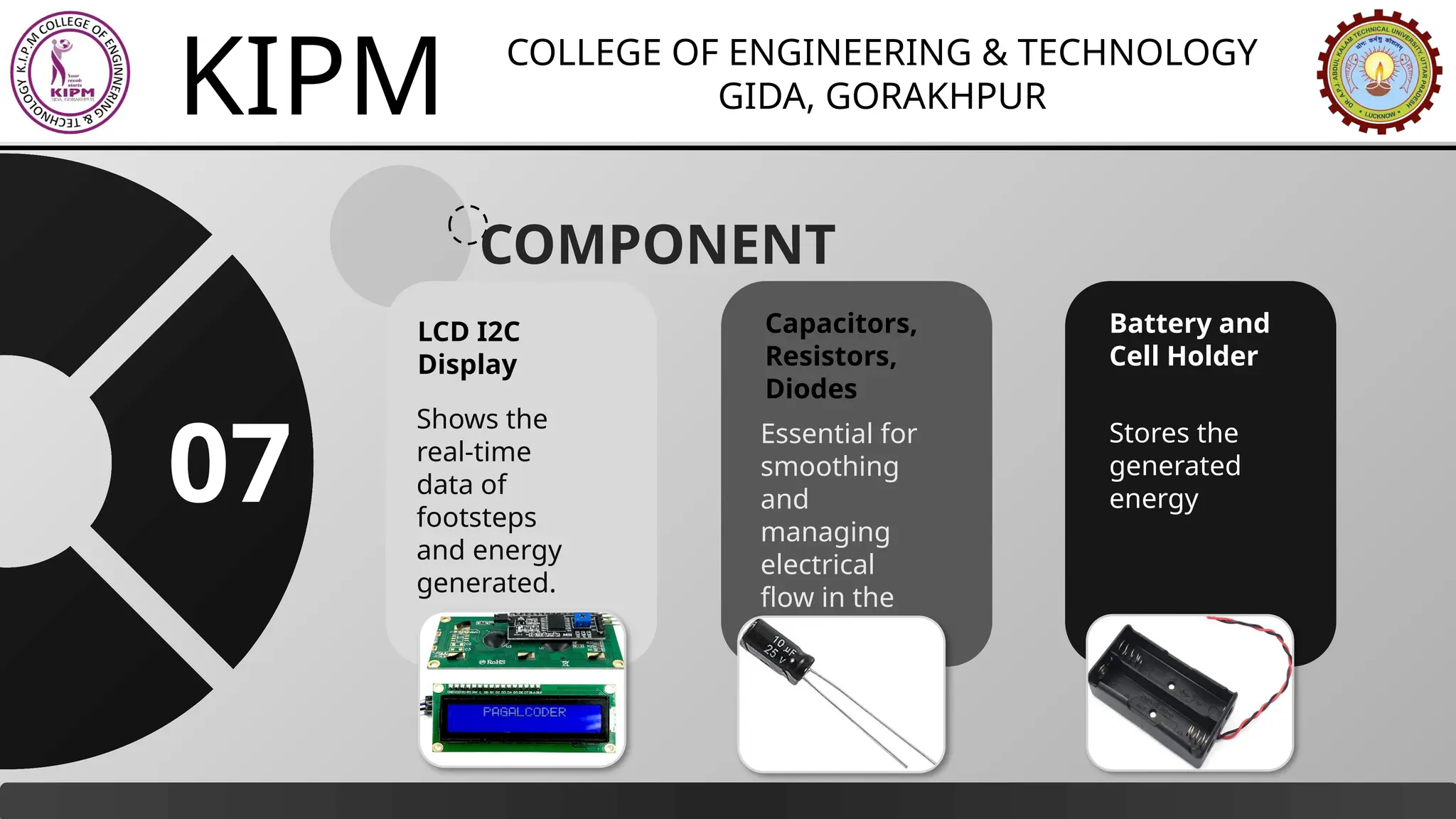
Shows the
real-time
data of
footsteps
and energy
generated.
LCD I2C
Display
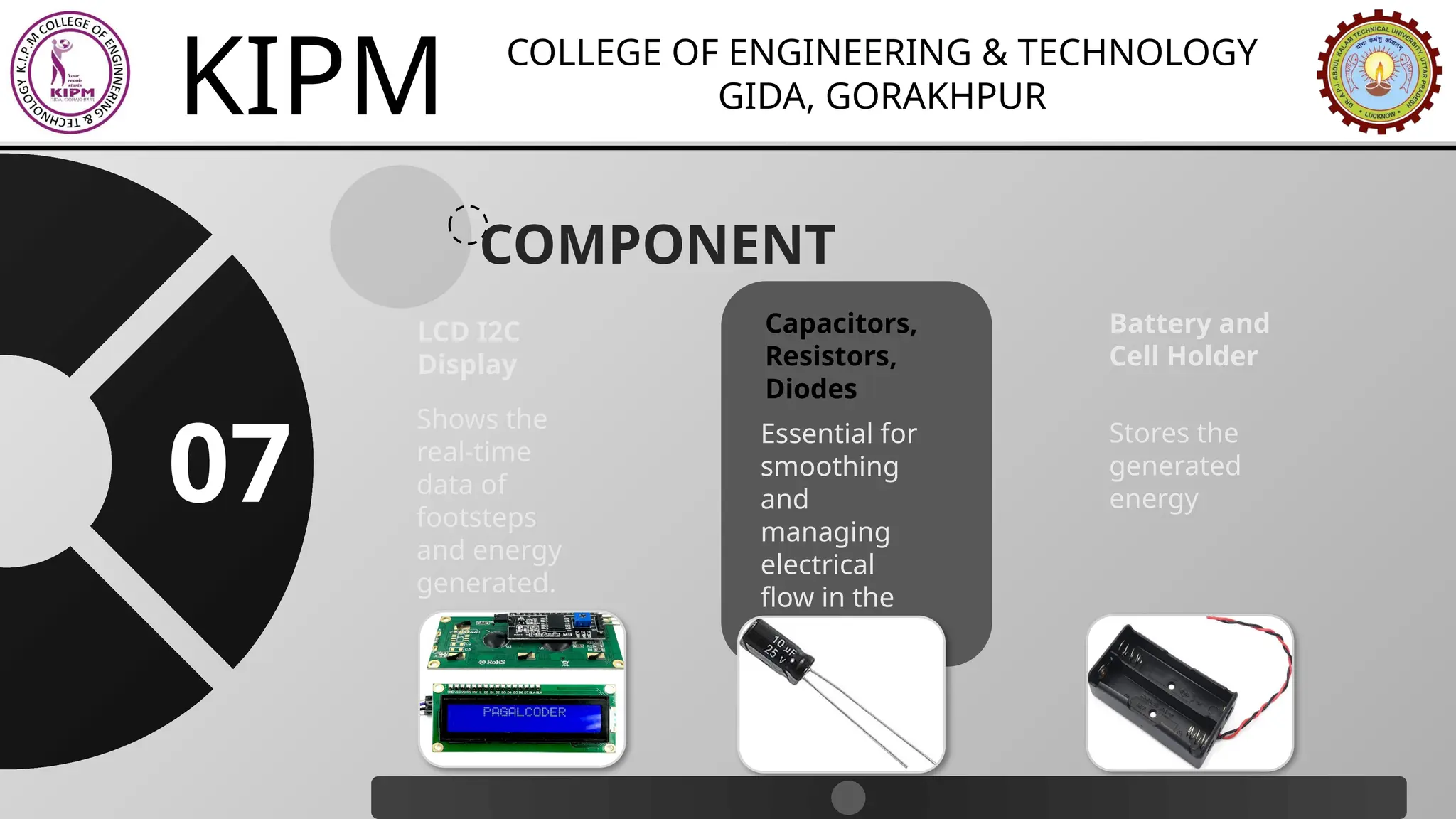
Essential for
smoothing
and
managing
electrical
flow in the
circuit.
Capacitors,
Resistors,
Diodes
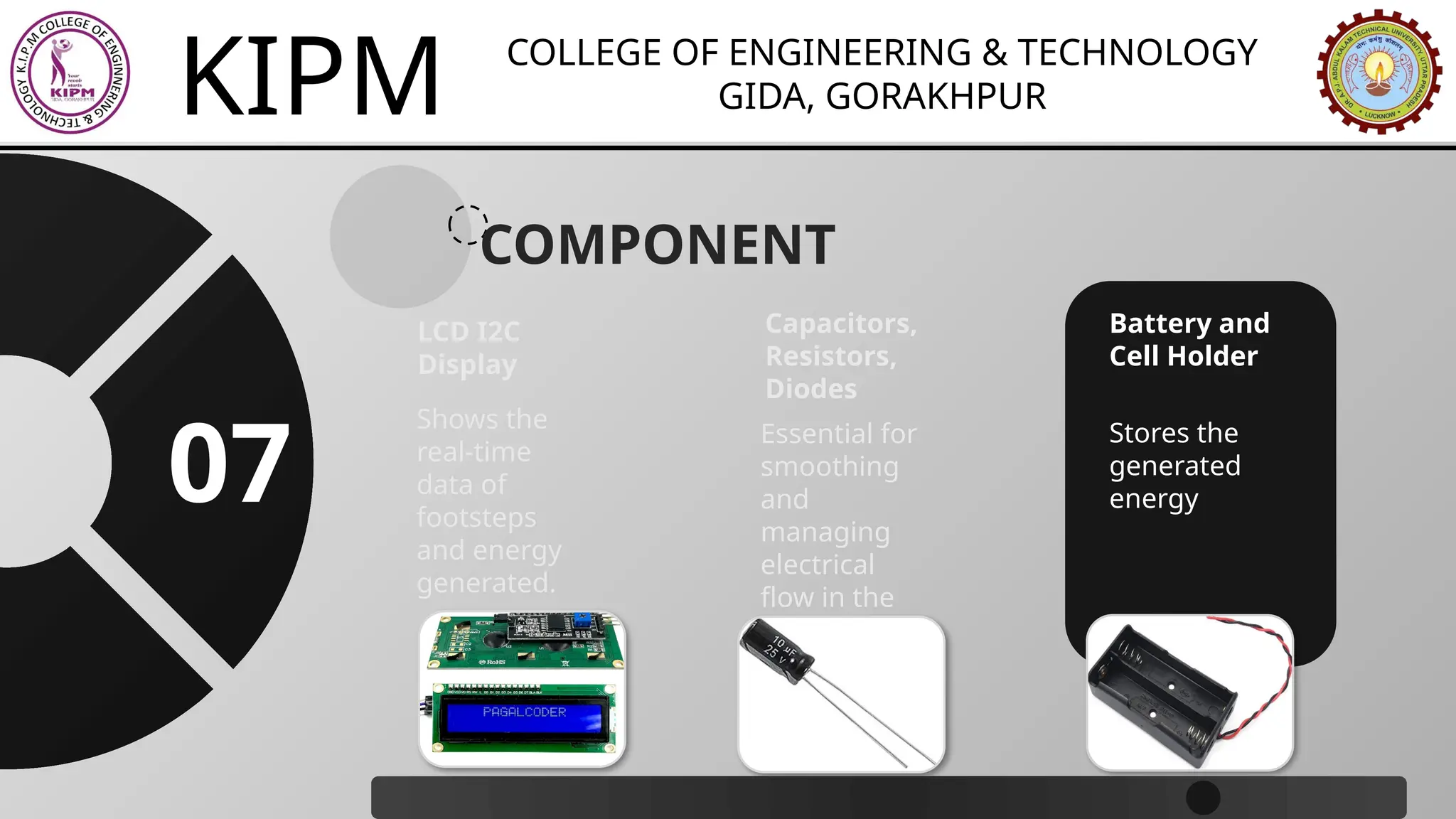
Stores the
generated
energy
Battery and
Cell Holder
07
KIPM COLLEGE OF ENGINEERING & TECHNOLOGY
GIDA, GORAKHPUR
COMPONENT
Shows the
real-time
data of
footsteps
and energy
generated.
LCD I2C
Display
Essential for
smoothing
and
managing
electrical
flow in the
circuit.
Capacitors,
Resistors,
Diodes
Stores the
generated
energy
Battery and
Cell Holder
07
KIPM COLLEGE OF ENGINEERING & TECHNOLOGY
GIDA, GORAKHPUR
COMPONENT
Shows the
real-time
data of
footsteps
and energy
generated.
LCD I2C
Display
Essential for
smoothing
and
managing
electrical
flow in the
circuit.
Capacitors,
Resistors,
Diodes
Stores the
generated
energy
Battery and
Cell Holder
07
KIPM COLLEGE OF ENGINEERING & TECHNOLOGY
GIDA, GORAKHPUR
COMPONENT
Shows the
real-time
data of
footsteps
and energy
generated.
LCD I2C
Display
Essential for
smoothing
and
managing
electrical
flow in the
circuit.
Capacitors,
Resistors,
Diodes
Stores the
generated
energy
Battery and
Cell Holder
07
KIPM COLLEGE OF ENGINEERING & TECHNOLOGY
GIDA, GORAKHPUR
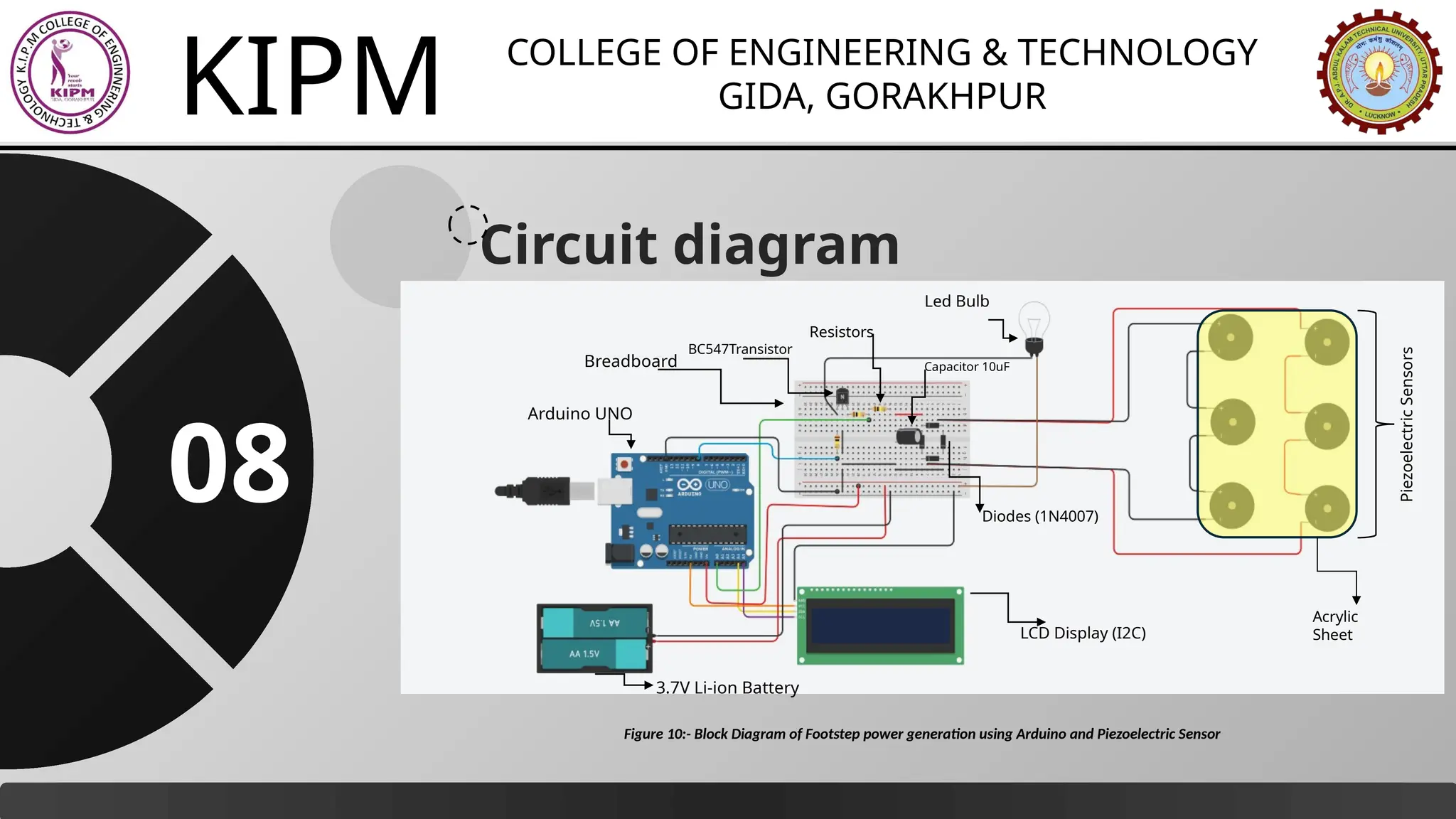
Circuit diagram
Arduino UNO
Breadboard
Piezoelectric
Sensors
LCD Display (I2C)
Resistors
Diodes (1N4007)
Capacitor 10uF
BC547Transistor
3.7V Li-ion Battery
Led Bulb
Figure 10:- Block Diagram of Footstep power generation using Arduino and Piezoelectric Sensor
08
Acrylic
Sheet
KIPM COLLEGE OF ENGINEERING & TECHNOLOGY
GIDA, GORAKHPUR
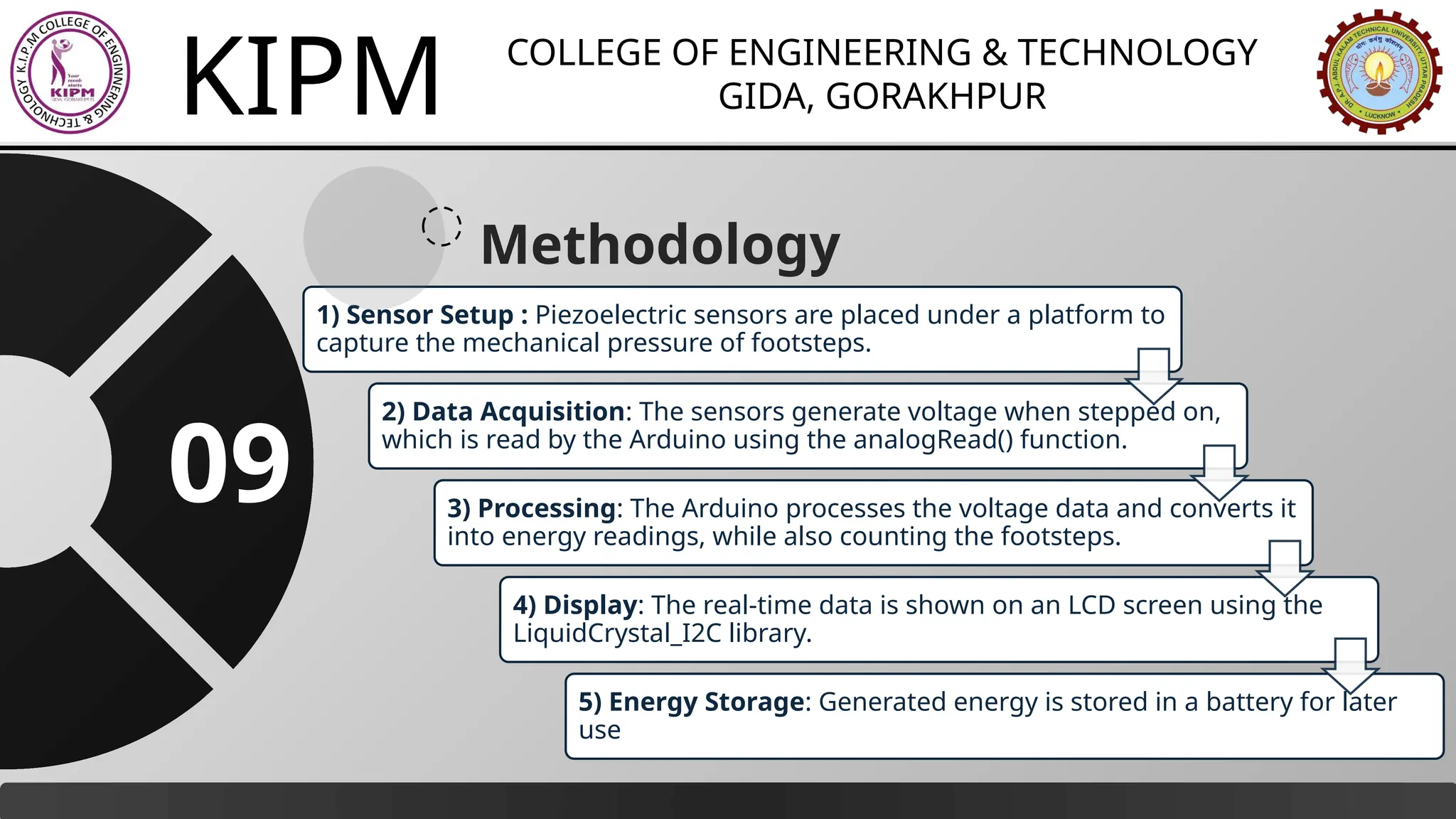
Methodology
1) Sensor Setup : Piezoelectric sensors are placed under a platform to
capture the mechanical pressure of footsteps.
2) Data Acquisition: The sensors generate voltage when stepped on,
which is read by the Arduino using the analogRead() function.
3) Processing: The Arduino processes the voltage data and converts it
into energy readings, while also counting the footsteps.
4) Display: The real-time data is shown on an LCD screen using the
LiquidCrystal_I2C library.
5) Energy Storage: Generated energy is stored in a battery for later
use
09
KIPM COLLEGE OF ENGINEERING & TECHNOLOGY
GIDA, GORAKHPUR
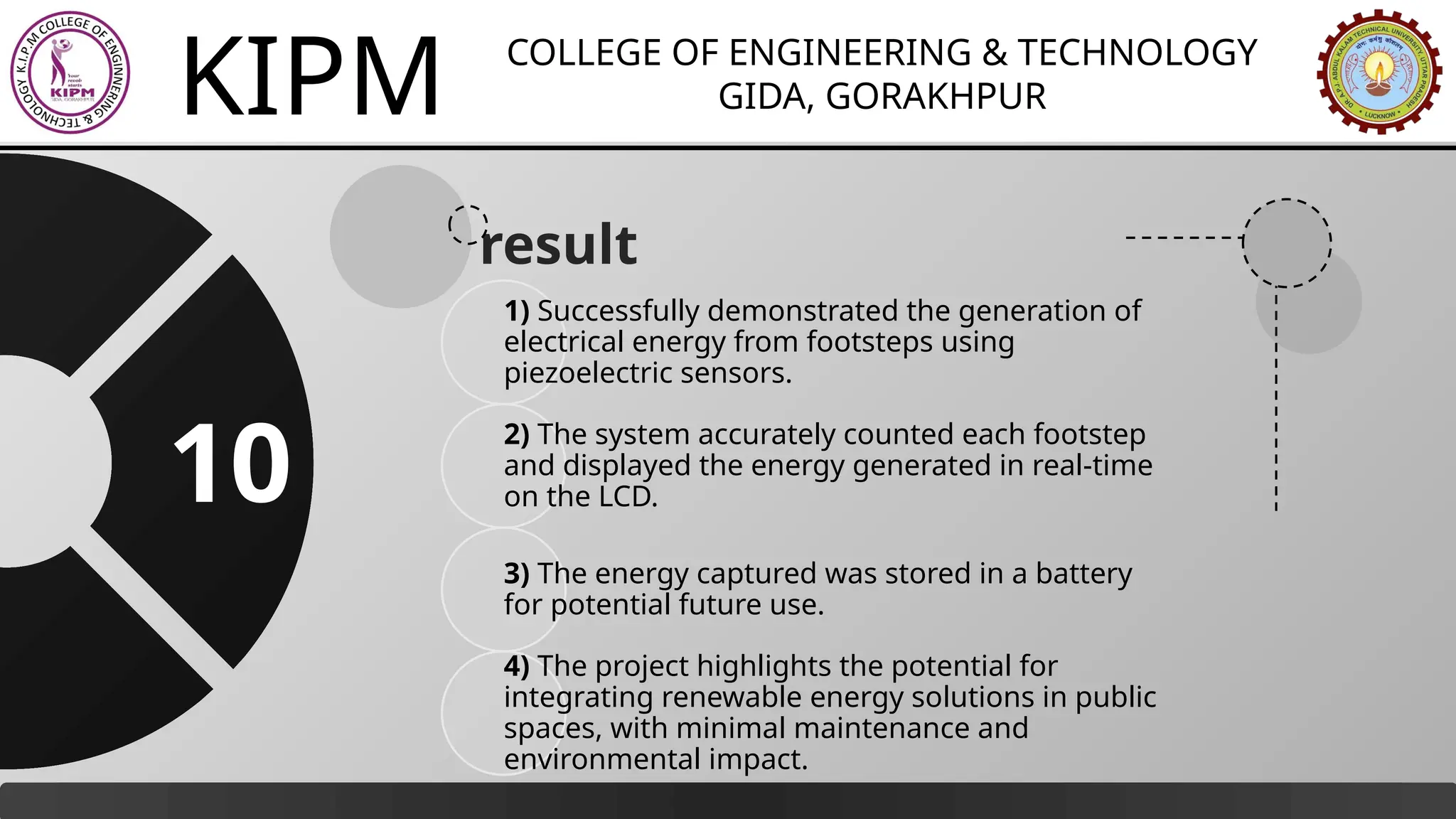
result
1) Successfully demonstrated the generation of
electrical energy from footsteps using
piezoelectric sensors.
2) The system accurately counted each footstep
and displayed the energy generated in real-time
on the LCD.
3) The energy captured was stored in a battery
for potential future use.
4) The project highlights the potential for
integrating renewable energy solutions in public
spaces, with minimal maintenance and
environmental impact.
10
KIPM COLLEGE OF ENGINEERING & TECHNOLOGY
GIDA, GORAKHPUR
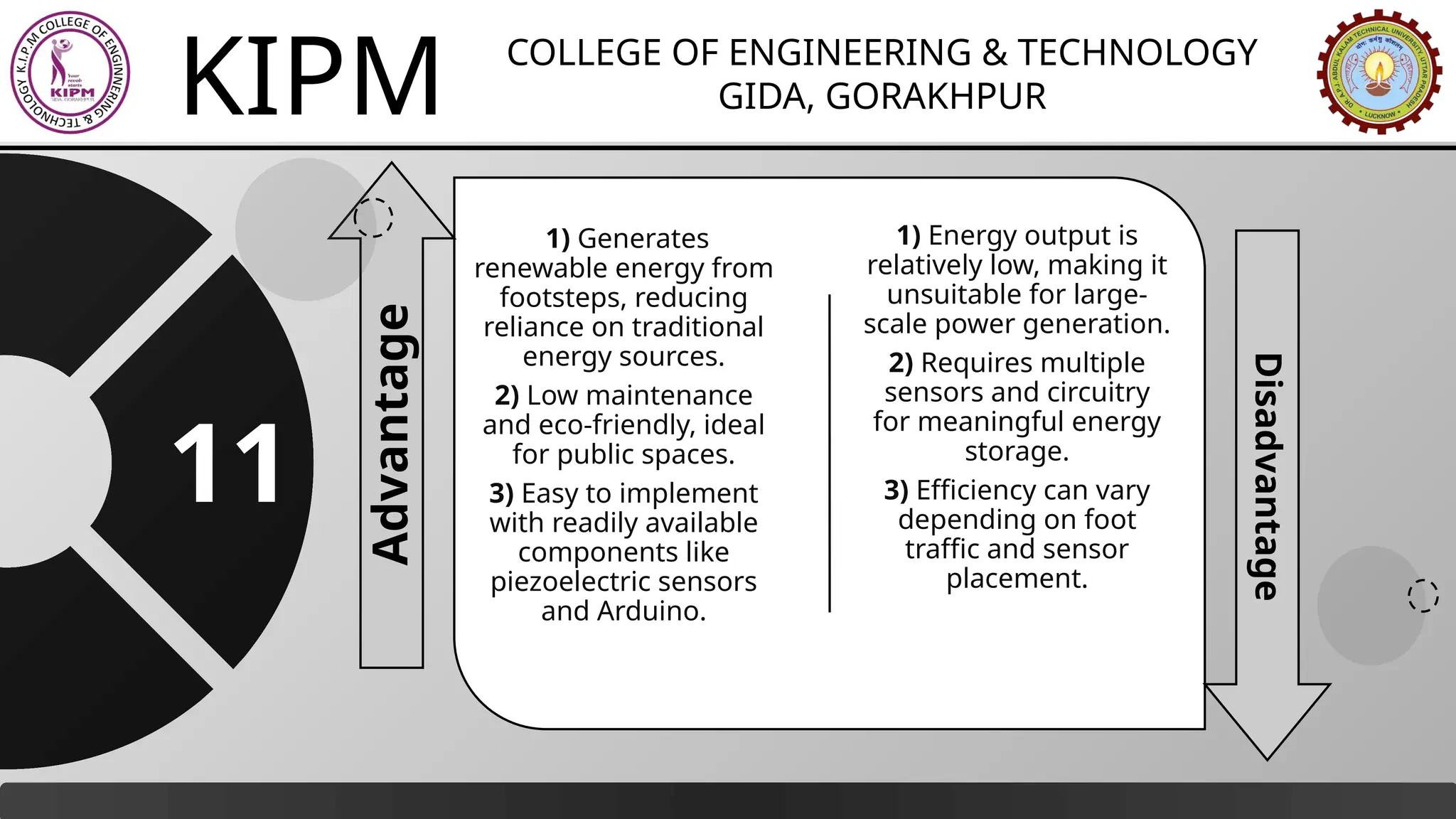
1) Generates
renewable energy from
footsteps, reducing
reliance on traditional
energy sources.
2) Low maintenance
and eco-friendly, ideal
for public spaces.
3) Easy to implement
with readily available
components like
piezoelectric sensors
and Arduino.
1) Energy output is
relatively low, making it
unsuitable for large-
scale power generation.
2) Requires multiple
sensors and circuitry
for meaningful energy
storage.
3) Efficiency can vary
depending on foot
traffic and sensor
placement.
Advantage
Disadvantage
11
KIPM COLLEGE OF ENGINEERING & TECHNOLOGY
GIDA, GORAKHPUR
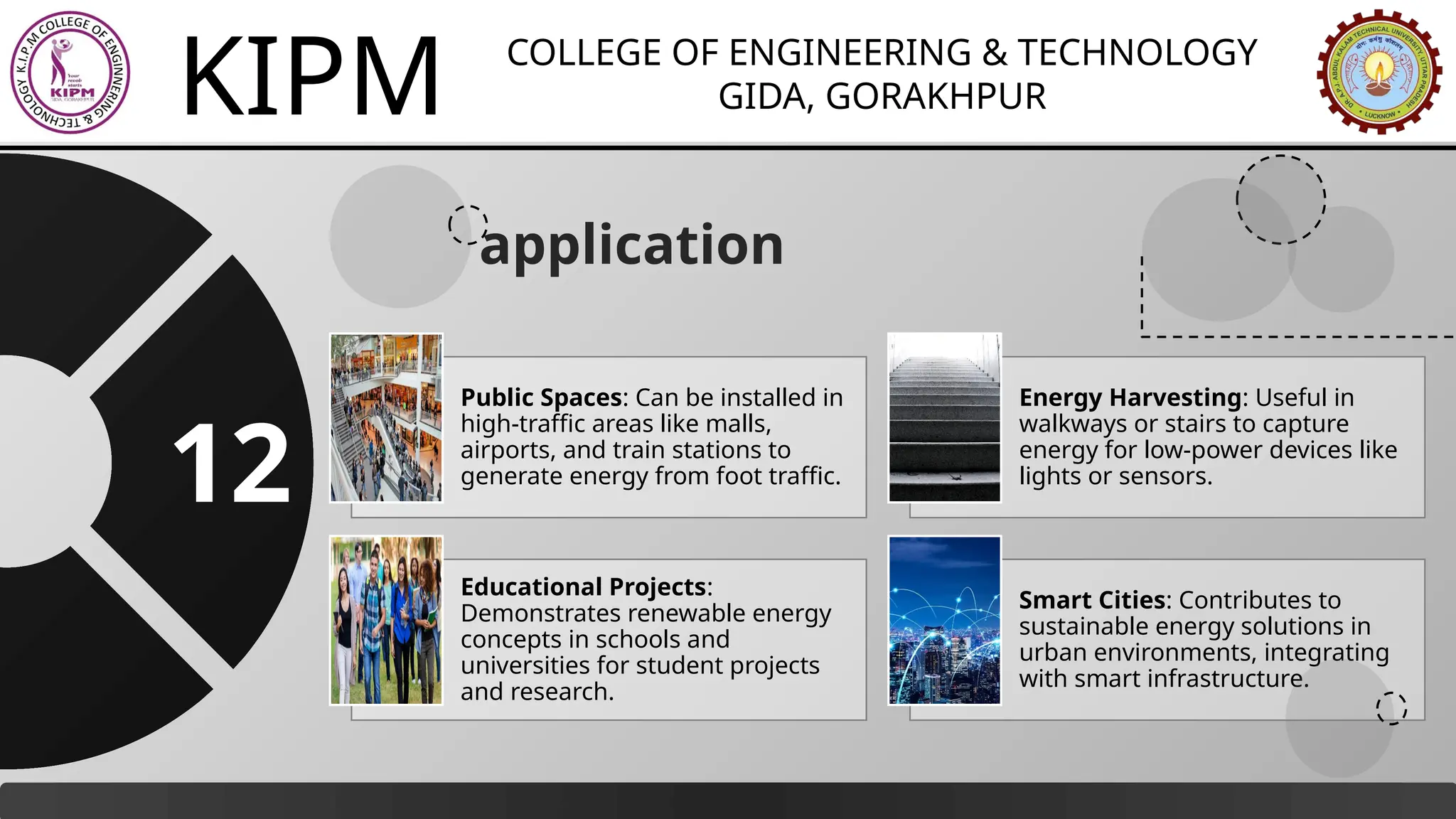
application
Public Spaces: Can be installed in
high-traffic areas like malls,
airports, and train stations to
generate energy from foot traffic.
Energy Harvesting: Useful in
walkways or stairs to capture
energy for low-power devices like
lights or sensors.
Educational Projects:
Demonstrates renewable energy
concepts in schools and
universities for student projects
and research.
Smart Cities: Contributes to
sustainable energy solutions in
urban environments, integrating
with smart infrastructure.
12
KIPM COLLEGE OF ENGINEERING & TECHNOLOGY
GIDA, GORAKHPUR
conclusion
The footstep power generation project effectively
demonstrates how renewable energy can be harvested from
everyday activities like walking. By utilizing piezoelectric
sensors and Arduino, the system successfully captures and
converts mechanical energy into electrical power. This
solution, though limited in large-scale applications, offers
great potential for use in public spaces and educational
demonstrations, promoting sustainability and innovation in
energy harvesting technologies
12
KIPM COLLEGE OF ENGINEERING & TECHNOLOGY
GIDA, GORAKHPUR
THANK
YOU……
13

Footstep power generation using piezoelectirc sensor and arduino.pptx

  • 1.
    KIPM COLLEGE OFENGINEERING & TECHNOLOGY GIDA, GORAKHPUR Footstep Power Generation using Arduino and Piezoelectric Sensors 01
  • 2.
    KIPM COLLEGE OFENGINEERING & TECHNOLOGY GIDA, GORAKHPUR PRESENTED BY : NIRMA KUMARI SAHIL GUPTA SHUBHAM GIRI SHAHIL KUMAR GUPTA 02
  • 3.
    KIPM COLLEGE OFENGINEERING & TECHNOLOGY GIDA, GORAKHPUR Table of content INTRODUCTION OBJECTIVE COMPONENT Circuit Diagram Methodology Result Advantage & Disadvantage Application Conclusion Acrylic Sheet Piezoelectric Sensors Arduino UNO LCD I2C Display Capacitors, Resistors, Diodes Stores the generated energy 03
  • 4.
    KIPM COLLEGE OFENGINEERING & TECHNOLOGY GIDA, GORAKHPUR INTRODUCTION Footstep power generation is an innovative way to harness renewable energy from daily human activity. By using piezoelectric sensors, energy is captured from footsteps and converted into electrical power. This project, utilizing Arduino technology, demonstrates how energy can be generated from foot traffic and displayed in real-time. The system provides an environmentally friendly energy solution, ideal for public spaces such as train stations, airports, and malls, highlighting the potential of sustainable power sources in everyday life. 04
  • 5.
    KIPM COLLEGE OFENGINEERING & TECHNOLOGY GIDA, GORAKHPUR OBJECTIVE The main objective of this project is to harness renewable energy from footsteps using piezoelectric sensors. By converting mechanical energy from walking into electrical energy, the project aims to provide an eco-friendly and sustainable power source for small-scale applications, while also displaying real-time data on footstep counts and energy generated using an Arduino-controlled system. 05
  • 6.
    KIPM COLLEGE OFENGINEERING & TECHNOLOGY GIDA, GORAKHPUR COMPONENT Provides the base for the footstep sensors Acrylic Sheet Capture the mechanical pressure from footsteps and convert it into electrical energy. Piezoelectric Sensors The microcontroller that processes sensor data and controls the display. Arduino UNO 06
  • 7.
    KIPM COLLEGE OFENGINEERING & TECHNOLOGY GIDA, GORAKHPUR COMPONENT Provides the base for the footstep sensors Acrylic Sheet Capture the mechanical pressure from footsteps and convert it into electrical energy. Piezoelectric Sensors The microcontroller that processes sensor data and controls the display. Arduino UNO 06
  • 8.
    KIPM COLLEGE OFENGINEERING & TECHNOLOGY GIDA, GORAKHPUR COMPONENT Provides the base for the footstep sensors Acrylic Sheet Capture the mechanical pressure from footsteps and convert it into electrical energy. Piezoelectric Sensors The microcontroller that processes sensor data and controls the display. Arduino UNO 06
  • 9.
    KIPM COLLEGE OFENGINEERING & TECHNOLOGY GIDA, GORAKHPUR COMPONENT Provides the base for the footstep sensors Acrylic Sheet Capture the mechanical pressure from footsteps and convert it into electrical energy. Piezoelectric Sensors The microcontroller that processes sensor data and controls the display. Arduino UNO 06
  • 10.
    KIPM COLLEGE OFENGINEERING & TECHNOLOGY GIDA, GORAKHPUR COMPONENT Shows the real-time data of footsteps and energy generated. LCD I2C Display Essential for smoothing and managing electrical flow in the circuit. Capacitors, Resistors, Diodes Stores the generated energy Battery and Cell Holder 07
  • 11.
    KIPM COLLEGE OFENGINEERING & TECHNOLOGY GIDA, GORAKHPUR COMPONENT Shows the real-time data of footsteps and energy generated. LCD I2C Display Essential for smoothing and managing electrical flow in the circuit. Capacitors, Resistors, Diodes Stores the generated energy Battery and Cell Holder 07
  • 12.
    KIPM COLLEGE OFENGINEERING & TECHNOLOGY GIDA, GORAKHPUR COMPONENT Shows the real-time data of footsteps and energy generated. LCD I2C Display Essential for smoothing and managing electrical flow in the circuit. Capacitors, Resistors, Diodes Stores the generated energy Battery and Cell Holder 07
  • 13.
    KIPM COLLEGE OFENGINEERING & TECHNOLOGY GIDA, GORAKHPUR COMPONENT Shows the real-time data of footsteps and energy generated. LCD I2C Display Essential for smoothing and managing electrical flow in the circuit. Capacitors, Resistors, Diodes Stores the generated energy Battery and Cell Holder 07
  • 14.
    KIPM COLLEGE OFENGINEERING & TECHNOLOGY GIDA, GORAKHPUR Circuit diagram Arduino UNO Breadboard Piezoelectric Sensors LCD Display (I2C) Resistors Diodes (1N4007) Capacitor 10uF BC547Transistor 3.7V Li-ion Battery Led Bulb Figure 10:- Block Diagram of Footstep power generation using Arduino and Piezoelectric Sensor 08 Acrylic Sheet
  • 15.
    KIPM COLLEGE OFENGINEERING & TECHNOLOGY GIDA, GORAKHPUR Methodology 1) Sensor Setup : Piezoelectric sensors are placed under a platform to capture the mechanical pressure of footsteps. 2) Data Acquisition: The sensors generate voltage when stepped on, which is read by the Arduino using the analogRead() function. 3) Processing: The Arduino processes the voltage data and converts it into energy readings, while also counting the footsteps. 4) Display: The real-time data is shown on an LCD screen using the LiquidCrystal_I2C library. 5) Energy Storage: Generated energy is stored in a battery for later use 09
  • 16.
    KIPM COLLEGE OFENGINEERING & TECHNOLOGY GIDA, GORAKHPUR result 1) Successfully demonstrated the generation of electrical energy from footsteps using piezoelectric sensors. 2) The system accurately counted each footstep and displayed the energy generated in real-time on the LCD. 3) The energy captured was stored in a battery for potential future use. 4) The project highlights the potential for integrating renewable energy solutions in public spaces, with minimal maintenance and environmental impact. 10
  • 17.
    KIPM COLLEGE OFENGINEERING & TECHNOLOGY GIDA, GORAKHPUR 1) Generates renewable energy from footsteps, reducing reliance on traditional energy sources. 2) Low maintenance and eco-friendly, ideal for public spaces. 3) Easy to implement with readily available components like piezoelectric sensors and Arduino. 1) Energy output is relatively low, making it unsuitable for large- scale power generation. 2) Requires multiple sensors and circuitry for meaningful energy storage. 3) Efficiency can vary depending on foot traffic and sensor placement. Advantage Disadvantage 11
  • 18.
    KIPM COLLEGE OFENGINEERING & TECHNOLOGY GIDA, GORAKHPUR application Public Spaces: Can be installed in high-traffic areas like malls, airports, and train stations to generate energy from foot traffic. Energy Harvesting: Useful in walkways or stairs to capture energy for low-power devices like lights or sensors. Educational Projects: Demonstrates renewable energy concepts in schools and universities for student projects and research. Smart Cities: Contributes to sustainable energy solutions in urban environments, integrating with smart infrastructure. 12
  • 19.
    KIPM COLLEGE OFENGINEERING & TECHNOLOGY GIDA, GORAKHPUR conclusion The footstep power generation project effectively demonstrates how renewable energy can be harvested from everyday activities like walking. By utilizing piezoelectric sensors and Arduino, the system successfully captures and converts mechanical energy into electrical power. This solution, though limited in large-scale applications, offers great potential for use in public spaces and educational demonstrations, promoting sustainability and innovation in energy harvesting technologies 12
  • 20.
    KIPM COLLEGE OFENGINEERING & TECHNOLOGY GIDA, GORAKHPUR THANK YOU…… 13