TABLE OF
CONTENT
1. INTRODUCTION
2.AIM
3. USED EQUIPMENTS
4. WORKING PRINCIPAL
5. ADVANTAGE AND DISADVANTAGE
6. APPLICATION
7. FUTURE SCOPE
8. CONCLUSION
4.
INTRODUCTION :-
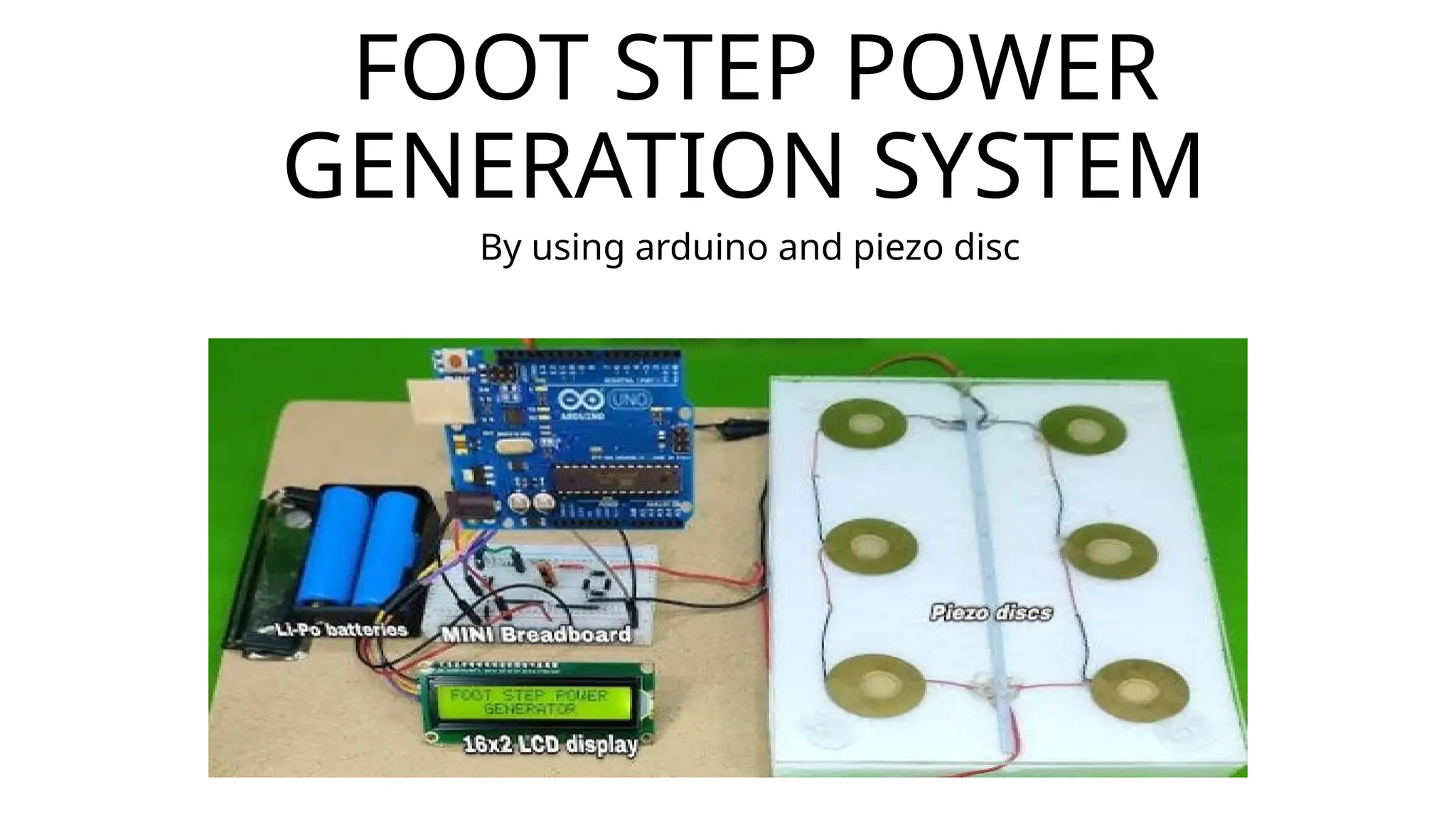
This projectis an innovation of converting mechanical energy generated
by human footsteps into electrical energy. Its main objective is to produce
eco-friendly and sustainable electricity using renewable energy sources.
In this system, when a person walks on a particular platform, the
pressure generated by his/her steps is converted into electricity through a
piezoelectric sensor or a mechanical device (such as a dynamo).
This technology can be used in crowded places like railway stations, malls,
or schools where there is a lot of movement of people. This project
provides a low-cost, pollution-free, and effective solution for energy
conservation.
• Its main advantage is that it generates energy from everyday activities,
which can reduce dependence on conventional energy sources.
5.
AIM :-
• Themain objective of this project is to develop a sustainable
and eco-friendly energy source by converting mechanical
energy generated by human footsteps into electrical energy.
6.
WORKING PRINCIPAL :-
Thefoot step power generation system works in the following manner:
1. Pressure Collection:
In this system, a special platform or floor is made which
absorbs the pressure from the footsteps. When a person
walks on it, mechanical energy is generated from his weight
and motion.
2.Energy Conversion:
Piezoelectric method: Piezoelectric sensors are installed underneath the platform,
which generate an electrical charge when pressure is applied.
This charge is stored as a small amount of electricity.
3. Energy Storage:
The electricity generated is stored in batteries or
capacitors. This stored energy can later be used to run
small appliances such as bulbs, fans or charging points.
7.
4.Utilization:
This system iseffective in places where there is a lot of movement of people,
such as stations, markets or public places. Here the electricity generated by
footsteps can be used for lighting or other small electrical appliances.
Note
:
This project is based on the law of conservation of energy, in which
mechanical energy is converted into electrical energy.
ADVANTAGE AND DISADVANTAGEOF
PROJECT:-
ADVANTAGE
• Renewable energy source
• Eco-friendly
• Low cost
• Easy installation
• Energy independence
• Versatile use
• Everyday use
DISADVANTAGE
• Limited energy production
• Location dependency
• Initial cost
• Weather impact
• Durability challenge
• Energy storage problem
10.
APPLICATION :-
1. Lightingin public places
2.Mobile Charging Station
3. Smart City Project
4.Emergency power supply
5.Playgrounds or Gyms
11.
FUTURE SCOPE :-
Thefuture of electricity generation project by walking is full of possibilities,
especially when the world is moving towards sustainable and renewable energy
solutions. This technology, which converts kinetic energy from human footsteps
into electrical energy, Energy can play a role in solving challenges, especially in
urban areas and densely populated places. Below are some key aspects of its
future, based on current trends and prospects:
1. Integration into smart cities
Electricity generation from walking can become part of the infrastructure of
smart cities. With increasing urbanization, cities are looking for new ways to
generate clean energy. Piezoelectric tiles or similar mechanisms can be installed
in busy places such as sidewalks, railway stations, airports, shopping malls and
stadiums, to harvest energy from the constant movement of people. Companies
such as Pavegen are already working on this concept, installing kinetic flooring
in places such as the UK and Japan to power streetlights, signage or sensors.
12.
2. Advances inpiezoelectric materials
The efficiency of electricity production from walking depends on the materials
used, such as piezoelectric crystals (e.g. PZT – lead zirconate titanate). Future
research may lead to the development of more efficient, durable and cost-
effective materials, which will increase the energy production per step.Hybrid
systems using nanotechnology or combining piezoelectricity and solar energy
could further improve performance, making this technology more practical for
large-scale use.
3. Expansion and energy storage
Although current pedestrian power generation systems generate small amounts
of electricity (such as enough to charge a battery or run small appliances), future
innovations in energy storage—such as advanced batteries or supercapacitors—
may allow this energy to be stored and used more efficiently.For example,
energy collected during peak hours can be stored and used later for lighting or
public facilities.
13.
4. Use indeveloping regions
In countries like India, where population density is high and energy demand is
increasing, pedestrian power generation can serve as a decentralised energy
source. It can be installed to supplement conventional power supplies in rural
areas where access to the grid is limited, or in congested urban centers.This is in
line with India’s renewable energy goals, such as achieving 175 GW of power
from renewable sources by 2022 (which is on track), and can reduce dependence
on fossil fuels.
5. Environmental and economic
benefits
As a clean energy source, pedestrian power generation produces no emissions,
making it environmentally friendly. It may see widespread adoption in the future.
Because governments and organizations are prioritizing green technologies to
combat climate change.Economically, although initial installation costs are high,
long-term maintenance may be low, and this technology could create jobs in
manufacturing, installation, and research.
14.
6. Challenges
• Lowpower generation: Current systems generate limited power (e.g. a
few watts) per step, which is insufficient for large-scale power needs.
• Cost: High installation and material costs may hinder widespread
adoption, unless subsidies or mass production reduce costs
• Durability: The tiles or mechanism will have to withstand constant
wear and tear in busy areas, which necessitates a robust design.
• Competition: Other renewable sources such as solar and wind are
more established and efficient, which could outcompete this
technology unless it finds a unique niche.
15.
CONCLUSION
The electricity generationproject from walking, utilizing Arduino, demonstrates the potential for
an innovative and sustainable energy solution. The primary objective of this project was to convert
kinetic energy generated from human steps into electrical energy, with Arduino playing a crucial
role in processing sensor data, controlling energy conversion, and monitoring output. By
combining piezoelectric sensors with an Arduino-based circuit, we successfully generated small-
scale electricity, which could be used for tasks such as powering LEDs or charging small electronic
devices.
However, the project also highlighted certain limitations, such as the low amount of energy
generated per step and the high cost for large-scale implementation. Nevertheless, it proved to be
an initial step in the field of renewable energy, promoting environmentally conscious technologies.
In the future, this project can be enhanced with more efficient materials, improved energy storage
systems, and advanced Arduino programming to make it suitable for practical applications.
Overall, the project illustrates that small-scale energy production is feasible using affordable and
readily available microcontrollers like Arduino. This technology could be useful as a supplementary
energy source in urban areas, schools, or public spaces, while also serving as an excellent tool to
raise awareness about renewable energy among students and researchers.

![[BLOCK DIAGRAM ]](https://image.slidesharecdn.com/shubhammauryaproject-250613003915-04046e9a/75/Footstep-power-generation-project-ppt-pdf-8-2048.jpg)



![Footstep_Power_Generation_System[1]-Batch9.pptx](https://cdn.slidesharecdn.com/ss_thumbnails/footsteppowergenerationsystem1-batch9-250417023633-fc5887ee-thumbnail.jpg?width=640&height=640&fit=bounds)


![FOOT STEP BY POWER GENERATION PPT[1].pptxnew.pptx](https://cdn.slidesharecdn.com/ss_thumbnails/footstepbypowergenerationppt1-250919021928-9d77c296-thumbnail.jpg?width=640&height=640&fit=bounds)


