8-2
Food Safety Management Systems
Food safety management system:
 Group of practices and procedures
intended to prevent foodborne illness
 Actively controls risks and hazards
throughout the flow of food
These are the foundation of a food safety management system:
Food safety training program
8-3
Food Safety Programs
Quality control and
assurance program
Supplier selection and
specification program
Personal hygiene program
These are the foundation of a food safety management system:
8-4
Food Safety Programs
Standard operating
procedures (SOPs)
Pest control program
Facility design and equipment
maintenance program
Cleaning and
sanitation program
Focuses on controlling the five most common risk factors for
foodborne illness:
1. Purchasing food from unsafe sources
2. Failing to cook food adequately
3. Holding food at incorrect temperatures
4. Using contaminated equipment
5. Practicing poor personal hygiene
8-5
Active Managerial Control
There are many ways to achieve active managerial control in
the operation:
 Training programs
 Manager supervision
 Incorporation of standard operating procedures (SOPs)
 HACCP
These are critical to the success of active managerial control:
 Monitoring critical activities in the operation
 Taking the necessary corrective action when required
 Verifying that the actions taken control the risks factors
8-6
Active Managerial Control
The FDA provides recommendations for
controlling the common risk factors for
foodborne illness:
 Demonstration of knowledge
 Staff health controls
 Controlling hands as a vehicle
of contamination
 Time and temperature parameters for
controlling pathogens
 Consumer advisories
8-7
Active Managerial Control
The HACCP approach:
 HACCP is based on identifying significant biological,
chemical, or physical hazards at specific points within
a product’s flow through an operation
 Once identified, hazards can be prevented, eliminated,
or reduced to safe levels
8-8
HACCP
To be effective, a HACCP system must be
based on a written plan:
 It must be specific to each facility’s menu,
customers, equipment, processes, and operations
 A plan that works for one operation may not work
for another
8-9
HACCP
The seven HACCP principles:
1. Conduct a hazard analysis
2. Determine critical control points (CCPs)
3. Establish critical limits
4. Establish monitoring procedures
5. Identify corrective actions
6. Verify that the system works
7. Establish procedures for record keeping and documentation
8-10
The 7 HACCP Principles
Time for a HACCP Story
8-11
Activity
HACCP Principles Analogy
The Situation
8-12
HACCP Principles Analogy
1. Conduct a hazard analysis
8-13
HACCP Principles Analogy
2. Determine critical control points
8-14
HACCP Principles Analogy
3. Establish critical limits
8-15
HACCP Principles Analogy
4. Establish monitoring procedures
8-16
HACCP Principles Analogy
5. Identify corrective actions
8-17
HACCP Principles Analogy
6. Verify the system works
8-18
HACCP Principles Analogy
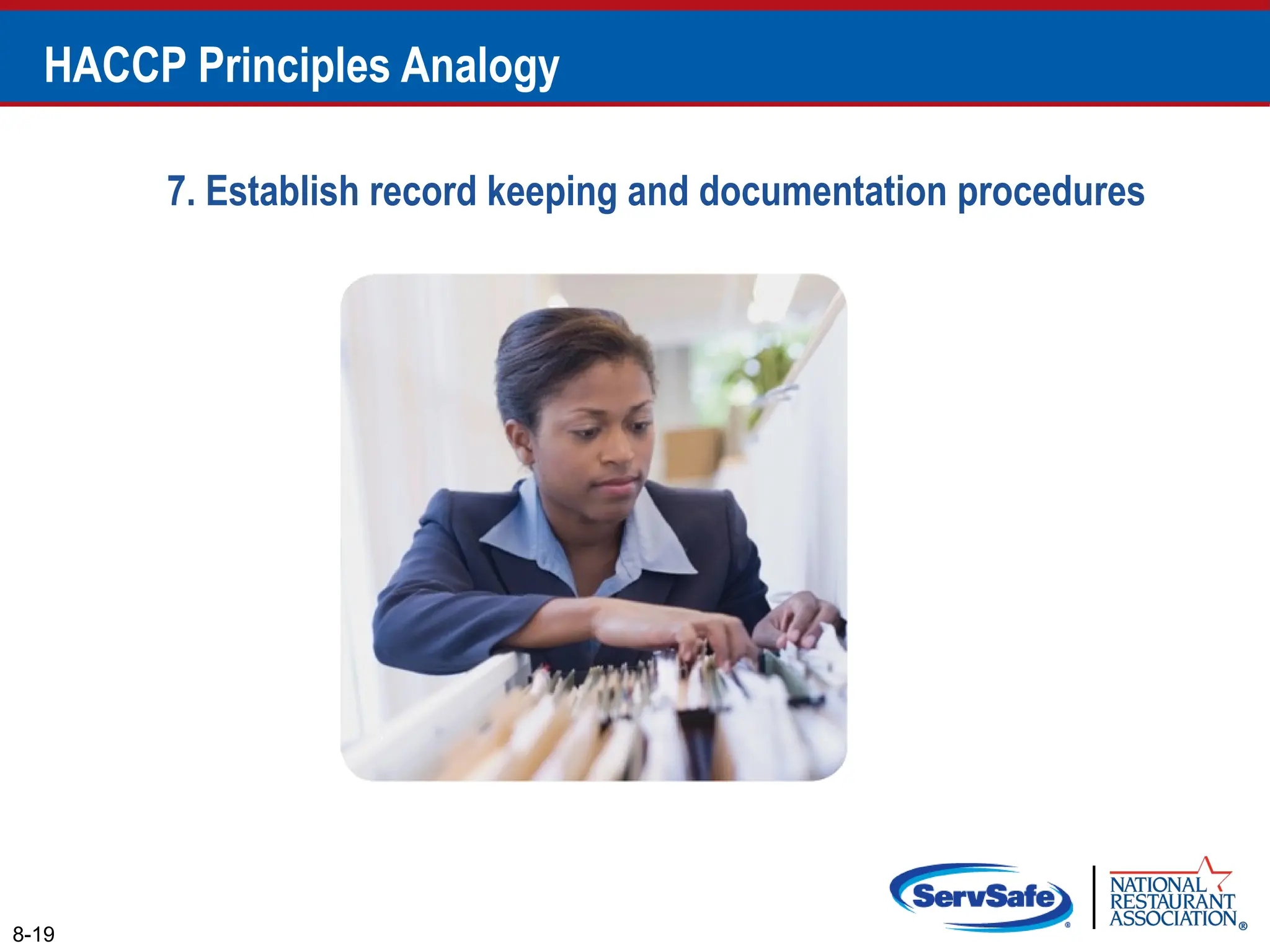
7. Establish record keeping and documentation procedures
8-19
HACCP: The 7 HACCP Principles Analogy
The Seven HACCP Principles
1. What hazard were town officials trying to control?
2. What did they decide was critical to control the hazard?
3. What limit did they establish to slow cars down?
4. How did the town monitor the new speed limit?
5. What action was taken by drivers who received tickets?
6. How did town officials verify that the new speed limit was
reducing accidents?
7. What did town officials do to stay on top of the situation?
8-20
Principle 1: Conduct a hazard analysis
 Identify potential hazards in the food served by looking at how it
is processed
 Identify TCS food items and determine where hazards are likely to occur
for each one; look for biological, chemical, and physical contaminants
8-21
The 7 HACCP Principles
Principle 2: Determine critical control
points (CCPs)
 Find points in the process where identified
hazards can be prevented, eliminated, or
reduced to safe levels—these are the CCPs
 Depending on the process, there may be
more than one CCP
8-22
The 7 HACCP Principles
Principle 3: Establish critical limits
 For each CCP, establish minimum or
maximum limits
 These limits must be met to
o Prevent or eliminate the hazard
o Reduce it to a safe level
Critical
Limit
8-23
The 7 HACCP Principles
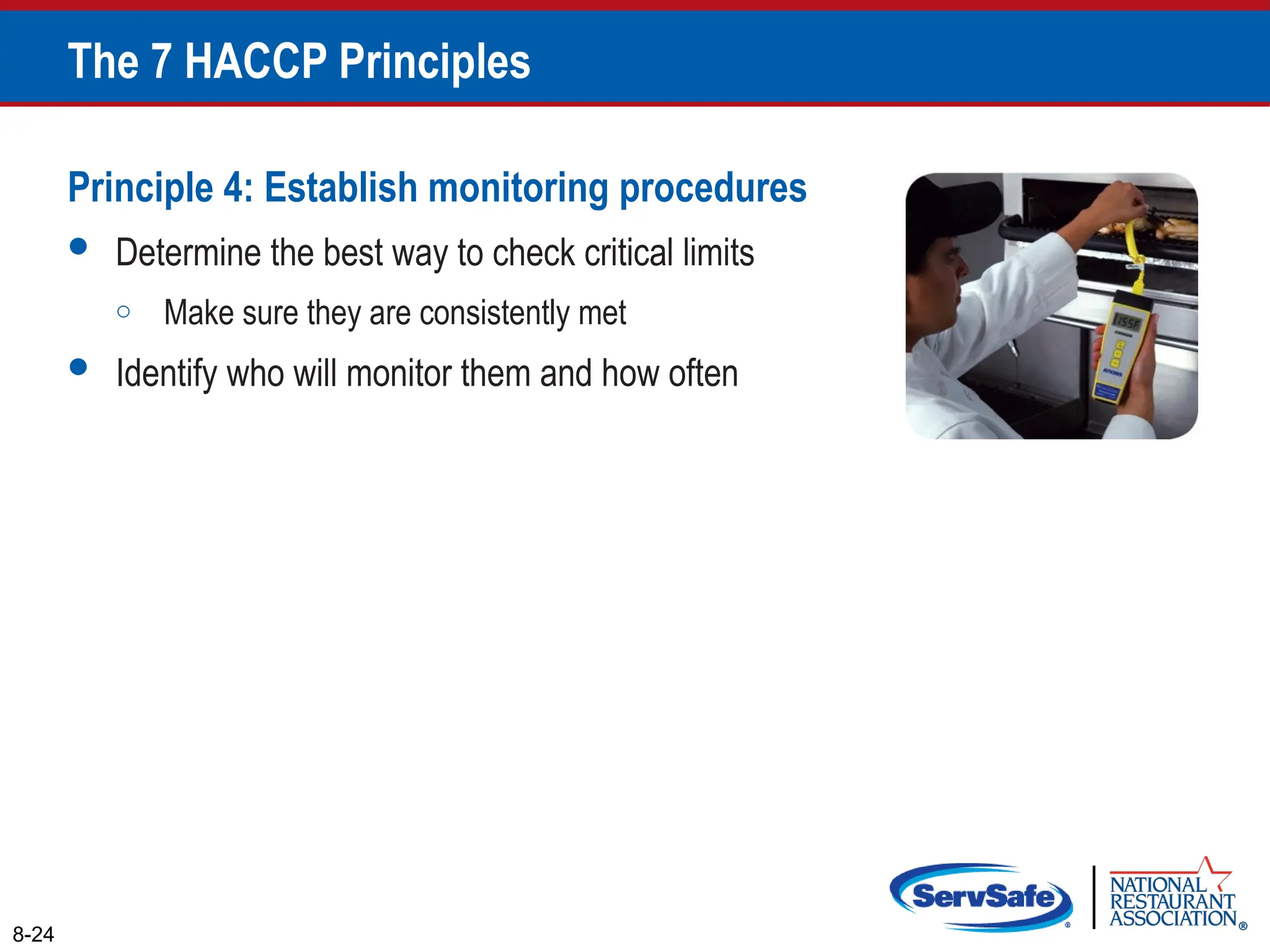
Principle 4: Establish monitoring procedures
 Determine the best way to check critical limits
o Make sure they are consistently met
 Identify who will monitor them and how often
8-24
The 7 HACCP Principles
8-25
The 7 HACCP Principles
Principle 5: Identify corrective actions
 Identify steps that must be taken when a
critical limit is not met
 Determine these steps in advance
Principle 6: Verify that the system works
 Determine if the plan is working as intended
 Evaluate the plan on a regular basis using
o Monitoring charts
o Records
o Hazard analysis
 Determine if your plan prevents, reduces, or
eliminates identified hazards
8-26
The 7 HACCP Principles
Principle 7: Establish procedures for
record keeping and documentation
Keep records for these actions:
 Monitoring activities
 Corrective actions
 Validating equipment (checking for good
working condition)
 Working with suppliers (invoices,
specifications, etc.)
8-27
The 7 HACCP Principles
These specialized processing methods require a
variance and may require a HACCP plan:
 Smoking food as a method to preserve it (but not to
enhance flavor)
 Using food additives or components, such as vinegar, to
preserve or alter food so it no longer requires time and
temperature control for safety
 Curing food
 Custom-processing animals
8-28
HACCP
These specialized processing methods require a
variance and may require a HACCP plan:
 Packaging food using ROP methods including
o MAP
o Vacuum-packed
o Sous vide
 Treating (e.g. pasteurizing) juice on-site and packaging it
for later sale
 Sprouting seeds or beans
8-29
HACCP
Let’s Review
8-30
Review
A. Hazard analysis
B. Critical control points
Checking to see if critical limits are met
8-31
Review
C. Critical limits
D. Monitoring
E. Corrective action
F. Verification
G. Record keeping and documentation
A. Hazard analysis
B. Critical control points
Keeping HACCP plan documents
8-32
Review
C. Critical limits
D. Monitoring
E. Corrective action
F. Verification
G. Record keeping and documentation
A. Hazard analysis
B. Critical control points
Assessing risks within the flow of food
8-33
Review
C. Critical limits
D. Monitoring
E. Corrective action
F. Verification
G. Record keeping and documentation
A. Hazard analysis
B. Critical control points
Specific places within the flow of food where hazards can be
prevented, eliminated, or reduced to a safe level
8-34
Review
C. Critical limits
D. Monitoring
E. Corrective action
F. Verification
G. Record keeping and documentation
A. Hazard analysis
B. Critical control points
Predetermined step taken when a critical limit is not met
8-35
Review
C. Critical limits
D. Monitoring
E. Corrective action
F. Verification
G. Record keeping and documentation
A. Hazard analysis
B. Critical control points
Minimum or maximum boundaries that must be met to
prevent a hazard
8-36
Review
C. Critical limits
D. Monitoring
E. Corrective action
F. Verification
G. Record keeping and documentation
A. Hazard analysis
B. Critical control points
Determining if the HACCP plan is working as intended
8-37
Review
C. Critical limits
D. Monitoring
E. Corrective action
F. Verification
G. Record keeping and documentation

food safety management system documentation

  • 2.
    8-2 Food Safety ManagementSystems Food safety management system:  Group of practices and procedures intended to prevent foodborne illness  Actively controls risks and hazards throughout the flow of food
  • 3.
    These are thefoundation of a food safety management system: Food safety training program 8-3 Food Safety Programs Quality control and assurance program Supplier selection and specification program Personal hygiene program
  • 4.
    These are thefoundation of a food safety management system: 8-4 Food Safety Programs Standard operating procedures (SOPs) Pest control program Facility design and equipment maintenance program Cleaning and sanitation program
  • 5.
    Focuses on controllingthe five most common risk factors for foodborne illness: 1. Purchasing food from unsafe sources 2. Failing to cook food adequately 3. Holding food at incorrect temperatures 4. Using contaminated equipment 5. Practicing poor personal hygiene 8-5 Active Managerial Control
  • 6.
    There are manyways to achieve active managerial control in the operation:  Training programs  Manager supervision  Incorporation of standard operating procedures (SOPs)  HACCP These are critical to the success of active managerial control:  Monitoring critical activities in the operation  Taking the necessary corrective action when required  Verifying that the actions taken control the risks factors 8-6 Active Managerial Control
  • 7.
    The FDA providesrecommendations for controlling the common risk factors for foodborne illness:  Demonstration of knowledge  Staff health controls  Controlling hands as a vehicle of contamination  Time and temperature parameters for controlling pathogens  Consumer advisories 8-7 Active Managerial Control
  • 8.
    The HACCP approach: HACCP is based on identifying significant biological, chemical, or physical hazards at specific points within a product’s flow through an operation  Once identified, hazards can be prevented, eliminated, or reduced to safe levels 8-8 HACCP
  • 9.
    To be effective,a HACCP system must be based on a written plan:  It must be specific to each facility’s menu, customers, equipment, processes, and operations  A plan that works for one operation may not work for another 8-9 HACCP
  • 10.
    The seven HACCPprinciples: 1. Conduct a hazard analysis 2. Determine critical control points (CCPs) 3. Establish critical limits 4. Establish monitoring procedures 5. Identify corrective actions 6. Verify that the system works 7. Establish procedures for record keeping and documentation 8-10 The 7 HACCP Principles
  • 11.
    Time for aHACCP Story 8-11 Activity
  • 12.
  • 13.
    HACCP Principles Analogy 1.Conduct a hazard analysis 8-13
  • 14.
    HACCP Principles Analogy 2.Determine critical control points 8-14
  • 15.
    HACCP Principles Analogy 3.Establish critical limits 8-15
  • 16.
    HACCP Principles Analogy 4.Establish monitoring procedures 8-16
  • 17.
    HACCP Principles Analogy 5.Identify corrective actions 8-17
  • 18.
    HACCP Principles Analogy 6.Verify the system works 8-18
  • 19.
    HACCP Principles Analogy 7.Establish record keeping and documentation procedures 8-19
  • 20.
    HACCP: The 7HACCP Principles Analogy The Seven HACCP Principles 1. What hazard were town officials trying to control? 2. What did they decide was critical to control the hazard? 3. What limit did they establish to slow cars down? 4. How did the town monitor the new speed limit? 5. What action was taken by drivers who received tickets? 6. How did town officials verify that the new speed limit was reducing accidents? 7. What did town officials do to stay on top of the situation? 8-20
  • 21.
    Principle 1: Conducta hazard analysis  Identify potential hazards in the food served by looking at how it is processed  Identify TCS food items and determine where hazards are likely to occur for each one; look for biological, chemical, and physical contaminants 8-21 The 7 HACCP Principles
  • 22.
    Principle 2: Determinecritical control points (CCPs)  Find points in the process where identified hazards can be prevented, eliminated, or reduced to safe levels—these are the CCPs  Depending on the process, there may be more than one CCP 8-22 The 7 HACCP Principles
  • 23.
    Principle 3: Establishcritical limits  For each CCP, establish minimum or maximum limits  These limits must be met to o Prevent or eliminate the hazard o Reduce it to a safe level Critical Limit 8-23 The 7 HACCP Principles
  • 24.
    Principle 4: Establishmonitoring procedures  Determine the best way to check critical limits o Make sure they are consistently met  Identify who will monitor them and how often 8-24 The 7 HACCP Principles
  • 25.
    8-25 The 7 HACCPPrinciples Principle 5: Identify corrective actions  Identify steps that must be taken when a critical limit is not met  Determine these steps in advance
  • 26.
    Principle 6: Verifythat the system works  Determine if the plan is working as intended  Evaluate the plan on a regular basis using o Monitoring charts o Records o Hazard analysis  Determine if your plan prevents, reduces, or eliminates identified hazards 8-26 The 7 HACCP Principles
  • 27.
    Principle 7: Establishprocedures for record keeping and documentation Keep records for these actions:  Monitoring activities  Corrective actions  Validating equipment (checking for good working condition)  Working with suppliers (invoices, specifications, etc.) 8-27 The 7 HACCP Principles
  • 28.
    These specialized processingmethods require a variance and may require a HACCP plan:  Smoking food as a method to preserve it (but not to enhance flavor)  Using food additives or components, such as vinegar, to preserve or alter food so it no longer requires time and temperature control for safety  Curing food  Custom-processing animals 8-28 HACCP
  • 29.
    These specialized processingmethods require a variance and may require a HACCP plan:  Packaging food using ROP methods including o MAP o Vacuum-packed o Sous vide  Treating (e.g. pasteurizing) juice on-site and packaging it for later sale  Sprouting seeds or beans 8-29 HACCP
  • 30.
  • 31.
    A. Hazard analysis B.Critical control points Checking to see if critical limits are met 8-31 Review C. Critical limits D. Monitoring E. Corrective action F. Verification G. Record keeping and documentation
  • 32.
    A. Hazard analysis B.Critical control points Keeping HACCP plan documents 8-32 Review C. Critical limits D. Monitoring E. Corrective action F. Verification G. Record keeping and documentation
  • 33.
    A. Hazard analysis B.Critical control points Assessing risks within the flow of food 8-33 Review C. Critical limits D. Monitoring E. Corrective action F. Verification G. Record keeping and documentation
  • 34.
    A. Hazard analysis B.Critical control points Specific places within the flow of food where hazards can be prevented, eliminated, or reduced to a safe level 8-34 Review C. Critical limits D. Monitoring E. Corrective action F. Verification G. Record keeping and documentation
  • 35.
    A. Hazard analysis B.Critical control points Predetermined step taken when a critical limit is not met 8-35 Review C. Critical limits D. Monitoring E. Corrective action F. Verification G. Record keeping and documentation
  • 36.
    A. Hazard analysis B.Critical control points Minimum or maximum boundaries that must be met to prevent a hazard 8-36 Review C. Critical limits D. Monitoring E. Corrective action F. Verification G. Record keeping and documentation
  • 37.
    A. Hazard analysis B.Critical control points Determining if the HACCP plan is working as intended 8-37 Review C. Critical limits D. Monitoring E. Corrective action F. Verification G. Record keeping and documentation

Editor's Notes

  • #3 Instructor Notes Having food safety programs already in place gives you the foundation for your system. The principles presented in the ServSafe program are the basis of these programs.
  • #4 Instructor Notes Having food safety programs already in place gives you the foundation for your system. The principles presented in the ServSafe program are the basis of these programs.
  • #5 Instructor Notes It is the manager’s responsibility to actively control these and other risk factors for foodborne illness. This is called active managerial control. It is important to note that active managerial control is proactive rather than reactive. You must anticipate these risks and plan for them.
  • #6 Instructor Notes There are many ways to achieve active managerial control in the operation. According to the Food and Drug Administration (FDA), you can use simple tools such as training programs, manager supervision, and the incorporation of SOPs. Active Managerial Control can also be achieved through more complex solutions such as a HACCP Program. Monitoring is critical to the success of active managerial control. Food will be safe if managers monitor critical activities in the operation. Managers must also take the necessary corrective action when required. They must also verify that the actions taken to control the risk factors for foodborne illness are actually working.
  • #7 Instructor Notes Demonstration of knowledge: As a manager, you must be able to show that you know what to do to keep food safe. Becoming certified in food safety is one way to show this. Staff health controls: Procedures must be put in place to make sure staff are practicing personal hygiene. For example, staff must know that they must report illnesses and illness symptoms to management. Controlling hands as a vehicle of contamination: Controls must be put in place to prevent bare-hand contact with ready-to-eat food. This might include requiring the use of tongs to handle ready-to-eat food. Time and temperature parameters for controlling pathogens: Procedures must be put in place to limit the time food spends in the temperature danger zone. Requiring food handlers to check the temperature of food being hot-held every two hours is an example. Consumer advisories: Notices must be provided to customers if you serve raw or undercooked menu items. These notices must include a statement about the risks of eating these foods.
  • #8 Instructor Notes There are many systems you can implement to achieve active managerial control of foodborne illness risk factors. Hazard Analysis Critical Control Point (HACCP) is one such system. HACCP (pronounced HASS-ip) is based on identifying significant biological, chemical, or physical hazards at specific points within a product’s flow. Once identified, the hazards can be prevented, eliminated, or reduced to safe levels.
  • #9 Instructor Notes Each HACCP plan is unique, a plan that works for one operation may not work for another.
  • #10 Instructor Notes In general terms, the HACCP principles can be broken into three groups: Principles 1 and 2 help you identify and evaluate your hazards. Principles 3, 4, and 5 help you establish ways for controlling those hazards. Principles 6 and 7 help you maintain the HACCP plan and system and verify its effectiveness.
  • #11 Instructor Notes You are about to illustrate the seven HACCP principles using an analogy. This analogy helps students understand the HACCP principles by relating HACCP to a traffic accident story. As you present the next seven slides, read the instructor notes on the bottom of each slide to the class. The eighth slide will tie the whole analogy together. This is a proven technique for helping students understand the seven HACCP principles.
  • #12 Instructor Notes Read the following scenario to the class: “A town has been experiencing several car accidents. Multiple people have been killed. Town residents are in an uproar and demand that town officials do something. Town officials vow to look into the problem and reduce the accidents.”
  • #13 Instructor Notes Read the following scenario to the class: “Town officials start by analyzing police reports from the accidents to try to figure out the hazard that is causing them.”
  • #14 Instructor Notes Read the following scenario to the class: “They realize that cars are driving too fast, which is causing accidents. They determine that if they can control the speed of the cars on their roads, accidents will be reduced and lives will be saved.”
  • #15 Instructor Notes Read the following scenario to the class: “Town officials impose a speed limit to reduce accidents. The new speed limit is 50 mph.”
  • #16 Instructor Notes Read the following scenario to the class: “To make sure people don’t drive faster than the new speed limit, police use radar to monitor the speed limit.”
  • #17 Instructor Notes Read the following scenario to the class: “When people are caught driving above the speed limit, they are given a speeding ticket by the police. Because they don’t want to get another ticket, people slow down when driving through town.”
  • #18 Instructor Notes Read the following scenario to the class: “Town officials want to see if the new speed limit is reducing accidents in town. They review accident reports and see a decline in the number of accidents, proving that speeding is the cause of the previous accidents. This verifies that imposing a speed limit was the right thing to do.”
  • #19 Instructor Notes Read the following scenario to the class: “Town officials want to stay on top of the situation, so they require the police department to keep accident records and speeding tickets on file for the next five years.”
  • #20 Instructor Notes Answers: Accidents (conduct a hazard analysis) Lowering the speed limit (determine critical control points) A speed limit of 50 mph (establish critical limits) Police monitored the speed of cars using radar (establish monitoring procedures) Drivers were given tickets when caught speeding (identify corrective actions) Reviewed accident reports (verify the system works) Required police to keep accident records and speeding tickets on file for five years (establish record keeping and documentation procedures)
  • #28 Instructor Notes Some food processes are highly specialized and can be a serious health risk if specific procedures are not followed. Typically these processes are carried out at processing plants. A variance from the regulatory authority will be required before processing food this way. A variance is a document that allows a requirement to be waived or changed. A HACCP plan may also be required if the processing method carries a higher risk of causing a foodborne illness. There may also be dangers unique to these processes that are best addressed by HACCP.
  • #29 Instructor Notes Always check with your local regulatory authority to see if a variance is also required when prepping food in these ways. A HACCP plan is required when packaging food using reduced-oxygen packaging (ROP) methods. This includes MAP, vacuum-packed, and sous vide food. Clostridium botulinum and Listeria monocytogenes are risks to food packaged in these ways.
  • #30 Instructor Notes Review the content presented using the next several PowerPoint slides. To ensure that everyone in class participates, pass out index cards with the letters A, B, C, D, E, F, and G on them. Have each student answer each question by holding up the correct letter.
  • #31 Instructor Notes The answer is D. Once critical limits have been created, determine the best way for your operation to check them. Make sure the limits are consistently met. Identify who will monitor them and how often.
  • #32 Instructor Notes The answer is G. Maintain your HACCP plan and keep all documentation created when developing it. Keep records for the following actions: • Monitoring activities • Taking corrective action • Validating equipment (checking for good working condition) • Working with suppliers (i.e., shelf-life studies, invoices, specifications, challenge studies, etc.)
  • #33 Instructor Notes The answer is A. First, identify and assess potential hazards in the food you serve. Start by looking at how food is processed in your operation. Many types of food are processed in similar ways.
  • #34 Instructor Notes The answer is B. Find the points in the process where the identified hazard(s) can be prevented, eliminated, or reduced to safe levels. These are the critical control points (CCPs). Depending on the process, there may be more than one CCP.
  • #35 Instructor Notes The answer is E. Identify steps that must be taken when a critical limit is not met. These steps should be determined in advance.
  • #36 Instructor Notes The answer is C. For each CCP, establish minimum or maximum limits. These limits must be met to prevent or eliminate the hazard, or to reduce it to a safe level.
  • #37 Instructor Notes The answer is F. Determine if the plan is working as intended. Evaluate it on a regular basis. Use your monitoring charts, records, hazard analysis, etc.; and determine if your plan prevents, reduces, or eliminates identified hazards.