FOOD PROCESSING & POST
HARVEST TECHNOLOGY
Presented by:
Shikhangi Singh
Department of Post Harvest Process & Food Engineering
GBPUA&T, Pantnagar
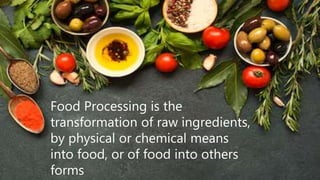
Food Processing is the
transformation of raw ingredients,
by physical or chemical means
into food, or of food into others
forms
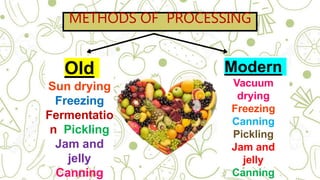
METHODS OF PROCESSING
Old
Sun drying
Freezing
Fermentatio
n Pickling
Jam and
jelly
Canning
Modern
Vacuum
drying
Freezing
Canning
Pickling
Jam and
jelly
Canning
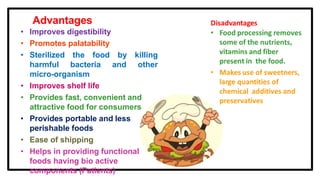
Advantages
• Improves digestibility
• Promotes palatability
• Sterilized the food by killing
harmful bacteria and other
micro-organism
• Improves shelf life
• Provides fast, convenient and
attractive food for consumers
• Provides portable and less
perishable foods
• Ease of shipping
• Helps in providing functional
foods having bio active
components (Patients)
EFFECT OF PROCESSING ON NUTRIENTS
Nutrient Process Effect
Protein Heating
Coagulation and
shrinkage
Carbohydrates Heating Gelatinization
Vitamin A
Heating, Drying
Milling
Nutritional loss
Vitamin B
Sterilization, use of
alkali
Nutritional loss
Vitamin C Cooking Nutritional loss
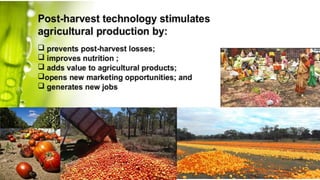
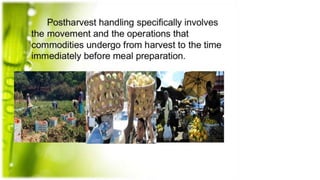
Post Harvest Management includes the processes
done immediately after harvesting the produce,
including cooling, cleaning, sorting and packing.
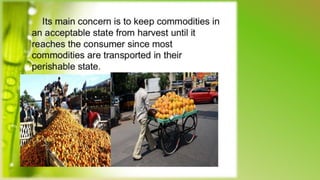
The instant a crop is removed from the ground, or
separated from its parent plant, it begins to
deteriorate.
Therefore post harvest treatment are given to
increase its shelf life and maintain its quality. Thus
post harvest management largely determines final
quality.
What is Post Harvest Management
Post
harvest?For minimizing the
qualitative losses after
harvesting
40% losses in fruits and
vegetables due to improper
handling, storage, packaging
and transportation
REASONS FOR LOSSES
• Lack of clear concept of packing house operations.
•Lack of awareness among the growers, contractors and even
the policy makers.
• Lack of infrastructure.
• Late realization of its importance.
• Inadequate technical support.
• Inadequate post-harvest quality control.
• Unorganized marketing.
• Absence of pre-cooling and cold storage.
•Inadequate market facilities, market intelligence
and market information service (MIS) • Poor storage
facilities.
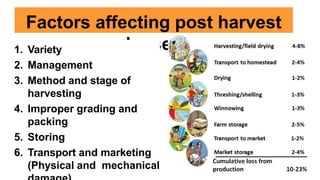
Factors affecting post harvest
losses1. Variety
2. Management
3. Method and stage of
harvesting
4. Improper grading and
packing
5. Storing
6. Transport and marketing
(Physical and mechanical
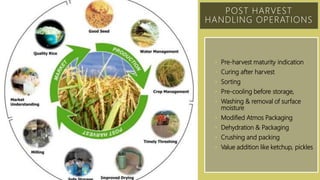
• Pre-harvest maturity indication
• Curing after harvest
• Sorting
• Pre-cooling before storage,
• Washing & removal of surface
moisture
• Modified Atmos Packaging
• Dehydration & Packaging
• Crushing and packing
• Value addition like ketchup, pickles
POST HARVEST
HANDLING OPERATIONS
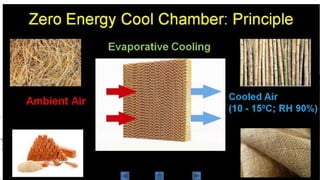
ZERO ENERGY COOL CHAMBER
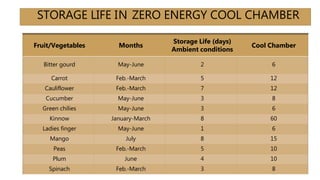
STORAGE LIFE IN ZERO ENERGY COOL CHAMBER
Fruit/Vegetables Months
Storage Life (days)
Ambient conditions
Cool Chamber
Bitter gourd May-June 2 6
Carrot Feb.-March 5 12
Cauliflower Feb.-March 7 12
Cucumber May-June 3 8
Green chilies May-June 3 6
Kinnow January-March 8 60
Ladies finger May-June 1 6
Mango July 8 15
Peas Feb.-March 5 10
Plum June 4 10
Spinach Feb.-March 3 8
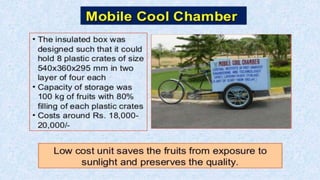
• Theinsulated boxwasdesignedsuchthat it couldhold 8 plasticcratesof
size 540x360x295 mm in two layer of four each
• Capacityof storagewas100 kgof fruits with 80%filling of each plastic
crates• CostsaroundRs.18,000-20,000/-
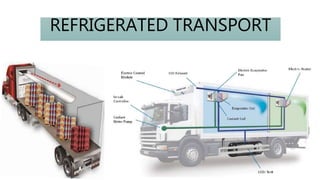
REFRIGERATED TRANSPORT
SOLAR TUNNEL DRYER
Food processing and post harvest technology

Food processing and post harvest technology

  • 1.
    FOOD PROCESSING &POST HARVEST TECHNOLOGY Presented by: Shikhangi Singh Department of Post Harvest Process & Food Engineering GBPUA&T, Pantnagar
  • 3.
    Food Processing isthe transformation of raw ingredients, by physical or chemical means into food, or of food into others forms
  • 5.
    METHODS OF PROCESSING Old Sundrying Freezing Fermentatio n Pickling Jam and jelly Canning Modern Vacuum drying Freezing Canning Pickling Jam and jelly Canning
  • 6.
    Advantages • Improves digestibility •Promotes palatability • Sterilized the food by killing harmful bacteria and other micro-organism • Improves shelf life • Provides fast, convenient and attractive food for consumers • Provides portable and less perishable foods • Ease of shipping • Helps in providing functional foods having bio active components (Patients)
  • 7.
    EFFECT OF PROCESSINGON NUTRIENTS Nutrient Process Effect Protein Heating Coagulation and shrinkage Carbohydrates Heating Gelatinization Vitamin A Heating, Drying Milling Nutritional loss Vitamin B Sterilization, use of alkali Nutritional loss Vitamin C Cooking Nutritional loss
  • 12.
    Post Harvest Managementincludes the processes done immediately after harvesting the produce, including cooling, cleaning, sorting and packing. The instant a crop is removed from the ground, or separated from its parent plant, it begins to deteriorate. Therefore post harvest treatment are given to increase its shelf life and maintain its quality. Thus post harvest management largely determines final quality. What is Post Harvest Management
  • 13.
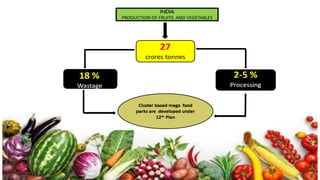
    Post harvest?For minimizing the qualitativelosses after harvesting 40% losses in fruits and vegetables due to improper handling, storage, packaging and transportation
  • 14.
    REASONS FOR LOSSES •Lack of clear concept of packing house operations. •Lack of awareness among the growers, contractors and even the policy makers. • Lack of infrastructure. • Late realization of its importance. • Inadequate technical support. • Inadequate post-harvest quality control. • Unorganized marketing. • Absence of pre-cooling and cold storage. •Inadequate market facilities, market intelligence and market information service (MIS) • Poor storage facilities.
  • 15.
    Factors affecting postharvest losses1. Variety 2. Management 3. Method and stage of harvesting 4. Improper grading and packing 5. Storing 6. Transport and marketing (Physical and mechanical
  • 16.
    • Pre-harvest maturityindication • Curing after harvest • Sorting • Pre-cooling before storage, • Washing & removal of surface moisture • Modified Atmos Packaging • Dehydration & Packaging • Crushing and packing • Value addition like ketchup, pickles POST HARVEST HANDLING OPERATIONS
  • 17.
  • 18.
    STORAGE LIFE INZERO ENERGY COOL CHAMBER Fruit/Vegetables Months Storage Life (days) Ambient conditions Cool Chamber Bitter gourd May-June 2 6 Carrot Feb.-March 5 12 Cauliflower Feb.-March 7 12 Cucumber May-June 3 8 Green chilies May-June 3 6 Kinnow January-March 8 60 Ladies finger May-June 1 6 Mango July 8 15 Peas Feb.-March 5 10 Plum June 4 10 Spinach Feb.-March 3 8
  • 19.
    • Theinsulated boxwasdesignedsuchthatit couldhold 8 plasticcratesof size 540x360x295 mm in two layer of four each • Capacityof storagewas100 kgof fruits with 80%filling of each plastic crates• CostsaroundRs.18,000-20,000/-
  • 20.
  • 21.