





Food Processing
   in Bihar
 The Road Ahead


      Prepared by

   for Government of Bihar
FOOD PROCESSING
   IN BIHAR
 THE ROAD AHEAD
Contents

Executive Summary                                   7

1.        Introduction                             15


1.1       Agriculture Sector                       15
1.2       Food Processing Sector: Size             16
1.3       Opportunities                            17
1.4       Constraints                              17
1.5       Vision 2015: Central Government          18
1.6       Investment Needs to Realise the Vision   18


2.        Bihar: A Brief Profile                   19


2.1       Demography                               19
2.2       Physical and Natural Resources           20
2.3       Economy                                  21
2.4       Disparity in Development within Bihar    23
2.5       Infrastructure and Services              25
2.5.1     Manufacturing                            25
2.5.2     Roads                                    25
2.5.3     Rail Network                             26
2.5.4     Power Supply                             26
2.6       Financial Services and Capital Markets   26
2.7       Investment Climate                       27
2.8       Agriculture                              27
2.8.1     Food Grains                              28
2.8.2     Vegetables                               30
2.8.3     Fruits                                   31
2.8.4     Dairy, Fish, Meat and Poultry            32
2.8.4.1   Meat                                     32
2.8.4.2   Poultry                                  33
2.8.4.3   Milk                                     33
2.8.4.4   Fish                                     33
2.8.5     Spices                                   33
2.9       Opportunities                            34
2.9.1     Agriculture & Horticulture Production    34
2.9.2     Crop Diversification                     35
2.9.3     Marketable Surplus                       35
2.10      Issues in Focus                          36
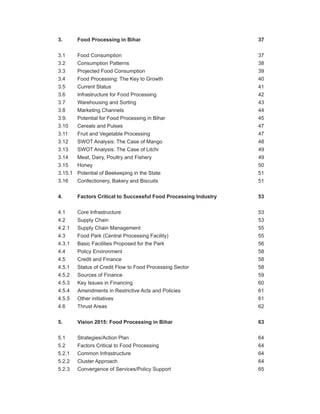
3.       Food Processing in Bihar                                  37


3.1      Food Consumption                                          37
3.2      Consumption Patterns                                      38
3.3      Projected Food Consumption                                39
3.4      Food Processing: The Key to Growth                        40
3.5      Current Status                                            41
3.6      Infrastructure for Food Processing                        42
3.7      Warehousing and Sorting                                   43
3.8      Marketing Channels                                        44
3.9.     Potential for Food Processing in Bihar                    45
3.10     Cereals and Pulses                                        47
3.11     Fruit and Vegetable Processing                            47
3.12     SWOT Analysis: The Case of Mango                          48
3.13     SWOT Analysis: The Case of Litchi                         49
3.14     Meat, Dairy, Poultry and Fishery                          49
3.15     Honey                                                     50
3.15.1   Potential of Beekeeping in the State                      51
3.16     Confectionery, Bakery and Biscuits                        51


4.       Factors Critical to Successful Food Processing Industry   53


4.1      Core Infrastructure                                       53
4.2      Supply Chain                                              53
4.2.1    Supply Chain Management                                   55
4.3      Food Park (Central Processing Facility)                   55
4.3.1    Basic Facilities Proposed for the Park                    56
4.4      Policy Environment                                        58
4.5      Credit and Finance                                        58
4.5.1    Status of Credit Flow to Food Processing Sector           58
4.5.2    Sources of Finance                                        59
4.5.3    Key Issues in Financing                                   60
4.5.4    Amendments in Restrictive Acts and Policies               61
4.5.5    Other initiatives                                         61
4.6      Thrust Areas                                              62


5.       Vision 2015: Food Processing in Bihar                     63


5.1      Strategies/Action Plan                                    64
5.2      Factors Critical to Food Processing                       64
5.2.1    Common Infrastructure                                     64
5.2.2    Cluster Approach                                          64
5.2.3    Convergence of Services/Policy Support                    65
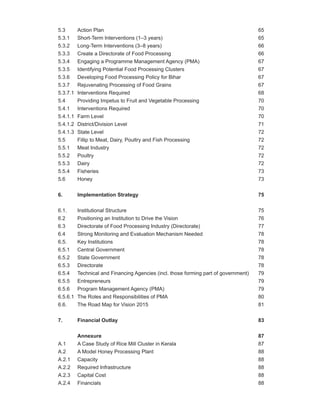
5.3       Action Plan                                                                 65
5.3.1     Short-Term Interventions (1–3 years)                                        65
5.3.2     Long-Term Interventions (3–8 years)                                         66
5.3.3     Create a Directorate of Food Processing                                     66
5.3.4     Engaging a Programme Management Agency (PMA)                                67
5.3.5     Identifying Potential Food Processing Clusters                              67
5.3.6     Developing Food Processing Policy for Bihar                                 67
5.3.7     Rejuvenating Processing of Food Grains                                      67
5.3.7.1   Interventions Required                                                      68
5.4       Providing Impetus to Fruit and Vegetable Processing                         70
5.4.1     Interventions Required                                                      70
5.4.1.1   Farm Level                                                                  70
5.4.1.2   District/Division Level                                                     71
5.4.1.3   State Level                                                                 72
5.5       Fillip to Meat, Dairy, Poultry and Fish Processing                          72
5.5.1     Meat Industry                                                               72
5.5.2     Poultry                                                                     72
5.5.3     Dairy                                                                       72
5.5.4     Fisheries                                                                   73
5.6       Honey                                                                       73


6.        Implementation Strategy                                                     75


6.1.      Institutional Structure                                                     75
6.2       Positioning an Institution to Drive the Vision                              76
6.3       Directorate of Food Processing Industry (Directorate)                       77
6.4       Strong Monitoring and Evaluation Mechanism Needed                           78
6.5.      Key Institutions                                                            78
6.5.1     Central Government                                                          78
6.5.2     State Government                                                            78
6.5.3     Directorate                                                                 78
6.5.4     Technical and Financing Agencies (incl. those forming part of government)   79
6.5.5     Entrepreneurs                                                               79
6.5.6     Program Management Agency (PMA)                                             79
6.5.6.1   The Roles and Responsibilities of PMA                                       80
6.6.      The Road Map for Vision 2015                                                81


7.        Financial Outlay                                                            83


          Annexure                                                                    87
A.1       A Case Study of Rice Mill Cluster in Kerala                                 87
A.2       A Model Honey Processing Plant                                              88
A.2.1     Capacity                                                                    88
A.2.2     Required Infrastructure                                                     88
A.2.3     Capital Cost                                                                88
A.2.4     Financials                                                                  88
Executive Summary


AGRICULTURE: A CAUSE FOR CONCERN


T
          he Indian economy is poised to achieve a double-digit growth rate. Increasingly, India
          is being regarded as the economy to watch and various projections suggest that India
          would be the second largest economy by 2050. However, this success story hides a
larger worry on the agricultural front. The share of agriculture sector in GDP has declined from
around 35 per cent in 1990–91 to around 27 per cent in 1999–2000 and further to merely 18.5
per cent during 2006–07. The annual average growth rate for the agriculture sector was merely
3 per cent in the first five years of the new millennium. Thus, the agriculture sector is proving
to be a drag on the economy. With more than half the population depending directly on this
sector, low agricultural growth has serious implications. Further, the food grains production is
actually declining which can have its own impact on the food security of the country.
Against this background, the state of Bihar is being talked about as a sleeping giant of Indian
agriculture. The National Commission on Farmers has concluded that Bihar and Eastern India
present uncommon opportunities for becoming another “fertile crescent” even as the present
fertile crescent (Punjab, Haryana and Western Uttar Pradesh) have reached a state of economic
and ecological distress. Water, the lifeline of agriculture, is abundant in Bihar and the real issue
is not availability but management.


FOOD PROCESSING
While tapping potential of untapped states can achieve increased production, for the agriculture
sector to be revitalised the growth of food processing industry has to be ensured. The food
processing industry can address the key issues of wastages and value addition and attract new
investment in the sector. Global experiences indicate that agriculture development in the country
can be given a big boost by the growth of agro and food processing industries. India currently
produces about 50 million tonne of fruits, which is about 9 per cent of the world’s production
8    Food Processing in Bihar: The Road Ahead


of fruits and 90 million tonne of vegetables, which accounts for 11 per cent of the world’s
vegetable production. However, only about 2 per cent of the fruits and vegetables in India are
processed, which is very low compared to countries like the USA, China and others. Lack of
processing and inadequate storage of fruits and vegetables result in huge wastages.
Currently, the Indian food processing sector employs about 13 million people directly and
about 35 million people indirectly. In 2004–05, food processing sector contributed about 14
per cent of manufacturing GDP with a share of Rs 2,80,000 crore. Of this, the unorganised
sector accounted for more than 70 per cent of production in terms of volume and 50 per cent
in terms of value.


AGRICULTURE: LIFELINE OF BIHAR
Even as the state of Bihar is being talked of as the next big hope for agriculture sector in the
country, this sector also remains the most crucial factor for the state economy. Degree of
dependence of Bihar on agriculture in term of employment as well as income is much higher
than the national level and the current share of agriculture in the Gross State Domestic Product
(GSDP) and employment is similar to that of the country just after independence. Food
production and processing contribute more than 55 per cent to the GSDP employing over 80
per cent of the work force (agriculture alone over 76 per cent).
Bihar ranks 11th of the 15 major states in terms of social and economic infrastructure. Annual
Survey of Industries reveals that only about 1,500 industries are operating in the state (2003–04)
or 1.13 per cent of the total industries all over India. The manufacturing sector contributes just
3.31 per cent to the GSDP. The division of Bihar in 2000 was a big blow for the state as almost
all major mineral producing regions became part of state of Jharkhand. In such circumstances,
agriculture and food processing remain almost the only hope for the state to catch up with the
rest of the country.


FOOD PROCESSING OPPORTUNITIES
There are several factors that favour agriculture sector in Bihar. The state is now uniquely
positioned to utilise its rich untapped natural resources such as fertile soils and abundant water.
More importantly, it can avail of the benefits of increasing stress on the food processing sector
at the national level. This can give the state at least a level playing field, if not a head start, in
food processing provided certain critical interventions are undertaken.
As a consumer, Bihar with a population of 83 million and a population growth of about 2.43
per cent per annum, is a large and growing market for food products. Food is the single largest
component of private consumer expenditure, accounting for as much as 59 to 65 per cent
of the total. At a conservative estimate, the current market for food in Bihar is a whopping
Executive Summary            9


Rs 40,000 crore1 of which the processed food market including beverages is estimated at close
to Rs 18,000 crore. At the estimated national growth rate of consumption of 7 per cent, the
food consumption market in Bihar is estimated to be Rs 56,000 crore in 2010 and Rs 83,000
crore in 2015.2


VISION 2015: TAP THE UNTAPPED
The vision 2015 is a timely intervention by the Government of Bihar to create a road map for
food processing sector in the state. This is designed to ‘tap the untapped potential’ of Bihar’s
agriculture sector through accelerated development of the food processing industry.


STRATEGY/ACTION PLAN
The development of the food processing sector in Bihar calls for a product specific cluster based
approach under a Public-Private Partnership (PPP) mode. The strategy suggested is aimed at
attracting new investment and ensuring technology infusion in the sector which can turn the food
processing industry from low capital, dated technology industry to a vibrant industry emerging
not only as a driver for the state economy but also a trend setter for the food processing sector
in the Eastern/Central region of India.


STRATEGY
♦ Identify potential Economic Clusters3 and help them to move up the value chain
♦ Initialise the investment process by: (a) channelisation of public funds for development
  of core infrastructure in potential clusters to begin with and (b) provide liberal financial
  support to private investment in basic infrastructure in the food processing sector like farm
  level pre-cooling facilities, cold chain, packaging, etc
♦ Help build a common brand for niche products unique to Bihar


ACTION PLAN
Short-Term Interventions (1–3 years)

♦ Create a Directorate of Food Processing within the Department of Industries as a single
  window for catalysing the food processing industry
♦ Engage a professional project management agency to assist the Government of Bihar
♦ Develop a food processing policy and launch awareness campaign
♦ Identify the geographical and sectoral priority areas—including identification of existing
  and potential clusters


1
  NSSO Data (60th Round) and IL&FS Analysis
2
  NSSO Data (60th Round) and IL&FS Analysis
3
  Economic Clusters are geographical concentration of inter-connected companies, specialised suppliers (producers),
service providers and associated institutions present in a region. Clusters arise because they increase the productivity
with which companies can compete.
10   Food Processing in Bihar: The Road Ahead


♦ Prepare Detailed Project Report (DPR) for selected clusters detailing supply chain and
  processing linkages aimed at creating models for replication
♦ Create a market development fund for promotion of state products
♦ Design and establish three regional capacity building centres for building capacities of
  unskilled labour force to tap the emerging employment potential from the food processing
  industry nationally and locally
♦ Create a panel of sector specific experts
♦ Help establish integrated food zones/mega food parks in the selected clusters
♦ Establish modern abattoirs and fish processing units in the selected clusters
♦ Establish a state level institute for food processing in Bihar with incubation centres
♦ Promote quality awareness throughout the state including adoption of TQM, HACCP,
  ISO standards, GMP, GHP etc
♦ Establish/Upgrade quality control laboratory/food testing laboratory


Long-Term Interventions (3–8 years)

♦ Launch awareness campaign based on successful projects
♦ Based on the experience gained from the initial pilot projects, prepare an action plan for
  strengthening the backward linkages and implement the same. This may address the issue
  of processable varieties, appropriate models for community farming, etc
♦ Create at least one safe food town
♦ Establish a strategic distribution centre for facilitating retail under PPP mode
♦ Strengthen the board/directorate to evolve polices for further development of the sector


CREATING A DIRECTORATE OF FOOD PROCESSING AND
ENGAGING A PROGRAMME MANAGEMENT AGENCY (PMA)
The state government may create a directorate of food processing as a separate unit under the
Department of Industries headed by an officer in the rank of director and assisted by at least
two technical experts and the support staff to lead the development of the industry within the
state. The directorate will be assisted by an independent professional PMA to develop and roll
out appropriate policies and guidelines and monitor their implementation. The primary role of
PMA will be to assist the Bihar Government in effective implementation of the food processing
policy and action plan under this vision document. Engagement of such an agency will enable
the convergence of the interests of the industry, government and other stakeholders.
Executive Summary          11


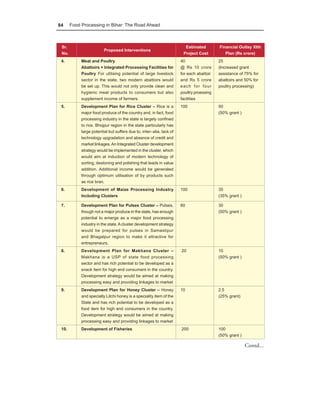
PROPOSED FINANCIAL OUTLAY

Sr.                                                            Estimated          Financial Outlay XIth
                   Proposed Interventions
No.                                                           Project Cost           Plan (Rs crore)
1.    Commissioning Studies to
      • Develop and enact food processing policy                  0.50                     5.00
      • Map agri-zones using Enviro-Max approach                  2.00
      • Find status of organic farming & certification            0.50
      • Identify clusters and develop business plans              2.00
2.    Establishment of 100 Rural Agri-Business                    500                     125
      Centres (RABCs)/Primary Processing Centres                                (25% grant subject to ceil-
                                                                                ing of Rs 1.25 crore per
                                                                                centre)
3.    Development of two Integrated Food Zones                    240                      100
                                                                                       ( 50% grant
                                                                                  subject a maximum of
                                                                                   Rs 50 crore per food
                                                                                          zone)
4.    Integrated Processing                                  40 @ Rs 10                     25
      Facilities - Poultry and Abattoirs                     crore each for      (Increased grant assis-
      For utilising potential of large livestock sector in   abattoir and        tance of 75% for abat-
      the state, two modern abattoirs would be set up.       Rs 5 crore each     toirs and 50% for poultry
      This would not only provide clean and hygienic         for 4 poultry       processing)
      meat products to consumers but also supplement         processing
      income of farmers.                                     facilities
5.    Development Plan - Rice Cluster                             100                      50
      Rice is a major food produce of the country and,                                 (50% grant )
      in fact, food processing industry in the state is
      largely confined to rice. Bhojpur region in the
      state particularly has large potential but suffers
      due to, inter–alia, lack of technology upgradation
      and absence of credit and market linkages. An
      integrated cluster development strategy would be
      implemented in the cluster, which would aim at in-
      duction of modern technology of sorting, destoning
      and polishing helping in value addition. Additional
      income would be generated through optimum
      utilisation of by products such as rice bran .
6.    Development of Maize Processing                             100                      35
      Industry including Clusters.                                                     (35% grant )
7.    Development Plan - Pulses Cluster                            60                      30
      Pulses, though not a major produce in the state,                                 (50% grant)
      has enough potential to emerge as a major
      food processing industry in the state. A cluster
      development strategy would be prepared for
      pulses in Samastipur–Bhagalpur region to make
      it attractive for entrepreneurs.

                                                                                                  Contd...
12     Food Processing in Bihar: The Road Ahead


PROPOSED FINANCIAL OUTLAY

 Sr.                                                               Estimated       Financial Outlay XIth
                      Proposed Interventions
 No.                                                              Project Cost        Plan (Rs crore)
  8.     Development Plan - Makhana Cluster                           20                    10
         Makhana is a USP of state food processing sector                                 (50% grant)
         and has rich potential to be developed as a snack
         item for high end consumers in the country. Devel-
         opment strategy would be aimed at making pro-
         cessing easy and providing linkages to market
  9.     Development Plan - Honey Cluster                             10                   2.5
         Honey and specially Litchi honey is a special-                                (25% grant)
         ity item of the state and has rich potential to be
         developed as a food item for high end consumers
         in the country. Development strategy would be
         aimed at making processing easy and providing
         linkages to market
 10.     Development of Fisheries                                     200                 100
                                                                                       (50% grant)
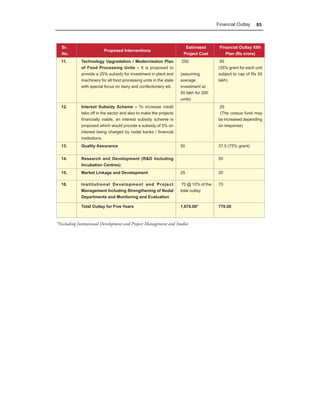
 11.     Technology Upgradation                                        250                   85
         It is proposed to provide a 25% subsidy for invest-    (Assuming aver-    (35% grant for each
         ment in plant and machinery for all food processing     age investment    unit subject to cap of
         units in the state with special focus on dairy and       at 50 lakh for        Rs 50 lakh)
         confectionery etc                                          200 units)
 12.     Interest Subsidy Scheme                                                             25
         To increase credit take off in the sector and also                        (The corpus fund may
         to make the projects financially viable, an interest                      be increased depend-
         subsidy scheme is proposed which would provide                              ing on response)
         a subsidy of 5% on interest being charged by nodal
         banks / financial institutions.
 13.     Quality Assurance                                            50                  37.5
                                                                                       (75% grant)
 14.     R&D including Incubation Centres                                                   50


 15.     Market Linkage and Development                               25                    20
 16.     Institutional Development and Project Manage-           70 @ 10% of                70
         ment Including Strengthening of Nodal Depart-          the total outlay
         ments and Monitoring and Evaluation
         Total Outlay for five years                               1,670.00*              770.00

*Excluding Institutional Development and Project Management and Studies
Executive Summary       13


IMPACT
The present action plan envisages an investment of Rs 1,670 crore including a proposed budgetary
outlay of Rs 770 crore during the Eleventh Five Year Plan. Assuming a leveraging ratio of 2.5, an
investment of Rs 1,670 crore in the sector can lead to a total investment of Rs 4,175 crore. Using
the global thumb rule of creation of 140 jobs per crore of investment, an investment of Rs 4,175
crore will lead to creation of 5,84,500 additional jobs. Additionally, assuming a reasonable turnover
ratio of 2, a total investment of Rs 4,175 crore will lead to an additional aggregate turnover of
Rs 8,350 crore to the state’s economy.
The income levels of farmers are envisaged to grow by at least 30 per cent by 2015 by way of
increase in processing by 15 per cent and reduction of at least 15 per cent in wastages.
1
                           Introduction


1.1            AGRICULTURE SECTOR


O
         n many counts, Indian agriculture is as much a success story as it is about missed
         opportunities and messy policy initiatives. The economic potential of this labour-
         intensive activity, which can ensure growth with equity for nearly two-thirds of the
population, has remained largely untapped.
Agriculture continues to play a significant role in the economic development of India. Despite
the fact that share of agriculture in the GDP has been progressively declining, it still employs
two-thirds of its population. Long-term projections on food availability do not leave room
for complacency, particularly in a scenario where population growth rate is exceeding the
food grains production growth rate. Rate of growth of food grains production4 has declined
from 2.09 per cent in the 1990s — from 149.7 million MT in 1990 to 178.2 million MT in
1999—to registering a negative growth rate of –0.18 per cent during 2000-05 — from 183.6
million MT in 2000 to 173.6 million MT in 2005. This is lower than the growth rate of 2.14
per cent in population in the last decade and 1.6 per cent during the current decade. If the rate
of growth in food grains production is not increased soon, the country may face shortage of
food grains in the near future.
Though the green revolution helped the country achieve self-sufficiency, the fact remains that the
impact of green revolution was confined to a few irrigated pockets with production technologies
relying heavily on chemical fertilizers and pesticides and High Yielding Variety (HYV) seeds. This
led to flattening of yield curve besides scores of issues relating to land degradation among others.
Lopsided development of agriculture skewed towards production without adequate attention
to post-harvest management, processing and marketing. These made agriculture unattractive


4
 Net production of food grains in India
Source: Economic Survey 2006–07
16    Food Processing in Bihar: The Road Ahead


leading to a decline in investment and making agriculture a non-remunerative proposition. In
the current liberalised economy, unless agriculture achieves global competitiveness, its sustenance
will become a major issue. To make it competitive, it has to move up in the value chain.


1.2          FOOD PROCESSING SECTOR: SIZE
India is a major producer of many agricultural commodities and it accounts for nine per cent
of the world’s fruit production and about 11 per cent of the vegetable production. But the
level of processing and value addition of fruits and vegetables is just two per cent of the total
production, compared to 65 per cent in the USA, 23 per cent in China and 78 per cent in the
Philippines as given in the figure below.


There is huge wastage of perishable agricultural commodities. The position in the country
with regard to other products also is not very encouraging. The overall level of processing of
agricultural commodities in the country is estimated at six per cent. The annual loss on account
of wastage of agricultural commodities is estimated to be about Rs 50,000 crore.
At present, the food processing sector employs about 13 million people directly and about 35
million people indirectly. In 2004–05, food processing sector contributed about 14 per cent
of manufacturing GDP with a share of Rs 2,80,000 crore. Of this, the unorganised sector
accounted for more than 70 per cent of production in terms of volume and 50 per cent in
terms of value.
On the export front, India has 1.5 per cent (INR 360 Bn in 2003–04) share of global agricultural
exports (approx USD 522 Bn or INR 24,000 Bn), despite its leadership in agricultural
production.
Indian exports primarily are of commodities (in raw form) and primary processed products, with
low price realisation. In addition, many products are showing single digit or negative growth.
Introduction   17


    Exports: India’s Total versus Agricultural and Food Products (INR Bn)


  Source: Ministry of Commerce, Govt of India


1.3           OPPORTUNITIES
Food today is the single largest component of household consumption expenditure within India
with the current food consumption estimated at Rs 8,60,000 crore. Processed foods account for
Rs 4,60,000 crore and primary processed food (includes packed fruits and vegetables, packed
milk, etc.) Rs 2,80,000 crore.
Changing age profile, increase in income, social changes (increasing number of working
women), life style factors and organised retail outlets are factors favouring the growth of the
food processing sector. This helps the sector generate significant employment. The multiplier
effect of investment in food processing industry on employment generation is 2.5 times than
in other industrial sectors.


1.4           CONSTRAINTS
While the food processing sector offers several opportunities, it faces constraints as well:
♦ Low income and the high share of basic food in the household consumption
♦ Socio-cultural factors such as preference in India for freshly plucked / cooked food, variation
  in food habits across the country, easy availability of raw materials for cooking, preference
  for consumption of food at home, etc.
♦ Low productivity, high wastage
♦ Inadequate infrastructure for sorting, grading, packing, etc., in addition to the high cost
  of raw material (at processor’s level)
♦ APMC Act which restricts sourcing materials from farmers
♦ Lack of a common policy on contract farming
♦ Lack of trained manpower for processing, storage, marketing and branding
♦ Lack of access to modern technology
♦ Low share of sale of food products through organised retail, which are the usual drivers of
  quality, scale and integration.
♦ Access to credit for farmers as well as small and medium food processors is a key issue. Over
  75 per cent rely on informal credit at very high interest rates leading to increase in cost of
  production affecting competitiveness
18    Food Processing in Bihar: The Road Ahead


♦ Inability to attract investment by large corporate houses who complain of unreliable sources
  of supply of raw material
♦ Inability to induce investor confidence
♦ Low inflow of Foreign Direct Investment (FDI) despite permission for 100 per cent FDI in
  the food processing sector (except in food retailing, alcoholic beverages and plantations)
♦ Inability of government schemes to have the desired impact on productivity, technology
  and market arrivals


1.5           VISION 2015: CENTRAL GOVERNMENT
♦    Enhancing and stabilising the income level of farmers
♦    Providing choice to consumers in terms of greater variety and taste, including ethnic food
♦    Providing greater assurance about safety and quality of food to consumers
♦    Promoting a dynamic food processing industry
♦    Enhancing competitiveness in domestic and international markets
♦    Making the sector attractive for both domestic and foreign investors
♦    Achieving integration of the food processing infrastructure from farm to market
♦    Having a transparent and industry friendly regulatory regime
♦    Putting in place a transparent system of standards based on science
     The specific targets are to increase:
♦ The level of processing of perishables from 6 per cent to 20 per cent
♦ Value addition from 20 per cent to 35 per cent
♦ Share in global food trade from 1.5 per cent to 3 per cent by 2015


1.6           INVESTMENT NEEDS TO REALISE THE VISION
The Government of India estimates an investment of Rs 1,00,000 crore to realise the above
vision of which Rs 45,000 crore is expected to come from the private sector, Rs 45,000 crore
from financial institutions and Rs 10,000 crore from its own sources.
2
      Bihar: A Brief Profile


B
       ihar is located in the eastern part of the country (between 83°–30’ to 88°–00’ longitude
       and 21°–58’–10” ~ 27°–31’–15” latitudes) with an area of 94,163 sq km constituting
       2.85 per cent of the geographical area of India. Of this, 92,257 sq km is rural and 1,096
sq km is urban. A landlocked state, it lies midway between the humid West Bengal in the east
and the sub-humid Uttar Pradesh in the west, Nepal in the north and Jharkhand in the south.
The Bihar plain is divided into two unequal halves by the river Ganges that flows through the
middle from west to east.
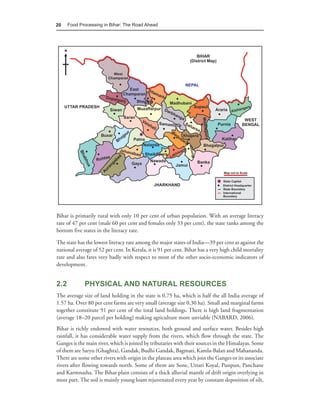
Administratively, the state is divided into nine divisions with 38 districts, 101 sub-divisions,
534 development blocks, 8,471 panchayats and 45,103 revenue villages. There are nine urban
agglomeration with 130 towns having 43 police districts and 853 police stations.


2.1          DEMOGRAPHY
Bihar is the third largest populous state in the country with a population of about 83 million
as per the 2001 Census and a sex ratio (females per thousand males) of 921. The state is one
of the most densely populated regions in India with a density of 880 persons per sq km. The
growth of population for the decade 1991–2001 was 28.43 per cent, which was the highest
in the country.
20    Food Processing in Bihar: The Road Ahead


Bihar is primarily rural with only 10 per cent of urban population. With an average literacy
rate of 47 per cent (male 60 per cent and females only 33 per cent), the state ranks among the
bottom five states in the literacy rate.

The state has the lowest literacy rate among the major states of India—39 per cent as against the
national average of 52 per cent. In Kerala, it is 91 per cent. Bihar has a very high child mortality
rate and also fares very badly with respect to most of the other socio-economic indicators of
development.


2.2          PHYSICAL AND NATURAL RESOURCES
The average size of land holding in the state is 0.75 ha, which is half the all India average of
1.57 ha. Over 80 per cent farms are very small (average size 0.30 ha). Small and marginal farms
together constitute 91 per cent of the total land holdings. There is high land fragmentation
(average 18–20 parcel per holding) making agriculture more unviable (NABARD, 2006).
Bihar is richly endowed with water resources, both ground and surface water. Besides high
rainfall, it has considerable water supply from the rivers, which flow through the state. The
Ganges is the main river, which is joined by tributaries with their sources in the Himalayas. Some
of them are Saryu (Ghaghra), Gandak, Budhi Gandak, Bagmati, Kamla-Balan and Mahananda.
There are some other rivers with origin in the plateau area which join the Ganges or its associate
rivers after flowing towards north. Some of them are Sone, Uttari Koyal, Punpun, Panchane
and Karmnasha. The Bihar plain consists of a thick alluvial mantle of drift origin overlying in
most part. The soil is mainly young loam rejuvenated every year by constant deposition of silt,
Bihar: A Brief Profile   21


clay and sand brought by different streams. This soil is deficient in phosphoric acid, nitrogen
and humus, but potash and lime are usually present in sufficient quantity.
There are three major types of soil in Bihar:
♦ Piedmont Swamp Soil—found in northwestern part of west Champaran district.
♦ Terai Soil—found in northern part of the state along the borders of Nepal.
♦ The Gangetic Alluvium—the plain of Bihar is covered by Gangetic alluvium.

The topography of Bihar can be described as a fertile alluvial plain occupying the Gangetic
Valley. The plain extends from the foothills of the Himalayas in the north to a few miles south
of the river Ganges as it flows through the state from the west to the east. Rich farmland and
lush orchards extend throughout the state.

Bihar lies in the tropical to sub-tropical region. Rainfall here is the most significant factor in
determining the nature of vegetation. Bihar has a monsoon climate with an average annual
rainfall of 1,200 mm.


2.3          ECONOMY
The state of Bihar amply illustrates “poverty in riches” paradox. Even when the state was leading
in terms of mineral resources in the country, this huge potential could never be converted into
reality. The state got bifurcated in 2000 and most of mineral rich regions of Bihar became part
of Jharkhand. The challenges facing the state economy have only intensified since then.
Even as large parts of the country experienced the process of rapid industrialisation over last
decade and a half of liberalisation, the state of Bihar found itself bypassed and untouched from
this process. In fact, the state was witness to a process of de-industrialisation over this period.
Far from attracting fresh investments, even existing industries gradually started winding up.
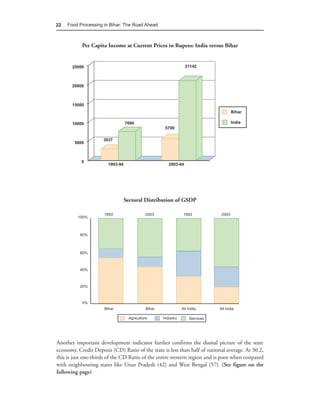
Not surprisingly, Bihar remains one of the least developed states of India with a per capita annual
income of Rs 5,780 in 2003–04 against India’s average of Rs 21,142. As depicted below, this
divide has become sharper in recent years. While the state’s per capita income was around 40
per cent of national figure in 1993–94, it was reduced to 27 per cent in 2003–04.
Bihar’s annual growth rate was 5.2 per cent compared to all India’s 5.6 per cent in the 1980s, which
declined to 2.9 per cent compared to the national growth rate of around 5.5 per cent during the
ninth plan period and increased slightly to 4.01 per cent—merely 60 per cent of the national growth
rate of seven per cent during the tenth plan period.
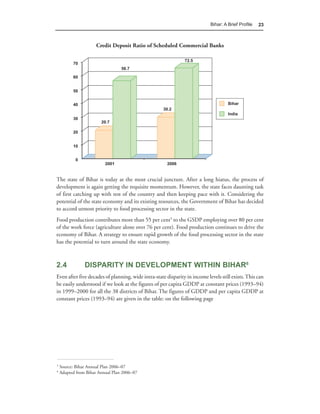
Agriculture continues to be a dominant contributor to the GSDP even though it decreased from
48 per cent in 1993 to 40 per cent in 2003. The contribution of the manufacturing sector /
industry has more or less remained stagnant at around 10 per cent during this period and the
services sector has grown from 41 per cent to 50 per cent during this period. (See figures on
the following page)
22   Food Processing in Bihar: The Road Ahead


           Per Capita Income at Current Prices in Rupees: India versus Bihar


                              Sectoral Distribution of GSDP


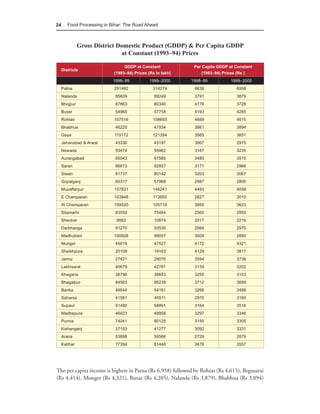
Another important development indicator further confirms the dismal picture of the state
economy. Credit Deposit (CD) Ratio of the state is less than half of national average. At 30.2,
this is just one-thirds of the CD Ratio of the entire western region and is poor when conpared
with neighbouring states like Uttar Pradesh (42) and West Bengal (57). (See figure on the
following page)
Bihar: A Brief Profile   23


                     Credit Deposit Ratio of Scheduled Commercial Banks


The state of Bihar is today at the most crucial juncture. After a long hiatus, the process of
development is again getting the requisite momentum. However, the state faces daunting task
of first catching up with rest of the country and then keeping pace with it. Considering the
potential of the state economy and its existing resources, the Government of Bihar has decided
to accord utmost priority to food processing sector in the state.
Food production contributes more than 55 per cent5 to the GSDP employing over 80 per cent
of the work force (agriculture alone over 76 per cent). Food production continues to drive the
economy of Bihar. A strategy to ensure rapid growth of the food processing sector in the state
has the potential to turn around the state economy.


2.4             DISPARITY IN DEVELOPMENT WITHIN BIHAR6
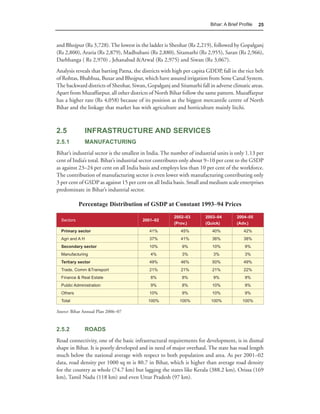
Even after five decades of planning, wide intra-state disparity in income levels still exists. This can
be easily understood if we look at the figures of per capita GDDP at constant prices (1993–94)
in 1999–2000 for all the 38 districts of Bihar. The figures of GDDP and per capita GDDP at
constant prices (1993–94) are given in the table: on the following page


5
    Source: Bihar Annual Plan 2006–07
6
    Adapted from Bihar Annual Plan 2006–07
24      Food Processing in Bihar: The Road Ahead


               Gross District Domestic Product (GDDP) & Per Capita GDDP
                               at Constant (1993–94) Prices

                                 GDDP at Constant            Per Capita GDDP at Constant
     Districts
                            (1993–94) Prices (Rs In lakh)        (1993–94) Prices (Rs )
                            1998–99           1999–2000     1998–99           1999–2000
     Patna                  291482             314274         6638              6958
     Nalanda                 85609              89249         3791              3879
     Bhojpur                 87863              80340         4176              3728
     Buxar                   54965              57758         4193              4285
     Rohtas                 107516             108693         4689              4615
     Bhabhua                 46220              47934         3861              3894
     Gaya                   115172             121354         3565              3651
     Jehanabad & Arwal       43336              43197         3067              2975
     Nawada                  53474              55962         3187              3235
     Aurangabad              65043              67585         3480              3515
     Saran                   96813              92857         3171              2966
     Siwan                   81737              80142         3203              3067
     Gopalganj               60317              57968         2987              2800
     Muzaffarpur            157831             146241         4493              4058
     E Champaran            103848             113650         2827              3010
     W Champaran            109320             105718         3855              3623
     Sitamarhi               63550              75464         2565              2955
     Sheohar                 9562               10874         2017              2219
     Darbhanga               91270              93530         2984              2970
     Madhubani              100928              99057         3009              2880
     Munger                  45019              47527         4172              4321
     Sheikhpura              20109              19163         4129              3817
     Jamui                   27421              29070         3594              3736
     Lakhisarai              40679              42781         3139              3202
     Khagaria                38796              38653         3255              3153
     Bhagalpur               84563              86239         3712              3689
     Banka                   49544              54161         3268              3488
     Saharsa                 41561              45511         2975              3160
     Supaul                  51480              58891         3164              3518
     Madhepura               46923              48958         3297              3346
     Purnia                  74041              80125         3155              3305
     Kishanganj              37193              41277         3092              3331
     Araria                  53898              58566         2729              2879
     Katihar                 77394              81446         3478              3557


The per capita income is highest in Patna (Rs 6,958) followed by Rohtas (Rs 4,615), Begusarai
(Rs 4,414), Munger (Rs 4,321), Buxar (Rs 4,285), Nalanda (Rs 3,879), Bhabhua (Rs 3,894)
Bihar: A Brief Profile   25


and Bhojpur (Rs 3,728). The lowest in the ladder is Sheohar (Rs 2,219), followed by Gopalganj
(Rs 2,800), Araria (Rs 2,879), Madhubani (Rs 2,880), Sitamarhi (Rs 2,955), Saran (Rs 2,966),
Darbhanga ( Rs 2,970) , Jehanabad &Arwal (Rs 2,975) and Siwan (Rs 3,067).
Analysis reveals that barring Patna, the districts with high per capita GDDP, fall in the rice belt
of Rohtas, Bhabhua, Buxar and Bhojpur, which have assured irrigation from Sone Canal System.
The backward districts of Sheohar, Siwan, Gopalganj and Sitamarhi fall in adverse climatic areas.
Apart from Muzaffarpur, all other districts of North Bihar follow the same pattern. Muzaffarpur
has a higher rate (Rs 4,058) because of its position as the biggest mercantile centre of North
Bihar and the linkage that market has with agriculture and horticulture mainly litchi.


2.5           INFRASTRUCTURE AND SERVICES
2.5.1         MANUFACTURING
Bihar’s industrial sector is the smallest in India. The number of industrial units is only 1.13 per
cent of India’s total. Bihar’s industrial sector contributes only about 9–10 per cent to the GSDP
as against 23–24 per cent on all India basis and employs less than 10 per cent of the workforce.
The contribution of manufacturing sector is even lower with manufacturing contributing only
3 per cent of GSDP as against 15 per cent on all India basis. Small and medium scale enterprises
predominate in Bihar’s industrial sector.

            Percentage Distribution of GSDP at Constant 1993–94 Prices
                                                        2002–03        2003–04        2004–05
  Sectors                                2001–02
                                                        (Prov.)        (Quick)        (Adv.)
  Primary sector                            41%            45%            40%            42%
  Agri and A H                              37%            41%            36%            38%
  Secondary sector                          10%             9%            10%             9%
  Manufacturing                              4%             3%             3%             3%
  Tertiary sector                           49%            46%            50%            49%
  Trade, Comm &Transport                    21%            21%            21%            22%
  Finance & Real Estate                      8%             8%             9%             9%
  Public Administration                      9%             8%            10%             9%
  Others                                    10%             9%            10%             9%
  Total                                    100%           100%           100%            100%

Source: Bihar Annual Plan 2006–07


2.5.2         ROADS
Road connectivity, one of the basic infrastructural requirements for development, is in dismal
shape in Bihar. It is poorly developed and in need of major overhaul. The state has road length
much below the national average with respect to both population and area. As per 2001–02
data, road density per 1000 sq m is 80.7 in Bihar, which is higher than average road density
for the country as whole (74.7 km) but lagging the states like Kerala (388.2 km), Orissa (169
km), Tamil Nadu (118 km) and even Uttar Pradesh (97 km).
26      Food Processing in Bihar: The Road Ahead


The state has taken a back seat not only in respect of road length covered by the state highway,
MDR, ODR or village roads being developed by the state government but also in respect of
National Highways—that is constructed and maintained by the Government of India.
The important roads in the state are very poorly maintained and only 50 per cent of roads are
surfaced as against a national average of 60 per cent and even higher levels in Gujarat (90 per
cent) and Tamil Nadu (77 per cent). World Bank estimates that roads do not still connect 70
per cent of inhabited areas. There are 48,212 registered trucks in the state, just 2.15 per cent
of the total number of trucks registered in India.

                                           Road Connectivity
     Length of Highways, Roads in 2002                            Bihar                All India
     Length of National Highways (in km)                          3502                 58112
     Length of National Highways per Lakh Population ( in km)     4.219                5.65
     Length of National Highways per sq km (in km)                0.037                0.018
     Length of Surface Roads (in km)                              32858                1420489
     Length of Surface Roads per Lakh Population ( in km)         39.588               138.099
     Length of Surface Roads per sq km (in km)                    0.349                0.432
     Length of Total Roads (in km)                                76065                2456647
     Length of Total Roads per Lakh Population ( in km)           91.645               238.834
     Length of Total Roads per sq km (in km)                      0.808                0.747


2.5.3            RAIL NETWORK
Railways have a good network in the state and as per 2004–05 statistics, railway line density
per 1,000 sq m is 35.88 km as against 19.3 km for India as a whole. The states of West Bengal
(43.43) and Punjab (41.66) have higher railway line density than Bihar.


2.5.4            POWER SUPPLY
Power generation and availability rates are the lowest in Bihar, compared to            Captive Units
an all India average annual electricity consumption level of 334 kWh and 895           Per unit cost of
kWh of Punjab. The average per capita consumption of electricity in Bihar              power produc-
                                                                                       tion in captive
was only 55 kWh. High unit costs, large transmission and distribution losses           units is higher
and low collection rates have created high units of power supply in Bihar.             and reduces
                                                                                       competitive-
The supply is poor and irregular with large voltage fluctuations resulting in          ness of the
majority of industries opting for captive power units.                                 units.


2.6              FINANCIAL SERVICES AND CAPITAL MARKETS
Bihar has one of the least developed financial sectors in India, due to both demand and supply side
factors. The NSS survey of private sector perceptions identified weak capital markets as the major
impediment. There is considerably low household account usage—21 per cent as compared to 73
per cent nationally. However, banks in Bihar also have higher depositor numbers per branch and
very low credit to deposit ratios despite reasonably higher savings rates, thereby reflecting the banks’
Bihar: A Brief Profile       27


perceptions of high risk and general lack of quality lending opportunity. The World Bank report
concludes that financial services, due to all the above, are relatively undeveloped, more expensive and
often unavailable, particularly in rural areas. The major fallout of this is that Bihar is a net exporter
of capital, i.e. the capital is being used elsewhere than in the state.


2.7           INVESTMENT CLIMATE7
Investment Climate (IC) refers to the institutional, economic, political           Credit Deposit Ratio
and infrastructural environment affecting investment in industry. Bihar           Bihar’s Credit Deposit
ranks the lowest, in terms of physical and institutional environment,             ratio with commer-
even below Orissa and Jharkhand. For most of the other IC indicators              cial banks was 30.2
                                                                                  per cent in 2005–06
such as penetration of infrastructure, financial system and workforce             against 42 per cent in
quality, Bihar is ranked at or close to the bottom.                               Uttar Pradesh, 65 per
                                                                                  cent in Orissa, 102
                                                                                  per cent in Maharash-
                                                                                  tra and 106 per cent
                                                                                  in Tamil Nadu.
2.8           AGRICULTURE
Bihar is the seventh largest economy in India in terms of food production. The economy is primarily
agrarian with agriculture contributing to more than 38 per cent to the Gross State Domestic Product
(GSDP).8 Bihar is the eighth largest producer of food grains in the country. The major agricultural
products of Bihar are cereals, pulses, oilseeds and cash crops. The major cereals are rice, wheat and
maize and major pulses are gram, arhar, mung and masoor. In addition, the major cash crops are
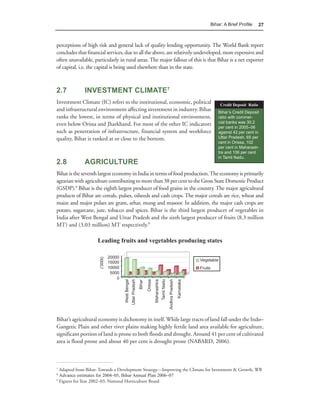
potato, sugarcane, jute, tobacco and spices. Bihar is the third largest producer of vegetables in
India after West Bengal and Uttar Pradesh and the sixth largest producer of fruits (8.3 million
MT) and (3.03 million) MT respectively.9

                    Leading fruits and vegetables producing states


Bihar’s agricultural economy is dichotomy in itself. While large tracts of land fall under the Indo–
Gangetic Plain and other river plains making highly fertile land area available for agriculture,
significant portion of land is prone to both floods and drought. Around 41 per cent of cultivated
area is flood prone and about 40 per cent is drought prone (NABARD, 2006).


7
  Adapted from Bihar: Towards a Development Strategy—Improving the Climate for Investment & Growth, WB
8
  Advance estimates for 2004–05, Bihar Annual Plan 2006–07
9
  Figures for Year 2002–03, National Horticulture Board
28      Food Processing in Bihar: The Road Ahead


Average size of land holding is 0.75 ha, which is half of the all India average of 1.57 ha. Over
80 per cent farms are very small (average size 0.30 ha). Small and marginal farms together
constitute 91 per cent of the total land holdings of the state.
There is high land fragmentation (average 18–20 parcel per holding) making agriculture more
unviable (NABARD, 2006). Irrigation intensity of 152 per cent and cropping intensity of 139
per cent is slightly higher than the all India average of 133 per cent.
The state is endowed with good quality soils resulting in higher productivity. Its average
productivity of food grains is 1,662 kg/ha, which is higher than the average for India (1,636
kg/ha)10. However, the higher average productivity levels have not percolated in value terms
to the economy. The land productivity level in value terms is at Rs 7, 351/ha as against Rs
11,691/ha for the country, coupled with dominance of low value crops and absence of crop
diversification.
Per capita annual agricultural production of Bihar is only Rs 661 as against Rs 2,304 for India
as a whole. This may be the result of relatively low level of technological and input use such
as fertiliser consumption of only 96.79 kg per ha against 184.25 kg per ha in Punjab (CMIE,
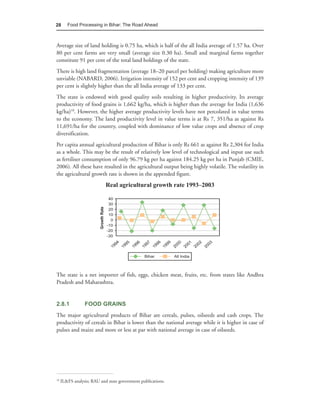
2006). All these have resulted in the agricultural output being highly volatile. The volatility in
the agricultural growth rate is shown in the appended figure.
                            Real agricultural growth rate 1993–2003


The state is a net importer of fish, eggs, chicken meat, fruits, etc. from states like Andhra
Pradesh and Maharashtra.


2.8.1            FOOD GRAINS
The major agricultural products of Bihar are cereals, pulses, oilseeds and cash crops. The
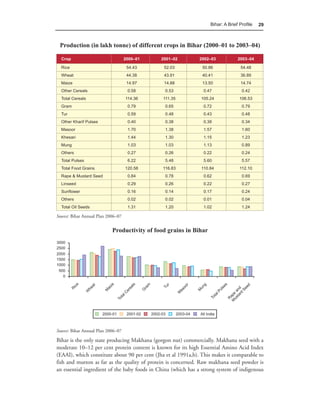
productivity of cereals in Bihar is lower than the national average while it is higher in case of
pulses and maize and more or less at par with national average in case of oilseeds.


10
     IL&FS analysis; RAU and state government publications.
Bihar: A Brief Profile   29


 Production (in lakh tonne) of different crops in Bihar (2000–01 to 2003–04)

  Crop                              2000–01   2001–02         2002–03           2003–04

  Rice                               54.43     52.03            50.86             54.48
  Wheat                              44.38     43.91            40.41             36.89
  Maize                              14.97     14.88            13.50             14.74
  Other Cereals                      0.58       0.53            0.47              0.42
  Total Cereals                     114.36     111.35          105.24            106.53
  Gram                               0.79       0.65            0.72              0.79
  Tur                                0.59       0.48            0.43              0.48
  Other Kharif Pulses                0.40       0.38            0.38              0.34
  Masoor                             1.70       1.38            1.57              1.60
  Khesari                            1.44       1.30            1.15              1.23
  Mung                               1.03       1.03            1.13              0.89
  Others                             0.27       0.26            0.22              0.24
  Total Pulses                       6.22       5.48            5.60              5.57
  Total Food Grains                 120.58     116.83          110.84            112.10
  Rape & Mustard Seed                0.84       0.78            0.62              0.69
  Linseed                            0.29       0.26            0.22              0.27
  Sunflower                          0.16       0.14            0.17              0.24
  Others                             0.02       0.02            0.01              0.04
  Total Oil Seeds                    1.31       1.20            1.02              1.24

Source: Bihar Annual Plan 2006–07


                            Productivity of food grains in Bihar


Source: Bihar Annual Plan 2006–07

Bihar is the only state producing Makhana (gorgon nut) commercially. Makhana seed with a
moderate 10–12 per cent protein content is known for its high Essential Amino Acid Index
(EAAI), which constitute about 90 per cent (Jha et al 1991a,b). This makes it comparable to
fish and mutton as far as the quality of protein is concerned. Raw makhana seed powder is
an essential ingredient of the baby foods in China (which has a strong system of indigenous
30    Food Processing in Bihar: The Road Ahead


medicine). It has about 78 per cent carbohydrate mainly in the form of starch. It has only 0.1
per cent fat content and is rich in minerals. Ayurveda mentions it to have spermatogenic and
aphrodisiac properties.


2.8.2           VEGETABLES
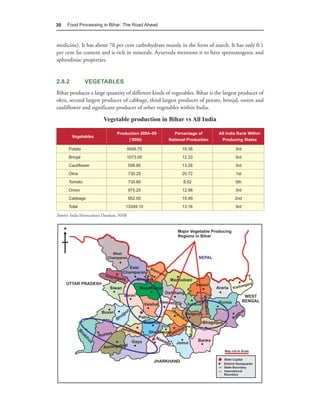
Bihar produces a large quantity of different kinds of vegetables. Bihar is the largest producer of
okra, second largest producer of cabbage, third largest producer of potato, brinjal, onion and
cauliflower and significant producer of other vegetables within India.

                          Vegetable production in Bihar vs All India

                                  Production 2004–05     Percentage of       All India Rank Within
        Vegetables
                                       (‘000t)         National Production    Producing States

      Potato                               5656.70           19.38                   3rd
      Brinjal                              1073.00           12.33                   3rd
      Cauliflower                          598.80            13.28                   3rd
      Okra                                 730.20            20.72                   1st
      Tomato                               735.80            8.52                    5th
      Onion                                975.20            12.98                   3rd
      Cabbage                              952.00            15.49                   2nd
      Total                            13349.10              13.16                   3rd

Source: India Horticulture Database, NHB
Bihar: A Brief Profile     31


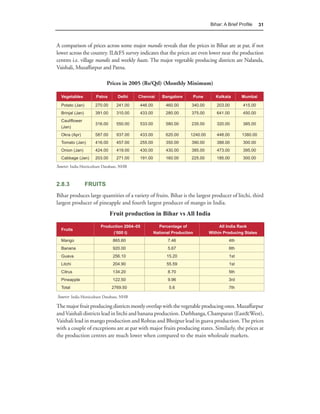
A comparison of prices across some major mandis reveals that the prices in Bihar are at par, if not
lower across the country. IL&FS survey indicates that the prices are even lower near the production
centres i.e. village mandis and weekly haats. The major vegetable producing districts are Nalanda,
Vaishali, Muzaffarpur and Patna.

                            Prices in 2005 (Rs/Qtl) (Monthly Minimum)

  Vegetables          Patna       Delhi    Chennai      Bangalore         Pune      Kolkata     Mumbai

  Potato (Jan)        270.00      241.00   446.00         460.00      340.00        203.00       415.00
  Brinjal (Jan)       391.00      310.00   433.00         280.00      375.00        641.00       450.00
  Cauliflower
                      316.00      550.00   533.00         580.00      235.00        320.00       385.00
  (Jan)
  Okra (Apr)          587.00      937.00   433.00         620.00     1240.00        448.00      1380.00
  Tomato (Jan)        416.00      457.00   255.00         350.00      390.00        388.00       300.00
  Onion (Jan)         424.00      419.00   430.00         430.00      385.00        473.00       395.00
  Cabbage (Jan)       203.00      271.00   191.00         160.00      225.00        185.00       300.00

Source: India Horticulture Database, NHB


2.8.3             FRUITS
Bihar produces large quantities of a variety of fruits. Bihar is the largest producer of litchi, third
largest producer of pineapple and fourth largest producer of mango in India.
                               Fruit production in Bihar vs All India
                         Production 2004–05           Percentage of                   All India Rank
  Fruits
                              (‘000 t)              National Production          Within Producing States
  Mango                         865.60                    7.46                            4th
  Banana                        920.00                    5.67                            6th
  Guava                         256.10                    15.20                           1st
  Litchi                        204.90                    55.59                           1st
  Citrus                        134.20                    8.70                            5th
  Pineapple                     122.50                    9.96                            3rd
  Total                        2769.50                     5.6                            7th

Source: India Horticulture Database, NHB

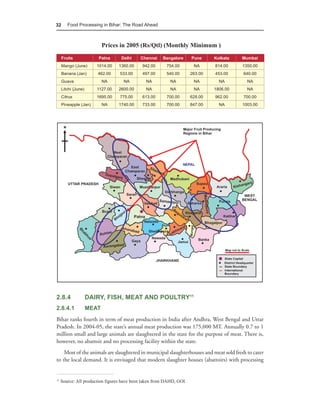
The major fruit producing districts mostly overlap with the vegetable producing ones. Muzaffarpur
and Vaishali districts lead in litchi and banana production. Darbhanga, Champaran (East&West),
Vaishali lead in mango production and Rohtas and Bhojpur lead in guava production. The prices
with a couple of exceptions are at par with major fruits producing states. Similarly, the prices at
the production centres are much lower when compared to the main wholesale markets.
32      Food Processing in Bihar: The Road Ahead


                            Prices in 2005 (Rs/Qtl) (Monthly Minimum )
     Fruits             Patna      Delhi    Chennai    Bangalore      Pune     Kolkata   Mumbai
     Mango (June)       1014.00   1360.00    942.00      754.00        NA      814.00    1350.00
     Banana (Jan)       462.00    533.00     497.00      540.00       263.00   453.00    640.00
     Guava                  NA      NA         NA          NA          NA        NA        NA
     Litchi {June)      1127.00   2600.00      NA          NA          NA      1806.00     NA
     Citrus             1695.00   775.00     613.00      700.00       628.00   962.00    700.00
     Pineapple (Jan)        NA    1740.00    733.00      700.00       847.00     NA      1003.00


2.8.4                DAIRY, FISH, MEAT AND POULTRY11
2.8.4.1              MEAT
Bihar ranks fourth in term of meat production in India after Andhra, West Bengal and Uttar
Pradesh. In 2004-05, the state’s annual meat production was 175,000 MT. Annually 0.7 to 1
million small and large animals are slaughtered in the state for the purpose of meat. There is,
however, no abattoir and no processing facility within the state.
    Most of the animals are slaughtered in municipal slaughterhouses and meat sold fresh to cater
to the local demand. It is envisaged that modern slaughter houses (abattoirs) with processing


11
     Source: All production figures have been taken from DAHD, GOI.
Bihar: A Brief Profile   33


facilities having due backward and forward linkage can contribute significantly to the growth
of value added products within this sector. The buffalo meat production in India is growing
at a CAGR of 5 per cent and the outstripping of demand vis-à-vis supply of lamb and mutton
presents a huge opportunity for Bihar to tap into given its large livestock resources.


2.8.4.2       POULTRY
The production of eggs amounted to 789 million eggs (1.75 per cent of the total egg production
in India) in the state in 2004–05. The livestock census carried out in 1982 estimated about 6
million birds in the state. The poultry rearing is mainly a homestead activity in the state with
slaughtering mainly occurring in the unorganised sector. No value addition is currently taking
place. Poultry meat is the fastest growing animal protein in India with a CAGR of 11 per cent
during 1991–2003 and estimated to increase further. Bihar with negligible share in national
poultry meat trade thus has every thing to gain by investing into and creating the right climate
to spur the production of poultry and value added products.


2.8.4.3       MILK
Bihar produces about 2.9 million MT of milk or just about or 3.28 per cent of the total
milk production in the country. However, only 9–10 per cent of production is processed by
COMFED (by Sudha Dairy) at 11 places in Bihar (Barauni, Muzaffarpur, Samastipur, Patna,
Gaya, Arra, Bhagalpur and Kaimur) and another 2–3 per cent in the private sector. Milk
processing capacity in India has grown at a CAGR of 4 per cent with almost negligible growth
in Bihar. The technology being used is now decades old with no primary processing / cooling
facility at the farm/village level.


2.8.4.4       FISH
Fish is one of the popularly consumed items in Bihar, particularly in Mithila region. It is the fastest
growing sub-sector indicating a growth rate of over 10 per cent per annum (NABARD, 2006).
Fish production in Bihar depicts increase in trend from a level of approximately 2,22,000 MT
in 2000–01 to 2,67,000 MT in 2004–05 (against an estimated demand of 3,00,000 MT).


2.8.5         SPICES
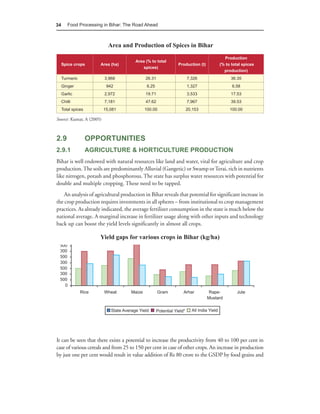
A variety of spices are produced in Bihar. Chilli accounts for 47.6 per cent of the area under
spices and 39.5 per cent of the production followed by turmeric, which occupies 26.3 per cent
of the area under spices and accounts for 36.4 per cent of the production in the state.
34       Food Processing in Bihar: The Road Ahead


                            Area and Production of Spices in Bihar
                                                                                  Production
                                       Area (% to total
     Spice crops       Area (ha)                           Production (t)       (% to total spices
                                          spices)
                                                                                  production)
     Turmeric             3,968             26.31               7,326                36.35
     Ginger                942              6.25                1,327                 6.58
     Garlic               2,972             19.71               3,533                17.53
     Chilli               7,181             47.62               7,967                39.53
     Total spices         15,081           100.00              20,153                100.00

Source: Kumar, A (2005)


2.9                 OPPORTUNITIES
2.9.1               AGRICULTURE & HORTICULTURE PRODUCTION
Bihar is well endowed with natural resources like land and water, vital for agriculture and crop
production. The soils are predominantly Alluvial (Gangetic) or Swamp or Terai, rich in nutrients
like nitrogen, potash and phosphorous. The state has surplus water resources with potential for
double and multiple cropping. These need to be tapped.
    An analysis of agricultural production in Bihar reveals that potential for significant increase in
the crop production requires investments in all spheres – from institutional to crop management
practices. As already indicated, the average fertilizer consumption in the state is much below the
national average. A marginal increase in fertilizer usage along with other inputs and technology
back up can boost the yield levels significantly in almost all crops.

                       Yield gaps for various crops in Bihar (kg/ha)


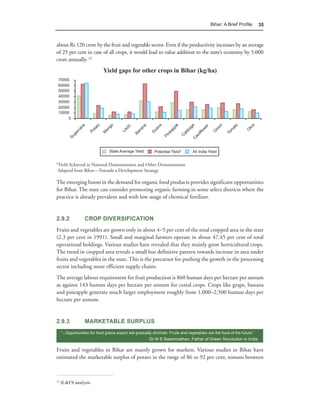
It can be seen that there exists a potential to increase the productivity from 40 to 100 per cent in
case of various cereals and from 25 to 150 per cent in case of other crops. An increase in production
by just one per cent would result in value addition of Rs 80 crore to the GSDP by food grains and
Bihar: A Brief Profile         35


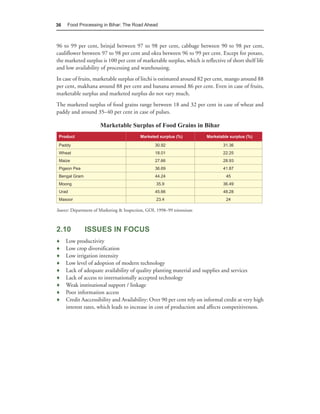
about Rs 120 crore by the fruit and vegetable sector. Even if the productivity increases by an average
of 25 per cent in case of all crops, it would lead to value addition to the state’s economy by 5,000
crore annually. 12
                              Yield gaps for other crops in Bihar (kg/ha)


*Yield Achieved in National Demonstration and Other Demonstration
 Adapted from Bihar—Towards a Development Strategy

The emerging boom in the demand for organic food products provides significant opportunities
for Bihar. The state can consider promoting organic farming in some select districts where the
practice is already prevalent and with low usage of chemical fertilizer.


2.9.2              CROP DIVERSIFICATION
Fruits and vegetables are grown only in about 4–5 per cent of the total cropped area in the state
(2.3 per cent in 1991). Small and marginal farmers operate in about 47.45 per cent of total
operational holdings. Various studies have revealed that they mainly grow horticultural crops.
The trend in cropped area reveals a small but definitive pattern towards increase in area under
fruits and vegetables in the state. This is the precursor for pushing the growth in the processing
sector including more efficient supply chains.
The average labour requirement for fruit production is 860 human days per hectare per annum
as against 143 human days per hectare per annum for cereal crops. Crops like grape, banana
and pineapple generate much larger employment roughly from 1,000–2,500 human days per
hectare per annum.


2.9.3              MARKETABLE SURPLUS
     “...Opportunities for food grains export will gradually diminish. Fruits and vegetables are the food of the future.”
                                                          Dr M S Swaminathan, Father of Green Revolution in India.

Fruits and vegetables in Bihar are mainly grown for markets. Various studies in Bihar have
estimated the marketable surplus of potato in the range of 86 to 92 per cent, tomato between


12
     IL&FS analysis
36   Food Processing in Bihar: The Road Ahead


96 to 99 per cent, brinjal between 97 to 98 per cent, cabbage between 90 to 98 per cent,
cauliflower between 97 to 98 per cent and okra between 96 to 99 per cent. Except for potato,
the marketed surplus is 100 per cent of marketable surplus, which is reflective of short shelf life
and low availability of processing and warehousing.
In case of fruits, marketable surplus of litchi is estimated around 82 per cent, mango around 88
per cent, makhana around 88 per cent and banana around 86 per cent. Even in case of fruits,
marketable surplus and marketed surplus do not vary much.
The marketed surplus of food grains range between 18 and 32 per cent in case of wheat and
paddy and around 35–40 per cent in case of pulses.

                     Marketable Surplus of Food Grains in Bihar
 Product                                 Marketed surplus (%)          Marketable surplus (%)

 Paddy                                           30.92                         31.36
 Wheat                                           18.01                         22.25
 Maize                                           27.66                         28.93
 Pigeon Pea                                      36.69                         41.87
 Bengal Gram                                     44.24                           45
 Moong                                           35.9                          36.49
 Urad                                            45.66                         48.28
 Masoor                                          23.4                            24

Source: Department of Marketing & Inspection, GOI, 1998–99 triennium


2.10           ISSUES IN FOCUS
♦    Low productivity
♦    Low crop diversification
♦    Low irrigation intensity
♦    Low level of adoption of modern technology
♦    Lack of adequate availability of quality planting material and supplies and services
♦    Lack of access to internationally accepted technology
♦    Weak institutional support / linkage
♦    Poor information access
♦    Credit Aaccessibility and Availability: Over 90 per cent rely on informal credit at very high
     interest rates, which leads to increase in cost of production and affects competitiveness.
3
                           Food Processing
                               in Bihar

            3.1           FOOD CONSUMPTION


            A
                    s a consumer, Bihar with a population of 83 million growing at about 2.43 per cent
                    per annum is a large and growing market for food products. Food is the single largest
                    component of private consumer expenditure, accounting for as much as 59 to 65 per
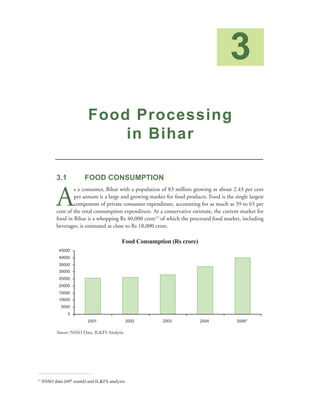
            cent of the total consumption expenditure. At a conservative estimate, the current market for
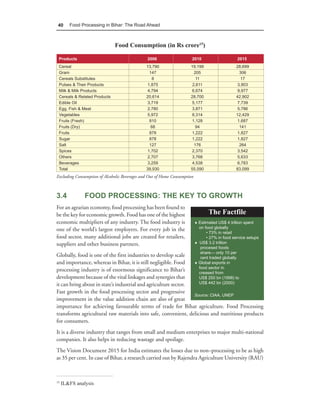
            food in Bihar is a whopping Rs 40,000 crore13 of which the processed food market, including
            beverages, is estimated at close to Rs 18,000 crore.

                                            Food Consumption (Rs crore)


            Source: NSSO Data, IL&FS Analysis


13
     NSSO data (60th round) and IL&FS analysis
38    Food Processing in Bihar: The Road Ahead


3.2          CONSUMPTION PATTERNS
The expenditure pattern indicates that consumption of cereals continues to dominate the
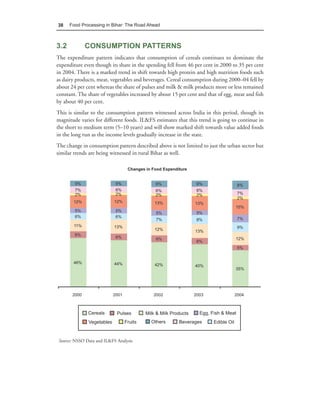
expenditure even though its share in the spending fell from 46 per cent in 2000 to 35 per cent
in 2004. There is a marked trend in shift towards high protein and high nutrition foods such
as dairy products, meat, vegetables and beverages. Cereal consumption during 2000–04 fell by
about 24 per cent whereas the share of pulses and milk & milk products more or less remained
constant. The share of vegetables increased by about 15 per cent and that of egg, meat and fish
by about 40 per cent.
This is similar to the consumption pattern witnessed across India in this period, though its
magnitude varies for different foods. IL&FS estimates that this trend is going to continue in
the short to medium term (5–10 years) and will show marked shift towards value added foods
in the long run as the income levels gradually increase in the state.
The change in consumption pattern described above is not limited to just the urban sector but
similar trends are being witnessed in rural Bihar as well.


 Source: NSSO Data and IL&FS Analysis
Food Processing in Bihar            39


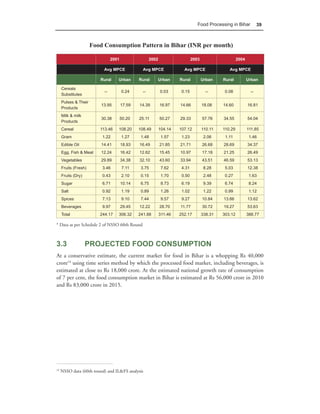
                      Food Consumption Pattern in Bihar (INR per month)

                                2001                  2002                    2003                     2004

                           Avg MPCE              Avg MPCE               Avg MPCE                 Avg MPCE

                         Rural     Urban       Rural     Urban        Rural          Urban    Rural           Urban

     Cereals
                           --          0.24      --          0.03      0.15            --      0.08             --
     Substitutes
     Pulses & Their
                          13.95        17.59   14.39         16.97    14.66          18.08    14.60           16.81
     Products
     Milk & milk
                          30.38        50.20   25.11         50.27    29.33          57.76    34.55           54.04
     Products
     Cereal              113.46    108.20      108.49        104.14   107.12         110.11   110.29          111.85
     Gram                 1.22         1.27     1.48          1.57     1.23           2.06     1.11            1.46
     Edible Oil           14.41        18.93   16.49         21.85    21.71          26.68    28.69           34.37
     Egg, Fish & Meat     12.24        16.42   12.62         15.45    10.97          17.18    21.25           26.49
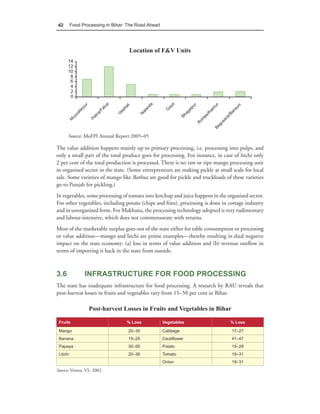
     Vegetables           29.89        34.38   32.10         43.60    33.94          43.51    46.59           53.13
     Fruits (Fresh)       3.46         7.11     3.75          7.62     4.31           8.28     5.03           12.38
     Fruits (Dry)         0.43         2.10     0.15          1.70     0.50           2.48     0.27            1.63
     Sugar                6.71         10.14    6.75          8.73     6.19           9.39     6.74            8.24
     Salt                 0.92         1.19     0.89          1.26     1.02           1.22     0.99            1.12
     Spices               7.13         9.10     7.44          9.57     9.27          10.84    13.66           13.62
     Beverages            9.97         29.45   12.22         28.70    11.77          30.72    19.27           53.63
     Total               244.17    306.32      241.88        311.46   252.17         338.31   303.12          388.77

* Data as per Schedule 2 of NSSO 60th Round


3.3                 PROJECTED FOOD CONSUMPTION
At a conservative estimate, the current market for food in Bihar is a whopping Rs 40,000
crore14 using time series method by which the processed food market, including beverages, is
estimated at close to Rs 18,000 crore. At the estimated national growth rate of consumption
of 7 per cent, the food consumption market in Bihar is estimated at Rs 56,000 crore in 2010
and Rs 83,000 crore in 2015.


14
     NSSO data (60th round) and IL&FS analysis
40     Food Processing in Bihar: The Road Ahead


                              Food Consumption (in Rs crore15)

 Products                                      2006                    2010                      2015
 Cereal                                        13,790                 19,199                     28,699
 Gram                                            147                    205                        306
 Cereals Substitutes                               8                     11                         17
 Pulses & Their Products                        1,875                  2,611                      3,903
 Milk & Milk Products                           4,794                  6,674                      9,977
 Cereals & Related Products                    20,614                 28,700                     42,902
 Edible Oil                                     3,719                  5,177                      7,739
 Egg, Fish & Meat                               2,780                  3,871                      5,786
 Vegetables                                     5,972                  8,314                     12,429
 Fruits (Fresh)                                  810                   1,128                      1,687
 Fruits (Dry)                                     68                     94                        141
 Fruits                                          878                   1,222                      1,827
 Sugar                                           878                   1,222                      1,827
 Salt                                            127                    176                        264
 Spices                                         1,702                  2,370                      3,542
 Others                                         2,707                  3,768                      5,633
 Beverages                                      3,259                  4,538                      6,783
 Total                                         39,930                 55,590                     83,099
Excluding Consumption of Alcoholic Beverages and Out of Home Consumption


3.4            FOOD PROCESSING: THE KEY TO GROWTH
For an agrarian economy, food processing has been found to
be the key for economic growth. Food has one of the highest                       The Factfile
economic multipliers of any industry. The food industry is                 ♦ Estimated US$ 4 trillion spent
                                                                             on food globally
one of the world’s largest employers. For every job in the
                                                                                 • 73% in retail
food sector, many additional jobs are created for retailers,                     • 27% in food service setups
suppliers and other business partners.                                     ♦ US$ 3.2 trillion
                                                                              procesed foods
                                                                              share— only 10 per
Globally, food is one of the first industries to develop scale                cent traded globally
and importance, whereas in Bihar, it is still negligible. Food             ♦ Global exports in
                                                                             food sector in
processing industry is of enormous significance to Bihar’s                   creased from
development because of the vital linkages and synergies that                 US$ 250 bn (1998) to
it can bring about in state’s industrial and agriculture sector.             US$ 442 bn (2000)

Fast growth in the food processing sector and progressive
                                                                 Source: CIAA, UNEP
improvement in the value addition chain are also of great
importance for achieving favourable terms of trade for Bihar agriculture. Food Processing
transforms agricultural raw materials into safe, convenient, delicious and nutritious products
for consumers.
It is a diverse industry that ranges from small and medium enterprises to major multi-national
companies. It also helps in reducing wastage and spoilage.
The Vision Document 2015 for India estimates the losses due to non–processing to be as high
as 35 per cent. In case of Bihar, a research carried out by Rajendra Agriculture University (RAU)


15
     IL&FS analysis
Food Processing in Bihar   41


estimates the post-harvest losses in case of fruits
varies from 15–25 per cent in banana to 30–50 per              The Largest Employers
cent in papaya and in case of vegetables it varies           The Food & Drinks industry is one of
from 17–27 per cent in cabbage to 41–47 per cent             the largest employers worldwide. In
in cauliflower. Just the arrest of the losses in fruit       Australia, the F&D industry employs
and vegetables in the state through processing and           about one in five of the manufactur-
                                                             ing workforce.
post-harvest management will result in an increase
in income of Rs 2,000 crore to the economy. The              The F&D industry also has an
loss in cereal is estimated at Rs 4,500 crore.               important employment multiplier
                                                             effect. For example, it is estimated
Creating the necessary infrastructure for post-harvest       that each job in the European soft
handling and food processing will directly increase          drink sector generates up to an
the farm gate prices, rural income and increased             additional ten jobs (with suppliers,
                                       employment.           retailers etc.).
 It is estimated that the incomes of
 farmers and rural workers increase       Food processing industries will help in establishing
 by an average of 100 to 200 per          technology linkages, marketing channels besides reducing
 cent due to establishment of food        wastages. Growth of food industry has direct benefits on the
 processing project in a region. Yields
                                          lives of farmers and rural workers.
 increase by 50 to 250 per cent. The
 potential for employment is high.
                                    The present action plan envisages an investment of Rs 1,670
 (CII–Mckinsey FAIDA Report)
                                    crore including a proposed budgetary outlay of Rs 770 crore
during the Eleventh Five Year Plan. Assuming a leveraging ratio of 2.5, an investment of Rs
1,670 crore in the sector can lead to a total investment of Rs 4,175 crore. Using the global
thumb rule of creation of 140 jobs per crore of investment, an investment of Rs 4,175 crore
will lead to creation of 5,84,500 additional jobs. Additionally, assuming a reasonable turnover
ratio of 2, a total investment of Rs 4,175 crore will lead to an additional aggregate turnover of
Rs 8,350 crore to the state’s economy.


3.5            CURRENT STATUS
In Bihar, the level of processing is negligible barring the dairy industry where the level of
processing is between 9–10 per cent. The low levels of processing are a combination of complex
issues including Bihar’s Investment Climate (IC), traditional demand for fresh produce,
infrastructure constraints, weakness of local factor markets and institutional support.
The major food processing activities in the state are milling and milk processing. Currently,
there are 58 roller flour mills (about half of them closed), 4,872 (3.5 per cent of total rice mills
in India) rice mills (comprising 4,749 hullers, 63 shellers, nine huller cum shellers and only
51 modern cum modernised mills). There are 45 licensed fruit and vegetable processing units
(0.7 per cent of the all India units).
The food processing in Bihar today is mainly in the unorganised sector with over 1,000 bakeries
and confectioneries and even small-scale grain processing continuing in the unorganised sector.
The estimated growth rate of food processing sector in Bihar during the last two to three years
has been 3.46 per cent as compared to an all-India figure of about seven per cent.
42        Food Processing in Bihar: The Road Ahead


                                    Location of F&V Units


      Source: MoFPI Annual Report 2005–05

The value addition happens mainly up to primary processing, i.e. processing into pulps, and
only a small part of the total produce goes for processing. For instance, in case of litchi only
2 per cent of the total production is processed. There is no raw or ripe mango processing unit
in organised sector in the state. (Some entrepreneurs are making pickle at small scale for local
sale. Some varieties of mango like Bathua are good for pickle and truckloads of these varieties
go to Punjab for pickling.)
In vegetables, some processing of tomato into ketchup and juice happens in the organised sector.
For other vegetables, including potato (chips and fries), processing is done in cottage industry
and in unorganised form. For Makhana, the processing technology adopted is very rudimentary
and labour-intensive, which does not commensurate with returns.
Most of the marketable surplus goes out of the state either for table consumption or processing
or value addition—mango and litchi are prime examples—thereby resulting in dual negative
impact on the state economy: (a) loss in terms of value addition and (b) revenue outflow in
terms of importing it back in the state from outside.


3.6             INFRASTRUCTURE FOR FOOD PROCESSING
The state has inadequate infrastructure for food processing. A research by RAU reveals that
post-harvest losses in fruits and vegetables vary from 15–50 per cent in Bihar.

                  Post-harvest Losses in Fruits and Vegetables in Bihar

 Fruits                            % Loss            Vegetables                 % Loss

 Mango                             25–30             Cabbage                     17–27
 Banana                            15–25             Cauliflower                 41–47
 Papaya                            30–50             Potato                      15–29
 Litchi                            20–36             Tomato                      19–31
                                                     Onion                       19–31

Source: Verma, VS, 2002.
Food Processing in Bihar   43


A study by Department of Marketing and Inspection, GoI records that the post-harvest losses
of food grains in Bihar vary from three to six per cent. This, however, does not account for
farm level losses.

                            Post-harvest Losses in Food Grains
 Crop                             % Loss            Crop                         % Loss

 Paddy                             4.88             Bengal Gram                   3.66
 Wheat                             4.15             Moong                         2.98
 Maize                             3.79             Urad                          2.73
 Pigeon Pea                        3.22             Masoor                        5.66

Source: Department of Marketing & Inspection, GoI


3.7           WAREHOUSING AND SORTING
Bihar has a total food grains storage capacity of 13.4 lakh tonne which caters to only 12 per
cent of the total produce in the state. Besides, there are only about 120–130 rural godowns as
against 7,000 rural markets. There is an urgent need to construct rural godowns for the benefit
of small and marginal farmers.

              State-wise Storage Capacity as on 1.3.2005 (Lakh Tonne)

  State                     FCI            CWC             SWC      Others         Grand Total
  Andhra Pradesh           33.68            14.4           22.82     12.85            83.75
  Bihar                     4.91            0.97            2.03      5.49             13.4
  Haryana                  22.95             4.4           16.07      15.9            59.32
  Maharashtra              15.71           15.64            12.2     13.69            57.24
  Orissa                    6.25            1.88            4.05      4.52             16.7
  Punjab                   77.81            7.74           60.12     60.67           206.34
  Uttar Pradesh             25.6           11.56           28.88     14.95            80.99
  Chhatisgarh               9.27            2.37            6.07        0             17.71
  Grand Total             260.31           101.9           195.2     170.6           728.01

Source: Department of Food and Public Distribution, GOI

Bihar has 215 cold stores of which only 5.6 per cent are in the cooperative sector, rest belonging
to the private sector. Most of the cold storage space (76.75 per cent) is being used to store
potatoes.
The existing capacity in the State is extremely inadequate to cope up with the production and
hence there is urgent need to create warehousing infrastructure at vantage point.
44        Food Processing in Bihar: The Road Ahead


                                         Cold Storages in Bihar
                                                                             Capacity
  S. No        Description                                Nos.
                                                                  Cubic meter       Metric tonne
     1.        Total cold storages                        215      2359060              778550
     2.        Total in private sector                    203      2182461              721850
     3.        Total in co-operative sector                12      176599               56700
     4.        Total in public sector                     Nil        Nil                 Nil
     5.        Total for potato                           165      1781469              586912
     6.        Total for multipurpose                      50      577591               191638
     7.        Total for fish & marine products           Nil        Nil                 Nil
     8.        Total for milk products & others           Nil        Nil                 Nil
     9.        % Share of private sector on total        94.40%       –                 92.70%
     10.       % Share of co-operative sector on total    5.60%       –                  7.30%
     11.       % Share of public sector on total             0        –                     0
     12.       % Share of potato on total                76.75%       –                 75.40%
     13.       % Occupation for multipurpose             23.25%       –                 24.60%
     14.       % Share of fish, marine & others              0        –                     0

Source: Govt. of Bihar


3.8             MARKETING CHANNELS
There are more than 7,000 rural markets and haats in addition to erstwhile 95 APMC mandis
and 32 principal markets yards. Out of these 7,000 only about 855 rural haats have their own
buildings and premises for providing rudimentary grading and sorting facilities.
The principal market yards are complete structures with adequate provision for grading, sorting,
storage including cold stores, etc. However, the Government of Bihar estimates only 70 grading
and sorting facilities in the state.
There exists a large chain of intermediaries in the marketing system of cereals, fruits and
vegetables from the farm gate to the end user. High proportions of vegetables are sold in the
rural / periodical markets (haats) or though village sales. This is much higher in case of small
and marginal farmers.
                 Three channels through which the produce is marketed
Food Processing in Bihar   45


There are primarily three channels through which the produce is marketed as under. The share
of the producer / farmers varies depending on the produce and the channel employed.

                                  Price Received by Farmers (%)
                                              Channels 1 & 2                     Channel 3

     Potato
     Darbhanga                                     56.08                           54.53
     Katihar                                       62.07                           61.77
     Nalanda                                       57.06                           59.23
     Tomato
     Darbhanga                                     56.84                           63.33

Source: Prasad J, ANSISS, 1999

In terms of the various marketing costs borne by different players, retailers and farmers typically
bear the cost of sorting and cleaning, farmer and village intermediary bear the cost of packing
and bagging, intermediaries bear the cost of weighing, loading and unloading, wholesalers
mainly bear the cost of storage, if any, transport charges are shared between all the players in
varying proportion, physical handling/losses are borne by farmer, wholesaler and retailer and
market charges by the intermediaries.
However, it was found that the producer has to bear in some proportion or the other, the cost
of various items of marketing. This leads to a low realisation at the farm level whereas the cost
at terminal mandi is more or less at par with major mandis in the country, giving no specific
advantage to the producers/processors or consumers.


3.9              POTENTIAL FOR FOOD PROCESSING IN BIHAR
The value addition in Fortune Product International (FPI) in India is estimated at about 20 per
cent.16 The level of processing varies across segments and states. Given the current low level of
processing in the state, there exists a tremendous potential if the right IC, operating environment
and policy impetus are provided for the sector. The emerging retail boom provides another big
opportunity for the state to establish food processing industries in the state.
Bihar already has a few agricultural commodities to cater to niche markets. For a gainful utilisation
of the existing potential, infrastructure creation and institutional development holds the key.
A decrease in post-harvest losses by just one per cent will result in value addition of Rs 80 crore
to the GSDP by food grains and about Rs 120 crore by the fruit and vegetable sector. Thus,
the total value addition to the state GSDP simply by minimising losses to 2 per cent in food
grains and 15 per cent in Fruits and Vegetables would lead to a value addition in the GSDP by
approximately Rs 2000 crore.17


16
     Adapted from Vision 2015: Strategy & Action Plan for FPI In India
17
     IL&FS analysis
46    Food Processing in Bihar: The Road Ahead


The multiplier effect of investment in food processing industry on employment generation
is 2.5 times more than in any other industrial sector. Even within food processing industry,
the employment intensity is significantly higher in the unorganised sector as compared to the
organised sector for the same level of investment. For every Rs 10 million of investment, 1,050
jobs are created in the unorganised sector against 140 jobs in the organised sector.
Processing, in spite of all the constraints in the state, has a few success stories to show the path for
the food processing industry. The Bihar state Cooperative Milk Producer’s Federation (COMFED)
is one example and the ‘makhana’ industry is another along with litchi. In fact, COMFED is
one of the few success stories of organised milk processing within India. COMFED’s success is
based on integrated vertical and horizontal linkages across the supply chain of milk. It provides
all the elements of supply chain intervention to its members—upgradation of milk production
technology (including milch animals varietal and productivity enhancements), animal health,
efficient procurement, storage and processing (using appropriate and latest technology), market
linkage etc. COMFED procures 5.75 lakh litres of milk per day through milk unions—the milk
procurement has increased by about 8 times from 1991–92 to 2005–06. It processes about nine
per cent of the milk processed in the state.

                                  Makhana Processing
Makhana or gorgon nut is unique to Bihar as it is grown commercially only in Bihar. It contributes around Rs 250
crore at farm gate prices and Rs 550 crore at retail prices annually to the state’s economy. Close to organic based
cultivation gives an added advantage to the crop particularly in the export market. Edible part of makhana contain
12.8 per cent moisture, 9.7 per cent protein, 0.1 per cent fat, 0.5 per cent
minerals, 76.9 per cent carbohydrates, and 1.4 mg/100 g of carotene. Calorific
analysis gives a value of 362 kcal/100 g for raw makhana and 328 kcal/100 g
for popped makhana. Thus, the calorific value of makhana compares well with
staple food materials such as wheat, rice, etc. Makhana is considered superior
to dry fruits such as almonds, walnut, coconut and cashew nut in terms of sugar,
protein, and ascorbic acid and phenol content. The medicinal properties of
makhana are also well established at least in China where it has been made
mandatory ingredient in baby foods.

                                            A Case Study
Prayag Sahani lives in Bhairo Paatti of Darbhanga. He lives with about half a dozen other families here all of
whom are engaged in makhana processing. He works with his wife and children to process makhana seeds into
makhana pops. A group of 3 family members process 4 to 6 tonne of makhana seeds every year. On an average
60 kg is processed every day. They mainly process makhana on share basis. Farmers give them makhana seed
and collect makhana pops. For every 126 kg makhana seed farmers are given 40 kg makhana pops and 10–12 kg
makhana pops remain with the processors for their services. Processors have to use about 40 kg of wood per day
to process 60 kg makhana seeds and this wood costs Rs 160. One kg of makhana pop is sold at Rs 100–140/kg.
There are about 10,000 persons engaged in makhana processing in Darbhanga district alone and in Madhubai
district the number is more.
The harvesting and popping process is as under:
♦   The harvesting, during winter season, is done manually by fishermen diving under water and taking out Guri
    (Makhana seeds) embedded underwater (1.5–2.5 feet of standing water body) for long hours under trying
    conditions. They are paid a pittance and get addicted to drinking to counter intense cold water.
♦   The roasting and splitting of makhana seeds is very tedious and back breaking work. The hot seeds are hand
    placed in a platter for splitting for hours together which damages the left palm of the worker.
♦   The whole process right from planting to roasting needs a re-look to ensure areas where the process can be
    re–engineered to not only bring relief to the workers but also increase productivity. The makhana seeds are
    graded, cleaned, dried. Grading is done so that the heating and pressure for pop making remain uniform.
    The method is crude, unhygienic and risky for the processors. There is scope of developing mechanised
    processing.
Food Processing in Bihar      47


3.10         CEREALS AND PULSES
There exists a large potential for scientific milling and processing of food grains like rice, wheat,
maize and pulses. In case of rice and wheat, dated technologies like hullers or shellers are used
for milling resulting in lower recovery and consequent lower value. There is no large-scale
processing unit for maize in the state. There are a couple of processing units working as registered
units and there is no fair estimate of the number of small unregistered units processing maize
in flour and poultry feed etc. Such units operate at small scale as household processing units.
However, no details are available on the number of these small units and quantity of maize
processed with in the state.
There is a huge scope for maize processing in the state. Data indicates that establishment of
poultry; as well as animal feed processing units may be a success in the state. Looking into the
large quantity of maize in food system, processing of maize for snack and other food items may
also be planned. Feasibility of installing industrial units to process maize to get starch, ethanol
and alcohol etc need to be studied
Recently there has been interest shown by large private players in maize processing in the
state of Bihar. M/s India Gasohol Ltd., Tamil Nadu, has already planned to install four maize
processing plants with an investment of Rs 2,500 crore in Begusarai, Muzaffarpur, Bhagalpur
and Vaishali districts of Bihar. They plan to produce ethanol, alcohol, extra neutral alcohol and
crucial oils etc.


3.11         FRUIT AND VEGETABLE PROCESSING
There are only 45 licensed fruit and vegetable processing units in the state. Most of these units
are engaged in the manufacture of fruit juices, fruit pulps (excluding frozen), squashes, pickles,
tomato ketchup/sauce, tomato juice, tomato puree, tomato paste, jam/jelly/marmalades,
squashes/crushes/cordials, barley waters, fruit beverages, chutneys, fruit juice concentrate (except
tamarind), etc. There are a few more units along similar lines in the unorganised sector also
which are involved in minimal processing. However, the industry estimates that only about 2–3
per cent of the total produce is processed.
Farm level pre-processing facilities such as pre-cooling facilities, cooling facilities, collection
centers, grading and sorting systems, washing and cleaning facilities and pack houses, etc.,
are absent. These are critical to preserve quality
and prevent temperature shocks immediately after             World Trade Expanding
harvest. Warehousing and storage system for fruits
                                                          The world trade in agri-food products con-
and vegetables are absent except for potatoes and a       tinues to expand, with total global exports
few for onions. The entire produce after harvest is       increasing from USD 250 billion in 1988 to
immediately transported to the markets within and         USD 442 billion in 2000. During this time,
outside state and some to the processing units mainly     processed food’s share of the agri-food
for fruits.                                               trade has also grown. For example, F&D
                                                             industry exports now represent (in value
The fruit and vegetable processing segment is                terms) 79% of EU global agricultural and
marked by a complete absence of cold chain along             food product exports.

the value chain resulting in quality deterioration                                     (CIAA/UNEP)
and degradation of raw materials. Similarly, even
48      Food Processing in Bihar: The Road Ahead


after processing, the products are kept under minimal refrigeration or no refrigeration. A large
number of these units are working on work-order basis for larger chains and as such find that
the operating margins being thin leave no scope of either technology upgradation or expansion.
Fruits and vegetables have been shown to earn 20–30 times more foreign exchange per unit
area than cereals due to higher yields and higher price available in the international market
(Planning Commission study in 2003).
Case studies of mango and litchi explain this explicitly.


3.12               SWOT ANALYSIS: THE CASE OF MANGO
Bihar is the fourth largest producer of mango in India. However, up to 20 per cent of mango18
is exported out of the state for pickling, chutney and jam and jelly making.

             Strengths                      Weaknesses                  Opportunities              Threats

     Highly conducive agro-         Most existing orchards de-      Scope for promoting       Large gap be-
     climate, fourth largest        veloped unscientifically and    mango based mixed         tween available
     producer of mango              wide technology adoption        cropping /inter crop-     and adopted
                                    gaps                            ping among small          technology at
                                                                    growers                   field level
     About 11% share in the         Mango is having a gesta-        High and stable re-       Lack of strict ob-
     national production. High      tion period of 5 years and      turns compared to         servance of quar-
     quality table varieties like   it suffers from the “Alter-     cereals and pulses        antine regulations
     Maldah / Langra, Sipia,        nate–bearing” problem                                     for the export of
     Gulabkhas, Krishnbhog,                                                                   specific fruits
     Jaradalu, Dashaheri
     and Chausa grown com-
     mercially. Varieties like
     Chausa and Dashaheri
     are suitable for exports
     Many varieties produced        Inadequate storage and          Peak production in        Frequent and pro-
     and varying maturity time      processing facilities lead to   Bihar coincides with      longed floods may
     makes it available for         high post-harvest losses        lean period in some       affect the produc-
     more than four months—                                         of the other mango        tion strategy.
     from 1st fortnight of May                                      producing states.
     to 2nd fortnight of Aug.
                                    Existing trade mechanisms       Less than one per
                                    and lack of market intelli-     cent of the total fruit
                                    gence allow intermediaries      production is being
                                    take away.                      processed.


18
     IL&FS survey and market analysis
Food Processing in Bihar         49


3.13             SWOT ANALYSIS: THE CASE OF LITCHI

  Strength                  Weakness                    Opportunities                   Threat

 Substantial area          Lack of appropriate         Climate specific crop           Climate-specific crop
 under litchi production   packaging

 Suitable climate          Lack of quality planting    Possibility of area expansion   Short storage life.
                           material

 Bihar is widely           Very short shelf life.      Possibilities of increasing     Susceptible to pest
 known for Litchi.                                     yield by better management      and diseases.
                                                       practices

 Better return             High post-harvest losses.   Scope for value addition
 per unit area                                         by increasing shelf life and
                                                       processing.

                           Lack of proper post-        High export potential.
                           harvest & processing
                           facilities


3.14             MEAT, DAIRY, POULTRY AND FISHERY
Bihar ranks fourth in term of meat production in India. There is, however, no abattoir and no
processing facility within the state. No value addition is currently taking place.
Most of the meat is slaughtered in municipal slaughterhouses and sold fresh to cater to the
local demand. It is envisaged that modern slaughter houses (abattoirs) with processing facilities
having due backward and forward linkage can contribute significantly to the growth of value
added products in this sector. The buffalo meat production in India is growing at a CAGR of 5
per cent and the outstripping of demand vis-à-vis supply of lamb and mutton presents a huge
opportunity for Bihar to tap into its large livestock resources.
Poultry meat is the fastest growing animal protein in India with a CAGR of 11 per cent during
the last 15 years. Bihar with negligible share in national poultry meat trade thus has every thing
to gain by investing into and creating the right climate to spur the production of poultry and
value added products.
Only 9–10 per cent of milk produced is processed by COMFED (Sudha Dairy at 11 places in
Bihar —Barauni, Muzaffarpur, Samsastipur, Patna, Gaya, Arra, Bhagalpur and Kaimur) and
another 2–3 per cent in the organised private sector. Although, milk processing capacity in India
is growing at a CAGR of 4 per cent, it has shown negligible growth in Bihar.
Milk processing presents a huge potential in Bihar even if it were to reach half of the country
processing level or around 17–18 per cent. This would mean doubling the existing processing
capacities. The technology being used in the processing facilities is now decades old, with no
primary processing/cooling facility at the farm/village level.
Fish is one of the popularly consumed items in Bihar, particularly in Mithila region and it is the
fastest growing sub sector indicating a growth rate of over 10 per cent per annum (NABARD,
2006). An area of 1,13,664 ha is available in Bihar in the form of tanks/ponds, mauns (ox-bow
50    Food Processing in Bihar: The Road Ahead


lakes), chaurs (flood plains) and reservoirs. In addition to this, there is big potential in the large
low-lying area of about 3,38,745 ha, which can be suitably developed for various aquaculture
activities. Against the huge water resources potential available, only 26,000 ha (7.68 per cent)
of water areas have been developed for fish culture.
No processing, however, takes place and there are no fish processing industries in the state.
Another more serious handicap in the development of fisheries is the absence of a proper
marketing system. At present, only about three per cent of the total fish landings are handled
by organised sector
Given that these sectors are growing very fast nationally – consumption of milk and milk
products is growing at 7.6 per cent, poultry meat consumption at 26 per cent, and freshwater fish
consumption at 3.5 per cent (likely to grow to 3.9 per cent). They present a huge opportunity
for the state to cash in with appropriate strategies and market linkages.


3.15         HONEY
In India, production of honey is very low compared to China, the highest producer, which
exports 80,000 tonne annually compared to India’s 7,000 tonne. Honey production in the
country is only about 27,000 tonne a year. Only about 20 per cent to 25 per cent of the bees
are being exploited at present.
India is also one of the low end consumer and in spite of its rich nutritive value, honey is still
confined to Ayurvedic drug industry and is yet to become a regular food item. Against a per
capita consumption of 1.5 kg in Germany, the Indian per capita consumption is only 5 gm.
However, honey is increasingly being recognised as food item in India nowadays and thus
presents a significant market potential for the product in the years to come.
Bihar is one of the leading honey producing states in India. The main regions in which beekeeping
is done are the districts of Muzaffarpur, Vaishali, Sitamarhi, Champaran, Madhepura, Katihar
and Begusarai. Approximately 3,900 MT of honey was produced in the state out of the total
country’s production of 8,400 MT in 2002. Bihar is the only state producing litchi honey on
commercial scale, and it should rank at par with some of the premium honey in world market
such as the Block Forest Honey of Germany and the Spanish Orange Honey in terms of its
uniqueness and quality.
Honey yield with the Italian honeybee species is the highest in Bihar as compared to other
states with a production rate of 40 and 60 kg honey/hive/year under stationary and migratory
bee keeping respectively.
The processing industry has not kept pace with the increase in beekeeping in the state with no
large processing unit within the state. There are a handful of processing units in the organised
sector with most of the processing happening in the unorganised sector with the main being
the processing plant run by Mirzanagar Gramudyog Samiti.
Food Processing in Bihar     51


                             A Calendar of Bee Flora in Bihar
 Flora        Jan     Feb     Mar     Apr     May     Jun    Jul    Aug    Sep     Oct    Nov     Dec

 Mustard       X                                                                           X      X
 Mango                 X       X       X
 Litchi                        X       X
 Karanj                                X       X
 Guava                                 X       X                     X      X      X
 Pineapple                             X       X       X


The Bihar State Honey Federation has provided the much needed thrust to honey production
in the state by announcing a minimum support price of Rs 45 per kg in 2004–05 when price
nosedived across the country.
Small quantities is procured and packed by the KVIC units. However, buyers from North India
like Dabur India Ltd, Honeybee Natural Products Ltd., Kejriwal and some other traders pick
up the bulk of the honey.


3.15.1        POTENTIAL OF BEEKEEPING IN THE STATE
Beekeeping has a tremendous potential in Bihar. Taking the acreage of Litchi as about 24, 000
hectares, Bihar can support 2,40,000 bee colonies on Litchi alone. The crops of Mango, Guava,
Mustard, and Rapeseed can help the bee colonies develop for the Litchi honey flow. Though
the crops of rapeseed of over 100, 000 hectares as shown above can support around 10 lakh bee
colonies, these crops normally just help to build up the bee colonies after the severe monsoon
and help them increase in population for the summer honey flows on Litchi and Karanj.
In the world market the demand for honey is around one million tonne. There is an immense
possibility for India to increase its export share from 7,000 tonne to three lakh tonne and Bihar
can lead the way to capture this market as it has shown with the increase in productivity. At a
conservative estimate, given the various cropping pattern and area under different crops suitable
for bee keeping, Bihar has the potential to produce about 40,000 MT of honey with an estimated
value of Rs 200 crore annually and creation of more than 6,00,000 employments.


3.16          CONFECTIONERY, BAKERY AND BISCUITS
Globally bakery and confectionery industries are the first of the food processing industries to be
established in a region and are among the largest of the food processing industries. India is no
exception—bakery in India is probably the largest among the processed food industries, production
of which has been increasing steadily in the country. The two major bakery industries, viz., breads
and biscuits account for about 82 per cent of the total bakery products. The annual production of
bakery products which include breads, biscuits, pastries, cakes, buns, rusk, etc., most of which are in
the unorganised sector, is estimated to be in excess of 30 lakh tonne. The production of breads and
biscuits in the country, both in the organised and unorganised sectors, is estimated to be around 15
lakh tonne and 11 lakh tonne respectively.
52    Food Processing in Bihar: The Road Ahead


The Indian bakery industry is dominated by the small scale sector with an estimated 50,000
small and medium–size producers, besides around 15 lager scale units.
The Indian confectionery market includes sugar boiled confectionery, hard-boiled candies,
toffees and other sugar-based candies. Sugar boiled confectionery has penetrated an estimated
15 per cent of the households only, suggesting a large potential for growth.
The annual per capita consumption of branded confectionery in India is still under 100 gm.
Hard-boiled candy is reserved for the small-scale sector. There are about 5,000 units catering
to the local markets. The big players have used a mix of franchise arrangements (with small
units) and product formulations to get out of the reservation mode.
The total volume of the sugar boiled confectionery market in the organised sector
(comprising plain / hard boiled candies, toffees, eclairs and gums) is around Rs 2,000 crore.
Add to this the unorganised sector and the market for all types of confectionery are of the order
of Rs 5,000 crore. However, in value terms, the organised sector commands 60 per cent of
market share. With the exit of MNCs and other established organised players from very low
priced (25 paise) category, the unorganised sector has grown very fast.
The Indian snack foods market is of the order of 4,00,000 tonne. At low average price of Rs
35 a kg, the value is of the order of Rs 1,400 crore. With a larger share still remaining in the
small informal sector, the value—as well as tonnage—could be much higher.
There is a wide range of products available in the snack food market, which is explained by
the diverse tastes and life styles of each region. Potato chips are a sizeable segment but potato
chips constitute only a small share—1.0 to 1.5 per cent. In terms of volume, it is of the order
of 6,000 TPA. Together with the unbranded chips and like products, the total market is five
times larger.
In Bihar, though no production and consumption figures are available for this segment, industry
estimates suggest that there are large numbers of players, over 1,000, mainly in the unorganised
sector. While the unorganised sector caters to mainly the rural markets, the national brands and
large players mainly cater to the urban markets. The unorganised sector is burdened with the use
of low, dated technologies, which presents issues of food safety, quality and lower recovery.
4
         Factors Critical to
          Successful Food
        Processing Industry

4.1           CORE INFRASTRUCTURE


L
       ike any other industry, food processing industry also needs well developed core
       infrastructure such as rural roads, farm connectivity, water supply, uninterrupted power,
       access to credit and technology and enabling institutional support to grow. These factors
need to be addressed to an integrated manner on priority to facilitate the development of the
food processing industry in the state.


4.2           SUPPLY CHAIN
An inefficient raw material supply chain affects food processing industry in the country as a
whole. To establish an efficient raw material supply chain, interventions across the value chain
in terms of infrastructure, investment and management are required which call for a holistic
approach to the supply chain management. The efforts so far in the country in general have been
fragmented and more so in Bihar. Bihar can learn from the experience elsewhere and make a
beginning with some of the tried and tested models prevalent elsewhere giving it a head start.
An integrated and efficient supply chain is more or less non-existent in Bihar. It has been
estimated by the Department of Marketing and Inspection, GoI, that in Bihar only 365 MT
per 10 km of storage capacity is available. The cost of storage is as high as Rs 7.5/qtl per month
compared to Rs 2–2.5 per quintal per month elsewhere. Rural pack houses, grading and sorting
facilities, collection centres, pre-cooling facilities, appropriate packaging and packaging facilities,
transportation (normal, insulated, refrigerated, reefer vans, etc.), integration with industry and
markets are more or less non-existent.
54    Food Processing in Bihar: The Road Ahead


A Profile of a typical integrated food zone with centralised infrastructure for processing is
given below.


In view of the experience gained in the implementation of some of the infrastructure schemes
in the food processing sector in various states in the country, a new approach to processing
is proposed. The approach will rely on cluster-based approach with the creation of requisite
infrastructure across the value chain with involvement of stakeholders. This will focus on a zone
which will provide economies of scale and deal with multi-products.
In this food zone/park there will be provision for a centralised infrastructure to take care of the
processing activities, which require cutting edge technology like testing laboratories, effluent
treatment, packaging, etc., which are capital and technology intensive. Under the umbrella
of such a park, primary processing centres for processing of intermediate products and even
finished products with minimal processing can be established. These could also be a platform
for technology feedback to address several issues such as introduction of appropriate varieties
for processing and handling of produce to meet the processing requirements.
The food park can be established for any sector on need basis such as fruits and vegetables, dairy,
meat & poultry, wine, etc. Subject to feasibility, such centres can facilitate organic farming and
processing of organic food. In zones, which offer potential for organic farming, exclusive food
parks could be set up for value addition and marketing. These centres can also serve as sourcing
hubs for retail chains for fresh produce / minimally processed products.
The integrated food zone/mega food park could be implemented in already identified AEZ.
Factors Critical to Successful Food Processing Industry      55


4.2.1         SUPPLY CHAIN MANAGEMENT
The feedback from the industry regarding the limited success of the food parks elsewhere indicates
lack of reliable raw material supply as a major constraint. While supply chain management is
important for all industries, it is of paramount importance as far as the food processing industry
is concerned. Production is relatively unorganised and this calls for appropriate backward linkages
to be established simultaneously with processing facilities. Bulk of production of fruits and
vegetables occurs in small and marginal holdings. In such a situation, it is extremely essential to
have aggregation of the produce at the village level itself before being transported to the park,
which is centrally located.
Appropriate institutional development at grassroots level, with involvement of small and marginal
farmers is essential. The concept of Self-Help Groups (SHGs) or Neighborhood Groups (NGs)
has been found effective in the food/vegetable production system. Each group may comprise of
10–20 farmers. These groups can be the first point of aggregation of the produce and can also
act as an agency for transfer of technology for adoption of best practices that will help improve
productivity and quality to meet the market needs. These organisations will be stakeholders
in the food park. The model has already been tried in the plantation sector with a fair degree
of success.
In the model for supply chain management, the fruit/vegetable Producers’ Society/Association
is the next suggested level. Fruit/vegetable Producers’ society/association would be a cluster of
20–30 SHGs, which would also provide these groups with basic minimum facilities for handling
the fruits and vegetables produced by their members.
Around 10–20 such clusters are to be organised in the service area of food parks to ensure
regular supply of raw materials to the parks. The same concept can hold good for poultry and
dairy sectors.
The mega food park/integrated food zones will, therefore, have three tiers in the supply chain
(backward linkage) viz:
Producers’ groups comprise 20–30 SHGs (each SHG 10–20 farmers)
Collection centres/primary processing centres (product-specific clusters) for each Producers’
Group with pre-cooling facilities. Depending on the need, sorting, grading & packing facilities
will be provided at these centre. These centers will have facilities for transfer of technology as well
as information kiosks, supply of inputs etc . About 20 such clusters will feed the food park.


4.3           FOOD PARK (CENTRAL PROCESSING FACILITY)
                                         The Supply Chain


The food park project may be implemented by a SPV, ideally a private limited company in which
the stakeholders will be the investors in the park, Producers’ agencies, retailers, service providers,
state government agencies, financial institutions, etc. The backward linkages in the jurisdiction
of a park will be organised under an appropriate institutional arrangement—a Producers’
56      Food Processing in Bihar: The Road Ahead


Company (registered under Section 25) or a Society under Charitable Societies Act. Under the
proposed arrangement, it is estimated that approximately 4000–5000 farmers will get directly
involved in the supply chain. The Producers’ Company or the Society will be a shareholder in
the SPV formed for implementing the food park. Alternatively, the Producers’ Company with
the equity participation of about 20 fruit/vegetable Producers’s’ Society/Association (cluster),
large farmers, traders, etc., can be promoted by the SPV of the park and the SPV can have
equity participation in the Producers’ Company.
Facilitating formation of SHGs of farmers will require intensive extension efforts. The SPV
proposed to be formed for implementing the food park may not be in a position to carry out
this task directly. These functions can be discharged by the state agricultural/horticultural
departments, or specific agencies created by the state government or central government for
the purpose. Identifying NGOs to carry out the tasks outlined can be considered as an option.
The capacity building of the extension workers and technologists will be the responsibility of
the SPV. These farmers’ Producers’ companies can also make arrangements for bulk supply of
inputs, access to technology, organise programmes for capacity building, etc.
One of the major constraints in the sector is lack of good planting materials. The farmers’
Producers’ companies can address this issue. Nurseries can be run on a commercial scale
including adoption of biotechnology and micro propagation techniques. An information kiosk
can be provided at the fruit/vegetable Producers’ Society/Association level to provide market
information.
The institutional arrangement proposed would address the concerns raised by farmer
organisations in the context of contract farming. The Producers’ Company can directly deal
with entrepreneurs/corporates investing in the park for the supply of appropriate varieties by
changing the cropping pattern, if need be.
SPV also can enter into contracts with the retailers. While the demand for fresh products can
be met through the primary processing/ collection centers, the demand for intermediate/ fully
processed food products can be met by the units in the park. If the project is tailored and marketed
properly, the retailers themselves also can become equity partners in the SPV of the parks.


4.3.1         BASIC FACILITIES PROPOSED FOR THE PARK
♦ Common Infrastructure such as roads and water supply (bore well, over head tank,
  distribution lines, water treatment plant)
♦ Administrative building, conference room, guest house, bank, post office, shopping
  complex
♦ Internet
♦ Electric sub-station, DG Sets
♦ Technical Infrastructure
♦ Basic refrigeration plant with puff insulated panels—18,000 MT
♦ Weigh bridge
♦ CA chamber
♦ Pressure ventilation
♦ Incubation chambers
♦ IQF facility
Factors Critical to Successful Food Processing Industry                57


♦        Variable humidity store (Additional Equipment) 6,000 MT
♦        Pre-cooling units
♦        Effluent treatment plant
♦        Packaging R&D & quality control lab
♦        Training facility
List illustrative–to be finalised on a need basis

 Estimated cost of infrastructure in an integrated food zone/mega food park
    Sr. No     Item                                                                            Cost (Rs crore)
    1.         Primary Processing Centres—10                                                           48.7
               Land, built up area with puff panels, state power, generator, electricity
               equipment, ripening chambers, grading–treatment, packing lines—7.5
               MT/hr—3 lines, pre-cooling chambers—300 MT refrigeration system,
               reefer vans 10 nos, ordinary vans—8 nos., Internet
    2.         Common Infrastructure—High-Tech Cold Store                                             22.54
               Basic refrigeration plant with puff insulated panels—30,000 MT
               CA, 16,000 MT pressure ventilation, 6,000 MT variable humidity store
               (additional equipment), 9000MT pre-cooling units building infrastructure,
               power DG sets, fork lift, crates, pallets, incubation centre
    3.         Common Infrastructure– General                                                           50
               Land, buildings (administrative block), internal roads, weigh bridge, train-
               ing facility, guest house, bank, post office, furniture, drainage Water sup-
               ply, road, electricity, gensets, ETP, etc., including pre-operative costs


               Total                                                                                  121.24


It is established that fresh agri produce loss
reduction is cheaper than equivalent increase                             The Heavy Spender
in production so far as cost, energy and impact                   Up the supply chain, food processing requires
on environment is concerned. Theoretically,                       the purchase of energy and huge investments
one per cent post-harvest loss reduction of                       are made to buy equipment, technology and
horticulture produce is expected to save Rs                       new products. The food processing sector
                                                                  is also a major customer for the packaging
120 crore annually in Bihar. Given the level of
                                                                  industry and transport services, and invests in
post-harvest losses between 15–40 per cent in
                                                                  transport infrastructure, networks and vehicles.
the horticultural sector, a conservative estimate                 At the end of the supply chain, the food pro-
of reduction even by 15 per cent, would result                    cessing sector is one of the largest spenders
in contribution to the state economy by                           on advertising and plays an important role in
Rs 1,800–2,000 crore annually.                                    supplying the retail industry…… CIAA/UNEP


4.4              POLICY ENVIRONMENT
“A policy is defined as a specific statement of principles or guiding actions that imply clear
commitment by the government; a statement of values or intent that provides a basis for
consistent decision making and resource allocation; or a definite method or course of action
selected to guide and determine present and future decisions.”
58      Food Processing in Bihar: The Road Ahead


A policy document lays out the plan or course of action and helps make procedures simple and
transparent. A food processing policy document will help convey the Government of Bihar’s
intent and commitment to promote/energise the food processing industry and send a green
signal to the entrepreneurs. Policy components provide government strategy, reforms and actions
on behalf of the government and monitor regulatory mechanisms proposed, if any.
The food processing policy should aim at accelerating growth in food processing sector focusing
on areas that show potential for rapid growth which may result in reduction of poverty and
regional disparities and promote economic development.
A conducive policy environment is essential for triggering growth of any industry including food
processing. Measures to catalyse investment need to be aggressively adopted and pursued. The
food processing industry needs a special focus taking into consideration a host of infirmities
the sector has to confront such as extreme perishable nature of raw materials, seasonality of
production, long and complex value chain, small and fragmented production base and capital-
intensive technology and infrastructure.
A liberal public support is critical and time tested mechanism to ensure development of food
processing industry.


4.5           CREDIT AND FINANCE
The Indian food processing industry is highly fragmented. The sector largely comprises of small and
medium scale companies, who have limited ability to invest in developing backward and forward
linkages and lack advantages of scale. Majority of these units are involved in primary and secondary
processing. The newer units involved in tertiary processing mainly produce unbranded products that
occupy the lower segment of the food market and are unable to compete with branded products.
Given the small scales of units, their limited volumes and higher risks associated with them because
of their stand alone nature, and seasonality of produces, credit availability for the sector is a matter
of concern.


4.5.1         STATUS OF CREDIT FLOW TO FOOD
              PROCESSING SECTOR
In 2006, the value of bank credit disbursed to food processing sector stood at Rs 30,843 crore as
against total Gross Bank Credit to all sectors amounting to Rs 549,057 crore (refer table below).
This is just 5.6 per cent of the Gross Bank Credit deployed to industries (including small, medium
and large) even as the industry accounts for around 14 per cent of SGDP.
Factors Critical to Successful Food Processing Industry   59


           Deployment of Gross Bank Credit to Food Processing Industry
                Deployment of Gross          Deployment of Gross        Deployment of Gross Bank
               Bank Credit to Industry       Bank Credit to Food         Credit to Food Processing
    Year
               (Small, medium, Large)         Processing Sector        Sector as percentage of Gross
                    (in Rs crore)                (in Rs crore)           Bank Credit to all Industry
  FY 1997               138548                       3655                           2.6
  FY 1998               161038                       4134                           2.6
  FY 1999               178999                       4750                           2.7
  FY 2000               200133                       5986                           3.0
  FY 2001               218839                       6345                           2.9
  FY 2002               229523                       7285                           3.2
  FY 2003               295562                       8577                           2.9
  FY 2004               313065                       9872                           3.2
  FY 2005               426892                      24433                           5.7
  FY 2006               549057                      30843                           5.6

Source: Reserve Bank of India

A huge gap, therefore, exists between the actual fund requirement and the credit support provided
by the banking sector.


4.5.2          SOURCES OF FINANCE
♦ Banks: The food processing sector has access to credit from commercial banks, cooperative banks
  and the regional rural banks for long term loans for capital investments and short–term loans
  for working capital. Commercial banks dominate credit scene in the country but remain wary
  of providing long term credit to the sector.
♦ National Bank for Agricultural and Rural Development (NABARD): NABARD is the apex
  financial institution which offers refinance facilities for food processing, agri infrastructure,
  developmental assistance to banks and financial institutions. However, in recent years,
  credit off take under refinance has come down as refinance rates are no longer attractive
  for banks.
♦ Small Industries Development Bank of India (SIDBI): SIDBI is the dedicated financial insti-
  tution engaged in providing term loan to Micro Small and Medium Enterprises (MSMEs)
  in the country. Food processing sector is a very small fraction of its loan portfolio.
♦ Export Import Bank (EXIM Bank): EXIM Bank assists in financing and facilitating foreign
  trade. The bank also refinances commercial working capital for exports.
♦ National Cooperative Development Corporation (NCDC): NCDC assists in promoting,
  planning and financing the agricultural supply chain from production, processing, stor-
  age and trade of agricultural produce and food products. NCDC also provides assistance
  for marketing of certain notified commodities, like fertilisers, pesticides and agricultural
  machinery etc.
♦ Ministries/Government bodies
  Ministry of Food Processing Industries (MFPI): MFPI is the Nodal agency
  for development of the processed food sector in the country. MFPI’s financial
  assistance schemes include schemes for technology upgradation, HRD, Quality testing,
60     Food Processing in Bihar: The Road Ahead


  R&D, TQM, backward and forward integration, development of infrastructure including
  food parks, abattoirs, cold chains etc.
  Agricultural and Processed Foods Products Export Development Authority (APEDA):
  APEDA facilitates market linkages between Indian Producers’s, manufacturers and the
  international market. APEDA provides financial assistance for market development, infra-
  structure development and development of quality enhancing facilities.
♦ Ministry of Agriculture (MoA), Government of India: The Ministry of Agriculture under
  various schemes provides financial assistance for development of specific crops for invest-
  ment in seeds, irrigation, farm implements, inputs, infrastructure and training.
♦ National Horticultural Board (NHB): NHB promotes integrated development in horticulture,
  assists in development of post-harvest management infrastructure, promotes production and
  processing of fruits and vegetables, strengthening of market information systems and assists in
  R&D programmes in cultivation and processing. NHB’s financial schemes are directed towards
  commercial horticulture and infrastructure related to post-harvest techniques financial assistance
  from these organisations are in the form of grants, back-ended subsidies, soft loans, refinance, etc.,
  with most of the schemes directed to specific sub-sectors of the agri/food processing industry.


4.5.3         KEY ISSUES IN FINANCING
One of the main reasons cited by bankers behind low credit flow to sector is the high Non
Performing Assets (NPA) level in the sector because of seasonal availability of raw material and
thus underutilisation of capacity.
For the very same reason, inventory holdings are also high. The working capital finance issued through
normal maximum permissible bank finance method does not address the funding requirements for
the sector adequately. The high rate of interest on credit for funding working capital requirements
restricts the small players from accessing working capital when the prices of raw material are favourable.
This affects procurement of raw material and results in underutilisation of capacities.
The banks incur high loan servicing costs due to limited volumes, lack of reliable information
and high costs of information on demand-supply, pricing trends, raw material availability, high
supervision costs etc. These are passed on to the borrowers in the form of high interest rates.
Concerns about transparency in the financial statements of the small-sized food processing units
that would like to access credit, results in banks levying a higher risk charge. This increases the
cost of borrowing for the small firms.
It has been observed that most of the credit in agriculture is of short term nature and it suits the
asset–liability profile of the banks better. As a result, projects requiring investments for capital
formation, which are long term in nature, such as infrastructure development projects, do not have
adequate access to credit.
Investments in food processing sector directly benefit the farmers in better realisation of value for
their produce, advances to food processing sector should be considered for qualification under
direct agriculture sub-target of priority sector lending. However, as of now, food processing
sector with investments in plants and machinery up to Rs 5 crore qualify as priority sector credit.
This limit is not sufficient to take advantages of scale.
Cooperative Act and Warehousing Act prohibit cooperatives and Central and State Warehousing
from banking with private sector banks.
Factors Critical to Successful Food Processing Industry     61


As a follow-up to the budget (2006–07) announcement on the creation of separate window
in NABARD with a corpus of Rs 1,000 crore provides refinance for loans disbursed to food
processing industries. NABARD has earmarked Rs 1000 crore in its refinance budget for 2006–07
and has proposed to encourage take off of credit, an interest subvention of 3 per cent.


4.5.4        AMENDMENTS IN RESTRICTIVE ACTS AND POLICIES
Acts and policies such as Cooperatives Act and State Warehousing Corporation Act need to
be amended to allow private banks to finance cooperative societies and Central and State
Warehousing Corporation respectively.
Stamp Duty on documents executed in connection with agricultural loans to farmers need to
be abolished to reduce the burden on borrowers.
The Governments of Andhra Pradesh, Uttar Pradesh, Tamil Nadu and Gujarat have taken a
step in this direction. Other state governments need to take similar steps.


4.5.5        OTHER INITIATIVES
One of the reasons leading to high risk perception about borrowers in the food processing industry
is lack of information about borrowers on part of the credit institutions. Credit Information
Bureau of India Ltd. (CIBIL) aims at providing credit granting institutions information
pertaining to commercial borrowers. CIBIL could be mandated to maintain a separate database
of those availing credit in the food processing sector.
Under the Credit Guarantee Trust Fund for Small Industries (CGTSI) set up by SIDBI and
GoI, any collateral free credit up to Rs 25 lakh can be extended guarantee cover. The guarantee
cover available is up to 75 per cent of the loans. This fund may be used more actively to cover
the cases in the food processing sector.
While there are Venture Capital Funds operating in the country, need is for dedicated Venture
Capital Funds for the Food Processing Industry preferably in the private sector, especially to finance
innovative products.
Finally, MSMEs in the sector have to be linked to large corporate units, which may act as a guarantor
for credit facilities in the sector.


4.6          THRUST AREAS
Taking an overview of the current situation, for establishing a vibrant food processing industry
in the state, thrust needs to be provided in the following areas:
♦ Enhancing and stabilising the income level of the farmers
♦ Establishing a sustainable raw material supply chain with ownership and participation of
  stakeholders
♦   Providing greater assurance about safety and quality of food to consumers
♦   Enhancing the competitiveness of food processing industry
♦   Making the sector attractive for both domestic and foreign investors
♦   Achieving integration of the food processing infrastructure from farm to market
♦   Having a transparent and industry friendly regulatory regime
♦   Increasing the level of processing to at least 15 per cent by 2015.
♦   Reducing wastages at 50 per cent of current levels by 2015
5
                    Vision 2015: Food
                   Processing in Bihar


A
         developed food processing industry is a prerequisite not only to reap the benefits of
         commercialisation of agriculture, which has become a reality in the WTO mandated
         regime, but also to safeguard the interest of the farmers. Bihar first has to catch up with
the rest of the country in terms of agricultural development and then position itself to take
advantage of the huge business opportunities in processed foods triggered by consumer needs
of retail boom.
As the agro/food processing is receiving intense and focused attention at the national level, the
time is appropriate for Bihar to evolve strategies, which will ensure an accelerated growth of
the food processing industry which, in turn, would exert the demand pull for the agriculture
sector to grow.
The Vision 2015 is to ‘tap the untapped potential’ of Bihar’s agriculture sector through accelerated
development of the food processing industry.
Specifically, it will:
♦ Develop and strengthen region-specific supply chain infrastructure and linkage
♦ Increase processing, reduce wastages and ensure value addition in perishables like fruits,
  vegetables, meat, fish and poultry. It will target reducing wastages to about 15 per cent and
  increase the level of processing from the present negligible levels to at least 10 per cent
♦ Provide focused attention on processing of pulses and maize
♦ Create capacity building facilities to upgrade the skills of stakeholders in the industry
♦ Establish mechanism for ensuring and promoting food safety standards
64      Food Processing in Bihar: The Road Ahead


5.1            STRATEGIES/ACTION PLAN
The development of the food processing sector in Bihar calls for a commodity specific cluster
based approach under a Public-Private Partnership (PPP) mode. Such an approach will provide
the much-needed handholding for small and medium enterprises critical to ensuing employment
generation, social security and economies of scale besides attracting capital inflow and technology
infusion and turn the current food processing industry from low capital, outdated technology
industry to a vibrant industry emerging as a trend setter for the food processing sector in the
Eastern/Central region of India.
The proposed approach will address the issue of:
♦    Skill development
♦    Entrepreneurship
♦    Investment
♦    Institutional development
♦    Providing a policy environment, which stimulates growth.


The strategies required to achieve the goals are:
♦ Identify existing and potential Economic Clusters19 and move them up the value chain
♦ Initialise the investment process by: (a) channelisation of public funds for development
  of core infrastructure in potential clusters to begin with and (b) provide liberal financial
  support to private investment in basic infrastructure in the food processing sector like farm
  level pre-cooling facilities, cold chain, packaging, etc.
♦ Help build a common brand for niche products unique to Bihar.


5.2            FACTORS CRITICAL TO FOOD PROCESSING
5.2.1          COMMON INFRASTRUCTURE
As the production of agricultural commodities are in rural areas, where infrastructure in general
is not well developed, several measures have to be adopted to facilitate post-harvest management
and processing. Though interventions required for such activities may not be within the control
of agency responsible for providing/developing, these are critical to the success of the development
of food processing industry.


5.2.2          CLUSTER APPROACH
A cluster approach with due emphasis on institutional framework and skill development can
help address many of the issues faced by the industry. An empowered group itself is an asset. The
state government can also consider a preferential channelisation of resources to the identified
clusters with potential of creating the supply chain for the food processing industry. Cluster


19
  Economic Clusters are geographical concentration of inter-connected companies, specialised suppliers (pro-
ducers), service providers and associated institutions present in a region. Clusters arise because they increase
the productivity with which companies can compete.
Vision 2015: Food Processing in Bihar      65


approach as a strategy in the food/agro processing industry is in the nascent stages and as such
Bihar has not missed much on this front. The cluster will be linked to the processor/market
through an integrated supply chain with the right type of infrastructure and institutional
structure. Development of food processing industry would also necessitate several changes to be
effected in the production system after a period of time. Issues of institutional finances, access
to technology and inputs, also need close attention. These to a great extent will get resolved
though the cluster based interventions suggested in the strategy.
Cluster approach does not confine itself to the production sector, but can be adopted for the
existing agro/food processing industries itself, on a need based manner under Public Private
Partnership mode.


5.2.3        CONVERGENCE OF SERVICES/POLICY SUPPORT
Optimum utilisation of resources available for complimenting activities has to be accorded priority
and can be used to leverage investment. Harnessing various schemes of the Government of India
(MoA, NHM, MFPI, MoARI, etc.)/Government of Bihar with appropriate customisation can
help to enhance the viability even after considering the risks factors in making the investments
in a state where the food processing industry is in a rather primitive stage. This itself can enhance
investor confidence. Similarly government also may evolve schemes/programme providing both
financial and policy support such as tax holidays (sales tax/VAT), subsidising the credit through
appropriate linkage, forming consortiums of banks, and a plan for reduction of interest rates.
Needless to mention, the food processing industry cannot grow in isolation. Much will
depend on the general investment climate in the state, specifically helping to catalyse private
investments.


5.3          ACTION PLAN
5.3.1        SHORT-TERM INTERVENTIONS (1–3 YEARS)
♦ Create a Directorate of Food Processing within the Department of Industry as a single
  window for catalysing the food processing industry
♦ Engage a professional project management agency to assist the Government of Bihar
♦ Develop Food Processing Policy for Bihar
♦ Identify the geographical and sectoral priority areas, including identification of existing
  and potential clusters
♦ Prepare Detailed Project Report (DPR) for the selected clusters, detailing supply chain and
  processing linkages aimed at creating models for replication
♦ Create a Market Development Fund for promotion of the processing products within the
  country and aboard.
♦ Launch awareness campaigns
♦ Design and establish three regional capacity building centres for building capacities of
  unskilled labour force to tap the emerging employment potential from the food processing
  industry nationally and locally
♦ Create a panel of sector-specific experts
66      Food Processing in Bihar: The Road Ahead


♦ Help establish and operationalise ‘mega food parks’/integrated food zones in the selected
  clusters
♦ Establishment of modern abattoirs and fish processing units in the selected clusters
♦ Establish a state level institute for food processing in Bihar with incubation centres
♦ Promoting quality awareness throughout the state including adoption of TQM, HACCP,
  ISO standards, GMP, GHP, etc.
♦ Establishment/upgradation of Quality Control Laboratory/Food Testing Laboratory


5.3.2         LONG-TERM INTERVENTIONS (3–8 YEARS)
♦ Awareness campaign based on success stories within and outside the state
♦ Implement the various schemes taken up on pilot scale in the first phase, statewide.
♦ Based on the experience gained from the initial pilot projects, prepare an action plan for
  strengthening the backward linkages and implement the same. This may address the issue
  of processable varieties, appropriate models for community farming, etc.
♦ Create at least one Safe Food Town
♦ Establish a Strategic Distribution Centre for facilitating retail under PPP mode.
♦ Strengthening Board/Directorate to evolve polices for further development of the sector


5.3.3          CREATE A DIRECTORATE OF FOOD PROCESSING
The state government may create a Directorate of Food Processing as a separate unit under the
Department of Industries headed by an officer in the rank of Director and assisted by at least
two technical experts and the required support staff to lead the development of the industry
within the state.
The Directorate will be assisted by an independent professional Programme Management
Agency to develop and roll out appropriate policies and guidelines and monitor their
implementation.
Specifically, it will undertake:
♦ Development of the Bihar Food Processing Policy and schemes therein
♦ Implement the action plans under the Vision 2015 document
♦ Undertake, assist or encourage scientific, technological, economic, supply chain or any
  other relevant research
♦ Develop policies and incentives to attract private and other investment in the industry in
  the state including Foreign Direct Investments
♦ Interact and coordinate with other national and state institutions and private players in
  planning the development of the sector
♦ Liaise with state agricultural universities/food technology institutes, R&D centres, Capacity
  building institutions, central government institutes, CTRI, NIFTEM, etc.
♦ Help develop market linkages and assist the marketing efforts of the industry
♦ Imparting technical advice to the food processing industry in the state
♦ Providing financial and other assistance for the development of the industry
♦ Encouraging adoption of modern technologies
♦ Assisting, encouraging, promoting and financing agricultural, technological, industrial or
  economic research
Vision 2015: Food Processing in Bihar    67


♦ Collecting statistics on the industry and publishing them
♦ Undertaking publicity activities
♦ Advise the state government on all matters relating to the development of the food
  industry
♦ Advise the state government with regard to participation in any international conference
  or scheme relating to food industry


5.3.4        ENGAGING A PROGRAMME MANAGEMENT AGENCY (PMA)
The Project Management Agency (PMA) will be an independent professional agency with multi
disciplinary skill set and will be positioned for assisting the Bihar Food Processing Directorate
in its efforts to develop the industry within Bihar.
The primary role of PMA will be to assist the Bihar Government in effective implementation
of the food processing policies and Action Plan under this vision document. In other words,
PMA will be the extension of Bihar Government in providing need based technical support.
Such technical support by the state government, through a specialised agency, will enable the
convergence of the interests of the industry, Government and other stakeholders.


5.3.5        IDENTIFYING POTENTIAL FOOD PROCESSING CLUSTERS
♦ Cluster to be identified and mapped and business plans developed by December 2007


5.3.6        DEVELOPING FOOD PROCESSING POLICY FOR BIHAR
♦ Develop and enact ‘Bihar Food Processing Policy’
♦ Evolve various facilitating schemes harnessing Centrally-sponsored schemes and
  programmes
♦ Develop a commercially viable institutional framework safeguarding farmers interest with
  stakeholder participation under PPP mode


5.3.7        REJUVENATING PROCESSING OF FOOD GRAINS
The intervention in the food grains sector has to start right from the production process through
post-harvest management and processing including packaging. Though the present action plan
does not focus on production-related activities, it takes into account the fact that there will
be interventions to address these issues as part of the state’s overall agricultural development
policy.
For an optimum utilisation of resources on a long term basis and to avoid mistakes made
elsewhere, it is suggested to commission studies on the following aspects:
♦ Mapping the various agro-climatic zones in the state—using the Enviro-Max approach—to
  understand the micro level production potential and micro level interventions that need to
  be carried out to raise the productions and
♦ Mapping the status of organic farming and certification in the state to tap the untapped po-
  tential of organic crops, given the low/negligible use of chemical fertilisers and pesticides.
68    Food Processing in Bihar: The Road Ahead


5.3.7.1      Interventions Required

Analysis of the processing facilities for food grains leads to envisaging a multi-crop, multi-
pronged and multi-phased approach to address the constraints for rejuvenating the food grain
processing.

             Rice

There are around 5,000 rice mills in the state of which more than 95 per cent are hullers and
shellers and only 5 per cent of the existing processing facilities can be considered as modern mills.
These rice mills are mainly found in the erstwhile Shahabad district (comprising the districts of
Rohtas, Buxar, Bhabhua and Bhojpur), Purnea, Araria and Champaran districts.
There is a need to modernise the rice milling facilities in the state, given the obsolete technology
being used and also increase the processing capacities of a large number of the existing mills.
Given the volume of investments required to modernise the supply chain, a two-phased approach
is most appropriate.

     Short Term

Here, the prime need is to strengthen and upgrade the existing rice mills. The following interventions
may be undertaken
♦ Small and Medium Mills: Cluster based interventions need to be undertaken to federate the
  existing clusters of small and medium units to upgrade the technology in use and facilitate
  larger infrastructure like common facility centres. Common facility centres may be created
  through a Special Purpose Vehicle (SPV) on a PPP basis to leverage technology and invest-
  ments in the districts mentioned above.
♦ Large Mills: A select number of large mills (about 25 in number or 50 per cent of the existing
  numbers) on a first come basis need to be upgraded using the latest technology available
♦ Warehousing: Creation of 100–150 rural warehousing facilities of 1,000–2,000 MT each
  in the identified clusters on a PPP basis
♦ Common Brand: Creation of a common Brand with required certification, standardisation
  and promotion and related facilities.
♦ Special Brand: Creation and promotion of special brand for Kali Jira variety of scented rice
  along the lines of Basmati.

     Long Term

In the long term, the following interventions need attention:
♦ Facilitating creation of at least 3–4 rice bran processing facilities for cogeneration and oil
  milling on a PPP basis and creation of additional facilities in other paddy growing areas of
  Bihar like Patna, Nalanda, Aurangabad, Jehanabad on a PPP basis
♦ Setting up of 10–15 grain silos with a storage capacity of 1,00,000 tonne each across the
  state on a PPP basis but mainly in the 10 districts above.
♦ Establishment of an apex research and development organisation for undertaking product
  and post-harvest technology development on a commercial basis.
Vision 2015: Food Processing in Bihar   69


            Maize

Bihar is the pioneer in Rabi maize and Quality Protein maize varieties. There is a discernible
shift taking place from wheat to Rabi maize within the state. However, there are no processing
facilities worth the name to complete the supply chain of maize. Most of the maize goes out of
the state for milling and maize based product manufactured outside the state.
There lies a tremendous potential untapped in maize processing which needs to be exploited
on commercial basis immediately.
The potential processing areas are production of corn oil, poultry and animal feed and high
value products like ethanol, alcohol, and extra neutral alcohol given the high protein content
in Bihar maize.
The following interventions are proposed for maize processing.

    Short Term

♦ Poultry and Animal Feed: Cluster based interventions needs to be undertaken to federate
  the existing small unorganised household enterprises into 8–10 clusters and develop pro-
  cessing mills. Common facility centres may be created through a Special Purpose Vehicle
  (SPV) on a PPP basis to leverage technology and investments in the districts of Begusarai,
  Samastipur, Khagaria, and Saharsa.
♦ Corn oil: Establishment of 2–3 large units of 200 to 250 TPD processing capacity may be
  facilitated in the four districts mentioned above on a PPP basis.
♦ Creation of 100–150 rural warehousing facilities of 1,000–2,000 MT each in the identified
  clusters on a PPP basis
♦ Facilitating the establishment of 1–2 units for value added product table product like corn
  flakes, popcorn, corn sweeteners etc
♦ Linkage with jute mills for the production of gunny bags for packaging
    Medium to Long Term

In the medium to long term, the following interventions need attention:
♦ Establishment of 2–3 corn based starch producing units of 150 TPD–200 TPD each
♦ Upgrading the corn oils mills into value added products like ethanol, alcohol, etc.
♦ Induce the formation of additional 5–6 clusters in other maize growing areas of Bihar like
  Purnea, Katihar, Madhepura, Bhagalpur on a PPP basis with further provision for inducing
  additional 3–4 cluster, should the need based demand arise.
♦ Establishment of 4–5 grain silos with a storage capacity of 100,000 tonne each across the
  state on a PPP basis but mainly in the maize producing districts.


            Sugar

Sugar industry is another important industry for the economy of Bihar. However, it is not
considered in this vision document as the state has already made action plans for revitalising
the sugar industry within the state.
70      Food Processing in Bihar: The Road Ahead


              Pulses

Though pulses production in Bihar currently is not very high, it ranks number one in productivity
of Arhar and second in gram, second in Masoor and overall second in productivity on all India
basis. There is renewed thrust on increasing the production of pulses though the ISOPOM
project of GoI. However, like maize no organised processing of pulses takes place in the state.
This is a cause of concern as it results in high losses during processing and more so when India
is the largest importer of pulses globally.
The above two factors itself provide enough reasons to not only increase the pulse productivity
but also processing and milling of pulses in Bihar.
It is envisaged that a collaborative mechanism of modern milling facilities of pulses and
establishment of appropriate modified atmosphere storage facilities be created to give a fillip to
the pulse processing in the state.
♦ Three clusters, one each in the districts of Patna, Nalanda and Aurangabad need to be
  induced on a PPP basis.
♦ Similarly, 20–30 modified atmospheric storage chambers of 250–500 MT each need to be
  set up in these three districts.


5.4           PROVIDING IMPETUS TO FRUIT AND
              VEGETABLE PROCESSING
Focusing on just the processing of food grains in Bihar is like addressing the tip of iceberg. The
processing of fruits and vegetables needs as much attention, if not more. The produce is mostly
marketed fresh with negligible processing and value addition. Only a handful of processing
facilities and that too mainly in fruits—litchi and mangoes—are present and operational.
The most critical interventions need to be in the post-harvest management, aimed at reducing
wastages and provide better returns and thereby facilitate increased production of fruits and
vegetables for Bihar to become the food hub of the country. It is to be noted that post-harvest
management and processing facilities are much more important for fruits and vegetables due
to high perishability and thus higher wastage ratio.


5.4.1         INTERVENTIONS REQUIRED
Investment and promoting creation of Infrastructure along the supply chain is the major strategy
along with an integrated approach for backward and forward linkage to provide thrust to fruits
and vegetable value addition chain.


5.4.1.1       Farm Level

Primary Processing Centres/Rural Agriculture Business Centres (RABCs): These centres will have
facilities for pre-cooling, sorting, grading, cleaning, washing, packing and minimal processing
along with provision of mobile pre-cooling vans and reefer vans for transport of the produce from
farm to the RABC and from RABC to retail/processing units. These will act as rural enterprises
centres and the hub for procurement for retail markets and processing units. These will help
Vision 2015: Food Processing in Bihar    71


reduce wastages, improve quality, provide sorted material for table and processing purposes and
result in increased income to farmers.


The RABCs, apart from being procurement hubs, will also provide related services to help fuel
the growth in the region.
It is proposed to establish 100 such RABCs. In the first phase 50 RABCs will be made operational
in identified clusters in Muzaffarpur, Vaishali, Darbhanga, Champaran (East & West), Rohtas,
Bhojpur, Nalanda, and Patna districts to followed by 25 RABCs in districts like Bhagalpur,
Aurangabad, Nawada, Katihar, Purnea, Madhepura, Khagaria and Gaya and another 25 in the
rest of the state in third phase.


5.4.1.2      District/Division Level

♦ Integrated Food Zones/Mega Food Parks: In addition to the primary processing facilities, two
  integrated food zones/mega food parks, are envisaged for the state. These will be fully inte-
  grated facilities consisting of sorting/grading yards, state-of-art storage facilities including
  controlled atmosphere chambers, modified atmosphere chains, cold chain infrastructure
  to cater to the catchment areas including mobile pre-coolers, reefer vans, etc.
♦ Makhana Processing: Cluster based interventions need to be undertaken to federate the
  existing small–unorganised household enterprises and develop common facilities centres
  including processing. Common facility centres may be created through a Special Purpose
  Vehicle (SPV) on a PPP basis to leverage technology and investments in the districts of
  Madhubani, Darbhanga and Saharsa.
72    Food Processing in Bihar: The Road Ahead


5.4.1.3      State Level

Three major interventions are suggested at the state level:
♦ Research: Need to support research on value added products within the processing units
  with strong focus on developing various value added products from state specific crops like
  litchi, makhana, etc.
♦ Promoting market linkage/brand building.
♦ Strengthening of industry associations


5.5          FILLIP TO MEAT, DAIRY, POULTRY
             AND FISH PROCESSING
5.5.1        MEAT INDUSTRY
Modernisation of Abattoirs will be regarded top of the agenda as this alone can make a significant
turn around of the meat sector. The modernisation process will be carried out with a new
strategy. Public Private Partnership (PPP) approach will be adopted which is already a success
in various infrastructure projects across the country.
♦ Two medium sized modern abattoirs with processing facilities with due backward and
  forward linkage are envisaged.
♦ Additionally, about 20 existing slaughterhouses are proposed to be upgraded.
♦ Backward and forward linkage is the key to the provision of disease free, hygienic and safe
  meat to the consumers. Due focus will be provided on the rearing of disease free animals
  and creation of requisite cold chain and reefer vans for the sale of safe, hygienic and quality
  meat products to consumers.


5.5.2        POULTRY
♦ It is proposed to establish four state-of-art processing facilities in Patna, Bhagalpur, Muzaf-
  farpur and Gaya with strong backward and forward integration. Development of farmer
  processor linkages is the key element envisaged to ensure rearing of disease free birds and
  creation of requisite cold chain and reefer vans for the sale of safe, hygienic and quality
  meat products to consumers
♦ It is envisaged to create a capacity building fund to create awareness among the poultry
  rearers on scientific rearing practices and awareness building on quality assurance including
  HACCP/ISO 20000 and EUREPGAP protocols
♦ In the medium to long term 4 regional reference laboratories with international accredita-
  tion need to be established.
♦ A Market Research & Development Fund needs to be created for undertaking market
  research and promotional activities within and outside state.


5.5.3        DAIRY
There is a need to upgrade the technology and processing facilities at all levels starting from
the farm and village level with due focus on market building and promotional activities. It is
proposed to upgrade the existing 10 dairies in the cooperative sector and establish 5 more small
Vision 2015: Food Processing in Bihar        73


sized processing units in the state. To ensure the quality of milk at the farm level, it is proposed
to set up 1,500 bulk chilling units at the village/cluster level in conjunction with the existing /
proposed dairies and with provision of about 100 milk tankers.
The dairy products from the state apart form being consumed locally, have found markets in
the neighbouring states of West Bengal. It is proposed to aggressively pursue marketing and
promotional activities to further expand the markets within the state and nearby states and
towards this creation of marketing fund is proposed.


5.5.4         FISHERIES
Fisheries sector occupies a very important place in the socio-economic development of any
region. It has been recognised as a powerful income and employment generator as it stimulates
growth of a number of subsidiary industries, and is a source of cheap and nutritious food. It is
the source of livelihood for a large section of economically backward population of the state.
The Vision 2015 proposes to develop appropriate arrangements for building and strengthening
of related infrastructure within the state as under
♦ Facilitating setting up of 2 integrated aqua food park in the districts of Muzaffarpur and
  Bhagalpur with integrated fishing, packaging preservation and storage.
♦ Creating additional 50 ice factories and cold storages along the supply chain with reefer
  vans, etc. are proposed.
♦ Establishing two regional Quality Control & Certification laboratories is envisaged
♦ Building awareness on good fishing practices, safety standards and quality awareness,
  a Capacity Building Fund is proposed to train fish farmers and fishermen in scientific
  rearing/catch practices and make them aware on quality assurance including HACCP/ISO
  20000 and EUREPGAP protocols.


5.6           HONEY
Cluster based interventions need to be undertaken to federate the existing small-unorganised
household enterprises and develop common facilities centres including processing. Common
facility centres may be created through a Special Purpose Vehicle (SPV) on a PPP basis to
leverage technology and investments.


Design and Establish a Capacity Building Centre for Building Capacities of
Unskilled Labour Force to Tap the Emerging Employment Potential from the
Food Processing Industry Nationally and Locally

This intervention aims at development of skills in entrepreneurship and transfer of technology
for post-harvest management, handling, cooling, packaging and processing of food products
using locally grown raw material and providing hands on experience at such production cum
training centres. This aims at creating 3 regional facilities like library, laboratory, pilot plants, etc.,
for running Degree / Diploma Courses and Training Programmemes for Food Processing. It is
proposed to have a minimal user fee in the first 5 years and full financial support by the state.
74    Food Processing in Bihar: The Road Ahead


Promoting Adoption of TQM Including HACCP, ISO Standards, GMP, GHP, etc.

♦ Developing the curricula for capacity building of the industry and related works force on
  the above aspects using specialised agency
♦ Implementing the curricula in all skill building and capacity building centres
♦ Organising workshops and training programmes across the state but more intensive with
  at least one training and one follow ups trainings in each of the rural business centres and
  districts market complexes, food parks, abattoirs, etc. Total number of training envisaged
  1000 per year.


Setting Up / Upgradation of Quality Control Laboratory/Food Testing Laboratory

♦ Financial assistance to be provided for upgradation / setting up of around 9 food-testing
  laboratories at District levels during the vision period. Towards this 100 per cent grant
  towards cost of equipment in case of state agencies, universities, and up to 75 per cent to
  private sector institutions will be provided.
♦ Leverage GoI’s scheme on the above for establishment of all the nine proposed facilities


Upgradation and Technology Strengthening in Consumer Foods, Bakery and
Confectionery

♦ Develop a Business Plan in the above areas targeting the units in the unorganised sector


Awareness Campaign based on Success Stories Within and Outside the State

♦ Awareness campaigns using different promotional strategies is required to attract potential
  investors
♦ Markets research study to be commissioned by April 2008 and completed by December
  2008 to inform development of strategies and action plans for roll out by April 2009
♦ Promotional campaigns including identification and selection of Brand Bihar Ambassadors
  to be developed and initialised by December 2009
6
Implementation Strategy


6.1          INSTITUTIONAL STRUCTURE


T
        o achieve Vision 2015, it is of paramount importance to create a strong, responsible,
        dedicated and responsive institutional structure. The absence of a dedicated institutional
        structure has been found to be the one of the major constraints in achieving the vision
in many instances and results in lack of investor confidence. This is bound to result in potential
not being optimally exploited.
Thus, positioning a strong institution to drive the agenda of sectoral growth promoting interests
of farmers, processors and consumer is an absolute necessity to make a success of the vision
2015.
Considering the importance of food processing sector to Bihar due to its much promised
potential, achievements of the Vision 2015 assume critical importance to lead the growth of
the economy.
Looking at the present growth, employability, and overall economic size of the sector, the
aspect of strong institutional support needs to be addressed if the food processing industry has
to succeed in Bihar.
76    Food Processing in Bihar: The Road Ahead


6.2         POSITIONING AN INSTITUTION
            TO DRIVE THE VISION
As discussed earlier, one of the reasons for the past Better Networking
failures has been the lack of a strong institution acting   The Directorate of Food Processing Industry
as an effective link among the supply chain players.        (Directorate) will maintain a strong focus on
This has prevented the sector from taking up the task       networking among all players to help raise
                                                            the bar on local capability. Lack of aware-
of volume building. An unorganised sector also makes
                                                            ness at times can be the biggest hindrance
it very difficult for the government to lend support with   to growth. Information like market prices,
all its good intentions. The ‘poor’ Investment Climate      technology options and material availability
(IC) has added to further woes. As a result the sector      can prevent fair competition to build a strong
                                                            market structure.
has functioned only as a fractional contributor to the
economy due to lack of economies of scale.
A strong institution thus needs to be in the position to achieve the goals of the Vision 2015,
which enjoys confidence of state government, yet is able to function proactively to achieve the
desired results in an optimal manner.
A State Level Advisory Committee will be constituted to oversee the entire vision and provide
guidance and local facilitation as required. It is suggested that Minister of Industry chairs
this committee looking to the government being the prime stakeholder in the vision and
inter–departmental needs that will emerge while growing the food processing sector in Bihar
Implementation Strategy      77


till 2015. Such a structure will allow Government of Bihar to be informed of all decisions being
exercised yet give the Directorate autonomy to function and meet needs as an efficient and
competitive management set up.
A system of budget, sanctioned on basis of presentation of an Annual Work Plan and Budget
will be followed with utilisation framework spelt out. The following year’s needs could be
considered after a nine month period by when at least two detailed quarterly reviews would
have been carried out. This will allow sufficient time to Government of Bihar to assess progress
made, clear the proposal for the year ahead.


6.3           DIRECTORATE OF FOOD PROCESSING
              INDUSTRY (DIRECTORATE)
Vision 2015 needs to be managed on joint participation as a body constituted by Government of
Bihar. The body will function in a two-tiered manner addressing needs of (i) advisory/oversight,
and (ii) operational management through a Directorate and a Programme Management Agency
(PMA) respectively.
The Directorate that may function as a constituted body will manage the operational/
implementation aspects. State Level Advisory Committee will review performance of the
Directorate on a half-yearly basis. This will help address needs of efficient project management
and also those of keeping the stakeholders involved on a time-to-time basis. Aspects of bonding
and project ownership particularly from a long-term sustainability point of view will be addressed
if a fair representation of stakeholders and experts is brought into the proposed State Level
Advisory Committee.
Past experience suggests that if accountability is to be addressed, a clear ownership/mandate
should be given to the implementing agency, in this case the Directorate, to pursue Vision
Action Plans, else it may pose difficulties from an implementation perspective. Thus, this
constituted body should have clear authority to function within an agreed framework with
minimal interference, else it cannot be held accountable for delivery.
The Directorate will commit itself to achieving goals of Vision 2015 Food Processing Industry
in Bihar and drive needs of clustered activity particularly addressing collective needs of market,
technology, infrastructure, credit and policy.
As implementer of the Vision 2015 Food Processing Industry in Bihar, Directorate will address
all cross-cutting issues related to the sector’s growth in the state and outside it, including capacity
development, policy, technology, supportive infrastructure requirements, market strengthening
and financing mechanisms. This will be managed by a 6–7 multi-skill member management
structure.
The Directorate will work at proactively facilitating private investment, market linkage process
and even try to establish market shelf space in terms of display and warehousing at major markets.
It will also give valuable direction from a market perspective that will help reinforce cluster
organisation’s efforts. It will encourage promotion of cluster level organisations and function in
a manner to create and strengthen capacities and opportunities for such organisations.
78      Food Processing in Bihar: The Road Ahead


6.4           STRONG MONITORING AND
              EVALUATION MECHANISM NEEDED
Considering various inputs, funding agencies and deliverables, a strong monitoring and
evaluation mechanism will need to be positioned to ensure the project is kept on track and
meeting expectations of outputs (deliverables) and outcomes (larger impacts) in both qualitative
and financial terms. The body to manage this function should enjoy autonomy of reporting to
encourage them to be effective in functioning.


6.5           KEY INSTITUTIONS
6.5.1         CENTRAL GOVERNMENT
Institutions involved:
♦    Ministry of Food Processing Industry
♦    Ministry of Agriculture
♦    Ministry of Rural Development
♦    Ministry of Industries
♦    Ministry of Agriculture and Cooperatives
♦    Ministry of Small Scale and Agro Industries
♦    Ministry of Science and Technology

Issues expected to be addressed:

♦ Policy changes as may need to be addressed
♦ Support through various schemes announced for funding and capacity development
♦ Financial, technical, infrastructure and market support


6.5.2         STATE GOVERNMENT
Institutions involved:
♦    Industries Department
♦    Rural Development Department
♦    Agriculture and Animal Husbandry Department
♦    Marketing Board
♦    Rural Infrastructure Department
♦    Finance Department

Issues expected to be addressed:

♦    Budgetary support as agreed
♦    Inter-departmental coordination issues
♦    Policy changes as may need to be addressed
♦    Support through various schemes announced for funding and capacity development
♦    Development of infrastructure
♦    Community mobilisation and federation needs
♦    Availability of finance as committed to agreed plans
Implementation Strategy   79


6.5.3        DIRECTORATE
♦   Needs of project management
♦   Institutional development and refinement
♦   Effective mobilisation of farmers and entrepreneurs
♦   Creation of supply chain infrastructure
♦   Development of food parks, abattoirs, market complexes
♦   Development and strengthening of market linkages and networking needs
♦   Market development, market intelligence
♦   Brand building
♦   Opportunity scouting for venture capital funding
♦   Market research
♦   Development of Rural Agricultural Business Centres


6.5.4        TECHNICAL AND FINANCING AGENCIES (INCL. THOSE
             FORMING PART OF GOVERNMENT)
♦   Technology support
♦   Marketing, finance and design support (stand alone or through buyers)
♦   Infrastructure support
♦   Capacity building support
♦   Credit needs
♦   Consultancy needs for functional and project management needs


6.5.5        ENTREPRENEURS
♦   Financing enterprise
♦   Community and resource management
♦   Skill development
♦   Managing enterprise


6.5.6        PROGRAMME MANAGEMENT AGENCY (PMA)
The Project Management Agency (PMA) will be an independent professional agency with
multi- disciplinary skill set and positioned for assisting the Bihar Food Processing Directorate
in its efforts to develop the industry within Bihar.
The primary role of PMA will be to assist the Bihar Government in effective implementation
of the Food Processing policies and Action Plan under this vision document and provide need-
based technical support. Such technical support by the state government, through a specialised
agency, will enable the convergence of the interests of the industry, government and other
stakeholders.
80    Food Processing in Bihar: The Road Ahead


6.5.6.1      The Roles and Responsibilities of PMA

♦ Pre-feasibility studies
  PMA would conduct the studies to assess the feasibility of the proposed mega food process-
  ing projects in the potential locations.

♦ Project identification
     Based on the feasibility studies, the potential projects in terms of users/stake holders/part-
     ners/linkages, the locations and the broad business plan of the proposed projects would be
     identified.

♦ Preparation of Detailed Project Reports (DPRs)
     Once the potential projects are identified, (DPRs) will be prepared for each of the projects.
     It would provide technical, financial, commercial, institutional and O&M details for each
     of the project elements. The DPR would also be appraised/evaluated by the PMA with
     respect to its financial viability, commercial sustainability and socio-economic impacts.

♦ Structuring the SPVs
     Since each of the identified projects need to be owned, executed and managed by the
     concerned stake holders, PMA shall assist such stake holders in developing/structuring
     appropriate institutional mechanism/framework in the form of project specific SPVs. This
     would include assistance for incorporation of the SPV execution of shareholder agreements
     and other project related agreements. PMA will also advise the SPVs in meeting the legal
     and secretarial compliances in accordance with company law and other relevant acts.

♦ Approval of the projects by MFPI
     PMA shall present the DPRs of the identified projects to the ministry and facilitate the
     decision making process for approvals.

♦ Financial closure
     Once the projects are approved by the state government, PMA shall assist the project specific
     SPVs in achieving financial closure.

♦ Assistance to SPVs in project execution and supply chain management
     Once the financial closure is achieved, the concerned SPVs would take up the execution/
     implementation of the approved projects by way of engaging need based consultants/service
     providers for various components of the projects.
     PMA would provide advisory/oversight to the SPVs in execution of the project. Such
     assistance to SPVs would include: procurement of project specific consultancy services,
     identification and establishment of effective supply chain, need based engineering activities,
     technology sourcing, market linkages, etc.

♦ Release and utilisation of state grant
     PMA shall assist/advise Bihar Government in release of grant support to SPVs and also
     oversight proper utilisation of such released funds. A suitable framework in the form of a
     dedicated project account maintained by SPVs with designated banks for the government
     grant will also be developed for this purpose.
Implementation Strategy    81


♦ Coordination with Central Government and institutions
   The role of Central Government is very critical in successful execution of the projects by the
   SPVs. PMA, therefore, would coordinate, on behalf of Bihar Government and SPVs, with
   the Central Government and concerned institutions for the purpose of various schemes,
   resources, technological interventions, supply chain etc. PMA would also liaison with expert
   institutions/agencies that are relevant to the projects.

♦ O&M of the projects
   Post execution, the PMA would assist the SPVs in development and implementation of
   suitable O&M plan for the projects.

♦ Monitoring and reporting
   PMA would assist the state government in effective monitoring of the project by way of
   providing periodical progress reports on various aspects of each of the approved projects.
   Suitable MIS would be developed for this purpose.


6.6        THE ROAD MAP FOR VISION 2015
7
               Financial Outlay


T    otal proposed budgetary outlay for interventions discussed earlier is estimated at Rs 770
     crore, during the Eleventh Five Year Plan.


Sr.                                                           Estimated     Financial Outlay XIth
                       Proposed Interventions
No.                                                          Project Cost      Plan (Rs crore)
1.         Commissioning Studies to:
           • Develop and enact Food Processing Policy       0.50            5.00
           • Map various agri-zones using Enviro-Max        2.00
              approach
           • Find out status of organics farming and        0.50
              certification
           • Identify clusters and develop business plans   2.00
2.         Estabhlishment of 100 Rural Agri-Business        500             125
           Centres (RABCs) / Primary Processing                             (25% grant subject to
           Centres                                                          ceiling of Rs 1.25 crore
                                                                            per centre)


3.         Development of two integrated food zones         240             100
                                                                            (50% grant subject
                                                                            a maximum of Rs 50
                                                                            crore per food zone)

                                                                                          Contd...
84     Food Processing in Bihar: The Road Ahead


 Sr.                                                                    Estimated         Financial Outlay XIth
                         Proposed Interventions
 No.                                                                   Project Cost          Plan (Rs crore)
 4.         Meat and Poultry                                          40                  25
            Abattoirs + Integrated Processing Facilities for          @ Rs 10 crore       (Increased grant
            Poultry For utilising potential of large livestock        for each abattoir   assistance of 75% for
            sector in the state, two modern abattoirs would           and Rs 5 crore      abattoirs and 50% for
            be set up. This would not only provide clean and          each for four       poultry processing)
            hygienic meat products to consumers but also              poultry proessing
            supplement income of farmers.                             facilities
 5.         Development Plan for Rice Cluster – Rice is a             100                 50
            major food produce of the country and, in fact, food                          (50% grant )
            processing industry in the state is largely confined
            to rice. Bhojpur region in the state particularly has
            large potential but suffers due to, inter–alia, lack of
            technology upgradation and absence of credit and
            market linkages. An Integrated Cluster development
            strategy would be implemented in the cluster, which
            would aim at induction of modern technology of
            sorting, destoning and polishing that leads in value
            addition. Additional income would be generated
            through optimum utilisation of by products such
            as rice bran.
 6.         Development of Maize Processing Industry                  100                 35
            Including Clusters                                                            (35% grant )

 7.         Development Plan for Pulses Cluster – Pulses,             60                  30
            though not a major produce in the state, has enough                           (50% grant )
            potential to emerge as a major food processing
            industry in the state. A cluster development strategy
            would be prepared for pulses in Samastipur
            and Bhagalpur region to make it attractive for
            entrepreneurs.
 8.         Development Plan for Makhana Cluster –                    20                  10
            Makhana is a USP of state food processing                                     (50% grant )
            sector and has rich potential to be developed as a
            snack item for high end consumers in the country.
            Development strategy would be aimed at making
            processing easy and providing linkages to market
 9.         Development Plan for Honey Cluster – Honey                10                  2.5
            and specially Litchi honey is a speciality item of the                        (25% grant)
            State and has rich potential to be developed as a
            food item for high end consumers in the country.
            Development strategy would be aimed at making
            processing easy and providing linkages to market
 10.        Development of Fisheries                                  200                 100
                                                                                          (50% grant )

                                                                                                         Contd...
Financial Outlay    85


  Sr.                                                                 Estimated         Financial Outlay XIth
                         Proposed Interventions
  No.                                                                Project Cost          Plan (Rs crore)
  11.        Technology Upgradation / Modernisaton Plan             250                 85
             of Food Processing Units – It is proposed to                              (35% grant for each unit
             provide a 25% subsidy for investment in plant and      (assuming          subject to cap of Rs 50
             machinery for all food processing units in the state   average            lakh)
             with special focus on dairy and confectionery etc      investment at
                                                                    50 lakh for 200
                                                                    units)
  12.        Interest Subsidy Scheme – To increase credit                               25
             take off in the sector and also to make the projects                       (The corpus fund may
             financially viable, an interest subsidy scheme is                         be increased depending
             proposed which would provide a subsidy of 5% on                           on response)
             interest being charged by nodal banks / financial
             institutions.
  13.        Quality Assurance                                      50                 37.5 (75% grant)


  14.        Research and Development (R&D Including                                   50
             Incubation Centres)
  15.        Market Linkage and Development                         25                 20

  16.        Institutional Development and Project                   70 @ 10% of the   70
             Management Including Strengthening of Nodal            total outlay
             Departments and Monitoring and Evaluation

             Total Outlay for Five Years                            1,670.00*          770.00


*Excluding Institutional Development and Project Management and Studies
Annexure


A.1          A CASE STUDY OF RICE MILL CLUSTER IN KERALA


K
        erala is an inspiring example of successful intervention in a rice cluster which can be
        replicated in Bihar. About 70 modern rice mills are functioning in and around Kalady
        of Ernakulam district making it the most prominent rice producing cluster in Kerala.
These SME rice mill units have a capacity of about 10 to 30 tonne per day (TPD) each. In
addition to par boiled rice, about 400 TPD of rice bran and husk are produced as byproducts.
The turnover of the cluster is estimated at about Rs 2,000 crore per annum.
The rice cluster saw modernisation process only during the 1990’s with emergence of a
modernised and mechanised par boiling and drying system of paddy. It was made possible by
forward looking approach of the entrepreneurs who were able to get modern machinery from
China and Japan. The modern automatic rice mills now produce superior quality rice with
the introduction of par boiling, steam drying and modern milling systems. Rice is now free of
mud, stone, husk, bran, etc.
The intervention in rice milling cluster of Kalady has been through a consortium based approach.
It started with 39 rice mill units coming together and setting up a Rice Millers Consortium with
an equity base of Rs 2 crore. The consortium has now become a marketing arm of the cluster.
It is also taking steps aimed at reducing cost of inputs and profitably using the byproducts of
the cluster.
A modern market yard has been established. Prior to this, roadsides were being used for the
sale of inputs to millers. A common brand called ‘Leads’ has been promoted by the consortium
members though this is yet to take off. An oil extraction facility and a refining facility in the
form of a Common Facility Centre (CFC) have come about for better value realisation from rice
bran produced by the units. A solvent extraction unit was set up by the consortium with a mix
of debt and equity finance. CFC solvent extraction plant has already been commissioned and is
expected to increase the net earnings per member by about Rs 2,000 per day. A testing laboratory
has been set up for testing rice, bran and facilitating the standardisation of the products.
88    Food Processing Industry in Bihar: The Road Ahead


A.2          A MODEL HONEY PROCESSING PLANT
A.2.1        CAPACITY
Handling around 6,000 tonne of bulk honey which needs to be pre-processed, filtered and
then filled into steel drums.


A.2.2        REQUIRED INFRASTRUCTURE
The plant would require around one acre of land with around 13,000 square feet of main plant
area. The plant would have the following facilities:
♦    Unloading platform
♦    Laboratory
♦    Raw honey storage
♦    The hot room
♦    Honey processing room
♦    Honey heating tanks and OAC filters, baffle tanks
♦    Storage tanks
♦    Honey filling area with automatic drum filling and weighing machine
♦    Storage, washing and drying facilities for drums
♦    Finished goods store
♦    Loading ramp
♦    Utilities such as generators and transformers
♦    Office, receipt and dispatch sections


A.2.3        CAPITAL COST
The plant and machinery cost is expected to be around Rs 150 lakh.


A.2.4        FINANCIALS
Considering a capacity utilisation of 70 per cent which would handle around 4,000 tonne of
honey annually, the plant is expected to ensure a net profit of 15–20 per cent on net sales.
Food processing

Food processing

  • 1.
    Food Processing in Bihar The Road Ahead Prepared by for Government of Bihar
  • 2.
    FOOD PROCESSING IN BIHAR THE ROAD AHEAD
  • 3.
    Contents Executive Summary 7 1. Introduction 15 1.1 Agriculture Sector 15 1.2 Food Processing Sector: Size 16 1.3 Opportunities 17 1.4 Constraints 17 1.5 Vision 2015: Central Government 18 1.6 Investment Needs to Realise the Vision 18 2. Bihar: A Brief Profile 19 2.1 Demography 19 2.2 Physical and Natural Resources 20 2.3 Economy 21 2.4 Disparity in Development within Bihar 23 2.5 Infrastructure and Services 25 2.5.1 Manufacturing 25 2.5.2 Roads 25 2.5.3 Rail Network 26 2.5.4 Power Supply 26 2.6 Financial Services and Capital Markets 26 2.7 Investment Climate 27 2.8 Agriculture 27 2.8.1 Food Grains 28 2.8.2 Vegetables 30 2.8.3 Fruits 31 2.8.4 Dairy, Fish, Meat and Poultry 32 2.8.4.1 Meat 32 2.8.4.2 Poultry 33 2.8.4.3 Milk 33 2.8.4.4 Fish 33 2.8.5 Spices 33 2.9 Opportunities 34 2.9.1 Agriculture & Horticulture Production 34 2.9.2 Crop Diversification 35 2.9.3 Marketable Surplus 35 2.10 Issues in Focus 36
  • 4.
    3. Food Processing in Bihar 37 3.1 Food Consumption 37 3.2 Consumption Patterns 38 3.3 Projected Food Consumption 39 3.4 Food Processing: The Key to Growth 40 3.5 Current Status 41 3.6 Infrastructure for Food Processing 42 3.7 Warehousing and Sorting 43 3.8 Marketing Channels 44 3.9. Potential for Food Processing in Bihar 45 3.10 Cereals and Pulses 47 3.11 Fruit and Vegetable Processing 47 3.12 SWOT Analysis: The Case of Mango 48 3.13 SWOT Analysis: The Case of Litchi 49 3.14 Meat, Dairy, Poultry and Fishery 49 3.15 Honey 50 3.15.1 Potential of Beekeeping in the State 51 3.16 Confectionery, Bakery and Biscuits 51 4. Factors Critical to Successful Food Processing Industry 53 4.1 Core Infrastructure 53 4.2 Supply Chain 53 4.2.1 Supply Chain Management 55 4.3 Food Park (Central Processing Facility) 55 4.3.1 Basic Facilities Proposed for the Park 56 4.4 Policy Environment 58 4.5 Credit and Finance 58 4.5.1 Status of Credit Flow to Food Processing Sector 58 4.5.2 Sources of Finance 59 4.5.3 Key Issues in Financing 60 4.5.4 Amendments in Restrictive Acts and Policies 61 4.5.5 Other initiatives 61 4.6 Thrust Areas 62 5. Vision 2015: Food Processing in Bihar 63 5.1 Strategies/Action Plan 64 5.2 Factors Critical to Food Processing 64 5.2.1 Common Infrastructure 64 5.2.2 Cluster Approach 64 5.2.3 Convergence of Services/Policy Support 65
  • 5.
    5.3 Action Plan 65 5.3.1 Short-Term Interventions (1–3 years) 65 5.3.2 Long-Term Interventions (3–8 years) 66 5.3.3 Create a Directorate of Food Processing 66 5.3.4 Engaging a Programme Management Agency (PMA) 67 5.3.5 Identifying Potential Food Processing Clusters 67 5.3.6 Developing Food Processing Policy for Bihar 67 5.3.7 Rejuvenating Processing of Food Grains 67 5.3.7.1 Interventions Required 68 5.4 Providing Impetus to Fruit and Vegetable Processing 70 5.4.1 Interventions Required 70 5.4.1.1 Farm Level 70 5.4.1.2 District/Division Level 71 5.4.1.3 State Level 72 5.5 Fillip to Meat, Dairy, Poultry and Fish Processing 72 5.5.1 Meat Industry 72 5.5.2 Poultry 72 5.5.3 Dairy 72 5.5.4 Fisheries 73 5.6 Honey 73 6. Implementation Strategy 75 6.1. Institutional Structure 75 6.2 Positioning an Institution to Drive the Vision 76 6.3 Directorate of Food Processing Industry (Directorate) 77 6.4 Strong Monitoring and Evaluation Mechanism Needed 78 6.5. Key Institutions 78 6.5.1 Central Government 78 6.5.2 State Government 78 6.5.3 Directorate 78 6.5.4 Technical and Financing Agencies (incl. those forming part of government) 79 6.5.5 Entrepreneurs 79 6.5.6 Program Management Agency (PMA) 79 6.5.6.1 The Roles and Responsibilities of PMA 80 6.6. The Road Map for Vision 2015 81 7. Financial Outlay 83 Annexure 87 A.1 A Case Study of Rice Mill Cluster in Kerala 87 A.2 A Model Honey Processing Plant 88 A.2.1 Capacity 88 A.2.2 Required Infrastructure 88 A.2.3 Capital Cost 88 A.2.4 Financials 88
  • 7.
    Executive Summary AGRICULTURE: ACAUSE FOR CONCERN T he Indian economy is poised to achieve a double-digit growth rate. Increasingly, India is being regarded as the economy to watch and various projections suggest that India would be the second largest economy by 2050. However, this success story hides a larger worry on the agricultural front. The share of agriculture sector in GDP has declined from around 35 per cent in 1990–91 to around 27 per cent in 1999–2000 and further to merely 18.5 per cent during 2006–07. The annual average growth rate for the agriculture sector was merely 3 per cent in the first five years of the new millennium. Thus, the agriculture sector is proving to be a drag on the economy. With more than half the population depending directly on this sector, low agricultural growth has serious implications. Further, the food grains production is actually declining which can have its own impact on the food security of the country. Against this background, the state of Bihar is being talked about as a sleeping giant of Indian agriculture. The National Commission on Farmers has concluded that Bihar and Eastern India present uncommon opportunities for becoming another “fertile crescent” even as the present fertile crescent (Punjab, Haryana and Western Uttar Pradesh) have reached a state of economic and ecological distress. Water, the lifeline of agriculture, is abundant in Bihar and the real issue is not availability but management. FOOD PROCESSING While tapping potential of untapped states can achieve increased production, for the agriculture sector to be revitalised the growth of food processing industry has to be ensured. The food processing industry can address the key issues of wastages and value addition and attract new investment in the sector. Global experiences indicate that agriculture development in the country can be given a big boost by the growth of agro and food processing industries. India currently produces about 50 million tonne of fruits, which is about 9 per cent of the world’s production
  • 8.
    8 Food Processing in Bihar: The Road Ahead of fruits and 90 million tonne of vegetables, which accounts for 11 per cent of the world’s vegetable production. However, only about 2 per cent of the fruits and vegetables in India are processed, which is very low compared to countries like the USA, China and others. Lack of processing and inadequate storage of fruits and vegetables result in huge wastages. Currently, the Indian food processing sector employs about 13 million people directly and about 35 million people indirectly. In 2004–05, food processing sector contributed about 14 per cent of manufacturing GDP with a share of Rs 2,80,000 crore. Of this, the unorganised sector accounted for more than 70 per cent of production in terms of volume and 50 per cent in terms of value. AGRICULTURE: LIFELINE OF BIHAR Even as the state of Bihar is being talked of as the next big hope for agriculture sector in the country, this sector also remains the most crucial factor for the state economy. Degree of dependence of Bihar on agriculture in term of employment as well as income is much higher than the national level and the current share of agriculture in the Gross State Domestic Product (GSDP) and employment is similar to that of the country just after independence. Food production and processing contribute more than 55 per cent to the GSDP employing over 80 per cent of the work force (agriculture alone over 76 per cent). Bihar ranks 11th of the 15 major states in terms of social and economic infrastructure. Annual Survey of Industries reveals that only about 1,500 industries are operating in the state (2003–04) or 1.13 per cent of the total industries all over India. The manufacturing sector contributes just 3.31 per cent to the GSDP. The division of Bihar in 2000 was a big blow for the state as almost all major mineral producing regions became part of state of Jharkhand. In such circumstances, agriculture and food processing remain almost the only hope for the state to catch up with the rest of the country. FOOD PROCESSING OPPORTUNITIES There are several factors that favour agriculture sector in Bihar. The state is now uniquely positioned to utilise its rich untapped natural resources such as fertile soils and abundant water. More importantly, it can avail of the benefits of increasing stress on the food processing sector at the national level. This can give the state at least a level playing field, if not a head start, in food processing provided certain critical interventions are undertaken. As a consumer, Bihar with a population of 83 million and a population growth of about 2.43 per cent per annum, is a large and growing market for food products. Food is the single largest component of private consumer expenditure, accounting for as much as 59 to 65 per cent of the total. At a conservative estimate, the current market for food in Bihar is a whopping
  • 9.
    Executive Summary 9 Rs 40,000 crore1 of which the processed food market including beverages is estimated at close to Rs 18,000 crore. At the estimated national growth rate of consumption of 7 per cent, the food consumption market in Bihar is estimated to be Rs 56,000 crore in 2010 and Rs 83,000 crore in 2015.2 VISION 2015: TAP THE UNTAPPED The vision 2015 is a timely intervention by the Government of Bihar to create a road map for food processing sector in the state. This is designed to ‘tap the untapped potential’ of Bihar’s agriculture sector through accelerated development of the food processing industry. STRATEGY/ACTION PLAN The development of the food processing sector in Bihar calls for a product specific cluster based approach under a Public-Private Partnership (PPP) mode. The strategy suggested is aimed at attracting new investment and ensuring technology infusion in the sector which can turn the food processing industry from low capital, dated technology industry to a vibrant industry emerging not only as a driver for the state economy but also a trend setter for the food processing sector in the Eastern/Central region of India. STRATEGY ♦ Identify potential Economic Clusters3 and help them to move up the value chain ♦ Initialise the investment process by: (a) channelisation of public funds for development of core infrastructure in potential clusters to begin with and (b) provide liberal financial support to private investment in basic infrastructure in the food processing sector like farm level pre-cooling facilities, cold chain, packaging, etc ♦ Help build a common brand for niche products unique to Bihar ACTION PLAN Short-Term Interventions (1–3 years) ♦ Create a Directorate of Food Processing within the Department of Industries as a single window for catalysing the food processing industry ♦ Engage a professional project management agency to assist the Government of Bihar ♦ Develop a food processing policy and launch awareness campaign ♦ Identify the geographical and sectoral priority areas—including identification of existing and potential clusters 1 NSSO Data (60th Round) and IL&FS Analysis 2 NSSO Data (60th Round) and IL&FS Analysis 3 Economic Clusters are geographical concentration of inter-connected companies, specialised suppliers (producers), service providers and associated institutions present in a region. Clusters arise because they increase the productivity with which companies can compete.
  • 10.
    10 Food Processing in Bihar: The Road Ahead ♦ Prepare Detailed Project Report (DPR) for selected clusters detailing supply chain and processing linkages aimed at creating models for replication ♦ Create a market development fund for promotion of state products ♦ Design and establish three regional capacity building centres for building capacities of unskilled labour force to tap the emerging employment potential from the food processing industry nationally and locally ♦ Create a panel of sector specific experts ♦ Help establish integrated food zones/mega food parks in the selected clusters ♦ Establish modern abattoirs and fish processing units in the selected clusters ♦ Establish a state level institute for food processing in Bihar with incubation centres ♦ Promote quality awareness throughout the state including adoption of TQM, HACCP, ISO standards, GMP, GHP etc ♦ Establish/Upgrade quality control laboratory/food testing laboratory Long-Term Interventions (3–8 years) ♦ Launch awareness campaign based on successful projects ♦ Based on the experience gained from the initial pilot projects, prepare an action plan for strengthening the backward linkages and implement the same. This may address the issue of processable varieties, appropriate models for community farming, etc ♦ Create at least one safe food town ♦ Establish a strategic distribution centre for facilitating retail under PPP mode ♦ Strengthen the board/directorate to evolve polices for further development of the sector CREATING A DIRECTORATE OF FOOD PROCESSING AND ENGAGING A PROGRAMME MANAGEMENT AGENCY (PMA) The state government may create a directorate of food processing as a separate unit under the Department of Industries headed by an officer in the rank of director and assisted by at least two technical experts and the support staff to lead the development of the industry within the state. The directorate will be assisted by an independent professional PMA to develop and roll out appropriate policies and guidelines and monitor their implementation. The primary role of PMA will be to assist the Bihar Government in effective implementation of the food processing policy and action plan under this vision document. Engagement of such an agency will enable the convergence of the interests of the industry, government and other stakeholders.
  • 11.
    Executive Summary 11 PROPOSED FINANCIAL OUTLAY Sr. Estimated Financial Outlay XIth Proposed Interventions No. Project Cost Plan (Rs crore) 1. Commissioning Studies to • Develop and enact food processing policy 0.50 5.00 • Map agri-zones using Enviro-Max approach 2.00 • Find status of organic farming & certification 0.50 • Identify clusters and develop business plans 2.00 2. Establishment of 100 Rural Agri-Business 500 125 Centres (RABCs)/Primary Processing Centres (25% grant subject to ceil- ing of Rs 1.25 crore per centre) 3. Development of two Integrated Food Zones 240 100 ( 50% grant subject a maximum of Rs 50 crore per food zone) 4. Integrated Processing 40 @ Rs 10 25 Facilities - Poultry and Abattoirs crore each for (Increased grant assis- For utilising potential of large livestock sector in abattoir and tance of 75% for abat- the state, two modern abattoirs would be set up. Rs 5 crore each toirs and 50% for poultry This would not only provide clean and hygienic for 4 poultry processing) meat products to consumers but also supplement processing income of farmers. facilities 5. Development Plan - Rice Cluster 100 50 Rice is a major food produce of the country and, (50% grant ) in fact, food processing industry in the state is largely confined to rice. Bhojpur region in the state particularly has large potential but suffers due to, inter–alia, lack of technology upgradation and absence of credit and market linkages. An integrated cluster development strategy would be implemented in the cluster, which would aim at in- duction of modern technology of sorting, destoning and polishing helping in value addition. Additional income would be generated through optimum utilisation of by products such as rice bran . 6. Development of Maize Processing 100 35 Industry including Clusters. (35% grant ) 7. Development Plan - Pulses Cluster 60 30 Pulses, though not a major produce in the state, (50% grant) has enough potential to emerge as a major food processing industry in the state. A cluster development strategy would be prepared for pulses in Samastipur–Bhagalpur region to make it attractive for entrepreneurs. Contd...
  • 12.
    12 Food Processing in Bihar: The Road Ahead PROPOSED FINANCIAL OUTLAY Sr. Estimated Financial Outlay XIth Proposed Interventions No. Project Cost Plan (Rs crore) 8. Development Plan - Makhana Cluster 20 10 Makhana is a USP of state food processing sector (50% grant) and has rich potential to be developed as a snack item for high end consumers in the country. Devel- opment strategy would be aimed at making pro- cessing easy and providing linkages to market 9. Development Plan - Honey Cluster 10 2.5 Honey and specially Litchi honey is a special- (25% grant) ity item of the state and has rich potential to be developed as a food item for high end consumers in the country. Development strategy would be aimed at making processing easy and providing linkages to market 10. Development of Fisheries 200 100 (50% grant) 11. Technology Upgradation 250 85 It is proposed to provide a 25% subsidy for invest- (Assuming aver- (35% grant for each ment in plant and machinery for all food processing age investment unit subject to cap of units in the state with special focus on dairy and at 50 lakh for Rs 50 lakh) confectionery etc 200 units) 12. Interest Subsidy Scheme 25 To increase credit take off in the sector and also (The corpus fund may to make the projects financially viable, an interest be increased depend- subsidy scheme is proposed which would provide ing on response) a subsidy of 5% on interest being charged by nodal banks / financial institutions. 13. Quality Assurance 50 37.5 (75% grant) 14. R&D including Incubation Centres 50 15. Market Linkage and Development 25 20 16. Institutional Development and Project Manage- 70 @ 10% of 70 ment Including Strengthening of Nodal Depart- the total outlay ments and Monitoring and Evaluation Total Outlay for five years 1,670.00* 770.00 *Excluding Institutional Development and Project Management and Studies
  • 13.
    Executive Summary 13 IMPACT The present action plan envisages an investment of Rs 1,670 crore including a proposed budgetary outlay of Rs 770 crore during the Eleventh Five Year Plan. Assuming a leveraging ratio of 2.5, an investment of Rs 1,670 crore in the sector can lead to a total investment of Rs 4,175 crore. Using the global thumb rule of creation of 140 jobs per crore of investment, an investment of Rs 4,175 crore will lead to creation of 5,84,500 additional jobs. Additionally, assuming a reasonable turnover ratio of 2, a total investment of Rs 4,175 crore will lead to an additional aggregate turnover of Rs 8,350 crore to the state’s economy. The income levels of farmers are envisaged to grow by at least 30 per cent by 2015 by way of increase in processing by 15 per cent and reduction of at least 15 per cent in wastages.
  • 15.
    1 Introduction 1.1 AGRICULTURE SECTOR O n many counts, Indian agriculture is as much a success story as it is about missed opportunities and messy policy initiatives. The economic potential of this labour- intensive activity, which can ensure growth with equity for nearly two-thirds of the population, has remained largely untapped. Agriculture continues to play a significant role in the economic development of India. Despite the fact that share of agriculture in the GDP has been progressively declining, it still employs two-thirds of its population. Long-term projections on food availability do not leave room for complacency, particularly in a scenario where population growth rate is exceeding the food grains production growth rate. Rate of growth of food grains production4 has declined from 2.09 per cent in the 1990s — from 149.7 million MT in 1990 to 178.2 million MT in 1999—to registering a negative growth rate of –0.18 per cent during 2000-05 — from 183.6 million MT in 2000 to 173.6 million MT in 2005. This is lower than the growth rate of 2.14 per cent in population in the last decade and 1.6 per cent during the current decade. If the rate of growth in food grains production is not increased soon, the country may face shortage of food grains in the near future. Though the green revolution helped the country achieve self-sufficiency, the fact remains that the impact of green revolution was confined to a few irrigated pockets with production technologies relying heavily on chemical fertilizers and pesticides and High Yielding Variety (HYV) seeds. This led to flattening of yield curve besides scores of issues relating to land degradation among others. Lopsided development of agriculture skewed towards production without adequate attention to post-harvest management, processing and marketing. These made agriculture unattractive 4 Net production of food grains in India Source: Economic Survey 2006–07
  • 16.
    16 Food Processing in Bihar: The Road Ahead leading to a decline in investment and making agriculture a non-remunerative proposition. In the current liberalised economy, unless agriculture achieves global competitiveness, its sustenance will become a major issue. To make it competitive, it has to move up in the value chain. 1.2 FOOD PROCESSING SECTOR: SIZE India is a major producer of many agricultural commodities and it accounts for nine per cent of the world’s fruit production and about 11 per cent of the vegetable production. But the level of processing and value addition of fruits and vegetables is just two per cent of the total production, compared to 65 per cent in the USA, 23 per cent in China and 78 per cent in the Philippines as given in the figure below. There is huge wastage of perishable agricultural commodities. The position in the country with regard to other products also is not very encouraging. The overall level of processing of agricultural commodities in the country is estimated at six per cent. The annual loss on account of wastage of agricultural commodities is estimated to be about Rs 50,000 crore. At present, the food processing sector employs about 13 million people directly and about 35 million people indirectly. In 2004–05, food processing sector contributed about 14 per cent of manufacturing GDP with a share of Rs 2,80,000 crore. Of this, the unorganised sector accounted for more than 70 per cent of production in terms of volume and 50 per cent in terms of value. On the export front, India has 1.5 per cent (INR 360 Bn in 2003–04) share of global agricultural exports (approx USD 522 Bn or INR 24,000 Bn), despite its leadership in agricultural production. Indian exports primarily are of commodities (in raw form) and primary processed products, with low price realisation. In addition, many products are showing single digit or negative growth.
  • 17.
    Introduction 17 Exports: India’s Total versus Agricultural and Food Products (INR Bn) Source: Ministry of Commerce, Govt of India 1.3 OPPORTUNITIES Food today is the single largest component of household consumption expenditure within India with the current food consumption estimated at Rs 8,60,000 crore. Processed foods account for Rs 4,60,000 crore and primary processed food (includes packed fruits and vegetables, packed milk, etc.) Rs 2,80,000 crore. Changing age profile, increase in income, social changes (increasing number of working women), life style factors and organised retail outlets are factors favouring the growth of the food processing sector. This helps the sector generate significant employment. The multiplier effect of investment in food processing industry on employment generation is 2.5 times than in other industrial sectors. 1.4 CONSTRAINTS While the food processing sector offers several opportunities, it faces constraints as well: ♦ Low income and the high share of basic food in the household consumption ♦ Socio-cultural factors such as preference in India for freshly plucked / cooked food, variation in food habits across the country, easy availability of raw materials for cooking, preference for consumption of food at home, etc. ♦ Low productivity, high wastage ♦ Inadequate infrastructure for sorting, grading, packing, etc., in addition to the high cost of raw material (at processor’s level) ♦ APMC Act which restricts sourcing materials from farmers ♦ Lack of a common policy on contract farming ♦ Lack of trained manpower for processing, storage, marketing and branding ♦ Lack of access to modern technology ♦ Low share of sale of food products through organised retail, which are the usual drivers of quality, scale and integration. ♦ Access to credit for farmers as well as small and medium food processors is a key issue. Over 75 per cent rely on informal credit at very high interest rates leading to increase in cost of production affecting competitiveness
  • 18.
    18 Food Processing in Bihar: The Road Ahead ♦ Inability to attract investment by large corporate houses who complain of unreliable sources of supply of raw material ♦ Inability to induce investor confidence ♦ Low inflow of Foreign Direct Investment (FDI) despite permission for 100 per cent FDI in the food processing sector (except in food retailing, alcoholic beverages and plantations) ♦ Inability of government schemes to have the desired impact on productivity, technology and market arrivals 1.5 VISION 2015: CENTRAL GOVERNMENT ♦ Enhancing and stabilising the income level of farmers ♦ Providing choice to consumers in terms of greater variety and taste, including ethnic food ♦ Providing greater assurance about safety and quality of food to consumers ♦ Promoting a dynamic food processing industry ♦ Enhancing competitiveness in domestic and international markets ♦ Making the sector attractive for both domestic and foreign investors ♦ Achieving integration of the food processing infrastructure from farm to market ♦ Having a transparent and industry friendly regulatory regime ♦ Putting in place a transparent system of standards based on science The specific targets are to increase: ♦ The level of processing of perishables from 6 per cent to 20 per cent ♦ Value addition from 20 per cent to 35 per cent ♦ Share in global food trade from 1.5 per cent to 3 per cent by 2015 1.6 INVESTMENT NEEDS TO REALISE THE VISION The Government of India estimates an investment of Rs 1,00,000 crore to realise the above vision of which Rs 45,000 crore is expected to come from the private sector, Rs 45,000 crore from financial institutions and Rs 10,000 crore from its own sources.
  • 19.
    2 Bihar: A Brief Profile B ihar is located in the eastern part of the country (between 83°–30’ to 88°–00’ longitude and 21°–58’–10” ~ 27°–31’–15” latitudes) with an area of 94,163 sq km constituting 2.85 per cent of the geographical area of India. Of this, 92,257 sq km is rural and 1,096 sq km is urban. A landlocked state, it lies midway between the humid West Bengal in the east and the sub-humid Uttar Pradesh in the west, Nepal in the north and Jharkhand in the south. The Bihar plain is divided into two unequal halves by the river Ganges that flows through the middle from west to east. Administratively, the state is divided into nine divisions with 38 districts, 101 sub-divisions, 534 development blocks, 8,471 panchayats and 45,103 revenue villages. There are nine urban agglomeration with 130 towns having 43 police districts and 853 police stations. 2.1 DEMOGRAPHY Bihar is the third largest populous state in the country with a population of about 83 million as per the 2001 Census and a sex ratio (females per thousand males) of 921. The state is one of the most densely populated regions in India with a density of 880 persons per sq km. The growth of population for the decade 1991–2001 was 28.43 per cent, which was the highest in the country.
  • 20.
    20 Food Processing in Bihar: The Road Ahead Bihar is primarily rural with only 10 per cent of urban population. With an average literacy rate of 47 per cent (male 60 per cent and females only 33 per cent), the state ranks among the bottom five states in the literacy rate. The state has the lowest literacy rate among the major states of India—39 per cent as against the national average of 52 per cent. In Kerala, it is 91 per cent. Bihar has a very high child mortality rate and also fares very badly with respect to most of the other socio-economic indicators of development. 2.2 PHYSICAL AND NATURAL RESOURCES The average size of land holding in the state is 0.75 ha, which is half the all India average of 1.57 ha. Over 80 per cent farms are very small (average size 0.30 ha). Small and marginal farms together constitute 91 per cent of the total land holdings. There is high land fragmentation (average 18–20 parcel per holding) making agriculture more unviable (NABARD, 2006). Bihar is richly endowed with water resources, both ground and surface water. Besides high rainfall, it has considerable water supply from the rivers, which flow through the state. The Ganges is the main river, which is joined by tributaries with their sources in the Himalayas. Some of them are Saryu (Ghaghra), Gandak, Budhi Gandak, Bagmati, Kamla-Balan and Mahananda. There are some other rivers with origin in the plateau area which join the Ganges or its associate rivers after flowing towards north. Some of them are Sone, Uttari Koyal, Punpun, Panchane and Karmnasha. The Bihar plain consists of a thick alluvial mantle of drift origin overlying in most part. The soil is mainly young loam rejuvenated every year by constant deposition of silt,
  • 21.
    Bihar: A BriefProfile 21 clay and sand brought by different streams. This soil is deficient in phosphoric acid, nitrogen and humus, but potash and lime are usually present in sufficient quantity. There are three major types of soil in Bihar: ♦ Piedmont Swamp Soil—found in northwestern part of west Champaran district. ♦ Terai Soil—found in northern part of the state along the borders of Nepal. ♦ The Gangetic Alluvium—the plain of Bihar is covered by Gangetic alluvium. The topography of Bihar can be described as a fertile alluvial plain occupying the Gangetic Valley. The plain extends from the foothills of the Himalayas in the north to a few miles south of the river Ganges as it flows through the state from the west to the east. Rich farmland and lush orchards extend throughout the state. Bihar lies in the tropical to sub-tropical region. Rainfall here is the most significant factor in determining the nature of vegetation. Bihar has a monsoon climate with an average annual rainfall of 1,200 mm. 2.3 ECONOMY The state of Bihar amply illustrates “poverty in riches” paradox. Even when the state was leading in terms of mineral resources in the country, this huge potential could never be converted into reality. The state got bifurcated in 2000 and most of mineral rich regions of Bihar became part of Jharkhand. The challenges facing the state economy have only intensified since then. Even as large parts of the country experienced the process of rapid industrialisation over last decade and a half of liberalisation, the state of Bihar found itself bypassed and untouched from this process. In fact, the state was witness to a process of de-industrialisation over this period. Far from attracting fresh investments, even existing industries gradually started winding up. Not surprisingly, Bihar remains one of the least developed states of India with a per capita annual income of Rs 5,780 in 2003–04 against India’s average of Rs 21,142. As depicted below, this divide has become sharper in recent years. While the state’s per capita income was around 40 per cent of national figure in 1993–94, it was reduced to 27 per cent in 2003–04. Bihar’s annual growth rate was 5.2 per cent compared to all India’s 5.6 per cent in the 1980s, which declined to 2.9 per cent compared to the national growth rate of around 5.5 per cent during the ninth plan period and increased slightly to 4.01 per cent—merely 60 per cent of the national growth rate of seven per cent during the tenth plan period. Agriculture continues to be a dominant contributor to the GSDP even though it decreased from 48 per cent in 1993 to 40 per cent in 2003. The contribution of the manufacturing sector / industry has more or less remained stagnant at around 10 per cent during this period and the services sector has grown from 41 per cent to 50 per cent during this period. (See figures on the following page)
  • 22.
    22 Food Processing in Bihar: The Road Ahead Per Capita Income at Current Prices in Rupees: India versus Bihar Sectoral Distribution of GSDP Another important development indicator further confirms the dismal picture of the state economy. Credit Deposit (CD) Ratio of the state is less than half of national average. At 30.2, this is just one-thirds of the CD Ratio of the entire western region and is poor when conpared with neighbouring states like Uttar Pradesh (42) and West Bengal (57). (See figure on the following page)
  • 23.
    Bihar: A BriefProfile 23 Credit Deposit Ratio of Scheduled Commercial Banks The state of Bihar is today at the most crucial juncture. After a long hiatus, the process of development is again getting the requisite momentum. However, the state faces daunting task of first catching up with rest of the country and then keeping pace with it. Considering the potential of the state economy and its existing resources, the Government of Bihar has decided to accord utmost priority to food processing sector in the state. Food production contributes more than 55 per cent5 to the GSDP employing over 80 per cent of the work force (agriculture alone over 76 per cent). Food production continues to drive the economy of Bihar. A strategy to ensure rapid growth of the food processing sector in the state has the potential to turn around the state economy. 2.4 DISPARITY IN DEVELOPMENT WITHIN BIHAR6 Even after five decades of planning, wide intra-state disparity in income levels still exists. This can be easily understood if we look at the figures of per capita GDDP at constant prices (1993–94) in 1999–2000 for all the 38 districts of Bihar. The figures of GDDP and per capita GDDP at constant prices (1993–94) are given in the table: on the following page 5 Source: Bihar Annual Plan 2006–07 6 Adapted from Bihar Annual Plan 2006–07
  • 24.
    24 Food Processing in Bihar: The Road Ahead Gross District Domestic Product (GDDP) & Per Capita GDDP at Constant (1993–94) Prices GDDP at Constant Per Capita GDDP at Constant Districts (1993–94) Prices (Rs In lakh) (1993–94) Prices (Rs ) 1998–99 1999–2000 1998–99 1999–2000 Patna 291482 314274 6638 6958 Nalanda 85609 89249 3791 3879 Bhojpur 87863 80340 4176 3728 Buxar 54965 57758 4193 4285 Rohtas 107516 108693 4689 4615 Bhabhua 46220 47934 3861 3894 Gaya 115172 121354 3565 3651 Jehanabad & Arwal 43336 43197 3067 2975 Nawada 53474 55962 3187 3235 Aurangabad 65043 67585 3480 3515 Saran 96813 92857 3171 2966 Siwan 81737 80142 3203 3067 Gopalganj 60317 57968 2987 2800 Muzaffarpur 157831 146241 4493 4058 E Champaran 103848 113650 2827 3010 W Champaran 109320 105718 3855 3623 Sitamarhi 63550 75464 2565 2955 Sheohar 9562 10874 2017 2219 Darbhanga 91270 93530 2984 2970 Madhubani 100928 99057 3009 2880 Munger 45019 47527 4172 4321 Sheikhpura 20109 19163 4129 3817 Jamui 27421 29070 3594 3736 Lakhisarai 40679 42781 3139 3202 Khagaria 38796 38653 3255 3153 Bhagalpur 84563 86239 3712 3689 Banka 49544 54161 3268 3488 Saharsa 41561 45511 2975 3160 Supaul 51480 58891 3164 3518 Madhepura 46923 48958 3297 3346 Purnia 74041 80125 3155 3305 Kishanganj 37193 41277 3092 3331 Araria 53898 58566 2729 2879 Katihar 77394 81446 3478 3557 The per capita income is highest in Patna (Rs 6,958) followed by Rohtas (Rs 4,615), Begusarai (Rs 4,414), Munger (Rs 4,321), Buxar (Rs 4,285), Nalanda (Rs 3,879), Bhabhua (Rs 3,894)
  • 25.
    Bihar: A BriefProfile 25 and Bhojpur (Rs 3,728). The lowest in the ladder is Sheohar (Rs 2,219), followed by Gopalganj (Rs 2,800), Araria (Rs 2,879), Madhubani (Rs 2,880), Sitamarhi (Rs 2,955), Saran (Rs 2,966), Darbhanga ( Rs 2,970) , Jehanabad &Arwal (Rs 2,975) and Siwan (Rs 3,067). Analysis reveals that barring Patna, the districts with high per capita GDDP, fall in the rice belt of Rohtas, Bhabhua, Buxar and Bhojpur, which have assured irrigation from Sone Canal System. The backward districts of Sheohar, Siwan, Gopalganj and Sitamarhi fall in adverse climatic areas. Apart from Muzaffarpur, all other districts of North Bihar follow the same pattern. Muzaffarpur has a higher rate (Rs 4,058) because of its position as the biggest mercantile centre of North Bihar and the linkage that market has with agriculture and horticulture mainly litchi. 2.5 INFRASTRUCTURE AND SERVICES 2.5.1 MANUFACTURING Bihar’s industrial sector is the smallest in India. The number of industrial units is only 1.13 per cent of India’s total. Bihar’s industrial sector contributes only about 9–10 per cent to the GSDP as against 23–24 per cent on all India basis and employs less than 10 per cent of the workforce. The contribution of manufacturing sector is even lower with manufacturing contributing only 3 per cent of GSDP as against 15 per cent on all India basis. Small and medium scale enterprises predominate in Bihar’s industrial sector. Percentage Distribution of GSDP at Constant 1993–94 Prices 2002–03 2003–04 2004–05 Sectors 2001–02 (Prov.) (Quick) (Adv.) Primary sector 41% 45% 40% 42% Agri and A H 37% 41% 36% 38% Secondary sector 10% 9% 10% 9% Manufacturing 4% 3% 3% 3% Tertiary sector 49% 46% 50% 49% Trade, Comm &Transport 21% 21% 21% 22% Finance & Real Estate 8% 8% 9% 9% Public Administration 9% 8% 10% 9% Others 10% 9% 10% 9% Total 100% 100% 100% 100% Source: Bihar Annual Plan 2006–07 2.5.2 ROADS Road connectivity, one of the basic infrastructural requirements for development, is in dismal shape in Bihar. It is poorly developed and in need of major overhaul. The state has road length much below the national average with respect to both population and area. As per 2001–02 data, road density per 1000 sq m is 80.7 in Bihar, which is higher than average road density for the country as whole (74.7 km) but lagging the states like Kerala (388.2 km), Orissa (169 km), Tamil Nadu (118 km) and even Uttar Pradesh (97 km).
  • 26.
    26 Food Processing in Bihar: The Road Ahead The state has taken a back seat not only in respect of road length covered by the state highway, MDR, ODR or village roads being developed by the state government but also in respect of National Highways—that is constructed and maintained by the Government of India. The important roads in the state are very poorly maintained and only 50 per cent of roads are surfaced as against a national average of 60 per cent and even higher levels in Gujarat (90 per cent) and Tamil Nadu (77 per cent). World Bank estimates that roads do not still connect 70 per cent of inhabited areas. There are 48,212 registered trucks in the state, just 2.15 per cent of the total number of trucks registered in India. Road Connectivity Length of Highways, Roads in 2002 Bihar All India Length of National Highways (in km) 3502 58112 Length of National Highways per Lakh Population ( in km) 4.219 5.65 Length of National Highways per sq km (in km) 0.037 0.018 Length of Surface Roads (in km) 32858 1420489 Length of Surface Roads per Lakh Population ( in km) 39.588 138.099 Length of Surface Roads per sq km (in km) 0.349 0.432 Length of Total Roads (in km) 76065 2456647 Length of Total Roads per Lakh Population ( in km) 91.645 238.834 Length of Total Roads per sq km (in km) 0.808 0.747 2.5.3 RAIL NETWORK Railways have a good network in the state and as per 2004–05 statistics, railway line density per 1,000 sq m is 35.88 km as against 19.3 km for India as a whole. The states of West Bengal (43.43) and Punjab (41.66) have higher railway line density than Bihar. 2.5.4 POWER SUPPLY Power generation and availability rates are the lowest in Bihar, compared to Captive Units an all India average annual electricity consumption level of 334 kWh and 895 Per unit cost of kWh of Punjab. The average per capita consumption of electricity in Bihar power produc- tion in captive was only 55 kWh. High unit costs, large transmission and distribution losses units is higher and low collection rates have created high units of power supply in Bihar. and reduces competitive- The supply is poor and irregular with large voltage fluctuations resulting in ness of the majority of industries opting for captive power units. units. 2.6 FINANCIAL SERVICES AND CAPITAL MARKETS Bihar has one of the least developed financial sectors in India, due to both demand and supply side factors. The NSS survey of private sector perceptions identified weak capital markets as the major impediment. There is considerably low household account usage—21 per cent as compared to 73 per cent nationally. However, banks in Bihar also have higher depositor numbers per branch and very low credit to deposit ratios despite reasonably higher savings rates, thereby reflecting the banks’
  • 27.
    Bihar: A BriefProfile 27 perceptions of high risk and general lack of quality lending opportunity. The World Bank report concludes that financial services, due to all the above, are relatively undeveloped, more expensive and often unavailable, particularly in rural areas. The major fallout of this is that Bihar is a net exporter of capital, i.e. the capital is being used elsewhere than in the state. 2.7 INVESTMENT CLIMATE7 Investment Climate (IC) refers to the institutional, economic, political Credit Deposit Ratio and infrastructural environment affecting investment in industry. Bihar Bihar’s Credit Deposit ranks the lowest, in terms of physical and institutional environment, ratio with commer- even below Orissa and Jharkhand. For most of the other IC indicators cial banks was 30.2 per cent in 2005–06 such as penetration of infrastructure, financial system and workforce against 42 per cent in quality, Bihar is ranked at or close to the bottom. Uttar Pradesh, 65 per cent in Orissa, 102 per cent in Maharash- tra and 106 per cent in Tamil Nadu. 2.8 AGRICULTURE Bihar is the seventh largest economy in India in terms of food production. The economy is primarily agrarian with agriculture contributing to more than 38 per cent to the Gross State Domestic Product (GSDP).8 Bihar is the eighth largest producer of food grains in the country. The major agricultural products of Bihar are cereals, pulses, oilseeds and cash crops. The major cereals are rice, wheat and maize and major pulses are gram, arhar, mung and masoor. In addition, the major cash crops are potato, sugarcane, jute, tobacco and spices. Bihar is the third largest producer of vegetables in India after West Bengal and Uttar Pradesh and the sixth largest producer of fruits (8.3 million MT) and (3.03 million) MT respectively.9 Leading fruits and vegetables producing states Bihar’s agricultural economy is dichotomy in itself. While large tracts of land fall under the Indo– Gangetic Plain and other river plains making highly fertile land area available for agriculture, significant portion of land is prone to both floods and drought. Around 41 per cent of cultivated area is flood prone and about 40 per cent is drought prone (NABARD, 2006). 7 Adapted from Bihar: Towards a Development Strategy—Improving the Climate for Investment & Growth, WB 8 Advance estimates for 2004–05, Bihar Annual Plan 2006–07 9 Figures for Year 2002–03, National Horticulture Board
  • 28.
    28 Food Processing in Bihar: The Road Ahead Average size of land holding is 0.75 ha, which is half of the all India average of 1.57 ha. Over 80 per cent farms are very small (average size 0.30 ha). Small and marginal farms together constitute 91 per cent of the total land holdings of the state. There is high land fragmentation (average 18–20 parcel per holding) making agriculture more unviable (NABARD, 2006). Irrigation intensity of 152 per cent and cropping intensity of 139 per cent is slightly higher than the all India average of 133 per cent. The state is endowed with good quality soils resulting in higher productivity. Its average productivity of food grains is 1,662 kg/ha, which is higher than the average for India (1,636 kg/ha)10. However, the higher average productivity levels have not percolated in value terms to the economy. The land productivity level in value terms is at Rs 7, 351/ha as against Rs 11,691/ha for the country, coupled with dominance of low value crops and absence of crop diversification. Per capita annual agricultural production of Bihar is only Rs 661 as against Rs 2,304 for India as a whole. This may be the result of relatively low level of technological and input use such as fertiliser consumption of only 96.79 kg per ha against 184.25 kg per ha in Punjab (CMIE, 2006). All these have resulted in the agricultural output being highly volatile. The volatility in the agricultural growth rate is shown in the appended figure. Real agricultural growth rate 1993–2003 The state is a net importer of fish, eggs, chicken meat, fruits, etc. from states like Andhra Pradesh and Maharashtra. 2.8.1 FOOD GRAINS The major agricultural products of Bihar are cereals, pulses, oilseeds and cash crops. The productivity of cereals in Bihar is lower than the national average while it is higher in case of pulses and maize and more or less at par with national average in case of oilseeds. 10 IL&FS analysis; RAU and state government publications.
  • 29.
    Bihar: A BriefProfile 29 Production (in lakh tonne) of different crops in Bihar (2000–01 to 2003–04) Crop 2000–01 2001–02 2002–03 2003–04 Rice 54.43 52.03 50.86 54.48 Wheat 44.38 43.91 40.41 36.89 Maize 14.97 14.88 13.50 14.74 Other Cereals 0.58 0.53 0.47 0.42 Total Cereals 114.36 111.35 105.24 106.53 Gram 0.79 0.65 0.72 0.79 Tur 0.59 0.48 0.43 0.48 Other Kharif Pulses 0.40 0.38 0.38 0.34 Masoor 1.70 1.38 1.57 1.60 Khesari 1.44 1.30 1.15 1.23 Mung 1.03 1.03 1.13 0.89 Others 0.27 0.26 0.22 0.24 Total Pulses 6.22 5.48 5.60 5.57 Total Food Grains 120.58 116.83 110.84 112.10 Rape & Mustard Seed 0.84 0.78 0.62 0.69 Linseed 0.29 0.26 0.22 0.27 Sunflower 0.16 0.14 0.17 0.24 Others 0.02 0.02 0.01 0.04 Total Oil Seeds 1.31 1.20 1.02 1.24 Source: Bihar Annual Plan 2006–07 Productivity of food grains in Bihar Source: Bihar Annual Plan 2006–07 Bihar is the only state producing Makhana (gorgon nut) commercially. Makhana seed with a moderate 10–12 per cent protein content is known for its high Essential Amino Acid Index (EAAI), which constitute about 90 per cent (Jha et al 1991a,b). This makes it comparable to fish and mutton as far as the quality of protein is concerned. Raw makhana seed powder is an essential ingredient of the baby foods in China (which has a strong system of indigenous
  • 30.
    30 Food Processing in Bihar: The Road Ahead medicine). It has about 78 per cent carbohydrate mainly in the form of starch. It has only 0.1 per cent fat content and is rich in minerals. Ayurveda mentions it to have spermatogenic and aphrodisiac properties. 2.8.2 VEGETABLES Bihar produces a large quantity of different kinds of vegetables. Bihar is the largest producer of okra, second largest producer of cabbage, third largest producer of potato, brinjal, onion and cauliflower and significant producer of other vegetables within India. Vegetable production in Bihar vs All India Production 2004–05 Percentage of All India Rank Within Vegetables (‘000t) National Production Producing States Potato 5656.70 19.38 3rd Brinjal 1073.00 12.33 3rd Cauliflower 598.80 13.28 3rd Okra 730.20 20.72 1st Tomato 735.80 8.52 5th Onion 975.20 12.98 3rd Cabbage 952.00 15.49 2nd Total 13349.10 13.16 3rd Source: India Horticulture Database, NHB
  • 31.
    Bihar: A BriefProfile 31 A comparison of prices across some major mandis reveals that the prices in Bihar are at par, if not lower across the country. IL&FS survey indicates that the prices are even lower near the production centres i.e. village mandis and weekly haats. The major vegetable producing districts are Nalanda, Vaishali, Muzaffarpur and Patna. Prices in 2005 (Rs/Qtl) (Monthly Minimum) Vegetables Patna Delhi Chennai Bangalore Pune Kolkata Mumbai Potato (Jan) 270.00 241.00 446.00 460.00 340.00 203.00 415.00 Brinjal (Jan) 391.00 310.00 433.00 280.00 375.00 641.00 450.00 Cauliflower 316.00 550.00 533.00 580.00 235.00 320.00 385.00 (Jan) Okra (Apr) 587.00 937.00 433.00 620.00 1240.00 448.00 1380.00 Tomato (Jan) 416.00 457.00 255.00 350.00 390.00 388.00 300.00 Onion (Jan) 424.00 419.00 430.00 430.00 385.00 473.00 395.00 Cabbage (Jan) 203.00 271.00 191.00 160.00 225.00 185.00 300.00 Source: India Horticulture Database, NHB 2.8.3 FRUITS Bihar produces large quantities of a variety of fruits. Bihar is the largest producer of litchi, third largest producer of pineapple and fourth largest producer of mango in India. Fruit production in Bihar vs All India Production 2004–05 Percentage of All India Rank Fruits (‘000 t) National Production Within Producing States Mango 865.60 7.46 4th Banana 920.00 5.67 6th Guava 256.10 15.20 1st Litchi 204.90 55.59 1st Citrus 134.20 8.70 5th Pineapple 122.50 9.96 3rd Total 2769.50 5.6 7th Source: India Horticulture Database, NHB The major fruit producing districts mostly overlap with the vegetable producing ones. Muzaffarpur and Vaishali districts lead in litchi and banana production. Darbhanga, Champaran (East&West), Vaishali lead in mango production and Rohtas and Bhojpur lead in guava production. The prices with a couple of exceptions are at par with major fruits producing states. Similarly, the prices at the production centres are much lower when compared to the main wholesale markets.
  • 32.
    32 Food Processing in Bihar: The Road Ahead Prices in 2005 (Rs/Qtl) (Monthly Minimum ) Fruits Patna Delhi Chennai Bangalore Pune Kolkata Mumbai Mango (June) 1014.00 1360.00 942.00 754.00 NA 814.00 1350.00 Banana (Jan) 462.00 533.00 497.00 540.00 263.00 453.00 640.00 Guava NA NA NA NA NA NA NA Litchi {June) 1127.00 2600.00 NA NA NA 1806.00 NA Citrus 1695.00 775.00 613.00 700.00 628.00 962.00 700.00 Pineapple (Jan) NA 1740.00 733.00 700.00 847.00 NA 1003.00 2.8.4 DAIRY, FISH, MEAT AND POULTRY11 2.8.4.1 MEAT Bihar ranks fourth in term of meat production in India after Andhra, West Bengal and Uttar Pradesh. In 2004-05, the state’s annual meat production was 175,000 MT. Annually 0.7 to 1 million small and large animals are slaughtered in the state for the purpose of meat. There is, however, no abattoir and no processing facility within the state. Most of the animals are slaughtered in municipal slaughterhouses and meat sold fresh to cater to the local demand. It is envisaged that modern slaughter houses (abattoirs) with processing 11 Source: All production figures have been taken from DAHD, GOI.
  • 33.
    Bihar: A BriefProfile 33 facilities having due backward and forward linkage can contribute significantly to the growth of value added products within this sector. The buffalo meat production in India is growing at a CAGR of 5 per cent and the outstripping of demand vis-à-vis supply of lamb and mutton presents a huge opportunity for Bihar to tap into given its large livestock resources. 2.8.4.2 POULTRY The production of eggs amounted to 789 million eggs (1.75 per cent of the total egg production in India) in the state in 2004–05. The livestock census carried out in 1982 estimated about 6 million birds in the state. The poultry rearing is mainly a homestead activity in the state with slaughtering mainly occurring in the unorganised sector. No value addition is currently taking place. Poultry meat is the fastest growing animal protein in India with a CAGR of 11 per cent during 1991–2003 and estimated to increase further. Bihar with negligible share in national poultry meat trade thus has every thing to gain by investing into and creating the right climate to spur the production of poultry and value added products. 2.8.4.3 MILK Bihar produces about 2.9 million MT of milk or just about or 3.28 per cent of the total milk production in the country. However, only 9–10 per cent of production is processed by COMFED (by Sudha Dairy) at 11 places in Bihar (Barauni, Muzaffarpur, Samastipur, Patna, Gaya, Arra, Bhagalpur and Kaimur) and another 2–3 per cent in the private sector. Milk processing capacity in India has grown at a CAGR of 4 per cent with almost negligible growth in Bihar. The technology being used is now decades old with no primary processing / cooling facility at the farm/village level. 2.8.4.4 FISH Fish is one of the popularly consumed items in Bihar, particularly in Mithila region. It is the fastest growing sub-sector indicating a growth rate of over 10 per cent per annum (NABARD, 2006). Fish production in Bihar depicts increase in trend from a level of approximately 2,22,000 MT in 2000–01 to 2,67,000 MT in 2004–05 (against an estimated demand of 3,00,000 MT). 2.8.5 SPICES A variety of spices are produced in Bihar. Chilli accounts for 47.6 per cent of the area under spices and 39.5 per cent of the production followed by turmeric, which occupies 26.3 per cent of the area under spices and accounts for 36.4 per cent of the production in the state.
  • 34.
    34 Food Processing in Bihar: The Road Ahead Area and Production of Spices in Bihar Production Area (% to total Spice crops Area (ha) Production (t) (% to total spices spices) production) Turmeric 3,968 26.31 7,326 36.35 Ginger 942 6.25 1,327 6.58 Garlic 2,972 19.71 3,533 17.53 Chilli 7,181 47.62 7,967 39.53 Total spices 15,081 100.00 20,153 100.00 Source: Kumar, A (2005) 2.9 OPPORTUNITIES 2.9.1 AGRICULTURE & HORTICULTURE PRODUCTION Bihar is well endowed with natural resources like land and water, vital for agriculture and crop production. The soils are predominantly Alluvial (Gangetic) or Swamp or Terai, rich in nutrients like nitrogen, potash and phosphorous. The state has surplus water resources with potential for double and multiple cropping. These need to be tapped. An analysis of agricultural production in Bihar reveals that potential for significant increase in the crop production requires investments in all spheres – from institutional to crop management practices. As already indicated, the average fertilizer consumption in the state is much below the national average. A marginal increase in fertilizer usage along with other inputs and technology back up can boost the yield levels significantly in almost all crops. Yield gaps for various crops in Bihar (kg/ha) It can be seen that there exists a potential to increase the productivity from 40 to 100 per cent in case of various cereals and from 25 to 150 per cent in case of other crops. An increase in production by just one per cent would result in value addition of Rs 80 crore to the GSDP by food grains and
  • 35.
    Bihar: A BriefProfile 35 about Rs 120 crore by the fruit and vegetable sector. Even if the productivity increases by an average of 25 per cent in case of all crops, it would lead to value addition to the state’s economy by 5,000 crore annually. 12 Yield gaps for other crops in Bihar (kg/ha) *Yield Achieved in National Demonstration and Other Demonstration Adapted from Bihar—Towards a Development Strategy The emerging boom in the demand for organic food products provides significant opportunities for Bihar. The state can consider promoting organic farming in some select districts where the practice is already prevalent and with low usage of chemical fertilizer. 2.9.2 CROP DIVERSIFICATION Fruits and vegetables are grown only in about 4–5 per cent of the total cropped area in the state (2.3 per cent in 1991). Small and marginal farmers operate in about 47.45 per cent of total operational holdings. Various studies have revealed that they mainly grow horticultural crops. The trend in cropped area reveals a small but definitive pattern towards increase in area under fruits and vegetables in the state. This is the precursor for pushing the growth in the processing sector including more efficient supply chains. The average labour requirement for fruit production is 860 human days per hectare per annum as against 143 human days per hectare per annum for cereal crops. Crops like grape, banana and pineapple generate much larger employment roughly from 1,000–2,500 human days per hectare per annum. 2.9.3 MARKETABLE SURPLUS “...Opportunities for food grains export will gradually diminish. Fruits and vegetables are the food of the future.” Dr M S Swaminathan, Father of Green Revolution in India. Fruits and vegetables in Bihar are mainly grown for markets. Various studies in Bihar have estimated the marketable surplus of potato in the range of 86 to 92 per cent, tomato between 12 IL&FS analysis
  • 36.
    36 Food Processing in Bihar: The Road Ahead 96 to 99 per cent, brinjal between 97 to 98 per cent, cabbage between 90 to 98 per cent, cauliflower between 97 to 98 per cent and okra between 96 to 99 per cent. Except for potato, the marketed surplus is 100 per cent of marketable surplus, which is reflective of short shelf life and low availability of processing and warehousing. In case of fruits, marketable surplus of litchi is estimated around 82 per cent, mango around 88 per cent, makhana around 88 per cent and banana around 86 per cent. Even in case of fruits, marketable surplus and marketed surplus do not vary much. The marketed surplus of food grains range between 18 and 32 per cent in case of wheat and paddy and around 35–40 per cent in case of pulses. Marketable Surplus of Food Grains in Bihar Product Marketed surplus (%) Marketable surplus (%) Paddy 30.92 31.36 Wheat 18.01 22.25 Maize 27.66 28.93 Pigeon Pea 36.69 41.87 Bengal Gram 44.24 45 Moong 35.9 36.49 Urad 45.66 48.28 Masoor 23.4 24 Source: Department of Marketing & Inspection, GOI, 1998–99 triennium 2.10 ISSUES IN FOCUS ♦ Low productivity ♦ Low crop diversification ♦ Low irrigation intensity ♦ Low level of adoption of modern technology ♦ Lack of adequate availability of quality planting material and supplies and services ♦ Lack of access to internationally accepted technology ♦ Weak institutional support / linkage ♦ Poor information access ♦ Credit Aaccessibility and Availability: Over 90 per cent rely on informal credit at very high interest rates, which leads to increase in cost of production and affects competitiveness.
  • 37.
    3 Food Processing in Bihar 3.1 FOOD CONSUMPTION A s a consumer, Bihar with a population of 83 million growing at about 2.43 per cent per annum is a large and growing market for food products. Food is the single largest component of private consumer expenditure, accounting for as much as 59 to 65 per cent of the total consumption expenditure. At a conservative estimate, the current market for food in Bihar is a whopping Rs 40,000 crore13 of which the processed food market, including beverages, is estimated at close to Rs 18,000 crore. Food Consumption (Rs crore) Source: NSSO Data, IL&FS Analysis 13 NSSO data (60th round) and IL&FS analysis
  • 38.
    38 Food Processing in Bihar: The Road Ahead 3.2 CONSUMPTION PATTERNS The expenditure pattern indicates that consumption of cereals continues to dominate the expenditure even though its share in the spending fell from 46 per cent in 2000 to 35 per cent in 2004. There is a marked trend in shift towards high protein and high nutrition foods such as dairy products, meat, vegetables and beverages. Cereal consumption during 2000–04 fell by about 24 per cent whereas the share of pulses and milk & milk products more or less remained constant. The share of vegetables increased by about 15 per cent and that of egg, meat and fish by about 40 per cent. This is similar to the consumption pattern witnessed across India in this period, though its magnitude varies for different foods. IL&FS estimates that this trend is going to continue in the short to medium term (5–10 years) and will show marked shift towards value added foods in the long run as the income levels gradually increase in the state. The change in consumption pattern described above is not limited to just the urban sector but similar trends are being witnessed in rural Bihar as well. Source: NSSO Data and IL&FS Analysis
  • 39.
    Food Processing inBihar 39 Food Consumption Pattern in Bihar (INR per month) 2001 2002 2003 2004 Avg MPCE Avg MPCE Avg MPCE Avg MPCE Rural Urban Rural Urban Rural Urban Rural Urban Cereals -- 0.24 -- 0.03 0.15 -- 0.08 -- Substitutes Pulses & Their 13.95 17.59 14.39 16.97 14.66 18.08 14.60 16.81 Products Milk & milk 30.38 50.20 25.11 50.27 29.33 57.76 34.55 54.04 Products Cereal 113.46 108.20 108.49 104.14 107.12 110.11 110.29 111.85 Gram 1.22 1.27 1.48 1.57 1.23 2.06 1.11 1.46 Edible Oil 14.41 18.93 16.49 21.85 21.71 26.68 28.69 34.37 Egg, Fish & Meat 12.24 16.42 12.62 15.45 10.97 17.18 21.25 26.49 Vegetables 29.89 34.38 32.10 43.60 33.94 43.51 46.59 53.13 Fruits (Fresh) 3.46 7.11 3.75 7.62 4.31 8.28 5.03 12.38 Fruits (Dry) 0.43 2.10 0.15 1.70 0.50 2.48 0.27 1.63 Sugar 6.71 10.14 6.75 8.73 6.19 9.39 6.74 8.24 Salt 0.92 1.19 0.89 1.26 1.02 1.22 0.99 1.12 Spices 7.13 9.10 7.44 9.57 9.27 10.84 13.66 13.62 Beverages 9.97 29.45 12.22 28.70 11.77 30.72 19.27 53.63 Total 244.17 306.32 241.88 311.46 252.17 338.31 303.12 388.77 * Data as per Schedule 2 of NSSO 60th Round 3.3 PROJECTED FOOD CONSUMPTION At a conservative estimate, the current market for food in Bihar is a whopping Rs 40,000 crore14 using time series method by which the processed food market, including beverages, is estimated at close to Rs 18,000 crore. At the estimated national growth rate of consumption of 7 per cent, the food consumption market in Bihar is estimated at Rs 56,000 crore in 2010 and Rs 83,000 crore in 2015. 14 NSSO data (60th round) and IL&FS analysis
  • 40.
    40 Food Processing in Bihar: The Road Ahead Food Consumption (in Rs crore15) Products 2006 2010 2015 Cereal 13,790 19,199 28,699 Gram 147 205 306 Cereals Substitutes 8 11 17 Pulses & Their Products 1,875 2,611 3,903 Milk & Milk Products 4,794 6,674 9,977 Cereals & Related Products 20,614 28,700 42,902 Edible Oil 3,719 5,177 7,739 Egg, Fish & Meat 2,780 3,871 5,786 Vegetables 5,972 8,314 12,429 Fruits (Fresh) 810 1,128 1,687 Fruits (Dry) 68 94 141 Fruits 878 1,222 1,827 Sugar 878 1,222 1,827 Salt 127 176 264 Spices 1,702 2,370 3,542 Others 2,707 3,768 5,633 Beverages 3,259 4,538 6,783 Total 39,930 55,590 83,099 Excluding Consumption of Alcoholic Beverages and Out of Home Consumption 3.4 FOOD PROCESSING: THE KEY TO GROWTH For an agrarian economy, food processing has been found to be the key for economic growth. Food has one of the highest The Factfile economic multipliers of any industry. The food industry is ♦ Estimated US$ 4 trillion spent on food globally one of the world’s largest employers. For every job in the • 73% in retail food sector, many additional jobs are created for retailers, • 27% in food service setups suppliers and other business partners. ♦ US$ 3.2 trillion procesed foods share— only 10 per Globally, food is one of the first industries to develop scale cent traded globally and importance, whereas in Bihar, it is still negligible. Food ♦ Global exports in food sector in processing industry is of enormous significance to Bihar’s creased from development because of the vital linkages and synergies that US$ 250 bn (1998) to it can bring about in state’s industrial and agriculture sector. US$ 442 bn (2000) Fast growth in the food processing sector and progressive Source: CIAA, UNEP improvement in the value addition chain are also of great importance for achieving favourable terms of trade for Bihar agriculture. Food Processing transforms agricultural raw materials into safe, convenient, delicious and nutritious products for consumers. It is a diverse industry that ranges from small and medium enterprises to major multi-national companies. It also helps in reducing wastage and spoilage. The Vision Document 2015 for India estimates the losses due to non–processing to be as high as 35 per cent. In case of Bihar, a research carried out by Rajendra Agriculture University (RAU) 15 IL&FS analysis
  • 41.
    Food Processing inBihar 41 estimates the post-harvest losses in case of fruits varies from 15–25 per cent in banana to 30–50 per The Largest Employers cent in papaya and in case of vegetables it varies The Food & Drinks industry is one of from 17–27 per cent in cabbage to 41–47 per cent the largest employers worldwide. In in cauliflower. Just the arrest of the losses in fruit Australia, the F&D industry employs and vegetables in the state through processing and about one in five of the manufactur- ing workforce. post-harvest management will result in an increase in income of Rs 2,000 crore to the economy. The The F&D industry also has an loss in cereal is estimated at Rs 4,500 crore. important employment multiplier effect. For example, it is estimated Creating the necessary infrastructure for post-harvest that each job in the European soft handling and food processing will directly increase drink sector generates up to an the farm gate prices, rural income and increased additional ten jobs (with suppliers, employment. retailers etc.). It is estimated that the incomes of farmers and rural workers increase Food processing industries will help in establishing by an average of 100 to 200 per technology linkages, marketing channels besides reducing cent due to establishment of food wastages. Growth of food industry has direct benefits on the processing project in a region. Yields lives of farmers and rural workers. increase by 50 to 250 per cent. The potential for employment is high. The present action plan envisages an investment of Rs 1,670 (CII–Mckinsey FAIDA Report) crore including a proposed budgetary outlay of Rs 770 crore during the Eleventh Five Year Plan. Assuming a leveraging ratio of 2.5, an investment of Rs 1,670 crore in the sector can lead to a total investment of Rs 4,175 crore. Using the global thumb rule of creation of 140 jobs per crore of investment, an investment of Rs 4,175 crore will lead to creation of 5,84,500 additional jobs. Additionally, assuming a reasonable turnover ratio of 2, a total investment of Rs 4,175 crore will lead to an additional aggregate turnover of Rs 8,350 crore to the state’s economy. 3.5 CURRENT STATUS In Bihar, the level of processing is negligible barring the dairy industry where the level of processing is between 9–10 per cent. The low levels of processing are a combination of complex issues including Bihar’s Investment Climate (IC), traditional demand for fresh produce, infrastructure constraints, weakness of local factor markets and institutional support. The major food processing activities in the state are milling and milk processing. Currently, there are 58 roller flour mills (about half of them closed), 4,872 (3.5 per cent of total rice mills in India) rice mills (comprising 4,749 hullers, 63 shellers, nine huller cum shellers and only 51 modern cum modernised mills). There are 45 licensed fruit and vegetable processing units (0.7 per cent of the all India units). The food processing in Bihar today is mainly in the unorganised sector with over 1,000 bakeries and confectioneries and even small-scale grain processing continuing in the unorganised sector. The estimated growth rate of food processing sector in Bihar during the last two to three years has been 3.46 per cent as compared to an all-India figure of about seven per cent.
  • 42.
    42 Food Processing in Bihar: The Road Ahead Location of F&V Units Source: MoFPI Annual Report 2005–05 The value addition happens mainly up to primary processing, i.e. processing into pulps, and only a small part of the total produce goes for processing. For instance, in case of litchi only 2 per cent of the total production is processed. There is no raw or ripe mango processing unit in organised sector in the state. (Some entrepreneurs are making pickle at small scale for local sale. Some varieties of mango like Bathua are good for pickle and truckloads of these varieties go to Punjab for pickling.) In vegetables, some processing of tomato into ketchup and juice happens in the organised sector. For other vegetables, including potato (chips and fries), processing is done in cottage industry and in unorganised form. For Makhana, the processing technology adopted is very rudimentary and labour-intensive, which does not commensurate with returns. Most of the marketable surplus goes out of the state either for table consumption or processing or value addition—mango and litchi are prime examples—thereby resulting in dual negative impact on the state economy: (a) loss in terms of value addition and (b) revenue outflow in terms of importing it back in the state from outside. 3.6 INFRASTRUCTURE FOR FOOD PROCESSING The state has inadequate infrastructure for food processing. A research by RAU reveals that post-harvest losses in fruits and vegetables vary from 15–50 per cent in Bihar. Post-harvest Losses in Fruits and Vegetables in Bihar Fruits % Loss Vegetables % Loss Mango 25–30 Cabbage 17–27 Banana 15–25 Cauliflower 41–47 Papaya 30–50 Potato 15–29 Litchi 20–36 Tomato 19–31 Onion 19–31 Source: Verma, VS, 2002.
  • 43.
    Food Processing inBihar 43 A study by Department of Marketing and Inspection, GoI records that the post-harvest losses of food grains in Bihar vary from three to six per cent. This, however, does not account for farm level losses. Post-harvest Losses in Food Grains Crop % Loss Crop % Loss Paddy 4.88 Bengal Gram 3.66 Wheat 4.15 Moong 2.98 Maize 3.79 Urad 2.73 Pigeon Pea 3.22 Masoor 5.66 Source: Department of Marketing & Inspection, GoI 3.7 WAREHOUSING AND SORTING Bihar has a total food grains storage capacity of 13.4 lakh tonne which caters to only 12 per cent of the total produce in the state. Besides, there are only about 120–130 rural godowns as against 7,000 rural markets. There is an urgent need to construct rural godowns for the benefit of small and marginal farmers. State-wise Storage Capacity as on 1.3.2005 (Lakh Tonne) State FCI CWC SWC Others Grand Total Andhra Pradesh 33.68 14.4 22.82 12.85 83.75 Bihar 4.91 0.97 2.03 5.49 13.4 Haryana 22.95 4.4 16.07 15.9 59.32 Maharashtra 15.71 15.64 12.2 13.69 57.24 Orissa 6.25 1.88 4.05 4.52 16.7 Punjab 77.81 7.74 60.12 60.67 206.34 Uttar Pradesh 25.6 11.56 28.88 14.95 80.99 Chhatisgarh 9.27 2.37 6.07 0 17.71 Grand Total 260.31 101.9 195.2 170.6 728.01 Source: Department of Food and Public Distribution, GOI Bihar has 215 cold stores of which only 5.6 per cent are in the cooperative sector, rest belonging to the private sector. Most of the cold storage space (76.75 per cent) is being used to store potatoes. The existing capacity in the State is extremely inadequate to cope up with the production and hence there is urgent need to create warehousing infrastructure at vantage point.
  • 44.
    44 Food Processing in Bihar: The Road Ahead Cold Storages in Bihar Capacity S. No Description Nos. Cubic meter Metric tonne 1. Total cold storages 215 2359060 778550 2. Total in private sector 203 2182461 721850 3. Total in co-operative sector 12 176599 56700 4. Total in public sector Nil Nil Nil 5. Total for potato 165 1781469 586912 6. Total for multipurpose 50 577591 191638 7. Total for fish & marine products Nil Nil Nil 8. Total for milk products & others Nil Nil Nil 9. % Share of private sector on total 94.40% – 92.70% 10. % Share of co-operative sector on total 5.60% – 7.30% 11. % Share of public sector on total 0 – 0 12. % Share of potato on total 76.75% – 75.40% 13. % Occupation for multipurpose 23.25% – 24.60% 14. % Share of fish, marine & others 0 – 0 Source: Govt. of Bihar 3.8 MARKETING CHANNELS There are more than 7,000 rural markets and haats in addition to erstwhile 95 APMC mandis and 32 principal markets yards. Out of these 7,000 only about 855 rural haats have their own buildings and premises for providing rudimentary grading and sorting facilities. The principal market yards are complete structures with adequate provision for grading, sorting, storage including cold stores, etc. However, the Government of Bihar estimates only 70 grading and sorting facilities in the state. There exists a large chain of intermediaries in the marketing system of cereals, fruits and vegetables from the farm gate to the end user. High proportions of vegetables are sold in the rural / periodical markets (haats) or though village sales. This is much higher in case of small and marginal farmers. Three channels through which the produce is marketed
  • 45.
    Food Processing inBihar 45 There are primarily three channels through which the produce is marketed as under. The share of the producer / farmers varies depending on the produce and the channel employed. Price Received by Farmers (%) Channels 1 & 2 Channel 3 Potato Darbhanga 56.08 54.53 Katihar 62.07 61.77 Nalanda 57.06 59.23 Tomato Darbhanga 56.84 63.33 Source: Prasad J, ANSISS, 1999 In terms of the various marketing costs borne by different players, retailers and farmers typically bear the cost of sorting and cleaning, farmer and village intermediary bear the cost of packing and bagging, intermediaries bear the cost of weighing, loading and unloading, wholesalers mainly bear the cost of storage, if any, transport charges are shared between all the players in varying proportion, physical handling/losses are borne by farmer, wholesaler and retailer and market charges by the intermediaries. However, it was found that the producer has to bear in some proportion or the other, the cost of various items of marketing. This leads to a low realisation at the farm level whereas the cost at terminal mandi is more or less at par with major mandis in the country, giving no specific advantage to the producers/processors or consumers. 3.9 POTENTIAL FOR FOOD PROCESSING IN BIHAR The value addition in Fortune Product International (FPI) in India is estimated at about 20 per cent.16 The level of processing varies across segments and states. Given the current low level of processing in the state, there exists a tremendous potential if the right IC, operating environment and policy impetus are provided for the sector. The emerging retail boom provides another big opportunity for the state to establish food processing industries in the state. Bihar already has a few agricultural commodities to cater to niche markets. For a gainful utilisation of the existing potential, infrastructure creation and institutional development holds the key. A decrease in post-harvest losses by just one per cent will result in value addition of Rs 80 crore to the GSDP by food grains and about Rs 120 crore by the fruit and vegetable sector. Thus, the total value addition to the state GSDP simply by minimising losses to 2 per cent in food grains and 15 per cent in Fruits and Vegetables would lead to a value addition in the GSDP by approximately Rs 2000 crore.17 16 Adapted from Vision 2015: Strategy & Action Plan for FPI In India 17 IL&FS analysis
  • 46.
    46 Food Processing in Bihar: The Road Ahead The multiplier effect of investment in food processing industry on employment generation is 2.5 times more than in any other industrial sector. Even within food processing industry, the employment intensity is significantly higher in the unorganised sector as compared to the organised sector for the same level of investment. For every Rs 10 million of investment, 1,050 jobs are created in the unorganised sector against 140 jobs in the organised sector. Processing, in spite of all the constraints in the state, has a few success stories to show the path for the food processing industry. The Bihar state Cooperative Milk Producer’s Federation (COMFED) is one example and the ‘makhana’ industry is another along with litchi. In fact, COMFED is one of the few success stories of organised milk processing within India. COMFED’s success is based on integrated vertical and horizontal linkages across the supply chain of milk. It provides all the elements of supply chain intervention to its members—upgradation of milk production technology (including milch animals varietal and productivity enhancements), animal health, efficient procurement, storage and processing (using appropriate and latest technology), market linkage etc. COMFED procures 5.75 lakh litres of milk per day through milk unions—the milk procurement has increased by about 8 times from 1991–92 to 2005–06. It processes about nine per cent of the milk processed in the state. Makhana Processing Makhana or gorgon nut is unique to Bihar as it is grown commercially only in Bihar. It contributes around Rs 250 crore at farm gate prices and Rs 550 crore at retail prices annually to the state’s economy. Close to organic based cultivation gives an added advantage to the crop particularly in the export market. Edible part of makhana contain 12.8 per cent moisture, 9.7 per cent protein, 0.1 per cent fat, 0.5 per cent minerals, 76.9 per cent carbohydrates, and 1.4 mg/100 g of carotene. Calorific analysis gives a value of 362 kcal/100 g for raw makhana and 328 kcal/100 g for popped makhana. Thus, the calorific value of makhana compares well with staple food materials such as wheat, rice, etc. Makhana is considered superior to dry fruits such as almonds, walnut, coconut and cashew nut in terms of sugar, protein, and ascorbic acid and phenol content. The medicinal properties of makhana are also well established at least in China where it has been made mandatory ingredient in baby foods. A Case Study Prayag Sahani lives in Bhairo Paatti of Darbhanga. He lives with about half a dozen other families here all of whom are engaged in makhana processing. He works with his wife and children to process makhana seeds into makhana pops. A group of 3 family members process 4 to 6 tonne of makhana seeds every year. On an average 60 kg is processed every day. They mainly process makhana on share basis. Farmers give them makhana seed and collect makhana pops. For every 126 kg makhana seed farmers are given 40 kg makhana pops and 10–12 kg makhana pops remain with the processors for their services. Processors have to use about 40 kg of wood per day to process 60 kg makhana seeds and this wood costs Rs 160. One kg of makhana pop is sold at Rs 100–140/kg. There are about 10,000 persons engaged in makhana processing in Darbhanga district alone and in Madhubai district the number is more. The harvesting and popping process is as under: ♦ The harvesting, during winter season, is done manually by fishermen diving under water and taking out Guri (Makhana seeds) embedded underwater (1.5–2.5 feet of standing water body) for long hours under trying conditions. They are paid a pittance and get addicted to drinking to counter intense cold water. ♦ The roasting and splitting of makhana seeds is very tedious and back breaking work. The hot seeds are hand placed in a platter for splitting for hours together which damages the left palm of the worker. ♦ The whole process right from planting to roasting needs a re-look to ensure areas where the process can be re–engineered to not only bring relief to the workers but also increase productivity. The makhana seeds are graded, cleaned, dried. Grading is done so that the heating and pressure for pop making remain uniform. The method is crude, unhygienic and risky for the processors. There is scope of developing mechanised processing.
  • 47.
    Food Processing inBihar 47 3.10 CEREALS AND PULSES There exists a large potential for scientific milling and processing of food grains like rice, wheat, maize and pulses. In case of rice and wheat, dated technologies like hullers or shellers are used for milling resulting in lower recovery and consequent lower value. There is no large-scale processing unit for maize in the state. There are a couple of processing units working as registered units and there is no fair estimate of the number of small unregistered units processing maize in flour and poultry feed etc. Such units operate at small scale as household processing units. However, no details are available on the number of these small units and quantity of maize processed with in the state. There is a huge scope for maize processing in the state. Data indicates that establishment of poultry; as well as animal feed processing units may be a success in the state. Looking into the large quantity of maize in food system, processing of maize for snack and other food items may also be planned. Feasibility of installing industrial units to process maize to get starch, ethanol and alcohol etc need to be studied Recently there has been interest shown by large private players in maize processing in the state of Bihar. M/s India Gasohol Ltd., Tamil Nadu, has already planned to install four maize processing plants with an investment of Rs 2,500 crore in Begusarai, Muzaffarpur, Bhagalpur and Vaishali districts of Bihar. They plan to produce ethanol, alcohol, extra neutral alcohol and crucial oils etc. 3.11 FRUIT AND VEGETABLE PROCESSING There are only 45 licensed fruit and vegetable processing units in the state. Most of these units are engaged in the manufacture of fruit juices, fruit pulps (excluding frozen), squashes, pickles, tomato ketchup/sauce, tomato juice, tomato puree, tomato paste, jam/jelly/marmalades, squashes/crushes/cordials, barley waters, fruit beverages, chutneys, fruit juice concentrate (except tamarind), etc. There are a few more units along similar lines in the unorganised sector also which are involved in minimal processing. However, the industry estimates that only about 2–3 per cent of the total produce is processed. Farm level pre-processing facilities such as pre-cooling facilities, cooling facilities, collection centers, grading and sorting systems, washing and cleaning facilities and pack houses, etc., are absent. These are critical to preserve quality and prevent temperature shocks immediately after World Trade Expanding harvest. Warehousing and storage system for fruits The world trade in agri-food products con- and vegetables are absent except for potatoes and a tinues to expand, with total global exports few for onions. The entire produce after harvest is increasing from USD 250 billion in 1988 to immediately transported to the markets within and USD 442 billion in 2000. During this time, outside state and some to the processing units mainly processed food’s share of the agri-food for fruits. trade has also grown. For example, F&D industry exports now represent (in value The fruit and vegetable processing segment is terms) 79% of EU global agricultural and marked by a complete absence of cold chain along food product exports. the value chain resulting in quality deterioration (CIAA/UNEP) and degradation of raw materials. Similarly, even
  • 48.
    48 Food Processing in Bihar: The Road Ahead after processing, the products are kept under minimal refrigeration or no refrigeration. A large number of these units are working on work-order basis for larger chains and as such find that the operating margins being thin leave no scope of either technology upgradation or expansion. Fruits and vegetables have been shown to earn 20–30 times more foreign exchange per unit area than cereals due to higher yields and higher price available in the international market (Planning Commission study in 2003). Case studies of mango and litchi explain this explicitly. 3.12 SWOT ANALYSIS: THE CASE OF MANGO Bihar is the fourth largest producer of mango in India. However, up to 20 per cent of mango18 is exported out of the state for pickling, chutney and jam and jelly making. Strengths Weaknesses Opportunities Threats Highly conducive agro- Most existing orchards de- Scope for promoting Large gap be- climate, fourth largest veloped unscientifically and mango based mixed tween available producer of mango wide technology adoption cropping /inter crop- and adopted gaps ping among small technology at growers field level About 11% share in the Mango is having a gesta- High and stable re- Lack of strict ob- national production. High tion period of 5 years and turns compared to servance of quar- quality table varieties like it suffers from the “Alter- cereals and pulses antine regulations Maldah / Langra, Sipia, nate–bearing” problem for the export of Gulabkhas, Krishnbhog, specific fruits Jaradalu, Dashaheri and Chausa grown com- mercially. Varieties like Chausa and Dashaheri are suitable for exports Many varieties produced Inadequate storage and Peak production in Frequent and pro- and varying maturity time processing facilities lead to Bihar coincides with longed floods may makes it available for high post-harvest losses lean period in some affect the produc- more than four months— of the other mango tion strategy. from 1st fortnight of May producing states. to 2nd fortnight of Aug. Existing trade mechanisms Less than one per and lack of market intelli- cent of the total fruit gence allow intermediaries production is being take away. processed. 18 IL&FS survey and market analysis
  • 49.
    Food Processing inBihar 49 3.13 SWOT ANALYSIS: THE CASE OF LITCHI Strength Weakness Opportunities Threat Substantial area Lack of appropriate Climate specific crop Climate-specific crop under litchi production packaging Suitable climate Lack of quality planting Possibility of area expansion Short storage life. material Bihar is widely Very short shelf life. Possibilities of increasing Susceptible to pest known for Litchi. yield by better management and diseases. practices Better return High post-harvest losses. Scope for value addition per unit area by increasing shelf life and processing. Lack of proper post- High export potential. harvest & processing facilities 3.14 MEAT, DAIRY, POULTRY AND FISHERY Bihar ranks fourth in term of meat production in India. There is, however, no abattoir and no processing facility within the state. No value addition is currently taking place. Most of the meat is slaughtered in municipal slaughterhouses and sold fresh to cater to the local demand. It is envisaged that modern slaughter houses (abattoirs) with processing facilities having due backward and forward linkage can contribute significantly to the growth of value added products in this sector. The buffalo meat production in India is growing at a CAGR of 5 per cent and the outstripping of demand vis-à-vis supply of lamb and mutton presents a huge opportunity for Bihar to tap into its large livestock resources. Poultry meat is the fastest growing animal protein in India with a CAGR of 11 per cent during the last 15 years. Bihar with negligible share in national poultry meat trade thus has every thing to gain by investing into and creating the right climate to spur the production of poultry and value added products. Only 9–10 per cent of milk produced is processed by COMFED (Sudha Dairy at 11 places in Bihar —Barauni, Muzaffarpur, Samsastipur, Patna, Gaya, Arra, Bhagalpur and Kaimur) and another 2–3 per cent in the organised private sector. Although, milk processing capacity in India is growing at a CAGR of 4 per cent, it has shown negligible growth in Bihar. Milk processing presents a huge potential in Bihar even if it were to reach half of the country processing level or around 17–18 per cent. This would mean doubling the existing processing capacities. The technology being used in the processing facilities is now decades old, with no primary processing/cooling facility at the farm/village level. Fish is one of the popularly consumed items in Bihar, particularly in Mithila region and it is the fastest growing sub sector indicating a growth rate of over 10 per cent per annum (NABARD, 2006). An area of 1,13,664 ha is available in Bihar in the form of tanks/ponds, mauns (ox-bow
  • 50.
    50 Food Processing in Bihar: The Road Ahead lakes), chaurs (flood plains) and reservoirs. In addition to this, there is big potential in the large low-lying area of about 3,38,745 ha, which can be suitably developed for various aquaculture activities. Against the huge water resources potential available, only 26,000 ha (7.68 per cent) of water areas have been developed for fish culture. No processing, however, takes place and there are no fish processing industries in the state. Another more serious handicap in the development of fisheries is the absence of a proper marketing system. At present, only about three per cent of the total fish landings are handled by organised sector Given that these sectors are growing very fast nationally – consumption of milk and milk products is growing at 7.6 per cent, poultry meat consumption at 26 per cent, and freshwater fish consumption at 3.5 per cent (likely to grow to 3.9 per cent). They present a huge opportunity for the state to cash in with appropriate strategies and market linkages. 3.15 HONEY In India, production of honey is very low compared to China, the highest producer, which exports 80,000 tonne annually compared to India’s 7,000 tonne. Honey production in the country is only about 27,000 tonne a year. Only about 20 per cent to 25 per cent of the bees are being exploited at present. India is also one of the low end consumer and in spite of its rich nutritive value, honey is still confined to Ayurvedic drug industry and is yet to become a regular food item. Against a per capita consumption of 1.5 kg in Germany, the Indian per capita consumption is only 5 gm. However, honey is increasingly being recognised as food item in India nowadays and thus presents a significant market potential for the product in the years to come. Bihar is one of the leading honey producing states in India. The main regions in which beekeeping is done are the districts of Muzaffarpur, Vaishali, Sitamarhi, Champaran, Madhepura, Katihar and Begusarai. Approximately 3,900 MT of honey was produced in the state out of the total country’s production of 8,400 MT in 2002. Bihar is the only state producing litchi honey on commercial scale, and it should rank at par with some of the premium honey in world market such as the Block Forest Honey of Germany and the Spanish Orange Honey in terms of its uniqueness and quality. Honey yield with the Italian honeybee species is the highest in Bihar as compared to other states with a production rate of 40 and 60 kg honey/hive/year under stationary and migratory bee keeping respectively. The processing industry has not kept pace with the increase in beekeeping in the state with no large processing unit within the state. There are a handful of processing units in the organised sector with most of the processing happening in the unorganised sector with the main being the processing plant run by Mirzanagar Gramudyog Samiti.
  • 51.
    Food Processing inBihar 51 A Calendar of Bee Flora in Bihar Flora Jan Feb Mar Apr May Jun Jul Aug Sep Oct Nov Dec Mustard X X X Mango X X X Litchi X X Karanj X X Guava X X X X X Pineapple X X X The Bihar State Honey Federation has provided the much needed thrust to honey production in the state by announcing a minimum support price of Rs 45 per kg in 2004–05 when price nosedived across the country. Small quantities is procured and packed by the KVIC units. However, buyers from North India like Dabur India Ltd, Honeybee Natural Products Ltd., Kejriwal and some other traders pick up the bulk of the honey. 3.15.1 POTENTIAL OF BEEKEEPING IN THE STATE Beekeeping has a tremendous potential in Bihar. Taking the acreage of Litchi as about 24, 000 hectares, Bihar can support 2,40,000 bee colonies on Litchi alone. The crops of Mango, Guava, Mustard, and Rapeseed can help the bee colonies develop for the Litchi honey flow. Though the crops of rapeseed of over 100, 000 hectares as shown above can support around 10 lakh bee colonies, these crops normally just help to build up the bee colonies after the severe monsoon and help them increase in population for the summer honey flows on Litchi and Karanj. In the world market the demand for honey is around one million tonne. There is an immense possibility for India to increase its export share from 7,000 tonne to three lakh tonne and Bihar can lead the way to capture this market as it has shown with the increase in productivity. At a conservative estimate, given the various cropping pattern and area under different crops suitable for bee keeping, Bihar has the potential to produce about 40,000 MT of honey with an estimated value of Rs 200 crore annually and creation of more than 6,00,000 employments. 3.16 CONFECTIONERY, BAKERY AND BISCUITS Globally bakery and confectionery industries are the first of the food processing industries to be established in a region and are among the largest of the food processing industries. India is no exception—bakery in India is probably the largest among the processed food industries, production of which has been increasing steadily in the country. The two major bakery industries, viz., breads and biscuits account for about 82 per cent of the total bakery products. The annual production of bakery products which include breads, biscuits, pastries, cakes, buns, rusk, etc., most of which are in the unorganised sector, is estimated to be in excess of 30 lakh tonne. The production of breads and biscuits in the country, both in the organised and unorganised sectors, is estimated to be around 15 lakh tonne and 11 lakh tonne respectively.
  • 52.
    52 Food Processing in Bihar: The Road Ahead The Indian bakery industry is dominated by the small scale sector with an estimated 50,000 small and medium–size producers, besides around 15 lager scale units. The Indian confectionery market includes sugar boiled confectionery, hard-boiled candies, toffees and other sugar-based candies. Sugar boiled confectionery has penetrated an estimated 15 per cent of the households only, suggesting a large potential for growth. The annual per capita consumption of branded confectionery in India is still under 100 gm. Hard-boiled candy is reserved for the small-scale sector. There are about 5,000 units catering to the local markets. The big players have used a mix of franchise arrangements (with small units) and product formulations to get out of the reservation mode. The total volume of the sugar boiled confectionery market in the organised sector (comprising plain / hard boiled candies, toffees, eclairs and gums) is around Rs 2,000 crore. Add to this the unorganised sector and the market for all types of confectionery are of the order of Rs 5,000 crore. However, in value terms, the organised sector commands 60 per cent of market share. With the exit of MNCs and other established organised players from very low priced (25 paise) category, the unorganised sector has grown very fast. The Indian snack foods market is of the order of 4,00,000 tonne. At low average price of Rs 35 a kg, the value is of the order of Rs 1,400 crore. With a larger share still remaining in the small informal sector, the value—as well as tonnage—could be much higher. There is a wide range of products available in the snack food market, which is explained by the diverse tastes and life styles of each region. Potato chips are a sizeable segment but potato chips constitute only a small share—1.0 to 1.5 per cent. In terms of volume, it is of the order of 6,000 TPA. Together with the unbranded chips and like products, the total market is five times larger. In Bihar, though no production and consumption figures are available for this segment, industry estimates suggest that there are large numbers of players, over 1,000, mainly in the unorganised sector. While the unorganised sector caters to mainly the rural markets, the national brands and large players mainly cater to the urban markets. The unorganised sector is burdened with the use of low, dated technologies, which presents issues of food safety, quality and lower recovery.
  • 53.
    4 Factors Critical to Successful Food Processing Industry 4.1 CORE INFRASTRUCTURE L ike any other industry, food processing industry also needs well developed core infrastructure such as rural roads, farm connectivity, water supply, uninterrupted power, access to credit and technology and enabling institutional support to grow. These factors need to be addressed to an integrated manner on priority to facilitate the development of the food processing industry in the state. 4.2 SUPPLY CHAIN An inefficient raw material supply chain affects food processing industry in the country as a whole. To establish an efficient raw material supply chain, interventions across the value chain in terms of infrastructure, investment and management are required which call for a holistic approach to the supply chain management. The efforts so far in the country in general have been fragmented and more so in Bihar. Bihar can learn from the experience elsewhere and make a beginning with some of the tried and tested models prevalent elsewhere giving it a head start. An integrated and efficient supply chain is more or less non-existent in Bihar. It has been estimated by the Department of Marketing and Inspection, GoI, that in Bihar only 365 MT per 10 km of storage capacity is available. The cost of storage is as high as Rs 7.5/qtl per month compared to Rs 2–2.5 per quintal per month elsewhere. Rural pack houses, grading and sorting facilities, collection centres, pre-cooling facilities, appropriate packaging and packaging facilities, transportation (normal, insulated, refrigerated, reefer vans, etc.), integration with industry and markets are more or less non-existent.
  • 54.
    54 Food Processing in Bihar: The Road Ahead A Profile of a typical integrated food zone with centralised infrastructure for processing is given below. In view of the experience gained in the implementation of some of the infrastructure schemes in the food processing sector in various states in the country, a new approach to processing is proposed. The approach will rely on cluster-based approach with the creation of requisite infrastructure across the value chain with involvement of stakeholders. This will focus on a zone which will provide economies of scale and deal with multi-products. In this food zone/park there will be provision for a centralised infrastructure to take care of the processing activities, which require cutting edge technology like testing laboratories, effluent treatment, packaging, etc., which are capital and technology intensive. Under the umbrella of such a park, primary processing centres for processing of intermediate products and even finished products with minimal processing can be established. These could also be a platform for technology feedback to address several issues such as introduction of appropriate varieties for processing and handling of produce to meet the processing requirements. The food park can be established for any sector on need basis such as fruits and vegetables, dairy, meat & poultry, wine, etc. Subject to feasibility, such centres can facilitate organic farming and processing of organic food. In zones, which offer potential for organic farming, exclusive food parks could be set up for value addition and marketing. These centres can also serve as sourcing hubs for retail chains for fresh produce / minimally processed products. The integrated food zone/mega food park could be implemented in already identified AEZ.
  • 55.
    Factors Critical toSuccessful Food Processing Industry 55 4.2.1 SUPPLY CHAIN MANAGEMENT The feedback from the industry regarding the limited success of the food parks elsewhere indicates lack of reliable raw material supply as a major constraint. While supply chain management is important for all industries, it is of paramount importance as far as the food processing industry is concerned. Production is relatively unorganised and this calls for appropriate backward linkages to be established simultaneously with processing facilities. Bulk of production of fruits and vegetables occurs in small and marginal holdings. In such a situation, it is extremely essential to have aggregation of the produce at the village level itself before being transported to the park, which is centrally located. Appropriate institutional development at grassroots level, with involvement of small and marginal farmers is essential. The concept of Self-Help Groups (SHGs) or Neighborhood Groups (NGs) has been found effective in the food/vegetable production system. Each group may comprise of 10–20 farmers. These groups can be the first point of aggregation of the produce and can also act as an agency for transfer of technology for adoption of best practices that will help improve productivity and quality to meet the market needs. These organisations will be stakeholders in the food park. The model has already been tried in the plantation sector with a fair degree of success. In the model for supply chain management, the fruit/vegetable Producers’ Society/Association is the next suggested level. Fruit/vegetable Producers’ society/association would be a cluster of 20–30 SHGs, which would also provide these groups with basic minimum facilities for handling the fruits and vegetables produced by their members. Around 10–20 such clusters are to be organised in the service area of food parks to ensure regular supply of raw materials to the parks. The same concept can hold good for poultry and dairy sectors. The mega food park/integrated food zones will, therefore, have three tiers in the supply chain (backward linkage) viz: Producers’ groups comprise 20–30 SHGs (each SHG 10–20 farmers) Collection centres/primary processing centres (product-specific clusters) for each Producers’ Group with pre-cooling facilities. Depending on the need, sorting, grading & packing facilities will be provided at these centre. These centers will have facilities for transfer of technology as well as information kiosks, supply of inputs etc . About 20 such clusters will feed the food park. 4.3 FOOD PARK (CENTRAL PROCESSING FACILITY) The Supply Chain The food park project may be implemented by a SPV, ideally a private limited company in which the stakeholders will be the investors in the park, Producers’ agencies, retailers, service providers, state government agencies, financial institutions, etc. The backward linkages in the jurisdiction of a park will be organised under an appropriate institutional arrangement—a Producers’
  • 56.
    56 Food Processing in Bihar: The Road Ahead Company (registered under Section 25) or a Society under Charitable Societies Act. Under the proposed arrangement, it is estimated that approximately 4000–5000 farmers will get directly involved in the supply chain. The Producers’ Company or the Society will be a shareholder in the SPV formed for implementing the food park. Alternatively, the Producers’ Company with the equity participation of about 20 fruit/vegetable Producers’s’ Society/Association (cluster), large farmers, traders, etc., can be promoted by the SPV of the park and the SPV can have equity participation in the Producers’ Company. Facilitating formation of SHGs of farmers will require intensive extension efforts. The SPV proposed to be formed for implementing the food park may not be in a position to carry out this task directly. These functions can be discharged by the state agricultural/horticultural departments, or specific agencies created by the state government or central government for the purpose. Identifying NGOs to carry out the tasks outlined can be considered as an option. The capacity building of the extension workers and technologists will be the responsibility of the SPV. These farmers’ Producers’ companies can also make arrangements for bulk supply of inputs, access to technology, organise programmes for capacity building, etc. One of the major constraints in the sector is lack of good planting materials. The farmers’ Producers’ companies can address this issue. Nurseries can be run on a commercial scale including adoption of biotechnology and micro propagation techniques. An information kiosk can be provided at the fruit/vegetable Producers’ Society/Association level to provide market information. The institutional arrangement proposed would address the concerns raised by farmer organisations in the context of contract farming. The Producers’ Company can directly deal with entrepreneurs/corporates investing in the park for the supply of appropriate varieties by changing the cropping pattern, if need be. SPV also can enter into contracts with the retailers. While the demand for fresh products can be met through the primary processing/ collection centers, the demand for intermediate/ fully processed food products can be met by the units in the park. If the project is tailored and marketed properly, the retailers themselves also can become equity partners in the SPV of the parks. 4.3.1 BASIC FACILITIES PROPOSED FOR THE PARK ♦ Common Infrastructure such as roads and water supply (bore well, over head tank, distribution lines, water treatment plant) ♦ Administrative building, conference room, guest house, bank, post office, shopping complex ♦ Internet ♦ Electric sub-station, DG Sets ♦ Technical Infrastructure ♦ Basic refrigeration plant with puff insulated panels—18,000 MT ♦ Weigh bridge ♦ CA chamber ♦ Pressure ventilation ♦ Incubation chambers ♦ IQF facility
  • 57.
    Factors Critical toSuccessful Food Processing Industry 57 ♦ Variable humidity store (Additional Equipment) 6,000 MT ♦ Pre-cooling units ♦ Effluent treatment plant ♦ Packaging R&D & quality control lab ♦ Training facility List illustrative–to be finalised on a need basis Estimated cost of infrastructure in an integrated food zone/mega food park Sr. No Item Cost (Rs crore) 1. Primary Processing Centres—10 48.7 Land, built up area with puff panels, state power, generator, electricity equipment, ripening chambers, grading–treatment, packing lines—7.5 MT/hr—3 lines, pre-cooling chambers—300 MT refrigeration system, reefer vans 10 nos, ordinary vans—8 nos., Internet 2. Common Infrastructure—High-Tech Cold Store 22.54 Basic refrigeration plant with puff insulated panels—30,000 MT CA, 16,000 MT pressure ventilation, 6,000 MT variable humidity store (additional equipment), 9000MT pre-cooling units building infrastructure, power DG sets, fork lift, crates, pallets, incubation centre 3. Common Infrastructure– General 50 Land, buildings (administrative block), internal roads, weigh bridge, train- ing facility, guest house, bank, post office, furniture, drainage Water sup- ply, road, electricity, gensets, ETP, etc., including pre-operative costs Total 121.24 It is established that fresh agri produce loss reduction is cheaper than equivalent increase The Heavy Spender in production so far as cost, energy and impact Up the supply chain, food processing requires on environment is concerned. Theoretically, the purchase of energy and huge investments one per cent post-harvest loss reduction of are made to buy equipment, technology and horticulture produce is expected to save Rs new products. The food processing sector is also a major customer for the packaging 120 crore annually in Bihar. Given the level of industry and transport services, and invests in post-harvest losses between 15–40 per cent in transport infrastructure, networks and vehicles. the horticultural sector, a conservative estimate At the end of the supply chain, the food pro- of reduction even by 15 per cent, would result cessing sector is one of the largest spenders in contribution to the state economy by on advertising and plays an important role in Rs 1,800–2,000 crore annually. supplying the retail industry…… CIAA/UNEP 4.4 POLICY ENVIRONMENT “A policy is defined as a specific statement of principles or guiding actions that imply clear commitment by the government; a statement of values or intent that provides a basis for consistent decision making and resource allocation; or a definite method or course of action selected to guide and determine present and future decisions.”
  • 58.
    58 Food Processing in Bihar: The Road Ahead A policy document lays out the plan or course of action and helps make procedures simple and transparent. A food processing policy document will help convey the Government of Bihar’s intent and commitment to promote/energise the food processing industry and send a green signal to the entrepreneurs. Policy components provide government strategy, reforms and actions on behalf of the government and monitor regulatory mechanisms proposed, if any. The food processing policy should aim at accelerating growth in food processing sector focusing on areas that show potential for rapid growth which may result in reduction of poverty and regional disparities and promote economic development. A conducive policy environment is essential for triggering growth of any industry including food processing. Measures to catalyse investment need to be aggressively adopted and pursued. The food processing industry needs a special focus taking into consideration a host of infirmities the sector has to confront such as extreme perishable nature of raw materials, seasonality of production, long and complex value chain, small and fragmented production base and capital- intensive technology and infrastructure. A liberal public support is critical and time tested mechanism to ensure development of food processing industry. 4.5 CREDIT AND FINANCE The Indian food processing industry is highly fragmented. The sector largely comprises of small and medium scale companies, who have limited ability to invest in developing backward and forward linkages and lack advantages of scale. Majority of these units are involved in primary and secondary processing. The newer units involved in tertiary processing mainly produce unbranded products that occupy the lower segment of the food market and are unable to compete with branded products. Given the small scales of units, their limited volumes and higher risks associated with them because of their stand alone nature, and seasonality of produces, credit availability for the sector is a matter of concern. 4.5.1 STATUS OF CREDIT FLOW TO FOOD PROCESSING SECTOR In 2006, the value of bank credit disbursed to food processing sector stood at Rs 30,843 crore as against total Gross Bank Credit to all sectors amounting to Rs 549,057 crore (refer table below). This is just 5.6 per cent of the Gross Bank Credit deployed to industries (including small, medium and large) even as the industry accounts for around 14 per cent of SGDP.
  • 59.
    Factors Critical toSuccessful Food Processing Industry 59 Deployment of Gross Bank Credit to Food Processing Industry Deployment of Gross Deployment of Gross Deployment of Gross Bank Bank Credit to Industry Bank Credit to Food Credit to Food Processing Year (Small, medium, Large) Processing Sector Sector as percentage of Gross (in Rs crore) (in Rs crore) Bank Credit to all Industry FY 1997 138548 3655 2.6 FY 1998 161038 4134 2.6 FY 1999 178999 4750 2.7 FY 2000 200133 5986 3.0 FY 2001 218839 6345 2.9 FY 2002 229523 7285 3.2 FY 2003 295562 8577 2.9 FY 2004 313065 9872 3.2 FY 2005 426892 24433 5.7 FY 2006 549057 30843 5.6 Source: Reserve Bank of India A huge gap, therefore, exists between the actual fund requirement and the credit support provided by the banking sector. 4.5.2 SOURCES OF FINANCE ♦ Banks: The food processing sector has access to credit from commercial banks, cooperative banks and the regional rural banks for long term loans for capital investments and short–term loans for working capital. Commercial banks dominate credit scene in the country but remain wary of providing long term credit to the sector. ♦ National Bank for Agricultural and Rural Development (NABARD): NABARD is the apex financial institution which offers refinance facilities for food processing, agri infrastructure, developmental assistance to banks and financial institutions. However, in recent years, credit off take under refinance has come down as refinance rates are no longer attractive for banks. ♦ Small Industries Development Bank of India (SIDBI): SIDBI is the dedicated financial insti- tution engaged in providing term loan to Micro Small and Medium Enterprises (MSMEs) in the country. Food processing sector is a very small fraction of its loan portfolio. ♦ Export Import Bank (EXIM Bank): EXIM Bank assists in financing and facilitating foreign trade. The bank also refinances commercial working capital for exports. ♦ National Cooperative Development Corporation (NCDC): NCDC assists in promoting, planning and financing the agricultural supply chain from production, processing, stor- age and trade of agricultural produce and food products. NCDC also provides assistance for marketing of certain notified commodities, like fertilisers, pesticides and agricultural machinery etc. ♦ Ministries/Government bodies Ministry of Food Processing Industries (MFPI): MFPI is the Nodal agency for development of the processed food sector in the country. MFPI’s financial assistance schemes include schemes for technology upgradation, HRD, Quality testing,
  • 60.
    60 Food Processing in Bihar: The Road Ahead R&D, TQM, backward and forward integration, development of infrastructure including food parks, abattoirs, cold chains etc. Agricultural and Processed Foods Products Export Development Authority (APEDA): APEDA facilitates market linkages between Indian Producers’s, manufacturers and the international market. APEDA provides financial assistance for market development, infra- structure development and development of quality enhancing facilities. ♦ Ministry of Agriculture (MoA), Government of India: The Ministry of Agriculture under various schemes provides financial assistance for development of specific crops for invest- ment in seeds, irrigation, farm implements, inputs, infrastructure and training. ♦ National Horticultural Board (NHB): NHB promotes integrated development in horticulture, assists in development of post-harvest management infrastructure, promotes production and processing of fruits and vegetables, strengthening of market information systems and assists in R&D programmes in cultivation and processing. NHB’s financial schemes are directed towards commercial horticulture and infrastructure related to post-harvest techniques financial assistance from these organisations are in the form of grants, back-ended subsidies, soft loans, refinance, etc., with most of the schemes directed to specific sub-sectors of the agri/food processing industry. 4.5.3 KEY ISSUES IN FINANCING One of the main reasons cited by bankers behind low credit flow to sector is the high Non Performing Assets (NPA) level in the sector because of seasonal availability of raw material and thus underutilisation of capacity. For the very same reason, inventory holdings are also high. The working capital finance issued through normal maximum permissible bank finance method does not address the funding requirements for the sector adequately. The high rate of interest on credit for funding working capital requirements restricts the small players from accessing working capital when the prices of raw material are favourable. This affects procurement of raw material and results in underutilisation of capacities. The banks incur high loan servicing costs due to limited volumes, lack of reliable information and high costs of information on demand-supply, pricing trends, raw material availability, high supervision costs etc. These are passed on to the borrowers in the form of high interest rates. Concerns about transparency in the financial statements of the small-sized food processing units that would like to access credit, results in banks levying a higher risk charge. This increases the cost of borrowing for the small firms. It has been observed that most of the credit in agriculture is of short term nature and it suits the asset–liability profile of the banks better. As a result, projects requiring investments for capital formation, which are long term in nature, such as infrastructure development projects, do not have adequate access to credit. Investments in food processing sector directly benefit the farmers in better realisation of value for their produce, advances to food processing sector should be considered for qualification under direct agriculture sub-target of priority sector lending. However, as of now, food processing sector with investments in plants and machinery up to Rs 5 crore qualify as priority sector credit. This limit is not sufficient to take advantages of scale. Cooperative Act and Warehousing Act prohibit cooperatives and Central and State Warehousing from banking with private sector banks.
  • 61.
    Factors Critical toSuccessful Food Processing Industry 61 As a follow-up to the budget (2006–07) announcement on the creation of separate window in NABARD with a corpus of Rs 1,000 crore provides refinance for loans disbursed to food processing industries. NABARD has earmarked Rs 1000 crore in its refinance budget for 2006–07 and has proposed to encourage take off of credit, an interest subvention of 3 per cent. 4.5.4 AMENDMENTS IN RESTRICTIVE ACTS AND POLICIES Acts and policies such as Cooperatives Act and State Warehousing Corporation Act need to be amended to allow private banks to finance cooperative societies and Central and State Warehousing Corporation respectively. Stamp Duty on documents executed in connection with agricultural loans to farmers need to be abolished to reduce the burden on borrowers. The Governments of Andhra Pradesh, Uttar Pradesh, Tamil Nadu and Gujarat have taken a step in this direction. Other state governments need to take similar steps. 4.5.5 OTHER INITIATIVES One of the reasons leading to high risk perception about borrowers in the food processing industry is lack of information about borrowers on part of the credit institutions. Credit Information Bureau of India Ltd. (CIBIL) aims at providing credit granting institutions information pertaining to commercial borrowers. CIBIL could be mandated to maintain a separate database of those availing credit in the food processing sector. Under the Credit Guarantee Trust Fund for Small Industries (CGTSI) set up by SIDBI and GoI, any collateral free credit up to Rs 25 lakh can be extended guarantee cover. The guarantee cover available is up to 75 per cent of the loans. This fund may be used more actively to cover the cases in the food processing sector. While there are Venture Capital Funds operating in the country, need is for dedicated Venture Capital Funds for the Food Processing Industry preferably in the private sector, especially to finance innovative products. Finally, MSMEs in the sector have to be linked to large corporate units, which may act as a guarantor for credit facilities in the sector. 4.6 THRUST AREAS Taking an overview of the current situation, for establishing a vibrant food processing industry in the state, thrust needs to be provided in the following areas: ♦ Enhancing and stabilising the income level of the farmers ♦ Establishing a sustainable raw material supply chain with ownership and participation of stakeholders
  • 62.
    Providing greater assurance about safety and quality of food to consumers ♦ Enhancing the competitiveness of food processing industry ♦ Making the sector attractive for both domestic and foreign investors ♦ Achieving integration of the food processing infrastructure from farm to market ♦ Having a transparent and industry friendly regulatory regime ♦ Increasing the level of processing to at least 15 per cent by 2015. ♦ Reducing wastages at 50 per cent of current levels by 2015
  • 63.
    5 Vision 2015: Food Processing in Bihar A developed food processing industry is a prerequisite not only to reap the benefits of commercialisation of agriculture, which has become a reality in the WTO mandated regime, but also to safeguard the interest of the farmers. Bihar first has to catch up with the rest of the country in terms of agricultural development and then position itself to take advantage of the huge business opportunities in processed foods triggered by consumer needs of retail boom. As the agro/food processing is receiving intense and focused attention at the national level, the time is appropriate for Bihar to evolve strategies, which will ensure an accelerated growth of the food processing industry which, in turn, would exert the demand pull for the agriculture sector to grow. The Vision 2015 is to ‘tap the untapped potential’ of Bihar’s agriculture sector through accelerated development of the food processing industry. Specifically, it will: ♦ Develop and strengthen region-specific supply chain infrastructure and linkage ♦ Increase processing, reduce wastages and ensure value addition in perishables like fruits, vegetables, meat, fish and poultry. It will target reducing wastages to about 15 per cent and increase the level of processing from the present negligible levels to at least 10 per cent ♦ Provide focused attention on processing of pulses and maize ♦ Create capacity building facilities to upgrade the skills of stakeholders in the industry ♦ Establish mechanism for ensuring and promoting food safety standards
  • 64.
    64 Food Processing in Bihar: The Road Ahead 5.1 STRATEGIES/ACTION PLAN The development of the food processing sector in Bihar calls for a commodity specific cluster based approach under a Public-Private Partnership (PPP) mode. Such an approach will provide the much-needed handholding for small and medium enterprises critical to ensuing employment generation, social security and economies of scale besides attracting capital inflow and technology infusion and turn the current food processing industry from low capital, outdated technology industry to a vibrant industry emerging as a trend setter for the food processing sector in the Eastern/Central region of India. The proposed approach will address the issue of: ♦ Skill development ♦ Entrepreneurship ♦ Investment ♦ Institutional development ♦ Providing a policy environment, which stimulates growth. The strategies required to achieve the goals are: ♦ Identify existing and potential Economic Clusters19 and move them up the value chain ♦ Initialise the investment process by: (a) channelisation of public funds for development of core infrastructure in potential clusters to begin with and (b) provide liberal financial support to private investment in basic infrastructure in the food processing sector like farm level pre-cooling facilities, cold chain, packaging, etc. ♦ Help build a common brand for niche products unique to Bihar. 5.2 FACTORS CRITICAL TO FOOD PROCESSING 5.2.1 COMMON INFRASTRUCTURE As the production of agricultural commodities are in rural areas, where infrastructure in general is not well developed, several measures have to be adopted to facilitate post-harvest management and processing. Though interventions required for such activities may not be within the control of agency responsible for providing/developing, these are critical to the success of the development of food processing industry. 5.2.2 CLUSTER APPROACH A cluster approach with due emphasis on institutional framework and skill development can help address many of the issues faced by the industry. An empowered group itself is an asset. The state government can also consider a preferential channelisation of resources to the identified clusters with potential of creating the supply chain for the food processing industry. Cluster 19 Economic Clusters are geographical concentration of inter-connected companies, specialised suppliers (pro- ducers), service providers and associated institutions present in a region. Clusters arise because they increase the productivity with which companies can compete.
  • 65.
    Vision 2015: FoodProcessing in Bihar 65 approach as a strategy in the food/agro processing industry is in the nascent stages and as such Bihar has not missed much on this front. The cluster will be linked to the processor/market through an integrated supply chain with the right type of infrastructure and institutional structure. Development of food processing industry would also necessitate several changes to be effected in the production system after a period of time. Issues of institutional finances, access to technology and inputs, also need close attention. These to a great extent will get resolved though the cluster based interventions suggested in the strategy. Cluster approach does not confine itself to the production sector, but can be adopted for the existing agro/food processing industries itself, on a need based manner under Public Private Partnership mode. 5.2.3 CONVERGENCE OF SERVICES/POLICY SUPPORT Optimum utilisation of resources available for complimenting activities has to be accorded priority and can be used to leverage investment. Harnessing various schemes of the Government of India (MoA, NHM, MFPI, MoARI, etc.)/Government of Bihar with appropriate customisation can help to enhance the viability even after considering the risks factors in making the investments in a state where the food processing industry is in a rather primitive stage. This itself can enhance investor confidence. Similarly government also may evolve schemes/programme providing both financial and policy support such as tax holidays (sales tax/VAT), subsidising the credit through appropriate linkage, forming consortiums of banks, and a plan for reduction of interest rates. Needless to mention, the food processing industry cannot grow in isolation. Much will depend on the general investment climate in the state, specifically helping to catalyse private investments. 5.3 ACTION PLAN 5.3.1 SHORT-TERM INTERVENTIONS (1–3 YEARS) ♦ Create a Directorate of Food Processing within the Department of Industry as a single window for catalysing the food processing industry ♦ Engage a professional project management agency to assist the Government of Bihar ♦ Develop Food Processing Policy for Bihar ♦ Identify the geographical and sectoral priority areas, including identification of existing and potential clusters ♦ Prepare Detailed Project Report (DPR) for the selected clusters, detailing supply chain and processing linkages aimed at creating models for replication ♦ Create a Market Development Fund for promotion of the processing products within the country and aboard. ♦ Launch awareness campaigns ♦ Design and establish three regional capacity building centres for building capacities of unskilled labour force to tap the emerging employment potential from the food processing industry nationally and locally ♦ Create a panel of sector-specific experts
  • 66.
    66 Food Processing in Bihar: The Road Ahead ♦ Help establish and operationalise ‘mega food parks’/integrated food zones in the selected clusters ♦ Establishment of modern abattoirs and fish processing units in the selected clusters ♦ Establish a state level institute for food processing in Bihar with incubation centres ♦ Promoting quality awareness throughout the state including adoption of TQM, HACCP, ISO standards, GMP, GHP, etc. ♦ Establishment/upgradation of Quality Control Laboratory/Food Testing Laboratory 5.3.2 LONG-TERM INTERVENTIONS (3–8 YEARS) ♦ Awareness campaign based on success stories within and outside the state ♦ Implement the various schemes taken up on pilot scale in the first phase, statewide. ♦ Based on the experience gained from the initial pilot projects, prepare an action plan for strengthening the backward linkages and implement the same. This may address the issue of processable varieties, appropriate models for community farming, etc. ♦ Create at least one Safe Food Town ♦ Establish a Strategic Distribution Centre for facilitating retail under PPP mode. ♦ Strengthening Board/Directorate to evolve polices for further development of the sector 5.3.3 CREATE A DIRECTORATE OF FOOD PROCESSING The state government may create a Directorate of Food Processing as a separate unit under the Department of Industries headed by an officer in the rank of Director and assisted by at least two technical experts and the required support staff to lead the development of the industry within the state. The Directorate will be assisted by an independent professional Programme Management Agency to develop and roll out appropriate policies and guidelines and monitor their implementation. Specifically, it will undertake: ♦ Development of the Bihar Food Processing Policy and schemes therein ♦ Implement the action plans under the Vision 2015 document ♦ Undertake, assist or encourage scientific, technological, economic, supply chain or any other relevant research ♦ Develop policies and incentives to attract private and other investment in the industry in the state including Foreign Direct Investments ♦ Interact and coordinate with other national and state institutions and private players in planning the development of the sector ♦ Liaise with state agricultural universities/food technology institutes, R&D centres, Capacity building institutions, central government institutes, CTRI, NIFTEM, etc. ♦ Help develop market linkages and assist the marketing efforts of the industry ♦ Imparting technical advice to the food processing industry in the state ♦ Providing financial and other assistance for the development of the industry ♦ Encouraging adoption of modern technologies ♦ Assisting, encouraging, promoting and financing agricultural, technological, industrial or economic research
  • 67.
    Vision 2015: FoodProcessing in Bihar 67 ♦ Collecting statistics on the industry and publishing them ♦ Undertaking publicity activities ♦ Advise the state government on all matters relating to the development of the food industry ♦ Advise the state government with regard to participation in any international conference or scheme relating to food industry 5.3.4 ENGAGING A PROGRAMME MANAGEMENT AGENCY (PMA) The Project Management Agency (PMA) will be an independent professional agency with multi disciplinary skill set and will be positioned for assisting the Bihar Food Processing Directorate in its efforts to develop the industry within Bihar. The primary role of PMA will be to assist the Bihar Government in effective implementation of the food processing policies and Action Plan under this vision document. In other words, PMA will be the extension of Bihar Government in providing need based technical support. Such technical support by the state government, through a specialised agency, will enable the convergence of the interests of the industry, Government and other stakeholders. 5.3.5 IDENTIFYING POTENTIAL FOOD PROCESSING CLUSTERS ♦ Cluster to be identified and mapped and business plans developed by December 2007 5.3.6 DEVELOPING FOOD PROCESSING POLICY FOR BIHAR ♦ Develop and enact ‘Bihar Food Processing Policy’ ♦ Evolve various facilitating schemes harnessing Centrally-sponsored schemes and programmes ♦ Develop a commercially viable institutional framework safeguarding farmers interest with stakeholder participation under PPP mode 5.3.7 REJUVENATING PROCESSING OF FOOD GRAINS The intervention in the food grains sector has to start right from the production process through post-harvest management and processing including packaging. Though the present action plan does not focus on production-related activities, it takes into account the fact that there will be interventions to address these issues as part of the state’s overall agricultural development policy. For an optimum utilisation of resources on a long term basis and to avoid mistakes made elsewhere, it is suggested to commission studies on the following aspects: ♦ Mapping the various agro-climatic zones in the state—using the Enviro-Max approach—to understand the micro level production potential and micro level interventions that need to be carried out to raise the productions and ♦ Mapping the status of organic farming and certification in the state to tap the untapped po- tential of organic crops, given the low/negligible use of chemical fertilisers and pesticides.
  • 68.
    68 Food Processing in Bihar: The Road Ahead 5.3.7.1 Interventions Required Analysis of the processing facilities for food grains leads to envisaging a multi-crop, multi- pronged and multi-phased approach to address the constraints for rejuvenating the food grain processing. Rice There are around 5,000 rice mills in the state of which more than 95 per cent are hullers and shellers and only 5 per cent of the existing processing facilities can be considered as modern mills. These rice mills are mainly found in the erstwhile Shahabad district (comprising the districts of Rohtas, Buxar, Bhabhua and Bhojpur), Purnea, Araria and Champaran districts. There is a need to modernise the rice milling facilities in the state, given the obsolete technology being used and also increase the processing capacities of a large number of the existing mills. Given the volume of investments required to modernise the supply chain, a two-phased approach is most appropriate. Short Term Here, the prime need is to strengthen and upgrade the existing rice mills. The following interventions may be undertaken ♦ Small and Medium Mills: Cluster based interventions need to be undertaken to federate the existing clusters of small and medium units to upgrade the technology in use and facilitate larger infrastructure like common facility centres. Common facility centres may be created through a Special Purpose Vehicle (SPV) on a PPP basis to leverage technology and invest- ments in the districts mentioned above. ♦ Large Mills: A select number of large mills (about 25 in number or 50 per cent of the existing numbers) on a first come basis need to be upgraded using the latest technology available ♦ Warehousing: Creation of 100–150 rural warehousing facilities of 1,000–2,000 MT each in the identified clusters on a PPP basis ♦ Common Brand: Creation of a common Brand with required certification, standardisation and promotion and related facilities. ♦ Special Brand: Creation and promotion of special brand for Kali Jira variety of scented rice along the lines of Basmati. Long Term In the long term, the following interventions need attention: ♦ Facilitating creation of at least 3–4 rice bran processing facilities for cogeneration and oil milling on a PPP basis and creation of additional facilities in other paddy growing areas of Bihar like Patna, Nalanda, Aurangabad, Jehanabad on a PPP basis ♦ Setting up of 10–15 grain silos with a storage capacity of 1,00,000 tonne each across the state on a PPP basis but mainly in the 10 districts above. ♦ Establishment of an apex research and development organisation for undertaking product and post-harvest technology development on a commercial basis.
  • 69.
    Vision 2015: FoodProcessing in Bihar 69 Maize Bihar is the pioneer in Rabi maize and Quality Protein maize varieties. There is a discernible shift taking place from wheat to Rabi maize within the state. However, there are no processing facilities worth the name to complete the supply chain of maize. Most of the maize goes out of the state for milling and maize based product manufactured outside the state. There lies a tremendous potential untapped in maize processing which needs to be exploited on commercial basis immediately. The potential processing areas are production of corn oil, poultry and animal feed and high value products like ethanol, alcohol, and extra neutral alcohol given the high protein content in Bihar maize. The following interventions are proposed for maize processing. Short Term ♦ Poultry and Animal Feed: Cluster based interventions needs to be undertaken to federate the existing small unorganised household enterprises into 8–10 clusters and develop pro- cessing mills. Common facility centres may be created through a Special Purpose Vehicle (SPV) on a PPP basis to leverage technology and investments in the districts of Begusarai, Samastipur, Khagaria, and Saharsa. ♦ Corn oil: Establishment of 2–3 large units of 200 to 250 TPD processing capacity may be facilitated in the four districts mentioned above on a PPP basis. ♦ Creation of 100–150 rural warehousing facilities of 1,000–2,000 MT each in the identified clusters on a PPP basis ♦ Facilitating the establishment of 1–2 units for value added product table product like corn flakes, popcorn, corn sweeteners etc ♦ Linkage with jute mills for the production of gunny bags for packaging Medium to Long Term In the medium to long term, the following interventions need attention: ♦ Establishment of 2–3 corn based starch producing units of 150 TPD–200 TPD each ♦ Upgrading the corn oils mills into value added products like ethanol, alcohol, etc. ♦ Induce the formation of additional 5–6 clusters in other maize growing areas of Bihar like Purnea, Katihar, Madhepura, Bhagalpur on a PPP basis with further provision for inducing additional 3–4 cluster, should the need based demand arise. ♦ Establishment of 4–5 grain silos with a storage capacity of 100,000 tonne each across the state on a PPP basis but mainly in the maize producing districts. Sugar Sugar industry is another important industry for the economy of Bihar. However, it is not considered in this vision document as the state has already made action plans for revitalising the sugar industry within the state.
  • 70.
    70 Food Processing in Bihar: The Road Ahead Pulses Though pulses production in Bihar currently is not very high, it ranks number one in productivity of Arhar and second in gram, second in Masoor and overall second in productivity on all India basis. There is renewed thrust on increasing the production of pulses though the ISOPOM project of GoI. However, like maize no organised processing of pulses takes place in the state. This is a cause of concern as it results in high losses during processing and more so when India is the largest importer of pulses globally. The above two factors itself provide enough reasons to not only increase the pulse productivity but also processing and milling of pulses in Bihar. It is envisaged that a collaborative mechanism of modern milling facilities of pulses and establishment of appropriate modified atmosphere storage facilities be created to give a fillip to the pulse processing in the state. ♦ Three clusters, one each in the districts of Patna, Nalanda and Aurangabad need to be induced on a PPP basis. ♦ Similarly, 20–30 modified atmospheric storage chambers of 250–500 MT each need to be set up in these three districts. 5.4 PROVIDING IMPETUS TO FRUIT AND VEGETABLE PROCESSING Focusing on just the processing of food grains in Bihar is like addressing the tip of iceberg. The processing of fruits and vegetables needs as much attention, if not more. The produce is mostly marketed fresh with negligible processing and value addition. Only a handful of processing facilities and that too mainly in fruits—litchi and mangoes—are present and operational. The most critical interventions need to be in the post-harvest management, aimed at reducing wastages and provide better returns and thereby facilitate increased production of fruits and vegetables for Bihar to become the food hub of the country. It is to be noted that post-harvest management and processing facilities are much more important for fruits and vegetables due to high perishability and thus higher wastage ratio. 5.4.1 INTERVENTIONS REQUIRED Investment and promoting creation of Infrastructure along the supply chain is the major strategy along with an integrated approach for backward and forward linkage to provide thrust to fruits and vegetable value addition chain. 5.4.1.1 Farm Level Primary Processing Centres/Rural Agriculture Business Centres (RABCs): These centres will have facilities for pre-cooling, sorting, grading, cleaning, washing, packing and minimal processing along with provision of mobile pre-cooling vans and reefer vans for transport of the produce from farm to the RABC and from RABC to retail/processing units. These will act as rural enterprises centres and the hub for procurement for retail markets and processing units. These will help
  • 71.
    Vision 2015: FoodProcessing in Bihar 71 reduce wastages, improve quality, provide sorted material for table and processing purposes and result in increased income to farmers. The RABCs, apart from being procurement hubs, will also provide related services to help fuel the growth in the region. It is proposed to establish 100 such RABCs. In the first phase 50 RABCs will be made operational in identified clusters in Muzaffarpur, Vaishali, Darbhanga, Champaran (East & West), Rohtas, Bhojpur, Nalanda, and Patna districts to followed by 25 RABCs in districts like Bhagalpur, Aurangabad, Nawada, Katihar, Purnea, Madhepura, Khagaria and Gaya and another 25 in the rest of the state in third phase. 5.4.1.2 District/Division Level ♦ Integrated Food Zones/Mega Food Parks: In addition to the primary processing facilities, two integrated food zones/mega food parks, are envisaged for the state. These will be fully inte- grated facilities consisting of sorting/grading yards, state-of-art storage facilities including controlled atmosphere chambers, modified atmosphere chains, cold chain infrastructure to cater to the catchment areas including mobile pre-coolers, reefer vans, etc. ♦ Makhana Processing: Cluster based interventions need to be undertaken to federate the existing small–unorganised household enterprises and develop common facilities centres including processing. Common facility centres may be created through a Special Purpose Vehicle (SPV) on a PPP basis to leverage technology and investments in the districts of Madhubani, Darbhanga and Saharsa.
  • 72.
    72 Food Processing in Bihar: The Road Ahead 5.4.1.3 State Level Three major interventions are suggested at the state level: ♦ Research: Need to support research on value added products within the processing units with strong focus on developing various value added products from state specific crops like litchi, makhana, etc. ♦ Promoting market linkage/brand building. ♦ Strengthening of industry associations 5.5 FILLIP TO MEAT, DAIRY, POULTRY AND FISH PROCESSING 5.5.1 MEAT INDUSTRY Modernisation of Abattoirs will be regarded top of the agenda as this alone can make a significant turn around of the meat sector. The modernisation process will be carried out with a new strategy. Public Private Partnership (PPP) approach will be adopted which is already a success in various infrastructure projects across the country. ♦ Two medium sized modern abattoirs with processing facilities with due backward and forward linkage are envisaged. ♦ Additionally, about 20 existing slaughterhouses are proposed to be upgraded. ♦ Backward and forward linkage is the key to the provision of disease free, hygienic and safe meat to the consumers. Due focus will be provided on the rearing of disease free animals and creation of requisite cold chain and reefer vans for the sale of safe, hygienic and quality meat products to consumers. 5.5.2 POULTRY ♦ It is proposed to establish four state-of-art processing facilities in Patna, Bhagalpur, Muzaf- farpur and Gaya with strong backward and forward integration. Development of farmer processor linkages is the key element envisaged to ensure rearing of disease free birds and creation of requisite cold chain and reefer vans for the sale of safe, hygienic and quality meat products to consumers ♦ It is envisaged to create a capacity building fund to create awareness among the poultry rearers on scientific rearing practices and awareness building on quality assurance including HACCP/ISO 20000 and EUREPGAP protocols ♦ In the medium to long term 4 regional reference laboratories with international accredita- tion need to be established. ♦ A Market Research & Development Fund needs to be created for undertaking market research and promotional activities within and outside state. 5.5.3 DAIRY There is a need to upgrade the technology and processing facilities at all levels starting from the farm and village level with due focus on market building and promotional activities. It is proposed to upgrade the existing 10 dairies in the cooperative sector and establish 5 more small
  • 73.
    Vision 2015: FoodProcessing in Bihar 73 sized processing units in the state. To ensure the quality of milk at the farm level, it is proposed to set up 1,500 bulk chilling units at the village/cluster level in conjunction with the existing / proposed dairies and with provision of about 100 milk tankers. The dairy products from the state apart form being consumed locally, have found markets in the neighbouring states of West Bengal. It is proposed to aggressively pursue marketing and promotional activities to further expand the markets within the state and nearby states and towards this creation of marketing fund is proposed. 5.5.4 FISHERIES Fisheries sector occupies a very important place in the socio-economic development of any region. It has been recognised as a powerful income and employment generator as it stimulates growth of a number of subsidiary industries, and is a source of cheap and nutritious food. It is the source of livelihood for a large section of economically backward population of the state. The Vision 2015 proposes to develop appropriate arrangements for building and strengthening of related infrastructure within the state as under ♦ Facilitating setting up of 2 integrated aqua food park in the districts of Muzaffarpur and Bhagalpur with integrated fishing, packaging preservation and storage. ♦ Creating additional 50 ice factories and cold storages along the supply chain with reefer vans, etc. are proposed. ♦ Establishing two regional Quality Control & Certification laboratories is envisaged ♦ Building awareness on good fishing practices, safety standards and quality awareness, a Capacity Building Fund is proposed to train fish farmers and fishermen in scientific rearing/catch practices and make them aware on quality assurance including HACCP/ISO 20000 and EUREPGAP protocols. 5.6 HONEY Cluster based interventions need to be undertaken to federate the existing small-unorganised household enterprises and develop common facilities centres including processing. Common facility centres may be created through a Special Purpose Vehicle (SPV) on a PPP basis to leverage technology and investments. Design and Establish a Capacity Building Centre for Building Capacities of Unskilled Labour Force to Tap the Emerging Employment Potential from the Food Processing Industry Nationally and Locally This intervention aims at development of skills in entrepreneurship and transfer of technology for post-harvest management, handling, cooling, packaging and processing of food products using locally grown raw material and providing hands on experience at such production cum training centres. This aims at creating 3 regional facilities like library, laboratory, pilot plants, etc., for running Degree / Diploma Courses and Training Programmemes for Food Processing. It is proposed to have a minimal user fee in the first 5 years and full financial support by the state.
  • 74.
    74 Food Processing in Bihar: The Road Ahead Promoting Adoption of TQM Including HACCP, ISO Standards, GMP, GHP, etc. ♦ Developing the curricula for capacity building of the industry and related works force on the above aspects using specialised agency ♦ Implementing the curricula in all skill building and capacity building centres ♦ Organising workshops and training programmes across the state but more intensive with at least one training and one follow ups trainings in each of the rural business centres and districts market complexes, food parks, abattoirs, etc. Total number of training envisaged 1000 per year. Setting Up / Upgradation of Quality Control Laboratory/Food Testing Laboratory ♦ Financial assistance to be provided for upgradation / setting up of around 9 food-testing laboratories at District levels during the vision period. Towards this 100 per cent grant towards cost of equipment in case of state agencies, universities, and up to 75 per cent to private sector institutions will be provided. ♦ Leverage GoI’s scheme on the above for establishment of all the nine proposed facilities Upgradation and Technology Strengthening in Consumer Foods, Bakery and Confectionery ♦ Develop a Business Plan in the above areas targeting the units in the unorganised sector Awareness Campaign based on Success Stories Within and Outside the State ♦ Awareness campaigns using different promotional strategies is required to attract potential investors ♦ Markets research study to be commissioned by April 2008 and completed by December 2008 to inform development of strategies and action plans for roll out by April 2009 ♦ Promotional campaigns including identification and selection of Brand Bihar Ambassadors to be developed and initialised by December 2009
  • 75.
    6 Implementation Strategy 6.1 INSTITUTIONAL STRUCTURE T o achieve Vision 2015, it is of paramount importance to create a strong, responsible, dedicated and responsive institutional structure. The absence of a dedicated institutional structure has been found to be the one of the major constraints in achieving the vision in many instances and results in lack of investor confidence. This is bound to result in potential not being optimally exploited. Thus, positioning a strong institution to drive the agenda of sectoral growth promoting interests of farmers, processors and consumer is an absolute necessity to make a success of the vision 2015. Considering the importance of food processing sector to Bihar due to its much promised potential, achievements of the Vision 2015 assume critical importance to lead the growth of the economy. Looking at the present growth, employability, and overall economic size of the sector, the aspect of strong institutional support needs to be addressed if the food processing industry has to succeed in Bihar.
  • 76.
    76 Food Processing in Bihar: The Road Ahead 6.2 POSITIONING AN INSTITUTION TO DRIVE THE VISION As discussed earlier, one of the reasons for the past Better Networking failures has been the lack of a strong institution acting The Directorate of Food Processing Industry as an effective link among the supply chain players. (Directorate) will maintain a strong focus on This has prevented the sector from taking up the task networking among all players to help raise the bar on local capability. Lack of aware- of volume building. An unorganised sector also makes ness at times can be the biggest hindrance it very difficult for the government to lend support with to growth. Information like market prices, all its good intentions. The ‘poor’ Investment Climate technology options and material availability (IC) has added to further woes. As a result the sector can prevent fair competition to build a strong market structure. has functioned only as a fractional contributor to the economy due to lack of economies of scale. A strong institution thus needs to be in the position to achieve the goals of the Vision 2015, which enjoys confidence of state government, yet is able to function proactively to achieve the desired results in an optimal manner. A State Level Advisory Committee will be constituted to oversee the entire vision and provide guidance and local facilitation as required. It is suggested that Minister of Industry chairs this committee looking to the government being the prime stakeholder in the vision and inter–departmental needs that will emerge while growing the food processing sector in Bihar
  • 77.
    Implementation Strategy 77 till 2015. Such a structure will allow Government of Bihar to be informed of all decisions being exercised yet give the Directorate autonomy to function and meet needs as an efficient and competitive management set up. A system of budget, sanctioned on basis of presentation of an Annual Work Plan and Budget will be followed with utilisation framework spelt out. The following year’s needs could be considered after a nine month period by when at least two detailed quarterly reviews would have been carried out. This will allow sufficient time to Government of Bihar to assess progress made, clear the proposal for the year ahead. 6.3 DIRECTORATE OF FOOD PROCESSING INDUSTRY (DIRECTORATE) Vision 2015 needs to be managed on joint participation as a body constituted by Government of Bihar. The body will function in a two-tiered manner addressing needs of (i) advisory/oversight, and (ii) operational management through a Directorate and a Programme Management Agency (PMA) respectively. The Directorate that may function as a constituted body will manage the operational/ implementation aspects. State Level Advisory Committee will review performance of the Directorate on a half-yearly basis. This will help address needs of efficient project management and also those of keeping the stakeholders involved on a time-to-time basis. Aspects of bonding and project ownership particularly from a long-term sustainability point of view will be addressed if a fair representation of stakeholders and experts is brought into the proposed State Level Advisory Committee. Past experience suggests that if accountability is to be addressed, a clear ownership/mandate should be given to the implementing agency, in this case the Directorate, to pursue Vision Action Plans, else it may pose difficulties from an implementation perspective. Thus, this constituted body should have clear authority to function within an agreed framework with minimal interference, else it cannot be held accountable for delivery. The Directorate will commit itself to achieving goals of Vision 2015 Food Processing Industry in Bihar and drive needs of clustered activity particularly addressing collective needs of market, technology, infrastructure, credit and policy. As implementer of the Vision 2015 Food Processing Industry in Bihar, Directorate will address all cross-cutting issues related to the sector’s growth in the state and outside it, including capacity development, policy, technology, supportive infrastructure requirements, market strengthening and financing mechanisms. This will be managed by a 6–7 multi-skill member management structure. The Directorate will work at proactively facilitating private investment, market linkage process and even try to establish market shelf space in terms of display and warehousing at major markets. It will also give valuable direction from a market perspective that will help reinforce cluster organisation’s efforts. It will encourage promotion of cluster level organisations and function in a manner to create and strengthen capacities and opportunities for such organisations.
  • 78.
    78 Food Processing in Bihar: The Road Ahead 6.4 STRONG MONITORING AND EVALUATION MECHANISM NEEDED Considering various inputs, funding agencies and deliverables, a strong monitoring and evaluation mechanism will need to be positioned to ensure the project is kept on track and meeting expectations of outputs (deliverables) and outcomes (larger impacts) in both qualitative and financial terms. The body to manage this function should enjoy autonomy of reporting to encourage them to be effective in functioning. 6.5 KEY INSTITUTIONS 6.5.1 CENTRAL GOVERNMENT Institutions involved: ♦ Ministry of Food Processing Industry ♦ Ministry of Agriculture ♦ Ministry of Rural Development ♦ Ministry of Industries ♦ Ministry of Agriculture and Cooperatives ♦ Ministry of Small Scale and Agro Industries ♦ Ministry of Science and Technology Issues expected to be addressed: ♦ Policy changes as may need to be addressed ♦ Support through various schemes announced for funding and capacity development ♦ Financial, technical, infrastructure and market support 6.5.2 STATE GOVERNMENT Institutions involved: ♦ Industries Department ♦ Rural Development Department ♦ Agriculture and Animal Husbandry Department ♦ Marketing Board ♦ Rural Infrastructure Department ♦ Finance Department Issues expected to be addressed: ♦ Budgetary support as agreed ♦ Inter-departmental coordination issues ♦ Policy changes as may need to be addressed ♦ Support through various schemes announced for funding and capacity development ♦ Development of infrastructure ♦ Community mobilisation and federation needs ♦ Availability of finance as committed to agreed plans
  • 79.
    Implementation Strategy 79 6.5.3 DIRECTORATE ♦ Needs of project management ♦ Institutional development and refinement ♦ Effective mobilisation of farmers and entrepreneurs ♦ Creation of supply chain infrastructure ♦ Development of food parks, abattoirs, market complexes ♦ Development and strengthening of market linkages and networking needs ♦ Market development, market intelligence ♦ Brand building ♦ Opportunity scouting for venture capital funding ♦ Market research ♦ Development of Rural Agricultural Business Centres 6.5.4 TECHNICAL AND FINANCING AGENCIES (INCL. THOSE FORMING PART OF GOVERNMENT) ♦ Technology support ♦ Marketing, finance and design support (stand alone or through buyers) ♦ Infrastructure support ♦ Capacity building support ♦ Credit needs ♦ Consultancy needs for functional and project management needs 6.5.5 ENTREPRENEURS ♦ Financing enterprise ♦ Community and resource management ♦ Skill development ♦ Managing enterprise 6.5.6 PROGRAMME MANAGEMENT AGENCY (PMA) The Project Management Agency (PMA) will be an independent professional agency with multi- disciplinary skill set and positioned for assisting the Bihar Food Processing Directorate in its efforts to develop the industry within Bihar. The primary role of PMA will be to assist the Bihar Government in effective implementation of the Food Processing policies and Action Plan under this vision document and provide need- based technical support. Such technical support by the state government, through a specialised agency, will enable the convergence of the interests of the industry, government and other stakeholders.
  • 80.
    80 Food Processing in Bihar: The Road Ahead 6.5.6.1 The Roles and Responsibilities of PMA ♦ Pre-feasibility studies PMA would conduct the studies to assess the feasibility of the proposed mega food process- ing projects in the potential locations. ♦ Project identification Based on the feasibility studies, the potential projects in terms of users/stake holders/part- ners/linkages, the locations and the broad business plan of the proposed projects would be identified. ♦ Preparation of Detailed Project Reports (DPRs) Once the potential projects are identified, (DPRs) will be prepared for each of the projects. It would provide technical, financial, commercial, institutional and O&M details for each of the project elements. The DPR would also be appraised/evaluated by the PMA with respect to its financial viability, commercial sustainability and socio-economic impacts. ♦ Structuring the SPVs Since each of the identified projects need to be owned, executed and managed by the concerned stake holders, PMA shall assist such stake holders in developing/structuring appropriate institutional mechanism/framework in the form of project specific SPVs. This would include assistance for incorporation of the SPV execution of shareholder agreements and other project related agreements. PMA will also advise the SPVs in meeting the legal and secretarial compliances in accordance with company law and other relevant acts. ♦ Approval of the projects by MFPI PMA shall present the DPRs of the identified projects to the ministry and facilitate the decision making process for approvals. ♦ Financial closure Once the projects are approved by the state government, PMA shall assist the project specific SPVs in achieving financial closure. ♦ Assistance to SPVs in project execution and supply chain management Once the financial closure is achieved, the concerned SPVs would take up the execution/ implementation of the approved projects by way of engaging need based consultants/service providers for various components of the projects. PMA would provide advisory/oversight to the SPVs in execution of the project. Such assistance to SPVs would include: procurement of project specific consultancy services, identification and establishment of effective supply chain, need based engineering activities, technology sourcing, market linkages, etc. ♦ Release and utilisation of state grant PMA shall assist/advise Bihar Government in release of grant support to SPVs and also oversight proper utilisation of such released funds. A suitable framework in the form of a dedicated project account maintained by SPVs with designated banks for the government grant will also be developed for this purpose.
  • 81.
    Implementation Strategy 81 ♦ Coordination with Central Government and institutions The role of Central Government is very critical in successful execution of the projects by the SPVs. PMA, therefore, would coordinate, on behalf of Bihar Government and SPVs, with the Central Government and concerned institutions for the purpose of various schemes, resources, technological interventions, supply chain etc. PMA would also liaison with expert institutions/agencies that are relevant to the projects. ♦ O&M of the projects Post execution, the PMA would assist the SPVs in development and implementation of suitable O&M plan for the projects. ♦ Monitoring and reporting PMA would assist the state government in effective monitoring of the project by way of providing periodical progress reports on various aspects of each of the approved projects. Suitable MIS would be developed for this purpose. 6.6 THE ROAD MAP FOR VISION 2015
  • 83.
    7 Financial Outlay T otal proposed budgetary outlay for interventions discussed earlier is estimated at Rs 770 crore, during the Eleventh Five Year Plan. Sr. Estimated Financial Outlay XIth Proposed Interventions No. Project Cost Plan (Rs crore) 1. Commissioning Studies to: • Develop and enact Food Processing Policy 0.50 5.00 • Map various agri-zones using Enviro-Max 2.00 approach • Find out status of organics farming and 0.50 certification • Identify clusters and develop business plans 2.00 2. Estabhlishment of 100 Rural Agri-Business 500 125 Centres (RABCs) / Primary Processing (25% grant subject to Centres ceiling of Rs 1.25 crore per centre) 3. Development of two integrated food zones 240 100 (50% grant subject a maximum of Rs 50 crore per food zone) Contd...
  • 84.
    84 Food Processing in Bihar: The Road Ahead Sr. Estimated Financial Outlay XIth Proposed Interventions No. Project Cost Plan (Rs crore) 4. Meat and Poultry 40 25 Abattoirs + Integrated Processing Facilities for @ Rs 10 crore (Increased grant Poultry For utilising potential of large livestock for each abattoir assistance of 75% for sector in the state, two modern abattoirs would and Rs 5 crore abattoirs and 50% for be set up. This would not only provide clean and each for four poultry processing) hygienic meat products to consumers but also poultry proessing supplement income of farmers. facilities 5. Development Plan for Rice Cluster – Rice is a 100 50 major food produce of the country and, in fact, food (50% grant ) processing industry in the state is largely confined to rice. Bhojpur region in the state particularly has large potential but suffers due to, inter–alia, lack of technology upgradation and absence of credit and market linkages. An Integrated Cluster development strategy would be implemented in the cluster, which would aim at induction of modern technology of sorting, destoning and polishing that leads in value addition. Additional income would be generated through optimum utilisation of by products such as rice bran. 6. Development of Maize Processing Industry 100 35 Including Clusters (35% grant ) 7. Development Plan for Pulses Cluster – Pulses, 60 30 though not a major produce in the state, has enough (50% grant ) potential to emerge as a major food processing industry in the state. A cluster development strategy would be prepared for pulses in Samastipur and Bhagalpur region to make it attractive for entrepreneurs. 8. Development Plan for Makhana Cluster – 20 10 Makhana is a USP of state food processing (50% grant ) sector and has rich potential to be developed as a snack item for high end consumers in the country. Development strategy would be aimed at making processing easy and providing linkages to market 9. Development Plan for Honey Cluster – Honey 10 2.5 and specially Litchi honey is a speciality item of the (25% grant) State and has rich potential to be developed as a food item for high end consumers in the country. Development strategy would be aimed at making processing easy and providing linkages to market 10. Development of Fisheries 200 100 (50% grant ) Contd...
  • 85.
    Financial Outlay 85 Sr. Estimated Financial Outlay XIth Proposed Interventions No. Project Cost Plan (Rs crore) 11. Technology Upgradation / Modernisaton Plan 250 85 of Food Processing Units – It is proposed to (35% grant for each unit provide a 25% subsidy for investment in plant and (assuming subject to cap of Rs 50 machinery for all food processing units in the state average lakh) with special focus on dairy and confectionery etc investment at 50 lakh for 200 units) 12. Interest Subsidy Scheme – To increase credit 25 take off in the sector and also to make the projects (The corpus fund may financially viable, an interest subsidy scheme is be increased depending proposed which would provide a subsidy of 5% on on response) interest being charged by nodal banks / financial institutions. 13. Quality Assurance 50 37.5 (75% grant) 14. Research and Development (R&D Including 50 Incubation Centres) 15. Market Linkage and Development 25 20 16. Institutional Development and Project 70 @ 10% of the 70 Management Including Strengthening of Nodal total outlay Departments and Monitoring and Evaluation Total Outlay for Five Years 1,670.00* 770.00 *Excluding Institutional Development and Project Management and Studies
  • 87.
    Annexure A.1 A CASE STUDY OF RICE MILL CLUSTER IN KERALA K erala is an inspiring example of successful intervention in a rice cluster which can be replicated in Bihar. About 70 modern rice mills are functioning in and around Kalady of Ernakulam district making it the most prominent rice producing cluster in Kerala. These SME rice mill units have a capacity of about 10 to 30 tonne per day (TPD) each. In addition to par boiled rice, about 400 TPD of rice bran and husk are produced as byproducts. The turnover of the cluster is estimated at about Rs 2,000 crore per annum. The rice cluster saw modernisation process only during the 1990’s with emergence of a modernised and mechanised par boiling and drying system of paddy. It was made possible by forward looking approach of the entrepreneurs who were able to get modern machinery from China and Japan. The modern automatic rice mills now produce superior quality rice with the introduction of par boiling, steam drying and modern milling systems. Rice is now free of mud, stone, husk, bran, etc. The intervention in rice milling cluster of Kalady has been through a consortium based approach. It started with 39 rice mill units coming together and setting up a Rice Millers Consortium with an equity base of Rs 2 crore. The consortium has now become a marketing arm of the cluster. It is also taking steps aimed at reducing cost of inputs and profitably using the byproducts of the cluster. A modern market yard has been established. Prior to this, roadsides were being used for the sale of inputs to millers. A common brand called ‘Leads’ has been promoted by the consortium members though this is yet to take off. An oil extraction facility and a refining facility in the form of a Common Facility Centre (CFC) have come about for better value realisation from rice bran produced by the units. A solvent extraction unit was set up by the consortium with a mix of debt and equity finance. CFC solvent extraction plant has already been commissioned and is expected to increase the net earnings per member by about Rs 2,000 per day. A testing laboratory has been set up for testing rice, bran and facilitating the standardisation of the products.
  • 88.
    88 Food Processing Industry in Bihar: The Road Ahead A.2 A MODEL HONEY PROCESSING PLANT A.2.1 CAPACITY Handling around 6,000 tonne of bulk honey which needs to be pre-processed, filtered and then filled into steel drums. A.2.2 REQUIRED INFRASTRUCTURE The plant would require around one acre of land with around 13,000 square feet of main plant area. The plant would have the following facilities: ♦ Unloading platform ♦ Laboratory ♦ Raw honey storage ♦ The hot room ♦ Honey processing room ♦ Honey heating tanks and OAC filters, baffle tanks ♦ Storage tanks ♦ Honey filling area with automatic drum filling and weighing machine ♦ Storage, washing and drying facilities for drums ♦ Finished goods store ♦ Loading ramp ♦ Utilities such as generators and transformers ♦ Office, receipt and dispatch sections A.2.3 CAPITAL COST The plant and machinery cost is expected to be around Rs 150 lakh. A.2.4 FINANCIALS Considering a capacity utilisation of 70 per cent which would handle around 4,000 tonne of honey annually, the plant is expected to ensure a net profit of 15–20 per cent on net sales.