
Post harvest Loss & Food Processing
Maitrayee Pal
16-PGDM-ABPM-67
Indian Food Industry – Emerging
Opportunities
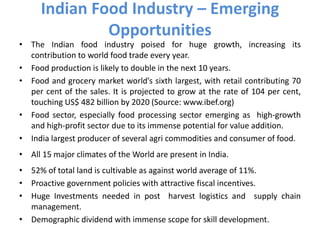
• The Indian food industry poised for huge growth, increasing its
contribution to world food trade every year.
• Food production is likely to double in the next 10 years.
• Food and grocery market world’s sixth largest, with retail contributing 70
per cent of the sales. It is projected to grow at the rate of 104 per cent,
touching US$ 482 billion by 2020 (Source: www.ibef.org)
• Food sector, especially food processing sector emerging as high-growth
and high-profit sector due to its immense potential for value addition.
• India largest producer of several agri commodities and consumer of food.
• All 15 major climates of the World are present in India.
• 52% of total land is cultivable as against world average of 11%.
• Proactive government policies with attractive fiscal incentives.
• Huge Investments needed in post harvest logistics and supply chain
management.
• Demographic dividend with immense scope for skill development.
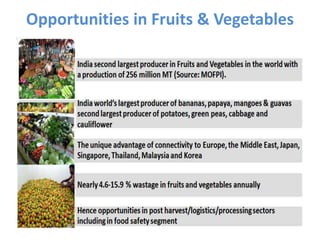
Opportunities in Fruits & Vegetables
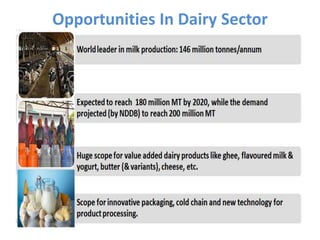
Opportunities In Dairy Sector
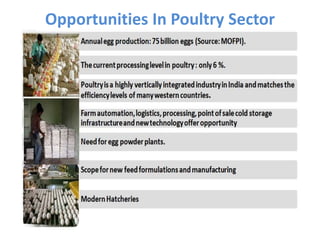
Opportunities In Poultry Sector
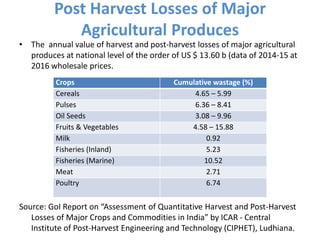
Post Harvest Losses of Major
Agricultural Produces
• The annual value of harvest and post-harvest losses of major agricultural
produces at national level of the order of US $ 13.60 b (data of 2014-15 at
2016 wholesale prices.
Source: GoI Report on “Assessment of Quantitative Harvest and Post-Harvest
Losses of Major Crops and Commodities in India” by ICAR - Central
Institute of Post-Harvest Engineering and Technology (CIPHET), Ludhiana.
Crops Cumulative wastage (%)
Cereals 4.65 – 5.99
Pulses 6.36 – 8.41
Oil Seeds 3.08 – 9.96
Fruits & Vegetables 4.58 – 15.88
Milk 0.92
Fisheries (Inland) 5.23
Fisheries (Marine) 10.52
Meat 2.71
Poultry 6.74
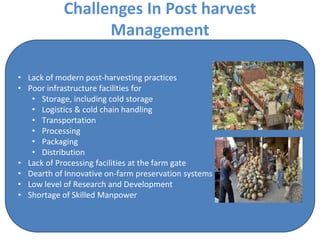
Challenges In Post harvest
Management
• Lack of modern post-harvesting practices
• Poor infrastructure facilities for
• Storage, including cold storage
• Logistics & cold chain handling
• Transportation
• Processing
• Packaging
• Distribution
• Lack of Processing facilities at the farm gate
• Dearth of Innovative on-farm preservation systems
• Low level of Research and Development
• Shortage of Skilled Manpower
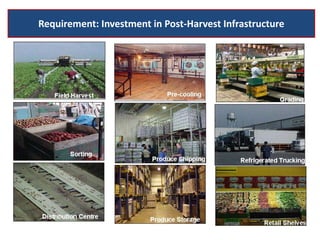
Requirement: Investment in Post-Harvest Infrastructure
Cold Chain: Status & Opportunities
• Production of more than 400 million MT of perishables every year.
• Cold storage capacity around 31.8 million MT (Source: NHB).
• Geographically clustered facilities
– 4 states provide around 70% of cold store capacity
• Overall average capacity utilization in cold storage is 75% - showing
sustainability of the cold chain business in India.
• Industry is largely fragmented and unorganized.
• Dominated by one or two products
– 75% cold storage capacity used for potato
– 25 % multi-commodity cold storages
• Pre-coolers and refer trucks facilities are negligible at present.
• 92% of cold storages owned and operated by private sector.
• Large capacity in cold storage, CA storage, reefers, ripening chambers, IQF,
milk chilling and processing, etc.
• Requirement for cold chain across all states.
• Need for energy efficient cold chain technologies in the entire agri & food
value chain.
Opportunities In Food Processing
Industry
• The Indian food processing industry accounts for 32 per cent of the
country’s total food market, 14 per cent of manufacturing Gross Domestic
Product (GDP), 13 per cent of India’s exports and six per cent of total
industrial investment. Indian food service industry is expected to reach
US$ 78 billion by 2018 (www.ibef.org).
• The Industry witnessed 7.1 % growth during 2013-14, much higher than
the growth in agricultural sector (Source: MOFPI).
• Low level of processing –
– 2% in the case of fruits and vegetables
– 35% in Dairy
– 23% in Marine Produce
– 21% in Meat and
– 6% in Poultry (Source: MOFPI)
• India’s share in world’s processed food production-1%
• Value addition 20% against 45% in Philippines
• Estimated wastage fruits & vegetables in India 4.6 – 15.9 %
Indicative Opportunities in Food
Processing
Infrastructure & Technology
• New Technology in F&V
processing, cold storage,
reefers, IQF, pack houses
and ripening chambers
• New Packaging technology
for enhanced shelf life,
retaining taste and texture,
attractive, easy to handle
and space efficient
• Modern storage facilities &
logistics
• Energy efficient technologies
• Food testing labs
• R & D Infrastructure
• New products- Fortified
products, health food, tradition
Indian food, convenience food
• Processed organic food specially
baby food, confectionery and
bakery items have an increasing
domestic and overseas demand
• New product development in
beverages viz., flavoured teas,
juice variants, health drinks,
energy drinks, sports drinks
• Packaged local drinks like nimbu
pani, jaljeera, coconut water,
etc.
Infrastructure & Technology Processing
Reasons for Sub Optimal Growth
of Food Processing
• Lack of access to world class technology
• Lack of infrastructure, especially cold chain infrastructure
• Inadequate investment
• Agricultural development programmers focused generally on production
o Post harvest handling including agri/food processing was not a
priority agenda under agricultural extension
• Lack of processing varieties
• Absence of efficient supply chain management
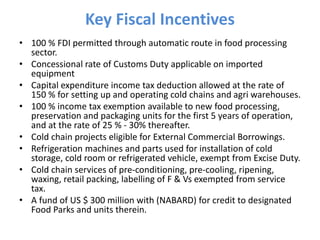
Key Fiscal Incentives
• 100 % FDI permitted through automatic route in food processing
sector.
• Concessional rate of Customs Duty applicable on imported
equipment
• Capital expenditure income tax deduction allowed at the rate of
150 % for setting up and operating cold chains and agri warehouses.
• 100 % income tax exemption available to new food processing,
preservation and packaging units for the first 5 years of operation,
and at the rate of 25 % - 30% thereafter.
• Cold chain projects eligible for External Commercial Borrowings.
• Refrigeration machines and parts used for installation of cold
storage, cold room or refrigerated vehicle, exempt from Excise Duty.
• Cold chain services of pre-conditioning, pre-cooling, ripening,
waxing, retail packing, labelling of F & Vs exempted from service
tax.
• A fund of US $ 300 million with (NABARD) for credit to designated
Food Parks and units therein.
Thank you…

Post harvest logistics & food processing

  • 1.
    Post harvest Loss& Food Processing Maitrayee Pal 16-PGDM-ABPM-67
  • 2.
    Indian Food Industry– Emerging Opportunities • The Indian food industry poised for huge growth, increasing its contribution to world food trade every year. • Food production is likely to double in the next 10 years. • Food and grocery market world’s sixth largest, with retail contributing 70 per cent of the sales. It is projected to grow at the rate of 104 per cent, touching US$ 482 billion by 2020 (Source: www.ibef.org) • Food sector, especially food processing sector emerging as high-growth and high-profit sector due to its immense potential for value addition. • India largest producer of several agri commodities and consumer of food. • All 15 major climates of the World are present in India. • 52% of total land is cultivable as against world average of 11%. • Proactive government policies with attractive fiscal incentives. • Huge Investments needed in post harvest logistics and supply chain management. • Demographic dividend with immense scope for skill development.
  • 3.
  • 4.
  • 5.
  • 6.
    Post Harvest Lossesof Major Agricultural Produces • The annual value of harvest and post-harvest losses of major agricultural produces at national level of the order of US $ 13.60 b (data of 2014-15 at 2016 wholesale prices. Source: GoI Report on “Assessment of Quantitative Harvest and Post-Harvest Losses of Major Crops and Commodities in India” by ICAR - Central Institute of Post-Harvest Engineering and Technology (CIPHET), Ludhiana. Crops Cumulative wastage (%) Cereals 4.65 – 5.99 Pulses 6.36 – 8.41 Oil Seeds 3.08 – 9.96 Fruits & Vegetables 4.58 – 15.88 Milk 0.92 Fisheries (Inland) 5.23 Fisheries (Marine) 10.52 Meat 2.71 Poultry 6.74
  • 7.
    Challenges In Postharvest Management • Lack of modern post-harvesting practices • Poor infrastructure facilities for • Storage, including cold storage • Logistics & cold chain handling • Transportation • Processing • Packaging • Distribution • Lack of Processing facilities at the farm gate • Dearth of Innovative on-farm preservation systems • Low level of Research and Development • Shortage of Skilled Manpower
  • 8.
    Requirement: Investment inPost-Harvest Infrastructure
  • 9.
    Cold Chain: Status& Opportunities • Production of more than 400 million MT of perishables every year. • Cold storage capacity around 31.8 million MT (Source: NHB). • Geographically clustered facilities – 4 states provide around 70% of cold store capacity • Overall average capacity utilization in cold storage is 75% - showing sustainability of the cold chain business in India. • Industry is largely fragmented and unorganized. • Dominated by one or two products – 75% cold storage capacity used for potato – 25 % multi-commodity cold storages • Pre-coolers and refer trucks facilities are negligible at present. • 92% of cold storages owned and operated by private sector. • Large capacity in cold storage, CA storage, reefers, ripening chambers, IQF, milk chilling and processing, etc. • Requirement for cold chain across all states. • Need for energy efficient cold chain technologies in the entire agri & food value chain.
  • 10.
    Opportunities In FoodProcessing Industry • The Indian food processing industry accounts for 32 per cent of the country’s total food market, 14 per cent of manufacturing Gross Domestic Product (GDP), 13 per cent of India’s exports and six per cent of total industrial investment. Indian food service industry is expected to reach US$ 78 billion by 2018 (www.ibef.org). • The Industry witnessed 7.1 % growth during 2013-14, much higher than the growth in agricultural sector (Source: MOFPI). • Low level of processing – – 2% in the case of fruits and vegetables – 35% in Dairy – 23% in Marine Produce – 21% in Meat and – 6% in Poultry (Source: MOFPI) • India’s share in world’s processed food production-1% • Value addition 20% against 45% in Philippines • Estimated wastage fruits & vegetables in India 4.6 – 15.9 %
  • 11.
    Indicative Opportunities inFood Processing Infrastructure & Technology • New Technology in F&V processing, cold storage, reefers, IQF, pack houses and ripening chambers • New Packaging technology for enhanced shelf life, retaining taste and texture, attractive, easy to handle and space efficient • Modern storage facilities & logistics • Energy efficient technologies • Food testing labs • R & D Infrastructure • New products- Fortified products, health food, tradition Indian food, convenience food • Processed organic food specially baby food, confectionery and bakery items have an increasing domestic and overseas demand • New product development in beverages viz., flavoured teas, juice variants, health drinks, energy drinks, sports drinks • Packaged local drinks like nimbu pani, jaljeera, coconut water, etc. Infrastructure & Technology Processing
  • 12.
    Reasons for SubOptimal Growth of Food Processing • Lack of access to world class technology • Lack of infrastructure, especially cold chain infrastructure • Inadequate investment • Agricultural development programmers focused generally on production o Post harvest handling including agri/food processing was not a priority agenda under agricultural extension • Lack of processing varieties • Absence of efficient supply chain management
  • 13.
    Key Fiscal Incentives •100 % FDI permitted through automatic route in food processing sector. • Concessional rate of Customs Duty applicable on imported equipment • Capital expenditure income tax deduction allowed at the rate of 150 % for setting up and operating cold chains and agri warehouses. • 100 % income tax exemption available to new food processing, preservation and packaging units for the first 5 years of operation, and at the rate of 25 % - 30% thereafter. • Cold chain projects eligible for External Commercial Borrowings. • Refrigeration machines and parts used for installation of cold storage, cold room or refrigerated vehicle, exempt from Excise Duty. • Cold chain services of pre-conditioning, pre-cooling, ripening, waxing, retail packing, labelling of F & Vs exempted from service tax. • A fund of US $ 300 million with (NABARD) for credit to designated Food Parks and units therein.
  • 14.