b
Aquaponics Spring Farm
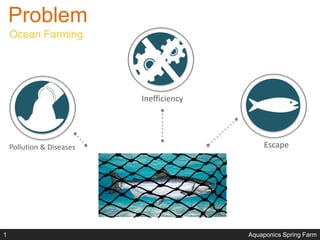
Problem
Ocean Farming
Inefficiency
EscapePollution & Diseases
1
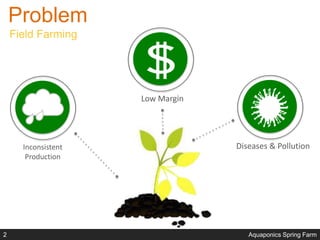
Problem
Field Farming
Inconsistent
Production
Low Margin
Diseases & Pollution
Aquaponics Spring Farm2
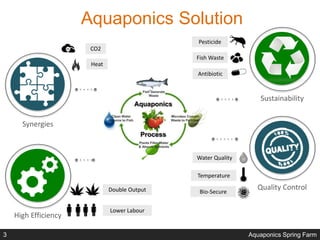
Aquaponics Solution
High Efficiency
Quality Control
Synergies
Sustainability
Double Output
Lower Labour
CO2
Heat
Pesticide
Fish Waste
Water Quality
Temperature
Antibiotic
Bio-Secure
Aquaponics Spring Farm3
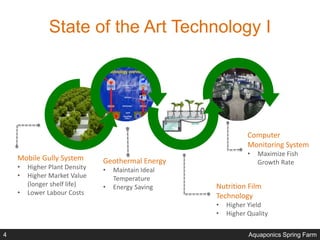
State of the Art Technology I
Mobile Gully System
• Higher Plant Density
• Higher Market Value
(longer shelf life)
• Lower Labour Costs
Geothermal Energy
• Maintain Ideal
Temperature
• Energy Saving Nutrition Film
Technology
• Higher Yield
• Higher Quality
Computer
Monitoring System
• Maximize Fish
Growth Rate
Aquaponics Spring Farm4
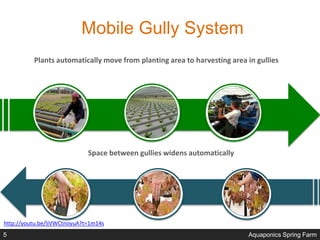
Mobile Gully System
Plants automatically move from planting area to harvesting area in gullies
Space between gullies widens automatically
http://youtu.be/ljVWCtnoyuA?t=1m14s
Aquaponics Spring Farm5
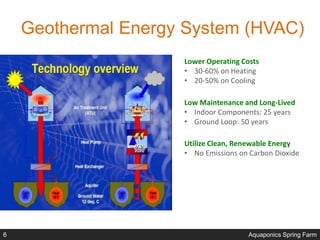
Geothermal Energy System (HVAC)
Utilize Clean, Renewable Energy
• No Emissions on Carbon Dioxide
Lower Operating Costs
• 30-60% on Heating
• 20-50% on Cooling
Low Maintenance and Long-Lived
• Indoor Components: 25 years
• Ground Loop: 50 years
Aquaponics Spring Farm6
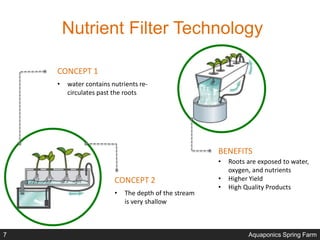
Nutrient Filter Technology
• water contains nutrients re-
circulates past the roots
CONCEPT 1
• The depth of the stream
is very shallow
CONCEPT 2
BENEFITS
• Roots are exposed to water,
oxygen, and nutrients
• Higher Yield
• High Quality Products
Aquaponics Spring Farm7
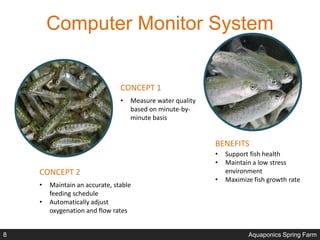
Computer Monitor System
• Measure water quality
based on minute-by-
minute basis
CONCEPT 1
• Maintain an accurate, stable
feeding schedule
• Automatically adjust
oxygenation and flow rates
CONCEPT 2
BENEFITS
• Support fish health
• Maintain a low stress
environment
• Maximize fish growth rate
Aquaponics Spring Farm8
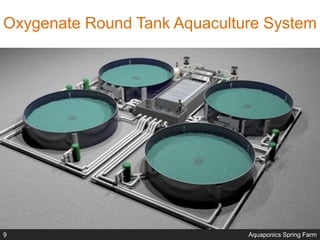
Oxygenate Round Tank Aquaculture System
Aquaponics Spring Farm9
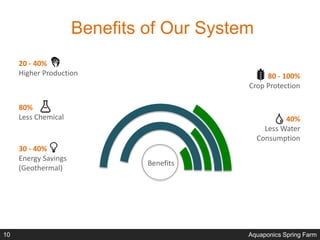
Benefits of Our System
Benefits
80%
Less Chemical 40%
Less Water
Consumption
20 - 40%
Higher Production
30 - 40%
Energy Savings
(Geothermal)
80 - 100%
Crop Protection
Aquaponics Spring Farm10
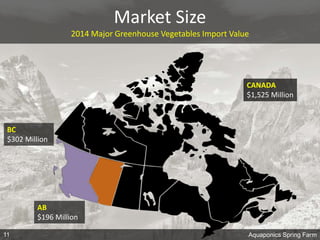
BC
$302 Million
AB
$196 Million
CANADA
$1,525 Million
Market Size
2014 Major Greenhouse Vegetables Import Value
Aquaponics Spring Farm11
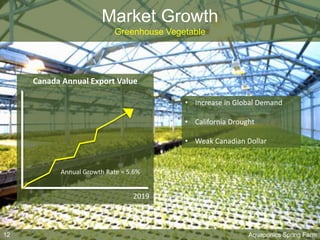
Market Growth
Greenhouse Vegetable
• Increase in Global Demand
• California Drought
• Weak Canadian Dollar
Canada Annual Export Value
2019
Annual Growth Rate = 5.6%
Aquaponics Spring Farm12
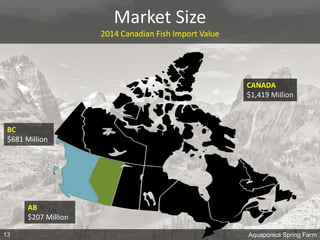
BC
$681 Million
AB
$207 Million
CANADA
$1,419 Million
Market Size
2014 Canadian Fish Import Value
Aquaponics Spring Farm13
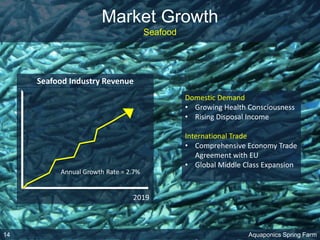
Market Growth
Seafood
Domestic Demand
• Growing Health Consciousness
• Rising Disposal Income
International Trade
• Comprehensive Economy Trade
Agreement with EU
• Global Middle Class Expansion
Seafood Industry Revenue
2019
Annual Growth Rate = 2.7%
Aquaponics Spring Farm14
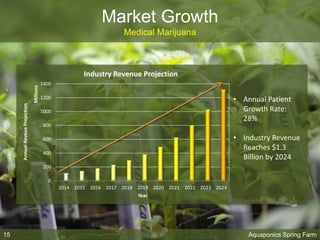
Market Growth
Medical Marijuana
0
200
400
600
800
1000
1200
1400
2014 2015 2016 2017 2018 2019 2020 2021 2022 2023 2024
AnnualReveueProjection
Millions
Year
Industry Revenue Projection
• Annual Patient
Growth Rate:
28%
• Industry Revenue
Reaches $1.3
Billion by 2024
Aquaponics Spring Farm15
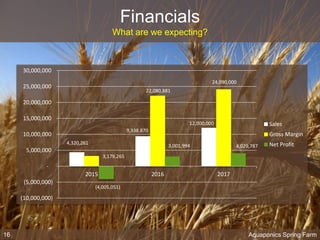
Financials
What are we expecting?
Aquaponics Spring Farm
4,320,261
9,338,870
12,000,000
3,179,265
22,080,881
24,090,000
(4,005,051)
3,001,994 4,029,787
(10,000,000)
(5,000,000)
-
5,000,000
10,000,000
15,000,000
20,000,000
25,000,000
30,000,000
2015 2016 2017
Sales
Gross Margin
Net Profit
16
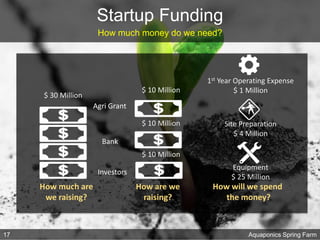
Startup Funding
How much money do we need?
Aquaponics Spring Farm
How much are
we raising?
$ 30 Million
How will we spend
the money?
How are we
raising?
Investors
$ 10 Million
Bank
$ 10 Million
Agri Grant
$ 10 Million
Equipment
$ 25 Million
Site Preparation
$ 4 Million
1st Year Operating Expense
$ 1 Million
17
Team
What are our experiences and expertise?
Aquaponics Spring Farm
ABC
CEO
ABC
COO
ABC
CMO
ABC
CFO
18
Aquaponic Fish Farm

Aquaponic Fish Farm

  • 1.
  • 2.
    Aquaponics Spring Farm Problem OceanFarming Inefficiency EscapePollution & Diseases 1
  • 3.
  • 4.
    Aquaponics Solution High Efficiency QualityControl Synergies Sustainability Double Output Lower Labour CO2 Heat Pesticide Fish Waste Water Quality Temperature Antibiotic Bio-Secure Aquaponics Spring Farm3
  • 5.
    State of theArt Technology I Mobile Gully System • Higher Plant Density • Higher Market Value (longer shelf life) • Lower Labour Costs Geothermal Energy • Maintain Ideal Temperature • Energy Saving Nutrition Film Technology • Higher Yield • Higher Quality Computer Monitoring System • Maximize Fish Growth Rate Aquaponics Spring Farm4
  • 6.
    Mobile Gully System Plantsautomatically move from planting area to harvesting area in gullies Space between gullies widens automatically http://youtu.be/ljVWCtnoyuA?t=1m14s Aquaponics Spring Farm5
  • 7.
    Geothermal Energy System(HVAC) Utilize Clean, Renewable Energy • No Emissions on Carbon Dioxide Lower Operating Costs • 30-60% on Heating • 20-50% on Cooling Low Maintenance and Long-Lived • Indoor Components: 25 years • Ground Loop: 50 years Aquaponics Spring Farm6
  • 8.
    Nutrient Filter Technology •water contains nutrients re- circulates past the roots CONCEPT 1 • The depth of the stream is very shallow CONCEPT 2 BENEFITS • Roots are exposed to water, oxygen, and nutrients • Higher Yield • High Quality Products Aquaponics Spring Farm7
  • 9.
    Computer Monitor System •Measure water quality based on minute-by- minute basis CONCEPT 1 • Maintain an accurate, stable feeding schedule • Automatically adjust oxygenation and flow rates CONCEPT 2 BENEFITS • Support fish health • Maintain a low stress environment • Maximize fish growth rate Aquaponics Spring Farm8
  • 10.
    Oxygenate Round TankAquaculture System Aquaponics Spring Farm9
  • 11.
    Benefits of OurSystem Benefits 80% Less Chemical 40% Less Water Consumption 20 - 40% Higher Production 30 - 40% Energy Savings (Geothermal) 80 - 100% Crop Protection Aquaponics Spring Farm10
  • 12.
    BC $302 Million AB $196 Million CANADA $1,525Million Market Size 2014 Major Greenhouse Vegetables Import Value Aquaponics Spring Farm11
  • 13.
    Market Growth Greenhouse Vegetable •Increase in Global Demand • California Drought • Weak Canadian Dollar Canada Annual Export Value 2019 Annual Growth Rate = 5.6% Aquaponics Spring Farm12
  • 14.
    BC $681 Million AB $207 Million CANADA $1,419Million Market Size 2014 Canadian Fish Import Value Aquaponics Spring Farm13
  • 15.
    Market Growth Seafood Domestic Demand •Growing Health Consciousness • Rising Disposal Income International Trade • Comprehensive Economy Trade Agreement with EU • Global Middle Class Expansion Seafood Industry Revenue 2019 Annual Growth Rate = 2.7% Aquaponics Spring Farm14
  • 16.
    Market Growth Medical Marijuana 0 200 400 600 800 1000 1200 1400 20142015 2016 2017 2018 2019 2020 2021 2022 2023 2024 AnnualReveueProjection Millions Year Industry Revenue Projection • Annual Patient Growth Rate: 28% • Industry Revenue Reaches $1.3 Billion by 2024 Aquaponics Spring Farm15
  • 17.
    Financials What are weexpecting? Aquaponics Spring Farm 4,320,261 9,338,870 12,000,000 3,179,265 22,080,881 24,090,000 (4,005,051) 3,001,994 4,029,787 (10,000,000) (5,000,000) - 5,000,000 10,000,000 15,000,000 20,000,000 25,000,000 30,000,000 2015 2016 2017 Sales Gross Margin Net Profit 16
  • 18.
    Startup Funding How muchmoney do we need? Aquaponics Spring Farm How much are we raising? $ 30 Million How will we spend the money? How are we raising? Investors $ 10 Million Bank $ 10 Million Agri Grant $ 10 Million Equipment $ 25 Million Site Preparation $ 4 Million 1st Year Operating Expense $ 1 Million 17
  • 19.
    Team What are ourexperiences and expertise? Aquaponics Spring Farm ABC CEO ABC COO ABC CMO ABC CFO 18

Editor's Notes

  • #5 HIGH EFFICIENCY Double output with lower labour ALL YEAR ROUND PRODUCTION Production is no longer affected by seasonal and weather changes QUALITY CONTROL Precisely control temperature, humidity, and pesticide
  • #7 A growing field in which the growing plants automatically move, in plant gullies, from the planting area to the harvesting area. While moving along the growing field, the space between gullies widens in order to provide an optimum space for the plant in each stage of growth. Related Videos: https://www.youtube.com/watch?v=ljVWCtnoyuA (Suggest playtime: 1:14 – 2:38)
  • #8 During the day, hot air collected in overhead hanging gutters is pulled through by a high-volume air conditioner (HVAC) and cooled with a heat exchanger. Water stripped from the air is saved for recirculation while carbon dioxide is added to the cool air being sent back though the greenhouse via perforated plastic pipes located at the base of the plants. At night, the system is reversed. Cold air is pulled from the hanging gutters and heated by the HVAC/heat exchanger. The heated air is then sent back into the greenhouse through the perforated pipes. The water for the heat exchanger is maintained separately while small amounts of hot and cold water are kept in storage tanks (another installation uses ditches instead of tanks). The primary reservoirs consist of “storage bubbles” in the aquifer below the greenhouse.