(ТАҒАМ ТҮРЛЕРІ)
FOOD FOR THOUGHT
 Are you healthy?
 Do you eat things that are
good for you?
 Do you think about your
diet?
 Do you ever eat too
much/too little?
 Do you take vitamins?
SPEAKING
ACTIVE VOCABULARY
o Delicacy ['delikәsi] – деликатес, жеңсік
o Celebration [seli'breiSәn]– тойлау, мейрамдау
o Rare [rea`]- сирек
o Nest [ nest] - ұя
o Urchins [`ә:tSin] – теңіз кірпісі
o Locust ['lәukәst]– шегіртке
o Snail [sneil] - ұлу
o Tribe [traib] – тайпа
o Tarantula [ta'rәentjula] – бүйі
o Seaweed ['si:wi:d] - балдыр
o Eel [ i: l]- жыланбалық
o Squid [skwid] – кальмар
o Octopus [‘oktәpәs]- сегізаяқ
Read the text
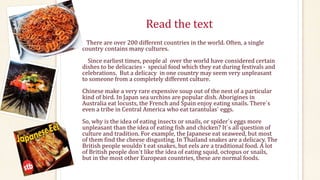
There are over 200 different countries in the world. Often, a single
country contains many cultures.
Since earliest times, people al over the world have considered certain
dishes to be delicacies - special food which they eat during festivals and
celebrations. But a delicacy in one country may seem very unpleasant
to someone from a completely different culture.
Chinese make a very rare expensive soup out of the nest of a particular
kind of bird. In Japan sea urchins are popular dish. Aborigines in
Australia eat locusts, the French and Spain enjoy eating snails. There`s
even a tribe in Central America who eat tarantulas` eggs.
So, why is the idea of eating insects or snails, or spider`s eggs more
unpleasant than the idea of eating fish and chicken? It`s all question of
culture and tradition. For example, the Japanese eat seaweed, but most
of them find the cheese disgusting. In Thailand snakes are a delicacy. The
British people wouldn`t eat snakes, but eels are a traditional food. A lot
of British people don`t like the idea of eating squid, octopus or snails,
but in the most other European countries, these are normal foods.
Let`s sing a song
Exercise 8,
page 65.
Country Food
China
locust
France
Central America
snake
Japan
Europe
eel
• Complete the table

Food for thought

  • 1.
  • 2.
     Are youhealthy?  Do you eat things that are good for you?  Do you think about your diet?  Do you ever eat too much/too little?  Do you take vitamins? SPEAKING
  • 3.
    ACTIVE VOCABULARY o Delicacy['delikәsi] – деликатес, жеңсік o Celebration [seli'breiSәn]– тойлау, мейрамдау o Rare [rea`]- сирек o Nest [ nest] - ұя o Urchins [`ә:tSin] – теңіз кірпісі o Locust ['lәukәst]– шегіртке o Snail [sneil] - ұлу o Tribe [traib] – тайпа o Tarantula [ta'rәentjula] – бүйі o Seaweed ['si:wi:d] - балдыр o Eel [ i: l]- жыланбалық o Squid [skwid] – кальмар o Octopus [‘oktәpәs]- сегізаяқ
  • 4.
    Read the text Thereare over 200 different countries in the world. Often, a single country contains many cultures. Since earliest times, people al over the world have considered certain dishes to be delicacies - special food which they eat during festivals and celebrations. But a delicacy in one country may seem very unpleasant to someone from a completely different culture. Chinese make a very rare expensive soup out of the nest of a particular kind of bird. In Japan sea urchins are popular dish. Aborigines in Australia eat locusts, the French and Spain enjoy eating snails. There`s even a tribe in Central America who eat tarantulas` eggs. So, why is the idea of eating insects or snails, or spider`s eggs more unpleasant than the idea of eating fish and chicken? It`s all question of culture and tradition. For example, the Japanese eat seaweed, but most of them find the cheese disgusting. In Thailand snakes are a delicacy. The British people wouldn`t eat snakes, but eels are a traditional food. A lot of British people don`t like the idea of eating squid, octopus or snails, but in the most other European countries, these are normal foods.
  • 5.
  • 6.
    Exercise 8, page 65. CountryFood China locust France Central America snake Japan Europe eel • Complete the table