Something OldSomething NewUsing African Folktales and Audacity™ to Improve Reading Fluency
6th Grade1:1 environmentGreensboro Day SchoolMarilyn Jones—Language Arts TeacherSarah Hanawald—Technology SpecialistWebsite (this presentation, bibliography of tales, links to software downloads, our email addresses) http://fc.greensboroday.org/~shanawald/LIo8
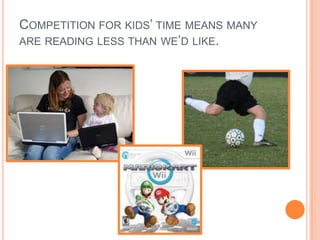
Competition for kids’ time means many are reading less than we’d like.
You want children to read for pleasure and instruction with enthusiasm and engagement.
How do you improve fluency to facilitate learning and enjoy reading?
There is excellent research on fluency.
RehearsalExplicit Goals	Underlying (sneaky teacher) GoalsStated goal was to be prepared for recording.Rubric provided for students.Repeated oral readingsListening comprehensionSimultaneous reading and listening
We illustrate after Recording
MotivationTo sound good	Have funCreate something “cool”Share their product with the worldDevelop fluencyAccuracy of pronunciationExposure to a variety of textsTeach the technologyLearn to follow complex directionsStudent MotivationEducational Intent
Unexpected BenefitsCreative outlet for students who aren’t necessarily artistic.Performance opportunity for shy students.Students with technical skills aren’t always leaders in other areas, they shone here.Every student makes progress and is able to work at his/her ability level.Practice with citation skills.
???
So, how do I actually do this???(Audacity 101) Download Audacity (it’s free!): http://audacity.sourceforge.net/How do I use it?It isn’t difficult to teach yourself fairly quickly if you are comfortable with software in general.Tutorials are available:  http://audacity.sourceforge.net/help/tutorialsIt’s a good idea to make an mp3 yourself before you ask your students to do so.
Here We Go…Step 1:  Open AudacityStep 2:  After practicing reading your story aloud, Click the Record button and tell your story.
When you’re finished telling your story, you must stop the recording.Step 3:  Click the Stop (NOT pause) button.
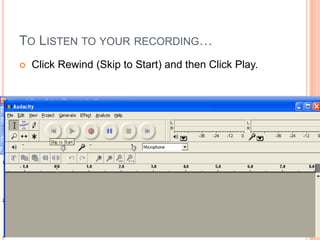
To Listen to your recording… Click Rewind (Skip to Start) and then Click Play.
Save Your Audacity Project.Go to file and save.  This will allow you to save the project as an Audacity file.  NOTE:  IT IS NOT AN MP3 File,  but an aud file that you can continue to record and edit in Audacity.To export as an mp3, you need to get the encoder lame from http://lame.buanzo.com.ar/ and save Next Go to File and select Export as MP3.The first time you export as an MP3 file, you will need to show Audacity where your Lame_enc.dll file is located.
Cool Stuff You Can Do: Selector KeyThe Selector Key allows students to select segments to edit and replace with an improvement
Time Shift ToolTime Shift Tool allows students to move their sound clips left or right  within the sound tracks.
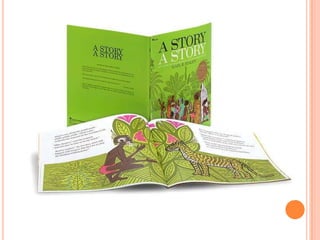
Questions?Thank You!Marilyn Jones:  Mjones@greensboroday.orgSarah Hanawald:  Shanawald@greensboroday.orgCredits: Images--www.africanvariety.com (mask) www.bergoiata.org  (cheetah)

Folktales And Audacity

  • 1.
    Something OldSomething NewUsingAfrican Folktales and Audacity™ to Improve Reading Fluency
  • 2.
    6th Grade1:1 environmentGreensboroDay SchoolMarilyn Jones—Language Arts TeacherSarah Hanawald—Technology SpecialistWebsite (this presentation, bibliography of tales, links to software downloads, our email addresses) http://fc.greensboroday.org/~shanawald/LIo8
  • 4.
    Competition for kids’time means many are reading less than we’d like.
  • 5.
    You want childrento read for pleasure and instruction with enthusiasm and engagement.
  • 6.
    How do youimprove fluency to facilitate learning and enjoy reading?
  • 7.
    There is excellentresearch on fluency.
  • 10.
    RehearsalExplicit Goals Underlying (sneakyteacher) GoalsStated goal was to be prepared for recording.Rubric provided for students.Repeated oral readingsListening comprehensionSimultaneous reading and listening
  • 14.
  • 15.
    MotivationTo sound good HavefunCreate something “cool”Share their product with the worldDevelop fluencyAccuracy of pronunciationExposure to a variety of textsTeach the technologyLearn to follow complex directionsStudent MotivationEducational Intent
  • 16.
    Unexpected BenefitsCreative outletfor students who aren’t necessarily artistic.Performance opportunity for shy students.Students with technical skills aren’t always leaders in other areas, they shone here.Every student makes progress and is able to work at his/her ability level.Practice with citation skills.
  • 17.
  • 20.
    So, how doI actually do this???(Audacity 101) Download Audacity (it’s free!): http://audacity.sourceforge.net/How do I use it?It isn’t difficult to teach yourself fairly quickly if you are comfortable with software in general.Tutorials are available: http://audacity.sourceforge.net/help/tutorialsIt’s a good idea to make an mp3 yourself before you ask your students to do so.
  • 21.
    Here We Go…Step1: Open AudacityStep 2: After practicing reading your story aloud, Click the Record button and tell your story.
  • 22.
    When you’re finishedtelling your story, you must stop the recording.Step 3: Click the Stop (NOT pause) button.
  • 23.
    To Listen toyour recording… Click Rewind (Skip to Start) and then Click Play.
  • 24.
    Save Your AudacityProject.Go to file and save. This will allow you to save the project as an Audacity file. NOTE: IT IS NOT AN MP3 File, but an aud file that you can continue to record and edit in Audacity.To export as an mp3, you need to get the encoder lame from http://lame.buanzo.com.ar/ and save Next Go to File and select Export as MP3.The first time you export as an MP3 file, you will need to show Audacity where your Lame_enc.dll file is located.
  • 25.
    Cool Stuff YouCan Do: Selector KeyThe Selector Key allows students to select segments to edit and replace with an improvement
  • 26.
    Time Shift ToolTimeShift Tool allows students to move their sound clips left or right within the sound tracks.
  • 27.
    Questions?Thank You!Marilyn Jones: Mjones@greensboroday.orgSarah Hanawald: Shanawald@greensboroday.orgCredits: Images--www.africanvariety.com (mask) www.bergoiata.org (cheetah)

Editor's Notes

  • #3 Not everyone likes to read aloud or perform.
  • #4 Nothing fancy about what we’re doing here. . . But it is technology infused in ways that support student learning.This particular project is a culminating project that pulls together a number of skills students have been learning all year in both technology and reading.
  • #5 The only way to build reading fluency is to read more text written at the independent reading level (not necessarily the same as grade level).
  • #6 We can’t just put the books into the students head. And yet, only through fluency can students become the readers we hope for their future. What does fluency mean to you? Getting the words right, nice cadence and rhythm, expression, punctuation.
  • #7 Lots of text. How much?
  • #8 Sarah—hold up book. Partner talk in seats about their experiences with this report. OR What role does scientifically based play in your classroom? What does scientifically based research tellus about fluency instruction? Comprehension is influenced by fluency—when students “see” and “hear” the story in their heads their memory and understanding of text improve.“Repeated and monitored oral reading improves reading fluency and overall reading achievement.”6th grade is too early to drop fluency instruction6th graders still need exposure to oral textWhy not do a typical book report?
  • #9 Short stories are funStudents can read a lot of varied text in a short timeShort stories need not be “elementary” Novels have their place too, but don’t exclude short text. There can be a richness in vocabulary and many are written at higher reading levels than you might think.Folktales provide multiple opportunities for students to make connections to the text and between texts practicing reading comprehension strategies.provide multiple opportunities for students to make connections to the text and between texts.Art opportunityDo several read alouds for student response/analysis.Create a print-rich environment, have a classroom filled with books and stories.Students select and read at least 3 to 5 stories silently to themselves (opportunity for differentiation).Students select (with guidance) an appropriate story for their podcast
  • #10 Came from Landmark-project David Warlick’s site.
  • #11 Students read their tale several times, first to themselves, then aloud with an audience.Rehearsal required reading their selected text to a partner, small group, whole class, a teacher or a combination of these.Students practiced telling their stories with expression and using pleasing cadence and rhythm. Students listened to their peers tell their stories while reading along with the text.All of these activities are research-based fluency instruction methods.Guess what—you read an extra story when you listen to your peer!
  • #12 Audacity was used to create a recording of their tale. It is obvious when students are not prepared—and they end up re-recording.Many students recorded their stories several times before they were pleased with the results.Students returned to the text to check their accuracy.Audacity permits “splicing” of corrected snips which encourages students to polish their product (practice pronouncing difficult words).
  • #13 Rehearsals! Recording studio. The room becomes a studio with everyone reading and re-reading their stories aloud. Students will partner read via “live reading” or via recording.I’m not a pro—nor am I willing to spend hours getting a video clip to work exactly the way I want. If I felt everything had to be perfect, I’d never make it in ed tech. On the other hand, other projects do matter.
  • #14 So, how do we get started? What we don’t do is a long “I show, you do” lesson. We almost never do those anymore. Instead, if there’s a “how to” needed, we break it up into small lessons and make videos of how to do these. We also use audio for things such as Quia spelling quizzes. Each student can hear the word/sentence as many times as they like. Powerful because they are hearing my voice, and seeing my screen.
  • #15 Students use a storyboard to plan a visual presentation to accompany their narrative (PowerPoint, Inspiration, or Moviemaker).Original art encouraged, but not required.Students can write and record film their own myths.Musical introductions and backgrounds (freeplaymusic.com).Students can film or stage a dramatic interpretation of a folktale.
  • #16 M and S
  • #17 M
  • #18 Sound Control: headsets with microphones ($12 at CDWG)Crowd Control: you’ll need more adult bodies in the classroom, pull in your media specialist and tech people. There’s nothing wrong with starting small the first year.Text: you need lots of texts available, at least twice as many as you have students in your largest class. Single books are better than collections. Magazines and the Internet can be a good resource.Converting to a podcast takes QuickTime Pro and FOREVER.Time Management: about 6-10 class periods. More the first year.
  • #19 A finished product. Gifted and 5th grade instructional level.
  • #21 S