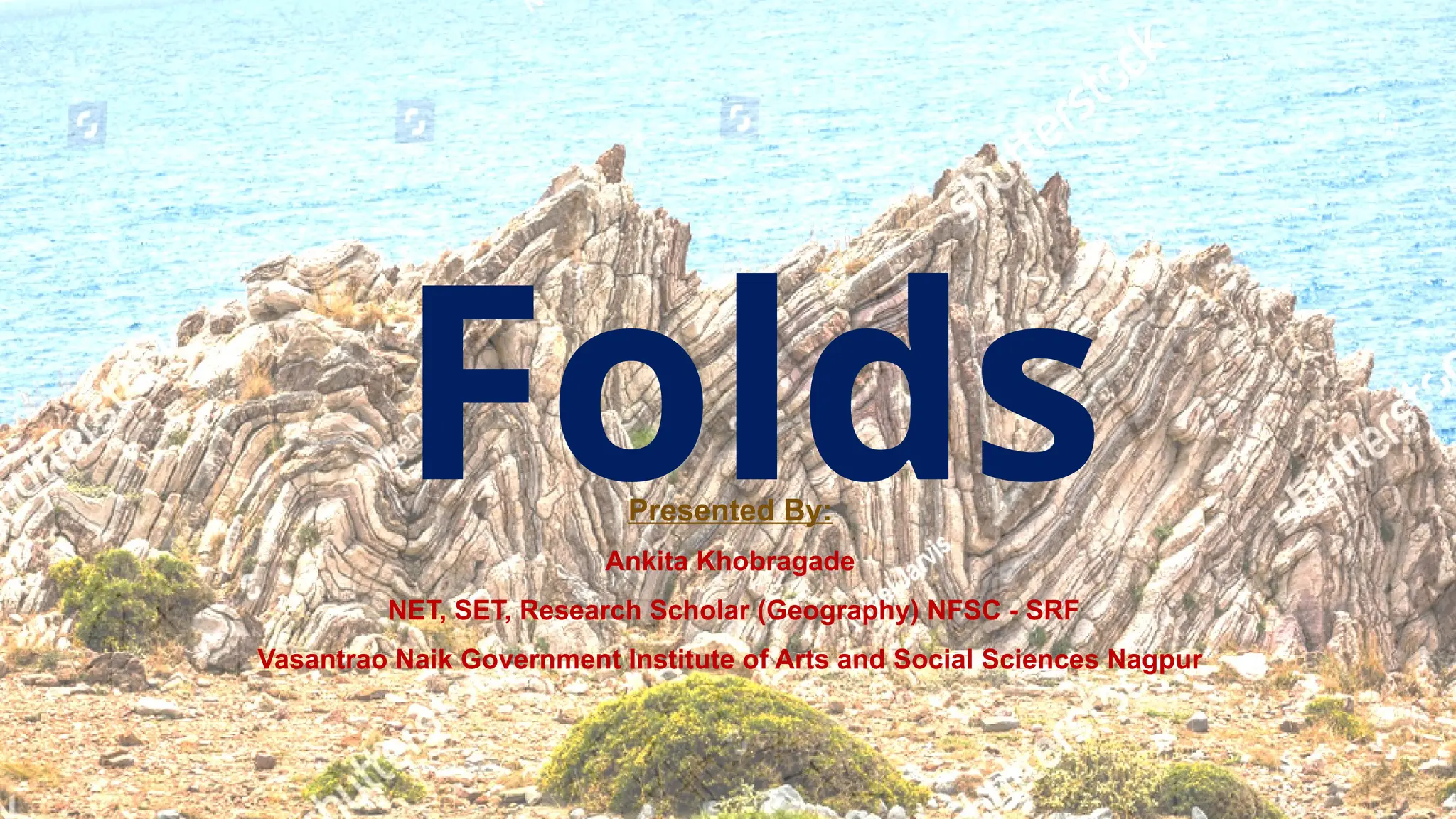
Folds
Presented By:
Ankita Khobragade
NET, SET, Research Scholar (Geography) NFSC - SRF
Vasantrao Naik Government Institute of Arts and Social Sciences Nagpur
Folds:
In geography, folds are wave-like bends or curves in rock layers caused by Earth's
internal forces, typically compression. These bends can form upward (anticlines) or
downward (synclines) structures, contributing to the formation of mountain ranges and
other landforms.
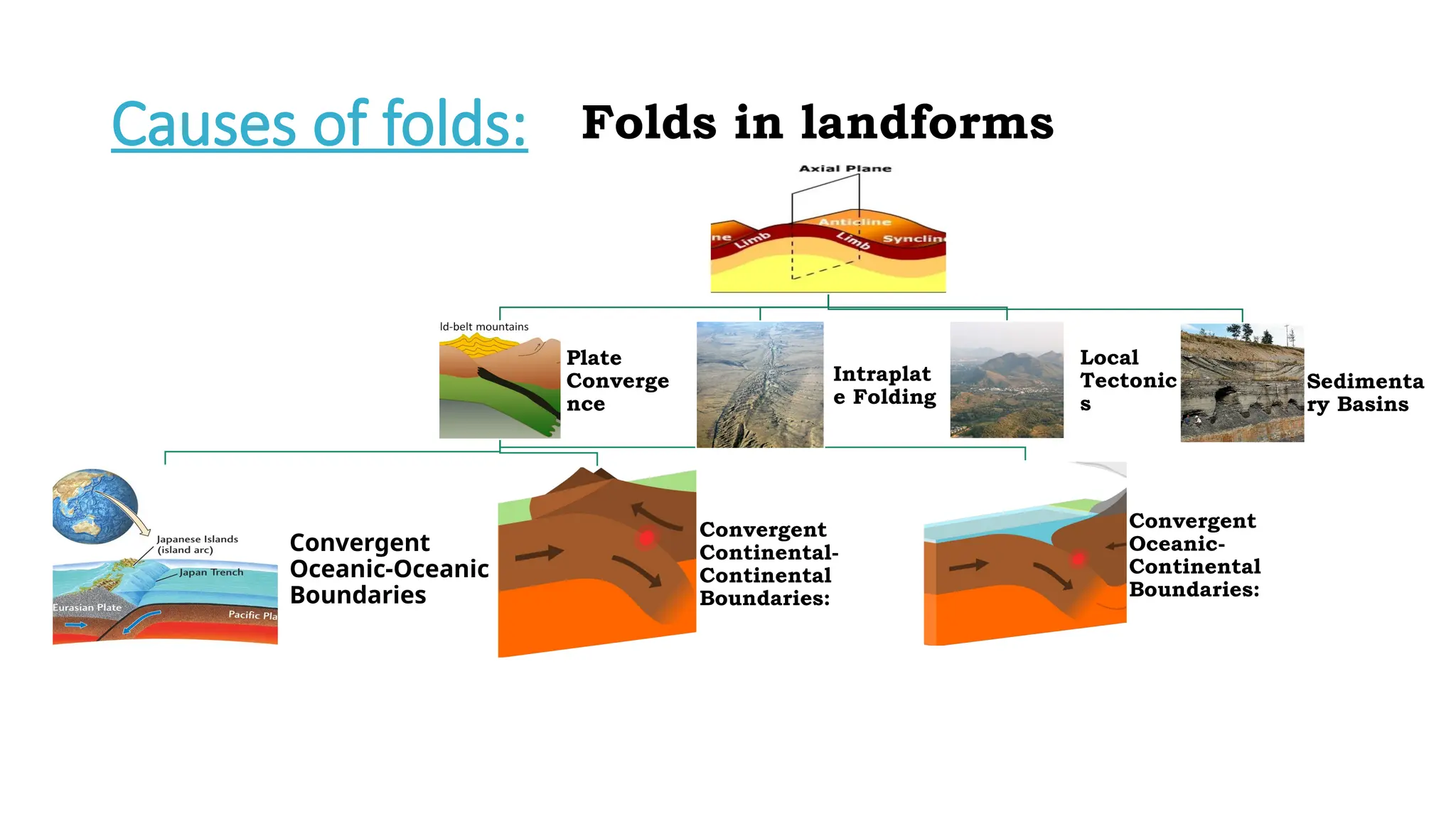
Folds in landforms
Sedimenta
ry Basins
Local
Tectonic
s
Intraplat
e Folding
Plate
Converge
nce
Convergent
Oceanic-
Continental
Boundaries:
Convergent
Continental-
Continental
Boundaries:
Convergent
Oceanic-Oceanic
Boundaries
Causes of folds:
Rates of Plate Movement
•The Arctic Ridge has the slowest rate (less than 2.5
cm/year), and the East Pacific Rise in the South Pacific
(about 3,400 km west of Chile), has the fastest rate (more
than 15 cm/year).
Major tectonic plates
1) Antarctica and the surrounding oceanic plate
2) North American plate
3) South American plate
4) Pacific plate
5) India-Australia-New Zealand plate
6) Africa with the eastern Atlantic floor plate
7) Eurasia and the adjacent oceanic plate
Minor tectonic plates
1) Cocos plate: Between Central America and Pacific plate
2) Nazca plate: Between South America and Pacific plate
3) Arabian plate: Mostly the Saudi Arabian landmass
4) Philippine plate: Between the Asiatic and Pacific plate
5) Caroline plate: Between the Philippine and Indian plate
(North of New Guinea)
6) Fuji plate: North-east of Australia
7) Turkish plate
8) Aegean plate (Mediterranean region)
9) Caribbean plate
10) Juan de Fuca plate (between Pacific and North American
plates)
11) Iranian plate.
folds in landforms, particularly fold mountains, predominantly occur near the margins of tectonic
plates.
Plate Convergence: Fold mountains form when two tectonic plates collide. The immense pressure
from this collision forces the Earth's crust to buckle and fold, creating the characteristic mountain
ranges.
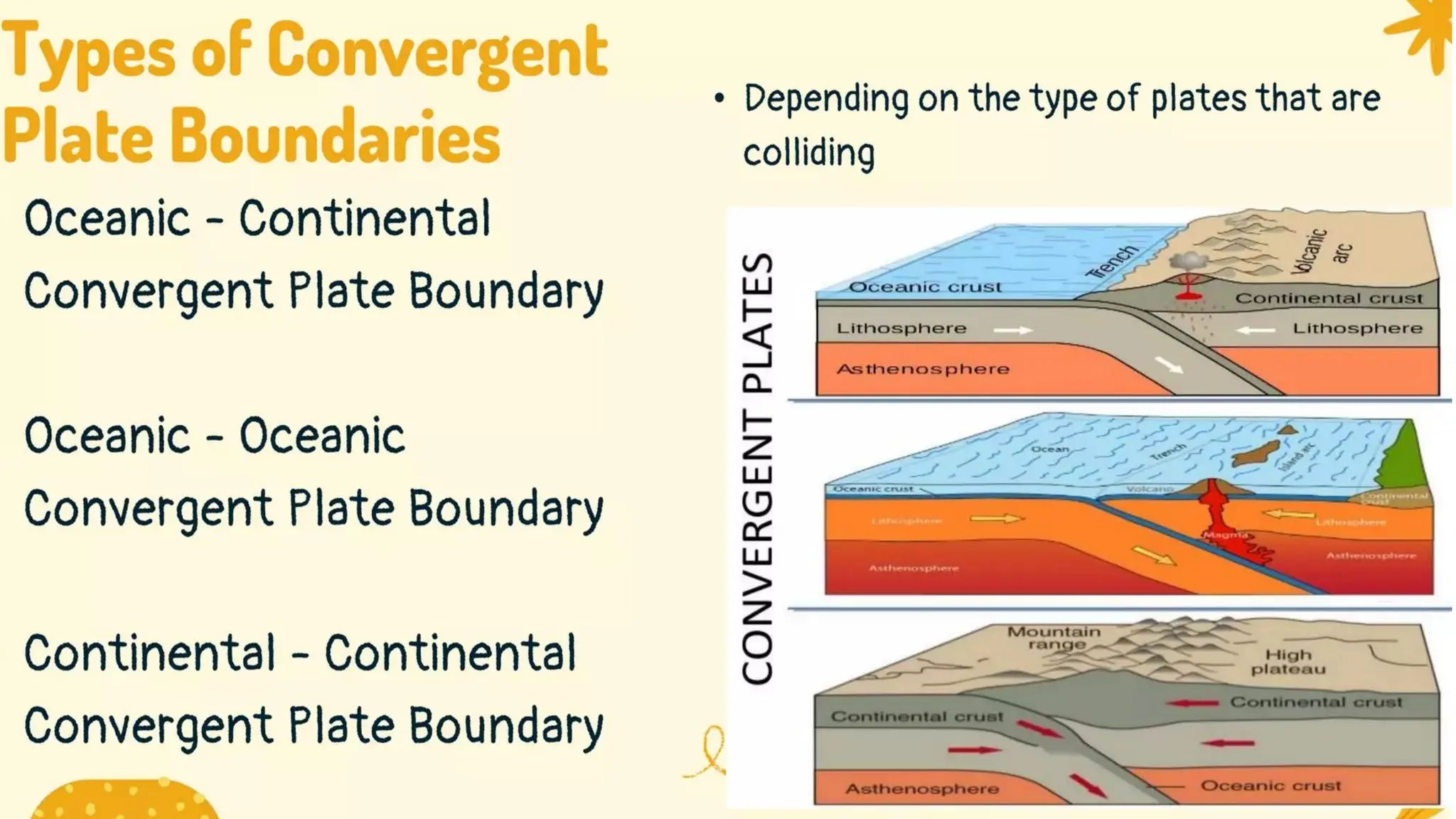
Types of Plate Boundaries:
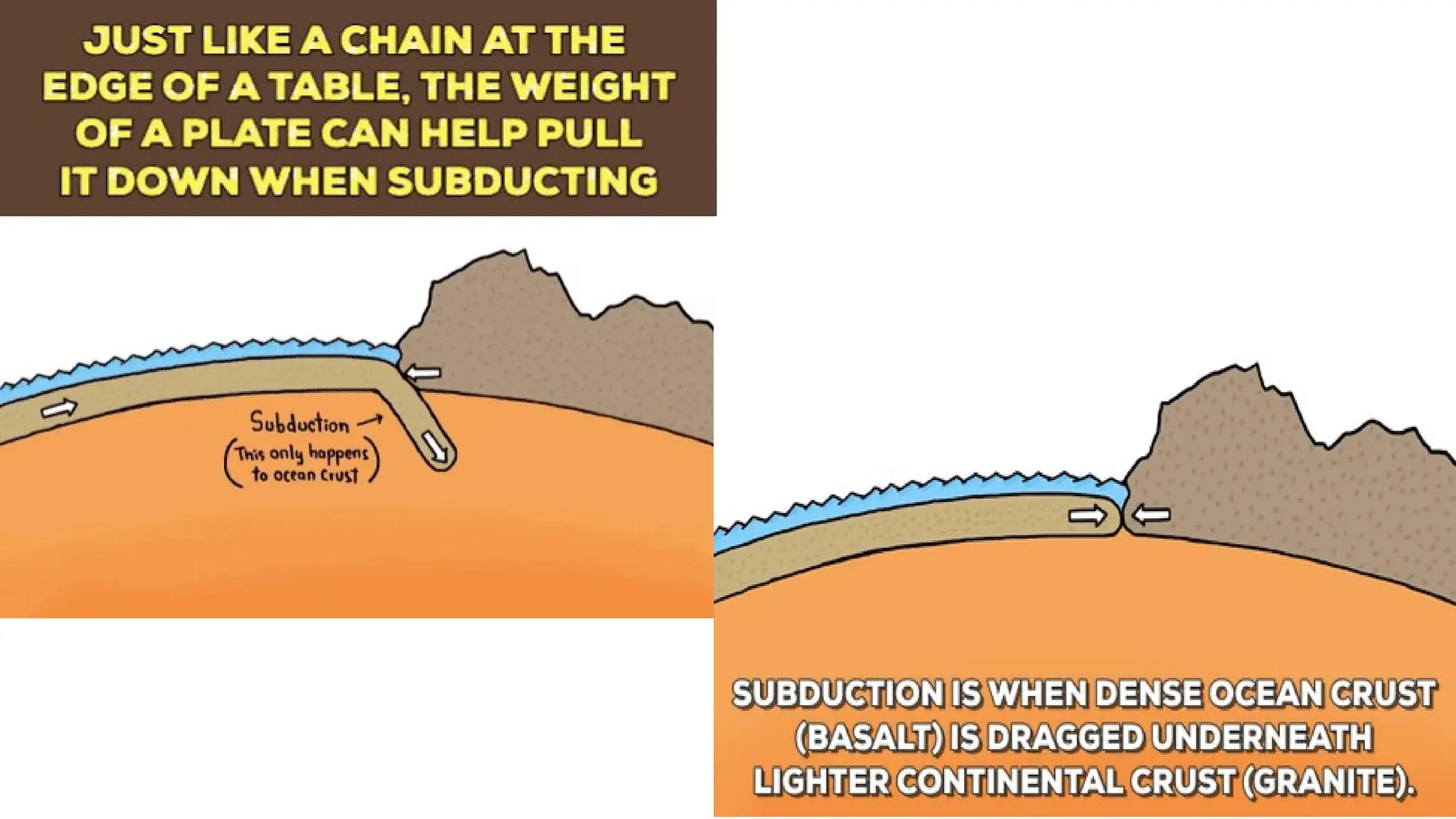
 Convergent Continental-Continental Boundaries (C=C): When two continental plates collide,
neither can subduct due to their similar densities. This leads to intense compression and the
formation of major fold mountain ranges like the Himalayas.
 Convergent Oceanic-Continental Boundaries(O=C): When an oceanic plate collides with a
continental plate, the denser oceanic plate subducts beneath the continental plate. This can also
lead to the formation of fold mountains along the continental margin, such as the Andes
Mountains.
Folds in landforms are often associated with the margins of tectonic plates because this is where
significant compressional forces occur due to plate interactions. These forces cause the rock layers
to bend and form folds. For example, mountain ranges like the Himalayas and the Alps are formed
by the folding of the Earth's crust at convergent plate boundaries.
However, folds can also occur in other geological settings, including plateaus, plains, and low-lying
regions. Here’s how:
 Intraplate Folding: Folding can occur within a tectonic plate due to internal stresses, even if the
region is not near a plate boundary. This can result from processes like subsurface faulting or
differential loading.
 Sedimentary Basins: In regions where, sedimentary layers accumulate over time, folds can
develop due to the weight and pressure of overlying sediments, as well as due to subsurface
movements.
 Local Tectonics: Even in relatively stable regions, local tectonic forces can create folds. For
example, regions with ancient orogenies (mountain-building events) may still exhibit folding.
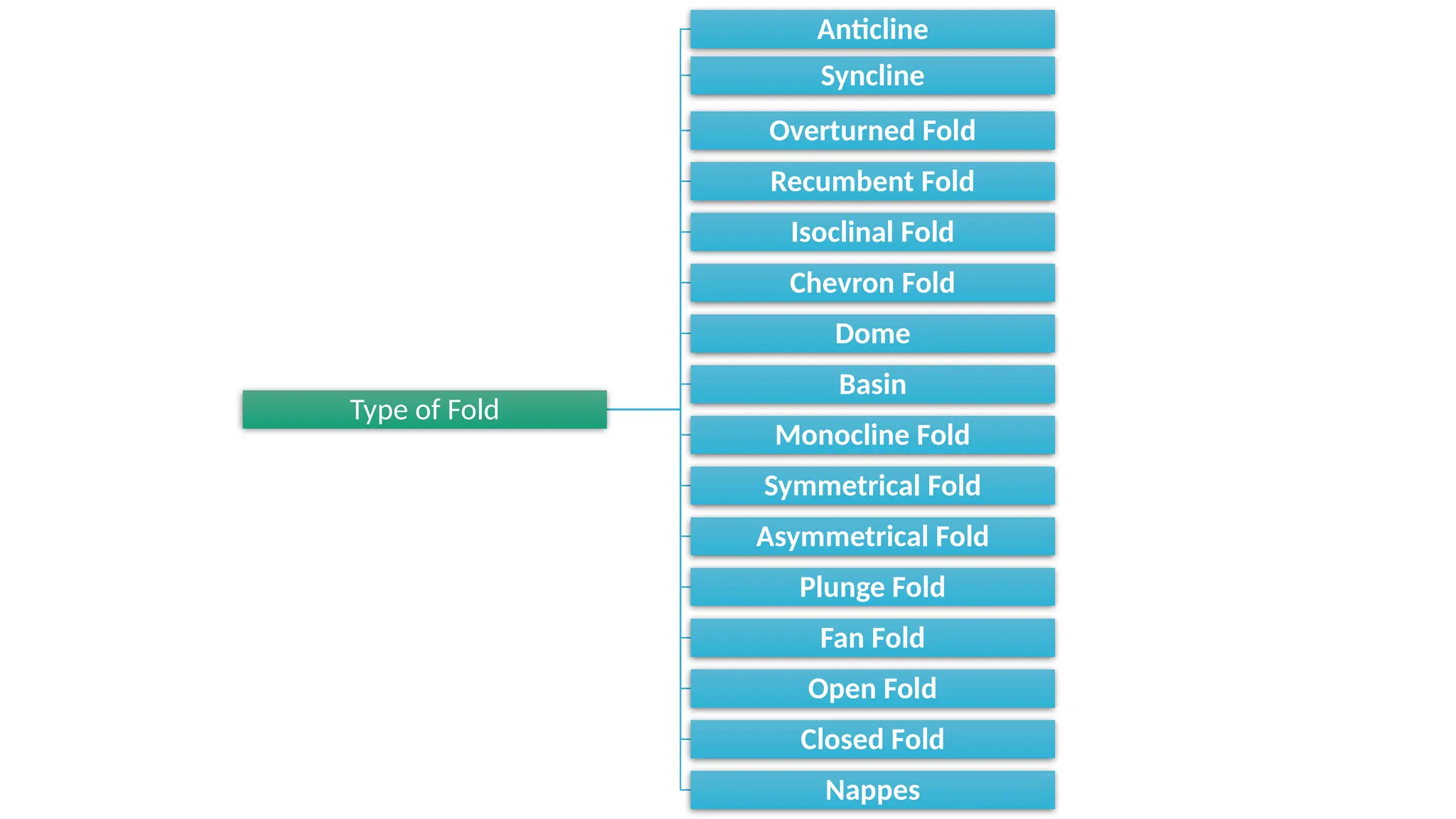
Type of Fold
Anticline
Syncline
Overturned Fold
Recumbent Fold
Isoclinal Fold
Chevron Fold
Dome
Basin
Monocline Fold
Symmetrical Fold
Asymmetrical Fold
Plunge Fold
Fan Fold
Open Fold
Closed Fold
Nappes
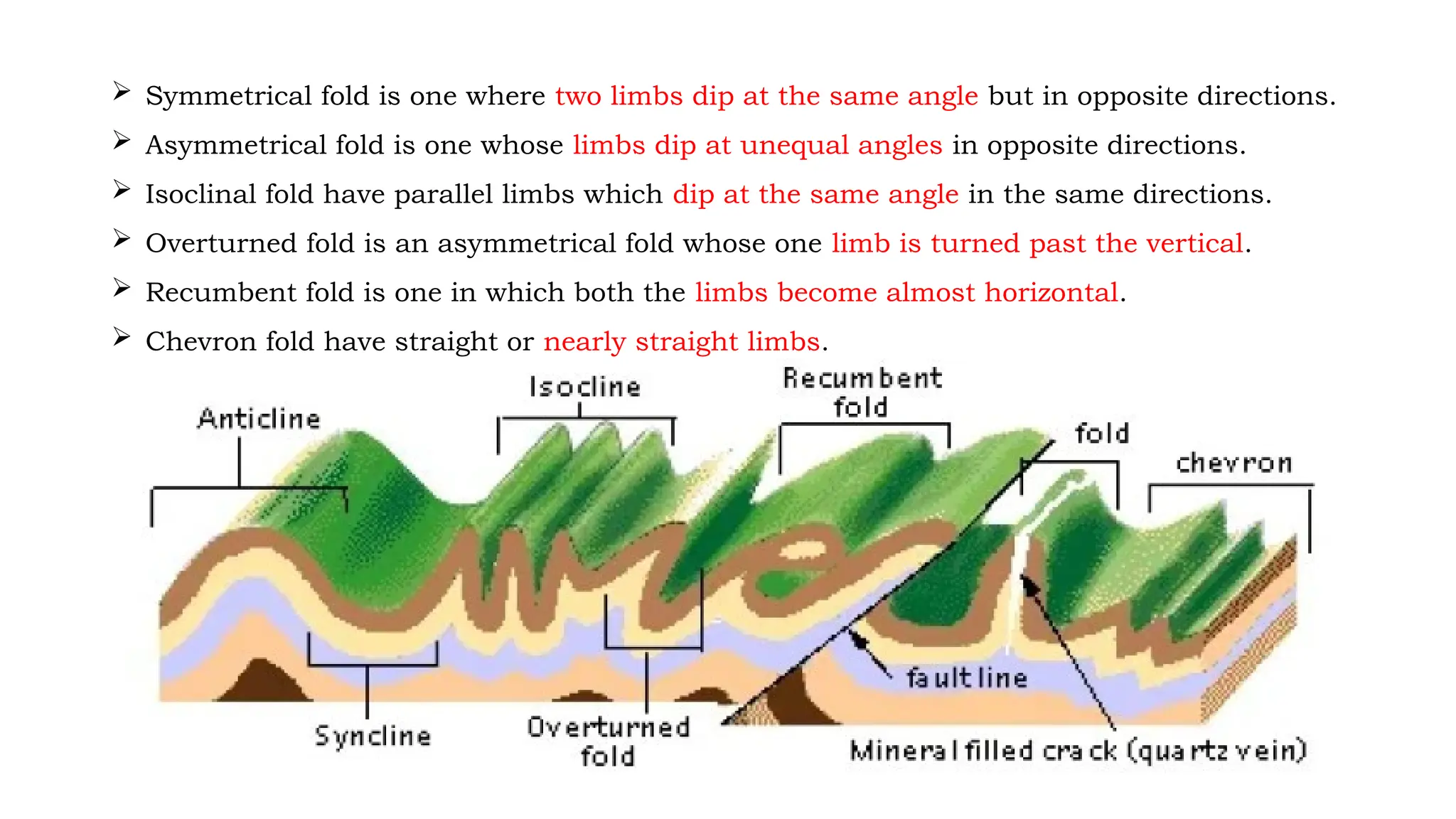
 Symmetrical fold is one where two limbs dip at the same angle but in opposite directions.
 Asymmetrical fold is one whose limbs dip at unequal angles in opposite directions.
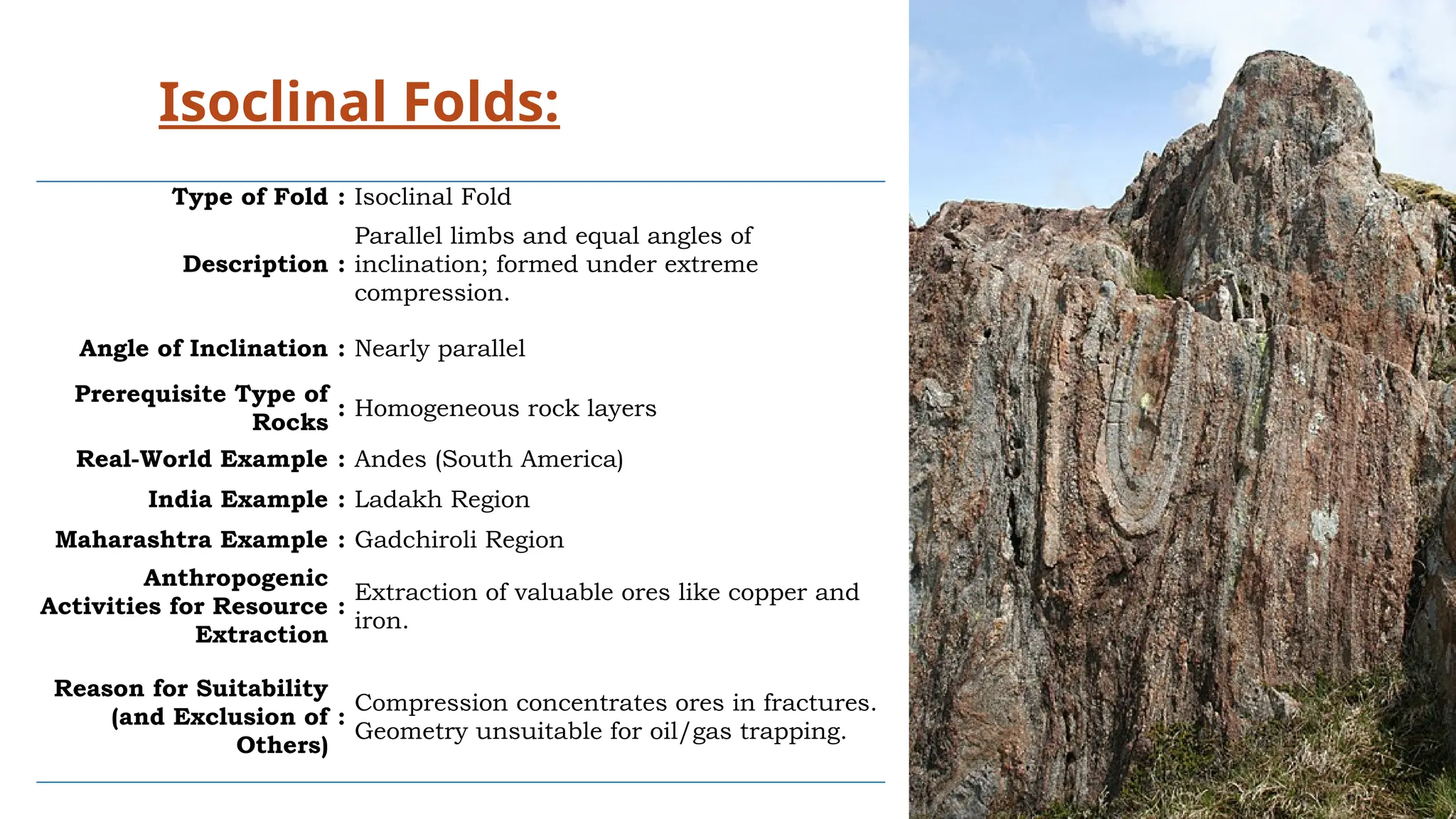
 Isoclinal fold have parallel limbs which dip at the same angle in the same directions.
 Overturned fold is an asymmetrical fold whose one limb is turned past the vertical.
 Recumbent fold is one in which both the limbs become almost horizontal.
 Chevron fold have straight or nearly straight limbs.
Type of Fold : Anticline
Pictures :
This anticline is in Alberta, Canada in the
Rocky Mountains
Description :
Upward-arching fold with the oldest rocks at
the core.
Angle of Inclination : Steep to gentle
Prerequisite Type of Rocks : Sedimentary or metamorphic rocks
Real-World Example :
Appalachian Mountains (USA), Alps, Andes,
and Rockies.
India Example : Himalayan Anticlines, Aravalli Range
Maharashtra Example : Satpura Ranges, Western Ghats
Anthropogenic Activities for Resource
Extraction
:
Mining of coal, petroleum, and natural gas
within anticline traps.
Reason for Suitability (and Exclusion of
Others)
:
Acts as traps for hydrocarbons due to
overlying impermeable rocks.
Poor suitability for groundwater due to
elevated structure causing minimal recharge.
Anticline folds:
Anticline folds: Syncline folds:
Overturned Folds: Recumbent Folds:
Type of Fold : Syncline
Description :
Downward-arching fold with youngest
rocks at the core.
Angle of Inclination : Steep to gentle
Prerequisite Type of Rocks : Sedimentary or metamorphic rocks
Real-World Example :
Jura Mountains (Switzerland), Paris
Basin in France
India Example :
Himalayan Synclines, Shillong
Plateau
Maharashtra Example :
Vidarbha Region (Coal Belts), Bhor
Ghat region
Anthropogenic Activities for Resource
Extraction
:
Extraction of coal and groundwater
reserves due to natural trapping.
Reason for Suitability (and Exclusion of
Others)
:
Accumulates water and sediments,
ideal for aquifers and coal.
Lacks upward traps for
hydrocarbons.
Syncline folds:
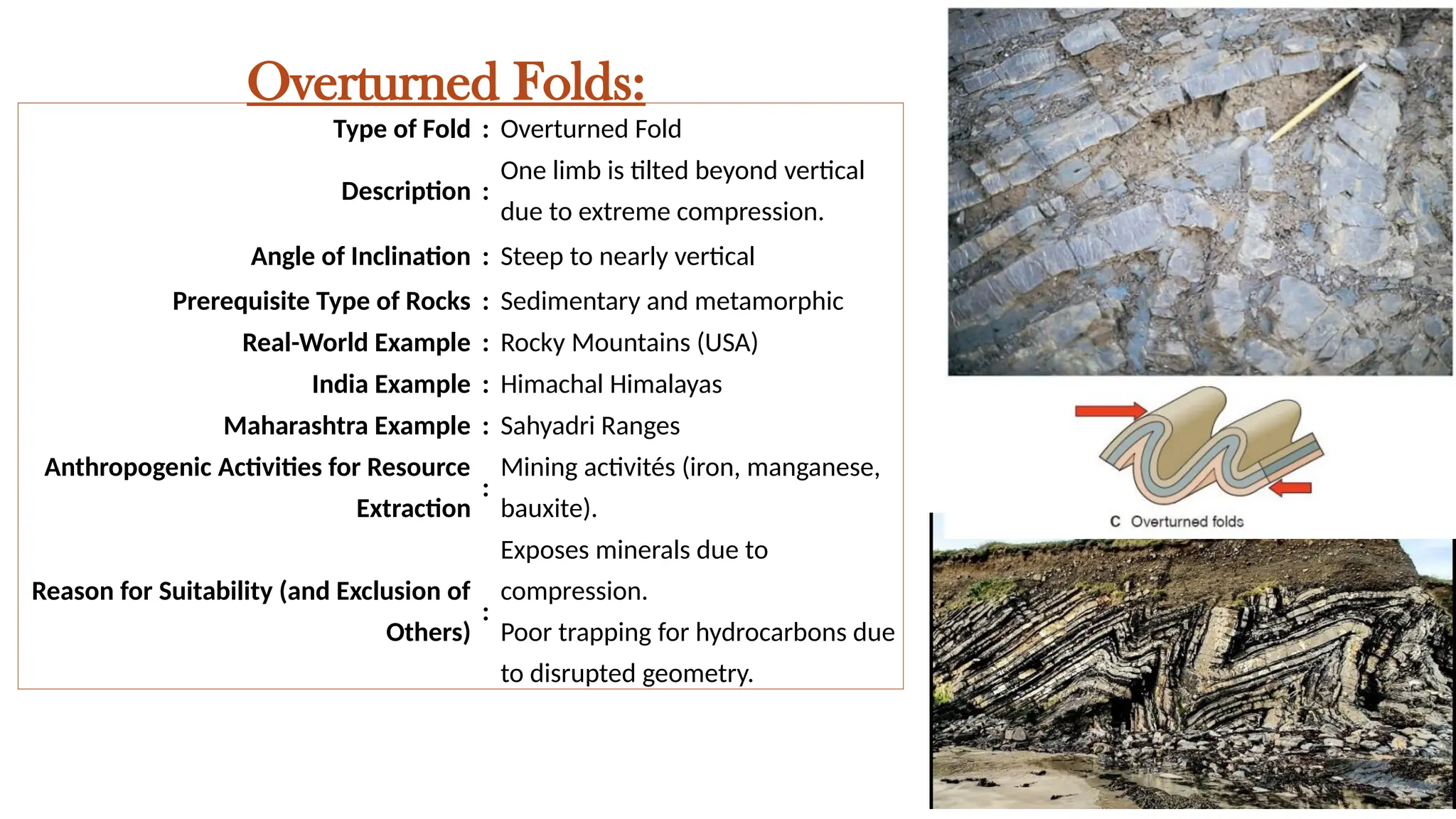
Type of Fold : Overturned Fold
Description :
One limb is tilted beyond vertical
due to extreme compression.
Angle of Inclination : Steep to nearly vertical
Prerequisite Type of Rocks : Sedimentary and metamorphic
Real-World Example : Rocky Mountains (USA)
India Example : Himachal Himalayas
Maharashtra Example : Sahyadri Ranges
Anthropogenic Activities for Resource
Extraction
:
Mining activités (iron, manganese,
bauxite).
Reason for Suitability (and Exclusion of
Others)
:
Exposes minerals due to
compression.
Poor trapping for hydrocarbons due
to disrupted geometry.
Overturned Folds:
Recumbent fold in Black Hills, South Dakota, USA
Type of Fold : Recumbent Fold
Description :
Horizontally compressed fold with limbs
nearly parallel to the ground.
Angle of Inclination : Horizontal
Prerequisite Type of Rocks : Highly compressed sedimentary
Real-World Example : Alps (Europe)
India Example : Western Himalayan Region
Maharashtra Example : Western Ghats
Anthropogenic Activities for
Resource Extraction :
Hydrocarbon extraction, tunnel
construction for mining and
transportation.
Reason for Suitability (and
Exclusion of Others)
:
Forms sealed reservoirs and allows
tunnels.
Unsuitable for groundwater due to
disrupted recharge.
Recumbent Folds:
Type of Fold : Isoclinal Fold
Description :
Parallel limbs and equal angles of
inclination; formed under extreme
compression.
Angle of Inclination : Nearly parallel
Prerequisite Type of
Rocks
: Homogeneous rock layers
Real-World Example : Andes (South America)
India Example : Ladakh Region
Maharashtra Example : Gadchiroli Region
Anthropogenic
Activities for Resource
Extraction
:
Extraction of valuable ores like copper and
iron.
Reason for Suitability
(and Exclusion of
Others)
:
Compression concentrates ores in fractures.
Geometry unsuitable for oil/gas trapping.
Isoclinal Folds:
Type of Fold : Chevron Fold
Pictures :
Chevron folds with flat-lying
axial planes, Millook Haven,
North Cornwall, UK
Description :
Sharp, angular folds with
straight limbs and narrow
hinges.
Angle of Inclination : Sharp, angular inclination
Prerequisite Type of Rocks :
Thinly bedded sedimentary
layers
Real-World Example : Appalachian Basin (USA)
India Example : Himalayas, Narmada Belt
Maharashtra Example : Satpura Ranges
Anthropogenic Activities
for Resource Extraction
:
Quarrying of angular strata
for construction materials.
Reason for Suitability (and
Exclusion of Others)
:
Exposes straight limbs,
simplifying access. Disrupts
continuity for hydrocarbons
and aquifers.
Chevron Folds:
Type of Fold : Monocline Fold
Description :
Step-like fold where rock layers
have one steep limb with the
other relatively horizontal.
Angle of Inclination : One limb steep
Prerequisite Type of Rocks : Sedimentary
Real-World Example : Monument Valley (USA)
India Example : Great Vindhyan Escarpment
Maharashtra Example :
Deccan Traps (Limited
Expression)
Anthropogenic Activities for
Resource Extraction
:
Suitable for accessing strata
with oil/gas or coal reserves.
Reason for Suitability (and
Exclusion of Others)
:
Easy drilling along monoclines
for oil and coal but minimal
groundwater due to incomplete
trapping.
Monocline Folds:
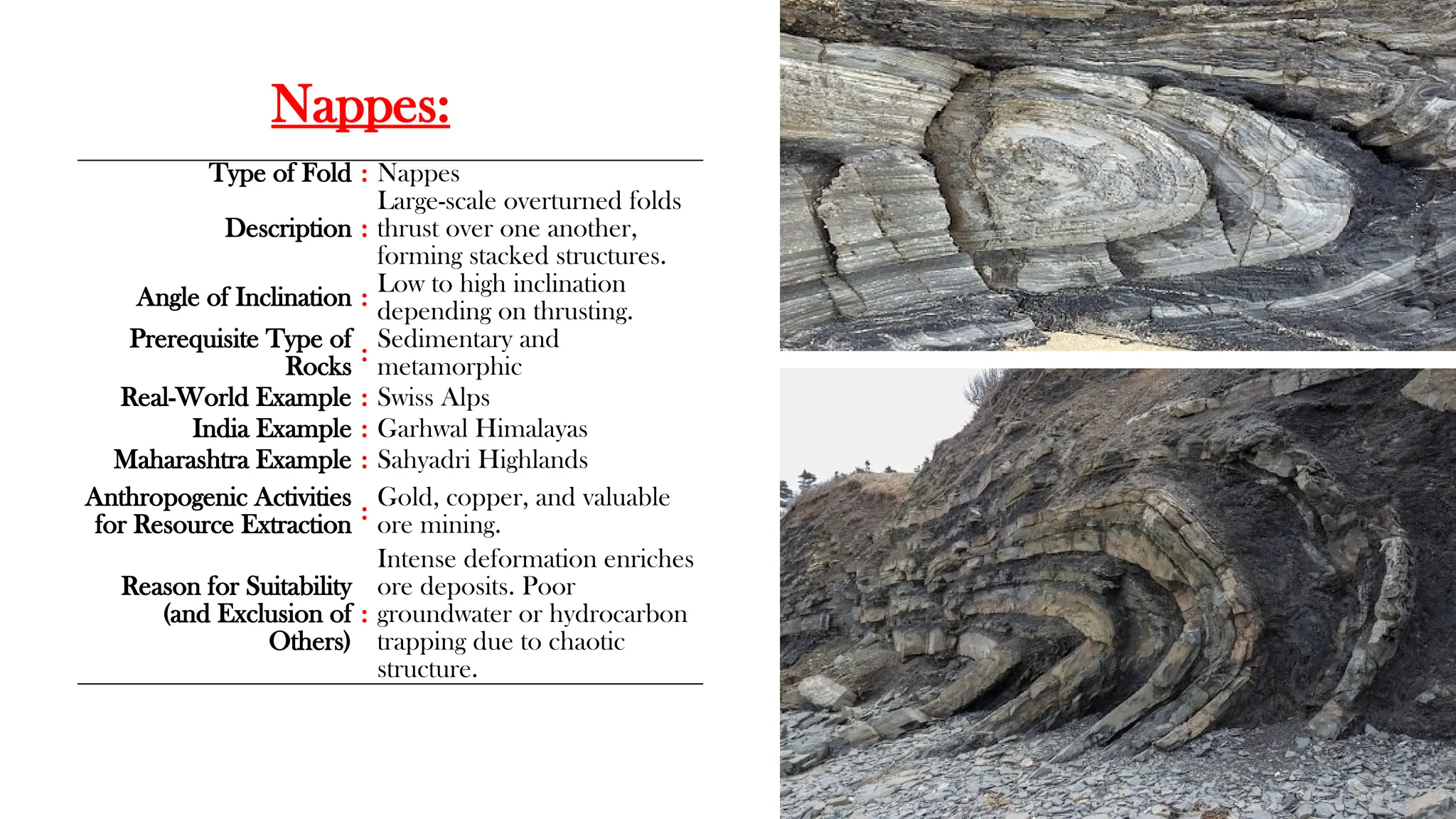
Type of Fold : Nappes
Description :
Large-scale overturned folds
thrust over one another,
forming stacked structures.
Angle of Inclination :
Low to high inclination
depending on thrusting.
Prerequisite Type of
Rocks
:
Sedimentary and
metamorphic
Real-World Example : Swiss Alps
India Example : Garhwal Himalayas
Maharashtra Example : Sahyadri Highlands
Anthropogenic Activities
for Resource Extraction :
Gold, copper, and valuable
ore mining.
Reason for Suitability
(and Exclusion of
Others)
:
Intense deformation enriches
ore deposits. Poor
groundwater or hydrocarbon
trapping due to chaotic
structure.
Nappes:
Type of Fold : Symmetrical Fold
Description :
Limbs are mirror images of each other;
fold axis is vertical.
Angle of Inclination : Symmetrical
Prerequisite Type of
Rocks : Uniformly bedded sedimentary
Real-World Example : Appalachian Synclines (USA)
India Example : Naga Hills
Maharashtra
Example : Chandrapur Coalfields
Anthropogenic
Activities for
Resource Extraction
: Suitable for coal and ore mining.
Reason for
Suitability (and
Exclusion of Others)
:
Consistency of layering enhances ore
deposits and hydrocarbon traps. Poor
suitability for water storage in rigid
layers.
Symmetrical Folds:
Anticline
Syncline
Type of Fold :
Asymmetrical Fold, Overturned
folds, Recumbent folds
Description :
One limb is steeper than the
other due to uneven
compression.
Angle of Inclination : Uneven inclination
Prerequisite Type of Rocks : Sedimentary and metamorphic
Real-World Example : Himalayas
India Example : Western Ghats
Maharashtra Example : Sahyadri Escarpment
Anthropogenic Activities for
Resource Extraction :
Facilitates ore deposits and
mining activities.
Reason for Suitability (and
Exclusion of Others) :
Compression exposes valuable
mineral veins.
Lack of continuity reduces
efficiency for hydrocarbons.
Asymmetrical Folds:
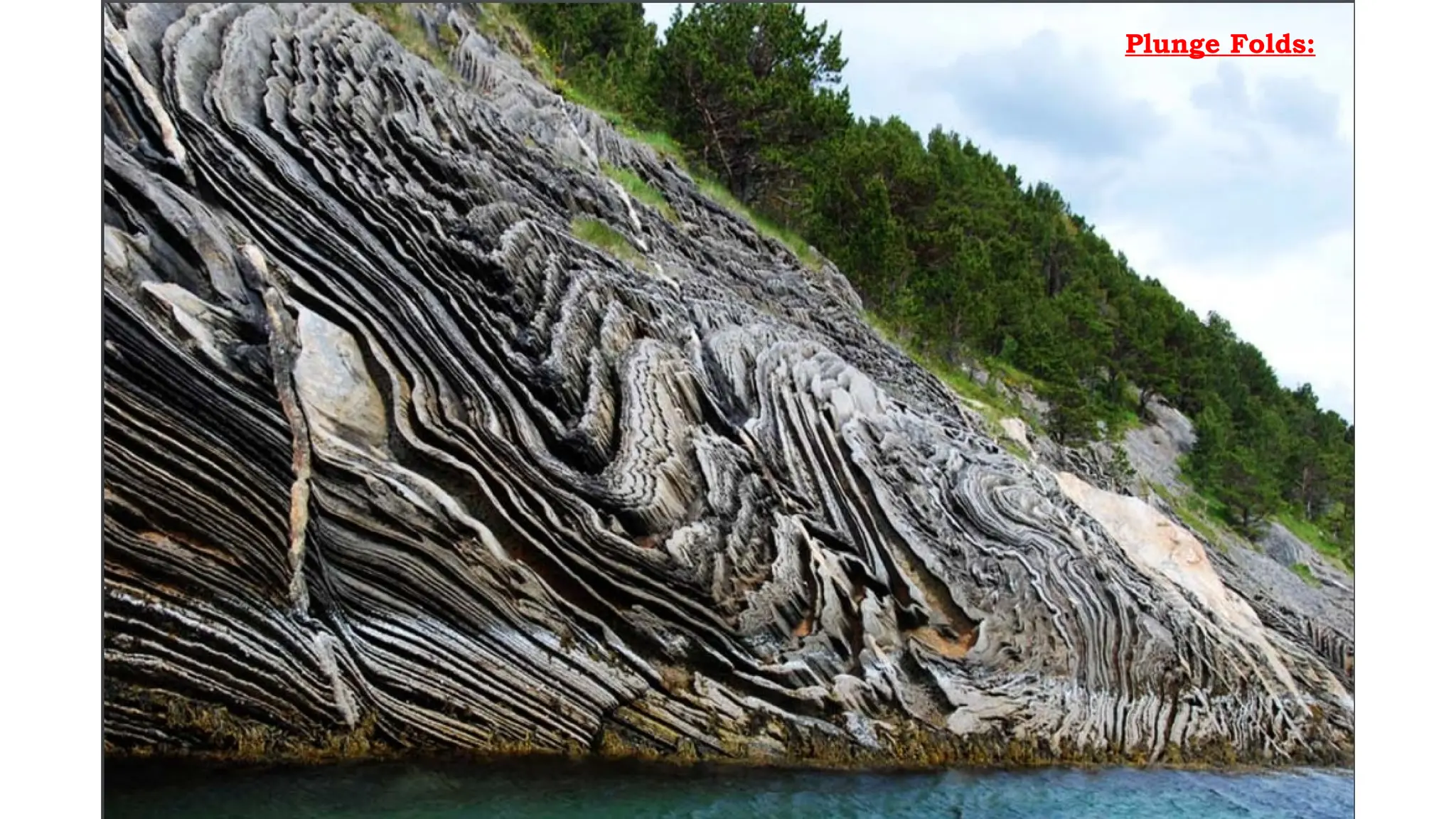
Type of Fold : Plunge Fold
Description :
Fold axis is tilted, forming a plunging
geometry.
A plunging fold is a type of fold
where the fold hinge line is not
horizontal but dips or plunges into
the Earth
Angle of Inclination : Moderate to steep plunge
Prerequisite Type of
Rocks
: Sedimentary, volcanic
Real-World Example : Rockies (USA), Alps (Europe)
India Example : Aravalli Hills
Maharashtra Example : Satmala Range
Anthropogenic Activities
for Resource Extraction
:
Mining for metals like gold and
copper.
Reason for Suitability (and
Exclusion of Others)
:
Tilted strata facilitate the exposure of
metal ores but disrupt fluid reservoirs
for hydrocarbons or water.
Plunge Folds:
Plunge Folds
Symmetrical Asymmetrical Anticline
domes or
elongated
hills
Syncline
valleys or
basins
Plunge Folds:
Plunge Folds:
Type of Fold : Fan Fold
Description :
Limbs diverge away from
each other, forming a fan-
shaped structure.
Angle of Inclination : Wide to steep divergence
Prerequisite Type of
Rocks
: Soft sedimentary layers
Real-World Example : Andes (South America)
India Example : Kumaon Himalayas
Maharashtra Example : Sahyadri Foothills
Anthropogenic
Activities for
Resource Extraction
:
Extracting sediments,
aggregates, and groundwater.
Reason for Suitability
(and Exclusion of
Others)
:
Diverging structure
accumulates sediments,
providing access to
aggregates and aquifers.
Fan Folds:
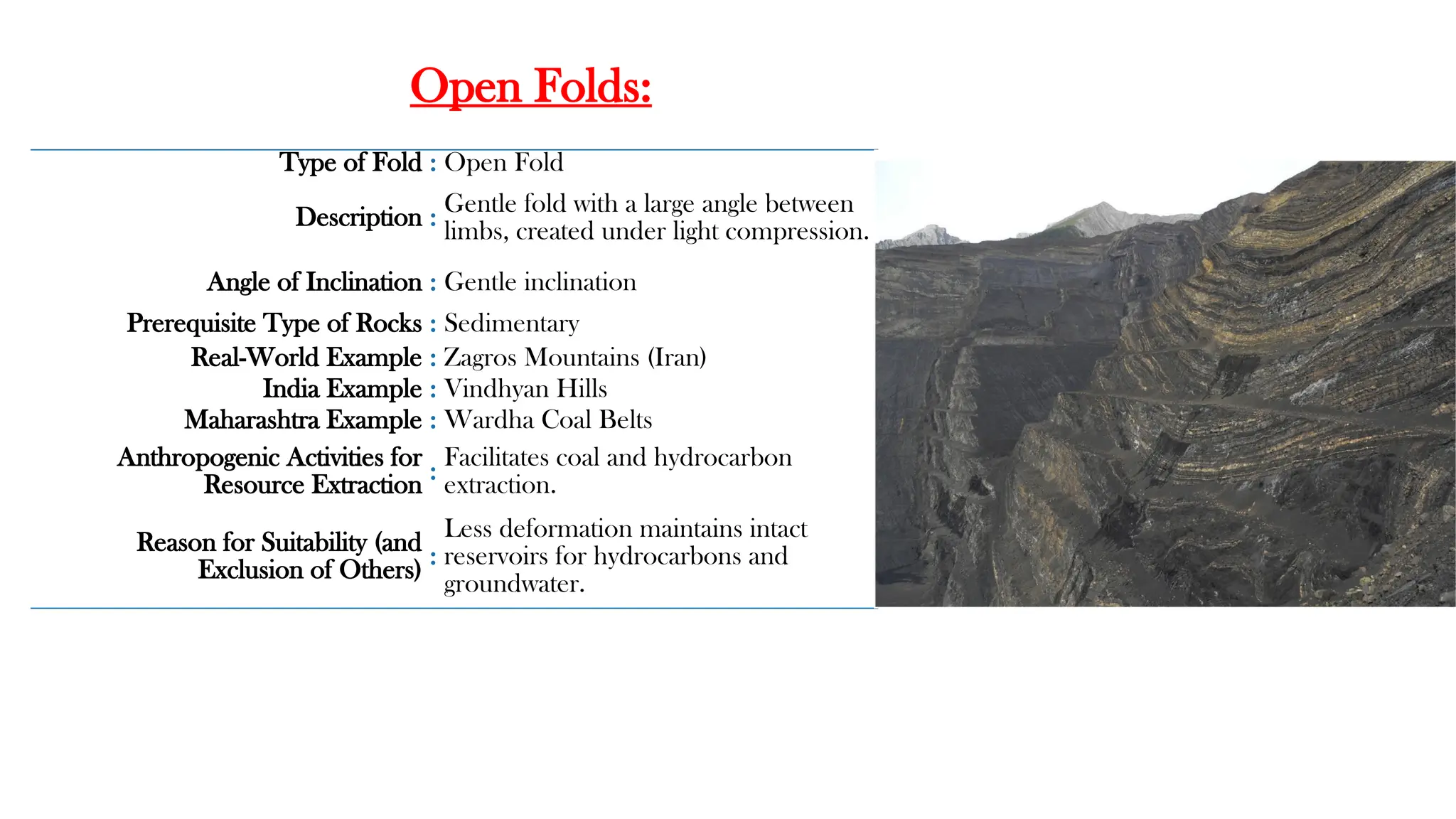
Type of Fold : Open Fold
Description : Gentle fold with a large angle between
limbs, created under light compression.
Angle of Inclination : Gentle inclination
Prerequisite Type of Rocks : Sedimentary
Real-World Example : Zagros Mountains (Iran)
India Example : Vindhyan Hills
Maharashtra Example : Wardha Coal Belts
Anthropogenic Activities for
Resource Extraction :
Facilitates coal and hydrocarbon
extraction.
Reason for Suitability (and
Exclusion of Others)
:
Less deformation maintains intact
reservoirs for hydrocarbons and
groundwater.
Open Folds:
Type of Fold : Closed Fold
Description :
Tight fold with a small angle between
limbs due to intense compression.
Angle of Inclination : Tight inclination
Prerequisite Type of Rocks : Compact sedimentary, metamorphic
Real-World Example : Alps (Europe), Andes
India Example : Ladakh
Maharashtra Example : Satpura Hills
Anthropogenic Activities for
Resource Extraction
: Ore extraction (iron, copper).
Reason for Suitability (and
Exclusion of Others)
:
Intense folding leads to enriched
mineral veins but disrupts continuous
reservoirs for fluids.
Closed Folds:
Type of Fold : Dome (anticlines)
Description : Broad, upward bulge resembling an
anticline but circular in pattern.
Angle of Inclination : Radial inclination outward
Prerequisite Type of Rocks : Sedimentary overlying igneous
Real-World Example : Black Hills, South Dakota (USA)
India Example : Vindhyan Dome Region
Maharashtra Example : Deccan Plateau
Anthropogenic Activities for
Resource Extraction
:
Oil, natural gas, and mineral
resource extraction within dome
traps.
Reason for Suitability (and
Exclusion of Others)
:
Traps hydrocarbons and minerals at
the core. Outward dips reduce
groundwater storage.
Dome:
Type of Fold : Basin (synclines)
Description : Downward, bowl-shaped fold with rocks
dipping towards the center.
Angle of Inclination : Radial inclination inward
Prerequisite Type of Rocks : Sedimentary
Real-World Example : Michigan Basin (USA)
India Example : Cambay Basin
Maharashtra Example : Godavari Basin
Anthropogenic Activities for
Resource Extraction
: Extraction of coalbed methane, oil, and
groundwater reservoirs.
Reason for Suitability (and
Exclusion of Others)
:
Traps hydrocarbons, coal, and water at
the center. Limited surface mineral
deposits.
Basin
Folds in landforms and their Causes (Geography)

Folds in landforms and their Causes (Geography)

  • 1.
    Folds Presented By: Ankita Khobragade NET,SET, Research Scholar (Geography) NFSC - SRF Vasantrao Naik Government Institute of Arts and Social Sciences Nagpur
  • 2.
    Folds: In geography, foldsare wave-like bends or curves in rock layers caused by Earth's internal forces, typically compression. These bends can form upward (anticlines) or downward (synclines) structures, contributing to the formation of mountain ranges and other landforms.
  • 3.
    Folds in landforms Sedimenta ryBasins Local Tectonic s Intraplat e Folding Plate Converge nce Convergent Oceanic- Continental Boundaries: Convergent Continental- Continental Boundaries: Convergent Oceanic-Oceanic Boundaries Causes of folds:
  • 5.
    Rates of PlateMovement •The Arctic Ridge has the slowest rate (less than 2.5 cm/year), and the East Pacific Rise in the South Pacific (about 3,400 km west of Chile), has the fastest rate (more than 15 cm/year). Major tectonic plates 1) Antarctica and the surrounding oceanic plate 2) North American plate 3) South American plate 4) Pacific plate 5) India-Australia-New Zealand plate 6) Africa with the eastern Atlantic floor plate 7) Eurasia and the adjacent oceanic plate Minor tectonic plates 1) Cocos plate: Between Central America and Pacific plate 2) Nazca plate: Between South America and Pacific plate 3) Arabian plate: Mostly the Saudi Arabian landmass 4) Philippine plate: Between the Asiatic and Pacific plate 5) Caroline plate: Between the Philippine and Indian plate (North of New Guinea) 6) Fuji plate: North-east of Australia 7) Turkish plate 8) Aegean plate (Mediterranean region) 9) Caribbean plate 10) Juan de Fuca plate (between Pacific and North American plates) 11) Iranian plate.
  • 10.
    folds in landforms,particularly fold mountains, predominantly occur near the margins of tectonic plates. Plate Convergence: Fold mountains form when two tectonic plates collide. The immense pressure from this collision forces the Earth's crust to buckle and fold, creating the characteristic mountain ranges. Types of Plate Boundaries:  Convergent Continental-Continental Boundaries (C=C): When two continental plates collide, neither can subduct due to their similar densities. This leads to intense compression and the formation of major fold mountain ranges like the Himalayas.  Convergent Oceanic-Continental Boundaries(O=C): When an oceanic plate collides with a continental plate, the denser oceanic plate subducts beneath the continental plate. This can also lead to the formation of fold mountains along the continental margin, such as the Andes Mountains.
  • 11.
    Folds in landformsare often associated with the margins of tectonic plates because this is where significant compressional forces occur due to plate interactions. These forces cause the rock layers to bend and form folds. For example, mountain ranges like the Himalayas and the Alps are formed by the folding of the Earth's crust at convergent plate boundaries. However, folds can also occur in other geological settings, including plateaus, plains, and low-lying regions. Here’s how:  Intraplate Folding: Folding can occur within a tectonic plate due to internal stresses, even if the region is not near a plate boundary. This can result from processes like subsurface faulting or differential loading.  Sedimentary Basins: In regions where, sedimentary layers accumulate over time, folds can develop due to the weight and pressure of overlying sediments, as well as due to subsurface movements.  Local Tectonics: Even in relatively stable regions, local tectonic forces can create folds. For example, regions with ancient orogenies (mountain-building events) may still exhibit folding.
  • 16.
    Type of Fold Anticline Syncline OverturnedFold Recumbent Fold Isoclinal Fold Chevron Fold Dome Basin Monocline Fold Symmetrical Fold Asymmetrical Fold Plunge Fold Fan Fold Open Fold Closed Fold Nappes
  • 17.
     Symmetrical foldis one where two limbs dip at the same angle but in opposite directions.  Asymmetrical fold is one whose limbs dip at unequal angles in opposite directions.  Isoclinal fold have parallel limbs which dip at the same angle in the same directions.  Overturned fold is an asymmetrical fold whose one limb is turned past the vertical.  Recumbent fold is one in which both the limbs become almost horizontal.  Chevron fold have straight or nearly straight limbs.
  • 19.
    Type of Fold: Anticline Pictures : This anticline is in Alberta, Canada in the Rocky Mountains Description : Upward-arching fold with the oldest rocks at the core. Angle of Inclination : Steep to gentle Prerequisite Type of Rocks : Sedimentary or metamorphic rocks Real-World Example : Appalachian Mountains (USA), Alps, Andes, and Rockies. India Example : Himalayan Anticlines, Aravalli Range Maharashtra Example : Satpura Ranges, Western Ghats Anthropogenic Activities for Resource Extraction : Mining of coal, petroleum, and natural gas within anticline traps. Reason for Suitability (and Exclusion of Others) : Acts as traps for hydrocarbons due to overlying impermeable rocks. Poor suitability for groundwater due to elevated structure causing minimal recharge. Anticline folds:
  • 20.
    Anticline folds: Synclinefolds: Overturned Folds: Recumbent Folds:
  • 21.
    Type of Fold: Syncline Description : Downward-arching fold with youngest rocks at the core. Angle of Inclination : Steep to gentle Prerequisite Type of Rocks : Sedimentary or metamorphic rocks Real-World Example : Jura Mountains (Switzerland), Paris Basin in France India Example : Himalayan Synclines, Shillong Plateau Maharashtra Example : Vidarbha Region (Coal Belts), Bhor Ghat region Anthropogenic Activities for Resource Extraction : Extraction of coal and groundwater reserves due to natural trapping. Reason for Suitability (and Exclusion of Others) : Accumulates water and sediments, ideal for aquifers and coal. Lacks upward traps for hydrocarbons. Syncline folds:
  • 22.
    Type of Fold: Overturned Fold Description : One limb is tilted beyond vertical due to extreme compression. Angle of Inclination : Steep to nearly vertical Prerequisite Type of Rocks : Sedimentary and metamorphic Real-World Example : Rocky Mountains (USA) India Example : Himachal Himalayas Maharashtra Example : Sahyadri Ranges Anthropogenic Activities for Resource Extraction : Mining activités (iron, manganese, bauxite). Reason for Suitability (and Exclusion of Others) : Exposes minerals due to compression. Poor trapping for hydrocarbons due to disrupted geometry. Overturned Folds:
  • 23.
    Recumbent fold inBlack Hills, South Dakota, USA Type of Fold : Recumbent Fold Description : Horizontally compressed fold with limbs nearly parallel to the ground. Angle of Inclination : Horizontal Prerequisite Type of Rocks : Highly compressed sedimentary Real-World Example : Alps (Europe) India Example : Western Himalayan Region Maharashtra Example : Western Ghats Anthropogenic Activities for Resource Extraction : Hydrocarbon extraction, tunnel construction for mining and transportation. Reason for Suitability (and Exclusion of Others) : Forms sealed reservoirs and allows tunnels. Unsuitable for groundwater due to disrupted recharge. Recumbent Folds:
  • 25.
    Type of Fold: Isoclinal Fold Description : Parallel limbs and equal angles of inclination; formed under extreme compression. Angle of Inclination : Nearly parallel Prerequisite Type of Rocks : Homogeneous rock layers Real-World Example : Andes (South America) India Example : Ladakh Region Maharashtra Example : Gadchiroli Region Anthropogenic Activities for Resource Extraction : Extraction of valuable ores like copper and iron. Reason for Suitability (and Exclusion of Others) : Compression concentrates ores in fractures. Geometry unsuitable for oil/gas trapping. Isoclinal Folds:
  • 26.
    Type of Fold: Chevron Fold Pictures : Chevron folds with flat-lying axial planes, Millook Haven, North Cornwall, UK Description : Sharp, angular folds with straight limbs and narrow hinges. Angle of Inclination : Sharp, angular inclination Prerequisite Type of Rocks : Thinly bedded sedimentary layers Real-World Example : Appalachian Basin (USA) India Example : Himalayas, Narmada Belt Maharashtra Example : Satpura Ranges Anthropogenic Activities for Resource Extraction : Quarrying of angular strata for construction materials. Reason for Suitability (and Exclusion of Others) : Exposes straight limbs, simplifying access. Disrupts continuity for hydrocarbons and aquifers. Chevron Folds:
  • 27.
    Type of Fold: Monocline Fold Description : Step-like fold where rock layers have one steep limb with the other relatively horizontal. Angle of Inclination : One limb steep Prerequisite Type of Rocks : Sedimentary Real-World Example : Monument Valley (USA) India Example : Great Vindhyan Escarpment Maharashtra Example : Deccan Traps (Limited Expression) Anthropogenic Activities for Resource Extraction : Suitable for accessing strata with oil/gas or coal reserves. Reason for Suitability (and Exclusion of Others) : Easy drilling along monoclines for oil and coal but minimal groundwater due to incomplete trapping. Monocline Folds:
  • 28.
    Type of Fold: Nappes Description : Large-scale overturned folds thrust over one another, forming stacked structures. Angle of Inclination : Low to high inclination depending on thrusting. Prerequisite Type of Rocks : Sedimentary and metamorphic Real-World Example : Swiss Alps India Example : Garhwal Himalayas Maharashtra Example : Sahyadri Highlands Anthropogenic Activities for Resource Extraction : Gold, copper, and valuable ore mining. Reason for Suitability (and Exclusion of Others) : Intense deformation enriches ore deposits. Poor groundwater or hydrocarbon trapping due to chaotic structure. Nappes:
  • 30.
    Type of Fold: Symmetrical Fold Description : Limbs are mirror images of each other; fold axis is vertical. Angle of Inclination : Symmetrical Prerequisite Type of Rocks : Uniformly bedded sedimentary Real-World Example : Appalachian Synclines (USA) India Example : Naga Hills Maharashtra Example : Chandrapur Coalfields Anthropogenic Activities for Resource Extraction : Suitable for coal and ore mining. Reason for Suitability (and Exclusion of Others) : Consistency of layering enhances ore deposits and hydrocarbon traps. Poor suitability for water storage in rigid layers. Symmetrical Folds: Anticline Syncline
  • 31.
    Type of Fold: Asymmetrical Fold, Overturned folds, Recumbent folds Description : One limb is steeper than the other due to uneven compression. Angle of Inclination : Uneven inclination Prerequisite Type of Rocks : Sedimentary and metamorphic Real-World Example : Himalayas India Example : Western Ghats Maharashtra Example : Sahyadri Escarpment Anthropogenic Activities for Resource Extraction : Facilitates ore deposits and mining activities. Reason for Suitability (and Exclusion of Others) : Compression exposes valuable mineral veins. Lack of continuity reduces efficiency for hydrocarbons. Asymmetrical Folds:
  • 33.
    Type of Fold: Plunge Fold Description : Fold axis is tilted, forming a plunging geometry. A plunging fold is a type of fold where the fold hinge line is not horizontal but dips or plunges into the Earth Angle of Inclination : Moderate to steep plunge Prerequisite Type of Rocks : Sedimentary, volcanic Real-World Example : Rockies (USA), Alps (Europe) India Example : Aravalli Hills Maharashtra Example : Satmala Range Anthropogenic Activities for Resource Extraction : Mining for metals like gold and copper. Reason for Suitability (and Exclusion of Others) : Tilted strata facilitate the exposure of metal ores but disrupt fluid reservoirs for hydrocarbons or water. Plunge Folds: Plunge Folds Symmetrical Asymmetrical Anticline domes or elongated hills Syncline valleys or basins
  • 34.
  • 35.
  • 36.
    Type of Fold: Fan Fold Description : Limbs diverge away from each other, forming a fan- shaped structure. Angle of Inclination : Wide to steep divergence Prerequisite Type of Rocks : Soft sedimentary layers Real-World Example : Andes (South America) India Example : Kumaon Himalayas Maharashtra Example : Sahyadri Foothills Anthropogenic Activities for Resource Extraction : Extracting sediments, aggregates, and groundwater. Reason for Suitability (and Exclusion of Others) : Diverging structure accumulates sediments, providing access to aggregates and aquifers. Fan Folds:
  • 37.
    Type of Fold: Open Fold Description : Gentle fold with a large angle between limbs, created under light compression. Angle of Inclination : Gentle inclination Prerequisite Type of Rocks : Sedimentary Real-World Example : Zagros Mountains (Iran) India Example : Vindhyan Hills Maharashtra Example : Wardha Coal Belts Anthropogenic Activities for Resource Extraction : Facilitates coal and hydrocarbon extraction. Reason for Suitability (and Exclusion of Others) : Less deformation maintains intact reservoirs for hydrocarbons and groundwater. Open Folds:
  • 38.
    Type of Fold: Closed Fold Description : Tight fold with a small angle between limbs due to intense compression. Angle of Inclination : Tight inclination Prerequisite Type of Rocks : Compact sedimentary, metamorphic Real-World Example : Alps (Europe), Andes India Example : Ladakh Maharashtra Example : Satpura Hills Anthropogenic Activities for Resource Extraction : Ore extraction (iron, copper). Reason for Suitability (and Exclusion of Others) : Intense folding leads to enriched mineral veins but disrupts continuous reservoirs for fluids. Closed Folds:
  • 39.
    Type of Fold: Dome (anticlines) Description : Broad, upward bulge resembling an anticline but circular in pattern. Angle of Inclination : Radial inclination outward Prerequisite Type of Rocks : Sedimentary overlying igneous Real-World Example : Black Hills, South Dakota (USA) India Example : Vindhyan Dome Region Maharashtra Example : Deccan Plateau Anthropogenic Activities for Resource Extraction : Oil, natural gas, and mineral resource extraction within dome traps. Reason for Suitability (and Exclusion of Others) : Traps hydrocarbons and minerals at the core. Outward dips reduce groundwater storage. Dome:
  • 41.
    Type of Fold: Basin (synclines) Description : Downward, bowl-shaped fold with rocks dipping towards the center. Angle of Inclination : Radial inclination inward Prerequisite Type of Rocks : Sedimentary Real-World Example : Michigan Basin (USA) India Example : Cambay Basin Maharashtra Example : Godavari Basin Anthropogenic Activities for Resource Extraction : Extraction of coalbed methane, oil, and groundwater reservoirs. Reason for Suitability (and Exclusion of Others) : Traps hydrocarbons, coal, and water at the center. Limited surface mineral deposits. Basin