FMCSA & WISCONSIN
STATE
PATROL UPDATE
A review of current regulatory and
compliance issues that will impact your
business.
date
To Our Sponsors: Thank You!
FEDERAL MOTOR CARRIER
SAFETY ADMINISTRATION
2016-2017
Mark Oesterle, Wisconsin Division Administrator
November 10, 2016
Brookfield, WI
FMCSA Overview
• Safety Fitness Determination Rating Process
• Drug and Alcohol Clearinghouse
• Controlled Substance Testing using Hair Follicles
• Insulin Dependent Driver Waivers
• Complaints received by FMCSA
o386.12
oNo CSA Basic over the thresholds
oFocused Review
oNational Consumer Compliant Database
Part 382 - Types of Testing
• PRE-EMPLOYMENT
• RANDOM
• POST-ACCIDENT
• REASONABLE CAUSE
• RETURN TO DUTY
• FOLLOW-UP
Electronic Logging Devices
What is an Electronic Logging Device (ELD)?
• Why has FMCSA implemented a new rule about ELDs?
• The rule is intended to help create a safer work environment for drivers,
and make it easier and faster to accurately track, manage, and share
records of duty status (RODS) data
• As part of the MAP-21 Act, Congress required the adoption of the ELD
rule
An ELD synchronizes with a vehicle engine to automatically
record driving time, for easier, more accurate hours of service
(HOS) recording
Who is required to use an ELD?
• Interstate CMV drivers currently required to keep RODS
• Subject to requirements in 49 CFR 395
• CMVs defined in 49 CFR 390.5
• ≥ 10,001 pounds
• Placarded hazmat
• More than 8 or 15 passengers
Who is Exempt from the ELD Rule?
• The ELD Rule applies to most motor carriers and drivers who are currently
required to maintain RODS. The rule applies to commercial buses as well
as trucks. Canada and Mexico domiciled drivers are included, unless they
qualify for one of the exceptions to the ELD rule.
• The following are not required to use ELDs (but carriers may choose to
use ELDs even if they are not required):
• Drivers who comply with the 100 or 150 mile radius exemption
• Drivers who use paper logs no more than 8 days during any
30-day period
• Driveaway-towaway operations (transporting an empty vehicle for
sale, lease, or repair, provided the vehicle is part of the shipment),
as defined in 49 CFR § 390.5
• Drivers of vehicles manufactured before model year 2000
About the ELD Rule
• The ELD Rule…
• Specifies who is covered by the rule and the rule’s exceptions
• Provides for ELDS to be certified, registered, and listed on a FMCSA website
• Includes technical specifications to ensure ELDs are standardized
and compliant
• Has a phased implementation timeline to give carriers and drivers
time to comply
• Includes provisions to help prevent data tampering and harassment
of drivers
• Requires standard data displays and data transfer processes, making
it easier to demonstrate compliance and faster to share RODS with
safety officials
Who is Impacted by the ELD Rule?
• Carriers and Drivers who are subject to the rule must install and
use ELDs by the appropriate deadline
ELD Manufacturers must conform to ELD technical specifications,
certify their ELDs, and register them with FMCSA
Enforcement Partners must understand enforcement and
compliance procedures during each implementation phase, and which
regulatory guidance applies to each
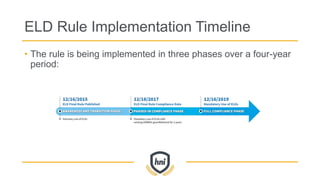
ELD Rule Implementation Timeline
• The rule is being implemented in three phases over a four-year
period:
ELD Rule Implementation
• Phase 1 “Awareness and Transition”
• February 16, 2016 to December 18, 2017
• Carriers and drivers subject to the rule should prepare to comply,
and may voluntarily use ELDs
• Carriers and drivers subject to the rule can use any of the following
for RODS status:
- Paper logs
- Devices with installed logging software and applications
- AOBRDs (Automatic On Board Recording Devices)
- ELDs that are registered and listed on the FMCSA website
ELD Rule Implementation
• Phase 2 “Phased-In Compliance”
• December 18, 2017 to December 16, 2019
• Carriers and drivers subject to the rule can
use:
- AOBRDS that were installed prior to
December 17, 2017
- Certified, registered ELDs following rule
publication
ELD Rule Implementation
• Phase 3 “Full Compliance”
• After December 16, 2019
• All drivers and carriers subject to the
rule must use certified, registered ELDs
that comply with requirements of the
ELD regulations
Logging In / Accessing an ELD
• A driver must have only one driver account with a carrier, with a
unique identification number and password
• An owner/operator must have a single account as a driver, and a
separate account for administrative functions (setting up user
accounts, etc.)
• What if the driver forgets to log onto the ELD?
• A warning will be issued from the device to remind the driver to stop and log
in
• The device will also record accumulated driving time in accordance with the
ELD defaults, under the unidentified driver profile
• ELD events logged under the “Unidentified Driver” profile should be
added to the driver’s record – or the driver should add a note
(annotation) explaining that the unassigned hours are not his/hers
How an ELD Records Drivers’ Hours of Service
• An ELD records actual time for each duty status entered or
automatically started
• ELDs cannot be set to record minimum duty status durations,
such as 15-minute intervals
• ELDs record data every hour when a vehicle is moving, and
there has not been a duty status change or interim recording in
the previous hour
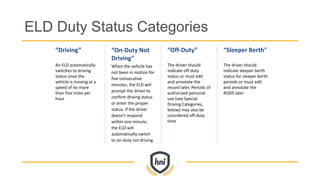
“Driving”
An ELD automatically
switches to driving
status once the
vehicle is moving at a
speed of no more
than five miles per
hour
“On-Duty Not
Driving”
When the vehicle has
not been in motion for
five consecutive
minutes, the ELD will
prompt the driver to
confirm driving status
or enter the proper
status. If the driver
doesn’t respond
within one minute,
the ELD will
automatically switch
to on-duty not driving
“Off-Duty”
The driver should
indicate off-duty
status or must edit
and annotate the
record later. Periods of
authorized personal
use (see Special
Driving Categories,
below) may also be
considered off-duty
time
“Sleeper Berth”
The driver should
indicate sleeper berth
status for sleeper berth
periods or must edit
and annotate the
RODS later
ELD Duty Status Categories
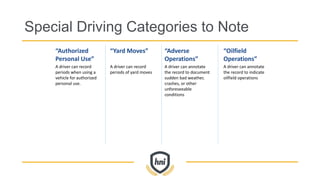
Special Driving Categories to Note
“Authorized
Personal Use”
A driver can record
periods when using a
vehicle for authorized
personal use.
“Yard Moves”
A driver can record
periods of yard moves
“Adverse
Operations”
A driver can annotate
the record to document
sudden bad weather,
crashes, or other
unforeseeable
conditions
“Oilfield
Operations”
A driver can annotate
the record to indicate
oilfield operations
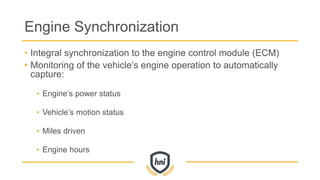
Engine Synchronization
• Integral synchronization to the engine control module (ECM)
• Monitoring of the vehicle’s engine operation to automatically
capture:
• Engine’s power status
• Vehicle’s motion status
• Miles driven
• Engine hours
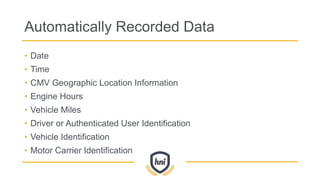
Automatically Recorded Data
• Date
• Time
• CMV Geographic Location Information
• Engine Hours
• Vehicle Miles
• Driver or Authenticated User Identification
• Vehicle Identification
• Motor Carrier Identification
ELD Event Data Recordings
• Engine power up and shut down
• Driver login/logout
• Duty status changes
• Personal use or yard moves
• Certification of driver’s daily record
• 60-minute intervals when the vehicle is in motion
• Malfunction of diagnostic events
Geolocations
• CMV Geographic Location Information
• Show a nearby city, town, or village, or the compass direction
and distance from the nearest city, town, or village
• During on-duty driving periods, the location accuracy is
approximately within a 1-mile radius
• When a CMV is used for personal use, the position reporting
accuracy is approximately within a 10-mile radius
Manual Inputs
• Motor carriers – User account setup
• Drivers
• Support personnel (mechanics, dispatch, etc.)
• Drivers
• Annotations, when applicable
• Location description, when prompted by the ELD
• CMV power unit number
• Trailer number(s), if applicable
• Shipping document number, if applicable
ELD Record of Duty Status
• It is required that RODS be shared in one of two ways at
roadside (choice of the driver or motor carrier):
• Printout (not all ELDs provide)
• Screen display visible to enforcement at a reasonable distance
• Acceptance of data via fax, email or other method of
transmission is at the discretion of the inspector.
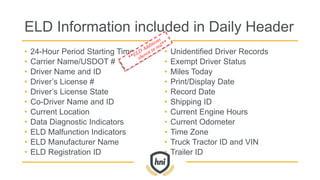
ELD Information included in Daily Header
• 24-Hour Period Starting Time
• Carrier Name/USDOT #
• Driver Name and ID
• Driver’s License #
• Driver’s License State
• Co-Driver Name and ID
• Current Location
• Data Diagnostic Indicators
• ELD Malfunction Indicators
• ELD Manufacturer Name
• ELD Registration ID
• Unidentified Driver Records
• Exempt Driver Status
• Miles Today
• Print/Display Date
• Record Date
• Shipping ID
• Current Engine Hours
• Current Odometer
• Time Zone
• Truck Tractor ID and VIN
• Trailer ID
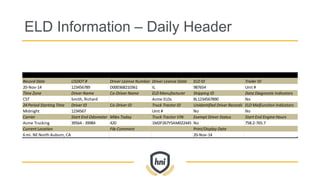
ELD Information – Daily Header
Record Date USDOT # Driver License Number Driver License State ELD ID Trailer ID
20-Nov-14 123456789 D000368210361 IL 987654 Unit #
Time Zone Driver Name Co-Driver Name ELD Manufacturer Shipping ID Data Diagnostic Indicators
CST Smith, Richard Acme ELDs BL1234567890 No
24 Period Starting Time Driver ID Co-Driver ID Truck Tractor ID Unidentified Driver Records ELD Malfunction Indicators
Midnight 1234567 Unit # No No
Carrier Start End Odometer Miles Today Truck Tractor VIN Exempt Driver Status Start End Engine Hours
Acme Trucking 39564 - 39984 420 1M2P267Y5AM022445 No 758.2-765.7
Current Location File Comment Print/Display Date
6 mi. NE North Auburn, CA 20-Nov-14
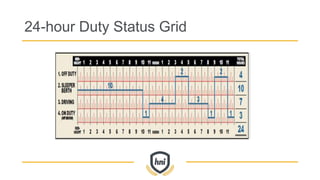
24-hour Duty Status Grid
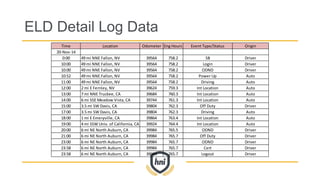
ELD Detail Log Data
Time Location Odometer Eng Hours Event Type/Status Origin
20-Nov-14
0:00 49 mi NNE Fallon, NV 39564 758.2 SB Driver
10:00 49 mi NNE Fallon, NV 39564 758.2 Login Driver
10:00 49 mi NNE Fallon, NV 39564 758.2 ODND Driver
10:52 49 mi NNE Fallon, NV 39564 758.2 Power Up Auto
11:00 49 mi NNE Fallon, NV 39564 758.2 Driving Auto
12:00 2 mi E Fernley, NV 39624 759.3 Int Location Auto
13:00 7 mi NNE Truckee, CA 39684 760.3 Int Location Auto
14:00 6 mi SSE Meadow Vista, CA 39744 761.3 Int Location Auto
15:00 3.5 mi SW Davis, CA 39804 762.3 Off Duty Driver
17:00 3.5 mi SW Davis, CA 39804 762.3 Driving Auto
18:00 1 mi E Emeryville, CA 39864 763.4 Int Location Auto
19:00 4 mi SSW Univ. of California, CA 39924 764.4 Int Location Auto
20:00 6 mi NE North Auburn, CA 39984 765.5 ODND Driver
21:00 6 mi NE North Auburn, CA 39984 765.7 Off Duty Driver
23:00 6 mi NE North Auburn, CA 39984 765.7 ODND Driver
23:58 6 mi NE North Auburn, CA 39984 765.7 Cert Driver
23:58 6 mi NE North Auburn, CA 39984 765.7 Logout Driver
Supporting Documents: Definition
“A document, in any medium, generated or received by a motor
carrier in the normal course of business as described in 395.11
that can be used, as produced or with additional identifying
information, by the motor carrier and enforcement officials to
verify the accuracy of a driver’s record of duty status.” [§ 395.2]
Supporting Documents: Data Elements
• Driver name (or carrier-assigned ID)
• Can be vehicle unit number if that number can be linked to the driver
• Date
• Location (including the name of nearest city, town or village)
• Time
Supporting Documents: Categories
• Bills of lading, itineraries, schedules, or equivalent with the origin and
destination of each trip
• Dispatch records, trip records, or equivalent
• Expense receipts related to on-duty (not driving) periods
• Electronic mobile communication records
• Payroll records, settlement sheets, or equivalent
Supporting Documents: Number
• Retain maximum of 8 documents per 24-hour duty day
• If more than 8 documents are submitted per day, must retain first
and last document of day
• If fewer than 8 documents are submitted, a document that contains
all of the elements except “time” is considered a supporting
document
• If a driver does not use an ELD, all toll records must be retained
• Toll receipts do not count toward the 8-document cap
Supporting Documents: General
• Must be retained for 6 months
• Must be submitted within 13 days
• Must be able to be matched to RODS
• Cannot be destroyed, defaced, or altered
• Driver must make supporting documents in his/her possession
available to authorized Federal, State, or local official upon
request
Resources
• Website: www.fmcsa.dot.gov/elds
• Public email address: ELD@dot.gov
THANK YOU!
WISCONSIN STATE PATROL
2016-2017
Sergeant Mark J. Abrahamson
November 10, 2016
Brookfield, WI
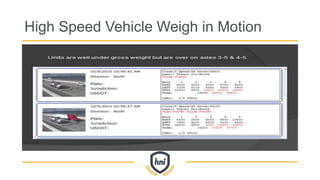
High Speed Vehicle Weigh in Motion
• Non-Compliance with WI’s adoption of the FMCSR’s
• 2017 Commercial Vehicle Safety Plan (CVSP)
• 2017 High Priority Grant (HPG)
• Fast Act Update
• Intrastate Activities
Overview of Presentation
40
• The State’s exemption of intrastate drivers from its adoption of
driver qualifications and hours of service (HOS) regulations
during emergencies, in Trans 327.09 (6) is not compatible with
49 CFR 390.23.
• The emergency must be declared by certain specified Federal,
State, or local officials. The Wisconsin regulations allow the
motor carrier to declare the emergency.
Trans. 327 Review
41
• The State’s exemption in Trans 327.09 of intrastate drivers
holding a Wisconsin CDL issued prior to July 29, 1996 from the
driver qualification requirements contained in 49 CFR 391 is not
compatible with the FMCSRs.
• The “grandfather” provision of the medical card will expire and
all drivers operating a vehicle requiring a CDL will need a
medical card in INTRAstate commerce.
Trans. 327 Review
42
• The State’s exception for intrastate drivers of CMVs in Trans
327.03 from the minimum age requirements contained in 49
CFR 391.11(b)(1) is not compatible with the FMCSRs.
• 16 and 17 year old drivers will not be able to drive a CMV as
defined in part 390.5 in INTRAstate commerce. (GVWR 10,001+)
Trans. 327 Review
43
• Define “planting and harvesting season” to mean the period of
time beginning March 15 through December 15 of each year,
consistent with Trans 325.01. Currently, “planting and
harvesting season” is not defined for intrastate transportation.
• More uniform to FMCSR’s – ELD Rule automatically adopted
• 395.8 -Graph grid record of duty status if not excepted – no change to
150 air mile radius exceptions.
• 395.5 – Passenger carriers follow same interstate rule 10/15, 60/70
Trans. 327 Review
44
Trans. 327 Review
Property Carriers Maintain;
Intrastate Operations
• 12/16 Hour Rule
• 60/70 Hour Rule
• 1. More than 12 hours following 10 consecutive hours off duty.
• 2. Any period after having been on duty 16 hours following 10 consecutive hours off duty.
• 3. After having been on duty for 70 hours in any period of 7 consecutive days.
• 4. After having been on duty for 80 hours in any period of 8 consecutive days.
• (b) A driver is exempt from the requirements of 395.8 if the driver
operates within a 150 air-mile radius of the normal work reporting
location;
Note: NOT; “after having come on duty” like interstate rule.
Objectives:
• Inspecting commercial vehicles and their drivers to ensure
vehicles are mechanically sound and drivers are in
compliance with federal and state laws and regulations.
• Assuring the implementation of CSA initiatives to further
program quality standards including a good faith review of all
inspection-related Requests for Data Review (RDRs) for
three years from the date of inspection and for all crash-
related RDRs for five years from the date of the crash
2017 Commercial Vehicle Safety Plan
46
2017 Commercial Vehicle Safety Plan
Objectives cont.
• Setting up motor coach destination inspections through strike forces
and addressing related unsafe driver behavior and conduct such as
speeding, following too closely, operating in violation of an out-of-
service order, and hours of service violations.
• Monitoring industry initiatives including frac sand mining in Northwest
Wisconsin, the timber industry, and other large industry activities and
creating special details to ensure that safety is ensured commensurate
with the level of CMV traffic being generated
47
Objectives cont.
• Ensuring that a motor carrier’s operating authority is confirmed during
each inspection and that action is taken if not in compliance.
• Conducting CMV traffic enforcement associated with an inspection and
traffic enforcement without an accompanying inspection resulting from
an observed unsafe driver behavior
• Participation in training associated with the Electronic Logging Device
(ELD) final rule published on December 16, 2015
2017 Commercial Vehicle Safety Plan
48
Objectives cont.
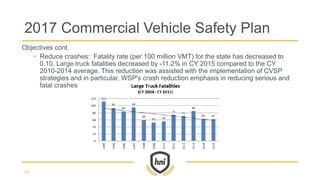
• Reduce crashes: Fatality rate (per 100 million VMT) for the state has decreased to
0.10. Large truck fatalities decreased by -11.2% in CY 2015 compared to the CY
2010-2014 average. This reduction was assisted with the implementation of CVSP
strategies and in particular, WSP's crash reduction emphasis in reducing serious and
fatal crashes
2017 Commercial Vehicle Safety Plan
49
• Activities to accomplish the objectives
• Focused details with 6 officer strike forces in WI’s highest
crash counties.
• 24 counties identified // 2 details in each county
• CMV drivers operating aggressively and passenger cars
operating aggressively around CMV’s.
• Use FMCSA’s Query Central program to screen for carriers
operating under Federal Out of Service Order.
• If detected place out of service and remove IRP plate(s)
from power unit.
2017 Commercial Vehicle Safety Plan
50
• Activities to accomplish the objectives
• 15 counties have been recognized as having significant work zones. 2
details in each work zone will be conducted focusing on following too
close, cell phone use, texting, and speeding.
• 33000 inspections will be conducted at SWEF’s or mobile enforcement.
• 40 passenger carrying vehicles
• 1400 HAZMAT carrying vehicles
• 10 MC sergeants will each do at least 2 traffic details focusing on areas
where crashes occur.
2017 Commercial Vehicle Safety Plan
51
• Activities to accomplish the objectives
• Wisconsin will conduct a minimum of 118 compliance reviews.
• 50 educational outreach activities (including 6 outreach events for
MCEIU) are anticipated
• 4,500 questions answered, via WSP’s motor carrier hotline (608) 267-
9762
• A minimum of 30 forums where educational materials are provided.
2017 Commercial Vehicle Safety Plan
52
• 5 details at each SWEF concentrating on hours of service
regulations
• Participate in CVSA and FMCSA initiatives
• 72 hour road check
• Brake Check (1 day-Spring)
• FMCSA - Passenger Strike Force
• Brake Safety Week
• Operation Safe Driver
2017 Commercial Vehicle Safety Plan
53
• Two Initiatives within this grant
• Frac Sand Focus
• Speed Focus
2017 High Priority Grant
54
• Frac
• While frac sand mining has resulted in a positive economic
boom to the state, and to the commercial trucking industry, it
is imperative that Wisconsin continue to manage and reduce
CMV-related crashes even as the number of sand mining
facilities and trucks hauling frac sand increases.
• In FFY 2014, an increase of 13% crashes involving dump
trucks in the frac sand counties occurred when compared
to the three-year (FFY 2011- 2013).
2017 High Priority Grant
55
• Goal: The State of Wisconsin requests Federal financial assistance through the FFY
2016-17 High Priority Grant Program to reduce the number of dump truck crashes in 13
counties where frac sand mining operations are occurring and to proactively address these
crashes as the number and/or scale of frac sand mining operations continue to expand
due to increasing demand for the product. Grant funds will be used to support activities
that provide targeted enforcement and education activities as the strategy to meet this
goal.
• Objective: By the end of FFY 2017, Wisconsin proposes to reduce the number of dump
truck crashes overall by 5.0% of the 2012-2014 average overall through mobile
inspections/ enforcement in the targeted counties and through the education of motor
carriers and their employees in the target areas.
2017 High Priority Grant
56
• Strategy 1: The WSP will conduct a minimum of 4 safety talks with motor
carriers and their employees focusing on safety issues related to dump
trucks and compliance with motor carrier federal and state regulations.
• Strategy 2: The WSP will conduct 30 details concentrating enforcement
and inspection efforts at times when dump trucks are more likely to be
operating and at locations where related general traffic hazards may be
more significant.
2017 High Priority Grant
57
• Speed
• Goal: Reduce the number of CMV-related serious and fatal
crashes by 2% of the 2012-2014 baseline (crashes) overall by
the end of FFY 2017 in the 28 targeted counties by focusing on
identified highway corridors that continue to experience
speeding, unsafe driving behavior, and crashes coincident with
CMV traffic. Grant funds will be used to support activities that
provide highly-visible, and targeted enforcement and education
activities as the strategy to meet this goal.
2017 High Priority Grant
58
Objective: Wisconsin will reduce the number of CMV-related
crashes through mobile inspections/enforcement in the specified
counties and through educating carriers and their employees
about state and federal laws regulating commercial motor
carriers including regulations restricting the use of texting and
hand-held cell phone regulations.
2017 High Priority Grant
59
• Strategy 1: The WSP will concentrate enforcement/educational efforts at
times when CMV-related crashes are more likely to occur based on data
and where related general traffic hazards may be more significant in the
identified corridors. To enhance these efforts over previous years, troopers
will assist inspectors in CMV speed enforcement efforts.
• Strategy 2: Whenever appropriate and at the inspector’s and trooper’s
discretion, the WSP will provide safety brochures developed to CMV
drivers at each traffic stop addressing the need to be compliant with motor
carrier federal and state regulations.
2017 High Priority Grant
60
• Strategy 3: WSP will utilize aircraft – a minimum of 36 details involving
aircraft (e.g., typically 3 in each county) and will post signs in a highly-
visible manner indicating to the public that enforcement utilizing aircraft is
taking place.
• Strategy 4: WSP will provide special focus on the enforcement of
inattentive driving including texting and hand-held cell phone regulations in
the proposed corridors.
2017 High Priority Grant
61
FIXING AMERICA’S
SURFACE TRANSPORTATION ACT
THE “FAST ACT”
• Any carrier operating outside of Wisconsin will need to contact
the respective jurisdiction to ensure compliance ALTHOUGH
• FMCSA has issued a Federal Register which requires states to
accept the provisions addressed in the FAST Act.
Wisconsin Adoption of the Fast Act
Provisions – MCSAP Related
63
• Ready Mix Concrete Delivery Vehicles (5521)
• Transportation Of Construction Materials And Equipment
(5522)
• Exemptions For Certain Welding Trucks Used In Pipeline
Industry (5524)
Overview Of Presentation
For The Road Inspector
64
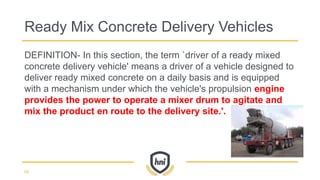
DEFINITION- In this section, the term `driver of a ready mixed
concrete delivery vehicle' means a driver of a vehicle designed to
deliver ready mixed concrete on a daily basis and is equipped
with a mechanism under which the vehicle's propulsion engine
provides the power to operate a mixer drum to agitate and
mix the product en route to the delivery site.'.
Ready Mix Concrete Delivery Vehicles
65
IN GENERAL- Notwithstanding any other provision of law,
regulations issued under 395.1(e)(1)(ii) (exempt from 395.8) of
title 49, Code of Federal Regulations regarding reporting,
recordkeeping, or documentation of duty status shall NOT apply
to any driver of a ready mixed concrete delivery vehicle if--
Ready Mix Concrete Delivery Vehicles
66
• `(A) the driver operates within a 100(inter) 150 (intra) air-mile
radius of the normal work reporting location;
• `(B) the driver returns to the work reporting location and is
released from work within 14 consecutive hours;
• `(C) the driver has at least 10 consecutive hours off duty
following each 14 hours on duty;
Ready Mix Concrete Delivery Vehicles
67
• `(D) the driver does not exceed 11 hours maximum driving time
following 10 consecutive hours off duty; and
• `(E) the motor carrier that employs the driver maintains and
retains for a period of 6 months accurate and true time records
that show--
Ready Mix Concrete Delivery Vehicles
68
• `(i) the time the driver reports for duty each day;
• `(ii) the total number of hours the driver is on duty each day;
• `(iii) the time the driver is released from duty each day; and
• `(iv) the total time for the preceding driving week the driver is
used for the first time or intermittently.
Ready Mix Concrete Delivery Vehicles
69
• 395.1(m)
• Construction materials and equipment. In the instance of a
driver of a commercial motor vehicle who is used primarily in
the transportation of construction materials and equipment, any
period of 7 or 8 consecutive days may end with the beginning of
any off-duty period of 24 or more successive hours.
Transportation Of Construction Materials
And Equipment
70
Transportation of construction materials and equipment means the
transportation of construction and pavement materials, construction
equipment, and construction maintenance vehicles, by a driver to or from an
active construction site (a construction site between mobilization of
equipment and materials to the site to the final completion of the
construction project) within a 75 air mile radius of the normal work reporting
location of the driver. This paragraph does not apply to the transportation of
material found by the Secretary to be hazardous under 49 U.S.C. 5103 in a
quantity requiring placarding under regulations issued to carry out such
section.
Transportation Of Construction
Materials And Equipment - 395.2 Def.
71
• (a) Covered Motor Vehicle Defined- In this section, the
term `covered motor vehicle' means a motor vehicle that--
• (1) is traveling in the State in which the vehicle is
registered or another State;
• (2) is owned by a welder;
• (3) is a pick-up style truck;
• (4) is equipped with a welding rig that is used in the
construction or maintenance of pipelines; and
• (5) has a gross vehicle weight and combination weight
rating and weight of 15,000 pounds or less.
Exemptions For Certain Welding
Trucks Used In Pipeline Industry
72
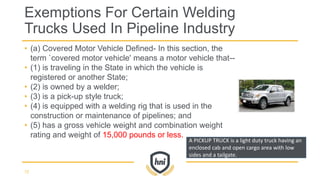
A PICKUP TRUCK is a light duty truck having an
enclosed cab and open cargo area with low
sides and a tailgate.
• (b) Federal Requirements- A covered motor vehicle, including
the individual operating such vehicle and the employer of such
individual, shall be exempt from the following:
• (1) Any requirement relating to registration as a motor carrier,
including the requirement to obtain and display a USDOT #.
NO 390
• (2) Any requirement relating to driver qualifications. NO 391
Exemptions For Certain Welding Trucks
Used In Pipeline Industry
73
• (3) Any requirement relating to driving of commercial motor
vehicle. NO 392
• (4) Any requirement relating to parts and accessories and
inspection, repair, and maintenance of commercial motor
vehicles. NO 393 OR 396
• (5) Any requirement relating to hours of service of drivers,
including maximum driving and on duty time. NO 395
Exemptions For Certain Welding Trucks
Used In Pipeline Industry
74
• Amending s. 348.15(3)(f)(2) would raise the truck weight exemption for idle
reduction equipment from 400 to 550 lbs. consistent with the new federal
weight allowance
• Amending s.348.15 would allow commercial motor vehicles (power units)
an additional 2,000 pounds of weight (up to a maximum gross vehicle
weight of 82,000 pounds) to accommodate a fuel tank for vehicles
primarily powered by natural gas consistent with the new federal weight
allowance found in the 2015 FAST Act
Weight Changes Involving Idle Reduction Technology and
Natural Gas (CNG) Vehicles 2017-2019 Budget Process
75
• Vehicle combinations authorized under a FMP permit shall have a
maximum gross weight of 98,000 pounds and a minimum of 6 axles.
• Vehicle combinations that exceed the maximum gross weight
limitations under s. 348.15(3)(c), Wis. Stats., by not more than 18,000
pounds if the vehicle combination has 6 or more axles and the gross
weight imposed on the highway by the wheels of any one axle of the
vehicle combination does not exceed 18,000 pounds, except that the
gross weight imposed on the highway by the wheels of any steering
axle on the power unit may not exceed the greater of 13,000 pounds or
the manufacturer's rated capacity, but not to exceed 18,000 pounds.
Weight Changes Involving Fluid Milk
Products 2017-2019 Budget Process
76
Intrastate Safety/Compliance Review
• Federal Grant timelines to use federal funding (Fast Act)
prevented full implementation till FFY 18 (10/01/17)
• Outreach/Enforcement efforts have begun in part with
Passenger Vehicles yet not formalized.
• CVISN now called Innovation Technology Deployment (ITD) Funds will be sought to
focus on a proposed online carrier compliance tools and “one source” location to
identify DOT regulatory requirements.
• Identified problem intrastate carriers are currently being visited with FMCSA
partnerships with 382/383 focus
Data Quality Review Process
• If you find errors use the DataQ program
• Violations that were observed roadside that now “mysteriously”
self correct back at the terminal is generally not reviewable.
(most light violations)
• The data that affects your score is only as good as what is put
in. We want accurate data – no retribution in filing as carriers
occasionally assert.
• We make mistakes but are interested in correction and training
our staff so it is not repeated with another carrier.
Roadside Inspection Lifecycle/SMS
• Roadside Inspection Report
• ISS use
• CVSA Decal Issuance
• Uploaded immediately
• Enters Safety Net / SMS (updated monthly)
• View Public SMS
• Weighing of violations (3x< 6mo, 2x 6-12mo, 1x 12-24m)
• Violation Severity Appendix A
Safety Management Systems
Not just a “Federal Term” – SMS – Carrier Culture
• DO NOT rely upon the “systems” to become your safety
program.
• Review the Records of Duty Status (AOBRD included)
• Unassigned Miles be able to answer
• Changes in duty status locations with no drive time
• Review DVIR’s – Roadside defect = DVIR!
• Review the SMS systems for Inspection Reports
• Implement and execute a progressive compliance program. Some
drivers need correction.
• Get back to the basics… safe driving
Chapter 348 – Size/Weight
• Improved weigh in motion system at Abrams SWEF – Oconto Co.
• Measures tractor/trailer “bridge” to ensure legal operation of 53’ Trailer
348.07(2) (gv) 53 feet for a semitrailer whose length from kingpin to axle does not exceed 43 feet and which is operated as part of a 2-vehicle
combination, except as provided in par. (gr) or sub. (4m). The length limits in this paragraph do not apply to a trailer or a semitrailer that is
authorized to operate under par. (im).
• http://wisconsindot.gov/Documents/dmv/shared/truck-routes.pdf
• http://wisconsindot.gov/Pages/dmv/com-drv-vehs/mtr-car-trkr/truck-routes.aspx
• Class B Highway- 60% Limit/Unless exit/entry on roadway
• Posted? Don’t go.. Unless permission
• Don’t Trust GPS units!!!!
• Spring Thaw updates
THANK YOU!
ECONOMIC AND PENDING
REGULATORY UPDATE
2016-2017
Don Jerrell, HNI
November 10, 2016
Brookfield, WI
Economic update
• Motor Carrier Failures:
• 2nd quarter 120 companies with an average flee size of 17 units
ceased operations
• 70% increase from 2015
• Attributed to rising fuel prices and weak demand
• Freight Markets:
• “to remain choppy”
• had spikes in Feb and May
Driver turnover update
• Driver turnover rates at large truckload carriers fell by 13% in the first quarter to
89%, the lowest level in nearly a year
• Smaller fleet turnover fell only 1% to 88%, up from last year’s average of 79%
• Turnover at less-than-truckload fleet remained much lower than at truckload
fleets, falling three points to 8%, the lowest point seen since the second quarter
of 2013
• Experts believe the decline in turnover is reflective of the freight economy
softening in the first quarter. If freight economy sees an uptick, so will turnover
and driver demand
Regulatory update
• Hours of Service:
• 34 restart:
• Senate wants 73 hours restart
• House not sure
• Simple restart or rolling restart
• Study completed – 200 drivers
• 150 company
• 25 Independent Contractor’s
• 25 o/op’s
• Two periods?
• Personal conveyance definition?
• Wait for NAS Study on driver fatigue to be completed
• 30 minute break? Industry believes gradual erosion with applied exemptions
Regulatory update
• Accident Preventability:
• FMCSA challenged cost of 11 million to review “every accident”
• We countered with just non preventable via challenge
• Trying to get some accident types removed from CSA
• Animal hits
• Parked
• Non attended
• Data Q thru committee not states
• 24 month pilot program proposed
• Issue with citations – in some instances other driver convicted may be
required – could take time.
• At least 12 months out
Regulatory update
• Proposed CSA changes
• Basic thresholds:
• Crash, fatigued, unsafe – same at 60 and 65
• Maintenance down from 80 to 75
• Driver, Hazmat, Controlled Substance and Alcohol up to 90
• 3 crashes in 2 years to get a “score”
• No score if no violations occurred in basic in last 12 months
• Split hazmat into bulk and non bulk (50% of all inspections had to be bulk to
classify as bulk)
Regulatory update
• Carrier fitness determination:
• Notice of proposed rulemaking
• Eliminate conditional
• Proposal to revise using CSA threshold and compliance
reviews
Regulatory update
• Speed limiters:
• Notice of proposed rulemaking released no speed listed (63,65,68 mph).
• ATA requesting 30 day extension for comments
• We wanted tamperproof, speed listed,
• FMCSA response:
• Did not address tamper proof
• FMCSA enforcement only
• No retroactive
• Final rule? Maybe next year???
Regulatory update
• Unified Carrier Registration (URS) update:
• Final rule delayed until January 14, 2017
• Delays insurance filing until April 14, 2017
• No other substantive changes to the Regulations
• Drug and Alcohol Clearing house
• Projected publication date: Sept 26, 2016
Regulatory update
• Other areas to be noted:
• Hazmat:
• National Tank truck carriers filing relief from rest break provision
• TWIK and Hazmat endorsement reciprocity on background
checks
Cargo Theft and Inteligence Threats
• Cargo Theft:
• Statistics for 2016 in line with 2015
• Ports number one
• Rail, truck, air high traffic areas (Chicago, Atlanta, Los Angeles,
etc.)
• Food and beverages most frequent followed by electronics
Cargo Theft and Intelligence Threats
• INTELLIGENCE THREATS:
• Current threat level for ground based transportation is low
• Expected to remain low for rest of year
• Homegrown violent extremist or lone offenders (no longer allowed to call
wolfs) most likely if anything
• Worldwide – 48 attacks since January – 19% were trucks
• Vehicle as weapon 7 times in 2016, 10 times ins 2015
• Al-Qaeda – 3 attacks aviation, 13 attacks IED
• Often do threat messaging prior to attack.
• Inspire magazine is Al-Qaeda
• Dabiq is ISIL
Cargo Theft and Intelligence Threats
• INTELLIGENCE THREATS (Cont):
• General procedures:
1. Surveillance of facility
2. Test of security
3. Suspicious events (i.e. substitution of individuals at work locations, different person vs. who they
interviewed for job)
• Belgium and London Attacks had similarities:
• Fake identities
• Rented vehicles
• Smell and odors prevalent
• Dead and dying plants outside locations
• Producing weapons in multiple rooms at location
• Obtaining supplies locally (catching thru reports from store owners)
THANK YOU!

FMCSA & Wisconsin State Patrol Update 2016

  • 1.
    FMCSA & WISCONSIN STATE PATROLUPDATE A review of current regulatory and compliance issues that will impact your business. date
  • 2.
    To Our Sponsors:Thank You!
  • 3.
    FEDERAL MOTOR CARRIER SAFETYADMINISTRATION 2016-2017 Mark Oesterle, Wisconsin Division Administrator November 10, 2016 Brookfield, WI
  • 4.
    FMCSA Overview • SafetyFitness Determination Rating Process • Drug and Alcohol Clearinghouse • Controlled Substance Testing using Hair Follicles • Insulin Dependent Driver Waivers • Complaints received by FMCSA o386.12 oNo CSA Basic over the thresholds oFocused Review oNational Consumer Compliant Database
  • 6.
    Part 382 -Types of Testing • PRE-EMPLOYMENT • RANDOM • POST-ACCIDENT • REASONABLE CAUSE • RETURN TO DUTY • FOLLOW-UP
  • 7.
  • 8.
    What is anElectronic Logging Device (ELD)? • Why has FMCSA implemented a new rule about ELDs? • The rule is intended to help create a safer work environment for drivers, and make it easier and faster to accurately track, manage, and share records of duty status (RODS) data • As part of the MAP-21 Act, Congress required the adoption of the ELD rule An ELD synchronizes with a vehicle engine to automatically record driving time, for easier, more accurate hours of service (HOS) recording
  • 9.
    Who is requiredto use an ELD? • Interstate CMV drivers currently required to keep RODS • Subject to requirements in 49 CFR 395 • CMVs defined in 49 CFR 390.5 • ≥ 10,001 pounds • Placarded hazmat • More than 8 or 15 passengers
  • 10.
    Who is Exemptfrom the ELD Rule? • The ELD Rule applies to most motor carriers and drivers who are currently required to maintain RODS. The rule applies to commercial buses as well as trucks. Canada and Mexico domiciled drivers are included, unless they qualify for one of the exceptions to the ELD rule. • The following are not required to use ELDs (but carriers may choose to use ELDs even if they are not required): • Drivers who comply with the 100 or 150 mile radius exemption • Drivers who use paper logs no more than 8 days during any 30-day period • Driveaway-towaway operations (transporting an empty vehicle for sale, lease, or repair, provided the vehicle is part of the shipment), as defined in 49 CFR § 390.5 • Drivers of vehicles manufactured before model year 2000
  • 11.
    About the ELDRule • The ELD Rule… • Specifies who is covered by the rule and the rule’s exceptions • Provides for ELDS to be certified, registered, and listed on a FMCSA website • Includes technical specifications to ensure ELDs are standardized and compliant • Has a phased implementation timeline to give carriers and drivers time to comply • Includes provisions to help prevent data tampering and harassment of drivers • Requires standard data displays and data transfer processes, making it easier to demonstrate compliance and faster to share RODS with safety officials
  • 12.
    Who is Impactedby the ELD Rule? • Carriers and Drivers who are subject to the rule must install and use ELDs by the appropriate deadline ELD Manufacturers must conform to ELD technical specifications, certify their ELDs, and register them with FMCSA Enforcement Partners must understand enforcement and compliance procedures during each implementation phase, and which regulatory guidance applies to each
  • 13.
    ELD Rule ImplementationTimeline • The rule is being implemented in three phases over a four-year period:
  • 14.
    ELD Rule Implementation •Phase 1 “Awareness and Transition” • February 16, 2016 to December 18, 2017 • Carriers and drivers subject to the rule should prepare to comply, and may voluntarily use ELDs • Carriers and drivers subject to the rule can use any of the following for RODS status: - Paper logs - Devices with installed logging software and applications - AOBRDs (Automatic On Board Recording Devices) - ELDs that are registered and listed on the FMCSA website
  • 15.
    ELD Rule Implementation •Phase 2 “Phased-In Compliance” • December 18, 2017 to December 16, 2019 • Carriers and drivers subject to the rule can use: - AOBRDS that were installed prior to December 17, 2017 - Certified, registered ELDs following rule publication
  • 16.
    ELD Rule Implementation •Phase 3 “Full Compliance” • After December 16, 2019 • All drivers and carriers subject to the rule must use certified, registered ELDs that comply with requirements of the ELD regulations
  • 17.
    Logging In /Accessing an ELD • A driver must have only one driver account with a carrier, with a unique identification number and password • An owner/operator must have a single account as a driver, and a separate account for administrative functions (setting up user accounts, etc.) • What if the driver forgets to log onto the ELD? • A warning will be issued from the device to remind the driver to stop and log in • The device will also record accumulated driving time in accordance with the ELD defaults, under the unidentified driver profile • ELD events logged under the “Unidentified Driver” profile should be added to the driver’s record – or the driver should add a note (annotation) explaining that the unassigned hours are not his/hers
  • 18.
    How an ELDRecords Drivers’ Hours of Service • An ELD records actual time for each duty status entered or automatically started • ELDs cannot be set to record minimum duty status durations, such as 15-minute intervals • ELDs record data every hour when a vehicle is moving, and there has not been a duty status change or interim recording in the previous hour
  • 19.
    “Driving” An ELD automatically switchesto driving status once the vehicle is moving at a speed of no more than five miles per hour “On-Duty Not Driving” When the vehicle has not been in motion for five consecutive minutes, the ELD will prompt the driver to confirm driving status or enter the proper status. If the driver doesn’t respond within one minute, the ELD will automatically switch to on-duty not driving “Off-Duty” The driver should indicate off-duty status or must edit and annotate the record later. Periods of authorized personal use (see Special Driving Categories, below) may also be considered off-duty time “Sleeper Berth” The driver should indicate sleeper berth status for sleeper berth periods or must edit and annotate the RODS later ELD Duty Status Categories
  • 20.
    Special Driving Categoriesto Note “Authorized Personal Use” A driver can record periods when using a vehicle for authorized personal use. “Yard Moves” A driver can record periods of yard moves “Adverse Operations” A driver can annotate the record to document sudden bad weather, crashes, or other unforeseeable conditions “Oilfield Operations” A driver can annotate the record to indicate oilfield operations
  • 21.
    Engine Synchronization • Integralsynchronization to the engine control module (ECM) • Monitoring of the vehicle’s engine operation to automatically capture: • Engine’s power status • Vehicle’s motion status • Miles driven • Engine hours
  • 22.
    Automatically Recorded Data •Date • Time • CMV Geographic Location Information • Engine Hours • Vehicle Miles • Driver or Authenticated User Identification • Vehicle Identification • Motor Carrier Identification
  • 23.
    ELD Event DataRecordings • Engine power up and shut down • Driver login/logout • Duty status changes • Personal use or yard moves • Certification of driver’s daily record • 60-minute intervals when the vehicle is in motion • Malfunction of diagnostic events
  • 24.
    Geolocations • CMV GeographicLocation Information • Show a nearby city, town, or village, or the compass direction and distance from the nearest city, town, or village • During on-duty driving periods, the location accuracy is approximately within a 1-mile radius • When a CMV is used for personal use, the position reporting accuracy is approximately within a 10-mile radius
  • 25.
    Manual Inputs • Motorcarriers – User account setup • Drivers • Support personnel (mechanics, dispatch, etc.) • Drivers • Annotations, when applicable • Location description, when prompted by the ELD • CMV power unit number • Trailer number(s), if applicable • Shipping document number, if applicable
  • 26.
    ELD Record ofDuty Status • It is required that RODS be shared in one of two ways at roadside (choice of the driver or motor carrier): • Printout (not all ELDs provide) • Screen display visible to enforcement at a reasonable distance • Acceptance of data via fax, email or other method of transmission is at the discretion of the inspector.
  • 27.
    ELD Information includedin Daily Header • 24-Hour Period Starting Time • Carrier Name/USDOT # • Driver Name and ID • Driver’s License # • Driver’s License State • Co-Driver Name and ID • Current Location • Data Diagnostic Indicators • ELD Malfunction Indicators • ELD Manufacturer Name • ELD Registration ID • Unidentified Driver Records • Exempt Driver Status • Miles Today • Print/Display Date • Record Date • Shipping ID • Current Engine Hours • Current Odometer • Time Zone • Truck Tractor ID and VIN • Trailer ID
  • 28.
    ELD Information –Daily Header Record Date USDOT # Driver License Number Driver License State ELD ID Trailer ID 20-Nov-14 123456789 D000368210361 IL 987654 Unit # Time Zone Driver Name Co-Driver Name ELD Manufacturer Shipping ID Data Diagnostic Indicators CST Smith, Richard Acme ELDs BL1234567890 No 24 Period Starting Time Driver ID Co-Driver ID Truck Tractor ID Unidentified Driver Records ELD Malfunction Indicators Midnight 1234567 Unit # No No Carrier Start End Odometer Miles Today Truck Tractor VIN Exempt Driver Status Start End Engine Hours Acme Trucking 39564 - 39984 420 1M2P267Y5AM022445 No 758.2-765.7 Current Location File Comment Print/Display Date 6 mi. NE North Auburn, CA 20-Nov-14
  • 29.
  • 30.
    ELD Detail LogData Time Location Odometer Eng Hours Event Type/Status Origin 20-Nov-14 0:00 49 mi NNE Fallon, NV 39564 758.2 SB Driver 10:00 49 mi NNE Fallon, NV 39564 758.2 Login Driver 10:00 49 mi NNE Fallon, NV 39564 758.2 ODND Driver 10:52 49 mi NNE Fallon, NV 39564 758.2 Power Up Auto 11:00 49 mi NNE Fallon, NV 39564 758.2 Driving Auto 12:00 2 mi E Fernley, NV 39624 759.3 Int Location Auto 13:00 7 mi NNE Truckee, CA 39684 760.3 Int Location Auto 14:00 6 mi SSE Meadow Vista, CA 39744 761.3 Int Location Auto 15:00 3.5 mi SW Davis, CA 39804 762.3 Off Duty Driver 17:00 3.5 mi SW Davis, CA 39804 762.3 Driving Auto 18:00 1 mi E Emeryville, CA 39864 763.4 Int Location Auto 19:00 4 mi SSW Univ. of California, CA 39924 764.4 Int Location Auto 20:00 6 mi NE North Auburn, CA 39984 765.5 ODND Driver 21:00 6 mi NE North Auburn, CA 39984 765.7 Off Duty Driver 23:00 6 mi NE North Auburn, CA 39984 765.7 ODND Driver 23:58 6 mi NE North Auburn, CA 39984 765.7 Cert Driver 23:58 6 mi NE North Auburn, CA 39984 765.7 Logout Driver
  • 31.
    Supporting Documents: Definition “Adocument, in any medium, generated or received by a motor carrier in the normal course of business as described in 395.11 that can be used, as produced or with additional identifying information, by the motor carrier and enforcement officials to verify the accuracy of a driver’s record of duty status.” [§ 395.2]
  • 32.
    Supporting Documents: DataElements • Driver name (or carrier-assigned ID) • Can be vehicle unit number if that number can be linked to the driver • Date • Location (including the name of nearest city, town or village) • Time
  • 33.
    Supporting Documents: Categories •Bills of lading, itineraries, schedules, or equivalent with the origin and destination of each trip • Dispatch records, trip records, or equivalent • Expense receipts related to on-duty (not driving) periods • Electronic mobile communication records • Payroll records, settlement sheets, or equivalent
  • 34.
    Supporting Documents: Number •Retain maximum of 8 documents per 24-hour duty day • If more than 8 documents are submitted per day, must retain first and last document of day • If fewer than 8 documents are submitted, a document that contains all of the elements except “time” is considered a supporting document • If a driver does not use an ELD, all toll records must be retained • Toll receipts do not count toward the 8-document cap
  • 35.
    Supporting Documents: General •Must be retained for 6 months • Must be submitted within 13 days • Must be able to be matched to RODS • Cannot be destroyed, defaced, or altered • Driver must make supporting documents in his/her possession available to authorized Federal, State, or local official upon request
  • 36.
    Resources • Website: www.fmcsa.dot.gov/elds •Public email address: ELD@dot.gov
  • 37.
  • 38.
    WISCONSIN STATE PATROL 2016-2017 SergeantMark J. Abrahamson November 10, 2016 Brookfield, WI
  • 39.
    High Speed VehicleWeigh in Motion
  • 40.
    • Non-Compliance withWI’s adoption of the FMCSR’s • 2017 Commercial Vehicle Safety Plan (CVSP) • 2017 High Priority Grant (HPG) • Fast Act Update • Intrastate Activities Overview of Presentation 40
  • 41.
    • The State’sexemption of intrastate drivers from its adoption of driver qualifications and hours of service (HOS) regulations during emergencies, in Trans 327.09 (6) is not compatible with 49 CFR 390.23. • The emergency must be declared by certain specified Federal, State, or local officials. The Wisconsin regulations allow the motor carrier to declare the emergency. Trans. 327 Review 41
  • 42.
    • The State’sexemption in Trans 327.09 of intrastate drivers holding a Wisconsin CDL issued prior to July 29, 1996 from the driver qualification requirements contained in 49 CFR 391 is not compatible with the FMCSRs. • The “grandfather” provision of the medical card will expire and all drivers operating a vehicle requiring a CDL will need a medical card in INTRAstate commerce. Trans. 327 Review 42
  • 43.
    • The State’sexception for intrastate drivers of CMVs in Trans 327.03 from the minimum age requirements contained in 49 CFR 391.11(b)(1) is not compatible with the FMCSRs. • 16 and 17 year old drivers will not be able to drive a CMV as defined in part 390.5 in INTRAstate commerce. (GVWR 10,001+) Trans. 327 Review 43
  • 44.
    • Define “plantingand harvesting season” to mean the period of time beginning March 15 through December 15 of each year, consistent with Trans 325.01. Currently, “planting and harvesting season” is not defined for intrastate transportation. • More uniform to FMCSR’s – ELD Rule automatically adopted • 395.8 -Graph grid record of duty status if not excepted – no change to 150 air mile radius exceptions. • 395.5 – Passenger carriers follow same interstate rule 10/15, 60/70 Trans. 327 Review 44
  • 45.
    Trans. 327 Review PropertyCarriers Maintain; Intrastate Operations • 12/16 Hour Rule • 60/70 Hour Rule • 1. More than 12 hours following 10 consecutive hours off duty. • 2. Any period after having been on duty 16 hours following 10 consecutive hours off duty. • 3. After having been on duty for 70 hours in any period of 7 consecutive days. • 4. After having been on duty for 80 hours in any period of 8 consecutive days. • (b) A driver is exempt from the requirements of 395.8 if the driver operates within a 150 air-mile radius of the normal work reporting location; Note: NOT; “after having come on duty” like interstate rule.
  • 46.
    Objectives: • Inspecting commercialvehicles and their drivers to ensure vehicles are mechanically sound and drivers are in compliance with federal and state laws and regulations. • Assuring the implementation of CSA initiatives to further program quality standards including a good faith review of all inspection-related Requests for Data Review (RDRs) for three years from the date of inspection and for all crash- related RDRs for five years from the date of the crash 2017 Commercial Vehicle Safety Plan 46
  • 47.
    2017 Commercial VehicleSafety Plan Objectives cont. • Setting up motor coach destination inspections through strike forces and addressing related unsafe driver behavior and conduct such as speeding, following too closely, operating in violation of an out-of- service order, and hours of service violations. • Monitoring industry initiatives including frac sand mining in Northwest Wisconsin, the timber industry, and other large industry activities and creating special details to ensure that safety is ensured commensurate with the level of CMV traffic being generated 47
  • 48.
    Objectives cont. • Ensuringthat a motor carrier’s operating authority is confirmed during each inspection and that action is taken if not in compliance. • Conducting CMV traffic enforcement associated with an inspection and traffic enforcement without an accompanying inspection resulting from an observed unsafe driver behavior • Participation in training associated with the Electronic Logging Device (ELD) final rule published on December 16, 2015 2017 Commercial Vehicle Safety Plan 48
  • 49.
    Objectives cont. • Reducecrashes: Fatality rate (per 100 million VMT) for the state has decreased to 0.10. Large truck fatalities decreased by -11.2% in CY 2015 compared to the CY 2010-2014 average. This reduction was assisted with the implementation of CVSP strategies and in particular, WSP's crash reduction emphasis in reducing serious and fatal crashes 2017 Commercial Vehicle Safety Plan 49
  • 50.
    • Activities toaccomplish the objectives • Focused details with 6 officer strike forces in WI’s highest crash counties. • 24 counties identified // 2 details in each county • CMV drivers operating aggressively and passenger cars operating aggressively around CMV’s. • Use FMCSA’s Query Central program to screen for carriers operating under Federal Out of Service Order. • If detected place out of service and remove IRP plate(s) from power unit. 2017 Commercial Vehicle Safety Plan 50
  • 51.
    • Activities toaccomplish the objectives • 15 counties have been recognized as having significant work zones. 2 details in each work zone will be conducted focusing on following too close, cell phone use, texting, and speeding. • 33000 inspections will be conducted at SWEF’s or mobile enforcement. • 40 passenger carrying vehicles • 1400 HAZMAT carrying vehicles • 10 MC sergeants will each do at least 2 traffic details focusing on areas where crashes occur. 2017 Commercial Vehicle Safety Plan 51
  • 52.
    • Activities toaccomplish the objectives • Wisconsin will conduct a minimum of 118 compliance reviews. • 50 educational outreach activities (including 6 outreach events for MCEIU) are anticipated • 4,500 questions answered, via WSP’s motor carrier hotline (608) 267- 9762 • A minimum of 30 forums where educational materials are provided. 2017 Commercial Vehicle Safety Plan 52
  • 53.
    • 5 detailsat each SWEF concentrating on hours of service regulations • Participate in CVSA and FMCSA initiatives • 72 hour road check • Brake Check (1 day-Spring) • FMCSA - Passenger Strike Force • Brake Safety Week • Operation Safe Driver 2017 Commercial Vehicle Safety Plan 53
  • 54.
    • Two Initiativeswithin this grant • Frac Sand Focus • Speed Focus 2017 High Priority Grant 54
  • 55.
    • Frac • Whilefrac sand mining has resulted in a positive economic boom to the state, and to the commercial trucking industry, it is imperative that Wisconsin continue to manage and reduce CMV-related crashes even as the number of sand mining facilities and trucks hauling frac sand increases. • In FFY 2014, an increase of 13% crashes involving dump trucks in the frac sand counties occurred when compared to the three-year (FFY 2011- 2013). 2017 High Priority Grant 55
  • 56.
    • Goal: TheState of Wisconsin requests Federal financial assistance through the FFY 2016-17 High Priority Grant Program to reduce the number of dump truck crashes in 13 counties where frac sand mining operations are occurring and to proactively address these crashes as the number and/or scale of frac sand mining operations continue to expand due to increasing demand for the product. Grant funds will be used to support activities that provide targeted enforcement and education activities as the strategy to meet this goal. • Objective: By the end of FFY 2017, Wisconsin proposes to reduce the number of dump truck crashes overall by 5.0% of the 2012-2014 average overall through mobile inspections/ enforcement in the targeted counties and through the education of motor carriers and their employees in the target areas. 2017 High Priority Grant 56
  • 57.
    • Strategy 1:The WSP will conduct a minimum of 4 safety talks with motor carriers and their employees focusing on safety issues related to dump trucks and compliance with motor carrier federal and state regulations. • Strategy 2: The WSP will conduct 30 details concentrating enforcement and inspection efforts at times when dump trucks are more likely to be operating and at locations where related general traffic hazards may be more significant. 2017 High Priority Grant 57
  • 58.
    • Speed • Goal:Reduce the number of CMV-related serious and fatal crashes by 2% of the 2012-2014 baseline (crashes) overall by the end of FFY 2017 in the 28 targeted counties by focusing on identified highway corridors that continue to experience speeding, unsafe driving behavior, and crashes coincident with CMV traffic. Grant funds will be used to support activities that provide highly-visible, and targeted enforcement and education activities as the strategy to meet this goal. 2017 High Priority Grant 58
  • 59.
    Objective: Wisconsin willreduce the number of CMV-related crashes through mobile inspections/enforcement in the specified counties and through educating carriers and their employees about state and federal laws regulating commercial motor carriers including regulations restricting the use of texting and hand-held cell phone regulations. 2017 High Priority Grant 59
  • 60.
    • Strategy 1:The WSP will concentrate enforcement/educational efforts at times when CMV-related crashes are more likely to occur based on data and where related general traffic hazards may be more significant in the identified corridors. To enhance these efforts over previous years, troopers will assist inspectors in CMV speed enforcement efforts. • Strategy 2: Whenever appropriate and at the inspector’s and trooper’s discretion, the WSP will provide safety brochures developed to CMV drivers at each traffic stop addressing the need to be compliant with motor carrier federal and state regulations. 2017 High Priority Grant 60
  • 61.
    • Strategy 3:WSP will utilize aircraft – a minimum of 36 details involving aircraft (e.g., typically 3 in each county) and will post signs in a highly- visible manner indicating to the public that enforcement utilizing aircraft is taking place. • Strategy 4: WSP will provide special focus on the enforcement of inattentive driving including texting and hand-held cell phone regulations in the proposed corridors. 2017 High Priority Grant 61
  • 62.
  • 63.
    • Any carrieroperating outside of Wisconsin will need to contact the respective jurisdiction to ensure compliance ALTHOUGH • FMCSA has issued a Federal Register which requires states to accept the provisions addressed in the FAST Act. Wisconsin Adoption of the Fast Act Provisions – MCSAP Related 63
  • 64.
    • Ready MixConcrete Delivery Vehicles (5521) • Transportation Of Construction Materials And Equipment (5522) • Exemptions For Certain Welding Trucks Used In Pipeline Industry (5524) Overview Of Presentation For The Road Inspector 64
  • 65.
    DEFINITION- In thissection, the term `driver of a ready mixed concrete delivery vehicle' means a driver of a vehicle designed to deliver ready mixed concrete on a daily basis and is equipped with a mechanism under which the vehicle's propulsion engine provides the power to operate a mixer drum to agitate and mix the product en route to the delivery site.'. Ready Mix Concrete Delivery Vehicles 65
  • 66.
    IN GENERAL- Notwithstandingany other provision of law, regulations issued under 395.1(e)(1)(ii) (exempt from 395.8) of title 49, Code of Federal Regulations regarding reporting, recordkeeping, or documentation of duty status shall NOT apply to any driver of a ready mixed concrete delivery vehicle if-- Ready Mix Concrete Delivery Vehicles 66
  • 67.
    • `(A) thedriver operates within a 100(inter) 150 (intra) air-mile radius of the normal work reporting location; • `(B) the driver returns to the work reporting location and is released from work within 14 consecutive hours; • `(C) the driver has at least 10 consecutive hours off duty following each 14 hours on duty; Ready Mix Concrete Delivery Vehicles 67
  • 68.
    • `(D) thedriver does not exceed 11 hours maximum driving time following 10 consecutive hours off duty; and • `(E) the motor carrier that employs the driver maintains and retains for a period of 6 months accurate and true time records that show-- Ready Mix Concrete Delivery Vehicles 68
  • 69.
    • `(i) thetime the driver reports for duty each day; • `(ii) the total number of hours the driver is on duty each day; • `(iii) the time the driver is released from duty each day; and • `(iv) the total time for the preceding driving week the driver is used for the first time or intermittently. Ready Mix Concrete Delivery Vehicles 69
  • 70.
    • 395.1(m) • Constructionmaterials and equipment. In the instance of a driver of a commercial motor vehicle who is used primarily in the transportation of construction materials and equipment, any period of 7 or 8 consecutive days may end with the beginning of any off-duty period of 24 or more successive hours. Transportation Of Construction Materials And Equipment 70
  • 71.
    Transportation of constructionmaterials and equipment means the transportation of construction and pavement materials, construction equipment, and construction maintenance vehicles, by a driver to or from an active construction site (a construction site between mobilization of equipment and materials to the site to the final completion of the construction project) within a 75 air mile radius of the normal work reporting location of the driver. This paragraph does not apply to the transportation of material found by the Secretary to be hazardous under 49 U.S.C. 5103 in a quantity requiring placarding under regulations issued to carry out such section. Transportation Of Construction Materials And Equipment - 395.2 Def. 71
  • 72.
    • (a) CoveredMotor Vehicle Defined- In this section, the term `covered motor vehicle' means a motor vehicle that-- • (1) is traveling in the State in which the vehicle is registered or another State; • (2) is owned by a welder; • (3) is a pick-up style truck; • (4) is equipped with a welding rig that is used in the construction or maintenance of pipelines; and • (5) has a gross vehicle weight and combination weight rating and weight of 15,000 pounds or less. Exemptions For Certain Welding Trucks Used In Pipeline Industry 72 A PICKUP TRUCK is a light duty truck having an enclosed cab and open cargo area with low sides and a tailgate.
  • 73.
    • (b) FederalRequirements- A covered motor vehicle, including the individual operating such vehicle and the employer of such individual, shall be exempt from the following: • (1) Any requirement relating to registration as a motor carrier, including the requirement to obtain and display a USDOT #. NO 390 • (2) Any requirement relating to driver qualifications. NO 391 Exemptions For Certain Welding Trucks Used In Pipeline Industry 73
  • 74.
    • (3) Anyrequirement relating to driving of commercial motor vehicle. NO 392 • (4) Any requirement relating to parts and accessories and inspection, repair, and maintenance of commercial motor vehicles. NO 393 OR 396 • (5) Any requirement relating to hours of service of drivers, including maximum driving and on duty time. NO 395 Exemptions For Certain Welding Trucks Used In Pipeline Industry 74
  • 75.
    • Amending s.348.15(3)(f)(2) would raise the truck weight exemption for idle reduction equipment from 400 to 550 lbs. consistent with the new federal weight allowance • Amending s.348.15 would allow commercial motor vehicles (power units) an additional 2,000 pounds of weight (up to a maximum gross vehicle weight of 82,000 pounds) to accommodate a fuel tank for vehicles primarily powered by natural gas consistent with the new federal weight allowance found in the 2015 FAST Act Weight Changes Involving Idle Reduction Technology and Natural Gas (CNG) Vehicles 2017-2019 Budget Process 75
  • 76.
    • Vehicle combinationsauthorized under a FMP permit shall have a maximum gross weight of 98,000 pounds and a minimum of 6 axles. • Vehicle combinations that exceed the maximum gross weight limitations under s. 348.15(3)(c), Wis. Stats., by not more than 18,000 pounds if the vehicle combination has 6 or more axles and the gross weight imposed on the highway by the wheels of any one axle of the vehicle combination does not exceed 18,000 pounds, except that the gross weight imposed on the highway by the wheels of any steering axle on the power unit may not exceed the greater of 13,000 pounds or the manufacturer's rated capacity, but not to exceed 18,000 pounds. Weight Changes Involving Fluid Milk Products 2017-2019 Budget Process 76
  • 77.
    Intrastate Safety/Compliance Review •Federal Grant timelines to use federal funding (Fast Act) prevented full implementation till FFY 18 (10/01/17) • Outreach/Enforcement efforts have begun in part with Passenger Vehicles yet not formalized. • CVISN now called Innovation Technology Deployment (ITD) Funds will be sought to focus on a proposed online carrier compliance tools and “one source” location to identify DOT regulatory requirements. • Identified problem intrastate carriers are currently being visited with FMCSA partnerships with 382/383 focus
  • 78.
    Data Quality ReviewProcess • If you find errors use the DataQ program • Violations that were observed roadside that now “mysteriously” self correct back at the terminal is generally not reviewable. (most light violations) • The data that affects your score is only as good as what is put in. We want accurate data – no retribution in filing as carriers occasionally assert. • We make mistakes but are interested in correction and training our staff so it is not repeated with another carrier.
  • 79.
    Roadside Inspection Lifecycle/SMS •Roadside Inspection Report • ISS use • CVSA Decal Issuance • Uploaded immediately • Enters Safety Net / SMS (updated monthly) • View Public SMS • Weighing of violations (3x< 6mo, 2x 6-12mo, 1x 12-24m) • Violation Severity Appendix A
  • 80.
    Safety Management Systems Notjust a “Federal Term” – SMS – Carrier Culture • DO NOT rely upon the “systems” to become your safety program. • Review the Records of Duty Status (AOBRD included) • Unassigned Miles be able to answer • Changes in duty status locations with no drive time • Review DVIR’s – Roadside defect = DVIR! • Review the SMS systems for Inspection Reports • Implement and execute a progressive compliance program. Some drivers need correction. • Get back to the basics… safe driving
  • 81.
    Chapter 348 –Size/Weight • Improved weigh in motion system at Abrams SWEF – Oconto Co. • Measures tractor/trailer “bridge” to ensure legal operation of 53’ Trailer 348.07(2) (gv) 53 feet for a semitrailer whose length from kingpin to axle does not exceed 43 feet and which is operated as part of a 2-vehicle combination, except as provided in par. (gr) or sub. (4m). The length limits in this paragraph do not apply to a trailer or a semitrailer that is authorized to operate under par. (im). • http://wisconsindot.gov/Documents/dmv/shared/truck-routes.pdf • http://wisconsindot.gov/Pages/dmv/com-drv-vehs/mtr-car-trkr/truck-routes.aspx • Class B Highway- 60% Limit/Unless exit/entry on roadway • Posted? Don’t go.. Unless permission • Don’t Trust GPS units!!!! • Spring Thaw updates
  • 82.
  • 83.
    ECONOMIC AND PENDING REGULATORYUPDATE 2016-2017 Don Jerrell, HNI November 10, 2016 Brookfield, WI
  • 84.
    Economic update • MotorCarrier Failures: • 2nd quarter 120 companies with an average flee size of 17 units ceased operations • 70% increase from 2015 • Attributed to rising fuel prices and weak demand • Freight Markets: • “to remain choppy” • had spikes in Feb and May
  • 85.
    Driver turnover update •Driver turnover rates at large truckload carriers fell by 13% in the first quarter to 89%, the lowest level in nearly a year • Smaller fleet turnover fell only 1% to 88%, up from last year’s average of 79% • Turnover at less-than-truckload fleet remained much lower than at truckload fleets, falling three points to 8%, the lowest point seen since the second quarter of 2013 • Experts believe the decline in turnover is reflective of the freight economy softening in the first quarter. If freight economy sees an uptick, so will turnover and driver demand
  • 86.
    Regulatory update • Hoursof Service: • 34 restart: • Senate wants 73 hours restart • House not sure • Simple restart or rolling restart • Study completed – 200 drivers • 150 company • 25 Independent Contractor’s • 25 o/op’s • Two periods? • Personal conveyance definition? • Wait for NAS Study on driver fatigue to be completed • 30 minute break? Industry believes gradual erosion with applied exemptions
  • 87.
    Regulatory update • AccidentPreventability: • FMCSA challenged cost of 11 million to review “every accident” • We countered with just non preventable via challenge • Trying to get some accident types removed from CSA • Animal hits • Parked • Non attended • Data Q thru committee not states • 24 month pilot program proposed • Issue with citations – in some instances other driver convicted may be required – could take time. • At least 12 months out
  • 88.
    Regulatory update • ProposedCSA changes • Basic thresholds: • Crash, fatigued, unsafe – same at 60 and 65 • Maintenance down from 80 to 75 • Driver, Hazmat, Controlled Substance and Alcohol up to 90 • 3 crashes in 2 years to get a “score” • No score if no violations occurred in basic in last 12 months • Split hazmat into bulk and non bulk (50% of all inspections had to be bulk to classify as bulk)
  • 89.
    Regulatory update • Carrierfitness determination: • Notice of proposed rulemaking • Eliminate conditional • Proposal to revise using CSA threshold and compliance reviews
  • 90.
    Regulatory update • Speedlimiters: • Notice of proposed rulemaking released no speed listed (63,65,68 mph). • ATA requesting 30 day extension for comments • We wanted tamperproof, speed listed, • FMCSA response: • Did not address tamper proof • FMCSA enforcement only • No retroactive • Final rule? Maybe next year???
  • 91.
    Regulatory update • UnifiedCarrier Registration (URS) update: • Final rule delayed until January 14, 2017 • Delays insurance filing until April 14, 2017 • No other substantive changes to the Regulations • Drug and Alcohol Clearing house • Projected publication date: Sept 26, 2016
  • 92.
    Regulatory update • Otherareas to be noted: • Hazmat: • National Tank truck carriers filing relief from rest break provision • TWIK and Hazmat endorsement reciprocity on background checks
  • 93.
    Cargo Theft andInteligence Threats • Cargo Theft: • Statistics for 2016 in line with 2015 • Ports number one • Rail, truck, air high traffic areas (Chicago, Atlanta, Los Angeles, etc.) • Food and beverages most frequent followed by electronics
  • 94.
    Cargo Theft andIntelligence Threats • INTELLIGENCE THREATS: • Current threat level for ground based transportation is low • Expected to remain low for rest of year • Homegrown violent extremist or lone offenders (no longer allowed to call wolfs) most likely if anything • Worldwide – 48 attacks since January – 19% were trucks • Vehicle as weapon 7 times in 2016, 10 times ins 2015 • Al-Qaeda – 3 attacks aviation, 13 attacks IED • Often do threat messaging prior to attack. • Inspire magazine is Al-Qaeda • Dabiq is ISIL
  • 95.
    Cargo Theft andIntelligence Threats • INTELLIGENCE THREATS (Cont): • General procedures: 1. Surveillance of facility 2. Test of security 3. Suspicious events (i.e. substitution of individuals at work locations, different person vs. who they interviewed for job) • Belgium and London Attacks had similarities: • Fake identities • Rented vehicles • Smell and odors prevalent • Dead and dying plants outside locations • Producing weapons in multiple rooms at location • Obtaining supplies locally (catching thru reports from store owners)
  • 96.

Editor's Notes

  • #4 3
  • #39 38
  • #41 Overview should be specific such as listing the goals of the presentation and items to be covered. For example: “Explain Hwy 51 project alternatives.” Use a verb followed by a brief phase or sentence. Overview should include time for Q&A or indicate if you intend to take questions during the presentation or prefer that they wait until the end of the presentation.
  • #42 Provide facts, figures and objective data will help to keep the audience focused. Review political, financial or other information. Dispel misinformation.
  • #43 Provide data, facts and figures. Photos or graphics will enhance retention and understanding. Consider grouping key periods such as the past 6-12 months and the next 6-12 months. Be sure to link to hot topics and accurately address those concerns.
  • #44 Clarify issues or answer anticipated questions. Often the audience does not clearly understand the benefits of the project and may therefore make up their own assumptions which can be inaccurate. Use the benefits to refute contentious issues. Use factual information on “hot topics” to divert anger and lessen the chance for misunderstanding.
  • #63 62
  • #65 Overview should be specific such as listing the goals of the presentation and items to be covered. For example: “Explain Hwy 51 project alternatives.” Use a verb followed by a brief phase or sentence. Overview should include time for Q&A or indicate if you intend to take questions during the presentation or prefer that they wait until the end of the presentation.
  • #84 83