User PerspectivesonELDCompliance
American Association of MotorVehicle Administrators (AAMVA) Region IV Conference
Soona Lee, Regulatory Compliance Manager | May 19, 2016 / Portland, OR
1
Focus for today’s session
Provide an overview of the ELD mandate
• What is an ELD?
• Who needs it and who will be exempt?
• When does it apply?
• What are the differences between ELD, AOBR and ELS?
Explain the ELD mandate from different user perspectives
• What are the benefits of early compliance?
• What are the key challenges facing drivers, carriers and enforcement officials in adoption of ELDs ?
• How to manage and overcome those challenges?
ELDOverview
3
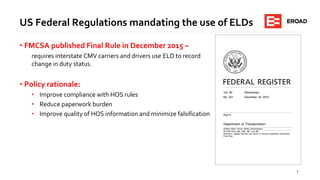
US Federal Regulations mandating the use of ELDs
• FMCSA published Final Rule in December 2015 –
requires interstate CMV carriers and drivers use ELD to record
change in duty status.
• Policy rationale:
• Improve compliance with HOS rules
• Reduce paperwork burden
• Improve quality of HOS information and minimize falsification
4
What is an ELD?
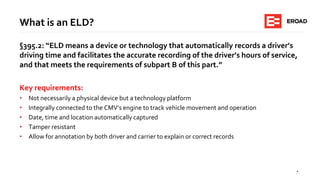
§395.2: “ELD means a device or technology that automatically records a driver’s
driving time and facilitates the accurate recording of the driver’s hours of service,
and that meets the requirements of subpart B of this part.”
Key requirements:
• Not necessarily a physical device but a technology platform
• Integrally connected to the CMV’s engine to track vehicle movement and operation
• Date, time and location automatically captured
• Tamper resistant
• Allow for annotation by both driver and carrier to explain or correct records
5
Who needs it and who is exempt?
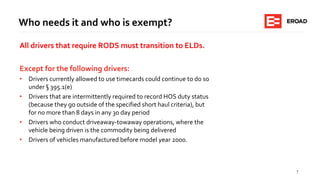
All drivers that require RODS must transition to ELDs.
Except for the following drivers:
• Drivers currently allowed to use timecards could continue to do so
under § 395.1(e)
• Drivers that are intermittently required to record HOS duty status
(because they go outside of the specified short haul criteria), but
for no more than 8 days in any 30 day period
• Drivers who conduct driveaway-towaway operations, where the
vehicle being driven is the commodity being delivered
• Drivers of vehicles manufactured before model year 2000.
6
When does it apply?
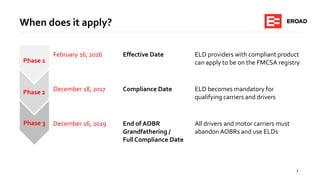
February 16, 2016 Effective Date ELD providers with compliant product
can apply to be on the FMCSA registry
December 18, 2017 Compliance Date ELD becomes mandatory for
qualifying carriers and drivers
December 16, 2019 End of AOBR
Grandfathering /
Full Compliance Date
All drivers and motor carriers must
abandonAOBRs and use ELDs
Phase 1
Phase 2
Phase 3
7
Compliance phases
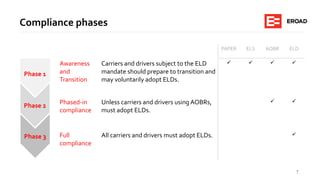
Phase 1
Phase 2
Phase 3
PAPER ELS AOBR ELD
Awareness
and
Transition
Carriers and drivers subject to the ELD
mandate should prepare to transition and
may voluntarily adopt ELDs.
   
Phased-in
compliance
Unless carriers and drivers using AOBRs,
must adopt ELDs.
 
Full
compliance
All carriers and drivers must adopt ELDs. 
8
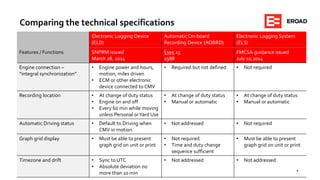
Comparing the technical specifications
Electronic Logging Device
(ELD)
Automatic On-board
Recording Device (AOBRD)
Electronic Logging System
(ELS)
Features / Functions SNPRM issued
March 28, 2014
§395.15
1988
FMCSA guidance issued
July 10,2014
Engine connection –
“integral synchronization”
• Engine power and hours,
motion, miles driven
• ECM or other electronic
device connected to CMV
• Required but not defined • Not required
Recording location • At change of duty status
• Engine on and off
• Every 60 min while moving
unless Personal orYard Use
• At change of duty status
• Manual or automatic
• At change of duty status
• Manual or automatic
Automatic Driving status • Default to Driving when
CMV in motion
• Not addressed • Not required
Graph grid display • Must be able to present
graph grid on unit or print
• Not required
• Time and duty change
sequence sufficient
• Must be able to present
graph grid on unit or print
Timezone and drift • Sync to UTC
• Absolute deviation no
more than 10 min
• Not addressed • Not addressed
9
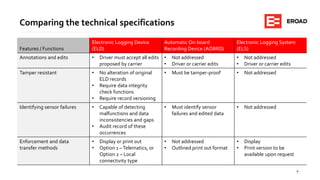
Comparing the technical specifications
Features / Functions
Electronic Logging Device
(ELD)
Automatic On-board
Recording Device (AOBRD)
Electronic Logging System
(ELS)
Annotations and edits • Driver must accept all edits
proposed by carrier
• Not addressed
• Driver or carrier edits
• Not addressed
• Driver or carrier edits
Tamper resistant • No alteration of original
ELD records
• Require data integrity
check functions
• Require record versioning
• Must be tamper-proof • Not addressed
Identifying sensor failures • Capable of detecting
malfunctions and data
inconsistencies and gaps
• Audit record of these
occurrences
• Must identify sensor
failures and edited data
• Not addressed
Enforcement and data
transfer methods
• Display or print out
• Option 1 –Telematics, or
Option 2 – Local
connectivity type
• Not addressed
• Outlined print out format
• Display
• Print version to be
available upon request
10
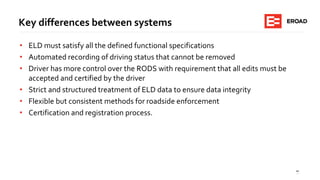
Key differences between systems
• ELD must satisfy all the defined functional specifications
• Automated recording of driving status that cannot be removed
• Driver has more control over the RODS with requirement that all edits must be
accepted and certified by the driver
• Strict and structured treatment of ELD data to ensure data integrity
• Flexible but consistent methods for roadside enforcement
• Certification and registration process.
ELD from different perspectives
12
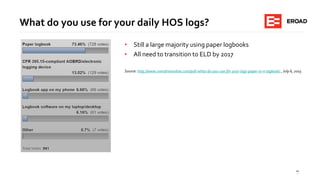
• Still a large majority using paper logbooks
• All need to transition to ELD by 2017
Source: http://www.overdriveonline.com/poll-what-do-you-use-for-your-logs-paper-or-e-logbook/ , July 6, 2015
What do you use for your daily HOS logs?
13
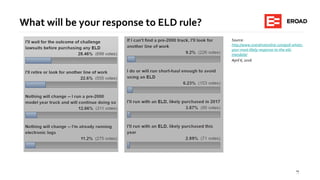
Source:
http://www.overdriveonline.com/poll-whats-
your-most-likely-response-to-the-eld-
mandate/
April 6, 2016
What will be your response to ELD rule?
14
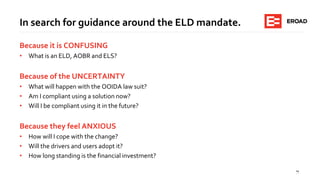
In search for guidance around the ELD mandate.
Because it is CONFUSING
• What is an ELD, AOBR and ELS?
Because of the UNCERTAINTY
• What will happen with the OOIDA law suit?
• Am I compliant using a solution now?
• Will I be compliant using it in the future?
Because they feel ANXIOUS
• How will I cope with the change?
• Will the drivers and users adopt it?
• How long standing is the financial investment?
15
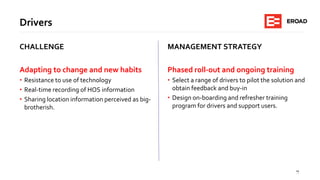
Drivers
CHALLENGE
Adapting to change and new habits
• Resistance to use of technology
• Real-time recording of HOS information
• Sharing location information perceived as big-
brotherish.
MANAGEMENT STRATEGY
Phased roll-out and ongoing training
• Select a range of drivers to pilot the solution and
obtain feedback and buy-in
• Design on-boarding and refresher training
program for drivers and support users.
16
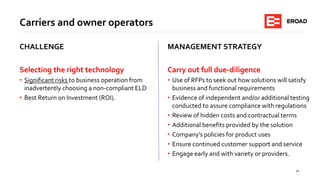
Carriers and owner operators
CHALLENGE
Selecting the right technology
• Significant risks to business operation from
inadvertently choosing a non-compliant ELD
• Best Return on Investment (ROI).
MANAGEMENT STRATEGY
Carry out full due-diligence
• Use of RFPs to seek out how solutions will satisfy
business and functional requirements
• Evidence of independent and/or additional testing
conducted to assure compliance with regulations
• Review of hidden costs and contractual terms
• Additional benefits provided by the solution
• Company’s policies for product uses
• Ensure continued customer support and service
• Engage early and with variety or providers.
17
Enforcement officials
CHALLENGE
Maintaining public safety and
compliance outcomes
• Ensure compliance by drivers and carriers
• Efficient and effective checks and inspections.
MANAGEMENT STRATEGY
Learning and training with technology
• Familiarize with various technology solutions
• Understand how to obtain and check relevant
information for compliance
• Request training and further guidance materials
from ELD manufacturers.
18
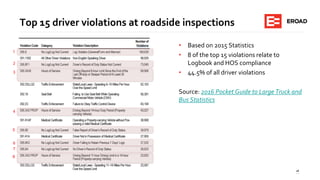
Top 15 driver violations at roadside inspections
• Based on 2015 Statistics
• 8 of the top 15 violations relate to
Logbook and HOS compliance
• 44.5% of all driver violations
Source: 2016 Pocket Guide to Large Truck and
Bus Statistics
1
2
3
4
5
6
7
8
19
Benefits of early compliance
Electronic logbook helps drivers avoid most common logbook violations
• Helps with form and manner violations
• Ensures drivers retain previous 7 days of logs
• Automated prompts for drivers to take rests and avoid 14-hour and 11-hour violations.
Prepared for seamless transition by the Compliance Date
• Drivers have sufficient and adequate time to familiarize and comfortable with ELD
• Redundancy and support process established with ELD manufacturer and understood by users
• Training and support programs tested and developed.
Questions?
21
Soona Lee
Regulatory Compliance Manager
Strategy & Market Development
971 804 3260 | soona.lee@eroad.com

Aamva user perspectives on eld compliance - may 2016

  • 1.
    User PerspectivesonELDCompliance American Associationof MotorVehicle Administrators (AAMVA) Region IV Conference Soona Lee, Regulatory Compliance Manager | May 19, 2016 / Portland, OR
  • 2.
    1 Focus for today’ssession Provide an overview of the ELD mandate • What is an ELD? • Who needs it and who will be exempt? • When does it apply? • What are the differences between ELD, AOBR and ELS? Explain the ELD mandate from different user perspectives • What are the benefits of early compliance? • What are the key challenges facing drivers, carriers and enforcement officials in adoption of ELDs ? • How to manage and overcome those challenges?
  • 3.
  • 4.
    3 US Federal Regulationsmandating the use of ELDs • FMCSA published Final Rule in December 2015 – requires interstate CMV carriers and drivers use ELD to record change in duty status. • Policy rationale: • Improve compliance with HOS rules • Reduce paperwork burden • Improve quality of HOS information and minimize falsification
  • 5.
    4 What is anELD? §395.2: “ELD means a device or technology that automatically records a driver’s driving time and facilitates the accurate recording of the driver’s hours of service, and that meets the requirements of subpart B of this part.” Key requirements: • Not necessarily a physical device but a technology platform • Integrally connected to the CMV’s engine to track vehicle movement and operation • Date, time and location automatically captured • Tamper resistant • Allow for annotation by both driver and carrier to explain or correct records
  • 6.
    5 Who needs itand who is exempt? All drivers that require RODS must transition to ELDs. Except for the following drivers: • Drivers currently allowed to use timecards could continue to do so under § 395.1(e) • Drivers that are intermittently required to record HOS duty status (because they go outside of the specified short haul criteria), but for no more than 8 days in any 30 day period • Drivers who conduct driveaway-towaway operations, where the vehicle being driven is the commodity being delivered • Drivers of vehicles manufactured before model year 2000.
  • 7.
    6 When does itapply? February 16, 2016 Effective Date ELD providers with compliant product can apply to be on the FMCSA registry December 18, 2017 Compliance Date ELD becomes mandatory for qualifying carriers and drivers December 16, 2019 End of AOBR Grandfathering / Full Compliance Date All drivers and motor carriers must abandonAOBRs and use ELDs Phase 1 Phase 2 Phase 3
  • 8.
    7 Compliance phases Phase 1 Phase2 Phase 3 PAPER ELS AOBR ELD Awareness and Transition Carriers and drivers subject to the ELD mandate should prepare to transition and may voluntarily adopt ELDs.     Phased-in compliance Unless carriers and drivers using AOBRs, must adopt ELDs.   Full compliance All carriers and drivers must adopt ELDs. 
  • 9.
    8 Comparing the technicalspecifications Electronic Logging Device (ELD) Automatic On-board Recording Device (AOBRD) Electronic Logging System (ELS) Features / Functions SNPRM issued March 28, 2014 §395.15 1988 FMCSA guidance issued July 10,2014 Engine connection – “integral synchronization” • Engine power and hours, motion, miles driven • ECM or other electronic device connected to CMV • Required but not defined • Not required Recording location • At change of duty status • Engine on and off • Every 60 min while moving unless Personal orYard Use • At change of duty status • Manual or automatic • At change of duty status • Manual or automatic Automatic Driving status • Default to Driving when CMV in motion • Not addressed • Not required Graph grid display • Must be able to present graph grid on unit or print • Not required • Time and duty change sequence sufficient • Must be able to present graph grid on unit or print Timezone and drift • Sync to UTC • Absolute deviation no more than 10 min • Not addressed • Not addressed
  • 10.
    9 Comparing the technicalspecifications Features / Functions Electronic Logging Device (ELD) Automatic On-board Recording Device (AOBRD) Electronic Logging System (ELS) Annotations and edits • Driver must accept all edits proposed by carrier • Not addressed • Driver or carrier edits • Not addressed • Driver or carrier edits Tamper resistant • No alteration of original ELD records • Require data integrity check functions • Require record versioning • Must be tamper-proof • Not addressed Identifying sensor failures • Capable of detecting malfunctions and data inconsistencies and gaps • Audit record of these occurrences • Must identify sensor failures and edited data • Not addressed Enforcement and data transfer methods • Display or print out • Option 1 –Telematics, or Option 2 – Local connectivity type • Not addressed • Outlined print out format • Display • Print version to be available upon request
  • 11.
    10 Key differences betweensystems • ELD must satisfy all the defined functional specifications • Automated recording of driving status that cannot be removed • Driver has more control over the RODS with requirement that all edits must be accepted and certified by the driver • Strict and structured treatment of ELD data to ensure data integrity • Flexible but consistent methods for roadside enforcement • Certification and registration process.
  • 12.
    ELD from differentperspectives
  • 13.
    12 • Still alarge majority using paper logbooks • All need to transition to ELD by 2017 Source: http://www.overdriveonline.com/poll-what-do-you-use-for-your-logs-paper-or-e-logbook/ , July 6, 2015 What do you use for your daily HOS logs?
  • 14.
  • 15.
    14 In search forguidance around the ELD mandate. Because it is CONFUSING • What is an ELD, AOBR and ELS? Because of the UNCERTAINTY • What will happen with the OOIDA law suit? • Am I compliant using a solution now? • Will I be compliant using it in the future? Because they feel ANXIOUS • How will I cope with the change? • Will the drivers and users adopt it? • How long standing is the financial investment?
  • 16.
    15 Drivers CHALLENGE Adapting to changeand new habits • Resistance to use of technology • Real-time recording of HOS information • Sharing location information perceived as big- brotherish. MANAGEMENT STRATEGY Phased roll-out and ongoing training • Select a range of drivers to pilot the solution and obtain feedback and buy-in • Design on-boarding and refresher training program for drivers and support users.
  • 17.
    16 Carriers and owneroperators CHALLENGE Selecting the right technology • Significant risks to business operation from inadvertently choosing a non-compliant ELD • Best Return on Investment (ROI). MANAGEMENT STRATEGY Carry out full due-diligence • Use of RFPs to seek out how solutions will satisfy business and functional requirements • Evidence of independent and/or additional testing conducted to assure compliance with regulations • Review of hidden costs and contractual terms • Additional benefits provided by the solution • Company’s policies for product uses • Ensure continued customer support and service • Engage early and with variety or providers.
  • 18.
    17 Enforcement officials CHALLENGE Maintaining publicsafety and compliance outcomes • Ensure compliance by drivers and carriers • Efficient and effective checks and inspections. MANAGEMENT STRATEGY Learning and training with technology • Familiarize with various technology solutions • Understand how to obtain and check relevant information for compliance • Request training and further guidance materials from ELD manufacturers.
  • 19.
    18 Top 15 driverviolations at roadside inspections • Based on 2015 Statistics • 8 of the top 15 violations relate to Logbook and HOS compliance • 44.5% of all driver violations Source: 2016 Pocket Guide to Large Truck and Bus Statistics 1 2 3 4 5 6 7 8
  • 20.
    19 Benefits of earlycompliance Electronic logbook helps drivers avoid most common logbook violations • Helps with form and manner violations • Ensures drivers retain previous 7 days of logs • Automated prompts for drivers to take rests and avoid 14-hour and 11-hour violations. Prepared for seamless transition by the Compliance Date • Drivers have sufficient and adequate time to familiarize and comfortable with ELD • Redundancy and support process established with ELD manufacturer and understood by users • Training and support programs tested and developed.
  • 21.
  • 22.
    21 Soona Lee Regulatory ComplianceManager Strategy & Market Development 971 804 3260 | soona.lee@eroad.com