1
FMCSA Overview
Mark Oesterle
Wisconsin Division Administrator
November, 2017
2
Hours of Service
Eleven hours of driving and 14 hours on duty
60 hours on duty in 7days
70 hours on duty in 8 days
34 Hour Restart
3
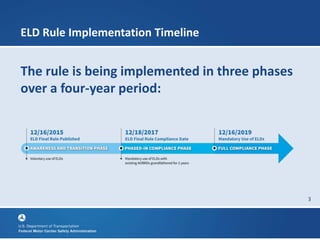
ELD Rule Implementation Timeline
The rule is being implemented in three phases
over a four-year period:
4
Who is required to use an ELD?
Interstate CMV drivers currently required to keep RODS
Subject to requirements in 49 CFR 395
CMVs defined in 49 CFR 390.5
≥ 10,001 pounds
Placarded hazmat
More than 8 or 15 passengers
5
Who is Exempt from the ELD Rule?
The ELD Rule applies to most motor carriers and drivers who are currently required
to maintain RODS. The rule applies to commercial buses as well as trucks.
The following are not required to use ELDs (but carriers may choose to use ELDs even
if they are not required):
• Drivers who comply with the 100 or 150 mile radius exemption
• Drivers who use paper logs no more than 8 days during any
30-day period
• Driveaway-towaway operations (transporting an empty vehicle for sale, lease, or
repair, provided the vehicle is part of the shipment), as defined in 49 CFR § 390.5
• Drivers of vehicles manufactured before model year 2000
6
Logging In / Accessing an ELD
• A driver must have only one driver account with a carrier, with a unique identification
number and password
• An owner/operator must have a single account as a driver, and a separate account for
administrative functions (setting up user accounts, etc.)
• What if the driver forgets to log onto the ELD?
- A warning will be issued from the device to remind the driver to stop and log in
- The device will also record accumulated driving time in accordance with the ELD
defaults, under the unidentified driver profile
• ELD events logged under the “Unidentified Driver” profile should be added to the
driver’s record – or the driver should add a note (annotation) explaining that the
unassigned hours are not his/hers
7
How an ELD Records Drivers’ Hours of Service
• An ELD records actual time for each duty status entered or
automatically started
• ELDs cannot be set to record minimum duty status durations, such as 15-
minute intervals
• ELDs record data every hour when a vehicle is moving, and there has not
been a duty status change or interim recording in the previous hour
8
“Driving”
An ELD automatically
switches to driving
status once the
vehicle is moving at a
speed of no more
than five miles per
hour
“On-Duty Not
Driving”
When the vehicle has
not been in motion for
five consecutive
minutes, the ELD will
prompt the driver to
confirm driving status
or enter the proper
status. If the driver
doesn’t respond
within one minute,
the ELD will
automatically switch
to on-duty not driving
“Off-Duty”
The driver should
indicate off-duty
status or must edit
and annotate the
record later. Periods of
authorized personal
use (see Special
Driving Categories,
below) may also be
considered off-duty
time
“Sleeper Berth”
The driver should
indicate sleeper berth
status for sleeper berth
periods or must edit
and annotate the
RODS later
ELD Duty Status Categories
9
Special Driving Categories to Note
“Authorized
Personal Use”
A driver can record
periods when using a
vehicle for authorized
personal use.
“Yard Moves”
A driver can record
periods of yard moves
“Adverse
Operations”
A driver can annotate
the record to document
sudden bad weather,
crashes, or other
unforeseeable
conditions
“Oilfield
Operations”
A driver can annotate
the record to indicate
oilfield operations
10
Manual Inputs
Motor carriers – User account setup
Drivers
Support personnel (mechanics, dispatch, etc.)
Drivers
Annotations, when applicable
Location description, when prompted by the ELD
CMV power unit number
Trailer number(s), if applicable
Shipping document number, if applicable
11
ELD Information included in Daily Header
24-Hour Period Starting Time
Carrier Name/USDOT #
Driver Name and ID
Driver’s License #
Driver’s License State
Co-Driver Name and ID
Current Location
Data Diagnostic Indicators
ELD Malfunction Indicators
ELD Manufacturer Name
ELD Registration ID
Unidentified Driver Records
Exempt Driver Status
Miles Today
Print/Display Date
Record Date
Shipping ID
Current Engine Hours
Current Odometer
Time Zone
Truck Tractor ID and VIN
Trailer ID
12
ELD Information – Daily Header
Record Date USDOT # Driver License Number Driver License State ELD ID Trailer ID
20-Nov-14 123456789 D000368210361 IL 987654 Unit #
Time Zone Driver Name Co-Driver Name ELD Manufacturer Shipping ID Data Diagnostic Indicators
CST Smith, Richard Acme ELDs BL1234567890 No
24 Period Starting Time Driver ID Co-Driver ID Truck Tractor ID Unidentified Driver Records ELD Malfunction Indicators
Midnight 1234567 Unit # No No
Carrier Start End Odometer Miles Today Truck Tractor VIN Exempt Driver Status Start End Engine Hours
Acme Trucking 39564 - 39984 420 1M2P267Y5AM022445 No 758.2-765.7
Current Location File Comment Print/Display Date
6 mi. NE North Auburn, CA 20-Nov-14
13
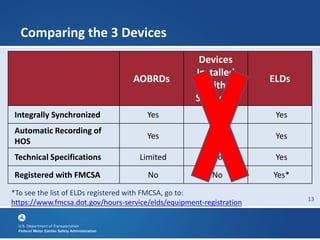
Comparing the 3 Devices
AOBRDs
Devices
Installed
with
Software
ELDs
Integrally Synchronized Yes No Yes
Automatic Recording of
HOS
Yes No Yes
Technical Specifications Limited No Yes
Registered with FMCSA No No Yes*
*To see the list of ELDs registered with FMCSA, go to:
https://www.fmcsa.dot.gov/hours-service/elds/equipment-registration
14
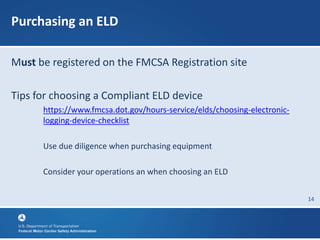
Purchasing an ELD
Must be registered on the FMCSA Registration site
Tips for choosing a Compliant ELD device
https://www.fmcsa.dot.gov/hours-service/elds/choosing-electronic-
logging-device-checklist
Use due diligence when purchasing equipment
Consider your operations an when choosing an ELD
15
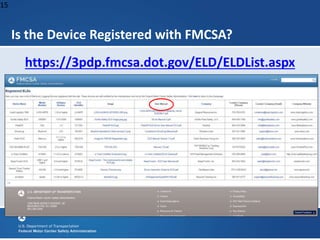
Is the Device Registered with FMCSA?
https://3pdp.fmcsa.dot.gov/ELD/ELDList.aspx
15
16
Driver’s Responsibilities
Data Transfer Instruction Sheet
ELD Malfunction Instruction Sheet
Supply of blank record of duty status graph grids
Any supporting documents in the driver’s possession must be provided to
the safety official upon request
17
Electronic Data Transfer
ELD provider is required to select 1 of 2 options:
Telematics or Local
Within the selected option, the ELD must support both
methods:
Telematics; email and webservices
or
Local; USB and Bluetooth
18
ELD Malfunction (Driver)
Note the malfunction
Provide written notice to motor carrier within 24 hours. (Maybe include an electronic
message, such as an email and/or a Fleet Management Systems (FMS) message.)
Reconstruct the previous 7 days
Continue to manually prepare records of duty status
19
End of working day
Change duty status to on-duty not driving
Log off
Log back in
Enter missing data
“I hereby certify that my data entries and my record of duty status for this
24 hour period are true and correct.”
Submit to motor carrier within 13 days of being generated.
20
Edits
Drivers can make edits to their ELD record
Must re-certify ELD data after edit is made
Carrier can request edits after ELD records have been submitted
Driver has the right to decline edits
Assigned miles must be addressed prior to operating the commercial motor
vehicle
Accepted or declined
21
Record Retention - Motor Carrier Responsibilities
Paper Logs
Printout from device installed with logging software
Printout from an Automatic On-Board Recording Device (if now using an
ELD)
6 Months Retention
21
22
Lists of Users
395.22 – Driver Accounts
Driver’s first and last name as reflected on the driver’s license
Unique ELD username
Driver’s license number; and
The state or jurisdiction that issued the driver’s license.
23
Unidentified Driving
Annotate
Assign
Maintain Unidentified driving records for 6 Months
Must provide to requesting safety official
24
Nominal Hours of Service
Hours of service violations that is 15 minutes or less
Identify patterns of hours of service non compliance
Less impact on safety management score
25
Got Questions?
Email: ELD@DOT.GOV
ELD Website: https://www.fmcsa.dot.gov/hours-service/elds/electronic-logging-
devices
26
Resources
fmcsa.dot.gov
Safer.dot.gov
csa.fmcsa.dot.gov
27
Mark Oesterle
Mark.oesterle@dot.gov
FMCSA Wisconsin Division
1 Point Place Suite 101
Madison, WI 53719
Office: 608-662-2010
1-800-832-5660
November, 2017

HNI U: FMCSA Overview 2017

  • 1.
    1 FMCSA Overview Mark Oesterle WisconsinDivision Administrator November, 2017
  • 2.
    2 Hours of Service Elevenhours of driving and 14 hours on duty 60 hours on duty in 7days 70 hours on duty in 8 days 34 Hour Restart
  • 3.
    3 ELD Rule ImplementationTimeline The rule is being implemented in three phases over a four-year period:
  • 4.
    4 Who is requiredto use an ELD? Interstate CMV drivers currently required to keep RODS Subject to requirements in 49 CFR 395 CMVs defined in 49 CFR 390.5 ≥ 10,001 pounds Placarded hazmat More than 8 or 15 passengers
  • 5.
    5 Who is Exemptfrom the ELD Rule? The ELD Rule applies to most motor carriers and drivers who are currently required to maintain RODS. The rule applies to commercial buses as well as trucks. The following are not required to use ELDs (but carriers may choose to use ELDs even if they are not required): • Drivers who comply with the 100 or 150 mile radius exemption • Drivers who use paper logs no more than 8 days during any 30-day period • Driveaway-towaway operations (transporting an empty vehicle for sale, lease, or repair, provided the vehicle is part of the shipment), as defined in 49 CFR § 390.5 • Drivers of vehicles manufactured before model year 2000
  • 6.
    6 Logging In /Accessing an ELD • A driver must have only one driver account with a carrier, with a unique identification number and password • An owner/operator must have a single account as a driver, and a separate account for administrative functions (setting up user accounts, etc.) • What if the driver forgets to log onto the ELD? - A warning will be issued from the device to remind the driver to stop and log in - The device will also record accumulated driving time in accordance with the ELD defaults, under the unidentified driver profile • ELD events logged under the “Unidentified Driver” profile should be added to the driver’s record – or the driver should add a note (annotation) explaining that the unassigned hours are not his/hers
  • 7.
    7 How an ELDRecords Drivers’ Hours of Service • An ELD records actual time for each duty status entered or automatically started • ELDs cannot be set to record minimum duty status durations, such as 15- minute intervals • ELDs record data every hour when a vehicle is moving, and there has not been a duty status change or interim recording in the previous hour
  • 8.
    8 “Driving” An ELD automatically switchesto driving status once the vehicle is moving at a speed of no more than five miles per hour “On-Duty Not Driving” When the vehicle has not been in motion for five consecutive minutes, the ELD will prompt the driver to confirm driving status or enter the proper status. If the driver doesn’t respond within one minute, the ELD will automatically switch to on-duty not driving “Off-Duty” The driver should indicate off-duty status or must edit and annotate the record later. Periods of authorized personal use (see Special Driving Categories, below) may also be considered off-duty time “Sleeper Berth” The driver should indicate sleeper berth status for sleeper berth periods or must edit and annotate the RODS later ELD Duty Status Categories
  • 9.
    9 Special Driving Categoriesto Note “Authorized Personal Use” A driver can record periods when using a vehicle for authorized personal use. “Yard Moves” A driver can record periods of yard moves “Adverse Operations” A driver can annotate the record to document sudden bad weather, crashes, or other unforeseeable conditions “Oilfield Operations” A driver can annotate the record to indicate oilfield operations
  • 10.
    10 Manual Inputs Motor carriers– User account setup Drivers Support personnel (mechanics, dispatch, etc.) Drivers Annotations, when applicable Location description, when prompted by the ELD CMV power unit number Trailer number(s), if applicable Shipping document number, if applicable
  • 11.
    11 ELD Information includedin Daily Header 24-Hour Period Starting Time Carrier Name/USDOT # Driver Name and ID Driver’s License # Driver’s License State Co-Driver Name and ID Current Location Data Diagnostic Indicators ELD Malfunction Indicators ELD Manufacturer Name ELD Registration ID Unidentified Driver Records Exempt Driver Status Miles Today Print/Display Date Record Date Shipping ID Current Engine Hours Current Odometer Time Zone Truck Tractor ID and VIN Trailer ID
  • 12.
    12 ELD Information –Daily Header Record Date USDOT # Driver License Number Driver License State ELD ID Trailer ID 20-Nov-14 123456789 D000368210361 IL 987654 Unit # Time Zone Driver Name Co-Driver Name ELD Manufacturer Shipping ID Data Diagnostic Indicators CST Smith, Richard Acme ELDs BL1234567890 No 24 Period Starting Time Driver ID Co-Driver ID Truck Tractor ID Unidentified Driver Records ELD Malfunction Indicators Midnight 1234567 Unit # No No Carrier Start End Odometer Miles Today Truck Tractor VIN Exempt Driver Status Start End Engine Hours Acme Trucking 39564 - 39984 420 1M2P267Y5AM022445 No 758.2-765.7 Current Location File Comment Print/Display Date 6 mi. NE North Auburn, CA 20-Nov-14
  • 13.
    13 Comparing the 3Devices AOBRDs Devices Installed with Software ELDs Integrally Synchronized Yes No Yes Automatic Recording of HOS Yes No Yes Technical Specifications Limited No Yes Registered with FMCSA No No Yes* *To see the list of ELDs registered with FMCSA, go to: https://www.fmcsa.dot.gov/hours-service/elds/equipment-registration
  • 14.
    14 Purchasing an ELD Mustbe registered on the FMCSA Registration site Tips for choosing a Compliant ELD device https://www.fmcsa.dot.gov/hours-service/elds/choosing-electronic- logging-device-checklist Use due diligence when purchasing equipment Consider your operations an when choosing an ELD
  • 15.
    15 Is the DeviceRegistered with FMCSA? https://3pdp.fmcsa.dot.gov/ELD/ELDList.aspx 15
  • 16.
    16 Driver’s Responsibilities Data TransferInstruction Sheet ELD Malfunction Instruction Sheet Supply of blank record of duty status graph grids Any supporting documents in the driver’s possession must be provided to the safety official upon request
  • 17.
    17 Electronic Data Transfer ELDprovider is required to select 1 of 2 options: Telematics or Local Within the selected option, the ELD must support both methods: Telematics; email and webservices or Local; USB and Bluetooth
  • 18.
    18 ELD Malfunction (Driver) Notethe malfunction Provide written notice to motor carrier within 24 hours. (Maybe include an electronic message, such as an email and/or a Fleet Management Systems (FMS) message.) Reconstruct the previous 7 days Continue to manually prepare records of duty status
  • 19.
    19 End of workingday Change duty status to on-duty not driving Log off Log back in Enter missing data “I hereby certify that my data entries and my record of duty status for this 24 hour period are true and correct.” Submit to motor carrier within 13 days of being generated.
  • 20.
    20 Edits Drivers can makeedits to their ELD record Must re-certify ELD data after edit is made Carrier can request edits after ELD records have been submitted Driver has the right to decline edits Assigned miles must be addressed prior to operating the commercial motor vehicle Accepted or declined
  • 21.
    21 Record Retention -Motor Carrier Responsibilities Paper Logs Printout from device installed with logging software Printout from an Automatic On-Board Recording Device (if now using an ELD) 6 Months Retention 21
  • 22.
    22 Lists of Users 395.22– Driver Accounts Driver’s first and last name as reflected on the driver’s license Unique ELD username Driver’s license number; and The state or jurisdiction that issued the driver’s license.
  • 23.
    23 Unidentified Driving Annotate Assign Maintain Unidentifieddriving records for 6 Months Must provide to requesting safety official
  • 24.
    24 Nominal Hours ofService Hours of service violations that is 15 minutes or less Identify patterns of hours of service non compliance Less impact on safety management score
  • 25.
    25 Got Questions? Email: ELD@DOT.GOV ELDWebsite: https://www.fmcsa.dot.gov/hours-service/elds/electronic-logging- devices
  • 26.
  • 27.
    27 Mark Oesterle Mark.oesterle@dot.gov FMCSA WisconsinDivision 1 Point Place Suite 101 Madison, WI 53719 Office: 608-662-2010 1-800-832-5660 November, 2017

Editor's Notes

  • #14 The following is a chart that has been provided to the field to assists them with differentiating the permitted devices. AOBRD Which is defined in 49 CFR 395.2, as an electric, electronic, electromechanical, or mechanical device capable of recording a driver’s duty status information accurately and automatically as required by 49 CFR § 395.15. The device must be integrally synchronized with specific operations of the CMV in which it is installed. At a minimum, the device must record engine use, road speed, miles driven, the date, and time of day.   Logging Software Programs and Applications Can no longer be used by motor carriers subject to the ELD rule. An ELD is a device or technology that automatically records a driver’s driving time and facilitates the accurate recording of the driver’s HOS, and meets the technical specifications of the ELD rule. An ELD must be integrally synchronized with the engine of the commercial motor vehicle (CMV). An ELD must be certified and registered with FMCSA. Said ELDs will be listed at
  • #16 Screenshot of ELD list. Ensure vendor/manufacture is on this list. If the device or ELD solution is not on this list then it is not an ELD.
  • #18 Device must be able to transfer data via 1 of the 2 options and both methods within each option