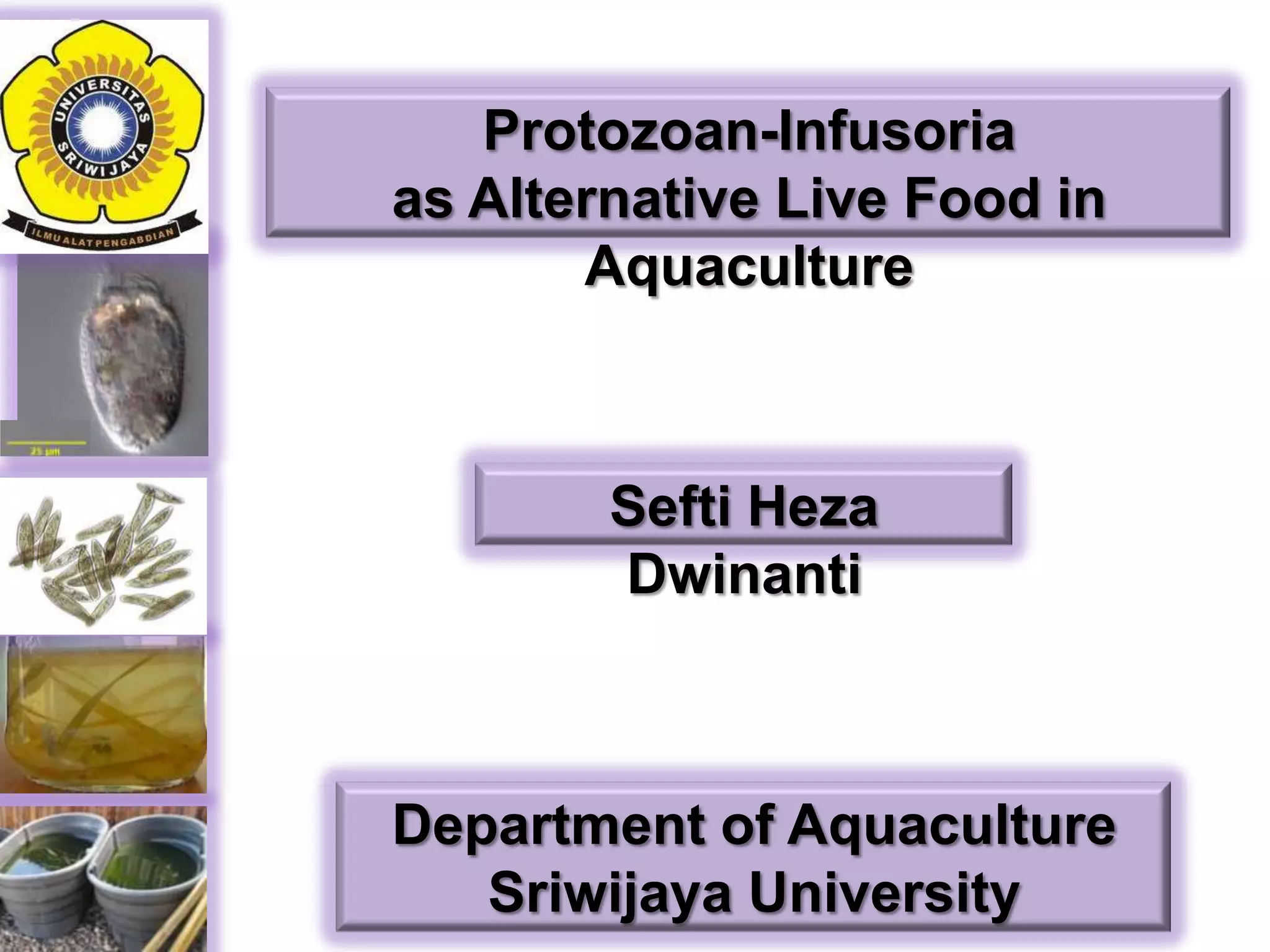
Protozoan-Infusoria
as Alternative Live Food in
Aquaculture

Sefti Heza
Dwinanti

Department of Aquaculture
Sriwijaya University
Protozoa Infusoria

Protozoa merupakan binatang yang paling banyak di dunia
Infusoria merupakan kelompok terbesar di Phylum Protozoa, di mana
anggotanya sekitar 8.000 species
Infusoria adalah sekumpulan jasad renik sejenis zooplankton
(FLAGELLATE, CILIATE, AND TENTACULIFEROUS PROTOZOA)

Umumnya berukuran antara 40-100 mikron
Infusoria sebagai pakan alami digunakan sebagai makanan pertama
(first feeding) bagi larva ikan yang mempunyai bukaan mulut kecil

Secara visual warna infusoria adalah putih dan hidup menggerombol
sehingga akan tampak seperti lapisan putih tipis seperti awan.
• Infusoria is a collective term for minute
aquatic creatures like:1. Ciliates
2. Euglenoids
3. Protozoa
4. Unicellular Algae
that exist in freshwater ponds.
• In modern formal classifications the
term is considered obsolete; and the
microorganisms previously included in
the Infusoria are mostly assigned to the
Kingdom Protista.
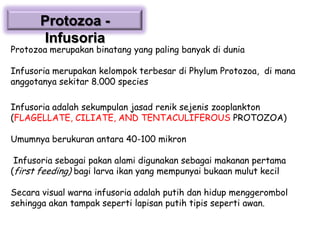
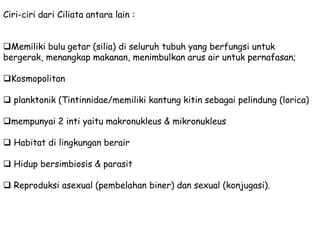
Ciri-ciri dari Ciliata antara lain :
Memiliki bulu getar (silia) di seluruh tubuh yang berfungsi untuk
bergerak, menangkap makanan, menimbulkan arus air untuk pernafasan;

Kosmopolitan
 planktonik (Tintinnidae/memiliki kantung kitin sebagai pelindung (lorica)
mempunyai 2 inti yaitu makronukleus & mikronukleus
 Habitat di lingkungan berair
 Hidup bersimbiosis & parasit

 Reproduksi asexual (pembelahan biner) dan sexual (konjugasi).
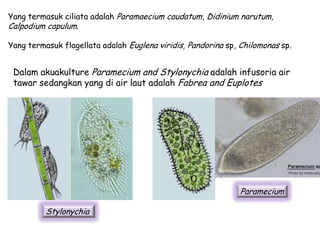
Yang termasuk ciliata adalah Paramaecium caudatum, Didinium narutum,
Calpodium capulum.
Yang termasuk flagellata adalah Euglena viridis, Pandorina sp, Chilomonas sp.

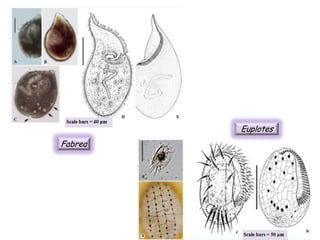
Dalam akuakulture Paramecium and Stylonychia adalah infusoria air
tawar sedangkan yang di air laut adalah Fabrea and Euplotes

Paramecium
Stylonychia
Euplotes
Fabrea
Ciliated protozoans may be important for first-feeding fish larvae
because:
1) ciliates often dominate such communities and are more
abundant than copepod nauplii in coastal waters
(Kamiyama 1994);
2) most of the ciliates in the plankton are of a similar or
smaller size than copepod nauplii (Taniguchi 1978).
3) Protozoans can grow often just as well on inert foods, which is
easier for aquaculture purposes
Marine ciliates are conventionally divided into loricate (tintinnid) and
aloricate (naked) forms (Sanders 1987, Kamiyama 1994).
Naked ciliates may be more important food for fish larvae than tintinnids,
because naked ciliates occur in considerably larger numbers than
tintinnids (Pierce and Turner 1992).
The advantages of Fabrea salina as an alternative for rotifers or brine
shrimp larvae were summarized by De Winter, 1975 as follows:
i) It is one of the few truly “pelagic” ciliates
ii) It has the appropriate dimensions as a live food: depending on
culturing conditions its size can vary from 50 - 500 μm
iii) The smooth cell wall and the absence of appendages facilitate its
uptake by the predators
iv) The generation time is very short
v) As a particle feeder it can be cultured on live algae as well as inert
foods
vi) According to the literature data its nutritional value for fish larvae
seems to be excellent
vii) As many other protozoans it forms a tough cyst membrane when
submitted to unfavorable environmental conditions. The cysts can be
kept viable for a certain period of time without losing their
hatchability.
Generally, for infusoria culture, lettuce, cabbage and banana peels are commonly used
as media as they stimulated growth of organisms. Take a glass jar or aquarium, filled with
de-chlorinated filtered water and add 2 to 3 banana peelings. Cover the container with
a cloth to prevent the entry of mosquitoes and files. Keep the container in a cool place
where natural diffused light is available. After 2 to 3 days the water will turn milky and
also emit foul smell. This is due to the multiplication of a large number of bacteria causing
decay of banana peelings. A film of slime will be formed on the water surface. In about
4 to 5 days, the water will turn clear, becoming transparent with light yellowish colour.
This is because of the floating spores of infusoria in the air which have settled on the
water surface break up and disintegrate. The culture is now ready for feeding the early
stages of fish larvae. Once the culture reaches the peak density, it must be harvested, if
not, the density will suddenly fall due to lack of space and oxygen depletion. After 50 %
harvesting, add 2 to 3 drops of milk and again fill the glass jar with fresh water. The
culture will sustain for a week. Infusoria can also be cultured by above method by putting
bruised lettuce leaves or take some dry paddy husk and boiled it in water and take the
solution for culture. Infousoria can be collected using 0.12 mm fine mesh cloth from foul
smelling water bodies.
Ciliate Culture
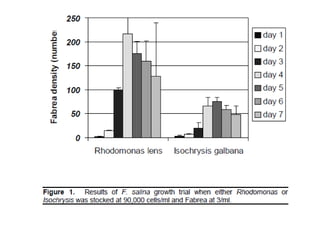
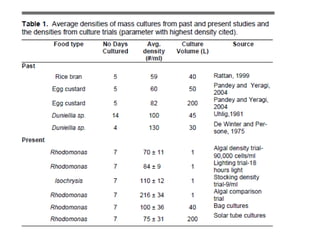
Initially, several ciliates were considered for culture, and Fabrea salina
showed to be more reliable in culture than Strombilidium sp. and Strombidium
sp and is, therefore, the focus of this paper. Algae (Isochrysis and Rhodomonas ) provided as
food was cultured with Gulliard’s F/2 in the laboratory. All of the experiments were carried
out for seven days in 2 L
Erlenmeyer flask initially containing 1 L of chlorinated then dechlorinated, 1
μm filtered seawater (32 - 34 ‰). the normal range was 25 - 30°C. The trials
were conducted under continuous light ranging from 1,240 to 1,680 lux. Daily
counts for organisms were performed in triplicate using Sedgwick-Rafter slides
on a compound microscope; Samples for water quality measurements including ammonia,
temperature, salinity, dissolved oxygen, and pH were taken daily from each
replicate.

Infusoria in Aquaculture

  • 1.
    Protozoan-Infusoria as Alternative LiveFood in Aquaculture Sefti Heza Dwinanti Department of Aquaculture Sriwijaya University
  • 2.
    Protozoa Infusoria Protozoa merupakanbinatang yang paling banyak di dunia Infusoria merupakan kelompok terbesar di Phylum Protozoa, di mana anggotanya sekitar 8.000 species Infusoria adalah sekumpulan jasad renik sejenis zooplankton (FLAGELLATE, CILIATE, AND TENTACULIFEROUS PROTOZOA) Umumnya berukuran antara 40-100 mikron Infusoria sebagai pakan alami digunakan sebagai makanan pertama (first feeding) bagi larva ikan yang mempunyai bukaan mulut kecil Secara visual warna infusoria adalah putih dan hidup menggerombol sehingga akan tampak seperti lapisan putih tipis seperti awan.
  • 3.
    • Infusoria isa collective term for minute aquatic creatures like:1. Ciliates 2. Euglenoids 3. Protozoa 4. Unicellular Algae that exist in freshwater ponds. • In modern formal classifications the term is considered obsolete; and the microorganisms previously included in the Infusoria are mostly assigned to the Kingdom Protista.
  • 4.
    Ciri-ciri dari Ciliataantara lain : Memiliki bulu getar (silia) di seluruh tubuh yang berfungsi untuk bergerak, menangkap makanan, menimbulkan arus air untuk pernafasan; Kosmopolitan  planktonik (Tintinnidae/memiliki kantung kitin sebagai pelindung (lorica) mempunyai 2 inti yaitu makronukleus & mikronukleus  Habitat di lingkungan berair  Hidup bersimbiosis & parasit  Reproduksi asexual (pembelahan biner) dan sexual (konjugasi).
  • 5.
    Yang termasuk ciliataadalah Paramaecium caudatum, Didinium narutum, Calpodium capulum. Yang termasuk flagellata adalah Euglena viridis, Pandorina sp, Chilomonas sp. Dalam akuakulture Paramecium and Stylonychia adalah infusoria air tawar sedangkan yang di air laut adalah Fabrea and Euplotes Paramecium Stylonychia
  • 6.
  • 7.
    Ciliated protozoans maybe important for first-feeding fish larvae because: 1) ciliates often dominate such communities and are more abundant than copepod nauplii in coastal waters (Kamiyama 1994); 2) most of the ciliates in the plankton are of a similar or smaller size than copepod nauplii (Taniguchi 1978). 3) Protozoans can grow often just as well on inert foods, which is easier for aquaculture purposes Marine ciliates are conventionally divided into loricate (tintinnid) and aloricate (naked) forms (Sanders 1987, Kamiyama 1994). Naked ciliates may be more important food for fish larvae than tintinnids, because naked ciliates occur in considerably larger numbers than tintinnids (Pierce and Turner 1992).
  • 8.
    The advantages ofFabrea salina as an alternative for rotifers or brine shrimp larvae were summarized by De Winter, 1975 as follows: i) It is one of the few truly “pelagic” ciliates ii) It has the appropriate dimensions as a live food: depending on culturing conditions its size can vary from 50 - 500 μm iii) The smooth cell wall and the absence of appendages facilitate its uptake by the predators iv) The generation time is very short v) As a particle feeder it can be cultured on live algae as well as inert foods vi) According to the literature data its nutritional value for fish larvae seems to be excellent vii) As many other protozoans it forms a tough cyst membrane when submitted to unfavorable environmental conditions. The cysts can be kept viable for a certain period of time without losing their hatchability.
  • 11.
    Generally, for infusoriaculture, lettuce, cabbage and banana peels are commonly used as media as they stimulated growth of organisms. Take a glass jar or aquarium, filled with de-chlorinated filtered water and add 2 to 3 banana peelings. Cover the container with a cloth to prevent the entry of mosquitoes and files. Keep the container in a cool place where natural diffused light is available. After 2 to 3 days the water will turn milky and also emit foul smell. This is due to the multiplication of a large number of bacteria causing decay of banana peelings. A film of slime will be formed on the water surface. In about 4 to 5 days, the water will turn clear, becoming transparent with light yellowish colour. This is because of the floating spores of infusoria in the air which have settled on the water surface break up and disintegrate. The culture is now ready for feeding the early stages of fish larvae. Once the culture reaches the peak density, it must be harvested, if not, the density will suddenly fall due to lack of space and oxygen depletion. After 50 % harvesting, add 2 to 3 drops of milk and again fill the glass jar with fresh water. The culture will sustain for a week. Infusoria can also be cultured by above method by putting bruised lettuce leaves or take some dry paddy husk and boiled it in water and take the solution for culture. Infousoria can be collected using 0.12 mm fine mesh cloth from foul smelling water bodies.
  • 12.
    Ciliate Culture Initially, severalciliates were considered for culture, and Fabrea salina showed to be more reliable in culture than Strombilidium sp. and Strombidium sp and is, therefore, the focus of this paper. Algae (Isochrysis and Rhodomonas ) provided as food was cultured with Gulliard’s F/2 in the laboratory. All of the experiments were carried out for seven days in 2 L Erlenmeyer flask initially containing 1 L of chlorinated then dechlorinated, 1 μm filtered seawater (32 - 34 ‰). the normal range was 25 - 30°C. The trials were conducted under continuous light ranging from 1,240 to 1,680 lux. Daily counts for organisms were performed in triplicate using Sedgwick-Rafter slides on a compound microscope; Samples for water quality measurements including ammonia, temperature, salinity, dissolved oxygen, and pH were taken daily from each replicate.