FlurryDB
A Dynamically Scalable Relational
Database with Virtual Machine Cloning
Michael Mior and Eyal de Lara
University of Toronto
Cluster Databases
                                          DBMS

                      Load                VM
                    balancer

                                          DBMS

                                          VM


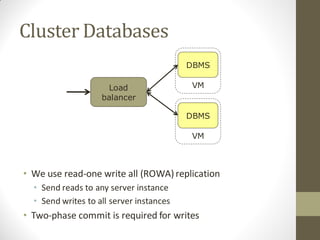
• We use read-one write all (ROWA) replication
  • Send reads to any server instance
  • Send writes to all server instances
• Two-phase commit is required for writes
Problem


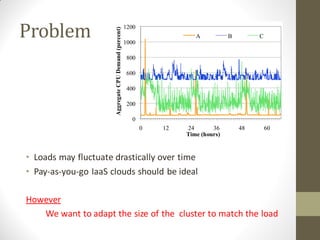
• Loads may fluctuate drastically over time
• Pay-as-you-go IaaS clouds should be ideal

However
   We want to adapt the size of the cluster to match the load
Problem
• Databases have large state and are hard to scale
• A complete copy may be required for new instances
• Copying large databases may take hours


Queries

Replication
                   copy       boot        catch         add
                   data      replica       up         replica


• Overprovisioning is necessary to maintain service
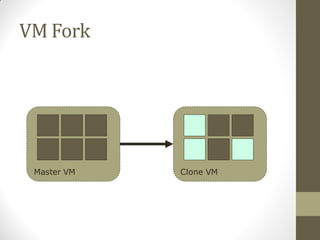
Solution – Virtual Machine Fork

• Analogous to fork() for OS processes
• Clones start immediately
• State fetched on-demand
  • Page faults fetch the memory or disk page


      This can reduce instantiation time
      from minutes or hours to seconds
VM Fork


 Master VM   Clone VM
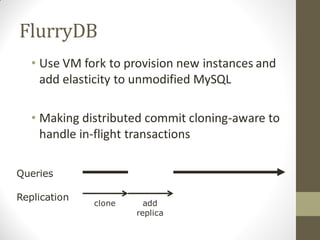
FlurryDB
   • Use VM fork to provision new instances and
     add elasticity to unmodified MySQL

   • Making distributed commit cloning-aware to
     handle in-flight transactions

Queries

Replication
              clone     add
                      replica
FlurryDB Challenges

1. Incorporate new worker into cluster

2. Preserve application semantics
Incorporate new worker

• Clone must connect to the load balancer

• Load balancer must begin sending
  transactions to the clone
Preserve application semantics
• Transactions may be in-progress at the
  time of cloning
• Clone gets new IP address
• Doing nothing drops connections and
  transaction status is unknown
                                New IP Address


     DBMS       T     DBMS
                                 ?T’

    Master VM        Clone VM
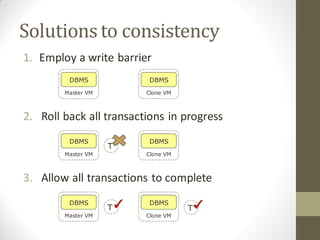
Solutions to consistency
1. Employ a write barrier
         DBMS             DBMS
        Master VM        Clone VM


2. Roll back all transactions in progress
         DBMS             DBMS
                    T’
        Master VM        Clone VM


3. Allow all transactions to complete
         DBMS             DBMS
                    T               T’
        Master VM        Clone VM
FlurryDB: Consistency beyond VM fork


Solution
Use a proxy which is aware of VM fork inside
the virtual machine to maintain the database
connection
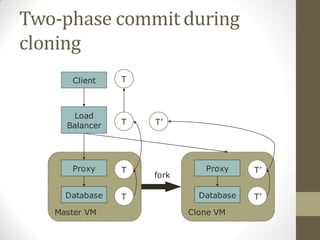
Two-phase commit during
cloning
      Client    T


       Load
     Balancer   T   T’


      Proxy     T             Proxy     T’
                    fork

     Database   T            Database   T’
   Master VM               Clone VM
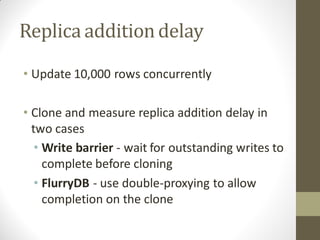
Replica addition delay
• Update 10,000 rows concurrently

• Clone and measure replica addition delay in
  two cases
   • Write barrier - wait for outstanding writes to
     complete before cloning
   • FlurryDB - use double-proxying to allow
     completion on the clone
Replica addition delay
Proxy overhead


• Measurement of large SELECT transfer
  times shows ~5% drop in bandwidth

• Reconnection to new servers ~10x
  faster with no authentication
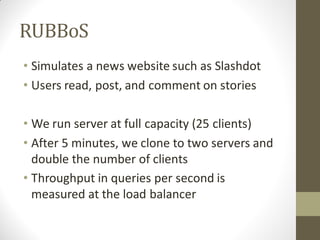
RUBBoS
• Simulates a news website such as Slashdot
• Users read, post, and comment on stories

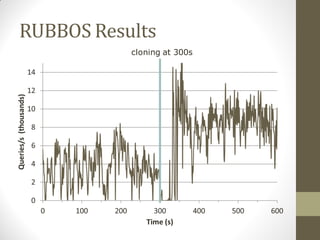
• We run server at full capacity (25 clients)
• After 5 minutes, we clone to two servers and
  double the number of clients
• Throughput in queries per second is
  measured at the load balancer
RUBBOS Results
           cloning at 300s
Summary
• FlurryDB adds elasticity to unmodified MySQL
  by interposing a cloning-aware proxy

• VM fork handles most of the issues with
  replica addition

• A proxy handles in-flight requests

• New replicas can be made available in
  seconds while maintaining consistency
Future Work

• Experiment with varying consistency protocols
  (e.g. master-slave, eventual consistency)

• Test scalability with larger numbers of clones

• Optimize virtual disk performance

• Provide support for transactional workloads
Questions?
Related Work
• “NoSQL” (perhaps more accurately, NoACID) systems
  using eventual consistency or key-value data models
  such as Cassandra or Dynamo
• Relational Cloud uses dynamic partitioning across a
  cluster of MySQL/PostgreS instances
• Urgaonkar et al. use rapid changes in resource allocate to
  provision a multi-tier Internet application
• Soundararajan et al. present dynamic replication policies
  for scaling database servers
• HyPer uses process fork and memory snapshots to
  enable a hybrid OLAP/OLTP workload

FlurryDB: A Dynamically Scalable Relational Database with Virtual Machine Cloning

  • 1.
    FlurryDB A Dynamically ScalableRelational Database with Virtual Machine Cloning Michael Mior and Eyal de Lara University of Toronto
  • 2.
    Cluster Databases DBMS Load VM balancer DBMS VM • We use read-one write all (ROWA) replication • Send reads to any server instance • Send writes to all server instances • Two-phase commit is required for writes
  • 3.
    Problem • Loads mayfluctuate drastically over time • Pay-as-you-go IaaS clouds should be ideal However We want to adapt the size of the cluster to match the load
  • 4.
    Problem • Databases havelarge state and are hard to scale • A complete copy may be required for new instances • Copying large databases may take hours Queries Replication copy boot catch add data replica up replica • Overprovisioning is necessary to maintain service
  • 5.
    Solution – VirtualMachine Fork • Analogous to fork() for OS processes • Clones start immediately • State fetched on-demand • Page faults fetch the memory or disk page This can reduce instantiation time from minutes or hours to seconds
  • 6.
    VM Fork MasterVM Clone VM
  • 7.
    FlurryDB • Use VM fork to provision new instances and add elasticity to unmodified MySQL • Making distributed commit cloning-aware to handle in-flight transactions Queries Replication clone add replica
  • 8.
    FlurryDB Challenges 1. Incorporatenew worker into cluster 2. Preserve application semantics
  • 9.
    Incorporate new worker •Clone must connect to the load balancer • Load balancer must begin sending transactions to the clone
  • 10.
    Preserve application semantics •Transactions may be in-progress at the time of cloning • Clone gets new IP address • Doing nothing drops connections and transaction status is unknown New IP Address DBMS T DBMS ?T’ Master VM Clone VM
  • 11.
    Solutions to consistency 1.Employ a write barrier DBMS DBMS Master VM Clone VM 2. Roll back all transactions in progress DBMS DBMS T’ Master VM Clone VM 3. Allow all transactions to complete DBMS DBMS T T’ Master VM Clone VM
  • 12.
    FlurryDB: Consistency beyondVM fork Solution Use a proxy which is aware of VM fork inside the virtual machine to maintain the database connection
  • 13.
    Two-phase commit during cloning Client T Load Balancer T T’ Proxy T Proxy T’ fork Database T Database T’ Master VM Clone VM
  • 14.
    Replica addition delay •Update 10,000 rows concurrently • Clone and measure replica addition delay in two cases • Write barrier - wait for outstanding writes to complete before cloning • FlurryDB - use double-proxying to allow completion on the clone
  • 15.
  • 16.
    Proxy overhead • Measurementof large SELECT transfer times shows ~5% drop in bandwidth • Reconnection to new servers ~10x faster with no authentication
  • 17.
    RUBBoS • Simulates anews website such as Slashdot • Users read, post, and comment on stories • We run server at full capacity (25 clients) • After 5 minutes, we clone to two servers and double the number of clients • Throughput in queries per second is measured at the load balancer
  • 18.
    RUBBOS Results cloning at 300s
  • 19.
    Summary • FlurryDB addselasticity to unmodified MySQL by interposing a cloning-aware proxy • VM fork handles most of the issues with replica addition • A proxy handles in-flight requests • New replicas can be made available in seconds while maintaining consistency
  • 20.
    Future Work • Experimentwith varying consistency protocols (e.g. master-slave, eventual consistency) • Test scalability with larger numbers of clones • Optimize virtual disk performance • Provide support for transactional workloads
  • 21.
  • 22.
    Related Work • “NoSQL”(perhaps more accurately, NoACID) systems using eventual consistency or key-value data models such as Cassandra or Dynamo • Relational Cloud uses dynamic partitioning across a cluster of MySQL/PostgreS instances • Urgaonkar et al. use rapid changes in resource allocate to provision a multi-tier Internet application • Soundararajan et al. present dynamic replication policies for scaling database servers • HyPer uses process fork and memory snapshots to enable a hybrid OLAP/OLTP workload